SOCIUS Working Papers
A comprehensive approach towards academic failure:
the case of Mathematics I in ISEG graduation
Margarida Chagas Lopes
Graça Leão Fernandes
Nº 06/2012
SOCIUS - Centro de Investigação em Sociologia Económica e das Organizações ISEG - Instituto Superior de Economia e Gestão
1
A comprehensive approach towards academic failure: the case of
Mathematics I in ISEG graduation
1Margarida Chagas Lopes2,3
Graça Leão Fernandes2,4
Abstract
Despite the enormous progress in graduation completion rates along the last decade,
academic failure in Portuguese Higher Education is still attracting concern. This is
particularly true for some 1st. year critical subjects as Mathematics. Most research and
analyses on the issue are focused upon either the “academic” or the “non academic” determinants of failure whilst it becomes more and more obvious that the explanation,
or at least an important part of it, resides in the interaction between those two sets of
features. Having developed previous research on the basis of the former factors to
elucidate failure rate in ISEG graduation, we are now analyzing the joint influence of
both kind of determinants. For that purpose we rely upon students’ information
retrieved from ISEG Pedagogical Observatory Database and the outputs of a Survey on
Attitudes Towards Mathematics 1 (SATM 1) which has been especially redesigned and
addressed to 1st. year students.
Key Words: academic failure; Mathematics; objective determinants; attitudes,
motivation and expectations.
J.E.L. Classification: I23; I21
1
This paper develops the contents of a communication addressed to the European Education Research Conference Education, Development and Freedom held in the Universidad of Cadiz, 13th to 17th September 2012.
2
ISEG – School of Economics and Business Administration, Technical University of Lisbon
3
SOCIUS – Research Centre in Economic and Organizational Sociology.
4
2
Resumo
A taxa de insucesso que caracteriza ainda hoje o Ensino Superior em Portugal, apesar
do grande progresso registado na última década, justifica que seja dada atenção especial
à análise dos seus determinantes. A questão coloca-se com mais acuidade em certas
disciplinas críticas do primeiro ano dos ciclos de graduação, como as da área da
Matemática. Grande parte da investigação de referência no domínio do insucesso no
Ensino Superior convoca, alternativamente, os determinantes de natureza externa (“académica”) ou os de natureza interna (“não académica”) ligados às expectativas, atitudes e motivação dos estudantes. Seguindo diversos contributos mais recentes, é
nossa convicção de que a explicação daquele insucesso tem necessariamente de
considerar a intervenção de ambos os tipos de fatores. Assim, no seguimento de
trabalhos anteriores sobre o insucesso escolar no ISEG, nas quais nos detivemos sobre
os determinantes objetivos, alargamos agora a análise de forma a comportar o estudo da
influência articulada daqueles dois tipos de influências. Servimo-nos da informação
constante da base de dados do Observatório Pedagógico do ISEG e também dos
resultados de um inquérito às atitudes, expectativas e motivação dos estudantes
relativamente a Matemática 1 (SATM 1), deliberadamente lançado com esta finalidade.
Palavras chave: insucesso académico; Matemática; determinantes objetivos; atitudes,
motivação e expectativas.
3
Introduction
The wide reforms which imparted Portuguese Higher Education (HE) since 1995
display by now quite clear outcomes: the net graduation rate (first timers) in Tertiary
Type A programs reached 40,0% in 2010, equalizing the EU-21 rate and overtaking the
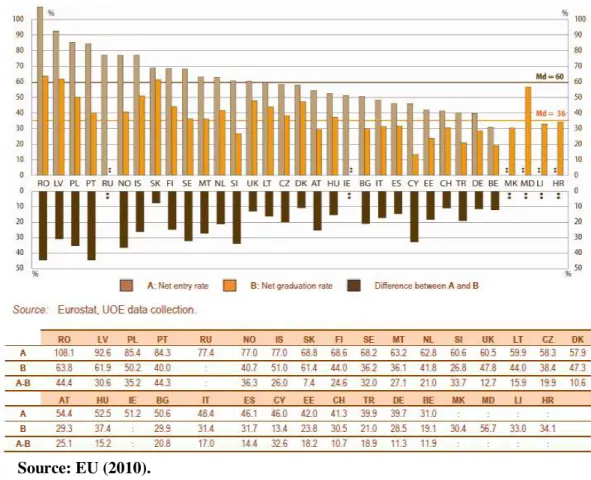
corresponding rate for OECD by 1 p.p. (OECD 2012). Nevertheless, the Portuguese HE “production function” goes on bearing severe inefficiency5
which can be characterized
by the fact that it displays the second wider difference between net graduation rates and
net entry rates – 44,3% (44,4% in Romania), as the figure below clearly depicts for
2008-2009:
Figure 1: Net entry rate and net graduation rate (%) tertiary type – A programs, 2008-2009
Source: EU (2010).
As it had been stressed by some previous studies, failure in tertiary education occurs
mostly in 1st. cycle (graduation) and above all among some 1st. year critical subjects. As
5
4 a matter of fact, academic success along individual trajectories depends a great deal on
some core 1st year subjects because of the syllabuses interdependency in sequential
graduation years. The implementation of Bologna Chart has contributed to reinforce this
trend as it led to shorter time duration for 1st. cycle completion though syllabuses’
extension and complexity remained identical most of times (EC 2010) .
At the same time university becomes more and more attractive to new kind of students
as the ones who need to combine work and study on account of the increasing budget
constraints faced by most families. Accordingly academic failure has to be reconsidered
not only on the basis of better diagnostic but also in what concerns new pedagogical
challenges.
Academic failure in some of ISEG critical subjects had already been addressed
throughout research carried by the Pedagogic Observatory (PO) of the Institute. The joint influence exerted by the social and educational status of students’ parents, their relative success along previous schooling, the students’ situation towards income and work, as well as the course schedules and other scholar arrangements, were then taken
into consideration to investigate the main factors behind school failure in Economics 1
and Mathematics 1. As we then stressed, most of the outcomes obtained went on line
with the leading findings within reference literature.
However, almost no attention was then given to the influence exerted by students’
attitude and motivation towards the above mentioned disciplines. Likewise it was not
possible to take into consideration, as we do now, some important behavioral and
personal determinants of individual learning proposed and developed by the Social
Cognitive Theory and the Self-Determination Theory: namely, the ones affecting
intrinsic and extrinsic motivation, self-efficacy and attribution, value and outcome
expectations.
Due to a survey on attitudes towards Mathematics (SATM) recently addressed by PO to
the ISEG students enrolled in Mathematics 1 (Math 1) it is now possible to go further
into the precedent analysis. In this paper we investigate the joint effect exerted by the
5
now identified as two main students’ profiles: the one of commitment and the other of
stress and anxiety towards that discipline.
In this study we got a more robust diagnosis of school failure that allows a more reasoned approach to building a more comprehensive and - hopefully - effective pedagogical strategy against failure.
Theoretical Background
Numerous textbooks, readings and papers in Economics and Sociology of Education
have been addressing the role played by the usually called academic and “non
academic” determinants of academic failure.
Factors such as the socioeconomic status of the family of origin and namely father’s and
mother’s school level, combined with family’s average income, stay among some of the most researched determinants. The average revenue of the family of origin closely affects children’s and youngster’s scholar and academic success not only by providing the minimum conditions for nourishment, health and comfort but also the means to
access to cultural goods and complimentary educational resources. Such features stay
frequently in close interaction with some deep social imbalances as poverty among
children and youngsters, early motherhood and single parenthood, exposure to
unemployment of the two adults running the family, among other. In such contexts of
the kind, early school leaving and scholar or academic failure emerge as the main
outputs related to the educational trajectories as, for instance, Cairns et al. (1989) and
Blau (1999) clearly state.
More generally, father’s and mother’s school level not only condition children’s
academic outcomes throughout the income level they can raise but also – and
sometimes mostly – on the grounds of the educational and socio-cultural resources
which constitute the family’s way of living (Benavente & Correia 1980; Plug 2002; Chagas Lopes & Medeiros 2004; Clemens 2004). More recently, this line of research came to consider the effects of the current crisis and deterioration in the families’ income level on the changing conditions which characterize the intergenerational
transmission of economic and educational status, as in Belley & Lochner (2007) and
6 which leads an increasing number of young men and women to stay longer within the
family of origin, being unable to raise their own families even when a graduation or
advanced studies had been completed, severely alters previous demographic trends and
deeply interacts with intergenerational relationship, as in Portugal nowadays (Kovács &
Chagas Lopes 2012). But especially the above mentioned minimum levels of family
comfort and even the ability of providing for adequate nourishment and health are
nowadays severely affecting Portuguese children’ and youngsters’ school outcomes.
The influence exerted by each one’s previous scholar trajectory on academic success
has also deserved a thorough concern from most researchers on educational issues.
Among the most well known approaches in this line we refer to Hanushek (1979) and
Kaplan et al. (1997). Some more recent approaches, dealing mostly with success and
failure in graduation programs, as Makinen et al. (2004) or Yorke & Longden (2008),
among others, point to the particular influence exerted by success or failure outcomes in
the first year of students’ graduation, revealing how it so deeply compromises future
outcomes. These latter results appear to be of main importance in our present study.
Actually, most basic subjects are usually taught and learnt during the first year of
graduation, especially now that the Bologna arrangements have led most graduation programs to condensation. General knowledge and “basics” are critical on the grounds that they strongly condition the ability to learn more elaborate issues. The same applies
to schooling previous to university: during upper secondary, students are supposed to
acquire the technical basis required by further studying, which in this case has to do
with the type of subjects which they are taught (e.g., Math A against Math B…) and the
relative success in that acquisition, among other factors. Furthermore, first year
graduation students, most of them freshmen/women, have quite different attitudes,
motivation and expectations then their more advanced colleagues; this is a feature of the
most relevance to our study and we will come into this in the next sections.
Organizational issues and program options inside higher education severely condition,
success and failure, as well. (Siegel et al. 2003). This is particularly true for working
students who have to adjust to school schedules which frequently are not in accordance
with their occupational obligations. Moreover, the organizational specificities of each
academic program, the mismatch between students' knowledge and their curricula and
7 In previous studies we relied upon ISEG PO database and closely approached the
effects exerted by the above mentioned features upon success and failure during
graduation trajectories and most especially during the 1st. year of the graduation
programs (Fernandes & Chagas Lopes 2008; Chagas Lopes & Fernandes 2010). The
results we then obtained were mostly in accordance with some well known reference
studies as Hanushek (1979) or Kalb & Maani (2007).
Nevertheless, despite the robustness of the tests associated with the statistical
adjustments we then developed, an important share of academic failure was left to be
explained. At the same time, in those analyses we did not explicitly consider the influence displayed by students’ attitudes, motivation and expectation towards
graduation and particularly towards some more critical subjects – as Math 1 - as we are
doing now.
Pedagogical knowledge is assumed by most authors to constitute a corner stone in the diagnostic of students’ academic failure. Most approaches concerned with these matters clearly state the role played by attitudes, behavior and beliefs on academic success and
usually adopt methodologies which encompass a close assessment and the follow up of those “non-academic” factors along the graduation trajectory (Nielsen 2009). Despite considering, as a general rule, that the most important clue for success has to do with a
rigorous background and a solid academic preparation, those social and emotional
features clearly condition the basis upon which adequate knowledge acquisition can
takes place.
Taking as seminal contributions the works by Bandura (1977; 1997) on the social
learning theory and on self efficacy and control, this line of approaches come to consider that one’s perception on his/her ability to learn clearly influences academic success mostly throughout the need of effort and commitment which individuals
associate to that perception. But commitment and effort are in turn strongly dependent
on self motivation, engagement and academic discipline: the latter being no longer
considered as pure intrinsic characteristics. Authors like Fredericks et al. (2004) and
Belfanz (2009) openly demonstrate how academic challenging and supportive
8 Another “non academic” key feature positively associated with students’ success concerns the perception towards the role and importance they expect that graduation as
well as some subjects – as Math – will display in their future professional lives
(Bedsworth et al. 2006). As a matter of fact, the way students but also their parents and
peers evaluate the future social and professional outcomes associated with graduation or
mastering a given subject profoundly determines their present motivation and
engagement. The same is true for advanced studies. Students intending to pursue for a
PhD are, in average, much more motivated and committed.
As it becomes easily understood, academic and non academic features interact and reinforce each other. Father’s and mother’s school level and more generally the social economic and cultural status (SES) of the family of origin are closely associated with students’ motivation and expectations. Past scholar experiences deeply condition each one’s self efficacy and assertiveness. Being a working student leads to differences in self confidence, motivation and commitment when compared to other students.
Likewise, the most adequate methodologies to approach academic success and failure
should encompass both kind of determinants – academic and non academic ones – and
carefully assess the corresponding joint influences, as we do in this paper. Studies
which propose such an integrative approach are, among others, Waxman et al. (2003),
Upcraft et al. (2005), Clark (2007) and Noel-Levitz (2007). We will come back to them
further on to compare our results since they specially address the situation of first year
students.
Data Sources
To develop the present analysis on academic failure we relied upon two data sources:
-ISEG PO database, upon which previous studies were developed, which
9 transitional process from upper secondary to higher education, on students’ present situation towards labor market, among other.
-The information obtained throughout a Survey on Attitudes Towards
Mathematics 1 (SATM) addressed by email to all students enrolled in
Mathematics (Math) 1 during the 1st. semester of 2011-2012. For the 195
(23% response rate) students who answered SATM we got data on students’
attitude and motivation, but also objective data on individual’s age and
gender, family’s educational status and several indicators on previous and present academic success (e.g., grades obtained and number of attempts in
Math 1).
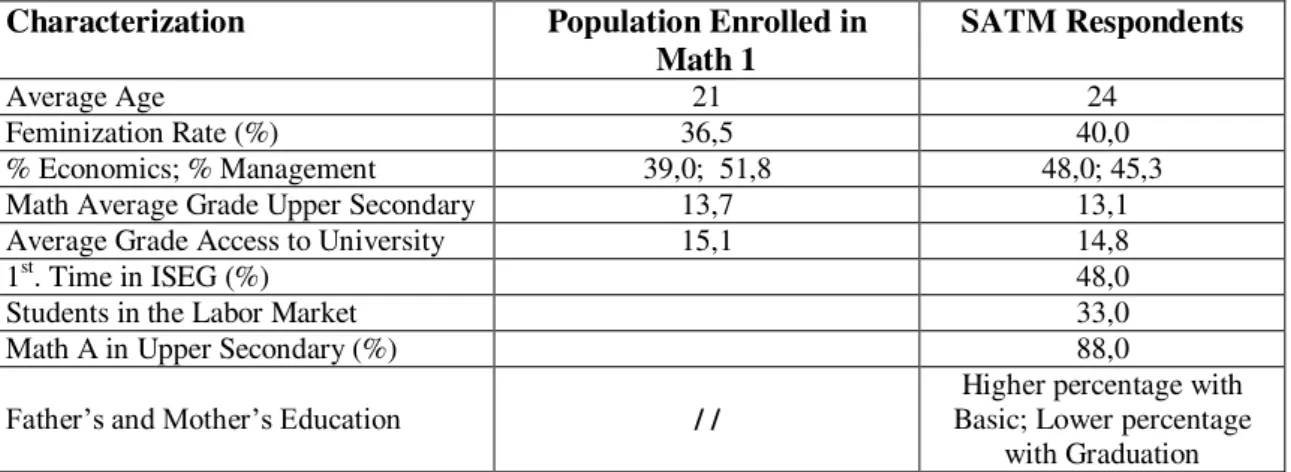
In Table 1 we display the main characteristics of the respondents and compare them
with the universe of the population enrolled in Math 1 in the first semester of
2011-2012. As we can observe, the respondents are in average older, with a higher
feminization rate and they are sons and daughters of parents with lower levels of
education than the general population.
Economics graduation is over represented and students in the sample are, in general,
worse students. We find as well that about one half are freshmen/women in ISEG and
circa one third are working students. About 88,0% had Math A – the most demanding
type of Mathematics - in Upper Secondary.
Table 1:SATM1 - Characterization of survey respondents
Characterization Population Enrolled in
Math 1
SATM Respondents
Average Age 21 24
Feminization Rate (%) 36,5 40,0
% Economics; % Management 39,0; 51,8 48,0; 45,3 Math Average Grade Upper Secondary 13,7 13,1 Average Grade Access to University 15,1 14,8
1st. Time in ISEG (%) 48,0
Students in the Labor Market 33,0
Math A in Upper Secondary (%) 88,0
Father’s and Mother’s Education / /
Higher percentage with Basic; Lower percentage
10
Methodology and Discussion
As to the methodology of analysis, we took the sets of questions in SATM in order to
build three a priori profiles – “Responsibility and Commitment”, “Irresponsibility and
Indifference” and “Block and Insecurity”. We had to abandon the second one due to the small number of responses we obtained to the corresponding questions.
In order to build each profile we summed up all the answers denoting agreement (from “agree” to “completely agree”) towards the questions which we considered to be more representative of each one of the Profiles:
- Profile I - “Responsibility and Commitment” - “I plan to work hard” (agreement 179/195), “I plan to go to assessment” (agreement 183/195);
- Profile II –“Irresponsibility, indifference”- “Math is useless” (agreement 25/195), “ I am not going to use Math in my future occupation” (6/195 agreement);
- Profile III – “Block and Insecurity” – “Math frightens me” (agreement
73/195), “I feel stressed in Math classes” (agreement 86/195). Let us consider now the statistical methodologies we applied to analyze data.
We began by analyzing the survey outputs and data throughout Contingency Analysis.
We aim to study the possible association between agreement towards each one of the
leading questions in each profile and a set of “academic” covariates we had been using
in previous studies: sex, age, father’s and mother’s school level, type of Math in Upper
Secondary, grades (access to University, Math in 12º, expected grade in Math1),
graduation program, nº enrollments in Math1, intention to further studying, being/not in
the labor market. We obtained very meaningful association results between the
covariates and the idiosyncratic questions for Profiles I and III but not for Profile II,
given the very low frequencies characterizing the latter Profile. In Table 2 we display
11 Table 2: Covariates which exhibited higher positive association values in each Profile:
Profiles Covariates/Situations
Profile I (Responsibility & Commitment) Being woman; being freshman/woman; grade expected in Math 1; had Math A in Upper
Secondary; intending to pursue for PhD. …
Profile II (Irresponsibility, Indifference) The size of this Profile prevented us from
deriving any meaningful association within
this Profile.
Profile III (Block and Insecurity) Being ISEG 1st. timer, intending to get a PhD,
having had Math A in Upper Secondary,
expecting an higher grade at Math1 and being
daughter/son of a mother with school level
higher than graduation.
Relatively to profiles I and III, we must say that the association results clearly confirm
the outcomes in Nielsen (2009) and Waxman et al. (2003), respectively. It is interesting
to notice that Profile III practically convokes all covariates but sex: this variable which
provided a meaningful association with the intentions of commitment and effort seems
to be neutral towards the feelings of insecurity and stress. From Profile III it is also
possible to conclude its transversal nature towards most “academic” determinants, an
outcome to which we return later. It should also be noticed that mother’s “educational
capital”, together with setting higher targets towards the grade expected in Math 1, may induce feelings of insecurity and stress, all the other covariates being the same.
Considering the association outcomes common to the three profiles, we obtained the
following ranking:
- Being a freshman/woman (the “first timer effect”) displays the higher and
more systematic association values with intentions of motivation and
commitment, self identification with the discipline, positive valuing of the
role expected to be displayed by the discipline in a future occupation, higher
concern and confidence towards learning;
- The grade expected in Math 1, with a multimodal distribution, displays
12 valuing of the present and future roles of the discipline, disagreement
towards feelings of stress and difficulty in learning basic assumptions in
Math 1;
- The intention to pursue further studies, especially PhD. and post-graduation,
appears to be strongly and positively associated with motivation,
commitment, positive evaluation of the role to be displayed by Math in
professional life and confidence towards learning ability; and to display a
negative association with feelings of insecurity and low valuing of the role
played by the discipline. These outcomes are in pace with the results in
Bedsworth et al (2006) and Nielsen (2009);
- Being working students exhibit positive associations with commitment and
motivation and with a positive evaluation of the role displayed by Math on
employability; but a meaningful association as well with questions which
express insecurity and lack of confidence;
- Father’s and mother’s school level display positive association values with
commitment and confidence (mostly fathers with a MSc.), feelings of
easiness in learning and positive valuing of present and future roles assigned
to the discipline (mothers with a MSC.), and general disagreement towards
feelings of insecurity and stress (mothers with at least a graduation).
Contrary to what we initially expected, the type of Math (A or B) and the grade
obtained in Math at the final exam in Upper Secondary, displayed only small
association values with intentions of commitment and effort, showing no association patterns with the other profiles’ questions. Also, and contrary to most studies, we found no association between the graduation program attended in ISEG and anyone of the
three profiles’ questions.
With the application of the discriminant analysis we intended to identify which
variables could better separate between the situations ‘agreement’/’disagreement’
towards the leading questions in each profile.
For profile I we adjusted the discriminant to both idiosyncratic questions as displayed in
13
Table 3: Discriminant values relative to the question “I plan to go to assessment”
Values for the statistical tests
Eigenvalue Canonical
Correlation
Wilk´s Lambda
Qui-square Significance
Level
% of Correctly Classified
Cases F1 0,187 0,397 0,843 12,665 (df 6) 0,049 93,8
Standard Coefficients for the Canonic Discriminant Function (absolute values)
Expected grade in Math 1
Mother’s School
Level
Grade in Math Exam (12º degree) Graduation Program Father’s School Level
0,766 0,674 0,587 0,337 0,289
Table 4: Discriminant values relative to the question “I plan to work hard”
Values for the statistical tests
Eigenvalue Canonical
Correlation
Wilk´s Lambda
Qui-square Significance
Level
% of Correctly Classified Cases F1 0,529 0,588 0,654 28,674 (df 11) 0,003 82,6
Standard Coefficients for the Canonic Discriminant Function (absolute values)
Nº enrollments Math 1 Grade expected Math 1 Mother’s School Level
Age Father’s
School Level Grade Access to ISEG Type Math in Upper Secondary Graduation Program
0,772 0,711 0,571 0,460 0,304 0,200 0,074 0,006
From the above tables we can observe that the first profile, relative to responsibility and
commitment, is effectively sub divided into two different sub profiles:
- The one depicted in Table 3, appears to be mostly contingent upon the
14 obtained in the final Math examination in upper secondary. When we cross compute the cases which express ‘agreement’ towards age and number of enrollments in the discipline, we obtain that most respondents are first timers
in ISEG.
- The other sub profile, as expressed by Table 4, seems to be especially
sensitive to such covariates as the number of enrollments and the expected
grade in the discipline as well as age, among other meaningful discriminant
variables. This clearly represents repeating students.
For profile II, concerning the “irresponsibility/indifference” attitudes and motivation,
the results obtained through the discriminant analysis should be carefully considered on
account of the reduced size of this profile, as we have already mentioned. Table 5
displays the corresponding results:
Table 5: Discriminant values relative to the question “Mathematics is useless”
Values for the statistical tests
Eigenvalue Canonical
Correlation
Wilk´s Lambda
Qui-square Significance
Level
% of Correctly Classified Cases F1 0,115 0,321 0,897 8,235 (df 3) 0,041 93,8
Standard Coefficients for the Canonic Discriminant Function (absolute values)
Mother’s School
Level
Graduation Program
0,571 0,006
As we can infer, lack of representativeness of this profile translates as well in the fact
that only one variable – mother’s school level – seems to display discriminating
capacity; nevertheless, we also obtained inconsistency in terms of the sign associated
with the corresponding relative value and for that reason we decided not to consider this
15 As have already referred, profile III concerns feelings of block, insecurity and lack of
confidence. The results of the discrimination between the “agreement” and
“disagreement” situations towards the leading question are displayed in Table 6:
Table 6: Discriminant values relative to the question “Feeling Stressed in Mathmatics classes”
Values for the statistical tests
Eigenvalue Canonical
Correlation
Wilk´s Lambda
Qui-square Significance
Level
% of Correctly Classified Cases F1 0,641 0,625 0,610 35,394 (df 11) 0,000 74,4
Standard Coefficients for the Canonic Discriminant Function (absolute values)
Expected Grade Math 1 Father’s School Level Nº Enrollments Math 1 Type of Math in Upper Secondary
Age Grade
in Math 12º Graduation Program Mother’s School Level Nº Credits Grade Access to ISEG
0,829 0,501 0,432 0,369 0,161 0,113 0,065 0,058 0,047 0,018
It then appears that feelings of block and insecurity towards Mathematics are associated
with almost all the covariates but sex: although with different intensity, most individual
characteristics and academic variables seem to display meaningful discrimination between the “agreement” and “disagreement” responses towards the question “I feel stressed in Math classes”. Here we find indeed the intervention of both “academic” and “non academic” determinants, as in Clark (2007) and Noel-Levitz (2007), among other. Either the family’s of origin educational status (father’s and mother’s school level), or the variables relative to previous schooling (type of Math in upper secondary, grade
obtained in12º grade Math examination and grade of access to university) or even the students’ present situation (expected grade in Math 1, nº of credits and nº of enrollments, graduation program) reveal themselves to be meaningfully associated with
this profile III. Obviously, this outcome clearly reflects the transversal nature of the
16
Conclusions and Recommendations
Among the outputs of this study, we emphasize the two which in our opinion deserve further development and concern: the evidence of a “1st
. timer effect” and the
transversal nature of the feelings of insecurity and lack of confidence.
Relatively to the former, we refer to the enthusiastic feelings and high expectations
expressed by freshmen/women students towards Math 1 and which are no longer
observable among repeating students. This feature justifies that we further launch a
slightly modified version of SATM to students in the final year of graduation in order to
assess not only their ex post opinions on Math 1 but also the result of the evolution of
expectations and motivation towards Mathematics between the beginning and the end of
graduation at ISEG. Such an analysis should also contribute to investigate which kind of
factors do contribute to erode those positive attitudes and expectations along the
graduation trajectory, after controlling for the natural optimism of the newcomers.
Both profiles I and especially III point to the multiplicity of factors behind commitment
and motivation, by one hand, and stress and lack of confidence, by the other. In the latter situation we can observe an even combination between “academic” and “non academic” determinants, in line with the results discussed by the authors we reviewed in
the theoretical background. This outcome leads us to advise that an integrated
pedagogical approach must be designed in order to enhance success in the discipline.
Such an approach should comprise remediation strategies especially targeted towards:
students which had no Math A in upper secondary; students with lower grades in the
Mathematics final examination in upper secondary; repeating students in Math 1;
working students. When designing such strategies it should be advisable to carry a
thorough appraisal of the results obtained with the allocation of MSc. students to
monitor practical lessons in graduation with the purpose of better designing tutorial
classes, among other recuperation measures.
In the fight against academic failure, here relatively to Math 1, it is also firmly advisable
a more systematic confront between analysis like the present one and the results
17 characterize each subject and its professor’s methodologies, ability and preparation.
Likewise, the design of new strategies to cope with academic failure would be best fitted by combining internal and external determinants of student’s attitudes. Likewise, the design of new strategies to address academic failure would become better equipped
by combining internal and external determinants of students’ attitudes.
References
Bandura, A. (1977). Social Learning Theory. London: General Learning Press &
Google. Books (
http://books.google.pt/books?hl=pt-PT&lr=&id=zjBDZ-T0WMgC&oi=fnd&pg=PR9&dq=%E2%80%A2%09Bandura,+A.+(1977).
Balfanz, R. (2009). Putting Middle Grade Students on the Graduation Path: a
Policy and Practice Brief. New York: National Middle School Association
(http://www.amle.org/portals/0/pdf/research/Research_from_the_Field/Policy_Brief_Ba
lfanz.pdf).
Bedsworth, W., Colby, S. & Doctor, J. (2006) Reclaiming the American Dream.
The Bridgespan Group (http://www.inpathways.net/ReclaimingtheAmericanDream.pdf)
Belley, Ph & Lochner, L. (2007). The Changing Role of Family Income and
Ability in Determining Educational Achievement. Journal of Human Capital,vol. 1(1).
University of Chicago Press: 37-89.
Benavente, A. & Pinto Correia, A. (1980). Obstáculos ao Sucesso na Escola
Primária. Lisbon: IED.
Blau, D. (1999). The Effect Of Income On Child Development. The Review of
Economics and Statistics, MIT Press, vol. 81(2): 261-276.
Cairns, R.B., Cairns, B.D. & Neckerman, H. (1989). Early School Drop-out:
Configurations and Determinants. Child Development, vol. 60, nº6: 1437-1452.
Chagas Lopes, M. & Medeiros, J. (2004). School Failure and Intergerational “Human Capital” Transmission in Portugal. MPRA Paper, RePec: pra:mprapa: 26764.
Chagas Lopes, M. & Fernandes, Graça. (2010). Success/failure in Higher
Education: How Long Does it Take to Complete Some Core 1st. Year
18 Clark, J. (2007). Retention: a Selected Critical Inventory of Best Practices
(http://www.csus.edu/oir/Retention%20and%20Graduation/Retention%20and%20Grad
uation%20Initiatives/Retention%20Task%20Force/Critical%20Inventory.pdf)
Clemens, M. (2004). The Long Walk to School: International Education Goals
in Historic Perspective. New York: United Nations Millenium Project Task Force on
Education and Gender Equality. (http://cgdev.org/files/2754_file_cgd_wp037.pdf).
EC. (2010). Focus on Higher Education in Europe 2010: The Impact of the
Bologna Process. EURYDICE.
(http://eacea.ec.europa.eu/about/eurydice/index_en.htm).
EU. (2010).The European Higher Education Area in 2012: Bologna Process-
Implementation Report
(http://eacea.ec.europa.eu/education/eurydice/documents/thematic_reports/138EN.pdf)
Fernandes, G. & Chagas Lopes, M. (2008). ISEG Undergraduate Students:
Determinants of Academic Performance. MPRA Paper 22082, University Library of
Munich, Germany.
Fredricks et al (2004). School engagement: potential of the concept, state of the
evidence. Review of Educational Research, 74: 59-119.
Hanushek, E. (1979). Conceptual and Empirical Issues in the Estimation of
Educational Production Functions. Journal of Human Resources, vol. 14(3). University
of Wisconsin Press: 351-388.( http://ideas.repec.org/e/pha97.html)
Hanushek, E. (2007). Education ProductionFunctions.. Palgrave: Encyclopedia
(http://129.110.10.36/research/tsperc/pdf/jrnl_hanushek_2007_education_production_fu
nctions.pdf.pdf).
Kaplan, D., Peck, B. & Kaplan, H. (1997). Decomposing the Academic Failure – Dropout Relationship. The Journal of Educational Research, Vol. 90, nº6: 331-343.
Kovács, I. & Chagas Lopes, M. (2012). A juventude e o emprego: entre a
flexibilidade e a precariedade. In Sara Falcão Casaca (coord.) Mudanças Laborais e
Relações de Género. Coimbra, Almedina: 51-86.
Makinen, J., Olkimora, E. and Lonke, K. (2004). Students at risk: students’
general study orientations and abandoning/prolonging the course of studies. Higher
Education (48:2). (http://mpra.ub.uni-muenchen.de/34227/).
Nielsen, H. (2009). Influence on Student Academic Behaviour Through
19
Improve Learning. Issues in Informing Science and Information Technology, vol. 6:
545-556. (http://www.informingscience.us/icarus/journals/iisit/publications).
Noel-Levitz Inc. (2007). National Research Report: Student Retention Practices
at Four-Year Institutions. (https://www.noellevitz.com).
OECD (2012). Education at a Glance. (http://oecd.org).
Plug, E. (2002). How Do Parents Raise the Educational Attainment of Future
Generations?. IZA Discussion Papers 652, Institute for the Study of Labor (IZA).
(http://papers.ssrn.com/sol3/papers.cfm?abstract_id=371621).
Siegel, D., Waldman, D. & Link, A. (2003). Assessing the impact
of organizational practices on the relative productivity of university technology transfer
offices: an exploratory study. Research Policy, vol. 32, nº 1: 27-48.
Upcraft, M. L., Gardner, J.N., Barefoot, B.O., & Associates. (2005).
Challenging and Supporting the First-Year Student: A Handbook for Improving the
First Year of College. San Francisco: Jossey-Bass.
Vandenberghe, V. (2007). Family Income and Tertiary Education Attendance
across the EU: An empirical assessment using sibling data. CASE Papers case123,
Centre for Analysis of Social Exclusion, LSE.
(http://sticerd.lse.ac.uk/dps/case/cp/CASEpaper123.pdf).
Yorke, M. & Longden, B. (2008). The first-year experience of higher education in the UK - Final Report, London: The Higher Education Academy.