with subjects, class moments and their targets
Introduction
Misbehaviour in the School context is a recurrent problem in which the teach-ers’ main task is to identify its cause and prevent it. When attributing causes for the students’ misbehaviours, teachers mainly refer to the external factors (the students’ poor education, students’ precarious personal and social education and lacking family support) [1]. Consequently, when declining responsibility for the students’ misbehaviour, they do not look for solutions to solve the current problems [2].
Considering that in the physical education class the students are mainly in ac-tivity, performing different movements in space and with material use, with the simulta-neous involvement of many students, the occurrence of misbehaviour is propitious. Moreover, the plurality of teaching materials in the Physical Education subject makes the disciplinary control and regulation of the students more difficult. This is due to the diversity of the relations established between students, activities and teacher. Due to its nature, the Physical Education class assumes different characteristics within the parts it consists of (initial, fundamental and final), and the practice, instruction and management periods. Thus, the prevention strategies for misbehaviour should be es-tablished in relation to the class ecology, which contemplates the interaction of stu-dents’ instruction, management and socialization systems [3 ,4].
The main objective of this study is to identify the teacher’s representation to-wards students’ misbehaviours in physical education classes related to the subject matters, class moments and their targets.
with subjects, class moments and their targets
Mesquita, I.1; Tavares, P.1; Rosado, A.2
Methods
The subjects were 122 physical education teachers of a Secondary School. The study variables related to the teaching subjects were all the modalities of the the secondary school official program for Physical Education in Portugal: football, basket-ball, handbasket-ball, volleybasket-ball, athletics, gymnastics, skating, combat sports, racket sports, dance and expressive activities. As for the parts of the class, the three-part structure (initial, fundamental and final) was considered; regarding the class periods, the essen-tial teaching functionswere taken into account: class organization period, practical pe-riod, teacher organization pepe-riod, instruction pepe-riod, task presentation pepe-riod, initial instruction period and closing session period.
Data collection was obtained through a questionnaire, and a Likert scale with five items was applied. An independent “specialist validation” process was undertaken to assure the validity of the instrument. The questionnaire was object of a pilot applica-tion where the filling in procedures and quesapplica-tions interpretaapplica-tion were discussed and analysed. It was administered to 30 Physical education teachers from Secondary Schools, randomly chosen. When analysing the data, the normality pre-requisites with the Kolmogorov-Smirnov test and the homogeneity of variances with the Levene test were confirmed. The ANOVA One-Way test with the post-hoc calculations were also apllied.
Results
Subject Matter
The results demonstrated that teachers believe misbehaviour varies according to the characteristics of the subject matter, although they also believe that none of the subjects are particularly propitious to the occurrence of misbehaviour. All the values are situated between 1,58 and 3,01, i.e. between few and some misbehaviours (Table 1).
Table 1. Mean values and standard deviation of teachers’ representations about students’ misbehaviours in physical education related with subjects.
Subjects Foot. Hand. Bask. Gym. D. C. Vol. A. Exp. Pat. Athl. D.R.
X 3,01 2,56 2,35 2,27 2,21 1,84 1,76 1,74 1,67 1,58
SD 1,203 0,988 0,890 1,037 0,973 0,813 0,910 0,821 0,818 0,759
However, invasion games (Football, Basketball and Handball) propitiate the occurrences of a greater quantity of misbehaviour episodes, which might be caused by the nature of these modalities (direct contact with opponents when disputing the ball). Among all, football is the subject which causes more misbehaviour (X=3,01), followed by handball (X=2,56), basketball (X=2,35), gymnastics (X=2,27) and combat sports (X=2,21) Volleyball is the only collective sport that has a value lower than 2 in the Likert scale (1,84), approaching the modalities such as skating (1,74), expressive activities (1,76) and Racket sports (1,58).
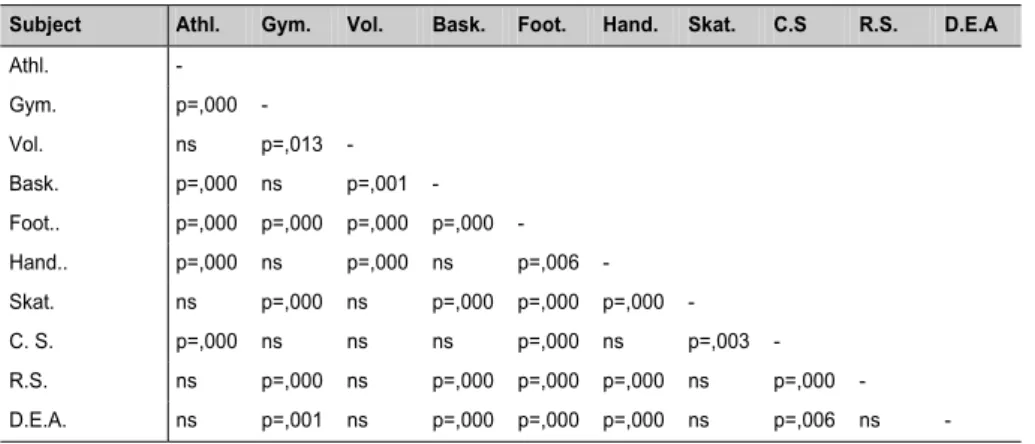
Table 2 shows that only football presents significant statistic differences in rela-tion to all the other subjects. Immediately afterwards are basketball, handball, gymnas-tics and racket sports, which do not present significant statistic differences in only three subjects. Dance and expressive activities, combat sports, and skating do not present differences in four subjects and volleyball in five subjects. These results show that, according to the teacher, the nature of the subject significantly differentiates the stu-dents’ misbehaviours. With this in mind, when structuring the learning tasks, teachers should consider the content nature, namely the relationships established between the students in the modalities which demand cooperation and opposition, such as collec-tive sports, and in the individual modalities such as Gymnastics, where sometimes the long waiting periods generate misbehaviour.
Table 2. Comparative results of teacher’s representations about students’ misbehaviours in physical education related with subjects.
Subject Athl. Gym. Vol. Bask. Foot. Hand. Skat. C.S R.S. D.E.A
Athl. -
Gym. p=,000 - Vol. ns p=,013 - Bask. p=,000 ns p=,001 -
Foot.. p=,000 p=,000 p=,000 p=,000 - Hand.. p=,000 ns p=,000 ns p=,006 -
Skat. ns p=,000 ns p=,000 p=,000 p=,000 - C. S. p=,000 ns ns ns p=,000 ns p=,003 - R.S. ns p=,000 ns p=,000 p=,000 p=,000 ns p=,000 - D.E.A. ns p=,001 ns p=,000 p=,000 p=,000 ns p=,006 ns -
Class Moments
Table 3 presents the average values and diversion pattern of teacher’s repre-sentation in the misbehaviour incidences during the different parts and periods of the class. Generally teachers consider that the misbehaviour incidence is low in any part or period of the class, since the values fluctuated between 1,93 and 2,58, i.e. between few and some.
However, when comparing the different parts of the class, we verified that it is normally during the “fundamental part” that teachers assure the existence of more misbehaviour (2,48). The “fundamental part” of the class corresponds to the moment with more time assigned, and it is also the part where we observe more kinetics den-sity. According to other studies [5, 6], it is precisely in this class moment that more problems related to inappropriate behaviour are observed. The initial part of the class is referred to by the teachers as more propitious to misbehaviour than the final part (2,13 and 1,93, respectively), which corroborates the findings of other research [7] studies. The final part of the class, a shorter one, diminishes the probability of misbehaviour occurrences.
However, when comparing the differences in the different parts of the class, we only see significant statistical differences in the fundamental part in relation to the initial part and the final part (table 4), which means that the most extensive part of the class is the one that naturally leads to misbehaviour.
In relation to the class periods, the class organization period, practical period, and teacher organization period show the highest values, although they have low de-grees of incidence (2,61; 2,52 and 2,40, respectively) (Table 3).
The fact that during the class organization period students have a high degree of freedom might propitiate the occurrence of misbehaviours. The way the teacher structures the students’ interventions in the organization of the class activities is an
Table 3. Mean values and standard deviation of teachers’ representations about students’ misbehaviours in physical education related with class moments.
P.F. P.I. P.F. P.C.O. P.P. P.O.P. P.I. P.A.T. P.I.I. P.E.S.
X 2,48 2,13 1,93 2,61 2,52 2,40 2,28 2,23 2,20 2,05
SD 0,763 0,927 0,864 0,809 0,845 0,830 0,893 0,851 0,878 0,880
easily influencing factor in the occurrence of misbehaviours and should be properly structured during the class preparation and its consecution. Related to the practical period, a study centred on the observation of real situations in Physical Education classes [6], confirmed the fact that during these periods more students’ misbehaviours occurred. The teacher organization period is ranked in third position, which shows that the class management during the activity organization is a fundamental factor in the functional stabilization of the class, and consequently in the regulation of indisciplinary behaviours.
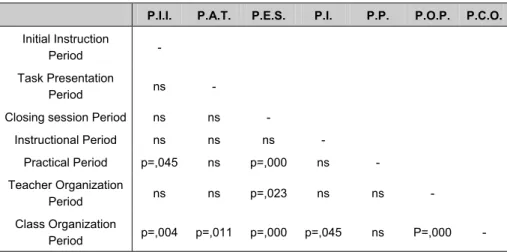
The comparative analysis (Table 5) showed an increase in the class organiza-tion period of the trend for students’ misbehaviour, however, it did not show significant statistical differences with the practical period, which suggests that the teachers con-sider that the activities organized by the students normally, generate misbehaviour. Although this fact may be apparently understandable, as it permits more freedom in the students’ intervention, it is the teacher’s duty to apply dynamic routines in which au-tonomy and responsibility are given to students.
Misbehaviour Targets
Table 6 shows that the “colleagues in practice” (X=2,98) are a bigger target to indiscipline behaviour, followed by the materials (X=2,28), “activity” (X=2,28), “dispensed colleagues” (X=1,83) and finally “the teacher” (X=1,55). However, as already observed above, the values are substantially lower.
Oliveira (2002) realized in her study that the indiscipline behaviours directed to colleagues in practice are common in team sports, with differentiated attitudes and hostile behaviours from some students to others. However, the author noted that the most frequent indiscipline behaviours were directed towards the activity, followed by the colleagues in practice and after teacher.
The misbehaviours directed to the “materials” and to the “activity” with very close values, respectively 2,28 and 2,25, are to be highlighted. Different studies [2, 8,
Table 4. Comparative results of teachers’ representations about students’ misbehaviours in physical education related with the typical part of the lessons.
Initial Part Fundamental
part Final Part
Initial Part -
Fundamental Part p= ,005 -
Final Part ns p= ,000 -
9, 10, 11], related to the observation of real situation in class, showed that the misbehaviours were firstly directed to the activity. In fact, the activity is confirmed by the investigation as a variable that propitiates misbehaviours. Fernandez-Balboa [2] indicates that 46,5% of the misbehaviours refer to behaviours directed to the activity and Mendes [8] and Oliveira [10] refer to values of 47,1% and 65,2%, respectively. Even though these values do not distinguish the subjects referred to, they show that during PE class the misbehaviours are related with the development of the activity, and they mainly occur during the accomplishment of the tasks.
In the present study, the dispensed colleagues and the teacher are the less harmful targets in the misbehaviours (X=1,98 and X=1,55, respectively). The observa-tion studies in real teaching situaobserva-tions [5, 12, 8] confirm that the dispensed students are one of the less harmful targets in indiscipline behaviours (11,5%, 18,6% and 16,8%, respectively). Other studies [11, 12] also refer that the students consider the teacher
Table 5. Comparative results of of teachers’ representations about students’ misbehaviours in physical education related with lessons periods.
P.I.I. P.A.T. P.E.S. P.I. P.P. P.O.P. P.C.O.
Initial Instruction
Period -
Task Presentation
Period ns -
Closing session Period ns ns -
Instructional Period ns ns ns -
Practical Period p=,045 ns p=,000 ns -
Teacher Organization
Period ns ns p=,023 ns ns -
Class Organization
Period p=,004 p=,011 p=,000 p=,045 ns P=,000 -
Description: ns – statistically non-significant values; pd≤, 05 – statistically significant differences. P.I.I.: Initial Instruction Part; P.A.T.: Task Presentation Part; P.E.S.: Closing session Part; P.I.: Instructional Period; P.P.: Prac-tical Period; P.O.P.: Teacher Organization Period; P.C.O.: Class Organization Period.
Table 6. Mean values and standard deviation of teachers’ representations about students’ misbehaviours in physical education related with their targets
Colleagues
in Practice Materials Activity
Dispensed
Colleagues Teacher
X 2,98 2,28 2,25 1,83 1,55
the less harmful target. In a study comprehending 111 teachers from various disciplin-ary areas, Gaudêncio [13] concluded that the majority consider conflicts occurring many times / always in the teacher/student relationship The behaviours directed to the teacher are rarely explained by the students’ indifference when facing activities that are pro-posed in class, which many times generate rudeness and students’ refusal to obey, causing confrontation and resistance feelings [10].
The comparative analysis (table 7) shows that from all the targets being stud-ied; only the colleagues in practice present statistically significant differences as com-pared to the others, which shows that the teachers consider that the colleagues in practice are, no doubt, the favourite target for students in the misbehaviours during the Physical Education Class (Table7).
Conclusions
For the teachers from the sample, the misbehaviours do not present a high incidence in the Physical Education class, apart from the materials, the parts, the class periods or the target. Although, results show that physical education teachers consider that the misbehaviours in their classes vary according to particular variables. Frequent indisciplinary behaviour is highlighted in the invasion sports games, in the class mo-ments, where students have more freedom, thus becoming the preferential target for the colleagues in practice. Consequently, the invasion games demand the application of pre-established rules, which regulate the students’ misbehaviours. Prevention strat-egies must be eclectic, pointingout to relatedaspects such as class environment, management, the domain of subject and the instruction. The regulation of the disciplinary control requires the management of ecological variables, which interfere
Table 7. Comparative results of teachers’ representations about students’ misbehaviours in physical education related to their targets
Subjects Teacher Activity Material Colleague in Practice
Dispensed Colleague
For Teacher -
In Activity p=,000 -
In Material p=,000 ns -
For Colleagues
in Practice p=,000 p=,000 p=,000 -
For Dispensed
Colleagues ns p=,002 p=,001 p=,000 -
in the teaching-learning process, thus influencing misbehaviour and students’ perfor-mance.
References
[1] Miller, A., Ferguson, E., & Moore, E. (2002). Parents’ and pupils’ causal attributions for difficult classroom behaviour. British Journal of Educational Psychology, 72, 27-40.
[2] Fernandez-Balboa, J. M (1991). Beliefs, interactive thoughts, and actions of physical education student teachers regarding pupil misbehaviors. Journal of Teaching in Physical Education, 11(1), 59-78.
[3] Doyle, W. (1986). Classroom Organization and Management. In Wittrock (Ed): 3rd Handbook of Research on Teaching. pp.392-431. New York: Mac Millan Publishing Company. [4] Supaporn, S., Dodds, P., & Griffin, L. (2003). An ecological analysis of middle school
misbehavior through student and teacher perspectives. Journal of Teaching in Physical Education, 22(3), 328-349.
[5] Brito, M. (1986). Identificação de Episódios de Indisciplina em Aulas de Educação Física no Ensino Preparatório: Análise do Comportamento de Professores e Alunos. Dissertação de Mestrado, ISEF –UTL. Lisboa.
[6] Oliveira, R. (2003). Estudo Comparativo de Comportamentos de Indisciplina nas aulas de Educação Física em dois Contextos Escolares Diferenciados. Dissertação de Mestrado. Faculdade de Ciências do Desporto e da Educação Física. U.C. Coimbra.
[7] Silva, R. (2001). A Percepção dos Comportamentos Inapropriados na Aula de Educação Física: estudo comparativo entre professores estagiários e professores com mais de sete anos de serviço. Monografia. FCDEF – UC. Coimbra.
[8] Mendes, F. (1995). A Indisciplina em aulas de Educação Física no 6º ano de Escolaridade: contributo para o estudo dos comportamentos de indisciplina do aluno e análise dos proce-dimentos de controlo utilizados pelo Professor. Tese de Doutoramento. FCDEF- UP. Porto. [9] Oliveira, T. (1993). O Padrão de Reacção dos professores de Educação Física aos compor-tamentos de indisciplina dos alunos. Dissertação de Mestrado. Em Ciências do Desporto na especialidade de Desporto para Crianças e Jovens. FCDEF-UP. U.P. Porto.
[10] Oliveira, T. (2002). A Indisciplina em Aulas de Educação Física. Estudo das crenças e proce-dimentos dos professores relativamente aos comportamentos de indisciplina dos alunos nas aulas de educação Física do 2º e3º ciclos do Ensino Básico. Edição do Instituto Supe-rior Politécnico de Viseu. Viseu.
[11] Peres, R. (1998). Interculturalidade e Indisciplina no ensino da Educação Física. Educação intercultural. Comportamento do aluno. Distúrbios do comportamento. Género Educação Física. Multiculturalismo. Grupos Étnicos. Dissertação de Mestrado. Universidade Aberta. Lisboa.
[12] Emonts, M.; Piéron, M. (1988). Analyse des Problemes de Discipline dans les Classes d’Education Physique. Revue de l’Education Physique. Vol. 28, (1) pp.33-40.