ScienceDirect
IFAC-PapersOnLine 48-3 (2015) 1093–1098
ScienceDirect
2405-8963 © 2015, IFAC (International Federation of Automatic Control) Hosting by Elsevier Ltd. All rights reserved. Peer review under responsibility of International Federation of Automatic Control.
10.1016/j.ifacol.2015.06.229
© 2015, IFAC (International Federation of Automatic Control) Hosting by Elsevier Ltd. All rights reserved.
Keywords: Switching, Governance, Control, Predictive, Reactive, Flexible Manufacturing Systems.
1. INTRODUCTION
Industries expect Manufacturing control systems to perform efficiently under exigent market demands. Equally, they expect to manage adequately manufacturing disruptions to maintain effective operations. In this context, industries aim to deploy mechanisms that provide optimal and reactive manufacturing solutions (Trentesaux, 2009). Therefore, control must ideally pursuit a balance between effective performance and reactiveness in order to respond competently to manufacturing requirements (Gunasekaran & Ngai, 2011).
Originally and currently in some cases, manufacturing control systems have been implemented over conventional centralized architectures interested in optimal performances (predictive and/or proactive approaches as mathematical programming or metaheuristics methods). Thereafter, they migrated to decentralized architectures that features reactiveness over disrupted manufacturing scenarios (reactive approaches, as heuristic methods). However, even predictive and reactive approaches respond respectively to optimal and reactivity required performances, each concept lacks of giving a complete integrated solution. Under these circumstances, it is desirable to develop a manufacturing control systems that couples in an efficient way and according to real-time events, the predictive and reactive decision-making approaches in order to respond to the introduced manufacturing needs.
Thereby, since few years, researchers integrate dynamic features in the manufacturing control system architectures
(Jimenez et al. 2013). From our point of view, the term
control system architecture (CSA) refers to the structural and behavioural characteristics that define the elements, attributes, structure composition and operational behaviour of a control system. Accordingly, a control configuration of a CSA is a specific parameterization (definition of all parameters), eventually dynamic which characterizes specific settings of the control system solution. This dynamism or
switching is the action of changing the control configuration of a CSA, under unexpected events. In this context, this paper proposes a governance mechanism that switches dynamically to optimize the blended articulation of optimal and reactive mechanisms within a CSA.
In this paper, it is evaluated the research potential of this approach. Experiments were conducted for testing its feasibility. This document is organized as follows. Section 2 reviews the literature on dynamic CSA frameworks that feature switching mechanisms. Then, Section 3 details a
framework that includes the proposed governance
mechanism. In Section 4, it is presented the experiments executed in a simulated environment. At the end, Section 5 rounds up the paper with the conclusions and points out the main challenges to be addressed as future work.
2. LITERATURE REVIEW
In this section, it is reviewed literature of manufacturing control that present either a dedicated or distributed component with the responsibility of self-organizing the production control by an event-based switching. From our point of view, two different approaches with this dynamic features or "switching" can be identified in such CSA:
dynamicity at the structural level, denoted DSL, which
Governance mechanism in control architectures
for flexible manufacturing systems
Jose-Fernando Jimenez a b c*. Abdelghani Bekrar b c. Damien Trentesaux b c. Gabriel Zambrano Rey a. Paulo Leitão d e.
a
Pontificia Universidad Javeriana, Bogotá, Colombia. b LAMIH,UMR CNRS 8201 University of Valenciennes and Hainaut Cambrésis,UVHC, Le Mont Houy, 59313 France. c Université Lille Nord de France, France. d Polytechnic Institute of
Braganca, Portugal. e LIACC - Artificial Intelligence and Computer Science Laboratory. * (email: [email protected])
Abstract: Manufacturing systems, and specifically Flexible Manufacturing Systems (FMS), face the challenge of accomplish global optimal performance and reactiveness at dynamic manufacturing environments. For this reason, manufacturing control systems must incorporate mechanisms that support dynamic custom-build responses. This paper introduces a framework that includes a governance mechanism in control system architectures that dynamically steers the autonomy of decision-making between predictive and reactive approaches. Results from experiments led in simulation show that it is worth studying in depth a governance mechanism that tailors the structure and/or behaviour of a manufacturing control system and, at the same time, potentiate the reactivity required in manufacturing operations.
corresponds to the switching from different CSA layout
arrangements (for example, from Hierarchical to
Heterarchical architectures or vice versa); and dynamicity at a behaviour level, denoted DBL, which corresponds to switching in the functioning of entities or decision-making process of the CSA's entities. Our literature review is organized according to these two introduced approaches.
On the one hand, regarding the dynamicity at the structural level (DSL), the dynamicity featured in control lies in the capability of reconfiguring the organization of constituent entities consistently to shop floor needs. For instance, the self-organization adjustments might be changes from centralized to heterarchical architecture, among others. Pach et al. (2014) proposed to couple a switching tool between a mixed linear and integer programming (MILP) centralized technique with a heterarchical product arrangement CSA guided under the potential fields method. In this framework, under normal or disrupted mode, an effective performance in FMS is achieved as each product evaluates whether it follows imposed centralized or self-determined decentralized decision-making. Another contribution, focused at the structural level, has been proposed by (Borangiu et al. 2014). The authors described a semi-heterarchical CSA that switches between centralized and decentralized architectures in order to ensure global and agility optimization. The authors use local entities with decision capabilities to activate a centralized rescheduling process when is needed. Once executed, it returns to a decentralized structure for production continuation. Another contribution at structural level is the self-organized ADACOR paradigm (Leitão, 2006). The author proposed an adaptive control system that defines two states as response to disruptions under optimality or reactivity requirements, respectively.
On the other hand, the dynamicity at the behavioural level (DBL) of a CSA is achieved by the capability of rearranging the characteristics and functioning of decision-making processes consistently to shop floor needs. So, the self-organization arrangements might be applied to conduct rules, coordination guidelines, entities roles or monitoring strategies, among others. In (Raileanu et al , 2012), the authors present a switching mechanism that exploits three different production strategies used during manufacturing execution. Basically, each strategy, with its own objective and perturbation avoidance, manages differently certain shop-floor events. So, according to local judgment of intelligent products, it switches to a configuration that achieves a better performance. At the end, the control program has an alternative operating mode to accommodate according to manufacturing needs. Another CSA is proposed by (Zambrano Rey, 2014). The author introduced a flexible decision-making technique (i.e. optimization, simulation or simulation/optimization) in order to reduce myopic behaviour of local decisional entities. The author defines interaction modes between coercive, limitary and steering for imposing centralized instructions, proposing decisional boundaries or guiding with a local decisional parameters or policies, respectively. Hence, it is possible to set the control configuration with a particular interaction mode to suit the
decision-making process and respond to manufacturing environments. In (Schmidt, 2013), the author integrated in their CSA a reconfiguration technique at periodic stages that works as a back-up re-scheduling mechanism to be used when necessary. The author obtained optimal execution as the system switches to a backup schedule and takes advantage of early proactive solutions at a crisis event.
Actually, from our point of view, these contributions are interesting first steps but the potential benefits of switching mechanisms in CSA are not fully exploited. Indeed, from the literature, the reviewed switching mechanisms are limited to changes within few alternatives of control configuration, mostly from determined or loosely designed and pre-evaluated possibilities. In response to this limitation, there is an intuition that, despite the fact that it is not possible to explore the entire set of control configurations, a switching mechanism with broader scope of control solutions (resulted from different control configurations) associated to a proper evaluation, might lead to superior manufacturing control systems. In that context, there is an interesting opportunity in considering the extension of the framework proposed by (Zambrano Rey, 2014) because of the ease to generalise different operating modes to switch depending the interaction or similar characteristics. Our idea is to improve this study by including dynamic features at DSL and DBL levels to exploit all the potential the author proposed. So, as an innovative concept in CSA, it is proposed the inclusion of a
governance mechanism that manages the control
configuration diversity, switches between different operating modes and steers more adequately according the particular manufacturing needs.
3. GOVERNANCE MECHANISM
Governance is a framework of structure, process, and accountability put in place within a system in order to make
good decisions (Wijegunaratne et al. 2014). From our point
of view, a governance mechanism (GM) in control, is defined
as a mechanism with the ability of monitoring the performance of the control system, balancing predictive and reactive decision-making techniques in CSA and finding a custom-built control configuration of a CSA in both structural and behavioural levels. In our approach, the term
governance refers then to the synchronization of available resources (i.e. Hardware as machines or AGVs; or, Software, as process or procedures) to achieve the proposed objectives. Hence, the GM is a management scheme that, through continuous CSA parameter settings, governs the functioning of a control system, supports diversity in the control configuration and searches an adequate control configuration for obtaining an efficient control results.
3.1 Reference CSA and its extension to integrate the GM
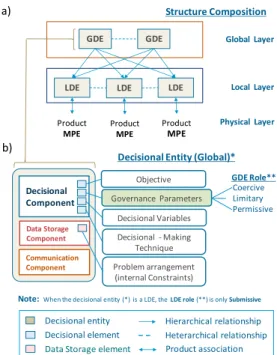
features a composition intended to host the predictive and reactive decision-making techniques and, defines the manufacturing specifications and constraints. At first, the global layer has a global view of the system. It hosts the predictive decision-making approach and contains the global decisional entities (GDE). Accordingly, each GDE is responsible for a global performance objective (i.e. makespan, balance machine workload, etc.). The local layer has a limited view of the system. It contains the local decisional entities (LDE) and hosts the myopic reactive decision-making approach. Accordingly, each LDE is responsible for accomplishing local objectives (i.e. machine selection, process execution, etc.). Additionally, LDEs represent product or resource components as the bridge between the software entities and the manufacturing physical entities (MPE). At last, the PL contains the MPE (i.e. products and resources) that interact within the shop-floor. MPEs execute the production processes and establish the shop-floor layout that determines the physical interactions between physical elements.
Fig. 1. CSA structure and decisional entity diagram, inspired from Zambrano Rey (2014)
In the attributes of entities in (Zambrano Rey (2014), each decisional entity (being GDE or LDE) is constituted by a decisional, a communication and a data storage component (see fig. 1b). Each entity is capable of sensing, processing, storing and acting through the control system environment. The decisional component, as the core element, is the processing unit that indicates the comportment and actions of the entity. The communication component actuates as the data transmitter within the control system and/or the physical layer. And last, the data storage component is responsible for consolidating the knowledge during execution and, at the same time, works as acknowledgement mechanism of the shop floor constraints.
However, considering the governance mechanism's
framework, the decisional component is defined differently
from Zambrano Rey's work. In this paper, the decisional component actuates under a decisional process. It contains an objective, governance parameters, decision variables and a decision-making technique for resolution purposes (See Fig. 2). Accordingly, the decisional process starts by sensing the manufacturing current-state through the communication component. Then, aiming to execute the previously assigned objective (for example, minimize the makespan or choosing the shortest path at global and local level, respectively), the decisional-making technique is activated subject to the current control configuration. This technique is the internal decision process (heuristics or metaheuristics) which evaluates and commands the instructions through the decisional variables. Once it finishes, the decision variables, which contains its results, are sent to the correspondent entity to control through the communication component. During the entire process, the data storage component collects the sensing, processing and acting data of the entity.
Certainly, also as a contribution of this paper, the decisional process is framed under the governance parameters, as they define the attributes and rules of conduct that dictate the entity behavioural guidelines. In fact, it is called governance parameters because it is over these parameters of all entities that the governance mechanism will change the control configuration between different feasible possibilities.
Fig. 2. Decisional process in the extended CSA.
Regarding the interaction of entities within the governance mechanism, the decisional entities might have hierarchical or heterarchical relations. On one side, the hierarchical relations are held by GDEs and LDEs in a modified master-slave interaction. In our proposal, this interaction consists in a unidirectional control from a master to a slave entity, which relation is characterized by a level of dominance. The level of dominance for each pair of entities is defined as a categorized measurement ranged from null influence to full influence and graded according the engagement of predictive and reactive a)
Decisional Component
Communication Component
Objective
Decisional Variables Governance Parameters
Decisional - Making Technique LDE
GDE GDE Global Layer
Local Layer
Physical Layer
Data Storage Component
Product
MPE
LDE
Product
MPE LDE
Product
MPE
Structure Composition
Decisional Entity (Global)*
Problem arrangement (internal Constraints)
Decisional entity Decisional element
Hierarchical relationship Heterarchical relationship Product association
Data Storage element b)
Coercive Limitary Permissive
GDE Role**
Note: When the decisional entity (*) is a LDE, the LDE role (**) is only Submissive
Entity to control Decisional Component
Data Storage Component Communication Component Decisional-Making
Technique
Governance Parameters Objective
Decisional Variables
Local decisional entity (LDE) **
1. Sensing 3. Acting
2. Processing
Decisional Process
4. Storing
Decisional Entity * (Global - GDE)
Entity to control
approaches in the decision-making process. In fact, our framework use this modified master-slave interaction in order to articulate the optimality and reactivity required in manufacturing needs. On the other side, the heterarchical relation, either between two global or two local decisional entities, are the connections created to encourage the coordination of entities when there is disagreement within objectives between two or more entities. (e.g. negotiation, cooperation, iterative bidding or equilibrium, among others).
3.2 Integrating a governance mechanism in the extended CSA
The decisional complexity of the parameterization of the assumed control configuration demands now to tackle its governance as an optimization problem. Therefore, the optimization problem in control pursues to optimize an efficient performance of the manufacturing controls system by selecting an adequate control configuration (problem's optimal or near-optimal solution) from a range of feasible control configurations. In that sense, considering that the control configuration will change continuously due to real-time events, the proposed framework is based on the
inclusion of the introduced GM that manages the
improvement search process in the control's optimization problem.
One can note that diverse control configuration might result from different governance parameters' settings. Some example are such as the role of decisional entities, the scope of control homogeneity, the optimality technique used in global and local entities or the coordination policy of the heterarchical relationships. However, the role of decisional entities (GDE and LDE) is the only governance parameter to be detailed in this paper under the governance parameter scheme. Therefore, three GDE roles are defined regarding the dominance level: Coercive, Limitary and Permissive. While coercive and limitary roles are based on the interaction modes
proposed by Zambrano (2014), the permissive role is a
contribution as a complementary role in the dominance level.
First, the global coercive role corresponds to a direct
command of instructions to be performed by local entities. In fact, these imperative instructions might be transmitted either as concrete decisions or as an imposed objective or behaviour of local entities. Then, the global limitary role concerns the case when the global entity proposes either a set of complete solutions for the local entities or additional bounds (parameters, policies or restrictions) to the regular constraints at local entity decisional level. Finally, the global permissive role is a role in which the GDE delegates to local entities full autonomy on its decisions. On the LDE side, these entities only have a local submissive role as local entities are passive and follow instruction given by the GDE.
To formalize these introduced GDE and LDE roles in mathematical terms and to demonstrate the resulting operating modes from the switching features, a general optimization control system problem derived by the global and local governance parameter interaction (Entities' roles) is represented as follows:
GDE problem (for each GDE):
min F(α) Subject to : G(α)≤ b (1)
LDE problem from
Global Coercive and local submissive interaction: fj(αj) Subject to: gj (αj) ≤ aj and Hj (αj) ≥ cj , j (2)
Global limitary and local submissive interaction:
min fj(αj) Subject to: gj (αj) ≤ aj and Lj(αj) ≥ dj , j (3)
Global permissive and local submissive interaction:
min fj(αj) Subject to: gj (αj) ≤ aj , j (4)
where α is the vector solution for shop-floor execution
variables and αj is a sub-vector (contained in α) that refers to
the corresponding execution variables of local decisional entities LDEj (j is set of local decisional entities). F(α) is the
global objective function (1) evaluated in vector solution α
and fj(αj) is the local objective function (2), (3) and (4) of
LDEj evaluated in vector solution αj. G(α) models the entire
set of shop-floor constraints and gj(αj) models the restrictions
associated to the local decisional entity LDEj . The terms b
and aj are the capacity bounds for the related restrictions.
During production execution, equation (1) is a global optimization problem (assigned to a GDE) that aims to determine the entire set of execution variables of the shop-floor. Consequently, according the combination of governance parameter at the global and local entity roles, equations (2), (3) and (4) represent the resulted local decision problem to be solved by each LDE. For equation (2), LDE dismisses own-objective (Not minimize or maximize) and receives imposed instruction in terms of additional restrictions Hj(αj) and capacity cj. For equation (3), each LDE
increases autonomy as it follows its own-objective fj(αj) but it
is constrained as it obtains decisional boundaries in terms of additional restrictions Lj (αj) and capacities dj. Finally, for
equation (4), each LDE receives full decisional autonomy as it pursues its own-objective and lacks of any additional restrictions.
Fig. 3. Switching general process (Case: coercive to limitary global roles)
LDE
GDE
Product Governance Mechanism
LDE
Product LDE
Product
C
o
n
tro
l
P
e
rf
o
rm
a
n
ce
m
o
ni
to
ri
ng
LDE
GDE
Product Governance Mechanism
LDE
Product LDE
Product
S
w
it
ch
G
o
v
e
rn
.
P
ar
am
.
Govern. Param. Role
Coercive
Govern. Param. Role
Limitary
Machine 2 Breakdown
Improvement Search
Step1:
Normal centralized functioning and perturbation event
Step2:
Disruption detection and Governance process triggered
Step3:
Switch of governance parameter and re-start operations
Step4:
Semi-heterarchical functioning with shared global and local influence Global
Autonomy Local
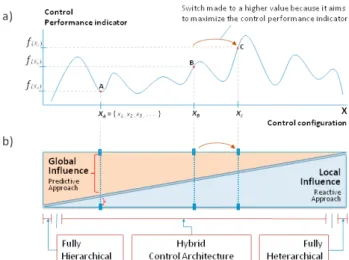
The general process of the governance mechanism is illustrated in Fig. 3. In this case, once the breakdown is detected, the governance mechanism decides to switch from coercive to limitary global role by decreasing the level dominance of the global entity. As it was stated before, the governance of a control system and its switching can be seen as an optimization problem. For that purpose, Fig. 4a illustrates conceptually the optimization problem resulted from CSA. The array Xi (plotted in x-axis) symbolizes the ith solution from the optimization problem and characterizes a particular control configuration in CSA. A control performance indicator f(Xi) is associated to a specific value (plotted in y-axis) and it diagnoses the control effectiveness at each control configuration Xi. In the case of XA, there is a shared autonomy between the articulated global/local entities that influences the emergence collective comportment.
Fig. 4. Conceptual idea of switching control configuration
For explaining the switching process, consider an initial feasible control configuration solution with shared autonomy
is represented in array XB. Then, the GM monitors the
manufacturing environment through previously defined control performance indicators. In this case, it is detected an improvement possibility by reducing the global autonomy (see fig. 4b). After that, the GM rearranges the corresponding GDE/LDE entities' governance parameters in order to encourage a control configuration change. The control configuration switch from XB to XC control configuration and, as a consequence, the governance objective function improves from f(xB) to f(xC). At the end, the governance mechanism coordinates the resources of control system (i.e. GDE and LDE governance parameters) for reconfiguring an adequate control system configuration when is necessary.
4. EXPERIMENT AND RESULTS
The main goals of experiments were to test the feasibility and the potential benefits of increasing the performance of a manufacturing control system using the proposed Governance Mechanism. The proposed CSA applied using an agent-based simulation model (NetLogo 4.1.3) consistently with the benchmark proposed in (Trentesaux et al., 2013). This benchmark supports the simulation of a flexible job-shop scheduling problem with six workstations placed in a
flexible transportation system. The production program consists in assembling seven types of jobs (B, E, L, T, A, I and P), each with different configurations of five components and assembled in a specific sequence order. From the benchmark, it was extracted three different data sets of production orders (D0, E0 and F0 with 15, 29 and 37 jobs, respectively).
The tested CSA is based on a GDE and several LDE that equal the number of jobs in each production order. The GDE integrates a specific meta-heuristic (in our study, a genetic algorithm) that solves the machine allocation, machine sequence and job release sequencing. The genetic algorithm,
which fitness F(α) aims to minimize the production order
Cmax (GDE objective), used the same solution representation
and algorithm parameters of the FJSP at (Wang, Du, & Ding, 2011). Its description is beyond the scope of this paper. The execution time of the genetic algorithm was limited to the next completion time of any operation. In this experiment, the coercive strategy imposes a unique instruction given by the best individual in the genetic algorithm. Instead, limitary strategy uses the genetic algorithm evolved population, by selecting the pareto-front individuals, to use as alternatives to command to local entities. At local layer, LDEs evaluate and choose the alternative to be executed in terms of the shortest path objective.
The experimental protocol is as follows. In these experiments, it is analyzed the global governance parameter by switching between coercive and limitary role (global permissive role not tested) of the GDE (See the general process in fig 3) dynamically during production. LDEs maintain in a submissive role throughout the execution. The scenario executed was the dynamic disrupted scenario #PS9, which simulates that a redundant machine (Workstation 2) will go down during a given time window. In this paper scenario, it was defined a time window between 0.25*MS
and 0.50*MS, where MS is the Cmax of the corresponding
production without any perturbation. Afterwards, it is considered two different experiments. They were designed in order to explore the differences between static configuration with a unique strategy through the whole execution (GM not included) and a switching strategy with a different GDE role (GM included) over the disruption time window. For experiment 1, a first situation, denoted Case A, considers a continuous coercive role strategy. The Case B considers coercive (no-disruption) and limitary (disruption) role strategies. For experiment 2, Case C considers a continuous limitary role strategy and Case D considers limitary (no-disruption) and coercive ((no-disruption) role strategies. For each of these 4 cases and three data sets, a simulated Cmax is measured before, during and after machine breakdown. Each
result obtained from the simulator is the Cmax estimation at
different stages of execution. Results are now presented.
In table 1, considering experiment 1, starting from the same
Cmax of 830 seconds before breakdown, the switching
considered in case B reduces in 8.21% (978 to 898 seconds) the Cmax resulted from case A. Equally, the improvements given in data set E0 and F0 are 5.76% and 7.78%,
min F(α) G(α) ≤ b
α α ≤ a α ≥
α α ≤ a α ≥
α α ≤ a
α is the vector solution for
variables and α vector (contained in α) that refers
(α) evaluated in vector solution α (α
evaluated in vector solution α G(α) (α
(α
(α
(α
LDE
GDE
Governance Mechanism
LDE LDE
C
o
n
tro
l
P
e
rf
o
rm
a
n
ce
m
o
ni
to
ri
ng
LDE
GDE
Governance Mechanism
LDE
LDE
S
w
it
ch
G
o
v
e
rn
.
P
ar
am
Govern. Param. Role
Govern. Param. Role
Improvement Search
Step1
Step2
Step3
respectively. In experiment 2 there are similar results, as they are 15.86%, 5.44% and 10.46%, correspondingly.
Table. 1. Experimental Results
In conclusion, the cases with a switch stand up over static strategies as they present a better performance at overall disruption response. In brief, in the experiments conducted, we think that satisfactory results come because the switching strategy works as a post-optimal algorithm in the manufacturing problem. Therefore, besides adding the local autonomy as a reactive technique, the performance is improved as it refines an initial schedule under new conditions (Articulated optimal and reactive approaches). Obviously, the paper is done recognizing that these experiments are only cases that illustrate the potential interest of using switching strategies through a governance mechanism, not a proof of this. In conclusion, from these experiments, it seems for us that it is worth studying in depth the idea of including a governance mechanism for control system management and this research provides confidence for considering the governance mechanism for steering the system overall improvement, which was the targeted topic of this paper.
5. CONCLUSION AND FUTURE WORKS
In this article, the pertinence of including a governance mechanism within CSA was discussed and tested in the case of a flexible manufacturing system's benchmark. The
governance mechanism aims to steer the control
configuration by balancing the global/local decisional entities autonomy according manufacturing events. In our experiments, the situation where the GM switches entities’
autonomy in the CSA, demonstrated an improved performance reaction compared to constant control configuration strategy under a breakdown. This result comforts us in pursuing our research activity in that field. Accordingly, it is validated the need of exploring the control program reconfigurability and the inclusion of a governance scheme for performance enhancement. The research perspective lies in the development of a generic governance mechanism framework for CSA with switching capabilities. Specifically, the mechanism must address the "To which control configuration to switch", "when to switch" and "how
to switch" in order to fulfil optimal and reactive requirements. Additionally, it needs to be reviewed other methods that do not have a dedicated switching component, such a recently proposed model named ADACOR² (Barbosa et al., 2014). Moreover, once it is defined a generic GM, another research perspective is to control the nervousness of the system. Eventually, considering a continuous switching, the system might chaotically change without any consolidation time. At last, in order to test the feasibility of our approach, it must be applied to a real flexible manufacturing system.
REFERENCES
Barbosa, J., Leitão, P., Adam, E. & Trentesaux, D. (2015), Dynamic self-organization in holonic multi-agent manufacturing systems: the ADACOR evolution,
Computers in Industry, 66, 99-111.
Borangiu, T., Răileanu, S., Berger, T., & Trentesaux, D.
(2015). Switching mode control strategy in
manufacturing execution systems. International
Journal of Production Research Vol. 53, 7, 1950-1963. Gunasekaran, A., & Ngai, E. (2011). The future of operations
management: An outlook and analysis. International
Journal of Production Economics, 135(2), 687–701. Jimenez, J.F., Bekrar, A., Trentesaux, D., Montoya-Torres, J.
& Leitão, P. (2013). State of the Art and Future Trends of Optimality and Adaptability Articulated Mechanisms
for Manufacturing Control Systems. In 2013 IEEE
International Conference on SMC, 1265–1270.
Leitão, P., & Restivo, F. (2006). ADACOR: A holonic architecture for agile and adaptive manufacturing control. Computers in Industry, 57(2), 121–130.
Pach, C., Berger, T., Bonte, T., & Trentesaux, D. (2014). ORCA-FMS: a dynamic architecture for the optimized and reactive control of flexible manufacturing scheduling. Computers in Industry, 65(4), 706-720. Raileanu, S., Parlea, M., Borangiu, T. & Stocklosa, O.
(2012). A jade environment for product driven automation of holonic manufacturing. Springer. Studies in Computational Intelligence, Volume 402, 265-277 Schmidt, K. W. (2013). Optimal configuration changes for
reconfigurable manufacturing systems. In 52nd IEEE
Conference on Decision and Control, 7621–7626. Trentesaux, D. (2009). Distributed control of production
systems. Engineering Applications of Artificial
Intelligence, 22(7), 971–978.
Trentesaux, D., Pach, C., Bekrar, A., Sallez, Y., Berger, T., Bonte, T., Leitão, P., Barbosa, J. (2013). Benchmarking flexible job-shop scheduling and control systems.
Control Engineering Practice, 21(9), 1204–1225. Wang, J., Du, B., & Ding, H. (2011). A genetic algorithm for
the flexible job-shop scheduling problem. Advanced
Research on Computer Science, 332-339.
Wijegunaratne, I., Fernandez, G., & Evans-Greenwood, P.
(2014). Enterprise Architecture for Business Success,
Bentham Science Publishers Ltd.
Zambrano Rey, G. (2014), Reducing Myopic Behavior in FMS Control: A Semi-Heterarchical Simulation
Optimization Approach, PhD dissertation. Univ. of