Open Access
Full open access to this and thousands of other papers at
http://www.la-press.com.
Air, Soil and Water Research 2010:3 113–121
doi: 10.4137/ASWR.S6105
This article is available from http://www.la-press.com.
© the author(s), publisher and licensee Libertas Academica Ltd.
This is an open access article. Unrestricted non-commercial use is permitted provided the original work is properly cited. O R i g i n A L R e S e A R c h
Aerobic and Facultative Microorganisms Isolated From
corroded Metallic structures in a Hydroeletric power Unit
in the Amazon Region of Brazil
Amabel F. correia1, Jorge F.O. Segovia2, Roberto M. Bezerra3, Magda c.A. gonçalves3, Sócrates
S. Ornelas4, Damaris Silveira5, José c.T. carvalho3, Sérgio P.S.S. Diniz6 and Luis i.B. Kanzaki4 1central Public health Laboratory/LAcen, Brasília, DF, Brazil, ceP 70830-010. 2The Brazilian Agricultural Research
corporation/eMBRAPA, Rodovia Juscelino Kubitschek, Fazendinha, Macapá, AP, Brazil, ceP 68903-419. 3Laboratory
of Drugs, Federal University of Amapá, AP, Brazil, ceP 68902-280. 4Laboratory of Bioprospection, University of Brasília,
DF, Brazil, ceP 70910-900. 5Faculty of health Sciences, University of Brasilia, DF, Brazil, ceP 70910-900. 6Laboratory
of natural Products, State University of Maringá, PR, Brazil, ceP 87020-900. corresponding author email: [email protected]
Abstract: Aerobic and facultative bacteria belonging to the Enterobacteriaceae, Pseudomonadaceae, Bacillaceae, Corynebacteriaceae
and Streptococcaceae families have been isolated from corroded metallic structures of a hydroelectric power unit in the Amazon region of Brazil. In addition to anamorphic dematiaceous and moniliaceous fungi, members of the archeobacteria kingdom were also detected in the same samples. Scanning electron micrographs of metal bars cultivated with consortia of the isolated microorganisms depicted suggestiveimagesofbiofilmformationandcorrodedmetallicstructuresquestioningthepossibleroleofthesemicroorganismsinthe corrosion activity. We also found Amazonian medicinal plants exhibiting inhibitory activity against some of the isolated microorganisms. Our new findings need additional studies to confirm the participation of some isolated microorganisms in the process of metallic degradationdespiteourmainquestionifarethereparticularmicroorganismsinvolvedinthecorrosionprocess?orifphysicochemical conditions would favor the development of a particular microbiota and consequently the corrosion process would result from its metabolism?Thereforewehypothesizethatanymicroorganismcouldbepotentiallyinvolvedinthegenesisofcorrosionprocess.Thisis thefirstreportintheliteraturedealingwithmicrobiologicallyinducedcorrosionintheAmazonregionwhichisespeciallycharacterized by its high humidity and elevated temperature all year round.
Introduction
Microbiologically induced corrosion is a matter of great concern all over the world. It costs so much to prevent the corrosion process and to replace periodically deteriorated metal structures.1
Theisolationandiden-tificationofmicroorganismsinvolvedinthecorrosion process is a necessary and mandatory step in order to design methods to prevent and control it.2,3Thebiofilm
formation which is mainly determined by the interac-tion of a consortia of microorganisms represents the main factor involved in the etiological mechanism of biocorrosion. Composed basically of 95% of water and 5% percent of extracellular polymeric substances including organic molecules produced by the micro-bial metabolic activity and inorganic molecules, the biofilm generates a highly dynamic environment, promoting the exchange of ions between the metallic surface and itself. Such ionic interactions weaken the arrangement of metallic bonds’ structures, causing fissuresinitssurfacethatinanamplifiedscaleand at a practical view result in great economic loss.1,2,4
Thealgae,fungiandbacteriahavebeenreportedto be involved in corrosion processes.5,6Themembers
of the Enterobacter and Pseudomonas genera were found to be potential candidates in the etiology of bio-corrosion related processes as these microorganisms are capable to interchange electrons with the adhered surface representing the fundamental mechanism of ionic interplay over the metallic surfaces leading to the corrosion process.7,8 Also, Sulfate-Reducing
Bacteria (SRB), a group of phylogenetically diverse anaerobes that perform the dissimilatory reduction ofsulfurcompoundsincludingsulfate,sulfite,thio-sulfate and even sulfur to form sulfide, is involved in the corrosion process, in mechanisms producing cathodic depolarization by the removal of hydrogen ions (protons) from the cathodic area on the iron sur-face catalyzed by bacterial hydrogenases, coupled to sulfatereductiontosulfidethatcouldaccountforthe severe corrosion of iron in an anoxic environment under neutral pH.9,10
Here we report for the first time, the isolation and biochemical characterization of microorganisms cultivated from fragments of corroded metallic structures collected at the facilities of Coaracy Nunes hydroelectric power unit, in Amapa state, in the Amazon region of Brazil and found also the suggestive role of the isolated consortiated microorganisms in
the corrosion process, as also preliminary results of antimicrobial activity of Amazonian medicinal plants against the isolated microorganisms. Taking into account our results we are strongly inspired to hypothesize that any microorganism is capable to trigger mechanisms of metallic corrosion dependly mainly on the microenvironment physicochemical conditions and the molecular composition and archi-tecture of the material surface exposed to the local microbiota.
Materials and Methods
The hydroeletric power unit
“coaracy nunes”
TheCoaracyNuneshydroelectricpowerunit(UHE) is located in northern Brazil, at Ferreira Gomes county, in the Amapa state, delimited at southeast by theAmazonriverandnortheastbytheOiapoqueriver, in the boundaries of French Guyana (00°55’00’ North and 51°15’00’ West) as depicted in Figure 1 (Map of Amapá, Brazil).
corroded metallic structures
AttheUHE,10samplesofcorrodedfragmentsand 2 water samples from pipelines designated AB1 to AB12 were collected from the metallic surfaces of the pipelines/valves/heat exchanger and from the refrigeration system. The crusts were removed
Figure 1. geographic localization of coaracy nunes hydroeletric Power
utilizing a sterile bistouri and blade and collected on sterile falcon tubes containing transport medium (vermiculite) as also water from the pipelines refrig-eration system.
Microbiological culture of corroded
metallic fragments and water
In order to isolate and biochemically characterize the microorganisms, the collected samples were inoculated into sterile brain heart infusion medium (BHI) and incubated at 35 ± 1 °C for 24 hours and transferred to blood agar, MacConkey agar and azide agar.Thegramstainingwasperformedatthisstage. Additional 24 hours incubation period was carried out atthesameconditions.Theagargrowncolonieswere recorded considering morphological and staining characteristics. The pure cultures were obtained by reinoculation of isolated colonies in the same media. Thecomplementingbiochemicalcharacterizationwas performed in a semiautomatic Autoscan Walkaway (W/A) system (MicroScan, Sacramento, Calif.) and by the analysis based on the metabolic characteristics of isolated microorganisms.11
Also the previously suspended samples in BHI media were transferred to the Sabouraud agar dextrose and Mycosel agar, and kept under incubation for 10 days at 25 °C.Thefungigrowncolonieswere transferred to the Potato dextrose agar and kept at roomtemperature.Thephenotypicidentificationwas based on the macroscopic and staining characteristics likewise the texture, topography and colour of the colonies as also the microscopic features displayed by the reproductive structures, the hyphae and conidia.12,13
Detection of unculturable
microorganisms by molecular methods
The samples collected from the metallic corroded structures in BHI medium were submitted to DNA extraction and amplified by the polymerase chain reaction utilizing the Archaebacteria universal primers.14 As briefly described, 500 uL of each
collected sample, enriched in BHI medium was incu-bated under agitation for 24 hours at 35 °C. After growth, DNA was extracted utilizing the PureLink Genomic DNA kit (Invitrogen), following the steps of proteinase K digestion of bacterial lisates and RNA degradation by RNase treatment. DNA was extracted
oncolumns(PureLinkSpinColumn),washedoutand eluted.ThequalityofobtainedDNAwasassessedby visualizationon1%agarosegelandquantifiedina spectrophotometer.
DNAsampleswereamplifiedbythepolymerase chain reaction utilizing 0.5 uM of archael primer pair A571FandUA1204R(16SrRNA),0.2mMofdNTPs, 1.0UofTaqpolymerasein2.5uLofbuffer(Roche) and 1.5 mM of Mg++inafinalvolumeof25uL.The
thermocycler was programmed to 94 °C/2 min., followed by 30 cycles of 94 °C/1 min., 55 °C/1 min., 72 °C/1 min. and finishing at 75 °C/10 minutes. Afteramplification,12.5uLofreactionvolumewas analyzed by electrophoresis on 1% agarose gel and ethidium bromide staining.
Analysis by scanning
electron microscopy
The corroded fragments and water (AB1 toAB12) collected in individual sterile falcon tubes were transferred to BHI sterile medium in tubes containing a metallic bar measuring 1 cm long × 1 cm large and 1 mm deep. Each 24 hours after inoculation, the turbidityofthemediumwasmeasuredinanELISA reader at 600 nm wavelength. After 14 days, the metal bars were washed out in distilled water, dried at room temperature and observed under the scanning electron microscope,inaJEOL-JSM,T-330Amodel,coupled to an analyzer of dispersive energy, a photographic camera and a LEO microscope Leica-Zeiss, 440 model coupled to EDX and WDX detector in a 50×magnifier.15
Results
Aerobic and facultative bacteria belonging to the Enterobacteriaceae, Pseudomonadaceae, Bacillaceae, Corynebacteriaceae and Enterococcaceae families were isolated from the corroded metallic structures andbiochemicallycharacterized.Theisolatesofthe Enterobacteriaceae family included the Enterobacter
cloacae, Escherichia coli, Hafnia alvei and Serratia marcescens, and pertaining to the Bacillaceae
family we isolated the Bacillus polymyxa, Bacillus
thuringiensis, Bacillus brevis and Bacillus alvei.The Corynebacterium pseudodiphthericum, Pseudomonas aeruginosa and Enterococcus faecalis were the
sole representatives of the Corynebacteriaceae, Pseudomonadaceae and Enterococcaceae families
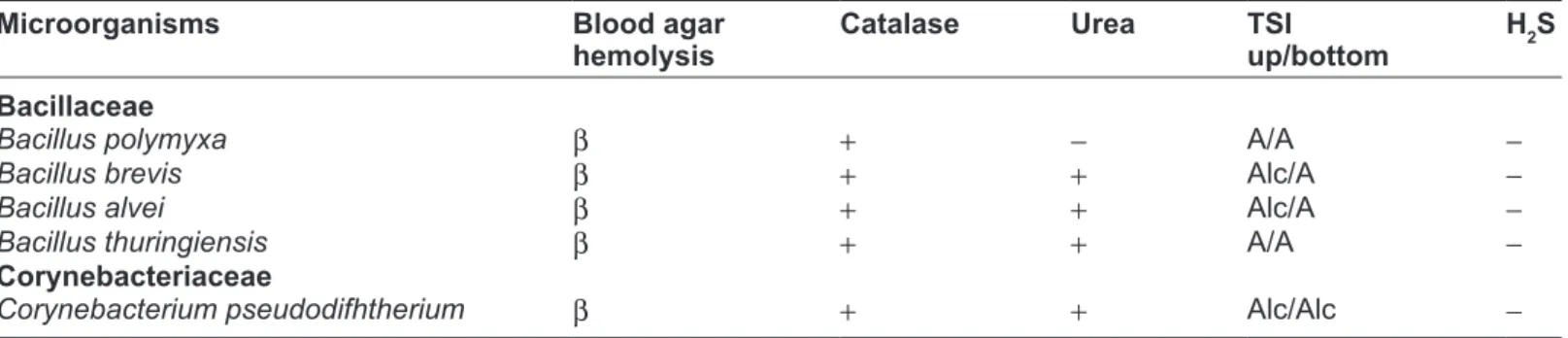
respectively. All biochemical parameters analyzed, manually and automatically, were displayed in Tables 1, 2 and 3. Phenotypical and metabolic profiles of isolated microorganisms were assorted and based on these data, identified in the W/A system’s computer software at the genera and spe-cies level.11
AllidentifiedmembersoftheEnterobac-teriaceae family, Enterobacter cloacae, Escherichia
coli, Hafnia alvei and Serratia marcescens presented
bacilar morphology, gram negative staining, oxidase and cetrimide negative test, ornithine and ortho-nitrophenyl-β-D-galactosidase positive tests, being all of them capable to utilize glucose, allowing us to differentiate them from the Pseudomonadaceae family member, Pseudomonas aeruginosa (Table 1). Members of the Bacillaceae and Corynebacteriaceae family reacted positively by the gram staining, being identified mainly by their property to ferment glu-
cose,sucroseandlactoseintheTSItest.TheBacil-lus polymyxa and Bacilcose,sucroseandlactoseintheTSItest.TheBacil-lus thuringiensis utilized all
carbohydrates and the Bacillus brevis and Bacillus
alvei just fermented glucose and, the solely
identi-fied species in the Corynebacteriaceae family, the
Corynebacterium pseudodifhtherium did not ferment
any sugar (Table 2). Just one species, Enterococcus
faecalis, in the Enterococcaceae family was
identi-fied,yieldingcatalasenegativetest,growthon6.5% NaCl broth and esculine positive test and did not hemolyze blood in agar (Table 3).
The Myceteae kingdom was represented by the isolates of anamorphic dematiaceous and moniliaceous fungi.Themorphologicalandstainingcharacteristics of colonies of fungi grown in Sabouraud agar are shown in Figure2Aand2B.Thedematiaceousfungi exhibited dark coloured, grayish or grayish-brown powdery and felt-like colonies, and their dark reverse showed curves to straight conidia, containing three to four septs and septated and dematiaeous hyphae, characteristic of Curvularia spp (Fig.2A).Themonili-aceous fungi presented white cotton-like colonies and a brown reverse colour with double verticillated con-idiophores exhibiting globolous conidia and septated and hyaline hyphae, characteristic of Penicillium spp (Fig. 2B).
Preliminary metagenomic analysis of DNA extracted from collected mixed water and corroded
metallic samples detected a band in the gel after Table
1. Biochemical characterization of e nterobacteriac eae and Pseudomonadaceae species isolated from corroded metallic structures in the c oaracy n unes h
ydroelectric Power Unit,
Amapa state. Metabolic markers Fermentation Urea Hydrogen sulfite Indole Lysine Arginine Ornithine Tryptophan deaminase esculin hydrolisis Voges-proskauer Galactosidadse (Onp G) citrate Malonate Tartarate Acetamide cetrimide nitrate OF Microorganisms Family/species Glucose sucrose sorbitol Raphnose Ramnose Arabinose Inositol Adonitol Melbiose Base Glicose Oxidase
enterobacteriaceae Enterobacter cloacae
+ + + + + + -+ + -+ + -+ + + + -+ -+ -+ -Escherichia coli + + + + + + -+ + -+ -+ -+ + -+ -+ -Hafnia alvei + -+ + -+ -+ -+ + -+ + -+ -+ -Serratia marcescens + + + -+ -+ -+ -+ + + + -+ + -+ -+
-pseudomonadaceae Pseudomonas aeruginosa
-+ -+ + + + + + -+ Abbreviations: + , positive; -, negative; O n P g , ortho-nitrophenyl-β-D-galactosidase; OF
submission to electrophoresis of amplified DNA fragments by the PCR assay, corresponding to 1,300 bp fragment stained by ethidium bromide as depicted in Figure3.Thebandwasnotresolvedin sequentialgelanalysisinordertocheckoutifmore than one band was present.
Previously mentioned isolated microorganisms were found to be associated in the corroded frag-ments and water removed from the metallic surfaces and pipelines respectively. The scanning electron micrographs exhibiting colonies of the isolated bacte- riaandbiofilmformationonthesurfaceofthemetal-lic structures are depicted in Figures 4 and 5 as also the metallic dissolution represented by the spectra of energy dispersion of molecular oxygen and iron ions (Fig.5).Thebacterialgrowthoverthesurface ofthemetallicbarsintheliquidmediuminconsor-tiated groups as designated in material and methods fromAB1 toAB12 did not show any significative difference in turbidity parameters, all starting the lag phase in the second day of cultivation, determined by the measurement of the optical density values in an ELISAreaderat600nmwavelength(Fig. 6). Also wedetectedfissuresinthesurfaceofthemetallicbars colonized in vitro by the consortiated microorganisms
that were previously biochemically characterized. They were not assayed individually as in the natu-ral environment those microorganisms are found associated as we corroborated in our experiments.
Of 30 distinct medicinal plants collected in the Amapa state, we detected preliminarily 5 plant extracts exhibiting antimicrobial activity. All plants assayed in this research work are traditionally utilized by native people in the Amazon region to cure their diseases.The ethanolic extracts of Copaifera
retic-ulata, Tabebuia serratifolia, Brosimum rubescens
and Carapa guianensis presented activity against gram positive bacilli of the Bacillus genera, and the ethanolic extract of Aspidospermum carapanauba showed activity against the gram positive bacilli and
Pseudomonas aeruginosa. Despite these data be
pre-liminary, most of the microorganisms susceptible to the plants extracts are multiresistant to commonly used antibiotics (data not shown).
Discussion
TheAmazonregionischaracterizedbyhighhumid-ity and elevated temperatures all over the year. In Amapa state, the Ami and Amw climates predomi-nate.AccordingtoKöppenclassification,theformer
Table 2. Biochemical identification of species belonging to the bacillaceae and Corynebacteriaceae families isolated from
corroded metallic structures in coaracy nunes hydroeletric Power Unit, Amapa state.
Microorganisms Blood agar
hemolysis catalase Urea TsI up/bottom H2s
Bacillaceae
Bacillus polymyxa β + - A/A
-Bacillus brevis β + + Alc/A
-Bacillus alvei β + + Alc/A
-Bacillus thuringiensis β + + A/A
-corynebacteriaceae
Corynebacterium pseudodifhtherium β + + Alc/Alc
-Abbreviations: +, positive; -, negative; β, β-hemolysis; TSi, triple sugar iron; Alc/A, alkaline and acid reaction in TSi.
Table 3. Biochemical identification of the Streptococcaceae family species isolated from corroded metallic structures of the
coaracy nunes hydroeletric Power Unit, Amapa state.
Microorganism Hemolisys in
blood agar catalase test nacl at 6.5% Bile + esculin test streptococcaceae
Enterococcus faecalis Without hemolisys - + +
is characterized by tropical rainy weather, presenting a well defined dry season, lacking pluviometric precipitation from August to December, and the latter is also characterized by tropical rainy weather but without a defined dry season, thus raining regularly during all year round.16TheCoaracyNunes
hydroeletric power unit is localized in the transi-tion limits of both climate pattern above described. Thepropermaintananceofmetallicstrucuturesina hydroeletric power unit, particularly in the amazon regionrequiresperiodicpaintingandsubstitutionof corroded structures, demanding excessive financial costs making the final product, the eletricity, so expensive to the population.
The rich microbiota in the Amazonian tropical forest greatly contributes to the widespread coloniza-tion of microorganisms in all surfaces of any mate-rialsuchaswood,metals,plasticswhatsoever.The metallic structures composing important industrial facilities, including the electricity power unit, suffer enormous losses due to the corrosion processes, mainly induced by microorganisms. In our work, wecouldconfirmthefindingsofmanylaboratories and also, observe in vitro the suggestive role of the
1 Kb MW BCR 1 BCR 2 BCR 3 BCR 4 BCR 5 BCR 6 BCR 7 BCR 8 BCR 9 BCR 10BCR 11BCR 12CONT.
-Figure 3. PCR assay of uncultured microorganisms DNA amplified
utilizing Archae universal primers (16S ribossomal RnA gene). First Lane/1 Kb MW (left) showing bands of DnA molecular markers and lane/ BcR 2 showing a 1,300 bp fragment and last Lane/cOnTR as a negative control.
Figure 4. Optical micrograph magnified 50× showing deposits of
metal-lic salts and corroded areas (black spots) in metal bars incubated with consortiated microorganisms isolated from corroded metallic structures of coaracy nunes hydroeletric Power unit in Amapa state.
Figure 2A. Fungus Curvullaria spp. cultivated in Agar Sabouraud. Agar
surface (left). Agar reverse side (midlle). Optical microscopy (40×), stained with lactophenol, showing conidia and septated dematiae hyphae (right).
Figure 2B. Fungus Penicillium spp. cultivated in Agar Sabouraud. Agar
surface (left). Agar reverse side (midlle). Optical microscopy (40×), stained with lactophenol cotton blue, showing double verticillated conid-iophores exhibiting globolous conidia and septated and hyaline hyphae (right).
isolated microorganisms consortiated in the corrosion process.Thedetectionofbiofilmproductionasalso the precipitated salts on the metallic bars allied to the detection of spectral patterns of metallic ions (Figs. 3 and 4) likewise, decrease in iron ions concentration, carbon atoms and molecular oxygen increase besides the alteration in the concentration of other elements (Fig. 5) suggests the occurrence of corrosion pro-cesses of microbial etiology. Interestingly, the micro-organisms usually reported in pathological processes in humans and animals as Serratia marcescens,
Escherichia coli, Enterobacter cloacae, Pseudomo-nas aeruginosa, Enterococcus faecalis, Hafnia alvei
and Corynebacterium pseudodiphtheriticum were detected in metallic corrosion processes too.17–19
Any-way, other microorganisms uncommonly causing diseases, known as opportunistics organisms are usu-ally widely spread in the environment, victimizing immunosupressed humans, animals and plants.20,21
Therefore,underthisviewpoint,bioorganismsdefend dynamically themselves against invading and colo-nizing microorganisms22 contrary to inert material
like metals that need technological devices23 to
pro-tect their surfaces against environmental microorgan-isms’colonizationandconsequentialionsexchange between the microorganisms metabolic products and metal ionic surface, which generally early or later results in corrosion processes, as generally proposed to certain microorganisms.24
Just a minimum percentage of microorganisms in distinct environments are cultivated by conventional microbiological methods.25 Uncultured
microorgan-isms have been detected by preliminary metagenomic analysis. In our study, the solely band found by the PCR assay of the isolated DNA samples of consor- tiatedmicroorganismscouldrepresenttheamplifica-tion of multiple microorganisms DNA fragments.26
Utilizing molecular tools to detect ribosomal DNA segments from fragments of industrial pipelines car-rying crude oil, about 31 distinct archaebacteria com-posing the Methanobacteriales, Methanomicrobiales and Methanosarcinales order were found, despite it is not known the role of these microorganisms in biocorrosion processes.27 As expected, common soil
microorganisms were found among the analyzed samples, mainly represented by members of the Bacillaceae family. Ongoing studies are aiming for the isolation and characterization of anaerobes which were partially initiated by metagenomic studies and considering their important roles in biocorrosion processes.9,10
Despitethecurrentknowledgetofindculpritsfor corrosion processes, our results allied to other reports in the literature suggest that there are not particular microorganisms involved in the mechanisms of corro-sion but, the physicochemical conditions of the envi-ronment determines that the particular microbiota of any surface and therefore the metabolic activity of any microorganism would interact with metallic surfaces or in other words, the redox reactions would occur initiating the corrosion process of metallic surfaces.
Presently we are looking for local solutions for the problem, besides to what actually has been done, likewise the removal of damaged metallic structures and their periodic painting. As an alternative way to chemical pollutants utilized in paintings composition, we are testing Amazonian medicinal plant extracts looking at growth inhibition or destruction of micro-organisms found colonizing the metallic structures. We have shown growth inhibition of multiresistant bacteria involved in human nosocomial infections by extracts of Amazonian medicinal plants.28 As many of
our microorganisms isolates from corrosion processes are also involved in human and animal diseases, we proposed in this study to assay Amazonian plants as antimicrobial agents to eliminate corrosion. If from the plants assayed, crude antimicrobial agents against
Figure 5. Scanning electron micrograph magnified 200.000× showing
surface fractures over the metal bar after microbial growth of samples obtained from corroded metallic structures of the coaracy nunes Power unit in Amapa state.
0 0,2 0,4 0,6 0,8 1 1,2 1st day Optical density AB01 AB02 AB03 AB04 AB05 AB06 AB07 AB08 AB09 AB10 AB11 AB12 CN 5th day 2nd day
Figure 6. growth curve (lag phase) of consortiated groups of bacteria
consortiated microorganisms could be developed, the benefitswouldprevailastheplantsarenottoxicto the environment, they could be cultivated and locally processed and would also contribute to the improve-mentofqualityoflifeoflocalcommunities.
Disclosures
Thismanuscripthasbeenreadandapprovedbyall authors.Thispaperisuniqueandnotunderconsid-eration by any other publication and has not been publishedelsewhere.Theauthorsandpeerreviewers report no conflicts of interest. The authors confirm that they have permission to reproduce any copy-righted material.
Acknowledgements
WearegratefultoEletronorte/ANEELforthefinan-cial support to carry out this study and particularly to Eletronorte/Amapa staff for the logistic support dur-ingsamplescollectionintheHydroeletricPowerUnit Coaracy Nunes.
References
1. Beech IB, Gaylarde CC. Recent advances in the study of biocorrosion: an overview. Rev Microbiol. 1999;30(3):117–90.
2. DinhHT,KueverJ,MussmannM,HasselAW,StratmannM,WiddelF.Iron corrosion by novel anaerobic microorganisms. Nature. 2004;427(6977): 829–32.
3. McNamaraCJ,PerryTD,LeardR,BearceK,DanteJ,MitchellR.Corrosion of aluminum alloy 2024 by microorganisms isolated from aircraft fuel tanks. Biofouling. 2005;21(5–6):257–65.
4. Beech IB, Sunner JA, Hiraoka K. Microbe-surface interactions in biofouling and biocorrosion processes. Int Microbiol. 2005;8(3):157–68.
5. Smirnov VF, Belov DV, Sokolova TN, Kuzina OV, Kartashov VR. Microbiological corrosion of aluminum alloys. Prikl Biokhim Mikrobiol. 2008;44(2):213–8.
6. Scheerer S, Ortega-Morales O, Gaylarde C. Microbial deterioration of stone monuments—an updated overview. Adv Appl Microbiol. 2009;66:97–139. 7. Neria-González I, Wang ET, Ramírez F, Romero JM, Hernández-
Rodríguez C. Characterization of bacterial community associated to biofilmsofcorrodedoilpipelinesfromthesoutheastofMexico.Anaerobe. 2006;12(3):122–33.
8. Yuan SJ, Pehkonen SO. Microbiologically influenced corrosion of 304 stainless steel by aerobic Pseudomonas NCIMB 2021 bacteria: AFM and XPS study. Colloids Surf B Biointerfaces. 2007;59(1):87–99.
9. Jan-Roblero J, Romero JM, Amaya M, Le Borgne S. Phylogenetic characterization of a corrosive consortium isolated from a sour gas pipeline. Appl Microbiol Biotechnol. 2004;64(6):862–7.
10. VidelaHA,HerreraLK.Microbiologicallyinfluencedcorrosion:lookingto the future. Inter Microbiol. 2005;8(3):169–80.
11. KellyMT,LeicesterC.EvaluationoftheAutoscanWalkawaysystemfor rapididentificationandsusceptibilitytestingofgram-negativebacilli.J Clin Microbiol. 1992;30(6):1568–71. 12. LacazCS,PortoE,MartinsJEC.Micologiamédica:fungos,actinomicetos ealgasdeinteressemédico.8thed.SãoPaulo:Sarvier,1998:695. 13. MinamiPS.Micologia:métodoslaboratoriaisdediagnósticosdasmicoses. SãoPaulo:Manole,2003:199. 14. BakerBJ,BanfieldJF.Microbialcommunitiesinacidminedrainage.FEMS Microbiol Ecol. 2003;44:139–52. 15. WangH,LiangC.Eletrochemicalbehaviorofantimicrobialstainlesssteel bearing copper in sulfate reducing bacterial medium. J Wuhan Univ Tech Mater Sci. 2008;23(1):113–7.
16. Köppen W. Das geographische System der Klimate. In: Wladimir Köppen und Rudolf Geiger, Hg., Handbuch der Klimatologie in fünf Bänden, Bd. 1: Allgemeine Klimalehre 1936.
17. Kramer A, Schwebke I, Kampf G. How long do nosocomial pathogens persist oninanimatesurfaces?Asystematicreview.BMC Infect Dis. 2006;6:130. 18. Koachere JF, Bughe RN, Oben BO, Ndip LM, Ndip RN. Phenotypic
characterization of human pathogenic bacteria in fish from the coastal waters of South West Cameroon: public health implications. Rev Environ Health. 2009;24(2):147–56. 0 0 2 O O Fe Fe Fe Fe Fe Fe P P P PSCl Cl S C NaSi 4 6 8 10 500 1000 1500 2000 2500 Counts 0 200 400 600 800 Counts Energy (keV) 0 2 4 6 8 10 Energy (keV)
Figure 7. Scanning electron micrograph magnified 50× showing metallic salts deposit (white area) and smooth zone displaying metallic dissolution as
publish with Libertas Academica and every scientist working in your field can
read your article
“I would like to say that this is the most author-friendly editing process I have experienced in over 150
publications. Thank you most sincerely.” “The communication between your staff and me has
been terrific. Whenever progress is made with the manuscript, I receive notice. Quite honestly, I’ve
never had such complete communication with a journal.”
“LA is different, and hopefully represents a kind of scientific publication machinery that removes the
hurdles from free flow of scientific thought.”
Your paper will be:
• Available to your entire community
free of charge
• Fairly and quickly peer reviewed
• Yours! You retain copyright
http://www.la-press.com
19. Camello TC, Souza MC, Martins CA, et al. Corynebacterium pseudodiphtheriticum isolated from relevant clinical sites of infection: a human pathogen overlooked in emerging countries. Lett Appl Microbiol. 2009;48(4):458–64.
20. WashburnBK,LevinAE,HennessyK,MillerMR.Identificationofbacteria in scuba divers’ rinse tanks. Undersea Hyperb Med. 2010;37(4):233–40. 21. YangSS,LinJY,LinYT.Microbiologicallyinducedcorrosionofaluminum
alloysinfuel-oil/aqueoussystem.J Microbiol Immunol Infect. 1998;31(3): 151–64.
22. Ooi EH, Psaltis AJ, Witterick IJ, Wormald PJ. Innate immunity. Otolaryngol Clin North Am. 2010;43(3):473–87, vii.
23. YuanSJ,PehkonenSO,TingYP,NeohKG,KangET.Inorganic-organic hybrid coatings on stainless steel by layer-by-layer deposition and surface-initiated atom-transfer-radical polymerization for combating biocorrosion. ACS Appl Mater Interfaces. 2009;1(3):640–52.
24. Haferburg G, Kothe E. Microbes and metals: interactions in the environment. J Basic Microbiol. 2007;47(6):453–67. http://www.v-brazil.com/tourism/ amapa/map-amapa.html. Acessed 2010 Oct 22.
25. Vartoukian SR, Palmer RM, Wade WG. Strategies for culture of ‘ unculturable’ bacteria. FEMS Microbiol Lett. 2010;309 (1):1–7.
26. DuncanKE,GiegLM,ParisiVA,etal.Biocorrosivethermophilicmicro-bial communities in Alaskan North Slope oil facilities. Environ Sci Technol. 2009;43(20):7977–84.
27. ZhuXY,LubeckJ,KilbaneIiJJ.Characterizationofmicrobialcommunities in gas industry pipelines. Appl Environ Microbiol. 2003;69(9):5354–63. 28. Correia AF, Segovia JFO, Gonçalves MCA, et al. Amazonian plant crude
extract screening for activity against multidrug-resistant bacteria. Eur Rev Med Pharmacol Sci. 2008;12(6):369–80.