
The selection of senior civil servants in the context of the different public administration models: an issue of accountability
23
0
0
Texto
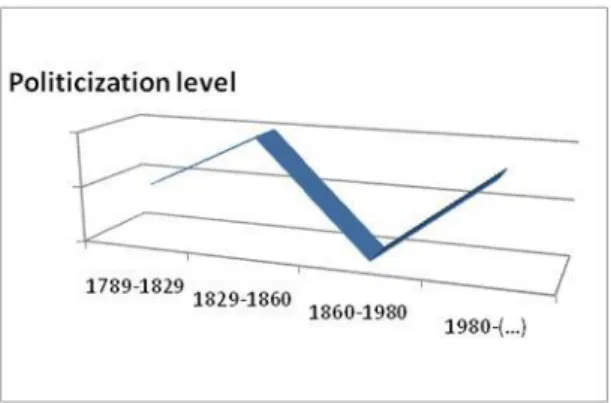
(2) The selection of Senior Civil Servants in the context of the different public administration models: an issue of accountability? Study Group IX: Civil Service and Politics. 1. Introduction From the 18th century to our days, Public Administration has been debating which politicaladministrative model it should have. European Administration, in its genesis, was too politicized and nepotism and patronage systems were present across all countries with the damages that such a system involves. In the 19th century the Northcote-Trevelyan Report (1854) appealed in the United Kingdom for a new system where a meritocratic system should enhance public administration performance. Some years after, in the United States of America, a federal law was published – the Pendleton Act (1883) also aiming at a more professionalized public service (Wilson, 1887). These two appeals required a completely different approach on the delivery of public services. Public Administration has to change its administrative model and be independent from politicians in order to promote a more professionalized public service, advocates Pitschas (2006: 35-52). However, as noted by Peters (1996: 5) , the adjustment process was made in a snail's pace. Nevertheless, in 1904, half of the USA’s civil servants were already recruited within a merit system. Rocha (2006: 6-7) refers that when we can set apart the political activity from the administrative activity we can speak about the Weber’s legal-bureaucratic administration model which contributes to the establishment of a professionalized body of civil servants protected by statutes that protect them from the discretionary political power. This environment provided a context in which professionalized civil servants detained all the administrative [and also political] technicalities, procedures and legal frameworks details (Peters, 1996:3; Chevallier, 2002:73). This kind of knowledge and techniques brought a lot of [informal] power to this new body that, with the New Deal, the Welfare State and the consequent admission of new civil servants (doctors, social assistants and teachers) , strengthened the influence and supremacy of the professionalized bureaucracy. As observed by Madureira (2006:42), in Portugal, until 2001, there has always been a compulsive increase on civil servants numbers. Senior Civil Servants gained excessive power over public policies, privileging their own individual interest over the public interest. That was the biggest error of the public choice theorists who advocated a more politicized system in spite of a professionalized distorted one with lacking legitimacy. The Public Choice and the New Public Management, together, forced senior civil servants to decrease their influence on public policies and, in a more generalist way, in administration. Political involvement on administration became a reality in countries such as the United Kingdom where public reform changed the traditional public service structure (Rocha, 2000:10, Mozzicafreddo, 2001: 3-1, Peters, 1996:4-13). As noted by Rocha (2005b: 11) and Madureira (2006:47) the traditional methods of recruitment and selection were substituted by other methods where political trust or party allegiance became the major criteria on the selection of senior civil servants. The figure below represents the cycle evolution on the senior civil servants selection criteria,. David Ferraz. Page 2.
(3) The selection of Senior Civil Servants in the context of the different public administration models: an issue of accountability? Study Group IX: Civil Service and Politics. considering the evolution of the ideological patterns of public administration models:. Figure 1: Politicization evolution, Ferraz (2008) Authors such as Peters (1987: 258) , Aberbach, Putnam e Rockman (1988: 1) argue that hybrid systems are the ideal type, as they gather the strengths of both meritocratic and politicized systems. But, is it really true? What kind of political-administrative configurations do best serve public interest?. 2. Political-administrative systems The configuration of political-administrative systems cannot be done without the conscience of what kind of issues are in question. By configuring a political-administrative system we are deciding how both political and administrative actors interact with each other. If we aim at a more professionalized system regarding the principles of the Rechtsstaat we have to configure a more independent and neutral administration. Otherwise, if we aim at a more political configuration ensuring that administration does what politicians want then we have to configure a more politicized system. In fact, the question is what kind of system to choose? On the one hand, if we opt by a neutral and independent system, we have to deal with issues like administration’s lack of legitimacy. Administration was not elected by citizens so it doesn’t have a democratic legitimacy, only a technical one. Moreover, technical legitimacy has not always been used to promote public interest and can sometimes even be used to subvert public policies’ original spirit, subjecting it to their own private interest (Aberbach, Putman Rockman, 1981 e Diamant, 1989 apud Herzfeld, 1992: 2). On the other hand, if we opt by a politicized system based on political trust, the independence and neutrality of public administration can be questioned in terms of the proximity and interpermeability relations between public officials and politicians. This is a real trade-off, as no matter what system we choose, we always loose. So the question is how to minimize this trade-off? How are countries across the world dealing with this trade-off? To answer these questions, we have to analyze some political-administrative systems focusing. David Ferraz. Page 3.
(4) The selection of Senior Civil Servants in the context of the different public administration models: an issue of accountability? Study Group IX: Civil Service and Politics. on the senior civil servants selection criteria. We will consider four main representing countries: France, Portugal, United Kingdom and United States of America.. 2.1. The French model In this model, political authorities have all the power to select any person for senior civil functions. Senior Civil Servants are selected inside or outside the administration. The main criteria are the political or personnel confidence or trust. Usually, Senior Civil Servants are selected considering their party allegiance. This system ensures that government program is implemented whatever its merit (Mulgan, 2007: 571). In any circumstances, politicians have the power to appoint or dismiss civil servants “at the pleasure of government” (Shepherd, 2007: 4). As noted by (Shepherd, 2007: 4) this system favours a patronage based system. In France les grands corps have great prestige being in direct contact with the ministers (Peters, 2001: 145). There are appointments for the following posts (Décret nº 85-779, 2005) : . General Director. . General Secretary. . High commissar. . Commissar. . Civil Governor. . Chief of Public Administration Inspection. . Other Senior Civil Servants that work directly to the government. Although it is not compulsory, the system gives a great importance to the training given by the École Nationale d’ Administration (25º article, Décret nº 85-779, 2005). Considering the findings of Nunes and Rouban (2000: 25; 2007:477) we could conclude that despite the fact that politicians have total freedom to appoint who they want, the recruitment is, in 89% of the cases, internal. We should emphasise that from the total (about 8000 senior civil servants) only 20% are women (Rouban, 2007: 477). Bellier, in a study conducted in 1993, noted that 46% of the French senior civil servants have, within their nuclear family, someone who is or was also a Senior Civil Servant or professor/researcher. This demonstrates that senior civil posts in France are very elitists. As Rouban noted (Rouban, 2007: 491-492) ¼ of the members of ministerial cabinets were already in that function before. The cabinet chief worked 35% of his professional life in ministerial cabinets. In the case of political appointment, both the Government and the President have to validate it.. David Ferraz. Page 4.
(5) The selection of Senior Civil Servants in the context of the different public administration models: an issue of accountability? Study Group IX: Civil Service and Politics. 2.2. The Portuguese model In Portugal, the politicized model was, till 2011, the dominant system. The dictatorial regime until 1974 didn’t allow a separation between politics and administration. After 1974, the new Senior Civil Servants’ statutes referred that senior civil servants were trust-positions in administration. Only in 2005, the Law 51/2005 established some posts that should be more professionalized. However it was stated that some posts still remained politicized: . General director. . Sub-.general director. . Agencies Presidents. . Agencies Vice-Presidents. . Commissar. . General Inspector. . Sub- General Inspector. . Civil Governor. . Other Senior Civil Servants that work directly to the government. As noted by Madureira (2006:41) it seems that the statute brings some will to control and evaluate the appointments of senior civil servants. However, after three years, the impact on appointments was imperceptible. France and Portugal still represent the traditional European model of administration. Senior Civil Servants were recruited from elites and selected on the base of trust and party filiations. The politicization is very high and exposes both the influence of Administration in Politics and the influence of Politics in Administration. Although it is was hard to draw a line between the political sphere and the administrative one, after 2011, with a new law for the selection of senior civil servants, the border line became more clear. In fact since 2011 that senior civil servants are recruited by a merit system.. 2.3. The United Kingdom model British administration is composed of civil servants selected through a meritocratic system which ensures a bigger neutrality of the administration. The line between administration and politics is explicit and very easy to identify (Shepherd, 2007: 20-23). When recruitment takes place the Senior Leadership Committee evaluates each candidate and makes a shortlist concerning the Civil Service Code principles. The final decision, from the shortlist, is made by a politician. Despite. David Ferraz. Page 5.
(6) The selection of Senior Civil Servants in the context of the different public administration models: an issue of accountability? Study Group IX: Civil Service and Politics. all the formalism to guarantee the merit of a nomination Dowding (1995: 109) noted however that Senior Civil Servants remain an elite from Oxford and Cambridge Universities. Although there are some evidences of professionalization, the system combines some hybrid nominations to some positions. It is the case of the Permanent Secretary nomination: it is the member of the government that selects the candidate taken into consideration for Senior Civil Service or Public Service Commission purpose (Shepherd, 2007: 20-23). This is, frequently, a consensual process.. 2.4. The United States model The federal government is composed of about 6000 political nominations, of which about 1000 have to be confirmed by the Senate. There are some political positions (700) reserved to the Senior Executive Service (SES) members (Shepherd, 2007: 13-14). The political positions are selected by the president considering a pool where civil servants, contrarily to the European countries, are rarely present. The actual system is the result of the institutionalization of senior posts in 1978, when the SES was created to reduce political arbitrary. Entering the SES means going through the Qualification Review Board that evaluates the candidate’s profile and competencies. The system is based on the merit principle that “all employees and applicants for employment should receive fair and equitable treatment in all aspects of personnel management without regard to political affiliation, race, colour, religion, national origin, sex, marital status, age, or handicapping condition, and with proper regard for their privacy and constitutional rights” (Merit System Principle - 5 U.S.C. 2301). Considering the findings of Peters (2001) and (Bonosaro, 2000) about 66% of the posts are occupied by members of the SES and 34% selected considering political factors. However, from those 34%, 22% are already members of the SES, leaving only about 12% of the senior civil servants to be selected at the government pleasure. Bearing in mind the evidences, we should conclude that the USA system is closer to a hybrid model where Senior Civil Servants are selected by a diversity of criteria, combining meritocratic measures and political ones.. 3. Political-administrative systems and public administration models and reforms 3.1. The Bureaucratic Model The structure and development of Public Administration from a more scientific point of view corresponded, after W ilson (1887) , on the application and development of the bureaucratic model. It was intended to bring more scientific and standardized procedures, more neutrality and (political) independence with public policies becoming implemented by professionalized career staffs (Bilhim 2000, Rocha 2009). The main goal was to guarantee the separation of political and. David Ferraz. Page 6.
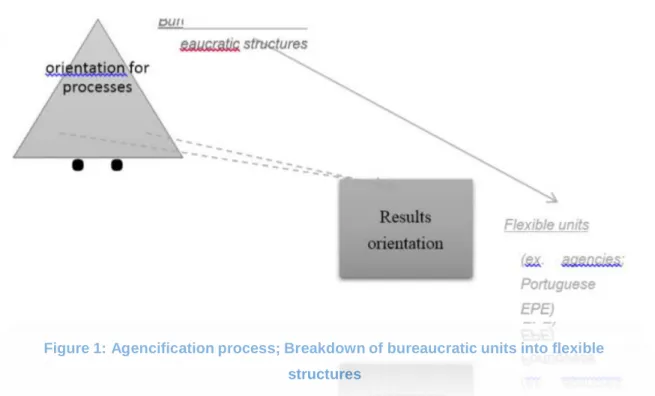
(7) The selection of Senior Civil Servants in the context of the different public administration models: an issue of accountability? Study Group IX: Civil Service and Politics. administration bodies and thus decrease the political discretion in the public interest (Rosenbloom 2008). Understanding the relevance, importance and justification of this objective requires from us contextualizing the predecessor model of Reichstag - a model of state that was based on the absolute monarchies, where the administration officials were at the personal service of the king and not always of the State. Under the transition from absolute monarchies to the state model based on the rule of law it was needed to make employees more independent and neutral, to for one way the government, and to the other to the service and public interest, reducing the arbitrariness and political interference in the administration. The bureaucracy emerged as model, idealizing a form of organization superior to all others that we hoped to achieve in the future (Perrow, 1972). It was believed that it should be possible to empower the administration and regulate its operation through the following principles and characteristics (Bilhim 2001, Rocha, 2009) : . Organization founded on written policies and procedures (rational, legal and exhaustive) ;. . Hierarchy of authority;. . Impersonality of relations;. . Formal communication;. . Separation between political staff and officials;. . Recruitment is based on merit;. . Professionalization;. . Rational division of the work;. . Routines and standardized procedures. We should note that the model was designed to fit the height predictable contexts, standardizing procedures and operating rules. Organizations, under this model, adopt pyramidal, hierarchical and oriented toward meeting standards and standardized processes and procedures (Figure 1).. orientation for processes Figure 1: Configuration of a bureaucratic structure. David Ferraz. Page 7.
(8) The selection of Senior Civil Servants in the context of the different public administration models: an issue of accountability? Study Group IX: Civil Service and Politics. 3.2. From the bureaucratic model to the New Public Management With the extension of state functions to more complex areas, particularly for social areas and with the advent of globalization and new technologies, the context in which the bureaucratic model is developed cannot be predicted and the change becomes a constant, disadvantaging administrative organizational models based on rigid and standardized procedures, as was the case of organizations and bureaucratic structures. If the context changes constantly and consequently ceases to be predictable, rules and procedures that had been defined for this same context, no longer make sense generating calls "bureaucratic dysfunctions". This was a major criticism of the bureaucratic model, basing on the inability of a rapid revision of routines and standard procedures, whenever the context changes (Blau 1956, Dimock 1959, Crozier 1967, Mouzelis, 1975). Moreover, with the growth of the welfare state state indebtedness increases and hence its need for funding too. This situation is worsened by the oil crises and the inability to finance these social functions. The criticism of the welfare state and the bureaucratic model add to the criticisms made by the Public Choice (Ostrom and Ostrom, 1971, Downs 1978, Lane 1987, Dunleavy 1991) stressing that employees and officers of the Public Administration seek in the course of their duties, obtain advantages for themselves instead of maximizing the public interest. They argue that these advantages are derived from their position in the hierarchy and maximizing your career and your personal interest only after the collective interest. Begins to be drawn to the bureaucratic model an alternative model - the New Public Management - First in English-speaking countries, under the influence of reformist policies of Margaret Thatcher and then spreads throughout the western world (Hoggett 1991, Hood 1991, Hood 1995, Pollitt and Homburg, 2007). Hood (1991) synthesized the main features of the New Public Management: . Private styles and practices. . Competition on the public sector. . Discipline in the use of resources (costs control). . Results orientation and outputs control (management by objectives). . Performance evaluation considering standards. . Division of big departments (agencification). . Professional management (professionalization of management). The New Public Management comes framed in managerial chain that was characterized by the belief that private management is superior to Public Administration and therefore the lack of differentiation between public and private organizations. It was intended, with an analysis of the. David Ferraz. Page 8.
(9) The selection of Senior Civil Servants in the context of the different public administration models: an issue of accountability? Study Group IX: Civil Service and Politics. critical success factors of private companies, importing practices of private management based on the principles of decentralization, deregulation and delegation (Peters and Waterman 1982) , encouraging the creation of more autonomous structures outside traditional hierarchical structures typical of the bureaucratic model (FLINDERS 2009). We witness as to the breakdown of large bureaucratic units for new structures, autonomous and decentralized, with delegated to comply with results that become contracted skills. Between us, this date corresponds to the 90's when the big DGs, with hundreds of employees, have disintegrated / divided to give rise to various public institutions (agencies or if we use the term equivalent in Anglo-Saxon literature). Globally, inherent in this model is the passage of a producer and provider of services to a regulatory state of the market and it is believed that in this way, it would be more efficient, economic and effective state. At issue was the need for a reform that opposed the bureaucratic model and their centralizers and procedural principles, focused on compliance and rules, within formal and hierarchical structures, a less rigid model oriented towards the fulfillment of objectives and results, under, flatter / horizontal flexible structures.. Figure 1: Agencification process; Breakdown of bureaucratic units into flexible structures That breakdown process of bureaucratic units in flexible structures, implies, in theory, configuring administrative structures diametrically opposed with regard to its guiding principles, as explained in Figure 3.. David Ferraz. Page 9.
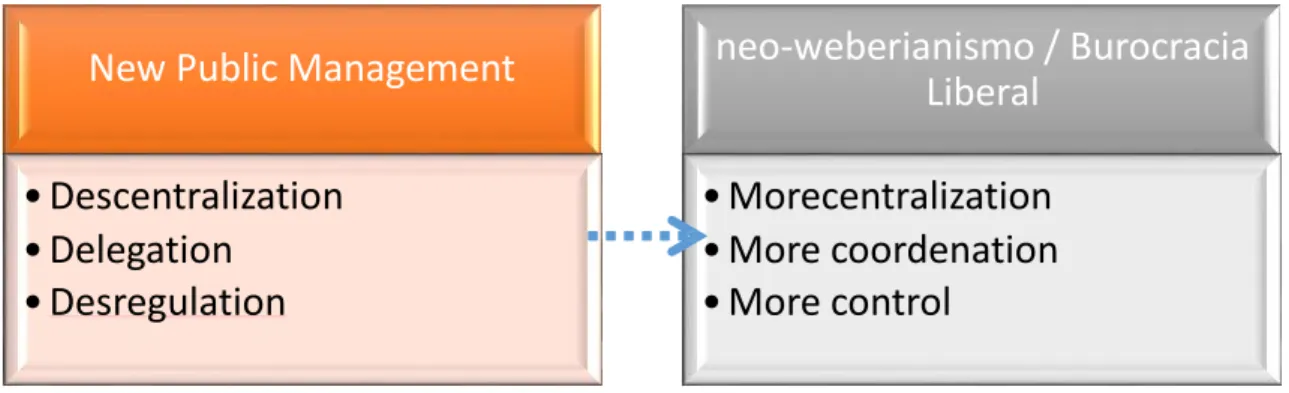
(10) The selection of Senior Civil Servants in the context of the different public administration models: an issue of accountability? Study Group IX: Civil Service and Politics. Weberian Bureaucracy • Centralization • Coordenation • Control. New Public Management • Descentralization • Delegation • Desregulation. Figure 3: Opposition between the guiding principles of the Bureaucratic Model and the New Public Management. The New Public Management, with its expansion to most Western countries, became the hegemonic model and seen by many governments as the ideal type model, having been "trendy" until recently. In Portugal some authors as Isabel Corte-Real (2001) , fall into the adoption of New Public Management in a subtype of New Public Management that Pollitt and Bouckaert (2004) termed as neo-Weberian state, that best characterized a set of countries (Continental European modernizers group) meet the specifics of reform. The truth is that, this time, were still to be done, in Portugal, a very significant part of management reforms including the introduction of SIADAP, the new Law Links, Careers and Remuneration Committee, assisted by the new Scheme of Work Contract in Public functions and PRACE. Such reforms approached the Portuguese public administration who were the original principles of New Public Management resulting in the end of the government of José Sócrates, the theoretical point of view rather than practical, the completion of the reform of the central public administration, in accordance with the original designs of the New Public Management (Magone, 2011). Exception is however, this reform, one of the main assumptions of running the New Public Management: the professionalization of management. In fact, during the reform of Portuguese public administration, public management continued to be politically appointed, subject to some [few] top management positions. Thus, the full adoption of the theoretical point of view of the principles of NPM, placed Portugal in the range of criticisms that, by this time (the early 2000s) , and in particular in the context of a crisis that had begun to draw and worse, were made to the model of New Public Management, in particular the inability of governments to control and coordinate structures under the New Public Management, and which had been given autonomy within the framework of administrative decentralization, deregulation of the economy and the delegation of powers. This inability of coordination and control by governments, autonomous structures (administrative and financial) that they had created, complemented by a failure to budget box and mounting debt, leads to a significant increase in state spending making it, since under NPM, interestingly and contrary to what had been advocated by NPM, very inefficient.. David Ferraz. Page 10.
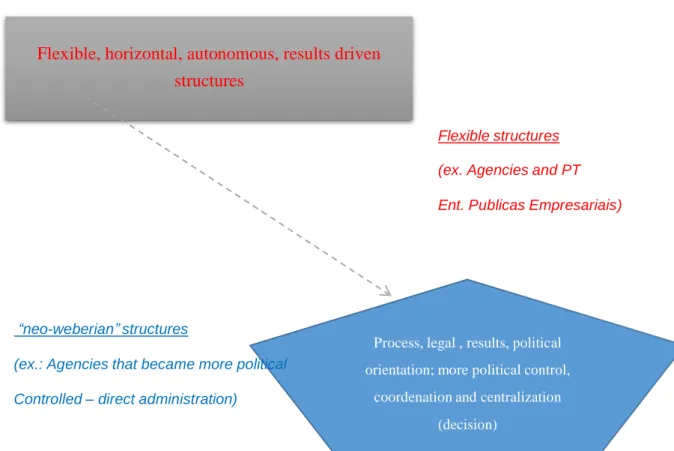
(11) The selection of Senior Civil Servants in the context of the different public administration models: an issue of accountability? Study Group IX: Civil Service and Politics. 3.3. From New Public Management to neo-Weberianism Such deterioration of public finances in the context of a crisis that has tended to worsen and extend to several countries in Europe and the world, made the criticism made to the New Public Management, the international space had increasingly more eco, not least because its main objective of reducing the weight of the state and make it more efficient, was not fully achieved. In this framework arise from alternative suggestions administrative organization which stressed the need for governments, legitimately elected, regain control and coordination of public institutions that enjoy some autonomy, so that the financial costs are subject to a much stricter supervision. It is in this context that some authors (Emery and Giauque 2001, Drechsler 2005, Giauque, Resenterra et al. 2009, Giauque, Resenterra et al. 2010) suggest that the control and coordination of the administrative machine could be at the expense of a smaller and decentralization / or delegation because there need to promote the centralization of the decision and, to some extent, the structures (neo) bureaucratic (see Figure 4).. New Public Management • Descentralization • Delegation • Desregulation. neo-weberianismo / Burocracia Liberal • Morecentralization • More coordenation • More control. Figure 4: Return to some of the guiding principles of the Bureaucratic Model Among us, and considering only the most recent reforms of public administration initiated by the present government in response to the crisis, it seems, in particular through a preliminary analysis to PREMAC without it can still analyse its effects, that this is a movement aimed, in Portugal, the greater centralization, coordination and control. In the background we speak of the loss of autonomy of flexible structures (Public Institutions and Public Entities Business) and greater centralization and / or coordination, not least the implementation of the memorandum of understanding with the troika and the consequent measures approved and then we shall speak (Figure 5).. David Ferraz. Page 11.
(12) The selection of Senior Civil Servants in the context of the different public administration models: an issue of accountability? Study Group IX: Civil Service and Politics. Flexible, horizontal, autonomous, results driven structures Flexible structures (ex. Agencies and PT Ent. Publicas Empresariais). “neo-weberian” structures Process, legal , results, political (ex.: Agencies that became more political Controlled – direct administration). orientation; more political control, coordenation and centralization (decision). Figure 5: Return to some of the guiding principles of the Bureaucratic Model This turns out to correspond to a certain setback (as some authors claim, not necessarily negative) in the consolidation of the New Public Management model, apparently springing a greater stimulus to centralization, coordination and political control. Evidences of a certain centralization and coordination, under the current reforms were: 1.. Reduction Plan and Improvement of Central Government – PREMAC (Portugal 2011) , with. the following goals:. a. Reduction and rationalization of the structures of State (Agencies and public enterprises) , acts. b. Promote a better use of human resources in the state. c. Reduction of at least 15% of Ministries structures and, consequently, reduction of at least 15% of the number of senior civil servants positions, both n upper level and medium ones. Note: This purpose was on the Troika’ Memorandum There was a decrease on the indirect administration (-23%) , fulfilling the objective set out in the application of PREMAC (report Portugal 2011) : "Overcome the existing challenges in the organization of the central state administration depended much more on a swift and firm decision-making and monitoring and strict control of its actual implementation, rather than. David Ferraz. Page 12.
(13) The selection of Senior Civil Servants in the context of the different public administration models: an issue of accountability? Study Group IX: Civil Service and Politics. the comprehensive reassessment of existing diagnostic and review applicant of the various analyzes that have been addressed in the past. This was the fundamental principle of action of PREMAC. ". 2.. Previous pronunciation of the Government members responsible for Finances, every time. that an administrative contract renew or acquisition over 5000€ was intended (Portaria n.º 9/2012, de 10 de Janeiro - (PORTUGAL 2012) ). Determined the mandatory binding request for prior pronunciation of the Cabinet members responsible for finance and administration to all procurement of services, particularly in terms of task and retainer and or whose object is the technical adviser, in particular legal, architectural, engineering or computer science, awarded by agencies and services within the scope of Law no. No.12-A/2008, February 27, 5000 except for contracts below EUR (excluding VAT) , training with less than 132 hours, procurement of services whose execution is complete within twenty days of notification of award, but must report to the Minister responsible for finance and Public Administration by the end of the month following that in which they award the contracts. The following point will relate the evolution of organizational models with the configurations of model of selection and accountability of senior civil servants.. 4. Policy, Management and organizational settings: implications for models of administration and accountability in the selection of leaders We have ssen in the preceding paragraphs, the model of public administration chosen to promote the public interest is not indifferent to the administrative principles of centralization vs. decentralization, coordination and control VS delegation and management freedom. Depending on the choice, there will be more or less centralized, more or less coordinated and more or less control by the political and administrative actors in the decisions taken by the government and its leaders. Consequently, the ways of effecting responsibilities, whether political or administrative, the results achieved, it is also distinct. Thus, a more or less centralized, more or less coordinated and more or less control by the political and administrative actors assumes different configurations organizational, political and administrative settings different, and also different assumptions selection and accountability public managers (Table 1).. David Ferraz. Page 13.
(14) The selection of Senior Civil Servants in the context of the different public administration models: an issue of accountability? Study Group IX: Civil Service and Politics. Table 1: Main characteristics of Administration Models Bureaucratic. New Public. Model. Management. Neo- Weberianism /. Liberal. Burocracial. Operating Assumptions. Decentralization,. Hierarchical,. Greater. centralized model that delegation, contracting. centralization,. promotes. coordination. from. coordination goals. the. top. ensuring. while. and. control in order to. control. mitigate. mechanisms. excesses. the of. too. autonomous structures Organizational. Hierarchical, pyramidal. Flexible - Horizontal. Combining. configuration. hierarchical structure with some degree of autonomy and accountability. Model selection of. Political (Trust). Neutral. appointment. competition. Hybrid: political. (merit). leaders Accountability. For. compliance. with By. rules and procedures. under. Political; renew or not the Commissions. fulfilling. results, Hybrid / shared:. management. contracts Political. Service (Evaluation of results /. and. professional. on objectives). electorate cycle Source: Own construction. Thus, associated with Bureaucratic, hierarchical and centralized model, based on a pyramidal organizational setting, was the appointment of political leaders and a consequent accountability for complying with rules, procedures, policies or standards and guidelines, primarily within the electoral cycle, since appointments were political (not necessarily in line with the envisaged in theory). With the reform of the bureaucratic model and the emergence of the New Public Management, which became the hegemonic model a significant part of Western countries, without prejudice to. David Ferraz. Page 14.
(15) The selection of Senior Civil Servants in the context of the different public administration models: an issue of accountability? Study Group IX: Civil Service and Politics. the particularities of each (Lane 2000, Drechsler 2005, Pollitt and Homburg 2007, Kickert 2011) the assumptions of the accountability of managers began to be linked to the achievement of results (Hoggett 1991) , formalized in management contracts (in Portugal through instruments such as Letters of Mission, the QUAR and SIADAP) , with primacy to the values of decentralization, freedom of decision and deregulation. Accountability is therefore taken based on the achievement of certain results previously contracted with political power. Already under the neo-Weberian model / Liberal Bureaucracy, which criticizes the excessive decentralization, deregulation and uncoordinated management, with a consequent reduced control by the State (Drechsler 2005) [not by the fault model, but omissions of Governments in its implementation], seem to favor it more "traditional" models, based on centralization, coordination and control by management and political power (Drechsler 2005) , as would seem to indicate some of the decisions taken by the present government in the implementation of PREMAC and opinions prior to contracting services above 5000 euros (without VAT). If under the model of bureaucratic leaders tended to be selected in practice by political criteria and accountability measured by compliance with rules, guidelines and procedures in the temporal context of the electoral cycle, with the New Public Management selection shall be based on professional criteria (procurement) and accountability to be made depending on the results achieved by comparing the contracted, although in Portugal the trend to professionalize management functions take place only in 2011 with a new paradigm of government and accountability to be far. Be aware that with the approval of the new status of the senior staff in December 2011, the directors shall be selected by tender carried out by the Committee on Recruitment and Selection for Public Administration, among subjects who completed the degree opening date the competition for at least 12 years (Grade 1) or 8 years (2nd Grade) , linked or not to the Public Administration, "with technical competence, fitness, work experience and necessary skills to perform their job functions" (Law No. 64/2011). Whereas a number of reforms in the Portuguese AP today near our administration model to neoWeberian model and based on the new system of selecting leaders into force with the approval of Law No. 64/2011, it should reflect on a political setting administrative-not only to promote the professionalization of the leaders but also their accountability in a context of apparent (neo) bureaucratization of management which aims to eliminate some discretion and freedom, "excessively" promoted the ideals of decentralization, deregulation and autonomy of New Public Management. At this level, Portugal is in line with the major Western countries and the authors who have criticized the limited control and central coordination arising from the adoption of the New Public Management. However, let us not forget, that the model of accountability for objectives based on the ability of the leader to influence the direction of the results and therefore to be fully responsible, must have the necessary autonomy (political) within the structures more closely to the ones identified when speaking of the New Public Management (see Figures 3 and. David Ferraz. Page 15.
(16) The selection of Senior Civil Servants in the context of the different public administration models: an issue of accountability? Study Group IX: Civil Service and Politics. 4 and Table 1). Instead, with policies, or excessive centralization appointments will be difficult responsibility for results, since leaders tend to argue that professionals and management objectives have not been achieved through policy and / or political interference constraints / lack of resources in which case, political accountability and model selection of the appointment. It is recalled, however, that it is assumed that a superior officer, when applying for a function steering, accepts the objectives and guidelines set for it, under a set of budgetary and human resources that will be made known resources.. Portuguese case study In Portugal, the politicized model was the dominant system till 2011. The dictatorial regime until 1974 didn’t allow a separation between politics and administration. After 1974, the new Senior Civil Servants’ statutes referred that senior civil servants were trust-positions in administration. Only in 2005, the Law 51/2005 established some posts that should be more professionalized. However it was stated that some posts still remained politicized: . General director. . Sub-.general director. . Agencies Presidents. . Agencies Vice-Presidents. . Commissar. . General Inspector. . Sub- General Inspector. . Civil Governor. . Other Senior Civil Servants that work directly to the government. As noted by Madureira (2006:41) at that time it seems that the new statute brings some will to control and evaluate the appointments of senior civil servants. In 2011, with the Law n.º 64/2011, with a new government, and under the pressure of the financial crisis, the managers statutes was once again change but, this time, in order to change from a political selection of the senior civil servants to a more professionalized system. The effects of such a change are still waiting for impact but its universally accepted that the transparency on the selection process have increased. Although its not yet possible to evaluate the impact because many of the competitions to select senior civil servants are still running, we can evaluate the selection process of senior civil servants till there. Based on the study of the Portuguese case, we tried to study the criteria that most influenced the choice of leaders and their perceptions regarding governance and governance systems. The unit of analysis in this study is constituted by public officers of the Portuguese government appointed in terms of the Staff Director.. David Ferraz. Page 16.
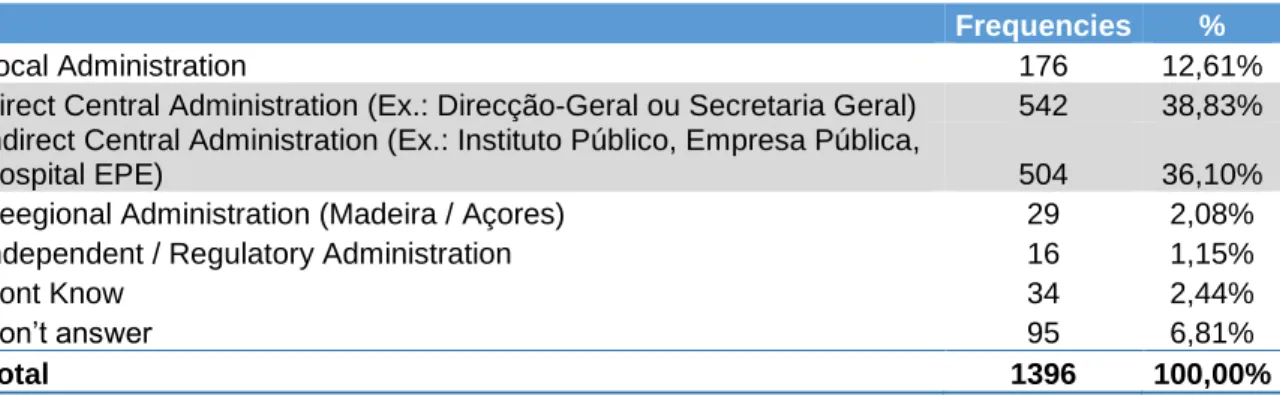
(17) The selection of Senior Civil Servants in the context of the different public administration models: an issue of accountability? Study Group IX: Civil Service and Politics. Failing access to all public officials in office, observation units were built up, based on these public officials who received training in INA and ISCTE- IUL, between 2004 and 2009.. Table 2: Gender Frequencies % 724 51,86% 672 48,14% 1396 100,00%. Female Male Total. Table 3: Sample Age group. 20 - 30 years 31 - 35 years 36 - 45 years 46 - 55 years 56 - 60 years 61 - 65 years Plus than 65 years Total. Frequencies 10 67 486 574 205 44 10 1396. % 0,72% 4,80% 34,81% 41,12% 14,68% 3,15% 0,72% 100,00%. Table 4: Sample Type of administration. Local Administration Direct Central Administration (Ex.: Direcção-Geral ou Secretaria Geral) Indirect Central Administration (Ex.: Instituto Público, Empresa Pública, Hospital EPE) Reegional Administration (Madeira / Açores) Independent / Regulatory Administration Dont Know Don’t answer Total. Frequencies 176 542. % 12,61% 38,83%. 504 29 16 34 95 1396. 36,10% 2,08% 1,15% 2,44% 6,81% 100,00%. Table 5: Sample Political Affiliation. No Yes Don’t answer Total. David Ferraz. Frequencies % 991 70,99% 136 9,74% 269 19,27% 1396 100,00%. Page 17.
(18) The selection of Senior Civil Servants in the context of the different public administration models: an issue of accountability? Study Group IX: Civil Service and Politics. Table 6: Sample Acceptance of political positions in future Frequencies % 659 47,21% 737 52,79% 1396 100,00%. No Yes Total. Table 7: Sample Acceptance of ministerial assessor position in future (cabinet). Yes No Don’t Know Don’t answer Total. Frequencies 436 399 431 130 1396. % 31,23% 28,58% 30,87% 9,31% 100,00%. The Following tables present the inquiries results and the and their perception regarding the political-administrative relation in the context of the public administration reforms.. Table 8 Reforms in recent years contributed to the leaders of the public administration had greater power in big decisions. Totally agree Agree Disagree Totally disagree Don’t Know Don’t answer Total. Frequencies. %. 8 254 591 105 127 311 1396. 0,57% 18,19% 42,34% 7,52% 9,10% 22,28% 100,00%. Table 9: There must be a clear and transparent separation between political and administrative functions. Frequencies % Totally agree Agree Disagree Totally disagree Don’t Know Don’t answer. 515 475 50 1 39 316. 36,89% 34,03% 3,58% 0,07% 2,79% 22,64%. Total. 1396. 100,00%. David Ferraz. Page 18.
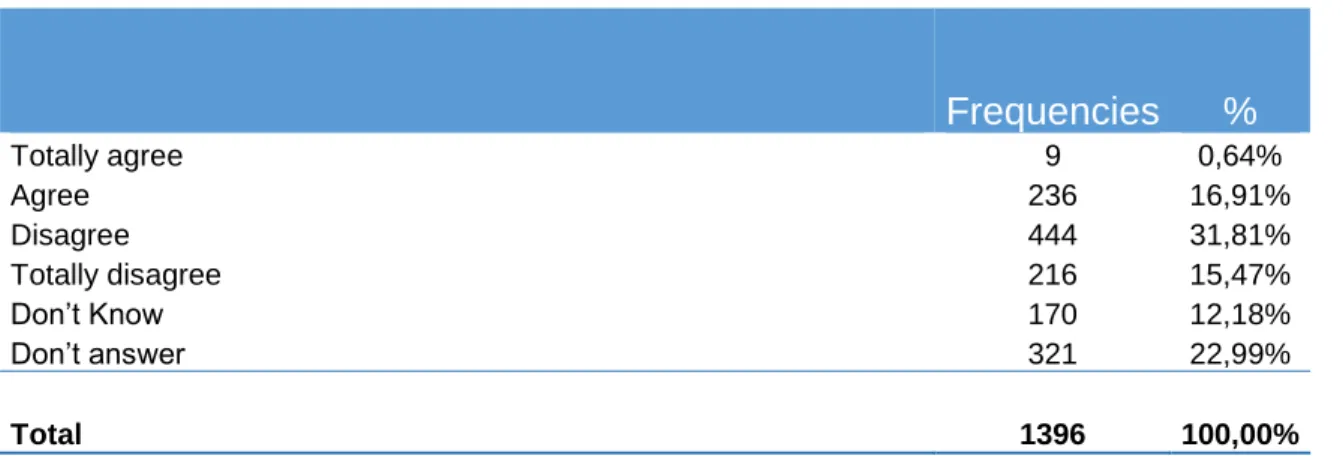
(19) The selection of Senior Civil Servants in the context of the different public administration models: an issue of accountability? Study Group IX: Civil Service and Politics. Table 10: The Government does not interfere in the application of public policies. Frequencies % Totally agree Agree Disagree Totally disagree Don’t Know Don’t answer Total. 25 116 620 213 106 316 1396. 1,79% 8,31% 44,41% 15,26% 7,59% 22,64% 100,00%. Table 11: Accordance to recent reforms impact on greater freedom to act and make decisions at administrative level. Frequencies. %. Totally agree Agree Disagree Totally disagree Don’t Know Don’t answer. 9 236 444 216 170 321. 0,64% 16,91% 31,81% 15,47% 12,18% 22,99%. Total. 1396. 100,00%. David Ferraz. Page 19.
(20) The selection of Senior Civil Servants in the context of the different public administration models: an issue of accountability? Study Group IX: Civil Service and Politics. Conclusion Considering the description given in relation to the changing patterns of Directors in the world in general and in particular in Portugal, seems to be clear that recent years have taken place numerous reforms that tended to reform the model of bureaucratic administration and give rise to the model the New Public Management. However from 2011, in Portugal, with a new government, and with the need to implement the Troika’ Plan, it seems that some decisions were takent to increase the coordination and monitoring power at the central level, falling more to the logic of neoWeberian model / Liberal Bureaucracy, tending to a certain centralization. The study performed in Portugal suggests: 1.. There is a relative equal distribution in terms of gender in public managerial functions in Portugal. 2.. Almost 60% of the public managers have more than 46 years old. 3.. About 71% of the Portuguese public managers do not have political affiliation, but 53% would accept a political position in the future. 4.. Almost 50% of the Portuguese public managers totally disagree or disagree with the affirmation that “Reforms in recent years contributed to the leaders of the public administration had greater power in big decisions”; only 19% agree or totally agree. 5.. 70% agree or totally agree that “There must be a clear and transparent separation between political and administrative functions”. 6.. Only 9% Agree or totally agree that with the affirmation that “The Government does not interfere in the application of public policies”. 7.. Only 17% agree or totally agree with the affirmation that “impact on greater freedom to act and make decisions at administrative level”. It should be noted however that, and specifically taken into consideration the specificities of NPS and the governance model, the important thing is, as we tried to explain, understand that each model has different principles and assumptions that affect the functioning of the public administration structure, particularly at the level of structures and administrative settings (direct vs. indirect administration) and, inside these macro settings, the most hierarchical and more flexible structures tend to provide different ways of enforcing responsibilities. Under the pressure of public administration reform issues must be attend in the changes of managerial models, especially with regard to the organizational settings and the politicaladministrative configuration (and consequential the forms of recruitment and selection of public officials) that are related to different forms of accountability. No individual measures should be approved if they are not contextualized in the presented framework of interrelations and variables (that influence and are influenced).. David Ferraz. Page 20.
(21) The selection of Senior Civil Servants in the context of the different public administration models: an issue of accountability? Study Group IX: Civil Service and Politics. References. Aberbach, and JD et al. (1988).Image IV Revisited: Executive and Political Roles. Governance. 1: 1-25. Aberbach, JD, RD Putnam and BA Rockman (1981). Bureaucrats and politicians in western democracies. Cambridge, Mass. Harvard University Press. Bellier, Irène (1993) , L’ENA Comme si vous y étiez, Paris: Éditions du Seuil. Bilhim, J. (2001). "Organizational theory: structures and people." Lisbon: ISCSP. Bilhim, J,.Ed (2000). Administration Science. Lisbon, Open University. Blau, PM (1956). Bureaucracy in modern society. New York, NY, Random House. Bonosaro, Carol (2000) , The United States Career Executive Service: Its operation and role in policy, in: 5º Congresso Clad, Santo Domingo. Chevallier, Jacques (2002) , Science administrative, Paris: PUF. Crozier, M. (1967). The bureaucratic phenomenon. Chicago, Ill., University of Chicago Press. Dimock, ME (1959). Administrative vitality. New York, NY, Harper & Brothers. Dowding, Keith. (1995) , “Policy-Making: Civil Servants in the Cross Fire” in The Civil Service, London: Routledge, Cap. 6, pp.108-128. Downs, A. (1978). Inside bureaucracy. Boston, Mass., Little. Drechsler, W. (2005). "The Rise and Demise of the New Public Management." post-autistic economics review (33). Dunleavy, P. (1991). Democracy, bureaucracy and public choice. Hemel Hempstead, Harvester Wheatsheaf. Emery, Y. and D. Giauque (2001). "New Public Management, Service Contracts and Financial Incentive Schemes: Practice and Problems Encountered in Switzerland." International Review of Administrative Sciences 67. Ferraz, D. (2009). "THERE IS SPACE FOR HYBRID MODELS MANAGEMENT OF SENIOR CIVIL SERVICE ACROSS POLITICAL- ADMINISTRATIVE SYSTEMS?" VIEŠOJI POLITIKA IR ADMINISTRAVIMAS : 57-67. Ferraz, David (2008) , “A selecção de dirigentes públicos no contexto da evolução dos modelos de Estado e de Administração” – working paper, not published yet Ferraz, David e Madureira, César (2006) , Modelos de Formação de Dirigentes Públicos - Análise Comparativa, Caderno INA 27, Oeiras: INA. FLINDERS, M. (2009). "The Politics of Patronage in the United Kingdom: Shrinking Reach and Diluted Permeation." Governance 22 (4) : 547-570. Giauque, D., and F. Resenterra Siggen M. (2009). "Modernization routes and relations between political and administrative spheres in Switzerland." International Review of Administrative Sciences, pp. 687-713 vol. 75: Giauque, D., and F. Resenterra Siggen M. (2010). "Modernization routes and relations between political and administrative spheres in Switzerland." International Review of Administrative Sciences 75 (4) :687-713. Hart, P. t. and Wille A. (2006). "Ministers and Top Officials in the Dutch Core Executive: Living Together, Growing Apart?" Public Administration 84 (1) : 121-146. Hoggett, P. (1991). "The New Management in the Public Sector." Policy and Politics 19 (4) : 243256.. David Ferraz. Page 21.
(22) The selection of Senior Civil Servants in the context of the different public administration models: an issue of accountability? Study Group IX: Civil Service and Politics. Hood, C. (1991). "A Public Management For All Seasons?" Public Administration 69 (1) : 3-19. Hood, C. (1995). "The" new public management "in the 1980s: Variations on a theme." Accounting, Organizations and Society 20 (2-3) : 93-109. Kickert, W. (2011). "Distinctiveness OF ADMINISTRATIVE REFORM IN GREECE, ITALY, SPAIN AND PORTUGAL COMMON CHARACTERISTICS OF CONTEXT, AND Administrations reforms.." Public Administration 89 (3) : 801-818. Lane, J.-E. (1987). Bureaucracy and public choice. London, Sage. Lane, J.-E., Ed (2000). New Public Management. London, Routledge. LeeE, K.-H. and RAADSCHELDERS JCN (2008). "Political-Administrative Relations: Impact of and Puzzles in Aberbach, Putnam, and Rockman, 1981." Governance 21 (3) : 419-438. Madureira, C. and D. Ferraz (2010). "SETTINGS POLITICAL AND ADMINISTRATIVE OFFICER SELECTION." Sociology, Problems and practice : 51-69. Madureira, César e Rodrigues, Miguel (2006) , “A evolução das formas de recrutamento e de avaliação do desempenho dos funcionários e dos dirigentes da Administração Pública portuguesa - contributos para a reforma administrativa”, Sociedade e Trabalho, Nº 29, 41-54 Magone, JM (2011). "DIFFICULT THE TRANSFORMATION OF STATE AND PUBLIC ADMINISTRATION IN PORTUGAL AND THE PERSISTENCE OF Europeanization NEOPATRIMONIALISM.." Public Administration 89 (3) : 756-782. Mouzelis, NP (1975). Organisation and bureaucracy. London, Routledge & Kegan Paul. Mozzicafreddo, Juan, e Salis Gomes (orgs.) (2001) , Administração e Política: Perspectivas de reforma da Administração Pública na Europa e nos Estados Unidos, Oeiras, Celta Editora. Mulgan, Richard (2007: 569-586) , “Truth in Government and the Politicization of Public Service Advice”, in Public Administration, vol. 85, nº3, 2007, pp. 569-586. Noordegraaf, M. (2007). "From" Pure "to" Hybrid "Professionalism: Present-Day Professionalism in Ambiguous Public Domains." Administration Society 39 (6) : 761-785. Nunes, Filipe (2000) , Os Directores Gerais: A elite Administrativa Portuguesa em Março de 2000, Apresentação de Tese de Mestrado, Instituto de Ciências Sociais da Universidade de Lisboa. Ostrom, E. V. and Ostrom (1971). "PUBLIC CHOICE – DIFFERENT APPROACH TO STUDY OF PUBLIC ADMINISTRATION." Public Administration Review 31 (2) : 203-216. Perrow, C. (1972). Organizational Analysis: A Sociological approach.São Paulo, Ed Atlas. Peters, B. Guy (1987) , “Politicians and bureaucrats in the politics of policy-making” in Lane, JanErike, Bureaucracy and Public Choice, London: Sage, pp. 256-282. Peters, B. Guy (1997) , “Policy Transfers Between Governments: The case of Administrative Reforms Lawrence, Kansas”, West European Politics, Vol.20, n.4, Outubro, London: FrankCass, pp.71-88. Peters, B. Guy (2001) , The Politics of Bureaucracy, 5ª ed. - London: Routledge. Peters, TJ and RH Waterman (1982) In search of excellence: lessons from America's best-run companies. New York, Harper & Row. Pitschas, Rainer, (2006) , Trusted Governance due to Public Value Management, Frankfurt: Peter Lang. Pollitt, C. and G. Bouckaert (2004). Public management reform: a comparative analysis. Oxford, Oxford University Press. Pollitt, C. and V. Homburg (2007). The new public management in Europe, Palgrave. Portugal (2011). Reduction Plan and Improvement of Central Government (PREMAC). Portugal. Portugal (2011).Report and Improvement Plan for the Reduction of the Central Government. PUBLIC GDSDEDA. Lisbon, Ministry of Finance : 23.. David Ferraz. Page 22.
(23) The selection of Senior Civil Servants in the context of the different public administration models: an issue of accountability? Study Group IX: Civil Service and Politics. PORTUGAL (2012). Ordinance no. 9/2012 of January 10 M. d. Finance. Lisbon, Portugal. Real, IC (2001). Rock, JAO (2009). Administrative Modernization and Public Rocha, J.A. Oliveira (2005a.) , Gestão de recursos humanos na administração pública, Lisboa: Escolar Editora. Rosenbloom, D. (2008). "The Politics Administration Dichotomy in U.S. Historical Context." Public Administration Review 68 (1) : 57-60. Rouban, L. (2004) “Politicization of the civil service in France: from structural to strategie politicization” from Peters, B. G. and Pierre, J., Politicization of the Civil Service in comparative perspective pp.1-2, Routledge. Shepherd, Geoffrey (2007) , Managing the Top Officials: Some International Experience. [Manuscrito não publicado cedido pelo autor, a pedido, por e-mail em Abril de 2008] Wilson, W. (1887). "The Study of Administration." Political Science Quarterly 2 (2).. David Ferraz. Page 23.
(24)
Imagem

+6


Documentos relacionados