RESEARCH ARTICLE
The rise and fall of Brazil
’s public security program: PRONASCI
Marco Aurélio Ruediger*Fundação Getúlio Vargas, Rio de Janeiro, Brazil
This study focuses on political and administrative issues in program design in a complex federal system. It examines the rise and fall of Program for Public Security with Citizenship (PRONASCI) in Brazil. This innovative, even radical combination of police reform and social change targeting crime and police practices in the nation’s poorest communities was launched as a national policy in a country – like the USA and other large democracies – with a strong federal constitutional frame-work. Although it was successful in many aspects, it ran afoul of a political and bureaucratic process tugging between innovation and conservatism and eventually collapsed, not on its merits but in the face of policy implementation issues that may be found more generally in the domain of police reform. One lesson of PRONASCI is that the reform process must take into account bureaucratic interests, the stance of the media, and opportunities that emerge at crucial moments in the political process. It also must sustain the commitment of political elites to the necessity of pursuing change.
Keywords: Brazil; police reform; public administration; federalism; political process; social development
Introduction
Brazil’s National Program for Public Security with Citizenship (PRONASCI) – was launched in August 2007 during President Luiz Inácio Lula da Silva’s second term, by the then Minister of Justice of Brazil, Tarso Genro. It had a planned budget of US $3 billion and its objective was to develop a range of new preventative and deterrent strat-egies for policing, including the expansion of effective citizenship to the lower reaches of society, enhancing the professional status of public security employees, and focusing new resources on areas with high levels of crime and low social cohesion.
Ninety-six specific projects were proposed under the program, which together formed a systematic effort to increase the operational capacity of state police forces, and – at the local level – to combine an increase in community-oriented policing with an expansion of activities focused on the historic low levels of civic participation and social development in poor areas. In particular, it was aimed at insulating socially vul-nerable young people from the drug trade. In short, it was intended to move policing closer to the community, build citizenship and participation at that level, and attack and undermine crime networks. As a whole, these approaches would reduce levels of crime by undermining its foundations and co-opting its potential participants.
When it was created, this initiative represented an innovative, even radical new direction for the criminal justice system, and one that was extremely novel for Brazil’s
*Email: [email protected]
–294, http://dx.doi.org/10.1080/15614263.2013.816488
federal government. As in many federal systems, public security in Brazil had been largely a prerogative of state governments. The federal government had previously avoided direct intervention in policing in the nation’s large metropolitan centers. By participating more actively in this sector, it was seeking to respond to increasing demands of society for action, even though this necessarily – and not by chance – would expand federal influence and the possibility of intervention at the state and municipal levels through controlling the use of new federal funds. This had to be done very carefully however, given Brazil’s federal government structure.
Therefore, it was decided that this involvement in traditionally local functions should follow a‘federative’ approach, rather than being case as a federal intervention in local affairs. This was of fundamental importance in the Brazilian case, because, as in the USA, the political structure assumes a high degree of regional independence, with layers of executive prerogative within sub-national units. By developing a program in a policy area that was widely known to be within the scope of the states of the Brazilian federation, the control of significant federal funds threatened to undermine this auton-omy, since it restricted the options open to states interested in obtaining funding. It was a mechanism for the national Ministry of Justice to exercise ‘soft power’ at the local level.
In parallel to the program, the Ministry of Justice constructed a web-based system aimed at monitoring and assisting the evaluation of PRONASCI. This was not done only in regard to the use of the funds provided; in addition qualitative and quantitative empirical research was also conducted to measure perceptions of the program among the social sectors it affected and participation in them.1
However, there were serious flaws in the design of PRONASCI. The complexity of this program was not effectively managed by the techno-bureaucracy in the Ministry of Justice. Nor, at the same time, was PRONASCI initially designed to accommodate the traditional policy concepts of Brazilian state governments in terms of public security.
The program was designed to represent a change in the paradigm for public security by a sophisticated and daring faction of President Luiz Inácio Lula da Silva’s Partido dos Trabalhadores (Workers’ Party, or PT). They proposed an experiment in the radical transformation of the Ministry of Justice and tightening a bureaucratic machine not accustomed to programs of such complexity and deep penetration into the affairs of the Brazilian states. Common wisdom in the Ministry of Justice’s bureaucracy and in state security agencies was that the ministry would only expand the traditional scope of federal policy, which was to support the acquisition of equipment by the states and repressive actions by the federal police and the federal highway police, especially those directed at drug trafficking and border control.
However, what was new was the idea of a strategy promoting structural changes in the bureaucratic machinery as well as of the substance of policies in this area, espe-cially those aimed at promoting the welfare of segments of society such as women, young people, former members of the armed forces, and persons recently released from prison. Needless to say, the introduction of the concept of community policing, and new police training support community oriented work, also presented a shock to the system.
Although initially successful, PRONASCI faced continuous resistance from seg-ments of the bureaucracy and was eventually impacted by a change in the set of actors that supported it, and by changes on the policy implementation process. These had devastating effects on the continuity of the program. This drama came to a head in the 2012 Brazilian budget, when funds for the program were reduced practically to zero.
The aim of this article is this to examine the development, outcomes, contradictions, and eventual demise of PRONASCI. The first stage was positive, illustrating that under certain conditions it was possible to develop and implement an innovative federal pol-icy dealing with historically local public security issues in a strongly federal environ-ment. The second stage turned negative. PRONASCI’s progress slowed and the program was eventually dismantled due to a confluence of political factors linked to a bureaucratic struggle between those supporting the new model and forces favoring the old regime.
I also intend to call attention to the conditions under which this kind of innovative political design can be threatened, so policy-makers and academics will be better attuned to how policy can be strategically insulated and avoid being dismantled. I will highlight the contradictions and conditions which eventually killed PRONASCI, empha-sizing the importance of such factors as the ability of the bureaucratic machine to throt-tle and resist programs that were contrary to its culture and the survival of structures of power consolidated through more formal practices of policy management.
But while it is correct that PRONASCI encountered difficulties and did not survive more than four years, it is important to highlight that it spawned a number of enduring and successful (thus far) spin-off projects, such as the UPPs in Rio de Janeiro state.2 Those projects, in turn, were successful in placing the concept of community policing on top of the public agenda, and community policing was one of the centerpiece ele-ments of PRONASCI. This not only created important policy results – as in the case of the police in Rio de Janeiro state – but also helped this state and its capital – Rio de Janeiro City – to win international competitions to host such important events as the 2014 World Cup and the 2016 Olympics. These in turn are calling forth significant new federal and international investment in different economic sectors in the region.
In the case of Rio de Janeiro, the concept of community policing, as well as the social actions of the state and city governments, became paradigmatic of a new approach to public security. Although less daring than what was proposed in the failed federal PRONASCI project, the UPPs have been a relatively successful experiment that have gained a high degree of public support.
As a methodological synthesis, I adopt here an approach based on the analysis of key events and pivotal changes in the political process that determine the construction of policy during a brief historical period and, which, at least potentially, provided an opportunity to construct new policy agendas. The analysis of this process involves spec-ifying the context and key actors, identspec-ifying the activities which unite them and events that develop along the way, as well as modeling the decision-making process in a sys-tematic manner. This approach is centered on strategic political actors and pivotal moments for changing policy processes (Barzelay & Gallego, 2010).
We examine them in the course of dynamic processes: dealing with one another, with resources that rise and fall, with events, and within the contexts in which they operate. These together create a menu of policy possibilities and potential windows of opportunity, including perhaps fairly dramatic alterations of the status quo. As we will see, PRONASCI was created and then dismantled as a result of the political forces emerging to fill two windows of opportunity produced by the political process and operated by gifted policy entrepreneurs. We thus structure this discussion around those two pivotal moments, within a temporal grid of events and the influence of actors in interaction. Secondarily, we also considered the Toquevillean perspective expressed by Evans, Rueschemeyer and Skocpol (1985), in terms of the intended and unintended effects of public policies, in this case of the spin-off effects of PRONASCI.
What can be seen from this conceptual and empirical policy effort is that a very complex program was necessary to address solutions to problems in contexts that are also complex and involve multiple causalities. Nevertheless, the success of any program is not only found in its design or in the effectiveness of its implementation and funds disposed, but also in its acceptance by the bureaucracy. At this point there were politi-cal errors in PRONASCI. A vision of this program as the solution for public security in Brazil did not come up as a key issue on the agenda contested during the 2006 presi-dential campaign, which led to President Lula’s second term, although public security as an issue was debated. It was designed and implemented only during 2007–2010. It also did not gain enough traction among key members of the bureaucracy who were responsible for its sustainable implementation. Finally, it had no relevance for the next presidential election in 2010.
To the contrary, the program threatened innovation which the Ministry of Justice and its bureaucratic agents were incapable of absorbing, and as a result they did not want to insert it into the agenda for debate during the presidential campaign and in pol-icy discussions after the election of a new president.
In this paper, I first look in more detail to the political genesis of PRONASCI. Then, I will explain the policy that emerged. Then I will describe its demise, a circum-stance that is not frequently discussed by students of policy-making. As a conclusion, I will consider PRONASCI as a case for reference, in both positive and negative ways, for studies of policy implementation.
The political genesis of PRONASCI
After resolving to a certain degree historical problems related to economic development and social justice which had been prevalent for many decades, Brazilian society has been undergoing an apparently sustainable process of economic growth and low infla-tion. It needs to be taken into account that, during its history, Brazil built an effective state apparatus linked to the promotion of development along many dimensions. A basic social welfare system has existed in Brazil since the 1930s, and this had the impact of strengthening state structures and a professional bureaucracy. As noted by Amsden (2001) in her analysis of later-developing nations, countries that rose toward the top achieved this because they were able to articulate development policies in which a strong national state was the central actor. Included on her list of rising nations is Brazil. In addition, Brazil was also (somewhat episodically) a democratic country, aligned with Western nations.
Nevertheless, despite the existence of a state apparatus which strengthened over time and the nation’s general path toward development, Brazil underwent repeated cycles of development and stagnation until the middle of the 1990s, with resulting serious social asymmetries, even though some of these have recently been somewhat mitigated.
Following this, most notably during Luiz Inácio Lula da Silva’s two administrations (2003–2010), a strategy of encouraging development with greater social inclusion of the poor was pursued. Above all this was aimed at strengthening low income groups, with a consequent increase in their well-being and an expansion of the domestic Brazilian market. These policies raised the consumption levels of 30 million Brazilians consid-ered as poor, altering Brazil’s political and economic equation and moving a large part of the population into the lower middle class (Neri, 2011).
Together these social and economic advances were converted into votes which elected President Luiz Inácio Lula da Silva twice, but they also created increasing social demands, both in terms of policies economic progress and increasingly effective citizen-ship rights among the poor who were his strongest supporters. Public security issues inserted themselves in this process in a critical manner, due to increases in crime and negative externalities created by crime in the economy during the 1980 and 1990s.
In general terms, public security in Brazil has been especially challenging in its large urban areas. This has had serious repercussions on the credibility of institutional effectiveness in Brazilian states, in addition to their obvious impact on local attractive-ness and the questions that they raise about the effectiveattractive-ness and honesty of public officials. It has thus hindered the federal strategy of promoting the country as an actor with a rising presence in the international political scene, as well as corroding the foundations of the credibility of state institutions. As noted by Santos (2005), Brazil is potentially risking a movement contrary to that of institution building, with the cooption of young people by the drug trade and the weakening of state credibility, since the web linking the drug trade extends dangerously close to the highest levels of the state. This could not be allowed and the federal government decided to take a further step.
Although this concern was expressed by the country’s political elite on various occasions, it was given an unprecedented central role by the Brazilian president in 2007. This was thefirst pivotal moment in the policy process, a very public recognition by the popular president of the importance of crime and policing issues on the Brazilian political agenda. In his second inaugural speech, President Luiz Inácio Lula da Silva stated that:
During the campaign I stated that my second government would be a government of devel-opment, with income distribution and high quality education. […] Other vital areas for the population – and something that is constantly demanded – are health and public security. […] I think that in relation to the question of public security – a real national scourge –the conditions for effective cooperation between the Federal Union and the states of the Feder-ation are increasing, without which it will be very difficult to resolve this crucial problem. (President Luiz Inácio Lula da Silva, Inauguration Speech, 2007; author’s translation)
There followed a confluence between this public recognition of the problem, the beginning of a new second presidential term, and a change in ministerial leadership that brought to office a new Minister for Justice, Tarso Genro. He recognized not only the opportunity created by the situation but also the need to implement a vigorous and innovative public security agenda. In an interview with another of the strategic actors involved in the process, Ferreira and Britto (2010) recorded:
[…] Then, when Tarso went to the Ministry of Justice, this problem already existed. There was the question of Rio de Janeiro, which was getting worse, there was the crisis of Ala-goas, there were the alarming levels of violence in Pernambuco [these are other Brazilian cities]. This meant that the question of public security gained a new centrality in the sec-ond mandate of President Lula [Luiz Inácio Lula da Silva], due to the notoriety which this question was acquiring. (Interview with Vicente Trevas, Assistant Secretary for Federative Affairs of the Office of the Presidency of the Republic; author’s translation).
The opportunity recognized by Tarso Genro when he was named Minister of Justice to develop a new federal policy concerning this traditionally local issue, was taken up quickly. Four aspects of the problem were widely discussed: (a) the need for a reduction
in levels of violence through effective security actions linked to social development in poorer areas; (b) the development of a federative pact recognizing the co-responsibility of states and municipalities in the issue; (c) the need to adapt federal state structures so that they could deal with local issues and authorities; and (d) the political conflict related to this question. In another interview by Ferreira and Britto (2010) the minister himself stated:
Insecurity has become a central category in politics, in the crisis of modernity. In other words, what is called post-modernity – a great fragmentation, the destruction of utopias, the hysterical sublimation of the present, the absence of perspectives, totalizing in the last instance what is social desegregation, the insecurity which is transformed into a central question of politics. I argue, thus, that whoever cannot answer these questions, cannot answer anything politically. (Interview with Tarso Genro, Minister of Justice; author’s translation)
This discussion was expanded to encompass local political elites, the media, and the population in general, especially the various targets of the program. A complex process of negotiation was developed within the Ministry of Planning to allocate US$3.35 billion for the program.
The political process and PRONASCI
PRONASCI, thus became defined as a progressive response to crime. It recognized that crime was strongly linked to economic distress, and traditional policing practices in Brazil were at the same time repressive and ineffective. Casting community safety as among the expanded rights that the Lula administration was promoting could simulta-neously respond to the fears of the urban middle classes and to residents of poor areas routinely subject to violent repression by both criminals and the police. PRONASCI aimed at replacing fear with trust between a reformed security apparatus and the population.
This is in line with Bendix (1996), who noted that authority depends on and is rebuilt through cumulative acts of trust, that a fluidity exists between administrative effectiveness and public cooperation. In this case, police reform and the adoption of a community policing model could facilitate the development of trust and cooperation, becoming a central part of a systemic and culturally sophisticated approach to public security.
Another author, Silver (2004) follows a similar line, observing that the penetration of the police in the context of civil society does not only reside in the crime fighting activities of the police, but also in their central presence in daily life. Nevertheless, presence in itself does not necessarily unleash an effective transformation process in the relationship of the police with the community. For this it, PRONASCI had to reform the practices and culture of its various security forces, in order to achieve an effective paradigm for social change. As observed by Janet Chan (2004) in relation to constructs developed by Bourdieu, a change in the habitus of the police, as proposed by PRONA-SCI, would achieve results if, and only if, it was also dependent on a change in the field in which it was inserted. In this case, field is the historical reality of relations between police and the community, which are structured on relations of power. PRONASCI sought to shift this agenda, understanding the community as a politically legitimate entity demanding greater citizenship rights. These included recognition of the right of the excluded to better living conditions and personal security, as well as a range
of expanded opportunities in relation to Marshall’s citizenship (1964). But this vision of a reciprocal relationship between communities and the public security apparatus that would together expand citizen’s rights could only be effective if it changed the system.
In this way, the perspective of criminality rooted exclusively in socially and eco-nomically depressed regions is altered. In part this is true, since the poorest areas – called favelas – have been a locus for gangs notorious for their connection with the drug trade. However, as observed in the case of Rio de Janeiro by Perlman (1976), fav-elas are mainly composed of workers and their families seeking to be close to work. Many have been there for decades, creating linkages with their more affluent neighbors and extensive networks of solidarity within their communities, despite their developing in a distinct manner, isolated from inclusion in the mainstream city. So taking these fav-elas to be homogenous worlds situated alongside the mainstream city is an error that extends the stigma of marginality to the entire community. Many different economic activities take place in them and they are actually included an agglomeration of social segments and distinct standards of affluence, though with low levels of social development as a whole. These areas have a logic similar to the economic dynamics of American ghettos, as described by Fusfeld and Bates (1984). Their accumulation processes are not sufficiently strong to alter their economic relevance or even their social status, even though their linkages and networks are intense.
In Rio de Janeiro, continuous efforts have been made to address these issues. The general growth of the country has translated into improvements in living standards in the favelas. However, effective, responsive, and professional policing has been critically lacking, contributing to the emergence in these communities of alternative structures under the control of crime cartels with economic linkages that go beyond their own territoriality.
Therefore, reforming the police could only become effective if linked to a change in their cultural and organizational orientation toward providing police services in the fav-elas, and their efforts to restore order under law in these areas could only be effective it they were combined with a broad range of new opportunities for residents there. Under PRONASACI, police reform focused on stimulating social mobility and the protection of highly vulnerable groups, such as youths lacking social or familial cohesion, individ-uals leaving the armed forces, the unemployed, and those returning from prison.
In order to achieve these objectives, PRONASCI fielded a number of programs, ranging from re-equipping security forces to providing new officer training, instituting community policing models, and providing assistance and promoting access to justice and social services to the most vulnerable groups. Community policing and the intro-duction of non-lethal weapons were probably the most visibly successful PRONASCI initiatives. Brazil’s version of community policing involved, reaching out to the com-munity with the support of integrated services management offices and local community security councils. It attempted to incorporate central elements of the program observed by Skogan and Hartnett (1997) and Skogan (2006), such as community involvement, restructuring of patrol units and the stable assignment of officers to their patrol areas, problem solving, and the provision of services, amongst other objectives. Finally, out-side poorer urban areas, PRONASCI supported greater professionalism among highway and border control police, following the strategy of maintaining close relations with other federal programs.
This complex construction of policies was created by the federal government not only with the aim of overcoming the pressure arising out of the increasing demands of civil society for more effective action on the part of the state, but also to invert it, so
that the states could– or had to – work within a new agenda. This political engineering of state-national relationships mobilized significant actors at the national level around public security issues, and modified the rules of resource allocation through a complex process of political negotiation.
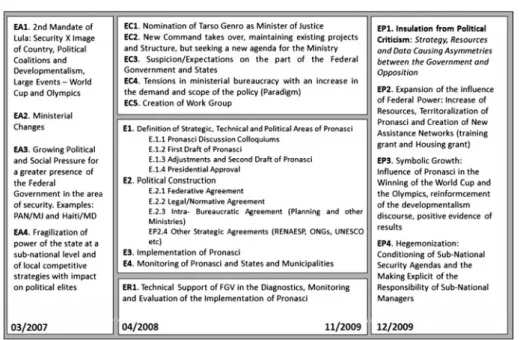
Figure 1 summarizes the processes being described here, focusing on the pivotal points in policy formulation. It is a process-based perspective on the interaction of key actors embedded within macroeconomic and political trends, such as decisions that were impending on the location of World Cup and Olympic events (Barzelay, Gaetani, Corta´ zar, & Cejudo, 2003; McAdam, Tarrow & Tilly, 2001). In this case, however, the devel-opment of policy over time did not follow the predicted path, and explaining the demise of PRONASCI becomes the central issue requiring explanation.
The foundational moment depicted in the Figure 1 arose out of the presidential initiative (E1) described above, announced in his second inaugural address. This was followed by ministerial changes common to a new government, changes made to accommodate political forces and to support changes in the upper echelons of state bureaucracy in order to support the strategic direction chosen by the president. Added to this process are pressures arising out of civil society and the political class related to concern about rising crime. All of this resulted in the nomination of a new Minister of Justice (EC1) who reviewed the strategic direction of the ministry (EC2) and announced plans to move in the direction that eventually led to PRONASCI.
To turn this strategic policy direction into a program required two complementary processes. Initially, it was necessary to overcome obstacles arising from the nation’s federal structure (E2, in Figure 1). The route to doing so was found in the new minister’s experience in CDES (Conselho de Desenvolvimento Econômico e Social, or Economic and Social Development Council), another agency that negotiated federal agreements relating to policy and inter-ministerial collaboration. Second, a great deal of
Figure 1. The PRONASCI policy process 2007–2009. Source: Author’s analysis.
consensus building had to be done around this new plan. After being conceptually structured, the program was sent to the President for official approval. Following this came the implementation stage (E3).
Notwithstanding approval for PRONASCI at the highest levels within the adminis-tration, it was also necessary to negotiate for support within‘technocratic’ levels of var-ious bureaucracies, with a special focus on those involved in movement and accountability for funds. This also involved repeated negotiations with multiple bureau-cratic actors, both horizontally and vertically. One problem was that, when it was cre-ated, PRONASCI had not been considered in the preparation of the budget. Furthermore, the volume and decentralized nature of the fund flows, which were of an extraordinary nature, added to the necessity of creating procedures for monitoring and evaluating the various activities that they were intended to support. This required the development of procedures for controlling the project and analytic tools for monitoring and evaluating its implementation, both from an administrative perspective and in the eyes of the target populations of the programs (E4 and ER1– Figure 1).
The key objective of implementation monitoring was, as noted by Wholey (1991), to gather systematic and continuous information about effectiveness of the various elements of PRONASCI, in order to improve its performance. In addition, surveys were conducted among two targets of the program: residents of the ‘territories of peace’ (as targeted flavelas were dubbed) and police, fire service, and other public security employees. These enabled adjustments to be made in the program‘on the fly.’ Shadish, Cook, and Leviton’s (1991) observation about evaluation was especially useful in understanding that public programs can change from incremental changes to large alterations in their scope and sets of rules. We sought an evaluation monitoring which allowed complex changes to be monitored. This proved particularly important early in the life of the program, when the relevant ministries were unexpectedly slow to implement the program. The Justice Minister was able to challenge the ministry, and he used the media to create pressure on the national government to press the program forward.
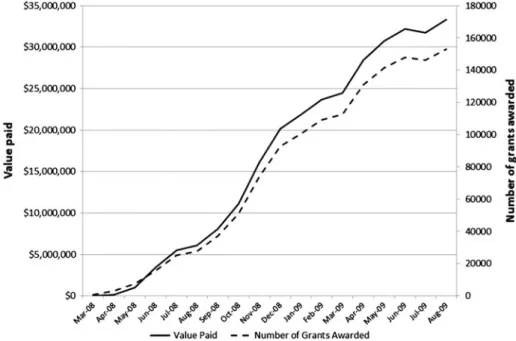
Figure 2 illustrates the progress of the program, once funds started toflow. It charts the progress of federal transfers to the Brazilian states of training grants to prepare police officers for community policing. Training funds were supplemented with salary money for officers while they were being trained, to encourage states to adopt PRONASCI and promptly spend the money. It can be seen there that through 2009 there was great success in budgeting and moving the money that was required; problems were to come later.
Figure 3 illustrates the results of monitoring public satisfaction with PRONASCI projects among various targeted populations. These included Civilian Reservists (Reservista Cidadão), former soldiers looking for employment in the formal economy; PROTEJO (Proteção a Jovens em Vulnerabilidade Social, or Protection of Socially Vul-nerable Youths), which aimed at assisting young people at risk of entering the drug trade to instead stay in school; and Preparatory Courses for ENEM (the university entrance exam), which provided preparatory assistance for low income youth to ready them for their university exams (this project was carried out in partnership with the Ministry of Education). All of these are programs were concerned with stimulating upward social mobility among residents of poor communities. Figure 3 briefly summa-rizes thefindings of a host of target-population surveys conducted as part of monitoring the implementation of PRONASCI, and illustrates the high levels of approval registered by those targeted by the program. Typically about 30% of program participants gave
Figure 2. Training grants awarded and expended 2008–2009. Source: PRONASCI evaluation.
Figure 3. Participant evaluations of PRONASCI programs. Source: PRONASCI evaluation.
the highest rating, and almost all the remainder gave ratings that were in the very positive range.
Together, Figures 2 and 3 highlight the success of PRONASCI as a program and its implementation in the adopting states. PRONASCI linked support for a new policing paradigm to the development of opportunities of social inclusion, combined with implementation monitoring and control of policy feedback (Pierson, 1993). A great deal of money was successfully delivered to support key programs, and there was a high degree of satisfaction among program participants. And then it died.
Dismantling PRONASCI
After a great deal of progress following its creation by an October 2007 statute, begin-ning in 2011 the actual budget for PRONASCI was reduced practically to zero. This concluding section considers the political and policy processes that shifted, leading to this unforeseen and pivotal change.
Figure 4 charts the progress of PRONASCI’s budgeted and actual expenditures. We first can see a very close match between authorized funds and those actually allocated in 2008 and 2009; the federal ministries transferred over 90% of allocated funds to the states during this period. But in 2010 that figure slipped to 77%, and in 2011 to 38%. Further, this shortfall was large confined to PRONASCI; it did not reflect some larger bureaucratic failure. Figure 5 contrasts comparable figures for the implementation of PRONASCI and for other programs supported by the Ministry of Justice. For each year, it presents the percentage of planned program funds that were actually dispersed. This chart extends only through 2011, the last year for which full-year data is available. As the chart illustrates, the Ministry’s success at funding its other programs matched the
Figure 4. Funds authorized and earmarked or expended 2008–2009 (US dollars). Source: PRONASCI evaluation.
PRONASCI rate during 2008–2010, but then police reform fell off the implementation agenda.
What led to the collapse in fiscal support for such an energetic program? PRONA-SCI had been created to transform not only operational policies, but also to promote social development and, indirectly, the institutional cultural of the Ministry of Justice and federal-state relationships in this policy domain. In the analytic approach presented by Skocpol (1985), states matter not just in terms of their policies, but because their policies affect governmental processes and standards, alter the political culture, strengthen different political groups, and create opportunities and changes (or externali-ties) that are sometimes unforeseen. The discussion of the contextual and political ori-gins of the program, which were summarized in Figure 1, predicted a much more successful life course for the policy. This leads us to consider the multiple possible causes of the program’s demise, all of which took place contemporaneously and con-verged to seal the fate of PRONASCI.
First, resistance by bureaucratic structures to the paradigmatic change called for by PRONASCI contributed to weakening support for the program in the budgeting process. Further, the program received a mixed reaction at the state level. The states were anx-ious to secure federal funds, but they resisted the new state-federal relationship imposed by the program, with its rules for local spending and persistent monitoring of program implementation. However, it was the juxtaposition of this resistance and the next pivotal moment in Brazilian politics, the 2010 presidential election that explains the program’s disappearance.
In 2010, the Minister responsible for the original design of PRONASCI left office to run for office in one of the Brazilian states. He was elected governor of Rio do Sul State, and left the national stage. At the same time, the party of outgoing president Luiz Inácio Lula da Silva chose as its presidential candidate his Chief of Staff, Dilma Roussef, who was also victorious. During the presidential campaign the question of security in large cities was a subject of debate. Rousef’s campaign reiterated the importance of PRONASCI’s conceptual framework. She spoke of the importance of
Figure 5. Implementation of PRONASCI and other justice ministry programs. Source: PRONASCI evaluation.
raising the status of police officers, who needed proper training and higher salaries. The candidate also spoke in favor of new policies and expenditures for modernizing prisons and dealing with highly dangerous prisoners. And in her view, the new UPPs inaugu-rated in Rio de Janeiro had the potential to be an important elements in defeating crime.3 However, but she barely referred to PRONASCI directly. This was in response to mixed views of the program among her campaign managers, who reflected some of the bureaucratic resistance and state-federal tension that the program generated. As a result, there was little public emphasis on PRONASCI as such, which would have com-mitted her politically to the program.
Instead, what happened was in line Weir and Skocpol’s (1985) concept of ‘policy results.’ In the case of Brazil, state structures, which are home to bureaucratic careers and have some autonomy of action, do not necessarily bend to the influence of elected administrators, who are more permeable to political forces or ideological agendas. Elite bureaucrats also are not insulated from pressure groups or from the chain of command which begins with elected representatives, but in practice they can postpone, distort or provide counter advice about the direction of a policy and its administration. Habitus and their own survival instinct lead them toward their zones of comfort and arrange-ments more optimal for their career and their network of alliances, even though this can be sub-optimal for political decision makers faced with contrary interests or legacies of polices in which they participated. PRONASCI’s budget disappeared into this maze of state and federal bureaucracies, not having won an explicit seal of approval from the new president during her campaign and no longer protected by its inaugural Minister of Justice.
Conclusion
Policy processes and public administration are continually interconnected. In addition, they increasingly dialogue with civil and development possibilities, whether individual or collective, in the public sphere. PRONASCI aimed at promoting both security and social development. It originated out of the capacity of a few high placed actors to per-ceive social and political changes that could support this two-pronged definition of the problem, and it was a policy formula that reflected the political stance of the President of the moment. It spoke to social problems on the citizen side of the program, and it promoted police reforms that could rebound to further support progressive social devel-opments. Further, it spoke to one of the most notable shortcomings of Brazilian democ-racy, the traditions and practices of its police. The program was positive in terms of its results, in spite of its short life. Most especially, its spin-offs included the UPP policing teams that remain effective in Rio de Janeiro.
As a lesson in public administration, policy-makers must be careful to take into account the distinct interests of the bureaucracy, to pay more attention to the key role played by the media in defining the situation, and the political opportunities that open and close as elite actors come and go. Elites across generations – which can be short in modern political life – need to buy into policies in order to guarantee their sustainabil-ity. Finally, in its short life PRONASCI did not generate enough mass support demand-ing its continuation. It was from the beginndemand-ing a top-down program. In the face of all of this, the modern monitoring and evaluation systems designed to promote program implementation did not play a significant role in protecting PRONASCI, despite the many positive signals they gathered.
Notes
1. This management and measurement program was developed by Fundação Getúlio Vargas, in Rio de Janeiro. The construction of multiple evaluation strategies, despite being complex to implement, allowed us to monitor the development of PRONASCI and its impacts in a com-parative and longitudinal manner. This provided an empirical basis for policy adjustments, as well as highlighting their results. This helped to hold the program accountable, and facilitated external pressure toward action at the sub-national level. The present paper is largely based on this research.
2. UPP means Unidade de Policia Pacificadora (Pacifying Police Unit). These units seem to be responsible for an increase in trust in police and declining fear of crime in Rio de Janeiro city. The UPPs operate in a manner that is distinct from traditional, repressive, policing, employing a community policing style instead.
3. Source: blog of Dilma (Dilma 13) during the presidential campaign (http://www.dilma13. com.br/entry/dilma-discute-propostas-para-segurança-publica/).
Notes on contributor
Marco Aurelio Ruediger holds a PhD in sociology from the University Research Institute of Rio de Janeiro and a MSC in Management and Policy Analysis from the New School for Social Research – New York. He is currently the director of Public Policy Analysis at Getulio Vargas Foundation where he conducts research on modernization of the State structures, e-government, and policy analysis on key topics of the Brazilian Political Agenda with focus on Public Security.
References
Amsden, A. H. (2001). The rise of“the rest”: Challenges to the west from late-lndustrializing economies. Oxford: Oxford University Press.
Barzelay, M., Gaetani, F., Cortázar, J. C., & Cejudo, G. (2003). Research on public manage-ment policy change in the Latin America region: A conceptual framework and methodo-logical guide. International Public Management Review, 4, 20–41.
Barzelay, M., & Gallego, R. (2010, April). The comparative historical analysis of public management policy cycles in France, Italy and Spain, symposium introduction. Governance, 23, 209–223.
Bendix, R. (1996). Construção nacional e cidadania [National construction and citizenship]. São Paulo: EDUSP.
Chan, J. (2004). Changing police culture. In Tim Newburn (Ed.), Policing key readings (pp. 338–363). Cullompton: Willan.
Ferreira, M., & Britto, A. (2010). Segurança e cidadania: Memórias do Pronasci [Security and citizenship: Memories of Pronasci] (1st ed.). Rio de Janeiro: FGV Editora.
Fusfeld, D. R., & Bates, T. (1984). The political economy of the urban ghetto. Carbondale, IL: Southern Illinois University Press.
Marshall, T. H. (1964). Citizenship and social class. In T. H. Marshall (Ed.), Class citizen-ship and social development (pp. 65–122). Chicago, IL: The University of Chicago Press.
Mcadam, D., Tarrow, S., & Tilly, C. (2001). Dynamics of contention. Cambridge: Cambridge University Press.
Neri, M. (2011). A nova classe média: o Lado brilhante dos pobres [The new middle class: The brilliant side of the poor]. Rio de Janeiro: FGV/CPS.
Perlman, J. (1976). The myth of marginality: Urban politics and poverty in Rio de Janeiro. Berkeley: University of California Press.
Pierson, P. (1993). When effect becomes cause: Policy Feedback and political change. World Politics, 45, 595–628.
Santos, W. G. (2005). O Conservadorismo Obsoleto do status quo [The obsolete conserva-tism of the status quo]. In B. S. Cavalcanti, M. A. Ruediger, & R. Sobreira (Eds.), Desenvolvimento e Construção Nacional: políticas públicas [Development and national construction: Public policies]. Rio de Janeiro: FGV Editora.
Shadish, W. R. Jr., Cook, T. D., & Leviton, L. C. (1991). Good theory for social program evaluation. In W. R. Shadish Jr., T. D. Cook, & L. C. Leviton (Eds.), Foundations of program evaluation: Theories of practice (pp. 36–67). Newbury Park, CA: Sage. Silver, A. (2004). The demand for order in civil society. In Tim Newburn (Ed.), Policing
key readings (pp. 7–24). Cullompton: Willan.
Skocpol, T. (1985). Bringing the state back in: Strategies of analysis in current research. In P. Evans, D. Rueschemeyer, & T. Skocpol (Eds.), Bringing the state back in (pp. 3–37). Cambridge: Cambridge University Press.
Skogan, W. (2006). Police and community in Chicago: A tale of three cities. New York, NY, and Oxford: Oxford University Press.
Skogan, W., & Hartnett, S. (1997). Community policing, Chicago style. New York, NY: Oxford University Press.
Weir, M., & Skocpol, T. (1985). State structures and the possibilities for “Keynesian” responses to the great depression in Sweden, Britain, and the United States. In Peter B. Evans, D. Rueschemeyer, & T. Skocpol (Eds.), Bringing the state back (pp. 169–191). Cambridge: Cambridge University Press.
Wholey, J. S. (1991). Evaluation for program improvement. In W. R. Shadish Jr., T. D. Cook, & L. C. Leviton (Eds.), Foundations of program evaluation: Theories of practice (pp. 225–269). Newbury Park, CA: Sage.