Universidade de Lisboa
Faculdade de Ciências
Departamento de Biologia
Animal
University of East Anglia
School of Environmental
Sciences
Effects of climate and land management changes on conservation
of Mediterranean Cork oak woodlands and their bird communities
Ricardo Aleixo Henriques Correia
Doutoramento em Biologia
Especialidade em Biologia da Conservação
2014
Universidade de Lisboa
Faculdade de Ciências
Departamento de Biologia
Animal
University of East Anglia
School of Environmental
Sciences
Effects of climate and land management changes on conservation
of Mediterranean Cork oak woodlands and their bird communities
Ricardo Aleixo Henriques Correia
Doutoramento em Biologia
Especialidade em Biologia da Conservação
2014
Tese orientada pelo Prof. Doutor Jorge Palmeirim e pela Doutora Aldina
Franco, especialmente elaborada para a obtenção do grau de Doutor em
2
Esta tese foi elaborada com o apoio financeiro da Fundação para a Ciência e Tecnologia (Bolsa de doutoramento SFRH / BD / 66150 / 2009).
A dissertação deve ser citada como:
Correia R. A. 2014. Effects of climate and land management changes on conservation of Mediterranean Cork oak woodlands and their bird communities. Doctoral thesis. University of Lisbon, Portugal.
This thesis was conducted with the financial support of the Fundação para a Ciência e Tecnologia (PhD grant SFRH / BD / 66150 / 2009)
The dissertation should be cited as:
Correia R. A. 2014. Effects of climate and land management changes on conservation of Mediterranean Cork oak woodlands and their bird communities. Doctoral thesis. University of Lisbon, Portugal.
3
Contents
Abstract 4 Resumo 5 Acknowledgements 10 Chapter 1: Introduction 12Chapter 2: Managing the future of Mediterranean Cork oak woodlands: 25 pitfalls of using incomplete species range models for climate
change adaptation planning
Chapter 3: Role of the Mediterranean Sea differentiating European and 48 North African woodland bird assemblages
Chapter 4: Major challenges for bird conservation in cork oak woodlands: 70
climate change versus land management
Chapter 5: Bird richness and abundance on cork oak woodlands decreases in 97
drier microclimates
Chapter 6: Can climate change provide the opportunity for trans-Saharan 122 migrants to overwinter in Europe?
Chapter 7: Conclusion 142
4
Abstract
Cork oak woodlands are a keystone habitat for Mediterranean biodiversity but are currently undergoing a global decline and widespread management changes driven by social, economic and climatic factors. I examine the effects of both climate and land management changes on cork oak woodlands and their bird communities across the western Mediterranean Basin. Future climatic scenarios indicate that up to 60% of current cork oak woodlands may become unsuitable by 2080, especially in southern areas where they will be restricted to microclimatic refugia sites. Increasing aridity, particularly in drier microclimates, will potentiate a decline of cork oak tree condition resulting in impacts across the food web that ultimately have a negative effect on breeding bird abundance and diversity, particularly for tree-dependent forest species. Farmland and shrubland birds respond mainly to habitat features modified by land management and their abundances increase in areas with open and heterogeneous ground cover. Current abandonment, intensification and overexploitation trends are likely to have negative effects on their populations but climate change can also play an important role if it provides an additional stimulus for land management changes. The unique bird assemblages of North African cork oak woodlands seem particularly vulnerable to both factors and should therefore be considered a conservation priority. Nonetheless, climate change may benefit species of Mediterranean origin and seems to have enabled the establishment of resident populations of traditionally migratory bird species in the Iberian Peninsula. This may provide new conservation opportunities for declining migratory species as long as adequate winter habitat areas are available. Adaptation strategies should aim to incorporate biodiversity-friendly management practices, promote cork oak afforestation in areas that will become climatically suitable and evaluate alternatives to provide similar economic and environmental services in the regions where cork oak woodlands are likely to disappear.
5
Resumo
Os montados de sobro (Quercus suber), também conhecidos como dehesas em Espanha, são um sistema agro-silvo-pastoril tradicional que tem origem na gestão humana das florestas Mediterrânicas originais. Distribuído sobretudo na região oeste da bacia Mediterrânica, este tipo de gestão multifuncional foi mantido durante vários séculos devido aos valores económicos, sociais, culturais e ecológicos que providencia às populações que dele dependem. Do ponto de vista ecológico, os montados de sobro são particularmente importantes devido à capacidade de conciliar a gestão e sustentabilidade económica com a manutenção de altos níveis de biodiversidade. Os montados de sobro apresentam comunidades bastante diversas de plantas e borboletas por exemplo, mas são particularmente importantes para as aves uma vez que para além de suportarem comunidades bastante diversas, albergam também espécies endémicas ou protegidas (e.g. Águia-imperial Aquila adalberti, Abutre-negro Aegypius monachus e Cegonha-negra Ciconia nigra) e milhões de aves provenientes do norte da Europa que invernam na bacia do Mediterrâneo todos os anos. Por todas estas razões, os montados de sobro são protegidos a nível europeu pela Diretiva Habitats (92/43/CEE).
Apesar deste facto, os montados de sobro têm sofrido uma regressão na sua área de distribuição nos últimos anos devido a diferentes fatores económicos, sociais e ambientais. Por um lado, a variação no preço de mercado da cortiça e de outros produtos tem levado ao abandono ou intensificação do sistema de gestão mais tradicional. Por outro lado, as alterações climáticas parecem já começar a afetar o sobreiro e o aumento dos eventos de seca tem levado a uma diminuição da condição física e fitossanitária das árvores, resultando em muitos casos na sua morte. Desta forma, tanto as alterações no clima como no sistema de gestão dos montados são passíveis de resultar em efeitos importantes nos montados de sobro e na sua biodiversidade mas ainda não existe uma avaliação desta situação que abranja a distribuição Mediterrânica deste sistema. Esta tese pretendeu examinar o papel das alterações climáticas e da gestão na conservação futura dos montados de sobro e nas suas comunidades de aves na região oeste da bacia do Mediterrâneo. Mais
especificamente, esta tese abordou cinco questões principais: i) como irão as alterações climáticas afetar a futura distribuição dos montados de sobro, ii) como diferem as
6
comunidades de aves nidificantes dos montados de sobro do Norte de África das comunidades presentes nos montados de sobro da Europa e como é que isso afeta a relevância da sua conservação, iii) qual é a importância relativa de alterações climáticas e de gestão na conservação dos diferentes grupos de aves nidificantes dos montados de sobro, iv) como irão as características microclimáticas e topográficas de pequena escala influenciar a resposta da comunidade de aves nidificantes às alterações climáticas e v) qual é a influência das alterações climáticas no recente estabelecimento de populações invernantes de aves tradicionalmente migradoras na região da bacia Mediterrânica.
As previsões obtidas no Capítulo 2 desta tese indicam que as alterações climáticas irão provocar um declínio de aproximadamente 40 a 60% da área atualmente ocupada pelos montados de sobro até 2080, sobretudo nas regiões mais a sul da sua distribuição como Marrocos, Tunísia, Argélia e o sul da Península Ibérica. Nestas regiões apenas deverão permanecer pequenos refúgios de clima adequado se os cenários de alteração climática mais drásticos se verificarem. A restante área de distribuição dos montados de sobro na zona central da Península Ibérica, em Itália e em muitas das ilhas Mediterrânicas deverá manter condições climáticas adequadas à sua manutenção. Novas áreas de clima
adequado deverão a norte da distribuição atual no norte da Península Ibérica, ao longo da costa oeste de França e no sul do Reino Unido que poderão se considerada para ações de reflorestação se estas forem consideradas viáveis. Este trabalho foi o primeiro a avaliar os potenciais efeitos das alterações climáticas ao longo de toda a distribuição Mediterrânica dos montados de sobro e, desta forma, a incluir informação da sua distribuição no Norte de África. A importância de incluir esta informação foi também avaliada e os resultados confirmaram estudos anteriores que identificaram potenciais erro nas previsões futuras quando é omissa informação no processo de calibração de modelos correlativos de distribuição de espécies.
No Capítulo 3 foram analisadas as diferenças entre as comunidades de aves nidificantes dos montados de sobro no Norte de África e no Sul da Península Ibérica uma vez que a existência de diferenças significativas poderia inviabilizar a generalização para ambas as regiões das respostas observadas nesta comunidade a fatores ambientais e humanos. Os resultados indicam que os padrões de diversidade e abundância de aves são
semelhantes entre as duas regiões e que a maioria das espécies registadas está presente nos montados de sobro de ambas as regiões. Este facto corrobora estudos anteriores que
7
evidenciam a semelhança entre as comunidades de aves florestais da Europa e do Norte de África. Ainda assim, a composição da comunidade de aves em termos de espécies e guildas é diferente entre regiões. A presença do Mar Mediterrânico como barreira à dispersão impediu algumas espécies de colonizarem ambas as regiões e permitiu que outras evoluíssem de forma distinta entre elas, explicando parte das diferenças observadas. As restantes diferenças entre as comunidades de aves dos montados de sobro da Europa e do Norte de África deve-se ao aumento de espécies generalistas e à diminuição de espécies florestais no Norte de África, o que pode ser explicado com base nos padrões locais de sobre-exploração dos recursos deste sistema. Estes resultados permitem considerar que a composição da comunidade de aves dos montados de sobro do Norte de África é sobretudo fruto da resposta às condições ambientais e de
intervenção humana observadas na região, que representam apenas um extremo do gradiente observado ao longo da distribuição Mediterrânica deste sistema.
Esta ideia é explorada de forma mais detalhada no Capítulo 4 que analisa a resposta da comunidade de aves nidificante aos gradientes climáticos e de estrutura de habitat observados nos montados de sobro da Península Ibérica e do Norte de África. Tanto fatores climáticos como a estrutura do habitat são importantes na composição da comunidade de aves nidificante dos montados de sobro e em conjunto explicaram mais de um terço da variabilidade total observada nas áreas amostradas. A abundância de aves associadas a ambientes agrícolas e matos como o Trigueirão (Emberiza calandra), o Estorninho-preto (Sturnus unicolor) e a Cotovia-dos-bosques (Lullula arborea) responde sobretudo a alterações na estrutura do habitat ao passo que a abundância de aves florestais e generalistas como o Rouxinol (Luscinia megarhynchos), o Rabirruivo-de-testa-branca (Phoenicurus phoenicurus) e a Carriça (Troglodytes troglodytes) está sobretudo associada a fatores climáticos. Apesar desta observação, a análise individual a cada uma das espécies registadas indica que a abundância da maioria destas espécies aumenta em áreas com uma estrutura mais aberta e heterogénea do sub-coberto e diminui em áreas onde se verificam temperaturas mais elevadas e maior sazonalidade climática. Finalmente, a análise dos padrões espaciais de fatores climáticos e da estrutura do habitat permite concluir que as comunidades de aves do Norte de África devem ser uma prioridade para medidas de conservação devido às alterações climáticas e sobre-exploração do habitat ao passo que no sul da Península Ibérica a principal ameaça são fatores climáticos.
8
O Capítulo 5 explora de forma mais detalhada como a comunidade de aves nidificante dos montados de sobro responde a condições microclimáticas ao longo de um gradiente de aridez no sul da Península Ibérica. Os dados obtidos com este trabalho evidenciam uma diminuição significativa da abundância e diversidade de aves em zonas mais áridas. Esta observação resulta de alterações na abundância de aves florestais em resposta às condições microclimáticas locais, particularmente evidente em encostas mais secas com orientadas a sul, e confirma o efeito das condições climáticas no na abundância de aves florestais. Em condições mais áridas, os sobreiros apresentam copas menos desenvolvidas pelo que, apesar de apresentarem densidades semelhantes, os montados de sobro nestas condições apresentam uma menor cobertura de copa total. Esta situação resulta numa diminuição dos recursos alimentares disponíveis para as aves florestais, indicando que os efeitos climáticos nas aves florestais se propagam através da cadeia trófica. Desta forma, o aumento das temperaturas e da aridez na região
Mediterrânica previsto para as próximas décadas poderá representar um desafio para a manutenção das populações de aves florestais nos montados de sobro do sul da Europa.
Contudo, o aumento da temperatura poderá também proporcionar novas oportunidades para a conservação de aves na Península Ibérica. O Capítulo 6 explora o papel das alterações climáticas no aumento do número de aves invernantes de espécies tradicionalmente migradores observado nos últimos anos na Península Ibérica. Os resultados demonstram que o aumento das temperaturas durante o inverno nas últimas três décadas é uma das potenciais causas para estas alterações do comportamento migratório de várias espécies de aves. Esta hipótese é suportada pelo aumento das temperaturas na Península Ibérica durante o Inverno que se têm tornado mais
semelhantes às temperaturas encontradas por estas aves nas suas áreas tradicionais de invernada em África. De facto, a semelhança climática entre estas regiões tem
aumentado nas últimas décadas, apesar da diminuição da precipitação observada na Península Ibérica. Adicionalmente, as aves que invernam na Península Ibérica parecem selecionar ativamente áreas que são climaticamente mais semelhantes às suas áreas de tradicionais de invernada em África em relação ao que seria esperado ao acaso. Este comportamento tem sido observado sobretudo em espécies mais generalistas como a Cegonha-branca (Ciconia ciconia), a Codorniz (Coturnix coturnix) e a Poupa (Upupa
epops), o que se pode dever ao facto de estas espécies apresentarem requisitos
9
Tendo em conta os resultados obtidos no âmbito desta tese, é sugerido um conjunto de medidas de adaptação que possam favorecer a manutenção dos montados de sobro e da sua diversidade em face das alterações climáticas e de gestão que estão a decorrer. Nas áreas onde as alterações climáticas deverão tornar difícil a manutenção de áreas de montado de sobro, será importante proteger potenciais refúgios microclimáticos de forma a manter a conectividade da paisagem e investigar quais as melhores opções do ponto de vista económico e ambiental para a substituição deste sistema de exploração. Em áreas onde a manutenção de áreas extensas de montado de sobro será possível, a prioridade deverá ser a manutenção de medidas de gestão e exploração que possam aumentar a resiliência económica e ecológica deste sistema. Neste sentido, será importante explorar as vantagens de um sistema de gestão e exploração económica multifacetada, que permita a manutenção da heterogeneidade característica deste sistema e que possa promover a robustez económica deste sistema às variações de mercado através da exploração de diferentes recursos. Finalmente, novas áreas de clima adequado para o sobreiro devem surgir a norte da sua distribuição atual e nestas áreas poderá ser ponderada a plantação ativa de novos montados de sobro que possam minimizar as perdas de área previstas em outras regiões.
10
Acknowledgements
This study was funded by a scholarship from Fundação para a Ciência e Tecnologia (FCT) with the reference SFRH / BD / 66150 / 2009.
Foremost, I would like to thank my supervisors Jorge Palmeirim, Aldina Franco and Jennifer Gill for their support during the course of this thesis. Their interest and ideas were essential in helping me to shape the initial ideas of the research project and their support and enthusiasm throughout the research process that culminates with this thesis were a very important driving force if its success. I would also like to particularly thank their help during the bureaucratic process of setting up and shaping the agreement that allowed this thesis to be done in collaboration between the University of Lisbon and the University of East Anglia and hope it can stimulate further collaborations in the future.
A formal acknowledgement is due to the many landowners and managers that allowed access to their properties during fieldwork and to the institutions that agreed to share their data for analysis within the framework of this thesis. Particularly, I would like to thank SPEA – Sociedade Portuguesa para o Estudo das Aves and SEO – Sociedad Española de Ornitología, the BirdLife partners in Portugal and Spain, for sharing the data collected as part of the Winter Bird Atlas projects of both countries and to BirdLife International for access to their species distribution database.
It was a pleasure to collaborate in setting up the research project that resulted in the Master’s thesis of Whitney Haskell. I would like to thank her for the interest she always demonstrated in the project and for the precious help during fieldwork.
The opportunity to undertake this project in collaboration between the University of East Anglia and the University of Lisbon provided a fantastic experience. The fact that this experience was so enjoyable is in great part due to friendship and support provided by colleagues and staff at both institutions. It was particularly fruitful to share
11
institutions: CEEC members at the University of East Anglia and CBA members at the University of Lisbon.
Discovering Norwich was much more enjoyable in the company of new friends with whom I shared amazing and unforgettable moments. My time here would not have been nearly as enjoyable without the friendship and company of Davi, Felipe, Seav-Ly, José and Vero, Kabelo, Joe, Martin, Nathalie and Dan, Eveliina, Phil, Mark, Karen, Maíra, Vanessa, Jonatan and Wilson. The Beehive became a second home in Norwich and I would like to thank Alex, Ray, Eric, Adrian, Pete, Dawn, Sarah, Chaelyn and
particularly Ollie who provided interesting discussions on farming sustainability and climate change, companionship, friendship and silly moments from day one. Finally, I am especially grateful to Colin and his family for making me part of the family.
Back home, I benefited from the support of many long-time friends and as always, their friendship was greatly cherished. My friends Bruno, Pedro, Catarina and Ricardo, Joana, Filipa, Marta, João P. S., João P. L., Rita, Ana D., Ana L. and Ricardo M., Ana R., Ricardo R. and Ricardo N. all have my deepest gratitude.
My travels during the last four years allowed me to establish friendships all over the world and I would like to acknowledge the great times spent with Michael, Saša, Carolina, Anton, Letizia, Simon, Pedro L., Bülend, Erçin and Ayça.
I could not go without saving a special word for someone I was lucky to meet during the course of the last four years and that came to hold a very special place in my heart. Zeynep, your support, comprehension, motivation, joy and love have been essential to successfully reach the finish line.
Finally, there aren’t enough words to express my gratitude to all my family for their constant support and particularly to my grandma, parents and brother for lifting me up during the rough times. I hope to be able to return all your support in the future.
12
Chapter 1
Introduction
Photo: Cork oak woodlands in the Alentejo region, Portugal
The remarkable biodiversity found across the Mediterranean Basin today has led to the classification of this region as a biodiversity hotspot (Myers et al. 2000). The complex biogeography of the Mediterranean region, characterized by a particular set of
geophysical, climatic and ecological pressures and long-term history of human intervention, has helped to shape the biodiversity patterns that we observe nowadays (Blondel et al. 2010). In fact, it has been argued that moderate disturbance regimes promoted by some traditional management systems are nowadays a key factor in the preservation of biological diversity (Blondel et al. 2010 and references therein).
1.1. Mediterranean cork oak woodlands
Examples of current traditional Mediterranean management systems include cereal pseudo-steppes, North African argan forests, and cork oak woodlands (e.g.
Benchekroun and Buttoud 1989, Suárez et al. 1997, Blondel et al. 2010). The latter system is particularly important across much of the western Mediterranean Basin where it is still relatively widespread; it covers more than 1.5 million hectares in southern Europe and nearly 1 million hectares in North Africa (Pausas et al. 2009). Cork oak
13
woodlands are known to support Mediterranean endemic and endangered species (e.g. Cabrera’s Vole Microtus cabrerae, Spanish Imperial Eagle Aquila adalberti, Iberian Lynx Lynx pardinus and Cinereous Vulture Aegypius monachus) and host diverse communities of plants (rivalled only by the diversity found in tropical forests),
butterflies and birds (Pineda and Montalvo 1995, Diáz et al. 1997). The importance of managed cork oak woodlands for biodiversity can only be understood in the light of the complex habitat structure that results from the mosaic of land uses characteristic of traditional management systems.
Cork oak woodlands are a traditional agro-silvo-pastoral system common throughout the western Mediterranean Basin (Pinto-Correia and Mascarenhas 1999). The core area of distribution nowadays is located in the south-western corner of the Iberian Peninsula, but it is also present in other countries along the northern (France and Italy) and
southern (Morocco, Algeria and Tunisia) margins of the Mediterranean Sea and even in some Mediterranean islands (Pausas et al. 2009). This type of land use system,
generally known as montado in Portugal and dehesa in Spain, results from a gradual human intervention on the original Mediterranean forests dominated by cork oak (Quercus suber) and holm oak (Quercus rotundifolia) trees (Joffre et al. 1999). Cork oak woodlands are generally characterized by a savannah-like physiognomy that mimics natural systems and is shaped by local management actions and environmental
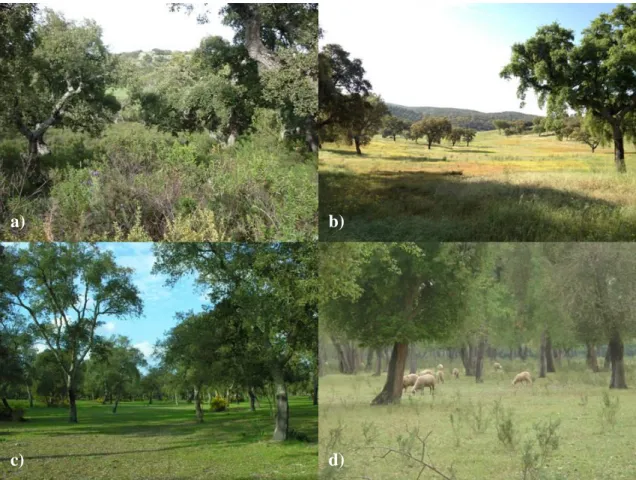
conditions (Marañón 1988, Joffre et al. 1999, Pereira and Tomé 2004). For this reason, several forms of cork oak woodland management can be found throughout their range (Fig. 1.1). In areas where the landscape in relatively flat, tree density is usually
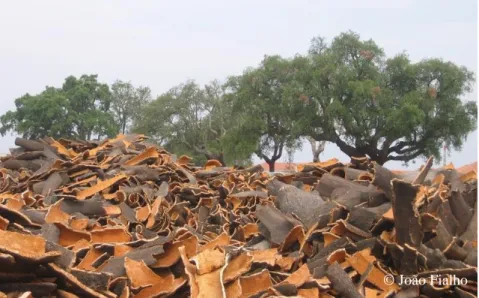
relatively low allowing a better use of the ground layer for agricultural crops (usually in more productive soils) or pastures for cattle grazing (Marañón 1988, Diáz et al. 1997). Land managers in areas with a more complex topography usually favour denser stands for silvicultural practices and avoid more intensive agricultural uses (Pereira and Tomé 2004). Other regular uses include hunting, mushroom collection and bee-keeping (Pereira and Tomé 2004, Bugalho et al. 2009). Common to all the different forms of Cork oak woodland uses is the importance of cork exploitation (Fig. 1.2), which represents in many cases the main source of revenue (Coelho and Campos 2009, Campos et al. 2009) and therefore guarantees the economic viability of this management system.
14
Figure 1.1. Different cork oak woodland management forms found throughout the Mediterranean Basin. Examples include (a) shrub-dominated woodland, b) open-canopy woodland, (c) closed-open-canopy woodland and (d) grazed woodland.
This diversity of uses and management activities has evolved over centuries, resulting in a complex mosaic of cork oak woodland structural and functional forms that favoured the maintenance of high biodiversity levels (Diáz et al. 1997, Telleria 2001). In fact, human intervention is actually required for cork oak woodlands to maintain part of their biodiversity and ecosystem services (Bugalho et al. 2011). This balance between human exploitation and biodiversity conservation has granted cork oak woodlands the status of High Nature Value Farmlands (Hoogeveen et al. 2004) and promoted their inclusion in the Habitats Directive (92/43/CEE). Still, the area of cork oak woodlands that is
currently protected has been unable to maintain a favourable conservation status (Berrahmouni et al. 2009, Underwood et al. 2009, Santos and Thorne 2010). In most regions, the area occupied by Cork oak woodlands has decreased in recent years, mostly due to the interrelated effects of land use and climate changes, and fighting this trend will require a better knowledge of potential impacts in order to elaborate adequate conservation efforts (Berrahmouni et al. 2009).
a) b)
15
Figure 1.2. Cork oak planks after extraction from the tree.
1.2. Major threats to cork oak woodlands
The last decades have seen an increase in cork oak woodland abandonment, intensification and overexploitation due to economic and socio-cultural pressures (Bugalho et al. 2009). Overexploitation occurs throughout the range of the cork oak but is more common in northern Africa, where cork oak woodlands are state-owned and have an open access. Together with a low economic condition of rural population this open access leads to overgrazing, excessive crop cultivation and over-collection of acorns and firewood (Bugalho et al. 2009, Berrahmouni et al. 2009). Abandonment and intensification trends are more common in European areas as a result of changes in market prices (particularly the devaluation of cork), rural exodus and European agricultural policies (Bugalho et al. 2009, Berrahmouni et al. 2009, Bugalho et al. 2011). Land abandonment promotes shrub encroachment, which increases fire hazard and contributes to the lack of regeneration observed in this system (Acácio et al. 2007, Bugalho et al. 2009). The intensification of management activities has been mostly associated with the increase in grazing pressure, which affects oak regeneration, and the introduction of heavy machinery for ploughing, which can destroy young trees and damage superficial roots, essential for cork oaks to survive under drier conditions (Joffre et al. 1999, Bugalho et al. 2009).
16
Figure 1.3. Dead cork oak tree.
In parallel with human-induced impacts, climate change has also increased the pressure on cork oak woodlands, mainly due to the higher frequency of extreme heat and drought events observed in the Mediterranean region over the last decades (Diffenbaugh et al. 2007, Hoerling et al. 2012). Recent research shows that, during these periods of water stress, cork oak trees show higher leaf loss (Carnicer et al. 2011) and reduced tree growth (Besson et al. 2014). These responses to drought lead to an overall decline in tree crown condition and a higher susceptibility to diseases and pests (e.g. Phytophthora
cinnamomi), which can ultimately result in tree mortality (Fig. 1.3; Brasier and Scott
1994, Allen et al. 2010, Carnicer et al. 2011). This process, potentiated by recurring wildfire events, also made more frequent by climate change, is slowly promoting the conversion of more open cork oak woodlands into persistent shrublands (Acácio et al. 2009) and their decline in many areas (Brasier and Scott 1994, Regato-Pajares et al. 2004, Costa et al. 2011). In summary, both human and climate-induced effects are endangering the long term sustainability of cork oak woodlands and are, therefore, also likely to affect the future of the important biological diversity they support.
1.3. Birds as biodiversity indicators in cork oak woodlands
Cork oak woodlands are important for many biological groups but the abundance and diversity of birds they support is particularly remarkable (Diáz et al. 1997). The
17
relatively open physiognomy of most cork oak woodlands allows the presence of species associated with both forest and open agricultural landscapes (Pulido and Diáz 1992, Diáz et al. 1997, Telleria 2001). Furthermore, the moderate disturbance regime promoted by traditional land management techniques supports the maintenance of endangered species such as the Black Stork (Ciconia nigra), Common Crane (Grus
grus) and Spanish Imperial Eagle (Aquila adalberti). The abundance of winter resources
also allows millions of Wood Pigeons (Columba palumbus), Robins (Erithacus
rubecula) and Mistle Thrushes (Turdus viscivorus) from northern Europe to overwinter
in these woodlands. This situation is only possible in cork oak woodlands due to the delicate balance between human intervention and environmental conditions that maintain a heterogeneous habitat structure that favours diverse and abundant bird assemblages (Diáz et al 1997, Telleria 2001). At the same time, birds are generally very responsive to any change that affects this balance and are often used as biodiversity indicators for this reason (Hutto 1998, Gregory et al. 2003).
Land use changes are currently a major threat to biodiversity across the Mediterranean Basin (Cuttelod et al. 2008) and severe impacts from climate change should also be expected (Alcamo et al. 2007). Several studies have highlighted the effects of land use change on birds (Donald et al. 2006, Sirami et al. 2008, Gil-Tena et al. 2009) and the loss of habitat heterogeneity seems particularly important (Atauri and de Lucio 2001, Benton et al. 2003). Birds have also been shown to be responding to climate change (Crick 2004, Devictor et al. 2012), inclusively in the Mediterranean region (Sanz 2002). However, much remains to be explored regarding the effects of changes in land use and climate on cork oak woodlands bird assemblages across the Mediterranean region. For example, the potential effects of different management activities have been highlighted (e.g. Camprodon and Brotons 2006, Godinho and Rabaça 2011, Santana et al. 2012, Leal et al. 2013) but the majority of studies that have addressed these issues were done in southwestern Europe, and their conclusions may not be applicable in regions with different ecological and sociological realities. The knowledge basis on the effects of climate change is even scarcer. The lack of long-term biodiversity monitoring, particularly in northern Africa, makes it difficult to evaluate the impacts of climate change on biodiversity and to disentangle them from those of other drivers of change. In order to promote the long term maintenance of the cork oak woodlands and their
18
biodiversity across the Mediterranean region, it is important to understand the impacts of potential threats across different spatial scales and temporal periods.
1.4. Thesis structure and objectives
The main aim of this thesis was to provide an insight on the potential effects of climate and land management changes on Mediterranean cork oak woodlands and their
associated biological diversity. Specifically, I aimed to answer five main questions: i) how may the predicted changes in climate affect the future distribution of cork oak woodlands; ii) how do breeding bird assemblages in North African cork oak woodlands differ from those in Europe and how does this affect their conservation relevance; iii) what is the relative importance of climate and land use change effects for the
conservation of different breeding bird groups of cork oak woodlands; iv) how will small-scale topographic and micro-climatic features influence breeding bird assemblage responses to climate change; and v) what is the influence of climate change on the recent establishment of wintering populations of traditionally migratory bird species in the Mediterranean region.
This thesis contains five data chapters (Chapters 2 to 6), each aimed to answer one of the above main questions. These chapters are written in manuscript format with the objective to publish each one as individual papers in peer-reviewed journals. Because of this, each chapter includes a reference list which may facilitate the individual access to each chapter and relevant references. One chapter is currently under editorial
consideration for publishing (Chapter 3) and the remaining chapters will all be submitted in due course to relevant journals.
Concerning the overall thesis structure, Chapter 1 provides a general introduction and context to this thesis. Chapter 2 evaluates the future of cork oak woodlands under different climate change scenarios. In addition, it assesses the potential problems
resulting from the use of predictive models trained with geographically incomplete data, particularly in the Mediterranean region. Chapter 3 compares the breeding bird
assemblages of European and North African cork oak woodlands and assesses the relative importance of a geographical barrier and of local management factors in the structuring of those assemblages. Chapter 4 assesses the response of breeding bird assemblages to climatic and habitat structure gradients across European and North
19
African cork oak woodlands and their role for bird conservation. Chapter 5 analyses the response of cork oak trees and breeding bird assemblages to local topographic and micro-climatic features across an aridity gradient. Chapter 6 tests the hypothesis that climate change might be linked to the increase of wintering bird populations of traditionally migratory species, using a niche-based approach. Finally, Chapter 7 compiles the key-findings of the thesis in a conservation perspective and provides suggestions for further research.
References
Acácio, V., Holmgren, M., Jansen, P. A., Schrotter, O., 2007. Multiple recruitment limitation causes arrested succession in Mediterranean Cork Oak systems. Ecosystems 10, 1220–1230.
Alcamo, J., Moreno, J., Nováky, B., Bindi, M., Corobov, R., Devoy, R.,
Giannakopoulos, C., Martin, E., Olesen, J., Shvidenko, A., 2007. Europe. In: Parry, M., Canziani, O., Palutikof, J., van der Linden, P., Hanson, C., (Eds.). Climate Change 2007: Impacts, Adaptation and Vulnerability. Contribution of Working Group II to the Fourth Assessment Report of the Intergovernmental Panel on Climate Change.
Allen, C. D., Macalady, A. K., Chenchouni, H., Bachelet, D., McDowell, N., Vennetier, M., Kitzberger, T., Rigling, A., Breshears, D. D., Hogg, E. H., Gonzalez, P., Fensham, R., Zhang, Z., Castro, J., Demidova, N., Lim, J. H., Allard, G.,
Running, S. W., Semerci, A., Cobb, N., 2010. A global overview of drought and heat-induced tree mortality reveals emerging climate change risks for forests. Forest Ecology and Management 259, 660–684.
Atauri, J. A., de Lucio, J. V., 2001. The role of landscape structure in species richness distribution of birds, amphibians, reptiles and lepidopterans in Mediterranean landscapes. Landscape Ecology 16, 147-159.
Berrahmouni, N., Regato, P., Ellatifi, M., Daly-Hassen, H., Bugalho, M., Bensaid, S., Diáz, M., Aronson, J., 2009. Ecoregional Planning for Biodiversity
20
Conservation. In: Aronson, J., Pereira, J. S., Pausas, J. G. (Eds.), Cork oak woodlands on the edge. Island Press, Washington, USA, pp. 203-216.
Benchekroun, F., Buttoud, G., 1989. L’arganeraie dans l’économie rurale du sud-ouest marocain. Fôret Méditeranéenne 9, 127-136.
Benton, T. G., Vickery, J. A., Wilson, J. D., 2003. Farmland biodiversity: Is habitat heterogeneity the key? Trends in Ecology and Evolution 18, 182-188.
Besson, C. K., Lobo-do-Vale, R., Rodrigues, M. L., Almeida, P., Herd, A., Grant, O. M., David, T. S., Schmidt, M., Otieno, D., Keenan, T. F., Gouveia, C., Mériaux, C., Chaves, M. M., Pereira, J. S., 2014. Cork oak physiological responses to manipulated water availability in a Mediterranean woodland. Agricultural and Forest Meteorology 184, 230-242.
Blondel, J., Aronson, J., Bodiou, J. Y., Boeuf, G., 2010. The Mediterranean Region: Biological Diversity in Space and Time. Oxford University Press, Oxford, UK.
Brasier, C. M., Scott, J. K., 1994. European oak declines and global warming: a theoretical assessment with special reference to the activity of Phytophthora cinnamomi. EPPO Bulletin 24, 221-232.
Bugalho, M., Plieninger, T., Aronson, J., Ellatifi, M., Crespo, D. G. 2009. Open Woodlands: A Diversity of Uses (and Overuses). In: Aronson, J., Pereira, J. S., Pausas, J. G. (Eds.), Cork oak woodlands on the edge. Island Press, Washington, USA, pp. 33-45.
Bugalho, M. N., Caldeira, M. C., Pereira, J. S., Aronson, J., Pausas, J. G., 2011. Mediterranean cork oak savanas require human use to sustain biodiversity and ecosystem services. Frontiers in Ecology and the Environment 9, 278-286.
Carnicer, J., Coll, M., Ninyerola, M., Pons, X., Sánchez, G., Peñuelas, J., 2011. Widespread crown condition decline, food web disruption, and amplified tree mortality with increased climate change-type drought. Proceedings of the National Academy of Sciences 108, 1474-1478.
21
Campos, P., Ovando, P., Chebil, A., Daly-Hassen, H., 2009. Cork Oak Woodland Conservation and Household Subsistence Economy Challenges in Norther Tunisia. In: Aronson, J., Pereira, J. S., Pausas, J. G. (Eds.), Cork oak woodlands on the edge. Island Press, Washington, USA, pp. 165-174.
Camprodon, J., Brotons, L., 2006. Effects of undergrowth clearing on the bird communities of the Northwestern Mediterranean Coppice Holm oak forests. Forest Ecology and Management 221, 72-82.
Coelho, I. S., Campos, P., 2009. Mixed Cork Oak-Stone Pine Woodlands in the
Alentejo Region of Portugal. In: Aronson, J., Pereira, J. S., Pausas, J. G. (Eds.), Cork oak woodlands on the edge. Island Press, Washington, USA, pp. 153-161.
Costa, A., Madeira, M., Santos, J. L., Oliveira, A., 2011. Change and dynamics in Mediterranean evergreen oak woodlands landscapes of Southwestern Iberian Peninsula. Landscape and Urban Planning 102, 164-176.
Crick, H. Q. P., 2004. The impact of climate change on birds. Ibis 149, 48-56.
Cuttelod, A., García, N., Abdul Malak, D., Temple, H., Katariya, V., 2008. The
Mediterranean: a biodiversity hotspot under threat. In: Vié, J.-C., Hilton-Taylor, C., Stuart, S.N. (Eds.), The 2008 Review of The IUCN Red List of Threatened Species. International Union for Conservation of Nature, Gland, Switzerland.
Devictor, V., van Swaay, C., Brereton, T., Brotons, L., Chamberlain, D., Heliölä, J., Herrando, S., Julliard, R., Kuussaari, M., Lindström, A., Reif, J., Roy, D. B., Schweiger, O., Settele, J., Stefanescu, C., Van Strien, A., Van Turnhout, C., Vermouzek, Z., WallisDeVries, M., Wynhoff, I., Jiguet, F., 2012. Differences in the climatic debts of birds and butterflies at a continental scale. Nature Climate Change 2, 121-124.
22
Diáz, M., Campos, P., Pulido, F. J., 1997. The Spanish dehesas: a diversity in land-use and wildlife. In: Pain, D. J., Pienkowski, M. W. (Eds.) Farming and birds in Europe. Academic Press, Cambridge, UK, pp 178–209.
Diffenbaugh, N. S., Pal, J. S., Giorgi, F., Gao, X., 2007. Heat stress intensification in the Mediterranean climate change hotspot. Geophysical Research Letters 34, L11706.
Donald, P. F., Sanderson, F. J., Burfield, I. J., van Bommel, F. P. J., 2006. Further evidence of continent-wide impacts of agricultural intensification on European farmland birds, 1990-2000. Agriculture, Ecosystems and Environment 116, 189-196.
Gil-Tena, A., Brotons, L., Saura, S., 2009. Mediterranean forest dynamics and forest bird distribution changes in the late 20th century. Global Change Biology 15, 474-485.
Godinho, C., Rabaça, J. E., 2011. Birds like it Corky: the influence of habitat features and management of ‘montados’ in breeding bird communities. Agroforestry Systems 82, 183-195.
Gregory, R. D., Noble, D., Field, R., Marchant, J., Raven, M., Gibbons, D. W., 2003. Using birds as indicators of biodiversity. Ornis Hungarica 12, 11-24.
Hoerling, M., Eischeid,J., Perlwitz, J., Quan, X., Zhang, T., Pegion, P., 2012. On the Increased Frequency of Mediterranean Drought. Journal of Climate 25, 2146-2161.
Hoogeveen, Y., Petersen, J. E., Balazs, K., Higuero, I., 2004. High Nature Value Farmland – Characteristics, Trends and Policy Challenges. EEA Report. No 1/2004. European Environment Agency, Copenhagen, Denmark.
Hutto, R.L., 1998. Using landbirds as an indicator species groups. In: Marzluff, J.M., Sallabanks, R. (Eds.), Avian Conservation: Research and Management, Washington DC, USA.
23
Joffre, R., Rambal, S., Ratte, J. P., 1999. The dehesa system of southern Spain and Portugal as a natural ecosystem mimic. Agroforestry Systems 45, 57-79. Leal, A. I., Correia, R. A., Palmeirim, J. M., Granadeiro, J. P., 2013. Does canopy
pruning affect foliage-gleaning birds in managed cork oak woodlands? Agroforestry Systems 87, 355-363.
Maranõn, T., 1988. Agro-Sylvo-Pastoral Systems in the Iberian Peninsula: Dehesas and Montados. Rangelands 10, 255-258.
Myers, N., Mittermeier, R. A., Mittermeier, C. G., Fonseca, G. A. B., Kent, J., 2000. Biodiversity hotspots for conservation priorities. Nature 403, 853-858.
Pausas, J. G., Pereira, J. S., Aronson, J., 2009. The Tree. In: Aronson, J., Pereira, J. S., Pausas, J. G. (Eds.), Cork oak woodlands on the edge. Island Press, Washington, USA, pp. 11-21.
Pereira, H., Tomé, M., 2004. Cork oak. In: Burley, J., Evans, J., Youngquist, J. A. (Eds.), Encyclopedia of Forest Sciences. Elsevier, Oxford, UK, pp. 613-620.
Pineda, F. D., Montalvo, J., 1995. Dehesa systems in the western Mediterranean:
Biological diversity in traditional land use systems. In: Halladay, P., Gilmour, D. A. (Eds.), Conserving biodiversity outside protected areas: The role of
traditional agro-ecosystems. International Union for the Conservation of Nature, Gland, Switzerland, pp. 107-122.
Pinto-Correia, T., Mascarenhas, J., 1999. Contribution to the
extensification/intensification debate: new trends in the Portuguese montado. Landscape and Urban Planning 46, 125-131.
Pulido, F. J. P., Diaz, M., 1992. Relaciones entre estructura de la vegetacion y
comunidades de aves nidificantes en las dehesas: influencia del manejo humano. Ardeola 39, 63-72.
24
Regato-Pajares, P., Jiménez-Caballero, S., Castejón, M., Elena-Rosselló, R., 2004. Recent landscape evolution in dehesa woodlands of Western Spain. In:
Mazzoleni, S., Di Pasquale, G., Mulligan, M., Di Martino, P., Rego, F. (Eds.), Recent dynamics of the Mediterranean vegetation and landscape. John Wiley and Sons, Chichester, UK, pp: 52-72.
Santana, J., Porto, M., Gordinho, L., Reino, L., Beja, P., 2012. Long-term responses of Mediterranean birds to forest fuel management. Journal of Applied Ecology 49, 632-643.
Santos, M. J., Thorne, J. H., 2010. Comparing culture and ecology: conservation planning of oak woodlands in Mediterranean landscapes of Portugal and Califronia. Environmental Conservation 37, 155-168.
Sanz, J. J., 2002. Climate change and birds: have their ecological consequences already been detected in the Mediterranean region? Ardeola 49, 109-120.
Sirami, C., Brotons, L., Burfield, I., Fonderflick, J., Martin, J.-L., 2008. Is land
abandonment having an impact on biodiversity? A meta-analytical approach to bird distribution changes in the north-western Mediterranean. Biological Conservation 141, 450-459.
Suárez, F., Naveso, M. A., De Juana, E., 1997. Farming in the drylands of Spain: birds of the pseudosteppes. In: Pain, D. J., Pienkowski, M. W. (Eds.) Farming and birds in Europe. Academic Press, Cambridge, UK, pp 297–330.
Tellería, J. L., 2001. Passerine bird communities of Iberian dehesas: a review. Animal Biodiversity and Conservation 24, 67-78.
Underwood, E. C., Klausmeyer, K. R., Cox, R. L., Busby, S. M., Morrison, S. A., Shaw, M. R., 2009. Expanding the global network of protected areas to save the
25
Chapter 2
Managing the future of Mediterranean cork oak woodlands:
pitfalls of using incomplete species range models for climate
change adaptation planning
To be submitted as:
Correia, R. A., Palmeirim, J. M., Franco, A. M. A., Managing the future of
Mediterranean cork oak woodlands: pitfalls of using incomplete species range models for climate change adaptation planning.
26
Abstract
The cork oak (Quercus suber) is a keystone species across the Western Mediterranean region and protected at the European level that is predicted to decline due to climate change. To elaborate conservation and adaptation plans for this species, it is essential to spatially forecast how it may be affected by climate change across its range. SDMs (species distribution models) are an adequate tool for this purpose but are potentially constrained by the availability of suitable data for calibration of models. In this study I assessed the consequences of using European only and full Mediterranean range data to predict climatically suitable areas for the cork oak and the implications of using
restricted range models for climate change adaptation planning in the Mediterranean Basin. I used maximum entropy modelling to identify present and future climatically suitable areas for the cork oak under the A2 and B2 emissions scenarios, using both restricted and full range models. The European only model predicted significantly greater range reductions than the full Mediterranean model. The best models indicated that about 40 to 60% of the current cork oak range will decline in climatic suitability, particularly in large areas of northern Africa and southern Iberian Peninsula. In these areas, cork oaks and their associated biodiversity will only persist in refugia sites. The areas that will remain suitable by 2080 are located in central Iberian Peninsula, Italy and the Mediterranean isles. To compensate losses in southern areas and maintain the
economic and ecologic value of cork oak woodlands across the Mediterranean Basin afforestation efforts are urgently needed and should focus in the new climatic suitable areas along the Atlantic coasts of northern Iberia, France and southern United Kingdom.
27
2.1. Introduction
The cork oak (Quercus suber) is a keystone species throughout much of the Western Mediterranean basin, which is part of a very important biodiversity hotspot (Myers et al. 2000). This species forms the basis of cork oak woodlands, usually known as montados or dehesas in Portugal and Spain respectively. Cork oak woodlands are a traditional agro-silvo-pastoral system of high economical and ecological value resulting from the original Mediterranean forests (Diáz et al. 1997). Most of its economic value usually comes from cork production (e.g. cork generates approximately 900M€ per year just in Portugal and represents approximately 2.5% of all Portuguese exports) and this activity that is generally compatible with high biodiversity levels (Leal et al. 2011). This allows cork oak woodlands to sustain high numbers of species endemic of the Mediterranean Basin and also regionally and globally endangered species among the diverse
communities it supports (Diáz et al. 1997). For this reason, cork oak woodlands are recognized as a High Nature Value Farmland (Hoogeveen et al. 2004) and their ecological value has been recognized even at the European level, with its inclusion on the Habitats Directive (92/43/CEE). Nonetheless, this system is under several threats. Increasing trends of abandonment and over-exploitation in traditionally managed areas are affecting tree health and regeneration (Acácio et al. 2007, Bugalho et al. 2009). Climate change is an important factor promoting cork oak defoliation and mortality through increasing drought events (Allen et al. 2010, Carnicer et al. 2011). Given that the Mediterranean basin is considered a hotspot for climate change (Giorgi 2006) and the generally low adaptive capacity of Mediterranean forests (Lindner et al. 2010), it is essential to predict changes in cork oak ranges and future climatic suitability areas to develop effective conservation strategies.
Species Distribution Models (SDMs) are one of the few available tools to spatially predict the impacts of future climate change. This makes them potentially useful for the planning of conservation (Rodriguez et al. 2007) and afforestation (Hidalgo et al. 2008, Vessella and Schirone 2013), both important components of a strategy for adaptation to the consequences of climate change. Still, the application of SDMs is not without challenges as their predictions are subject to uncertainty (Diniz-Filho et al. 2009, Buisson et al. 2010). While the inherent uncertainty in predictions associated with future climatic scenarios is inevitable, other important sources of uncertainty related to
28
the modelling framework should be minimized. The importance of the extent of the distribution data used to train models has been suggested (Thuiller et al. 2004), as not covering the full range of a species may result in erroneous assessments of suitable areas (Barbet-Massin et al. 2010, Sánchez-Fernández et al. 2011). Despite this fact, many large scale studies have failed to incorporate data from the full range of species (Huntley et al. 2008, Setelle et al. 2008), presumably because of the difficulty to obtain detailed data from some parts of the species ranges. This difficulty may explain why previous estimates of climate change impacts on many species, including the cork oak (Benito Garzón et al. 2008, Atorre et al. 2011), did not include data from their whole distribution. There is a need to understand how the usage of restricted range data may affect model predictions and, therefore, future conservation and adaptation decisions in a climate change context. This may be particularly important in the Mediterranean region as it spans an important north-south gradient in climatic conditions, which encompasses both Europe and North Africa. Due to the severity of climatic changes predicted for this region (Giorgi 2006), many projects use SDMs to forecast the future suitable range for animal and plant species of conservation concern. However, data on the distribution of some species in North Africa is much scarcer than in Europe, and thus researchers are often forced to train SDMs solely using data from their European range. This practice assumes that the range of the species in Europe is sufficiently representative of the climatic niche occupied by species to model current and future ranges.
In this manuscript I aim to (i) quantify differences in cork oak range change as predicted by European and full Mediterranean data models (ii) assess the consequences of using these two models for climate change adaptation planning in the Mediterranean Basin using the cork oak as a study species, and (iii) assess the potential of current
afforestation efforts to compensate climate change impacts on the distribution of cork oak woodlands, using Portugal as a case study.
29
2.2. Material and methods
2.2.1. Distribution data
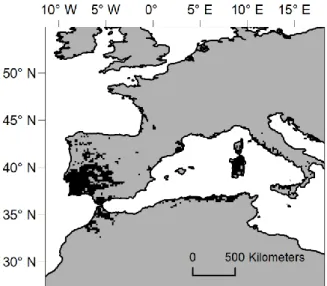
I obtained cork oak distribution data by geo-referencing or collecting geo-referenced distribution data resulting from national Forestry or Biodiversity Inventories for the Mediterranean countries where the species is present (Portugal – Autoridade Florestal Nacional 2009; Spain – Dirección General de Medio Natural y Política Forestal 2009; France – Institut National de l’Information Géographique et Forestière 2010, Italy – Atorre et al. 2011; Morocco – Haut Commissariat aux Eaux et Forêts et à la Lutte Contre la Désertification 2005; Algeria – Barry et al. 1974; Tunisia – Khaldi 2004). The spatial resolution of the data differed between countries, so the complete distribution data set was upscaled to a 10 arc-minutes resolution grid. This homogenised the spatial resolution of the distribution data and matched it to the resolution of the climate data used (Fig. 2.1). The location of recent cork oak plantations in Portugal was obtained from the same source as the distribution data (Autoridade Florestal Nacional 2009).
Figure 2.1. Cork oak distribution (in black). Over 60% of the current distribution is in the Iberian Peninsula (Pausas et al. 2009).
30
2.2.2. Environmental data
I obtained present climate data from the WorldClim database
(http://www.worldclim.org/) at 10 arc-minutes resolution, for the time-period between 1950 and 2000. Future climate predictions for 2080 (2070-2099) were obtained from the Consultative Group on International Agricultural Research (CGIAR)'s Research
Program on Climate Change, Agriculture and Food Security (CCAFS) climate data archive (http://ccafs-climate.org), at the same resolution as the present climate data, for three Global Circulation Models (GCMs – CGCM2, CSIRO MK2 and HadCM3) and two Global Emission Scenarios (GESs – IPCC SRES A2 and SRES B2). These scenarios were chosen as they represent moderate (B2 scenario, average increase of 2.4ºC by 2100) and high (A2 scenario, average increase of 3.4ºC by 2100) world-wide climate warming trends.
The full climate dataset included 19 bioclimatic variables (Hutchinson et al. 2009) for both present and future scenarios. I assessed pairwise variable correlation using Pearson’s r, and only variables with r<|0.8| were retained for modelling purposes (Désamoré et al. 2012, Telleria et al. 2012). The final variables included in the models were Mean Annual Temperature, Isothermality, Temperature Seasonality, Precipitation of the Wettest Month and Precipitation Seasonality (Table 2.1).
Table 2.1. List and description of the bioclimatic variables used for modelling purposes.
Variable Description
Mean Annual Temperature Mean of weekly mean temperatures
Isothermality Ratio of mean diurnal temperature range and
annual temperature range
Temperature Seasonality Coefficient of variation of mean weekly temperatures
Precipitation of the Wettest Month Precipitation occurred during the wettest month of the year
Precipitation Seasonality Coefficient of variation of weekly precipitation estimates
31
2.2.3. Modelling framework
In order to evaluate the consequences of using only part of the range of species in model calibration, I modelled suitable areas for the cork oak using its European only
(restricted) range and Mediterranean (full) range. A maximum entropy modelling method (Phillips et al. 2004, Elith et al. 2011) was used to obtain predictions of present and future suitable areas for the cork oak. This modelling technique is known to
perform well in comparison with other modelling algorithms (Elith et al. 2006), even with restricted data (Wisz et al. 2008), and is thus suitable for this study.
Maximum entropy models were run in R software package v2.15 (R Development Core Team 2011) with package dismo. Models were fitted using only Linear and Quadratic features in order to make results more interpretable biologically (Syfert et al. 2013) and to obtain better estimates of current and future potential distributions, which are
important for conservation purposes (Thuiller at al. 2004, Jiménez-Valverde et al. 2008). Background points were selected from the whole study region, but excluded areas where the cork oak is known to be present. For each range extent, models were replicated 100 times by selecting 75% of data records for calibration and 25% for validation, using a sub-sampling approach. I obtained presence-absence maps of suitable areas for cork oak using a metohod that minimizes the absolute difference between model sensitivity and specificity (“Equal training sensitivity and specificity” threshold in MaxEnt), which has been recommended as a good threshold selection approach (Liu et al. 2005, Jiménez-Valverde and Lobo 2007). Consensus maps were calculated for the present and future climate scenarios analysed using an unweighted average of the predictions obtained from model replicates. These maps were ultimately used to identify intervention areas for conservation and adaptation measures based on the impacts predicted by the A2 scenario. Consensus and intervention maps were edited using the ‘raster’ package for R software package v2.15 (R Development Core Team 2011) and map visualization and plotting was done using ArcGIS v10.0 (ESRI, 2010).
2.2.4. Model assessment and statistical analysis
Model predictive performance was assessed using AUC test scores. I obtained predictions of present and future suitable areas for two climate change scenarios in
32
order to quantify climate change effects on cork oak. These predictions were then used to obtain estimates of range change and range maintained for future scenarios. Range change was defined as the difference between the number of suitable pixels predicted in present and future scenarios; range maintained was the percentage of the pixels
currently occupied that is likely to remain suitable in the future. The role of recent afforestations to compensate potential cork oak losses in Portugal was assessed by calculating the area of current cork oak range and new plantations likely to remain suitable in the future. Finally, I evaluated the consequences of using incomplete species ranges in model calibration by comparing predictions obtained with restricted and full distribution datasets using pairwise t-tests. All the calculations were computed with R software package v2.15 (R Core Team 2011).
2.3. Results
Average AUC test scores of both restricted and full range models were 0.97 and did not differ significantly (Table 2.2). Predictions of present suitable range were also similar between models, averaging 2419 suitable pixels for the restricted model and 2402 for the full model. However, I did find significant differences between future suitable range predictions, for both the A2 (pairwise t-test, t=17.64, df=299, P<0.001) and B2
scenarios (pairwise t-test: t=18.59, df=299, P<0.001). The full range model always predicted a larger suitable area, averaging 2423 suitable pixels in the B2 scenario and 2237 suitable pixels in the A2 scenario (Table 2.2).
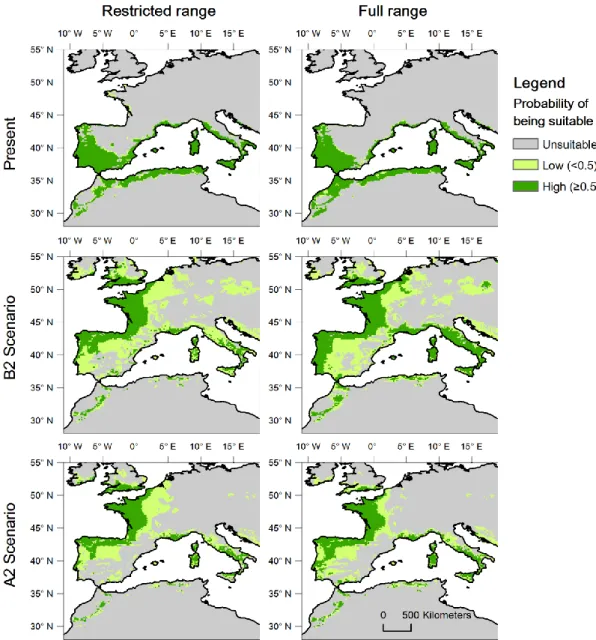
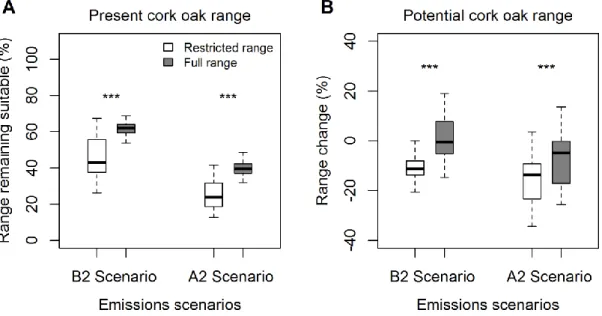
All models predict a major shift in the future range of the cork oak (Fig. 2.2), with a marked reduction of suitable areas in North Africa and southern Iberia, and a major increase in suitability to the north of the current core distribution (e.g. Atlantic Iberia, France and even England). However, the extent and geographic location of the predicted changes were quite different between the models trained with the restricted and full ranges (Fig. 2.2). For example, the restricted models predict substantially greater declines in the southern part of the current range. The full range models predict an area of the current range that will remain suitable in the future to be approximately 15% larger than what is estimated by the restricted range models in both scenarios (Fig. 2.3A). Therefore, predictions are significantly different between the restricted and full range models for both the B2 (pairwise t-test, t=30.30, df=299, P<0.001) and A2
33
scenarios (pairwise t-test, t=30.30, df=299, P<0.001). As a result, and in spite of the predicted increase in the area suitable for cork oaks in Atlantic Europe, most models still predicted a global loss of suitable area. Estimates of range change obtained with restricted range models are approximately 10% higher than the figures predicted by the full range models. This difference was statistically significant for both the B2 (pairwise
t-test, t=24.10, df=299, P<0.001) and A2 (pairwise t-test, t=26.74, df=299, P<0.001)
emissions scenarios (Fig. 2.3B).
Table 2.2. Summary of AUC scores and predicted number of suitable pixels for present and future scenarios obtained with the restricted and full range models. Indicated P-values obtained with pairwise t-test.
Descriptor Model P-value
Restricted range Full range
AUC test scores (mean ± SD) 0.97 ± 0.01 0.97 ± 0.01 0.97 No. suitable pixels (mean ± SD)
Present 2419 ± 87 2402 ± 55 0.11
B2 scenario 2154 ± 147 2423 ± 195 <0.001
A2 scenario 2040 ± 224 2237 ± 232 <0.001
Differences between models were also evident at the local scale when analysing estimates of range loss for Portugal and the future suitability of cork oak plantations (Fig. 2.4). I found significant differences between models for the estimates of future range loss in Portugal for both the A2 (pairwise t-test, t=58.08, df=299, P<0.001) and B2 scenarios (pairwise t-test, t=23.22, df=299, P<0.001). Even the more conservative full range model predicts average cork oak range losses in Portugal of approximately 5% (~25000 ha) for the B2 scenario and 40% (~200000 ha) for A2 emissions scenario (Fig. 2.5A). In what concerns recent cork oak plantations, the same model predicts that approximately 98% and 66% (B2 and A2 scenarios respectively) of plantations are in areas that should remain suitable in the future (Fig. 2.5B). Again, these estimates were significantly greater than those obtained with the restricted range model for the B2
34
(pairwise t-test, t=24.02, df=299, P<0.001) and A2 scenarios (paired t-test, t=85.60, df=299, P<0.001).
Figure 2.2. Climatically suitable areas for the cork oak as predicted by the restricted range (left) and full range (right) models. Images represent consensus maps of predicted suitability for the present (top row) and year 2080 according to different emission scenarios (centre and bottom rows).
35
Figure 2.3. Estimates of (A) present range likely to remain suitable in future scenarios, and (B) potential cork oak range change according to predictions made by the
restricted and full range models. Significant differences between models were found for all estimates and emissions scenarios analysed (*** p<0.001, pairwise t-test).
2.4. Discussion
2.4.1. European only vs. full Mediterranean models: implications for conservation planning
Predictions of future suitable areas obtained with the restricted range model, calibrated with the European distribution of the cork oak, differed significantly from the
predictions obtained with the full range model that included both the European and North African range (Fig. 2.2). These differences can be explained by the influence of data extent on the calibration of model response curves (Thuiller et al. 2004).
36
Figure 2.4. Distribution of recent cork oak plantations in Portugal and predicted suitability for present (top row) and future emission scenarios (middle and bottom rows), as predicted by the restricted (left) and full range (right) models.
Excluding data from regions with differing climatic conditions will likely prevent species distribution models to accurately identify all climatically suitable areas for the species. This is a particularly important drawback in a climate change context, because current climatic conditions may shift geographically or even disappear (Ohlemüller et
37
al. 2006), which may restrict model transferability and ultimately affect predictions (Barbet-Massin et al. 2010).
Figure 2.5. Estimates of (A) cork oak woodland area predicted to become unsuitable and (B) area of cork oak plantations remaining suitable in Portugal, as predicted by the restricted and full range models for the B2 and A2 emissions scenarios. Significant differences were found between model predictions for each statistic and emissions scenario analyzed (*** p<0.001, pairwise t-test).
These results have important implications for the use of SDMs for conservation planning: restricted models may fail to identify future suitable areas, hence providing inaccurate information for managers and policy-makers. Modelling techniques known to perform well with restricted data, such as maximum entropy models (Wisz et al. 2008), may result in good models of the current distributions, as results show, but are likely to be inaccurate when applied to future scenarios. Using more complete
information on species distributions to calibrate models is thus important (Lobo 2008). However, data availability is still a problem in many regions, and even when available, issues with data quality may prevent their inclusion in the high-resolution models that are usually required for conservation and policy decisions. The Mediterranean Basin is an example of the difficulties of making accurate predictions for future scenarios using SDMs. For many Mediterranean species, distribution data are more easily available for southern Europe than northern Africa. In spite of the ongoing progress of Natural history research in North African countries, distribution data is still usually sparse,
38
outdated, or of low resolution. The presence of the Mediterranean Sea separating these two regions provides additional geographical justification for excluding North Africa from modelling efforts. However, the omission of information from North Africa, where many Mediterranean species reach their warmest and driest range limits, will result in incorrect model calibration and, therefore, inaccurate future predictions. Efforts to tackle this issue should focus on increasing knowledge of species distributions
through biodiversity mapping (for an example, see Jetz et al. 2012) and improving data sharing, which may also stimulate inter-regional collaborations required to tackle climate change (Brooker et al. 2010).
Figure 2.6. Summary map of climate change impacts on suitable areas for the cork oak. Areas where the species is currently present but likely to become climatically unsuitable due to climate change are shown in red. In yellow are shown the areas where cork oak is currently present and climatic conditions are likely to remain suitable in the future. Green areas represent new suitable climatic space for the cork oak in areas where it is currently absent.
39
2.4.2. Cork oak conservation and adaptation priorities in light of future climate change
Results show a clear message: Climate change will affect the cork oak distribution range, which will have important impacts on the future of the Montado system. Both its potential and occupied range are expected to decline, with predictions of only 40 to 60% of its current worldwide range likely to remain suitable in the future. Impacts will not be homogenous across its range, and will affect mostly northern Africa and the south of the Iberian Peninsula (Fig. 2.2). In the particular case of Portugal, that currently holds approximately one third of the cork oak global range (Pausas et al. 2009), between 40 to 80% of its current area may become unsuitable in higher warming scenarios (Fig. 2.5). Nonetheless, the results obtained with the full range models provide more favourable scenarios for the application of conservation and adaptation measures than previous estimates resulting from incomplete range efforts. The type intervention required varies between regions and is dependent on the presence or absence of cork oak areas and the changes in the climatic suitability predicted due to climate change (Fig. 2.6).
Conservation priorities should focus primarily in areas of the current cork oak range that are expected to remain suitable. In more extreme scenarios, extensive losses of
climatically suitable areas are predicted in northern Africa and southern Iberian Peninsula and only small pockets of suitable climate are likely to maintain viable cork oak populations (red areas in Fig. 2.6). These areas of potential refugia should be
primary candidates for immediate protection in order to maintain landscape connectivity and should therefore be managed to increase their resilience and long term
sustainability. They would be valuable to boost the current network of European and Mediterranean protected areas, deemed necessary to face future climate change (Klausmeyer and Shaw 2009, Araújo et al. 2011).
Despite the likely reduction in suitable area for the cork oak, models still predict
between 40 and 60% of the current range to remain suitable in the future. Areas likely to maintain their cork oak populations include the central Iberian Peninsula, Italy and the Mediterranean islands of Sicily, Sardinia and Corsica (yellow areas in Fig. 2.6). In these areas the conservation focus should shift to the promotion of long term sustainable management practices, required to maintain biodiversity and ecosystem services