A R T I G O O R I G I N A L
B
I OR
EP
O R TA P ,
A N E L E C T R O N I C C L I N I C A LR E C O R D C O U P L E D W I T H A D A T A B A S E
:
A N E X A M P L E O F I T S U S E I N A S I N G L E C E N T R E
Campanilho-Marques R
*1, Polido-Pereira J
**1, Rodrigues A
**, Ramos F
*, Saavedra MJ
*, Costa M
*,
Martins F
***, Pereira da Silva JA
*, Canhão H
**, Fonseca JE
***Serviço de Reumatologia e Doenças Ósseas Metabólicas, Centro Hospitalar Lisboa Norte – Hospital de Santa Maria
**Unidade de Investigação em Reumatologia, Instituto de Medicina Molecular, Faculdade de Medicina da Universidade de Lisboa e Serviço de Reumatologia e Doenças Ósseas Metabólicas, Centro Hospitalar Lisboa Norte – Hospital de Santa Maria ***Sociedade Portuguesa de Reumatologia
1Both author contributed equally to this work
axial involvement the reduction of BASDAI and BASFI was not statistically significative. On top of that, PASI score suffered a reduction of 64%. Four-teen patients (33.3%) had to switch their TNF an-tagonist treatment. 58.8% of the switches were due to adverse effects and 41.2% due to therapy failure. Regarding the 56 adverse reactions registered, only one was a severe reaction. The remaining adverse reactions were not severe and 67% of them were due to infections.
Discussion: The results of this first report of the use
of the BioRePortAP in clinical practice confirm the efficacy and safety of TNF antagonist treatment in PsA. The results shown here elucidate the potential applications of BioRePortAP as a tool for efficacy and safety assessment of PsA patients treated with biotechnological drugs.
Keywords: Psoriatic Arthritis; Registry;
BioRepor-tAP; Biological Therapy; Portugal.
Introduction
Psoriatic arthritis (PsA) has been defined as an in-flammatory arthritis associated with psoriasis and seronegative for rheumatoid factor. PsA affects men and women almost equally. The average age at on-set in most studies is 36-40 years. The classic des-cription of PsA includes five clinical patterns1.
The-se patterns include distal interphalangeal (DIP) joint involvement, oligoarticular pattern (<5 joints involved) which is usually asymmetric in distribu-tion, a polyarticular pattern (>5 joints involved), which is symmetric in only half the patients, arthri-tis mutilans, which is a very destructive form of arthritis and spondyloarthritis, affecting the sacroi-liac joints and the apophyseal joints of the spine, with a clinical pattern often similar to ankylosing spondylitis (AS)2.
Over the past few years, there has been a
rene-Abstract
Aims: To evaluate the efficacy and safety of the
tre-atment of psoriatic arthritis (PsA) patients with tu-mor necrosis factor (TNF) antagonists in the Rheu-matology Department of Hospital de Santa Maria using the BioRePortAP.
Methods: The Portuguese Society of Rheumatology
(SPR) developed an electronic medical chart cou-pled with a database for the follow up of PsA pati-ents, the BioRePortAP, which was launched in May 2009. This evaluation was based on all the PsA pa-tients that were on active treatment with TNF an-tagonists in September 2009 and were registered in the BioRePortAP. All the previous data on these pa-tients were introduced in BioRePortAP using the prospective paper based follow up protocol that this Department was using since 1999. Only pa-tients with more than 9 months of treatment were analyzed.
Results: Forty-two patients with PsA, actively
trea-ted with anti-TNF agents in September 2009, for at least 9 months, were analyzed in BioRePortAP. Twenty-three patients were male (55%) and nine-teen were female (45%). The average age of these patients was 49.8±10.9 years old, the average disea-se duration was of 10.7±5.6 years and the mean du-ration of biological therapy was of 37.8±27.8 months. For the 81% of patients with peripheral jo-int disease there was a mean reduction of more than 80% in the swollen and tender joint counts, and almost 50% in the health assessment question-naire (HAQ) value. In the 19% of the patients with
C A M PA N I L H O-M A R Q U E S R E C O L.
wed interest in the treatment of PsA. This has resul-ted from the advent of tumor necrosis factor (TNF) antagonist therapy that had proven to be highly ef-fective in both psoriasis and PsA3. TNF is a leading
cytokine for the inflammatory aspects noted in the skin and joints and it is a key upstream factor in the activation of other chemokines and cytokines, which may lead to cartilage and bone destruction and to skin scarring. Thus, it is not surprising that tackling TNF leads to marked improvement in joint and skin symptoms and prevents joint destruction and permanent skin lesions. At this moment, only 3 anti TNF treatments are reimbursed in Portugal for the treatment of adult patients with active PsA who have responded inadequately to disease-mo-difying anti-rheumatic drugs (DMARDs): adalimu-mab, etanercept and infliximab. Etanercept, a re-combinant human soluble TNF receptor is a di-meric fusion protein consisting of the extracellu-lar portion of the human p75 TNF receptor linked to the Fc portion of a Type 1 human immunoglo-bulin (IgG1). The primary action of etanercept is to bind and inactivate soluble and cell-bound TNF and lymphotoxin alpha. In adults, it is administe-red 25 mg twice a week or 50 mg once a week. In-fliximab is a chimeric monoclonal antibody that binds specifically to human TNF and is composed of human constant and murine variable regions. Infliximab is administered as an intravenous infu-sion, at a dose of 5 mg/Kg, at 0, 2, and 6 weeks fol-lowed by infusions every 8 weeks. Adalimumab is a fully human anti-TNF IgG1 antibody, with a me-chanism of action similar to infliximab. It is admi-nistered as a subcutaneous injection at a dose of 40 mg every two weeks.
In order to measure disease activity, progression and change with therapy in PsA patients, it is im-portant to use accurate, reliable and feasible out-come measures that can ideally be employed in longitudinal cohorts, clinical trials and clinical practice4,5.
Until recently, there has been a low investment on the development of this kind of methodology applied to PsA. With emerging therapies, the focus on the methodology of outcome assessment has increased to ensure that discriminative instru-ments are used. Most tools applied to the quanti-fication of PsA outcomes have been borrowed from rheumatoid arthritis (RA) and ankylosing spondyli-tis (AS) outcome studies, but some have been spe-cifically tested in PsA3. However, the relative
varia-bility of PsA clinical manifestations still poses a
great challenge in the assessment of real life co-horts, which were not selected through complex inclusion and exclusion criteria, as is the case of cli-nical trials.
A key assessment in rheumatology clinical trials is the counting of the number of tender and swollen joints in a patient. Variable numbers of joints are counted in various systems, such as the American College of Rheumatology (ACR) joint count of 68 tender and 66 swollen (excluding the hips from assessment of swelling), developed in 1949 for the evaluation of RA6. This has been
fre-quently adapted to be used for the evaluation of PsA patients with peripheral joint involvement (wi-thout axial skeleton involvement) – the so called “RA like” patients. These joint counts are then com-bined with other core measures of disease activity (also adapted to the use in PsA), such as patient and physician assessed global health, through the use of a 100 mm visual analogue scale (VAS), pain (also using a VAS) and inflammation markers (Erythro-cyte Sedimentation Rate, ESR, and C reactive pro-tein, CRP)7. Another classical RA activity
measure-ment, the DAS 28 (disease activity score, based on 28 swollen and tender joints, ESR and patient glo-bal health VAS) has been also frequently used in PsA8.
The ASessment in Ankylosing Spondylitis (ASAS) working group has recommended the use of a number of outcome measures for spinal invol-vement in AS, which includes the Bath Ankylosing Spondylitis Disease Activity Index (BASDAI)9, the
Bath Ankylosing Spondylitis Function Index (BAS-FI)10and a set of mobility measures. This
measure-ments have been used to evaluate PsA in patients that have axial skeleton involvement – “AS like” pa-tients.
PsA joint disease activity is commonly not mir-rored by skin disease. It thus seems logical to as-sess skin disease separately. The most widely used system is the Psoriatic Area Severity Index (PASI)11,12
and this has been introduced in the description of PsA clinical cohorts.
Physical function refers to the abilities or diffi-culties in daily activities such as walking, opening jars, playing sports, lifting heavy objects, writing and so forth. Assessing physical function by self--reported questionnaire has become a favored approach because no special equipment or testing personnel is required. The Health Assessment Questionnaire (HAQ)13is a validated
BI OREPO R TAP, A N E L E C T R O N I C C L I N I C A L R E C O R D C O U P L E D W I T H A D ATA B A S E: A N E X A M P L E O F I T S U S E I N A S I N G L E C E N T R E
PsA may affect people in a way similar to RA it has been considered reasonable to use such measure in PsA.
An important aspect of the evaluation of the re-sults of DMARDs treatment is the repercussion on structural joint damage. Radiologic signs of joint damage remain the standard method in RA clini-cal trials, despite the advent of newer modalities such as ultrasound and magnetic resonance ima-ging (MRI). In PsA the distribution of joint disease is not predictable and it remains to be determined which joints should be scored to get a sufficiently valid measurement of joint damage.
Simple measures of inflammation, such as the acute phase reactants, which include ESR and CRP are used, but are not reliably elevated in patients with PsA, even with active inflammation. Desirable but not essential symptom domains to measure in-clude enthesitis, dactylitis, nails and fatigue14-16.
As has already been done for RA and AS, the Por-tuguese Society of Rheumatology (SPR) has deve-loped an informatics platform which combines features of electronic clinical chart with a databa-se for PsA patients who are being treated with bi-otechnological drugs – BioRePortAP. This article is the first application of the use of BioRePortAP to a cohort of PsA patients being followed in a Portu-guese Rheumatology Department. In addition, this is also the first report of a Portuguese cohort of PsA patients treated with TNF antagonists. In fact, SPR has promoted 2 national reports on the use of bio-technological drugs in RA17and AS18 but there is no
report on patients with PsA. Moreover, despite the existence of national guidelines for treatment of
RA19and AS20patients with biotechnological
DMARDs, SPR has not developed this instrument for PsA, which means that the results of this paper can be taken into account in the future elaboration of such guidelines. BioRePortAP will be an impor-tant tool for monitoring the efficacy and safety of the use of TNF antagonists in PsA at a national le-vel and this first practical application will help to detail the mechanisms for recording and analysis of data.
Material and methods
BioRePortAP is an electronic clinical chart that is linked to a database, built on the Plataform.NET (VB.NET) and the SQL DatabaseServer. The NET Plataform (Microsoft) allows the development of
software applications for Windows, based on VB.NET programming language to build all the screens used. The information entered is stored in the SQL server database management system (Mi-crosoft).
BioRePortAP was launched on 2 May 2009 at a national level by SPR and all PsA patients treated with biologic therapies in the Rheumatology De-partment of Santa Maria´s Hospital are being col-lected prospectively from that date. In addition, this department had also previously started (since 1999) a prospective evaluation of all rheumatic patients treated with biotechnological drugs structured on a paper based protocol. This proto-col has been adapted from an initial version pre-pared for RA patients published initially in 2001 and updated recently21. This evaluation was based
on all PsA patients that were on active treatment with TNF antagonists in September 2009 for more than 9 moths and were registered in the BioRePor-tAP. The criteria for starting TNF antagonists was based on the clinical opinion of the assisting physician reflecting, however, the Portuguese re-commendations for starting biotechnological drugs in RA19 and AS20patients were also taken into
account.
The key variables included in the BioRePortAP were: sex, age, birthplace, education, current em-ployment status, prior disease, personal history, general clinical data (type of arthritis, the onset of symptoms and date of diagnosis, radiological signs, HLA B27 typing, body mass index, smoking and alcohol consumption), surgeries, prior the-rapy (DMARD) and current thethe-rapy (name of the drug, starting date, dose, consumption of NSAIDs and corticosteroids) and adverse effects. Severe ad-verse reactions were defined as the occurrence of death, hospitalization or any event that causes per-manent damages. The tuberculin skin test (TST), chest x-ray results, tuberculosis risk factors and la-tent tuberculosis treatment is also recorded. The complete joint count is registered, as well as patient and physician’s global health VAS, patient’s pain VAS, HAQ and inflammation markers (ESR and CRP). A computer assisted automatic DAS 28 cal-culation is available (including CRP or ESR and 3 or 4 variables)7,8. For patients with axial
involve-ment BASDAI, BASFI and mobility measureinvolve-ments as defined by the ASAS group are used. Psoriasis Area and Severity Index (PASI) is the score used for skin involvement.
C A M PA N I L H O-M A R Q U E S R E C O L.
Results
Forty-two patients with PsA, who in September 2009 were under treatment with anti-TNF agents, for at least 9 months, were registered in BioRePor-tAP and analyzed. Twenty-three patients were male (55%) and nineteen were female (45%). The avera-ge aavera-ge of these patients was 49.8±10.9 years old. The youngest was 38 and the eldest was 60 years old. The average age at diagnosis was 38.1±11.6 years old and the average disease duration at the current evaluation was of 10.7±5.6 years. The shor-test disease duration was of 5 years and the longest disease duration was of 16 years. The mean disea-se duration at the beginning of the biological treat-ment was of 7.9±6.5 years and the mean duration of biological therapy currently under way was of 37.8±27.8 months (minimum of 10 months and maximum of 5 years).
For a total of 42 patients 19% had axial skeleton involvement and 81% peripheral joint involve-ment. HLA-B27 was registered in 24 patients and was positive in 4 (16.7%) of them.
Due to the high risk of tuberculosis in patients with inflammatory joint diseases treated with anti-TNF drugs, the tuberculin skin test (TST) with two units of RT23 and chest x-ray were performed be-fore starting therapy. For further evaluation 14 pa-tients (33.3%) were referred to specialized tubercu-losis centers (Centros de Diagnóstico Pneumológi-co, CDP) and eleven patients (26.2%) received latent tuberculosis treatment. Tuberculin skin test was performed in all patients prior to starting anti TNF treatment but in two of them there was no registry of the result. Six of the 27 patients with TST<5mm repeated the test and in all of them the result was less then 5mm. In none of them was prescribed prophylactic therapeutic but 4 of the 24 patients with initial TST<5mm and normal chest X-ray were submitted to isoniazid treatment due to the presen-ce of epidemiological risk factors for tuberculosis
(in 2 isoniazid 300mg/day during 6 months was prescribed and in the other 2 it was taken during 9 months). In 5 of the 8 patients with TST 5-10mm isoniazid (300mg/day during 6 months in 4 patients and during 9 months in 1) was prescribed due to the presence of prior immunosuppressive treatment. All the 5 patients with TST>10mm received latent tuberculosis treatment: 3 were treated with zid 300mg/day during 9 months, 1 received isonia-zid 300mg/day during 6 months and 1 isoniaisonia-zid and rifampicin during 3 months.
At the time of the current evaluation, in a total of 42 patients, 18 were under treatment with eta-nercept (42.9%), 16 with infliximab (38.1%) and 8 with adalimumab (19%). Only 26.2% were on mo-notherapy with anti-TNF drugs and the majority (73.8%) was being treated with an associated con-ventional DMARD. In 18 patients treated with eta-nercept, only 5 (27.8%) were on monotherapy and most (55.5%) were being treated concomitantly with methotrexate (MTX). For the 16 patients being treated with infliximab only 37.5% were on monotherapy and 57.3% have associated MTX or other DMARDs. All of the adalimumab treated pa-tients were receiving concomitant MTX (Table I).
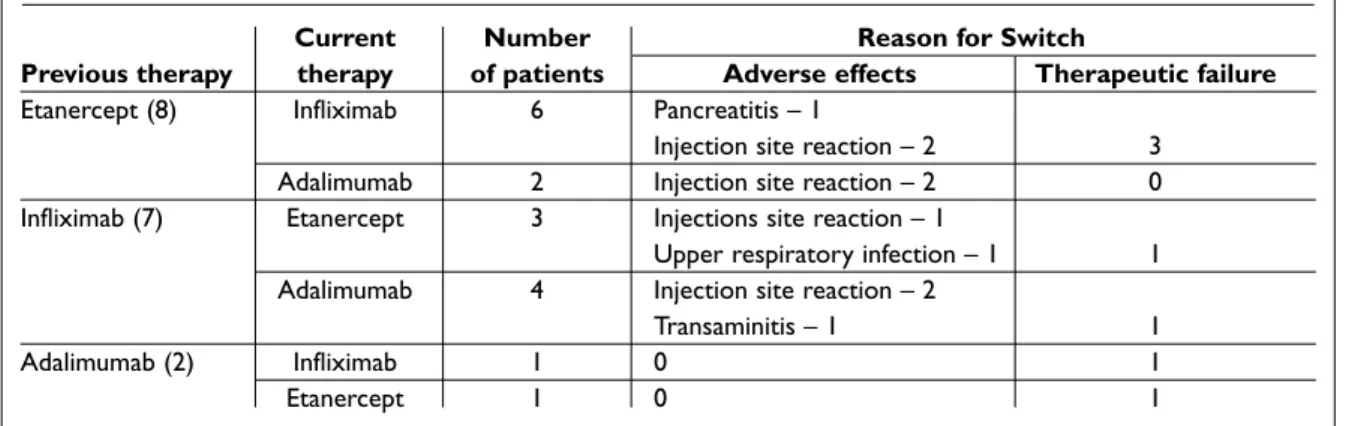
Fourteen patients (33.3%) had to switch their TNF antagonist treatment and 3 of them made two switches, so in total there were 17 switches. 58.8% of the switches were due to adverse effects and 41.2% due to therapy failure (Table II).
To evaluate the 81% of patients with predomi-nant peripheral joint involvement the 68 joint counts and the DAS28 score were applied. The ave-rage initial (at the beginning of biologic therapy) number of tender joints (68 joint count) was 16.3±10.4 and the final (at the moment of evalua-tion) was 3±5.1 (p=0.00005). The swollen joint (68 joint count) count at the beginning of treatment was 9.4±9.7 and at the final evaluation was 1.2±2.6 (p=0.0000659) (Figure 1). The initial DAS28 was 3.6±2.6 and the final was 3±1.6 (p=0.140) (Figure 2).
Table I. Biological therapy and DMARDs
Monotherapy MTX SLZ MTX/PDN MTX/PDN/SLZ PDN TOTAL
Infliximab 37.5 12.5 6.25 31.25 12.5 0 100
Etanercept 27.8 44.4 5.6 11.1 0 11.1 100
Adalimumab 0 62.5 0 25 12.5 0 100
Number of DMARDs (percentages) currently in use in association with biological therapy (anti-TNF) on Psoriatic Arthritis patients MTX: Methotrexate; SLZ: Sulphasalazine; PDN: Prednisone
BI OREPO R TAP, A N E L E C T R O N I C C L I N I C A L R E C O R D C O U P L E D W I T H A D ATA B A S E: A N E X A M P L E O F I T S U S E I N A S I N G L E C E N T R E
For the 19% of PsA patients with spinal involve-ment – “AS like patients” BASDAI and BASFI were used. The average initial BASDAI was 4.3±2.9 and the final was 3.4±1.9 (p=0,263). The average initial BASFI was 4.7±1.6 and the final was 4.3±1.9 (p=0.386) (Figure 3 and 4).
Concerning the acute phase reactants, the ini-tial ESR was 25.9±21.9 mm/1sthour and the final
was 19.1±21.5 mm/1sthour (p=0.084). The initial
CRP was 2.1±3.7 mg/dL and the final 0.9±1.8 mg/ /dL (p=0.04).
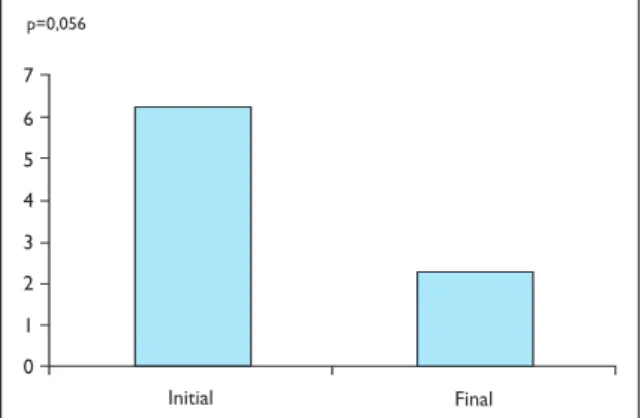
To assess skin disease in PsA the PASI was used. The mean initial PASI was 6.3±13.5 and the final was 2.2±5.5 (p=0,056) (Figure 5). In 40.5% of pa-tients there was a reduction of at least 50% of the PASI value.
Table II. Switch between biological therapies
Current Number Reason for Switch
Previous therapy therapy of patients Adverse effects Therapeutic failure
Etanercept (8) Infliximab 6 Pancreatitis – 1
Injection site reaction – 2 3
Adalimumab 2 Injection site reaction – 2 0
Infliximab (7) Etanercept 3 Injections site reaction – 1
Upper respiratory infection – 1 1
Adalimumab 4 Injection site reaction – 2
Transaminitis – 1 1
Adalimumab (2) Infliximab 1 0 1
Etanercept 1 0 1
Number and reason for switches (in absolute numbers)
2 0 18 8 4 6 10 12 16 14 Initial Final Tender joints Swollen joints p=0,00005 p=0,00007 N-68
Figure 1. Number of tender and swollen joints initial
and final (at the moment of the last evaluation) of the 81% of patients with peripheral involvement (mean follow-up – 37.8±27.8 months). 0 7 1 4 2 3 5 6 Initial Final p=0,140
Figure 2. Value of DAS 28 (Disease Activity Score) initial
and final (at the moment of the last evaluation) of the 81% of patients with peripheral involvement (mean follow-up – 37.8±27.8 months).
To assess physical function the self-reported questionnaire HAQ was used. The initial HAQ was 1.5±1 and the final was 0.7±0.8 (p=0.0002).
At the end of the evaluation period, 28.6 % of the peripheral joints affected patients had a DAS28 su-perior to 3.2, 12.5% of the axial involved patients had a BASDAI superior to 40 and 60% improved less than 50% in their skin condition.
The only documented severe adverse reaction was due to a case of pancreatitis, which was con-sidered by the assisting physician to be unlikely re-lated to the use of TNF antagonists. In 23.8% of the mild adverse reactions, the drug had to be discon-tinued definitely and switched to another TNF an-tagonist, while in the remaining patients a tempo-rary drug withhold proved to be enough. No tuber-culosis case was registered. According to the expo-sure time, 1.3 serious adverse reactions occurred by 100 patient-year (Figure 6).
C A M PA N I L H O-M A R Q U E S R E C O L.
Discussion
The results of this first report of the use of the Bio-RePortAP in clinical practice confirm the efficacy and safety of TNF antagonist treatment in PsA. In fact, in a cohort of 42 patients, with a mean treat-ment duration of 37.8±27.8 months (minimum ex-posure to the drug of 9 months) in the patients with peripheral joint disease there was a mean re-duction of more than 80% in the swollen and ten-der joint counts and in those with an axial invol-vement there was a mean reduction in the BASDAI score of 34%. On top of that, the mean PASI score suffered a reduction of 64%. On the other hand, in this group of patients there was a low rate of serio-us adverse effects, although a relatively high num-ber of mild adverse effects were reported.
The impact on functional scores, such as BASFI
(mean reduction of 0.5) and HAQ (mean reduction of 0.9), reflects the relatively long disease duration that these patients had at the time of starting the-se drugs. However, this dithe-seathe-se duration (slightly less than 8 years) is lower than the one that was ve-rified in the previous RA (almost 12 years) and AS (almost 14 years) Portuguese cohorts of patients treated with biotechnology drugs17,18.
Fourteen patients (33.3%) had to switch from one TNF antagonist to another one due to lack of efficacy in 41.2% of the cases. Three of these pa-tients had to switch again to a third anti TNF drug also due to lack of efficacy. The remaining causes for switching were adverse effects. Even with addi-tional measures to ensure the effectiveness of treat-0 8 1 2 5 3 4 6 7 Initial Final p=0,263
Figure 3. Bath Ankylosing Spondylitis Disease Activity Index
initial and final (at the moment of the last evaluation) of the 19% of patients with axial involvement (mean follow-up – 37.8±27.8 months). 0 7 1 4 2 3 5 6 Initial Final p=0,386
Figure 4. Bath Ankylosing Spondylitis Functional Index initial
and final (at the moment of the last evaluation) of the 19% of patients with axial involvement (mean follow-up – 37.8±27.8 months). 0 7 1 4 2 3 5 6 Initial Final p=0,056
Figure 5. Psoriatic Area and Severity Index (PASI) initial and
final (at the moment of the last evaluation) in all the pa-tients (mean follow-up - 37.8±27.8 months).
0,0 50,0 5,0 20,0 10,0 15,0 25,0 30,0 40,0 35,0 45,0 Etanercept
Infliximab Adalimumab Total Infectious Others Total
Figure 6. Number of adverse reactions per 100
BI OREPO R TAP, A N E L E C T R O N I C C L I N I C A L R E C O R D C O U P L E D W I T H A D ATA B A S E: A N E X A M P L E O F I T S U S E I N A S I N G L E C E N T R E
ment such as switching and associating DMARDs (73.8% of the patients) there were 28.6 % of the pe-ripheral affected patients with a DAS28 superior to 3.2, 12.5% of the axial involved patients with a BASDAI superior to 40 and 60% improved less than 50% in their skin condition. Moreover, the impro-vements observed in mean DAS28 and mean BAS-DAI scores were not statistically significative. These observations suggest that some of these patients should be reassessed for treatment optimization (classical DMARD readjustment, switch to another TNF antagonist and review of the treatment opti-ons for skin disease).
The dissociation between the reduction in the 68 joint count and the results of the DAS28 score suggest that DAS28 is a weak discriminating as-sessment toll for PsA.
Due to the high incidence of tuberculosis in the general Portuguese population, particularly in in-flammatory joints diseases treated with anti-TNF drugs, strict recommendations for the diagnosis and treatment of latent tuberculosis infection were elaborated by the Portuguese Society of Rheuma-tology22. Since 2002, specific guidelines for
scree-ning candidates to anti-TNF therapy for active and latent TB have been followed. The first version of these guidelines was published in September 2006 and placed on the General Directorate of Health In-ternet website in December 200623. Before this
date, the threshold of TST positivity was higher (TST>10mm) and that explains why 3 of the pa-tients, who had TST between 5 and 10mm and star-ted biological therapy before 2002 didn't receive la-tent tuberculosis infection treatment. In the recent Portuguese recommendations the TST is conside-red positive if: ≥5mm in any patient who is about to start anti-TNF treatment and is concomitantly immunossuppressed (prednisolone in doses hig-her than 10 mg/day and/or with immunosuppres-sant drugs, such as MTX, cyclosporine, azathiopri-ne, leflunomide or cyclophosphamide, regardless of the dose); or ≥10 mm in patients who are not tak-ing previous immunossuppresstak-ing drugs. Four of the patients had a negative TST but were, also in accordance to these guidelines, submitted to treat-ment because they were immunossuppressed and had epidemiologic risk factors for tuberculosis. Fourteen of the patients were referred to Centro Diagnóstico Pneumológico (CDP) or to a Pulmo-nology Department, corresponding to the ones that had started the treatment more recently, fol-lowing the 2008 updated version of these
guideli-nes that recommend that all patients in evaluation for TNF antagonist therapy should be referred to a tuberculosis specialized centre.
Regarding safety it is important to highlight that several mild infectious adverse effects were detec-ted. However, severe adverse effects were very rare. The way the Day Care Unit of Rheumatology De-partment of the Hospital de Santa Maria is organi-zed favors the detection of all the complications because patients are advised to seek medical sup-port in the Day Care Unit whenever a complicati-on occurs. On the other hand, this easy ccomplicati-ontact combined with a low threshold for the diagnosis of infections might contribute to the low rate of se-vere adverse effects.
The results shown here elucidate the potential applications of BioRePortAP as a tool for efficacy and safety assessment of PsA patients treated with biotechnological drugs. Moreover this informatics tool can also act as a guarantee of good clinical practice and a source of data for self assessment of a Rheumatology department.
The characteristics of this first report of the Bio-RePortAP, including only a population that was on therapy at a certain date (September 2009), limits the type of conclusions that can be achieved. Ho-wever, at long term evaluations, BioRePortAP will be able to inform precisely on drug survival, which is the main limitation of the current assessment. Correspondence to
Raquel Campanilho-Marques
Serviço de Reumatologia e Doenças Ósseas Metabólicas,
Centro Hospitalar Lisboa Norte Avenida Professor Egas Moniz 1649-035 Lisboa
Tel: +351 966 253 128
E-mail: [email protected]
References
1. Glandman DD. Psoriatic arthritis. Dermatol Ther 2009; 22: 40-55.
2. Taylor WJ. The epidemiology of psoriatic arthritis. Curr Opin Rheumatol 2002; 14: 98-103.
3. Taylor WJ. Assessment of outcome in psoriatic arthri-tis. Curr Opin Rheumatol 2004; 16: 350-353.
4. Mease JP. Spondyloarthritits Update: New insights Regarding Classification, Pathophysiology and ma-nagement. Bull NYU Hosp Jt Dis 2008; 66: 203-209. 5. Mease PJ, Antoni CE, Gladman DD et al. Psoriatic
arthritis assessment tools in clinical trials. Ann Rheum Dis 2005; 64: 49-54.
6. Van Gestel AM, Prevoo ML, van´t Hof MA et al. Deve-lopment and validation of the European League
C A M PA N I L H O-M A R Q U E S R E C O L.
Against Rheumatism response criteria for rheuma-toid arthritis. Arthritis Rheum 1996; 39: 34-40. 7. Deandrade JR. A seven-day variability study of 499
patients with peripheral rheumatoid arthritis. Arthri-tis Rheum 1965; 8: 302-334.
8. Smolen JS, Breedveld FC, Elberl G et al. Validity and reability of the twenty-eight-joint count for the as-sessment of rheumatoid arthritis activity. Arthritis Rheum 1995; 38: 38-43.
9. Garrett S, Jenkinson T, Kennedy LG et al. A new ap-proach to defining disease status in ankylosing spondylitis: the Bath Ankylosing Spondylitis Disease Activity Index. J Rheumatol 1994; 21: 2286–2291. 10. Calin A, Garrett S, Whitelock H et al. New approach to
defining functional ability in ankylosing spondylitis: the development of the Bath Ankylosing Spondylitis Functional Index. J Rheumatol 1994; 21: 2281–2285. 11. Frederiksson T. Severe psoriasis – oral therapy with a
new retinoid. Dermatol 1994; 157: 238-244.
12. Gottlieb AB. The National Psoriasis Foundation Pso-riasis Score (NPF-PS) system versus the PsoPso-riasis Area Severity Index (PASI) and Physician´s Global As-sessment (PGA): a comparison. J Drug Dermatol 2003; 2: 260:266.
13. Fries JF, Kraines RG, Splitz Z et al. Measurement of patient outcomes in arthritis. Arthritis Rheum 1980; 23: 137-145.
14. Olivieri I, Cantini F, Salvarani C et al. Fast spin echo-T2-weighted sequences with fat saturation in dactyli-tis of spondylarthridactyli-tis. No evidence of entheseal in-volvement of the flexor digitorum tendons. Arthritis Rheum 2002; 46: 2964-2967.
15. Schentag CT.Validation and normative data for the 0-10 point scale version of the fatigue severity scale (FSS). Ann Rheum Dis 2000; 43: 177-181.
16. McGonagle D, Emery P, Gibbon W et al. Classification of inflammatory arthritis by enthesistis. Lancet 1998; 352: 1137-1140.
17. Grupo de Estudos de Artrite Reumatóide da Socieda-de Portuguesa Socieda-de Reumatologia. Análise Socieda-de 376 doentes com artrite reumatóide submetidos a tera-pêutica biológica registados na base de dados de te-rapêutica biológica da Sociedade Portuguesa de Reu-matologia. Acta Reum Port 2005; 30: 63-71.
18. Grupo de Consensos para as terapêuticas biológicas na Espondilite Anquilosante da Sociedade Portugue-sa de Reumatologia. Análise de doentes com espon-dilite anquilosante submetidos a terapêutica biológi-ca registados na base de dados de terapêutibiológi-ca biológica da Sociedade Portuguesa de Reumatologia. Acta Reum Port 2005; 30: 253-260.
19. João Eurico Fonseca, Helena Canhão, Paulo Reis et al. Portuguese guidelines for the use of biological agents in rheumatoid arthritis – March 2010 update. Acta Reum Port 2010; 35: 95-98.
20. Grupo de Consensos para as Terapêuticas biológicas na Espondilite Anquilosante da Sociedade Portugue-sa de Reumatologia. Consensos sobre a utilização de antagonistas do TNF na terapêutica da espondilite anquilosante. Acta Reum Port 2005; 30: 155-159. 21. Fonseca JE, Canhão H, Reis P et al. Protocolo de
mo-nitorização clínica da artrite reumatóide (PMAR) – revisão de Dezembro de 2007. Acta Reum Port 2007 32: 367-374.
22. Fonseca JE, Lucas H, Canhão H et al. Recommenda-tions for the diagnosis and treatment of latent and active tuberculosis in inflammatory joint diseases candidates for therapy with tumor necrosis factor al-pha inhibitors March 2008 update. Acta Reum Port 2008; 33: 77-85.
23. Fonseca JE, Lucas H, Canhão H et al. Recomen-dações para o diagnóstico e tratamento da tubercu-lose latente e activa nas doenças inflamatórias arti-culares candidatas a tratamento com fármacos inibidores do factor de necrose tumoral alfa. Acta Reum Port 2006; 31: 237-245.