ARTICLE
The prevalence of multiple sclerosis in Belo
Horizonte, Brazil
Prevalência da esclerose múltipla em Belo Horizonte, Brasil
Marco A. Lana-Peixoto, Elizabeth R. C. Frota, Gilberto B. Campos, Leonardo P. Monteiro on behalf of the Brazilian Committee for Treatment and Research in Multiple Sclerosis.
Multiple sclerosis (MS) is a demyelinating inlammatory and degenerative disease of the central nervous system (CNS) whose etiology is still unknown. Epidemiological studies have suggested that the interaction between genetic susceptibil-ity and a variety of environmental factors may play a key role accounting for the diferences in its prevalence in distinct populations1.
In the last few decades, a large number of studies have demonstrated the frequency of MS in all continents2. Unfortunately, however, many of these epidemiological studies lack consistent methodological features, such as strict diagnostic criteria, well deined study populations or geographical areas, and complete case ascertainment3. Such faults have rendered their results unreliable for compari-sons with established data from other geographical areas2,3. In Latin America, surveys on the epidemiology of MS are
still scanty and most of them exhibit these methodological limitations4-8.
Interest in the study of MS in Brazil has markedly increased in the last few years. Yet, most investigations have focused on clinical description of hospital-based or MS Centers cohorts in diferent parts of the country9-16. Other studies have con-centrated on the association with HLA17,18, the inluence of ethnic factors on the phenomenological presentation of the disease19; the neuropsychological aspects of the disease20,21 and the impact of the disease on patients’ quality of life22.
hree papers on the prevalence of MS in well-deined geo-graphical areas in Brazil have been so far published. he irst study, in São Paulo city, considered 1990 as the prevalence year and showed a prevalence rate of 4.3 per 100,000 inhabitants23. A re-evaluation of this prevalence rate by the same senior au-thor24 took 1997 as the prevalence year and, through the use of
CIEM MS Research Center, Federal University of Minas Gerais, Belo Horizonte MG, Brazil.
Correspondence: Marco A. Lana-Peixoto; Rua Padre Rolim 769 / Sala 1301; 30130-090 Belo Horizonte MG - Brasil; E-mail: [email protected]
Conflict of interest: There is no conflict of interest to declare. Received 28 August 2011; Accepted 05 September 2011
ABSTRACT
Investigations on the prevalence rates of multiple sclerosis (MS) around the world have yielded important clues on the interplay between genetic susceptibility and environmental factors. As Brazil is a huge country laid on many latitudes and inhabited by population with distinct ethnic backgrounds, it might be assumed that the frequency of MS varies in its different regions. Objective: To determine the prevalence rate of MS in Belo Horizonte, the capital of the State of Minas Gerais, Southeastern Brazil. Methods: We used six sources to draw up a provisional list of identified cases of MS. Only patients with diagnosis of clinically definite MS according to Poser Committee criteria were included. Re-sults: The calculated crude MS prevalence was 18.1/100,000 inhabitants. Conclusions: The MS prevalence in Belo Horizonte is similar to that found in São Paulo and Botucatu, two other cities in southeastern Brazil with similar ethnic background.
Key words: multiple sclerosis, prevalence, Belo Horizonte, Southeastern Brazil.
RESUMO
Estudos sobre as taxas de prevalência da esclerose múltipla (EM) no mundo têm fornecido importantes evidências do papel da inter-relação dos fatores genéticos e ambientais determinando estas frequências. Como o Brasil é um país muito extenso e com populações de diversas origens étnicas, supõe-se que a frequência da EM seja variável em suas diferentes regiões. Objetivo: Determinar a taxa de prevalência da esclerose múltipla (EM) em Belo Horizonte, capital do estado de Minas Gerais, no sudeste do Brasil. Métodos: Nós usamos seis fontes para a identificação dos pacientes que preenchiam os critérios diagnósticos de EM clinicamente definida de acordo com o Comitê de Poser. Resul-tados: A taxa de prevalência encontrada foi de 18,1/100.000 habitantes. Conclusões: A prevalência em Belo Horizonte de EM é semelhante à encontrada nos estudos em São Paulo e Botucatu, duas outras cidades na região sudeste do Brasil habitadas por populações com similar origem étnica.
a more complete case ascertainment, yielded a prevalence rate of 15.0 per 100,000. A third prevalence investigation, conduct-ed in Botucatu, a city locatconduct-ed 150 km from São Paulo, disclosconduct-ed a prevalence rate of 17 per 100,000 inhabitants25.
Herein, we report the MS prevalence rate in Belo Horizonte, in the State of Minas Gerais, also located in Southeastern Brazil. As Belo Horizonte, São Paulo city and Botucatu are all situated in southeastern Brazil, with popula-tions sharing similar ethnic background, it is expected that they all have similar prevalence rates. he data may be help-ful for future comparison with other prevalence rates in dif-ferent geographical regions of the country which are under distinct environment factors and inhabited by populations with diferent ethnic background.
As Brazil is a huge country laid on many latitudes and in-habited by population with distinct ethnic backgrounds pref-erentially concentrated in distinct geographic areas, it might be assumed that the frequency of MS varies in diferent re-gions of the country. Studies using reliable epidemiological methodology in areas with biological rather than administra-tive divisions may be helpful to understand the relaadministra-tive rel-evance of both race and geography as determinant factors of MS frequency in the country.
METHODS
Area of survey
he prevalence survey was carried out in the city of Belo Horizonte, the capital of the mountainous state of Minas Gerais in southeastern Brazil and the second most populat-ed state in the country (Fig 1). he city is situatpopulat-ed at 19o South of Equator and covers an area of 331 square kilometers at a mean altitude of 900 meters above sea level. he climate is very pleasant all year long, as the mean annual temperature is 20.5o C, with little variation during the year, and a mean an-nual rainfall of 1450 mm26.According to the census, conduct-ed by the Brazilian Institute of Geography and Statistics, the estimated population at the prevalence day (July 1st, 2001) was 2,238,526, with 1,181,263 women and 1,057,263 men, comprising 52.7% of Brazilian whites, 39.8% of mulattoes, 7.3% of blacks and 0.2% of Asians. he city was founded about 100 years ago to harbor the government of the state of Minas Gerais. Immigrants from the neighborhood comprised Caucasians, mainly descendants of Portuguese, Spaniards and Italians, and a smaller number of mulattoes and blacks had been settled in the city then. A wave of immigrants from the Middle East, mainly from Syria and Lebanon, arrived in the thirties and forties. Since then, the population in the city could be considered ethnically stable. he major economic activities are manufacturing, trades and services.
Sanitation conditions are good and the health care system is made up of a network of public primary care outpatient clinics which refer patients to three major medical centers,
two of them ailiated to the two medical schools within the city area. he private medical care system, on the other hand, comprises 26 general hospitals and a number of specialized clinics. he level of medical organization is high. Most pa-tients with neurological conditions are referred to one of the 150 neurologists and neurosurgeons practicing in the city.
Case ascertainment
Following approval by the local Ethical Committee, we used the following sources to draw up a provisional nominal list of identiied cases of MS: (1) medical records from CIEM MS Research Center, a MS Center at the Federal University of Minas Gerais; (2) iles of most neurologists in town, both in their private and hospital-based practice; (3) the case notes of the Department of Neurology of the Federal University of Minas Gerais; (4) iles of the major general hospitals within the city area; (5) iles of all magnetic resonance imaging ser-vices within the survey area; (6) iles of the state and the na-tional MS societies; (7) iles of the City Health Department which supplies free medication to registered MS patients.
Patients’ names were included on the provisional list if they had been labeled as having MS by any of the sources of ascertainment and if they were alive and resident within the city area at the prevalence day. he 2001 Belo Horizonte street index in the telephone directory was used to verify an address as being within the survey area. All nominated pa-tients who had not been examined by any of the authors were
Fig 1. Geographical location of Belo Horizonte in Southeastern Brazil.
São Paulo 19° 55°
Belo Horizonte Brasília
interviewed by phone to provide information regarding the clinical and MRI characteristics of their condition.
Only patients with the diagnosis of clinically deinite MS according to Poser Committee criteria were included27. he purpose of excluding “probable” MS cases was to at-tain a higher accuracy of diagnosis aiming at increasing the study strength. he clinical forms of the disease were de-ined according to consensus criteria established by Lublin et al.28. Patients’ disability was classiied according to Kurtzke Expanded Disability Status Scale (EDSS)29 in groups of scores as follows: EDSS 0; EDSS 1.0-3.5; EDSS 4.0-5.5; EDSS 6.0; EDSS 6.5; EDSS 7.0-7.5; EDSS 8.0-9.5.
Details of clinical notes from neurologists and hospi-tal charts were transferred to a pre-coded form which was specially designed to facilitate entry information into a computerized database. For each patient, the following in-formation was recorded: name, sex, date of birth, race, ad-dress, city address at the presenting symptom, occupation, date of the presenting symptom, presenting symptom, date of MS diagnosis, MS clinical form and EDSS score at last vis-it. Information was collected on pre-coded forms created ad hoc and revised. Data were checked for consistency by the senior author and any doubts were cleared up through tele-phone calls to patients or their assistant neurologists, and the errors were corrected.
RESULTS
he provisional list contained 453 names labeled as hav-ing MS. Based on the interview and neurologic examina-tion, we discarded 44 patients (14 were not resident in Belo
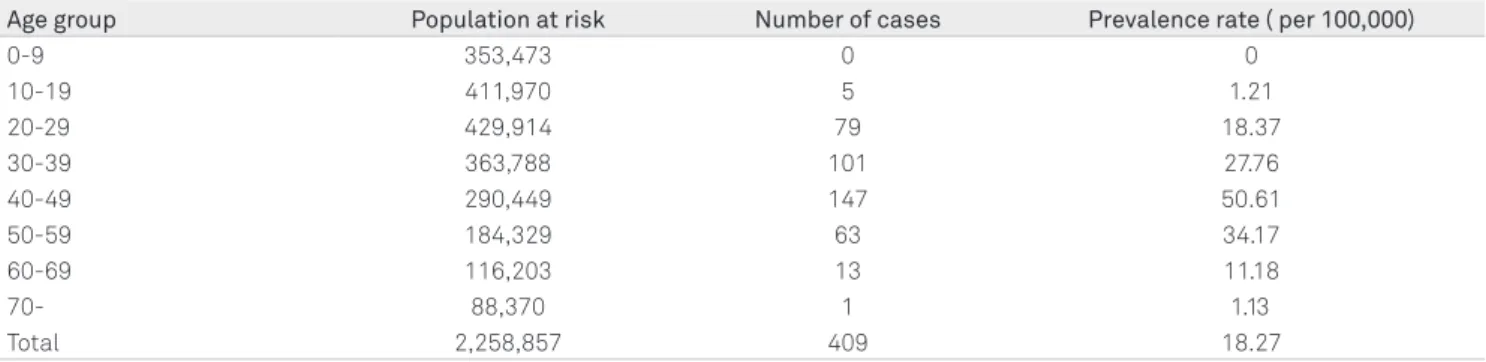
Horizonte at the onset of disease; 20 had the diagnosis of probable MS; and in 10 subjects the medical records and in-terview did not yield reliable information for the diagnosis of MS). he remaining 409 patients comprised 314 women and 95 men (F:M ratio 3.3). here were 315 Brazilian whites, 82 mulattoes and 12 blacks. he calculated crude MS preva-lence rate was 18.1 per 100,000 inhabitants. Table 1 displays the age-speciic prevalence rates. he prevalence curve rose to clear-cut peak in the ifth decade of life for both sexes. he mean age at the time of the survey was 35.4 years. Prevalence rates were 3.5 folder higher in women than in men. hey were also three and four times more frequent in whites than in mulattoes and blacks (Table 2).
Age at onset of the disease ranged from 4 to 63 years (mean 30.1) and was between 20 and 39 years in about two thirds of patients. Figure 2 shows distribution of patients ac-cording to age at disease onset and at the last visit before the prevalence day.
Age group Population at risk Number of cases Prevalence rate ( per 100,000)
0-9 353,473 0 0
10-19 411,970 5 1.21
20-29 429,914 79 18.37
30-39 363,788 101 27.76
40-49 290,449 147 50.61
50-59 184,329 63 34.17
60-69 116,203 13 11.18
70- 88,370 1 1.13
Total 2,258,857 409 18.27
Table 1. Age-specific prevalence rates of multiple sclerosis in Belo Horizonte.
Population at risk Number of cases Prevalence rate (per 100,000)
Women 1,181,263 314 37.6
Men 1,057,263 95 11.1
Whites 1,179,703 315 26.7
Mulattoes 809,933 82 9.2
Blacks 188,221 12 6.4
Table 2. Prevalence rates of multiple sclerosis in Belo Horizonte according to gender and ethnic group.
Firt symptom Last visit 40
30
20
10
0
0-9 10-19 20-29 30-39 40-49 50-59 60-69 Age (y)
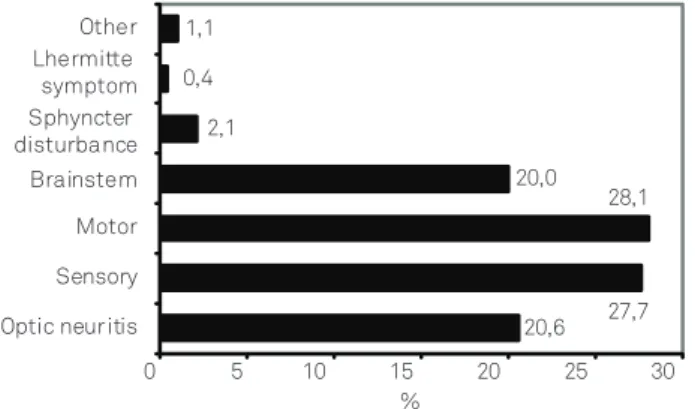
Weakness was the most frequent symptom/sign at pre-sentation, followed by sensory disturbances, optic neuritis and brainstem/cerebellar disturbances (Fig 3). At the time of the survey, the clinical course of the disease was as fol-lows: 261 patients had relapsing-remitting MS, 48 primary progressive MS, 78 secondary progressive MS, and 22 pro-gressive MS with relapses.
At the last visit, 82 patients had no neurological dei-cit, 120 had minimal symptoms/signs, 72 mild gait distur-bances, 54 required unilateral support, 27 bilateral support, 27 were bound to wheelchair and 27 were bedridden. Fig 4 shows the distribution of the population according to some key scores of the EDSS.
DISCUSSION
he present study shows that the prevalence rate of MS in Belo Horizonte is 18 per 100,000 inhabitants, a igure close to that found in São Paulo city and Botucatu. hese three cities share ethnic, economical and cultural features, and are situ-ated in Southeastern Brazil. Two sequential prevalence stud-ies in São Paulo city separated by an interval of seven years and conducted by the same senior author have shown strik-ingly diferent rates23,24. In the irst investigation, for the prev-alence year of 1990, 486 MS cases (325 women and 161 men)
were identiied and the prevalence rate was 4.3 per 100,000. In the second survey, for the prevalence year of 1997, the num-ber of identiied cases increased to 1483 (1076 men and 407 women) and the rate changed to 15.0 per 100,000. Probably, a more complete case ascertainment and the more widely use of the magnetic resonance imaging as an ancillary diagnos-tic tool can be accounted for the over three fold increase in the number of recognized patients. It has been pointed out that an almost universal rule concerning prevalence of MS is that later studies of the same area show higher rates than do earlier surveys and that modern laboratory diagnostic in-vestigations may potentially inluence prevalence rates2. he diferent results of these sequential surveys in São Paulo city illustrate that the extent investigators must care about accu-racy of diagnosis and completeness of case ascertainment.
Notwithstanding conducted under a more restrictive in-clusion criteria, as patients were included only if they both fulilled Poser’s criteria for the diagnosis of clinically deinite MS27 and if were living in Belo Horizonte at the time of the irst symptom of the disease, the present survey yielded a higher prevalence rate in Belo Horizonte than that found in São Paulo studies. herefore, the strict methodology strength-ens the reliability of the present prevalence study.
Yet, the prevalence rate as provided by the present sur-vey is probably underestimated as we failed to have access to data from some small hospitals and rehabilitation clinics, as well as to iles from about one-fourth of all neurologists in town. On the other hand, if one takes into account that the in the present study we surveyed all major hospitals and all MRI services in the city, as well as the ile of the State Health Agency, which provides free medication for all relapsing-re-mitting MS patients in the state, and additionally scrutinized the iles of the MS societies in the city, one may be able to evaluate how careful we have been to catch all MS patients living in the city. he resulting data provide, for the irst time in Latin America, the onset-adjusted prevalence rate, which is a more precise measure than crude prevalence3.
Comparison of MS prevalence rates in Belo Horizonte and São Paulo may further illustrate the increasing diiculty of case ascertainment in very large and highly populated areas. his is still more diicult if a well-organized and centralized registry system is not available, as it happens in both cities. Identiication of MS patients living in a 10 million inhabitants city, like São Paulo, with a huge number of general hospitals, outpatient clinics and hundreds of practicing neurologists may be a herculean task. In fact, as surveying Belo Horizonte, a city four times smaller than São Paulo, we have experienced enormous diiculties contacting neurologists, checking di-agnosis and exploring the necessary clinical information. For a number of cases, we had to interview patients by telephone or even examine them for diferential diagnosis.
On the other hand, only a few smaller sized communi-ties in Brazil may it appropriate for MS prevalence studies as most of them lack well organized medical care systems and 19.44
29.58 17.18
12.96 6.48 6.48 5.63 2.25
0 10 20 30 40
Normal Minimal symptoms Mild gait disturbance Unilateral support Bilateral support Wheelchair bound Bedridden Death
%
Fig 4. Distribution of the multiple sclerosis population in Belo Horizonte according to some key disability status.
20,6 27,7 28,1 20,0 2,1
0,4 1,1
0 5 10 15 20 25 30
Optic neuritis Sensory Motor Brainstem Sphyncter disturbance Lhermitte symptom Other
%
are usually bereft of resources to identify their MS patients with acceptable diagnostic accuracy.
Seemingly better itted to epidemiological surveys, the university city of Botucatu, situated 150 km from São Paulo city, has 103,000 inhabitants who are provided with high-level medical care in a well-organized health system. he recent-ly reported prevalence rate of 17 per 100,000 in Botucatu25 is very close to ours. However, it is well known that very small gains or losses in the number of cases may cause enormous change in the prevalence rate in places where its frequency is not high. In spite of Botucatu’s highly organized health sys-tem, the small number of recognized cases in its MS preva-lence study makes this caution necessary.
hese recent formal epidemiological studies of MS per-formed in Southeastern Brazil have established a prevalence rate much higher in the country than that previously esti-mated through less appropriate survey methodology30.
he distribution of MS in Latin America is still largely unknown as few surveys employing formal epidemiological methodology have been conducted. he irst data on MS fre-quency in Latin America was based on a study of MS among government employees and their dependents in Mexico City31. he calculated prevalence rate was 1.6 per 100,000 inhabit-ants. More recently, a few papers emphasized an increased frequency of identiied cases of MS in diferent areas of the country. A survey in the state of Chihuahua, at the border with the United States, collected 98 MS patients correspond-ing to a prevalence rate of 12 per 100,0006 In Colombia, whose territory is divided by the tropic of Capricorn, prevalence
rates from 1.48 to 4.98 per 100,000 were found in the ive provinces of the country5 whereas in Bogotá a prevalence of 4.4 was recently reported32. Interesting enough, the survey in the diferent Colombian provinces5 shows a relatively lower prevalence in Antioquia, whose population is mainly made up of Caucasians directly descendants from Spaniards, dif-ferently from the predominantly miscegenated residents of other provinces5. In Argentina, data collected from four hos-pitals in Buenos Aires suggested prevalence rates between 15.6 to 17.5 per 100,0004 whereas in Uruguay the rate of 17.6 per 100,000 has been reported7.
he present study shows that MS prevalence rate in Belo Horizonte is similar to that found in São Paulo24 and Botucatu25, two other cities in Southeastern Brazil, as well as to rates reported in Buenos Aires4 and Uruguay7, but much higher than those from Colombian5,32,33 and Mexican studies6,31,.
As Brazil’s territory covers tropical and subtropical lati-tudes, it is probable that the frequency of MS is direct related to the increase of south latitude. Such a gradient has been reported in other countries, as in Australia34.However, one has to keep in mind that a stronger Caucasian genetic back-ground distinguishes the population of Southeastern from those living in Northern and Northeastern Brazil. Good qual-ity surveys of MS prevalence, associated with genetic char-acterization of populations in selected Brazilian cities, may shed some light upon the interaction of genetic and environ-ment factors determining the frequency of MS in diferent populations and regions of the country.
1. Compston A, Wekerle H. The genetics of multiple sclerosis. In: Compston A, Canfavreux C, McDonald I, et al. (Eds). McAlpine’s Multiple Sclerosis. 4th edition. Philadelphia: Churchill Livingstone Elsevier; 2006. p. 113-182.
2. Compston A, Confavreux C. The distribution of multiple sclerosis. In: Compston A, Canfavreux C, McDonald I, et al. (Eds). McAlpine’s Multiple Sclerosis. 4th edition. Philadelphia: Churchill Livingstone Elsevier; 2006. p. 71-105.
3. Poser CM, Brinar VV. The accuracy of prevalence rates of multiple sclerosis: a critical review. Neuroepidemiology 2007;29:150-155.
4. Cristiano E, Patrucco L, Garcea O, et al. Prevalence of multiple sclerosis in Buenos Aires, Argentina, using the capture-recapture method. Eur J Neurol 2009;16:183-187.
5. Sánchez JL, Aguirre C, Arcos-Burgos OM, et al. Prevalencia de la esclerosis múltiple en Colombia. Rev Neurol 2000;31:1101-1103.
6. Velásquez MM, López Prieto, Marquez JC, Riviera CM, Vargas ML. Características epidemiológicas de la esclerosis múltiple en un estado fronteirizo con los Estados Unidos de Norteamérica. Arch Neuroscien Mex 2002;7:147-150.
7. Ketzoian C, Oehninger C, Alcántara J, et al. Estudio de la prevalencia de la esclerosis múltiple en el Uruguay. Acta Neurol Colomb 1999;15 (Suppl):S6.
8. Cristiano E, Patrucco L, Rojas JI. A systematic review of the epidemiology of multiple sclerosis in South America. Eur J Neurol 2008;15:1273-1278.
9. Arruda WO, Scola RH, Teive HA, Werneck LC. Multiple sclerosis: report on 200 cases from Curitiba, Southern Brazil and comparison with other Brazilian series. Arq Neuropsiquiatr 2001;59:165-170.
10. Ferreira ML, Machado MI, Vilela ML, et al. Epidemiology of 118 cases of multiple sclerosis after 15 years of follow-up on the reference center of Hospital da Restauração, Recife, Pernambuco, Brazil. Arq Neuropsiquiatr 2004,62:1027-1032.
11. Fragoso YD, Fiore AP. Description and characteristics of 81 patients attending the Reference Center for Multiple Sclerosis of the coastal region of the state of São Paulo-Brazil. Arq Neuropsiquiatr 2005;63:741-744.
12. Grzesiuk AK. Clinical and epidemiologic characteristics of 20 patients with multiple sclerosis in Cuiabá-Mato Grosso, Brazil. Arq Neuropsiquiatr 2006;64:635-638.
13. Santos EC, Yokota M, Dias NF. Multiple sclerosis: study of patients with relapsing-remitting form registered at Minas Gerais Secretary of State for Health. Arq Neuropsiquiatr 2007;65:885-888.
14. Finkelsztejn A, Cristovam Rdo A, Moraes GS, et al. Clinical features of multiple sclerosis in the south of Brazil: a partial analysis. Arq Neuropsiquiatr 2009;67:1071-1075.
15. Kaimen-Maciel DR, Medeiros M, Pisori R, Biaggio C, Rocha F, Lopes LHG. The prevalence of multiple sclerosis in two cities in north of Paraná State, Brazil. Mult Scler 2004;10 (Suppl):S158.
16. Gama PD, Trigo LX, Andrade CRR, Sala CR. Epidemiological study of multiple sclerosis in the city of Sorocaba, Brazil. Arq Neuropsiquiatr 2004;62 (Suppl):S13.
17. Alves-Leon SV, Papais-Alvarenga R, Magalhães M, Alvarenga M, Thuler LC, Fernández y Fernandez O. Ethnicity-dependent association of HLA DRB1-DQA1-DQB1 alleles in Brazilian multiple sclerosis patients. Acta Neurol Scand 2007;115:306-311.
18. Brum DG, Barreira AA, Louzada-Junior P, Mendes-Junior CT, Donadi EA. Association of the HLA-DRB1*15 allele group and the DRB1*1501 and DRB1*1503 alleles with multiple sclerosis in White and Mulatto samples from Brazil. J Neuroimmunol 2007;189:118-124.
19. Ferreira Vasconcelos CC, Santos Thuler LC, Cruz dos Santos GA, et al. Differences in the progression of primary progressive multiple sclerosis in Brazilians of African descent versus white Brazilian patients. Mult Scler 2010;16:597-603.
20. Negreiros MA, Mattos P, Landeira-Fernandez J, Paes RA, Alvarenga RP. A brief neuropsychological screening test battery for cognitive dysfunction in Brazilian multiple sclerosis patients. Brain Inj 2008,22:419-426.
21. Haase VG, Lima Ede P, Lacerda SS, Lana-Peixoto MA. Development of the Brazilian version of the Multiple Sclerosis Functional Composite Measure (MSFC-BCTRIMS): pilot study. Arq Neuropsiquiatr 2004;62:363-369.
22. Fragoso YD, Finkelsztejn A, Giacomo MC, Russo L, Cruz WS. The effect of multiple sclerosis on the professional life of a group of Brazilian patients. Arq Neuropsiquiatr 2010;68:914-917.
23. Callegaro D, Lolio CA, Radvany J, Tilbery CP, Mendonça RA, Melo AC. Prevalence of multiple sclerosis in the city of São Paulo, Brazil, in 1990. Neuroepidemiology 1992;11:11-14.
24. Callegaro D, Goldbaum M, Tilbery CP, et al. The prevalence of multiple sclerosis in the city of São Paulo, Brazil, 1997. Acta Neurol Scand 2001;104:208-213.
25. Rocha FC, Herrera LC, Morales RR and The Brazilian Committee for Treatment and Research in Multiple Sclerosis. Multiple sclerosis in Botucatu, Brazil. A population study. Mult Scler 2002;8(Suppl):S41-S42.
26. Instituto Brasileiro de Geografia e Estatística (IBGE). Available from: www.ibge.gov.br.
27. Poser CM, Paty DW, Scheinberg L, et al. New diagnostic criteria for multiple sclerosis: guidelines for research protocols. Ann Neurol 1983;13:227-231.
28. Lublin FD, Reingold SC. Defining the clinical course of multiple sclerosis: results of an international survey. National Multiple Sclerosis Society (USA) Advisory Committee on Clinical Trials of New Agents in Multiple Sclerosis. Neurology 1996;46:907-911.
29. Kurtzke JF. Rating neurological impairment in multiple
sclerosis: an expanded disability status scale (EDSS). Neurology 1983;33:1444-1452.
30. Christensen JC. Multiple sclerosis: some epidemiological clues to its etiology. Acta Neurol Latinoam 1975;21:66-85.
31. Alter M, Olivares L. Multiple sclerosis in Mexico. An epidemiologic study. Arch Neurol 1970;23:451-459.
32. Toro J, Sarmiento OI, Díaz del Castillo A, et al. Prevalence of multiple sclerosis in Bogotá, Colombia. Neuroepidemiology 2007;28:33-38.
33. Sánchez JL, Palacio LG, Uribe CS, et al. Clinical features of multiple sclerosis in a genetically homogenous tropical population. Mult Scler 2001;4:227-229.