- 22 - Original Article
HEALTH-PROMOTING BEHAVIORS: PSYCHOMETRIC PROPERTIES OF
AN ASSESSMENT TOOL
Catarina Cardoso Tomás1, Paulo Joaquim Pina Queirós2, Teresa de Jesus Rodrigues Ferreira3
1 Doctoral student in Nursing Sciences, the Abel Salazar Biomedical Science Institute, Universidade do Porto. Porto, Portugal.
E-mail: [email protected]
2 Postdoctoral student in Nursing, the Abel Salazar Biomedical Science Institute, Universidade do Porto. Coordinating Professor
of the Higher School of Nursing of Coimbra. Coimbra, Portugal. E-mail: [email protected]
3 Ph.D. in Psychology. Professor at the Department of Nursing, the Higher School of Nursing of Porto. Porto, Portugal. E-mail:
ABSTRACT: Aiming to evaluate the psychometric properties of an instrument to assess the levels of health promoting behaviors, as well as to encounter those same levels related to their age, sex and graduation in a sample of 1213 Portuguese adolescents, the study was conducted of a quantitative, descriptive, correlational, retrospective and cross-sectional. The instrument has good internal
consistency (Cronbach’s Alpha de 0,889) and reasonable correlations between items (entre -0,009 e 0,788), conirming the six factors deined by the authors of the scale. Levels of health-promoting behaviors in the sample are good (x=3,70), being higher in girls than boys, and youth to the detriment of younger older. Thus demonstrates the reliability of the instrument in the assessment of healthy behavior in portuguese adolescents, as well as the need for an health intervention in this population.
DESCRIPTORS: Health promotion. Adolescent behavior. Validation studies.
COMPORTAMENTOS PROMOTORES DE SAÚDE: PROPRIEDADES
PSICOMÉTRICAS DE UM INSTRUMENTO DE AVALIAÇÃO
RESUMO: Com o objetivo de avaliar as propriedades psicométricas de um instrumento de avaliação dos níveis de comportamentos promotores de saúde, bem como de conhecer esses mesmos níveis numa amostra de 1213 adolescentes portugueses, em relação à sua idade, sexo e ano de escolaridade, foi realizado este estudo, de caráter quantitativo, descritivo-correlacional, retrospetivo e transversal. O instrumento apresenta bons valores de consistência interna (Cronbach’s Alpha de 0,889) e razoáveis correlações entre itens (entre
-0,009 e 0,788), conirmando-se os seis fatores deinidos pelos autores da escala. Os níveis de comportamentos promotores de saúde na
amostra são bons (x=3,70), sendo mais elevados nas raparigas do que nos rapazes, e nos jovens mais novos em detrimento dos mais
velhos. Demonstra-se assim a iabilidade do instrumento na avaliação dos comportamentos promotores de saúde nos adolescentes
portugueses, e a necessidade de uma intervenção em saúde, nesta população.
DESCRITORES: Promoção da saúde. Comportamento do adolescente. Estudos de validação.
COMPORTAMIENTOS PROMOTORES DE LA SALUD: PROPIEDADES
PSICOMÉTRICAS DE UN INSTRUMENTO DE EVALUACIÓN
RESUMEN: Con el objetivo de evaluar las propiedades psicométricas de un instrumento para evaluar los niveles de comportamientos promotores de la salud, así como para conocerlos en una muestra de 1213 adolescentes portugueses en relación a su edad, sexo y años de escolaridad, se realizó este estudio de tipo cuantitativo, descriptivo, correlacional, retrospetivo y transversal. El instrumento tiene
buena consistencia interna (Cronbach’s Alpha de 0,889) y correlación razonable entre los elementos (entre -0,009 e 0,788), conirmado por los seis factores deinidos por los autores de la escala. Los niveles de comportamientos promotores de la salud en la muestra
son buenos (x=3,70), siendo mayor en las niñas que en los niños, y la juventud en detrimento de los jóvenes mayores. Por lo tanto se
demuestra la coniabilidad del instrumento en la evaluación de los comportamientos saludables en los adolescentes portugueses y la
necesidad de una intervención de salud en esta población.
DESCRIPTORES: Promoción de la salud. Conducta del adolescente. Estudios de validación.
INTRODUCTION
Adopting health-promoting behaviors as part of a lifestyle expresses the human tendency towards self-actualization. Above all, such behav-iors aim to increase individual well-being and at-tain personal actualization and accomplishment.1
Adopting healthy behaviors and lifestyle involves not only knowledge on the subject, but also the learning and development of emotional, cognitive and behavioral competencies so that such technical and theoretical knowledge can be put to practice in different real life contexts.2
Knowledge on healthy lifestyle in adoles-cence has become an important research topic3 and
many studies have used the Adolescent Health Promotion Scale (AHPS). Notwithstanding, there is an absence of studies in the Portuguese language or in Portugal.
The authors of this assessment tool used a sample of 1,128 individuals, representative of the Thai adolescent population, and found that the sample presented good levels of health-promoting behaviors (mean of 129 points and median of 130; scores ranged from 51 to 176 points).4
On the other hand, a study in Turkey with 1,351 male and female adolescents between the ages of 11 and 19 demonstrated that there were statistically signiicant differences in terms of gen-der and age concerning the frequency of health-promoting behaviors. Adolescent girls presented higher scale mean scores of health-promoting behaviors than boys. Those between the ages of 11 and 14 also presented higher mean scores of health promoting-behaviors than adolescents between 15 and 19.5
In China, a study analyzed the level of health-promoting behaviors among 407 male and female university students between the ages of 16 and 25 (mean age of 21 years), residing both in rural and urban areas. The highest values of health-promot-ing behaviors were observed for the subscales life appreciation, social support and stress manage-ment. Health responsibility and exercise behaviors were the lowest-scoring subscales. Female adoles-cents presented higher values of health-promoting behaviors (overall scale) than male adolescents, with statistically signiicant differences, as was also the case of the nutritional behaviors, social support and stress management subscales. How-ever, adolescent boys presented higher values in the exercise behaviors subscale. Adolescents who had been in university for less time presented more
favorable results in the life appreciation and exer-cise behaviors subscales; however, they presented lower scores in the nutritional behaviors subscale in comparison to those who had been at university for a longer period, with statistically signiicant differences. No relationship was found between health-promoting behaviors and area of residence, whether rural or urban.3
Programs aimed at preventing unhealthy lifestyles and risk behaviors are more effective when implemented in early life.4 A positive health
culture promotes higher levels of health literacy, aiding young people to deal with determinants of health and allowing them to develop the cognitive and social competencies needed for maintaining good health levels.6
Health promotion and disease prevention are essential for reducing the need for health care among young people.6 International directives
give special emphasis to the role of nursing in promoting health and health-promoting behavior.5
Nursing, especially school and community nurs-ing, possesses the necessary competencies for pro-moting the population’s health, accessing young people’s lifestyles and intervening to facilitate adequate behaviors and reduce inadequate ones.4
Considered a science and a professional ield, nursing presents a set of concepts and theories integrating a body of knowledge that includes concepts such as health promotion. Such body of knowledge, together with nursing caretaking practices, requires theoretical evidence to sustain its practice.7 It is essential that nurses be provided
with and trained for new methodological possibili-ties in the ield, as these professionals are currently the social actors responsible for many of the hap-penings taking place in the health context.8
Nola Pender’s Health Promotion Model9
The Health Promotion Model provides a classiication system that directs research towards predictors of global health, promoting lifestyles and speciic behaviors.9 The Adolescent Health
Promotion Scale was created based on this model.4
The main objective of this study was to as-sess the psychometric properties of the Adoles-cent Health Promotion Scale4 among Portuguese
adolescents. In addition to this main objective, we also aimed to assess levels of health-promoting behaviors among adolescents according to gender, age and school year.
The Adolescent Health Promotion Scale consists of 40 Likert items ranging from “never” to “always,” and assesses the frequency of cer-tain health-promoting behaviors. Such behaviors are distributed among six subscales, which cor-respond to several areas of behavior: nutritional behaviors, social support, health responsibility, life appreciation, exercise behaviors and stress management. Answers are scored from 1 to 5, and the higher the score, the higher the frequency of health promoting behaviors. The authors of the instrument assessed Kaiser-Meyer-Olkin mea-sures (0.942) and Bartlett’s sphericity (χ2=21,609; df=1,128; p=0,000), which showed that the samples met the criteria for factor analyses. After a Varimax rotation with Kaiser normalization and after delet-ing factors that were not consistent with the scale, factor analysis yielded six factors with eigenvalues greater than 1.00 and that explained 51.14% of the variance. Cronbach’s Alpha for the total scale was calculated as 0.932 and ranged from 0.748 to 0.878 for the subscales.4
METHOD
The instrument underwent translation and cultural validation for the Portuguese population by using a cross-cultural validation methodol-ogy, adapted from the methodology presented by Sousa & Rojjanasrirat.10 This process consisted of
the following steps: two independent translations, synthesis I, two independent back-translations, synthesis II, pilot testing, expert panel, and psy-chometric testing.
Following the translation and cultural validation process, psychometric analysis was included in the form of a descriptive, correlational, retrospective and cross-sectional study of quanti-tative design.
The study sample comprised adolescents attending high school in the district of Leiria,
Por-tugal. Using a non-probabilistic sampling method, we used a convenience sample of 1,213 adoles-cents. Inclusion criteria consisted of being a high school student at one of the two schools included in the research study in the above-mentioned district. Exclusion criteria were not wanting to par-ticipate or minors who did not provide the proper authorization from a parent or legal guardian.
Data were collected with a self-administered questionnaire composed of two parts. The irst gathered sociodemographic information and the second consisted of the Adolescent Health Promo-tion Scale, translated and culturally adapted for the Portuguese population.
This study abided by all formal and ethical research norms and was approved by the eth-ics committee of the Health Sciences Research Unit – Nursing (resolution no. 57-11/2011), and approved by the General Directorate for In-novation and Curriculum Development of the Portuguese Ministry of Education (registration n. 0241300002).
Psychometric analysis consisted of statisti-cal procedures similar to those employed by the authors of the original study, namely analyzing Cronbach’s Alpha and correlation between items (Pearson’s correlation test), as well as exploratory factor analysis for the deined subscales. A 5% chance for a Type I error was allowed for all tests and results obtained.
RESULTS
The total sample comprised 1,213 partici-pants, of which 640 (52.76%) were male adoles-cents and 573 (47.24%) were female adolesadoles-cents. Of the total sample, 34.95% (n=424) were in their 10th school year, 38.75% (n=470) in the 11th year,
and 26.30% (n=319) of participants were in their 12th year. Mean age of participants was 16.32 years (s=1.114), and the most prevalent age was 16 (34.30%). Sample age varied from 14 to 22 years.
Pearson’s correlation test. Resulting values varied between -0.009 (between items 4 and 6 on the nu-tritional behaviors subscale) and 0.788 (between items 9 and 13 on the social support scale).
The Kaiser-Meyer-Olkin test (0,887) and Bartlett’s sphericity test (x2=15420,100; df=780; p=0,000) revealed that samples met the criteria for the six-factor exploratory factor analysis, conduct-ed using the main component analysis by Varimax rotation with Keiser normalization (components are described in table 1). Explained total variance
was 45,622% with eigenvalues ranging from 8.231 to 1.528 and components from 0.012 to 0.867.
The first factor that was obtained corre-sponded to the life appreciation subscale (items 22 to 29), the second factor to stress management (items 35 to 40) and the third factor to health re-sponsibility (items 14 to 21). The fourth factor was equivalent to the social support subscale (items 7 to 13), the ifth factor to exercise behaviors (items 30 to 34) and the last factor corresponded to nu-tritional behaviors (items 1 to 6).
Table 1 - Factor analysis through main components analysis following Varimax rotation with Keiser normalization. Leiria, Portugal, 2014
Items 1st factor 2nd factor 3rd factor 4th factor 5th factor 6th factor
1 0.760
2 0.152
3 0.081
4 0.003
5 0.270
6 0.777
7 0.860
8 0.425
9 0.864
10 0.189
11 0.233
12 0.225
13 0.868
14 0.603
15 0.564
16 0.452
17 0.303
18 0.319
19 0.388
20 0.597
21 0.698
22 0.706
23 0.800
24 0.177
25 0.425
26 0.357
27 0.527
28 0.517
29 0.613
30 0.727
31 0.780
32 0.444
33 0.651
34 0.250
35 0.513
36 0.736
Items 1st factor 2nd factor 3rd factor 4th factor 5th factor 6th factor
38 0.207
39 0.472
40 0.470
Eigenvalue 8.231 3.011 2.144 1.740 1.597 1.528
% of explained variance 10.086 9.323 9.140 7.133 5.688 4.252
Cronbach’s Alpha was also determined for each factor, presenting values between 0.552 (nu-tritional behaviors) and 0.843 (life appreciation). Furthermore, values were not signiicantly altered when some items were deleted from the scale. Thus, Cronbach’s Alpha for the subscales and for the total scale were similar.
Following psychometric analysis, the present
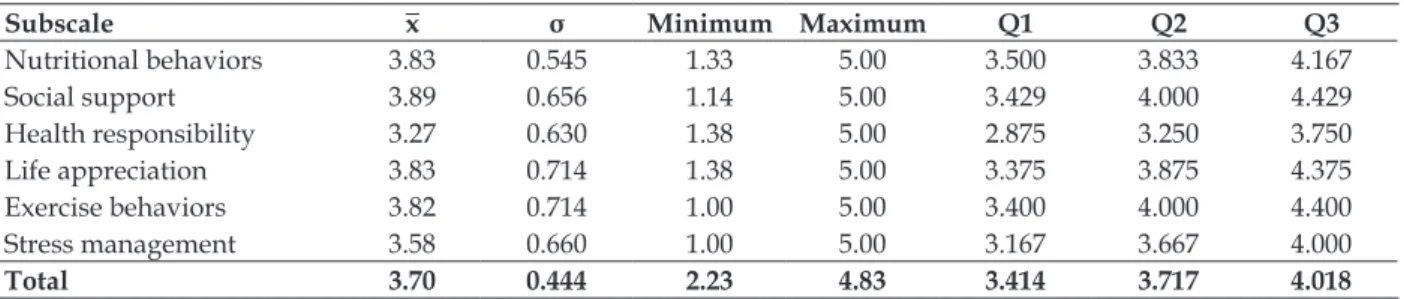
study assessed the level of health-promoting behav-iors presented by the sample of adolescents. The results revealed good levels of health-promoting behaviors, with values above the mean scale value (3), as illustrated in table 2. The minimum possible score was 40 points and the maximum possible score was 200. The sample’s mean and median scores were both 148, and scores ranged from 86 to 193.
Table 2 - Levels of health-promoting behavior. Leiria, Portugal, 2014
Subscale x σ Minimum Maximum Q1 Q2 Q3
Nutritional behaviors 3.83 0.545 1.33 5.00 3.500 3.833 4.167
Social support 3.89 0.656 1.14 5.00 3.429 4.000 4.429
Health responsibility 3.27 0.630 1.38 5.00 2.875 3.250 3.750
Life appreciation 3.83 0.714 1.38 5.00 3.375 3.875 4.375
Exercise behaviors 3.82 0.714 1.00 5.00 3.400 4.000 4.400
Stress management 3.58 0.660 1.00 5.00 3.167 3.667 4.000
Total 3.70 0.444 2.23 4.83 3.414 3.717 4.018
Using a Student’s t-test to compare health-promoting behaviors between genders, very significant statistical differences were found regarding the subscales of social support, health responsibility and exercise behaviors. Adolescent
boys presented more frequent exercise behaviors, but girls presented higher levels of social support and health responsibility behaviors, as can be observed in table 3. Regarding the total scale, no differences were found between genders.
Table 3 - Differences in levels of health-promoting behavior between genders (Student’s t-test). Leiria, Portugal, 2014
Subscale Gender x σ F F (p) t p*
Nutritional behaviors Male 3.82 0.552 1.139 0.286 -0.951 0.342
Female 3.85 0.537
Social support Male 3.80 0.686 11.379 0.001 -4.889 0.000†
Female 3.98 0.607
Health responsibility Male 3.18 0.643 3.197 0.074 -5.695 0.000†
Female 3.38 0.597
Life appreciation Male 3.83 0.766 19.462 0.000 -0.158 0.874
Female 3.83 0.650
Exercise behaviors Male 3.91 0.741 7.438 0.006 4.961 0.000†
Female 3.71 0.666
Stress management Male 3.56 0.673 0.804 0.370 -0.846 0.397
Female 3.59 0.644
Total Male 3.68 0.473 14.077 0.000 -1.641 0.101
Female 3.72 0.408
Differences among adolescents in different school years concerning health-promoting be-haviors were analyzed with one-way ANOVA. Statistically signiicant differences were found between groups with respect to nutritional health-promoting behaviors (p=0.016), and very statisti-cally signiicant differences regarding exercise behaviors (p=0.000), stress management (p=0.002), and total score (p=0.006).
To determine which school years presented statistically signiicant differences between them, Tukey’s post-hoc test was applied, as demonstrated in table 4. Adolescents in the 10th school year
pre-sented higher levels of health-promoting behav-iors in all the subscales that presented statistically signiicant differences, in addition to total health-promoting behaviors. Adolescents in the 11th year
presented the lowest values for these behaviors.
Table 4 - Differences in levels of health-promoting behaviors according to nutritional behaviors, exercise behaviors and stress management, and total behaviors among adolescents in different school years (Tukey’s test). Leiria, Portugal, 2014
Subscale a) b) x a) σ a) x b) σ b) Difference of x (a-b) p
Nutritional behaviors
10th year 11th year 3.88 0.531 3.78 0.543 0.102 0.014*
10th year 12th year 3.88 0.531 3.85 0.560 0.032 0.706
11th year 12th year 3.78 0.543 3.85 0.560 -0.070 0.175
Exercise behaviors
10th year 11th year 3.92 0.705 3.74 0.700 0.186 0.000†
10th year 12th year 3.92 0.705 3.78 0.729 0.146 0.016*
11th year 12th year 3.74 0.700 3.78 0.729 -0.040 0.719
Stress management
10th year 11th year 3.64 0.675 3.50 3.627 0.146 0.003†
10th year 12th year 3.64 0.675 3.61 0.674 0.032 0.784
11th year 12th year 3.50 3.627 3.61 0.674 -0.114 0.046*
Total
10th year 11th year 3.75 0.441 3.66 0.440 0.097 0.004†
10th year 12th year 3.75 0.441 3.71 0.448 0.048 0.314
11th year 12th year 3.66 0.440 3.71 0.448 -0.049 0.296
* p<0.05; †p<0.01.
Pearson’s test was conducted to test the correlation between levels of health-promoting behaviors and the age of participants and pre-sented signiicant results as described in table 5. Statistically signiicant correlations were found between age and health-promoting behaviors in the social support subscale. Very signiicant correlations were observed between age and nu-tritional behaviors, exercise behaviors and total behaviors, being that the older the adolescent, the less frequent the behaviors.
Table 5 - Correlation between levels of health-promoting behaviors and age of the adolescents (Pearson’s correlation test). Leiria, Portugal, 2014
Subscale R R2 p
Age
Nutritional behavior -0.077 -0.047 0.007†
Social support -0.056 -0.041 0.050*
Health responsibility -0.026 -0.018 0.373
Life appreciation -0.033 -0.026 0.250
Exercise behaviors -0.155 -0.123 0.000†
Stress management -0.037 -0.027 0.198
Total -0.095 -0.047 0.001†
* p<0.05; †p<0.01.
DISCUSSION
The Portuguese version of the Adolescent Health Promotion Scale presented good internal consistency and item validity for evaluating levels of health-promoting behaviors among Portuguese adolescents.
Internal consistency values remained con-stant when any item was deleted from the scale, thus none were dispensable even though correla-tions were weaker. Cronbach’s alpha was slightly lower than those obtained by the authors of the original instrument; notwithstanding, they still classiied as good.4 Furthermore, the percentage
of explained variance was not as high (although the difference was not very accentuated) as the original scale, even though the factor analysis applied in this study was exactly the same as that used by its authors.4
deined subscales has been demonstrated, accord-ing to the theoretical model set forth by its authors. 4
Regarding total health-promoting behaviors, the mean score of this study sample was 19 points higher than that of the original authors. In both cases, such levels were considered good.4 The
subscale with the highest scores of levels of health-promoting behaviors was social support, followed by life appreciation and nutritional behaviors. The lowest-scoring subscale was health responsibility, followed by stress management.
The authors of the Chinese study mentioned above found results similar to those of the present study in terms of levels of health-promoting be-haviors. However, the stress management subscale presented higher levels than in the present study and the exercise behaviors subscale presented lower levels.3
These data suggest that the adolescents in this study do present more health-promoting exer-cise behaviors. However, they would beneit from learning more effective stress management strate-gies in order to increase scores in this subscale.
Regarding the participants’ gender, higher values of health-promoting behaviors were found among female adolescents in the social support and health responsibility subscales. On the other hand, male adolescents presented higher levels of health-promoting exercise behaviors.3 Levels
of health-promoting behaviors were higher in female than male participants, but they were not statistically signiicant, contrary to other studies that found much more accentuated differences.3,5
Such differences between genders demonstrate the need for distinct interventions focused on the lowest-scoring health-promoting behaviors for each group.
Considering the participants’ age and school year, levels of health-promoting behaviors were higher among younger adolescents5 and those in
more advanced grades, namely between age and total behaviors, nutritional behaviors, social sup-port and exercise behaviors, and between school year and nutritional behaviors, exercise behaviors, stress management and total behaviors. Nonethe-less, other studies with similar results found that health-promoting nutritional behaviors were more common among older adolescents.3 Thus, the
older the adolescent, the lower the level of health-promoting behaviors. This inding highlights the risk of adolescents transitioning to adult age with poorer health and, above all, displaying unhealthy habits that can relect in future poor health.
These results relect the need for the ield of nursing to invest in health education, promote health literacy and aid in the development of competencies of this speciic age group in order to modify this reality.
FINAL CONSIDERATIONS
The Portuguese version of the Adolescent Health Promotion Scale presented good psycho-metric indicators, indicating its viability for as-sessing health-promoting behaviors and reliably assessing this concept among the Portuguese adolescent population. The instrument maintained the initial theoretical subscales deined by its au-thors, assessing health-promoting behaviors with regards to six areas. Generalizability of results could be obtained if the instrument were to be ap-plied in other studies and different contexts. It did not occur in the present study given the selected mode of sample selection. Moreover, replicating the study would certify the instrument’s viability and sensitivity in assessing the concept of health-promoting behaviors among the Portuguese ado-lescent population.
Levels of health-promoting behaviors were considered good and statistically signiicant dif-ferences were found between genders. The partici-pants’ age was inversely correlated with the level of health-promoting behaviors, i.e., such behaviors decreased as the participants’ age increased. Fur-thermore, the further along in their studies, the lower the levels of health-promoting behaviors presented by students, corroborating the correla-tion found between such levels and adolescent age.
REFERENCES
1. Chang LC. Health Literacy, self-reported status and health promoting behaviours for adolescents in Taiwan. J Clin Nurs. 2010 Jan; 20(1-2):190-6. 2. Santos O. O papel da literacia em saúde: capacitando
a pessoa com excesso de peso para o controlo e redução da carga ponderal. Rev ENDO. 2010 Jul; 3(4):127-34.
3. Wang D, Ou CQ, Chen MY, Duan N. Health promoting lifestyles of university students in Mainland China. BMC Public Health. 2009 Oct 9;9:379.
4. Chen MY, Wang E, Yang RJ, Liou YM. Adolescent
Health Promotion Scale: Development and Psychometric Testing. Public Health Nurs. 2003 Mar-Abr; 20(2):104-10.
5. Ortabag T, Ozdemir S, Bakir B, Tosun N. Health Promotion and Risk Behaviors Among Adolescents in Turkey. J Sch Nurs. 2011 Ago; 27(4):304-15.
6. Lee A. Health promoting schools: evidence for a holistic approach to promoting health and improving health literacy. Appl Health Econ Health Policy. 2009; 7(1):11-7.
7. Lopes M, Saraiva KR, Fernandes AF, Ximenes LB.
Análise do conceito de Promoção da Saúde. Texto Contexto Enferm. 2010 Jul-Set; 19(3):461-8.
8. Salci MA, Maceno P, Rozza SG, Silva DM, Boehs AE, Heidemann IT. Educação em Saúde e suas perspectivas teóricas: Algumas reflexões. Texto Contexto Enferm. [online] 2013 Jan-Mar [acesso 2014 Out 07]; 22(1): 224-30. Disponível em: http://dx.doi. org/10.1590/S0104-07072013000100027.
9. Pender NJ, Parsons M A, Murdaugh C. Health promotion in nursing practice. 6ª ed. Boston (US): Pearson; 2010.
10. Sousa VD, Rojjanasrirat W. Translation, adaptation and validation of instruments or scales for use in cross-cultural health care research: a clear and user-friendly guideline. J Eval Clin Pract. 2010 Abr; 17(2): 268-74.
Correspondence: Catarina Cardoso Tomás
Rua Paulo VI, Lote 44, 23 B, 5º A 2410-149 Leiria, Portugal
E-mail: [email protected]