# Rev Saúde Pública 2006;40(1):152-60 www.fsp.usp.br/rsp
Effects of health decentralization, financing
and governance in M exico
Efeitos da descentralização, financiamento e
governabilidade em saúde no México
Armando Arredondo and Emanuel O rozco
Centro de Investigación en Sistemas de Salud. Instituto Nacional de Salud Pública. Cuernavaca, Morelos, México
Correspondence:
Armando Arredondo
Instituto Nacional de Salud Pública Av. Universidad, 655 Col. Sta. Maria Ahuacatitlán
62508 Cuernavaca, Morelos, México E-mail: [email protected]
Financial support by Consejo Nacional de Ciencia y Tecnología (CONACYT-México n. 250066), and The International Development Research Center (IDRC-Canada - Grant n. 100191).
The authors declare no competing interests/ conflicts of interest. Received on 21/9/2004. Reviewed on 2/8/2005. Approved on 1/9/2005.
Keywords
Financing, health. Decentralization. Social participation. Governance.
D escritores
Financiamento da saúde.
Descentralização. Participação social. Governabilidade.
Abstract
Objective
To identify the effects of decentralization on health financing and governance policies in Mexico from the perspective of users and providers.
Methods
A cross-sectional study was carried out in four states that were selected according to geopolitical and administrative criteria. Four indicators were assessed: changes and effects on governance, financing sources and funds, the final destination of resources, and fund allocation mechanisms. Data collection was performed using in-depth interviews with health system key personnel and community leaders, consensus techniques and document analyses. The interviews were transcribed and analyzed by thematic segmentation.
Results
The results show different effectiveness levels for the four states regarding changes in financing policies and community participation. Effects on health financing after decentralization were identified in each state, including: greater participation of municipal and state governments in health expenditure, increased financial participation of households, greater community participation in low-income states, duality and confusion in the new mechanisms for coordination among the three government levels, absence of an accountability system, lack of human resources and technical skills to implement, monitor and evaluate changes in financing.
Conclusions
In general, positive and negative effects of decentralization on health financing and governance were identified. The effects mentioned by health service providers and users were related to a diversification of financing sources, a greater margin for decisions around the use and final destination of financial resources and normative development for the use of resources. At the community level, direct financial contributions were mentioned, as well as in-kind contributions, particularly in the form of community work.
Resumo
Objetivo
# !
Rev Saúde Pública 2006;40(1):152-60 www.fsp.usp.br/rsp
Effects of health decentralization in Mexico Arredondo A & Orozco E
INTRODUCTION
The decentralization of health services in the Mexican public sector introduced significant changes in social, political and economic aspects, which in turn have had different effects on the financing and governance of the health system.
These recent changes, which come together with Mexico’s new economic policy, have led to sectorial adjustments that are included in the Health Sector’s Reform.2,* This reform project, with the decentraliza-tion strategy, searches for healthcare alternatives ad-justed to payment abilities and health needs for the whole population. There is a special interest in ensur-ing that those who require the service should not be marginalized from the system and should receive at least basic coverage for the promotion and conserva-tion of health under the principles of financial pro-tection, equitable access and good quality of care.**
In this context, changes in financing policies for health services are one of the main elements in the Mexican decentralization strategy. During the first phase of this health system reform, in 1986, the Health Secretariat set forth the consolidation of a national
Métodos
Estudo de desenho transversal realizado em quatro estados selecionados a partir de critérios geo-político-administrativos. Quatro indicadores foram analisados: fontes de financiamento, fundos de financiamento, destino final e mecanismos de distribuição dos recursos. As técnicas de levantamento de informação estiveram baseadas em entrevistas a profundidade com informantes-chave do sistema de saúde, líderes comunitários e de ONGs, técnicas de consenso e análise de documento. As entrevistas foram transcritas e analisadas por segmentação temática.
Resultados
Os níveis de efetividade e de participação dos usuários foram diferentes para os quatro estados. Os efeitos identificados foram: maior participação dos governos municipais e estatais no financiamento e na geração de serviços de saúde, aumento da participação das famílias no financiamento, maior participação comunitária nos estados mais pobres, conflitos de governabilidade gerados pela duplicação e confusão nos novos mecanismos de coordenação entre os três níveis de governo, ausência de sistema de prestação de contas, carência de recursos humanos e habilidades técnicas para programar, monitorar e avaliar mudanças no financiamento.
Conclusões
Identificou-se, em geral, efeitos positivos e negativos da descentralização do financiamento e governabilidade na saúde. Os efeitos mencionados pelos fornecedores e usuários foram relacionados à diversificação das fontes de recursos, maior margem para decisões acerca do uso e destino final dos recursos, bem como o desenvolvimento de normas de utilização. Ao nível comunitário, as contribuições financeiras diretas foram mencionadas, assim como as voluntárias, particularmente na forma de trabalho comunitário.
health system, where the decentralization strategy was implemented in 12 of the 31 Mexican states. The le-gal and normative decentralization framework in-cluded important guidelines for financing policies at the national, state and municipal levels. These guidelines referred more directly to changes in mecha-nisms for the allocation of financial resources and new financing alternatives for the production of serv-ices at a local level.***
In 1994, with the approval of a new reform tool for the health sector, decentralization was once again used as a strategic line for the reform, proposing the con-solidation of the process in states that were already decentralized, and extending it to non-decentralized states. In this second phase of the health system’s re-structuring process, new changes in financing poli-cies were set forth, directed towards exploring financ-ing mechanisms to generate new financfinanc-ing alterna-tives with local resources for the production of health services. In other words, the second phase of decen-tralization constituted one of the fundamental strate-gies of the 2001-2006 National Development Plan. So, as in most Latin American countries, a proposal was made to generate new social participation mecha-nisms, as well as political and financial management
*Secretaría de Salud, Subsecretaría de Prevención y Control de Enfermedades. Recursos para la salud en unidades de la Secretaría de Salud, 1999. Salud Pública Méx 2000;42(3):252-9.
**Secretaría de Salud. Programa Nacional de Salud 2001-2006. México, DF; 2001. p. 26-9.
# " Rev Saúde Pública 2006;40(1):152-60 www.fsp.usp.br/rsp Effects of health decentralization in Mexico
Arredondo A & Orozco E
strategies that would allow for a greater independ-ence at state and municipal levels in the production as well as the financing of services.10,11
In view of the importance of documenting the ef-fects of these structural adjustments at local levels, it is sought here to establish that the states developed diverse strategies to finance their own health systems. Thus, challenges were documented at the operative level which could be faced by broadening the state and municipal financial participation and strength-ening the management capacity of federal entities as a background for the two phases of the decentraliza-tion process.4
Since the introduction of decentralization has hap-pened in times of economic crisis, its achievements have been heterogeneous and local experiences are not well documented. For this reason, local experi-ences were studied from the perspective of the social actors involved in the process. The applied frame-work allows to identifying lessons which could fa-cilitate the diverse stages of the process, as well as challenges and barriers that should be considered in order to consolidate the policy’s achievements.
The objective of this study was to show how the effects of the decentralization are perceived by the social actors involved in the processes and the effects of this decentralization process on Mexican states.
M ETH O D S
A descriptive cross-sectional study was carried out in 2004. The universe of study included four Mexi-can states that were selected according to the fol-lowing criteria: 1) different socioeconomic devel-opment, according to the Marginalization Index developed by the Population Board;8 2) an imple-mented decentralization process, with changes in health service financing policies and in community participation; 3) the existence of a database with economic information; 4) technical capacity in health financing policies and decentralization, as well as in the management of some financing indi-cators to support data collection and collaborate with the research team in an interdisciplinary
man-ner, and 5) technical and political commitment to using the study’s results.
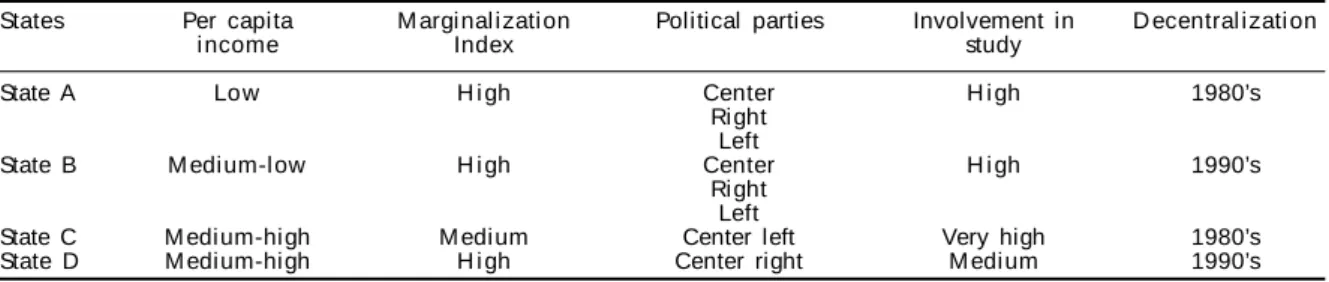
Table 1 shows that three states had high marginali-zation indexes and one had a medium one, with great per capita income variation by state. The political parties identified at the local level were diverse, which points to greater political plurality. For the purpose of the study, the involvement of state teams was mostly high, though participation was limited by govern-mental and administrative changes. Selected states are located in the central and southern regions of Mexico and their names were omitted to preserve the anonymity of the sources.
Twenty in-depth interviews were applied in each one of the selected states, with the support of three researchers with experience in data collection: five decision makers, as well as medical and administra-tive personnel; five service providers at health cent-ers; five representatives of civil organizations, as well as municipal representatives and, finally, five mem-bers of health committees and users of services at first level of care units.
The information was obtained through in-depth semi-structured interviews, using a thematic guide with questions and requesting authorization to carry out the interview and record it. Later on, the inter-views were transcribed and analyzed by thematic seg-mentation, using the ATLAS.ti software. During this procedure, the information was analyzed using 12 thematic codes. Finally, to triangulate field data, con-sensus techniques were applied and workshops were held with selected key personnel in each state for the presentation of results and the revision of documents related to changes in financing policies and commu-nity participation after decentralization.
RESU LTS
The information gathered in the studied decentral-ized states allowed to confirm that there has been a gradual reduction of the restrictions and locks of the previous centralized regime of the 1970’s.
In general, positive and negative effects of
decen-Table 1 - Social and political characteristics of states studied. Mexico, 2004.
States Per capita M argi nal i zati on Political parties Involvement in D ecentral i zati on
i ncome Index study
State A Low H i gh Center H i gh 1980’s
Ri ght Left
State B M edi um-l ow H i gh Center H i gh 1990’s
Ri ght Left
State C M edium-high M edium Center left Very high 1980’s
# #
Rev Saúde Pública 2006;40(1):152-60 www.fsp.usp.br/rsp
Effects of health decentralization in Mexico Arredondo A & Orozco E
tralization on health financing were identified. The effects mentioned by health service providers and users were related to a diversification of financing sources, a greater margin for decisions around the use and final destination of financial resources and nor-mative development for the use of resources. At the community level, direct financial contributions were mentioned, as well as in-kind contributions, particu-larly in the form of community work.
Financing sources
This concept refers to the primary entities provid-ing society with economic resources for different ac-tivities.1 Of the documented positive effects, the most outstanding one refers to a diversification in these sources. In addition to resources provided by the fed-eral level, the state contributions were a financing source that was broadly promoted by the federal policy. In this case, levels of contribution showed variations according to a set of economic and politi-cal variables and some outstanding cases were found.
Although achievements in the states were not re-ported homogenously, informants highlighted the creation of organizations for assistance, such as the Public Welfare, the establishment of recovery quotas, the substitution of services and state and municipal contributions. Public Welfare was identified as a very important financing source for services and support for the poorest population. Since it provides assist-ance, this organization is able to combine its financ-ing sources in order to achieve greater fundfinanc-ing.
Besides referred contributions, another source of financial resources was identified, coming from mu-nicipal town halls. The identification of this resource allowed to determining that, since changes in the fi-nancing of health services began, there is possibility for greater participation of local financing sources, as well as a greater power for the allocation of avail-able resources. This source of resources was identi-fied at the local level. The direct contribution com-ing from users was also considered by providers as a source of financing in the states.
Allocation mechanisms
This information refers to criteria used in resource allocation and distribution. Annual adjustment mecha-nisms have been implemented for allocation, which allowed for prioritization of actions to be taken and for these to be channeled to the areas with greater health care needs. There has been less influence of the federa-tion in the allocafedera-tion of resources for municipalities and priority programs for the state. It is important to
observe that, at the operative level, flexibility in the system was reported. According to the interviewed in-formants, this flexibility facilitated the identification of new financing sources. As for financial allocation mechanisms, there was a greater political will and more financial support and evidence that, at the state level, the Secretary of Health promoted and guaranteed new financial resources according to local needs, in spite of budgetary restrictions.
One of the most positive effects in terms of the in-corporation of new financing funds refers to the ap-plication of specific norms for the management of resources. This situation led to a greater acceptance of direct contributions in the community.
Governance
One of the most relevant findings of this study was that the negative effects of decentralization on the fi-nancing of health services were particularly found at the operative level, that is, where the services are pro-vided. The service providers’ perspective showed that personnel in charge of services lacked information and that there was also a set of political barriers. The users’ perspective showed negative effects related to the fi-nancial burden involved in paying the recovery fees, as well as the lack of opportunities for participation in decision making to establish health care priorities of communities jointly with health services.
For health service providers, the reported nega-tive effects included a lack of knowledge on gen-eral aspects of decentralization, as well as processes where there was low participation of healthcare pro-viders at the operative level, a set of political barri-ers and a tendency towards centralization around the management of resources for programs operat-ing at the federal level.
One of the negative effects derived from the lack of information on decentralization was that for the per-sonnel, the initiative represented an increase in work-load. In the case of State A, they reported that the new bureaucracy encouraged little participation of the main actors in the health system and of the commu-nity in the decision making process. There were ad-verse effects on some government health programs and difficulties in linking social participation to dif-ferent health programs.
# $ Rev Saúde Pública 2006;40(1):152-60 www.fsp.usp.br/rsp Effects of health decentralization in Mexico
Arredondo A & Orozco E
nel, most difficulties were generated by a lack of continuity in the new f inancing policies due to changes that exert pressure on the central levels of government.
Other negative effects reported by informants in charge of the operation of services are that decen-tralization was still not consolidated due to the regu-lating weight of the center (federal power). In this sense, decentralization kept pulling the best finan-cial and human resources invested locally, towards the central level, and therefore generated confusion at the different government levels.
The perception that decentralization is still an un-finished process was reinforced by the presence of assistance programs defined by the federation and operated through the state health services. Since in these cases the federal level defined goals and priori-ties, operative personnel perceived that, in spite of decentralization, there is still dependence on the na-tional central level, and there is confusion regarding the flow of authority and power in decision making.
There was also evidence suggesting some training in the management of financial resources after de-centralization, as well as mobilization of new finan-cial resources that were not being collected before decentralization. State C, with its 20 or so years of experience as a decentralized state, reported impor-tant benefits which have been identified by the serv-ice providers. There is evidence of a greater flow of resources with a more locally oriented management of decisions on resource allocation for local health programs. Also, a greater participation of users, sup-pliers, and municipal and state governments has been promoted to establish priority health needs.
The fact that two processes happened in parallel should be highlighted: the creation and incorpora-tion of new financing resources and the development of frameworks and normative schemes whose func-tion has been from the start to oversee, from the fed-eral and state levels, the adequate use of financial resources. Flexibility was one of the attributes mostly highlighted by the interviewed informants.
Community financing and social participation
The role of health service users in the context of decentralization implies several levels of social par-ticipation in health. Users may participate through direct contributions to the financing funds by means of recovery fees, through in-kind participation for the generation of health infrastructure at the local level, or through a direct participation in health programs.3,9
The most direct positive effect in terms of financ-ing, reported by the interviewed users, referred to sup-port for the operation of the health care unit, be it through fundraising and the awarding of economic resources to improve or expand the units, or through voluntary community work at the units. In this same sense, the increase of municipal contributions was also considered a relevant advantage.
Although community participation was already in place throughout the country before the end of the decentralization process, this policy helped define criteria which formalized channels through which community contributions were promoted. In this sense, ever since decentralization, there has been dis-cussed a greater participation of the community in terms of financing, infrastructure and priority setting in health matters. Regarding financing, in State A, there is a significant contribution as in-kind financ-ing to improve health infrastructure. The case of State A shows that manpower contributed by the inhabit-ants of several state municipalities has produced sav-ings in running expenses and the channeling of these resources to health programs where service users them-selves and community leaders have participated in establishing health priorities based on local needs.
Ever since decentralization and the changes in fi-nancing within the State Health System began, the population and its community leaders have taken on an active role in financial matters and in the produc-tion of services. The community has chosen repre-sentatives as members of the local health committees (integrated by suppliers and users), whose main task is designing and supervising health programs accord-ing to the main epidemiological problems at state and municipal levels.
From the user’s perspective, the negative effects referred to a more limited access to programs in rural areas, to diverse forms of rejection of recovery fees and to the lack of clear criteria for community par-ticipation. As for financial sources, there was limited rural access to public welfare, and support was given only to the poorest urban zones, but very little went to rural areas. With decentralization, there have been discussed new and varied sources of financing; how-ever, support for rural areas, in the form of donations and altruistic foundations, has been scarce.
# %
Rev Saúde Pública 2006;40(1):152-60 www.fsp.usp.br/rsp
Effects of health decentralization in Mexico Arredondo A & Orozco E
“health promoters”. Community leaders and some users have participated in the monitoring of some health programs, but the community has been reluc-tant to make economic contributions directly towards health financing. In fact, through the interviews ap-plied to several users, it became evident that there was a clear rejection of the recovery fee system that has been implemented as a result of the financing changes coming from decentralization.
In State D, recovery fees were described by users as a financial burden. In this context of community participation, as far as financing is concerned, un-der decentralization work was done to build aware-ness among the community regarding the impor-tance of financial collaboration in health services, albeit with few results and a lot of resistance. In State A, there was a lack of clear criteria to stimulate user participation in health programs. A set of defi-ciencies in health services was described, which lim-its the identification of beneflim-its and makes fees for services unattractive.
Some states reported on the role of political parties in the population’s level of participation, stating that these political organizations manipulate the provi-sion and financing of services. Also, references were made to the lack of spaces to motivate the operative personnel to participate. This situation, according to the interviewed personnel, generates inequity in the budget allocation carried out at the national level, whose mechanism is unknown by the state and mu-nicipal levels.
On the other hand, there is empirical evidence which allows to establishing favorable outcomes in the im-plementation of this policy in Mexico, as can be seen in Table 2.
This table shows that interviewed informants con-tributed to a broad variety of strengths in the states where one sees a great diversity of financing sources. There are also favorable effects of financing funds on infrastructure and the optimal use of financial re-sources. It is important to look at the references to a
Table 2 - Main strengths after decentralization on governance and health financing indicators. Mexico, 2004.
Governance-soci al participation: providers, users, community leaders
- Increased local participation in decision making
- Consolidation of the H ealth Committees
- Reduced
intervention of central political levels
- Strengthening of the role of community leaders in health matters
- Participation of social actors of the municipal level in the allocation of resources according to local needs
- Changes in the municipality-state-federation relationship
- Strengthening of the sanitary jurisdictions and of municipal health authorities
- Better management of information
- Greater participation of NGO leaders
- Improvement in decision making according to local problems.
Financing sources
- Diversity of financial sources
- Increase of recovery fees
- Greater municipal contribution
- Community contribution
- Regulation of the destination of recovery fees
- Creation of Public W el fare
- Participation and contribution from the municipalities
- Greater support from recovery fees
- Mixture of federal, state and municipal resources for health infrastructure
Financing funds
- Greater autonomy for fund management
- Increase of additional funds
- Greater liberty to implement
consolidated purchases for the jurisdictions
- Autonomy for decision making
- Greater autonomy for resource management
- Possibility of financial transfers among chapters
- Regularization for the final destination of recovery fees
- M anagement of additional funds
- Accountability of decentralized public organizations
- Training for fund management
- Increase of recovery fees
- Fundraising for additional funds
Allocation mechanisms
- Increase of allocation at the operative level
- Strengthening of management
- Improvement of the payment system to service providers
- Improvements in expenditure planning
- Allocation of resources to programs related to the State D evelopment Plan
- Greater local participation
- Annual adjustments in the allocation
- Less influence of the federati on
- Simplification of w orkers’ payment
- Greater political will regarding allocations
- Efficiency in expendi ture programmi ng
- Improved contracts
Final destination of resources
- Greater and better prioritization of needs
- Fulfillment of goals
- Timely solution of problems and/or greater solution capaci ty
- Optimization of investment expendi ture
- Strengthening of the first level
- Strengthening of infrastructure
- Strengthening of operati ve w ork
- Optimization of operative expenditure
- Greater
prioritization of needs
- Greater coverage
# & Rev Saúde Pública 2006;40(1):152-60 www.fsp.usp.br/rsp Effects of health decentralization in Mexico
Arredondo A & Orozco E
greater autonomy in the management of financial re-sources, as well as greater managerial development for a more efficient administration of resources.
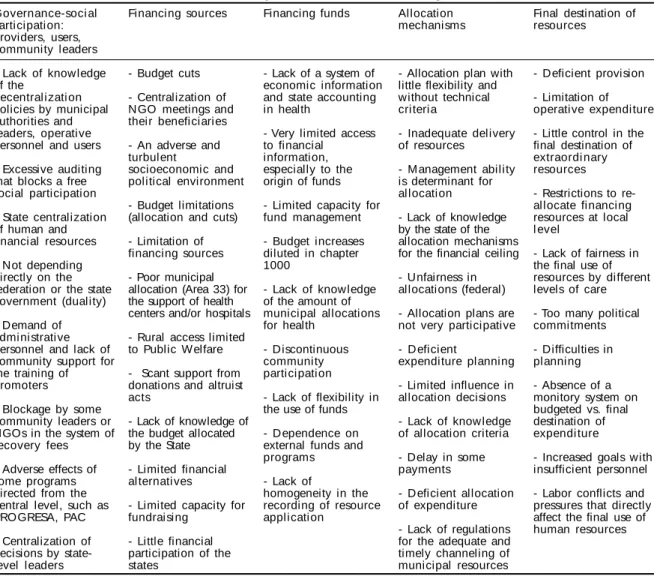
The negative effects identified by providers at the operative level and by users, as can be seen in Table 3, suggesting important challenges in terms of the creation of spaces for social participation and mecha-nisms to reduce the financial burden of direct contri-butions by users. In response to this problem, the de-velopment and application of a regulatory framework for state and municipal contributions could help counteract the described negative effects.
Table 3 also shows effects related to the budget-ary limitations with which state health systems operate. This also contrasts with the reference to the lack of knowledge on technical criteria and the lack of managerial abilities for resource adminis-tration. All these factors were related to the lack of local capacity for broadening the supply and pro-duction of health services.
D ISCU SSIO N
The information presented in this study shows that in the decentralization-transfer process from the fed-eral level to the states, adjustments were observed from which important lessons may be learned. The structural indicators and the establishment of local health priorities, confirms the strengthening of the local health system’s capacity to assess the decen-tralization and decision-making processes, as has been mentioned in the literature.5,6
With respect to the lessons learned for the transfer of functions from the federal level to the states, the compiled qualitative information suggests that there is a greater probability of increasing the alternatives of new financing sources in programs where users and providers are linked. That is, the level of social participation that is promoted and achieved in each state determines the financial diversity. The states where volunteer community leaders, NGO leaders, and users of health services themselves were involved
Table 3 - Main weaknesses after decentralization governance and health financing indicators. Mexico, 2004.
Governance-soci al Participation: providers, users, community leaders
- Lack of know ledge of the
decentral i zati on policies by municipal authorities and leaders, operative personnel and users
- Excessive auditing that blocks a free social participation
- State centralization of human and financial resources
- Not depending directly on the federation or the state government (duality)
- Demand of administrative personnel and lack of community support for the training of promoters
- Blockage by some community leaders or NGOs in the system of recovery fees
- Adverse effects of some programs directed from the central level, such as PROGRESA, PAC
- Centralization of decisions by state-level leaders
Financing sources
- Budget cuts
- Centralization of NGO meetings and their beneficiaries
- An adverse and turbulent
socioeconomic and political environment
- Budget limitations (allocation and cuts)
- Limitation of financing sources
- Poor municipal allocation (Area 33) for the support of health centers and/or hospitals
- Rural access limited to Public Welfare
- Scant support from donations and altruist acts
- Lack of knowledge of the budget allocated by the State
- Limited financial al ternati ves
- Limited capacity for fundraising
- Little financial participation of the states
Financing funds
- Lack of a system of economic information and state accounting in health
- Very limited access to financial
information, especially to the origin of funds
- Limited capacity for fund management
- Budget increases diluted in chapter 1000
- Lack of know ledge of the amount of municipal allocations for health
- Discontinuous community participation
- Lack of flexibility in the use of funds
- D ependence on external funds and programs
- Lack of
homogeneity in the recording of resource application
Allocation mechanisms
- Allocation plan with little flexibility and without technical criteria
- Inadequate delivery of resources
- M anagement ability is determinant for allocation
- Lack of knowledge by the state of the allocation mechanisms for the financial ceiling
- Unfairness in allocations (federal)
- Allocation plans are not very participative
- D eficient
expenditure planning
- Limited influence in allocation decisions
- Lack of know ledge of allocation criteria
- Delay in some payments
- Deficient allocation of expenditure
- Lack of regulations for the adequate and timely channeling of municipal resources
Final destination of resources
- Deficient provision
- Limitation of operative expenditure
- Little control in the final destination of extraordi nary resources
- Restrictions to re-allocate financing resources at local l evel
- Lack of fairness in the final use of resources by different levels of care
- Too many political commitments
- Difficulties in planning
- Absence of a monitory system on budgeted vs. final destination of expendi ture
- Increased goals with insufficient personnel
# '
Rev Saúde Pública 2006;40(1):152-60 www.fsp.usp.br/rsp
Effects of health decentralization in Mexico Arredondo A & Orozco E
were the states that showed greater financial contri-butions by NGO, contricontri-butions from donors, a greater increase in the economic contribution through re-covery fees, a greater social participation in free man-power for the construction of health centers, and a greater impact and social commitment of health pro-moters. Thus, it can be noted that new financing al-ternatives can be developed at state and municipal levels, besides better financial allocation mechanisms in tune with local health priorities, both in terms of health systems and health needs of the population, when there is broad community participation.
The providers’ discourse, which points to new fi-nancing mechanisms as a result of decentralization, establishes the importance of analyzing the local needs and allocating resources using technical criteria. This is important because in practice it has only been possi-ble to implement some allocation mechanisms based on epidemiological criteria modalities, without being able to apply clinical and economic criteria.
As an effect of decentralization on new financing policies, another important finding was the contri-bution of community work to support the operation of health units. To this source were added state and municipal contributions, thus increasing the alloca-tion of significant in-kind contribualloca-tions.
On the other hand, for providers and users alike, a situation of organizational ambivalence has emerged among the three levels of government. In fact, some-times, the level that makes the decision and takes on the financial responsibility for the allocation of re-sources for the different health programs is the na-tional level. The financial decentralization policy aims to putting an end to the excessively centralist sense of government structures. However, the same findings herein presented, like the results from other studies in other developing countries,7,12 show that in terms of health service financing, state and munici-pal levels still depend to a great extent on the center, and only with a few exceptions, as in state D, has it been possible to develop important changes in fi-nancing matters.
As a conclusion, it should be highlighted the fol-lowing three points:
a) Regarding the effectiveness of the changes in financing policies as part of the state reform and particularly of the health sector reform, said changes result in a very relative effectiveness which varies from state to state. In fact, there are
states where increases in the financial sums are more important than in others, and this has no close relationship to the per capita expenditure in health or to the population’s health needs. For instance, state B is one of the states with the highest marginalization index in the country; however, it is the state that receives fewer benefits from the increase in health expenditure. Thus, it is proposed making a more careful revision of the resource allocation formula that is being used and providing it with more flexibility, so that resource allocation done with fairness can be more effective. For example, the formula proposed by the legal framework for the allocation of munici-pal resources has to include more economic, clinical and epidemiological criteria, as well as new mechanisms to involve users in this process. b) In the four states studied, there is evidence of excessive control at the central level regarding the management of financial resources. In that regard, it is imperative to develop a mechanism where the local level can make a more adequate management of the financial resources assigned by the federal level, when dealing with health actions at the state level, or of state resources when dealing with health programs at the municipal level. In other words, as long as there is no trust, liberty and more responsibility in the process of allocation, reallocation and final use of resources, by type of health program at the local level, dependence and centralism in decision making will continue to thrive.
c) As to lessons in community participation in health system f inancing, documented in the states studied, it can be highlighted (in some states more than in others) the following: direct economic contributions through the fee recovery system; contribution of free manpower for the construction of health centers; the direct economic contri-bution of some NGOs and well-to-do community leaders, and f inally, the contribution from community leaders and users of health services for the establishment and surveillance of resource allocation and the operation of priority health programs according to local needs in both health and financing matters.
ACKN O W LED GM EN TS
$ Rev Saúde Pública 2006;40(1):152-60 www.fsp.usp.br/rsp Effects of health decentralization in Mexico
Arredondo A & Orozco E
REFEREN CES
1. Abel-Smith B, Dua A. Community financing in developing countries: the potential for health sector. Health Policy Plann 1988;3:95-108.
2. Arredondo A. Financial indicators for health care decentralization in developing countries: a framework for analysis. Health Syst Sci 1998;1(3):345-64.
3. Arredondo A. Profils d’assignation de ressources à la santé en fonction d’indicateurs d’efficience et des coûts de production: une proposition pour les pays de l’Amérique Latine. Rev Ruptures 2000;6(3):41-50.
4. Arredondo A, Parada I. Financing indicators of health care decentralization in Latin American countries: information for health planning and financing. Int J Health Plann Manage 2001;16(3):259-76.
5. Bobadilla J, Frenk J, Freika T, Lozano R. The
epidemiological transition and health priorities: health sector priorities review. Washington, DC: The World Bank; 1990. Future changes in demographic, epidemiologic and social factors; p. 14-6.
6. Bossert TJ, Larranaga O, Giedion U, Arbelaez JJ, Bowser DM . Decentralization and equity of resource allocation. evidence from Colombia and Chile. Bull World Health Organ 2003;81(2):95-100.
7. Collins C, Green A. Decentralization and primary health care: some negative implications in developing countries. Int J Health Serv 1994;24(3):459-75.
8. Consejo Nacional de Población. La marginación en
los municipios de México, 1990-2000. México, DF: Secretaría de Gobernación; 2002. p. 35-63.
9. Dolowitz D, Marsh D. Who learns what from whom:
a review of the policy transfer literature. Polit Stud 1996;44(2):343-57.
10. Gallardo H, Beeharry G. El desafío de la reforma en salud: foro de Europa y América sobre las reformas del sector salud. Washington, DC: Banco Mundial-IESE; 2002. Autonomía y competitividad de los hospitales públicos en el mercado de servicios de salud. p. 2-5.
11. Wodon QT, editor. Poverty and policy in Latin America and the Caribbean. Washington, DC: World Bank; 2000. p. 53-8. (World Bank Technical Paper, 467).