Sao Paulo Med J. 2015; 133(3):275-7 275
CASE REPORT
DOI: 10.1590/1516-3180.2013.7380002Aortic dissection during antiangiogenic therapy with sunitinib.
A case report
Dissecção de aorta em terapia anti-angiogênica com sunitinibe. Um relato de caso
Maria Nirvana da Cruz Formiga
I, Marcello Ferretti Fanelli
IIDepartment of Clinical Oncology, Fundação Antônio Prudente, Hospital do Câncer A. C. Camargo, São Paulo, Brazil
ABSTRACT
CONTEXT: Sunitinib is an antiangiogenic drug that has been approved for treating metastatic renal can-cer. Its action as a tyrosine kinase inhibitor of vascular endothelial growth factor receptors (VEGFRs) and other angiogenesis receptors may lead to adverse efects such as hypertension and heart failure. However, reports in the literature on an association between sunitinib therapy and acute aortic dissection are rare.
CASE REPORT: We report the case of a 68-year-old man with metastatic renal carcinoma who developed acute aortic dissection during sunitinib therapy. He had no history of hypertension or any other risk factor for aortic dissection. After aortic dissection had been diagnosed, sunitinib was withdrawn and an aortic endoprosthesis was placed. Afterwards, the patient was treated clinically with antihypertensive drugs and new therapy for renal cancer consisting of temsirolimus, an inhibitor of the mammalian target of rapamy-cin (mTOR) pathway.
CONCLUSION: Hypertension is a common event when antiangiogenic drugs are used in oncology. How-ever, knowledge of other severe cardiovascular events that may occur in these patients, such as acute aortic dissection, is important. Adequate control over arterial pressure and frequent monitoring of patients during the irst days of antiangiogenic therapy is essential for early diagnosis of possible adverse events.
RESUMO
CONTEXTO: Sunitinibe é uma droga antiangiogênica aprovada para tratamento de câncer renal metas-tático. Sua ação como inibidor de tirosina quinase de receptores de fatores de crescimento do endotélio vascular (VEGFR) e de outros receptores de angiogênese pode levar a eventos adversos como hipertensão e insuiciência cardíaca. No entanto, é escassa na literatura a associação da terapia com sunitinibe e dis-secção aguda de aorta.
RELATO DE CASO: Relatamos o caso de um paciente do sexo masculino de 68 anos com câncer renal me-tastático que desenvolveu dissecção aguda de aorta durante tratamento com sunitinibe. O paciente não tinha histórico prévio de hipertensão nem outro fator de risco para dissecção de aorta. Após diagnóstico da dissecção de aorta, a droga foi suspensa e o paciente foi submetido à colocação de endoprótese na aorta, evoluindo posteriormente com controle clínico da pressão arterial e nova terapia para câncer renal com tensirolimo, um inibidor da via proteína alvo da rapamicina em mamíferos (mTOR).
CONCLUSÕES: A hipertensão é um evento comum com uso de drogas antiangiogênicas na oncologia. No entanto, é importante o conhecimento de outros eventos cardiovasculares graves, como dissecção aguda de aorta, que podem ocorrer nesses pacientes. Controle adequado da pressão arterial e monitoriza-ção frequente dos pacientes nos primeiros dias de terapia antiangiogênica são essenciais para diagnóstico precoce de possíveis eventos graves.
IMD, MSc. Medical Oncologist, Hospital A. C. Camargo, São Paulo, Brazil.
IIMD, MSc. Head of Department of Clinical Oncology, Hospital A. C. Camargo, São Paulo, Brazil.
KEY WORDS: Antineoplastic agents. Angiogenesis inhibitors. Aortic aneurysm. Carcinoma, renal cell. Hypertension.
CASE REPORT | Formiga MNC, Fanelli MF
276 Sao Paulo Med J. 2015; 133(3):275-7
INTRODUCTION
Sunitinib is a tyrosine kinase inhibitor that targets several vascular endothelial growth factor and platelet-derived growth factor recep-tors. It is indicated as i rst-line therapy in metastatic renal cell car-cinoma, at a dose of 50 mg given orally once daily for four weeks, in a six-week treatment cycle. h e most common adverse ef ects are fatigue, diarrhea, hand-foot syndrome, skin discoloration and hematological alterations (leukopenia, anemia and thrombocyto-penia). h e cardiovascular ef ects observed in these patients are hypertension (all grades 15% to 34%; grade 3: 4% to 13%), periph-eral edema (24%), decline in ejection fraction (11% to 16%; grades 3/4: 1% to 3%), heart failure (≤ 15%) and chest pain (13%).1 Aortic
dissection associated with sunitinib therapy is a rare adverse ef ect (< 1%).2 Aortic dissection generally occurs in patients with
pre-disposing factors: hypertension, atherosclerosis, diabetes and Marfan’s syndrome.3 Hypertension is the main predisposing factor
for aortic dissection but, in the medical literature, there is only one case of aortic dissection relating to sunitinib (Table 1).4 Here, we
discuss the case of a 68-year-old patient with metastatic renal cell cancer who presented aortic dissection without preexisting hyper-tension, during sunitinib therapy at the usual doses.
CASE REPORT
Our patient was a 68-year-old man with a history of smoking (58 pack-years), who had undergone partial let nephrectomy in January 2006. Anatomopathological analysis showed a 25 mm clear cell carcinoma, of Fuhrman grade 2 and clinical stage T1N0M0. He was followed up with serial imaging studies.
In November 2009, bilateral renal and adrenal nodules were found on computed tomography scans. A biopsy was performed
on the adrenal lesion. h e result was consistent with metastatic clear cell carcinoma. His Memorial Sloan-Kettering Cancer Center score was low risk (Karnofsky performance score of 90%, with normal values for corrected serum calcium, lactate dehy-drogenase and hemoglobin, and metastatic recurrence more than one year at er the nephrectomy).
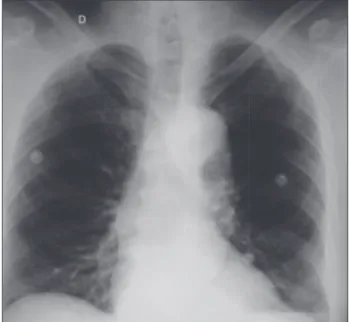
In April 2010, at er clinical evaluation showing normal blood pressure levels, he was started on target therapy with sunitinib, at a daily dose of 50 mg (four weeks on and two weeks of ). At er the i rst cycle, his clinically evaluated blood pressure was normal. He began the second cycle and 20 days later, when he sought the emergency room with chest pain, his blood pressure was 210 mmHg x 120 mmHg. Electrocardiography did not show ischemic signals but the chest X-ray showed an enlarged mediastinum (Figure 1) and chest CT-angiography revealed Stanford type B aortic dissection from the aortic arch to the abdominal aorta (Figure 2). He received intravenous β-blocker (metoprolol) and sodium nitroprusside, and then the blood pressure dropped to 160 mmHg x 110 mmHg.
h e patient was referred to a cardiovascular hospital, and an endoprosthesis was placed. He recovered well and started new ther-apy with temsirolimus, 25 mg weekly. His hypertension was man-aged using oral antihypertensives. At er 10 weeks of therapy, the
Table 1. Search strategies used and results from each database Database Keywords Results Relevant i ndings
Medline (via PubMed)
(sunitinib) AND (hypertension) 218
Main eff ects reported are hypertension and left ventricular ejection fraction dysfunction (renal cancer)
AND (acute aortic dissection)
6 One report of sorafenib associated with acute aortic dissection
(antiangiogenic) AND (aortic
dissection) 7
One report of acute aortic dissection during sunitinib therapy and another report relating to bevacizumab therapy
Lilacs (via Bireme)
(anti-angiogenic) AND (aortic
dissection) 1
One report of acute aortic dissection in a hypertensive patient with prostate cancer treated with bevacizumab
Embase (via OVID)
(sunitinib) AND (aortic
dissection) 8
Only one case of aortic dissection in a patient with metastatic renal carcinoma and preexisting hypertension as a predisposing factor
Last search in PubMed on January 12, 2014.
Last search in Lilacs and Embase on September 20, 2013.
Figure 1. Chest X-ray showing enlargement of mediastinum.
Aortic dissection during antiangiogenic therapy with sunitinib. A case report | CASE REPORT
Sao Paulo Med J. 2015; 133(3):275-7 277 patient achieved stable disease, according to the Response Evaluation
Criteria in Solid Tumors (RECIST) on computed tomography scans.
DISCUSSION
he management of metastatic kidney cancer has changed over the last few years, with the advent of tyrosine kinase inhibitors such as sunitinib and sorafenib, the monoclonal antibody beva-cizumab plus interferon, the antiangiogenic agent pazopanib and the mammalian target of rapamycin (mTOR) pathway inhibitors everolimus and temsirolimus. he main target of the therapy is inhibition of angiogenesis.5 he rapid growth of targeted
thera-pies has raised the challenge of management of side efects. he main side efects relating to tyrosine kinase inhibitors are fatigue, gastrointestinal alterations and hypertension.
Hypertension occurs due to the efect of the drug on vascular endothelial growth factor (VEGFR) signal pathways by increasing systemic vascular resistance. he underlying pathophysiological mechanism is not completely known. he endothelial dysfunction reduces the density of microvessels through lowering the produc-tion of nitric oxide and increasing oxidative stress.6
Only one case of aortic dissection with sunitinib had previ-ously been reported. In that report, a 58-year-old man with pre-existing hypertension presented chest pain ater four cycles of sunitinib. A computed tomography scan revealed descending aortic dissection. he drug was withdrawn and the antihypertensive ther-apy was modiied.4 Acute aortic dissection relating to therapy with
sorafenib, another antiangiogenic drug, and chemotherapy consist-ing of capecitabine and gemcitabine, in a 77-year-old patient with metastatic renal cell carcinoma, has been reported. In that case, the association between sorafenib and aortic dissection could not be airmed because the chemotherapy might have played a role.7 Also,
there is another report of aortic dissection associated with an anti-angiogenic drug, in a 70-year-old patient with metastatic prostate cancer. Difering from our patient, he had preexisting hypertension, which gradually worsened with continued use of bevacizumab, a monoclonal antibody that acts as an angiogenesis inhibitor.8
he hypertensive crisis with aortic dissection that we observed in our patient without previous hypertension was a serious side efect. It was managed by means of drug withdrawal and treatment of the aortic dissection in accordance with cardiological guidelines. Although our patient had a low-risk Memorial Sloan-Kettering Cancer Center score and clear cell carcinoma, we proposed to use temsirolimus on a trial basis, given that this drug has another mechanism of action and the rate of hypertension produced is very low. Mammalian target of rapamycin inhibitors are generally well tolerated and have low incidence of adverse events. he main concerns are stomatitis, hyperlipidemia, hyperglycemia and, rarely, non-infectious pneumonitis.9 Hypertensive crises relating to major
vascular disorders such as aortic dissection and use of antiangio-genic drugs therapy can be correlated with these events.
CONCLUSION
his report emphasizes the need for strict blood pressure con-trol among patients taking antiangiogenic drugs. Blood pressure evaluations should be scheduled more frequently, especially at the beginning of the treatment, so as to enable early recognition and manage hypertension or other side efects.
REFERENCES
1. Motzer RJ, Hutson TE, Tomczak P, et al. Sunitinib versus interferon alpha
in metastatic renal-cell carcinoma. N Engl J Med. 2007;356(2):115-24.
2. Bragalone DL. Sunitinib. In: Bragalone DL. Drug information
handbook for oncology. Hudson: Lexi-Comp; 2011. p. 1168-74.
3. Golledge J, Eagle KA. Acute aortic dissection. Lancet.
2008;372(9632):55-66.
4. Edeline J, Laguerre B, Rolland Y, Patard JJ. Aortic dissection in a patient
treated by sunitinib for metastatic renal cell carcinoma. Ann Oncol.
2010;21(1):186-7.
5. Kirchner H, Strumberg D, Bahl A, Overkamp F. Patient-based strategy
for systemic treatment of metastatic renal cell carcinoma. Expert Rev
Anticancer Ther. 2010;10(4):585-96.
6. Zhu X, Stergiopoulos K, Wu S. Risk of hypertension and renal
dysfunction with an angiogenesis inhibitor sunitinib: systematic
review and meta-analysis. Acta Oncol. 2009;48(1):9-17.
7. Serrano C, Suárez C, Andreu J, Carles J. Acute aortic dissection during
sorafenib-containing therapy. Ann Oncol. 2010;21(1):181-2.
8. Aragon-Ching JB, Ning YM, Dahut WL. Acute aortic dissection in a
hypertensive patient with prostate cancer undergoing chemotherapy
containing bevacizumab. Acta Oncol. 2008;47(8):1600-1.
9. Guevremont C, Alasker A, Karakiewicz PI. Management of sorafenib,
sunitinib, and temsirolimus toxicity in metastatic renal cell carcinoma.
Curr Opin Support Palliat Care. 2009;3(3):170-9.
Sources of funding: None
Conlict of interest: None
Date of irst submission: July 11, 2013
Last received: May 15, 2014
Accepted: June 2, 2014
Address for correspondence:
Maria Nirvana da Cruz Formiga
Fundação Antônio Prudente
Rua Professor Antônio Prudente, 213
Liberdade — São Paulo (SP) — Brasil
CEP 01509-900
Tel. (+55 11) 2189-5000
Fax. (+55 11) 2189-5108