Elderly attention to health strategy in
the family: action of nurses
ATENÇÃO AO IDOSO NA ESTRATÉGIA DE SAÚDE DA FAMÍLIA: ATUAÇÃO DO ENFERMEIRO
ANCIANOS ATENCIÓN A LA SALUD DE ESTRATEGIA EN LA FAMILIA: LA ACCIÓN DE LAS ENFERMERAS
1 Collective Health Specialist by Universidade Federal do Triângulo Mineiro. Nurse of the Family Health Program of Uberaba City Administration. Uberaba, MG, Brazil. [email protected] 2 PhD. in Nursing. Adjunct Professor of the Department of Nursing in Education and community Health at Centro de Graduação em
O
RIGINAL
A
R
TICLE
RESUMO
Este estudo objetivou descrever a consulta de enfermagem ao idoso realizada na ESF; identificar possíveis dificuldades na aten-ção à saúde do idoso, bem como os cursos de qualificação profissional realizados e as necessidades de aprendizagem. Os dados foram coletados por meio da entrevista se-miestruturada e submetidos à análise des-critiva e temática. Foram entrevistadas 12 enfermeiras, a maioria estando na faixa etária de 23 28 anos (66%); com 1 2 anos de formada (41%) em instituição particu-lar (75%). Emergiram duas categorias temá-ticas: consulta de enfermagem ao idoso na ESF e qualificação profissional para a aten-ção à saúde do idoso. Foi considerado como desafio na realização da consulta de enfer-magem a obtenção de dados fidedignos, a resolutividade e o apoio familiar. Os cursos para qualificar a atenção ao idoso ocorre-ram durante o período de graduação, des-tacando a falta de oportunidade, a pouca oferta e a necessidade de se aprofundar sobre o processo de envelhecimento.
DESCRITORES
Idoso.
Envelhecimento. Enfermagem geriátrica. Enfermagem familiar. Promoção da saúde. Saúde da família.
Juliana Costa Assis de Oliveira1, Darlene Mara dos Santos Tavares2
ABSTRACT
This study aimed to describe the nursing consultation for the elderly provided at the Family Health Strategy (ESF, acronym in Portuguese); identify possible difficulties in delivering health care to the elderly, as well as the professional qualification courses performed and the learning needs. Data were collected through semi-structured in-terviews and submitted to descriptive and thematic analysis. Interviews were per-formed with 12 nurses, most with ages be-tween 23 28 years (66%), with 1 2 years since graduation (41%) in private institu-tions (75%). Two thematic categories emer-ged from the analysis: nursing consultation for the elderly performed at ESF and pro-fessional qualification in health care for the elderly. Obtaining reliable data in the nurs-ing consultation, resolution and family sup-port were considered as challenges. The courses to qualify professionals for elderly care occurred during their graduation course, highlighting the lack of opportunity, the short supply and the need for deeper studies about the aging process.
KEY WORDS
Aged. Aging.
Geriatric nursing. Family nursing. Health promotion. Family health.
RESUMEN
Este estudio tuvo como objetivo describir la consulta de enfermería realizada por el anciano en la ESF; identificar posibles difi-cultades en la atención a la salud del ancia-no, así como los cursos de calificación pro-fesional realizados y las necesidades de aprendizaje. Los datos fueron recogidos a través de la entrevista semiestructurada y sometidos al análisis descriptivo temático. Fueron entrevistadas doce enfermeras, es-tando la mayoría situadas en la faja etaria de 23 a 28 años (66%), con 1-2 años de gra-duadas (41%) en instituciones particulares (75%). Emergieron dos categorías temáti-cas: consulta de enfermería del anciano en la ESF y calificación profesional para la aten-ción de la salud del anciano. Fue conside-rado como desafío en la realización de la consulta de enfermería la obtención de datos fidedignos, la resolutividad y el apo-yo familiar. Los cursos para calificar la aten-ción al anciano, tuvieron lugar durante el período de graduación, destacándose la falta de oportunidad, la poca oferta y la necesidad de profundizar sobre el proceso de envejecimiento.
DESCRIPTORES
INTRODUCTION
Currently, in Brazil, elderly people represent about 10% of the population. The 2000 Brazilian census showed that 15.5 million people are 60 years old or over, predicting an
increase to 18 million by 2010 and 25 million by 2025(1).
This increased number of elderly people, among other factors, show that it is necessary to resume the discussions that permeate the crisis in the healthcare sector. In this perspective, with the purpose of implementing the prin-ciples and guidelines of the Single Healthcare System –
Sistema Único de Saúde (SUS), the Ministry of Health
insti-tuted the Family Healthcare Strategy – Estratégia Saúde da
Família (ESF) in 1994. Such a strategy sees the family, not
the individual alone, as the unit for programmed actions(2).
ESF is focused on an active perspective of healthcare in-terventions, i.e., not only waiting until the population comes to the healthcare services to perform interventions. The in-teraction with the population should be
pre-ventive, becoming a real instrument to reor-ganize the demand. Also, conceptions of com-munity integration and the focus on integral healthcare are strengthened, avoiding reduc-tionist healthcare actions focused only on bio-logical and medical interventions (2). In this
con-text, the Brazilian government induces the healthcare sector to rebuild healthcare pro-duction. Therefore, it is necessary to qualify the professionals, make them co-responsible for the care provided and to encourage inte-gral healthcare for all family members in the several phases of the vital cycle.
The increase of the elderly population, which has occurred quickly and progressively, demands the healthcare professionals – nurses in particular – to be qualified to meet the needs
of this stage of life, thus improving the care provided(3).
The National Healthcare Policy for Elderly People, passed in 1999, has the purpose of promoting healthy aging; the maximum maintenance and improvement of the functional capacities of elderly people; prevention of disease, recov-ery of health and rehabilitation. It aims to ensure the per-manence of the elderly people in their own midst,
perform-ing their functions in society in an independent way(4).
However, for elderly people to obtain qualified and reso-lutive healthcare, it is necessary to educate professionals – nurses among them – who are well-prepared to visualize the tenacity of the installation of pathologic processes in the elderly, which may easily turn them from independent to dependent. Overall, they should be aware that elderly people have different needs than other adults, which are
inherent to the aging process(5).
Therefore, the nurses are expected to be educated and develop activities that will not simply inform people about the aging process, but that will educate professionals who are sensitive to the limits and characteristics of the elderly, so that they will be able to understand the physical,
emo-tional and social changes of this age range(6).
Furthermore, the nursing appointment needs to be implemented in the healthcare services, since it favors multiprofessional activities, the development of inter-sec-torial activities, interpersonal relations with clients and
rela-tives, and science-based care(7).
ESF is a privileged space to provide integral healthcare to the health of elderly people, since its proximity with the community and homecare allows for actions that are contextualized in the reality experienced by the elderly within their families. The effective insertion of elderly people in healthcare units, especially those working accord-ing to the ESF, may represent a bond with the healthcare system.
Considering the specificities of the aging process and the necessary professional ad-equacy and qualifications, this study aims to contribute for the discussion, reflection and (re)organization of the actions of nurses in the provision of healthcare to the elderly popu-lation in the scope of the ESF.
OBJECTIVES
1. Describing the nursing appointment for elderly patients performed in the Family Healthcare Strategy;
2. Identifying the possible difficulties ex-perienced by the nurses when providing healthcare for elderly people;
3. Identifying the professional qualification courses taken by nurses to provide healthcare for elderly people, as well as their educational needs.
METHOD
It is a descriptive, exploratory, qualitative study whose purpose was to comprehend the healthcare provided to elderly people by nurses working in the ESF.
This investigation was executed in the city of Uberaba, whose area is divided in three Sanitary District (SD), and currently has 47 ESF teams. For the selection of the place where the data would be collected, the 2007 Basic
Healthcare Information System – Sistema de Informação
de Atenção Básica (SIAB) was consulted in order to verify the number of elderly people per SD. As such, the
Sani-ESF is a privileged space to provide integral healthcare to
the health of elderly people, since its proximity with the
community and homecare allows for
actions that are contextualized in the reality experienced by the elderly within their
tary District I (SD I) was chosen, as it has the highest count of elderly people (6,731) over SD II (3,384) and SD III (5,221).
The study subjects were the nurses who fit the inclu-sion criteria: working at the ESF of SD I, for at least one year; not being on leave or on vacation; being of either gender and agreeing to take part in the study. Of 16 nurses, twelve took part in the study. Two were on vacation and another two refused.
Data collection was performed with a semi-structured interview, after a pilot test verifying comprehension, clar-ity, objectivity and adequacy of the proposed questions regarding the study goals. The data collection instrument is divided in two parts, with the following variables being in the first part: gender, age range, time since graduation and time working at the ESF, number of elderly people reg-istered in the area and monthly amount of elderly people who received care. The second part is constituted by eight guiding questions about elderly people healthcare.
The interview was arranged with the nurses, according to their and the researchers’ availability, in a private place – either a room at the healthcare unit or at the City Healthcare Secretariat. The interviews were recorded, with the participants’ authorization, and later transcribed. Those who agreed to take part in the study but did not allow the interviews to be recorded had their answers written down in the data collection instrument. The tapes will be de-stroyed after 5 years, as predicted by resolution #196/96 of the National Healthcare Council.
The data were submitted to the simple frequency dis-tribution and thematic analysis, according to the stages: pre-analysis, exploration of the material and treatment of results. In pre-analysis, the collected material was or-ganized, and the ideas were systematized after the rial was read exhaustively. In the exploration of the mate-rial, the experimental analysis itself processed. Reported excerpts were processed in an attempt to find the mean-ingful communication cores. Finally, the results obtained were grouped in categories according to their similarity were counted in each category and their percentage of
occurrence was calculated(8).
The City Healthcare Secretariat of Uberaba authorized the study. The project was approved by the Review Board of Universidade Federal do Triângulo Mineiro, in accordance with resolution #196/96, protocol #994. The nurses were contacted at their workplace, and presented the goals of the study, which were performed after the participants agreed to it by providing written consent. The secrecy and anonymity of the answers was guaranteed, since the inter-views were identified by numbers.
RESULTS AND DISCUSSION
Characteristics of the studied population
All the interviewees are female, with ages ranging from 23 + 28 years (66%) and 33+ 39 years (34%). These data show a predominance of women in the nursing workforce and younger population in the ESF, a place that has ab-sorbed a large amount of recent graduates.
It was verified that 75% of the nurses studied in private universities and 25% in public universities. A Brazilian study about the profile of family healthcare physicians and nurses in Brazil observed that 70.7% of the nurses studied in public universities, with higher percentages registered for the North-ern (72.9%) and NortheastNorth-ern (84.3%) regions, with an expres-sive participation of the public sector. A different situation is observed in other regions, where private colleges are respon-sible for nearly half the output of graduate nurses. In the South-eastern, Southern and Central-Western region, more than 40% of the ESF nurses had studied in private universities(9).
Regarding the time since graduation, the highest per-centages were for 1+ 2 years (41%), followed by 2 + 3 years (33%) and 3 years (26%). These data corroborate the find-ings of a study performed with ESF physicians and nurses in Brazil, where most professionals (43.1%) had finished
their undergraduate studies up to four years before(9).
The career time in the ESF showed that 50% of the pro-fessionals have been in the service for 1+ 2 years 34% be-tween 2 + 3 years and 16% for 1 year or less. This is also in agreement with the Brazilian profile, where 43.3% of the nurses have been working in ESF for less than one year. One of the factors that may explain this situation refers to the significant expansion of ESF in 1997 and 1998, when
nearly 1,524 teams were implemented in 550 cities(9).
The number of elderly patients registered in each unit varied between 152 and 1000. The number of appointments with elderly people varied between 70 and 500 per month. In all interviews, the number of monthly appointments re-ported by nurses did not reach the number of elderly people registered. Difficulties in the provision of monthly appoint-ments with elderly people, reflected in the study, reaffirms the necessity of healthcare planning regarding the elderly population and the overload of the nurses.
Thematic categories
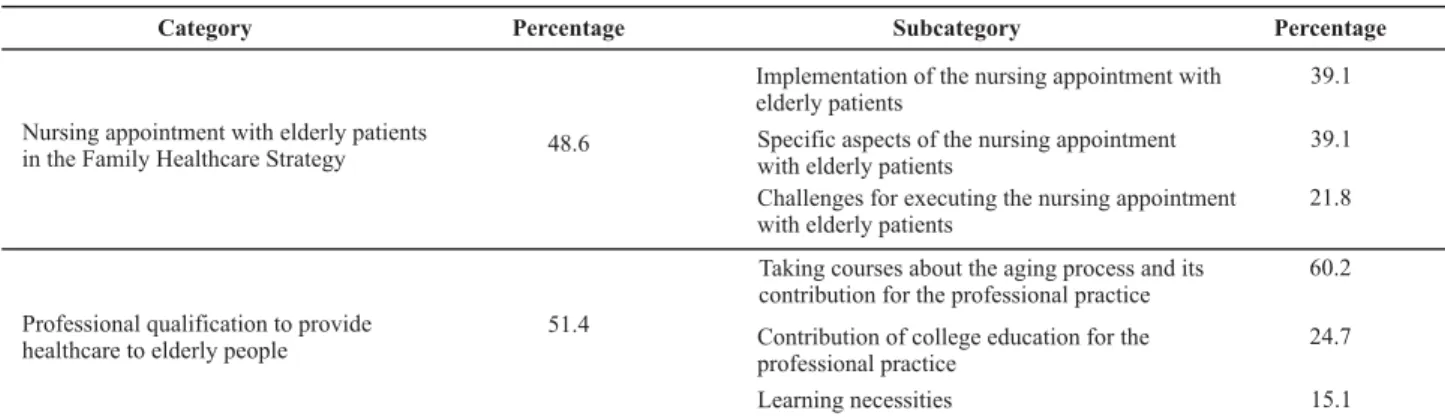
Two categories emerged after the thematic analysis:
Table 1 - Distribution of frequency of categories and subcategories obtained after the thematic analysis of the interviews with ESF
nurses of the DS I - Uberaba, 2008
Category Percentage Subcategory Percentage
Implementation of the nursing appointment with elderly patients
39.1
Specific aspects of the nursing appointment with elderly patients
39.1 Nursing appointment with elderly patients
in the Family Healthcare Strategy 48.6
Challenges for executing the nursing appointment with elderly patients
21.8
Taking courses about the aging process and its contribution for the professional practice
60.2
Contribution of college education for the professional practice
24.7 Professional qualification to provide
healthcare to elderly people
51.4
Learning necessities 15.1
The category Nursing appointment with elderly patients
in the Family Healthcare Strategy (48.6%) is composed by units of registry describing the stages of the nursing ap-pointment and the activities developed. They group the main challenges faced by the nurses regarding elderly people, their relatives, the organization of the healthcare services and society, as well as the professional qualifica-tion. The specifics of the nursing appointment are noted, due to some characteristics of the elderly patients, the pro-fessional attributes and the execution of work. It has three
subcategories: Implementation of the nursing appointment
with elderly patients (39.1%), Specific aspects of the nurs-ing appointment with elderly patients (39.1%) and Chal-lenges for executing the nursing appointment with elderly patients (21.8%).
In the subcategory Implementation of the nursing
ap-pointment with elderly patients the registry units describ-ing how the nursdescrib-ing appointment is performed were gath-ered, i.e., data collection, the physical examination, the fol-low-up, referrals (when necessary), in addition to healthcare education and homecare visits. Healthcare actions are es-pecially directed to elderly people, with few reports of in-volvement with relatives, as seen in their reports.
[…] I collect the patients’ data… (Ent 2); […] the physical examination of the patients, I check the vital signs, perform the heart and lung auscultation, check on the eliminations, lower limbs (Ent 10); […] I sit down with that elderly person, try to talk, know what their family is like, if they live alone or not, of they’re retired or not, if they’re independent to do things or not, if it’s easy for them to access that healthcare sector (Ent 10); […] I try to look at their social situation before checking for diseases (Ent 10); homecare visits (Ent 7); […] having the patient work in a group, to acquire a certain intimacy (Ent 10); orientations and follow-ups for hypertension, diabetes, dieting and general care (Ent 5).
The nursing appointment is understood as
care provided to the individual, the family and the commu-nity in a systematized and continuous way, performed by the nursing professional with the purpose of promoting
health with early diagnosis and treatment(10-112).
When performed with elderly people, it is necessary to aggregate the specifics of the human development process.
This activity is an exclusive responsibility of the nurses, who, by using their professional autonomy, takes responsi-bility for the nursing actions to be provided in the problems
detected and the level of complexity of the intervention(11).
In the aforementioned speeches, the nurses were ob-served to focus on the first stage of the nursing appoint-ment, being concerned about the provision of care accord-ing to the healthcare necessities of the elderly patient.
The nursing appointment, as well as other appointments performed by other professionals of the healthcare team, may be restricted to the nurse’s office and the appointment, sometimes resulting in a relationship of power valued
among workers(11).
However, the ESF is also focused on homecare, which favors the comprehension of the subjects’ and relatives’ social space, increasing the possibilities of work of the healthcare professionals and the establishment of partner-ships for the provision of care. In this subcategory, there are reports from nurses who note the home visit as a privi-leged space in the provision of care for elderly patients.
Another study verified that homecare has the potential to bring sensitivity to the way of acting and thinking of the healthcare professionals, instead of simply adding another task to the healthcare services, which are already highly
satu-rated(12). Homecare is noted to favor the approximation with
reality, in itself complex and dynamic, making it possible to review and reflect upon the attitude of the healthcare
pro-fessionals who strive to transform healthcare(12).
independence should not be preserved, nor the encour-agement of self-care.
The establishment of bonds between nurses and eld-erly people was evident in the registry units, with contacts in educational actions and the healthcare follow-up, with biological approaches and the socioeconomic and family determiners.
ESF has the potential to encourage community organi-zation and autonomy of families. The proposed technical model of healthcare favors the establishment of bonds by promoting health, supported by the encouragement and support so that social groups could have more control over their own health (10).
In the subcategory Specific aspects of the nursing
ap-pointment with elderly patients, the registry units (39.1%) express, according to the nurses, the specific aspects of the nursing appointment that are related to the comprehen-sion of certain characteristics of elderly people; gathering in-depth information; need for attention and security, sup-port and maintaining interpersonal relationships. On the other hand, they describe the necessity of providing more time, of helping, supporting, having more patience and cre-ativity, in addition to having the nurse know more about their disease and medication.
[…] the nursing appointments for elderly people have a few
dots that you have to seek out in the past, reporting even
its day (Ent 9); […] more time is needed, due to the neces-sity of establishing the dialogue with elderly people (Ent 3); […] you have to see the elderly person in a new way… as they see you as a someone that will support them (Ent 10); […] the nurses are usually those who know the patient’s history best… (Ent 11).
In the aforementioned speeches, it is possible to unveil the visibility of the elderly in the perspective of the nurses, such as lack of attention, need for support and security. Such a perspective may interfere in the nursing care so as to not encourage the potential of elderly people. As such, it is necessary to know the particular aspects involved in healthcare for elderly people, identifying specifics and in-crease treatment efficiency, prevention of disease and health promotion.
The health-disease process occurs differently among the subjects, depending on the body’s capacity of recovery, in the same way that a person experiences disease, hope of
recovery and age, among other factors(13). Such issues
strengthen the necessity that healthcare for the elderly should be supported in the particular aspects of this stage of life, and the preconceived ideas of the healthcare pro-fessionals should not imprint the fragility and incapacity of the elderly upon the healthcare.
On the other hand, the visibility of the nurses in rela-tion to elderly people shows that the professionals need to understand and improve their practice in order to deal with
Another aspect reported by the nurses was the time spent in the nursing appointment. This helps them to bond with the elderly, as it favors the comprehension of biological, so-cial, economic and cultural necessities, factors that were con-sidered in the resolution of the identified problems.
A study performed in a family healthcare unit in the state of Rio Grande do Sul identified the relation between the production of bonds and continuous provision of clini-cal care. Periodic cliniclini-cal activity was considered to increase the possibility of bonding, as well as the responsibility to-wards the clients’ needs. The study also found the neces-sity of bringing the nurses closer to these activities, so that their actions may have a stronger impact in the health of
the population, producing resolutive care (14).
The subcategory Challenges for executing the nursing
appointment with elderly patients was made up by registry units (21.8%) describing the main challenges faced, ex-pressed by the acquisition of accurate data on elderly healthcare; the inadequate assimilation of orientations, especially regarding medication; the lack of attention given by the relatives; the lack of resolutivity of the healthcare problems due to the system of referrals and counter-refer-rals and the impossibility of offering responses to social needs; and finally, the necessity of learning related to the physical examination.
[…] elderly people find it difficult to provide accurate data about their life and health (Ent 2). Lack of assimilation of information (by elderly patients) (Ent 5). Lack of monitoring by relatives (Ent 6). […] you have to check, identify the necessity, but, when you’re with the patient, you can’t do it (Ent 10). Sometimes, for some reason, you’re stopped, so we do what we can, whatever is proposed to us, but we always depend on another level (Ent 10). …difficulties with lung and heart auscultation, especially (Ent 12).
The challenges posed in this subcategory seem to be related to the data obtained in the first subcategory, as the nurses emphasized the acquisition of accurate data. It is also possible to infer that nurses are performing educational activities and homecare visits as strategies to face these challenges. Furthermore, such activities become a space for the elderly patients to improve their knowledge about their own health status.
Healthcare provided to elderly patients by the nurses aims to aid the clients and their relatives to identify and solve, if possible, the interactional maladjustments, in ad-dition to coping with problems and making decisions. The focus of care, therefore, should lie in aiding and qualifying the clients and their families, so that they can see to the needs of their members, especially regarding the health-disease process, mobilizing resources, promoting mutual
support and joint growth(15).
cial setbacks that may occur when families stray away from the role of caregiver(16).
Resolutivity of healthcare problems was another aspect considered as a challenge to be overcome by the nurses. Reaching integral care, or the effort to reach it by the pro-fessionals, helps produce more resolutivity in healthcare actions(17).
In the healthcare agenda, resolutivity has the purpose of implementing this principle, proper of the Single
Healthcare System – Sistema Único de Saúde (SUS).
How-ever, when faced with a broader comprehension about health – based on biological, social, cultural, environmen-tal, spiritual aspects, among others, it is necessary to es-tablish partnerships, with inter-sectorial actions, in an at-tempt to have more effective responses.
The complexity of the healthcare work requires co-re-sponsibilities, and this has encouraged the search for part-nerships among the many health-related social sectors in-volved. In this context, the healthcare sector makes its lead-ership over the other social sectors more evident. However, it is possible to see that, sometimes, the search for these articulations remains in the professional scope instead of the institutional scope, as recommended by inter-sectorial policies(18).
In the study, the necessity of learning related to physi-cal examinations was also evident. For that, it is recom-mended that nursing supervisors try to facilitate the par-ticipation of nurses in graduate courses contemplating propedeutic bases. We should also add the instrumental-ization of these professionals in order to provide care to elderly patients, due to the lack of content in undergradu-ate courses relundergradu-ated to the aging process and the alterations caused by this process(18).
However, it is worth noting that, according to another study, most nurses studied contents related to physical ex-amination during their undergraduate course; 88% of the interviewees performs the physical examination and are motivated to perform it, although they do it in an incom-plete way(18).
The second category, Professional qualification to
pro-vide healthcare to elderly people (51.4%), contains the reg-istry units describing courses about the aging process and the reasons for not taking them; the course contents and its impact on the professional practice. They also note that the course contents studied during undergraduation were paramount for their professional activities; however, they report the necessity of learning more about the aging
pro-cess. The following subcategories were identified: Taking
courses about the aging process and its contribution for the professional practice (60.2%), Contribution of college education for the professional practice (24.7%) and Learn-ing necessities (15.1%).
In the subcategory Taking courses about the aging
pro-cess and its contribution for the professional practice, the
registry units (60.2%) describe courses about the aging pro-cess take during undergraduation. When these are not taken, the reasons are usually related to lack of opportunity and offers. The course contents were: conceptual aspects, health promotion, prevention of disease; diseases; elderly healthcare, medication and social insertion. They note that the course met their learning necessities and favored pro-fessional activities with a stronger sense of security, as it al-lowed for in-depth, clearer studies about the topic.
Yes, I studied elderly healthcare during undergraduation… but not after graduation (Ent 11). […] I didn’t take any such course during undergraduation, not even those given by the city health secretariat (Ent 10) […] offers of this type of course are minimal (Ent 3); health promotion and later years (Ent 1); Chronic and degenerative diseases (Ent 6) […] When you see new things, listen to new things, you have to add it all to your daily routine, because there are things… details that you’ll forget, and, if you do that often, if somebody talks about it, emphasizing it, we can do it better (Ent 9).
Courses related to the aging process are still scarce, ac-cording to the registry units of this category. The publica-tion of the Statute of Elderly People, in 2003, strengthens the discussion about elderly healthcare. However, the con-struction and socialization of knowledge in geriatric nurs-ing still needs more implementation in the educational
in-stitutions and the availability of extension courses(19).
According to the nurses, the course contents denote a broader view of the health-disease process, and aging as part of life. The educational opportunities, in the aforemen-tioned perspective, must be multiplied in order to face the growing social demands due to population aging. At the same time, they should contribute for the implementation of the technical care model proposed by ESF, supported on the SUS principles, which are very necessary but still little
consolidated in our context(19).
When taken, the courses were observed to contribute for the professional activity. It should be noted that per-manent education may motivate personal and professional transformations, seeking alternatives that will minimize the existing challenges in the context of the healthcare services. Therefore, the healthcare team, and nursing in particular, will have common goals, which must be achieved by all its members(19).
The registry units (24.7%) of the subcategory
Contribu-tion of college educaContribu-tion for the professional practice show that, although the contents have not been studied in-depth during undergraduation, the acquired knowledge was para-mount for professional practice, favoring the increase of knowledge; execution of scientific studies; better compre-hension about diseases and the development of health pro-motion, preventive actions, treatment and rehabilitation from disease.
eld-erly people during undergraduation, since there isn’t much content about that area (Ent 10). This specific part about elderly people was not addressed [...] we studied some dis-eases that usually appear in elderly people, but nothing re-ally specific about the elderly, no (Ent 12) [...] I did a scien-tific study about the aging process and it was very important, it contributed then and it still contributes today Ent 11); [...] with the theoretical knowledge I already had, I could use it in practice and develop actions focused on prevention, promo-tion, healing and rehabilitation (Ent 8).
Gerontologic nursing aggregates nursing knowledge and practice, proveninent from general nursing, geriatrics and gerontology. However, the challenges for the nursing colleges begun only in November, 2001, with the changes proposed by the National Curricular Guidelines for Undegraduate Nurs-ing Courses – the education of professionals to provide care to elderly human beings. This theme was not a part of the
Undegraduate Nursing Courses from 1991 to 2000(19).
The nurses in this study reported that contents about the human aging process during professional education, although in need of more in-depth content, contributed for their pro-fessional practice. These data corroborate the investigation performed with nursing students in public colleges in the state of Minas Gerais. Geriatric/gerontologic nursing studies, offered in undergraduation, favored the increase of knowledge and theoretical/practical support for the development of profes-sional nursing care focused on elderly people. The lack of par-ticipation of students in university research and extension ac-tivities about the topic was also evident(6).
It should be noted that the number of human resources qualified to provide gerontologic care is increasingly nec-essary, in order to encourage the participation of students in activities related to the human aging process. It depends on the Undegraduate Nursing Courses to make the profes-sional education adequate to its social reality. On the other hand, the offer of gerontologic contents should be ex-panded for students who show some interest in the area
during their professional education years(16).
The subcategory Learning necessities is constituted by
registry units (15.1%) which report the need of studying the aging process in-depth, highlighting certain diseases that occur more frequently among the elderly, updating activities and psychosocial aspects.
[…] I think you should study something more in-depth ev-ery day, because things change and you have to update daily Ent 9); […] I think that we’ll never know everything, and, the more we learn, the more we see that there are more things to learn, especially in a population which has a higher and higher life expectancy (Ent 10); […] I have some difficulty in providing orientation to families and patients, such as Alzheimer and Parkinson’s disease (Ent 12); Yes, psychosocial needs (Ent 7).
The healthcare professionals – especially the nurses – are increasingly more concerned about improving the
qual-has the role of developing the professionals to perform their activities with more security, dynamism and in an
indivual-ized way, in the family and the collective context(19).
The education of human resources in the elderly health-care field is linked to a comprehension of the human aging process and its biopsychosocial repercussions. As such, the necessity of interdisciplinary studies done according to new
healthcare paradigms is strong(17). In order to develop this
type of work, the healthcare professionals need to be up-to-date, according to the evidence in the registry units in this subcategory.
The daily routine of professional practice makes qualifi-cation more significant, as it allies the experience of situa-tions to the process of knowledge, enabling the question-ing of social practices and instrumentalization for knowl-edge and actions(17).
Furthermore, the experience of the social reality allows the healthcare professionals to awaken for a more in-depth awareness of certain themes that are required by the health-care services, as previously observed in the nurses’ speeches.
This fact is improved by the experience developed with a multidisciplinary team from the Elderly Healthcare Cen-ter at Hospital Universitário Pedro Ernesto. When faced with changes, it was observed that knowledge, ideas or learned behaviors are not enough, with professional capacity and becoming a participative agent on social transformations being necessities, as well as detecting problems and search-ing for solutions(17).
CONCLUSION
Twelve ESF nurses took part in this study. Most is in the age range between 23+ 28 years (66%), educated in private institutions (75%), have graduated 1+ 2 years ago (41%) and have worked in the ESF for 1 + 2 years (50%).
The thematic analysis made two categories evident: Nursing appointments with elderly patients in the Family Healthcare Strategy and Professional qualification to pro-vide healthcare to elderly people, each of them with three subcategories.
more time; availability to help and support, in addition to needing to have more patience and creativity.
The nurses count on an important tool in the develop-ment of elderly healthcare, since they were considered a reference within the healthcare team in the provision of care for this public. The nurse-elderly patient bond showed the relevance of the nursing appointment, as it represents the possibility of reaching integral care, inserting family and community in the healthcare process.
The nurses observed that courses to qualify profession-als to work on elderly healthcare occurred during the
un-dergraduate years, although they note the lack of oppor-tunities and offers. The studied contents were related to the conceptual aspects, health promotion, disease preven-tion, diseases, elderly healthcare, medication and social insertion. They highlight the need of studying the aging process in-depth, mentioning that the course met their learning necessities. The knowledge acquired was funda-mental for the development of professional practice.
The ESF nurses are expected to work in collective health-care, corresponding to the emerging needs with the pur-pose of reorganizing the actions provided to the elderly population.
REFERENCES
1. Instituto Brasileiro de Geografia e Estatística (IBGE). Dados pre-liminares do censo 2000 [texto na Internet]. Rio de Janeiro; 2001. [citado 2006 mar. 15]. Disponível em: http://www.ibge. gov.br
2. Brasil. Ministério da Saúde. Secretaria de Atenção à Saúde. Departamento de Atenção Básica. Política Nacional de Aten-ção Básica. Brasília; 2006.
3. Silvestre JA, Costa MM. Abordagem do idoso em Programas de Saúde da Família. Cad Saúde Pública. 2009;19(3):839-47.
4. Brasil. Ministério da Saúde. Portaria n. 1395, de 10 de dezembro de 1999. Dispõe sobre a Política Nacional de Saúde do Idoso e dá outras providências [legislação na Internet]. Brasília; 1999. [citado 2007 abr. 22]. Disponível em: http:/dtr2004.saude. gov.br/ susdeaz/legislacao/arquivo/Portaria_1395_de_10_ 12_1999.pdf
5. Silva MJ, Duarte MJRS. O autocuidado dos idosos: intervenção de enfermagem e melhor qualidade de vida. Rev Enfem UERJ. 2001;9(3):248-53.
6. Montanholi LL, Tavares DMS, Oliveira GRS, Simões ALA. Ensino sobre idoso e gerontologia: visão do discente de enfermagem no Estado de Minas Gerais. Texto Contexto Enferm. 2006;15 (4):663-71.
7. Chrizostimo MM, Rosas AMMTF. A trilogia da promoção em saúde, consulta de enfermagem e gestão em saúde: o entrela-çar reflexivo. Inf Promoção Saúde [periódico na Internet]. 2006[citado 2007 mar. 15];2(2):[cerca de 3 p.]. Disponível em: http://www.uff.br/promocaodasaude/trilogia.pdf
8. Bardin L. Análise de conteúdo. Lisboa: Edições 70; 1977.
9. Machado MA, coordenador. Perfil dos médicos e enfermeiros da Saúde da Família no Brasil: Relatório final. Brasília: Ministé-rio da Saúde; 2000.
10. Schimith MD, Lima MADS. Acolhimento e vínculo em uma equipe do Programa Saúde da Família. Cad Saúde Pública. 2004;20(6):1487-94.
11. Gomes AMT, Oliveira DC. A representação social da autono-mia profissional do enfermeiro na saúde pública. Rev Bras Enferm. 2005;58(4):393-8.
12. Sakata KN, Almeida MCP, Alvarenga AM, Craco PF, Pereira MJB. Concepções da equipe de saúde da família sobre as visitas domiciliares. Rev Bras Enferm. 2007;60(6):659-64.
13. Marcon SS, Radovanovic CAT, Waidman MAP, Oliveira MLF, Sales CA. Vivência e reflexões de um grupo de estudos junto às famílias que enfrentam a situação crônica de saúde. Texto Contexto Enferm. 2005;14(n.esp):116-24.
14. Pan American Health Organization (PAHO). Pan American Sanitary Bureau. Division of Health Promotion and Protection and Protection. Plan of Action on Health and Aging: older adults in the Americas, 1999-2002. Washington; 1999.
15. Oliveira RG, Marcon SS. Trabalhar com famílias no Programa de Saúde da Família: a prática do enfermeiro em Maringá-Paraná. Rev Esc Enferm USP. 2007;41(1):65-72.
16. Santos SSC. O ensino da enfermagem gerontogeriátrica e a complexidade. Rev Esc Enferm USP. 2006;40(2):228-35.
17. Motta LB, Caldas CP, Assis M. A formação de profissionais para a atenção integral à saúde do idoso: a experiência interdis-ciplinar do NAI - UNATI/UERJ. Ciênc Saúde Coletiva. 2008; 13 (4):1143-51.
18. Paschoal AS, Mantovani MF, Méier MJ. Percepção da educa-ção permanente, continuada e em serviço para enfermeiros de um hospital de ensino. Rev Esc Enferm USP.2007;41(3):478-84.