2013 May-June;21(3):726-33 www.eerp.usp.br/rlae
Corresponding Author: Nilba Lima de Souza
Universidade Federal do Rio Grande do Norte. Centro de Ciências da Saúde Av. Senador Salgado Filho, 3000
Bairro: Lagoa Nova
CEP: 59078-900, Natal, RN, Brasil E-mail: [email protected]
Social representations of mothers about gestational hypertension and
premature birth
1Nilba Lima de Souza
2Ana Cristina Pinheiro Fernandes de Araújo
3Iris do Ceu Clara Costa
3Objective: To identify the meanings attributed by mothers to hypertensive disorders of pregnancy
(HDPs) and their consequences, such as premature birth and hospitalization of the infant in the
neonatal intensive care unit (NICU). Method: A qualitative study, based on the Central Nucleus
Theory, with 70 women who had hypertensive disorders of pregnancy and preterm delivery.
We used the technique of free word association (FWAT) with three stimuli: high blood pressure
during pregnancy, prematurity and NICU. Results: We obtained 1007 evocations, distributed
as follows: high blood pressure during pregnancy (335) prematurity (333) and NICU (339).
These constituted three thematic units: representation of HDPs, prematurity and the NICU. The
categories death and negative aspects were inherent to the three units analyzed, followed by
coping strategies and needs for care present in HDPs and prematurity. Conclusion: The study
had death as its central nucleus, and highlighted the subjective aspects present in the high
risk pregnancy and postpartum cycle. It is hoped that this research will contribute to qualifying
nursing care for women confronting the problem of HDPs, so that they can cope with less impacts
from the adverse effects of high risk pregnancy and birth.
Descriptors: Pregnancy, High-Risk; Pre-Eclampsia; Obstetrical Nursing; Infant, Premature.
1 Paper extracted from doctoral dissertation “Significados e percepções de puérperas sobre as síndromes hipertensivas da gravidez e parto
prematuro”, presented to Universidade Federal do Rio Grande do Norte, Natal, RN, Brazil.
Souza NL, Araújo ACPF, Costa ICC.
Introduction
Hypertension induced by the pregnancy status,
known as hypertensive disorders of pregnancy (HDPs), is conceptualized as the increase in arterial pressure
that is manifested, more speciically, in the second
half of pregnancy(1). These syndromes impact between 10% to 22% of the pregnancies considered high risk, and are among the diseases with the greatest
impact, complications of pregnancy and childbirth, with a tendency for premature births(1-2). In developed countries, 16.1% of all maternal deaths are caused by HDPs and hemorrhage(3). In Brazil, data demonstrate
that of the HDPs, pre-eclampsia is the most frequent complication during pregnancy and childbirth, around 5-10% of pregnancies, and that it is the leading cause
of maternal and fetal death(4).
High levels of maternal arterial pressure are associated with impaired fetal growth during the
third trimester of pregnancy and increase the risk of adverse outcomes such as preterm birth and perinatal death(5). Studies reveal that 11% of births between the 34th and 37th weeks of pregnancy are women
who developed preeclampsia; and, in the case of recurrence, it is doubled to 22%(6-7). They also indicate that 33% of premature births arising from pregnancy
with preeclampsia required intensive care(7). In this way, it is clear that the HDPs favor premature birth and subsequent hospitalization in a neonatal intensive care
unit (NICU), and are considered, therefore, to be a high risk pregnancy and perinatal condition.
It is worth highlighting the emotional issues that surround motherhood in a situation of high risk
pregnancy. There are reports in the literature of subjective aspects present in pregnancy that lead to arterial hypertension, revealing anxieties and insecurity
in women who experience threats of maternal and fetal death(8).
However, in the presence of a high risk pregnancy
and when the outcome of childbirth occurs earlier than planned, the mother deconstructs the ideal of motherhood and moves into living with the reality of a child that inspires care and risk of death. This
understanding leads to presuppose that a pregnancy with hypertensive syndrome and, as a consequence, the birth of a premature child requiring hospitalization
in the NICU, can induce women to experience feelings of a diverse nature, which constitute the meanings for her motherhood in a high risk situation. We recognized the need to investigate these subjective aspects present in the experience of a pregnancy that ends with the premature birth of a child, based on the following research question: What are the social representations of mothers about the HDP sequence leading to premature birth, which evolved into the hospitalization of a child in the NICU?
From this perspective, the study aimed to
identify the signiicance attributed by pregnant
mothers to hypertensive disorders of pregnancy, and their consequences, such as premature birth and hospitalization of the child in the NICU.
Method
An exploratory, descriptive and qualitative study, based on the theory of social representations based on the Central Nucleus Theory(9). Data collection occurred in 2009, and a university maternity hospital, a reference organization in the state of Rio Grande do Norte (RN), Brazil, for high risk pregnancy, labor, birth and postpartum, was used as the research site.
The study included 70 women with HDPs, 48 hours or more after the occurrence of preterm birth, who had completed at least two NICU visits to their
child. The convenience sample was deined by the
saturation criterion of repetition of terms, according to the methodology used. The project was approved by the Committee on Ethics in Research of the Universidade Federal do Rio Grande do Norte (CEP-UFRN), under No.
195/06. The Terms of Free and Informed Consent was read and signed by all participants.
Data were collected from May to October of 2009, in the inpatient maternity unit, using a questionnaire to collect sociodemographic and obstetrical data from participants, and another designed for using the free word association technique (FWAT).
Rev. Latino-Am. Enfermagem 2013 May-June;21(3):726-33.
level of understanding of the interviewees; prematurity and NICU. Five evocations considered by the women to be
the most important, and justiication, were requested for
each of these words.
The evocations obtained through FWAT were coded, following these steps: typing the evoked words inherent to each inducing stimulus; preparation of dictionaries, considering not only adjectives, but similar expressions;
and inally, construction of a database in an electronic
spreadsheet.
Subsequently the material was subjected to lexicographical analysis conducted by the EVOC (Ensemble L’Analyse des Programmes Permettant evocations) software, 2000 version, which organizes the words evoked in order of frequency and mean number of evocations(11), distributing them into four quadrants, also called four model cases, or a scatter plot. It confers different degrees of centrality to the vocabulary, each
quadrant constituting a nucleus of representation(11-12), as shown in Figure 1.
The vertical axis refers to the mean order of evocation (MOE). The elements with less MOE were in the lower left quadrant and those which possessed greater MOE were on the right. On the horizontal axis, the frequencies (f) of invocations are found, as follows: in the upper quadrants, the higher frequencies; and, in lower quadrants, the lowest frequencies. In the upper left, quadrant 1, the elements evoked with lower order of evocation are considered the elements of the central nucleus of social representation, because they represent a collective idea. In the lower right, quadrant 3, the lower frequencies of evocation and higher MOEs are found, integrated into the peripheral nucleus. They constitute individualized representations that provide sustainability to the central nucleus(9).
Figure 1 - Table of four model cases standardized by Vergès (1992)(11)
<MOE > Frequency > MOE > Frequency
Quadrant 1 - Elements of the central nucleus Quadrant 2 - Intermediary elements
<MOE <Frequency > MOE <Frequency
Quadrant 4 - Elements of contrasts Quadrant 3 - Peripheral elements
For purposes of analysis, the other nuclei were not considered important in the social representation, but, more recently, studies have shown that by its proximity with the central nucleus, the second quadrant composed of intermediate elements exerts influences on the representative system, by having very close values of the elements that compose the central system of representation(9). This fact was observed in this study and, therefore, it was decided to consider them as representative of the object studied.
Results
Characterization of the women
There was a mean age of 28 years, with a predominance of middle school education (58.60%), a household income of up to three minimum wages (75.70%), a mean number of four prenatal visits, a
predominance of Cesarean birth (90%), and the majority were primiparous (57.14%). Low birth weight (<1500 g) was recorded in 42.90% of the newborns.
The FWAT consisted of a total of 1007 evocations, distributed as follows: for the stimulus, high blood pressure in pregnancy, 335 words were evoked; for
prematurity, 333 words; and, for NICU, 339 expressions.
These are presented below in three thematic units and their respective categories, with explanations from
the women about the signiicance of some of these
evocations.
Signiicance attributed to hypertensive disorders of pregnancy
With respect to the inducing stimulus, high pressure in pregnancy, 91.3% of the words evoked were
of a similar nature, which relected the homogeneity in the responses of the women. They were divided into ive
Souza NL, Araújo ACPF, Costa ICC.
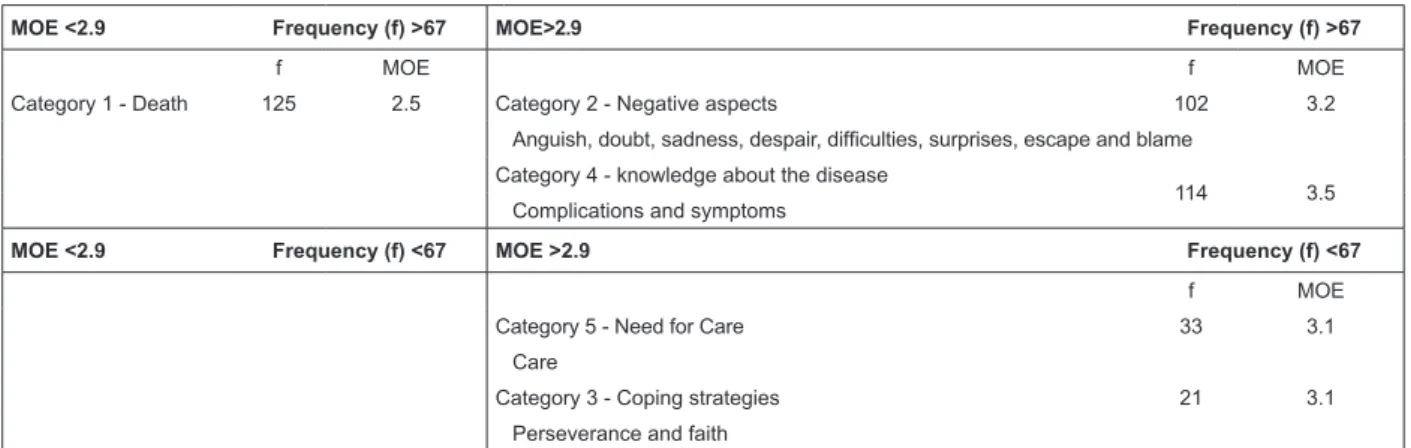
Referring to Figure 2, it is observed that the category
death arises in the irst quadrant, as the stronger representation of the HDPs, with a high frequency of evocation and low OME. In the second quadrant (intermediate nucleus), category 2 appears, the negative aspects of the disease, grouping the various
feelings that permeate the experience of a high-risk pregnancy, especially with the HDPs. The category knowledge about the disease, also arose, in which
complications and symptoms that were present in pregnancy were disclosed, especially changes which are the classic symptoms of HDPs: hypertension, epigastric pain, headache and edema.These signs and symptoms
were justiied by the women as abnormal situations in
the gestational period, and that made them feel that something was happening that was outside of normality.
In quadrant 3, (the peripheral system) the ifth
and third categories arose, called respectively, need for care and coping strategies. In this context, the women,
realizing their clinical severity, felt the need for care to preserve her life and especially that of her child, and sought religiosity as a means to cope with the physical
and emotional changes that the disease conferred. In a similar manner, the woman maintained perseverance in
the ight against the disease supported the idea that, in
preserving her own life, she played the maternal role of not depriving the premature child, also considered high-risk, of maternal care.
Signiicance attributed to prematurity
From the inducing stimulus «prematurity», 81% of
evocations distributed in ive categories (Figure 3) were
obtained, where, in quadrant 1, the word «death» was found as the strongest representation of prematurity.
Proceeding with the analysis of Figure 3, in the second quadrant the category fragility emerged the maternal expression of describing the premature infant as a “fragile baby.” This term presented a high frequency of evocation and could be inserted as the central nucleus, if not for the high OME. The need for care category, in the third quadrant, revealed the maternal commitment in offering love and dedication to a premature baby, which denotes fragility and, therefore, necessitated special care.
MOE <2.9 Frequency (f) >67 MOE>2.9 Frequency (f) >67
f MOE f MOE
Category 1 - Death 125 2.5 Category 2 - Negative aspects 102 3.2
Anguish, doubt, sadness, despair, dificulties, surprises, escape and blame Category 4 - knowledge about the disease
114 3.5
Complications and symptoms
MOE <2.9 Frequency (f) <67 MOE >2.9 Frequency (f) <67
f MOE
Category 5 - Need for Care 33 3.1
Care
Category 3 - Coping strategies 21 3.1
Perseverance and faith
Figure 2 - Identiication of the structure of social representations about hypertensive disorders in pregnancy evoked
by 70 mothers
MOE <2.5 Frequency (f)> 67 MOE> 2.5 Frequency (f)> 67
f MOE f MOE
Category 1-Death 90 2.5 Category 4 - Fragility 98 3.0
Death Fragile baby
MOE <2.5 Frequency (f) <67 MOE> 2.5 Frequency (f) <67
f MOE
Category 2 - Need for Care 65 3.1
Special care and love
Category 3 - Negative aspects 45 3.3
Rev. Latino-Am. Enfermagem 2013 May-June;21(3):726-33.
In that same quadrant, negative feelings arose in the category negative aspects (distress, sadness and
guilt) and relected the maternal dificulties with the
prematurity, initiated by guilt for not being able to carry the pregnancy to term and, after delivery, the vision of a sick baby surrounded by wires and appliances, which differed from the healthy child they desired. From the perspective of overcoming something contrary to expectations, women sought alternatives to live with and accept the new reality, and thus arose the category coping strategy, in which the words “faith” and “struggle”
are highlighted as mechanisms for accepting a fact in the daily life that is contrary to the process of normal birth, and overcoming the adversities experienced with a premature child requiring intensive treatment.
Signiicance attributed to the NICU
For the inducing stimulus NICU, 89% of evocations obtained were of a similar nature. These words
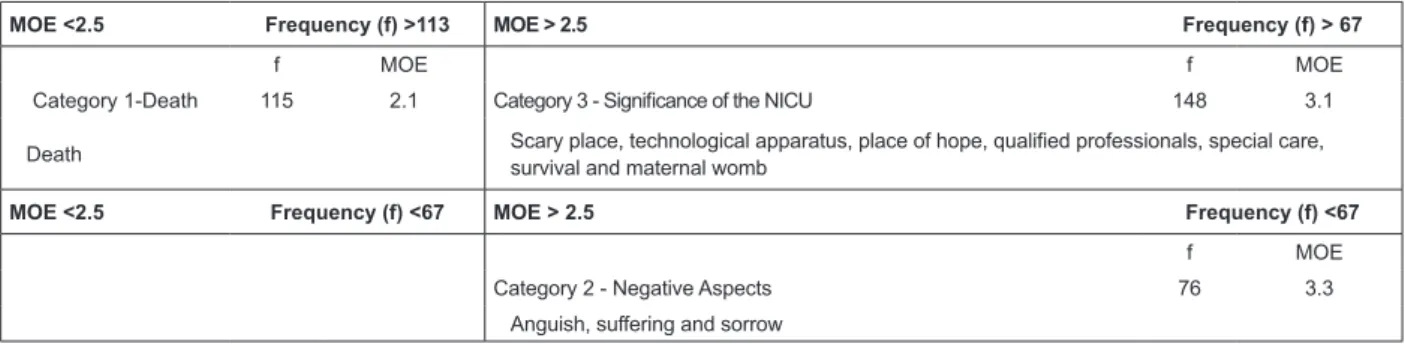
were grouped into three categories (Figure 4). The
death category appears in the irst quadrant, as the
strongest representation of NICU. The understanding of the women about the ICU was revealed as a place in which children are very serious and close to death, and they understood it as frightening, where, often, one witnessed the death of other babies and the suffering of other mothers. This construction reinforced the
feeling that to have one’s child hospitalized in this environment was to live daily with the risk of losing him.
In the second quadrant, the category, signiicance of the NICU, gave rise to specialized care symbolized by
technological devices, qualiied professionals and special care. This speciicity of care contributed to reframing this
sector: though living daily with the meaning of death, this started to be replaced by the realization that the available resources increased the chances for survival of the child.
MOE <2.5 Frequency (f) >113 MOE > 2.5 Frequency (f) > 67
f MOE f MOE
Category 1-Death 115 2.1 Category 3 - Signiicance of the NICU 148 3.1
Death Scary place, technological apparatus, place of hope, qualiied professionals, special care, survival and maternal womb
MOE <2.5 Frequency (f) <67 MOE > 2.5 Frequency (f) <67
f MOE
Category 2 - Negative Aspects 76 3.3
Anguish, suffering and sorrow
Figure 4 - Identiication of the structure of social representations evoked by the NICU for the 70 mothers
With this comes a whole new signiicance for
the NICU, as «maternal womb», giving it the sense of continuing the pregnancy and, therefore, being responsible for the completion of the pregnancy that was interrupted early. Thus, in the context of intensive care, the «technological devices» initially embodied a
frightening objectiication of the NICU and, later it is
reframed as a place in which the child›s life is being safeguarded.
In the third quadrant, as the peripheral system, the category, negative aspects, is encountered, arising from the feelings of mothers as caregivers of the child in the
NICU. These dificulties were outlined when the mother,
in the obstetric ward, listened to the pediatrician say that the child needed intensive care, and persisted
during the irst visit in the NICU and during the daily
hospitalization of the child.
Souza NL, Araújo ACPF, Costa ICC.
Discussion
In relation to this study, it was evident that social representations of mothers about the HDP sequence leading to premature birth, that progressed to the hospitalization of the child in the NICU, obtained the categories death and negative aspects presented as common to all three representative universes, by means
of FWAT, conirming that this was an experience of a
unique context, although with different consequences. Initially, HDPs were associated to death, the women made real their own condition of vulnerability when faced with an unknown and surprising disease, that referred to the early hospitalization, family estrangement and powerlessness in the face of the impossibility of carrying the pregnancy to term. In this sense, death arose not only as the end of life, but as the opposite of the celebration of motherhood and the role played by women in the social context in which they lived: to carry a pregnancy to term and give birth to a healthy child.
For the interviewees, to live with the meaning of
death, both for themselves and for the child, intensiied anxieties and fears, the objectiication of the real condition
of the risks to which they were subjected. Death, by exterminating existence, introduces the contradiction, sadness and horror in one’s heart(12). Therefore, the perceived risk of death brought feelings with different intensities, such as fear, anxiety and guilt(13). Thus, women with HDPs experienced emotional changes that could harm them not only pathophysiologically, but also from the subjective aspect.
The categories need for care and coping strategies emerged as alternatives to avoid an unfavorable outcome of the disease and to remove the risk of imminent death.
With this, upon hospitalization, women obtained speciic
treatment in search of their own survival and that of
As a relevant part of life, religion cannot be neglected, and must be included as an addition to medicalized treatment(14-15).
Premature birth represented the failure to carry the pregnancy to term and the uncertainties relating to the child’s survival. It was the death of the idealized pregnancy that brought up insecurities and fears attributed to the experience of anticipatory grief(16). With the hospitalization of neonates in the NICU, the mothers forgot their own risks inherent in puerperal HDPs, directing their actions to their child. There was a kind of solicitude, dedication and restlessness adopted by them in order to contribute to the recovery of the child(17). Thus, preterm birth and hospitalization of the premature baby in the NICU could compromise the maternal and family emotional equilibrium(18).
It is known that the NICUs were created in order to provide conditions for the reduction of neonatal morbidity and mortality. However, it is clear that, in this environment, it is common for professionals to focus their actions toward the biological requirements of the newborn, whereas the fragmentation of maternal care and family needs occurs, which are also present in the context of the birth and hospitalization of a premature baby.
There is a tendency for the postpartum maternal risks to be less valued by the neonatal team as a result of the care that is being given to the newborn. However, it is essential to remember that the high-risk neonate often comes from high-risk pregnancies and that the postpartum women, due to complications to which they are still exposed, require special care involving the mother, the infant and the family.
Referring to the negative aspects intrinsic to maternal experiences with the HDPs and prematurity,
there are perceptible social inluences on motherhood Thematic units
Signiicance of HDPs Signiicance of prematurity Signiicance of the NICU
Death Death Death
Negative Aspects Negative Aspects Negative Aspects
Coping strategies Coping strategies Signiicance of the NICU
Need for care Need for care
Knowledge about the disease Fragility
Rev. Latino-Am. Enfermagem 2013 May-June;21(3):726-33.
vulnerable family situation, especially for mothers who attributed to themselves the responsibility of having been affected by an illness that gave them the inability to produce a healthy child.
These social relexes crystallize the negative aspects
of HDPs with tendencies toward physical, emotional and social damage. As a function of this, it established the need for “caring” with special attention to the subjective aspects present in the experience of a high risk pregnancy and birth. Studies have demonstrated that the diagnosis of high-risk pregnancy was already a stressor and that anxiety and vulnerability of women to uncertainty of bringing the pregnancy to term were seen in those who experience gestational hypertension(8,19).
In this circumstance, the results of this study indicated that women, faced with a pregnancy with a hypertensive disorder, and resulting in the birth of a premature child, experience losses, separations,
conlicts and fears, which may inluence the adverse
effects of HDPs, premature delivery and subsequent hospitalization of a child in the NICU. In high-risk
pregnancy, emotions and feelings of guilt lourish which
may compromise the progression of the pregnancy(13). The perceived risk of death for both mother and child triggered the emotional aspects present in high-risk pregnancies, followed by premature birth and hospitalization of this child in the NICU. Accordingly, comprehensive care is required, based on maternal needs, offering support for coping with and adapting
to this new reality. This inding is supported by other
studies that show the need for health professionals to accommodate these mothers, so they feel more secure and valued(8,13).
Overall, the consolidation of EVOC enabled us to identify that the word “death” arose with high frequency and was present in all three contexts analyzed. Thus, the category death was the central nucleus of the study of social representations of hypertensive disorders of pregnancy, which had consequences of preterm birth and hospitalization of the child in the NICU, for the 70 mothers studied.
Elements such as feelings, perceptions, signiicance, attitudes and dificulties arising from individualized
expressions represented, collectively, the everyday interviews during the high risk pregnancy, labor, birth and postpartum. They composed: the category of negative aspects, present in all three situations analyzed;
the categories, coping strategies and needs for care, evidenced in HDPs and prematurity; and knowledge about the disease, fragility and signiicance of the NICU, which
represented speciic facts of each situation investigated.
These categories constituted the peripheral nucleus of the social representation of this study.
Final Considerations
Data analysis enabled the identiication that, for the
mothers in this study, the HDPs and their consequences, such as premature birth and hospitalization of the child in the NICU, revealed the construction of a negative social representation, which had death as its central nucleus, often with high evocation in the three contexts evaluated.
At irst, the meaning of death was represented by the risk of maternal and fetal death. After delivery, the respondents appeared to forget their own risks and they projected them to those to which the children were exposed, resulting from prematurity and NICU hospitalization. In this scenario, even if the persistence of the high complexity service had decreased or removed the risk of maternal or fetal death, the meaning of death continued to be strong, due to the disruption of the idealized pregnancy and anticipation of the arrival of a child in a situation contrary to what was desired.
The lack of contrasting elements that composed the lower left quadrants, in the Figures regarding the situations investigated, indicated that no situation was
opposed to common sense when it came to deining the
central nucleus. This led us to suppose that few or almost no aspect of the care received by the women surveyed favored the social deconstruction of assigning a meaning of death to the HDPs and their consequences.
It is worth highlighting the relevance of this study for addressing the experience of women with hypertensive disorders of pregnancy, revealing situations that encompass the cycle of pregnancy and childbirth, the premature birth and hospitalization of the child in the NICU. Therefore, it is believed to be contributing to advances in the quality of nursing care
and the dissemination of scientiic knowledge on this
little explored theme, with a view to ensuring decent care to women in situations of high risk pregnancy, so that they can cope with less injury from the adverse effects arising from a high risk pregnancy and birth.
References
1. Sibai B, Dekker G, Kupferminc M. Pre-eclampsia. Lancet. 2005;365:785-99.
Souza NL, Araújo ACPF, Costa ICC.
3. Khan KS, Wojdyla D, Say L, Gulmezoglu AM, Van Look PFA. WHO analysis of causes of maternal death: a systematic review. Lancet. 2006;367:1066-74.
4. Ministério da Saúde (BR). Secretaria de Atenção à Saúde. Departamento de Ações Programáticas Estratégicas: Manual dos comitês de mortalidade materna 3. ed. Brasília(DF): Ministério da Saúde, 2007. 5. Bakker R, Steegers EAP, Hofman A, Jaddoe VWV. Blood Pressure in Different Gestational Trimesters, Fetal Growth, and the Risk of Adverse Birth Outcomes The Generation R Study. Am J Epidemiol. 2011;174(7):797-806.
6. Mendilcioglu I, Trak B, Uner M, Umit S, Kucukosmanoglu M. Recurrent preeclampsia and perinatal outcome: a study of women with recurrent preeclampsia compared with women with preeclampsia who remained normotensive during their prior pregnancies. Acta Obstet Gynecol Scand. 2004;83(11):1044-8.
7. Habli M, Levine RJ, Qian C, Sibai B. Neonatal outcomes in pregnancies with preeclampsia or gestational hypertension and in normotensive pregnancies that delivered at 35, 36, or 37 weeks of gestation. Am J Obstet Gynecol. 2007;197(4):406.e1-406.e7.
8. Souza NL, Araujo ACPF. Costa ICC. The meanings that postpartum women assign to gestational hypertension and premature birth. Rev Esc Enferm USP 2011;45(6):1285-92.
9. Sá CP. Núcleo central das representações sociais. 2ªed. Petrópolis: Vozes; 2002.189p
10. Nóbrega SM, Coutinho MPL. O teste de associação livre de palavras In: Coutinho MPL, Lima AS, Oliveira FB, Fortunato ML,organizadores. Representações sociais. Uma abordagem interdisciplinar. João Pessoa: UFPB, Editora Universitária;2003 p. 67- 77.
11. Vergès P. L’évocation de l’argent: une méthode our la definition du noyau central d”une représentation. Bulletin de Psychologie. 1992;45(405):203-9.
12. Menossi MJ, Zorzo JCC, Lima RAG. The dialogic life-death in care delivery to adolescents with câncer. Rev. Latino-Am. Enfermagem fev 2012;20(1):126-34. 13. Carvalheira APP; Tonete VLP; Parada CMGL. Feelings and Perceptions of Women in the Pregnancy-Puerperal Cycle Who Survived Severe Maternal Morbidity. Rev. Latino-Am. Enfermagem nov/dez 2010;8(6):1187-94. 14. Faria JB, Seidl EMF. Religiosidade e enfrentamento em contexto de saúde e doença: revisão da literatura. Psicologia: Reflexão e Crítica. 2005;18(3):381-389.
15. Dourado V G, Pelloso S M. Gravidez de alto risco: o desejo e a programação de uma gestação. Acta Paul Enferm. 2007;20(1):12-7.
16. Maldonado MT. Psicossomática e obstetrícia. In: Mello Filho J, editor. Psicossomática hoje. Porto Alegre: Artes Médicas; 1992. p.208-14.
17. Silva IJ, Oliveira MFV, Silva SED, Polaro SHI, Radüz V, Santos EKA, Santana ME Care, self-care and caring for yourself: a paradigmatic understanding thought for nursing care.Rev Esc Enferm USP. 2009;43(3):697-703. 18. Correia LL, Carvalho AEV, Linhares MBM. Verbal contents expressed by mothers of preterm infants with clinical emotional symptoms. Rev. Latino-Am. Enfermagem. jan/fev 2008;16(1):64-70.