RevPaulPediatr.2016;34(2):225---233
REVISTA
PAULISTA
DE
PEDIATRIA
www.rpped.com.br
REVIEW
ARTICLE
Association
between
food
and
nutrition
insecurity
with
cardiometabolic
risk
factors
in
childhood
and
adolescence:
a
systematic
review
Naruna
Pereira
Rocha
∗,
Luana
Cupertino
Milagres,
Juliana
Farias
de
Novaes,
Sylvia
do
Carmo
Castro
Franceschini
DepartamentodeNutric¸ãoeSaúde,UniversidadeFederaldeVic¸osa(UFV),Vic¸osa,MG,Brazil
Received3March2015;accepted2August2015 Availableonline3February2016
KEYWORDS
Foodandnutrition
security;
Diabetesmellitus;
Hypertension;
Metabolicsyndrome;
Stressand
dyslipidemia
Abstract
Objective: To address the association between food and nutrition insecurity and car-diometabolicriskfactorsinchildhoodandadolescence.
Datasource:ArticleswereselectedfromtheMedline,LilacsandSciELOdatabaseswithno pub-licationdatelimit,involvingchildrenandadolescents,usingthedescriptors:foodandnutrition security, diabetesmellitus, hypertension,metabolicsyndrome, stressanddyslipidemia.The termswereusedinPortuguese,EnglishandSpanish.Thesearchwascarriedoutsystematically andindependentlybytworeviewers.
Datasynthesis: Exposuretofoodinsecurityduringchildhoodandadolescencerangedfrom3.3% to82% intheselected publications.Exposure tofoodinsecuritywas associatedwithstress, anxiety,greaterchanceofhospitalization,nutritionaldeficiencies,excessweightand inade-quatedietswithreducedintakeoffruitsandvegetablesandincreasedconsumptionofrefined carbohydratesandfats.
Conclusions: Foodandnutritioninsecuritywasassociatedwiththepresenceofcardiometabolic riskfactorsintheassessedpublications.Childhoodandadolescenceconstituteaperiodoflife thatisvulnerabletofoodinsecurityconsequences,makingitextremelyimportanttoensurethe regularandpermanentaccesstofood.Becausethisisacomplexassociation,somedifficulties arefound,suchasthesynergybetweenriskfactors,theassessmentofheterogeneousgroups andextrapolationofdatatootherpopulations,inadditiontotheinfluenceofenvironmental factors.
©2015SociedadedePediatriadeSãoPaulo.PublishedbyElsevierEditoraLtda.Thisisanopen accessarticleundertheCCBYlicense(https://creativecommons.org/licenses/by/4.0/).
∗Correspondingauthor.
E-mail:[email protected](N.P.Rocha).
http://dx.doi.org/10.1016/j.rppede.2016.01.006
226 RochaNPetal.
PALAVRAS-CHAVE
Seguranc¸aalimentar
enutricional;
Diabetesmellitus; Hipertensão;
Síndromemetabólica;
Estressee
dislipidemia
Associac¸ãodeinseguranc¸aalimentarenutricionalcomfatoresderisco cardiometabólicosnainfânciaeadolescência:umarevisãosistemática
Resumo
Objetivo: Abordaraassociac¸ãoentreinseguranc¸a alimentarenutricionalefatoresderisco cardiometabólicosnainfânciaeadolescência.
Fontesdedados: Osartigosforamselecionados pelasbases dedados Medline,Lilacs e Sci-ELO,semlimite dedata depublicac¸ão.Envolveramcrianc¸aseadolescenteseforamusados osdescritores:seguranc¸a alimentare nutricional,diabetes mellitus,hipertensão,síndrome metabólica,estresseedislipidemia.Ostermosforamusadosemportuguês,inglêseespanhol. Abuscafoifeitadeformasistemáticaeindependentepordoisrevisores.
Síntesedosdados: A exposic¸ãoàinseguranc¸a alimentarnoperíodo dainfância e adolescên-ciavarioude3,3%a82%naspublicac¸õesselecionadas.Aexposic¸ãoàinseguranc¸aalimentar esteveassociadaaestresse,ansiedade,maioreschancesdeinternac¸õeshospitalares, deficiên-ciasnutricionais,excessodepesoeconsumodedietasinadequadascomingestãoreduzidade frutasehortalic¸aseaumentodoconsumodecarboidratosrefinadosegorduras.
Conclusões: Ainseguranc¸aalimentarenutricionalesteveassociadaàpresenc¸adefatoresde riscocardiometabólicosnaspublicac¸õesavaliadas.Ainfânciaeadolescênciaconstituemuma fasedavidavulnerávelàsconsequênciasdainseguranc¸aalimentar,oquetorna deextrema importânciaagarantiadoacessoregularepermanenteaosalimentos.Porseressaassociac¸ão complexa, algumas dificuldades são encontradas, tais como a sinergia existente entre os própriosfatoresderisco,aavaliac¸ãodegruposheterogêneoseaextrapolac¸ãodosdadospara outraspopulac¸ões,alémdainfluênciadosfatoresambientais.
©2015SociedadedePediatriadeSãoPaulo.PublicadoporElsevierEditoraLtda.Esteéumartigo OpenAccesssobalicençaCCBY(https://creativecommons.org/licenses/by/4.0/deed.pt).
Introduction
The approach to food and nutrition insecurity (FNiS) has
gainedprominenceindevelopedanddevelopingcountries.
Theconceptoffoodandnutritionsecurity(FNS)was
estab-lishedbytheSecondNationalConferenceonFoodSecurity
heldin 2004in Braziland consistsinthe right ofall
indi-viduals to regular and permanent access to quality food
insufficientquantity,without compromising theaccessto
otheressentialneeds,basedonfoodpracticesthatpromote
health,respectculturaldiversityandthatare
environmen-tally,economicallyandsociallysustainable.1Situationsthat
includetheviolationofanyoftheseitemsconstituteFNiS. OnecanobservetheassociationofFNiSnotonlyinthe contextoflowbirthweightand/or presenceofdeficiency diseases,aswidelydebatedbyresearchers,butalsorelated to a ‘‘new’’ association of the topic with the presence of cardiometabolicrisk factors developed asearly asthe childhoodandadolescenceperiods,suchasobesity,insulin resistance,typeIIdiabetes,systemicarterialhypertension, dyslipidemiaandinflammation.2---4
Theseriskfactorscanbeclassifiedintotraditional (modi-fiableornot)andnon-traditional.Traditionalnon-modifiable factors include age, gender and family history of pre-mature cardiovascular disease, while the modifiable ones includedyslipidemia,arterialhypertension,typeIIdiabetes, smoking, physical inactivity and excess weight. The so-called non-traditional factors encompass the assessment of some cardiometabolic risk markers, such as inflamma-torycytokines,C-reactiveprotein,interleukin-6,leptinand adiponectin.5
Somestudieshaveshownpositiveassociationsbetween the presenceof FNiS andpoorerhealth status in children andadolescents.6---8 Amongtheseoutcomes,weemphasize
behavioral,psychosocialanddevelopmentalproblems,with greaterprevalenceofacuteandchronicdiseases.9However,
theprecisemechanismbywhichFNiSnegativelyaffectsthe healthstatusofthisgroupisyettobeelucidated.10
Basedonthisperspective,afterverifyingthescarcityof Brazilianstudiesonthistopic,asystematicreviewwas per-formed to assess whether foodand nutrition insecurity is associated withthe presence of cardiometabolicrisk fac-torsinchildhoodandadolescence,withtheaimofproviding subsidiesforpublichealthinterventions.Themainelements to be modified regarding this issue will help plan future interventionstudiesforchildren andadolescentsinaFNiS situation.
Method
Thesearchstrategyincludedthesearchforarticlesin
elec-tronicdatabases.TheMedline(NationalLibraryofMedicine,
USA) via PubMed, Lilacs (Latin American and Caribbean
Health Sciences) and SciELO (Scientific Electronic Library
Online)electronicdatabaseswereusedinthesearch.Article
identificationandselectioninallsearcheddatabaseswere
performedsimultaneouslybytworesearchersforamonth,
betweenAugustandSeptember2014.
Thedescriptorsusedwere:foodandnutritionsecurity,
diabetesmellitus,hypertension,metabolicsyndrome,stress
anddyslipidemia.AlldescriptorswereusedinPortuguese,
Associationbetweenfoodandnutritioninsecuritywithcardiometabolicrisk 227
English,accordingtoMedicalSubjectHeadings(MeSH).The
terms were also used in Spanish to encompass a greater
numberofstudiespublishedinthearea.Thefoodand
nutri-tionsecuritydescriptorwascombinedwithotherdescriptors
throughthe use of Booleanoperators represented by the
connectortermsAND,ORandNOT.Therefore,thefollowing
combinations were used:food and nutrition security AND
diabetesmellitus, foodandnutritionsecurityORdiabetes
mellitusandfoodandnutritionsecurityNOTdiabetes
mel-litus.Thesecombinationswerealwaysusedassociatingthe
descriptorfoodandnutritionsecuritytotheothers.
The risk factors for cardiometabolicdiseases (diabetes
mellitus,hypertension,metabolicsyndrome,stressand
dys-lipidemia)wereusedasdescriptors,aschronicdiseasesare
generallynotpresentinchildrenandadolescents.However,
thepresenceofriskfactorsthatleadtothedevelopmentof
thesediseasescanbeidentified.
The review searched for studiesthat assessedchildren
andadolescents,becausethisoneoftheperiodsofgreatest
vulnerability tofooddeprivation andoccurrence of
disor-dersrelatedtogrowthandphysiologicaldevelopmentand
that canoccur together withhealth problems.11,12
There-fore,the review included articles that associatedFNiS to atleastoneofthecardiometabolicriskfactorsinchildren and/oradolescents.
The exclusion criteria included studies on adults, the elderly, pregnant women, groups of children/adolescents withlow birth weight,those withcongenital diseases, as wellastheliteraturereviewand/orsystematicreview arti-cles,dissertations, theses,consensusanddocumentsfrom nationalandinternationalorganizations,repeatedarticles in different databases and published in other languages ratherthanPortuguese,EnglishandSpanish.
The identification and selection of articles in the databases were performed by two researchers, indepen-dently and systematically, who carried out the initial selection by analyzing the titles of publications found throughtheuse ofdescriptors and,subsequently,through theabstractsobtainedbyelectronicsearch.Afterthe selec-tionofpublicationsthroughthetitlesandabstracts,anew analysiswascarriedoutbythetworesearchers,who con-sensuallydetermined whichstudies shouldbe read infull andincludedinthereview.Thereferencesoftheselected articleswerescreened,aiming toincludeother studiesof potentialinterest.
The assessment of food andnutrition insecurity in the selectedarticleswasconsideredbasedonthedataobtained throughquestionnairesand/orstructuredquestions,applied to the children, adolescents or parents/guardians and/or basedonthesocialandeconomicdataoftheassessed fami-lies.FNiSwasidentifiedbyreadingthepublicationsinsearch of situations that addressed the presence of the physical sensation ofhungerand/or foodinsecuritydue toreasons relatedtoincomeand/or interruptionin thefeeding pat-terns,resulting fromthe lack of food and/or food intake assessment.
Forthe methodologicalassessment of publications,we aimedtoanswerthequestion ‘‘Isfoodandnutrition inse-curity associated with the presence of cardiometabolic risk factorsin childrenandadolescents?’’ Considering the question, all associations between FNiS and nutritional status, biochemicalparameters,overall health status and
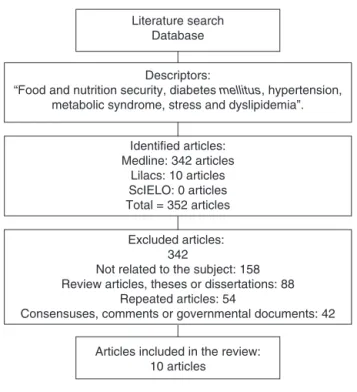
Literature search Database
Descriptors:
“Food and nutrition security, diabetes mellitus, hypertension, metabolic syndrome, stress and dyslipidemia”.
Identified articles: Medline: 342 articles
Lilacs: 10 articles ScIELO: 0 articles Total = 352 articles
Excluded articles: 342
Not related to the subject: 158 Review articles, theses or dissertations: 88
Repeated articles: 54
Consensuses, comments or governmental documents: 42
Articles included in the review: 10 articles
Figure1 Articlesselectedforcontentassessment.
foodintakewereexplored,asaddressed bytheidentified
studies.
Results
Thesearchforthedescriptorsresultedintheidentification
of352articlesintheareaofinterest.Atotalof 342
pub-licationswereexcluded(158publicationswerenotrelated
tothe topic,didnotmeet theobjectiveofthe study,did
notevaluatechildrenoradolescents,88werereview
arti-cles,theses or dissertations, 54articles wererepeatedin
differentdatabases,42wererelatedtoconsensuses,expert
commentaries or government agencies documents). Only
10articlesmettheinclusioncriteria, ofwhichthreewere
obtainedthroughthesearchperformedinthereferencesof
thepreselectedpublications(Fig.1).
Of the assessed studies, eight articles had a cross-sectional design and all had international samples from NorthAmerica, Europe and Asia. Nonational article that assessed the intended subject was identifiedthrough the searchforthedescriptors.
The approach of the association of FNiS with some cardiometabolic risk factor is relatively new in science. Theresearchers’interestinFNiSrelatedtochronichealth status alterations during childhood and adolescence can be observed after 200213 (Table 1). None of the studies
addressed the association between the presence of FNiS andnon-traditionalcardiometabolicriskfactors (inflamma-torycytokines,C-reactiveprotein,interleukin-6,leptinand adiponectin).
TheprevalenceofFNiSfoundinhouseholdswithchildren and adolescents ranged from 3.3% to 82%10,14 (Table 2).
SeveralmethodologieswereemployedtoidentifytheFNiS situation. The studies used specific tools to be utilized with families,6,7,13,15,16 tools developed for the answers
228
R
ocha
NP
et
al.
Table1 Evaluationofpublicationsonfoodandnutritioninsecurityandcardiometabolicriskfactorsinchildhoodandadolescence.
Author/year Design Sample Age Nutritionvariables NutritionalStatus Classification
Tooltoassessfoodand nutritionsecurity
Weinrebetal., 200213
Cross-sectional 408preschoolers, childrenand adolescents
2.5---17years Donotassess Donotperform CommunityChildhoodHunger IdentificationProjectand directquestionsforchildren olderthan9years
Cooketal.,20047 Cross-sectional
withcohort.
11,539children’s caregivers
Children<36 months
Weightandheight Donotreport U.S.HouseholdFoodSecurity Scale(U.S.HFSS)
Molchoetal., 200617
Cross-sectional 8424
schoolchildren
10---17years Donotassess Donotreport Foodandnutritioninsecurity definedbytwostructured questions
Martinetal., 200715
Cross-sectional 212childrenand 200parentsor tutors
Childrenfrom2 to12years
Weightandheight CurvesofCenters forDiseaseControl andPrevention
USDAFoodSecurityModule
Jiménez-Cruz etal.,200716
Cross-sectional Groupin2001: 1200children. Groupin2003: 1452children
Childrenfrom6 to11years
BMIandwaist circumference
CurvesofCenters forDiseaseControl andPrevention
CommunityChildhoodHunger IdentificationProject, adaptedforMexicanchildren
Gundersenetal., 20086
Cross-sectional 841childrenand adolescents
3---17years Weightandheight, BMI,stress
CurvesofCenters forDiseaseControl andPrevention
USDACoreFoodSecurity Module(CFSM)
Chenetal.,200918 Longitudinal 764,526children Childrenborn
between1997 and1999
Lowbirthweight reported
Notreported Foodandnutritioninsecurity assessedbydataonlowbirth weight,economicstatus, maternalnutritionalstatus andfamilyincome Kirkpatricketal.,
201010
Longitudinal 5809childrenand 3333adolescents
1stgroup: 10---15years and2ndgroup: 16---21years
Donotassess Donotperform Foodandnutritioninsecurity assessedbyquestionsasked tothemostexperienced person
Marjerrisonetal., 201120
Cross-sectional 183familieswith childrenand adolescents
<18years Mean: 11.8±3.99 years
BMIandA1c hemoglobin
Donotreport HouseholdFoodSecurity SurveyCanadianCommunity HealthSurveyModule
Sharkeyetal., 201214
Cross-sectional 50mothersand50 children
6---11years Weight,heightand BMI
CurvesofCenters forDiseaseControl andPrevention
TooldevelopedbyConnell etal.,24(2004)a
Association
between
food
and
nutrition
insecurity
with
cardiometabolic
risk
229
Table2 Resultsfoundinarticlesonfoodandnutritioninsecurityandcardiometabolicriskfactorsinchildhoodandadolescence.
Author/year Resultassociation Ethnicities PrevalenceofFNiS Limitations
Weinrebetal., 200213
Preschoolers:foodandnutritioninsecurityandworsehealthstatus(OR:2.8), lifeevents(OR:8.5),familysize(OR:3.2),lowbirthweight(OR:1.42). Schoolchildren:foodandnutritioninsecurityandlowbirthweight(OR:1.35), healthstatus(OR:3.4),lifeevents(OR:8.8)
Yes Preschoolers:
59.2%offoodand nutrition
insecurity
Yes
Schoolchildren: 66%
Cooketal., 20047
Foodandnutritioninsecurityandhealthstatusreportedas‘‘Fair/poor’’ (OR=1.90;CI:1.66---2.18).Foodandnutritioninsecurityandhospitalizations sincebirth(OR=1.31;CI:1.16---1.48).Therewasnoassociationbetweenfood andnutritioninsecurityandgrowthriskvariables(OR=1.09;CI:0.94---1.25)
Yes 21.4%of
householdswith foodandnutrition insecurity
Yes
Molchoetal., 200617
Foodandnutritioninsecurityandlowerconsumptionoffruits(OR:0.66; 95%CI:0.45---0.87),vegetables(OR:0.68;CI:0.49---0.87),whole-grainbread (OR:0.66;CI:0.42---0.90),higherconsumptionofpotatochipsamonggirlsand boys(OR:1.62;CI:1.39---1.85andOR:1.33;CI:1.05---1.61respectively).Food andnutritioninsecurityandmental,somaticsymptoms(OR:2.42;CI: 2.06---2.78)andemotionalsymptoms(CI:1.47;CI:1.47---1.23)
No Lowsocialclasses:
15.3%
Yes
Middleclass: 15.9% Highsocial classes:14.8% Martinetal.,
200715
Therewasnoassociationbetweenexcessweightandfoodandnutrition insecurity(OR:1.41;CI:0.67---2.99).Insufficientincomeandobesity(OR:0.4; CI:0.18---0.92).Riskofoverweightandfoodandnutritioninsecurity(OR:1.34; CI:0.53---3.36)
Yes 51.4%of
householdsinfood andnutrition insecurity
Yes
Jiménez-Cruz etal.,200716
HigherfoodandnutritioninsecurityinchildrenofparentsofNativeethnicity (68%;p<0.001)
Yes 46%in2001group No
Higherfoodandnutritioninsecurityinchildrenyoungerthan9years(71%; p<0.001)
58%inthe2003 group
230
R
ocha
NP
et
al.
Table2 (Continued)
Author/year Resultassociation Ethnicities PrevalenceofFNiS Limitations
Gundersen etal.,20086
Stressandfoodandnutritioninsecurityatfamilylevel(OR:0.05;CI:−0.27to 0.37),foodandnutritioninsecurityandcumulativestress(OR:0.02;CI:−0.01 to0.005)
Yes 44.5%of
householdswith foodandnutrition insecurity
Yes
Chenetal., 200918
Foodandnutritioninsecurityanddiabetesmellitus(OR:1.87),inherited metabolicdisorders(OR:1.94),iron-deficiencyanemia(OR:2.68)andpoorly definedsymptomsrelatedtonutrition,metabolismanddevelopment(OR: 2.02)
No Foodandnutrition
insecurityvalueis notshown,the studyassociates incometofood andnutrition insecurity
Yes
Kirkpatrick etal.,201010
Foodandnutritioninsecurityandhigherchancesofhavingworsehealthstatus (OR=1.91;CI:1.33---2.74)
No 10---15years:3.3% Yes
Foodandnutritioninsecuritywasnotassociatedtodiagnosedchronichealth conditions(OR=1.22;CI:0.75---1.99)
16---21years:3.9%
Marjerrison etal.,201120
Foodandnutritioninsecurityandhigherrateofhospitalization(OR,3.66;CI: 1.54---8.66).MeanconcentrationofA1chemoglobinwashigherinchildrenwith foodandnutritioninsecurity
No 21.9%offoodand
nutrition insecurity
Yes
Sharkeyetal., 201214
Foodandnutritioninsecurityhighertotalconsumptionofenergy,calcium, caloriesfromaddedsugars(ˇ=4.8.Standarderror=2.2.p=0.032;ˇ=4.4. Standarderror=1.9.p=0.028andˇ=8.4.Standarderror=2.0.p<0.001)
No 82%ofchildrenwithfood andnutritioninsecurity
Yes
Bodymassindexwasnotassociatedwithfoodandnutritioninsecuritystatusa
Associationbetweenfoodandnutritioninsecuritywithcardiometabolicrisk 231
and structured questions about food-related issues.10,13,17
InthearticlebyChenetal.,18foodinsecuritywasassessed
through some variables such as birth weight, economic powerandtimeoftheyear.Itwasunderstoodthatfamilies livinginpovertywouldhavegreaterchanceofhavingFNiS. The publications were heterogeneous regarding the assessed age groups, which ranged from observations of FNiSfrombirthto17years,aswellastheestablished sam-plesizes,whichvariedfrom50to764,526individuals.14---16
Of the studies that assessed the age ranges related to childhoodand adolescence,none considered the observa-tionsseparatelyby groupsof childrenandadolescents,as theydifferregardinggrowth,developmentandmaturation status.19 These differences can influence the presence of
cardiometabolicriskfactors.
Only six studies mentioned the use of anthropometric variablesthat wouldcontributetoidentifythe nutritional statusassociatedwithfoodinsecurity.6,7,14---16,20Among the
assessed anthropometric variables, only height, weight, bodymassindex(BMI)andwaistcircumferencewere men-tioned.Martinetal.15usedthechildren’sweightassociated
withparentalweighttoidentifycardiometabolicriskfactors (excessweight),inordertoassesswhetherchildrenthathad obeseparentswouldbemorelikelytohaveexcessweight and whether this association would be defined by fam-ily characteristics or causedby exposuretoFNiS. Sharkey etal.14 observedthattheBMIof childrenandadolescents
wasnotassociatedwithFNiS.Regardingthewaist circum-ference (WC), Jiménez-Cruz et al.16 found that children
withoutabdominalobesityhadhigherFNiSprevalence(78%) whencomparedtothosewithappropriateWC(22%).
Half of the study classified the assessed population intoethnicgroups.6,7,13,15,16Theidentifiedethnicitieswere
Hispanics,Caucasians,indigenousandnon-indigenous popu-lations,blackandwhiteethnicities.InthestudybyWeinreb etal.,13 thepopulationclassifiedasHispanic hadahigher
prevalence ofsevere FNiS.Cook etal. (2004)7 found that
HispanicshadhigherFNiSvalues(31.2%)andJiménez-Cruz et al.6 observed that children identified asof indigenous
ethnicityweremorelikelytolivewithFNiS.
Of the assessed articles, nine reported limitations to identifythe association mechanismbetween FNiSand the presence of cardiometabolic risk factors.6,7,10,13---15,17,18,20
The analyses made by the publications showed that the association between foodinsecurity andat least one car-diometabolic risk factor was identified in nine articles. However,Martinetal.15foundnoassociationbetweenFNiS
andtheanalyzedvariables(Table2).
Molcho etal.17 found an association betweenFNiS and
consumptionofanunhealthydiet,inwhichthepopulation withfoodinsecurityhadlowerconsumptionoffruits, veg-etables and fiber, and higher intake of fat. Cook et al.7
observed that children living with FNiS were more likely tohaveanimpairedhealthstatusandhospitalizationsdue to the presence of acute/chronic diseases. Chen et al.18
demonstratedthatchildrenandadolescentslivinginpoverty required more outpatientcare due todiseases relatedto metabolism,nutritionaldeficienciesanddiabetesmellitus.
TheassociationbetweenFNiSandstressoranxietylevels experiencedbythefamilieswasalsopresentandshowedto berelatedtotheconstantconcernabout adequateaccess tofood.6
Allstudiesdifferedinrelationtotheirobjectives.They hadincommononlythesubjectofFNiSandtheassessment ofat leastonecardiometabolicrisk factor.The evaluated associationswereFNiSand excessweight,16 FNiS and
dia-betesmellitus,20 FNiSandinadequatefoodconsumption,14
FNiSandstress.6
In an attempt to understand the several mechanisms of theassociation between FNiS andcardiometabolic risk factorsinchildhoodandadolescence,somepossible expla-nationsforthisassociationcanbeobserved(Fig.2).
Discussion
ThefindingsofthisstudyshowthatFNiSmaybeassociated
withthepresenceofcardiometabolicriskfactorsin
child-hood and adolescence, such as obesity, stress, metabolic
disordersandinadequatedietarypatterns.10,16---18
The prevalence of food insecurity among the studies washigh.13---16Thisprevalenceisnoteworthy,becausefora
periodoftime,theassessedgroupexperiencedfood depri-vationduringaphaseoflife.
FewpublicationsaddressedtheassociationbetweenFNiS andcardiometabolicriskfactors,especiallyinchildrenand adolescents. This limitation may be due to the unusual occurrenceofchronicdiseasesinthispopulation.However, someriskfactorscanbeobservedandtheirpersistencecan leadtothedevelopmentofsomecomorbidities.Early diag-nosisandtreatmentarecrucial.21
TherearemanypossiblecausesofadverseeffectsofFNiS inchildhoodandadolescence.Jiménez-Cruzetal.16report
thatthepresenceofFNiSassociatedwithweightalterations early in life might predispose to future risks for obesity, insulinresistance,diabetes,hypertension,highcholesterol levelsandmetabolicsyndrome.
Having a balanced andadequate diet during childhood andadolescenceiscrucialtodecreasehealthproblems.17It
isnoteworthythatthepresenceoffoodinsecurity,byitself, canresultinriskfactorsforaworsehealthstatusandthe developmentofbehavioralproblems,suchasemotionaland psychologicalstressandanxiety.7,18
Weinreb et al.13 point out that the presence of FNiS
can result in anxiety and stress for the families. The stressaffecting the childrencan alsoresultin higher lev-els of diseases. This association is established because the concentrations of stress-related hormones (cortisol, epinephrine,noradrenaline and glucagon) increase during adverse conditions and acute or chronic hypersecretion of these substances can lead to metabolic disorders and inflammation.22Stressalsocontributestopooreatinghabits
andlowerlevelsofphysical activity,bothassociated with overweightandobesity,whichareriskfactorsforthe devel-opmentofcardiometabolicdiseases.13
The study ofthe association of FNiSwiththe develop-ment of chronic diseases is still scarce, as shown by the articles.Almostallpublicationsinthisreviewdraw atten-tiontothedifficultyofidentifyingthemechanismsthrough which FNiS would increase the risk of developing chronic diseases.6,7,10,13---15,17,20
Inan attempt tounderstand thisassociation, Seligman andSchillinger3reportedthatFNiSconsistsinacyclical
232 RochaNPetal.
Restriction of the amount of consumed food
Food insecurity
Increase in stress-related hormones Weight gain
Worse health status for children Anxiety/Stress
High consumption of foods with higher energy density
and low consumption of fruits and vegetables.
Weight loss
Low micronutrient consumption
Metabolic alterations
Higher predisposition to the onset of cardiometabolic
diseases High consumption of simple
sugars and fats
Low birth weight due to dietary restriction during
pregnancy
Metabolic adaptations to the fasting period
(pregnancy)
Inflammatory process activation
Figure2 Associationbetweenfoodinsecurityandcardiometabolicriskfactorsinchildhoodandadolescence. AdaptedfromRef.[3].
cardiometabolicdiseases.Ingeneral,familiessufferingfood andnutritioninsecurity resorttocompensatory strategies duringperiods of foodabsence or reduction, which leads toweight loss and hypoglycemia. In times of abundance, theremaybeexcessiveconsumptionoffoodsthatleadsto weightgainandhyperglycemia.Thesebehaviors,associated with the state of stress and anxiety, can trigger obesity, hypertensionanddiabetes.
Martin et al.15 emphasize that moments with dietary
patternsalternatingbetweenthe absenceor reductionof foodwithperiodsofabundanceresultinmetabolic conse-quences.This situationisrelatedtolowerconsumptionof nutrients, sincethe consumption of fruits and vegetables decreases and can affect the expression of some chronic diseasestriggeredbynutrientdeficiency.18
Theheterogeneity ofthestudiesrelatedtoage,ethnic groupsandFNiSresearchmethodologyassociatedwith car-diometabolicriskfactorsleadstodifficultiesforcomparison andextrapolationoftheresultstootherpopulations.Most studiescarriedoutintheFNSareaarecross-sectional,which doesnotexplainthecauseandeffectassociationbetween thepresenceoffoodinsecurityandhealthofchildrenand adolescents.10
Itisnoteworthythefactthatfivearticlesconsideredthe ethnicityoftheassessedpopulation,butnoneexplainedthe significanceofthisinformation.Amongthemanyriskfactors
forthedevelopmentofcardiometabolicdiseases,apositive familyhistory,obesity,physicalinactivity,ethnicityand psy-chosocial factors mayhave possible associations withand increasetheproblem.23
Consideringthecomplexityandlimitationsonthe under-standing of FNiS association with cardiometabolic risk factors,morestudiesareextremelyimportantforpossible reformulationsofpublichealthandsocialpoliciesaimedto reducetheadverseeffectsofFNiSonhealth.18
Itisnecessarytoincreasetheknowledgeinthefoodand nutritioninsecurityareaandrecognizetheseveralrisk fac-torsthissituationbringstothehealthstatusofthousandsof childrenandadolescentswholivewithpovertyandhunger. Thistopicmustbepresentintheofficesofhealthcare spe-cialists, whogenerally donot question and do not assess the food status of theirpatients and do notconsider the associationbetweenFNiSandadversehealtheffects.13
Conclusion
Foodandnutritioninsecurityisassociatedwiththepresence
ofcardiometabolicriskfactorsinchildrenandadolescents.
Becausethisisacomplexassociation,somelimitationsare
foundtoexplaintheexactmechanismofhowthealteration
Associationbetweenfoodandnutritioninsecuritywithcardiometabolicrisk 233
betweenthecardiometabolicriskfactorstheevaluationof
heterogeneousgroups, the extrapolation of data toother
populationsandtheinfluenceofenvironmentalfactors.
Thestudiesshowedthatfoodinsecurityisassociatedwith
worsedietaryquality,withreducedintakeoffruitsand
veg-etablesandincreasedconsumptionofrefinedcarbohydrates
andfats,micronutrientdeficiency,withpoorhealthstatus
andstresssituations.
Considering this approach to food and nutrition
inse-curity, health professionals should be alert to assess the
associationbetweenFNiSandcardiometabolicriskfactors,
as well as their consequences for the health of children
andadolescents.Theidentificationandearlytreatmentof
FNiSandassociatedriskfactorscanallowthepreventionof
futurediseases.
Funding
Thisstudydidnotreceivefunding.
Conflicts
of
interest
Theauthorsdeclarenoconflictsofinterest.
References
1.Brasil---ConselhoNacionaldeSeguranc¸a Alimentar.Relatório FinaldaIIConferênciaNacionaldeSeguranc¸aAlimentare Nutri-cional;2004.p.17---20.
2.Kaur J, Lamb MM, Ogden CL. The association between food insecurity and obesity in children --- The National Health and Nutrition Examination Survey. J Acad NutrDiet. 2015;115:751---8.
3.SeligmanHK,SchillingerD.Hungerandsocioeconomic dispari-tiesinchronicdiseases.NEnglJMed.2010;363:6---9.
4.DinourLM,BergenD,YehMC.Thefoodinsecurity---obesity para-dox:areviewoftheliteratureandtherolefoodstampsmay play.JAmDietAssoc.2007;107:1952---61.
5.Gazolla FM, Bordallo MA, Madeira IR, Carvalho CN, Collett-SolbergPF,BordalloAP,etal.Fatoresderiscocardiovasculares emcrianc¸asobesas.RevHUPE.2014;13:26---32.
6.GundersenC,KreiderB.Boundingtheeffectsoffood insecu-rityon children’s health outcomes.J Health Econ.2009;28: 971---83.
7.Cook JT, Frank DA, Berkowitz C, Black MM, Casey PH, Cutts DB, et al. Food insecurity is associated with adverse healthoutcomes among humaninfantsand toddlers. JNutr. 2004;134:1432---8.
8.KursmarkM,WeitzmanM.Recentfindingsconcerningchildhood foodinsecurity.CurrOpinClinNutrMetabCare.2009;12:310---6.
9.NiclasenB,PetzoldM,SchnohrCW.Adversehealtheffectsof experiencing foodinsecurity amongGreenlandic school chil-dren.IntJCircumpolarHealth.2013;72:1---7.
10.KirkpatrickSI,McIntyreL,PotestioML.Childhungerand long-termadverse consequences for health. ArchPediatr Adolesc Med.2010;164:754---62.
11.PedrazaDF.Gruposvulnerablesysucaracterizacióncomo crite-riodediscriminacióndeLaseguridadalimentariaynutricional enBrasil.RevBrasSaudeMaternInfant.2005;5:367---75.
12.EisensteinE, CoelhoKS, CoelhoSC, CoelhoMA.Nutric¸ãona adolescência.JPediatr.2000;76Suppl.3:S263---74.
13.WeinrebL, WehlerC,PerloffJ, ScottR,HosmerD,Sagor L, etal.Hunger:itsimpactonchildren’shealthandmentalhealth. Pediatrics.2002;110:1---9.
14.SharkeyJR, Nalty C,Johnson CM, DeanWR.Children’s very lowfoodsecurityisassociatedwithincreaseddietaryintakes inenergy,fat,andaddedsugaramongMexican-originchildren (6---11y)inTexasbordercolonias.BMCPediatr.2012;12:1---12.
15.MartinKS,FerrisAM.Foodinsecurityandgenderareriskfactors forobesity.JNutrEducBehav.2007;39:31---6.
16.Jiménez-Cruz A, Gascón MB. Prevalence of overweight and hunger among Mexican children from migrant parents. Nutr Hosp.2007;22:85---8.
17.Molcho M, Gabhainn SN, Kelly C, Friel S, Kelleher C. Food povertyand healthamong schoolchildren inIreland:findings fromthehealthbehaviourinschool-agedchildren(HBSC)study. PublicHealthNutr.2006;10:364---70.
18.ChenL,WahlqvistML,TengNC,LuHM.Imputedfoodinsecurity asapredictorofdiseaseandmentalhealthinTaiwanese ele-mentaryschoolchildren.AsiaPacJClinNutr.2009;18:605---19.
19.FariaER,FariaFR,FranceschiniSC,PeluzioMC,SantAnaLF, NovaesJF,etal.Insulinresistanceandcomponentsofmetabolic syndrome,analysisbygenderandstageofadolescence.ArqBras EndocrinolMetabol.2014;58:610---8.
20.MarjerrisonS,CummingsEA,GlanvilleNT,KirkSF,LedwellM. Prevalenceandassociationsoffoodinsecurityinchildrenwith diabetesmellitus.JPediatr.2011;158:607---11.
21.SilvaMA,RiveraIR,FerrazMR,PinheiroAJ,AlvesSW,MouraAA, etal.Prevalênciadefatoresderiscocardiovascularemcrianc¸as eadolescentesdarededeensinodacidadedeMaceió.ArqBras Cardiol.2005;84:387---92.
22.BlackPH.Theinflammatoryconsequencesofpsychologicstress: relationshiptoinsulinresistance,obesity,atherosclerosisand diabetesmellitus,typeII.MedHypotheses.2006;67:879---91.
23.FilhoRD,MartinezTL.Fatoresderiscoparadoenc¸a cardiovas-cular:velhosenovosfatoresderisco,velhosproblemas!Arq BrasEndocrinolMetab.2002;46:212---4.