Original Article
Corresponding Author:
Rev. Latino-Am. Enfermagem
2011 July-Aug.;19(4):1018-24
www.eerp.usp.br/rlae
Corresponding Author: Maria Ines Monteiro
Universidade Estadual de Campinas. Faculdade de Ciências Médicas Departamento de Enfermagem
Rua Tessália Vieira de Camargo, 126 Cidade Universitária Zeferino Vaz CEP: 13083-887, Campinas, SP, Brasil E-mail: [email protected]
Living and working conditions of the professionals of the a Mobile
Emergency Service
1Camila Fernanda Lourençon Vegian
2Maria Inês Monteiro
3The assistance provided by the Mobile Emergency Service (SAMU) may result in changes
in the health of the workers. This is a cross-sectional epidemiological study which aimed to
evaluate the sociodemographic, health and lifestyle characteristics and the working conditions
among professionals of the SAMU in Campinas, SP, Brazil. A questionnaire was used to collect
sociodemographic, lifestyle, health and work data. The sample consisted of 197 workers -
nurses, physicians, nursing technicians, auxiliary nurses, drivers and administrative personnel.
There was a prevalence of males (61.4%), mean age 39.1 years (SD=8.3); married (63.5%),
with children (76.7%); of the category of drivers (30.5%), monitored by physicians (18.3%)
and auxiliary nurses (16.8%); 42.1% had additional employment, 48% performed overtime
and 25.3% worked more than 70 hours per week. The majority practiced physical (56.5%)
and leisure (96.5%) activities. New facets of the life of these workers were revealed and may
contribute to programs aimed at health promotion.
Descriptors: Emergency Medical Services; Emergency Medical Technicians; Ambulances.
1 Paper extracted from Master’s Dissertation “Capacidade para o trabalho e condições de vida e trabalho entre profissionais de um
Serviço de Atendimento Pré-Hospitalar Móvel de Urgência” presented to Departamento de Enfermagem, Faculdade de Ciências Médicas, Universidade Estadual de Campinas, SP, Brazil.
2 RN, Hospital das Clínicas, Universidade Estadual de Campinas, SP, Brazil. Master’s Student in Nursing, Universidade Estadual de
Campinas, SP, Brazil. E-mail: [email protected].
3 RN, Ph.D. in Nursing, Associate Professor, Departamento de Enfermagem, Faculdade de Ciências Médicas, Universidade Estadual de
Condições de vida e trabalho de proissionais de um Serviço de
Atendimento Móvel de Urgência
A assistência prestada pelo serviço de atendimento móvel de urgência (Samu) pode
resultar em alterações na saúde dos trabalhadores. Este é um estudo epidemiológico
transversal e teve como objetivo avaliar os aspectos sociodemográicos, saúde, estilo de vida e condições de trabalho entre os proissionais do Samu, em Campinas, SP, Brasil. Foi utilizado questionário com dados sociodemográicos, estilo de vida, saúde e trabalho.
A amostra foi composta por 197 trabalhadores – enfermeiros, médicos, técnicos e
auxiliares de enfermagem, motoristas e pessoal administrativo. Houve prevalência do
sexo masculino (61,4%), idade média de 39,1 anos (dp=8,3), casados (63,5%), com
ilhos (76,7%), da categoria de motoristas (30,5%), seguido pelos médicos (18,3%) e
auxiliares de enfermagem (16,8%), 42,1% tinham outro emprego, 48% realizavam hora
extra e 25,3% trabalhavam mais de 70 horas semanais. A maioria praticava atividade
física (56,5%) e de lazer (96,5%). Novas facetas da vida desses trabalhadores foram
reveladas, podendo contribuir para programas voltados à promoção da saúde.
Descritores: Serviços Médicos de Emergência; Auxiliares de Emergência; Ambulâncias.
Condiciones de vida y trabajo de los profesionales en un Servicio de
Atención Móvil de Urgencia
La asistencia prestada por el Servicio de Atención Móvil de Urgencia (SAMU) puede
resultar en alteraciones en la salud de los trabajadores de ese servicio. Este estudio
epidemiológico transversal tuvo como objetivo evaluar los aspectos sociodemográicos:
salud, estilo de vida y condiciones de trabajo entre los profesionales del SAMU, en
Campinas, SP, Brasil. Fue utilizado un cuestionario con datos: sociodemográicos, estilo
de vida, salud y trabajo. La muestra fue compuesta por 197 trabajadores: enfermeros,
médicos, técnicos y auxiliares de enfermería, choferes y personal administrativo. Hubo
prevalencia del sexo masculino (61,4%), edad promedio de 39,1 años (DE=8,3); casados
(63,5%), con hijos (76,7%); de la categoría de choferes (30,5%), seguido por los
médicos (18,3%) y auxiliares de enfermería (16,8%); 42,1% tenían otro empleo, 48%
realizaban horas extras y 25,3% trabajaban más de 70 horas semanales. La mayoría
practicaba actividades físicas (56,5%) y de ocio (96,5%). Nuevas facetas de la vida de
estos trabajadores fueron reveladas pudiendo contribuir con programas dirigidos a la
promoción de la salud.
Descriptores: Servicios Médicos de Urgência; Auxiliares de Urgência; Ambulancias.
Introduction
Prehospital Care - PHC is represented in Brazil by the
Mobile Emergency Service (SAMU), based on regulation
No. 2048/GM of November 5, 2002(1).Its main aim is to
organize care as a form of rapid response to emergency
demands, whether in the domicile, in the work place,
on public roads, or in other places where the patient
might be in need(2). For the professionals working in
PHC, performing in the face of the unexpected is routine
because workers seldom know what kind of service will
be required, or the characteristics of the place and the
agents that might interfere in the care provided. Other
aspects should be highlighted, such as the need to take
rapid decisions, the need to be in adequate physical
condition, the exposure to stressful conditions and the
high levels of anxiety, among others(3).
In addition to training in Basic Life Support and
Advanced Life Support, the professionals in general,
1020 Rev. Latino-Am. Enfermagem 2011 July-Aug.;19(4):1018-24.
have the capacity for teamwork, and must possess
initiative and quick thinking to take rapid decisions, as
well as self-control and emotional balance(4). The feelings
arising from the practice and formation of PHC nurses
in Porto Alegre were the target of a qualitative study
which revealed that the nurses felt secure, motivated
and prepared to work and that they experienced feelings
of compassion, grief, anger, pity, sorrow and anxiety,
and also considered the recognition and the fact that
they are able to restore lives motivating(5).
In a scenario where the studies directed toward
employees that work in PHC are scarce and where the
service in the country has only been in existence for a
few years, this study aimed to:
- Characterize the sociodemographic proile of the
workers;
- Investigate the living and working conditions of these
professionals.
Methods
This is an epidemiological, descriptive study,
conducted in the SAMU of the city of Campinas, SP,
Brazil. A total of 197 workers of the following professions
participated in the study: physicians, nurses, pharmacists,
nursing technicians and auxiliary nurses, ambulance
drivers, telephonists and radio operators and those
involved in the service administration and management.
The inclusion criteria employed were: professionals
active in the period of data collection, which occurred
between March and June 2009; and, when approached
by the researchers, agreeing to participate in the study.
Workers who were on some sort of leave or license
during the period of data collection were excluded. The
procedure for collecting data was through the use of
the Demographic Data, Lifestyle and Health and Work
Aspects Questionnaire (QSETS) created by Monteiro in
1996 and updated in 2009(6).
The study was submitted to the Ethics Committee
of the Faculty of Medical Sciences of the State University
of Campinas - UNICAMP and gained approval. To
participate in the study, the workers signed the Terms
of Free Prior Informed Consent. Statistical studies were
carried out using the SPSS (Statistical Package for the
Social Sciences) program. For the analysis between the
categorical variables the Chi-square test was used.
Results
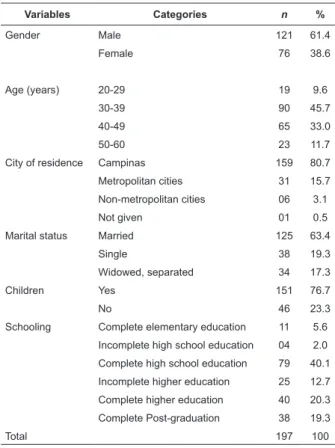
The sociodemographic data are presented in
Table 1. The ages ranged between 20 and 60 years, with
a mean of 39.1 years (SD ± 8.3), with the mean age of
their children being 15.1 years, where the minimum age
was two months and the maximum 35 years. The mean
time spent with the education of their children was 3.8
hours daily. Of 193 respondents, 104 (53.9%) reported
completing a course in their work area.
Table 1 - Distribution of absolute and relative frequencies
of the SAMU professionals, according to sociodemographic
variables. Campinas, 2010 (n=197)
Variables Categories n %
Gender Male 121 61.4
Female 76 38.6
Age (years) 20-29 19 9.6
30-39 90 45.7
40-49 65 33.0
50-60 23 11.7
City of residence Campinas 159 80.7
Metropolitan cities 31 15.7
Non-metropolitan cities 06 3.1
Not given 01 0.5
Marital status Married 125 63.4
Single 38 19.3
Widowed, separated 34 17.3
Children Yes 151 76.7
No 46 23.3
Schooling Complete elementary education 11 5.6
Incomplete high school education 04 2.0
Complete high school education 79 40.1
Incomplete higher education 25 12.7
Complete higher education 40 20.3
Complete Post-graduation 38 19.3
Total 197 100
Regarding traveling to work, the most widely used
means of transport was the car (62.1%), followed by
the bus (18.5%), with the mean travel time being 47.8
minutes (SD±38). The predominant type of housing was
brick built dwellings (91.8%). Regarding religion 79.3%
reported having some belief, with the Catholic religion
being dominant (59.6%). The data relating to the work
are presented in Table 2, which shows the 11 professional
categories that were approached. There were 11
employees on restricted duty (5.8%), i.e. performing
other work functions due to medical restrictions. The
predominant employment contract was the bond with
the city council through public concours (59.4%), under
the statutory regime. There was a statistically signiicant
difference between the variables ‘type of contract’ and
Vegian CFL, Monteiro MI.
Table 2 - Distribution of absolute and relative
frequencies of the SAMU professionals, according to
work characteristics. Campinas, 2010 (n=197)
Variables Categories n %
Professional category Auxiliary nurse 33 16.7
Nursing technician 17 8.6
Registered Nurse 16 8.1
Physician 36 18.3
Driver 60 30.5
Radio operator 09 4.6
Telephonist (TARM) 14 7.1
Administrator 06 3.1
Porter 03 1.5
Pharmacist 01 0.5
Manager 02 1.0
Work shift Day 107 54.3
Night 74 37.6
Day and Night 15 7.6
Not given 01 0.5
Total 197 100
In regards to having other employment, 42.1% said
they had another employment contract. The majority
of these, 38.3%, besides working in the SAMU, worked
elsewhere, this being, in 80.5% of the cases, another
health service. Approximately half of the workers
(48%) reported working overtime, and 50.3% of the
professionals reported a period of unemployment at some
stage in their professional lives. Regarding the total hours
worked per week, 40.5% worked up to 36 hours; 18.4%
from 37 to 49 hours; 15.8% between 50 and 69 hours;
and 25.3% more than 70 hours. There was a statistically
signiicant difference between the variables: ‘performance
of overtime’ and ‘gender’ (p-value 0.0083); ‘total hours
worked per week’ and ‘gender’ (p-value 0.0260); ‘work
schedule’ and ‘age’ (p-value 0.0050) (Chi-square test).
The predominant salary range was up to R$ 829.00
(32.6%) and the value of the minimum wage at the time
of data collection was R$465.00.
The values regarding time and work are presented
in Table 3.
Table 3 - Distribution of the minimum, maximum, mean and standard deviation values of the SAMU professionals,
according to the variables: age work was commenced, time working in the area of health, for the city council, and in
the SAMU, and total hours worked per week. Campinas, 2010 (n=197)
Variables Minimum Maximum Mean Standard deviation
Age working was commenced (in years) 7.0 30.0 16.7 4.9
Time working in the area of health (in years) 0.3 35.0 12.2 7.2
Time working for the city council (in years) 0.1 28.0 8.9 6.7
Time working in the SAMU (in years) 0.0 22.0 6.9 5.2
Total hours worked per week 30.0 132.0 52.9 20.2
Work accidents had occurred in 10.7% of the
sample and, in most cases, once (66.7%). Among the
types of occurrences, accidents involving cutting-piercing
materials (28.6%) predominated, followed by trafic
accidents with the ambulances (23.8%), for example,
overturning. The use of personal protective equipment
was reported by 78.1% of the workers. Procedure gloves
were the most cited (83.6%), followed by protective
goggles (51.4%), masks (43.6%), and boots (40.7%),
among others.
When asked about “what is tiring in the work”,
the four most frequent situations were: interpersonal
relationships (27.7%), the population do not know how
to make correct use of the service (16.4%), the high
work demand (11.8%), and weather conditions, such as
excessive heat (10.8%). Referring to the fact of liking
the work, the most frequent responses were: to be able
to exercise a type of care speciic to the SAMU (41.9%),
i.e. without routines, in shifts, and care to patients who
are mostly caught in life threatening situations and
require a rapid onsite response; the fact of being able to
help people with their work (41.9%), and relationships
with colleagues (31.8%).
The results related to the health of the workers are
presented in Table 4.
Variables Responses n %
Smoker Yes 43 21.8
No 154 78.2
Alcoholic beverage use Yes 94 47.7
No 101 51.3
Not given 02 1.0
Table 4 - Distribution of absolute and relative frequencies
of the SAMU professionals, according to aspects of health
and lifestyle. Campinas, 2010 (n=197)
1022 Rev. Latino-Am. Enfermagem 2011 July-Aug.;19(4):1018-24.
Table 4 - (continuation)
Variables Responses n %
Physical Activity Yes 109 55.3
No 84 42.7
Not given 04 2.0
Pain in the last 6 months Yes 112 56.9
No 83 42.1
Not given 02 1.0
Pain in the last week Yes 88 44.7
No 107 54.3
Not given 02 1.0
Total 197 100
The body site mentioned as the most frequent for
the occurrence of pain was the cervical spine: 65.7% in
the preceding six months and 45.1% in the preceding
week. The use of medication was referred to by 30.6%,
with antihypertensives being the most used (37.5%).
Some interviewees (17.9%) reported having problems
with sleep, with the main cause related to the night shift
schedule (24.1%). The majority reported having plans
for the future (94.4%) and responded afirmatively
regarding the performance of leisure activities (96.5%),
with watching television the most frequent (82.7%).
Among the subjects who participated in the study,
57.5% were satisied with the work, and 59.4% were satisied with life.
Discussion
The data analysis showed the predominance of males
among the subjects studied, which may be associated with
the absence of females in the most frequent professional
category, the drivers (30.5%). Despite the increasing
female participation in the labor market, this is still well
below male participation(7). In the present study males
were predominant, a fact that can be justiied by the demands for strength and physical itness in the work of
the SAMU(2). The predominance of complete high school
education is justiied by the sum of the drivers and of
the nursing class, which together represented almost
64% of participants. To perform the function of nursing
technician, a complete high school education is required,
and as a prerequisite for being a driver, Regulation 814(8)
requires complete primary education. Auxiliary nurses
must also have at least complete elementary education,
in addition to professional training.
It was evident that the majority of the professionals
had employment contracts that were made through public
concours (59.4%), in which the selection of candidates
with better education and performance may have
occurred. The mean age of 39.1 years demonstrates a
proile of individuals of productive age, with the majority
married and with children. The association between
‘age’ and ‘type of contract’ revealed no difference
between the age groups and the type of contract. The
perception was that older workers had bonds with the
city council through the public concours and the younger
ones, were temporarily employed. Almost half of the
workers (42.1%) had other employment contracts and
the majority of them were male (65.1%). There was a
predominance of physicians who had more than one job.
A study performed with doctors in Salvador highlighted
the work overload, especially during extra duty shifts,
which is worrying due to the consideration that the
medical activity is based on the physician and patient
interaction, study and scientiic-technical training and
that, to some extent, this can be compromised by the
lack of time(9). Regarding the drivers, the fact that they
also work in shifts may allow the accumulation of jobs.
Also noteworthy is the total hours worked per
week, over 70, with a maximum of 132 hours per week
reported. In these situations, it was identiied that,
among all the professional categories, the physicians
worked more hours per week (44.7%). The fact that
almost the majority of the individuals worked overtime
may be associated with two reasons: the SAMU, due to
its characteristic of readiness, promotes the probability
of extrapolating the inishing time, i.e. in the case of
care near the end time of the workday, by postponing
the employee returning to the central base; and also, the
work in events (such as concerts, races, etc.), in which
the presence of the SAMU is requested, which allows the
employee to perform overtime on their day of rest. It
is important to note the signiicant statistical difference
between ‘the performance of overtime’ and ‘gender’,
and the ‘total hours worked per week’ and ‘gender’. In
relecting on gender and work, the literature indicates
that one of the most marked differences concerning the
working day, i.e. the working week for women is about
ive times shorter than that of men; it was not possible
to conclude the reason, perhaps this being optional or
an impediment imposed by the labor market or even
factors beyond their control, possibly activities related
to the care of the family and home(7). In general, it
was observed that older people worked at night in the
environment of the SAMU. Coincidentally, there was a
statistically signiicant difference between the variables
‘work schedule’ and ‘age’.
Trafic accidents involving ambulances are
Vegian CFL, Monteiro MI.
among the work accidents (23.8%). A North American
study conducted with 1175 emergency technicians
found a prevalence of 8.6% of trafic accidents involving
ambulances, with the suggestion that age and sleep
were associated with this occurrence(10). The prevalence
of the constant relationship with people being tiresome
allows several perspectives. One is directed toward the
workers who had actual direct contact with the users
of the service. These constantly interacted with many
different people throughout their working day, both
directly and indirectly, with luctuating durations of the
interpersonal relationship. In addition, the interests
imposed in these relationships are also variable.
The people who worked in a closed environment had
less exposure. However, for those that interacted
indirectly, through the telephone, there was a loss
of communication, which could result in situations of
fatigue and exhaustion. This fact was highlighted in
a study on the working situation of telephonists, in
which the way they speak, what they say, what they
do not say and how they conduct a dialogue, created
an artiicial situation. This would certainly have effects
on the psychic lives of the subjects involved(11). The
working conditions and health of the SAMU telephonists
can be inluenced when the risk of death at the other
end of the line is considered, which can be mitigated
when they feel that they are participating in the work
process and useful to society.
Regarding lifestyle, the main cause of sleep
problems was associated with the work schedule. Shift
work and night work, the disruption of the circadian
rhythm of sleep, can cause serious impairment of brain
function(12). The level of life satisfaction was slightly higher
than work satisfaction. Work satisfaction is a complex,
subjective phenomenon, which varies depending on the
circumstances and the time when the same person is
considered(13).
Conclusion
The majority of participants were male, aged
between 30 and 39 years, residents of Campinas, had
children, and had complete high school education.
The use of the car as a means of transportation to
work, housed in brick built dwellings and following the
Catholic religion were predominant. Eleven types of
professionals participated: auxiliary nurses, nursing
technicians, registered nurses, physicians, drivers,
medical regulation service technicians (telephonists),
radio operators, managers, administrative workers,
porters and pharmacists. The category with the highest
percentage of participation in the study was the drivers,
followed by the physicians and the auxiliary nurses. The
majority of the participants had ties with the city council
through public concours, were part of the day shift and
worked up to 36 hours per week, with a signiicant
number of professionals who accumulated more than
70 hours worked per week (25.3%). Almost half of
the participants had other employment and performed
overtime. The mean length of working in the SAMU was
6.9 years (SD±5.2). The majority did not ingest alcoholic
beverages, did not smoke, practiced physical and leisure
activities, and had plans for the future.
In reference to the work in the SAMU, it is important
to know the characteristics of the professionals working
in PHC and their working conditions for the development
of programs aimed at maintaining and promoting the
mental and physical health of the workers. It is believed
that these are necessary when considering the work
in PHC. Another aspect to be highlighted is the long
working hours of the physicians, which should be better
evaluated and studied by the relevant agencies. Due to
this being a recent service in the country, it is suggested
that, for the structuring of the SAMU, measures aimed
at ensuring the health of its professionals are clearly
contemplated considering the future of this service, with
regard to the quality of care provided to users, as well as
the conservation of the quality of life and work of these
professionals.
References
1. Portaria GM/ MS n. 2048 de 05 de novembro de 2002
(BR). Dispõe sobre o regulamento técnico dos sistemas
estaduais de urgência e emergência. Diário da República
Federativa do Brasil. Brasília: Imprensa Oficial; nov
2002.
2. Campos RM. Satisfação da equipe de enfermagem do
Serviço de Atendimento Móvel às Urgências (SAMU) no
ambiente de trabalho. Natal (RN): Universidade Federal
do Rio Grande do Norte; 2005. 193 p.
3. Vargas D. Atendimento Pré-Hospitalar: a formação
específica do enfermeiro na área e as dificuldades
encontradas no início da carreira. Rev Paul Enferm.
2006;25(1):46-51.
4. Cristina JA. Vivências de uma equipe multiprofissional
de atendimento avançado pré-hospitalar móvel
ao adulto em situação de atendimento em parada
cardiorrespiratória. Ribeirão Preto (SP): Universidade de
1024 Rev. Latino-Am. Enfermagem 2011 July-Aug.;19(4):1018-24.
5. Romanzini EM, Bock LF. Conceptions and feelings of
nurses working in emergency medical services about
their professional practice and training. Rev. Latino-Am.
Enfermagem. 2010;18(2):108-12. Inglês, Português,
Espanhol.
6. Monteiro MI. Instrumento para coleta de dados.
Campinas, Grupo de Estudos e Pesquisas em Saúde e
Trabalho. Universidade Estadual de Campinas, 2009.
7. Ministério do Planejamento, Orçamento e Gestão.
Inserção no mercado de trabalho: diferenças por sexo
e conseqüências sobre o bem-estar. Rio de Janeiro (RJ);
2001. 32 p.
8. Portaria n. 814/GM de 01/06/01 (BR). Dispõe sobre a
normatização dos serviços de atendimento pré-hospitalar
móvel. Diário da República Federativa do Brasil. Brasília:
Imprensa Oficial; 2002.
9. Nascimento CL Sobrinho, Carvalho FM, Bonfim TAS,
Cirino CAS, Ferreira IS. Condições de trabalho e saúde
de médicos em Salvador, Brasil. Rev Assoc Med Bras.
2006;52(2):97-102.
10. Studnek JR; Fernandez AR. Characteristics of
emergency medical technicians involved in ambulance
crashes. Prehosp Disaster Med. 2008;23(5):432-7.
11. Vilela LVO, Assunção AV. Os mecanismos de controle
da atividade no setor de teleatendimento e as queixas
de cansaço e esgotamento entre os trabalhadores. Cad
Saúde Pública. 2004;20(4):1069-78.
12. Fischer FM, Moreno CRC, Rotenberg L. A saúde do
trabalhador na sociedade 24 horas. São Paulo Perspec.
2003;17(1):34-46.
13. Martinez MC, Paraguay AIBB, Latorre MRDO. Relação
entre satisfação com aspectos psicossociais e saúde dos
trabalhadores. Rev Saúde Pública. 2004;38(1):55-61.
Received: Aug. 23st 2010