THE TRIPTAN FORMULATIONS
A critical evaluation
Marcelo E. Bigal
1, Carlos A. Bordini
2, Ana L. Antoniazzi
2, José G. Speciali
2ABSTRACT - The migraine-specific triptans have revolutionized the treatment of migraine and are usually the drugs of choice to treat a migraine attack in progress. Different triptans are available in different strengths and formulations including oral tablets, orally disintegrating tablets, nasal sprays and subcutaneous injections. In Europe, sumatriptan is also available as a suppository. Specific differences among the triptans exist as evidenced by different pharmacological profiles includingT½½½½½, Tmaxmaxmaxmaxmax, Cmaxmaxmaxmaxmax, AUC, metabolism, drug-drug interaction profiles, amongst other parameters. How or whether these differences translate to clinical efficacy and tolerability differences is not well differentiated. Clinical distinctions among these agents are subtle and proper choice of triptan requires attention to the specific characteristics of each individual patient, knowledge of patient preference, accurate history of the efficacy of previous acute care medications as well as individual features of the drug being considered. Delivery systems may play an important role in the onset of action of triptans. The selection of an acute antimigraine drug for a patient depends upon the stratification of the patient’s migraine attack by peak intensity, time to peak intensity, level of associated symptoms such as nausea and vomiting, time to associated symptoms, comorbid diseases, and concomitant treatments that might cause drug-drug interactions. The clinician has in his armamentarium an ever-expanding variety of medications, available in multiple formulations and dosages, with good safety and tolerability profiles. Continued clinical use will yield familiarity with the various triptans, and it should become possible for the interested physician to match individual patient needs with the specific characteristics of a triptan to optimize therapeutic benefit.
KEY WORDS: triptans, migraine treatment, acute treatment.
FFFFFormulações dos triptanos: avaliacão críticaormulações dos triptanos: avaliacão críticaormulações dos triptanos: avaliacão críticaormulações dos triptanos: avaliacão críticaormulações dos triptanos: avaliacão crítica
RESUMO - Os triptanos, drogas anti-migranosas específicas, revolucionaram o tratamento da migrânea e são considerados as drogas de escolha para o tratamento da crise migranosa. Diferentes triptanos são disponíveis em diferentes formulações, incluindo comprimidos, tabletes de dispersão oral, sprays para administração nasal e injeções subcutâneas. Na Europa, sumatriptan também é disponível como supositório. Diferenças específicas entre os triptanos são evidenciadas por seu diferente perfil farmacológico, incluindo T½½½½½, Tmaxmaxmaxmaxmax, Cmaxmaxmaxmaxmax, AUC, metabolismo, perfil de interação entre drogas, entre outros parâmetros. Controvérsias existem sobre se, ou como, essas variáveis traduzem-se em eficácia clínica e tolerabilidade. A distinção clínica entre esses agentes é sutil e a escolha adequada de um triptano requer consideração sobre as características específicas de cada paciente, conhecimento da preferência dos mesmos, obtenção de história acurada sobre a eficácia de medicações previamente utilizadas, assim como consideração sobre as características individuais das diversas drogas. A via posológica parece desempenhar importante papel no modo de ação dos triptanos. A seleção de droga antimigranosa adequada para o tratamento da crise migranosa depende da estratificação do ataque de acordo como a intensidade da dor, tempo para que a máxima intensidade da dor seja atingida, sintomas associados, tempo para que os sintomas associados se manifestem, doenças concomitantes e tratamentos adjuvantes que possam causar interações medicamentosas. O clínico dispõe em seu armamentário uma variedade de medicamentos em constante expansão, em múltiplas formulações e dosagens, seguras e com bom perfil de tolerabilidade. O uso continuado dos triptanos perimitirá familiaridade com essa classe de medicação e possibilitará ao clínico a prescrição de drogas com características específicas para atender as necessidades clínicas de diferentes pacientes, de modo a otimizar o benefício terapêutico.
PALAVRAS-CHAVE: triptanos, migrânea, tratmento agudo.
1Department of Neurology, Albert Einstein College of Medicine, Bronx, NY, U.S.A, Research Associate, The New England Center for Headache,
Stamford, CT, U.S.A; 2Department of Neurology, School of Medicine at Ribeirão Preto, São Paulo University, Ribeirão Preto SP, Brazil.
Received 15 October 2002, received in final form 10 January 2003. Accepted 21 January 2003.
The pharmacological treatment of migraine is an
important part of the full regimen of good
manage-ment principles for migraine. Pharmacotherapy is
traditionally divided into acute-care and preventive
medications. Acute-care treatment (also called
abor-tive treatment) is intended to reverse attacks once
they begin, the goal being to reduce and ideally stop
the pain, associated symptoms and disability
1.
The migraine-specific triptans have revolutionized
the treatment of migraine and are usually the drugs
of choice to treat a migraine attack in progress. Their
mechanism of action is based on the stimulation of
specific serotonin (5-hydroxytryptamine; 5-HT)
recep-tors including peripheral 1
Band central and
periphe-ral 1
Dsubtypes
2. This results in reversal of
vasodilata-tion and decrease in neurogenic inflammavasodilata-tion, as well
as reducing central nociception. New triptans are being
released in rapid succession with each one
demons-trating some specific pharmacokinetic properties
which may be translated into clinical advantages. The
aim of this article is to critically review the
characteris-tics of these acute care migraine-specific drugs.
THE TRIPTANS
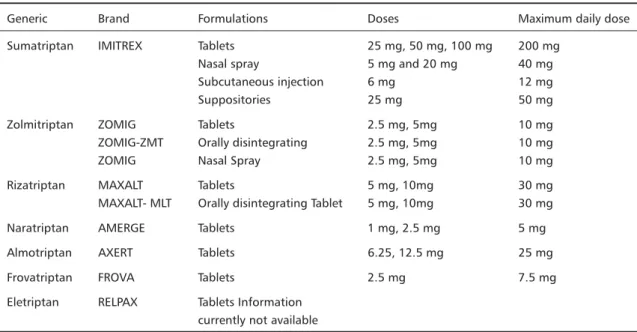
There are seven triptans available in the first quarter of 2002 in some countries. In order of their clinical deve-lopment, they are sumatriptan, zolmitriptan, naratriptan, rizatriptan, almotriptan, eletriptan (the latter available in some countries although not yet approved by the FDA) and frovatriptan (Table 1).
SUMA SUMA SUMA SUMA
SUMATRIPTTRIPTTRIPTTRIPTTRIPTANANANANAN
The first selective 5-HT1B/1D agonist to be synthesized was sumatriptan, as a subcutaneous (SC) injection, then
as an oral tablet and more recently as a nasal spray (NS)3.
It is also available in more than 15 countries as a supposi-tory. Sumatriptan is the most extensively studied agent in the history of migraine therapy. Since its release in Europe in 1991, it is estimated to have been used in over 200 million attacks by close to 10 million patients by 19994.
Sumatriptan has brought prompt and effective migraine relief that facilitates resumption of work and most nor-mal daily activities for the majority of patients5.
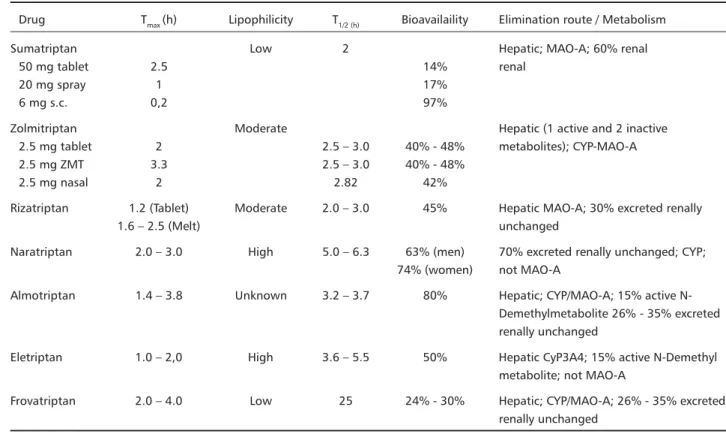
Subcutaneous sumatriptan, available as a 6 mg dose in a self injectable pen, has the most favorable pharmacokinetic profile of the triptans (Table 2), with a Tmax of 10 min and a bioavailability of 96%6. It also has the highest clinical
efficacy, with a 2 hour response rate of 76% and a rapidly attained pain free rate of 48% at 60 minutes after admi-nistration6. It has an intrapatient consistency in multiple
attacks ranging from 89% (2 of 3 attacks) to 73% (3 of 3 attacks)4. Recurrence of migraine within 24 hours, after
improvement at 2 hours, was reported as 34% to 38% in the first 2 large studies4.
The injection is the fastest way to stop a rapidly pro-gressing severe migraine or migraine present upon awa-ken. The subcutaneous form is the most efficient way to medicate someone with migraine and severe nausea; ho-wever the injection does produce a larger number of typical triptan adverse events (AE’s) than other forms, is inconve-nient to use, slightly uncomfortable at the site of injection, and is up to three times the price of most triptan tablets. The oral tablet has a bioavailability of 14%6, as shown
in Table 2. The minimum effective dose is 25 mg, and the optimum doses range from 50 to 100 mg with no gain in efficacy at the higher doses, but more adverse events when dose is increased7. Some more recent studies show added
effect of the 100 mg tablet when taken at the mild pain level of a progressing migraine attack8. Sumatriptan 50 mg
Table 1. Triptan medications.
Generic Brand Formulations Doses Maximum daily dose
Sumatriptan IMITREX Tablets 25 mg, 50 mg, 100 mg 200 mg
Nasal spray 5 mg and 20 mg 40 mg
Subcutaneous injection 6 mg 12 mg
Suppositories 25 mg 50 mg
Zolmitriptan ZOMIG Tablets 2.5 mg, 5mg 10 mg
ZOMIG-ZMT Orally disintegrating 2.5 mg, 5mg 10 mg
ZOMIG Nasal Spray 2.5 mg, 5mg 10 mg
Rizatriptan MAXALT Tablets 5 mg, 10mg 30 mg
MAXALT- MLT Orally disintegrating Tablet 5 mg, 10mg 30 mg
Naratriptan AMERGE Tablets 1 mg, 2.5 mg 5 mg
Almotriptan AXERT Tablets 6.25, 12.5 mg 25 mg
Frovatriptan FROVA Tablets 2.5 mg 7.5 mg
has been extensively studied, with a mean therapeutic gain (the difference between the active and the placebo res-ponse - TG) of 33% (95% CI 29% - 36%) after 2 hours4.The
first studies on oral sumatriptan showed statistically significant effects for the 50 mg dose as early as 30 mi-nutes when compared with placebo. For sumatriptan 25 mg, the TG is 24%9.
Sumatriptan nasal spray provides faster onset of effect than the tablet but produces a similar headache response at 2 hours10.The 20 mg spray demonstrated difference
from placebo, at 15 minutes, in 3 of 5 placebo-controlled trials4.The TG at 2 hours ranges from 28% to 55%. Some
patients prefer the nasal spray as it works more quickly than the tablet and does not have as many adverse effects as the injection. Others do not like it, for a variety of rea-sons, the nasal route of administration, bad taste and inconsistency of response.
The 25 mg suppository is available in Europe and Asia. Rectal sumatriptan is superior to placebo after 30 minutes and 60 minutes, the mean TG being 31% (95% CI 25% -37%)11. All forms of sumatriptan (and all other triptans)
relieve the associated symptoms (nausea, vomiting, photo and phonophobia) as well as the pain of migraine12. As
noted, the overall headache recurrence rate from suma-triptan is in the 30 to 40% range8-10, and occasionally higher
in certain studies. It appears that treating at the mild level of pain reduces headache recurrence8.
The dose of injectable sumatriptan is 6 mg subcuta-neous, which may be repeated once after 1 hour for a
total of two doses/24 hours. The dose of the nasal spray is 20 mg stat, which can be repeated once after 2 hours for a total of two doses/24 hours. The dose or oral sumatriptan is a 50 mg or 100 mg tablet early in the course of a mi-graine attack, which can be repeated in 2 hours. The ma-ximum oral dose is 200 mg per day in the US, 300 mg/24 hours in every other country in the world.
ZOLMITRIPT ZOLMITRIPT ZOLMITRIPT ZOLMITRIPT ZOLMITRIPTANANANANAN
Zolmitriptan was developed with the goal of creating a more lipophilic, centrally active and rapidly absorbed oral tablet than sumatriptan13. Its pharmacokinetic
pro-perties are displayed in Table 2. The dose is 2.5 mg or 5 mg early in the course of the migraine, and a repeat dose may be given in two hours. Maximum dose is 10 mg/24 hours in the US and by the EU regulatory authorities. Zol-mitriptan demonstrates a mean headache response of 64% with a TG of 34% for the 2.5 mg dose and a mean heada-che response of 65% with a TG of 37% for the 5 mg dose14.
The 2-hour pain-free response with the 5 mg dose was considerably better than that of the 2.5 mg, at 38% to 33%4,14. The recommended starting dose of 2.5 mg
provi-des the best balance of benefit and side effect although some patients do obtain more complete and rapid relief from the higher 5 mg dose, a dosage only available in the US and Sweden. The recurrence rate is variable, ranging from 22 to 37%15. There have been three comparative trials
between zolmitriptan and sumatriptan. The first, a single attack study compared zolmitriptan 5 mg to sumatriptan
Table 2. Pharmacokinetics of the Triptans.
Drug Tmax (h) Lipophilicity T1/2 (h) Bioavailaility Elimination route / Metabolism
Sumatriptan Low 2 Hepatic; MAO-A; 60% renal
50 mg tablet 2.5 14% renal
20 mg spray 1 17%
6 mg s.c. 0,2 97%
Zolmitriptan Moderate Hepatic (1 active and 2 inactive
2.5 mg tablet 2 2.5 – 3.0 40% - 48% metabolites); CYP-MAO-A
2.5 mg ZMT 3.3 2.5 – 3.0 40% - 48%
2.5 mg nasal 2 2.82 42%
Rizatriptan 1.2 (Tablet) Moderate 2.0 – 3.0 45% Hepatic MAO-A; 30% excreted renally
1.6 – 2.5 (Melt) unchanged
Naratriptan 2.0 – 3.0 High 5.0 – 6.3 63% (men) 70% excreted renally unchanged; CYP; 74% (women) not MAO-A
Almotriptan 1.4 – 3.8 Unknown 3.2 – 3.7 80% Hepatic; CYP/MAO-A; 15% active N-Demethylmetabolite 26% - 35% excreted renally unchanged
Eletriptan 1.0 – 2,0 High 3.6 – 5.5 50% Hepatic CyP3A4; 15% active N-Demethyl metabolite; not MAO-A
Frovatriptan 2.0 – 4.0 Low 25 24% - 30% Hepatic; CYP/MAO-A; 26% - 35% excreted renally unchanged
100 mg and found no difference for complete headache response, headache relief or pain-free state16.The second
was a 6 attack study comparing zolmitriptan 2.5 mg versus sumatriptan 25 mg and 50 mg and found the headache response at 2 hours was statistically higher for zolmitriptan 2.5 mg (67.1%) than for sumatriptan 25 mg (59.6%) or 50 mg (63.8%)17.The third trial was done with identical
methodology to the second, except zolmitriptan 2.5 and 5 mg were compared with sumatriptan 50 mg. This study showed no difference for any endpoint between the do-ses of medications18. Thus, for the primary efficacy clinical
endpoints there appears to be no overall significant diffe-rence between oral zolmitriptan and oral sumatriptan in large population studies. However, zolmitriptan is the only triptan with evidence of effectiveness of a second dose when the first was not completely successful19.
Zolmitriptan is also available, in some countries, as orally disintegrating tablet (ODT), that dissolves on the tongue within 30 seconds but is absorbed from the gas-trointestinal tract. It is a convenient alternative for those patients who prefer not to take conventional tablets or who are nauseated and cannot swallow water with their pill20. The TG at 2h , with the 2.5 mg ODT formulation is
41%, the pain-free response at 2h being 27% vs 7% in the placebo group4.The ODT was preferred to conventional
tablets by 70% of patients, and the adverse event profile was consistent with that previously reported for the con-ventional zolmitriptan tablet21.
Zolmitriptan NS has recently become available in Swe-den and is expected in the U.S.. NS formulations do offer the potential pharmacokinetic advantage of more rapid drug absorption across the nasal mucous. This may be
expected to confer a faster onset of action for a higher percentage of patients compared with oral treatments. In addition, intranasal administration offers a viable alterna-tive to subcutaneous injection when oral administration is undesirable or precluded. Preliminary results of the zol-mitriptan NS show a headache response of 70.2% at 2 h (TG = 40%) and pain free response of 35.9% (TG = 27.7%) for the 5 mg, according to randomized controlled trials22.
It has a rapid onset of headache relief demonstrating signi-ficant improvement over placebo as early as 15 minutes after the dose is administered. Nasal absorption has been demonstrated by PET-scan.
NARA NARANARA
NARANARATRIPTTRIPTTRIPTTRIPTTRIPTANANANANAN
Naratriptan was the third selective 5-HT1B/1D agonist to be introduced in the US for the acute treatment of mi-graine23. Oral naratriptan, available in the US in 1 and 2.5
mg tablets, differs from sumatriptan primarily in its longer half-life of 6 hours, longer Tmax of 2 hours, higher oral bioa-vailability (70%) and higher lipophilicity (70%)23.
Compa-red to other triptans, the 2.5 mg tablet of naratriptan, the only one available in most countries, presents a low TG at 2 hours (22%), with just about 48% of patients obtaining a headache response at 2h. The TG at 4 h is better, ran-ging from 26% to 34%24.
In several studies, the incidence of adverse events with naratriptan was very low, similar to placebo, and naratri-ptan has been referred to as the “gentle trinaratri-ptan.” It has not been found to have significant drug interactions23.
Recurrence of headache with naratriptan after 4-hour headache response is also low, ranging from 17% to 28%. When compared directly with sumatriptan and rizatriptan,
Table 3. clinical end-points for the triptans from selected clinical trials.
Drug Dose (mg) Therapeutic Gain Recurrence
and route at 2h (%) rate (%)
Sumatriptan 6 s.c. 51% 34 – 38
50 oral 29% - 36% 32
20 nasal spray 28% - 55% 32 – 34
Zolmitriptan 2.5 oral 34% 30
2.5 ZMT 41%
2.5 nasal spray 26% 5.0 nasal spray 40%
Naratriptan 2.5 oral 22% 17 - 28
Rizatriptan 10 oral 27% - 40% 30 – 47
10 MLT 19% - 46%
Almotriptan 12.5 oral 26% - 32% 18
Eletriptan 40 oral 22% – 41% 19 – 23
naratriptan showed lower recurrence rates25.
The probability of taking rescue medication after a first dose of naratriptan is low and similar to dihydroergota-mine22,25.
Thus, naratriptan has a more gentle adverse effect pro-file, and a lower recurrence rate when directly compared with other triptans, but it has a lower percent effectiveness at two and four hours after dosing. The dose is 2.5 mg given early in the course of the migraine attack, which may be repeated at two to four hours if the headache is not significantly better, to a maximum of 5 mg/24 hours.
RIZA RIZARIZA
RIZARIZATRIPTTRIPTTRIPTTRIPTANTRIPTANANANAN
Rizatriptan was synthesized also in the hope of creating a faster acting, more lipophilic tablet26. The drug is available
in two oral dosage strengths of 10 mg and 5 mg, with 10 mg being the recommended starting dose in most coun-tries. It can be repeated after 2 hours if the headache per-sists. Rizatriptan is also available as an ODT that can be taken without liquids,in the same dosages.
Rizatriptan has a high oral bioavailability of 45%. The half-life is 2 to 3 hours and the Tmax is 1.3 hours for the conventional tablet and slightly longer for the ODT (Table 2)27.Placebo-controlled studies for the 10 mg tablet found
a 2-hour TG ranging from 27% to 40%, with headache relief at 2 hours (70 to 77%) and a pain-free response at 2h ranging from 40% to 44% (Placebo response ranging from 2 to 10%).The recurrence rate for the 10 mg tablet ranges from 30% to 47%28,29.
As with the zolmitriptan ODT, the rizatriptan ODT is not absorbed from the mucous membrane of the mouth but rather dissolves in, and is subsequently swallowed with saliva for a further gastrointestinal absorption. The 2-h TG for this formulation ranges from 19% to 46%27.
There is clear evidence from direct comparisons with sumatriptan, zolmitriptan, and naratriptan that rizatriptan 10 mg is more likely to achieve a pain free outcome at 2 hours and sustained 2 hour pain free response.28
Tfelt-Hansen and Ryan29 reviewing clinical trials comparing
riza-triptan and sumariza-triptan, concluded that five mg rizariza-triptan was comparable to 50 mg sumatriptan. Rizatriptan 10 mg, the recommended dose in most countries, had a more rapid onset of action than 50 mg and 100 mg sumatriptan. In addition, 10 mg rizatriptan resulted in more patients
being pain-free after 2 hours than 100 mg sumatriptan and resulted in fewer drug-related adverse events than sumatriptan. Rizatriptan 10 mg, in a head to head com-parison to naratriptan 2.5 mg, showed statistical superi-ority in all end points at 2 hours, but the recurrence rate was lower with naratriptan27.
Rizatriptan 10 mg was also directly compared with zol-mitriptan 2.5 mg27. Rizatriptan was superior to zolmitriptan
at 2 h for pain free response. Since the optimal dose for zolmitriptan to achieve a 2 hour pain free response is 5 mg (see above), comparable doses may not have been used in this comparative study. However, since the 5 mg dose is only available in two countries, the commercially available doses and recommended starting doses were compared.
In summary, rizatriptan is a fast-acting oral triptan, with the highest pain free and sustained pain free res-ponses of the available triptans, and with a recurrence rate comparable with that of oral sumatriptan and zolmi-triptan, but higher than naratriptan.
ALMOTRIPT ALMOTRIPT ALMOTRIPT ALMOTRIPT ALMOTRIPTANANANANAN
Almotriptan is a new 5-HT1B , 5-HT1D and 5-HT1F ago-nist30.The bioavailability of oral almotriptan is around 70%.
Even though the Tmax is 2.5 hours, the absorption of almo-triptan seems to be rapid, with more than two-thirds of the drug reaching the plasma within the first hour of the oral administration30.
Clinical trials show a clear dose-response relationship for almotriptan, 6.25 mg being the minimum effective dose, 12.5 mg the ideal therapeutic dose with the most favorable relationship between efficacy and tolerability, and 25 mg being the most effective of therapeutic doses in clinical trials. The 12.5 mg dose shows significant onset of efficacy over placebo between 30 and 45 min. The TG for pain relief at 2 h ranges from 26% to 32%; the thera-peutic gain for the pain free state at 2h ranges from 20% to 23%. The recurrence rate is between 18% – 29%31. In
controlled trials, the overall incidence of drug-related ad-verse experiences with almotriptan 12.5 mg and placebo was 16% and 15%, respectively30,31.
There was no difference between almotriptan 12.5 mg and sumatriptan 100 mg directly compared, for primary efficacy measures and recurrence except for a superiority for sumatriptan 100 mg over almotriptan 12.5 mg for pain free at 2 hours32.
Almotriptan appears to be superior to sumatriptan regarding tolerability with lower AEs such as chest pain when directly compared in one study30-32. This does not
mean that almotriptan is safer, as chest symptoms are rarely cardiac in origin.
The optimal dose for almotriptan is a 12.5 mg tablet at the start of a migraine headache, which may be repeated once in 2 hours to a maximum of 25 mg/24 hours.
ELETRIPT ELETRIPT ELETRIPT ELETRIPT ELETRIPTANANANANAN
Oral eletriptan has a very short Tmax of 1 to 2 hours with a relatively long half-life of 3.6 to 5.5 hours. It has a
Table 4. Clinical features of the Group I and Group II triptans.
Group I Group II
Features Faster onset Slower onset Higher potency Lower potency Higher recurrence Lower recurrence Triptans Sumatriptan Naratriptan
Zolmitriptan Frovatriptan Rizatriptan
50% oral bioavailability33 (Table 2). Eletriptan may interact
with other compounds that are metabolized by the cyto-chrome (CYP) P-450 3A4 hepatic enzymatic system. Con-comitant administration of eletriptan with CYP 3A4 me-tabolized medications causes a rise in the eletriptan plas-ma levels34. The concern is that higher blood levels of
ele-triptan could cause an increase in AE’s. In the EU prescri-bing information eletriptan is not supposed to be used with potent CYP 3A4 metabolized medications such as macrolide antibiotics (e.g. erythromycin, clarithromycin), antifungals (e.g. fluconazole) and certain antivirals. According to pooled abstract data presented by Pfizer from two long-term studies, the incidence of adverse events was similar whether or not patients took CYP 3A4 inhibitors in combination with either eletriptan 40 mg or 80 mg. Even the concomitant use of potent CYP 3A4 inhibitors did not influence the incidence of reported adverse events in these studies34.Thus the concomitant use of CYP 3A4
inhibitors may not decrease the tolerability of eletriptan, but clinicians should be cautious about co-prescribing ele-triptan and significantly CYP 3A4 metabolized medications pending publication of full safety data.
The TG of eletriptan 40 mg at 2 h ranges from 22% to 41%. The TG of eletriptan 80 mg ranges from 30% to 53%33. Headache recurrence seems to occur in about one
third of patients in some studies, similar to sumatriptan, but is considerably lower in other studies33.
To date, only two peer-reviewed studies on eletriptan have been published. The first one was conducted by Goa-dsby et al35.They compared the efficacy, safety and
tolera-bility of oral eletriptan (20 mg, 40 mg and 80 mg) with 100 mg of encapsulated sumatriptan, in a double-blind, placebo controlled study. Two hours after dosing, heada-che response rates were 24% for placebo, 55% for suma-triptan 100 mg, 54% for elesuma-triptan 20 mg, 65% for eletri-ptan 40 mg and 77% for eletrieletri-ptan 80 mg. Headache-free rates at 2 hours were superior to placebo for both the 80 mg dose of eletriptan (37%) and the 40 mg dose (29%), with the 80 mg dose also being superior to sumatriptan 100 mg (23%). AEs occurred in 17% of the patients who received placebo, 40% who received sumatriptan, 34% who received eletriptan 20 mg, 35% who received eletri-ptan 40 mg and 51% who received eletrieletri-ptan 80 mg. The majority of AEs were mild or moderate in intensity and transient.
The second peer-reviewed study, on behalf of the Ele-triptan Steering Committee36 evaluate the efficacy, safety
and tolerability of eletriptan (40 mg and 80 mg) in a dou-ble-blind, placebo-controlled, three attack study treating 1,153 patients. In the initial attack, significantly more ele-triptan patients reported headache relief and complete pain relief at 2 h vs. placebo (40 mg, 62% and 32%; 80 mg, 65% and 34%; placebo, 19% and 3% - p < 0.0001). More patients that received both doses of eletriptan re-ported relief at 30 min (p < 0.01). There was a significantly lower recurrence rate with eletriptan 80 mg compared with placebo (21% vs. 40%, p < 0.01). The recurrence
rate of the 40 mg dose did not reach statistical significance (30%). Adverse events for all treatments were mild or mo-derate and self-limited. They concluded that eletriptan 40 mg and 80 mg appear to be effective and well-tolerated acute migraine treatments.
In the EU, eletriptan is approved in 20 and 40 mg do-ses. After two out of three well tolerated failures, patients have the option of taking two 40 mg doses at the onset of an attack, but maximum dosage/24 hours is 80 mg. In some countries (i.e. the Czech Republic) 40 mg and 80 mg tablets are available.
FROV FROVFROV
FROVFROVAAAATRIPTATRIPTTRIPTTRIPTTRIPTANANANANAN
Frovatriptan is an unusual triptan with an extremely long half-life of 26 hours37. This is the longest half-life of
any agent in the triptan class, where the other half-lives range from 2h to 6h. Like naratriptan and almotriptan, frovatriptan also has a dual route of elimination via both the kidney and liver (cytochrome P450 1A2). There is no metabolism via the MAO system. The pharmacokinetics of frovatriptan are not significantly altered by drugs such as propranolol, moclobemide, other antidepressants and ergotamine37.
Frovatriptan 2.5 mg is the optimal dose. The maximum dose/24 hours is 7.5 mg. Headache response at 2 h is 37% – 46%. The TG at 2 h ranges from 16% to 19%, and at 4h from 25% to 27%38. There is a paucity of peer-reviewed
studies on frovatriptan, so most information is only avai-lable in abstract form.
Frovatriptan has the lowest range of 24-hour headache recurrence among the triptans, from 7% to 25% when compared to placebo. However, when directly compared with sumatriptan 100 mg, there was no significant diffe-rence in recurdiffe-rence rate. This suggests yet again that recur-rence rate may not be related to half-life38.
During short and long-term clinical trials, again avai-lable only in abstract form, the number of adverse events for frovatriptan 2.5 mg was just marginally higher than that found for placebo. In a direct comparison with suma-triptan 100 mg, the overall incidence of adverse events with frovatriptan was significantly lower than with suma-triptan (36% vs 43%, p = 0.03)37,38.
TRIPT TRIPTTRIPT
TRIPTTRIPTANS ARE NOT THE SAMEANS ARE NOT THE SAMEANS ARE NOT THE SAMEANS ARE NOT THE SAMEANS ARE NOT THE SAME
Different triptans are available in different strengths and formulations including oral tablets, orally disintegra-ting tablets, nasal sprays and subcutaneous injections (ta-ble 1 and ta(ta-ble 3). In Europe, sumatriptan is also availa(ta-ble as a suppository. Specific differences among the triptans exist as evidenced by different pharmacological profiles including T½½½½½, Tmaxmaxmaxmaxmax, Cmaxmaxmaxmaxmax, AUC, metabolism, drug-drug
in-teraction profiles, amongst other parameters39. How or
preference, accurate history of the efficacy of previous acute care medications as well as individual features of the drug being considered.
Delivery systems may play an important role in the on-set of action of triptans. Subcutaneous delivery of suma-triptan offers the most rapid and complete pain relief of the triptans beginning as early as 10 to 15 minutes, yet it also is associated with a higher incidence of adverse events. The second most rapid onset of action of the triptans is achieved through NS deliveries of sumatriptan and zolmi-triptan, but the percentage of headache relief at 2 hours is not as high as with the subcutaneous delivery formu-lation. All of the triptans are available as conventional ta-blets, and two (rizatriptan and zolmitriptan) are also available in ODTs. ODT’s are more convenient to use and can be taken when the patient is nauseated; they do not work any faster than tablets, and their gastrointestinal absorption means that they will not be absorbed if vomi-ting occurs soon after ingestion.
Beside delivery options, other clinical distinctions to consider among the triptans are the percentage of patients attaining headache relief. The oral triptans can be divided into two groups (Table 4). Group I consists of the oral triptans with faster onset and higher potency, namely sumatriptan, zolmitriptan, rizatriptan, almotriptan, and eletriptan. Group II consists of the slower onset oral trip-tans with lower overall potency and lower recurrence. These are naratriptan and frovatriptan. Within each oral group, responses in populations studied are more similar than different.
Some brief specific characteristics of the individual trip-tans are39: 1) Sumatriptan has been available for the
lon-gest time, is most flexible in form, and has been given successfully to the most number of patients; 2) Zolmitriptan is the only triptan proven effective when repeated for a persistent headache; 3) Naratriptan has a slower onset of action but a most favorable adverse event profile and a lower recurrence rate, which may help ad-dress the clinical challenges of treating long migraine attacks; 4) Rizatriptan has the highest 2-hour pain free rates and sustained pain free rates and the fastest time to headache response rate for an oral tablet; 5) Almotriptan has a slightly better side effect profile with somewhat less chest pain than sumatriptan; 6) Eletriptan has a clear dose response curve and may be associated with good sustained headache response rates; 7) Frovatriptan is a slower acting triptan with the longest half life in the class. As noted above, in spite of these differences, the oral triptans within each group are more similar than different but, impor-tantly, one cannot predict which triptan will work best for any given patient39; the patient should be questioned
carefully to determine if the triptan taken is ideal in terms of rapid onset of action, complete response to attain the pain free state, consistency, lack of recurrence, tolerability and minimal side effects. Adverse event profiles are usually not helpful in determining which triptan is best matched for a particular patient, unless the patient has significant
and intolerable adverse effects from previous triptans, in which case naratriptan or almotriptan would be the ob-vious choices.
SAFETY AND TOLERABILITY SAFETY AND TOLERABILITY SAFETY AND TOLERABILITY SAFETY AND TOLERABILITY SAFETY AND TOLERABILITY
Safety needs to be distinguished from tolerability. To-lerability involves adverse events that are irritating but not generally considered as clinically significant, such as nausea or dizziness. Safety implies no clinically significant adverse events, such as myocardial infarction, stroke, or hepatic toxicity.
The triptans as a class are generally very well tolerated, with less than half of patients reporting adverse events, mostly mild in intensity and transient. Most of the triptans show a modest increase in the incidence of adverse events at higher doses39,40.
Overall, naratriptan, almotriptan and frovatriptan ap-pear to have the most favorable adverse event profiles. It should be emphasized, though, that tolerability problems as a reason for medication discontinuation are relatively low for all triptans.
For the triptans as a class there is a very low but definite potential risk of significant coronary vasoconstriction40 .
Extensive use of triptans over the past decade has provided substantial reassurance that the risk is very minimal, which is consistent with data suggesting that 5-HT1B receptors mediate less than 25% of the overall vasoconstrictive po-tential of the coronary arteries. Parenteral challenge with sumatriptan has been reported to result in approximately 14% coronary vasoconstriction.40 It should be noted that
the differential vasoconstrictive selectivity of triptans is partly due to the significantly higher density of 5-HT1B receptors in the meningeal arteries compared to the coronary arteries. All triptans appear to be relatively safe in the absence of coronary artery disease, any other signi-ficant vessel disease, uncontrolled hypertension and the presence of cardiac risk factors. But there is no “safest” triptan since no triptan is without some risk, and it should be emphasized that all are contraindicated in the presence of significant vascular disease.
CONCLUSIONS
REFERENCES
1. Sociedade Brasileira de Cefaléia. Recomendações para o tratamento profilático da migrânea: consenso da Sociedade Brasileira de Cefaléia. Arq Neuropsiquiatr 2002;60:159-169.
2. Humphrey PPA, Feniuk W, Perren MJ, et al. The pharmacology of the novel 5-HT1-like receptor agonist, GR43175. Cephalalgia 1989;9:23:35. 3. Humphrey PP. How it started. Cephalalgia 2001;21Suppl.1:2-5. 4. Tepper SJ, Rapoport AM. The triptans: a summary. CNS Drugs
1999;12:403-417.
5. Mansbach H. Sumatriptan: looking back and looking forward. In: Humphrey P, Ferrari M, Olesen J, editors. The triptans: novel drugs for migraine. New York: Oxford University Press, 2001:183-189. 6. Fowler PA, Lacey LF, Thomas M, Keene ON, Tanner RJN, Baber NS.
The clinical pharmacology , pharmacokinetics and metabolism of sumatriptan. Eur Neurol 1991;31:291-294.
7. Oral Sumatriptan Dose-Defining Study Group. Sumatriptan – an oral dose-defining study. Eur Neurol 1991;31:300-305.
8. Halpern MT, Lipton RB, Cady RK, et al. Cost-effectiveness of sumatriptan therapy: early vs delayed treatment.Cephalalgia 2001;21:336. 9. Goldestein J, Ryan R, Jiang K, et al, and the Rizatriptan Protocol 046
Study Group. Crossover comparison of rizatriptan 5 mg and 10 mg versus sumatriptan 25 mg and 50 mg in migraine. Headache 1998;38:737-747.
10. Ryan R, Elkind A, Baker CC, Mullican W, DeBussey S, Asgharnejad M. Sumatriptan nasal spray for the acute treatment of migraine: results of two clinical studies. Neurology 1997; 49:1225-1230.
11. Tepper SJ, Cochran A, Hobbs S, et al. Sumatriptan suppositories for the acute treatment of migraine. Int J Clin Pract 1998;1:31-35. 12. Lipton RB, Pascual J, Goadsby PJ, et al. Effect of rizatriptan and other
triptans on the nausea symptom of migraine: a post hoc analysis. Headache 2001;41:754-763.
13. Torres G. Zolmitriptan offers doctors and patient choices for effective treatment of migraine. In: Humphrey P, Ferrari M, Olesen J, editors. The triptans: novel drugs for migraine. New York: Oxford University Press, 2001:190-198.
14. Rapoport AM, Ramadan NM, Adelman JU, et al, on behalf of the 017 Clinical Trial Study Group. Optimizing the dose of zolmitriptan (Zomig, 311C90) for the acute treatment of migraine: A multicenter, double-blind, placebo-controlled, dose range-finding study. Neurology 1997;49:1210-1218.
15. Solomon GD, Cady RK, Klapper JA, et al. Clinical efficacy and tolerability of 2.5 mg zolmitriptan for the acute treatment of migraine. Neurology 1997;49:1219-1225.
16. Geraud G, Olesen J, Pfaffenrath V, et al. Comparison of the efficacy of zolmitriptan and sumatriptan: issues in migraine trial design. Cephalalgia 2000;20:30-38.
17. Gallagher RM. Comparison of zolmitriptan and sumatriptan for the acute treatment of migraine. Cephalalgia 1999;19:358.
18. Becker WJ. Zolmitriptan versus sumatriptan comparison trial. Headache 2001; 41:321-323.
19. Tepper SJ, Donnan GA, Dowson AJ, et al. A long-term study to maximize migraine relief with zomig. Curr Med Res Opin 1999;15:254-271. 20. Dowson AJ, MacGregor EA, Purdy A. Efficacy and safety of
zolmitriptan 2.5 mg orally disintegrating tablet for the acute treatment of migraine. Cephalalgia 2000;20:342.
21. Edmeads J., Millson DS. Tolerability profile of zolmitriptan (Zomig;
311C90), a novel dual central and peripheral HT1B/1D agonist.
Cephalalgia 1997;17:41-52.
22. Dowson AJ, Boes-Hansen S, Farkkila AM. Zolmitriptan nasal spray is fast-acting and highly effective in the acute treatment of migraine. Eur J Neurol 7 (Suppl 3):82.
23. Salonen R. Naratriptan: the gentle triptan. In: Humphrey P, Ferrari M, Olesen J, editors. The triptans: novel drugs for migraine. New York: Oxford University Press, 2001:228-235.
24. Mathew NT, Mahnaz A, Peykamian M, et al. Naratriptan is effective and well tolerated in the acute treatment of migraine: results of a double-blind, placebo-controlled, crossover study. Neurology 1997;49:1485-1490. 25. Dahlõf C, Winter P, Whitehouse H, Hassani H. Randomized, double-blind, placebo controlled comparison of oral naratriptan and oral sumatriptan in the acute treatment of migraine. Neurology 1997;48 Suppl. 3:85–86.
26. Hargreaves RJ. Pharmacology and potential mechanisms of action of rizatriptan. Cephalalgia 2000;20(Suppl)1:2-9.
27. Allen C. Rizatriptan: clinical update. In: Humphrey P, Ferrari M, Olesen J, editors. The triptans: novel drugs for migraine. New York: Oxford University Press, 2001:199-205.
28. Adelman JU, Lipton RB, Ferrari MD, et al. Comparison of rizatriptan and other triptans on stringent measures of efficacy. Neurology 2001;57:1377-1383.
29. Tfelt-Hansen P, Ryan RE. Oral therapy for migraine: comparisons between rizatriptan and sumatriptan. A review of four randomized, double-blind clinical trials. Neurology, 2000;55(Suppl.)2:19-24. 30. Pascual J. Almotriptan. In: Humphrey P, Ferrari M, Olesen J, editors.
The triptans: novel drugs for migraine. New York: Oxford University Press, 2001:199-205.
31. Fernandes FJ, Jansat JM, Cabarrocas X, Costa J, Salva P. Absolute bioavailability of oral and subcutaneous almotriptan. Cephalalgia 1999;23:363.
32. Cabarrocas X, Zayas JM, Suris M. Equivalent Efficacy of Oral Almotriptan, A New 5-HT Agonist, Compared with Sumatriptan 100 mg. Headache 1998;38:377-378.
33. Bardsley-Elliott A, Noble S. Eletriptan. CNS drugs 1999;12:325-333. 34. Gupta P, Napler CM, Purdy J, et al. In vitro profile of eletriptan, a new
5-HT1d –like receptor partial agonist. Cephalalgia 1996;16:368. 35. Goadsby PJ, Ferrari MD, Olesen J, et al. Eletriptan in acute migraine: A
double-blind, placebo-controlled comparison to sumatriptan. Neurology 2000;54:156-163.
36. Stark R, Dahlõf C, Haughie, Hettiarachchi J, et al. Efficacy, safety and tolerability of oral eletriptan in the acute treatment of migraine: results of a phase III, multicentre, placebo-controlled study across three attacks. Cephalalgia 2002;22:23-32.
37. Buchan P, Keywood C, Ward C. The pharmacokinetics of frovatriptan (VML 251/SB209509) in male and female subjects. Func Neurol 1998;13:177.
38. Keywood C. Frovatriptan – simplifying clinical practice in migraine. In: Humphrey P, Ferrari M, Olesen J, editors. The triptans: novel drugs for migraine. New York: Oxford University Press, 2001: 253 - 261. 39. Rapoport AM, Tepper SJ. Triptans are all different. Arch Neurol
2001;58:1479-1480.