Abstract
Floristic sampling was carried out in Serra do Japi Biological Reserve, Jundiaí, state of São Paulo, Brazil,
including physiognomies of semideciduous montane forest, a type of forest formation within the Atlantic Forest
domain. Six hundred and sixty one species distributed in 129 families were recorded; the ten most diverse
phanerogam families were: Asteraceae (56 species), Fabaceae (37), Rubiaceae (29), Poaceae (25), Solanaceae
(24), Cyperaceae (19), Euphorbiaceae (19), Orchidaceae (19), Melastomataceae (17), and Piperaceae (17).
The addition of 322 species from other floristic surveys increased the number of species of Serra do Japi to
976, distributed in 141 families. Compared to other floristic surveys carried out in the Atlantic Forest, our
results highlight the floristic diversity of the study area and the importance of preserving the vegetation of
this highly urbanized region.
Keywords
: Brazil, semideciduous montane forest, floristic, Atlantic Forest, vascular plants.
Resumo
Amostragem florística foi feita em áreas da Reserva Biológica Municipal da Serra do Japi, Jundiaí, Estado de
São Paulo, incluíndo fisionomias de floresta semidecídua montana, classificada como parte das formações da
Mata Atlântica. Foram encontradas 661 espécies em 129 famílias, as dez fanerogâmicas mais diversas foram:
Asteraceae (56 espécies), Fabaceae (37), Rubiaceae (29), Poaceae (25), Solanaceae (24), Cyperaceae (19),
Euphorbiaceae (19), Orchidaceae (19), Melastomataceae (17), e Piperaceae (17). O acréscimo de 322 espécies
adicionais compiladas de listagens florísticas suplementares eleva, para a Serra do Japi em geral, o número
registrado a 976 espécies em 141 famílias. Comparada a outros levantamentos florísticos na Mata Atlântica,
esses resultados demonstram a diversidade florística da área estudada e ressaltam o valor da preservação da
vegetação nessa região altamente urbanizada.
Palavras-chave
: Brasil, floresta semidecídua montana, florística, Mata Atlântica, plantas vasculares.
Vascular flora of Serra do Japi Biological Reserve, Jundiaí,
southeastern Brazil
Flora vascular da Reserva Biológica Municipal da Serra do Japi, Jundiaí, SP
Julio Antonio Lombardi
1,2,5,
Carolina da Silva Carvalho
3,
Leonardo Biral
4,
Mariana Naomi Saka
4&
Sean Miki Hieda
3Rodriguésia
63(2): 333-340. 2012
http://rodriguesia.jbrj.gov.br
1
Universidade Estadual Paulista – UNESP, Instituto de Biociências de Rio Claro, Depto. Botânica, Av. 24-A 1515, 13506-900, Rio Claro, SP, Brazil.
2Research Productivity Fellowship CNPq, proccess 300240/2009-0.
3
PIBIC Scholarship CNPq/UNESP, Undergraduate Program in Biological Sciences, Instituto de Biociências de Rio Claro, UNESP – Universidade Estadual
Paulista, Av. 24-A 1515, 13506-900, Rio Claro, São Paulo, Brazil.
4
CNPq Scholarship. Graduate Program in Biological Sciences (Plant Biology), Instituto de Biociências de Rio Claro, UNESP – Universidade Estadual Paulista,
Av. 24-A 1515, 13506-900, Rio Claro, São Paulo, Brazil.
5
Correponding author: e-mail: [email protected]
Introduction
The Atlantic Forest is highly complex,
both floristically and structurally. In the past, it
covered an almost continuous range along the
coast, from the state of Rio Grande do Norte to the
state of Rio Grande do Sul, which represents ca.
12% of the Brazilian territory (Consórcio Mata
Atlântica 1992; Fundação SOS Mata Atlântica
& INPE 2002; Galindo-Leal & Câmara 2003).
It comprises different vegetation types, from
forests to fields. Its current legal circumscription
is given by Decree no. 750/93, which deals with
the use of the Atlantic Forest, defining it as forest
formations and associated ecosystems inserted
334
Lombardi, J.A.
et al.
Rodriguésia
63(2): 333-340. 2012
in the domain of the Atlantic Forest, with their
respective official delimitations established
(IBGE 1991).
The flora of the Atlantic Forest was estimated
in 20 thousand species of vascular plants, of
which approximately eight thousand would
be endemic (Myers
et al
. 2000). Although this
estimate allows us to place this formation within
the so-called biodiversity hotspots (Mittermeier
et al
. 2004), we can still consider it relatively
poorly known, in particular because from 1990
to 2006 more than 1,100 new species from this
biome were described; over 40% of more than
1,100 new species described from Brazil were
made from this biome (Sobral & Stehmann 2009).
Floristic inventories including non-tree species are
relatively rare in the Atlantic Forest, whereas tree
species are better known, mainly due to several
phytosociological studies carried out in the state
of São Paulo (e.g. Leitão-Filho 1982).
The Serra do Japi range is considered a
priority area for conservation, representing the
largest inland continuous forest of the state of São
Paulo, and, despite the impacts of mining, logging
and human occupation that it has undergone, it still
represents an important remnant of the flora and
fauna of southeastern Brazil (Joly 1992;
Leitão-Filho & Morellato 1997, Morellato 1992a).
The range is located in a highly populated
region within the urban areas of São Paulo, Jundiaí,
and Campinas, which potentializes the risks of
disordered occupation that the area is subjected
to. However, since 1983, Serra do Japi is under
governmental trust (CONDEPHAAT - Conselho
de Defesa do Patrimônio Histórico, Arqueológico,
Artístico e Turístico do Estado/Council for
the Defense of the Historical, Archaeological,
Artistic and Touristic Heritage) and, from 1984
on, it was declared a reserve (APA - Área de
Proteção Ambiental/Environmental Protection
Area), partially located within the municipalities
of Jundiaí and Cabreúva. The Serra do Japi
Biological Reserve (RBMSJ - Reserva Biológica
Municipal da Serra do Japi) was created in 1992
(Jundiaí 1991-1992), and in 1993 it was included
in the Atlantic Forest Biosphere Reserve
(Leitão-Filho & Morellato 1997).
The Serra do Japi Biological Reserve has
been extensively studied in terms of arboreal flora
(Cardoso-Leite
et al.
2002; Leitão-Filho 1992;
Rodrigues
et al.
1989), physiognomy
(Cardoso-Leite
et al.
2005; Rodrigues & Shepherd 1992),
phenology (Morellato
et al.
1989; Morellato
et al.
1990; Morellato 1992b), and fauna (e.g. Brown
Jr. 1992; Haddad & Sazima 1992; Marinho-Filho
1992; Sazima & Haddad 1992; Silva 1992).
The objective of the present study was to
contribute to the knowledge of the flora of Serra
do Japi Biological Reserve, creating a floristic list
that includes all life forms, thus complementing
the lists already published for the area and
comparing it to other lists and taxonomic studies,
aiming to check the presence of invasive, rare or
endemic species, in order to give support to future
conservation and management projects.
Material and Methods
Study area
The massif of Serra do Japi is located
within the municipalities of Jundiaí, Itupeva,
Cabreúva, Pirapora do Bom Jesus, and Cajamar,
approximately between 23º11’S and 46º52’W, and
covers 354 km
2(Leitão-Filho & Morellato 1997).
The altitude of this mountain varies from 700
to 1,300 m, and its average annual temperature
varies from 15.7ºC in the highest areas to 19.2ºC
in the lowest areas. July is the coldest month,
with average temperatures between 11.8 ºC and
15.3ºC; the warmest month is January, with
average temperatures between 18.4ºC and 22.2ºC.
Hence, the local summer is warm and humid and
the winter is cold and dry (Pinto 1992).
Serra do Japi Biological Reserve is located
within the municipality of Jundiaí (between
23°12’-23º21’S and 46º30’-46º05’W), and
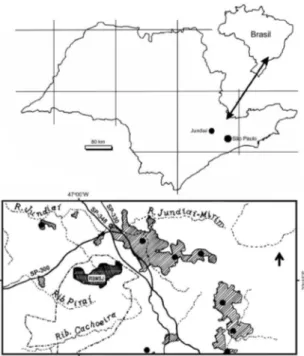
comprises 2,071.20 ha (Fig. 1) covered mainly by
seasonal semideciduous montane forest
(Cardoso-Leite
et al.
2005; IBGE 1991; Jundiaí 1991-1992).
Collections of botanical material were
carried out monthly, from May 2007 to November
2008; only reproductive specimens were collected.
Marked trails were covered, with eventual
incursions into the surrounding vegetation.
Considering that previous inventories focused
on sampling the tree stratum, we focused on
sampling specimens of other life forms, mainly
herbs and lianas.
Vascular flora of Serra do Japi
Rodriguésia
63(2): 333-340. 2012
335
of the Institute of Bioscience of Rio Claro,
Universidade Estadual Paulista (UNESP). Species
were identified based on the literature, exchange
of duplicates and consultation with specialists, as
well as by comparison with identified specimens
deposited in other herbaria in the state of São
Paulo (Appendix 1). The abbreviations of herbaria
followed Thiers (2009). The classification of
angiosperms followed APG III (2009), whereas
the classification of Lycophyta, Monilophyta,
and gymnosperms followed, respectively, Kramer
& Tryon (1990), Smith
et al.
(2006), and Page
(1990).
The floristic list presented encompasses
species collected in this inventory, plus species
reported as occurring in the area in previously
published lists for Serra do Japi (Cardoso-Leite
et al.
2002; Leitão-Filho 1992; Pansarin &
Pansarin 2008; Rodrigues
et al.
1989). Vouchers
are mentioned only for collections carried out in
the present study.
Names of native species included in the
lists presented here were checked on the Lista de
Espécies da Flora do Brasil (Forzza
et al.
2010).
The botanical synonymy and authorship of species
were checked in the literature (Forzza
et al.
2010,
"The Plant List"), and through consultation with
specialists. Whenever necessary, updating and
correction were made.
In the floristic comparison among Atlantic
Forest areas (Braga 2005), only species collected
in the present inventory were considered; the
six other areas of Atlantic Forest
s.l.
used for
comparison were selected from papers published
in the past ten years, which were extensive and
not restricted to a particular life form: Araldo
Forest (Mata do Araldo), state of Paraná (Souza
& Monteiro 2005); Santa Genebra Municipal
Reserve (Reserva Municipal de Santa Genebra),
Campinas, state of São Paulo (Guaratini
et al.
2008); Caratinga Biological Station (Estação
Biológica de Caratinga) and Rio Doce State Park
(Parque Estadual do Rio Doce), state of Minas
Gerais (Lombardi & Gonçalves 2000); João
Vasconcelos-Sobrinho Ecological Park (Parque
Ecológico João Vasconcelos-Sobrinho), state of
Pernambuco (Rodal & Sales 2007); Intervales
State Park (Parque Estadual Intervales), Saibadela
Base, state of São Paulo (Zipparro
et al.
2005);
Toró Forest (Mata do Toró), state of Permanbuco
(Rodal
et al.
2005).
Results and Discussion
In the Serra do Japi Biological Reserve,
661 species from 129 families (Appendix 1) were
collected. The ten best-represented phanerogam
families were: Asteraceae (56 species), Fabaceae
(37), Rubiaceae (29), Poaceae (25), Solanaceae
(24), Cyperaceae (19), Euphorbiaceae (19),
Orchidaceae (19), Melastomataceae (17), and
Piperaceae (17). Among pteridophytes, the three
most important families were: Polypodiaceae,
Pteridaceae (11 species each), and Blechnaceae
(6).
The addition of 322 species compiled from
other floristic lists increased the number of species
recorded for Serra do Japi to 976 species from
141 families. Compared to the other inventories
selected (Tab. 1), the number of species sampled
in the present study was only smaller than that
reported in the inventory of the Atlantic Forest
of Minas Gerais (Lombardi & Gonçalves 2000),
which includes two areas: Caratinga Biological
Figura 1
‒
Location of the municipality of Jundiaí
in the state of São Paulo and of Serra do Japi
Biolo-gical Reserve, showing the surrounding urban areas
(adapted from Cardoso-Leite
et al.
2005 and Neves
336
Lombardi, J.A.
et al.
Rodriguésia
63(2): 333-340. 2012
Station (Estação Biológica de Caratinga) and Rio
Doce State Park (Parque Estadual do Rio Doce).
The ten most common families were also present
in the other inventories used for comparison;
Fabaceae was the most important family in
terms of number of species in eight inventories,
whereas in Serra do Japi Biological Reserve the
predominance of Asteraceae over Fabaceae is
explained by the inclusion of ruderal species in
the present study.
Although all sampled areas exhibited
different signs of anthropic alteration, the large
number of species found in this study highlights
the high floristic richness of the region. Additional
collections could add more species to the list
presented here.
The identification of the specimens sampled
in Serra do Japi Biological Reserve recorded
species previously considered extinct in the state:
Prestonia solanifolia
(Müll.Arg.) Woodson and
Peperomia nitida
Dahlst. (Mamede
et al.
2007),
as well as several species considered vulnerable:
Cissampelos pareira
L.,
Dicksonia sellowiana
Hook.,
Eugenia brasiliensis
Lam.,
Euterpe
edulis
Mart., and
Trichilia hirta
L. (Mamede
et
al.
2007).
Cissus striata
subsp.
argentina
(Suess.)
Lombardi was observed in the region, which
had been previously recorded for the state
of São Paulo only in collections from the
municipalities of São Bernardo do Campo and
Campos do Jordão, where it was found up to the
Caparaó Mountain Range (Serra do Caparaó),
state of Minas Gerais, always in high-altitude
areas, but with its geographic distribution
restricted mainly to southern Brazil and northern
Argentina (Lombardi 2000, 2002). Moreover, a
new species,
Sida
sp. nov., was discovered and
is being described (A. Krapovickas, personal
communication).
In Serra do Japi Biological Reserve, 112
of the collected species can be classified as
cultivated, both non-invasive (29 species) or
invasive (83 species) (Appendix 1).
The species considered as cultivated
non-invasive were collected in the surroundings of
the Ecological Base (head office) or in ruins
of abandoned residences, and were apparently
unable to self-propagate, since other individuals
outside these sites have not been observed.
These species, according to Colautti & MacIsaac
(2004), are non-invasive and classified in stages
III and IVb, non-native species that, respectively,
have restricted populations and are numerically
rare, or are locally restricted but dominant in
the area.
The species considered as invasive here are
non-native with a capacity for self-propagation,
represented by widely distributed individuals and
apparently maintaining a population in the study
areas, which, according to Colautti & MacIsaac
(2004), are invasive species classified in stages
IVa and V, non-native species that are well
distributed in the study area and, respectively, rare
or dominant. The vast majority of these species
are herbs, few are ornamental woody or
fruit-bearing. Especially common along the trails and
most illuminated areas are the herbs
Impatiens
walleriana
Hook.f., very common along trails
and borders, particularly in humid areas, and
Crocosmia crocosmiiflora
(Lemoine
ex
Morren)
N.E.Br. that occurs in more restricted areas,
mainly along the trail Ecological Base-Belvedere
(Base Ecológica-Mirante), which has more intense
visitation. Some tree or shrub species, such as
Eriobotrya japonica
(Thunb.) Lindl. and
Citrus
limon
(L.) Burm.f., are sometimes found growing
in the forest; the dispersal of these species is
probably carried out by the autochthonous fauna,
such as birds, taking into account that they are
dispersed in the region.
We considered these invasive species to
be integrated in the ecosystem, in a ‘natural’
evolution under human interference; according
to some authors, efforts to amend situations such
as these are useless and considered a waste of
resources (Hobbs
et al.
2006). Eradicating these
species in order to restore the ecosystem to a
previous condition is probably very difficult,
or even impossible, since these species are well
distributed in the study areas, though they occupy
areas of relatively narrow ecological range, on
borders and humid areas, where they can be rare
(stage IVa:
Eriobotrya japonica
and
Citrus limon
)
or dominant (stage V:
Impatiens walleriana
and
Crocosmia crocosmiiflora
).
Vascular flora of Serra do Japi
Rodriguésia
63(2): 333-340. 2012
337
Table 1
‒
Comparation between that floristic survey on the "Reserva Biológica Municipal da Serra do Japi" (RBMSJ) and six others on Atlantic Forest
s.l.
areas, showing
the top ten families in number of species. ARAL = Mata do Araldo, Porto Rico, PR (Souza & Monteiro 2005); CAMP = Reserva Municipal de Santa Genebra, Campinas,
SP (Guaratini
et al.
2008); EBC+PERD = Estação Biológica de Caratinga (EBC) and Parque Estadual do Rio Doce (PERD), Caratinga (EBC) and Marliéria, Timóteo
and Dionísio (PERD), MG (Lombardi & Gonçalves 2000); PEJVS = Parque Ecológico João Vasconcelos-Sobrinho, Caruaru, PE (Rodal & Sales 2007); SAIBA = Parque
Estadual Intervales, Base Saibadela (Zipparro
et al.
2005); and TORÓ = Mata do Toró, Estação Ecológica do Tapacurá, São Lourenço da Mata, PE (Rodal
et al.
2005).
Total = total number of species, in each area.
RBMSJ ARAL CAMP EBC+PERD PEJVS SAIBA TORÓ
Asteraceae (56) Fabaceae (20) Fabaceae (18) Fabaceae (125) Fabaceae (51) Myrtaceae (55) Fabaceae (29)
Fabaceae (37) Myrtaceae (9) Rubiaceae (18) Rubiaceae (69) Asteraceae (20) Rubiaceae (32) Rubiaceae (12)
Rubiaceae (29) Poaceae (9) Myrtaceae (14) Asteraceae (51) Rubiaceae (19) Fabaceae (25) Euphorbiaceae (10)
Poaceae (25) Rubiaceae (9) Rutaceae (11) Bignoniaceae (49) Solanaceae (14) Melastomataceae (23) Myrtaceae (9)
Solanaceae (24) Bignoniaceae (8) Solanaceae (9) Myrtaceae (39) Myrtaceae (13) Araceae (20) Sapindaceae (8)
Cyperaceae (19) Solanaceae (6) Sapindaceae (9) Solanaceae (33) Melastomataceae (12) Lauraceae (14) Apocynaceae (7)
Euphorbiaceae (19) Meliaceae (5) Bignoniaceae (8) Euphorbiaceae (32) Acanthaceae (8) Orchidaceae (14) Erythroxylaceae (6)
Orchidaceae (19) Rutaceae (5) Meliaceae (8) Melastomataceae (31) Cyperaceae (8) Solanaceae (14) Melastomataceae (6)
Melastomataceae (17) Asteraceae (4) Euphorbiaceae (8) Malpighiaceae(21) Euphorbiaceae (8) Celastraceae (12) Verbenaceae (6)
Piperaceae (16) Lauraceae (4) Malvaceae (7) Moraceae (19) Araceae (7) Piperaceae (11) Cyperaceae (5)
338
Lombardi, J.A.
et al.
Rodriguésia
63(2): 333-340. 2012
reserve with 2,071.20 ha of vegetation, despite
the alterations that it has undergone so far, is
even more urgent in a region where urbanization
and industrialization are very intensive (Florgård
2004). Furthermore, it is very important to
preserve headwaters and to promote well-being
in the region (Gowdy 1997; Kellert 1993; Pretty
2004; Ulrich 1993).
Acknowledgments
FAPESP – São Paulo Research Foundation
(process no. 2006/07225-4) funded this research.
CNPq - National Council for Scientific and
Technological Development granted JAL
(process number 306395/2006-1) a research
productivity fellowship and CSC, MNS, and
SMH undergraduate research scholarships.
Jundiaí City Administration (Prefeitura Municipal
de Jundiaí) and the Municipal Department of
Planning and Environment (Secretaria Municipal
de Planejamento e Meio Ambiente) granted us a
permit for carrying out the present study. We also
thank one anonymous reviewer, whose criticisms
improved substantially the writing style of the
manuscript. João Vasconcellos Neto helped us
elaborate the original project. Natália Macedo
Ivanauskas gave us invaluable suggestions for an
early version of the manuscript. The specialists
reported in the species list helped identifying
species.
References
APG ‒ Angiosperm Phylogeny Group. 2009. An update of the Angiosperm Phylogeny Group classification for the orders and families of flowering plants: APG
III. Botanical Journal of the Linnean Society of London 161: 105-121.
Braga, J.M.A. 2005. Marantaceae ‒ novidades
taxonômicas e nomenclaturais III: tipificações,
sinonímias e uma nova combinação em Calathea. Acta Botanica Brasilica 19: 763-768.
Brown Jr., K.S. 1992. Borboletas da Serra do Japi: diversidade, hábitos, recursos alimentares e variação temporal. In: Morellato, L.P.C. (ed.) História natural da Serra do Japi. Editora da UNICAMP, FAPESP, Campinas. Pp. 142-186. Cardoso-Leite, E.; Pagani, M.I.; Hamburger, D.S. &
Monteiro, R.R. 2002. Fitofisionomia, fitossociologia
e conservação da vegetação na Reserva Biológica Municipal da Serra do Japi, Jundiaí, SP. Naturalia (Rio Claro) 27: 165-200.
Cardoso-Leite, E.; Pagani, M.I.; Monteiro, R.R. & Hamburger, D.S. 2005. Ecologia da paisagem:
mapeamento da vegetação da Reserva Biológica da Serra do Japi, Jundiaí, SP, Brasil. Acta Botanica Brasílica 19: 233-243.
Consórcio Mata Atlântica. 1992. Reserva da Biosfera da Floresta Atlântica. Plano de ação. Referências básicas. Vol. 1. Editora da Universidade Estadual de Campinas, Campinas. 147p.
Colautti, R.I. & MacIsaac, H.J. 2004. A neutral
terminology to define "invasive" species. Diversity and Distributions 10: 135-141.
Forzza, R. C. et al. 2010. Lista de Espécies da Flora do Brasil. 2010 [continuamente atualizado]. Available in <http://floradobrasil.jbrj.gov.br/2010/>. Access on 16 May 2011.
Fidalgo, O. & Bononi, V.L.R. 1984. Técnicas de coleta, preservação e herborização de material botânico. Instituto de Botânica, São Paulo. 62p.
Florgård, C. 2004. Remaining original natural vegetation
in towns and cities ‒ Introduction. Urban Forestry
& Urban Greening 3: 1-2.
Fundação SOS Mata Atlântica & INPE. 2002. Atlas dos
remanescentes florestais da Mata Atlântica; período
1995–2000. Available in <http://mtc-m12.sid.inpe. br/col/sid.inpe.br/jeferson/2003/06.02.07.45/doc/
RelatorioAtlas.pdf>. Access on 20 Jun 2012.
Galindo-Leal, C. & Câmara, I.G. 2003. Atlantic Forest hotspots status: an overview. In: Galindo-Leal, C. & Câmara, I.G. (eds.). The Atlantic Forest of South America: biodiversity status, threats, and outlook. Center for Applied Biodiversity Science e Island Press, Washington. Pp. 3-11.
Gowdy, J. M. 1997. The value of biodiversity: markets, society, and ecosystems. Land Economics 73: 25-41.
Guaratini, M.T.G.; Gomes, E.P.C.; Tamashiro, J.Y. &
Rodrigues, R.R. 2008. Composição florística da
Reserva Municipal de Santa Genebra, Campinas, SP. Revista Brasileira de Botânica 31: 323-337. Haddad, C.F.B. & Sazima, I. 1992. Anfíbios anuros da
Serra do Japi. In: Morellato, L.P.C. (ed.). História Natural da Serra do Japi. Editora da UNICAMP, FAPESP, Campinas. Pp. 188-211.
Hobbs, R.J.; Arico, S.; Aronson, J.; Baron, J.S.; Bridgewater, P.; Cramer, V.A.; Epstein, P.R.; Ewel, J.J.; Klink, C.A.; Lugo, A.E.; Norton, D.; Ojima, D.; Richardson, D.M.; Sanderson, E.W.; Valladares, F.; Vilà, M.; Zamora, R. & Zobel, M. 2006. Novel ecosystems: theoretical and management aspects of the new ecological world order. Global Ecology & Biogeography 15: 1-7.
IBGE ‒ Fundação Instituto Brasileiro de Geografia e
Vascular flora of Serra do Japi
Rodriguésia
63(2): 333-340. 2012
339
Joly, C.A. 1992. A preservação da Serra do Japi. In: Morellato, L.P.C. (ed.). História natural da Serra do Japi. Editora da UNICAMP, FAPESP, Campinas. Pp. 310-321.
Jundiaí (Município). Lei nº 3.672, de 10 de janeiro de 1991. Cria a Reserva Biológica Municipal da Serra do Japi. Decreto nº 13.196, de 30 de dezembro de 1992. Available in <http://www.jundiai.sp.gov.
br/PMJSITE/biblio.nsf/V03.01/lei_3672-91/$file/ lei_3672-91.pdf>. Access on 28 Jul 2009.
Kellert, S.R. 1993. The biological basis for human values of nature. In: Kellert, S.R. & Wilson, E.O. (eds.). The biophilia hypothesis. Island Press, Washington. Pp. 42-69.
Kramer, K.U. & Tryon, R.M. 1990. Introduction to the treatment of pterodophytes. In: Kramer, K.U. & Green, P.S. (eds.). The families and genera of vascular plants. I. Pteridophytes and Gymnosperms. Springer-Verlag, Berlin. Pp. 12-13.
Leitão-Filho, H.F. 1982. Aspectos taxonômicos das
florestas do estado de São Paulo. Silvicultura em
São Paulo 16: 197-206.
Leitão-Filho, H.F. 1992. A flora arbórea da Serra do
Japi. In: Morellato, L.P.C. (ed.). História natural da Serra do Japi. Editora da UNICAMP, FAPESP, Campinas. Pp. 40-62.
Leitão-Filho, H.F. & Morellato, L.P.C. 1997.
Semideciduous forests of Southeastern Brasil ‒
Serra do Japi. In: Davis, S.D.; Heywood, V.H.; Herrera-MacBryde, O.; Villa-Lobos, J. & Hamilton, A.C. (eds.). Centres for plant diversity: a guide and strategy for their conservation. IUCN, WWF, Washington. Pp. 381-384.
Lombardi, J.A. 2000. Vitaceae ‒ gêneros Ampelocissus,
Ampelopsis e Cissus. Flora Neotropica Monograph 80: 1-250.
Lombardi, J.A. 2002. Vitaceae. In: Wanderley, M.G.L.; Shepherd, G.J.; Giulietti, A.M.; Melhem, T.S.; Bittrich, V. & Kameyama, C. Flora fanerogâmica do estado de São Paulo. HUCITEC, FAPESP, São Paulo. Vol. 2. Pp. 365-374.
Lombardi, J.A & Gonçalves, M. 2000. Composição
florística de dois remanescentes de Mata Atlântica
do sudeste de Minas Gerais, Brasil. Revista Brasileira de Botânica 23: 255-282.
Mamede, M.C.H.; Souza, V.C.; Prado, J.; Barros, F.; Wanderley, M.G.L. & Rando, J.G. 2007. Livro vermelho das espécies vegetais ameaçadas do Estado de São Paulo. Instituto de Botânica;
Imprensa Oficial, São Paulo. 165p.
Marinho-Filho, J. 1992. Mamíferos da Serra do Japi. In: Morellato, L.P.C. (ed.). História natural da Serra do Japi. Editora da UNICAMP, FAPESP, Campinas. Pp. 264-286.
Mittermeier, R.A.; Gil, P.R.; Hoffmann, M.; Pilgrim, J.; Brooks, J.; Mittermeier, C.G.; Lamourux, J. &
Fonsêca, G.A.B. 2004. Hotspots revisited: Earth’s biologically richest and most endangered terrestrial ecoregions. CEMEX, Washington, D.C.
Morellato, L.P.C. 1992a. Introdução. In: Morellato, L.P.C. (ed.). História natural da Serra do Japi. Editora da UNICAMP, FAPESP, Campinas. Pp. 8-11. Morellato, L.P.C. 1992b. Sazonalidade e dinâmica
de ecossistemas florestais na Serra do Japi. In: Morellato, L.P.C. (ed.). História natural da Serra do Japi. Editora da UNICAMP, FAPESP, Campinas. Pp. 98-110.
Morellato, L.P.C.; Rodrigues, R.R. ; Leitão-Filho, H.F.; Joly, C.A. 1989. Estudo comparativo da fenologia de espécies arbóreas de floresta de altitude e
Floresta Mesófila Semidecídua na Serra do Japi, SP.
Revista Brasileira de Botânica 12: 85-98.
Morellato, L.P.C.; Rodrigues, R.R.; Leitão-Filho, H.F. & Joly, C.A. 1990. Estratégias fenológicas de
espécies arbóreas em floresta de altitude na Serra
do Japi, Jundiaí, SP. Revista Brasileira de Biologia 50: 149-162.
Myers, N.; Mittermeier, R.A.; Mittermeier, C.G.; Fonsêca, G.A.B. & Kent, J. 2000. Biodiversity hotspots for conservation priorities. Nature 403: 853-858.
Neves, M. A. & Cardoso, M. S. N. 2006. Qualidade das águas do Rio Jundiaí (SP): a necessidade de uma gestão integrada. Holos Environment [Online] 6:2. Available in <http://cecemca.rc.unesp.br/ojs/
index.php/holos/article/view/556/467>. Access on
5 Oct 2009.
Page, C.N. 1990. Taxonomic concepts in Conifers and Ginkgoids. In: Kramer, K.U. & Green, P.S. (ed.). The families and genera of vascular plants. I. Pteridophytes and Gymnosperms. Springer-Verlag, Berlin. Pp. 282.
Pansarin, E.R. & Pansarin, L.M. 2008. A família Orchidaceae na Serra do Japi, São Paulo, Brasil. Rodriguésia 59: 99-111.
Pinto, H.S. 1992. Clima da Serra do Japi. In: Morellato, L.P.C. (ed.). História natural da Serra do Japi. Editora da UNICAMP, FAPESP, Campinas. Pp. 30-38.
Pretty, J. 2004. How nature contributes to mental and physical health. Spirituality and Health International 5: 68-78.
Rodal, M.J.N.; Lucena, M.F.A.; Andrade, K.V.S.A. & Melo, A.L. 2005. Mata do Toró: uma floresta estacional semidecidual de terras baixas no nordeste do Brasil. Hoehnea 32: 283-294.
Rodal, M.J.N. & Sales, M.F. 2007. Composição da flora
vascular em um remanescente de floresta montana
no semi-árido do nordeste do Brasil. Hoehnea 34: 433-446.
Rodrigues, R.R. & Shepherd, G.J. 1992. Análise da
340
Lombardi, J.A.
et al.
Rodriguésia
63(2): 333-340. 2012
características edáficas, num gradiente altitudinal
na Serra do Japi. In: Morellato, L.P.C. (ed.). História Natural da Serra do Japi. Editora da UNICAMP & FAPESP, Campinas. Pp. 64-96.
Rodrigues, R.R.; Morellato, L.P.C.; Joly, C.A. &
Leitão-Filho, H.F. 1989. Estudo florístico e fitossociológico
envolvendo um gradiente altitudinal em uma mata
mesófila estacional semidecídua na Serra do Japi,
Jundiaí, SP. Revista Brasileira de Botânica 12: 71-84.
Sazima, I. & Haddad, C.F.B. 1992. Répteis da Serra do Japi: notas sobre história natural. In: Morellato, L.P.C. (ed.). História natural da Serra do Japi. Editora da UNICAMP, FAPESP, Campinas. Pp. 212-236.
Silva, W.R. 1992. As aves da Serra do Japi. In: Morellato, L.P.C. (ed.). História natural da Serra do Japi. Editora da UNICAMP, FAPESP, Campinas. Pp. 238-263.
Smith, A.R.; Pryer, K.M.; Schuettpelz, E.; Korall, P.; Schneider, H. & Wolf, P.G. 2006. A classification for extant ferns. Taxon 55: 705-731.
Sobral, M. & Stehmann, J.R. 2009. An analysis of new angiosperm species discoveries in Brazil
(1990‒2006). Taxon 58: 227-232.
Souza, M.C. & Monteiro, R. 2005. Levantamento
florístico em remanescente de floresta ripária no
alto rio Paraná: Mata do Araldo, Porto Rico, Paraná, Brasil. Acta Scientiarum Biological Sciences 27: 405-414.
The Plant List. 2010. Version 1. Available in <http://
www.theplantlist.org/>. Access on 27 May 2011.
Thiers, B. 2009 "continuously updated". Index Herbariorum: A global directory of public herbaria and associated staff. New York Botanical Garden’s Virtual Herbarium. Available in <http://
sweetgum.nybg.org/ih/>. Access on 22 Jul 2009.
Ulrich, R. 1993. Biophilia, biophobia, and natural landscapes. In: Kellert, S.R. & Wilson, E.O. (ed.). The biophilia hypothesis. Island Press, Washington. Pp. 73-137.
Zipparro, V.B.; Guilherme, F.A.G.; Almeida-Scabbia, R.J. & Morellato, L.P.C. 2005. Levantamento
florístico de Floresta Atlântica no sul do estado
de São Paulo, Parque Estadual Intervales, Base Saibadela. Biota Neotropica 5: 147-170. Available in <http://www.biotaneotropica.org.br/v5n1/pt/abs
tract?inventory+BN02605012005>. Access on 24
Aug 2010.
Vascular flora of Serra do Japi Biological Reserve, Jundiaí,
southeastern Brazil
Flora vascular da Reserva Biológica Municipal da Serra do Japi, Jundiaí, SP
Julio Antonio Lombardi
1,2,5,
Carolina da Silva Carvalho
3,
Leonardo Biral
4,
Mariana Naomi Saka
4&
Sean Miki Hieda
3Rodriguésia
63(2): A1-A25. 2012
http://rodriguesia.jbrj.gov.br
Appendix 1
‒
Floristic list from the "Reserva Biológica Municipal da Serra do Japi". JAL = collections of J.A.
Lombardi
et al.
; LBS = collections of L.B. Santos.
1, 2, 3, 4= species reported by Cardoso-Leite
et al.
(2002)
1,
Leitão--Filho (1992)
2, Rodrigues
et al.
(1989)
3or Pansarin & Pansarin (2008)
4, but not sampled in the present study. # =
species only found in cultivation; § = invasive species.
Acanthaceae Aphelandra longiflora (Lindl.) Profice JAL 7369
A. schottiana (Nees) Profice JAL 6757
Eranthemum pulchellum Andrews# JAL 7437
Hygrophila costata Nees JAL 7309
Justicia carnea Lindl. JAL 6628
J. lythroides (Nees) V.A.W.Graham JAL 7304
Justicia sp. 1 JAL 6637
Mendoncia velloziana Mart. JAL 7006
Pseuderanthemum sp. 1 JAL 6751
Ruellia sp. 1 JAL 7418
Indet. 1 JAL 7333
Adoxaceae Sambucus nigra L. # JAL 6845
Alliaceae Nothoscordum gracile (Aiton) Stearnvar. gracile§ JAL 7519
Alstroemeriaceae Alstroemeria cunha Vell. JAL 7312
Bomarea edulis (Tussac.) Herb. JAL 7059
Amaranthaceae Alternanthera tenella Colla JAL 6737
Chamissoa altissima (Jacq.)Kunth. var. altissima JAL 6759
Chenopodium ambrosioides L.§ JAL 7299
Hebanthe eriantha (Poir.) Pedersen JAL 6856
Iresine diffusa Humb. & Bonpl. ex Willd. JAL 7361
Pfaffia gnaphaloides (L.f.) Mart. JAL 6598
Indet. 1 JAL 6919
Amaryllidaceae (J.H.A.
Dutilh ‒ UEC) Hippeastrum puniceum (Lam.) Kuntze JAL 6914
Hippeastrum sp. [híbrido cultivado]# JAL 7520
Anacardiaceae Astronium graveolens Jacq.2, 3
Lithraea molleoides (Vell.) Engl.1, 2
Schinus terebinthifolius Raddi JAL 6651
Tapirira guianensis Aubl. JAL 6898
T. obtusa (Benth.) J.D. Mitch.2, 3
A2
Lombardi, J.A.
et al.
Rodriguésia
63(2): A1-A25. 2012
Anemiaceae (A. Salino ‒
BHCB)
Anemia phyllitidis (L.) Sw. JAL 6647
A. raddiana Link JAL 7290
Annonaceae Annona cacans Warm.2, 3
A. sylvatica A.St.-Hil. JAL 6974
Guatteria australis A.St.-Hil. JAL 7028
Xylopia brasiliensis Spreng.2
Apiaceae Centella asiatica (L.) Urb.§ JAL 6953
Cyclospermum leptophyllum (Pers.) Sprague§ JAL 6792
Eryngium horridum Malme JAL 6886
Apocynaceae (R. Morokawa,
W. Marcondes-Ferreira ‒ UEC)
Asclepias curassavica L.§ JAL 6795
Aspidosperma olivaceum Müll.Arg. JAL 7476
A. parvifolium A.DC.1
A. pyricollum Müll.Arg.3
Condylocarpon isthmicum (Vell.) A.DC. JAL 6458
Ditassa burchellii Hook. & Arn. JAL 7314
D. hispida (Vell.) Fontella JAL 7313
Ditassa sp. 1 JAL 7425
Odontadenia sp. 1 JAL 7317
Orthosia urceolata E.Fourn. JAL 6823
Oxypetalum insigne (Decne.) Malme var. insigne JAL 6719
O. pachyglossum Decne. JAL 7074
Peltastes peltatus (Vell.) Woodson JAL 7024
Prestonia coalita (Vell.) Woodson JAL 7048
P. solanifolia (Müll.Arg.) Woodson JAL 6989
Rauvolfia sellowii Müll.Arg.2
Aquifoliaceae Ilex cerasifolia Reissek JAL 7291
I. dumosa Reissek1
Araceae (L.G. Temponi ‒
UNIOESTE, M. Nadruz ‒ RB) Anthurium gaudichaudianum Kunth JAL 6691
A. scandens (Aubl.) Engl. JAL 6612
A. sellowianum Kunth JAL 8646
Asterostigma sp. 1 JAL 7249
Dieffenbachia amoena hort. ex Gentil# JAL 7349
Monstera adansonii var. klotzschiana (Schott) Madison JAL 6964
Philodendron appendiculatum Nadruz & Mayo JAL 7487
P. bipinnatifidum Schott JAL 7451
P. martianum Engl.# JAL 6965
Xanthosoma sp. 1 JAL 7414
Zantedeschia aethiopica (L.) Spreng.# JAL 7470
Araliaceae Dendropanax cuneatus (DC.) Decne. & Planch. JAL 6758
Hydrocotyle quinqueloba Ruiz & Pav. JAL 6980
Schefflera calva (Cham.) Frodin & Fiaschi1, 2
Vascular flora of Serra do Japi
Rodriguésia
63(2): A1-A25. 2012
A3
Araucariaceae Araucaria angustifolia (Bertol.) Kuntze JAL 7379 Arecaceae Acrocomia aculeata (Jacq.) Lodd. ex Mart. 2
Bactris setosa Mart. JAL 6999
Euterpe edulis Mart.2
Syagrus romanzoffiana (Cham.) Glassman2
Aristolochiaceae Aristolochia triangularis Cham. & Schltdl. JAL 6613
Aspagaraceae Yucca filamentosa L.# JAL 7505
Aspleniaceae (T.E. Almeida,
A. Salino ‒ BHCB) Asplenium claussenii Hieron. JAL 6660
A. mucronatum C.Presl JAL 8649
A. triquetrum N.Murak. & R.C.Moran JAL 6822
Asteraceae (M.E. Monge –
UEC) Acanthospermum australe (Loefl.) Kuntze
§ JAL 7337
Achyrocline satureioides (Lam.) DC. JAL 6806
Ambrosia polystachya DC.§ JAL 6945
Baccharis articulata (Lam.) Pers. JAL 6877
B. crispa Spreng. JAL 6817
B. dentata (Vell.) G.M. Barroso JAL 7063
B. dracunculifolia DC. JAL 7274
B. mesoneura DC. JAL 6807
B. aff. reticularia DC. JAL 7447
B. semiserrata DC. JAL 6821
B. tarchonanthoides DC. JAL 6895
B. trinervis (Lam.) Pers. JAL 6881
Barrosoa aff. betonicaeformis (DC.) R.M.King & H.Rob. JAL 7464
Calea pinnatifida (R.Br.) Less. JAL 6470
Campovassouria cruciata (Vell.) R.M.King & H.Rob. JAL 6859
Chaptalia nutans (L.) Pol.§ JAL 6797
Coreopsis lanceolata L. JAL 6977
Cosmos sulphureus Cav.§ JAL 6755
Cyrtocymura scorpioides (Lam.) H. Rob. JAL 6805
Dasyphyllum brasiliense (Spreng.) Cabrera2
D. flagellare (Casar.) Cabrera JAL 7443
Dendrophorbium pellucidinerve (Sch.Bip. ex Baker) C.Jeffrey JAL 6809
Elephantopus mollis Kunth§ JAL 6703
Erechtites valerianifolius (Wolf) DC.§ JAL 7347
Eremanthus erythropappus (DC.) MacLeish JAL 6814
Erigeron maximus (D.Don) Otto ex DC.§ JAL 6674
Galinsoga parviflora Cav.§ JAL 7402
Gamochaeta americana (Mill.) Wedd.§ JAL 7086
Gochnatia polymorpha (Less.) Cabrera1, 2, 3
Grazielia intermedia (DC.) R.M.King & H.Rob. JAL 7277
Heterocondylus alatus (Vell.) R.M.King & H.Rob. JAL 6768
A4
Lombardi, J.A.
et al.
Rodriguésia
63(2): A1-A25. 2012
Jaegeria hirta (Lag.) Less.§ JAL 6991
Lepidaploa eriolepis (Gardner) H. Rob. JAL 6803
Mikania aff. cordifolia (L.f.) Willd. JAL 6593
M. erioclada DC. JAL 6800
M. glomerata Spreng. JAL 6788
M. lasiandrae DC. JAL 6770
M. micrantha Kunth JAL 6771
Mutisia coccinea A.St.-Hil. JAL 6725
Piptocarpha angustifolia Dusén ex Malme1, 2
P. axillaris (Less.) Baker JAL 6836
P. macropoda (DC.) Baker JAL 6815
P. sellowii (Sch.Bip.) Baker2
Podocoma notobellidiastrum (Griseb.) G.L.Nesom JAL 6893
Pterocaulon alopecuroides (Lam.) DC.§ JAL 7242
Senecio brasiliensis (Spreng.) Less. JAL 6853
S. icoglossus DC. JAL 6767
S. oxyphyllus A. Cunn. ex DC. JAL 6920
Solidago chilensis Meyer§ JAL 7350
Stevia collina Gardner JAL 7346
Symphyopappus reticulatus Baker JAL 7266
Tagetes minuta L.§ JAL 6644
Tilesia baccata (L.f.) Pruski JAL 7283
Tithonia diversifolia (Hemsl.) A.Gray# JAL 6739
Trichogoniopsis adenantha (DC.) R.M.King & H.Rob. JAL 6646
Trixis antimenorrhoea (Schrank) Kuntze JAL 6776
T. praestans (Vell.) Cabrera JAL 6844
Vernonanthura discolor (Spreng.) H.Rob.2
V. divaricata (Spreng.) H.Rob. JAL 6774
V. petiolaris (DC.) H. Rob. JAL 6595
V. phosphorica (Vell.) H. Rob. JAL 6838
Viguiera arenaria Baker JAL 7341
Balanophoraceae Scybalium fungiforme Schott & Endl. JAL 7435
Balsaminaceae Impatiens walleriana Hook.f.§ JAL 6673
Begoniaceae Begonia angulata Vell. JAL 7360
B. cucullata Willd. JAL 7055
B. fischeri Schrank JAL 6675
B. parilis Irmsch. JAL 6676
Bignoniaceae (R.G.
Udulutsch ‒ HRCB) Adenocalymma bracteatum (Cham.) DC. JAL 6750
A. marginatum (Cham.) DC. JAL 7069
Amphilophium dolichoides (Cham.) L.G.Lohmann JAL 6951
Dolichandra unguis-cati (L.) L.G.Lohmann JAL 6648
Fridericia formosa (Bureau) L.G.Lohmann JAL 7014
Vascular flora of Serra do Japi
Rodriguésia
63(2): A1-A25. 2012
A5
F. speciosa Mart. JAL 7019
Handroanthus albus (Cham.) Mattos1, 2
H. chrysotrichus (Mart. ex DC.) Mattos1, 2, 3
H. impetiginosus Mattos2
H. vellosoi (Toledo) Mattos2
Jacaranda micrantha Cham.2, 3
Jacaranda macrantha Cham. JAL 7477
Lundia corymbifera (Vahl) Sandwith JAL 7353
Mansoa difficilis (Cham.) Bureau & K.Schum. JAL 6718
Mansoa sp. 1 JAL 7012
Pyrostegia venusta (Ker Gawl.) Miers JAL 6787
Stizophyllum perforatum (Cham.) Miers JAL 6713
Tanaecium selloi (Spreng.) L.G.Lohmann JAL 6630
Tynanthus micranthus Corr.Mello ex K.Schum. JAL 6990
Zeyheria tuberculosa (Vell.) Bureau ex Verl.2
Blechnaceae (A. Salino ‒
BHCB)
Blechnum binervatum subsp. acutum (Desv.) R.M.Tryon & Stolze JAL 6828
B. brasiliense Desv. JAL 6747
B. cordatum (Desv.) Hieron. JAL 6748
B. divergens Mett. JAL 6721
B. polypodioides Raddi JAL 6655
B. cf. usterianum (Christ.) C.Chr. JAL 6772
Boraginaceae Cordia ecalyculata Vell.2
C. polycephala (Lam.) I.M.Johnst. JAL 7374
C. sellowiana Cham. JAL 6811
C. trichotoma (Vell.) Arráb. ex Steud.1, 2
Heliotropium transalpinum Vell. JAL 7071
Tournefortia paniculata Cham. JAL 6835
Brassicaceae Lepidium virginicum L.§ JAL 7068
Bromeliaceae Aechmea bromeliifolia (Rudge) Baker JAL 7469
A. distichantha Lem. JAL 6669
Ananas bracteatus (Lindl.) Schult. & Schult.f. JAL 6966
Billbergia distachia (Vell.) Mez JAL 6682
Tillandsia gardneri Lindl. JAL 6946
T. recurvata (L.) L. JAL 7343
Vriesea carinata Wawra JAL 7415
Burseraceae Protium heptaphyllum (Aubl.) Marchand2, 3
Cactaceae Cereus hildmannianus K.Schum. JAL 6997
Lepismium houlletianum (Lem.) Barthlott JAL 6928
Pereskia grandifolia Haw. JAL 7511
Rhipsalis floccosa Salm-Dyck ex Pfeiff. JAL 7474
R. paradoxa (Salm-Dyck ex Pfeiff.) Salm-Dyck JAL 6904
R. puniceodiscus G.Lindb. JAL 6681
A6
Lombardi, J.A.
et al.
Rodriguésia
63(2): A1-A25. 2012
R. teres (Vell.) Steud. JAL 7416
Campanulaceae Lobelia exaltata Pohl JAL 6653
Siphocampylus sulfureus E.Wimm. JAL 6663
Cannabaceae Celtis iguanaea (Jacq.) Sarg. JAL 7009
Trema micrantha (L.) Blume JAL 6986
Cannaceae Canna paniculata Ruiz & Pav. JAL 6773
Cardiopteridaceae Citronella paniculata (Mart.) R.A.Howard1, 2
Caricaceae Jacaratia spinosa (Aubl.) A.DC.2
Caryophyllaceae Drymaria cordata (L.) Willd. ex Roem. & Schult.§ JAL 6978
Celastraceae Hippocratea volubilis L. JAL 6923
Maytenus aquifolia Mart. JAL 6831
M. evonymoides Reissek JAL 6874
M. gonoclada Mart.1, 2,
M. robusta Reissek JAL 6902
M. salicifolia Reissek JAL 6666
Peritassa hatschbachii Lombardi JAL 7015
Pristimera celastroides (Kunth) A.C.Sm. JAL 6950 Chrysobalanaceae Hirtella hebeclada Moric. ex DC. JAL 6940
Clethraceae Clethra scabra Pers. JAL 6699
Clusiaceae Calophyllum brasiliense Cambess.2
Clusia criuva Cambess.2
Garcinia gardneriana (Planch. & Triana) Zappi2
Tovomitopsis paniculata (Spreng.) Planch. & Triana JAL 6656 Combretaceae Terminalia glabrescens Mart.2, 3
Commelinaceae Commelina sp. 1 JAL 6760
Tradescantia fluminensis Vell. JAL 6981
T. pallida (Rose) D.R.Hunt JAL 7413
T. zanonia (L.) Sw. JAL 6829
Tripogandra diuretica (Mart.) Handlos JAL 7257 Connaraceae Bernardinia fluminensis (Gardner) Planch. JAL 6857
Connarus regnellii G.Schellenb. JAL 6654
Convolvulaceae Dichondra microcalyx (Hallier f.) Fabris§ JAL 7263
Ipomoea alba L. JAL 7093
I. indica (Burm.) Merr. JAL 6686
Jacquemontia ciliata Sandwith JAL 6623
Merremia macrocalyx (Ruiz & Pav.) O’Donell JAL 7371
M. umbellata (L.) Hallier f. JAL 7338
Costaceae Costus spiralis (Jacq.) Roscoe JAL 7351
Crassulaceae Bryophyllum delagoense (Eckl. & Zeyh.) Druce§ JAL 6638
Sedum multiceps Coss. & Durieu§ JAL 7501
Cucurbitaceae Cayaponia diversifolia (Cogn.) Cogn. JAL 6793
Cayaponia sp. 1 JAL 7389
Vascular flora of Serra do Japi
Rodriguésia
63(2): A1-A25. 2012
A7
Melothria cucumis Vell. JAL 7342
Wilbrandia hibiscoides Silva Manso JAL 6862
W. longibracteata Cogn. JAL 6939
Indet. 1 JAL 7294
Indet. 2 JAL 7386
Cunoniaceae Lamanonia ternata Vell. (=Lamanonia speciosa (Cambess.) L.B.Sm.) JAL 6473
Cupressaceae Cupressus lusitanica Mill.# JAL 6889
Cyatheaceae (T.E. Almeida,
A. Salino ‒ BHCB) Alsophila setosa Kaulf. JAL 6639
Cyathea atrovirens (Langsd. & Fisch.) Domin JAL 6668
C. delgadii Sternb.
Cyperaceae (S. Martins –
HRCB, M.V. Alves – UFP) Bolboschoenus robustus (Pursh) Soják JAL 6778
Bulbostylis capillaris (L.) C.B.Clarke JAL 6947
Carex pseudocyperus L.§ JAL 6933
Cyperus friburgensis Boeckeler JAL 7039
C. haspan L. JAL 6931
C. cf. luzulae (L.) Retz. JAL 6932
Cyperus sp. 1 JAL 7037
Cyperus sp. 2 JAL 7363
Cyperus sp. 3 JAL 7376
Eleocharis sp. 1 JAL 7026
Fimbristylis autumnalis (L.) Roem. & Schult. JAL 7084
Pleurostachys foliosa Kunth JAL 6885
P. stricta Kunth JAL 7268
Rhynchospora corymbosa (L.) Britton JAL 6649
R. cf. holoschoenoides (Rich.) Herter JAL 7075
R. splendens Lindm. JAL 6779
Scleria myriocarpa Kunth JAL 6810
S. panicoides Kunth JAL 6667
S. variegata (Nees) Steud. JAL 6808
Dicksoniaceae (T.E. Almeida
– BHCB) Dicksonia sellowiana Hook. JAL 8651
Dioscoreaceae (D. Araújo ‒
HRCB)
Dioscorea fodinarum Kunth JAL 6929
D. multiflora Mart. ex Griseb. JAL 7092
D. subhastata Vell. JAL 7356
Dryopteridaceae (A. Salino,
L.C.N. Melo – BHCB) Ctenitis submarginalis (Langsd. & Fisch.) Ching JAL 6830
Didymochlaena truncatula (Sw.) J.Sm. JAL 6925
Elaphoglossum lingua (C.Presl) Brack. JAL 7315
Megalastrum sp. JAL 8657
Polybotrya cylindrica Kaulf. JAL 7043
Rumohra adiantiformis (G.Forst.) Ching JAL 6722
Ebenaceae Diospyros inconstans Jacq. JAL 7506
A8
Lombardi, J.A.
et al.
Rodriguésia
63(2): A1-A25. 2012
Elaeocarpaceae Sloanea hirsuta (Schott) Planch. ex Benth. JAL 8640
Erythroxylaceae Erythroxylum daphnites Mart. JAL 6926
E. deciduum A.St.-Hil. JAL 6456
Euphorbiaceae Acalypha chamaedrifolia (Lam.) Müll.Arg.# JAL 6955
Actinostemon concolor (Spreng.) Müll.Arg. JAL 7463
A. klotzschii (Didr.) Pax JAL 6869
Alchornea glandulosa subsp. iricurana (Casar.) Secco JAL 6743
A. sidifolia Müll.Arg. 2
A. triplinervia (Spreng.) Müll.Arg.1, 2, 3
Aparisthmium cordatum (A.Juss.) Baill. JAL 7382
Bia alienata Didr. JAL 7011
Croton floribundus Spreng. JAL 6976
C. lundianus (Didr.) Müll.Arg. JAL 6927
C. macrobothrys Baill. JAL 6971
C. salutaris Casar.2
C. urucurana Baill. JAL 7089
Dalechampia triphylla Lam. JAL 6818
Euphorbia cotinifolia L.# JAL 7087
E. milii Des Moul.# JAL 7493
E. pulcherrima Willd. ex Klotzsch# JAL 6728
Ricinus communis L.§ JAL 6961
Sapium glandulosum (L.) Morong JAL 6942
Sebastiania edwalliana Pax & K.Hoffm. LBS 83
S. serrata Müll.Arg.1, 3
Indet. 1 JAL 7316
Indet. 2 JAL 6890
Fabaceae (L.P. Queiroz ‒
HUEFS) Aeschynomene sp. 1 JAL 7018
Albizia pedicellaris (DC.) L.Rico2
A. polycephala (Benth.) Killip ex Record2
Anadenanthera colubrina (Vell.) Brenan JAL 7003
A. peregrina (L.) Speg.2
Andira fraxinifolia Benth. JAL 6891
A. inermis (W.Wright) DC.2, 3
Bauhinia forficata Link2
B. longifolia (Bong.) Steud. JAL 7085
Calliandra brevipes Benth.# JAL 7468
C. tweedii Benth.# JAL 7475
Cassia ferruginea (Schrad.) Schrad. ex DC. JAL 7002
Centrolobium tomentosum Benth.2
Chamaecrista flexuosa (L.) Greene§ JAL 7344
Copaifera langsdorffii Desf.1, 2, 3
Crotalaria breviflora DC.§ JAL 7240
Vascular flora of Serra do Japi
Rodriguésia
63(2): A1-A25. 2012
A9
C. incana L.§ JAL 6726
C. lanceolata E.Mey§ JAL 6738
C. micans Link§ JAL 7017
Dalbergia brasiliensis Vogel JAL 7038
D. frutescens (Vell.) Britton1
D. villosa (Benth.) Benth.2, 3
Desmodium discolor Vogel§ JAL 7326
D. incanum DC.§ JAL 6858
Dioclea rufescens Benth. JAL 7510
Enterolobium contortisiliquum (Vell.) Morong2
Erythrina falcata Benth.2
E. speciosa Andrews# JAL 7452
Holocalyx balansae Micheli2
Hymenaea courbaril L.2
Inga laurina (Sw.) Willd.2
I. marginata Willd. JAL 7081
I. sessilis (Vell.) Mart. JAL 6466
I. striata Benth. JAL 7483
I. subnuda Salzm. ex Benth.2
I. vera Willd.2
Leucochloron incuriale (Vell.) Barneby & J.W.Grimes JAL 6864
Lonchocarpus campestris Mart. ex Benth.2, 3
L. muehlbergianus Hassl. JAL 6724
L. subglaucescens Mart. ex Benth2, 3
Luetzelburgia guaissara Toledo2
Machaerium brasiliense Vogel JAL 6918
M. lanceolatum (Vell.) J.F.Macbr.1
M. nictitans (Vell.) Benth. JAL 7372
M. oblongifolium Vogel JAL 7524
M. scleroxylon Tul.2
M. stipitatum (DC.) Vogel2, 3
M. villosum Vogel JAL 6765
Mucuna pruriens (L.) DC. JAL 7325
Myrocarpus frondosus Allemão1
Myroxylon peruiferum L.f.2
Ormosia arborea (Vell.) Harms JAL 7318
O. minor Vogel1, 2
Parapiptadenia rigida (Benth.) Brenan2
Peltophorum dubium (Spreng.) Taub.2
Piptadenia gonoacantha (Mart.) J.F.Macbr.2, 3
Platymiscium floribundum Vogel JAL 7495
Platypodium elegans Vogel2
A10
Lombardi, J.A.
et al.
Rodriguésia
63(2): A1-A25. 2012
Pterocarpus rohrii Vahl2
Pterogyne nitens Tul.2
Schizolobium parahyba (Vell.) Blake2
Senegalia polyphylla (DC.) Britton & Rose2, 3
Senegalia sp. 1 JAL 7302
Senna pendula (Humb.&Bonpl. ex Willd.) H.S.Irwin & Barneby JAL 6685
S. splendida (Vogel) H.S.Irwin & Barneby JAL 6611
Senna sp. 1 JAL 7512
Stylosanthes guianensis (Aubl.) Sw.§ JAL 6715
Sweetia fruticosa Spreng.2
Vigna latidenticulata (Harms) A.Delgado§ JAL 7297
Vigna sp. 1§ JAL 6601
Zollernia ilicifolia (Brongn.) Vogel2
Zornia gemella Vogel§ JAL 7053
Geraniaceae Pelargonium hortorum L.H.Bailey# JAL 6960
Gesneriaceae (A. Chautems
‒ G) Nematanthus striatus (Handro) Chautems JAL 6684
Sinningia aggregata (Ker Gawl.) Wiehler JAL 6916
S. allagophylla (Mart.) Wiehler JAL 7509
S. douglasii (Lindl.) Chautems JAL 6915
Gleicheniaceae (A. Salino ‒
BHCB)
Sticherus lanuginosus (Fée) Nakai JAL 6693
Sticherus sp. 1 JAL 7273
Heliconiaceae Heliconia rostrata Ruiz & Pav. JAL 7329
Hypericaceae Hypericum brasiliense Choisy JAL 7079
Vismia micrantha A.St.-Hil. JAL 7256
Hypoxidaceae Hypoxis decumbens L.§ JAL 7021
Iridaceae Crocosmia crocosmiiflora (Lemoine ex Morren) N.E.Br.§ JAL 6680
Neomarica candida (Hassl.) Sprague JAL 6873
Sisyrinchium micranthum Cav. JAL 6954
Trimezia martinicensis (Jacq.) Herb. JAL 6952
Juncaceae Juncus microcephalus Kunth JAL 6618
Lamiaceae Aegiphila integrifolia (Jacq.) Moldenke JAL 7285
Eriope macrostachya Mart. ex Benth.§ JAL 6993
Hyptis mutabilis (Rich.) Briq.§ JAL 6683
Leonurus sibiricus L.§ JAL 7062
Ocimum carnosum (Spreng.) Link & Otto ex Benth.§ JAL 7239
Peltodon radicans Pohl JAL 6631
Plectranthus barbatus Andrews# JAL 6842
P. neochilus Schltr.§ JAL 6905
Salvia coccinea Buc’hoz ex Etl.§ JAL 7064
Tetradenia riparia (Hochst.) Codd# JAL 7428
Vitex megapotamica (Spreng.) Moldenke JAL 7040
Vascular flora of Serra do Japi
Rodriguésia
63(2): A1-A25. 2012
A11
V. polygama Cham. JAL 7035
Indet. 1 JAL 7420
Lauraceae (P.L.R. Moraes ‒
HUEFS) Aniba firmula (Nees & Mart.) Mez JAL 7445
Cinnamomum stenophyllum (Meisn.) Vattimo-Gil1, 2, 3
C. triplinerve (Ruiz & Pav.) Kosterm.1
Cryptocarya aschersoniana Mez1, 2
C. moschata Nees & Mart.2, 3
Endlicheria paniculata (Spreng.) J.F.Macbr. JAL 7307
Nectandra grandiflora Nees2, 3
N. megapotamica (Spreng.) Mez JAL 6917
N. oppositifolia Nees1, 2
Ocotea bicolor Vattimo-Gil1
O. corymbosa (Meisn.) Mez1, 2, 3
O. diospyrifolia (Meisn.) Mez2
O. elegans Mez2, 3
O. glaziovii Mez2
O. lanata (Nees & Mart.) Mez2
O. minarum (Nees & Mart.) Mez JAL 6973
O. nutans (Nees) Mez JAL 6457
O. odorifera (Vell.) Rohwer2
O. puberula (Rich.) Nees1, 2, 3
O. pulchella (Nees & Mart.) Mez2
O. silvestris Vattimo-Gil1
O. teleiandra (Meisn.) Mez3
Persea americana Mill.§ JAL 7449
P. venosa Nees & Mart.1, 2, 3
P.willdenovii Kosterm. JAL 7287
Laxmanniaceae Cordyline sp. 1 JAL 6944
Lecythidaceae Cariniana estrellensis (Raddi) Kuntze1, 2, 3
C. legalis (Mart.) Kuntze2
Loganiaceae Spigelia beyrichiana Cham. & Schltdl. JAL 6912
Spigelia sp. 1 JAL 6909
Strychnos brasiliensis Mart. JAL 6957
Lomariopsidaceae (A. Salino
– BHCB) Nephrolepis cordifolia (L.) C.Presl JAL 7395
Loranthaceae Struthanthus flexicaulis Mart. JAL 6695
S. marginatus (Desr.) Blume JAL 6843
S. staphylinus Mart. JAL 7479
Lycopodiaceae (A. Salino ‒
BHCB)
Lycopodiella cernua (L.) Pic.Serm. JAL 6599
Lycopodium thyoides Humb. & Bonpl. ex Willd. JAL 7441 Lythraceae Cuphea calophylla subsp. mesostemon (Koehne) Lourteig JAL 6979
A12
Lombardi, J.A.
et al.
Rodriguésia
63(2): A1-A25. 2012
Lafoensia pacari A.St.-Hil. JAL 7023
Magnoliaceae Magnolia champaca (L.) Baill. ex Pierre# JAL 7050
M. ovata (A.St.-Hil.) Spreng.2
Malpighiaceae (M.C.H.
Mamede – SP) Alicia anisopetala (A.Juss.) W.R.Anderson JAL 6733
Heteropterys intermedia (A.Juss.) Griseb. JAL 6742
H. umbellata A.Juss. JAL 7088
Mascagnia cordifolia (A.Juss.) Griseb. JAL 7052
Mascagnia sp. 1 JAL 6717
Niedenzuella acutifolia (Cav.) W.R.Anderson JAL 7251
Peixotoa parviflora A.Juss. JAL 6636
Tetrapterys phlomoides (Spreng.) Nied. JAL 6650
Indet. 1 JAL 7387
Indet. 2 JAL 7462
Malvaceae (A. Krapovickas
‒ CTES) Abutilon bedfordianum (Hook.) A.St.-Hil. & Naudin JAL 6746
Bastardiopsis densiflora (Hook. & Arn.) Hassl.2
Ceiba speciosa (A.St.-Hil.) Ravenna JAL 7270
Eriotheca candolleana (K.Schum.) A.Robyns2
Guazuma ulmifolia Lam.2
Helicteres ovata Lam.2
Heliocarpus popayanensis Kunth2
Luehea divaricata Mart. & Zucc.2
L. grandiflora Mart. & Zucc. JAL 6854
L. paniculata Mart. & Zucc.2
Malvaviscus arboreus Cav.# JAL 7401
Pavonia communis A.St.-Hil. JAL 6938
P. nemoralis A.St.-Hil. & Naudin JAL 7253
P. sepium A.St.-Hil. JAL 7262
Pseudobombax grandiflorum (Cav.) A.Robyns JAL 6720
P. longif1orum (Mart. & Zucc.) A.Robyns2
Sida sp.nov. JAL 6633
Triumfetta semitriloba Jacq. JAL 6634
Waltheria americana L.§ JAL 6702
Wissadula hernandioides (L.Hér.) Garcke JAL 7330
W. parviflora (A.St.-Hil.) R.E.Fr. JAL 6621 Marantaceae Calathea cf. monophylla (Vell.) Körn. JAL 7236
Ctenanthe lanceolata Petersen JAL 7076
Melastomataceae (R.
Goldenberg ‒ UPCB, G.A.R. Silveira ‒ UEC)
Leandra aurea (Cham.) Cogn. JAL 6775
L. melastomoides Raddi JAL 6619
L. purpurascens (DC.) Cogn. JAL 6841
Miconia cinnamomifolia (DC.) Naudin1, 2
Vascular flora of Serra do Japi
Rodriguésia
63(2): A1-A25. 2012
A13
M. discolor DC. JAL 6769
M. ibaguensis (Bonpl.) Triana JAL 6476
M. latecrenata (DC.) Naudin JAL 6632
M. ligustroides (DC.) Naudin JAL 6641
M. pusilliflora (DC.) Naudin JAL 6609
M. selllowiana Naudin JAL 6804
Ossaea amygdaloides (DC.) Triana JAL 6658
O. marginata (Desr.) Triana JAL 6878
Tibouchina granulosa (Desr.) Cogn. JAL 7247
T. pulchra Cogn.2
T. sebastianopolitana (Raddi) Cogn. JAL 6614
T. sellowiana Cogn. JAL 7423
T. semidecandra (Schrank & Mart. ex DC.) Cogn. JAL 7439
Tibouchina sp. 1 JAL 6624
Tibouchina sp. 2 JAL 6762
Meliaceae Cabralea canjerana (Vell.) Mart. JAL 6736
Cedrela fissilis Vell.1, 2, 3
C. odorata L. JAL 7516
Guarea guidonia (L.) Sleumer1, 2
G. macrophylla Vahl JAL 6970
Trichilia casaretti C.DC.2
T. catigua A.Juss. JAL 7004
T. clausseni C*.DC.2
T. elegans A.Juss. JAL 6967
T. hirta L.2
T. cf. pallens C.DC.1
T. pallida Sw. JAL 7403
Menispermaceae Abuta selloana Eichler JAL 6983
Cissampelos andromorpha DC. JAL 6465
C. pareira L. JAL 7010
Hyperbaena oblongifolia (Mart.) Chodat & Hassl. JAL 7421
Monimiaceae Mollinedia argyrogyna Perkins JAL 6907
M. clavigera Tul. JAL 6870
M. schottiana (Spreng.) Perkins2
M. uleana Perkins2
Moraceae Ficus citrifolia Mill.2
F. enormis Mart. ex Miq.2
F. eximia Schott2
F. guaranitica Chodat2
F. luschnathiana (Miq.)Miq. JAL 7471
F. pertusa L.f.2
Morus nigra L.# JAL 6846
A14
Lombardi, J.A.
et al.
Rodriguésia
63(2): A1-A25. 2012
Maclura tinctoria (L.) D. Don ex Steud.2, 3
Sorocea bonplandii (Baill.) W.C.Burger et al. JAL 6812 Myrsinaceae (L.C. Bernacci
‒ IAC) Cybianthus cuneifolius Mart. JAL 7286
Myrsine coriacea (Sw.) R.Br. ex Roem. & Schult. JAL 6706
M. gardneriana A.DC. JAL 6657
M. lancifolia Mart.2
M. umbellata Mart. JAL 6472
Myrtaceae (M. Sobral ‒
BHCB)
Calyptranthes clusiifolia O.Berg2
C. concinna DC.2
Campomanesia guazumifolia (Cambess.) O.Berg.1, 2, 3
C. maschalantha (O.Berg) Kiaersk.2
C. phaea (O. Berg) Landrum2
Campomanesia sp. 1 JAL 7507
Eucalyptus sp. 1§ JAL 7460
Eugenia acutata Miq. JAL 7072
E. biflora (L.) DC.2
E. blastantha (O.Berg) D.Legrand2, 3
E. brasiliensis Lam. JAL 7515
E. florida DC2
E. geminiflora O.Berg2
E. handroana D.Legrand2
E. involucrata DC.2
E. kleinii D.Legrand JAL 6477
E. leptoclada O.Berg JAL 7241
E. ligustrina (Sw.) Willd.2
E. myrcianthes Nied.2
E. cf. neosilvestris Sobral JAL 6837
E. neolaurifolia. Sobral2, 3
E. neomyrtifolia Sobral1, 2
E. neoverrucosa Sobral LBS 87
E. prasina O.Berg.
E. pyriformis Cambess. JAL 6475
E. speciosa Cambess.1, 2
E. sulcata Spring ex Mart.2 JAL 7339
E. tenuipedunculata Kiaersk.2, 3
E. vattimoana Mattos2, 3
E.verticillata (Vell.) Angely2
Eugenia sp. 1 JAL 6714
Marlierea silvatica (O.Berg.) Kiaersk.2, 3
Myrceugenia campestris (DC.) D.Legrand & Kausel2, 3
M. myrcioides (Cambess.) O.Berg2
Vascular flora of Serra do Japi
Rodriguésia
63(2): A1-A25. 2012
A15
Myrcia glazioviana Kiaersk.2
M. guianensis (Aubl.) DC.2
M. hebepetala DC.2
M. multiflora (Lam.) DC.2
M. aff. retorta Cambess.1
M. rufipes DC.2
M. spectabilis DC.2
M. splendens (Sw.) DC. JAL 6996
M. tomentosa (Aubl.) DC.2
M. undulata O.Berg2
M. venulosa DC.2, 3
Myrciaria floribunda (H.West ex Willd.) O.Berg JAL 7288
Myrcianthes pungens (O.Berg) D.Legrand2
Pimenta pseudocaryophyllus (Gomes) Landrum1, 2, 3
Psidium cattleianum Sabine JAL 7066
P. grandifolium Mart. ex DC.2
Siphoneugena densiflora O.Berg1, 2, 3
Nyctaginaceae Bougainvillea spectabilis Willd.# JAL 7500
Guapira opposita (Vell.) Reitz JAL 6865
Mirabilis jalapa L.§ JAL 7238
Pisonia ambigua Heimerl JAL 6866
Ochnaceae Ouratea castaneifolia (DC.) Engl.2
O. parviflora (A.DC.) Baill.2
O. semiserrata (Mart. & Nees) Engl.1, 2, 3
Onagraceae Fuchsia regia (Vell.) Munz JAL 6903
Ludwigia elegans (Cambess.) H.Hara JAL 7078
L. sericea (Cambess.) H.Hara JAL 7359
Opiliaceae Agonandra excelsa Griseb.
Orchidaceae Acianthera aphthosa (Lindl.) Pridgeon & M.W.Chase4
A. auriculata (Lindl.) Pridgeon & M.W.Chase4
A. leptotifolia (Barb.Rodr.) Pridgeon & M.W.Chase4
A. luteola (Lindl.) Pridgeon & M.W.Chase4
A. saundersiana (Rchb.f.) Pridgeon & M.W.Chase4
A. saurocephala (Lodd.) Pridgeon & M.W.Chase4
Alatiglossum longipes (Lindl.) Baptista4
Aspidogyne hylibates (Rchb.f.) Garay4
A. metallescens (Barb.Rodr.) Garay4
Baptistonia fimbriata (Lindl.) Chiron & V.P.Castro4
B. pubes (Lindl.) Chiron & V.P.Castro4
B. sarcodes (Lindl.) Chiron & V.P.Castro4
Barbosella cogniauxiana (Speg. & Kraenzl.)Schltr.4
Bifrenaria harrisoniae (Hook.) Rchb.f.4
A16
Lombardi, J.A.
et al.
Rodriguésia
63(2): A1-A25. 2012
Brasilidium crispum (Lodd.) Campacci4
B. praetextum (Rchb.f.) Campacci4
Brasiliorchis chrysantha (Barb.Rodr.) R.B.Singer et al.4
B. consanguinea (Klotzsch) R.B.Singer et al.4
B. gracilis (Lodd.) R.B.Singer et al.4
B. picta (Hook.) R.B.Singer et al.4
Bulbophyllum chloroglossum Rchb.f. & Warm.4
B. exaltatum Lindl.4
B. glutinosum (Barb.Rodr.) Cogn.4
B. regnellii Rchb.f.4
Campylocentrum micranthum (Lindl.) Rolfe4
Capanemia superflua (Rchb.f.) Garay4
C. thereziae Barb.Rodr.4
Catasetum cernuum (Lindl.) Rchb.f.4
Cattleya loddigesii Lindl.4
Christensonella cepula (Rchb.f.) S.Koehler4
C. ferdinandiana (Barb.Rodr.) Szlach. et al.4
C. neuwiedii (Rchb.f.) S.Koehler4
C. pumila (Hook.) Szlach. et al.4
Cirrhaea dependens (Lodd.) Loudon4
Coppensia flexuosa (Sims) Campacci JAL 7300
C. hookeri (Rolfe) F.Barros & L.Guimarães4
C. montana (Barb.Rodr.) Campacci4
C. varicosa (Lindl.) Campacci4
Corymborchis flava (Sw.) Kuntze JAL 7260
Cyclopogon calophyllus Barb.Rodr.4
C. congestus (Vell.) Hoehne JAL 6834
C. elatus (Sw.) Schltr. JAL 7481
C. variegatus Barb.Rodr.4
Dryadella aviceps (Rchb.f.) Luer4
Encyclia patens Hook.4
Epidendrum armeniacum Lindl.4
E. chlorinum Barb.Rodr.4
E. difforme Jacq.4
E. henschenii Barb.Rodr.4
E. latilabre Lindl.4
E. martianum Lindl.4
E. ochrochlorum Barb.Rodr.4
E. paniculatum Ruiz & Pav.4
E. proligerum Barb.Rodr.4
E. secundum Jacq. JAL 6463
Eulophia alta (L.) Fawc. & Rendle4