REGULAR ARTICLE
BIOACTIVE COMPOUNDS IN COMMONLY UTILIZED LEGUME CULTIVARS FROM IRAQ
Dalaram S. Ismael, Alena Vollmannová*, Maria Timoracká
Address: prof. RNDr. Alena Vollmannová, PhD.
Department of Chemistry, Faculty of Biotechnology and Food Sciences, Slovak University of Agriculture, Tr. A. Hlinku 2, 949 76 Nitra; Slovak Republic, phone number: +421376414606.
*Corresponding author: [email protected]
ABSTRACT
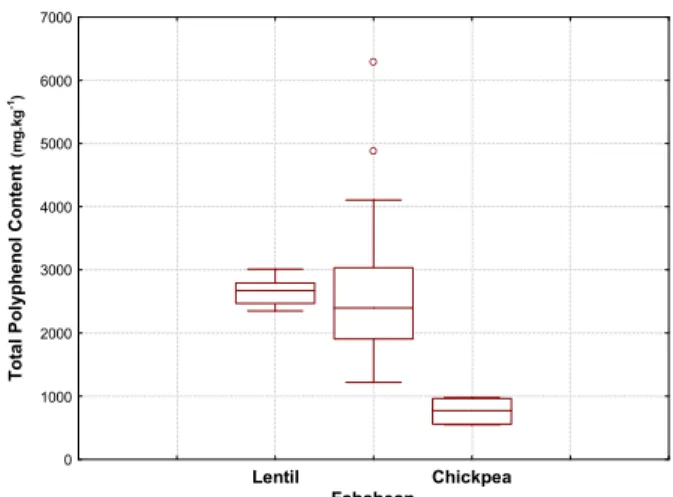
Total polyphenol content as well as total antioxidant capacity in three chickpea, four fababean and four lentil cultivars from regions of Iraq with different environmental growth conditions were investigated in the work. The total polyphenol content (TP) was estimated using Folin-Ciocalteau assay and the total antioxidant capacity (TAC) of legume extracts was measured using the DPPH spectrophotometrically. The obtained results confirmed that the polyphenols content in the tested legume cultivars was influenced by locality. From tested legumes the highest polyphenol content was measured in fababean (1220 – 6286 mg GAE.kg -1). In lentil (2351 – 3011 mg GAE.kg-1) the average TP value was slightly lower (by 1,6%),
while in chickpea (549 – 978 mg GAE.kg-1) it was dramatically (by 71,5%) lower in comparison to fababean. The similar trend was observed at values of TAC. The highest average TAC value was determined in fababean (15.2 – 25.6% DPPH), in lentil (14.2 – 28.9% DPPH) the TAC value was by 2% and in chickpea (1.9 – 4.5% DPPH) by 83,6% lower in comparison to fababean. Only in lentil a statistically strong correlation (P-value 2.391E-06; R = 0.802) was found. Our results confirmed that legumes can be a good source of bioactive compounds in the human nutrition.
INTRODUCTION
Legume grains have been playing a key role in the traditional diets of human beings throughout the world. They are excellent source of protein, dietary fiber, starch, micronutrients and bioactive compounds with low level of fat (Chang et al., 2000). The bioactive principles are divided chemically into a number of groups among which are alkaloids, volatile essential oils, phenols and phenolic glycosides, resins, oleosins, steroids, tannins and terpenoids (Ferreira et al., 2008), antioxidants (Heimler et al., 2005) and anticarcinogenic compounds (Hangen, Bennink, 2002; Mishra et al., 2010 ). Evaluation of antioxidant activity of phenolic compounds from leguminous seeds has been of interest in recent year. Phenolic compounds, such as phenolic acids, flavonols, flavones, isoflavones, anthocyannins, and condensed tannins, have been identified and characterized in food legumes (Beninger and Hosfield, 2003; Madhujith et al., 2004; Xu et al., 2007a, b). Several studies have reported on antioxidant and antiradical activity of tannins (Troszyńska
and Kubicka,2001;Amarowicz et al., 2004; Alasalvar et al., 2006; Amarowicz, 2007).
The aim of the work was to evaluate the content of bioactive compounds (polyphenolics) in legumes commonly utilized in the human diet in Iraq, to compare their antioxidant capacity and to evaluate the influence of grown locality on observed parameters.
MATERIAL AND METHODS
Three chickpea, four fababean and four lentil cultivars were cultivated in fields of regions in Iraq with different environmental growth conditions.
Extraction
For 12 hours extraction, dry material (5 g) was used and continuously extracted by a Twisselmann extractor with methanol (80%, v/v).
Total polyphenols
Antioxidant aktivity
The free radical scavenging activity of the extracts was measured using the DPPH
(1,1-diphenyl-2-picrylhydrazyl) method of Brand-Williams et al. (1995)
spectrophotometrically (Shimadzu UV/VIS-1240).
Statistical analysis
Statistical processing of the results was carried out Statistica 8. One-way ANOVA was used. Mean comparisons between cultivars were done by the LSD test.
RESULTS AND DISCUSSION
According to the obtained results, the polyphenols content (TP) in the tested cultivars was significantly different and was influenced by locality.
Table 1 Total polyphenols content (mg eq. gallic acid.kg-1 DM) and antioxidant activity (% of
DPPH inhibition) in chickpea cultivars
cultivar (locality) TP AOA
C1 (Marakeshi) 555.12±4.13 a 4.01±0.33 b
C2 (Erbil Research) 969.30±6.39 c 3.87±0.24 a,b
C3 (Harer) 770.68±19.92 b 2.08±0.11 a
Data expressed as means of six replications ± standard deviation. Values in the same column with the different letters present significant differences using t-test for independent samples.
Our results suggest that severe climatic conditions have caused a slight increase in the total content of polyphenolic substances. For growing chickpeas are the best warm and dry areas. Therefore the C1 seeds have shown significantly much lower TP content (this cultivar is grown in area suitable for growing chickpea), while the C3 variety, grown in mountain areas with higher rainfall, recorded higher amount of polyphenols. Lachman et al. (2006)
About the impact site is not enough literature demonstrable knowledge and scientists attache greater importance to other factors: the influence of variety, vintage effects and stress factors. Antioxidant capacity was genotype dependent, ranging from 2.08 to 4.01% of DPPH inhibition, but unaffected by location.
Table 2 Total polyphenols content (mg eq. gallic acid.kg-1 DM) and antioxidant activity (% of
DPPH inhibition) in fababean cultivars
cultivar (locality) TP AOA
F1 (Aqra) 1898.71±26.20 a 16.62±0.81 a
F2 (Erbil, Ankawa ) 2702.44±37.95 a,b 24.54±0.64 d
F3 (Alton kupri) 1583.54±13.79 b 21.66±2.12 b
F4 (Erbil Research) 3374.91±13.38 a 18.24±0.39 c
Data are expressed as means of six replications ± standard deviation. Values in the same column with the different letters present significant differences p < 0.05 using t-test for independent samples.
Our results suggest that more severe climatic conditions have caused a slight increase in the total content of polyphenolic substances (Table 2). For growing fababean warm and dry areas appears as the best. Therefore the F3 seeds from Alton kupri locality have shown the lowest TP content (this cultivar is grown in area suitable for growing fababean), while in the same F1 cultivar grown in mountain area (Aqra) with higher rainfall, was recorded more higher TP amount. Lachman et al. (2006) investigated the effect of weather conditions on the TP contents of potatoes and their results also showed that an upland cooler site with higher rainfall provide the seeds with a higher content of TP. On the other hand, the highest TP value of cv. F2 or F4 from Erbil locality with medium rainfall also indicates more influence on TP content.
Antioxidant capacity was in relation to genotype, ranging from 16.62 to 24.54 % of DPPH inhibition, but unaffected by location in varieties grown in Iraq.
Table 3 Total polyphenols content (mg eq. gallic acid.kg-1 DM) and antioxidant activity (% of DPPH inhibition) in lentil cultivars
cultivar (locality) TP AOA
L1 Qushtopa 2863.60±95.82 d 25,85±2,09 c
L2 Shaklawa 2419.62±47.99 a 16,66±1,56 a
L3 Kalak 2762.07±60.25 c 21,07±1,05 b
L4 Koysinjaq 2533.01±81.27 b 15,85±0,40 a
Data are expressed as means of six replications ± standard deviation. Values in the same column with the different letters present significant differences p < 0.05 using t-test for independent samples.
The determined TP content in lentil was in interval 2351 – 3011 mg GAE.kg-1, the
determined TAC value in interval 14.2 – 28.9% DPPH (Table 3). Gillooly (1983) presented higher values of the total polyphenol content in brown and green lentils (6800 mg.kg-1 and
6300 mg.kg-1 respectively). Awada et al. (2005) determined lower polyphenol content in
lentil seeds (4730 mg.kg-1) in comparison to mentioned authors. On other hand the values of
total polyphenols in lentil presented by Sindhu et al. (2012) (1191 mg.kg-1) are significantly lower than our results. The obtained results confirmed that the polyphenols content in the tested lentil cultivars was influenced by locality.
Along with essential nutrients, lentils are good sources of many nonnutrient functional phytochemicals such as phytic acid and tannins (Vidal-Valverde et al., 1994), which are considered among the functional antioxidant ingredients (Scalbert et al., 2005; Vucenik,
Shamsuddin, 2006). Lentils are also good sources of the antioxidants catechins and
procyanidins (Auger et al., 2004). As a consequence of the presence of a wide spectrum of phenolic and nonphenolic antioxidants in lentils, they have shown the highest antioxidant and oxygen radical-absorbing capacities among different legumes (Xu and Chang, 2007, 2008). Natural phenolic antioxidants can scavenge reactive oxygen and nitrogen species (RONS) thereby preventing of oxidative diseases in the body (Willett, 1994).
Lentil Fababean Chickpea 0 1000 2000 3000 4000 5000 6000 7000 To ta l P ol yp he no l C on te nt (m g. kg -1)
Figure 1 Polyphenol content in tested legumes (mg GAE.kg-1)
Lentil Fababean Chickpea 0 2 4 6 8 10 12 14 16 18 20 22 24 26 28 30 To ta l A nt io xi da nt C ap ac ity (% )
Figure 2 Total antioxidant capacity in tested legumes (% DPPH)
Neither in fababean (P-value 0.797, Figure 3) nor in chickpea (P-value 0.767, Figure 4) were confirmed correlations between total polyphenol content and total antioxidant capacity values. Only in lentil a statistically strongly significant correlation (P-value 2.391E-06; R = 0.802) was found (Figure 5). Amarowicz et al. (2005) analysed the extracts of fababean, broad bean, adzuki bean, red bean, pea, red lentil and green lentil seeds using 80% (v/v) acetone and confirmed a statistically significant correlation between the total antioxidant activity values and total phenolics (P = 0.01). A strong correlation between total polyphenol content and antioxidant activity (R = 0.86; P0.05) was observed also by Akond et al. (2011)
in common bean. According these authors this finding suggests that total polyphenol content is a good predictor of in vitro antioxidant activity.
Figure 3 Correlation between TP and TAC (fababean)
Figure 4 Correlation between TP and TAC (chickpea)
CONCLUSION
Fababean, chickpea and lentil belong to commonly utilized legumes in Iraq and they play a key role in the traditional human diet in this country. Based on our results the followed order of total polyphenol content as well as total antioxidant capacity in investigated legumes obtained from Iraq can be created: fababean lentil chickpea. Our results confirmed that legumes can be a good source of bioactive compounds in the human nutrition.
Acknowledgments: This contribution is the result of the project implementation: Centre of
excellence for white-green biotechnology, ITMS 26220120054, supported by the Research & Development Operational Programme funded by the ERDF.
REFERENCES
AKOND G. M. A. S. M. – KHANDAKER, L. – BERTHOLD, J. – GATES, L. – PETERS, K. – DELONG, H. – HOSSAIN, K. 2011. Anthocyanin, total polyphenols and antioxidant activity of common bean. In American Journal of Food Technology, vol. 6, 2011, no. 5, p. 385-394.
ALASALVAR, C. – GRIGOR, J. M. – ZHANG, D. – QUANTICK, P. C. – SHAHIDI, F. 2001. Comparison of volatiles, phenolics, sugars, antioxidant vitamins, and sensory quality of different colored carrot varieties. In Journal of Agricultural and Food Chemistry, vol. 49, 2001, p. 1410-1416.
AMAROWICZ, R. 2007. Tannins: the new natural antioxidants? In European Journal of Lipid Science and Technology, vol. 109, 2007, no. 6, p. 549-551.
AMAROWICZ, R. – TROSZYŃSKA, A. 2004. Antioxidant and antiradical activity of extracts of phenolic compounds from red bean. In Czech Journal of Food Sciences, vol. 22, 2004, p. 206-208.
AUGER, C. – AL-AWWADI, N. – BORNET, A. – ROUANET, J. M. – GASC, F. – CROS, G. – TEISSEDRE, P.-L. 2004. Catechins and procyanidins in Mediterranean diet. In Food Research International, vol. 37, 2004, p. 233-245.
AWADA, S. H. – HADY, H. – HASSAN, A. B. – ISAM ALI, M. – BABIKER, E. E. 2005. Antinutritional Factors Content and availability of Protein, Starch and Mineral of Maize (Zeamays linnaus) and Lentil (Lens culinaris) As Influnced by Domestic Processing. In Journal of Food Technology, vol. 3, 2005, no. 4, p. 523-528.
BENINGER, C. W. – HOSFIELD, G. L., 2003. Antioxidant activity of extracts, condensed tannin fractions, and pure flavonoids from Phaseolus vulgaris L. seed coat color genotypes. In Journal of Agricultural and Food Chemistry, vol. 51, 2003, p. 7879-7883.
BRAND-WILLIAMS, W. – CUVELIER, M. E. – BERSTE, C. 1995. Use free radical method to evaluate antioxidant activity. In Lebensmittel-Wissenschaft & Technologie, vol. 28, 1995, p. 25-30.
CHANG, S. – TAN, CH. – FRANKEL, E. N. – BARRET, D. M. 2000. Low-density lipoprotein antioxidant activity of phenolic compounds and polyphenol oxidase activity in selected clingstone peach cultivars. In Journal of Agricultural and Food Chemistry, vol. 48, 2000, p. 147-151.
FERREIRA, D. et al. 2008. Tannins and related-polyphenols: Perspectives on their chemistry, biology, ecological effects, and human health protection. In Phytochemistry, vol. 69, 2008, p. 3006-3008.
FERREIRA, P. M. P. – FARIAS, D. F. – de ABREU OLIVEIRA, J. T. – URANO CARVALHO, A. de F. 2008. Moringa oleifera: Bioactive compounds and nutritional potential. In Revista de Nutrição, vol. 21, 2008, p. 431-437.
GILLOOLY, M. – BOTHWELL, T. H. – TORRANCE, J. D. – MacPHAIL, A. O. – DERMAN, D. P. – BEZWODA, W. R. – MILLS, W. – CHARLTON, R. W. – MAYET, F. The effects of organic acids, phytates and polyphenols on the absorption of iron from vegetables. In British Journal of Nutrition, vol. 49, 1983, p. 331.
HANGEN, L. – BENNINK, M. 2002. Consumption of BlackBeans and Navy Beans (P. vulgaris) Reducedazoxymethane-induced colon cancer in rats. In Nutrition and Cancer, vol. 44, 2002, p. 60-65.
LACHMAN, J. – HAMOUZ, K. – ČEPL, J. – PIVEC, V. – ŠULC, M. – DVOŘÁK, P. 2006. Vliv vybraných faktorů na obsah polyfenolů a antioxidační aktivitu hlíz brambor. In Chemické listy, vol. 100, 2006, no. 7, p. 522-527.
LACHMAN, J. – HOSNEDL, V. – PIVEC, V. – ORSÁK, M. 1998. Polyphenols in cereals and their positive and negative role in human and animal nutrition. In Cereals for human health and preventive nutrition, Brno: MZLU, 1998, p. 118-125.
MADHUJITH, T. – NACZK, M. – SHAHIDI, F. 2004. Antioxidant activity of common beans (Phaseolus vulgaris L.). In Journal of Food Lipids, vol. 11, 2004, p. 220-233.
MISHRA, S. B. – RAO, CH. V. – OJHA, S. K. – VIJAYAKUMAR, M. – VERMA, A. 2010. An analytical review of plants for antidiabetic activity with their phytoconstituent &mechanism of action: a review. In International Journal of Pharmacology Science Research, vol. 1, 2010, no. 1, p. 29-44.
SCALBERT, A. – MANACH, C. – MORAND, C. 2005. Dietary Polyphenols and the Prevention of Diseases. In Critical Reviews in Food Science and Nutrition, vol. 45, 2005, p. 287-306.
SINDHU. S. N. et al. 2012. Isolation and determination of nutritional and antinutritional compounds from the seeds of selected plant species. In Journal of Chemical and Pharmaceutical Research, vol. 4, 2012, no. 7, p. 3529-3534.
TROSZYŃSKA, A. – KUBICKA, E. 2001. Superoxide scavenging activity of seed coat extracts from legume seeds. In Polish Journal of Food and Nutrition Sciences, vol. 10, 2001, p. 55-59.
VIDAL-VALVERDE, C. – FRIAS, J. – ESTRELLA, I., – GOROSPE, M. J. – RUIZ, R. – BACON, J.1994. Effect of processing on some antinutritional factors of lentils. In Journal of Agricultural and Food Chemistry, vol. 42, 1994, p. 2291-2295.
VUCENIK, I. – SHAMSUDDIN, A. M. 2006. Protection against cancer by dietary IP6 and inositol. In Nutrition and Cancer, vol. 55, 2006, p. 109-125.
WILLETT, W. C. 1994. Diet and health: What should we eat? In Science, 1994, vol. 264, 1994, p. 532-537.
XU, B. J. – CHANG, S. K. C. 2007. A comparative study on phenolic profiles and antioxidant activities of legumes as affected by extraction solvents. In Journal of Food Science, vol. 72, 2007, p. 159-166.
XU, B. J. – YUAN, S. H. – CHANG, S. K. C. 2007a. Comparative studies on the antioxidant activities of nine common food legumes against copper-induced human low-density lipoprotein oxidation in vitro. In Journal of Food Science, vol. 72, 2007, p. 522-527.