UNIVERSIDADE NOVA DE LISBOA
FACULDADE DE CIÊNCIAS MÉDICAS
DEPARTAMENTO DE SAÚDE MENTAL
IMPLEMENTATION PROGRESS OF MENTAL HEALTH
SERVICES IN RWANDA
Bugesera District case
MASTER’S DISSERTATION IN MENTAL HEALTH POLICY AND SERVICES
By
Claire Nancy MISAGO
Supervisor: Prof. BERNARDO BARAHONA-CORRÊA
Resumo
O Ministério da Saúde do Governo do Ruanda identifica a saúde mental como uma área de prioridade estratégica para a intervenção em resposta à alta carga dos transtornos mentais no Ruanda. Ao longo dos últimos 20 anos após o genocídio, o sector público reconstruiu sua Resposta Nacional de Saúde Mental com base no acesso equitativo aos cuidados, através do desenvolvimento de uma Política Nacional de Saúde Mental e novas estruturas de saúde mental. A política de Saúde Mental do Ruanda, revista em 2010, prima pela descentralização e integração dos serviços de saúde mental em todas as estruturas nacionais do sistema de saúde e ao nível da comunidade.
O presente estudo de caso tem como objetivo avaliar a situação do sistema de saúde mental de um distrito típico de uma área rural no Ruanda, e sugerir melhorias, incluindo algumas estratégias para monitoras as mudanças. Os resultados do estudo permitirão ao Ruanda reforçar a sua capacidade para implementar o Plano Nacional de Saúde Mental ao nível dos distritos. O relatório também será útil para monitorar o progresso da implementação de serviços de saúde mental nos distritos, incluindo a prestação de serviços de base comunitária e a participação dos usuários, suas famílias e outros interessados na promoção, prevenção, assistência e reabilitação em saúde mental.
Este estudo também procurou avaliar o progresso da implementação dos cuidados de saúde mental a nível descentralizado, com vista a compreender as implicações em termos de recursos desses processos. Foi realizada uma análise situacional num local do distrito, baseado em entrevistas com as principais partes interessadas responsáveis, usando o Instrumento de Avaliação de Sistemas de Saúde Mental da Organização Mundial da Saúde (WHO-AIMS).
Os resultados sugerem que os recursos humanos para a saúde mental e serviços de base comunitária de saúde mental no distrito continuam a ser extremamente limitados. Os profissionais de saúde mental são adicionalmente limitados na sua capacidade para oferecer intervenções de emergência a pacientes psiquiátricos e garantir a continuidade do tratamento farmacológico a pacientes com condições crônicas. Para planejar
de saúde mental deve envolver também os representantes das famílias e dos usuários no processo de planificação de modo a melhorar a sua contribuição no processo de
implementação das atividades de saúde mental.
Este estudo de caso do Distrito de Bugesera oferece a primeira análise de nível distrital dos serviços de saúde mental no Ruanda, e pode servir como uma mais-valia para a melhoria do sistema de saúde mental, incluindo a advocacia para a melhoria da
qualidade dos cuidados de saúde mental a este nível, aumentando o financiamento para a implementação de serviços clínicos de saúde mental e os recursos humanos
disponíveis para a prestação de cuidados de saúde mental, principalmente a nível dos cuidados primários.
Abstract
To deal with the high burden of mental health disorders resulting from consequences of the
1994 genocide against Tutsis, the Rwanda Ministry of Health (MoH) considers mental health
as a priority intervention. For the last 20 years, Ministry of Health focused on rebuilding a
national and equity-oriented mental health program responding to the population needs in
mental health. Mental health services are now decentralized and integrated in the national
health system, from the community level up to the referral level.
This study assessed the situation of mental health services in one rural district in Rwanda. It
was aimed at assessing the progress of implementation of mental health care at the
decentralized level, focusing on resource implications and processes.
This study is based on interviews conducted with key stakeholders, using the World Health
Organization's Assessment Instrument for Mental Health Systems (WHO-AIMS).
Findings show that human resources for mental health care and community-based mental
health services of the assessed district remain extremely limited. Mental health professionals
face limitation regarding the ability to provide emergency management of psychiatric patients
and to ensure continuity of psychopharmacological treatment of patients with chronic
conditions.
To improve the implementation process of mental health interventions and activities, a
planning process based on community needs and the involvement of representatives of
families and users in planning process should be considered.
The Bugesera case study on the situation of mental health services can serve as a baseline for
improvement of the mental health program in Rwanda, in terms of quality care services,
infrastructure and equipment, human and financial resources.
DEDICATES
To my husband Richard and my three daughters Delphine, Cindy and Meghane
To my family, brothers and sisters and regret parents
To my colleagues and friends
ACKNOWLEDGEMENTS
I wish to acknowledge my congregation to Universidade Nova de Lisboa for the support and the opportunity to do this Dissertation. My supervisor, Prof. Bernardo CORREA, deserves special mention for the significant role he has played in steering this dissertation from the very beginning to its completion.
Special thanks to Dr Achour Ait Mohand, Psychiatrist and Public Health, Technical Assistant of Mental health Division in Ministry of Health of Rwanda for his technical support. To the mental health division of Rwanda biomedical Center that supported me in my Masters journey, accept my sincere gratitude.
I am greatly indebted to the mental health unit of Bugesera District for providing me with data regarding their services and their imperturbability and support during the time of development of the Dissertation.
My sincere gratitude to my husband and daughters for their patience and moral support during the training period.
The team of MIPSSM, especially Prof. Caldas de Almeida, Prof Benedetto Saraceno and Prof Graça Cardoso deserve special mention for their experienced remarks during the training and courage during the thesis, we are very grateful.
Many thanks to the team of GEPG of FCM-UNL, and especially Sónia Tavares, for her serenity and availability to facilitate the process to participate in the training.
To my friends and colleagues, in the Master’s program accept my gratitude for your kindness and team work spirit.
I am very thankful to Dr Sebastiana NKOMO from WHO-Department of Mental Health and Substance Abuse (MSD), for her kind facilitation to access on the World Health Organization Assessment Instrument for Mental health Systems (WHO-AIMS) in collaboration with colleagues inside and outside of WHO.
Special thanks to Dr Stephanie SMITH, Psychiatrist and PIH/Department of Global Health and Social Medicine, Harvard Medical School, and her team for their support with serenity and empowering attitudes during the training and thesis period.
My sincere gratitude goes to the Hon. Minister of Health Dr Agnes BINAGWAHO and Dr Yvonne KAYITESHONGA, National Manager of Mental Health Division, for having given me this great opportunity to pursue my post-graduate studies and for their uncountable encouragement and support during my studies.
ACRONYMS
BD : Bugesera District
BDH
: Bugesera District Hospital
CHW : Community Health Workers
DH : District Hospital
DHS : Demographic Health Survey
EDPRS: Development Poverty Reduction Strategy
GN : General Nurse
GDP : Gross Domestic Product
GOR : Government of Rwanda
GP : General Practitioner
HC : Health Center
HMIS : Health Management Information System
HSSP : Health Sector Strategic Plan
LEM : List of Essential Medication
MH : Mental Health
MHN : Mental Health Nurse
MHU : Mental Health Unit
NISR : National Institute of Statistic of Rwanda
TABLE OF CONTENTS
ABSTRACT ... II
DEDICATES ... V
ACKNOWLEDGMENTS ... VI
ACRONYMS ... VII
INTRODUCTION ... XII
CHAPTER I: BACKGROUND OF MENTAL HEALTH IN RWANDA ... 1
1.1. POLICY ENVIRONMENT ... ERROR!BOOKMARK NOT DEFINED. 1.2. SOCIO-ECONOMIC SITUATION ... 1
1.3. HUMAN RESOURCES FOR HEALTH (HRH) ... 2
1.4. HEALTH FINANCING ... 2
1.5. HEALTH SERVICE DELIVERY ... 3
1.6. HEALTH INFORMATION SYSTEM ... 4
1.7. MENTAL HEALTH BACKGROUND ... 4
1.8. MENTAL HEALTH POLICY ... 7
1.9. PROGRESSOFIMPLEMENTATIONOFMENTALHEALTHSERVICES ... 9
1.9.1 Mental health resources ... 9
1.9.2. Health insurance to access on mental health care ... 10
1.9.3. Mental health prevention and promotion ... 10
1.9.4. Mental health epidemiological situation ... 11
1.9.5. Treatment and resources in mental health system ... 11
1.9.6. Rehabilitation and social integration ... 12
1.9.7. Monitoring of mental health data ... 12
1.9.8. Legislation in mental health ... 12
1.9.9. Inter-sectorial collaboration ... 13
CHAPTER II: METHODOLOGY ... 16
2.1.METHODOLOGY ... 16
2.2.CHARACTERISTICS OF RESEARCH SITE ... 17
2.3.HEALTH FACILITIES AVAILABLE ... 18
2.4.INSTRUMENTS ... 19
2.5.VARIABLES ... 19
2.6.ADAPTATION, TRANSLATION, BACK-TRANSLATION PROCEDURES ... 20
2.7.ANALYSIS PLAN ... 20
DOMAIN1:POLICYANDLEGISLATIVEFRAMEWORK ... 22
3.1.1. Policy, Plan and Legislation ... 22
3.1.2. Financing of Mental Health services ... 23
DOMAIN2:MENTALHEALTHSERVICES ... 26
3.2.1. Organization of mental health services ... 26
3.2.2. Mental health Outpatient facilities ... 28
3.2.3. Diagnosis of new mental health cases received in Outpatient Services ... 29
3.2.4. Diagnosis of old mental health cases received in Outpatient Services ... 29
3.2.5. Day treatment facilities ... 31
3.2.6. Health Centers ... 31
3.2.7. Community-based psychiatric inpatient units ... 31
3.2.8. Community residential facilities ... 32
3.2.9. Psychiatric Hospital ... 32
3.2.10. Forensic and other residential facilities ... 32
3.2.11. Human rights and equity ... 33
DOMAIN3:MENTALHEALTHINPRIMARYHEALTHCARE ... 39
3.3.1 Training in mental health care for primary care staff ... 39
3.3.2 Assessment and treatment protocols of care in primary health care ... 40
3.3.3. Prescription by primary health care doctors ... 40
DOMAIN4:HUMANRESOURCES ... ERROR!BOOKMARK NOT DEFINED. 3.4.1 Number of human resources in mental health care ... 42
3.4.2. Training of health professionals in mental health ... 42
3.4.3 Users and Family Associations ... 42
DOMAIN5:PUBLICEDUCATIONANDLINKSWITHOTHERSECTORS ... 44
3.5.1. Public education and awareness campaigns on mental health ... 44
3.5.2. Legislative and financial provisions for persons with mental disorders ... 45
3.5. 3. Links with other sectors ... 46
DOMAIN6:MONITORINGANDRESEARCH ... 49
CHAPTER IV ... 52
DISCUSSION, CONCLUSION AND RECOMMENDATION ... 52
4.1.DISCUSSIONS ... 52
LIST OF TABLES
Table 1: Estimated mental health expenditures in 2013 - Bugesera District Hospital 2013 .... 24
Table 2: Diagnoses of new mental health cases received in Health Centers - Bugesera District
- 2013 ... 31
Table 3: Diagnoses of old mental health cases received in Health Centers - Bugesera District
- 2013 ... 31
Table 4: Availability of psychotropic medication in mental health unit of BDH in 2013 ... 38
Table 5:General health professionals of PHC trained in mental health in BD in 2013 .... Error! Bookmark not defined.
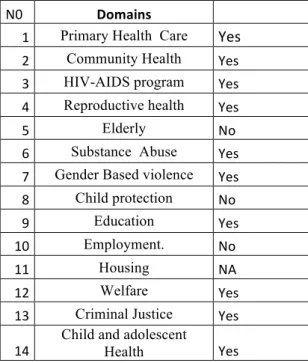
Table 6: Collaborations between mental health and other sectors in Bugesera District in 2013
... 47
LIST OF FIGURES
Figure 1: Situation of visits in mental health services- Ndera Neuropsychiatric Hospital ... 11
Figure 2: Estimation of mental health expenditures compared to the total of health
expenditures in Bugesera District - 2013 ... 25
Figure 3: Patients treated in mental health unit/outpatients unit of Bugesera district Hospital 34
Figure 4: Number of patients treated in inpatients mental health care at BDH in 2013 ... 34
Figure 5: Patients treated in inpatients mental health unit per diagnosis in 2013 ... 35
Figure 6: Old mental health cases received in Outpatient Services - Bugesera District Hospital
- 2013 ... 36
INTRODUCTION
Country context
1. Demographic and geographic situation
Rwanda is a small mountainous and land locked country of 26,338 square kilometers and
lying just south of the equator with an average elevation of 1,700 meters. Rwanda is a nation
of almost eleven million people in East Africa bordered by Uganda, Tanzania, Burundi and
the Democratic Republic of the Congo (NISR, 2012). The climate is temperate, with two
rainy seasons each year, February to April and September to December. Approximately 35
percent of the land is fit for cultivation.
Rwanda’s population is growing rapidly, with implications for the demographic structure of
the country. The most recent population census conducted in 2012 estimated the population to
be around 10.5 million people. The population density is the highest in Sub-Saharan Africa
(416 inhabitants per square kilometer). The population is essentially young, with 52 percent of
all Rwandans under the age of 20. In terms of gender, the 2012 census shows females to be in
the majority (52 percent) while males make up 48 percent of the population (NISR, 2012).
Between the two DHS of 2005 and 2010 the illiteracy rate declined from 34 percent to 15.5
percent among women and from 24 percent to 10.3 percent among men.
There are three official languages in the country. Kinyarwanda is the predominant language of
local business, while French and English are more professional languages. The largest
religious group is Christian.
The country is included in the lower income group based on World Bank 2004 criteria. The
unemployment rate was estimated at 25.5% in September 2006
OBJECTIVES
The principal objective of the study is to;
Collect the essential information on mental health services in one rural district of Rwanda
(Bugesera District).
Specifically, the study will reinforce the existing MH information system and facilitate the
CHAPTER I: INTRODUCTION
1.
BACKGROUND OF MENTAL HEALTH IN RWANDA
HEALTH SYSTEM BACKGROUND
1.1. National Health Policy
In the last 15 years, the Government of Rwanda (GoR) successfully designed and
implemented a broad set of policies and programs of economic reform and decentralization to
enhance local capacity. GoR has recently developed a new “Economic development and
poverty reduction strategy” (EDPRS 2) as mid-term plan for implementation of Rwanda’s
“Vision 2020”which will make Rwanda a lower-middle-income country by 2020.
Rwanda is committed to the international and regional agreements for which it is a signatory
such as the Millennium Developments Goals (MDGs) and is on track for achieving most of
the targets set for 2015. The health sector contributes directly to achieving five of the eight
goals which are: (i) Eradicate extreme poverty and hunger, (ii) reduce child mortality, (iii)
improve maternal health, (iv) Combat HIV/AIDS, Malaria and other diseases, (v)ensure
environmental sustainability.
New global objectives will be determined for the next period after 2015 and Rwanda will
continue to use these international goals to guide its development efforts.
To reach these national and international goals, Rwanda has decided to update the Health
sector policy developed in 2005, and to align the Health sector strategic plan (HSSP III
2012-2018) to this new policy.
1.2. Socio-economic situation
Efforts have been made to develop the service sector and stimulate investment in the
industrial sector; however, the Rwandan economy remains dominated by agriculture.
In 2010, the service sector accounts for the largest share of Rwanda’s Gross Domestic Product
(GDP), roughly 50 %, followed by agriculture with 33 % and industry with 17 %. (6)
The health sector has a crucial role to play in the achievement of the national mid-term goal of
11.5% economic growth rate. Continuous progress in the coverage and quality of health care
status and productivity of the Rwandan workers. Health services, as an important element of
the service sector, thus contribute in a decisive manner to the generation of collective wealth.
According to the Ministry of Finance in the fiscal year 2010-2011 GDP Growth was 8.1% and
the GDP per capita was $562. The percentage of people living below the poverty line was
44.9% in 2010-11, down from 56.7% in 2005-06. In 2010-11, net primary school and
secondary school attendance were respectively at 91.7% and 20.9%. The percentage of people
having access to safe drinking water was 74.2%, while only 10.8% of people had access to
electricity for lighting. (7)
1.3. Human Resources for Health (HRH)
In 2013, there were 678 doctors and 9,448 nurses/midwives working in Rwanda. Based on
2010 data from the Human Resources Information System (HRIS), this corresponds to a ratio
of 1 doctor per 16,046 inhabitants, 1 midwife per 18,790 inhabitants and 1 nurse per 1,227
inhabitants. (3)
Specialized physicians represent a small portion (24%) of the total number of physicians in
clinical practice in the country. Additionally, they are mainly located in and around the
capital city Kigali; whereas 76% of general practitioners are distributed in District hospitals in
the rural area. The process of continuous learning for graduates to have specialization at all
levels of health professional cadres is still low (A0/A1 nurses represent 31% of all nurses
including the psychiatric nurses who manage principally mental health services in health
facilities, and specialized physicians 24% of all physicians). The objective is to have human
resources with Masters Degrees for different competencies in the health system. The HRH
quality improvement targets both health care providers and health managers.
Capacity building of CHWs is in process to improve cost-effective health care delivery at the
community level. The role of CHWs is increasing and considered as a priority in
strengthening the mental health community based services.
1.4. Health Financing
Over the last few years, Rwanda has developed a comprehensive financing framework with
two main channels for financing, one from the supply side, transfers from the treasury to
Government agencies such as the Ministry of Health and Rwanda Biomedical Center manage
47% of health funds. Risk pooling has been greatly improved as a result of the extension of
community-based health insurance schemes which allow the majority of the population access
to health care services and drugs. Social and private health insurances now cover
approximately 92% of the population. Mental health care and psychotropic medication is
included in the health care services covered.
Other pooling mechanisms are important for efficient management of drug procurement,
performance-based financing (PBF) and CHW cooperatives.
For Financial accessibility to health care services the population is classified in the Ubudehe
categories which are the local government system of categorizing population according to
their social and economic cluster aiming to increase wellbeing and providing direct support
to the population (Ministry of local government, 2013). The Ubudehe category determines
the amount of the contribution of households to the Community based health insurance
(Mutuelles). The government pays the full contribution for the poorest.
Mutuelles is a community based health insurance program, established since 1999 by the
Government of Rwanda as a key component of the national health strategy on providing
universal health care.
1.5. Health Service delivery
The Rwanda health system comprises a network of five referral hospitals including the single
neuro-psychiatric hospital in the country, 43 district hospitals, and 450 health centres.
In addition, the emergency medical assistance service (SAMU), are mainly providing
ambulances with first aid and conduct transfers of patients to health facilities. The service is
now fully operational in all districts with 154 ambulances (five ambulances in each district the
standard requirement fitted with tracking systems) and a call centre managing the flow of
transfers including mental health cases.
Emergency Departments have been constructed in most referral and DHs and a Pre-Hospital
Emergency Care Service has been established.
Implementation of the community health services package has been one of the greatest
The Rwandan health system has greatly benefited from task shifting in which Community
Health Workers (CHWs) are delivering primary health services at the community level.
This has relieved the workload at health centres and has reduced patients’ travel costs to reach
health centres. It is estimated that the community level deals with approximately 80% of the
total disease burden and has to be appropriately strengthened. (3)
Rwanda’s health care system is organised along the principles of primary health care and
services are provided at different levels: community, health centers, district hospitals, and
referral hospitals. Health Center is the first contact point for patients from villages, and also
coordinates all outreach and prevention activities held at the community level, carried out by
community health workers (CHWs).
1.6. Health Information System
The Health sector Monitoring and Evaluation System is primarily divided between health
facility-based and community-based components of monitoring and evaluation of health
interventions.
A community based information system has been introduced throughout the country.
The Health Management Information System (HMIS) integrate indicators of mental health
and is regularly monitored and analysed by mental health professionals for evaluation of
needs and best planning.
1.7. Mental health background
Rwanda faces an exceptionally large burden of mental disorders. The top five leading causes
of YLDs (Years lived with disability) in Rwanda include two mental health disorders. Indeed,
the top five leading causes of YLDs in Rwanda are major depressive disorder, anxiety
disorders, iron-deficiency anaemia, low back pain, and chronic obstructive pulmonary
disease. YLDs are estimated by weighting the prevalence of different conditions based on
GBD profile: Rwanda (Global burden of diseases, injuries, and risk factors study 2010 http://www.healthmetricsandevaluation.org)
In Rwanda, the percentage change of causes of Disability-adjusted life years1 (DALYs)
between 1990 and 2010 shows an increase of three neuropsychiatric disorders in the five first
causes: anxiety disorders, major depression and epilepsy.
1
GBD profile: Rwanda (Global burden of diseases, injuries, and risk factors study 2010
http://www.healthmetricsandevaluation.org)
Rates of depression and post-traumatic stress disorder among adults remain high and have
been reported at levels that far exceed international averages. Much of the country’s burden of
mental disorders can be traced back to the genocide in 1994, which resulted in the deaths of
more than one million people and untold additional disability and suffering. Physical
devastation aside, the emotional and mental implications were and continue to be
incalculable. Up to one in four adults is estimated to suffer from post-traumatic stress disorder
(PTSD) and prevalence of major depression was estimated to be as high as 15.5% (10). In
response to the burden of mental disorders, the government of Rwanda, Ministry of health has
developed strategies to provide people-centred services for all with mental health problems. In
fact, over the last 20 years, the public sector has rebuilt its national mental health response
based on equitable access to care. Rwanda developed its first national mental health policy in
1995. By 2005, mental health was identified within the health sector policy as a priority area
for intervention. (3) This policy also called for the integration of mental health services in all
Box 1: Key interventions of the national mental health policy (2011)
1) Decentralization and integration of mental health care into primary health care, and promotion of community-based approaches 2) Integration of mental health care into
community-based health insurance (CBHI), and support for the availability of psychotropic medicines
3) Improving the quality of mental health care 4) Sensitizing on mental health issues and
fighting stigma
5) Developing human resources in mental health 6) Promoting human rights and drafting a mental
health law
7) Development of specific programmes
according to the epidemiological context: PTSD, drug abuse, epilepsy and child and adolescent mental health
programs for mental health and general professionals have been implemented, and dedicated
referral facilities have been established. Decentralized hospitals and health centers across the
country are now capacitated to provide mental health care.
In terms of the organization of mental health care, there is a Mental Health Division within
Rwanda Biomedical Center in the Ministry of Health. The Mental Health Division is
composed of three main units: the psychiatric care unit, community interventions and
promotion unit, substance abuse prevention and control unit. The staff comprises a total of
eleven professionals.
Its mission is to implement the mental health policy through a strategic plan under the
guidance of the Health Sector Strategic Plan. (2)
1.8. Mental health policy
The first national mental health policy was developed in 1995 and reviewed in 2011 using an
intensely participatory and consultative process. (Ministry of Health 2011) The revised mental
health policy includes a problem statement, specific objectives and the priority intervention
areas (see Box 1 for a summary of the main intervention areas). In general, the values and
principles developed in the policy
promote human rights,
community-based approaches and
intersectoral collaboration. The
policy highlights the need for
mental health legislation that
upholds the rights of people with
mental health problems and that
establishes a legal framework in
mental health care practice. A
proper analysis of the document
found that the principles of
primary health care are
According to the current mental health policy, the Mental Health Division of the Ministry of
Health has initiated a series of policy actions:
ü Provision of trained mental health nurses to all District Hospitals (43)
ü Provision to each district of at least one general medical doctor and one general nurse trained in MH;
ü Provision of training in MH to HC nurses (currently about one third have nurses trained in MH)
ü Provision of mental health training to CHWs
ü Development of mental health legislation
Within this framework, the Mental Health Division priority strategies and interventions
include:
ü Strengthening the integrated mental health care model within the health system:
ü Initiating referral mental health services in future provincial hospitals;
ü Providing mentorship in mental health services in DHs, provincial hospitals, and specialized institutions;
ü Developing protocols and guidelines for treatment of MH problems and community psycho-social rehabilitation;
ü Providing psychotropic drugs in all health facilities;
ü Producing and disseminating documentation on mental health issues;
ü Coordinating psychological interventions during commemoration of genocide.
ü Using the CHWs network for community mental health interventions by integrating mental health in the CHWs package of activities in all villages
Recent achievements of the Mental Health Division include:
ü Coordinating psychological interventions during commemoration of genocide against Tutsi,
ü Organizing sensitization campaign of communities and schools against drug abuse,
ü Training mental health professionals and in particular psychiatrists,
ü Initiating training and mentorship of general practitioners and nurses working in all HFs,
ü Developing a master plan of drug abuse prevention and control interventions by initiating treatment and detoxification in specialized services.
ü Using operational research to develop evidence-based interventions,
ü Conducting research on prevalence of mental health issues.
The Rwandan mental health policy called mainly for the integration of mental health services
into the health system to assure that services are complete and continuous.
1.9. PROGRESS OF IMPLEMENTATION OF MENTAL HEALTH SERVICES
1.9.1 Mental health resources
There are two referral settings in mental health in Rwanda, all based in Kigali city: The first
inpatient neuropsychiatric hospital is in main city at Kigali that offers specialized services for
patients with both neurologic and psychiatric disorders. There is also a Mental Health
outpatient referral department located at the Kigali University Teaching Hospital (CHUK).
Specific interventions to strengthen the overall health care system have led to the scaling up
of district facility referral capacity for mental health care: 44 district hospitals are now
equipped with at least 1 mental health nurse. Nearly half of all district hospitals also mobilize
a clinical psychologist as part of the district mental health team. Six of them have specific
hospital beds for the mentally ill. Two general practitioners and two general nurses from each
district hospital are trained each year in psychiatric care to support part time the mental health
services. The effort to decentralize and integrate mental health into the PHC system is further
pursued by targeted training for nurses of the health centres and for community health
workers. All district hospitals are linked to approximately ten to twenty health centres in the
community with one up to two general nurses trained in mental health (8)
The number of clinicians trained in mental health care is increasing and training has
accelerated in recent years, but many of the clinicians work at the central level and few are
practicing in health facilities managed by the Ministry of Health. Others work for
non-governmental organizations, international institutions, or local government. A parallel
phenomenon is seen among psychiatric nurses: among the 293 trained by 2011, only 140 are
1.9.2. Health insurance to access mental health care
All mental health care and essential psychotropic drugs are enrolled in Rwanda’s
community-based health insurance system (mutuelles de santé). All insurance premiums and co-payments are fully subsidized for the poorest quarter of the population. Community-based health
insurance allows people with mental disorders to pay at most a 10% co-payment for drugs and
services
Currently there is 91% enrolment in the mutuelles de santé and another 7% of Rwandans covered by civil servant or private insurance as of June 2012. (9)
As a result of these increases in capacity and access as well as the mass sensitization
campaigns about mental health issues done twice each year, mental health consultations at
health facilities have increased dramatically over recent years. Ate the same time, the transfers
from decentralized services to referral services have decreased. (8)
1.9.3. Mental health prevention and promotion
The Mental Health Division organizes an annual national campaign for “World Mental Health
Day” based on an internationally chosen topic and adapted to the country context. Other
activities and events are organized throughout the year in order to increase awareness within
communities of mental health and drug abuse issues. These activities include school
education, community sensitization sessions, and radio spots designed to fight against the
stigma of mental disorders in society and to sensitize the population to use mental health
services and contribute to community interventions for victims.
There is a Mental Health Technical Working Group that meets quarterly to plan, guide and
coordinate the implementation of mental health activities. This committee is composed of
representatives of public and civil society stakeholders, representatives of mental health
institutions and MH education boards for coordinating mental health activities in the country.
The Mental Health Division hosts an annual international conference for mental health
professionals and representatives of international institutions to share experiences and best
practices of countries, in order to improve the quality of mental health care interventions in
1.9.4. Mental health epidemiological situation
According to the 2008 Global burden of disease study, Non Communicable Diseases
represent 17% of the disease burden in 2004 and 4.3% of them are neuropsychiatric
conditions (12)
During the post-genocide period, new challenges related to mental trauma problems and their
complexity emerged within Rwandan communities. A study conducted in 2009 by Dr.
Munyandamutsa and Dr. Mahoro on 981 adults revealed that 79.41 per cent of the total
population have experienced in one way or another, traumatic events. The study findings
estimate the prevalence of PTSD at 21.6 per cent of the total population. Fifty four per cent
(54%) among traumatized people suffer also from depression. (4)
In addition, demand for mental health care increased. For example Table 1 shows the trend of
inpatient and outpatient consultations in Ndera Neuropsychiatric hospital, the only one in the
country. Outpatient consultations have increased since 2007 from 25830 in 2007 to 37978 in
2012. (8)
Table 1: Evolution of the number of outpatient consultations and hospitalisation at
Ndera Neuropsychiatric Hospital
Activity
Year
2007 2008 2009 2010 2011 2012
Outpatient consultations 25830 31125 34951 36392 37644 37978
Inpatient 2917 3463 3278 3416 3332 3452
1.9.5. Treatment and resources in mental health system
The management of mental health problems at the district level is mainly the job of public
health facilities. Due to the shortage of psychiatrists in the country, until now the management
of mental health patients in health facilities has been shifted to the mental health nurses and
clinical psychologists.
As for community based interventions, work is mostly conducted by trained health
professionals as well as by non-professional health workers, including community health
workers trained in mental health, counsellors, and psychosocial animators. Mental health care
packages at all levels and essential psychotropic drugs are fully integrated in community
In order to insure continuously the reinforcement of capacities of mental health staff, the
mental health division performs regular clinical supervisions and mentorships from referral
mental health services to decentralized services. This is done by a team of mental health
experts (psychiatrist, psychologist and psychiatric nurse) on a weekly basis, across all
districts. District Hospitals are performing monthly integrated supervisions to Health Centres
where they mentored mental health services and captured all data related.
1.9.6. Rehabilitation and social integration
After managing the mental health cases at the district level, and before discharge into the
community, mental health professionals design a reintegration and rehabilitation plan based
on developing patients’ capacities and identification of supporting networks in the
community.
After strengthening capacities of patients for reintegration and rehabilitation, social workers
along with mental health professionals proceed to the sensitization and education of families,
mainly focusing treatment adherence and compliance with the reintegration project and
follow-up schedule. It is in this inter sectorial framework that they advocate for effective
reintegration of mental health patients and the few cases they followed in the period of study
are reported in regular report of hospital.
1.9.7. Monitoring of mental health data
Clinical data of patients are continuously collected during both inpatient and outpatient visits.
Diagnoses are based on CDI 10 and DSM IV criteria, and both diagnoses and treatment are
recorded. Other information is collected from regular reports and registers of patients
attending mental health services in each region and they are reported to national health
management information system for analysis and using.
1.9.8. Legislation in mental health
The current mental health strategic plan of 2010-2015 assumes as its priority the development
of a mental health law to protect persons with mental health disorders, and to regulate the
management and quality of mental health services in Rwanda. The draft law is currently
available in the public domain and is in the process of translation and validation. The law will
be presented to parliament and cabinet of Ministers for validation between July 2014 and June
1.9.9. Inter-sectorial collaboration
A Mental health collaboration framework in Rwanda has been built by the National Technical
Working Group, comprising stakeholders from national and international NGOs. The group
supports the implementation of the government’s mental health policy through national
mental health programs. The national steering committee meets regularly and is chaired by
the head of mental health division/Ministry of Health, which is the advisor entity for mental
health policy and for the coordination of its implementation. In parallel with this, there is
collaboration between several sectors (youth, education, internal security, justice, etc.) in the
field of awareness and the fight against drug abuse and addiction. In this context several
awareness campaigns are conducted several times a year in youth related environments,
schools, universities, etc. Recently the government has established a project to set up an
inter-sectorial committee for the coordination of actions against drugs
There is also collaboration between the Ministry of Health and Ministry of Education in the
field of prevention of psychotrauma in schools via districts activities.
The Ministry of Health has also conducted training for nurses working in health centers in
prisons in the field of mental health in order to integrate a mental health component in health
2.
Objectives of the study
2.1. General objective
The purpose of the study is to collect information on the implementation progress of mental
health services in one rural district (Bugesera district).
2.2. Specific objectives were:
- To monitor the progress of implementation of mental health services in Bugesera
district settings
- To identify the barriers of the process of implementation of mental health services
- To suggest strategies to improve the plan in remaining districts and region
1.3. Research questions
- What is the progress of implementation of mental health services in Bugesera district?
- What are the barriers of the process of implementation of mental health services in
Bugesera district?
- What are the strategies that we could suggest to improve the MH services in Bugesera
District?
1.3.1. Study hypotheses
General hypothesis
The process of implementation of mental health services into health system is taking place as
planned.
1.4. Significance of the study
Even if there are many actions to increase mental health services capacities in the Rwandan
health system, as of yet there has been no evaluation of the process.
The results of the study will help to evaluate the progress of implementation of the mental
health services in the overall health system, as well as the barriers toward the process of
The outcome of the study will also suggest strategies to improve the implementation process
all over the country.
WHO-AIMS data should assist Rwanda as a country in developing information-based mental
health plans with clear baseline information and targets.
Via this work, Rwanda could be able to monitor progress in implementing reform policies,
providing community services, and involving consumers, families, and other stakeholders in
mental health promotion, prevention, care, and rehabilitation.
Through the use of the WHO-AIMS, Rwanda will have a clearer and more comprehensive
picture of the main weaknesses in their mental health system, and this knowledge should
facilitate improvements over time.
The results can also serve as scalable model in decentralization and integration process of
CHAPTER II: METHODOLOGY
2.1. Methodology
The present study uses the English version of the instrument of evaluation for mental health
services of the World Health Organization. The World Health Organization Assessment
Instrument for Mental health Systems (WHO-AIMS) is a new WHO tool for collecting
essential information on the mental health system of a country or region. The goal of
collecting this information is to improve mental health systems.
For this study is aimed to analyse the mental health situation in the semi-rural district of
Bugesera. The data collection was done at the mental health unit within the general hospital in
Bugesera District, along with use of information from local government and stakeholders as
needed. Data were collected for calendar year 2013.
The following data management steps were taken:
• Routine data including demographic information, patient diagnoses and treatments
administered are currently routinely recorded by district mental health clinicians in
their daily register in both the district outpatient mental health clinic and inpatient
general hospital. These data were pulled from the registers by me.
• Mental health indicators reported nationally within general district health reports were
also used to complete WHO-AIMS.
• Face to face semi structured interviews was performed with mental health and other
hospital staff to obtain data required by WHO-AIMS which is not routinely recorded
by district health system staff. Interviews were also held with local authorities’ heads
of social services, education, prison, and other administration entities of the district.
• Data were entered by me into the WHO-AIMS Excel Data Entry program for analysis
2.2. Characteristics of research site
Demographic card
DEMOGRAPHY (PROJECTIONS IN 5-YEARS)
Bugesera District is one of the seven districts that comprise the eastern province of Rwanda.
The recent national survey estimated the district population to be 314 892 habitats in 2011
(UBUDEHE 2011). The population represents 15.45% of the entire population of the Eastern
province. 47.1 % of them are male and 52, 9 % are female. The accessibility to Community
Map of health facilities in Rwanda (2012)
C S: centre de santé (Health center) , D ISP: dispensaire (dispensary) , FO SA C O M : Formation Sanitaire Communautaire (Community health facilities), H D :Hopital de district (District Hospital), PR IS: prison, H M : Hopital Militaire ( Military Hospital), H N R : Hopital National de Reference (National referral Hospital), C M S: Centre Medical Social (Social Medical Centre) , H P : Hopital Provincial (provincial Hospital , PS : Post de Santé (health Post).
2.3. Health Facilities available
The Bugesera District has one district Hospital, Nyamata District Hospital, with one
integrated mental health service in the district hospital. The hospital is in the district town
area, Nyamata sector. The district has 15 health centers (primary level), each with one or two
nurses trained in mental health who can receive mental health cases for preliminary
management before transfer to the district hospital.(12) The majority of those HCs are within
30km of the district hospital, which facilitates the access and transfer system. (14) There are
about three organizations of community mental health stakeholders working with mental
health community based services. Two for orphans and widows of genocide victims and one
for youth working in fighting against drug abuse. The local mental health organizations are
meeting reguraly at bugesera district hospital for implementation of mental health activities
services in one year is 2.2 for women vs 1.4 of men (Which can probably be justified by the
using of maternity or family planning services). At the national level, BD is among the top
six districts in terms of number of general hospital admissions, with a higher number of
admissions for women (117 vs 46 ). (12)
The source of health financing in Bugesera District hospital is government budget, incomes
generating from services delivery, and financial support from partners ( local and international
NGOs). It is very difficult to estimate the global budget for health because not all sources of
funds are reported in the financial reporting system of the district. Nevertheless, the 3 most
important domains of expenditure are remuneration of staff, training and supervision, and
purchasing of medication and consumables, which represent 94.9 % of all health expenditures
each year. (12)
Criteria that contributed to the choice of Bugesera District.
- District located in rural area that offers the mental health services at all levels
of health facility.
- Services available from January1st, to December 31st, 2013 and delivered by
mental health professionals with or without support of partners
.
- Bugesera District has in and outpatient mental health services integrated in the
general hospital.
2.4. Instruments
I used the WHO-AIMS volume 2.2 (World Health Organization Assessment Instrument for
Mental Health Systems), a valid, cost-effective tool designed to evaluate mental health
services in a region or country (13).
The 6 aspects of the instrument relevant to the district-level analysis of the Bugesera district
were included: policy and legislative framework; mental health services; mental health in
primary care; human resources; public education and links with other sectors; and monitoring
and research.
The WHO-AIMS instrument comprises 156 items grouped into 6 domains, including
demographic and service use variables such as: sex, age of patients attended, diagnosis
according to the DSM-4 scale, time spent during hospitalization, type of admission, patients
registered/isolated, access to psychotropic medicine, human resources in MH, inter sectorial
collaboration, existing social support to patients and monitoring, prevention and promotion
programs in Mental health.
The number of variables has been analysed and presented by regrouping the items of the
AIMS-WHO tool domains.
The analysis has been done by regrouping the results in 6 domains of the tool like: related to
policies, legislation, strategies and action plans and funding; mental health services; primary
care; human resources and liaison with other key sectors in presentations of data and easy
analysis of data.
2.6. Adaptation, translation, back-translation procedures
The English versions of WHO- AIMS volume 2.2 (WHO 2005a) was used as English is one
of two professional languages in the country. The French version was referred to if needed for
clarification.
2.7. Analysis plan
For analysis of data collected, I used the WHO-AIMS Excel Data Entry Program and analysis
software, which performed automatic percentage calculations. In addition, descriptive
statistics was used to complete analysis (e.g.: to analyse the financial estimation of mental
CHAPTER III: RESULTS
Introduction
This study aims to find the essential information on progress implementation of mental health
services of Bugesera district hospital. Health professionals, representative of families, local
authorities and four patients were interviewed:
1- The director of the unit of psychiatric care in the national mental health division, who is
coordinating the process of implementation of mental health policy in decentralized levels,
PHS and PHD in Mental health nursing
2- Two psychiatric nurses working for mental health services in BDH, who have worked for
the service at least in the last two years,
3- Two representatives of patients’ families, attending the support groups of the BDH,
4- Four patients (2 new cases and 2 follow up cases),
5- Director of BDH, MD, MPH
6- Financial Manager of BDH, Accountant
7- Vice mayor, in charge of social affairs, health, education and vulnerable groups support at
the Bugesera district, Social worker
8- Head of health centers in Bugesera district, MPH
9- Data manager and Monitoring and evaluation officers of BDH, Statistician and MPH
After presenting the concept of the research, the purpose of the study and the key questions
which are in the tool, the interviewees were recruited by the principal author.
The interviews were semi structured and individual, and occurred face to face. At the
beginning of the interviews, the participants were briefly introduced to the concepts of the
AIMS-WHO tool used. Then they were asked to discuss their views and answers. For some
questions they used their regular reports and hospital database.
In addition, all participants were asked to discuss particular issues and to express their
opinions about what can be done to improve the process of implementation of the mental
DOMAIN 1: POLICY AND LEGISLATIVE FRAMEWORK
3.1.1. Policy, Plan and Legislation
The Mental Health Plan in the Bugesera District is based on the national mental health policy,
reviewed in 2011. The relevant priorities of that policy are: provide Mental Health Services
and insure effective, coordinated mental health care through the enhancement of education,
capacity building at various levels and inter-sectorial collaboration in order to improve access
to the services end quality of treatment for Rwanda people with mental disorders.
The current policy aims to reinforce the following interventions within the district: (1)
decentralization of mental health care and integration of mental health care into primary
health care; (2) strengthening of human resources; (3) rehabilitation and reintegration of
mental health patients; (4) advocacy and promotion; (5) protection of human rights of
patients; (6) improvement of quality of mental health services; (7) monitoring and evaluation.
Planning for service delivery is the responsibility of districts. For Bugesera district, they have
a district strategic plan and yearly DH operational health plan, including mental health
services as a priority component. For community mental health services, mental health
services are included within these general health plans. The district uses the national list of
essential psychotropic medicines. These medicines include antipsychotics, anxiolytics,
antidepressants, mood stabilizers, antiepileptic drugs and others.
There is a draft of mental health legislation (the Mental Health Care Act) currently in process
of validation at the national level, which will eventually be implemented in Bugesera district.
The review boards are planned to be established when the law reaches implementation phase.
However, there is currently no specific mental health law within the district. There is also no
official emergency/disaster preparedness plan for mental health at either the national or
district level.
However, the psychosocial services for refugees are integrated in the national emergency
interventions package availed by ad hoc national multisectorial steering committee of
3.1.2. Financing of Mental Health services
The budget dedicated to mental health is fully integrated into the overall budget for health at
district level. The total budget is expressed in areas of expenditure by integrated and global
fields (e.g. purchasing medications, salaries or remuneration, capacity building of staff…). So,
it is very difficult to know the exact amount specifically dedicated to mental health.
In this study, the estimation of mental health expenditure in Bugesera District is limited to
expenditures on mental health at the district hospital. Expenditures on mental health in health
centers and other structures at the community level are not available. Expenditures reported
by the district hospital do not include the running cost and maintenance of the mental health
unit. Note that the local community health insurance scheme supports up to 90% of expenses
related to the outpatient consultation, inpatient care, transfers to the referral mental health
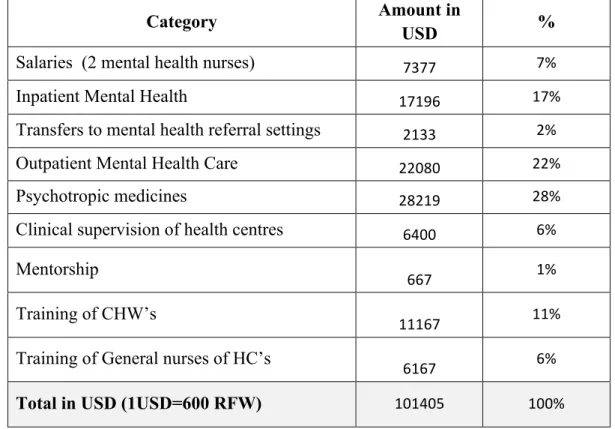
Table 1: Estimated mental health expenditures in 2013 - Bugesera District Hospital 2013
Category Amount in
USD %
Salaries (2 mental health nurses) 7377 7%
Inpatient Mental Health 17196 17%
Transfers to mental health referral settings 2133 2%
Outpatient Mental Health Care 22080 22%
Psychotropic medicines 28219 28%
Clinical supervision of health centres 6400 6%
Mentorship
667 1%
Training of CHW’s
11167 11%
Training of General nurses of HC’s
6167 6%
Total in USD (1USD=600 RFW) 101405 100%
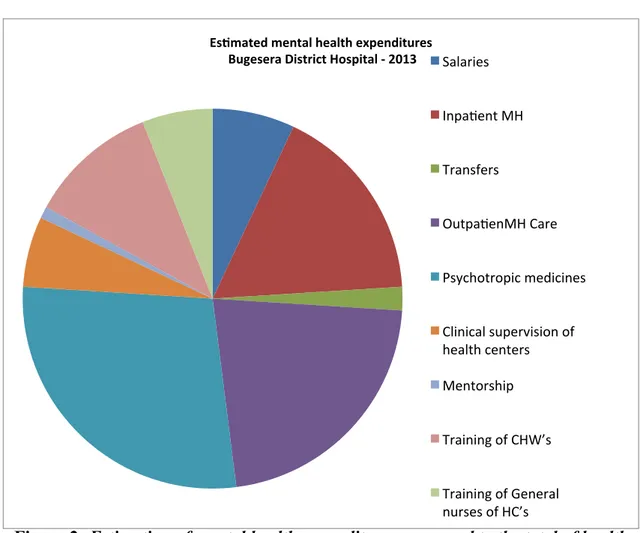
In Bugesera district Hospital, the expenses with mental health services in 2013 are estimated
at 99 272 USD, which corresponds to 3.8 % of the general health budget of the Bugesera
district. The largest expenditures correspond to purchasing psychotropic drugs, outpatient care
Figure 1: Estimated mental health expenditures in 2013 - Bugesera District Hospital 2013
Figure 2: Estimation of mental health expenditures compared to the total of health expenditures in Bugesera District Hospital - 2013
4%
96% 100%
Es/mated mental health expenditures
Other health expenditures
Total of health expenditures
Es#ma#on of mental health expenditures compared to the total of health expenditures in Bugesera District - 2013
Es#mated mental health expenditures
Bugesera District Hospital - 2013 Salaries
Inpa/ent MH
Transfers
Outpa/enMH Care
Psychotropic medicines
Clinical supervision of health centers
Mentorship
Training of CHW’s
DOMAIN 2: MENTAL HEALTH SERVICES
3.2.1. Organization of mental health services
Mental health services are organized in terms of district catchment areas throughout the
country. At the central level there is a mental health division.
The Division of mental health is located at the Ministry of Health and is in charge of
developing and implementing health policies, plans, and legislation, both in the area of mental
health and drug use related problems, by ensuring regulation and coordination of mental
health services across the country. In terms of implementation this entity also has an
important role ensuring the integration of mental health services into primary care and
decentralized community based services.
The Mental Health Division comprises a Head of division and includes three units managed
by three directors of units:
• Unit I: Psychiatric care and mental health development,
• Unit II: Prevention and treatment of substance abuse disorders
• Unit II: Community-based rehabilitation and interventions in specific environments
Within each unit there are two professional specialists (psychiatric nurses and clinical
psychologists and one crosscutting technical assistant (psychiatrist). the directors of the units
in charge of topics assigned to each unit (see the figure below). In addition, the Mental Health
Division includes a data manager and an administrative staff.
The Mental Health Division, through its three units, provides policy direction to the mental
health stakeholders and health authorities, who are involved in service planning, service
management and coordination; and monitoring and quality assessment of mental health care
Mental health structure, Rwanda Biomedical Centre /Ministry of Health
(2014, RBC report)
For Bugesera District, all the resources and the budget for mental health services are
integrated into the overall budget of district. Therefore this study includes district indicators
3.2.2. Mental health Outpatient facilities (Outpatient mental health services unit in general Hospital)
In Bugesera District there is a mental health department located in the general District
hospital. The department performs outpatient consultations and inpatient services in one
mental health unit.
In 2013, Nyamata DH Mental Health Unit has performed 3312 consultations, among them
246 (7 %) were new cases and 3066 (93%) were follow up cases. The average is 276
consultations per month.
Among the new cases 81 (33%) were children less than 15 years. Among the adult new cases
74% are female and 26% are male.
Among the follow-up consultations 32.39% were children under 15 years. 50.41% are female
cases and 49.59% are male cases.
The diagnoses are reported by categories according to the HMIS data base tool (the national
general health data collection instrument). For new cases, the data show a predominance of
epilepsy (65 %), followed by schizophrenia and other psychoses (20%). For the follow-up
consultations the data again show a predominance of epilepsy (64 %), followed by
3.2.3. Diagnosis of new mental health cases received in Outpatient Services -
Bugesera District Hospital - 2013
Diagnosis Number %
Epilepsy 160 65%
Schizophrenia and other psychoses 49 20%
Psychosomatic problems 16 6%
Depression 9 4%
Neurological problems 5 2%
Other Psychological problems 5 2%
Post-traumatic stress disorder 2 1%
Total 246 100%
3.2.4. Diagnosis of mental health cases followed up in Outpatient Services -Bugesera District Hospital - 2013
Diagnosis Mental cases
received %
Epilepsy 1950 64%
Schizophrenia and other psychoses 920 30%
Depression 92 3%
Psychosomatic problems 61 2%
Neurological problems 31 1%
Other Psychological problems 12 0,40%
Post-traumatic stress disorder 0 0%
The most frequent diagnosis for both new visits and follow up visits in mental health
outpatient services is epilepsy, followed by schizophrenia.
The rate of visits performed by the mental health unit was 1052 per 100000 habitants. The
average number of contacts per user was 12.
The Mental Health Unit of BDH doesn’t provide data of routine follow-up of community care
for patients received in outpatient mental health services. Those data are reported in the
individual case files and are not kept in the general report of the district hospital.
Psychosocial interventions are integrated in the mental healthcare package provided by the
Mental Health Unit in Bugesera District Hospital. According to the interview with the mental
health nurse in charge of the mental health unit, almost all of patients (81 to 100%) have
received one or more psychosocial interventions in inpatient mental health care and the
majority (51 to 81%) have received one or more psychosocial interventions in outpatient
mental health services.
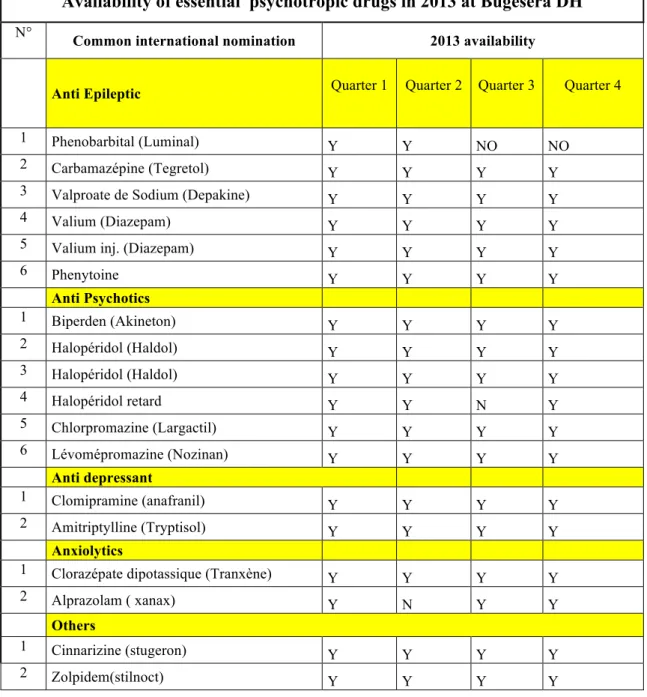
The Mental Health Unit had at least one psychotropic medicine of each therapeutic class
(anti-psychotic, antidepressant, mood stabilizer, anxiolytic, and antiepileptic medicines)
3.2.5. Day treatment facilities
There are no day treatment facilities available in Bugesera District and there is no specific
department for children and adolescents.
3.2.6. Health Centers
There are 15 primary care health centers which offer primary care services, including mental
health care. However, services are not extensive, with 15 health centers reporting only 58
cases with a psychiatric diagnosis according the HMIS data base, which represents 0.3 % of
all cases received in the Health centers. Health centers Mental Health Data are not
disaggregated by gender or diagnosis, but are compiled together as either epilepsy or a mental
disorder. The diagnoses reported are classified as following
:
Table 2: Diagnoses of new mental health cases received in Health Centers - Bugesera District - 2013
Diagnosis Number %
Epilepsy 4 100%
Psychological/Mental
problems 0 0
Total 4 100%
Table 3: Diagnoses of mental health cases followed up in Health Centers - Bugesera District - 2013
Diagnosis Number %
Epilepsy 36 67%
Psychological/Mental
problems 18 33%
Total 54 100%
3.2.7. Community-based psychiatric inpatient units
(Psychiatric inpatient unit in general hospitals)
There is one community-based psychiatric inpatient unit available in Bugesera District at the
District hospital, with a total of 3.8 beds per 100,000 population. The proportion of
There are no specific beds in the inpatient unit reserved for children and adolescents. The
head of the mental health services at BDH reported that if there is a need to admit a child or
adolescent, they try to give the mental health first care in the paediatric ward and then they
transfer the case directly to the referral psychiatric Hospital at 30 km of BDH.
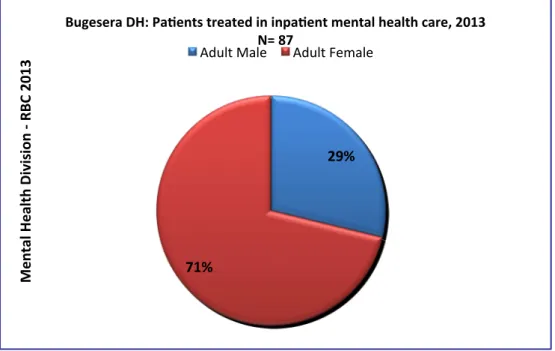
The psychiatric inpatient unit of BDH admitted 89 cases in 2013. The percentage of
admissions to this unit that are female is 70%, 28% are male and 2% of children under or
equal to 15years. Diagnoses of inpatients are not collected routinely, but some of them are
kept individually within individual case files. (Table 7 below)
The average of stay for admission in BDH mental health unit is 10 days per patient in 2013.
The head of the mental health unit in Bugesera district reported a limited amount and variety
of psychosocial interventions at the District Hospital’s MH unit
In 2013, the Mental Health Unit at BDH supported 25 patients regrouped in support groups by
providing the minimum consumables such as meals, clothing, cleaning materials … and
advocate for them in the local authority for sustainable financial support of their project of
agriculture.
3.2.8. Community residential facilities
There are community residential facilities in Bugesera District.
3.2.9. Psychiatric Hospital
There is no psychiatric hospital at this level of district. Bugesera District is 30km from the
central referral Psychiatric hospital.
3.2.10. Forensic and other residential facilities
In Bugesera district, like in other districts of the country, there is no specific forensic inpatient
unit. Patients with mental disorders from the Bugesera district prison are referred to the
general hospital mental health unit or internal medicine department for short hospitalizations.
If more intensive treatment is needed, they are transferred to the referral Neuropsychiatric
Hospital.
There are no specific beds for infants or adolescents in the district hospital’s psychiatric unit
of Bugesera. The patients who have specific needs for expert treatment are transferred to the
Neuropsychiatric hospital or to the mental health department at the University Teaching