26th MEETING OF THE SUBCOMMITTEE
ON
PLANNING AND PROGRAMMING
Washington, D.C., 25-27 March 1996
Provisional Agenda Item 10
SPP26/10 (Eng.)
26 February 1996
ORIGINAL: ENGLISH
PROVISIONAL DRAFT OF THE PROGRAM BUDGET OF THE
WORLD HEALTH ORGANIZATION FOR THE REGION OF THE
AMERICAS FOR THE FINANCIAL PERIOD
1998-1999
The Pan American Health Organization is required to submit the
recommendations of the XXXIX Meeting of the PAHO Directing Council, XLVIII
Meeting of the Regional Committee of WHO for the Americas, to be held in
September 1996, to the Director-General of WHO, concerning the Program Budget
for the Region of the Americas for the fmancial period 1998-1999. The regional
proposal will become a part of the global proposal to be presented to the
99th Session of the WHO Executive Board in January 1997 and the 50th World
Health Assembly in May 1997.
This provisional draft is presented to the Subcommittee on Planning and
Programming for its review prior to submission to the 118th Meeting of the
Executive Committee in June 1996.
1.
WHO Regular Planning Allocation
for
1998-1999
The budgetary guidance and regional planning allocations for 1998-1999 from the
Director-General of WHO provide for no overall program growth over the 1996-1997
program budget. The initial proposals from the Regions are to be submitted without cost
increases (mandatory and inflationary). The January 1997 WHO Executive Board will
consider the various cost increases to be provided to the Regions.
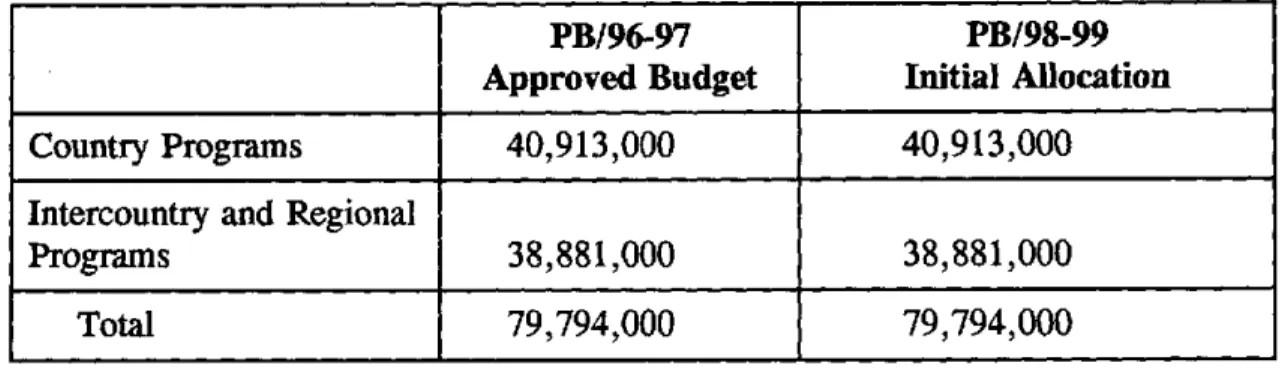
The initial planning allocation established for 1998-1999 for this Region, without
cost increases, is at the 1996-1997 level of $79,794,000. - The Director-General's
instruction calls for budget presentation be broken down at country, and intercountry and
regional office levels, as illustrated below:
2.
Formulation and General
Analysis
of the 1998-1999 WHO Program Budget
Proposal
The provisional draft of the 1998-1999 WHO program budget which was included
in PAHO's
Official
Document 267
of May/August 1995 has been used as the base for the
current proposals. The countries and the Governing Bodies reviewed the provisional
draft in general terms during 1995.
The 1998-1999 WHO Regular projection in that document (OD-267) was for an
increase of 8.2%, which provided for a program budget of $86,346,000. The initial
planning allocation of $79,794,000 provided by the Director-General is, therefore,
$6,552,000 less than the projection.
Tables 1A: Country Programs, 1B: Intercountry and Regional Programs, and 1C:
Total Program Budget, show the proposal for 1998-1999 in the WHO Classified List of
Program (CLP) at different locations.
These tables show the 1996-1997 base as
contained in the WHO official program budget document (PB.96-97) compared to the
1998-1999 projection (without cost increase) contained in PAHO's official program
budget document (OD-267).
Table 2 shows the complete list of WHO's classified programs for 1998-1999.
PB/96-97
PB/98-99
Approved Budget
Initial Allocation
Country Programs
40,913,000
40,913,000
Intercountry and Regional
Programs
38,881,000
38,881,000
Total
79,794,000
79,794,000
_
Table 1-A
COUNTRY PROGRAMS - WHO REGULAR PROGRAM BUDGET
... OF
WHO 1998-99 PROGRAM CLASSIFICATION
APPROPRIATION SECTION AND MAJOR PROGRAM
11. HEALTH POLICY AND MANAGEMENT
HEALTH, SCIENCE, AND PUBLIC POLICY
NATIONAL HEALTH POLICIES, PROGRAM DEVELOPMENT AND MANAGEMENT
BIOMEDICAL AND HEALTH INFORMATION AND TRENDS
1996-1997
% OF AMOUNT TOTAL
9 236.600 22.6
1,367,700 4,227,800 3,641,100 3.4 10.3 8.9
III. HEALTH SERVICES DEVELOPMENT 16.148 500 39.4 16.594.300 40.6
ORGANIZATION/MGMT OF HEALTH SYSTEMS BASED ON PHC
HUMAN RESOURCES FOR HEALTH
ESSENTIAL DRUGS
IV. PROMOTION AND PROTECTION OF HEALTH 761.9 700 18.6 7.528.000 18.4
REPRODUCTIVE, FAMILY, AND COMMUNITY HEALTH AND POPULATION ISSUES
HEALTHY BEHAVIOR AND MENTAL HEALTH
NUTRITION, FOOD SECURITY, AND SAFETY
ENVIRONMENTAL HEALTH
V. INTEGRATED CONTROL OF DISEASE 7.908,200 19.4 7.922.900 19.3
ERADICATION/ELIMINATION OF SPECIFIC COMMUNICABLE DISEASES
CONTROL OF OTHER COMMUNICABLE DISEASES
CONTROL OF NONCOMMUNICABLE DISEASES
40.913.000 -r--L- 100.0 40.913,000 -~~_,9_-,O 100.0 1998-1999 AMOUNT 8.867.800 1,060,700 3,475,700 4,331,400 % OF TOTAL 21.7 2.6 8.5 10.6 12,757,500 2,927,100 463,900 31.1 7.2 1.1 13,030,900 2,958,700 604,700 31.9 7.2 1.5 1,535,200 384,800 803,000 4,896,700 3.8 .9 1.9 12.0 1,566,200 892,400 724,800 4,344,600 3.8 2.2 1.8 10.6 194,000 6,069,600 1,644,600 .5 14.9 4.0 0 6,196,800 1,726,100 15.1 4.2
Table 1-B
INTERCOUNTRY AND REGIONAL PROGRAMS - WHO REGULAR PROGRAM BUDGET
1996-1997 1998-1999 WHO 1998-99 PROGRAM CLASSIFICATION ---
---% OF %X OF
APPROPRIATION SECTION AND MAJOR PROGRAM AMOUNT TOTAL AMOUNT TOTAL
. GOVERNING BODIES 337100 .9 337.100 .9
GOVERNING BODIES 337,100 .9 337,100 .9
II. HEALTH POLICY AND MANAGEMENT 11.043.700 28.4 11,421.000 29.4
GENERAL PROGRAM DEVELOPMENT AND MANAGEMENT 1,855,800 4.8 2,156,700 5.5
HEALTH, SCIENCE, AND PUBLIC POLICY 802,600 2.1 438,700 1.1
NATIONAL HEALTH POLICIES, PROGRAM DEVELOPMENT AND MANAGEMENT 2,610,500 6.7 2,721,700 7.0
BIOMEDICAL AND HEALTH INFORMATION AND TRENDS 5,774,800 14.8 6,103,900 15.8
III. HEALTH SERVICES DEVELOPMENT 4,862.200 12.5 4.851.900 12.4
ORGANIZATION/MGMT OF HEALTH SYSTEMS BASED ON PHC 2,570,500 6.6 1,867,100 4.8
HUMAN RESOURCES FOR HEALTH 1,687,500 4.3 2,385,500 6.1
ESSENTIAL DRUGS 253,000 .7 249,100 .6
QUALITY OF CARE AND HEALTH TECHNOLOGY 351,200 .9 350,200 .9
IV. PROMOTION AND PROTECTION OF HEALTH 8,202,700 21.0 8,060.600 20.8
REPRODUCTIVE, FAMILY, AND COMMUNITY HEALTH AND POPULATION ISSUES 1,475,000 3.8 1,734,200 4.4
HEALTHY BEHAVIOR AND MENTAL HEALTH 1,454,400 3.7 1,242,700 3.2
NUTRITION, FOOD SECURITY, AND SAFETY 2,098,800 5.4 1,924,700 5.0
ENVIRONMENTAL HEALTH 3,174,500 8.1 3,159,000 8.2
V. INTEGRATED CONTROL OF DISEASE 8.632.500 22.2 8.560.500 22.0
ERADICATION/ELIMINATION OF SPECIFIC COMMUNICABLE DISEASES 384,800 1.0 289,000 .7
CONTROL OF OTHER COMMUNICABLE DISEASES 7,846,800 20.2 7,820,200 20.1
CONTROL OF NONCOMMUNICABLE DISEASES 400,900 1.0 451,300 1.2
VI. ADMINISTRATIVE SERVICES 5.802.800 15.0 5.649,900 14.5
PERSONNEL 1,112,200 2.9 1,225,900 3.2
GENERAL ADMINISTRATION 3,173,900 8.2 2,929,700 7.5
BUDGET AND FINANCE 1,516,700 3.9 1,494,300 3.8
Table
1-C
TOTAL PROGRAM BUDGET - WHO REGULAR FUNDS
1996-1997 1998-1999 WHO 1998-99 PROGRAM CLASSIFICATION ---
---% OF % OF
APPROPRIATION SECTION AND MAJOR PROGRAM AMOUNT TOTAL AMOUNT TOTAL
1. GOVERNING BODIES 337.1.0 .4 337.100 .4
GOVERNING BODIES 337,100 .4 337,100 .4
II. HEALTH POLICY AND MANAGEMENT 20,280.300 25.4 20.288.800 25.2
GENERAL PROGRAM DEVELOPMENT AND MANAGEMENT 1,855,800 2.3 2,156,700 2.6
HEALTH, SCIENCE AND PUBLIC POLICY 2,170,300 2.7 1,499,400 1.9
NATIONAL HEALTH POLICIES, PROGRAM DEVELOPMENT AND MANAGEMENT 6,838,300 8.6 6,197,400 7.7
BIOMEDICAL AND HEALTH INFORMATION AND TRENDS 9,415,900 11.8 10,435,300 13.0
III. HEALTH SERVICES DEVELOPMENT 21,010.700 26.5 21.446,200 27.2
ORGANIZATION/MGMT OF HEALTH SYSTEMS BASED ON PHC 15,328,000 19.4 14,898,000 19.0
HUMAN RESOURCES FOR HEALTH 4,614,600 5.8 5,344,200 6.7
ESSENTIAL DRUGS 716,900 .9 853,800 1.1
QUALITY OF CARE AND HEALTH TECHNOLOGY 351,200 .4 350,200 .4
IV. PROMOTION AND PROTECTION OF HEALTH 15,822,400 19.7 154588,600 19 .4
REPRODUCTIVE, FAMILY, AND COMMUNITY HEALTH AND POPULATION ISSUES 3,010,200 3.7 3,300,400 4.1
HEALTHY BEHAVIOR AND MENTAL HEALTH 1,839,200 2.3 2,135,100 2.6
NUTRITION, FOOD SECURITY, AND SAFETY 2,901,800 3.6 2,649,500 3.3
ENVIRONMENTAL HEALTH 8,071,200 10.1 7,503,600 9.4
V. INTEGRATED CONTROL OF DISEASE 16.540,700 20.7 16.483.400 20.7
ERADICATION/ELIMINATION OF SPECIFIC COMMUNICABLE DISEASES 578,800 .7 289,000 .4
CONTROL OF OTHER COMMUNICABLE DISEASES 13,916,400 17.4 14,017,000 17.6
CONTROL OF NONCOMMUNICABLE DISEASES 2,045,500 2.6 2,177,400 2.7
VI. ADMINISTRATIVE SERVICES 5.802.800 7.3 5 649.900 7.1
PERSONNEL 1,112,200 1.4 1,225,900 1.5
GENERAL ADMINISTRATION 3,173,900 4.0 2,929,700 3.7
BUDGET AND FINANCE 1,516,700 1.9 1,494,300 1.9
79,794,000 100.0 79.794.000 100.0
Table 2
1.
GOVERNING BODIES
1.1 Governing Bodies 1.1.1 WHA World Health Assembly 1.1.2 EXB Executive Board 1.1.3 RCO Regional Committee
2.
HEALTH POLICY AND MANAGEMENT
2.1 General program development and 2.1.1 EXM Executive management
management 2.1.2 GPD Managerial process for WHO's prog. development. WHO response to Global change. Deputy RD's and Directors of prog. management at regional offices. Staff development
2.1.3 ISM Management and support to information systems 2.1.4 DGP D-G's and Regional Director's development program
2.1.5 COR Coordination with other organizations. Mobilization of external health resources
2.2 Health, science and public health 2.2.1 HSD Health in socioeconomic development 2.2.2 RPS Research policy and strategy development
2.3 National health policies and 2.3.1 TCC Technical cooperation among countries
program development and 2.3.2 ICO Collaboration with countries and peoples in greatest need management 2.3.3 SUP Procurement services (excluding drugs, biologicals, and
contraceptives)
2.3.4 EHA Emergency and humanitarian action; relief and rehabilitation operation and emergency preparedness program
2.4 Biomedical and health information 2.4.1 HST Epidemiology, statistics, trend assessment, and country health
and trends information
2.4.2 PLL Publishing, language, and library services
3.
HEALTH SERVICES
DEVELOPMENT
3.1 Organization and management of 3.1.1 HSR Health systems research and development health systems based on primary 3.1.2 NHP National health systems and policies health care 3.1.3 DHS District health systems
3.2 Human resources for health 3.2.1 HRH Human resources for health 3.2.2 MFP Fellowships
3.3 Essential drugs 3.3.1 DAP Action program on essential drugs
3.3.2 PDC Procurement of drugs, biologicals, and contraceptives
3.4 Quality of care and health 3.4.1 THC Technology for health care
4.
PROMOTION AND PROTECTION OF HEALTH
4.1 Reproductive, family and 4.1.1 RPH Reproductive health community health and population 4.1.2 CHD Women and child health
issues 4.1.3 ADH Adolescent health
4.1.4 WHD Women's health 4.1.5 AHE Aging and health
4.1.6 HRP Special program of research, development, and research training in human reproduction
4.1.7 OCH Occupational health
4.2 Healthy behavior and mental health 4.2.1 MNH Mental health
4.2.3 ADT Substance abuse including alcohol and tobacco 4.2.3 HEP Health promotion
4.2.4 INF Communications and public relations 4.2.5 RHB Rehabilitation
4.3 Nutrition, food security, and safety
4.4 Environmental health
4.3.1 4.3.2 4.3.3 4.4.1 4.4.2 4.4.3 4.4.4 4.4.5 NUT FOS FOA CWS EUD EHH PCS HCE Nutrition Food safety Food aid
Water supply and sanitation in human settlements Environmental health in urban development Assessments of environmental health hazards Promotion of chemical safety
Incorporation of health concerns into environmental manarmgement
5.
INTEGRATED CONTROL OF DISEASE
5.1.1 GEE Global eradication or elimination 5.1 Eradication/elimination of specific 5.1.2 REE Regional eradication or elimination
communicable diseases
5.2 Control of other communicable 5.2.1 VID Vaccine-preventable diseases
diseases 5.2.2 CDR Diarrheal and acute respiratory disease control 5.2.3 TUB Tuberculosis
5.2.4 EMC Emerging diseases including cholera and other epidemic diarrheas, zoonoses, and antimicrobial resistance 5.2.5 OCD Other communicable diseases
5.2.6 CTD Control of tropical diseases
5.2.7 TDR Special program for research and training in tropical diseases 5.2.8 PRD Prevention of blindness and deafness
5.2.9 UNA Joint United Nations Program on HIV/AIDS (UNAIDS) (Fund Code VA)
5.3 Control of noncommunicable 5.3.1 NCD Control of noncommunicable diseases
diseases 5.3.2 IAC IARC
6.
ADMINISTRATIVE SERVICES
6.1 Personnel 6.1.1 PER Personnel Services and administration
6.2 General administration 6.2.1 GAD Administrative support to technical programs
6.3 Budget and finance 6.3.1 BFI Budget and finance