Waldemar Antônio das Neves Júnior 1, Laís Záu Serpa de Araújo 2, Sergio Rego 3
Abstract
In Brazilian medical educaion and in the general teaching of bioethics in Brazil, there is a recurrent debate about the best way to teach ethics and/or bioethics, and even about whether it is possible to do so. In part this is due to the growing concern in society about the necessity of physicians to be both technically and morally competent. The teaching of bioethics is disinguished from medical ethics in that it focuses on the rights and duies of the doctor and also by its muli- and inter-disciplinary characterisics. The aim of the pres-ent study was to idenify whether bioethics as a speciic discipline is included in the curriculum of Brazilian undergraduate medical courses, and if so, how it is taught and what are its contents. The study found that the number of dedicated bioethics classes in medical courses has increased, and that the most frequently ad-dressed issues are: an introducion to bioethics and principles of bioethics, the physician-paient relaionship, aborion and euthanasia.
Keywords: Medical educaion. Bioethics. Higher educaion. Moral development.
Resumo
Ensino de bioéica nas faculdades de medicina no Brasil
É recorrente, no âmbito da educação médica brasileira e no ensino da bioéica de modo geral, o debate sobre a melhor maneira de ensinar éica e/ou bioéica. Parte disso decorre da crescente preocupação na sociedade de contar com médicos técnica e moralmente competentes. O ensino de bioéica disingue-se do ensino de éica médica, já que esse úlimo está centrado nos direitos e deveres do médico, enquanto o primeiro tem seu foco na muli, inter e transdisciplinaridade. O objeivo deste trabalho é ideniicar se a disciplina de bioéica encontra-se na matriz curricular, como é ministrada e quais são os conteúdos trabalhados nos cursos de me-dicina do Brasil. Observou-se aumento do número de oferta de disciplinas autônomas de bioéica nos cursos médicos e que os temas mais abordados pelas disciplinas são introdução à bioéica e princípios da bioéica, relação médico-paciente, aborto e eutanásia.
Palavras-chave: Educação médica. Bioéica. Educação superior. Desenvolvimento moral.
Resumen
La enseñanza de la bioéica en las escuelas de medicina en Brasil
Es muy común en el ámbito de la educación médica brasilera y en la enseñanza de la bioéica en general, el debate sobre la mejor manera de enseñar la éica y/o la bioéica. Parte de esto se debe a la preocupación cada vez mayor en la sociedad para que tengamos médicos técnica y moralmente competentes. La enseñanza de la bioéica se disingue de la éica médica; ésta úlima está centrada en los derechos y deberes del médico, mientras que la bioéica se caracteriza por ser muli, inter y transdisciplinaridad. El objeivo de este estudio es ideniicar si la disciplina Bioéica está en los planes de estudios, cómo se la enseña y cuáles son los contenidos trabajados en las carreras de Medicina de Brasil. En la invesigación se observó que hubo un aumento en el número de asignaturas de Bioéica autónomas en las carreras de Medicina y que los temas más discuidos son: Introducción a la bioéica y principios de la bioéica, la relación médico-paciente, el aborto y la eutanasia.
Palabras-clave: Educación Médica. Bioéica. Educación Superior. Desarrollo Moral.
Aprovação Ensp/Fiocruz 41664615.3.0000.5240
1.Doutorando[email protected] – Universidade Federal de Alagoas (Ufal), Maceió/AL. 2.Doutora [email protected] –
Universidade de Ciências da Saúde de Alagoas (Uncisal), Maceió/AL, Brasil. 3.Doutor[email protected] – Escola Nacional de Saúde
Pública Sérgio Arouca (Fiocruz), Rio de Janeiro/RJ, Brasil.
Correspondência
Waldemar Antônio das Neves Júnior – Rua Raul Pompeia nº 131, apt. 1005, Copacabana CEP 22080-001. Rio de Janeiro/RJ, Brasil.
Declaram não haver conlitos de interesse.
R
esear
In the last decades much has been discussed about the transformaions that have resulted from scieniic, technological and social development, as well as their implicaions in the large areas of knowledge, especially in biological sciences, health care and public health. Recently, market demands have required new capaciies and competencies from professionals so they can adapt to the new changes, whether technological, scieniic, concep-tual or in terms of values, especially in regard to ethical training.
In the center of these changes certain para-digmaic transiions have occurred, demanding a period of adaptaion from the exising models which no longer correspond to social demands and the technical and professional framework. Such changes have become necessary to the extent that previous scieniic paradigms have failed in the atempt to respond to problems which arise from the scienif-ic advances that have been occurring since the late 18th century, also including medicine 1.
Certain regulated and socially insituted pro-fessions, such as medicine, follow norms and rules regarding their exercise and this is the area in which medical ethics is located, given its normaive charac-ter, when it refers to the set of rights and duies to be followed in the medical pracice. What character-izes this discipline is the method, which consists in judging if a certain conduct is or is not in agreement with the ethical precepts adopted by the profession. These precepts are understood as duies from which professionals cannot “stray” if they want to be mor-ally correct in their conduct.
Carneiro and collaborators 2 state that for a long ime this model was the basis for teaching ethics in health courses and, regardless of its importance, has proven insuicient. In spite of the reformuaions carried out by the Câmara Técnica de Bioéica do Conselho Federal de Medicina (Technical Bioethics Chamber of the Federal Council of Medicine - CFM) it is necessary to adequate the teaching of bioethics to these changes, and to the changes that have oc-curred in society. Currently it has become clear that, for the ethical training of medicine professionals, it is not enough to solely understand ethics based on deontological codes in which values and norms are imposed as heteronomous adaptaion mechanisms which consolidate the authoritarian power of social norms.
Several ethical issues arise upon contesing the tradiional paradigm of ethical training in medicine, so that there is a need for phylosophical relec-ion aimed at mediarelec-ion and decisrelec-ion making in an
atempt to solve these conlicts 1. To morally educate someone it is necessary to prioriize examples when working with daily tasks that are known by students and teachers. Therefore, this is not a quesion of merely thinking about incorporaing them to our professional acivity, but also of evaluaing how we execute them in order to improve the ethical sense of our acions and thus detect the aspects which we deem posiive and negaive 3.
In the realm of Brazilian medical training in general, and in the teaching of bioethics, the debate over the best way to teach ethics and bioethics 4, or even if it is possible to convey this knowledge to students, is recurrent. There is great concern and demand from a porion of society for the medical profession to have morally competent professionals; however, medicine students are sill trained to deal only with the technical aspects of the profession, not with the ethical and moral ones 5. Therefore,
con-licts and dissacisfacion emerge from both paries, as well as the interest of universiies to readapt the strategies of their poliical and pedagogical projects (PPPs) and their educaion philosophy in an atempt to adequate their curriculums to the new demands made by society, so that this reformulaion is geared towards the inclusion of disciplines of ethical and philosophical nature in the basic training stages 6.
Ethics is a part of philosophy, a type of knowl-edge that has consituted itself in a raional way and which relies on conceptual rigor, methods and ex-planaions that are proper of philosophy 7. Ethics is founded on three prerequisites: 1) consciousness or percepion of conlict; 2) autonomy, an individual’s capacity to posiion him or herself between emoion and reason by way of an acive, autonomous choice; 3) coherence 8. It is known that people are not born
ethical, but they have a priori condiions for ethical
thinking and moral development to be built and in-trojected along ime, and for this reason these must be simulated.
Some authors such as Rego 9 point out the im-portance of the discussion about moral educaion in order to break away from the model of imposiion and indoctrinaion which is out of context, archaic and innefecive, and to a large extent the one upon which some teachers sill base their teaching of the medical ethics discipline. There are teachers who consider that they have “taught” medical ethics to their students solely by transmiing the norms of the Código de Éica Médica (Medical Ethics Code - CEM), or the deontological “should do” in each situaion.
Corina 10 states that when we talk about
ed-ucaion, especially moral eded-ucaion, it is necessary
R
esear
to disinguish between indoctrinaing and educaing in order to understand what is desired out of moral educaion. According to the author, when one talks about indoctrinaing one wishes to convey moral content to students, and by giving answers teach-ers avoid them to keep thinking and conine them to their own moral universe - which she calls “closed moral”. From an educaional perspecive it is nec-essary to open new content to allow for students to think morally on their own and make decisons based on their autonomy - which Corina classiies as “open moral”.
For this reason, bioethics is inserted in a wider context because it arises from the demands of society which quesions the very legal limits of the pracice, connecing to the efecive exercise of ciizenship itself 11. In addiion, bioethics is disinguished from the deontological view for having muli, inter and trans-disciplinary characterisics 6.
The main characterisic, regarding the iniial meaning of the word “bioethics” in the legacy of Van Rensselaer Poter in 1971, was to establish it as a philosophical discipline 12. Sill according to him, bioethics has advanced as a new discipline which combines biological knowledge and a system of hu-man values. Poter, quoted by Reich 13, thus explains the formaion of the term “bioethics”: I have cho-sen the preix bio to reprecho-sent biological knowledge, the science of living systems; and ethics to represent the system of human values 13. Ever since, there has been growing interest on the philosophical founda-ion of bioethics based on ethics, which shows, on the one hand, the interest of the authors of the area on bioethics for the ethical cornerstones and, on the other hand, the interest awoken in philosophy especially due to ethical issues and the debate on bioethics 14.
Kotow 15 considers that bioethics undoubtedly
behaves as a social phenomenon and also as a dis-cipline, given its consistent academic presence in regular, departmentalized courses with specialized faculies on diferent areas. What was at irst an ide-al and an intuiion by some physicians and scholars from several naions who planned on spreading the interest for this new discipline is now a reality 14. Due to its concern with the correct use of new tech-nologies in the area of medical sciences and with adequate soluions for the moral dilemmas present-ed by them, the ield is considerpresent-ed as applipresent-ed ethics. It would, therefore, be a speciic branch of moral philosophy, with its own characterisics 16. This way it is noiceable that bioethics has matured as a form of pracical moral philosophy in medicine 17.
Based on the results of their studies, Boylan and Donahue 18 supply the structure for a pracical
scenario with concrete suggesions to introduce ethical issues in university curricula. The idea and the rethinking process of this structure will allow for university students and professors to approach a wide array of ethical issues which may arise in class-room discussions, both in academic disciplines and in professional training.
Some studies, such as the one by Lind 5, have
concluded that medical training does not contribute to the moral development of the students. Mor-al educaion converges towards the construcivist thinking with historical and social anthropological orientaion, according to which the training of the human being is accomplished by means of social interacion, that is, through an individual’s relaion-ship with other individuals and through their acions on the world 19. To Mizukami 20, teaching is
inlu-enced by human development and knowledge is essenially acive. The author states that one of the fundamental implicaions for an individual is that the intelligence is constructed from the exchanges between the organism and its environment and in its acions. This acion, in our understanding, is the center of the training process and the social and educaional factor which consitutes a condiion for the development of the individual.
The main goal of the teaching of bioethics must be to develop in the students the process of inding soluions which involve several abiliies, which Kohlberg, quoted by Lind 5, calls “capacity
for moral judgment” and deines as the capacity to make decisions and making judgment that is mor-al, that is, based on internal principles and in acing according to such judgment. This presupposes the competence to idenify and disinguish individual moral interests (autonomy) from collecive moral in-terests (heteronomy), in addiion to the permanent condiion of being a socially uninished individual 6, in the form of a coninuous exercise for the con-strucion of one’s moral personality.
Currently, the new Diretrizes Curriculares Na-cionais (DCN – Naional Curricular Direcives) for the undergraduate medicine courses 21, put into efect by the Ministry of Educaion (MEC) on June 20, 2014, determine that graduaing students must be trained to substaniate quality in health care and be guided by their criical thinking, and that pro-fessional ethics must be founded on the principles of ethics and bioethics. This is an atempt to guide the development of competencies during medical training, recommending in which way the future
R
esear
professionals should act in respect to their moral behavior 6.
The DCN point out the competencies and abili-ies expected to be developed by medicine students in their professional training process 9. Its intent is to put forth several perspecive proposals in re-sponse to a wide array of problems, ranging from the propagaion of certain ethical, estheic and po -liical perspecives to the suggesion of procedures and competencies which must be part of the shared naional curricula base 22. It becomes evident that there is recurring debate on the best way to teach ethics and/or bioethics, or if it is possible to teach them in the realm of Brazilian medical educaion in general and in the teaching of bioethics 4.
There is also the concrete issue of real or apparent lack of interest from the teaching insitu-ions, according to Goergen 19, on what may or must be done in terms of ethical educaion. For the au-thor this derives from current imes, in which there is an emergence of conlicts that are inherent of a plural, democraic society which sill has not found either consensus around the values nor the dispo-siion to insil in youngsters the values or forms of behavior that are not shared by all.
This discussion suggests a renewal of school pracices and curricula due to the ethical conlicts, in the way how the content and the formaive val-ues to be taught may be clariied from the student’s learning process in order to facilitate the educaion-al process 19. For this reason it is paramount that there is a commitment by the teaching insituions to the promoion of a conduct which is based on ethical principles of valuing a person’s fundamental rights and obligaions, which has ceased from be-ing a subject restricted to specialists and educaion professionals and has become a mater of public in-terest 23.
Upon relecing on the ethical discourse of the competencies and abiliies prescribed by the DCN one may ask: will the technicist trend incorporated in Brazilian educaion account for the training and moral educaion of future physicians? Will they be prepared for the mediaion of the conlicts that will happen during their educaion and later profession-al aciviies? Do deontologicprofession-al disciplines such as medical ethics, deontology and forensic medicine bring educaion on values and moral development to these students?
For this reason the need has been considered to emphasize the relevance of moral educaion, or educaion on values (regarded here as synonyms)
during professional training, since with its pres-ence it is possible to opimize the creaion of social mulipliers, especially in the health area 24. It would take seeing the university as a place of permanent exercise of ethics, of criical discussion of conlicts, of guidance for the future and of transmission not only of knowledge but also of judgments of value to the students. In Lind’s 5 perspecive, moral and
democraic competencies should not be acquired by indoctrinaion or old ways of “top-down” teaching, but rather be learned by children, adolescents and adults from “botom to top”, for example by means of the soluion of “moral dilemmas” under the guid-ance of well-trained teachers.
Competencies are related to intelligence just as disciplines are to knowledge 25. Therefore,
spe-ciic knowledge organized in the form of disciplines must be rescaled in the perspecive of making up an instrument in service of the development of intelligence with autonomy, and therefore, of per-sonal development - a precondiion for growth as a ciizen and professional 25. To Culver 26, ethical train-ing must be devised as a means of improvtrain-ing the character of future physicians and endowing the ones who already have it with skills and aitudes to allow them to have the best possible ethical per-formance.
In agreement with this perspecive, Rego and collaborators 11 state that the teaching of bioeth-ics should have a double funcion: 1) contribute for students to develop/perfect their capacity for bioethical analysis and, therefore, for making deci-sions in situaions which involve ethical issues; and 2) create ciizens who are conscious and compro-mised with the common good. Correa 14 states, in addiion, that bioethics has started contribuing for the relecion and public debate on themes related to fundamental values regarding life and science to be introduced in the school curricula of many un-dergraduate careers – among them health – and in the coninuous graduate training of many profes-sionals.
In face of what has been shown, this paper aims at 1) idenifying how and where bioethics dis-ciplines and themes are situated in the curriculum matrices of the medicine courses in Brazilian univer-siies that have received scores 4 and 5 in the Exame Nacional de Desempenho de Estudantes (Enade – Naional Examinaion of Student Performance); verifying which bioethics topics are discussed in undergraduate medicine courses in Brazil; 3) ideni-fying which of these themes have been used in the elaboraion of Enade.
R
esear
Materials and Method
The data have been obtained by qualitaive de-scripive research, with data collecion made available on the oicial websites of the Ministry of Educaion (MEC), of the Associação Brasileira de Educação Médi-ca (Abem - Brazilian Associaion of MediMédi-cal EduMédi-caion), of the medical schools in Brazil and the Insituições de Ensino Superior (IES – Higher Educaion Insituions) which have undergraduate medicine courses in Brazil with a score of 4 or 5 in Enade.
Included in the sample are all medicine schools (both public and private) which have taken part in Enadefrom 2010 to 2013 andhaveobtained scores 4 and 5 in these evaluaions. The jusiicaion for this type of inclusion is that the conceito preliminar do cur-so (CPC – preliminary concept of courses) established by MEC 27 combines eight components that indicate the quality of the course, out of which we list the six most relevant ones for the purposes of this paper: • Infrastructure and physical faciliies
• Didacic and pedagogical organizaion
• Characterisics of the faculty: number of profes-sors with doctorate and masters degrees and full ime or part ime professors.
• Performance of graduaing students
• Performance of Enade paricipants
• Indicator of the diference between the expect-ed and observexpect-ed performance (performance dif-ference indicator – IDD)
All original measures pertaining to these components have been duly standardized and trans-formed into scores or grades between 0 and 5, with classiicaion and criteria in accordance with MEC/ Enade. This way, the best teaching insituions in Brazil have been selected according to these criteria.
According to Frinkler 28, the selecion of
these groups of universiies with grading 4 and 5 at Enade is also due to other variables related to the teaching of medicine graduate courses, such as the scieniic producivity and the introducion of new curriculum guidelines in 2014, including the school’s performance and references in the naional academic environment. Therefore, this can be con-sidered as the irst step, as a sample that relects the resuling knowledge and experiences, seeking that the HEI courses can be adequately studied.
All universiies with public data available on oicial websites of their respecive HEI courses were
considered. For this purpose, we analyzed all data
related to the pedagogical course projects of the rel-evant courses (PCP), in the curriculum matrices and class planning program contents of these subjects. Issues on Enade ethics were also analyzed based on informaion obtained at the Insituto Nacional de Estudos e Pesquisa Educacionais Anísio Teixeira (Inep - Anísio Teixera Naional Insitute of Educaion-al Studies and Research) website, which is a federEducaion-al autarchy linked to the MEC, seeking to ind which of these topics were used in the evaluaions, consider-ing the years in which the Enade test was ofered.
This research model, according to Bonet 29,is important because the university is an environment in which academic aspects and everyday pracice are interconnected, and at the same ime, social, psycho-logical and economic tensions are found. Medicine was selected as the object of study because it is the work environment of researchers; due to the re-searchers’ concern with medicine students’ ethical educaion; due to the fact that physicians frequently have to make decisions in delicate and potenially conlicive situaions, including young professionals who are sill geing used to “being” and becoming doctors and even because this afects all people liv-ing in society who need medical services, both to prevent disease and to regain a healthy condiion.
The analysis technique was deined based on the guidelines set by Minayo and collaborators 30,
according to which in a real-life context and in a concrete case, it is necessary to try to learn about a phenomenon as a whole and describe it in a cre-aive way, seeking to understand and interpret its complexity based on a number of evidences. Such evidence consitutes a database developed throughout research, therefore composing a chain of relevant evidence. It was also considered that unsurprisingly, discourse related to such concerns suggests a possible crisis of values typical of our society, as well as the need to renew our university pracices and curriculum, prioriizing and emphasiz-ing such goals, frequently considered as secondary or inexistent in past and present imes, as Correia 14 warns.
Consequently, this study seeks to idenify if bioethics courses are being ofered in medicine graduate courses in Brazil and how they are being
taught in course curriculum matrices, considering the topics and teaching methodologies used. We believed that this report is of extreme relevance, once it responds to new ethical issues permanent-ly incorporated to our relecion, bringing elements to work on the urgent need for teaching renovaion and modernizaion. 31.
R
esear
Discussion of results
According to the e-MEC portal, today there are 260 faculies of medicine registered in Brazil, out of which 177 took part in the triennial Enade 2010 and 166 paricipated in the last 2013 triennial, obtaining grading concepts that luctuated from 1 to 5. An im-portant data is that currently, a speciic evaluaion type for medicine courses is under analysis. For this purpose, an open public consultaion was prepared by INEP, seeking to create evaluaion instruments in agreement with the new medicine courses guide-lines 32.
During the study carried out based on the e-MEC and oicial HEI websites, we veriied that
93 medicine faculies achieved grading 4 and 5 at Enade in these triennials, from which (81.7%) made some course data available and 17 (18.3%) did not
ofer any informaion, matrices, curriculum summa-ries and/or program contents. Ater analyzing the 76 PCP found, we ideniied that 10 medicine universi-ies had no bioethics courses and that in 66 of them they were being ofered as an independent subject or with other speciicaion in the curriculum matrix. Thirty-two universiies made their matrices avail-able on their websites but not their curriculums or program contents.
Applying these exclusion criteria, with the number of evaluated courses – n = 66 – we
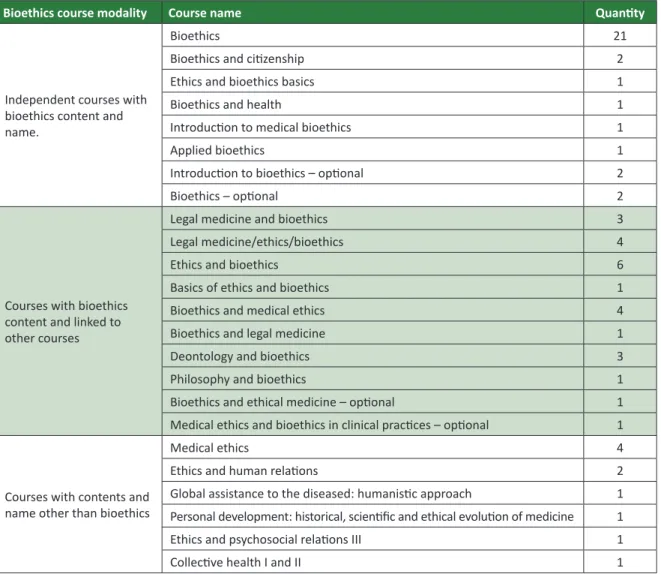
con-sidered those faculies that ofered enough data to have their curricular matrices analyzed in the PPC. Data obtained from the diferent courses was classiied in three groups: 47% were independent subjects with bioethics contents and name, 38% had bioethics content and were linked to other subjects and 15% had names other than bioethics and were also related to other subjects (Table 1).
Table 1. Distribuion of modaliies and names of bioethics courses
Bioethics course modality Course name Quanity
Independent courses with bioethics content and name.
Bioethics 21
Bioethics and ciizenship 2
Ethics and bioethics basics 1
Bioethics and health 1
Introducion to medical bioethics 1
Applied bioethics 1
Introducion to bioethics – opional 2
Bioethics – opional 2
Courses with bioethics content and linked to other courses
Legal medicine and bioethics 3
Legal medicine/ethics/bioethics 4
Ethics and bioethics 6
Basics of ethics and bioethics 1
Bioethics and medical ethics 4
Bioethics and legal medicine 1
Deontology and bioethics 3
Philosophy and bioethics 1
Bioethics and ethical medicine – opional 1
Medical ethics and bioethics in clinical pracices – opional 1
Courses with contents and name other than bioethics
Medical ethics 4
Ethics and human relaions 2
Global assistance to the diseased: humanisic approach 1 Personal development: historical, scieniic and ethical evoluion of medicine 1
Ethics and psychosocial relaions III 1
Collecive health I and II 1
Source: data from PPP from oicial websites of medical schools. HEI, 2015.
R
esear
This conirmed three course models found in health graduate programs menioned by Rego and collaborators 11: 1) schools that ofer only the teaching of professional ethics; 2) schools that ofer bioethics teaching within a model based on prob-lems adopted by the faculty and; 3) schools that ofer bioethics as a separate course.
Sill, in the Table 1 discussion, we ind classi-icaions based on the names of courses and their availability. We veriied a growing number of bio-ethics courses and contents in medicine curriculum matrices, although they are sill associated to oth-er normaive courses, as demonstrated by some research studies 31-33. This growth becomes evident
when we compare 47% of independent courses with bioethics name and contents found in our research with the study carried out in 2001 and menioned in the Dantas and Souza 31 study, in which they airm that related courses named “bioethics” or “medical ethics” appeared in 16.6% of cases. This fact clear-ly suggests the need to strengthen bioethics as a legiimate knowledge ield necessary for graduate courses, as well as the importance of disinguishing its contents from those of deontological courses. We can therefore airm that the absence of bioethics in the training of future doctors diicults inter, muli and trans-disciplinary aciviies and that there is also the percepion that ethical contents are transversal to those of other technical courses.
The difereniaion between bioethics teach-ing and other courses becomes necessary for its development and reinforcement as an academic course, once it is no longer possible to teach bio-ethics in graduate courses based on general basic contents, normally ofered together with other courses; it is also necessary to bring bioethics closer to its idenity, demanding from teachers the capac-ity to teach with a clinical, juridical and philosophic bioethics perspecive, with a bioethics methodology and within a bioethical environment 14. According to Gracia 34, if we expect that the teaching-learn-ing process can help in the improvement of moral character and aitudes by acquiring knowledge and through skills development, it is necessary to work in an enirely interacive and paricipaive way.
The impasse in the search for a beter course contents analysis resulted from the diiculty to obtain informaion, considering the following dis-tribuion: 51.5% of faculies had course contents and programs available online, while 48.5% did not
have either of them. Out of the content analysis and topics approached in the 66 courses found, only 34 were available on-line. When these courses were
analyzed on the HEI websites, it was discovered that only 25 summaries and 9 program contents were available to the public and that in some cases, they were sill incorporated and linked to courses with a diferent methodological approach than the one ad-opted in bioethics teaching.
The contents more frequently found in ana-lyzed courses are introduced in Table 2 below.
Table 2. Distribuion of bioethics courses contents in
studied faculies
Contents Frequency
Introducion to bioethics: bioethics
principles 22
Physician-paient relaionship 16 Research (experimentaion) in humans 15
Aborion 15
Euthanasia 14
Transplants 11
Medical deontology 11
Ethics, morals and law 11
Public health 10
Research Ethics Commitee 10
Human reproducion 9
Medical errors 8
Conideniality and privacy 8
Geneics, human genome 8
Death 8
Human rights 7
Terminal care – palliaive medicine 6 Clinical research and clinical bioethics 5
Assisted suicide 4
Bioethics and research in animals 4 Bioethics in medical emergencies 4 Bioethics and the pharmaceuical industry 3 Bioethics and the environment 3 Aids and sigmaizing diseases 3 Bioethics and spirituality 3 Blood transfusions and Jehovah witnesses 3
Human cloning 2
Stem cells therapy 2
Informed consent 2
Violence and health 2
Drugs 1
Vulnerability concepts 1
Global bioethics 1
Glue sniing (inhalants) 1
Mariri tea 1
Border and everyday bioethics 1
Source: PPP data from oicial HEI websites in 2015.
R
esear
Therefore, we can verify what research already revealed 31-33: among the maters that appear most
frequently and that are menioned as the most im-portant ones in bioethics teaching are the beginning and end of human life, bioethics principles and re-search with humans. It is necessary to consider that these topics should not be restricted to rigid course programs. As moral norms are built through ime, the modernizaion of teaching methods and con-tents updates afect the tradiional course model 35.
Another important issue is that this situaion also helps to prove the incompaibility of teach-ing ethics through the convenional methodology, which uses a passive knowledge transmission ap-proach merely through exposiive classes, dealing with reality in a standsill mode, distant from the dilemmas experienced by physicians in the exercise of their profession. To make this change feasible, it is necessary to develop wide group discussions and also apply other pedagogical techniques, seeking that the group work can be efecive 11. It is neces-sary to rethink contents and topics, as well as to promote further discussions on applied teaching methodologies and techniques that enable the learning process and help in the ethical training of future doctors.
Analyzing the distribuion of course modules, we noice that out of the 31 independent bioeth-ics courses, 23 are ofered in the irst modules of their graduate course: two in the 1º module, two in the 2º, nine in the 3º, eight in the 4º and two in the 5º module. It is possible that bioethics classes at the beginning of a graduate course can simulate students to perceive opportuniies to deal with com-mon interest issues such as generaing discussions and approaching situaions that concern them. Be-sides, this also intends to take advantage of the fact that most youngsters, when entering university, are interested in exercising the profession guided by a spirit of benevolence and solidarity and the desire to help people 36. As for the nine normaive courses, such as medical ethics, legal medicine and deon-tology, they are ofered closer to the ime in which students start their internships, due to their relaion to clinical pracices: four courses are ofered in the 7º module, four in the 8º and one in the 10º.
We analyzed the quesions on ethics found in Enade tests for the 2004, 2007, 2010 and 2013 triennials. In 2004, we ideniied ive quesions on ethics in the test, out of which four of them were on ethics and morals deiniions and the remaining one on cloning. In 2007 there were two quesions: one on conideniality and privacy and the other on
terminal paients and palliaive care. In 2010 there were four quesions: two on ethics deiniions, one on aids and bioethics and the last one on terminal paients. In 2013 there were a total of four ques-ions: two on secrecy and conideniality, one on consent and one on the Código de Éica Médica (Medical Ethics Code) (Table 3).
Table 3. Distribuion of triennials and quesions
found at Enade
Year Quanity of
quesions
Topics
2004 5 • 4 deiniions on ethics and morals • 1 on cloning
2007 2
• 1 on secrecy and coni-deniality
• 1 on terminal paients and palliaive care
2010 4
• 2 deiniions on ethics • 1 on Aids and bioethics • 1 on terminal paients
2013 4
• 2 on secrecy and conideniality • 1 on consent
• 1 on the Medical Ethics Code
Source: Anísio Teixeira Naional Insitute of Educaion, Research and Studies. August 26, 2015.
Enade itself qualiies quesions related to eth-ics and morals deiniions as general knowledge quesions, and the rest, as speciic knowledge, all of them requiring objecive answers. A relevant data is that general knowledge quesions have a 25% weight and speciic knowledge ones, 75% of the to-tal test points. It is therefore clear that ethics does not hold much value in medicine programs, contrary to what NCG suggests and Enade advocates. The alleged concern about ethics educaion in profes-sionals should be relected in the evaluaion criteria, as well as in the ethical care and the use of adopted teaching strategies and methodologies related to transversely and transversal issues linked to con-tents covered on many or even all course modules 4.
It is understood that the Enade quesions de-serve a wider criique on the goals and purposes on which they are based. Besides, it would be neces-sary to simulate criical thinking and understanding, bringing a criical relecion on ethics and bioethics closer to students’ pracices. This is, however, the issue that deserves the deepest discussion, as we believe it does not match the scope of this aricle.
R
esear
It is evident that one of the main current bioethics challenges is precisely its reairmaion as a ield of knowledge and as an academic course. Meanwhile, it is worth highlighing that the concern with the ac-ademic consolidaion and disseminaion of bioethics should not be restricted to specializaion courses, medical residency, masters and doctorate programs. It should rather focus on reaching the graduaion phase, where it could, without a doubt, contribute in a more efecive way to the moral educaion of medicine students.
Final consideraions
Although not all Brazilian medicine faculies were analyzed, due to the lack of HEI online data availability and updates, the informaion found al-lowed us to compare indings with those of previous research, corroboraing that there was not just an increase in bioethics courses ofered independent-ly, but also in their inclusion and contents transfer to other associated courses, even assuming that their methodological approaches are diferent. Like-wise, we veriied that these bioethics contents and
discussions are sill related to normaive courses contents such as medical ethics and deontology.
We also veriied that there are a reduced num-ber of independent bioethics courses, however with a moderate growth in the last few decades, which is also the case of speciic courses with such name available in graduate courses. We ideniied that most curriculum matrices are aimed at the technical aspects of the profession, not giving the neces-sary importance to the ethical educaion of future physicians, which suggest the need for medicine faculies to adapt to the recent NCG for the 2014 medicine courses. In addiion to this, we should also consider that most independent courses are ofered during the irst graduate modules.Among the most frequently approached maters we can menion bioethical principles, doctor-paient rela-ionship, beginning and end of life and research in humans. Finally, this study concluded that there is a need to deepen and reassessing discussions on the goals and purposes of Enade’s bioethical quesions, so that they can fairly simulate and ally ethical and technical educaion to make them part of the stu-dents’ pracice in medicine graduate courses.
Acknowledgements: Roberta Nascimento de Oliveira Lemos dos Santos, for her help in updaing data for this research study.
Referências
1. Almeida JLT, Schramm FR. Paradigm shit, metamorphosis of medical ethics, and the rise of bioethics. Cad Saúde Pública. [Internet]. 1999 [acesso 9 maio 2013];5(Supl. 1):15-25. Disponível: htp://www.scielo.br/pdf/csp/v15s1/0333.pdf
2. Carneiro LA, Porto CC, Duarte SBR, Chaveiro N, Barbosa MA. O ensino da éica nos cursos de graduação da área de saúde. Rev Bras Educ Med. [Internet]. 2010 [acesso 11 jun 2012];34(3):412-21. Disponível: htp://www.scielo.br/pdf/rbem/v34n3/11.pdf
3. Puig JM, García MX. As sete competências básicas para se educar em valores. São Paulo: Summus; 2010.
4. Silva RP, Ribeiro VMB. Inovação curricular nos cursos de graduação em medicina: o ensino da bioéica como uma possibilidade. Rev Bras Educ Med. [Internet]. 2009 [acesso 13 mar 2012];33(1):134-43. Disponível: htp://www.scielo.br/pdf/rbem/v33n1/17.pdf
5. Lind G. Moral regression in medical students and their learning environment. Rev Bras Educ Med. out-dez 2002;24(3):24-33.
6. Figueiredo AM, Garrafa V, Porillo JAC. Ensino da bioéica na área das ciências da saúde no Brasil: estudo de revisão sistemáica. Interthesis. [Internet]. 2008 [acesso 9 mar 2016];5(2):47-72. Disponível: htp://bit.ly/1TLkp9D
7. Corina A, Marínez E. O âmbito da ilosoia práica. In: ______. Éica. 3ª ed. São Paulo: Loyola; 2012. p. 7-26.
8. Cohen C, Segre M. Deinição de valores, moral, eicidade e éica. In: Segre M, Cohen C, organizadores. Bioéica. 3ª ed. São Paulo: Edusp; 2002. p. 17-26.
9. Rego S. Diretrizes curriculares para os cursos médicos: e a educação moral? Caderno de Currículo e Ensino. 2001;2(4):25-32.
10. Corina A. Educar na cidadania: aprender a construir o mundo juntos. In: ______. Cidadãos do mundo: para uma teoria da cidadania. São Paulo: Loyola; 2005. p. 171-95.
11. Rego S, Palácios M, Schramm FR. O ensino da bioéica nos cursos de graduação em saúde. In: Marins JJN, Rego S, Lampert JB, Araújo JGC, organizadores. Educação médica em transformação: instrumentos para a construção de novas realidades. São Paulo: Hucitec; 2004. p. 165-86, p. 170.
R
esear
Recebido: 23.11.2015 Revisado: 7. 3.2016 Aprovado: 9. 3.2016 12. Poter VR. Bioeica puente, bioéica global y bioéica profunda. Cuad Programa Reg Bioét.
1998;7:22-35.
13. Reich WT. The word “bioethics”: its birth and the legacies of those who shaped it. Kennedy Inst Ethics J. [Internet]. 1994 [acesso 4 abr 2010];4(4):319-33, p. 23.
Disponível: htp://www.ncbi.nlm.nih.gov/pubmed/10184226
14. Correa FJL. Trasmiir conocimientos, acitudes y valores al enseñar bioéica. In: Correa FJL, editor. Docencia de la bioéica en Lainoamérica: experiencias y valores comparidos. [Internet]. Saniago de Chile: Felaibe; 2011 [acesso 4 abr 2013]. Disponível: htp://bit.ly/1QSg0ON
15. Kotow M. Antropología médica como propedeuica de la bioéica: una propuesta curricular. Rev Bras Educ Med. [Internet]. 2005 [acesso 5 mar 2012];29(1):41-7.
Disponível: htp://www.educacaomedica.org.br/UserFiles/File/2005/antropologia.pdf 16. Clotet J. Bioéica: uma aproximação. Porto Alegre: Edipucrs; 2003.
17. Jonsen AR. The birth of bioethics. Hasings Center Report. 1993;23(6):S1-S15. 18. Boylan M, Donahue J. Ethics across the curriculum. Lanham: Lexington Books; 2003.
19. Goergen P. Educação e valores no mundo contemporâneo. Educ Soc. [Internet]. 2005 [acesso 16 jan 2012];26(92):983-1011. Disponível: www.scielo.br/pdf/es/v26n92/v26n92a13.pdf
20. Mizukami MGN. Ensino: as abordagens do processo. São Paulo: EPU; 1986.
21. Brasil. Ministério da Educação, Conselho Nacional de Educação, Câmara de Educação Superior. Resolução CNE/CES nº 3, de 20 de junho de 2014. Insitui Diretrizes Curriculares Nacionais do Curso de Graduação em Medicina e dá outras providências. [Internet]. 2014 [acesso 9 mar 2016]. Disponível: htp://portal.mec.gov.br/cne/arquivos/pdf/CES03.pdf
22. Carvalho JS. O discurso pedagógico das diretrizes curriculares nacionais: competência críica e interdisciplinaridade. Cadernos de Pesquisa. 2001;112:155-65.
23. Carvalho JS. Podem a éica e a cidadania ser ensinadas? Pró-Posições (Universidade Estadual de Campinas). [Internet]. 2002 [acesso 12 fev 2012];13:157-68, p. 156.
Disponível: htp://bit.ly/1MiChRx
24. Sapiro CM. Teorias em desenvolvimento sociomoral: Piaget, Kohlberg e Turiel – possíveis implicações para a educação moral na educação médica. Rev Bras Educ Med. 2000 out-dez;24(3):7-15. 25. Machado NJ. Eixos teóricos que estruturam o Enem. Conceitos principais: interdisciplinaridade e
contextualização. Brasília: MEC/Inep; 1999.
26. Culver CM, Clouser KD, Gert B, Brody H, Fletcher J, Jonsen A et al. Basic curricular goals in medical ethics. N Engl J Med. 1985;312(4):253-6.
27. Brasil. Ministério da Educação. Insituto Nacional de Estudos e Pesquisas Educacionais Anísio Teixeira. Cálculo do conceito preliminar de curso (CPC). [s.d.] [acesso 9 jun 2012]. Disponível: htp://download.inep.gov.br/download/enade/2008/Nota_Tecnica_CPC_17_12_2009.pdf 28. Finkler M. Formação éica em odontologia: realidades e desaios [tese]. Florianópolis:
Universidade Federal de Santa Catarina; 2009 [acesso 3 nov 2011]. Disponível: htp://www.prosaude.org/noicias/inkler/teseMirelleFinkler.pdf
29. Bonet O. Saber e senir: uma etnograia da aprendizagem da biomedicina. Rio de Janeiro: Editora Fiocruz; 2004.
30. Minayo MCS, Souza ER, Constaino P. Métodos, técnicas e relações em triangulação. In: Minayo MCS, Assis SG, Souza ER, organizadores. Avaliação por triangulação de métodos. Rio de Janeiro: Fiocruz; 2005.
31. Dantas F, Souza EG. Ensino da deontologia, éica médica e bioéica nas escolas médicas brasileiras: uma revisão sistemáica. Rev Bras Educ Med. [Internet]. 2008 [acesso 8 mar 2010];32(4): 507-17. Disponível: htp://www.scielo.br/pdf/rbem/v32n4/v32n4a14.pdf
32. Brasil. Ministério da Educação, Insituto Nacional de Estudos e Pesquisas Educacionais Anísio Teixeira. Adequação dos indicadores dos instrumentos de avaliação presencial e a distância dos cursos de graduação em medicina. 2015 [acesso 26 ago 2015]. Disponível: htp://bit.ly/1U1wWXd 33. Meira RA, Cunha MMS. O ensino da éica médica, em nível de graduação nas faculdades de
medicina do Brasil. Rev Bras Educ Med. 1994;18(1):7-10.
34. Gracia D. Fundamentación y enseñanza de la bioéica vol. 1. Éica y vida: estudios de bioéica. Santafé de Bogotá: El Búho; 2000.
35. Rego S. Relexão sobre o processo de formação éica dos médicos. Cadernos da Abem. 2004;1:28-9. 36. Rego S. O ensino da éica. In: ______. A formação éica dos médicos: saindo da adolescência com
a vida (dos outros) nas mãos. Rio de Janeiro: Fiocruz; 2003. p. 103-21.
Paricipação dos autores
Waldemar Antônio das Neves Júnior é responsável pela concepção do estudo, coleta de dados, desenho, elaboração e revisão do arigo. Laís Záu Serpa de Araújo e Sergio Rego pariciparam da orientação, elaboração e revisão do arigo.