U
NIVERSIDADE DE
L
ISBOA
Faculdade de Ciˆencias
Departamento de Inform´atica
SAFETY KERNEL FOR COOPERATIVE
SENSOR-BASED SYSTEMS
Pedro Nuno Pereira N´obrega da Costa
DISSERTAC
¸ ˜
AO
MESTRADO EM SEGURANC
¸ A INFORM ´
ATICA
U
NIVERSIDADE DE
L
ISBOA
Faculdade de Ciˆencias
Departamento de Inform´atica
SAFETY KERNEL FOR COOPERATIVE
SENSOR-BASED SYSTEMS
Pedro Nuno Pereira N´obrega da Costa
DISSERTAC
¸ ˜
AO
Dissertac¸˜ao orientada pelo Prof. Doutor Jos´e Manuel de Sousa de Matos Rufino e co-orientada pelo Mestre Jo˜ao Pedro Gonc¸alves Crespo Craveiro
MESTRADO EM SEGURANC
¸ A INFORM ´
ATICA
Acknowledgments
During the last year that now ends with the writing of this thesis, I received the support of many people, without whom this work would have been much harder, or even impossible, to accomplish. I, hereby, leave my eternal gratefulness to them.
First, I would like to express my gratitude to my supervisor, Professor Jos´e Rufino, and to my co-advisor, (now also Professor and very soon PhD) Jo˜ao Craveiro, for the opportunity they gave me to work with them and for their orientation, patience and con-tinuous support over the last year which were vital to the research and writing of this thesis.
One special word for the Department of Informatics and specially to the Navigators and LaSIGE research group for the way they welcomed the new students and for always having been a superb place to work, study and learn.
Furthermore, a special thanks to Professor Ant´onio Casimiro for its support along all the year and collaboration in the paper published in the ASCoMS 2013 proceedings. A word of appreciation goes as well to all the remaining people involved in the KARYON project for their collaboration, comments and ideas, which were undoubtedly very helpful in the various stages of this work.
I thank my fellow labmates of the Great Lab 25, with whom it was a pleasure to work with and for creating the best work environment I could ever imagine. To all the discussions, inspiration, humorous moments, lunches, dinners, sleepless nights, coffee breaks, bridge breaks, no-reason breaks, and to all the support you gave me along this year, both in good and bad moments (specially the latter), a big thank you.
Last but not least, a HUGE thank you for my family: my Mother, Father and Sister, for the support and hope given through all the stages of my studies and thesis. Thank you for always having believed in me and for never losing the patient, even when all hope and strength to continue seemed lost. Without your support I would never been able to accomplish this goal. Thank you.
This work was partially supported by the European Commission — through project KARYON (IST-FP7-STREP-288195) — and by Fundac¸˜ao para a Ciˆencia e a Tecnologia (FCT) — through Multiannual Funding to LaSIGE (UI 408) and the CMU|Portugal program.
Abstract
Future safety-critical systems, used in, for example, the aerospacial, aeronautic and automotive industries, call for innovative computing architectures, with increased com-plexity. These systems must still cope with strict requirements, not only in terms of safety and reliability, but also in terms of size, weight and power consumption (SWaP).
Traditional approaches used in the design of such critical systems, rely on proving and guaranteeing, at design time, the safety and predictability of their applications. However, with the emergence of new technological solutions and the increase of the complexity of applications, it gets harder or even infeasible to prove their safety by design, limiting the scope and possible features to include in such systems. For instance, the use of wireless communications opens a new world of possibilities: it may be used to develop smart vehicles that cooperate with each other to achieve some common goal. However, due to its uncertainty, the development of such applications for safety-critical systems turns out to be a challenging task.
In this thesis, we propose a hybrid architecture, in which simple and predictable com-ponents coexist with complex and unpredictable ones, without compromising safety, de-spite the unavoidable uncertainty. The inclusion of complex components into safety-critical systems allows the emergence of new applications that provide new features or that improve the existing ones. Furthermore, we want to deal with the uncertainty that characterizes wireless communications and provide mechanisms which allow systems to cooperate with each other in a safe way.
We rely on a component called Safety Kernel, in charge of monitoring and managing the runtime configuration of the system, forcing it to adapt to faults and runtime con-straints in order to avoid hazardous situations. We describe the architecture and role of such Safety Kernel, and how they interact with other components in the system archi-tecture, including the functional components of the control system. Finally we present a prototype implementation of such Safety Kernel over AIR, an architecture based on the concept of Time- and Space Partitioning (TSP) developed for aerospace systems.
Keywords: Architectural hybridization, Real-time Systems, Cooperation, Autonomous systems, Time-and-Space Partitioned systems
Resumo
Os sistemas cr´ıticos, usados em ind´ustrias como a aeroespacial, aeron´autica ou au-tom´ovel, requerem novas soluc¸˜oes tecnol´ogicas para responder `a constante procura por novas funcionalidades que respondam aos novos desafios do futuro, tornando-se cada vez mais complexos. Estes sistemas necessitam, contudo, de respeitar elevados e r´ıgidos re-quisitos, n˜ao s´o em termos de seguranc¸a na operac¸˜ao e fiabilidade, mas tamb´em em termos de requisitos de tamanho, peso e consumo energ´etico.
Arquiteturas tradicionais usados no desenho deste tipo de sistemas cr´ıticos baseiam a seguranc¸a na operac¸˜ao possibilidade de provar, em tempo de desenvolvimento, que o sis-tema garante a previsibilidade necess´aria. Contudo, o aparecimento de novas tecnologias acarreta um aumento na complexidade das aplicac¸˜oes usadas, o que torna o objetivo de provar a sua fiabilidade uma tarefa ´ardua ou mesmo imposs´ıvel, limitando as funciona-lidades pass´ıveis de serem integradas nestes sistemas. Por exemplo, o aparecimento de comunicac¸˜oes sem fios abriu um novo mundo de oportunidades: a mesma poderia permi-tir um conjunto de ve´ıculos comunicar e cooperar mutuamente para atingir um objetivo comum. Contudo, a incerteza que caracteriza este tipo de comunicac¸˜oes tem travado o desenvolvimento de aplicac¸˜oes passiveis de ser usados por sistemas cr´ıticos.
Nesta tese, propomos uma arquitetura h´ıbrida, constitu´ıda por componentes simples e previs´ıveis que coexistem com componentes complexos e imprevis´ıveis sem que isso, sem que essa coexistencia ponha em causa as garantias de seguranc¸a na operac¸˜ao. A possibilidade de incluir novas aplicac¸˜oes, que fac¸am uso de novas tecnologias, abre por-tas `a introduc¸˜ao de novas funcionalidades em sistemas cr´ıticos, permitindo melhorar a performance e servic¸o prestado pelos sistemas atualmente existentes.
A nossa arquitetura assenta num componente chamado N´ucleo de Seguranc¸a (Safety Kernel), que tem como tarefa a monitorizac¸˜ao dos requisitos de seguranc¸a e a gest˜ao da configurac¸˜ao do sistema, assegurando-se que este se adapta `as limitac¸˜oes observadas e que podem por em causa a seguranc¸a do sistema, evitando assim poss´ıveis acidentes. Este documento descreve a arquitetura deste componente bem como a integrac¸˜ao e interac¸˜ao do mesmo na arquitetura do sistema, apresentando a implementac¸˜ao de um prot´otipo do mesmo na arquitetura AIR - uma arquitetura baseada no conceito de compartimentac¸˜ao no espac¸o e tempo (CET) desenvolvida para sistemas aeroespaciais..
Palavras-chave: Hibridizac¸˜ao arquitetural, Sistemas de tempo-real, Cooperac¸˜ao, Sistemas Aut´onomos, Compartimentac¸˜ao no Espac¸o e Tempo
Resumo Alargado
O constante aumento de tr´afego autom´ovel nas nossas cidades ou o crescente n´umero de avi˜oes que diariamente cruzam os nossos c´eus colocam um grande desafio ao futuro da nossa sociedade. Visto que n˜ao ´e poss´ıvel construir novas estradas, expandir os nossos c´eus ou construir novos aeroportos ao mesmo ritmo a que o tr´afego aumenta, ´e impera-tivo desenvolver novas soluc¸˜oes que permitam aumentar a capacidade das infraestruturas atuais de maneira a lidar com este problema.
Os sistemas de controlo usados em ve´ıculos autom´oveis ou aeron´auticos s˜ao compos-tos por dezenas de componentes interligados como sensores e atuadores. Recentes desen-volvimentos tecnol´ogicos no dom´ınio deste tipo de sistemas embebidos e no dom´ınio das comunicac¸˜oes sem fios s˜ao um ponto chave no aparecimento de novas aplicac¸˜oes capazes de fornecer novas funcionalidades e de dar resposta `a necessidade de novas soluc¸˜oes. Por exemplo, os desenvolvimentos dos ´ultimos anos no dom´ınio das comunicac¸˜oes sem fios permitem o desenvolvimento de ve´ıculos inteligentes capazes de operar autonomamente e de comunicar e cooperar com outros ve´ıculos, capazes de fornecer servic¸os imposs´ıveis nos dias de hoje. A importˆancia da cooperac¸˜ao em sistemas de controlo j´a foi demons-trada em miss˜oes militares e em redes de sensores sem fios. Recentemente, a sua adoc¸˜ao em sistemas de transporte tem recebido grande atenc¸˜ao como um meio de ultrapassar os desafios do futuro. Por exemplo, na ind´ustria autom´ovel, a cooperac¸˜ao entre conjuntos de ve´ıculos permitir atingir uma reduc¸˜ao nos problemas de tr´afego, consumo energ´etico e at´e acidentes atrav´es da negociac¸˜ao de passagem em cruzamentos ou da navegac¸˜ao em grupo em autoestrada. No dom´ınio da aviac¸˜ao, a cooperac¸˜ao pode permitir que avi˜oes n˜ao tripulados (conhecidos como Unmanned Aerial Vehicles (UAVs) cooperem com avi˜oes tradicionais, permitindo o seu uso em espac¸os a´ereos partilhados, imposs´ıvel nos dias de hoje.
No entanto, as aplicac¸˜oes usadas em sistemas cr´ıticos, como s˜ao exemplo os usados nas industrias descritas, tˆem elevados requisitos em termos de seguranc¸a na operac¸˜ao, pre-visibilidade e confiabilidade. Tradicionalmente, estes requisitos s˜ao garantidos durante o desenvolvimento dos sistemas atrav´es da sua verificac¸˜ao, validac¸˜ao e certificac¸˜ao. Con-tudo, quando se consideram aplicac¸˜oes mais complexas e que usam fontes de informac¸˜ao imprevis´ıveis, como comunicac¸˜oes sem fios, a tarefa de garantir a sua previsibilidade em
tempo de desenho torna-se dif´ıcil ou mesmo imposs´ıvel, o que levanta problemas s´erios quando se precisa de garantir seguranc¸a na operac¸˜ao de um sistema.
Idealmente, gostar´ıamos de tirar partido dos benef´ıcios trazidos por estas novas tecno-logias e funcionalidades, como a cooperac¸˜ao entre ve´ıculos, com vantagens impl´ıcitas no que diz respeito ao servic¸o prestado pelos mesmos, sem descurar a seguranc¸a na operac¸˜ao dos mesmos. Mas, devido `a dificuldade em provar a sua previsibilidade, torna-se ne-cess´ario lidar com as poss´ıveis incertezas e falhas que possam acontecer, pelo que a sua inclus˜ao neste tipo de sistemas-criticos ´e uma tarefa desafiante.
Al´em dos requisitos j´a descritos, este tipo de sistemas possui ainda elevadas restric¸˜oes em termos de tamanho, peso e consumo energ´etico, obrigando a que a inclus˜ao de novos componentes e funcionalidades n˜ao aumente as necessidades deste conjunto de requisi-tos. Para fazer face a este problema, as ind´ustrias do mundo aeron´autico e autom´ovel tˆem seguido uma nova tendˆencia, cujo objetivo ´e a integrac¸˜ao de m´ultiplas func¸˜oes na mesma plataforma, o que permite obter melhor eficiˆencia na utilizac¸˜ao dos recursos dispon´ıveis. Neste campo, a adoc¸˜ao de standards como o ARINC 653 e o AUTOSAR s˜ao prova desta tendˆencia. Como as diversas func¸˜oes alojadas podem possui diferentes n´ıveis de critici-dade e de confiabilicritici-dade, a sua integrac¸˜ao levanta quest˜oes no que toca a seguranc¸a na operac¸˜ao do sistema. Este problema requer mecanismos de contenc¸˜ao de falhas entre as diferentes func¸˜oes, que garantam que uma eventual falha numa func¸˜ao de baixa critici-dade n˜ao afeta a execuc¸˜ao das demais func¸˜oes. Esta necessicritici-dade levou ao aparecimento do conceito de sistemas Compartimentados no Espac¸o e Tempo (CET), no qual as dife-rentes aplicac¸˜oes de um sistema s˜ao compartimentadas e isoladas entre si no dom´ınio do espac¸o e tempo, garantido que eventuais falhas s˜ao contidas ao seu dom´ınio de ocorrˆencia. A motivac¸˜ao para este trabalho prende-se assim com a necessidade de encontrar t´ecnicas que permitam a integrac¸˜ao de componentes e outras fontes de incerteza em sistemas cr´ıticos sem que eventuais falhas isso ponham em causa a sua correta operac¸˜ao. Para tal, esta tese prop˜oe uma soluc¸˜ao baseada no conceito de hibridizac¸˜ao arquitetural, que per-mite que componentes com um comportamento imprevis´ıvel coexistam no mesmo sistema com componentes provados corretos, permitindo tirar partido das novas funcionalidades fornecidas pelos componentes incertos e sem comprometer a seguranc¸a na operac¸˜ao. Isto requer mecanismos para gerir a configurac¸˜ao do sistema e garantir que o mesmo adapta o seu comportamento a restric¸˜oes observadas em tempo de execuc¸˜ao com o objetivo de garantir a sua seguranc¸a.
Com esse objetivo, nesta tese descrevemos um componente que adicionamos `a arqui-tetura descrita — denominado N´ucleo de Seguranc¸a — que devido `a sua simplicidade ´e pass´ıvel de ser provado seguro e por isso implementado na parte previs´ıvel do sistema. O N´ucleo de Seguranc¸a tem como objetivo gerir a configurac¸˜ao do sistema e com isso garantir a sua correta operac¸˜ao. Nesta tese descrevemos a arquitetura e as func¸˜oes deste N´ucleo de Seguranc¸a no contexto da arquitetura descrita. O N´ucleo de Seguranc¸a baseia a
sua operac¸˜ao num conjunto de regras predefinidas, usadas para monitorizar a execuc¸˜ao do sistema e reconfigura-lo em caso de necessidade. Descrevemos em detalhe os componen-tes individuais do N´ucleo de Seguranc¸a e as interac¸˜oes que os mesmos tˆem com o resto do sistema. Por fim, com o intuito de demonstrar a sua viabilidade, apresentamos um prot´otipo de uma implementac¸˜ao do N´ucleo de Seguranc¸a num sistema baseado na arqui-tetura AIR, uma arquiarqui-tetura desenvolvida para a ind´ustria aeroespacial que implementa o conceito de Compartimentac¸˜ao no Espac¸o e Tempo (CET) e que segue a especificac¸˜ao ARINC 653.
Do trabalho desta tese foi produzido o seguinte artigo cient´ıfico, publicado numa con-ferˆencia internacional:
• Pedro N´obrega da Costa, Jo˜ao Pedro Craveiro, Ant´onio Casimiro, and Jos´e Rufino. Safety kernel for cooperative sensor-based systems. In Safecomp 2013 Workshop on Architecting Safety in Collaborative Mobile Systems (ASCoMS), Toulouse, France, September 2013
Como trabalho futuro, propomos a implementac¸˜ao do N´ucleo de Seguranc¸a num am-biente real, onde sejam testados resultados do mesmo num cen´ario realista, bem como a verificac¸˜ao, validac¸˜ao e certificac¸˜ao da implementac¸˜ao do N´ucleo de Seguranc¸a de acordo com as normas usadas pela ind´ustria.
Contents
List of Figures xix
List of Tables xxi
Acronyms xxiv 1 Introduction 1 1.1 Motivation . . . 3 1.2 Objectives . . . 3 1.3 Contributions . . . 4 1.4 Institutional Context . . . 4 1.5 Publications . . . 5 1.6 Outline . . . 5 2 Related Work 7 2.1 Real-Time Systems . . . 7 2.2 Safety Concepts . . . 8 2.3 Hybrid Models . . . 9
2.3.1 Other hybrid systems examples . . . 10
2.4 Fault Containment . . . 11
2.4.1 Time and Space Partitioning - TSP . . . 12
2.5 Industry Standards . . . 12
2.5.1 Integrated Modular Avionics . . . 12
2.5.2 ARINC 653 . . . 13
2.5.3 AutoSAR . . . 16
2.6 ARINC In Space RTOS - AIR . . . 16
2.6.1 AIR Architecture . . . 17
2.6.2 APEX Interface . . . 18
2.6.3 Partition Management Kernel . . . 18
2.6.4 Mode Based Scheduling and Adaptability . . . 20
2.7 Summary . . . 20 xv
3 Cooperative Sensor-Based Systems 23 3.1 Sensor-based systems . . . 23 3.2 Cooperative Systems . . . 24 3.2.1 Communication . . . 25 3.3 Fault Model . . . 26 3.3.1 Quality of data . . . 27 3.4 Summary . . . 28 4 System Architecture 29 4.1 Levels of Service . . . 29 4.2 Hybrid Architecture . . . 31 4.3 Safety Kernel . . . 34 4.4 Summary . . . 35 5 Safety Kernel 37 5.1 Overview . . . 37
5.2 Safety Kernel design issues . . . 37
5.2.1 Runtime information . . . 37
5.2.2 Design time information . . . 38
5.2.3 Adapting the Level of Service . . . 39
5.3 Architecture . . . 40
5.3.1 Components of the Safety Kernel . . . 40
5.3.2 External Components . . . 46
5.3.3 Interfaces . . . 48
5.3.4 Operating System Support . . . 53
5.4 Summary . . . 54
6 Safety Kernel Implementation 55 6.1 Use Case system description . . . 55
6.1.1 Functionalities Definition . . . 56
6.1.2 Configuration Rules . . . 58
6.1.3 Data Multiplexing . . . 59
6.2 Prototype . . . 60
6.2.1 Communication and timing failures detection . . . 60
6.2.2 Rules Implementation . . . 61 6.2.3 Execution Samples . . . 63 6.3 Summary . . . 64 7 Conclusion 67 7.1 Future Work . . . 67 xvi
Bibliography 75
List of Figures
2.1 Real-Time Classes Utility/Time function . . . 8
2.2 IMA architecture . . . 13
2.3 ARINC 653 architecture . . . 14
2.4 AIR architecture from [14] . . . 18
2.5 Two-level hierarchical scheduling . . . 19
2.6 AIR Interpartition communication mechanisms . . . 20
3.1 Basic Control Loop . . . 23
3.2 Example of Adaptive Cruise Control Functionality . . . 24
4.1 Hybrid Architecture . . . 31
4.2 ACC functionality with multiple Levels of Service . . . 32
4.3 One component used in the provision of multiple functionalities . . . 33
4.4 Reconfigurable Component with multiple modes of execution . . . 33
4.5 System Architecture with Safety Kernel component . . . 35
5.1 System components overview and interaction . . . 41
5.2 Local LoS basic behaviour . . . 44
5.3 Safety Manager basic behaviour . . . 45
5.4 Data Component Multiplexer basic behaviour . . . 46
5.5 Cooperative LoS Evaluator basic behaviour . . . 47
5.6 Data Validity Interface flow . . . 50
5.7 Cooperative LoS Interface . . . 50
5.8 Mode Switch Interface . . . 51
5.9 Data Component Multiplexer Interface . . . 53
6.1 Use case system components . . . 56
6.2 System implementation over AIR . . . 61
6.3 Prototype Sample Execution . . . 63
6.4 Prototype - Reduced GPS validity example . . . 64
6.5 Prototype - Timing fault example . . . 64
List of Tables
5.1 Interfaces for Safety Kernel support . . . 49 6.1 Auto-Steering functionality safety requirements . . . 57 6.2 Adaptive Cruise Control functionality safety requirements . . . 58 6.3 Configuration Rules . . . 59 6.4 Speed Calculator Multiplexing Rules . . . 60
Acronyms
ACC Adaptive Cruise Control. AIR ARINC 653 In Space RTOS. APEX Application Executive. AS Auto-Steering.
ASC Auto Steering Calculator.
ASIL Automotive Safety Integrity Levels.
AUTOSAR AUTomotive Open System ARchitecture. BSC Basic Speed Calculator.
CAN Control Area Network. COTS Commercial of the Shelf. DAL Design Assurance Level.
DIMA Distributed Integrated Modular Avionics. GPS Global Positioning System.
HM Health Monitoring.
IMA Integrated Modular Avionics. LoS Level of Service.
MTF Major Time Frame. OS Operating System.
xxiv
PAL POS Adaptation Layer.
PMK Partition Management Kernel. POS Partition OS.
PST Partition Scheduling Table.
RTEMS Real-Time Executive for Multiprocessor Systems. RTOS Real-Time Operating System.
SSC Smart Speed Calculator.
SWaP Size, Weight and Power consumption. TSP Time and Space Partioning.
Chapter 1
Introduction
The constantly increasing automotive traffic in our cities or the increasing number of planes crossing the airspace puts substantial challenges to future societies. Given the fact that it is not possible to build new roads or extend the airspace at the same pace as the traffic increases, the throughput and capacity of current infrastructures has to be improved by other means, emphasizing the need for new technological solutions that cope with this problem.
Control systems used by individual vehicles are composed of dozens of connected componentssuch as sensors and actuators each used for a different purpose or function. Emerging technological improvements in the domains of such components, such as em-bedded computing, sensing, actuation and wireless communication are key enabling fac-tors for the emergence of new applications able to cope with the demand for new func-tionalities. For instance, recent improvements in the domain of wireless communication are a key factor in the development of smart systems that autonomously cooperate and interact, being able to provide new and improved functionalities. The importance of co-operation had already been acknowledged for using in military systems or wireless sensor networks. Finally, the use of cooperation in transportation systems has received consid-erable attention over the last few decades as a mean to overcome future challenges. By way of illustration, in the automotive domain, cooperation between smart cars may allow a reduction of traffic and fuel consumptions. In the avionics domain, Unmanned Aerial Vehicles (UAVs) might be able to cooperate with other airplanes, allowing to use these systems in shared airspace areas with regular airplanes, impossible with current solutions. However, applications used in safety-critical systems, such as the ones used by auto-motive, avionic and aeronautic industries, have very strict requirements in terms of safety, reliability and predictability. Traditional approaches for the design of safe control systems rely on the possibility of guaranteeing these requirements in design time during the several stages of the system development. Nevertheless, when considering applications based on more complex algorithms and using new sources of data such as wireless communication networks, it becomes difficult to ensure their correctness in design time, which is
2 Chapter 1. Introduction
lematic when safety is a fundamental attribute. Ideally, we would like to be able to exploit the benefits and functionalities brought by new applications such as cooperation between vehicles, with implicit gains to vehicles as a whole and to traffic, without making any concessions on safety. But, due to the difficulty of guaranteeing their safety, it becomes necessary to deal with the possible impact of the uncertainties, for which their inclusion in safety-critical systems shows to be a challenging task.
Furthermore, requirements in terms of Size, Weight and Power consumption (SWaP) for this kind of systems also became more strict, rising the need to develop and integrate new functionalities in such systems without increasing their demand for this set of re-quirements. To cope with this, several aerospace and automotive industries have been following a trend towards the integration of multiple functions in the same computing platform, achieving an optimization in the use of available resources, on which the adop-tion of standards like the ARINC 653 and AUTOSAR are examples of. As the multiple functions hosted in one system may have distinct criticality and safety levels, their integra-tion in the same platform rises safety issues, requiring fault containment mechanisms that ensure that faults in low-criticality functions do not affect the execution of high-criticality ones, leading to the emergence of the Time and Space Partioning (TSP) concept.
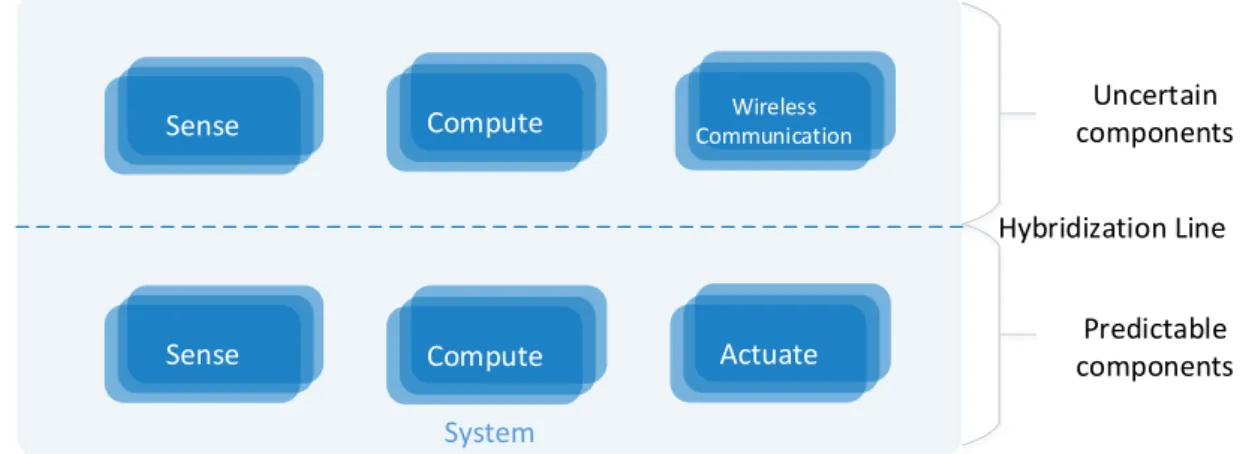
Addressing the challenge of including new functionalities without compromising safety requires innovative solutions to guarantee reliability of one system even in the occurrence of unforeseen failures.. To deal with it, this thesis proposes a solution based on the concept or architectural hybridization, allowing to have some components that are not proven-safe, and therefore that may show an unpredictable behaviour along with some others proven-safe and predictable components, being able to exploit the advantages provided by new applications without compromising safety. This requires mechanisms for managing the system’s configuration and constrain its execution whenever it experiences faults in order to guarantee safety.
For that, we define an additional component to our architecture — the Safety Ker-nel — implemented in the predictable part of the system that manages the system be-haviour and ensures safety. In this thesis, we describe the architecture and role of such Safety Kernel in the context of a hybrid system architecture. Based on a predefined set of rules, the Safety Kernel monitors the operation of the system and manages its operational configuration and forces it to adapt to observed runtime constraints.
We describe the individual components of the Safety Kernel backed up by a brief de-scription of the surrounding system architecture and how it interacts with the remaining functional componentsof the system architecture — the components in charge of provid-ing functionalities to the system. Finally we present a prototype implementation of the Safety Kernel based on ARINC 653 In Space RTOS (AIR), a TSP architecture developed with the aerospace in mind, but applicable to other safety-critical industries.
Chapter 1. Introduction 3
This work is integrated in the KARYON1, an European project that proposes a new
perspective to improve performance of smart vehicle coordination, whose objective is to provide system solutions for predictable and safe coordination of smart vehicles that autonomously cooperate and interact in an open and inherently uncertain environment.
1.1
Motivation
The present work was motivated by the following observations:
• Current state of the art smart vehicles, such as UAVs or smart cars, are not allowed to operate in the public air space or roads due to the risk of causing severe damage cannot be excluded with sufficient certainty;
• The emergence of new technological solutions implies an increase in the complex-ity of one system, which makes the task of proving its safety and predictabilcomplex-ity in design time a hard, or even impossible, task, limiting the integration of such solu-tions in safety-critical systems.
• Even on proven safe systems, failures may still happen due to unpredictable situ-ations. Safety-critical systems must be able adapt themselves to unexpected situa-tions in order to avoid possible catastrophic consequences.
1.2
Objectives
The main objective of the present work is to present the definition, requirements, design and prototype implementation of the Safety Kernel, a component to be used by safety-critical systems, that aims at providing predictability and ensuring safety despite the ex-istence of sources of uncertainty. We present its architecture and an example of imple-mentation within the AIR architecture. The Safety Kernel must be a trusted component, simple enough to have its reliability proven in design time by means of verification, vali-dation and certification.
In the presence of failures, the Safety Kernel must be able to take action to avoid any catastrophic consequence. This means that, at all time, the Safety Kernel must be aware of the system’s constraints and, when needed, trigger some system reconfiguration so that the new configuration meets the observed constraints.
Furthermore, we present an architectural pattern based on a hybrid model composed of components based on different assumptions and providing different trust degrees, as well as the integration of the Safety Kernel in such architecture.
4 Chapter 1. Introduction
1.3
Contributions
The main contributions of the work described in this thesis are:
1. The definition of a hybrid architecture for safety-critical systems that: (a) is composed by both reliable and unreliable components;
(b) allows a flexible and modular integration of new components;
(c) may operate with different configurations, providing different guarantees and functionalities;
2. The definition of a generic Safety Kernel that:
(a) monitors and looks up for constraints and faults in runtime; (b) manages the system’s configuration based on such observations; (c) create mechanisms that enable the cooperation between systems; 3. A prototype implementation of the Safety Kernel using the AIR architecture.
1.4
Institutional Context
This work took place at the Navigators research group, part of the Large-Scale Infor-mation Systems Laboratory (LaSIGE-FCUL), unit of the Informatics Department (DI) of the University of Lisbon, Faculty of Sciences, and was developed within the scope of KARYON, an European project, that consists on a consortium with members from Faculty of Sciences of University of Lisbon, Chalmers University of Technology, SP, Embraer, GMV, University of Magdeburg and 4S Group. The main objective of the KARYON project is, as stated in its mission, ”to provide system solutions for predictable and safe coordination of smart vehicles that autonomously cooperate and interact in an open and inherently uncertain environment”, which is achieved by ”investigating new ways of achieving fault-tolerant distributed control” and with the ”provision of a safety kernel to constraining system operation in order to avoid hazardous situations.”
As a junior researcher, the author of this thesis was a member of the KARYON project, having participated in multiple project activities, such as regular meetings for identifica-tion of problems and discussion of possible soluidentifica-tions, project meetings with other part-ners, helping in the production of project deliverables and publication of a scientific paper at an international conference.
Chapter 1. Introduction 5
1.5
Publications
The work present in this thesis generated the following publication:
• Pedro N´obrega da Costa, Jo˜ao Pedro Craveiro, Ant´onio Casimiro, and Jos´e Rufino. Safety kernel for cooperative sensor-based systems. In Safecomp 2013 Workshop on Architecting Safety in Collaborative Mobile Systems (ASCoMS), Toulouse, France, September 2013 [30].
And the following report:
• M´ario Calha, Jo˜ao Craveiro, Pedro N´obrega da Costa, and Ant´onio Casimiro. First report on safety kernel definition. Technical report, KARYON Deliverable WP4.2, FCUL, 2013 [10].
1.6
Outline
The remainder of this thesis is structured as follows:
Chapter 2 - Reviews some basic concepts for understanding the context of the work, including real-time systems, concepts about safety and how it is handled and guar-anteed in some approaches emerging both from the civil aviation and automotive worlds. It is also given a detailed overview over the AIR architecture;
Chapter 3 – Describes in detail the challenges of achieving cooperation in sensor based systems and the fault model considered for this work;
Chapter 4 – Gives a high-level view of the system architecture;
Chapter 5 - Describes the requirements and the architecture of the Safety Kernel com-ponent;
Chapter 6 - Presents an use cases system and gives an example of a prototype imple-mentation of the Safety Kernel under the AIR system;
Chapter 7 - Closes this documents with concluding remarks and some possible future developments.
Chapter 2
Related Work
2.1
Real-Time Systems
A real-time system is, according to its definition, a system whose requirements are de-fined in terms of timeliness constraints [27, 45, 41]. In other words, a real-time system is a system whose correctness is defined not only with constraints in the value domain, but also in the time one, so that its response and progression must satisfy strict timeliness requirements. As such, and contrary to a common misconception, the main goal of a real-time system is not to achieve a high performance level, but rather to ensure predictability and determinism in its execution. These goals are usually achieved through strict resource scheduling analysis that define how resources are used in runtime by applications, guar-anteeing that each application has the needed resources enough time to complete their actions before their deadline.
The scope of real-time systems is wide, and may go from simple control systems, such as an oven temperature or a traffic light controller to more complex systems such as the onboard navigation system of a car or plane or an air traffic control system.
Based on the timeliness requirements and on their impact on the system’s correctness, three different classes of real-time systems are defined: hard real-time, soft real-time and safety-critical systems.
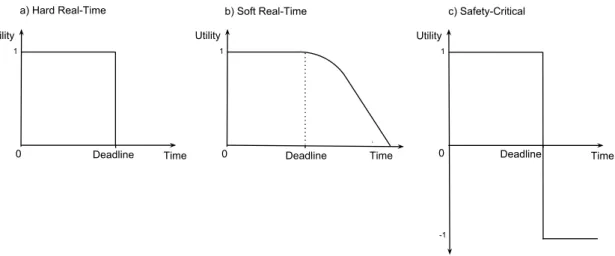
A hard real-time system is the system in which no timing failures may occur. As such, in case of a timing failure, its guarantees do not hold and its correctness is not guaranteed. Its correctness is hardly dependent on the assumption that all the computations produce the desired result before their deadline — the instant when the utility of a computation result drops to zero, as illustrated in Figure 2.1 a). One example of such real-time system is an on-board flight control system, in which a missed deadline may compromise the entire system’s correctness.
Soft real-timesystems are, in the other hand, systems where occasional timing failures are accepted and tolerated. Missing a deadline leads to a consequence a reduction in the utility of a computation result, lowering the quality of the service provided, reaching
8 Chapter 2. Related Work
progressively the zero if multiple deadlines are missed. An example of such systems are online video streaming services, where missing some frames (under a given threshold) is acceptable, having as a consequence a reduction in the quality of the video provided, but, as long as the missed deadlines remain under that given threshold, the service is able to continue its operation without any major consequences. This is illustrated in Figure 2.1 b). Finally, safety-critical systems are the ones where timing failures must be avoided but, in case they occur, they must be handled and treated as exceptions to avoid possible catastrophic consequences. As such, a safety-critical system is the one where a mishan-dled timing failure may have catastrophic consequences, such as the loss of human lives. One example of such is an air-traffic control system, where a single mishandled timing failure may lead to a mid-air plane collision. In this case, the system must be able to, somehow, handle a possible failure to avoid any major consequences. Figure 2.1 c) rep-resents this, where a catastrophic event is represented with a negative value of the utility of the computation result.
Time Utility 0 Deadline 1 Time Utility 0 Deadline 1 Time Utility 0 Deadline 1 b) Soft Real-Time
a) Hard Real-Time c) Safety-Critical
-1
Figure 2.1: Real-Time Classes Utility/Time function
2.2
Safety Concepts
Safetyis an intuitive concept that may be defined in several different ways, but similar in intention. When talking about dependable systems, some definitions for safety may be:
• the absence of unacceptable — where risk is the product of the probability of oc-currence of a failure and its severity risk [21];
• the freedom from accidents or losses [28];
• the guarantee that a given property is respected or the degree to which a system, upon failing, does so in a non-catastrophic manner [45].
Chapter 2. Related Work 9
When designing a safety-critical system, it is necessary to prove and guarantee in design time that all safety requirements and system specifications will be fulfilled in run-time. This is done by means of verification and validation of the software and hardware, through the multiple stages of development of one system. Verification and validation include multiple techniques such as dynamic and static testing of the system, formal ver-ification, fault injection and safety analysis [42].
These techniques intend to, according to some assumptions, statically prove and guar-antee the system’s safety in all cases, even in the presence of faults. The typical approach to do so, is based on making worst case assumptions and ensure safety (or reduce the risk to an acceptable level) under those pessimistic assumptions. For high criticality systems, these assumptions tend to be inflexible and are generally very constrained due to the need of guaranteeing strict and tight safety requirements.
Besides verification and validation, when talking about commercial systems, it is also necessary to talk about their certification process. Certification is usually required for legal reasons, to prove that a system complies with all the requirements specified by the government or some organization and that is acceptable for a commercial use. Certifica-tion must, therefore, follow specific guidelines and standards.
In the context of the avionics industry, certification must obey to standard guidelines such as the RTCA-DO-178 [35] or, in the automotive context, to the ISO 26262 [23] that define rules and practices for the complete development lifecycle of electrical and elec-tronic systems. In general, certification is done by analysing the system through all its development stages and compare it with independent defined safety requirements. These safety requirements vary according to the criticality level of the evaluated component that according to the standard may have different levels. For instance, the DO-178 defines the so-called Design Assurance Level (DAL), whereas for the automotive industry, the ISO 26262 defines the Automotive Safety Integrity Levels (ASIL). These levels are deter-mined at the beginning of the development of a system and are based on a safety analysis made for each component that measures the consequences that a failure on that compo-nent would have on the system’s safety, ranging from the catastrophic to the no effect levels. Based on the calculated level, each standard specifies the requirements and meth-ods that must be used to achieve that level and guarantee safety or the reduction of the risk to an acceptable level.
2.3
Hybrid Models
When designing a system, an application, or simply the solution for a given problem, it is necessary to clearly identify and specify a set of requirements for that system or problem, and a set of assumptions about the properties of the environment for which the problem is to be solved, which has a an implicit impact on the possible solutions [32]. The
10 Chapter 2. Related Work
set of assumptions characterize the relevant attributes of the environment for which the solutions will be developed constituting what is generally denominated as system model. The system model provides an abstraction of the real system, defines what the designer can take as granted, and how these properties are provided or enforced.
In a homogeneous system model, the set of assumptions that is made to the system is global, being applied to the system and all its components as a whole and do not change over time [12]. On the other hand, hybrid system models [43] represent systems in which different parts have different properties and can rely on different sets of assumptions (e.g., fault model, synchronism) and in which these assumptions may vary with time, presenting a number of advantages when compared with homogeneous approaches [44].
One simple example of a system well described by a hybrid system model is a system controlled by a watchdog. The watchdog is used as a safeguard, to make sure that if something goes wrong in the system then it will be possible to, at least, make the system stop in order to prevent some wrong or unsafe behaviour. Clearly, while the system is assumed to possibly fail, the watchdog is assumed to always operate correctly. Therefore, the watchdog is a subsystem with better properties than the rest of the system, which is possible because it is a simple component.
For the problem presented in this thesis, we will exploit the expressiveness of hybrid models to define a hybrid architecture and to design a solution that addresses the conflict-ing goals of predictability and uncertainty, by mergconflict-ing in the same system components assumed to be both reliable and unreliable.
2.3.1
Other hybrid systems examples
The Simplex [38, 39] approach proposes this same idea of composing one system with both complex and simple control components with similar function in order to achieve a control system with improved performance without compromising control safety. In this approach, the idea is to “use simplicity to control complexity”, by having two alternative control components executed in parallel that might be used for controlling some system. One is designed to achieve improved control at the expense of an increased complexity of the control algorithm. Other is designed to achieve a basic control, using a simple algorithm that is not designed for ultimate performance. The trade-off for the improved performance of the complex control algorithm is that it might not always behave correctly because it will be more prone to errors that may bring the controlled system to an unsafe state. The simple algorithm provides the necessary redundancy to compensate possible problems in the execution of the complex algorithm. Upon a detected failure in the com-plex one, the simpler one is called upon to take care of the execution of the system.
The recovery block concept [26] follows a hybrid model, where multiple alternatives for the same function are developed. Before executing the function, the system saves is state, and executes the first alternative, submitting its result to an acceptance test. If an
Chapter 2. Related Work 11
error is detected, the system rolls back to the saved state, and executes another alternative, preferably simpler than the previous, until finding one that passes the test.
In the N-version programming [6], also multiple versions are developed and executed simultaneously, whose results are compared and voted, being chosen the one with major-ity of voters. However, this approach requires to have a majormajor-ity of correct results, instead of only one like the recovery block scheme. Still, the Simplex shows to provide a better reliability when compared with both N-version programming and recovery blocks [26], when considering that the available resources are limited.
From the Simplex approach we inherit the idea of implementing control functions redundantly, each implementation with different degrees of reliability and features, as explained above. However, Simplex is designed by assuming that faults are reflected on some external behaviour that may be observed by some existing sensor. We, on the other hand, consider that sensors may suffer from failures that affect the validity or the timeliness of their data, for which we cannot use directly sensor information to determine how well the system is being controlled and to decide when to switch the control algorithm being used by the system.
2.4
Fault Containment
A mixed criticality system is, according to its definition, “an integrated suite of hardware, Operating System (OS), middleware services and application software that supports the execution of safety-critical, mission-critical, and non-critical software within a single, secure compute platform” [7]. This coexistence of functions with different levels of crit-icality raises the need for mechanisms that provide fault containment that is: that faults in one application are contained and do not spread to or affect the execution of the oth-ers, avoiding that a fault in a non-critical application compromises the execution of a high-critical one.
Virtualization [19, 20] has been widely used as a mechanism to run multiple systems with different environments (called virtual machines) within the same computing plat-form. Virtualization provides isolation in the space domain between virtual machines, meaning that the memory space of each one is independent from the others guaranteeing that faults do not propagate from one machine to another. However, typical virtualization solutions do not provide temporal isolation nor predictability, meaning that delays on one virtual machine may still affect the timeliness of another, not being suitable for use with functions with real-time requirements. Hence, real-time systems, call for isolation not only in the space domain, but also in the time domain, leading to the emergency of the TSP concept, described next.
12 Chapter 2. Related Work
2.4.1
Time and Space Partitioning - TSP
The need to provide fault containment in real-time time systems lead to the emergence of the Time and Space Partioning (TSP) concept [46]. Systems based on TSP are able to in-tegrate multiple components and to provide fault containment between them by enforcing segregation and independence from each other, both in the time and space domains.
Time partitioningmeans that one component shall not affect the timeliness of another. In other words, temporal failures, such as delays or crashes that happen in one component must be contained and may not affect the temporal requirements of another component; Space partitioningis concerned with ensuring that the addressing space memory of each component is independent and that one component may not access to memory of another. When combined, these two properties ensure that, in the occurrence of a any failure in one given component of the system that same failure (and its possible consequences) will be contained to its domain of occurrence, without affecting the remaining components, providing the fault containment properties needed by real-time systems. This concept has been adopted by industries and their standards, as described in the next section.
2.5
Industry Standards
This section intends to give a glance at the Integrated Modular Avionics (IMA) concept and at two main architectural standards used in the avionics and automotive industries: the ARINC 653 and the AUTOSAR. A deeper view is given in the ARINC 653 since it is the base of the AIR architecture, explained in 2.6, used as use cases architecture for the present work.
2.5.1
Integrated Modular Avionics
Avionic systems are composed by multiple different functions, each possibly having a dif-ferent degree of criticality, a difdif-ferent set of requirements and being produced by difdif-ferent developers.
Federated avionics are a legacy type of architecture for such systems, where each function is completely independent from the others, having its own dedicated board with its own computing resources. This architecture has been historically adopted as a mean of guaranteeing separation between functions with different criticalities, with the argument that it would prevent a lower criticality function to affect the behaviour of a higher criti-cality one. However, the fact that resources allocated to one function cannot be shared or reallocated to be used by another function, may lead to an inefficient use of the available resources.
With the increasing number of functions and their complexity present in critical sys-tems like avionics, the use of dedicated boards leads to an exponential growth of the SWaP
Chapter 2. Related Work 13
requirements for such systems.
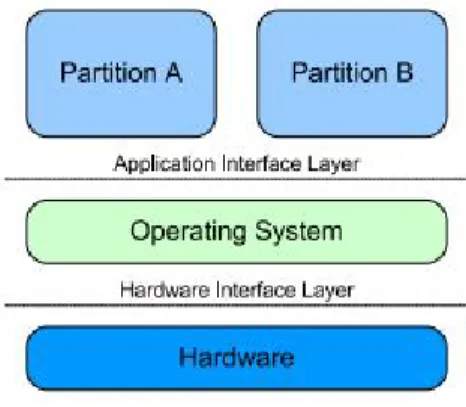
Integrated Modular Avionics (IMA) [1] is, in opposition to federated avionic systems, an alternative architecture concept for systems that integrate multiple functions, possi-bly with different criticalities, in a single shared computing system rather than having individual boards for each function. By integrating multiple functions in the same plat-form, this approach addresses the needs of modern systems, allowing to achieve a better optimization and efficiency in the use of available resources, reducing the set of SWaP requirements and, as consequence, the overall cost of one system. For instance, upon the construction of the commercial A380 airplane, Airbus declared that the use of IMA allowed to achieve a reduction of 50% in the processor units and a 40% decrease in the weight, compared with previous systems [33], which reduces both construction, mainte-nance and operational costs. The basic architecture of an IMA system may be seen in Figure 2.2
Figure 2.2: IMA architecture
As the figure pictures, under an IMA based system, functions are split and executed in individual logical containers known as partitions. These partitions are executed under a common OS that handles and abstracts the hardware layer, releasing the developer from focusing on the target platform and allow him to focus on the software, easing develop-ment and certification processes.
2.5.2
ARINC 653
A prominent example of a TSP system design, is the adoption of the ARINC specifica-tions 651 (Design Guidance for IMA) [1] and 653 (Avionics Application Software In-terface) by the avionics industry. ARINC 653 [2] is a standard software specification for IMA systems that exploits TSP to provide providing fault containment and independent validation, verification and certification of applications. ARINC 653 has been adopted as standard by the avionics industry, namely the Airlines Electronic Engineering Committee, and an example of its use in civil aviation is the software used in the recent Airbus A380 and Boeing 787 [24] aircrafts.
14 Chapter 2. Related Work
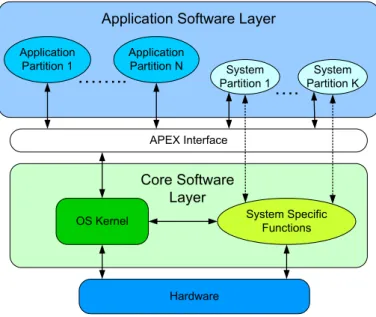
ARINC 653 defines an interface between software applications and the underlying operating system layer, called Application Executive (APEX). Following the IMA speci-fication, on the Application Software Layer, applications are executed in individual emph-partitions that consist on one or more processes that may invoke the services provided by the APEX interface or, if needed, may bypass it to invoke specific functions provided by the underlying core software layer, case in which are called system partitions. ARINC 653 specifies a mandatory set of services to be provided by the APEX and implemented by the OS Kernel such as partition and process management, inter and intra-partition communi-cation, time management and health monitoring. Figure 2.3 shows the basic ARINC 653 architecture.
Figure 2.3: ARINC 653 architecture
Time and space partitioning
In order to provide fault containment and to allow independent application development between partitions, ARINC 653 enforces TSP between partitions.
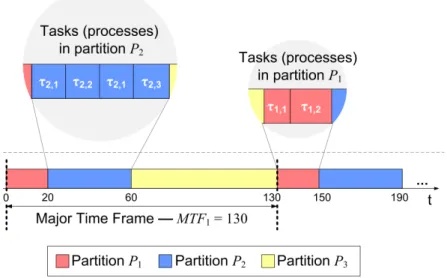
Time partitioning is guaranteed by employing a two-level scheduling hierarchy: on the first level, partitions are scheduled by the system according to fixed and cyclic Par-tition Scheduling Table (PST), defined off-line at integration time that repeats itself over a Major Time Frame (MTF). On the second level, processes are scheduled inside each partition according to a local preemptive scheduler. The use of a fixed scheduled on the first level guarantees that even if a process of one given partition gets delayed, the remain-ing partitions are not affected, since the fixed scheduled limits the time assigned to that partition.
Regarding space partitioning, ARINC 653 implicitly ensures it by the concept of par-titions. However, it does not specifies how it should be achieved by the operating system,
Chapter 2. Related Work 15
giving only the needed requirements of restricting applications to the memory addresses belonging to their own partition.
Interpartition Communication
Interpartition communication aims to support the transfer of information between parti-tions. Its relation with spatial partitioning implies the use of specific services that transfer the data from one partition to another without violating spatial segregation constraints.
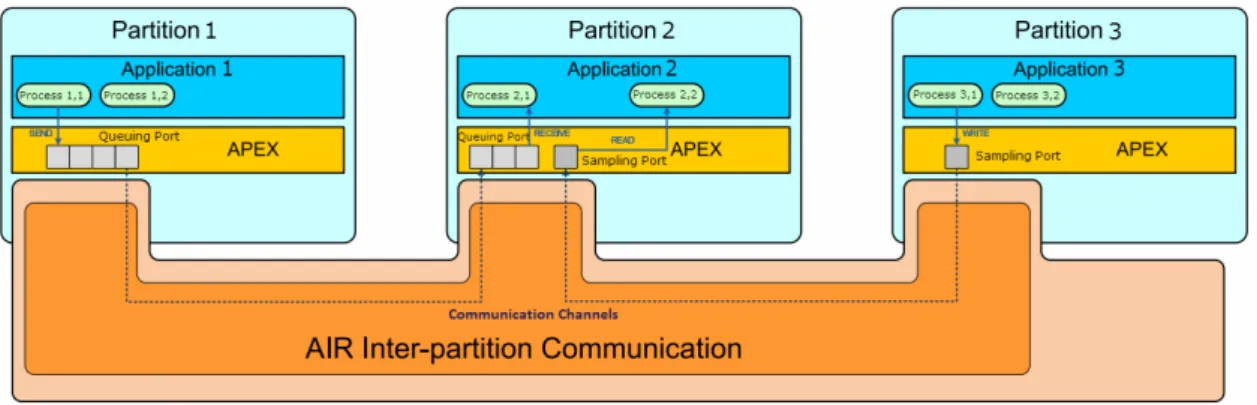
Partitions communicate through communication channels that define a link between one source and one or more destination partitions. Partitions access to channels using predefined access points called ports that abstract the way the information flows on the channels. Ports provide the required resources to send or receive messages in a specific channel. A partition is allowed to exchange messages through multiple channels via their respective source and destination ports. ARINC 653 defines two kinds of ports to ac-cess a communication channels: sampling ports and queuing ports. Sampling ports are bufferless in the sense that each occurrence of a message overwrites the previous one. On the other hand, queuing ports store messages in a FIFO queue, thus, each new instance of a message cannot overwrite the previous one. Upon the creation of a sampling port, besides specifying the writer and reader partitions it is also possible define a refresh rate period: this parameter defines the minimum rate at which the writer should send mes-sages, which allows to control whether messages arrive at a correct rate in the port or not. Upon reading from a sampling port, the reader receives a validity output parameter that indicates whether the age of the read message is consistent with the required refresh period attribute of the port or not.
These communication mechanisms are implemented by the underlying OS and made available to applications by the APEX interface that provides the primitives needed for communication such as create and destroy ports or send and receive messages.
Health Monitor
ARINC 653 also incorporates an Health Monitoring (HM) component that is in charge of monitoring resources and applications at different levels of the system, looking up for failures in the system, helping confining errors to their domain of occurrence. Upon the occurrence of an error (like a process deadline miss, memory protection violations, or even some hardware failures) an exception is raised and a handler, provided by the application developer may be executed. Hence, the HM is a fundamental component to achieve fault adaptability and dynamic behaviour. Faults may be signalized to the HM by applications or generated by the Operating System or detected by the HM itself. The HM component is spread virtually in the architecture components to ensure fault monitoring at all layers, which is why the HM component does not appear in Figure 2.3.
16 Chapter 2. Related Work
Extended Services
Besides these basic and mandatory services, ARINC 653 specification - Part 2 [3] de-scribes some extended and optional services, such as a Multiple Module Scheduler that allows to define several scheduling plans instead of a single and static one. This mech-anism may also be used to achieve adaptability, allowing to achieve different modes of operation instead of having a static one.
2.5.3
AutoSAR
AUTomotive Open System ARchitecture (AUTOSAR) [4] is a standard software archi-tecture developed by a consortium of car manufacturers and other automotive suppliers for the automotive industry, with the goal of establishing a standard base infrastructure for the development of vehicular software.
AUTOSAR allows to fulfil the requirements of future vehicles, providing easy soft-ware updates, flexibility to integrate and transfer softsoft-ware between different systems, the use of Commercial of the Shelf (COTS) components and, as a consequence, an optimiza-tion of the producoptimiza-tion costs. AUTOSAR provides definioptimiza-tions in three areas; first, it defines a standard interface for software applications, implying that software may be developed independently of the target hardware platform and that applications may communicate with each other in a standardized way, using a virtual bus that abstracts how the informa-tion flows between different applicainforma-tions.
Secondly, it defines a middleware that specify modules in different areas such as ser-vices, communication, operating system and hardware abstraction. Furthermore, it spec-ifies a set of templates to allow exchanging information between different companies. The top-level requirements for an AUTOSAR operating system include provisions that correspond, to some extent, to the notions of temporal and spatial isolation [4]. The specification of the AUTOSAR operating system, however, does not prescribe the use of strict partitioned scheduling as a means to achieve this temporal isolation among applica-tions [5].
2.6
ARINC In Space RTOS - AIR
AIR [37] is an architecture for a new generation of aerospace systems designed to imple-ment and fulfil the requireimple-ments of TSP that, despite being inspired in the ARINC 653 specification, aims to improve upon such specification, diverting from it where its limi-tations can be overcome to the benefit of additional functionality and flexibility, without compromising safety.
For instance, despite the strict prohibition thereto in ARINC 653, the architecture is being improved to safely schedule applications over multiple processor cores [17]. Other
Chapter 2. Related Work 17
example where AIR diverts from the ARINC 653 specification is related with the Core Software Layer; due to their constraints, Real-Time Operating Systems (RTOSs) are usu-ally more limited and use to lack relevant functions that are present in generic OSs. Port-ing those functions into a RTOS is a hard and expensive task. Motivated by this fact, instead of providing a single RTOS that is used by all partitions, AIR foresees the use of a different OS in each partition — called Partition OS (POS) — supporting the use of both generic and real-time operating systems [16], which allows to provide functions that were not possible to provide in a RTOS. AIR foresees the definition and use of multiple PSTs rather than a single fixed PST as defined in ARINC 653 basic services that may be interchanged at runtime. This feature allows AIR to define mode-based scheduling (e.g. different phases of a flight) providing a more efficient use of the resources (e.g., by deac-tivating unnecessary partitions) and also gives support to adaptation mechanisms in case of timing failures in one single partition [15].
The modularity of the AIR architecture and the fault containment properties provided by TSP allow to achieve composability property of AIR-based systems: composability means that properties that hold for individual components also hold after the components are assembled in the same system, which allows independent component development and eases the process of verification and validation of software components [18].
2.6.1
AIR Architecture
The AIR architecture, pictured in Figure 2.4 preserves the hardware independence inher-ited from ARINC 653 specification. It relies on an intermediary Partition Management Kernel (PMK) that acts as a hypervisor of the whole system, in charge of enforcing ro-bust TSP properties, hosting crucial services such as partition management (scheduling and dispatching), communication (inter and intra-partition) and low-level interruptions handling.
Each partition may host a different OS, called POS, which can be either a RTOS or a non-RTOS. The POS Adaptation Layer (PAL) encapsulates each POS, hiding the particularities of each one in order to make them homogeneous and to provide a POS-independent interface to the surrounding components.
Applications access to services provided by the PMK using the APEX interface. APEX provides an interface derived from ARINC 653 specification, providing services such as process and time management, communication and health monitoring to applica-tions. In addition, system partitions may bypass the APEX to invoke specific functions of the OS and not available via APEX.
18 Chapter 2. Related Work
Figure 2.4: AIR architecture from [14]
2.6.2
APEX Interface
According to the ARINC 653 specification, a standard interface between the application software layer and the core software layer called APEX provides the basic services to the applications such as process, partition and time management, communication and health monitoring. APEX may be used by applications to invoke these basic services or bypassed by system partitions to access to specific functions of the POS.
In order to support AIR extra features such as mode-based scheduling, adaptability and online system updates, the APEX base interface has been extended with new services and primitives [34, 15].
2.6.3
Partition Management Kernel
The PMK is the base of the Core Software Layer, and may be seen as an hypervisor, transversal to all partitions. It is responsible for ensuring robust TSP properties, pro-viding communication between different processes and partitions and handling low level interruptions.
Time Partitioning
AIR follows the two-level scheduling fashion proposed by the ARINC 653 specification to enforce temporal partitioning (i.e., that one partition does not interfere with each other’s timeliness), as pictured in Figure 2.5. In the first level, partitions are scheduled and dis-patched by the PMK, on a cyclic repetition (over a MTF) of a predetermined sequence of time windows — the PST. The PST is calculated offline and defines the amount of time assigned to each partition. In the second level of scheduling, inside each partition’s time window, processes are scheduled according to the native POS scheduler.
Chapter 2. Related Work 19
Figure 2.5: Two-level hierarchical scheduling
AIR support mode-based schedules, which means that the system can safely switch, in execution time, between multiple PSTs that are previously defined and integrated into the system.
Space Partitioning
AIR guarantees space partitioning between partitions by having separate addressing spaces for each one and not allowing an application from one partition to access memory ad-dresses of a different partition. In AIR, this achieved through a modular approach based on a mapping between hardware-independent descriptors and the hardware-provided mem-ory protection capabilities (e.g., its Memmem-ory Management Unit) [37].
Interpartition Communication
In conformity with the ARINC 653 specification [2], and as explained in 2.5.2, AIR pro-vides two types of ports for accessing communication channels: sampling ports and queu-ing ports. Interpatition communication mechanisms are implemented by the PMK layer and made available to applications by the APEX interface.
The relation between interpatition communication and spatial partitioning implies the use of specific services that transfer the data from one partition to another without vio-lating spatial segregation constraints. For that, the PMK must ensure memory protection, to guarantee that ports belonging to a given partition are not accessed by another one. Communication channels transfer data between ports, resorting to memory-to-memory copies mechanisms. Figure. 2.6 illustrates both types of interpartition communication mechanisms.
20 Chapter 2. Related Work
Figure 2.6: AIR Interpartition communication mechanisms
and sampling ports provided by the APEX and by invoking the primitives to write/read (in case of sampling ports) and send/receive (in case of queuing ports).
2.6.4
Mode Based Scheduling and Adaptability
ARINC 653 basic services rely on a a single PST used to schedule partitions, imple-menting the first level of the scheduling hierarchy. This PST is fixed and defined off-line at system integration time. AIR goes a step further and, instead of using a single PST, gives supports for the definition of a set of PSTs. The use of different PSTs allows to have different scheduling schemes that may be used to provide mode-based scheduling, adaptability and reconfiguration mechanisms, making the system more flexible and able to adapt its behaviour according to different needs. For instance, mode-based scheduling permits the system to adapt scheduling to correspond to a different mode of operation (e.g. take off, landing, etc.) allowing to make a more efficient use of the resources. Authorized system partitions may request scheduling switch by using the primitives provided by the APEX [34].
Furthermore, in [14] it is shown how this mechanism may help mitigating the rate of deadline misses in the presence of temporal faults of a single partition by assigning extra time to partitions experiencing timing delays
2.7
Summary
This chapter presented the basic concepts and related work that help understanding the work performed in the present thesis. First, it introduced real-time systems and their sev-eral classes, from soft-real time to safety-critical systems. It then gives a glance on some concepts related to safety and how it is guaranteed by means of validation, verification and certification of software. We then introduced the concept of hybrid models in opposition to homogeneous ones and the need for mechanisms that provide fault containment, from
Chapter 2. Related Work 21
which we highlight the TSP concept. The chapter closes with an overview over some emerging architectural standards from the civil and automotive worlds and with a detailed description of the AIR architecture. The next chapter will introduce sensor-based systems and the fault model considered in the present work.
Chapter 3
Cooperative Sensor-Based Systems
3.1
Sensor-based systems
A control system is a component or device added to one system in charge of controlling its behaviour, typically in an automated way. Examples of such systems are setpoint controllers in chemical plants, fly-by-wire systems on aircrafts or even router protocols that control traffic flow on the Internet. Other examples of emerging control systems are the ones used in autonomous smart vehicles, airplanes or robots, having high requirements in terms of confidence, reliability and safety levels [49]. Besides computation, control implies interaction with the physical world, for which control systems include not only computation units, but also sensors and actuators used to interact with the outside world or system [48]. The interaction between these components and the environment is a central concept in control and constitutes the control system loop [49], pictured in Figure 3.1.
Sense Compute
Environment
Actuate
Figure 3.1: Basic Control Loop
Sensors are in charge of sensing and acquiring data whether from the environment or from the system itself and produce information to be consumed by some component of the system. Computational units receive data as input (from sensors or from another computing element), process it and output a result to another component (to an actuator or another computing element). In its turn, actuators consume information produced by a computing component and actuate on the system, whose consequences reflect on the
24 Chapter 3. Cooperative Sensor-Based Systems
environment or on the system itself. This basic scheme abstracts the existing software, hardware and communication channels between components, being only focused on the data flow and the feedback between the control system and the actual controlled entity.
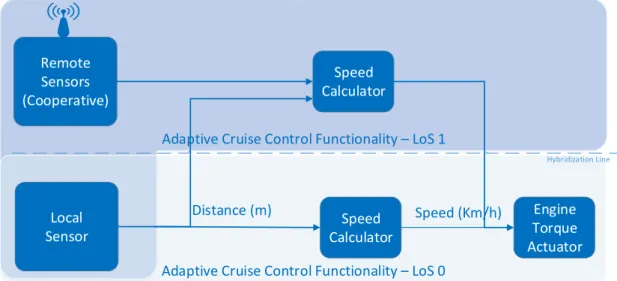
In this model, we assume that each component is used for a different function, serving a different purpose. A complete control loop (i.e., the flow of data from sensing to the ac-tuation), implements what we call a functionality. As such, a functionality is constituted by multiple functions, each implemented by a different component. For instance, consid-ering one vehicle: we may implement an Adaptive Cruise Control (ACC) functionality that adapts the car speed based on the relative position to the surrounding vehicles. In this case, the ACC functionality would be composed by one distance sensor, one component that extracts information about the position of the vehicle relatively to the surrounding vehicles, one component that implements a speed calculator function that receives the rel-ative position as input from the position calculator and outputs a speed, and an actuator that receives the speed calculated by the speed calculator and applies it to the car. Figure 3.2 represents this basic functionality.
Adaptative Cruise Control Functionality
Distance Sensor Speed Calculator Engine Torque Actuator
Distance (m) Position Speed (Km/h)
Estimator
Position
Figure 3.2: Example of Adaptive Cruise Control Functionality
3.2
Cooperative Systems
By cooperative systems, we understand a set of independent systems that actively ex-change data and interact in order to help each other to achieve some common goal, such as improving their efficiency as a whole, or to realize some cooperative functionality. Cooperation between control systems has wide range of applications such as military or surveillance operations, wireless sensor networks and transportation systems [29].
Research about cooperating control systems is not new theme. For instance, in 1997, the PATH project [11] showed of a group of cars able to cooperate with each other in order to drive in platoon formation in a closed environment. Due to the technological innovations developed over the past decade, the research on this area has been a hot topic, with several new projects being developed regarding cooperation in transportation sys-tems [40].
![Figure 2.4: AIR architecture from [14]](https://thumb-eu.123doks.com/thumbv2/123dok_br/15490445.1041543/44.892.119.767.103.315/figure-air-architecture-from.webp)