The cave‐adapted arthropod fauna from Madeira
archipelago
ARTUR R.M. SERRANO & PAULO A.V. BORGES
Serrano, A.R.M. & P.A.V. Borges 2010. The cave-adapted arthropod fauna from Madeira archipelago. Arquipelago. Life and Marine Sciences 27: 1-7.
This work provides an overview of the hypogean fauna from the Madeira archipelago, presenting a list of obligated cave-dwelling species. A total of 6 troglobiont species in 5 orders have been described to date. The cave fauna in Madeira can be considered poor when compared with either the local epigean fauna or the cave fauna of other Macaronesian archipelagos. Curious is the occurrence of one wood-louse cave species (Trichoniscus
bassoti), which apparently is the only troglobite living in more than one Macaronesian
archipelago (Canaries and Madeira). Major problems related to the conservation of cave fauna are discussed, but it is clear that the protection of this specialized fauna requires the adequate management of surface habitats.
Key words: Cavalum, Coleoptera, lava tubes, Machico, troglobiont species
Artur R.M. Serrano, Centro de Biologia Ambiental/Departamento de Biologia Animal, Faculdade de Ciências da Universidade de Lisboa, R. Ernesto de Vasconcelos, C2, PT-1749-016 Lisboa, Portugal. Paulo A.V. Borges (e-mail: [email protected]) Azorean Biodiversity Group, Departamento de Ciências Agrárias, Universidade dos Açores, Terra-Chã, PT-9700-851 Angra do Heroísmo, Terceira, Portugal.
INTRODUCTION
There are nearly 3891 taxa (species and subspecies) of terrestrial arthropods belonging to 462 families and 2118 genera recorded for Madeira and Selvagens, and a large proportion of these (921 species; 77 subspecies) are endemic to the archipelago (Borges et al. 2008). Most of the endemic species and subspecies are known from the native forest and new species and subspecies continue to be found, with an average of 90 new taxa described per decade (Borges et al. 2008). Madeira Islands have a volcanic origin and consequently have several habitats in which it is possible to find cave-adapted fauna (e.g. lava-tubes, volcanic pits, mesovoid shallow substratum – MSS). Interestingly and in contrast to the archipelagos of the Azores (see Borges & Oromí 1994; Borges et al. 2007) and the Canaries (see Oromí 1992; 2008), the cave inhabiting fauna of Madeira archipelago has been less studied and explored (but see a recent compilation in Serrano
& Borges in press). With the exception of the recent study of Nunes (2005) no other exhaustive study of the cave biota of Madeira is available. The so-called MSS (“Milieu souterrain super-ficiel” or “Mesovoid Shallow Substratum”, see Borges & Oromí 1994) could be a potential interesting habitat to explore cave-adapted fauna of Madeira archipelago, but almost nothing is known about the arthropod fauna of this habitat. Moreover, no organized information on the Madeira archipelago cave fauna is available in the project Encyclopaedia Biospeleologica (see Ju-berthie & Decu 1994; 1998).
Cave ecosystems support large numbers of arthropod species, which represent most of biomass in this environment (Culver & Pipan 2009). In many of their ecological roles, cave arthropods are unique and no other animal group could substitute them. However, most people are unaware of the importance of cave arthropods and frequently these small invertebrates have been overlooked in conservation management projects
both in caves and elsewhere. In this work we expand the data available in Serrano & Borges (in press) providing some comments on the conservation status of the species and their habitat.
MATERIAL AND METHODS
The Madeira archipelago is located in the Atlantic Ocean, southwest of the Iberian Peninsula, between the latitudes 32o30´ and 33o31´ northern
latitude and 16o30´and 17o30´ western longitude .
The distance between this archipelago and Ponta de Sagres (Portugal - the closest point of mainland Europe) is about 1,000 km. The largest island is Madeira (730 km2) and Porto Santo (70
km2) is located 60 km to the northeast of Madeira.
To the southeast the Madeira archipelago continues along the Desertas sub-archipelago, composed of three small islands: Ilhéu Chão (ca. 0.5 km2, 100 m maximum altitude), Deserta
Grande (ca. 10 km2, 479 m maximum altitude)
and Bugio (ca. 3 km2, 388 m maximum altitude).
This archipelago is part of the African plate and includes a single volcanic group (the Madeira-Porto Santo) which is interpreted as being a long-lived “hot spot” coming from the mantle (Carvalho & Brandão 1991). The emerged part of
the Madeira Island dates back to the Post-Miocene, <5.6 Ma (Ribeiro et al. 2005).
THE CAVE ENVIRONMENT
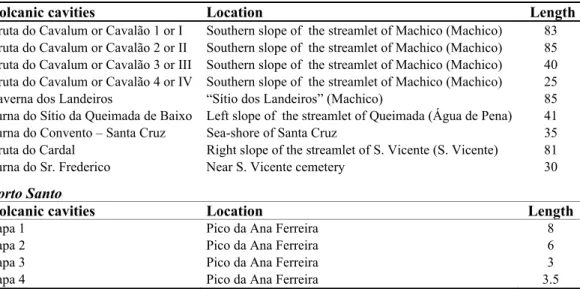
The volcanic activity in Madeira archipelago ended 6000-7000 years BP (Geldmacher et al. 2000). The known lava tube caves and pits are poorly studied from a geological perspective, and most probably are the result of the Mio-Pliocenic volcanic activity. Madeira is the only island with true lava tube caves known locally by different names such as “grutas”, “cavernas” and/or “furnas” (Gouveia 1963). No lava tube caves are known for Porto Santo, but only some pits locally known as “lapas” normally used by humans and cattle as refuges (Gouveia 1963). Cave and pit formations are unknown in the neighbouring islets of Desertas. The cavities of Madeira archipelago are poorly known and only two works devoted to this subject are available (Gouveia 1963; Relvas & Monteiro 1987). The speleometry of a total of six cavities and four “lapas” were given for Madeira and Porto Santo, respectively. (Gouveia 1963) (see Table 1). A topographic characterisation was done also for the complex of Cavalum caves located in Madeira Island (Relvas & Monteiro 1987).
Table 1. Volcanic cavities of Madeira and Porto Santo islands, with their location and length (m) (modified from Serrano & Borges in press).
Madeira Island
Volcanic cavities Location Length
Gruta do Cavalum or Cavalão 1 or I Southern slope of the streamlet of Machico (Machico) 83 Gruta do Cavalum or Cavalão 2 or II Southern slope of the streamlet of Machico (Machico) 85 Gruta do Cavalum or Cavalão 3 or III Southern slope of the streamlet of Machico (Machico) 40 Gruta do Cavalum or Cavalão 4 or IV Southern slope of the streamlet of Machico (Machico) 25 Caverna dos Landeiros “Sítio dos Landeiros” (Machico) 85 Furna do Sítio da Queimada de Baixo Left slope of the streamlet of Queimada (Água de Pena) 41 Furna do Convento – Santa Cruz Sea-shore of Santa Cruz 35 Gruta do Cardal Right slope of the streamlet of S. Vicente (S. Vicente) 81
Furna do Sr. Frederico Near S. Vicente cemetery 30
Porto Santo
Volcanic cavities Location Length
Lapa 1 Pico da Ana Ferreira 8
Lapa 2 Pico da Ana Ferreira 6
Lapa 3 Pico da Ana Ferreira 3
ARTHROPOD SAMPLING AND DATA
Field work in several caves of Madeira Island has been carried out by one of the authors (ARMS) between 1991 and 1993. The sampling of cave arthropods was performed using direct search and pitfall traps baited with TURQUIN (1000 ml of dark beer, 5 ml acetic acid, 5 ml formalin and 10 g of hydrate chloral) and a piece of Danish-Blue cheese suspended from the edge of the trap. A few drops of liquid detergent were added to reduce surface tension. Sets of eight traps (radius 70 mm and depth 100 mm) were dug into the soil (with the rim at the surface level) or placed inside cracks and fissures (for more details see also Serrano 1993; and Serrano & Borges 1995). In addition to the results obtained with field work we revise the available literature. In this revision we only consider the troglobite/troglo-biont fauna (i.e. hypogean), species which clearly show absence or at least clear reduction of eyes, lack of pigmentation, slender and long body and appendages, wings absent or rudimentary (for insects) and exclusive presence in subterranean habitats. We also refer to some cases of troglo-philic species, i.e. cave organism that may complete its life cycle in a cave, but can also survive in above ground habitats. No mention is made to trogloxene species that are organisms that uses caves for shelter but does not complete its life cycle in them (see Culver & Pipan 2009). The use of the term “subterranean” includes both the species that live in the caves and MSS (hypogean) and those occurring in the soil (endogean).
RESULTS
COMMENTED LIST OF SPECIES
PALPIGRADI
Eukoeneniidae. Eukoenenia madeirae Strinati &
Condé, 1995 is considered a troglobitic species. Described originally from specimens collected at Cavalum II (Strinati & Condé 1995), it was recently captured only at Cavalum I (Nunes 2005). Interestingly, there is a congeneric epigean species in Madeira, Eukoenenia mirabilis (Grassi & Calandruccio, 1885), but Eukoenenia madeirae
differs from the epigean relative by the patterns of setae distribution in urosternite VI.
PSEUDOSCORPIONES
Chthoniidae. In a recent intensive survey of the arthropod fauna of Madeiran lava tubes Nunes (2005) found a new pseudoscorpion species, Paraliochthonius cavalensis Zaragoza, 2004. Only one specimen of this troglobitic species was found in Cavalum III lava tube (Zaragoza et al. 2004; Nunes 2005). Interestingly, there is a congeneric epigean species on the island, Paraliochthonius hoestlandti Vachon, 1960, but the new cave species has no eyes and markedly elongated legs (Zaragoza et al. 2004).
ARANEAE
Linyphiidae. The two representatives of Araneae
belong to the genus Centromerus (Linyphiidae) (Wunderlich 1992; 1995) and may have a common epigean ancestor species (e.g. C. variegatus). Centromerus sexoculatus Wun-derlich, 1992 was found in the lava tubes of the Cavalum complex (Cavalum I) near Machico and C. anoculus Wunderlich, 1995 in Cardais cave near S. Vicente. These two species are cave-dwellers with reduced eyes as well as pronounced depigmentation. Cave species of the genus Centromerus are not present in other Macaronesian archipelagos (Wunderlich 1993).
ISOPODA
Trichoniscidae. Curious is the occurrence of one
wood-louse cave species (Trichoniscus bassoti Vandel, 1960), which apparently is the unique troglobite living in more than one Macaronesian archipelago (Canaries and Madeira) (Oromí 1992). The presence in more than one archipelago could be explained by: i) the secondary dispersal to an additional island. For instance, in the Azores many troglobionts occur near the entrances of caves and it could happen that their eggs or even juveniles have been transported by a bird or by wind in debris; ii) poor taxonomic resolution, i.e., in each island we have different taxa but with very similar morphologies.
Fig 1. a) Thalassophilus pieperi Erber (Coleoptera, Carabidae); b) Medon vicentensis Serrano (Coleoptera, Staphylinidae) (Photos by Enésima Mendonça).
This species was found only in “furnas” of Cavalum I, II and III (Machico) and Vandel (1960) refers that it is close to T. jeanneli Vandel and T. halophilus Vandel, 1951.
COLEOPTERA
Carabidae. The other three known cave-dwelling
species belong to the order Coleoptera. Thala-ssophilus pieperi Erber, 1990 (Carabidae) (Fig. 1a) was found in the complex of “furnas” of Cavalum I, II, III (Machico), in Cardais Cave (S. Vicente) and recently also in Landeiros Cave (Nunes 2005). The species shows depigmentation and reduced eyes. In spite of never having been found in caves, there is another Madeiran species of Thalassophilus (T. coecus), which also shows adaptations to a hypo-endogean habitat. When comparing five species of the genus, Erber (1990) concluded that these two species are very close. The presence of T. pieperi in cavities separated by several kilometres could indicate a subterranean connection between the caves (e.g., through MSS) or even a previously greater distribution of the species than the actual one in Madeira Island. It is strange that an island with a high number of epigean Trechus species (Lompe 1999) has just one record of a facultative troglophilic species living in the entrance of Cardais cave (T. fulvus Dejean, 1831) (Serrano & Borges 1995) and in Landeiros cave (Nunes 2005). This species, as the former authors pointed out, probably arrived recently to the island or, if not, by severe competition with other carabid species, remained limited to an empty biotope like the entrance of caves (in the mainland T. fulvus is sometimes also found in this type of biotopes).
Staphylinidae. The last cave-dweller found in
Madeira is the rove-beetle Medon vicentensis Serrano, 1993 (Fig. 1b) (Serrano 1993). This species is eyeless and depigmented, but with more or less normal legs and antennae. It was found only in Cardais Cave (S. Vicente). Rove-beetles as cave-dwellers are only known from the Canary and Madeira archipelagos in the context of the oceanic Macaronesia. Medon vicentensis belongs to the Medon ferrugineus group (species characterized by dilated protarsi in the males and
the morphology of the aedeagus), as defined by Assing (2006), which includes a total of ten species in the Atlantic Islands, the Western Mediterranean, and Europe. Originally Serrano (1993) erroneously attributed Medon vicentensis to the M. fusculus group (sensu Assing 2006). The epigean fauna of Madeira includes three additional species that are not included in the Medon ferrugineus group: Medon apicalis (Kraatz, 1857) (belonging to the M. apicalis group sensu Assing 2006); Medon ripicola (Kraatz, 1854) (belonging to the M. fusculus group sensu Assing 2006); and the endemic Medon indigena (Wollaston, 1857) which is considered as a separate monophyletic group (Assing 2006). Two additional cave adapted Medon species are known from the Canary Islands (M. antricola from Hierro; M. feloi from La Palma) (see Assing 2006).
DISCUSSION
While the endemic epigean arthropod fauna of the Madeira archipelago is very rich (many hundreds of species distributed by several orders) (see Borges et al. 2008), the known cave adapted fauna is very poor. On the other hand, the knowledge of the endogean fauna in the last three decades, mainly belonging to the genus Geostiba Thomson (Coleoptera Staphylinidae), has greatly improved (e.g. Franz 1981; Assing & Wunderle 1996).
The current apparent poverty of the hypogean fauna is due probably to the small number of available cavities, to the lack of sampling, or to both causes. In accordance with these assumptions, there are indications, based on recent sampling effort in Cavalum tubes, that the arthropod fauna of Madeira caves is much richer than previously expected (Nunes 2005). As was shown also by Oromí (1992), the fauna of the MSS is apparently unknown for the Madeira archipelago. We say “apparently” because some species collected in litter or even in deeper layers of soil can also potentially be found in the MSS (e.g. Talassophilus coecus Jeannel, Trechus myniops Wollaston, Geostiba spp.). These species show distinct adaptations to the hypo-endogean
life: some depigmentation and reduction of eyes. However, until now the known hypogean species of the archipelago were all found only in the cavities of Madeira Island.
Most caves have unique communities of invertebrates, but very few are obligate sub-terranean species as showed by our samples and Nunes (2005) survey. Due to their island endemic status and occurrence in only a few caves, most troglobites may represent an important fraction of the threatened species in Madeira. The most effective way to protect those species is to create special measures for the cave systems, since they usually cover a small area. Limiting access to caves with gates could be a solution. However, surface habitats have also to be carefully managed due to the danger of inputs of toxic contaminants or extreme eutrophication. Despite the widespread destruction of Madeira´s natural vegetation on the lowlands and particularly in the south part of the island, approximately 73% of Madeira’s territory corresponds to protected areas (Laurisilva Forest is a Natural World Heritage site under UNESCO). Nevertheless, there is no indication that cave fauna is safeguarded by the above-cited legislation. The inconspicuousness of many cave arthropod species and the lack of standardized population studies make it difficult to establish their threatened status. However, it is a priority to produce lists of threatened Madeira arthropods and to increase efforts to monitor their populations.
In contrast to recent efforts in the Azores, we do not have knowledge of significant efforts in the protection of cave systems in Madeira Island. Unfortunately one of the most interesting caves of Madeira (Gruta dos Cardais, S. Vicente) was partially destroyed and modified as show-cave in 1992-1993 with the support of the Regional Government and without any study of envi-ronmental impact. At least owing to its biological interest the cave of Cardais (the remaining undisturbed tubes) and “Furnas” of Cavalum must be protected in order to avoid the potential extinction of troglobitic species.
ACKNOWLEDGEMENTS
We would like to thank Dr. Manuel Biscoito (Museu Municipal do Funchal) for facilities and logistic support in Madeira. We also thank Mr. J. Silva of the same Museum for assistance in field work. We thank Pedro Oromí and Volker Assing acting as referees for their critical comments and improvements on the manuscript. Clara S. Gaspar and Enésima Mendonça produced figure 1.
REFERENCES
Assing, V. 2006. A revision of Western Palaearctic
Medon: the species of the Atlantic Islands, the
Western Mediterranean, and Europe, except for the southeast (Insecta: Coleoptera: Staphylinidae: Paederinae). Bonner Zoologische Beitrage 54: 25-95.
Assing, V. & P. Wunderle 1996. A revision of the Madeiran species of the genus Geostiba Thomson, 1858 (Coleoptera: Staphylinidae). Révue Suisse de
Zoologie 103: 119-150.
Borges, P.A.V. & P. Oromí 1994. The Azores. Pp. 605-610 in: Juberthie, C. & V. Decu (Eds),
Encyclopaedia Biospeologica. Tome I. Société de
Biospéologie, Moulis.
Borges, P.A.V., P. Oromí, A.R.M. Serrano, I.R Amorim & F. Pereira 2007. Biodiversity patterns of cavernicolous ground-beetles and their conservation status in the Azores, with the description of a new species: Trechus isabelae n. sp. (Coleoptera: Carabidae: Trechinae). Zootaxa 1478: 21–31.
Borges, P.A.V., A.M.F. Aguiar, M. Boieiro, M. Carles-Tolrá & A.R.M. Serrano 2008. The arthropods (Arthropoda) of Madeira and Selvagens archipelagos. Pp. 245-270 in: Borges, P.A.V., C. Abreu, A.M.F. Aguiar, P. Carvalho, R. Jardim, I. Melo, P. Oliveira, C. Sérgio, A.R.M. Serrano & P. Vieira (Eds). A list of the terrestrial fungi, flora
and fauna of Madeira and Selvagens archipelagos.,
Direcção Regional do Ambiente da Madeira and Universidade dos Açores, Funchal and Angra do Heroísmo.
Carvalho, A.M.G & J.M. Brandão 1991. Geologia do
Arquipélago da Madeira. Publicações Avulsas,
Museu Nacional de História Natural, Universidade de Lisboa, 170 pp. [In Portuguese]
Culver, D.C. & T. Pipan 2009. Biology of caves and
other subterranean habitats. Oxford University
Erber, D. 1990. Thalassophilus pieperi n. sp., a new cavernicolous carabid beetle from Madeira.
Bocagiana 140: 1-12.
Franz, H. 1981. Neue blinde, subterrane Coleopteren von den Makaronesischen Inseln (Coleoptera: Staphylinidae et Curculionidae). Entomologica
Scandinavica Supplement 15: 328-332. [In
German]
Geldmacher, J., P. Bogaard, K. Hoernle & H. Schmincke 2000. The 40Ar/39Ar age dating of the Madeira Archipelago and hotspot track (eastern North Atlantic). Geochemistry, Geophysics,
Geosystems, 1:1008.
Gouveia, F.A.R. 1963. Principais grutas existentes na ilha da Madeira. Boletim da Sociedade Portugeusa
de Espeleologia, 2ª série, 1: 34-40. [In Portuguese]
Juberthie C. & V. Decu (Eds) 1994. Encyclopaedia
Biospeologica. Tome I. Société de Biospéologie,
Moulis.
Juberthie C. & Decu V. (Eds) 1998. Encyclopaedia
Biospeologica. Tome II. Sociétè de Biospéleologie,
Moulis.
Lompe, A. 1999. Revision der Trechus–Arten Madeiras und Porto Santos (Coleoptera, Carbidae).
Entomologische Blätter 95: 93-143. [In German]
Nunes, E. 2005. Os Tubos de Lava de Machico (Ilha da
Madeira, Portugal): Biodiversidade e Conservação. BSc Thesis, Dpto. de Biologia,
Universidade da Madeira. 50 pp. [In Portuguese] Oromí, P. 1992. La Fauna Subterránea en las Islas
Macaronésicas. Pp. 193-205 in: Actas do 3º
Congresso Nacional de Espeleologia e do 1º Encontro Internacional de Vulcanoespeleologia das Ilhas Atlânticas (30 de Setembro a 4 de
Outubro de 1992), Angra do Heroísmo. [In Spanish]
Oromí, P. 2008. Biospeleology in Macaronesia.
Association for Mexican Cave Studies Bulletin 19:
98-104.
Relvas, P. & V. Monteiro 1987. Grutas do Cavalum. Machico – Madeira. Algarocho 9: 5-9. [In Por-tuguese]
Ribeiro, L., S. Echchakroun, J. Mata, A. Boven, N. Mattielli, J. Hus & C. Maerschalk 2005. Elemental and lead isotopic evidence for coeval heterogeneities at Madeira/Desertas mantle source. Pp. 485-488 in: Acts of VIII Congresso de
Geoquímica dos Países de Língua Portuguesa (Portugal) (ed. Anonymous).
Serrano, A.R.M. 1993. Medon vicentensis n. sp., a new species of eyeless rovebeetle (Coleoptera: Staphylinidae: Paederinae) from a cave in the island of Madeira. Bocagiana, 165: 1-7.
Serrano, A.R.M. & P.A.V. Borges 1995. A new subspecies of Trechus fulvus Dejean, 1831 (Trechus fulvus madeirensis n. ssp.) from the Madeira Island with some biogeographical comments. Boletim do Museu Municipal do
Funchal, Supl. 4º: 663-670.
Serrano, A.R.M. & P.A.V. Borges (in press). The Madeira archipelago. In: Juberthie C. & V. Decu (Eds), Encyclopaedia Biospeologica. Tome Ia
Amérique_et_Europe. Soc._de_Biospéologie, Moulis. Strinati, P. & B. Condé 1995. Grottes et Palpigrades de
Madère. Mémoires de Biospéologie 22:161-168. Vandel, A. 1960. Les Isopodes terrestres de l’archipel
madérien. Mémoires du Muséum national d'histoire
naturelle, sér. A, Zoologie 22: 1-155.
Wunderlich, J. 1992. Die Spinnen-Fauna der Makaronesischen Inseln. Taxonomie, Ökologie, Biogeographie und Evolution. Beiträge zur
Araneologie 1: 1-619. [In German]
Wunderlich, J. 1993. The Macaronesian cave-dwelling spider fauna (Arachnida: Araneae). Memoires of
the Queensland Museum 33: 681-686.
Wunderlich, J. 1995. Zur Ökologie, Biogeographie, Evolution und Taxonomie einiger Spinnen der Makaronesischen Inseln. Beiträge zur Araneologie 4: 385-439. [In German]
Zaragoza, J.A., D. Aguín-Pombo & E. Nunes 2004.
Paraliochthonius cavalensis, nueva especie
cavernícola de Madeira (Arachnida, Pseu-doscorpiones, Chthoniidae). Revista Ibérica de
Aracnología 9:343-351. [In Spanish] Accepted 29 March 2010.