Research Article
Impact of Business Interoperability on the Performance of
Complex Cooperative Supply Chain Networks: A Case Study
Izunildo Cabral
and Antonio Grilo
UNIDEMI, Departamento de Engenharia Mecˆanica e Industrial, Faculdade de Ciˆencias e Tecnologia, Universidade Nova de Lisboa, 2829-516 Caparica, Portugal
Correspondence should be addressed to Izunildo Cabral; [email protected]
Received 6 October 2017; Accepted 12 December 2017; Published 7 February 2018
Academic Editor: Salvatore Cannella
Copyright © 2018 Izunildo Cabral and Antonio Grilo. This is an open access article distributed under the Creative Commons Attribution License, which permits unrestricted use, distribution, and reproduction in any medium, provided the original work is properly cited.
This paper proposes an agent-based model for evaluating the effect of business interoperability on the performance of cooperative supply chain networks. The model is based on insights from the Industrial Marketing and Purchasing network approach and the complex systems theory perspective. To demonstrate its applicability, an explanatory case study regarding a Portuguese reverse logistics cooperative supply chain network is presented. Face-to-face interviews and forms were used to collect data. The findings show that the establishment of appropriate levels of business interoperability has helped to reduce several non-value-added interaction processes and consequently improve the operational performance of the Valorpneu network. Regarding the research implications, this paper extends the current knowledge on business interoperability and an important problem in business: how business interoperability gaps in dyadic organizational relationships affect the network of companies that the two companies belong to—network effect. In terms of practical implications, managers can use the proposed model as a starting point to simulate complex interactions between supply chain network partners and understand better how the performance of their networks emerges from these interactions and from the adoption of different levels of business interoperability.
1. Introduction
It has been widely recognized that, in an era in which the traditional competition between companies has been replaced by competition between supply chain networks (SCNs) [1, 2], individual companies no longer compete as independent entities [3, 4] with unique brand names but instead as integral parts of SCN relationships [5, 6]. As a consequence of this change of the business context to a network-driven economy, companies have been increasingly forced to establish cooperation with SCN partners and other external entities [7] in order to obtain mutual benefits by sharing or partitioning work [8], increase efficiency, improve environmental performance [9], resolve common problems [10], enable market creation [11], provide superior value [12, 13], and establish a superior competitive position [14–16]. This in turn leads to cooperative SCNs, which are defined in this research as set of three or more companies with symbiotic interests that join and efficiently combine the most suitable
set of skills and resources (e.g., knowledge, capital, and assets) for a time interval in order to achieve a common set of objectives [17].
However, because systems that support the operations in many companies were created independently [18], some challenges that SCN managers may face when it comes to establishing cooperation are misaligned and conflicting busi-ness goals, misaligned management approaches, misaligned business processes, misaligned methods of work, misaligned legal bases, multiple sources of data, heterogeneous and incompatible information technology, and so on (see [4, 19, 20]). To address these problems, business interoperability, often referred to as enterprise interoperability (e.g., [4, 21, 22]), has been widely pointed out as one of the main disciplines that has enabled companies to establish effective cooperation [23]. Its relevance to cooperative SCNs is evident. For example, Brunnermeier and Martin [24] estimated that, in the US automotive supply chain (SC), inadequate business interoperability delays the introduction of new models by at
Volume 2018, Article ID 9213237, 30 pages https://doi.org/10.1155/2018/9213237
least two months and costs the members of this industry at least US $1 billion per year. Business interoperability can be defined as “the ability of two or more business units, as well as
of all systems within their boundaries and the external systems that they utilize or are affected by, to work together” (adapted
from [25]).
An analysis of the current literature reveals that, despite the high expectations concerning the effects of business inter-operability on the performance of organizations, research in this field focuses mainly on developing architectures (e.g., [26, 27]), frameworks (e.g., [20, 28–30]), maturity models (e.g., [22, 31]), and methods/standards (e.g., [19, 32–35]). Indeed, as shall be discussed further below, only very little empirical research has been carried out regarding the analysis of the effects of business interoperability on the performance of companies, particularly in complex cooperative SCN contexts (see, e.g., [24, 36–39]).
An examination of these studies reveals that, despite their significance to the development of theory on business interoperability, they do not provide insights on how different levels of business interoperability in dyadic organizational relationships affect the performance of the two companies in the dyads and, more importantly, how different levels of business interoperability in dyadic organizational relation-ships influence the performance of the network that the two companies in the dyad belong to. In this research, the spread of the effects of different levels of business interoperability over the cooperative SCN is called network effect—a phe-nomenon that occurs in complex systems where the actions or behavior of a system’s component have effects on the other system’s components. Addressing the network effect in the analysis of the impact of business interoperability on the performance of cooperative SCNs is important because, as emphasized by H˚akansson and Snehota [40], the impacts of a dyad relationship are not limited to the two companies in the dyad; that is, other entities and dyads may be impacted. Limiting the analysis only to the performance of the two companies involved in the dyads does not allow a great understanding of the true effect of business interoperability on the performance of cooperative SCNs. In addition, they do not provide any guideline about how to predict the effect of business interoperability on the performance of a new cooperative SCN for being designed and how improvements in the level of interoperability affect the network performance over time. A level of business interoperability is a concept that is used to characterize the state at which a business system can be situated in terms of interoperability with other business systems [31], that is, a measure of how interoperable two or more connected business systems are [28]. Defining certain levels of business interoperability in the analysis of the effects of business interoperability is important to distinguish differ-ent interoperability requiremdiffer-ents and to serve as a guideline for improving the business interoperability performance of business systems [28, 41].
Another relevant gap is that those studies addressed the analysis of the impact of business interoperability by investigating the companies individually, assuming that no specific links are supposed to exist among the companies in the network. Put differently, the unit of analysis was set at
the organizational level instead of at the dyad relationships level. As Johnston [42] (cited in [43]) emphasized, grounding on any individual company/dyad cannot offer any great understanding of the business interactions. To overcome the research gaps identified above, this research presents a model that can be used to analyze the effect of business interoperability on the performance of complex cooperative SCNs. In seeking to achieve this goal, the following research question was posed:
How can we analyze the effect of business interoperability on the performance of complex cooperative supply chain networks?
To address this research question, the following research stance was defined:
Agent-based simulation provides an effective set of tools for analyzing the effect of business interoperability on the performance of complex cooperative supply chain networks.
Agent-based simulation (ABS) is a modeling tool used by researchers from different areas of knowledge to understand and analyze complex patterns that result from the interaction of many individuals within an environment [44]. The justifi-cation for choosing ABS as the modeling tool to address the above research question is provided in Section 4.1.
The remainder of this paper is structured as follows: the following section discusses the concept of business interoperability and the aspects of the complex system theory (CST), following the development of an extended business interoperability framework and research hypotheses. The rationale for using ABS and the details of the ABS model are provided in the section thereafter. The paper goes on to test the applicability of the model through a case study regarding a Portuguese reverse logistics (RL) cooperative SCN and ends with the conclusions and suggestions for the forthcoming work.
2. Theoretical Foundations
2.1. Business Interoperability: An Overview. Interoperability
has been mostly defined and addressed from the technical perspective (see [45]). This is revealed in one of the most cited definitions of interoperability [46]: “the ability of two
or more systems or components to exchange information and use the information that has been exchanged.” However,
inter-operability is not only an issue of exchanging information through information and communication technology (ICT) systems (e.g., [18, 45]). There are other dimensions such as interorganizational processes, culture, and the management of contractual issues between the business partners [8]. As a result, the concept of interoperability has been increasingly replaced by business interoperability in order to include the human and organizational elements (e.g., [28, 29, 32]). The definition of business interoperability adopted in this paper is the one provided in Section 1.
2.2. Business Interoperability Frameworks. The current
liter-ature includes many elements that have been identified in and around the business interoperability (e.g., [4, 26, 28, 29]), supply chain management (SCM) (e.g., [47–50]), business relationships (e.g., [51–53]), complex SCNs (e.g., [54–58]),
and collaboration (e.g., [59–62]) literature as responsible for the relationships between two or more companies. In the context of this research, the elements of these literature strands are grouped into categories that are named dimen-sions of business interoperability. A dimension of business interoperability can be defined as the different aspects of business interaction that two or more companies can engage in (e.g., business strategy, management of external relation-ships, cooperative business processes, business semantic, and information systems) [29]. As implied in this definition, business interoperability is a multidimensional concept that can be viewed and approached from various perspectives, and therefore many frameworks have been proposed to reconcile all the perspectives, approaches, and directions, which are frequently different [63].
A review of the business interoperability literature sug-gests that there is no shortage of frameworks for modeling interoperability in different business contexts. Among the frameworks published so far, the Levels of Information Sys-tems Interoperability (LISI) [41] is often regarded as the first significant initiative carried out to address interoperability (e.g., [31, 64]). However, it is often criticized due to its “strong” focus on the technical aspect of interoperability [31, 65]. Acknowledging this limitation, frameworks such as the IDEAS interoperability framework [66], the European Inter-operability Framework [67], the ATHENA interInter-operability framework [68], the E-health interoperability framework [69], and the Framework for Enterprise Interoperability [70] have been developed to capture other aspects of business interoperability such as business strategy, business processes, and knowledge management. Although these have been pointed out as some of the most relevant interoperability frameworks (e.g., [22, 26]), they do not incorporate a number of factors associated with the network complexity, which limit their use or make it difficult in the analysis of interoper-ability in complex business network contexts. In the attempt to overcome this limitation, ATHENA [28] developed the business interoperability framework to support the analysis of collaboration between networked organizations, which has been used as the reference to develop the Zutshi et al.’s [29] framework. This framework captures eight dimen-sions of business interoperability, called business interop-erability parameters, and further identifies subdimensions to allow measuring performance for each parameter (see [29]). In comparison with the frameworks mentioned above, ATHENA’s [28] and Zutshi et al.’s [29] frameworks enable a more holistic approach to business interoperability as they incorporate a greater number of business interoperability factors, which are also better organized into five and eight categories, respectively. However, despite recognizing their contribution to the business interoperability literature, we argue that, in order to examine the interactions among companies in complex cooperative SCNs, a more holistic framework is needed. This is in line with Corella et al. [71], who stress that there are scarce practical examples of an SC interoperability framework that can be applied as a reference, and therefore more holistic frameworks must be designed to support the improvement of business interoperability performance. Zutshi et al. [29] also recognized that as the
effects of business interoperability across multiple companies in a network need to be further explored, future investigations should adapt their framework in order to be used in a network-based context.
From our perspective, ATHENA’s [28] and Zutshi et al.’s [29] frameworks have two relevant limitations. First, they do not capture all relevant dimensions of business interoperability and even those that are incorporated do not include all relevant subdimensions. For example, in the dimension business strategy, issues such as alignment and visibility of cooperation goals are missing. Trust and transparency are missing in the dimension of management of external relationships. Alignment, coordination, integration, flexibility, and monitoring are also missing in the dimension cooperative business processes. Also, they do not incorporate elements related to one essential dimension of business interoperability, that is, Information Quality (see [72]). With regard to this, note that the subdimensions of information quality (e.g., accuracy, timeliness, and completeness) were not incorporated in any of the business interoperability frameworks published so far. The second limitation is related to the design of these frameworks, which was not supported on any relevant network or complexity theory. We argue that as business interoperability in network-based contexts is a multidimensional construct consisting of many related dimensions and subdimensions, making the network even more complex, a network theory is needed to address such complexity. For this reason, this research is grounded on the CST, which advocates that complex systems, as are the examples of cooperative SCNs, should be analyzed in a holistic and systemic way (e.g., [73]) (see the next section).
2.3. Complex Systems Theory. As a relatively new research
discipline, CST can be seen as a metatheory that deals with the research of complex systems [74, 75]. For example, in the SCM literature, it has been widely used as a theoretical lens for analyzing complex SCNs [76], providing theoretical frameworks for a number of SCN related publications (see, e.g., [54–58, 73, 77–80]).
The rationale for addressing CST in this research is not limited to the design of our business interoperability framework, which is associated with the aspect of decom-posability. From the perspective of CST, as SCN systems are embedded in an open and dynamic environment and interact with it [54], there are eight major aspects that must be taken into account when modeling this type of systems (see [54, 81, 82]): decomposability, dimensionality, reflexivity, nonlinearity, emergence, ability to learn, self-organization, and quasi-equilibrium. Indeed, these aspects have a number of implications for this research. For example, the aspect decomposability, which helps to separate subsystems from one to another [81], is important to decompose the busi-ness interoperability construct into detailed dimensions and subdimensions that can be clearly understood, measured, and managed. This facilitates the design of the extended business interoperability framework (see Figure 1) as well as the measurement of its constructs through a maturity model. Dimensionality addresses the degree of freedom that individual companies within the cooperative SCN have to
Business strategy Clarity in cooperation goals Alignment of cooperation goals Visibility of cooperation goals Management of external relationships Partner selection Cooperation contracts/ protocols Commitment Interorganizational trust Transparency Communication Interorganizational conflicts Cooperative business processes Clarity Alignment Performance evaluation Responsibility sharing Visibility Coordination Integration Flexibility
Products and services
Specificity
Frequency of transactions
Financial exchange
Employees and work culture Cultural differences Linguistic barriers Interpersonal trust Interpersonal conflicts Competences/skills Responsibility Motivation Knowledge management IPR protection Foreground IPR Organizational learning capability Individuals learning capability Business semantics Conflicting terminologies Semantic conversion Information systems Information model (database) Type of interaction Type of connectivity
Security and privacy
Accessibility
Data exchange tools
Speed
User interface/degree of sophistication
Multiple data sources
Multiple applications and devices
Integration (standards and protocols) Information quality Accuracy Reliability Timeliness Completeness Conciseness Relevance Understandability Format/readability Network details Network governance
Number and type of nodes
Number and type of relationships
Type of interdependence
Supplier-base complexity
Customer base complexity
Market uncertainty Communication channels Contact points Cooperation dynamics (entry/exit of partners) External cooperation mechanisms Legislations and regulations Dimensions and subdimensions of business interoperability
Incompatibility of software
Duration of cooperation Power and reciprocity
Legacy systems Heterogeneity of IT
platforms
Industry dynamics (new technologies/competitors) Maturity of industry Honesty/transparency Methods of work Monitoring Autonomy Information systems breakdown Adaptability Economic/political crisis Variety of products and
parts Joint relationship investments Strikes Natural disasters Terrorist attack
Figure 1: Extended business interoperability framework (adapted from [29]).
behave autonomously [81]. In the scope of this research, it is important to understand the dimensionality of the
coop-erative SCNs because [81](1) SCNs with high dimensionality
tend to be difficult to control and tend to be too uncooperative harnessing the achievement of the cooperation goals and (2) too less dimensionality implies lees autonomy to invest on innovative cooperation mechanisms, also hampering the value that business interoperability can provide to the whole SCN. Therefore, it is important to measure and maintain cooperating partners freedom in efficient levels.
Reflexivity suggests that as cooperative SCNs are fre-quently changing and adapting to new market and/or internal needs, the behaviors of each agent in the network have effects on the other agents around it [81]. For example, by closing emergent interoperability gaps, establishing or eliminating relationships in the cooperative SCN, the performance of the other agents in the network can be affected. This in turn might
force the other agents to act in response to those changes, hence causing a reflexive impact on the performance of the whole network. There is an interoperability gap when the cur-rent level of business interoperability on a particular situation of interaction does not match the required level. Nonlinearity suggests that cooperative SCNs contain critical nonlinear characteristics where a small change can be magnified to impact the whole network [81]. For example, “changes to the master schedule quantities can have unpredictable, nonlinear impacts on the individual material plans due to differences in planning lead times, lot-sizing rules, and inventory levels for lower level components” [57]. Interoperability gaps in a given dyad relationships may have different impacts on different dyads/companies. Emergence is the arising of new, unexpected patterns, structures, processes, or properties in the whole network [54]. These highly structured collective behaviors, which are not easy to predict by knowing only the
behavior of the individual agents, come from the interactions between these individual agents [83]. With reference to coop-erative SCNs, two of the emergent phenomena that can arise are demand amplification and inventory swing. For example, the delays downstream and decisions in an SC often lead to amplifying a nondesirable effect upstream, a phenomenon usually called the “bullwhip” effect [82]. Another key idea of emergent properties is that the outcome of those interactions leads to the concept of synergy, suggesting that the sum of the individual parts is more than the system as a whole [84]. Again, with reference to this study, the establishment of appropriate levels of business interoperability in the dyad relationships throughout the cooperative SCN might enable effective interactions between its partners, hence resulting in a performance that might be higher than the sum of the performance achieved in each dyad. Note that this aspect, along with reflexivity and nonlinearity, reinforces the importance of addressing the network effect in the analysis of the impact of business interoperability on the performance of cooperative SCN, as discussed in Section 1.
Ability to learn suggests that intelligent systems, as are the examples of cooperative SCNs, are able to adapt their individual capabilities and improve their performance as experience accumulates [81]. In the ambit of this research, it implies that cooperative SCNs must retain past knowledge on their interoperability experience and use it to learn how to improve their interoperability performance. This requires effective sharing and storage of information on the interoperability experience, which can be used to support decision-making regarding the interoperability mechanisms to be implemented. Self-organization occurs when, based on a certain degree of intelligence, a system uses acquired knowl-edge to change its internal structure in order to better interact with its environment and adapt automatically to external changes [81]. In the specific case of cooperative SCNs, the interactions among their companies are affected by a set of external events such as the introduction of new legislations and regulations, introduction of new technologies, natural disasters, and economic and political crisis. These events may cause disruptions in the cooperative SCN operations and, in this situation, the cooperative SCN must use its experience to self-organize and recover to a business interoperability state that is equal to or greater than the one when the disruptions occurred.
Last, a system is in quasi-equilibrium when it is prevented from collapsing into randomness but still retains enough freedom to evolve and adapt to the environment whenever needed [81]. In the ambit of this research, it refers to the ability of a cooperative SCN to oscillate between a state of network equilibrium where companies interact normally with inter-operable relationships and nonequilibrium characterized by a network with fuzzy relationships or with interoperability issues such as misaligned objectives, business processes and information systems, interorganizational conflicts, and responsibilities not well defined. It is therefore necessary to have in place effective interoperability mechanisms in order to minimize these oscillations and maximize the time cooperative SCNs are operating linearly profiting from a
maximum efficiency from the interoperable relationships [81].
2.4. Agent-Based Simulation. ABS is a relatively new
compu-tational method that enables a researcher to create, analyze, and experiment with models composed of agents that interact within an environment [85]. It is an approach to model-ing complex systems composed of interactmodel-ing, autonomous agents [86], and to investigating aggregate phenomena by simulating the behavior of individual agents, such as con-sumers or organizations [44]. In other words, it is a method for modeling Multiagent Systems (MAS) which consist of a set of elements (agents) characterized by some attributes and behaviors, which interact with each other through the definition of appropriate rules in a given environment [87]. Specifically, a MAS is defined by Monostori et al. [88] as a network of agents that interact and typically communicate with each other. Agents refer to any autonomous entity with its own properties, behaviors [44], and decision-making capability [89].
According to Giannakis and Louis [90], the agent-based technology is acknowledged as one of the most promising technologies for effective management of complex systems such as SCNs due to the vital properties of agents, which are summarized, for instance, in Michael and Jennings [91], MacAl and North [86], and Barbati et al. [87]:
(1) Autonomy. Agents are able to operate without the direct intervention of humans or others and have some kind of control over their actions and internal state. In other words, agents are aware of their envi-ronment operating and control their own actions as well as internal states in order to fulfil their objectives. In particular, the user does not interfere with their decision-making, after they specified their rules. (2) Social Ability. Agents are able to interact with other
agents (and possibly humans) via some kind of agent-communication language or common actions. (3) Reactivity. Agents are able to perceive their
environ-ment, including other agents, and they are able to react on the basis of these perceptions; that is, they are able to respond in a timely fashion to changes that occur in their environment.
(4) Proactiveness. Agents do not simply respond to changes in their environment but can initiate actions in order to satisfy their specified objectives.
3. Hypotheses Development
3.1. Framework of Reference. The framework developed in
this research to support the analysis of the effect of business on the performance of cooperative SCNs (see Figure 1) is an extended version of Zutshi et al.’s [29] framework. It was designed to overcome the limitations of the frameworks discussed in Section 2.2. The rationale for choosing Zutshi et al.’s [29] framework as the reference is that it draws upon the literature review of most of the previous interoperability frameworks and because it focuses on the dimensions of
Business strategy
Management of external relationships Cooperative business
processes
Products and services
Employees and work culture Knowledge management Business semantics Information quality Information systems Network details Business interoperability gaps on
Network effect
H1
H2
Supply chain network performance Operational
Economic
Environmental
Social
Figure 2: Conceptual framework.
business relationships between collaborating partners, which can also be applied to the context of cooperation. Given that business interoperability is a multidimensional concept, it has been built on the following assumption:
Business interoperability is a multidimension concept that considers not only the information systems configuration char-acteristics but also other dimensions such as management of external relationships, business strategy, cooperative business processes, employees and work culture, products and services, knowledge management, information quality, business seman-tics, and network details.
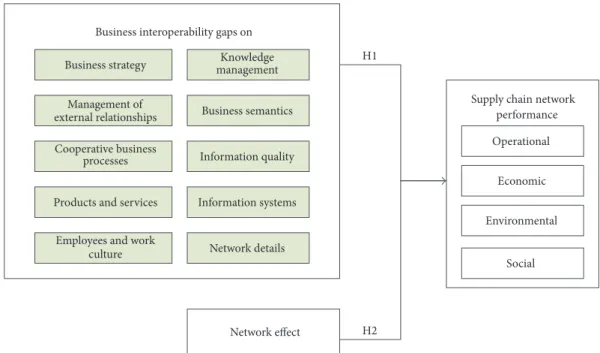
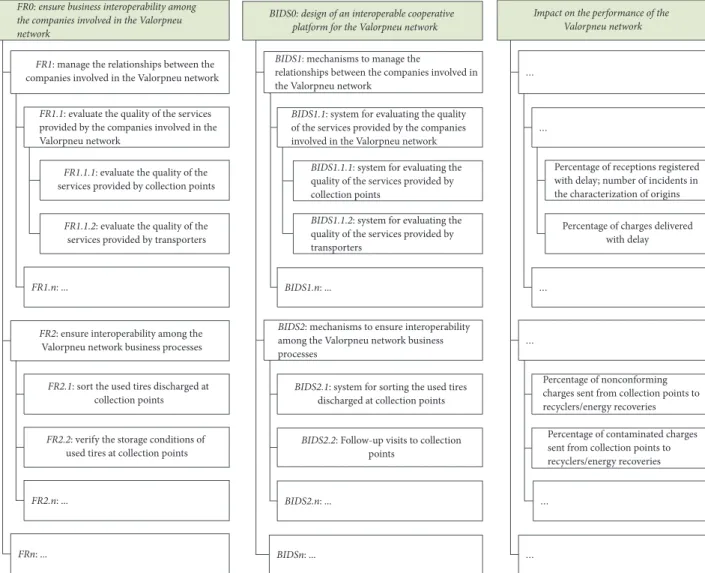
The dimensions of business interoperability included in Figure 1 will be used as constructs in the development of the research hypotheses, the theoretical framework (see Figure 2), and the theoretical ABS model (see Section 4.2). The description of each dimension and subdimension of business interoperability provided in Figure 1 can be found in Cabral [92]. Given that most of the constructs included in that framework are abstract and their integration in the ABS model depends on the business interoperability requirements of the cooperative SCN under analysis, the Axiomatic Design Theory [93, 94] was used to decompose them into detailed constructs that can be easily measured and modeled (see Figure 3). The Axiomatic Design Theory is a design methodology that is used by designers to decompose and structure the components of a complex system in a logical and rational way [94].
3.2. Linking the Levels of Business Interoperability to SCN Performance. Business interoperability has been regarded as
an important source of business value [36] and a challenge affecting the success of companies’ deployment [95]. For example, Brunnermeier and Martin [24] analyzed the US
automotive SC and concluded that imperfect interoperability is very costly and that fixing its problems may help to improve the performance of the industry by minimizing cycle time and cost. Jardim-Goncalves et al. [96] stress that business interoperability is a factor with high impact on the productivity of both the public and private sector, impacting the overall quality, cost of transactions, and yield time, as well as the design of industrial processes and digital public services.
Indeed, empirical evidence shows that business interop-erability has a significant effect on the business performance, mainly on the economic and operational dimensions. A classic example is Brunnermeier and Martin’s [24] study, mentioned in Section 1. Another example is the Loukis and Charalabidis’ [36] study, which concluded that the adoption of information systems interoperability standards such as proprietary, industry-specific, and eXtensible Markup Language- (XML-) based (http://www.w3.org/XML/) ones has a significant positive impact on the four dimensions of performance proposed by the balanced scorecard (customers, learning and innovation, financial, and internal business processes). Additional empirical studies on the impact of interoperability are Gallaher et al. [37], Gallaher et al. [38], and White et al. [39]. These studies suggest a link between business interoperability and economic/operational perfor-mance of cooperative SCNs. The perforperfor-mance of a business system refers to how efficiently and effectively it is able to transform the inputs to outputs [28]. Economic performance relates to the SCNs’ ability to reduce costs associated with purchased materials, energy consumption, waste treatment, waste discharge, and fines for environmental accidents, while operational performance relates to the SCNs’ capabilities to
FR0: ensure business interoperability among the companies involved in the Valorpneu network
FR1: manage the relationships between the
companies involved in the Valorpneu network
FR2: ensure interoperability among the
Valorpneu network business processes
FR1.1: evaluate the quality of the services
provided by the companies involved in the Valorpneu network
FR1.1.1: evaluate the quality of the
services provided by collection points
FR1.1.2: evaluate the quality of the
services provided by transporters
FR2.1: sort the used tires discharged at
collection points
FR2.n: ...
FRn: ...
BIDS0: design of an interoperable cooperative platform for the Valorpneu network
BIDS1: mechanisms to manage the
relationships between the companies involved in the Valorpneu network
BIDS2: mechanisms to ensure interoperability
among the Valorpneu network business processes
BIDS1.1: system for evaluating the quality
of the services provided by the companies involved in the Valorpneu network
BIDS1.1.1: system for evaluating the
quality of the services provided by collection points
BIDS1.1.2: system for evaluating the
quality of the services provided by transporters
BIDS2.1: system for sorting the used tires
discharged at collection points
BIDS2.n: ...
BIDSn: ...
Impact on the performance of the Valorpneu network
...
... ...
Percentage of receptions registered with delay; number of incidents in the characterization of origins
Percentage of charges delivered with delay
Percentage of nonconforming charges sent from collection points to recyclers/energy recoveries
...
...
FR2.2: verify the storage conditions of
used tires at collection points
BIDS2.2: Follow-up visits to collection
points
Percentage of contaminated charges sent from collection points to recyclers/energy recoveries
FR1.n: ... BIDS1.n: ... ...
Figure 3: Link between FRs, BIDSs, and performance measures.
more efficiently produce and deliver products or services to customers [9].
Common to the above studies is the focus on the infor-mation systems’ configuration characteristics. The literature mentioned earlier in this paper highlighted the need to take a holistic approach in addressing business interoperability, mainly in the context of cooperative SCNs. This is in line with Loukis and Charalabidis’ [36] recommendation to study empirically the value added not only of “technical inter-operability” but also of “organizational interinter-operability” as well and their complementarities. For example, the impact of complexity on the performance of SCNs, which is usually addressed in the SCM literature (see [57]), has never been addressed in the literature on the analysis of the effect of business interoperability on the performance of networked companies.
Also, the research approaches employed in those studies do not allow “pragmatic” testing of the effect of diverse levels of interoperability on the performance of networked compa-nies. Perhaps for this reason, the findings of Loukis and Char-alabidis [36] indicated that future research on the business
value of information systems should take into account the levels of interoperability that a company’s information and communication technology (ICT) infrastructures provide as high-priority variables. Testing the effect of different levels of business interoperability is important because a higher level of interoperability does not necessarily mean a sign of maturity or excellence, since the “optimum level of interop-erability” depends on whether the accumulated investments on business interoperability solutions outbalance the benefits, that is, whether it “fits” the interests of the stakeholders [28]. Therefore, the “optimum level of interoperability” has to be judged based on the individual requirement of each situation of interaction; that is, if a low level of business interoperability perfectly matches the situation, costly improvements to existing systems may be unwarranted [28]. In this study, “the optimum level of business interoperability” is reflected in the measure of the gap between the actual level of business interoperability (ALBI) and the required level of business interoperability (RLBI) (see (1)).
Another important limitation of the previous studies is the strong emphasis on the operational and economic
dimensions of business performance. Note that operations management has matured from a field that myopically focused only on these two dimensions to one that compre-hensively addresses the broader social and environmental issues that organizations face nowadays [97]. Corresponding to these trends and the fact that SCNs operate in open and dynamic environments (see Section 2.3), we argue that expected performance outcomes of business interoperability are not only operational and economic matters but also environmental and social ones. For example, Gallaher et al. [38] argue that inadequate interoperability in construction industry leads to missed opportunities that could generate valuable benefits for the public at large. In manufacturing industries, business interoperability problems impact
soci-ety’s economic welfare in the following ways:(1) increasing
the cost of designing and producing final products and(2)
delaying the introduction of new final products—an increase in the cost of designing and producing a new aircraft or automobile may result in an increase in the equilibrium price of their respective markets [37]. These arguments suggest that business interoperability also affects the social performance of SCNs. Social performance relates the ability of cooperative SCNs to meet their legal or social obligations that integrate societal concerns into their business operation and their interactions with their stakeholder groups such as employees, local communities, and the government [98, 99].
Regarding the environmental performance, which is defined as the ability of cooperative SCNs to reduce air emissions, effluent waste, and solid wastes and the ability to decrease consumption of hazardous and toxic materials [9], ATHENA [28] advocates that external contingences such as environmental legislations affect the business relationships and as a result may affect companies’ environmental per-formance. For example, in the case of the Waste Electrical and Electronic Equipment (WEEE) directive, manufactur-ers are enforced to be responsible for the entire lifecycle of their products [100], contributing to improving their environmental performance. There is also evidence that the implementation of Green Supply Chain Management (GSCM) in Asian countries, such as India, China, Malaysia, Taiwan, South Korea, Thailand, and Indonesia, is partially influenced by a cultural norm called Guanxi, which plays a key role in relationship governance within SC activities by helping companies to better manage their relationships while they green their SCs [101] and improve their environ-mental performance. In addition, issues such as absence of cleaner production technologies and underdevelopment of recycling technology may inhibit the establishment of GSCM (e.g., [102]) or reverse logistics (e.g., [103, 104]), which in turn might contribute to reducing companies’ environmental performance.
An analysis of the SCM literature (e.g., [102, 105]) also reveals that internal business interoperability drivers such as collaborative transportation, coordination of raw materials and components from suppliers to manufacturers, exchange of design specification and environmental requirements, involvement of suppliers in the development and design stage, cooperation with vendors to standardize packaging, integration between focal company engineers and suppliers’
designers, certification of suppliers/vendors’ environmental management system, organization of environmental semi-nars and training for suppliers, system for encouraging sup-pliers to take environmental initiatives, system for rewarding environmental initiatives taken by suppliers, and environ-mental auditing of suppliers/vendors can help SCN partners to eliminate or at least reduce emissions, energy, hazardous chemical, and solid waste. These arguments suggest that both external contingences and internal business interoperability drivers are related to the environmental performance of SCNs. Underpinned by the above theoretical discussions, the following hypothesis is postulated.
Hypothesis 1. Business interoperability gaps in a dyad
rela-tionship are negatively related to the performance of the two companies involved in the dyad.
3.3. Linking Network Effect to SCN Performance. As discussed
earlier in this paper, there is a need to address the network effect in the analysis of the effects of business interoperability on the performance of cooperative SCNs. Indeed, the lit-erature on business interoperability and SCM suggests that the effect of the levels of business interoperability in dyad relationships is not limited to the two companies in the dyads, although this aspect has not been empirically investigated. For example, Gallaher et al. [38] argue that inadequate inter-operability in dyad relationships increases the cost burden of construction industry and leads to missed benefits for this industry. White et al. [39] stress that small improvements in business interoperability in dyad relationships can produce disproportionately large improvements in SC function. On the other hand, issues such as order cancellations, production problems, shipment delays, and forecast revisions at any step in an SC may interrupt information and physical flows, forcing suppliers to adjust their planning (White et al. [39]), which in turn might have an impact on the whole network. However, although these arguments suggest that the levels of business interoperability in dyad relationships is expected to affect the performance of network of companies to which the dyads belong to, empirical research on the analysis of the effect of business interoperability on performance does not explain how this impact can be analyzed nor which network theories can help to understand such phenomenon [24, 36].
To address this gap, this study takes the perspectives from the Industrial Marketing and Purchasing (IMP) net-work approach and specific aspects of CST to connect the network effect to the performance of cooperative SCNs (see Hypothesis 2). The IMP network approach was developed in the IMP group [40, 106, 107] in an attempt to account for the complex reality of interorganizational exchanges [108]. It was developed based on the assumption that the initial IMP interaction model (e.g., [109]) is not appropriate to explain the effect of connectedness among dyadic business relationships because its emphasis is generally on a dyad relationship. In short, the basic assumption of the IMP network approach is that relationships should not be viewed as created and developed in isolation but as part of a broader network of interdependent relationships [40]. The implica-tion of this network approach to this study is that in order
to understand better the effect of business interoperability on the performance of networked companies, it is necessary to analyze not only how business interoperability affects the performance of the two companies in the dyad (Hypothesis 1) but also how it affects the whole network. For these reasons, the IMP network approach has been considered as one of the theoretical perspectives supporting the development of Hypothesis 2.
In addition to the IMP network approach, we argue that the principles of CST can also help us to understand the connection between the network effect of interoperability gaps and the performance of cooperative SCNs. Given the complex nature of SCNs (e.g., [54]), Agostinho and Jardim-Goncalves (2015) suggest that some complexity theory is per-ceived as a means of simplifying them. Indeed, SCNs exhibit emergent or synergistic properties that are difficult to be understood without reference to subcomponent relationships [81]. Putting it in the scope of this study, the emergent impact of business interoperability gaps in dyad relationships cannot be properly understood without an analysis of the network effect. We argue that such analysis must necessarily be grounded on the discipline of complex systems, particularly on the CST. The specific aspects of CST that allow us to transit to Hypothesis 2 and connect network effect to SCN performance are reflexivity, nonlinearity, and emergence (see Section 2.3).
Note that the insights from these three aspects of CST are in line with the principles of the IMP network approach. In sum, the insights from these two network theories suggest that the gaps between the ALBI and RLBI in dyad relation-ships have a reflexive and nonlinear effect on the performance of other agents belonging to the network and an emergent effect on the performance of the cooperative network as a whole. Therefore, based on the above review of the literature, the following hypothesis is articulated.
Hypothesis 2. Business interoperability gaps in a dyad
rela-tionship are negatively related to the performance of the cooperative SCNs that the dyad belongs to.
Figure 2 illustrates the theoretical framework that links the construct investigated in this study. Grounded on the theory discussed in Section 3.1 and this section, SCN per-formance is considered as a multidimensional construct consisting of four dimensions or dependent variables.
4. Model Development
4.1. Rationale for Selecting Agent-Based Simulation. In
Sec-tion 1, it was stated in the form of a research stance that simulation modeling, more specifically ABS modeling (e.g., [44, 85, 86]), provides an effective set of tools for analyzing the effect of business interoperability on the performance of complex cooperative supply chain networks. The rationale for simulation modeling is that the logical model of the system we are analyzing is not simple enough to be able to use ana-lytical tools to get answer to our research question. Indeed, the high number of dyad relationships usually involved in SCNs, the high number of factors affecting these dyads, the
nonlinear interdependencies among them, and the complex network effects that emerge from the interaction of many companies in the SCN make the modeling of such networks too complex for analytical tools. To become analytically tractable, such complexity would require overly simplistic assumptions about the system and companies’ behavior, which might bring the validity of the model into question. Although such oversimplifying assumptions could enable us to compute “the exact” effect of business interoperability on the performance of SCNs, they would probably result in an oversimplified model that would not be a valid representation of the system under analysis. We also argue that as the type of systems we are analyzing is pretty complicated, there may not be exact solutions worked out, which is where simulation comes in [110].
The rationale for ABS modeling rests on the nature of the phenomenon that this research seeks to better understand; that is, how different levels of business interoperability in dyad relationships affect the performance of the network of companies that the dyads belong to. The research addresses the network effect resulting from the adoption of different levels of business interoperability in one or more dyad links. The research does not examine how the whole population of companies in the cooperative network reacts to a change in the network environment but investigates how compa-nies belonging to dyads react to that change, individually. Achieving these goals requires a bottom-up approach rather than a top-down approach, which is to say that the dyads that compose the network, the companies that belong to those dyads, and their interactions have to be modeled at the individual level rather than as a whole, as is done in Systems Dynamics (e.g., [111]), for instance. The rationale for this is that if the network is modeled as a whole, it would be more difficult to identify dyads in which the level of business interoperability must be improved and companies in which performance measures must be improved and to understand the network effect. In addition, the need for ABS modeling can be explained by the fact that the phenomenon under analysis involves groups of autonomous and heterogeneous agents that operate in a dynamic environment and our con-struct of interest (SCN performance) is an emergent outcome of these entities’ interactions [44]. We also perceived that as we would need to model the reflexivity, nonlinearity, and emergence aspects of complex cooperative SCNs, traditional discrete simulation tools are not appropriate.
4.2. Description of the Proposed Model. To develop the
proposed ABS model, an extended business interoperability framework has been first built to capture the dimensions and subdimensions of business interoperability (see Figure 1). Then, the Axiomatic Design Theory [93, 94] was used to decompose these dimensions and subdimensions into detailed business interoperability functional requirements (FRs) and map them to their respective business interoper-ability design parameters (DPs)—see details in Cabral [92]. Note that the rationale for using the Axiomatic Design Theory is related to decomposability aspect of CST, discussed in Section 2.3.
C1 C2 C3 C6 C7 C5 C4 FC ALBI-RLBI ALBI-RLBI ALBI-RLBI ALBI-RLBI ALBI-RLBI ALBI-RLBI ALBI-RLBI ALBI-RLBI ALBI-RLBI ALBI-RLBI ALBI-RLBI ALBI-RLBI ALBI-RLBI Internal environment External environment
Natural disasters Strikes
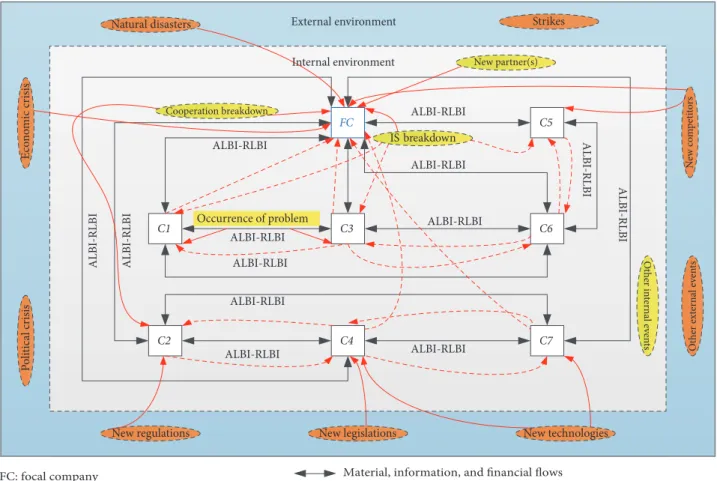
New technologies New legislations New regulations Ot her ext er n al e ven ts Eco n o mic cr isis Po li ti ca l c ri si s N ew co m p eti to rs New partner(s) IS breakdown Cooperation breakdown Ot her in te rn al e ven ts Occurrence of problem FC: focal company C: company
ALBI: actual levels of business interoperability
Material, information, and financial flows Direct impact
Indirect impact (network effect) RLBI: required levels of business interoperability
Figure 4: The theoretical agent-based simulation model.
Drawing upon the principles of the Axiomatic Design Theory, the dimensions and subdimensions of business interoperability have been stated in the form of FRs, which represent the goals or the business interoperability require-ments that must be achieved in the design of an interoper-able cooperative SCN platform. The dimensions of business interoperability have been stated in the level 1 FR and the subdimensions in the following levels. To satisfy each FR, a DP has been set in a physical domain. DPs are the solutions, mechanisms, methodologies, procedures, and approaches, used to achieve the business interoperability requirements (e.g., electronic data interchange, information systems stan-dards, radio frequency identification, contracts, and specifi-cations). In the scope of this research these DPs are called business interoperability design solutions (BIDSs). Having reached an appropriate level of decomposition, that is, a level where each last level BIDS can be easily comprehensible and implementable, the last level BIDSs have been used as decision variables in the design of the ABS model.
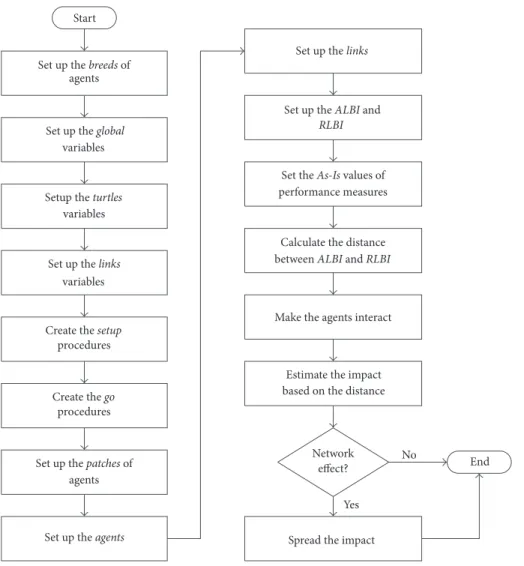
The proposed ABS model consists of a group of compa-nies and a set of dyad links connecting them (see Figure 4). The links are modeled as bidirectional, as information, financial, and material flows in cooperative SCNs typically
occur in both directions. Depending on its position or on its role within the cooperative SCN, each company is modeled as an agent with preestablished degree of autonomy to make decisions and characterized by a set of behaviors and attributes—see, for example, [112]. Behaviors are referred to as the way the agents act and react towards their partners, the extent to which they comply with the cooperation rules, the way they react to changes in their business environment, or their willingness to close any emergent interoperability gap. For example, agents may meet the lead-time or not, report the occurrence of a conflict in a timely way or not, provide information on their internal business processes or not, communicate the actual inventory level or not, accept delayed deliveries or not, implement a new information technology/legislation or not, and take initiatives to react to a strike or not. Examples of companies’ attributes are production capacity, capacity surplus, safety stock, type of certifications and/or legislation adopted, and so forth.
Based on a preestablished interaction or business rules, the agents interact with each other towards the achievement of the cooperation goals. For example, they negotiate price and conditions, place, and delivery orders, share information on the inventory level, solve conflicts, and so forth. While
Table 1: The proposed business interoperability maturity model.
Maturity level Description
0-isolated The BIDS is not implemented and partners are not aware of its importance.
1-initial The BIDS is not implemented or is implemented but is ad hoc. However, partners are aware of its importance. 2-functional The BIDS is implemented and imposed by the dominant partner(s) and does not reflect mutual agreements. 3-connectable The BIDS is implemented reflecting multilateral agreements but not documented.
4-interoperable The BIDS is well implemented and well documented, reflecting multilateral agreements.
they interact, their interactions and performance are affected by the interoperability gaps that exist in the dyads to which they belong to, the interoperability gaps in the dyads in which they do not belong to, and the interoperability gaps that exist at the network level. As discussed in Section 2.3, cooperative SCNs exhibit interdependence of their components, that is, the agents affect each other in many ways and therefore their behaviors are dependent upon other agents [113] (cited in [114]).
The interoperability gap, for each last level BIDS, may emerge at the dyad or network level. Thus, the BIDSs are modeled as “dyad variables” or as “network variables.” A BIDS is modeled as “dyad variable” if it defines the characteristics of a relationship between two companies. Some examples are mechanisms to define cooperation goals, mechanisms to solve conflicts, mechanisms to coordinate collaborative works, mechanisms to provide information on the processing status of the cooperative business processes, and mechanisms to deliver timely, accurate, or complete information. In contrast, a BIDS is modeled as “network variable” if it characterizes the network. Mechanisms to manage the supply-base complexity, mechanisms to manage the customer-base complexity, mechanisms to manage the market uncertainty, and mechanisms to manage external events are some examples.
The approach that drives the analysis of the impact was first proposed in [112] and is explained as follows: considering that the ALBI for a given BIDS is not always the RLBI and vice versa (see Section 3.2), a distance between these two states is proposed to measure the business interoperability gap, that is, how far the ALBI is from the RLBI (see (1)). Consider
business interoperability gap= ALBI − RLBI. (1)
The assessment of the ALBI and RLBI for each BIDS is grounded on a business interoperability maturity model that has been developed in the ambit of this study. This maturity model, which draws upon earlier literature such as ATHENA [28], Chen et al. [26], Campos et al. [31], and Gu´edria et al. [22], consists of five maturity levels as shown in Table 1. Note that this maturity model is not linear; that is, the descriptors may differ, depending on the BIDS. For example, some of the BIDSs associated with the dimension of information systems (e.g., speed, accessibility, and user interface) may require a different type of descriptors.
Based on the business interoperability gap, a probability of problem occurrence is estimated, assuming that if there is a gap in a dyad, then there is a problem-occurrence-chance
probability of problem(s) occurring between the two agents in the dyad. Examples of problems can be inefficient planning and forecasting due to information that is delivered incom-plete, inaccurate, or delayed. It is assumed that the greater the business interoperability gap, the higher the probability of problem occurrence. Again, note that the mechanism of the interoperability gap driving behavior (gap versus probability of problem occurrence) is not linear—given the same or different BIDSs, the same gap may have a different impact on different dyads. This is related to the nonlinearity of complex cooperative SCNs, discussed in Section 2.3.
Once an interoperability problem in a dyad occurs (called “problematic dyad”), the model first examines the probability of impact on the two agents in the dyad. The model assumes that the performance of these agents can be directly affected with a direct-impact-chance probability. If this probability is greater than or equal to random-float 1, the impact is first estimated regarding the agent(s) in the dyad and then spread over the network. Otherwise, there is neither a direct impact nor a network effect. The impact is spread along only established, directed links between two agents. That is, a dyad is only affected if its neighbor(s) has/have been affected. Another rule driving this diffusion is that the nonneighbor dyads have lower chance to be affected than the neighbor ones (given by a variable called
indirect-impact-chance). If the indirect-impact-chance probability is greater
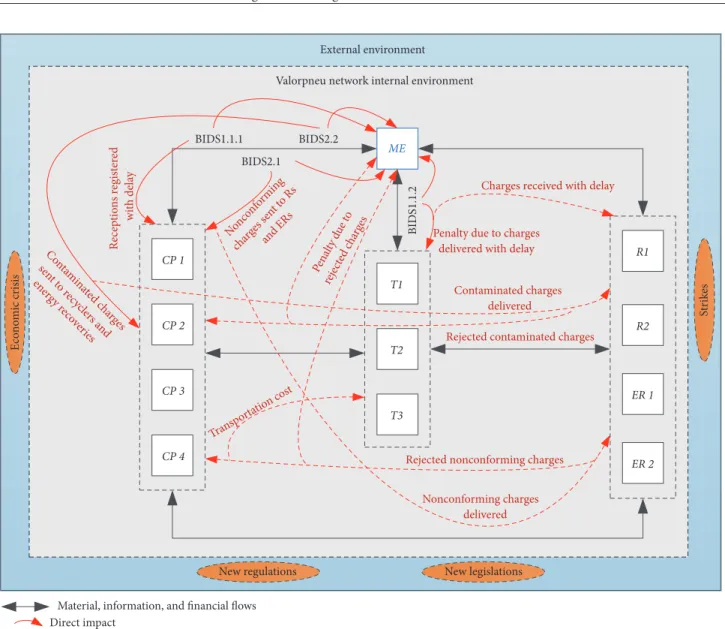
than or equal to random-float 1, the neighbor agents are indirectly affected, and their performances are updated by assigning the corresponding impact. Note that to assign both direct and indirect impact it is necessary to link each business interoperability gap and the resulting problem to specific performance measures (see Figure 3).
The model can also be used to analyze the impact of external events. The first step is to examine the probability of an external event to occur, given by a variable called
event-chance. An external event occurs when the external-event-chance probability is greater than or equal to random-float 1. Once an external event occurs, the model first
exam-ines the probability of the dyads in the network to be directly affected (given by a variable called
external-event—direct-impact-chance). An external event affects directly a dyad if the external-event—direct-impact-chance probability is greater
than or equal to random-float 1. This probability is estimated based on the interoperability gaps that exist regarding the BIDSs used to deal with external events. The approach for spreading the effects of these events is similar to the one proposed to spread the effect of an internal interoperability problem.
In the attempt to reduce the probability of occurrence of interoperability problems and make their network more interoperable, agents in cooperative SCNs continuously inter-act with and reinter-act to the network environment in order to create a new version of their network. They analyze their per-formance, identify dyads where interoperability gaps exist, discuss whether or not to modify their processes in order to close these gaps, and assess whether modifications have improved their performance. Indeed, when an interoperabil-ity gap is detected, there is a probabilinteroperabil-ity of closing it, and as a result performance might be improved. However, this behav-ior might be constrained, for instance, by the willingness of agents to modify their internal processes, which may depend on the relationship between investments versus benefits. The model also simulates this decision-making process as well as its impact on performance of the cooperative SCN. To achieve this goal, additional variables and logics are needed to give agents autonomy and intelligence to make informed decisions.
In the ambit of this research, the simple mechanism driving that decision-making process is to outbalance the accumulated investments needed to close an interoper-ability gap and the potential benefits. The core variables that control the behavior of agents in this process include information regarding relevant business performance, sat-isfaction level, accumulated investment, potential benefits, willingness to invest, and influencing power an agent has over other agents. For each relevant performance measure, it is assigned an expected-performance-threshold, which is later compared with the corresponding
real-performance-score, given by the plots set in the simulation
environ-ment. This comparison, which is supported by a variable called interoperability-gap-frequency-check, can be regularly scheduled (e.g., semiannually, quarterly, or annually). If the real-performance-score crosses the
expected-performance-threshold, the satisfaction-level regarding the performance
measure of interest increases. As a result, the dyad has a
close-interoperability-gap-chance probability to close the gap. Once
the agents in the dyad consider closing the gap, it is neces-sary to outbalance the minimum-expected-benefits-threshold with the maximum-accumulated-investment-threshold. If the
minimum-expected-benefits-threshold crosses the maximum-accumulated-investment-threshold, the willingness-to-close-interoperability-gap increases.
An interoperability gap is then closed if the
willingness-to-close-interoperability-gap is greater than or equal to random-float 1. Once an interoperability gap is closed, the
real-performance-scores of time periods𝑡 and 𝑡 − 1 (𝑡 is equal to
semester, quarter, year, etc.) are compared, and if the
real-performance-scoretcrosses the real-performance-𝑠𝑐𝑜𝑟𝑒𝑡−1, the
agents conclude that the performance has been improved. Otherwise, they conclude that it has not been improved. Depending on the assessment results, their
satisfaction-to-interoperability-gap-closed becomes the source of positive or
negative influence to their neighbors.
5. Case Study: Valorpneu Network
5.1. Case Study Overview. The case study presented in this
paper has been conducted in the Valorpneu network and its
purpose is to explore and demonstrate the applicability of the proposed ABS model in a specific and real situation, rather than to achieve generalization about the application of the method or the practices [115].
5.2. Characterization of the Network. Valorpneu network is
an RL cooperative industrial network that organizes and manages the system of collecting and disposing of used tires in Portugal. The system that supports the activities inherent to this network is called “Integrated System for Management of Used Tires (SGPU),” which started its operation on February 1, 2003. Currently Valorpneu’s collection network has 49 collection points, 27 retreaders, 3 recyclers, 4 energy recoveries, and 23 transporters or companies responsible for their subcontracting.
The Valorpneu network is regarded as an important industrial network in Portugal, and its economic, social, and environmental importance is evident. For instance, a study published in 2014 by Valorpneu about management of used tires in Portugal concluded that the system contributes € 78 million to the Portuguese Gross Value Added (GVA) (with reference to 2011) and created 970 direct jobs, 315 indirect jobs, and 698 induced jobs and that, on average, it reduces 1560 kg of CO2 and 46.5 GJ of energy per ton of used tire managed, per year.
5.3. Characterization of the Participants. In this case study, a
sample comprising four companies in the Valorpneu network was chosen. For each company participating in the study, a manager was chosen to be the respondent. The profiles of the four companies and the respondents are provided in Table 2.
5.4. Description of the SGPU Model. The SGPU starts with the
introduction of new or second-hand tires into the Portuguese market. Any company producing and/or importing new or second-hand tires—and/or vehicles, aircraft, or equipment that contains new or used tires—needs to celebrate a contract with the managing entity (Valorpneu), allowing the Ecovalue due on the imported tires to be charged. This Ecovalue, which pays for the provision of a service and is charged by tire producers, funds Valorpneu’s system.
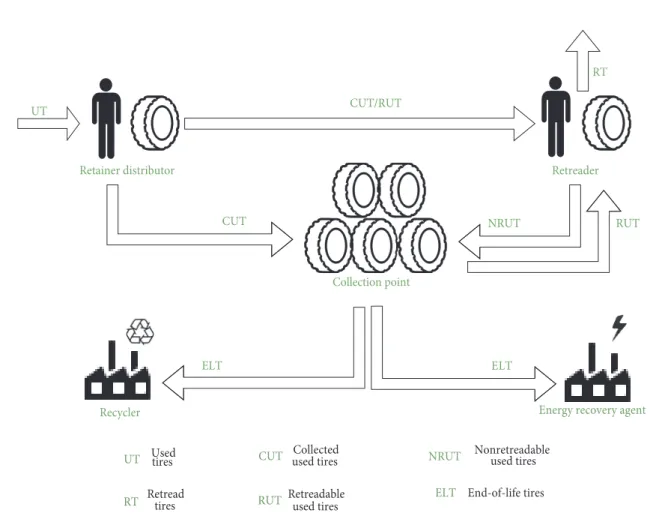
After reaching the end of their life cycle, tires may be delivered by distributors to collection points spread through-out the country (mainland Portugal and the Autonomous Regions of Madeira and the Azores), at zero cost to the tire holders. To locate the most convenient collection point to deliver tires, there is a Network Map available on the Valorpneu website (http://www.valorpneu.pt/). At collection points, the discharged tires are separated through a well-established sorting process, consisting of five categories (see Table 3), and stored temporarily.
Later, grounded on the inventory level of each of the categories shown in Table 3, tires are routed by Valorpneu from collection points to entities where they are processed (essentially energy recovery and recycling). The management of the information inherent to this complex network is supported by an online information system that enables the different agents within the SGPU to interact, while simultaneously allowing Valorpneu to control and manage
T a b le 2: C om p an ie s’ an d m an ag er s’ profi le . C o m p anies Co m p an y 1 Co m p an y 2 Co m p an y 3 Co m p an y 4 N ame V alo rp neu R enas cimen to B iogo ma T ra n sp o rtes B iza rr o D u ar te P o si ti o n in th e n et w o rk M an agi n g E n ti ty C o ll ecti o n po in t an d tra n sp o rt er R ec yc le r T ra n spo rt er Se ct o r o f ac ti vi ty W aste ma nag emen t ind ust ry W aste ma nag emen t ind ust ry W aste ma nag emen t ind ust ry R o ad tra nsp o rt o f mer cha ndis e M ain se rv ice p ro vided Ma n ag em ent of th e u se d ti re s flo ws in P o rt ugal W ast e m an ag emen t/log ist ics p ro vider Pro d u ct ion an d com m erc ia li za ti on of p ro d uc ts der iv ed fr o m u se d tir es Lo gi st ic s tr an spo rt Y ear s in V al or pn eu n et w or k bu si n es s M o re th an 10 ye ars M ore th an 10 ye ars (f rom 20 03 to p re se n t) F ew er th an 10 ye ars (f rom 20 0 8) M o re th an 10 ye ars (f rom 20 03 to p res en t) T u rn o ver (mi ll io n s €) 10–2 0 10–2 0 F ew er tha n 10 F ew er th an 10 C o m p an y si ze (e m p lo yee s) F ew er th an 50 100 – 200 F ew er th an 50 F ew er th an 50 G eogra p hic lo ca ti o n M ain la nd P o rt ugal (L isb o n) M ain la nd P o rt ugal (L o u re s) M ain la nd P o rt ugal (Sa n ta r´e m ) M ai n lan d P or tu ga l( M alve ir a) Int er vi ew ee s Resp o n den t 1 R esp o nden t 2 Resp o n den t 3 R esp o nden t 4 Jo b ti tl e L o gi st ic s m an ag er Quali ty ,en vir o nmen t, an d sec ur it y ma nag er P ro d uc ti o n ma nag er T o p ma nag emen t Y ea rs in b usiness M o re tha n 10 M o re tha n 15 M o re tha n 20 M o re tha n 10 Y ear s in V al or pn eu n et w or k bu si n es s Mo re th an 10 Mo re th an 10 Fe w er th an 10 Mo re th an 10
Table 3: Categories of tires at collection points.
Category Dimension/description
Passenger Diameter≤ 0.70 m and width ≤ 0.35 m
Heavy Diameter≤ 1.20 m and width ≤ 0.35 m
Industrial Higher dimensions
Damaged Heavy tires whose structure is damaged to the point that it is not possible to stand them vertically Massive All dimensions of massive tires, excluding bandages
CUT/RUT Retainer distributor Recycler UT Usedtires RT Retreadtires CUT UT ELT Collection point
CUT used tiresCollected
RUT Retreadableused tires
Retreader
NRUT RUT
ELT
Energy recovery agent
NRUT Nonretreadableused tires
EL T End-of-life tires
RT
Figure 5: The SGPU working model (source: Valorpneu website).
the whole SGPU. The working model of SGPU is shown in Figure 5.
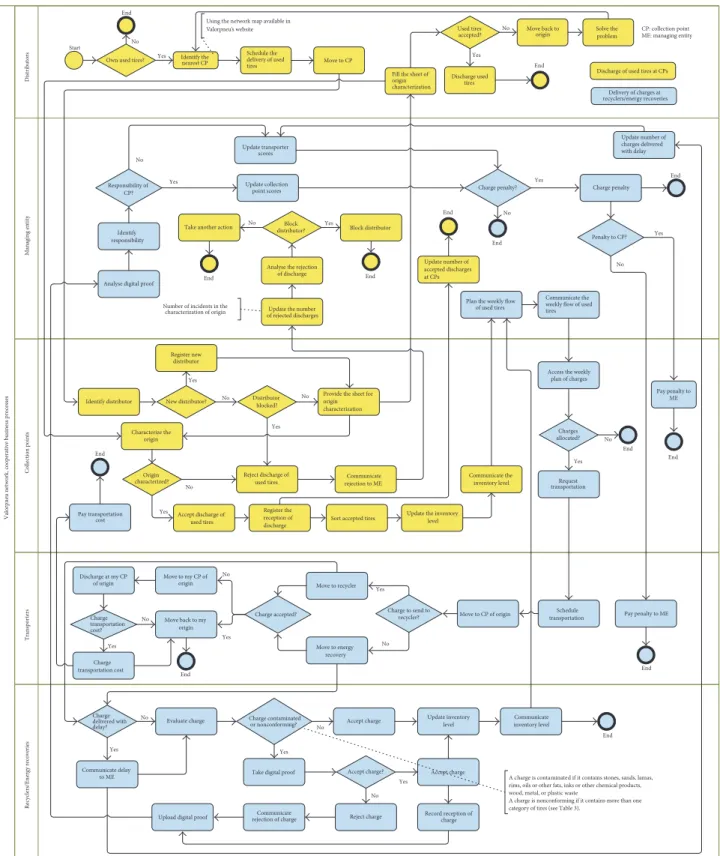
To help us in the demonstration of the ABS model, a business diagram has been developed to map and systematize the material, information, and financial flows involved in this complex system (see Figure 6).
5.5. Collected Data. Data for this case study were collected
primarily through face-to-face interviews. Complementary data were gathered through documents, namely, through the Annual Reports and Newsletter, available on Valorpneu’s website. As data were collected through multiple sources, triangulation was used to corroborate the evidence coming from the different sources. These data can be summarized according to two categories: quantitative and qualitative data. Qualitative data are concerned with the characterization
of the way that SGPU operators interact (Figure 6), the identification of performance measures and their link to BIDSs and FRs (Figure 3), and the characterization of the ALBI and RLBI (Table 4). Quantitative data are concerned with the SGPU operational performance measures (Table 6) and the numerical quantification of the effect of the BIDSs on the performance measures (Tables 7–10). As the aim is not to provide historical evolution of the SGPU from the beginning of its activity (2003), the time boundaries for data collection were set between 2007 and 2014. The main reason for this is that the annual reports, which contain much of the information needed for this case study, are not available for years prior to 2007.
Note that although the impact of business interoper-ability has been theoretically linked to the operational, economic, environmental, and social perspectives of business
Valorpneu network, cooperative business processes Distributors Collection points Managing entity Transporters Recyclers/Energy recoveries Yes
ME: managing entity
Identify the nearest CP Start CP: collection point Delivery of charges at recyclers/energy recoveries Discharge of used tires at CPs No
Own used tires? End Schedule the delivery of used tires Move to CP Used tires accepted? Move back to
origin Solve the problem
End
Identify distributor
Fill the sheet of origin characterization Discharge used tires Characterize the origin Origin
characterized? Reject discharge of used tires rejection to MECommunicate
Accept discharge of used tires
Analyse the rejection of discharge Block distributor? New distributor? Register new distributor
Provide the sheet for origin characterization Register the reception of discharge End Update number of accepted discharges at CPs Distributor blocked?
Update the number of rejected discharges
Block distributor Take another action
End
Update the inventory level
Communicate the inventory level Plan the weekly flow
of used tires
Communicate the weekly flow of used tires
Access the weekly plan of charges Request transportation Charges allocated? End Schedule transportation Move to CP of origin Charge to send to recycler? Move to recycler Move to energy recovery Charge accepted?
Evaluate charge Charge contaminatedor nonconforming? Move back to my origin Move to my CP of origin Discharge at my CP of origin End Accept charge Accept charge? Take digital proof
Upload digital proof Reject charge
Accept charge
Communicate
rejection of charge Record reception ofcharge Update inventory
level
Communicate inventory level Analyse digital proof
Identify responsibility Responsibility of CP? Pay penalty to ME Pay penalty to ME Charge delivered with delay? Communicate delay to ME Update number of charges delivered with delay Update transporter scores Update collection point scores End Charge penalty? Charge penalty
End End Penalty to CP? End End No No Yes Yes No Yes No No Yes Yes No Yes No Yes No No Yes Yes No End No Yes
Sort accepted tires
Charge transportation cost? Charge transportation cost Yes No Pay transportation cost End Yes No No Yes Yes No Yes
A charge is contaminated if it contains stones, sands, lamas, wood, metal, or plastic waste
category of tires (see Table 3).
rims, oils or other fats, inks or other chemical products, A charge is nonconforming if it contains more than one characterization of origin
Number of incidents in the Valorpneu’s website Using the network map available in
Figure 6: The Valorpneu network business process diagram.
performance (see Figure 2), this case study focuses only on the operational performance of the SGPU, as shown in Figure 3. The rationale for this is that, unlike the operational measures, the other three are more difficult to quantify,
in the words of the managers interviewed. Also note that although the developed framework suggests that business interoperability is also multidimensional, many of the dimen-sions are incompletely or not considered in this case study.
![Figure 1: Extended business interoperability framework (adapted from [29]).](https://thumb-eu.123doks.com/thumbv2/123dok_br/15148666.1012621/4.900.90.811.109.732/figure-extended-business-interoperability-framework-adapted-from.webp)