Escola Superior de Tecnologia e Gestão de Oliveira do Hospital
Master in Applied Informatics
Analysis of the security impact of making mShield
an IPv4 to IPv6 converter box
Master’s Thesis By Luís Rosa
Thesis submitted for the partial fulfillment of the requirements for the degree of Master of Science in Applied Informatics at the Higher School of Technology and Management of the Polytechnic Institute of Coimbra
Under supervision of:
Prof. Dr. Luís Veloso - Escola Superior de Tecnologia e Gestão de Oliveira do Hospital
Prof. Dr. Marco Veloso - Escola Superior de Tecnologia e Gestão de Oliveira do Hospital
Internship Supervision:
Holger Mikolon - Philips Medical Systems DMC GmbH Hamburg
Acknowledgements
I would like to express my sincere gratitude to my family. To my parents, Luís and Isabel, for their support and encouragement. They are and will be both present in all steps of my life. To Ana, my future wife, I would like to thank for her love, support and patience during all these years. To my sister, Alexandra, for her friendship and to her daughter, Camila, my little niece, for showing me the meaning of life.
I would like to thank my professors Luís Veloso and Marco Veloso, my supervisors at school, for their useful guidance, reviews and feedback. Thank to my supervisor at Philips, Erich, for giving me the opportunity to learn in a fruitful environment. Thank to Holger, more than my supervisor at Philips, for his continous support and motivation as well as the insightful discussions and reviews of my work. Thanks to Sami and Clara for proof reading part of this document. I also would like to thank Philips for the financial support.
Contents
List of Figures iii
List of Tables v
List of Listings vi
1 Introduction 1
1.1 Background . . . 2
1.2 Problem Statement . . . 3
1.3 Structure of the thesis . . . 3
2 IPv6 and Security Theory Review 5 2.1 IPv6 in a nutshell . . . 6 2.2 Core Protocols . . . 11 2.3 NAT . . . 14 2.4 Transition Mechanisms . . . 15 2.5 Security Theory . . . 21 3 Security Analysis 26 3.1 Methodology . . . 27 3.2 Environment . . . 30 3.3 Security Discussion . . . 33
4 mShield64 - Design and Implementation 44 4.1 Background . . . 45
4.2 Proposal Design . . . 46
4.3 Implementation . . . 51
4.4 Practical Tests . . . 51
5 Conclusions 69 5.1 Walkthrough . . . 70 5.2 Problem Discussion . . . 71 5.3 Main Contributions . . . 72 5.4 Further Work . . . 72 5.5 Final Thoughts . . . 72
A Stateless versus Stateful Translation Mode 73
B mShield64 - Implementation Details 76
Glossary 81
List of Figures
2 IPv6 and Security Theory Review 10
2.1 IPv4 versus IPv6 Header Format . . . 10
2.2 IPv6 Extension Header Uniform Format . . . 11
2.3 ICMPv6 Header in TCP / IP Architecture . . . 12
2.4 ICMPv6 Header Format . . . 12
2.5 IPv4 embedded in IPv6 addresses format . . . 18
2.6 Steps of a buffer overflow attack . . . 23
2.7 Behavior of different types of DoS attacks . . . 24
2.8 DRDoS attack using invalid TCP connections . . . 25
3 Security Analysis 27 3.1 Steps of the Methodology . . . 27
3.2 IPv6 Costumer Network and IPv4 Medical Devices . . . 31
3.3 IPv6 Costumer Network and IPv4/IPv6 Medical Devices . . . 31
3.4 IPv6/IPv4 Costumer Network and IPv4 Medical Devices . . . 31
3.5 IPv6/IPv4 Costumer Network and IPv4/IPv6 Medical Devices 31 3.6 Effect of different amount of packets/s on the environment . . 40
4 mShield64 - Design and Implementation 45 4.1 Overview of NAT64 applied to mShield . . . 45
4.2 Application level Proxy versus NAT64 approach . . . 47
4.3 Packet translation and routing steps . . . 49
4.4 Internal mShield behavior . . . 50
4.5 Connections between customer and medical devices . . . 51
4.7 TODO: . . . 58 4.8 TODO: . . . 60 4.9 TODO: . . . 61 4.10 TODO: . . . 61 4.11 TODO: . . . 63 4.12 TODO: . . . 63 4.13 TODO: . . . 65 4.14 TODO: . . . 66 4.15 TODO: . . . 68
A Stateless versus Stateful Translation Mode 74 A.1 Stateless versus Stateful network scenario . . . 74
B mShield64 - Implementation Details 77 B.1 Internal mShield components . . . 77
List of Tables
2 IPv6 and Security Theory Review 7
2.1 IPv6 text representation . . . 7
2.2 IPv6 addressed types based on the prefix, adapted from [1] . . 7
2.3 Most common and pre-defined IPv6 addresses . . . 9
3 Security Analysis 28 3.1 Assets Definition . . . 28
3.2 Assets evaluation and description . . . 35
3.3 Threats evaluation and description . . . 37
3.4 Risk classification . . . 43
4 mShield64 - Design and Implementation 51 4.1 Network Scenario Values . . . 51
A Stateless versus Stateful Translation Mode 74 A.1 Network scenario values . . . 74
A.2 Addressing values in an IPv4 initiated connections . . . 75
List of Listings
4 mShield64 - Design and Implementation 52
4.1 IPv6/UDP netcat client . . . 52
4.2 IPv4/UDP netcat server . . . 52
4.3 IPv4/TCP client using netcat . . . 53
4.4 IPv6/TCP server using netcat . . . 53
4.5 IPv6/UDP packet using scapy . . . 55
4.6 IPv4/UDP packet with DF flag set using scapy . . . 55
4.7 IPv4/UDP fragmented packet using scapy . . . 56
4.8 IPv6/UDP fragmented packet using scapy . . . 56
4.9 IPv4 to IPv6 UDP translation packets . . . 58
4.10 UDP translation with returned ICMP error messages . . . 58
4.11 TCP three-way handshake translation output . . . 59
4.12 TCP data translation translation output . . . 60
4.13 TCP connection termination translation output . . . 62
4.14 PMTUD mShield outputs using NAT46 mode . . . 62
4.15 PMTUD mShield outputs using NAT64 mode . . . 64
4.16 Fragmentation mShield outputs using NAT46 mode. . . 64
4.17 Fragmentation mShield outputs using NAT64 mode . . . 66
4.18 pf.c patch to clear DF flag in the case of receive IPv6 fragments 67 4.19 Patched fragmentation mShield outputs using NAT64 mode . 68 B mShield64 - Implementation Details 78 B.1 Routing mode configuration . . . 78
B.2 Bridge mode configuration . . . 78
B.3 IP settings configuration for mShield . . . 79
One of the greatest gifts you can give to anyone is the gift of at-tention. Jim Rohn
1
Introduction
1.1 Background . . . 2 1.2 Problem Statement . . . 3 1.3 Structure of the thesis . . . 31.1. BACKGROUND
1.1
Background
Nowadays, computers communicate over the network mainly via Internet Protocol version 4 (IPv4). This protocol was proposed in 1981 and has been the standard for communications using TCP/IP architecture. In the last years, there was a significant increase in demand for IPv4 addresses as a result of new network devices and the amount of connected people. The most significant limitation of IPv4 is probably the narrow address space resulting from the limited possible combinations of a 32-bit address. Internet Assigned Numbers Authority (IANA) already assigned the last IPv4 addresses block1.
In the meanwhile, several Request for Comments (RFC) and documents have been written describing its successor, Internet Protocol version 6 (IPv6).
It is not reasonably expected that all IPv4 devices can be easily changed to IPv6. Therefore, significant efforts are being made, not only in IPv6 specification, but also in defining strategies and mechanisms for a graceful transition phase. One of those transition strategies, provides a framework to translating addresses and packets between both versions.
This thesis, written under an internship in Philips Healthcare, Hamburg, covers the problem of enabling IPv6 communications in IPv4 legacy medical devices. mShield is a physical firewall developed by Philips to operate in a hospital environment. Its role is to protect medical devices from network based attacks. Currently it only supports IPv4.
Given the need for IPv6 transition, the next releases of mShield should also perform IPv4 to IPv6 conversion. This allows legacy medical devices to communicate with IPv6 hospital devices. Developing a medical device requires significant effort and costs, and therefore, it is not feasible to update each legacy device to IPv6.
Nevertheless, the problem is not just about enabling the converter function. It is important to understand that medical devices are operated in environments where it is necessary to protect sensitive patient data.
1
1.2. PROBLEM STATEMENT
1.2
Problem Statement
In this thesis, the need to move towards IPv6 is assumed. Moreover, in a medical context it is important to analyse the security implications of a new protocol. This study provides a comprehensive answer to the question:
What is the security impact of making mShield an IPv4 to IPv6 converter box ?
The change involves not only the converter role but also the support for both Internet Protocol (IP) versions (e.g. IPv6 to IPv6 communications). It is necessary to analyse the security issues arising from the change and compare them with the current design.
Even though restricted to mShield and its context, this study can be used as a reference in other studies regarding IPv4 to IPv6 translation covering the topic from the theory to practical implementation.
1.3
Structure of the thesis
In addition to this chapter, the thesis is composed of the following chapters:
Chapter 2 is composed of two parts: IPv6 and security theory reviews. It describes the main topics of IPv6 as well as some of the differences of IPv4 version. One of the focus regards the transition mechanisms, and particularly, the translation strategy used, NAT64. Additionally, a discussion about the vantages and disadvantages of the use of several mechanisms are also provided (e.g. stateless versus stateful address translation). At the end, an overview of
the security concepts used in the security analysis is also presented.
Chapter 3 is composed of tree parts: the methodology used, the environment description and the security analysis itself. The methodology includes a description of all performed steps as well as the terminology used during the security analysis. In the environment section, mShield, the medical devices network and customer network as well as features and constraints of the environment are described. Finally, in the security analysis, a security discussion of the issues that affect mShield is provided. Namely the effect of introducing a new IP version. The analysis takes into account the requirements
1.3. STRUCTURE OF THE THESIS
for the converter box and discusses the security effect of the possibilities for a new design. The assets and threats identified are presented in this chapter. At the end of the analysis, a risk assessment describing and measuring the impact and the likelihood of each threat is also presented. The analysis is based on a quantitative and qualitative analysis relating to each threat with known security threats and most common attacks.
Chapter 4 provides a detailed description of a new mShield design. It is proposed, based on the previous security discussion and the requirements for the converter process. It also contains a detailed description of its implementation. In adition to that, based on the implementation, practical tests are discussed.
Chapter 5 provides a picture of each chapter, highlighting the most relevant conclusions. An overall conclusion of the research question is also provided. In the conclusion, the main contributions and the further work are described. The thesis ends with some final thoughts about the developed work.
Reading without reflecting is like eating without digesting.
Edmund Burke
2
IPv6 and Security Theory Review
2.1 IPv6 in a nutshell . . . 6
2.1.1 Overview . . . 6
2.1.2 Addressing . . . 6
2.1.3 Header Format and Extensions . . . 9
2.2 Core Protocols . . . 11 2.2.1 ICMPv6 . . . 11 2.2.2 Neighbor Discovery . . . 11 2.3 NAT . . . 14 2.4 Transition Mechanisms . . . 15 2.4.1 Mechanisms . . . 15 2.4.2 Translators in detail . . . 16 2.5 Security Theory . . . 21 2.5.1 Security properties . . . 21 2.5.2 Malicious code . . . 22 2.5.3 Spoofing . . . 23 2.5.4 DoS . . . 24 2.5.5 Packet Filtering . . . 25
2.1. IPV6 IN A NUTSHELL
2.1
IPv6 in a nutshell
The differences between IPv4 and IPv6, IPv6 addressing architecture or IPv6 header format are explained in this section. Those IPv6 basics topics will help to understand the next topics and chapters of this thesis.
2.1.1 Overview
The IPv6 specification is defined as a draft standard [3] by Internet Engi-neering Task Force (IETF). The main differences between IPv4 and IPv6 are:
• Increase of addressing possibilities (due to the 128 bits address length compared with 32 bits in IPv4).
• Header simplification, the number of field in the base header was reduced increasing the processing speed of packets.
• New concept of Extension Headers to carry additional options used by non-IP but IP-related protocols.
• New Field, Flow Label, allows to group a set of packets as a flow, improving the packet processing for the same flow. This processing improvement is only valid for infrastructure devices, like routers. Some applications or infrastructure devices do not make any use of this field resulting in a normal processing speed.
• Authentication and Privacy features are defined as part of the base protocol using Internet Protocol security (IPsec).
2.1.2 Addressing
The most visible change, regardless the address length, is probably related to broadcast which is not used in IPv6. It was replaced by multicast functions using pre-defined addresses.
2.1. IPV6 IN A NUTSHELL
Syntax
An IPv6 address can be written by eight groups of four hexadecimal digits separated by colons. In IPv4 the representation is made in dotted decimal notation using four groups between 0 to 255, e.g. 255.255.255.0.
In order to simplify the address configuration from an user perspective, the addresses can also be written in a short format omitting leading or trailing zeros. The prefix notation syntax is similar to IPv4 CIDR ( prefix / prefix-length ). Some IPv6 addresses examples are provided in table 2.1.
Table 2.1: IPv6 text representation
Form Example
IPv6 address 2012:abcd:1234:4321:0000:0000:0000:0001 IPv6 Short-form 2012:abcd:1234:4321::1
Prefix Notation 2012:abcd:1234:4321::1/64
Notice that a single IPv6 address assignment, with at least 64 bits as prefix, has more host possibilities than the entire IPv4 address space. Its prefix information1 is used to group IPv6 address types as show in table 2.2. An IPv6 address type can represent a group of addresses or a single address. For example the loopback type represents a single address, the loopback address ::1.
Table 2.2: IPv6 addressed types based on the prefix, adapted from [1]
Notation
Address type Binary Prefix
Unspecified 00...0 (128 bits) ::/128 Loopback 00...1 (128 bits) ::1/128
Multicast 11111111 FF00::/8
Link-Local Unicast 1111111010 FE80::/10 Global Unicast others
1
The prefix information are the left-most n bits of the IPv6 address, where n is the prefix length.
2.1. IPV6 IN A NUTSHELL
Address scope
An address scope defines the span where the address can identify uniquely an interface [4]. The scope zone represents the area of a group of nodes using the same address scope [4]. The following list explains the unicast address scopes. Those concepts are important to understand each IPv6 type. Multicast address scopes are out of scope of this thesis.
Interface-local The span of the packets is limited to the same node/in-terface of the origin (e.g. communications between processes using a socket with the same IP address).
Link-local Equivalent to IPv4 broadcast domains, packets using these addresses are not forwarded by routers. Nevertheless, they can be used to create a fully functional network within that scope.
Global The most wide scope used to identify an interface over several networks (e.g. Internet).
Unicast
In IPv6, different addresses sub-types of unicast were introduced as charac-terized below.
Link-local It is composed of the well-known prefix, FE80::/10 plus a 64 bits interface ID in the 64 right-most bits. The remaining bits of the prefix are filled with zeros.
The interface ID identifies a specific network card inside a network, this means that an interface ID is unique per network prefix. Al-though it is possible that the same interface ID identifies different network cards in different networks, this is not likely, since in most cases this value is generated randomly, or based on a constant link-layer address.
The IPv6 link-local addresses can only be used with on the same a link. These addresses have an important role in several protocols such as Neighbor Discovery (ND). Before being generated, the global address, are used to exchange messages between nodes on
2.1. IPV6 IN A NUTSHELL
the same link. They can also be used to deploy an internal and non routable network.
Global It is a routable address built locally, in the node, using an ISP assigned prefix plus the Interface ID. Those addresses are globally unique and therefore, used for internetwork communication (e.g. between two or more IPv6 networks). Each interface can have more than one global address.
Site-local A routable address type restricted to an organization network scope, already deprecated [5].
Multicast
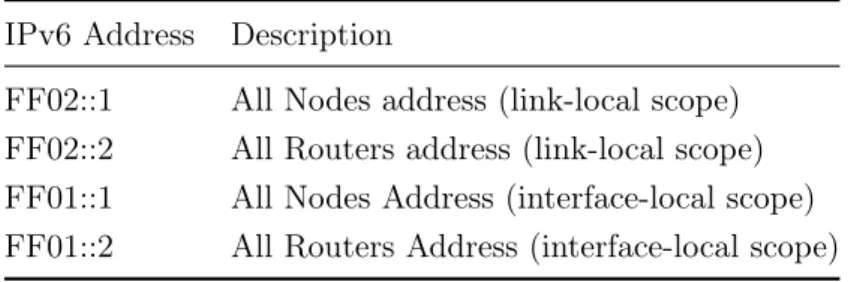
IPv6 multicast addresses are used in one-to-many communication playing an important role in several IP related protocols as a replacement of broadcast. Table 2.3 illustrates some of the most used and pre-defined multicast addresses.
If multicast needs to be supported by a v4-to-v6 converter box, like mShield, this device should be aware of pre-defined multicast groups and the incom-patibilities with the previous IP version.
Table 2.3: Most common and pre-defined IPv6 addresses
IPv6 Address Description
FF02::1 All Nodes address (link-local scope) FF02::2 All Routers address (link-local scope) FF01::1 All Nodes Address (interface-local scope) FF01::2 All Routers Address (interface-local scope)
2.1.3 Header Format and Extensions
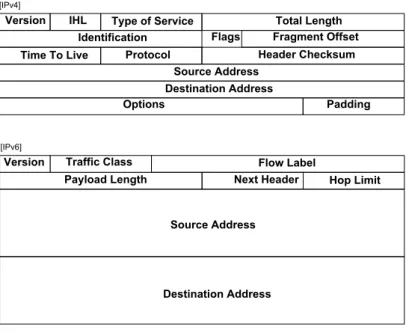
The IPv4 header carries all IP related information and has a variable size, whereas the IPv6 header has a fixed size and less fields. Figure 2.1 shows the IPv6 header next to the IPv4 header for easy comparison. In most cases not all IP options are used, so shifting them to Extension Headers improves packet processing.
2.1. IPV6 IN A NUTSHELL
Version Type of Service Total Length
Identification Flags Fragment Offset
Time To Live Protocol Header Checksum
Source Address Destination Address Options Padding IHL Traffic Class Source Address Destination Address
Version Flow Label
Payload Length Next Header Hop Limit
[IPv4]
[IPv6]
Figure 2.1: IPv4 versus IPv6 Header Format
The field Next Header is used to identify the next header, which could be another extension header or a protocol like, Internet Control Message Protocol version 6 (ICMPv6). It is possible to have a sequence of different extension headers, each pointing to the next one. Routers must process the headers in the same order as they appear [3]. The IPv6 specification defines that IPv6 implementations should have support for Authentication Header (AH) and Encapsulated Security Payload (ESP) used to provide secure communications at network layer [3]. Nevertheless, their use is not mandatory.
Both, v4- and v6- headers share the same base fields, an useful feature during the conversion between them2.
In IPv6, the Quality of Service (QoS) feature can be provided using the field Traffic Class, similar to the field Type of Service in IPv4 [7]. Additionally, in IPv6 exists the Flow Label field. This field can be used to identify the flow of packets, corresponding for instance to a VoIP session, which provides a more efficient routing process. Due the differences between the two IP versions since this is a new field without correspondence in IPv4, this feature can be lost (e.g. during a v6- to v4- header conversion [6]).
2
The IP/ICMP Translation Algorithm [6] defines how v4- and v6- fields should be mapped to the other version (e.g. Time To Live in IPv4 to Hop Limit in IPv6)
2.2. CORE PROTOCOLS
An uniform format for the IPv6 extensions header [8], showed in figure 2.2, was defined as an update to the IPv6 specification. According to that specification, a node can skip the processing of an unknown header.
Hdr Ext Len Next Header
Specific Data
Figure 2.2: IPv6 Extension Header Uniform Format
2.2
Core Protocols
In this section, several protocols like ICMPv6 or Stateless Address Autoconfig-uration (SLAAC) are presented. They are used to support IPv6 in functions like neighbor communication or address configuration. Their understanding is necessary for the security analysis and the design proposal (e.g. how the ICMPv6 messages can be used to trigger local network attacks).
2.2.1 ICMPv6
The successor to Internet Control Message Protocol version 4 (ICMPv4) is called ICMPv6 [9]. It defines a new set of control messages for informational and error purposes. The ICMPv6 header is added immediately after the IPv6 header, as outlined in figure 2.3.
Most of the ICMPv6 messages are derived from ICMPv4, like echo request/re-ply or time exceed. Nevertheless, new ICMPv6 messages were defined to cover new functions, like neighbor discovery and stateless autoconfiguration. It is also possible to define additional messages following a general message format as described in figure 2.4.
2.2.2 Neighbor Discovery
Neighbor Discovery [10] can be viewed as a mixture between Address Res-olution Protocol (ARP) and ICMPv4. Technically it defines an additional set of ICMPv6 messages (e.g. router advertisement / solicitation). Using
2.2. CORE PROTOCOLS Link-layer Header IPv6 Header ICMPv6 Header IPv6 Payload IPv6 Packet Echo request Header or Echo reply Header or Router solicitation Header
Figure 2.3: ICMPv6 Header in TCP / IP Architecture
Code Type
Message Body
Checksum
Figure 2.4: ICMPv6 Header Format
those messages, the nodes can interact with each other at the same link. The following topics describe some of the problems covered by ND:
• ND can be used to discover a list of routers, the network prefix or other parameters.
• Stateless Address Autoconfiguration allows to configure IPv6 addresses at network layer.
• Additional functions like Duplicate Address and Neighbor Unreachable Detection.
The following ICMPv6 messages were defined:
• Router Solicitation / Advertisement They are used to discover a router and learn IP settings (e.g. network prefix).
• Host Solicitation / Advertisement They are used to discover hosts on the same link. It is useful for instance to avoid duplicate IPv6 addresses.
Those messages, triggered by the ND algorithms, are sent as replies to nodes, or sent in an unsolicited way to rapidly propagate changes in the network.
2.2. CORE PROTOCOLS
Usually, in unsolicited messages a reserved multicast address (all-routers or all-nodes) is used as a destination IP address.
Stateless Auto-configuration
SLAAC [11] is used to generate link-local addresses and global addresses. The IPv6 addresses are composed of a prefix advertised by the routers and an interface ID generated based on the link-layer address. SLAAC eliminates the need of a Dynamic Host Configuration Protocol version 6 (DHCPv6) [12], also called stateful address autoconfiguration.
Stateless and stateful modes have the same goal, IP settings configuration. Nevertheless, they are defined at different layers of TCP/IP. Stateless mode is used at network layer whereas DHCPv6 runs at application layer.
The main disadvantage of the stateful mode is the need of a dedicated Dynamic Host Configuration Protocol (DHCP) server. Nevertheless, in a dual stack environment in order to support dynamic IPv4 and IPv6 address configuration it is necessary to have a DHCP server, at least for an IPv4 address configuration.
Stateless option is an advantage for a set of devices on the same link since they can use only link-local addresses to communicate between each other without the need of a router or even a DHCP server (e.g. a group of sensors or an ad-hoc network). Nevertheless, the SLAAC definition [11] limits the parameters advertised by the router and does not cover the use of Domain Name System (DNS) options3. Additionally, routers do not keep entries of hosts in the network in stateless mode.
SLAAC begins generating an IPv6 link-local address locally. In the next step the node sends a message to that IPv6 address and waits for a reply to check whether that IPv6 address is already used (Duplicate Address Detection (DAD) ). If successful, the assigned link-local address is used in the next steps4. A Router Solicitation (RS) message is sent to all-routers multicast IPv6 address and a Router Advertisement (RA) message containing the prefix information is expected. Finally, the host can use the network prefix together
3
IPv6 router advertisement options [13] can be used to configure DNS settings. 4The next steps are just performed by hosts
2.3. NAT
with the Interface ID to construct a global and routable IPv6 address.
Generating the interface ID from the Media Access Control (MAC) address raises security concerns since the value is predictable allowing host scanning in a remote network. The first 24 bits of Interface ID identifies the network card vendor that could be guessable and the next 16 bits are fixed reducing the scanning space to 24 bits [14]. Since the interface ID remains constant, this allows also for host-tracking in different networks. One possible solution is the use of SLAAC privacy extensions [15], generating temporary and random values for the Interface ID. However using temporary values makes it hard to manage IP assignments within a network. A proposal solution [16] defines a way of random generating the Interface ID value based on several inputs, including a private key and network prefix. In this approach the value remains constant within a network since all inputs remain constant, making it easy to manage and, at the same time, difficult to scan since it is randomly generated having a private as input.
SEND
A proposed standard, SEcure Neighbor Discovery (SEND) [17] defines a secure ND against attacks that include Denial of Service (DoS) and address spoofing [18]. The proposed solution involves:
• Certification Paths, a mechanism to establish trusted anchors to the authority of a router.
• Cryptographically Generated addresses (CGAs) [19] using a public-key scheme.
• Signature option in ND messages to guarantee the integrity and au-thenticity of the messages.
2.3
NAT
One of the proposed solutions in IPv4 to minimize the limitation of the amount of available addresses is called Network Address Translation (NAT) [20]. This technique is used to translate the source IP address of a packet. Commonly,
2.4. TRANSITION MECHANISMS
it uses an association of a private IP address and a port mapped to a global IP address, so multiple internal IP addresses can be translated to one single external IP address. Other terms such as NAT44 or NAPT44 are often used to describe the same technique.
In IPv6 the availability of free addresses is not a problem anymore. Never-theless, several other reasons, such as hiding internal devices in a network or renumbering purposes, can justify the use of NAT with IPv6. NAT breaks the end-to-end connectivity model and, without additional strategies, it will break several protocols. A discussion about the use of NAT in the design is presented in chapter 4. The security implications are discussed in chapter 3.
An experimental NAT66 document [21] defines a stateless mechanism to translate between IPv6 prefixes. There are no more RFCs referring to NAT in IPv6. Even that document does not define how to translate from multiple IPv6 addresses to a single IPv6 address.
Nevertheless, several implementations already support stateful NAT in IPv6 in the same way as used in IPv4, see appendix B. In the remainder of the document, the terms NAT44 and NAT66 are used to refer to a stateful NAT in IPv4 and IPv6 respectively. The use of NAT in transition scenarios is described in the following sections.
2.4
Transition Mechanisms
The term Transition adopted in IETF documents refers to the mechanisms used to migrate from IPv4 to IPv6. Although another term could be used, Coexistence, since those mechanisms describe scenarios of coexistence between the two IP versions, it is commonly accepted that Transition better describes the goal of those mechanisms [22]. On the other hand, the term Coexistence is associated with dual stack technique. The term Conversion refers to the translation technique used to convert between two IP versions.
2.4.1 Mechanisms
Generally, the transition mechanisms are grouped into three categories: dual-stack, tunneling and translation. In the following subsections, an overview of
2.4. TRANSITION MECHANISMS
each one is presented.
Dual Stack
Dual stack means full support for both IP architectures, IPv4 and IPv6 in the same host. This is the recommended approach for most scenarios [23]. However, this is not always possible (e.g. on legacy devices).
Tunneling
This technique refers to the encapsulation of IPv6 packets inside IPv4 packets. A tunnel between two end-points is established where an IPv4 header is added and extracted. The intermediate devices between the end-points of the tunnel do not need to know IPv6. One example of this implementation is Teredo [24].
Translation
Translation means convert IP packets to the other IP version. This translation occurs in IP and Internet Control Message Protocol (ICMP) headers, as well as in the transport header in some modes as described in the next topics. It allows IPv4-only devices to communicate with IPv6-only devices.
2.4.2 Translators in detail
A dual stack approach implies changes in all devices to use both IP versions, and that change could not be desirable (e.g. legacy medical devices). The tunnels approach does not solve the problem of enabling communication between two IP versions since it is used to enable communication between end nodes using the same IP version. Others solutions like A+P [25], NAT444 [26] or DS-Lite [27] aim to solve the problem of scarcity of IPv4 addresses. However, they do not enable the communication between both versions. In this thesis, the only approach considered regards translators.
One of the first attempts by IETF to standardize the translation process is Stateless IP/ICMP Translation Algorithm (SIIT) [28] and NAT-PT [29]. In
2.4. TRANSITION MECHANISMS
SIIT, a stateless mode of translating IP and ICMP headers is defined, whereas NAT-PT defines the routing process between both IP versions. Nevertheless, due to technical reasons [30], NAT-PT was obsoleted and the SIIT algorithm was updated by a new IP/ICMP translation algorithm [6] as part of a new translation framework, NAT64 [22].
A stateless translation approach called IVI Translation [31] deployed in China Education and Research Network (CERNET) is presented as an informational RFC. In this approach, the SIIT algorithm is used with a limited subset of IPv6 addresses and with a fixed prefix. Those constraints allow the support of one-to-one address translation in both directions providing scalability. The differences between stateless and stateful modes can be found in the next topics and appendix A.
To the best of author’s knowledge, no other relevant studies refer to practical deployments of the translation approach and the use of NAT64 framework either using the stateless or stateful mode. Nevertheless, some recent studies provide feasibility analyses referring to the behavior of the translators with the most common upper-layers protocols [32] [33]. No other studies were found mentioning security implications resulting from a practical deployment of NAT64. Nevertheless, several documents can be found mentioning theoretical security considerations regarding the transition mechanisms. These security considerations are covered by chapter 3. Looking at recent implementations, it is also expected that in the near future new studies will appear mentioning analysis vectors like security or performance.
NAT64 Framework
The NAT64 framework [22] includes the following components:
• IPv6 / IPv4 Address translation [34]
• IP and ICMP translation [6]
• Support for stateful mode [35]
• Support for DNS64 [36]
• Application Layer Gateway (ALG), additional definitions to support incompatible protocols due to its constrains (e.g. ftp active mode)
2.4. TRANSITION MECHANISMS
IPv6 / IPv4 Addressing Translation
A proposed standard [34] defines an algorithm to automatically compute an IPv6 address from an IPv4 address plus a well-defined prefix5 (or a manually defined one). The same definition also specifies the reverse algorithm to extract the IPv4 from an IPv6 address.
According to the terminology in the specification:
IPv4-translated IPv6 addresses Subset of IPv6 addresses used by IPv6 nodes that can be automatically translated to IPv4, used in stateless translation.
IPv4-converted IPv6 addresses IPv6 addresses representing the IPv4 addresses from IPv6 network perspective.
The IPv4 embedded IPv6 addresses (IPv4-converted IPv6 addresses and IPv4-translated IPv6 addresses) described in figure 2.5 contain the following elements:
Prefix Well-known prefix or statically assigned. The definition restricts the prefix length to 32, 40, 48, 56, 64 or 96 bits. The well-known prefix cannot be used with private IPv4 addresses.
Null Octet A null octet for prefixes smaller than 96 bits is included between bits 64 and 71. It is represented in the figure 2.5 by the letter u.
Suffix An all-zero suffix at the end till bit 128.
PL 32 40 48 56 96 64 64 32 96 u u u u u suffix suffix suffix suffix suffix prefix prefix prefix prefix prefix prefix v4 (32) v4 (24) v4 (16) (8) v4 (32) v4 (24) (16) (8) v4 (32)
Figure 2.5: IPv4 embedded in IPv6 addresses format
5
2.4. TRANSITION MECHANISMS
IP/ICMP Translation
IP / ICMP Translation Algorithm [6] defines how a specific IP or ICMP header can be translated to the other version. The document specifies the fields correspondence and defines what should be done in case of incompatibilities.
New IPv6 features are discarded during the translation (e.g. Flow Label field). The IP addresses are translated using address translation algorithm [34].
Some of the ICMP message types do not have correspondence in the other version. For instance, information request/reply messages in IPv4 are obso-leted in IPv6 and should be dropped out during the translation process. For those ICMP messages having correspondence in the other version, the fields are updated [6].
The IP/ICMP translation algorithm also specifies that the converter device should be capable of distinguishing when a packet should be translated or not. This is important and makes it possible to have both IP versions at the same side of the translator device which only performs the translation when needed.
Operation Modes
The major problem of NAT64 is how to represent any IPv6 address with a single IPv4, due to the difference in their lengths. This problem is visible in IPv4-initiated connections where an unknown IPv6 needs to be represented by an IPv4 address. In IPv6-initiated connections, the problem can easily be solved by representing each IPv4 address by its own value plus some prefix or using another appropriate scheme. Nevertheless, this process consumes one IPv4 address per each IPv6 and it is not suitable to solve the lack of IPv4 addresses.
The framework also defines two modes of operation:
Stateless The same algorithm is used to translate the source and des-tination IP addresses in both directions (IPv6 to IPv4 and vice versa). The stateless mode is limited to IPv4-translatable IPv6 addresses. In the stateless mode, the change only occurs in the IP header and it is not expected to interfere with the upper layers.
2.4. TRANSITION MECHANISMS
Stateful A state table is maintained and used to translate the desti-nation IP address. The state mantains the relation between the destination IP address and port to the translated IP address and port. After the translation, the packet is sent with the source IP address of the converter interface (i.e. IPv6 or IPv4 depending on the direction).
The stateful mode allows the use of any IPv6 address without any manual configuration, but also cannot solve the problem of IPv4-initiated connections. Nevertheless, in this approach each address translation can be manually specified. Restricting the IPv6 address space to a subset of IPv4-translatable IPv6 addresses simplifies the configuration since it can be based just on a prefix.
In this mode, the transport header is modified, for instance by changing the source address port. Other upper-layer protocols that include IP addresses in their own headers such DNS, need additional considerations and the use of an ALG. Moreover, the current specification [35] only supports ICMP, Transmission Con-trol Protocol (TCP) and User Datagram Protocol (UDP).
The Appendix A presents an overview of the translation steps (with emphasis on addressing) and compares stateless and stateful modes.
DNS64
One of the functions of DNS is a mapping between IP addresses and domain names using DNS records. The A records map an IPv4 address to a domain name whereas the AAAA records are used to map an IPv6 address to a domain name. DNS64 [36] permits the translation between an A record to an AAAA record.
Whenever an IPv6-only device needs an AAAA record, it sends a DNS request to the DNS64 device, that can be implemented or not in the same device of the NAT64 translator. If the DNS64 device does not know the AAAA record requested, it makes a new request to a DNS server for an A record using the same domain requested. If the DNS64 gets the answer, it synthesizes an AAAA record using the IPv4 address mapped in the A record plus a
2.5. SECURITY THEORY
configured prefix and forwards it to the IPv6- only device.
In theory DNS46 should perform the reverse process, by synthesizing the A records from AAAA records and returning the A records to IPv4 hosts. Currently, no valid drafts exist covering this process.
2.5
Security Theory
In this section, security concepts like malicious code or DoS attacks are explained. Those concepts are refered in the security analysis. Therefore, their understanding is necessary (e.g. the impact of a DoS attack in the network communication).
2.5.1 Security properties
The STRIDE model [37], used in security analysis, defines a threat classifi-cation (Spoofing, Tampering, Repudiation, Information Disclosure, Denial of Service, Elevation of Privilege) according to the effect on the following security properties:
Authentication Provide evidence of identity. Consists of a method where the identity is compared against some known and trusted values.
Integrity The term is often related with ensuring that specific data is not manipulated during a transfer. It can also mean that a system is free of malicious code.
Non-repudiation Guarantees that an action cannot be denied later by its actor.
Confidentiality Ensures that the information remains private. This means the use of cryptography to encrypt the data.
Availability Refers to whether a resource can be accessed. A resource can be a service running on a device or the entire network.
2.5. SECURITY THEORY
2.5.2 Malicious code
Malicious code defines the group of all types of programs coded to cause damage on a system or device. The term compromised is used to define a device that contains any type of malicious code. There are several types of malicious code such as virus, worms or trojans. Despite of their individual definitions, not covered by this thesis, they share some common properties:
• Reproduce itself via network by exploiting vulnerabilities or by human intervention
• Destroy, tamper or steal data by sending it to a remote machine
• Used to trigger attacks (e.g. Distributed Denial of Service (DDoS) attacks)
Figure 2.6 gives a generic overview of the steps needed to compromise a system over a network and steal confidential informations using a worm. A typical scenario involves the following steps:
Reconnaissance A pre-defined range or a random number of IP ad-dresses is used to discover potential victims. Several discovery techniques are applied to gather information like open ports and information about the services behind these ports. This helps to find potential targets that have vulnerabilities.
Exploiting a vulnerability The next step is to explore the vulnera-bility. The target can be any service reachable by network or even the protocol used during the communications, like IPv6. Figure 2.6 shows a simplified buffer overflow, where an arbitrary code can be executed as a result of lack of input validation.
Remote code Execution During this step, generally two actions are implemented. Repeat the cycle so another device can be compro-mised and, optionally, send any kind of data back to the original attacker. Other arbitrary actions are also possible.
2.5. SECURITY THEORY reconnaissance attacker victim information profile buffer overflow exploit stolen data memory expected instruction malicious code malicious payload normal data
Figure 2.6: Steps of a buffer overflow attack
2.5.3 Spoofing
IP Spoofing
The basic function of IP spoofing is to manipulate a packet header in order to change the IP source address, either IPv4 or IPv6. By applying this technique, an attacker can send a request from his machine to an intermediate device and expect that a reply will be sent to the victim machine, turning the intermediary into a reflector. This technique can be used in DoS attacks as described in the next topics. Another common usage is to bypass a firewall that implements filtering based on a source IP address.
Neighbor Spoofing
For unicast communications, whenever a host needs to sent a packet to another host, besides the IP values it also needs to know the MAC address to send the packet. In IPv4, the mapping of MAC to IP is usually done dynamically using ARP. In IPv6, ARP is not used anymore but the need of mapping IPv6 to MAC addresses remains. That function is performed using Neighbor Solicitation (NS) and Neighbor Advertisement (NA). An attacker can send unsolicited NA messages claiming a spoofed IP address causing the wrong association between the IP and MAC address on the victim.
2.5. SECURITY THEORY
2.5.4 DoS
The term DoS is associated with a class of attacks aiming at the availability of a service, a host or an entire network by consuming the available resources. An elevated number of packets per second may cause a network congestion or memory exhaustion and prevent others services of using those resources.
Although these types of attacks do not cause a direct damage on systems, they have a strong impact on companies, since presently a significant number of resources are network dependent. In chapter 3, the impact of those attacks on mShield and its environment is discussed.
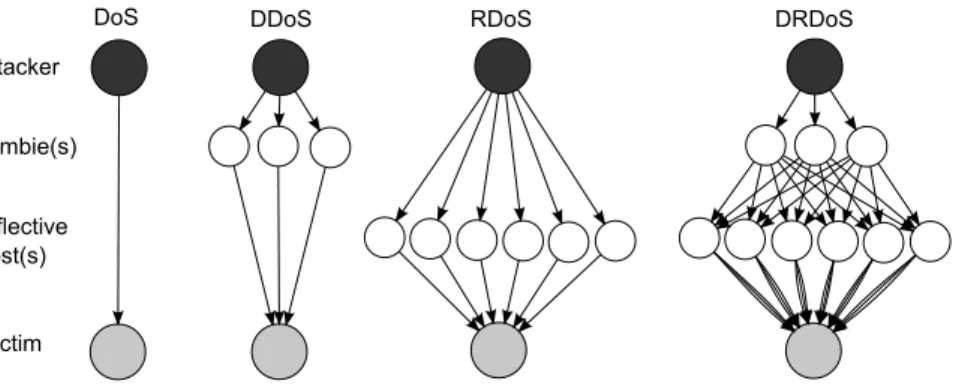
There are two classes of DoS: massive packet flooding or special forged packets in order to explore protocol issues or poor implementations. In the case of massive flooding attacks, one of the key aspects is the factor of amplification. A remote controlled structure of compromised devices, zombies, or a group of trusted servers, reflectors, are often used in order to amplify the attack. The reflectors are regular servers that reply to requests from a forged source IP address. This way, the replies are sent to the victims instead of the real source of the request. Different terms are applied according to the use of distributed compromised devices, DDoS, the used of reflective hosts, Reflective Denial of Service (RDoS), or combining both, Distributed Reflective Denial of Service (DRDoS) as outlined in figure 2.7. The compromised devices can also be organized in a multi-layer structure in order to amplify the attack factor and difficult the traceability of the attacker. The attacks may explore one or more protocols such as ICMP, TCP or UDP.
attacker
zombie(s)
victim reflective host(s)
DoS DDoS RDoS DRDoS
Figure 2.7: Behavior of different types of DoS attacks
2.5. SECURITY THEORY
filtering, and a prior spread of malicious code to create a "network" of compromised devices. An example of these attacks is shown in figure 2.8.
attacker zombie(s) victim reflective host(s) tcp-syn (3x6) commands (x3) tcp-syn-ack (18)
Figure 2.8: DRDoS attack using invalid TCP connections
2.5.5 Packet Filtering
Ingress filtering One of the security mechanisms against IP spoofing based DoS attacks is ingress filtering [38]. As a current best practice all packets coming from an unallocated space or any specially reserved IP should be blocked. Those IP addresses are usually called bogons6.
Egress filtering The egress filtering mechanism is used to filter spoofed packets from the inside.
These filtering techniques are specially useful if applied by an Internet Service Provider (ISP) in order to prevent DDoS attacks. However, since some ISP do not provide those types of filtering some of the techniques employed in those attacks are still valid.
6
Make your life easy. Holger Mikolon
3
Security Analysis
3.1 Methodology . . . 27 3.1.1 Terminology . . . 27 3.1.2 Modeling the Environment . . . 28 3.1.3 Identify the assets . . . 28 3.1.4 Identify the threats . . . 29 3.1.5 Security Discussion . . . 29 3.1.6 Risk Assessment . . . 29 3.1.7 Proposal Design . . . 29 3.1.8 Implementation . . . 30 3.1.9 Practical tests . . . 30 3.2 Environment . . . 30 3.2.1 Elements . . . 32 3.3 Security Discussion . . . 33 3.3.1 Assets . . . 34 3.3.2 Threats . . . 35 3.3.3 Security Considerations . . . 36 3.3.4 Risk Evaluation . . . 41 3.3.5 Overview . . . 433.1. METHODOLOGY
3.1
Methodology
The methodology used includes a set of steps as outlined in figure 3.1. It is composed of two parts: a theoretical and a practical part. The security analysis of making mShield an IPv4 to IPv6 converter box is provided in the theoretical part, whereas in the practical part, a design proposal and its implementation is presented. Additionally, it also includes a set of practical tests and a discussion of their results. The current mShield design does not have any IPv6 related support. Therefore, it is useful to understand how mShield can be redesigned to enable IPv6 support.
In the proposed design, all the design changes from current design are discussed. The practical tests support the theoretical security discussion and the proposed design. The terminology and a detailed description of each step are provided in the next topics.
Modeling the Environment
Identify the threats Identify the assets
[Theoretical] [Practical]
Risk Assessment
Security Discussion Proposed Design
Implementation
Practical Tests
Figure 3.1: Steps of the Methodology
3.1.1 Terminology
Asset An asset represents a process, data or physical resource that belongs to the information system.
3.1. METHODOLOGY
cause to assets. The damage results from an action of someone or something in the presence of a vulnerability. Even if a vulnerability is fixed, the threat persists and can be triggered in the presence of other vulnerability.
Vulnerability Vulnerability refers to a specific known weakness of a system. Can be referred to hardware or software weaknesses. The scope of this document is related to software.
Risk Risk is commonly expressed as the value of several inputs like the impact of a specific threat combined with the likelihood.
3.1.2 Modeling the Environment
This step involves gathering information about mShield, costumer network and Philips medical devices in order to understand the system. The main characteristics and requirements of those elements are described in section 3.2. A full description of the translation process and implementation details is presented in appendix B.
3.1.3 Identify the assets
At this step, a discussion about each asset is presented. The resulting list of assets will be used to match against the threats. Each asset is expressed in together with its importance, expressed by the terms high, medium or low. The definitions used to evaluate each asset are shown in table 3.1 whereas the assets are discussed in section 3.
Table 3.1: Assets Definition
Classification Definition
High It is mandatory to protect the asset.
Medium It is not mandatory but the asset should be pro-tected.
Low It is not mandatory but it could be desirable to protect the asset.
3.1. METHODOLOGY
3.1.4 Identify the threats
In this step a list of network threats are discussed. Each threat is grouped according the STRIDE model [37]: Spoofing identity, Tampering with data, Repudiation, Information disclosure, Denial of service, Elevation of privilege. The threats discussion is presented in section 3.
3.1.5 Security Discussion
In this step, a security analysis about the differences of both IP versions is provided. It includes a discussion about the needed changes to the design such the translation approach or the security implications of the IP address allocation method. The security discussion is presented in section 3.
3.1.6 Risk Assessment
In this step, a risk evaluation based on Risk Management Guides for Informa-tion technology Systems [40] is performed. It is important not only discuss the effects but also measure them. The risk assessment allows to quantify the risk associated with each threat and helps to decide the next steps (accept the risk or mitigate it). Two inputs are used in the risk evaluation: impact and likelihood [40].
The impact measures the consequences of a materialized threat whereas the likelihood measures the probability of the threat being realized, considering the existence of known vulnerabilities, design flaws or the complexity / expertise required. The impact discussion and the risk assessment is provided in section 3.
3.1.7 Proposal Design
In this step, a new mShield design is presented in chapter 4. All changes are discussed and explained including the role of mShield in the translation process. Those changes are based on the security analysis.
3.2. ENVIRONMENT
3.1.8 Implementation
In this step, the implementation of all design changes is provided. It contains all the steps, commands and scripts used to enable NAT64 translation on mShield. The implementation details are covered by the chapter 4. Never-theless, its details are presented in appendix B.
3.1.9 Practical tests
Several types of tests are part of this step. They are intended to support the proposed design and the theoretical security discussion. The converter box requirements are tested and the packet translation debugged. Finally, a discussion about their results is provided. The practical tests and their discussion are presented in the chapter 4.
3.2
Environment
An IPv4 to IPv6 converter box represents a network device capable of translating communications initiated by IPv4 devices towards IPv6 devices. The basic requirement includes support for unicast and IP / ICMP packets translation. Additionally, IPv6 to IPv4 translation must be also supported. The mShield device plays the role of a converter box.
In this section, the entire environment surrounding mShield is described. It includes the medical devices and customer networks as well as the charac-teristics of the environment. Finally, the role of mShield in the translation process is also described.
All the scenarios involving IPv4 legacy devices and the need of translation between IP versions were considered as outlined in figures 3.2 to 3.5. All options are important to consider since they affect the security analysis. For example in figure 3.2, the only one with just one IP architecture in both sides, the threats of IPv6 extensions headers are not considered since they are not translated by IP / ICMP translation algorithm [6].
3.2. ENVIRONMENT
Philips Scope
mShield
IPv4
IPv6
Figure 3.2: IPv6 Costumer Network and IPv4 Medical Devices
Philips Scope
mShield IPv4
IPv6 IPv6
Figure 3.3: IPv6 Costumer Network and IPv4/IPv6 Medical Devices
Philips Scope
mShield
IPv4 IPv4
IPv6
Figure 3.4: IPv6/IPv4 Costumer Network and IPv4 Medical Devices
Philips Scope
mShield IPv4
IPv6
IPv4
IPv6
3.2. ENVIRONMENT
Features
• The converter box should support communications in both directions. It includes incoming connections, initiated by customers devices, and outgoing connections, initiated by medical devices.
• The converter box should be able to translate IP / ICMP headers in unicast communications.
• Generic application layer protocols using TCP or UDP at the transport layer should be supported.
Constraints
• IPv4 legacy devices should be supported without the need of adapting the devices already developed.
• The new design should not impose any constraints in customers net-works. Those networks are not managed by Philips. Therefore, it should be possible to use any IP address in the customer side.
3.2.1 Elements
Medical Devices
Those devices represent the group of all medical devices deployed by Philips. The protocols used, run at the top of TCP or UDP (e.g. HyperText Trans-fer Protocol (HTTP) or Digital Imaging and Communications in Medicine (DICOM)). IPsec or multicast communications are not used. Therefore, it is not necessary the use of any ALG. Currently, medical devices uses only IPv4. Nevertheless, it is expected that new devices already support IPv6.
Customer Network
Since those networks are not managed by Philips, they should be considered as insecure. Nevertheless, in the most of the cases they have a perimeter device to filter traffic from the Internet. That consideration is necessary to the security analysis. Customer networks can be IPv4, IPv6 or both. The
3.3. SECURITY DISCUSSION
external interface of mShield, part of customer network, can be statically or dynamically assigned (e.g. using SLAAC). The security implications of using a dynamic assignment are discussed in section 3.
mShield
The mShield device represents the intermediate device in all communications between the customer and the medical devices network. Its first goal should be to ensure the security of the medical devices network. The security should be enforced before the efficiency. The conversion function is a requirement caused by the existence of legacy devices. Nevertheless, in the future, the communications are expected to be IPv6 to IPv6. Those concepts are important during the design and implementation of a new mShield release as a converter box.
In terms of software, mShield is a minimal modified version of OpenBSD. That choice can be justified with the main goal of security in mind. It is based on one of the most secure Operating System (OS) in the market. As a bonus, its reduced size make it an easily manageable software. The configuration can be done using a remote Secure Shell (SSH) connection or using serial connection via a configuration tool.
mShield is composed of 4 physical interfaces, one external interface connected to the costumer network, and the other internal interfaces, connected to medical devices. Additional functions such as IP translation or cryptographic operations could exceed the limited hardware capacity of mShield. Therefore, the hardware requirements should be reconsidered for the new design.
3.3
Security Discussion
In this section, a security analysis of the environment and its needed changes are presented. It is composed of the assets and threats identification, a discussion about their impact and a risk assessment. It is useful for the next phase in order to improve the security of the new mShield design.
3.3. SECURITY DISCUSSION
3.3.1 Assets
In this subsection, the security related assets are identified and discussed. Their importance and the role of mShield are necessary in order to understand what kind of threats surround the environment. A detailed discussion about the threats and their impact is provided in the next sections and the identified assets are shown in table 3.2.
Availability
Medical devices like x-ray systems are used in a critical environment. Those devices can be used to save lives, and therefore it is necessary to assure its availability. By filtering the traffic from the outside mShield should assure that they can still be used in case of network availability attacks (e.g. DoS attack from the outside).
Due to the actual design, all communications are via mShield exposing it as a single disruption point. Nevertheless, during network unavailability, it is always possible to physically access and use a medical device.
On the other hand, a successful attack against medical devices availability will cause a serious impact. Protecting the systems availability is therefore classified as of high importance. It is acceptable that mShield becomes unavailable but that is not acceptable for a medical device.
Integrity
The patient data, used by medical devices, is critical and should not be tampered or destroyed by malicious code.
The mShield role is limited to the traffic filtering, which means it cannot detect malicious code, like an anti-virus software. Nevertheless, through traffic filtering, mShield can reduce the propagation and effect of malicious code.
The loss of integrity has also an effect on the systems availability. For instance, a virus detection will likely cause a downtime for a device or the entire medical
3.3. SECURITY DISCUSSION
devices network. Since it is important to assure the systems availability it is also necessary to assure their integrity.
Table 3.2: Assets evaluation and description
ID Security Property
Asset Importance
1 Availability Ensure availability of the systems by pro-tecting the network against attacks.
High
2 Integrity Reduce the effect and propagation of mali-cious code over the network
Medium
Further Considerations
Additional considerations are important to understand the scope of this analysis and the security evaluation. Nevertheless, they are not covered by the threats and risk discussion since they are not related with the converter box, IPv6 or part of current features of mShield.
Traffic filtering is based on IP addresses and ports, there is no traffic au-thentication. Notice that the purpose of an IP address is identify a network card and not provide evidence. As a consequence, mShield is vulnerable to spoofing attacks either in IPv4 or IPv6.
Traffic encryption, providing end-to-end confidentiality, is done using upper layer protocols such as SSH or HyperText Transfer Protocol Secure (HTTPS).
Authentication and authorization are also a security concern in the remote access to mShield (spoofing and elevation of privileges). This access, for configuration purposes, use SSH protocol, and again, it is not related with converter role.
For the same reasons end-to-end data integrity and non-repudiation were also not considered.
3.3.2 Threats
In this subsection, the threats surrounding the environment are identified. It is also explained their meaning and why they are a threat. The identified
3.3. SECURITY DISCUSSION
threats are shown in table 3.3.
DoS
Two threats against the environment were considered: DoS attacks against mShield itself and DoS attacks against medical devices. The scenarios where an attack can affect medical devices but not mShield or the network communication are described in the next topics.
In both cases, the source of DoS attacks can be a device in the Internet or a compromised device in the customer network.
Those attacks are considered as threats since they affect the network avail-ability or, in the worst case, affect the availavail-ability of a medical device.
Tampering
In this category tree types of threats were considered: Malicious code affecting either medical devices or mShield and its propagation over network.
For the network propagation scenario, the communications between customer and medical devices as well as communications between medical devices via mShield were studied. Although, medical devices are considered trusted devices, they can get compromised and spread malicious code over network.
Malicious code affecting medical devices can be used to tamper, steal or destroy patient data. Whereas malicious code affecting mShield can be used to change firewall configurations or intercept and steal patient data.
A compromised device, either a medical device or mShield can also be used to trigger other network attacks (e.g. DoS attacks).
3.3.3 Security Considerations
In this section, the security implications of the design are discussed. The use of IPv6 and the options for the new design are discussed. They are necessary to understand the impact and the likelihood of each threat presented during the risk assessment.
3.3. SECURITY DISCUSSION
Table 3.3: Threats evaluation and description
ID Category Threat
1 DoS DoS attacks against mShield
2 DoS DoS attacks against medical devices
3 Tampering Network propagation of malicious code 4 Tampering Malicious code affecting medical devices 5 Tampering Malicious code affecting mShield
Translation approach
The translation aproach, such as NAT64, does not raise additional security considerations rather than use the IPv6 and IPv4. Nevertheless, all headers and IP address translations need to be computed and therefore, can be used as a DoS target. Other security issues may result from the implementation used.
Address Assignment
The IPv6 address allocation method can increase the likelihood of network attacks. Dynamic assignment methods, such as SLAAC or DHCPv6, generally, produce more predictable addresses (e.g. MAC based or sequential ranges) [41]. Although, it is not expected that mShield is connected to the Internet without any filtering allowing remote scans. Nevertheless, even considering random IPv6 addresses, the local scanning is possible as discussed in the next subsections.
Routing and Switching
In the current design, the packet filtering is based on IP addresses and ports, mShield operates on data-link layer such as a switch. That means mShield is not visible in the network scans. Nevertheless, the IP / ICMP translation and packet forwarding, required for the new design, are done at the network layer. In that case, it may be desirable that mShield operate at the network layer, such as a router. The discussion about functional advantages and disadvantages are presented in chapter 4.
3.3. SECURITY DISCUSSION
A router firewall means that it has assigned IP addresses on its interfaces and therefore it is also a target for network based attacks. In that case, the those attacks can be done not only against medical devices but also against mShield.
Using a router approach, from the outside perspective, medical devices are not visible. They are hidden behind external interface of mShield. Using Packet Filter (PF) it is possible to employ the same filtering policy.
On the other hand, medical devices are connected to internal mShield in-terfaces. In that case, mShield should behave as a switch, grouping those devices in a single network.
Communications between medical devices can occur without mShield filtering (e.g. external switch). In the case of internal communications using different IP versions, an external switch, without IP conversion is useless For the cases of a compromised medical devices, filtering internal connections can also prevent malicious code propagation via network.
Reconnaissance
Dual stack, specially in the external interface, increases the attack surface. Although, the necessary support for both IP versions in the customer side increases the number of effective malicious code and scanning methods. Excepting the common malicious code, the system is exposed to IPv4 plus the IPv6 threats. Several methods and tools have already been developed for perform IPv6 scans [42] [43] [44].
NAT in the communications between medical and customer devices difficults automated processes used by virus and worms to detect vulnerabilities and the OS fingerprint of medical systems. The same result can be achieved in the current design using traffic normalization.
In IPv6, even that the remote host scan can be difficult by using random IPv6 addresses, the local scan is simplified by the use of pre-defined multicast groups (e.g. ping to multicast link-local address of all nodes).
The services running on medical devices can be found by scanning all network range and ports either using a router or a switch approach. Using mShield as
3.3. SECURITY DISCUSSION
a NAT router, the result is one host, the external interface of mShield, with all used open ports whereas in the current design the open ports are spread by several hosts. It is possible to find services either in IPv4 or IPv6.
On the other hand, the random network scans performed by virus or worms can be easily flagged since all communications are controlled and expected. This feature is not present in the current design. Several approaches have been developed to detect those scans in IPv6 [45] [46].
Vulnerabilities
Nevertheless, after a successful services recognition it is also necessary to have some vulnerability to explore. One of them, refers to the use of Routing Headers since this could be used to perform DoS attacks or bandwidth theft, particularly the type 0, already deprecated [47].
Other topics already observed in IPv4 like fragmented packet handling or stateful mechanisms are susceptible to cause DoS or used to bypass packet filtering protection. The extension headers mechanisms, used in IPv6, can also be used to bypass firewall protection (e.g. allow unknown extensions headers).
Nevertheless, there are no open IPv6 vulnerabilities affecting OpenBSD that can be used to include some malicious code in the system1.
On the other hand, mShield is still vulnerable to neighbor spoofing and man in the middle attacks. Several IPv6 design problems were already demonstrated such neighbor spoofing [42]. ND messages can be spoofed and an attacker can therefore, intercept connections between mShield and customer devices. Despite of that, man in the middle attacks are also possible in IPv4 and in the actual design.
DoS Attacks
The DoS attacks exploring upper layer vulnerabilities are not covered by this document. Their operation mode does not change and can be easily adapted
1
A Common Vulnerabilities and Exposures (CVE) is an open and widely used vulnera-bility database. It maintains a list of vulnerabilities and exposures affecting multiple OS and protocols. [48].
3.3. SECURITY DISCUSSION
for IPv6.
In the case of a massive packet flooding from the outside, mShield will become unresponsive and break the network connection to medical devices. However, as outlined in figure 3.6, this consideration is not always true. A specific amount of packets per unit of time lesser than mShield maximum capability and greater than medical device capability will cause a DoS on medical device.
attacker medical device mShield 60000 packets/s 30000 packets/s (max.) 20000 packets/s (max.) 20000 packets/s 20000 packets/s 10000 packets/s (max.) 50000 packets/s (max.) 20000 packets/s 20000 packets/s 30000 packets/s (max.) 20000 packets/s (max.) die alive die alive alive alive
Figure 3.6: Effect of different amount of packets/s on the environment
Malicious Code
The mShield role against malicious code is limited to the network commu-nications. It can block either in the first stage of infection or during the propagation.
3.3. SECURITY DISCUSSION
data from the compromised machines. In both cases, it is expected that mShield block most of those communications. Other code designed to local modify or destroy data or spread by removable devices, like usb sticks, are out of the scope of mShield.
3.3.4 Risk Evaluation
In this subsection, the damage and the likelihood of a threat are evaluated. For the likelihood values a qualitative analysis based on the current knowledge of security issues is presented. A discussion about the complexity and expertise needed to perform the attack is also included in the likelihood discussion. In the impact analysis, the network and business consequences are presented.
DoS Attacks
Impact A successful DoS attack against a medical device represent high impact. It have costs for customer and for Philips. The costumer needs to find or use alternatives such as other available equipment or transfer patients to another hospital. Whereas Philips needs to allocate resources to support the costumer to identify and mitigate the problem.
Nevertheless, a DoS attack against mShield will not have the same impact, since the medical devices can be physical accessed and used. It was classified as of low impact.
Likelihood DoS attacks using packet flooding are not complex. They take the advantage of a distributed network of compromised devices to flood some victim.
Other DoS attacks using special crafted packets can be more complex. Nevertheless, for some of them pre-built tools can be used without too much knowledge. For those attacks it is necessary to explore an OpenBSD vulnerability.
Despite that, DoS attacks directly against medical devices are only possible in some cases as described before. Even in those cases, specific packet rates need to be used. Attacks against mShield
![Table 2.2: IPv6 addressed types based on the prefix, adapted from [1]](https://thumb-eu.123doks.com/thumbv2/123dok_br/14982699.1007365/19.892.264.625.803.1002/table-ipv-addressed-types-based-prefix-adapted.webp)