WORKING PAPER SERIES
Universidade dos Açores Universidade da Madeira
CEEAplA WP No. 21/2008
Internet-Driven Customer Centric: An
Exploratory Analysis
Maria Teresa Tiago
Internet-Driven Customer Centric: An Exploratory
Analysis
Maria Teresa Tiago
Universidade dos Açores (DEG)
e CEEAplA
Working Paper n.º 21/2008
Dezembro de 2008
CEEAplA Working Paper n.º 21/2008 Dezembro de 2008
RESUMO/ABSTRACT
Internet-Driven Customer Centric: An Exploratory Analysis
Firm’s are becoming everyday more focus on customer orientation, leading to the need use of new techniques or combine use of existent ones. Both Customer Relationship Management and Knowledge Management are increasingly relevant in the corporate agendas as well as been broadly studied by academic researchers and with the development of the digital economy it’s necessary to have a larger understanding of their role in e-business performance. Thus, our aims are to determine whether the implementation of virtual CRM and KM is linked to e-business performance and to identify the nature of the relationship existing in the combine use of these tools. Thus, this paper establishes a new model of the practices and results of the both tools which has been tested in European companies. For that purpose, we used a structural equation modelling analysis. The results show that both virtual CRM and KM have a positive impact on the maximization of e-business performance and that their combine use has also a positive impact on e-business performance. As limitations of the study we consider the need for more research into this field and the inclusion of news elements such as technological readiness and management support. This paper contributes to the research on this topic with new evidence in a broad sample.
Keywords: Customer Relationship Management, Knowledge Management, E-business Performance, European Companies
Maria Teresa Tiago
Departamento de Economia e Gestão Universidade dos Açores
Rua da Mãe de Deus, 58 9501-801 Ponta Delgada
Internet-Driven Customer Centric: An Exploratory Analysis
Maria Teresa Borges Tiago, PhD Business, Professor, University of Azores, Rua da Mãe de Deus, Ponta Delgada, [email protected]
ABSTRACT
Firm’s are becoming everyday more focus on customer orientation, leading to the need use of new techniques or combine use of existent ones. Both Customer Relationship Management and Knowledge Management are increasingly relevant in the corporate agendas as well as been broadly studied by academic researchers and with the development of the digital economy it’s necessary to have a larger understanding of their role in e-business performance. Thus, our aims are to determine whether the implementation of virtual CRM and KM is linked to e-business performance and to identify the nature of the relationship existing in the combine use of these tools. Thus, this paper establishes a new model of the practices and results of the both tools which has been tested in European companies. For that purpose, we used a structural equation modelling analysis. The results show that both virtual CRM and KM have a positive impact on the maximization of e-business performance and that their combine use has also a positive impact on e-business performance. As limitations of the study we consider the need for more research into this field and the inclusion of news elements such as technological readiness and management support. This paper contributes to the research on this topic with new evidence in a broad sample.
Keywords: Customer Relationship Management, Knowledge Management, E-business Performance, European Companies
Acknowledgement: This paper is based on data provided by the European Commission and the
e-Business W@tch and funding for this work is granted by FCT – CEEApla, Research Center for Applied Economics.
INTRODUCTION
Since 1994 the use of the Internet means risen exponentially, offering increasing opportunities and markets to firms all around the world. The traditional marketplace has rapidly moved into the marketspace, a virtual market 24/24 globally accessed. Many companies are rushing to be present without a comprehensive strategy or with no a real idea of the true potential and limitations linked to these kinds of initiatives. Behind these challenging changes there is a paradigm shift in marketing and information technology is taking place.
The Internet has generated a profound modification in business and consumer behaviours, compelling firms do adopt new postures in order to establish win-win relationships with
customers. The focus of marketing changed from a supplier’s perspective to a customer perspective. Understanding the true meaning of market orientation or customer orientation becomes a key to success and firms are reshaping their form of action in order to incorporate tools that allow them to take the most advantages possible. Since the Internet has established itself as part of the global information infrastructure, it is essential that organisations consider its impact on their business and develop strategies for using it. As information technology base customer relationship management and knowledge management are two powerful tools that can help firms in this conquest, especially due to their ability to create links between all stakeholders. However, as stated by Lüneborg and Nielsen (2003), the new information technology plays an essential role in recent advances of customer focusing, but customer-relationship and knowledge management are often considered as strictly technical issues. Even though, their strategic importance is considered by both academic and practitioners, this leads us to believe that it is relevant to measure its impact on e-business performance. With these considerations in mind, this paper discusses the results of an exploratory survey conducted among a sample of European companies. Using a structural equation analysis, this study analyses the relationship between e-business performance and KM and CRM initiatives combined.
The structure of this paper follows the logical sequence present. The paper starts, in next section, by the definition and the benefits of the CRM and in following section, a similar incursion is perform regarding the background literature about KM. The combined use these two tools in an Internet context it’s present in after and an Internet-based evaluation framework is developed in section five. After which the author present the results obtained. The last section is a summary of the author conclusions and suggestion for further investigation.
Customer Relationship Management
Forging a long-term relationship with customers is the key to stability and probability in an increasingly dynamic market. As numerous studies have pointed out, communication and customer knowledge are the basis of a strong relationship (see, Håkansson 1982; Dwyer et al., 1987; Duncan & Moriarty, 1998; Borghini & Rinallo, 2003; Huhtinen & Virolainen, 2002). There are two reasons for this special attention to consumers. First, loyal customers are far more profitable to a company (Page, Pitt & Berton, 1995; Reicheld, 1996), because they have a lower price-sensitivity and are less likely to be deal-prone switchers. Secondly, the relationship is usually difficult to understand and emulate (Day, 1997), which makes it a potential source of competitive advantage.
The recognition of customer relationship management began to grow in the 1990s (Ling & Yen, 2001; Xu et al., 2002). Rogers (2005) stated that companies recognized that customer relationships are the underlying tool for building customer value, and they are finally realizing that growing customer value is the key to increasing enterprise value.
In the quest to become customer-centric, organizations have invested in IT solutions that allow them to manage their customer relations strategically. CRM was the solution found by many companies and has become a buzzword in contemporary marketing and information systems, being widely studied by academics; however, there is no universally accepted definition of CRM as it may been see in the works of several authors (Kincaid, 2003; Kim et al., 2003; Fjermestad and Romano, 2003; Croteau and Li, 2003; Bose, 2002; Parvatiyar and Sheth, 2001; Swift 2001). Like many other information system applications, CRM is strongly linked to the literature to a sales and marketing perspective. As stated by Kincaid (2003), Xu et al. (2002) and West (2001), CRM involves, besides IT, four major organizational areas: marketing, sales, and
services and support. West (2001) suggested that CRM is the life cycle of a customer relationship that crosses from marketing, to sales, to service and support. IT is basic to supporting and maintaining these functional areas and CRM process (Kincaid, 2003).
Ngai (2005) points out that those organizations are motivated to adopt CRM in order to create and manage the relationships with their customers more effectively, regardless of it’s unsuccessful past and independently of organizations’ size.
A critical factor in the CRM’s popularity as a business tool is its benefits (Kim et al., 2003; Scullin et al., 2002; Jutla, Craig & Bodorik, 2001; Stone et al., 1996). Recent work in marketing advocates that paying attention to CRM can enhance firm performance: improving the accuracy of customer targeting and acquisition (Cao & Gruca, 2005); increases the potential of savings in the firms due to the implementation of CRM technologies (Jayachandran et al., 2005); improving customer lifetime value (Cao & Gruca, 2005; Lewis, 2005); increases firms knowledge about the customers and consequently their satisfaction (Mithas et al., 2005; Rylas, 2005); increases information sharing with suppliers that conducts to customer satisfaction (Mithas et al., 2005); allows the adoption of effective multi-channels strategies (Srinivasan & Morman, 2005).
From the literature review these can be summarized as increased customer retention and loyalty, a more effective marketing, creation of value for the customer, customization of products and services, higher customer profitability, cost reduction, high quality products and services. Thus, the main objective of customer relationship management is to maximize the lifetime value of a client to the organization (Stone et al., 1996; Kalakota and Robison, 1999; Shaw, 1999; Peppers et al., 1999; Brown, 2000; Peppard, 2000; Turban et al., 2000; Scullin et al., 2002; Kim et al., 2003; Wu and Wu, 2005) by using all available information to create additional value to the client.
Knowledge Management
According to Huosong et al. (2003), KM consists of management activities which develop and utilize an organization’s knowledge resources efficiently and improve a firm’s creative ability. While KM has been widely studied by academics, it has no universally accepted definition (See the works of Zhang et al., 2006; Huosong et al., 2003; Huysman and De Wit, 2000; Beckman, 1999; Laudon and Laudon, 1999; Davenport et al., 1998; Snowden, 1998; Spek and Spijkervet, 1997; Sveiby, 1997).
As suggested by authors such as Huysman and de Wit (2003, 2002), Bhatt (2001) and Neef (1999) despite the academic research and organizational practices developed around this concept, a considerable gap in literature remains. Huysman and De Wit (2002) suggested that the majority of the empirical studies didn’t analyze the complete knowledge cycle and that KM has not been treated in different views: first, as an external gathering of information and second, as external knowledge dissemination. In this context, the internal diffusion of knowledge and the innovation and creation associated with this process has been relegated to second place. Several models have attempted to explore the issues of knowledge discovery, knowledge classification, knowledge acquisition, learning, pattern recognition, artificial intelligence algorithms, and decision support in the Internet context.
Schwartz et al. (2000) presented the Acquisition, Organization and Distribution Model (AOD Model), in which the knowledge cycle is described in three phases: acquisition, organization and distribution of information. Tiwana (2001) suggested a similar model that considers, instead of the organization phase, the internal and external application of information.
After reviewing the existent literature, Awad and Ghaziri (2004) considering that KM went through an ongoing life cycle proposed a four step model: capturing; organizing; refining and transferring knowledge. According to these authors, the rapid improvement of knowledge exchange tools is moving forward KM to a stage where the potential relies in how well a company shares the “know-how” to improve its decision-making capacity and quality. KM is one of the main strategic areas being explored and adopted by companies (Schwartz et al., 2000; Grossman, 2006), especially by those who have invested in the Internet as a new channel and marketplace. Specially because it main function is to capture and disseminate new sources of information (Stojanovic and Handschuh, 2002), open wide and available at Internet.
Because of its characteristics, the Internet is profoundly changing KM and as Awad and Ghaziri (2004) stress out the World Wide Web has promoted KM from a trend to an e-business reality. Osmonbekov et al. (2002), Rao et al. (2003) and Leek et al. (2002) suggested that the Internet improves communication processes and, consequently, the gathering and sharing of information. Some empirical studies have pointed out additional benefits that might be achieved when operating in the cyberspace (Boyle & Alwitt, 1999; Boyle, 2001; de Long & Fahey 2000). By using the Internet, companies implement a knowledge-acquisition and knowledge-sharing system, which meets the requirements and specifications of unique and complex solutions that will match customer requirements to product characteristics (Ratchev et al., 2003). The success of knowledge-sharing in organizations does not only depend on technological means, but is also related with behavioral factors (Walsham, 2001; Calantone et al., 2002; Hertzum, 2002; Lang et al., 2002; Liao, 2003). Furthermore, in this society corporations need to adapt both knowledge management systems and business strategy in order to use digital information effectively and to take advantage of Internet’s possibilities (Takahashi & Vandenbrink, 2004).
Internet-Driven Customer Centric
The major challenge for companies in the new millennium is to abandon their product-centric focus to a customer-product-centric one (Kim et al. 2003; Kandell, 2000). As Stone at el. (1996) pointed out, “acquiring new customers is more expensive than keeping them” so companies need to promote their relationship with their customers.
In the last two decades, the Internet has shown its enormous potential as a tool for engaging new customer relationships and for transforming the interface between organizations and their customers. However, underlying this potential there is an aspect that needs to be considered: the proper alignment of customer needs with the business system. The Web presents a highly informed, powerful and smart group of customers, a group that demands a more satisfying relationship with companies, based on information exchange. Advances in technology have produced a vast menu of applications that can be used with these purposes. So, in both B2C and B2B commerce, there is a need for better selection and integration of IT tools in order to allow organizations to better understand how to leverage technology, such as customer relationship management and knowledge management (Kalota & Robinson, 1999; Wu & Wu, 2005). These features are considered as complementary at a certain level, due to the fact that both of them deal with information flows. Takahashi and Vandenbrink (2004) suggested that the problem facing top decision-makers in the ubiquitous information society will lie on how you best organize the knowledge cycle integrating different tools.
In this context, online companies are embracing Customer Relationship Management and/or Knowledge Management as major elements of corporate strategy, because online technological applications allow a precise segmentation, profiling and targeting of customers,
and the competitive pressures of the digital markets require a customer-centric corporate culture. Though, the adoption of these systems by organizations implies a complex restructuring of all organizational elements and processes, such as automating the back-office or revising the products and services offered (Pan & Lee, 2003).
Boyle and Alwitt (1999) and Boyle (2001) pointed out that the empirical results show an additional benefit in the relationship development gained by companies that operates over the Internet. Additionally, Osmonbekov et al. (2002), Rao et al. (2003) and Leek et al. (2002) suggested that Internet improves the communication process and consequently establishes relationships among stakeholders. Awad and Ghaziri (2004) claimed that information and knowledge are critical to companies’ performance. However, these authors suggested that capturing and transferring best practices and knowledge is not enough to achieve success. One of the challenges is to share the knowledge with inside entities who value it, and to do so organizations must create and deploy integrated systems, which cover customer-centric and business knowledge flows.
Danziger and Hull (2000) stated that the importance of adopting a knowledge management system approach relies on the fact that it supports knowledge transfers made in two forms: person to person and person to document (See, Hanson et al., 1999; Swan, et al., 1999; Alavi & Leidner, 2001; Awad & Ghaziri, 2004; Lee et al., 2005), becoming the bases for future customer-oriented activities.
While Internet is simplifying the nature of the communication and integration of consumers and suppliers, it is also challenging organizations to take advantages of a range of different systems tools, in order to: achieve new competitive advantages driven by information technologies; adopt new organizational forms; integrate heterogeneous information systems into virtual information systems; closer strategic planning and control; and a wider information sharing process, among others. Nevertheless, there are few empirical studies that try to measure the real impact of the combined use of technological tools, such as the case of KM and CRM, in overall business. So, considering that the digital economy made possible to develop and implement new tools and taking in consideration the statement of Carlson (2000) regarding customers expectation of getting the products or services through the same virtual channel – Internet-, which was used to sell, supply and retrieve information, it seems important to evaluate the implications of the adoption of CRM and KM in e-business performance.
Evaluation Framework and Hypotheses
From the literature review emerges that the main research developed on CRM and KM fields focus on (i) its adoption in a physical context, (ii) its influence on general business performance and (iii) its implementation in specific industries. Even though academic researchers and practitioners alike praise both adoptions (Khalifa & Shen, 2005; Schwartz et al., 2000) there is still a lack of empirical evidence of its effects on e-business success, because there is no measure of e-business success derived from their combined application. So, our aim is to establish a measurement framework that contributes to fill this gap and provide a better understanding of these customer-driven tools, based on a sample of European companies.
Following the literature reviewed in the previous sections, we investigated the relationship among CRM, KM and e-business performance. For that purpose we used a structural equation model with latent variables. This model consists of two sub models, the measurement model and the structural equation model. The former shows how the latent variables or factors are measured and the latter indicates the relationships among the latent variables. The validation
of the measurement model is done by using Confirmatory Factor Analysis (CFA). As we will see latter on that the observable variables (indicators) that were selected are measures of two latent variables (factors). We considered that these two factors have each one a direct effect on e-business performance and an indirect effect via their combined implementation.
The framework identifies metrics that can be used to measure the impact of the CRM and KM on business performance. Each perspective is evaluated according to the appropriate metrics. The proposed research model tests three hypotheses. The first dimension that needs to be defined is e-business performance. Suitable performance measurement is an issue that has been widely debated in the marketing literature. According to Bhargava et al. (1994) financial success is only one aspect of a firm's performance that can be considered as an indicator of its economic value (Hax & Wilde, 2001). With the establishment of online business, new models and measures of performance are needed (Amit & Zott, 2000; Hoque, 2000; Craig & Jutla, 2001). D'Souza and Williams (2000) advocate that an effective performance measurement should reflect CRM contribution to the overall competitive position. In terms of the e-business success measurement, we make a distinction between economic and market-based performance (Kholi & Jaworski, 1991; Bharadwaj, Varadarajan & Fahy, 1993; Reinartz et al., 2003). Therefore, the concept of corporate success in e-business in this research is limited to three dimensions (Amit & Zott, 2001): hard factors, soft factors and innovation. The first are indicators of economic performance, namely sales volume and number of customers. The second dimension refers to a company’s improvement in customer relationships – soft factors, measured in the model by the quality of customer service. The last dimension reflects the company’s achievements in terms of its competitive position, given by the sub dimension sales area.
Depending on the business strategies being pursued by the firm, the role and importance of technological features vary. The flexible and interactive nature of the Internet allows the collection of a great amount of data about online customers and their interactions. The traditional concept of CRM has evolved to become the strategic integration element (Anton & Hoeck, 2002) that allows companies to gather the information about customers’ needs. CRM processes are supported by information systems in order to handle vast amounts of customer data and guarantee efficient workflows, in order to return some benefits in terms of a company’s performance.
According to recent literature, CRM can be consider as a macro-process which has distinctive components (Reinartz et al., 2003). Thus, its performance will be indirectly measured in these models through six dimensions: exchange of knowledge throughout an organization, commercial transactions customisation, and product innovation cycle. According to the literature, these components profoundly affect the way companies that act in terms of CRM.
H1: The higher CRM competencies and implementation, the higher companies’ e-business performance on markets.
From an operational context, KM has to promote the gathering and sharing of non-explicit knowledge throughout the communication and collaboration of individuals inside and outside the organization (Schwartz et al., 2000). In keeping with this point, the Internet constitutes a powerful tool to make communication possible or at least easier, providing several advantages: doing business faster; easier access and gathering of opinions; easier trying out of new ideas; providing superior customer service; and supporting managerial functions (Awad & Ghaziri, 2004). The KM awareness benefits the entire organization and that it relies on developing a KM environment inside and outside the firm that allows the generation of new
knowledge, the transfer of existing knowledge, the application of knowledge to new products, services and process (Awad and Ghazirim, 2004). Hence, the foregoing discussion suggests that:
H2: The higher KM competencies and implementation, the higher companies’ e-business performance on markets.
Considering the developments in the literature fields of KM and CRM, two considerations need to be taken: (i) By one hand, KM is link to the notion of being able to capture a firm’s collective knowledge and deliver it to the professionals who need it and driven from this it has caught the interest of management, marketing teams and IT staff alike; and (ii) By other hand, CRM can be establish as a firm wide asset that reveals the unique and complex connections between people, companies, relationships, experience and expertise, which clearly rely on knowledge resources. The works of Pan and Lee (2003), Yip (2000) and Honeycutt et al. (1998) explore the possibility of combined use of these two tools. This led to the third hypothesis:
H3: The combined uses of CRM and KM have a positive effect in e-business performance.
As mention previously, there are several factors that may moderate the virtual implementation of KM and CRM and thereby the e-business performance. Considering that the virtual markets present some unique features, a larger set of opportunities and new models of transactions is available (Amit & Zott, 2001), that firms’ can use to enhance their performance, most of then related to knowledge process and customer relationship and its adoption and application will be the focus of the remains parts of this paper.
Methodology and Results
The objective of this study is to gain a broader understanding related to the combined adoption and implementation of CRM and KM and its implication in terms of e-business performance. The data employed in the empirical research come from e-Business W@tch annual survey (2003). This data was collected in a large survey about e-business in European enterprises. The original sample was limited to firms having e-business activities. So, the cases analysed (9.192) constitute a heterogeneous sample of companies in terms of industries, fields, size, business model and country. The data cover 25 European countries (Cyprus, Czech Republic, Estonia, Hungary, Latvia, Lithuania, Malta, Poland, Slovakia, Slovenia, Austria, Belgium, Denmark, Finland, France, Germany, Greece, Ireland, Italy, Netherlands, Portugal, Spain, Sweden, UK and Norway). Distribution of firm size, measured by the number of employees, shows that most are small and medium size (around 59% of the respondents). The two sectors that are most heavily represented in the sample are business services and tourism, respectively with 11.6% and 11.5%, closely followed by all the others, with the exception of the craft and trade sector that only represents about 6% of the sample.
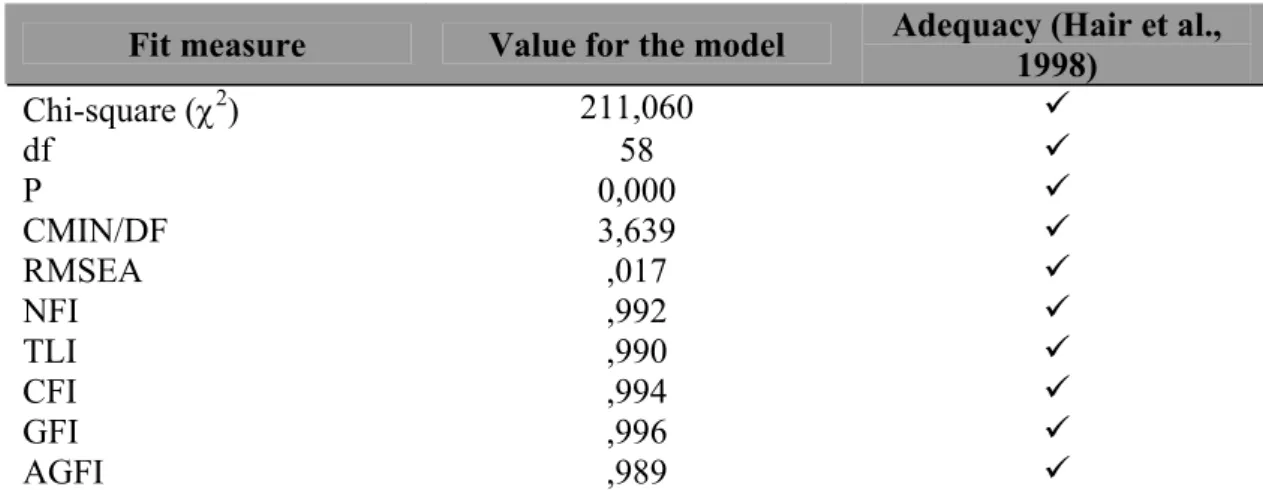
The model was estimated by the Maximum Likelihood method in the AMOS package and the model goodness of fit may be considered acceptable according to the values of some goodness-of-fit indices although the chi-square test statistic (χ2 = 211,06; df=58; p-value = 0,000) is significant implying a bad fit. However, as it is well known, this test has serious limitations namely its dependence of the sample size and of the number of indicators. In general, for large sample sizes the chi-square statistic is significant and in the present case the sample size is very large (n=9.192). For that reason, it is usual to evaluate the goodness of the fit by a set of indices (see, Table 1).
Fit measure Value for the model Adequacy (Hair et al., 1998) Chi-square (χ2) 211,060 9 df 58 9 P 0,000 9 CMIN/DF 3,639 9 RMSEA ,017 9 NFI ,992 9 TLI ,990 9 CFI ,994 9 GFI ,996 9 AGFI ,989 9
After global model fit has been assessed, the numerical results were evaluated in order to test their support of the research hypothesis. The numerical results can be obtained directly from the path coefficients of the structural model presented in Figure 1. We refer to standardized coefficients that account for scale effects and serve as indicators of the relative importance of the variables. Knowledge Management Customer Relationship Management E-business performance 0,33 0,87 0,94 Combine use 0,74 1,0 0,45 *** *** # # *** ***
Key for significance measures: * : α >0.10 **: α >0.05 ***: α >0.01
#: for model identifiably, this path coefficient was set to 1 in the
unstandardized case. Knowledge Management Customer Relationship Management E-business performance 0,33 0,87 0,94 Combine use 0,74 1,0 0,45 *** *** # # *** ***
Key for significance measures: * : α >0.10 **: α >0.05 ***: α >0.01
#: for model identifiably, this path coefficient was set to 1 in the
unstandardized case.
For that reason, it is usual to evaluate the goodness of the fit by a set of indices. The goodness-of-fit indices tests were conducted to access whether the empirical model could explain the observed data. The measures for global model fit included in Table 4 suggest that our model fits the underlying data quite well (Hair et al., 1998). All the hypothesis paths were all statistically significant. The regression coefficients estimates and p-values are reported in Table 2.
Table 2 - Standardised estimates of the model
Standardised regression weight (β) Estimate P
H1 CRM <--- E-business_success ,94 ***
H2 KM <--- E-business_success ,87
H3 E-business_success <--- Combine use ,326 ***
H3a KM <--- Combine use ,736 ***
H3b CRM <--- Combine use 1,000
Second order variable CRM
Cronbach Alpha α=0,620
Standardised regression weight (β) P value S.E
Sharing of information’s <--- CRM ,594 0,000 ,014 Transaction innovations <--- CRM ,768 0,000 ,040 Product innovation <--- CRM ,731 0,000 ,039 Transaction security <--- CRM ,262 0,000 ,039 Sales integrate system <--- CRM ,146 0,000 ,029 Customize products <--- CRM ,180 0,000 ,013 Chi-square (χ2) 62,783 df 9 P 0,000 CMIN/DF 6,976 RMSEA 0,025 NFI 0,986 TLI 0,973 CFI 0,988
Standardised regression weight (β) Estimate P
Nº of customers <--- E-business_success ,687 *** Sales Area <--- E-business_success ,773 ***
Quality of service <--- E-business_success ,776 ***
The examination of the values in Table 2 reveals that all the coefficients are statistically significant.
The measurement of customer relationship management contains six indicators as shown in Table 3. The results of the confirmatory factor analysis of the measurement component of the customer relationship management one factor congeneric model are summarised in Table 3. The same data is providing relating to the second order variable knowledge management, which contains four indicators. The coefficients alpha for CRM and KM are moderate (0,62 and 0,72 respectivly), as shown in Table 3, indicating that the variables are a reasonably good measure of the construct. Results suggest that most of the standardised regression weights of each of the variables were greater than 0.4 and variable reliabilities all above 0.5, indicating these variables reflect the underlying trait of the construct.
Table 3 – Confirmatory Factor Analysis
Second order variable KM
Cronbach Alpha α=0,720
Standardised regression weight (β) P value S.E.
Content management <--- KM ,346 0,000 ,162 Information access <--- KM ,473 0,000 ,185 Internal exchange <--- KM ,426 0,000 ,170 External exchange <--- KM ,306 0,000 ,014 Chi-square (χ2) 27,911 df 3 P 0,000 CMIN/DF 9,304 RMSEA 0,035 NFI 0,980 TLI 0,970 CFI 0,981
Regarding hypothesis 1, the results show that virtual CRM competencies explain 94 per cent of the variance in e-business success. Thus, this finding places empirical support to the concept that e-business performance can be improved by the investment in e-CRM systems. Following a similar path, hypothesis H2 is not rejected, as the results show that virtual KM competencies explain 87 per cent of the variance in e-business success.
By other hand, the two dimensions used to compose the combine use are all significant and explained 74% and 100% of the variance this construct. Nevertheless, the combine use explains only 33 per cent of in e-business success construct. With this consideration in mind, hypothesis H3 is supported, showing however, a low effect due to the small value of the result achieved in accordance to Hair at al. (1998).
Since, adoption and implementation of virtual CRM and KM are only one part of the equation and the e-business impact must also be measured. Therefore, in the e-business construct, sales volume, number of customers, sales area and quality of customer service contributes to the explanation of the variance respectively with 76%, 69%, 77% and 77%. The above significant relationships provide empirical support to the theoretical views that state that e-business performance needs to be measured using economic and market-based criteria.
DISCUSSION AND CONCLUSIONS
As literature review showed organizations face considerable challenges in implementing large-scale integrated systems such as CRM and KM. These kind of applications support all parts of an organization’s value chain, including promotion, procurement, production, recruiting, and customer service. Thus, most firms recognize that a key to achieving long-term success is coordinating efforts to reach and manage information flows oriented to customer satisfaction. The goal of the current study was twofold: (1) to determine whether the implementation of CRM and KM systems is positively linked to e-business success and (2) to identify the nature of the relationship existing between the conjoint use of these tools and e-business performance. This study is an attempt to help filling out the existing research gaps. For this purpose three propositions were developed with the aim of getting a better perspective of European empirical evidence on the interface of CRM and KM adoption and business performance.
The findings shown above, demonstrated the kind of applications which are really need or valorise by European firm’s, how customer relationship management and knowledge management can help them in the establishment of a narrow relationship with customers and to achieved higher levels of e-business performance, considering a new set of measurements.
More in particular, the results generated some interesting findings. First, the data support our conceptualization for both virtual CRM and virtual KM constructs. Within both components, most of the elements have a positive impact on the maximization of the competencies and consequently implementation of these tools. According to the results, the concepts that virtual CRM and KM are integrated e-business tools that allows a more profitable relation with customer and a more effective management are reinforced. So, managers should ponder the use of both competencies to improve everyday e-business process. Nonetheless, the size of the effect for the combine use of these tools was smaller than would be expected. This suggests that not all the base activities are determinant of business performance improvement. There is evidence of a threshold effect between the two components independently and the e-business success, something that has not been truly identify previously.
To marketers internet should be use as a potential field to gather information and with the use of CRM and KM be aware of a new set of opportunities to improve daily business activities. Namely, taking advantaged of the benefits such as reducing communication and operational costs, improves sales and the overall customers’ interaction pointed out by others researches. However, a cost benefit analysis should be made to assess the return of the investments made in these tools, since we only consider the upside of this initiative. Until both elements becomes an engrained and standard tools of e-business, the need to define measurements criteria’s will continue in order to support the implementation and maintaining of these system in firms.
This research provides some new insights into the impact of CRM and KM in e-business performance in a European context; however, these findings should be viewed in light of some limitations. Further work is clearly needed to examine the interaction of these integrated tools and e-business performance overtime or in small sets of the sample, allowing to know if the relationship equally strong in all countries and which contextual factors affect this relationship. Aside from the previous considerations, it would be interesting to compare european firms’ reality with other firms’ around the world, or to compare the results achieved by online and not online firms. Certainly, there is scope for further research in this arena.
In brief, this research paper provides a structure of understanding CRM and KM in a B2B and B2C setting and explores the impact of CRM and KM use on e-business performance. That framework is a contribution because it is the first rigorously researched step towards
understanding the important confluence of two powerful streams of business tools. The framework was built from theory and empirical research to represent this process and provides a foundation for further research.