Clinical Practice Knowledge Acquisition
and Interrogation using Natural Language
Aquisi¸c˜
ao e Interroga¸c˜
ao de Conhecimento de Pr´
atica Cl´ınica usando
Linguagem Natural
David Jos´
e Murteira Mendes
Tese apresentada `a Universidade de ´Evora para obten¸c˜ao do Grau de Doutor em Inform´aticaORIENTADORA: Irene Pimenta Rodrigues
´
Evora, Mar¸co de 2014
Clinical Practice Knowledge Acquisition
and Interrogation using Natural Language
Aquisi¸c˜
ao e Interroga¸c˜
ao de Conhecimento de Pr´
atica Cl´ınica usando
Linguagem Natural
David Jos´
e Murteira Mendes
Tese apresentada `a Universidade de ´Evora para obten¸c˜ao do Grau de Doutor em Inform´aticaORIENTADORA: Irene Pimenta Rodrigues
´
Evora, Mar¸co de 2014
usando Linguagem Natural
Sum´
ario
Os conceitos cient´ıficos, metodologias e ferramentas no sub-dom´ınio da Representa¸c˜ao de Conhec-imento da ´area da Inteligˆencia Artificial Aplicada tˆem sofrido avan¸cos muito significativos nos anos recentes. A utiliza¸c˜ao de Ontologias como conceptualiza¸c˜oes de dom´ınios ´e agora suficiente-mente poderosa para aspirar ao racioc´ınio computacional sobre realidades complexas.
Uma das tarefas cient´ıfica e tecnicamente mais desafiante ´e presta¸c˜ao de cuidados pelos profission-ais de sa´ude na especialidade cardiovascular.
Um dom´ınio de tal forma complexo pode beneficiar largamente da possibilidade de ajudas ao racioc´ınio cl´ınico que est˜ao neste momento `a beira de ficarem dispon´ıveis.
Investigamos no sentido de desenvolver uma infraestrutura s´olida e completa para a representa¸c˜ao de conhecimento na pr´atica cl´ınica bem como os processos associados para adquirir o conhecimento a partir de textos cl´ınicos e raciocinar automaticamente sobre esse conhecimento.
Natural Language
Abstract
The scientific concepts, methodologies and tools in the Knowledge Representation (KR) sub-domain of applied Artificial Intelligence (AI) came a long way with enormous strides in recent years. The usage of domain conceptualizations that are Ontologies is now powerful enough to aim at computable reasoning over complex realities.
One of the most challenging scientific and technical human endeavors is the daily Clinical Prac-tice (CP) of Cardiovascular (CV) specialty healthcare providers.
Such a complex domain can benefit largely from the possibility of clinical reasoning aids that are now at the edge of being available.
We research into a complete end-to-end solid ontological infrastructure for CP knowledge represen-tation as well as the associated processes to automatically acquire knowledge from clinical texts and reason over it.
Agradecimentos
I wish to extend my acknowledgments in first place to my tutor, Prof.a Dr.a Irene Pimenta Ro-drigues for all her patience, support and high valued technical and personal tutoring along these last 3 years.
I wish to express my gratitude to my family namely Alexandre Mendes and Rodrigo Mendes for their coping with my absences and lack of support that they unfortunately surely felt.
My acknowledgments are extended to my wider family for their long standing support namely Luisa and C´esar .
Last but not the least a special personal note of gratitude goes to Rosa Silvestre, the love of my life that was always there, supporting my recurrent ups and downs for all these years and specifically during those when my research in this project went along.
Of course, I acknowledge
• the financial and logistic support of Centro de Investiga¸c˜ao em Inteligˆencia Artificial (CENTRIA) at the early stages of my research,
• the Departamento de Inform´atica (DI) of Universidade de ´Evora (UE) in the person of Prof. Dr. Salvador Pinto de Abreu the PhD DI director,
• and Prof.a Dr.a Teresa Gon¸calves the DI director for welcoming me in the department, • Dr. Carlos Baeta for its invaluable support, motivation and devoted hard work,
• Unidade Local de Sa´ude do Norte Alentejano (ULSNA) for the cooperation.
• But most of all, I could only develop my activities thanks to the Bento de Jesus Cara¸ca scolarship gently granted by Instituto de Investiga¸c˜ao e Forma¸c˜ao Avan¸cada (IIFA).
To all of them I wish to express my most profound feelings of acknowledgment and gratitude.
Acronyms
ACE Attempto Controlled English . . . .22
AI Artificial Intelligence. . . .iii
AOL Automatic Ontology Learning . . . .28
Apache Apache Software Foundation. . . .xiv
APE Attempto Parsing Engine. . . .22
API Application Programming Interface . . . .7
BO Biomedical Ontologies . . . .53
BFO Basic Formal Ontology . . . .54
BioTOP Top-Domain Ontology for the Life Sciences . . . .39
CAT Computer Aided Translation . . . .66
CC Clinical Concepts . . . 63
CCL Clinical Controlled Language . . . .3
CDSS Clinical Decision Support Systems . . . .3
CENTRIA Centro de Investiga¸c˜ao em Inteligˆencia Artificial . . . .vii
CERN Conseil Europ´een pour la Recherche Nucl´eaire . . . .7
CH Clinical History . . . .3
CIDERS Clinical Integrated Discourse Extended Representation Structure . . . .3
CK Clinical Knowledge . . . .xiv
CLI Command Line Interface . . . .73
CNL Controlled Natural Language . . . .22
CORE Clinical Observations Recording and Encoding . . . .xiv
CP Clinical Practice . . . .iii
CP-ESB Clinical Practice - Enterprise Service Bus . . . .97
CPR Computer Based Patient Record Ontology . . . .48
CRR Co-Reference Resolution . . . .3
CSI Computer Semantic Interoperability . . . .xiv
cTAKES clinical Text Analysis and Knowledge Extraction System . . . .xiv
CV Cardiovascular . . . .iii
CVDO Cardiovascular Disease Ontology . . . .49
CUI Concept Unique Identifiers . . . .51
CWA Closed World Assumption . . . .80
DBE Discourse Based Enhancement. . . .43
DC Discourse Controller . . . .59
DE Domain Expert . . . .4
DI Departamento de Inform´atica . . . .vii
DL Description Logics . . . .xvi
DO Disease Ontology . . . .48
DR Discourse Reasoning. . . .44
DRS Discourse Representation Structure . . . .3
DRT Discourse Representation Theory . . . .3
EAV Extraction of Attributes and Values . . . .72
EHR Electronic Health Record . . . .41
EMR Electronic Medical Record . . . .40
ESB Enterprise Service Bus . . . .xviii
EU European Union . . . .20
FMA Foundational Model of Anatomy . . . .40
FO Formal Ontology . . . .17
FOL First Order Logic . . . .27
GATE General Architecture for Text Engineering . . . .30
GRDDL Gleaning Resource Descriptions from Dialects of Languages . . . .35
GF Grammatical Framework . . . .95
GO Gene Ontology . . . .18
HCLS IG Health Care and Life Sciences Interest Group . . . .7
HL7 Health Level 7 . . . .44
HTML HyperText Markup Language . . . .40
IE Information Extraction . . . .19
IIFA Instituto de Investiga¸c˜ao e Forma¸c˜ao Avan¸cada . . . .vii
IR Information Retrieval . . . .19
Jena Apache Jena . . . .35
JSON JavaScript Object Notation . . . 77
KA Knowledge Acquisition . . . .4
KAB Knowledge Acquisition Bottleneck . . . .3
KB Knowledge Base . . . .xvii
KR Knowledge Representation . . . .iii
ML Machine Learning . . . .4
MS Manchester Syntax . . . .22
MT Machine Translation . . . 66
NCBO National Center for Biomedical Ontologies . . . .xvii
NCOR National Center for Ontological Research . . . .20
NER Named Entity Recognition . . . .72
NLG Natural Language Generation . . . .70
NLP Natural Language Processing . . . .xiv
NLU Natural Language Understanding . . . .70
OASIS Organization for the Advancement of Structured Information Standards . . . .30
OBO Open Biological and Biomedical Ontologies . . . .xiv
OD Ontology Driven . . . .65
ODA Ontology Driven Expanded Semantic Annotation . . . .59
OGCP Ontology for General Clinical Practice . . . .xiv
OGMS Ontology for General Medical Science . . . .48
OL Ontology Learning . . . .8
OR Ontological Realism . . . .xiv
OWL Web Ontology Language . . . .xiii
OWL2 Web Ontology Language v.2 . . . .7
OWL API OWL Application Programming Interface . . . .15
OWL DL OWL Description Language . . . .12
PACE ACE Parser . . . .80
PDF Portable Document Format. . . .29
PHI Personal Health Information . . . .20
PL Predicate Logic . . . .13
PLT Problem List Terms . . . .51
POMR Problem Oriented Medical Record . . . .40
POS Part Of Speech . . . .72
QA Question Answering . . . .2
RDF Resource Description Framework . . . .7
RDFS Resource Description Framework Schema . . . .35
REST Representational State Transfer RIM Reference Information Model . . . .44
RO Relations Ontology . . . .39
RTU Referent Tracking Unit . . . .20
SAM Sistema de Apoio ao M´edico . . . .42
SNOMED-CT Standard Nomenclature of Medicine - Clinical Terms . . . .xiv
SO Symptom Ontology. . . .60
SOAP Subjective, Objective, Assessment, Plan . . . .xvii
SPARQL SPARQL Protocol and RDF Query Language. . . .7
SW Semantic Web . . . .9
SWRL Semantic Web Rules Language . . . .34
TE Textual Entailment . . . .89
TM Translation Memory . . . .xvii
TMM Translation Memory Manager . . . .65
TMX Translation Memory eXchange . . . .66
UB New York State University at Buffalo. . . .20
UE Universidade de ´Evora . . . .vii
UIMA Unstructured Information Management Architecture . . . .xiv
ULSNA Unidade Local de Sa´ude do Norte Alentejano . . . .vii
UMLS Unified Medical Language System . . . .xiv
URI Uniform Resource Identifier . . . .35
URL Uniform Resource Locator . . . .20
UTS UMLS Terminology Services . . . .50
VSO Vital Signs Ontology . . . .60
W3C World Wide Web Consortium . . . .7
WS Web Service . . . .7
WSD Word Sense Disambiguation . . . .72
WWW World Wide Web . . . .7
XML eXtensible Markup Language . . . .21
Contents
Sum´ario i
Abstract iii
Table of Contents xvi
List of Figures xviii
List of Tables xix
1 Introduction 1
1.1 Research context and motivation . . . 1
1.2 Research questions . . . 2
1.3 Scientific Innovation . . . 3
2 Tools and Technologies Addressed 7 2.1 Semantic Web . . . 7
2.2 Resource Description Framework . . . 8
2.3 Description Logics and Web Ontology Language v.2 . . . 8
2.3.1 Description Logics . . . 9
2.3.2 Web Ontology Language. . . 10
2.4 Reasoning about Knowledge . . . 11
2.5 Reasoning Support for OWL . . . 13
2.6 Web Ontology Language (OWL) Reasoners . . . 14
2.7 Consequence driven reasoning . . . 15
2.7.1 The ELK reasoner . . . 15
2.8 Biomedical Resources . . . 17
2.8.1 Generic and Biomedical Ontologies . . . 17 xiii
2.8.2 Biomedical Knowledge Representation . . . 18
2.9 Ontology Learning . . . 18
2.9.1 Knowledge Acquisition through Information Extraction from text Natural Lan-guage Processing (NLP) . . . 19
2.9.2 Controlled Natural Language . . . 21
2.9.3 The project: Attempto Controlled English. . . 22
2.10 Tools for specialized NLP . . . 27
2.10.1 Apache Software Foundation (Apache) OpenNLP . . . 28
2.10.2 Apache Tika . . . 29
2.10.3 Apache Unstructured Information Management Architecture (UIMA) . . . 29
2.10.4 Apache clinical Text Analysis and Knowledge Extraction System (cTAKES). . 31
2.11 Tools for Ontology manipulation . . . 32
2.11.1 Prot´eg´e . . . 32
2.11.2 Prot´eg´e Ace View Plugin . . . 34
2.11.3 Prot´eg´e OWL API . . . 34
2.11.4 Apache Jena . . . 35
3 Clinical Knowledge (CK) 37 3.1 Knowledge Representation . . . 37
3.1.1 Ontological Realism (OR) . . . 38
3.1.2 Ontological relations for clinical practice . . . 38
3.1.3 Clinical text available sources . . . 39
3.2 Knowledge Acquisition . . . 43
3.2.1 Using the Ontology for General Clinical Practice (OGCP) for Clinical Controlled Language building . . . 44
4 Ontology for General Clinical Practice proposal 47 4.1 OGCP Presuppositions. . . 47
4.1.1 Standard Nomenclature of Medicine - Clinical Terms (SNOMED-CT) . . . 49
4.1.2 Unified Medical Language System (UMLS) Clinical Observations Recording and Encoding (CORE) . . . 51
4.1.3 Suggested representation as Computer Semantic Interoperability (CSI) tool . . 51
4.2 OGCP ontologies alignment . . . 52
4.2.1 Open Biological and Biomedical Ontologies (OBO) Foundry ontologies . . . 52
4.2.2 OBO Foundry principles . . . 53
4.2.4 OBO foundry ontologies integration . . . 54
5 Knowledge Base population 63 5.1 Supervised tutoring. . . 64
5.1.1 Translation Memory as a controlled technical jargon repository . . . 66
5.1.2 Translation Memory Manager tools. . . 66
5.2 Automatic Ontology Learning . . . 68
5.2.1 Clinical Controlled Language translation. . . 72
5.2.2 Knowledge Acquisition through specialized NLP . . . 72
5.2.3 Ontology Driven Expanded Semantic Annotation . . . 76
5.2.4 Smart instance creation . . . 77
5.2.5 Ontological relations formation . . . 78
5.2.6 Pragmatic interpretation in NLP . . . 78
5.2.7 Round Trip Debug and Repair . . . 80
5.2.8 Reasoning with effective logics . . . 82
5.3 Text interpretation . . . 83
5.3.1 Preliminary considerations . . . 84
5.3.2 Ontology structure considerations . . . 84
5.3.3 OGCP enhancements in order to represent healthcare practice episodes. . . . 86
5.3.4 DRS rewriting methodology . . . 88
6 Clinical Practice Knowledge Interrogation 91 6.1 Clinical reasoning . . . 91
6.2 Clinical concept guidance . . . 92
6.3 Discourse Based Enhancement . . . 92
6.4 Quality indicators . . . 96
7 Results and Discussion 97 7.1 System Architecture . . . 97
7.1.1 Translation Memories workflow with CP-ESB . . . 98
7.2 OGCP Population examples . . . 100
7.3 Current on-going controlled results . . . 110
7.3.1 Domain experts validation . . . 111
8 Conclusions 113 8.1 Conclusions . . . 113
8.3 Comparable high standard formal results evaluation . . . 116
References 119
A Symbols and terminology 134
List of Figures
2.1 Tasks in TBox, Knowledge Base (KB) and ABox. . . 9
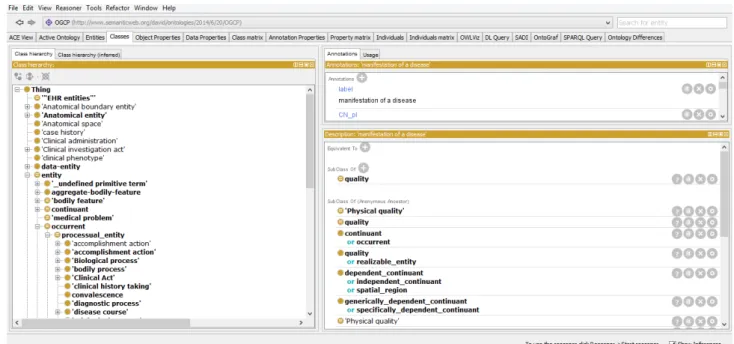
2.2 Prot´eg´e 4 Ontology Development Tool (Prot´eg´e). . . 33
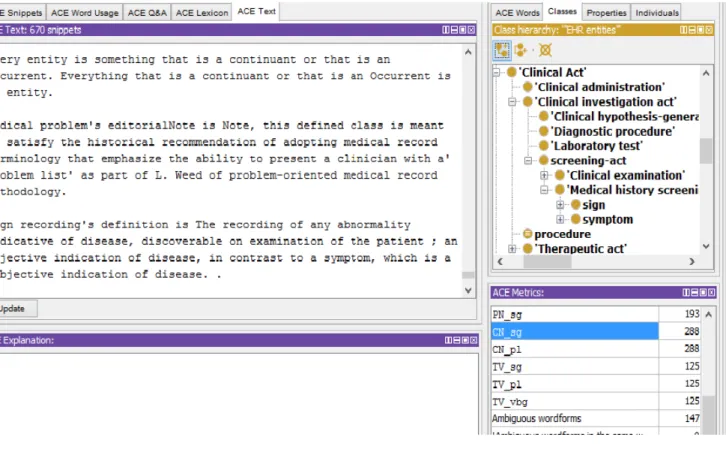
2.3 Prot´eg´e ACE View Plug-in. . . 34
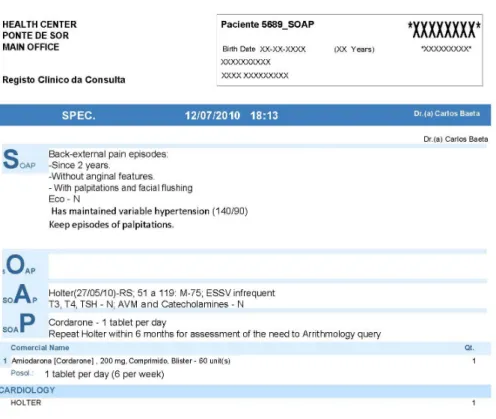
3.1 Subjective, Objective, Assessment, Plan (SOAP) report de-identified sample. . . 42
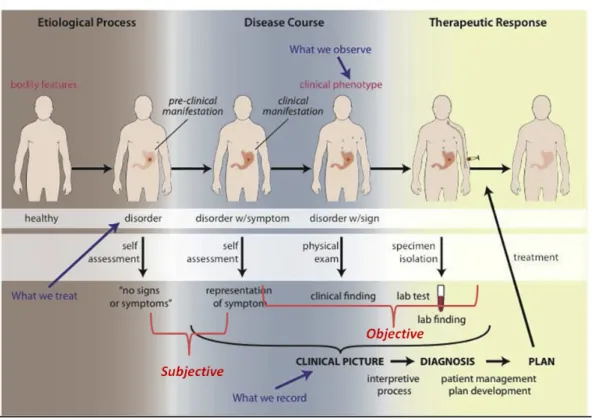
3.2 SOAP Points Insertion . . . 43
4.1 Leaf nodes of OGCP.. . . 49
4.2 Ontological structure of Ontology for General Clinical Practice (OGCP). . . 49
4.3 SNOMED-CT Concept Structure. . . 50
4.4 Ontology alignment structure in OGCP. . . 52
5.1 Knowledge Acquisition Phases. . . 64
5.2 Supervised Translation Memory (TM) training. . . 65
5.3 Axiom creation from SOAP. . . 69
5.4 SOAP-5682 Sample complex report. . . 70
5.5 National Center for Biomedical Ontologies (NCBO) expanded semantic annotation . . 76
5.6 Semantic parsing of ellipsis ill segment . . . 79
5.7 Enrichment of OGCP into a Healthcare Knowledge Base (KB). . . 82
5.8 OGCP inpatient encounter. . . 84
5.9 OGCP case history. . . 85
5.10 Signs and Symptoms in Clinical History . . . 86
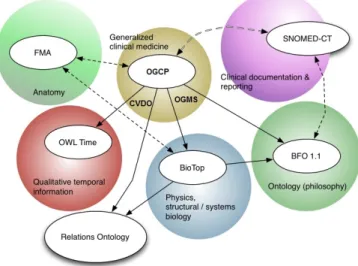
5.11 OGCP Analysis. . . 87
5.12 OGCP Medication . . . 87
6.1 ACE View Plugin. . . 93 xvii
6.2 ACE View Plugin snippets list. . . 94
6.3 ACE View Plugin snippets editor. . . 94
6.4 Knowledge Base (KB) Enrichment through Interrogation. . . 96
7.1 CP-Enterprise Service Bus (ESB) Architecture. . . 97
7.2 TMs workflow with CP-ESB. . . 98
7.3 OGCP Acquisition Workflow. . . 99
7.4 SOAP Report example . . . 100
7.5 OGCP Patient . . . 101
7.6 OGCP Physician . . . 102
7.7 OGCP Inpatient encounter . . . 103
7.8 Analysis hierarchy in OGCP. . . 107
List of Tables
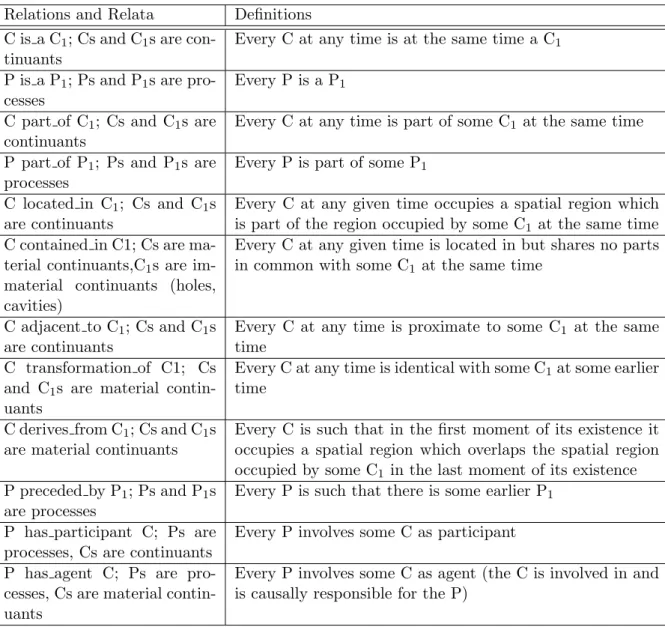
4.1 Primitive instance level relations in Relations Ontology . . . 57
4.2 Class-level relations in Relations Ontology . . . 58
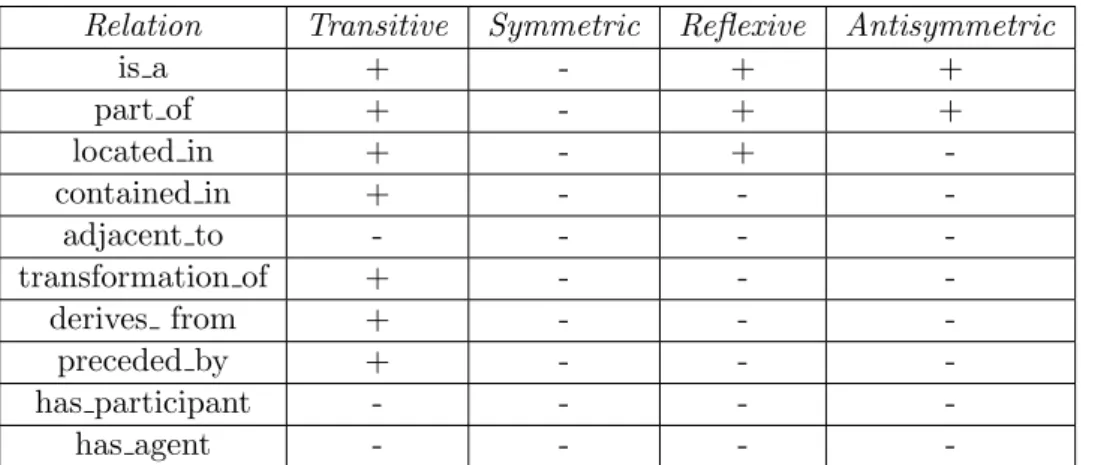
4.3 Properties of the relations in the OBO Relations Ontology . . . 59
7.1 XSLT transformations from XML NCBO Annotation into OGCP instance . . . 99
A.1 Symbols and notations . . . 134
A.2 Namespaces for qualified names abbreviation . . . 135
Chapter 1
Introduction
1.1
Research context and motivation
Having followed the Artificial Intelligence (AI) field for the last 14 years it was apparent that the application of computable reasoning to the healthcare sub-domain of life sciences was at the turn of a corner. In fact, several developments were achieved that raised that possibility.
The sub-domain of Artificial Intelligence (AI) that explores reasoning based in a theoretical represen-tation model of some reality, an Ontology, has come a long way in recent years. Several innovative concepts, techniques, methodologies and tools have surfaced recently in literature that induced our re-search for the last 3 years. Huge multi-billion dollars investments were made, and are in progress, that give consistence to this line of research and have been achieving impressive results in the Biomedical computing science domain.
The steady adoption of scientific achievements on reasoning in the Semantic Web also bring some new possibilities into our work.
A state-of-the-art of computable knowledge representation in the life sciences domain was developed in the preliminary phases of the work back in 2011 [MR11c]. Being directed at Computer Semantic Interoperability (CSI) application of understanding the meaning of medical texts, it was extended and published in [MR12] and later in [MRB13c]. Still under the theme interoperability studies, a paper regarding issues related to HL7 semantic interoperability is [MR11a]. These works rendered evident that an ontology for the healthcare sub-domain would facilitate the application of Artificial Intelligence to that realm of science.
Actually, in the last decade some biomedical ontologies were developed as computable knowledge rep-resentation in several sub-domains of life sciences. They were proven to be computationally effective. A multi million dollar investment was made in the Human Genome Ontology (GO) beginning in 2001. The first partial model of the Human Genome was done in 2004 and the complete map achieved in 2007. The Human Genome model was built by hypothesis formulation and validation that were on-tologies generated by automatic reasoning proving thus Description Logics as a fundamental piece
of Artificial Intelligence application in Life Sciences.
However, an ontology to model clinical practice does not exist yet due to scarce academic/scientific interest. In fact, scientists don’t look after, and investments are few, in the application of Artificial Intelligence in ”mundane activities” like healthcare.
The second impeaching factor is that the modeling language (OWL2) was only standardized in 2009. We shall see how some Description Logics capabilities and correspondent computational reasoning, which are essential to domain modeling in life sciences, did not exist in OWL standardized in 2004 but are only defined in OWL2.
As the third unfavorable condition, we can observe that the necessary computational reasoning capa-bilities were only developed and released very recently. The algorithms that allow clinical reasoning with acceptable response times appeared in literature only in 2011.
Last, but not the least, there is a distinguishable higher difficulty in development due to the “Knowl-edge Acquisition Bottleneck” that, in our opinion constitutes the major obstacle to the Semantic Web development in life sciences. To address this problem we shifted our research from scrapping messages to text oriented acquisition after the realization that the largest part of healthcare in-formation resides in clinical notes. The research papers in 2012 [MR12, MRRSB12] illustrate that shifting. These represent the basis of our contribution to solve the Knowledge Acquisition Bottleneck problem.
During 2013 the works focused on ontology development and integration tasks [MR13a, MR13b]. A noticeable contribution was also in the clinical justification of the results of the previous research in [MRB13a] because this justification is fundamental for the acceptance by healthcare professionals. The summarization of the OGCPstructure and automatic population appeared in [MRB13b].
This document presents applied Artificial Intelligence developing innovative contributions to Clinical Practice (CP) Knowledge Representation (KR) and reasoning.
We direct our research into developing a foundation of Horn-SQIH ontologies due to their computa-tional advantages both in modeling as in reasoning.
An ontology already pre-populated for very effective reasoning in a Cardiovascular healthcare en-vironment is provided. We uncover our options in proposing the ontological framework and the chosen ways to extract significant Clinical Practice (CP) knledge from text.
The acquired knowledge constitutes the support for Question Answering (QA) based clinical reasoning aids that will also be presented.
1.2
Research questions
In the present work different research questions had to be addressed but, ultimately, they all collapse into one that embrace all the others.
• How to model such a complex domain like healthcare ?
Of course this is an extremely difficult scientific sub-domain of life sciences to model as it encompasses an enormous number of semantic relations in several sub domains of health like anatomy, physiology, therapeutic procedures, symptomatology among several others.
• How to perform computational reasoning over a representation necessarily so complex ?
What reasoning techniques, algorithms and tools are usable that can handle such complex rep-resentation is one of the research important questions.
• What are the technologies and tools to be adopted that can lead to generalized acceptance by healthcare professionals ?
It is of significant importance, and particular attention has to be taken to, the acceptance factor that the ultimate final users have to show for the result of this work to reach any impact. • Can the recent scientific and technological breakthroughs be developed to attain the intended
result of effective clinical computational reasoning ?
This last one can be considered the joint research question because it is the drive shaft of all the PhD endeavors.
We shall research all the most recent scientific developments in the field and their applicability to the former questions to prove our thesis.
1.3
Scientific Innovation
Driven by the research question presented in the previous section some of the results that were ob-tained can be considered innovative by themselves, we standout and itemize five of them as the more significant scientific innovations:
1. Ontology for General Clinical Practice (OGCP) creation.
An ontology was developed in order to model the healthcare sub-domain of life sciences. Clinical practice healthcare in particular and it was developed in a way that any medical specialty can be incorporated as a movable part.
2. Knowledge Acquisition Bottleneck (KAB) problem resolution.
TheKABproblem is solved by the realization that knowledge figures mainly in controlled medical texts that constitute the source of our automatic knowledge acquisition proposal.
3. Automatic enrichment using Clinical Controlled Language (CCL) for any specialty. The term CCLis coined that represents the formalization of ”medical language” in accordance to theOWL verbalization of theOGCPT-Box built for a given specialty.
4. The definition of an extended Discourse Representation Structure (DRS), Clinical Integrated Discourse Extended Representation Structure (CIDERS), that increases the scope of Co-Reference Resolution (CRR) to the whole of a patients Clinical History (CH) using disparate source texts.
Unlike the traditional Discourse Representation Theory (DRT) based DRS used mainly for anaphoric reference resolution in a single text.
5. Clinical Decision Support Systems (CDSS) validated through disambiguation using the acquired clinical practice model.
The QA systems that can be developed over the knowledge representation introduced in this work only allow clinically valid questions and answers and constitute then knowledge oriented
In the remainder of this introduction a readers guideline is given, describing the structure of this document.
A careful detail was given to a heavy cross referencing because readers with different expectations at diverse moments will be interested in jumping back and forth to other specific points in text.
The overall sectioning provides a progressive introduction to all the needed concepts intending for a natural sequence reading.
1. A full list of figures, tables and acronyms is presented at the beginning.
All the acronyms in the text refer to the definitions in this preliminary section.
2. In the current chapter1 the intent of the present work is introduced and the reader is given an explanation about the document structure.
3. In chapter 2we provide a detailed listing of the needed tools and technologies in all the aspects that are significant to this work. At the beginning a current state-of-the-art is discussed to give a detailed overview of every scientific recent achievements that format our research and support the options taken. Starting in section2.9.3we derive from a State-of-the-Art discussion to introduce the relevant aspects of tooling and technology used.
4. We begin the explanation of our work by introducing the preliminary challenges of both Clinical Knowledge Representation (KR) and Knowledge Acquisition (KA) in chapter3.
5. By introducing and detailing the proposed ontological framework in chapter 4 we justify the adoption of the population and enrichment concepts, methodologies and tools presented in the next chapter.
6. Chapter 5 details a complete overview of all the automatic steps involved in clinical knowledge acquisition:
(a) The Machine Learning (ML) process tutoring and bootstrap for controlled translation from natural languageSOAP reports to clinical English in the Cardiovascular specialty.
(b) The steps for automatic Knowledge Base population from texts are explained.
(c) the advanced and practical E L++ inference restrictions, opportunities and techniques that will allow Cardiovascular Domain Experts (DEs) to benefit from.
finally ”Case based Clinical guidance” is also shown in this chapter.
7. Chapter 6 concludes the coverage of our research question itemizing all the steps now possible for Clinical Practice guidance through Knowledge Base natural language interrogation.
8. Some obtained results and discussion around them are to be found in chapter 7. 9. Conclusions and future work suggestions are wrapped up in chapter8.
10. After the conclusions we find the bibliographic references.
11. For self containment of the work some reading aids are provided in the Symbols and Terminology annex in page134,
12. An appendix is provided at page136with the detailed DL axiomatic structure of the leaf nodes of Ontology for General Clinical Practice (OGCP).
In this annex the ontology definitions, that are spread along the text, are found for reference using DL notation.
Chapter 2
Tools and Technologies Addressed
[ABB+00] All the tools and technologies that were reviewed leading to the construction of the current proposal are presented.
When adequate State-of-the-Art reviews, regarding specific scientific issues that are to be addressed already exist, they are referred and not transposed here.
When some documents, however, are very important to understand this work, the most significant examples of those documents are reproduced here, with the due credits and references, for self con-tainment.
Every issue that is covered in the current document is presented going from more general themes to more specific ones.
2.1
Semantic Web
The notion of a Semantic Web was first introduced by Tim Berners-Lee the inventor of the World Wide Web (WWW) and director of World Wide Web Consortium (W3C) at Conseil Europ´een pour la Recherche Nucl´eaire (CERN) in 2001 [BLHL01]. Also known as Web 3.0, the main breakthrough of the Semantic Web is to evolve from the Web of documents into the Web of data.
This is achieved by turning the concepts managed by computers ”understandable” by them so that linkage between data in the web can be done automatically [AAD+09] by systems and software agents. For it to be possible some way of encoding the concepts meaning had to be delivered and the Resource Description Framework (RDF) protocol was developed.
For manipulation of the data in RDF format the language of choice is SPARQL Protocol and RDF Query Language (SPARQL) however, in our case, it is seldom used to process ontologies maintained in Web Ontology Language v.2 (OWL2) files because we normally process them using either Web Services (WSs) or Web Ontology Language (OWL) tools and Application Programming Interfaces (APIs).
The W3C [W3C11b] has established the Semantic Web for Health Care and Life Sciences Interest
Group (HCLS IG) 1 to help organizations in their adoption of the Semantic Web.
This adoption has been, however, rather slow paced [BZC10] due mainly to the knowledge acquisition bottleneck [WLB12] verified in mining knowledge from text in specific scientific domains.
A very recent review addressing the issue of generic knowledge discovery in medicine appeared in [EBMT14].
We are, however, particularly concerned in knowledge harvesting from text for Ontology Learning (OL) and reasoning in the specific sub-domain of healthcare.
The use of logics in ontologies ranges from sound modeling to practical querying of that knowledge, thus adding a considerable value, so the basic foundations of data representation of ontologies and their Description Logicss (DLs) are now introduced.
2.2
Resource Description Framework
The Resource Description Framework (RDF) is a language for representing information about resources in the World Wide Web [KC06]. The current version RDF 1.1 was published in 2014, February 25th [W3C14].
InRDF, there is no technical distinction between Tbox and Abox (in some other logic languages there is) and distinguishing between them is just a matter of convention.
TBox (T for Terminology) defines the schema or taxonomy, it is terminological data. In other words, it’s the data that defines classes, properties, and relationships in your ontology.
The ABox (A for Assertions) is the data. This is the data where you enumerate the individual instances of your class and describe them. You can’t have assertions without using some terminology, and terminology isn’t that useful unless you actually use it to make some assertions, so ABox and TBox are just two different but required parts of a knowledge base.
An analogy from the SQL world: ”CREATE TABLE ...” creates Tbox data; ”INSERT” creates Abox data.
TBox and ABox logic operations differ and their purposes differ. TBox operations are based more on inferencing and tracing or verifying class memberships in the hierarchy (that is, the structural placement or relation of objects in the structure). ABox operations are more rule-based and govern fact checking, instance checking, consistency checking, and the like.
ABox reasoning is generally more complex and at a larger scale than that for the TBox.
2.3
Description Logics and Web Ontology Language v.2
Description logics constitute a family of fragments of first-order logic (nearly all of which are decid-able), in which members of this family are primarily differentiated based on the set of allowed logical operators.
For example, some logics exclude negation and universal quantification, which in turn determine the
1
Figure 2.1: Tasks in TBox, KBand ABox.
computational complexity of inference with the language.
Most of the state-of-the-art in DLs was synthesized already in 2003 in ”The description logic hand-book: theory, implementation, and applications” [Baa03], we explore thoroughly the second edition published in 2007 [BCM+07]. This comprehensive introduction to DLs in this new edition includes a chapter on ontology languages for the semantic web with full coverage of all aspects of the subject: theory, implementation and applications.
This new chapter is devoted to the new Web Ontology Language (OWL) that was developed and recommended by W3C as the standard web ontology language for the Semantic Web (SW). The Web Ontology Language (OWL) is a standard ontology language that captures the semantics of many description logic languages presented and we introduce ahead in this chapter in2.3.2also its state-of-the-art .
2.3.1 Description Logics
As the name Description Logics (DL) indicates, one of the characteristics of these languages is that they are equipped with a formal, logic-based semantics. Another distinguished feature is the emphasis on reasoning as a central service: reasoning allows one to infer implicitly represented knowledge from the knowledge that is explicitly contained in the knowledge base. [BCM+07]
DLlanguages are then viewed as the core of knowledge representation systems, considering both the structure of aDLknowledge base and its associated reasoning services. InDL, the important notions of a domain are described by means of concept descriptions that are built from concepts (also referred to as classes), roles (also referred to as properties or relations), denoting relationships between things, and individuals (also referred to as instances).
It is now possible to state facts about the domain in the form of axioms.
• Terminological axioms (TBox Set)
make statements about how concepts or roles are related to each other, • assertional axioms (ABox Set) (sometimes also called facts)
make statements about the properties of individuals of the domain [VHH09].
When trying to develop a process of ontology learning by acquiring an ontology from text sources we have to balance all the developments made so far in:
• The expressibility of theDLsupporting our ontology in order for the reality to be appropriately represented.
• The reasoning methods and capabilities available for the chosen DLto classify the ontology in practical terms (acceptable response times, tractability).
• The difficulty degree in enriching automatically (ABox) the ontology from text that will, obvi-ously be higher as long as the ontology structure (TBox) is richer in terms of complexity.
As could be expected, all the developments that happened in recent years have been going two-fold simultaneously:
• The complexity of the proposed biomedical ontologies has been increasing by the realization that Ontological Realism (OR) is essential for accurate reasoning and the application of the Open Biological and Biomedical Ontologies (OBO) foundry framework [The14] since it was generally accepted as a cornerstone for coordinated evolution in this scientific domain [SC10].
• Fine tuned subsets of expressive DLs and the reasoning methodologies that have been evolv-ing steadily both for local [BBL05], [LB10] and distributed reasoning [DG08], [UKOVH09], [MMH10], [KKS11].
Web Ontology Language v.2 (OWL2) is the representation language of choice for our proposed ontology so we had to achieve fluency in its details.
2.3.2 Web Ontology Language
TheW3C Web Ontology Language (OWL) [W3C11a] is a Semantic Web language designed to repre-sent rich and complex knowledge about things, groups of things, and relations between things. The
OWLontology language is based in Description Logics, the family of class-based knowledge represen-tation formalisms presented in the previous section such that knowledge expressed in OWL can be exploited by computer programs, e.g., to verify the consistency of that knowledge or to make implicit knowledge explicit.
OWL documents, known as ontologies, can be published in the World Wide Web and may refer to or be referred from otherOWL ontologies.
OWLversion 1 was approved byW3Cin 2004 for the adoption of the formal evolution of DAML+OIL de-facto standards that had been around in the Knowledge Representation (KR) community for some years then. OWLhad serious shortcomings in it’s ability to represent reality [SCK+05].
Evolution led to the approval of the Web Ontology Language v.2 (OWL2) standard and its associated profiles [W3C11a].
WithOWL2enough expressive possibilities are available to develop the reasoning needed for biomed-ical and clinbiomed-ical sub-domains and contributions flourished [GHM+08]. The most significant, in terms of representativeness and overall quality and coverage, unified framework appeared as late as 2010 [CS10]. The application of the proposed framework is fully adopted in our work. Although generating a higher complexity in the enrichment steps, the level of ontological expressiveness will lead ourKBs to unprecedented reasoning capabilities while maintaining tractability.
2.4
Reasoning about Knowledge
Concerning Knowledge Representation (KR) the disadvantages of natural language are its ambigu-ity, vagueness and potential inconsistency. To represent knowledge in computers people use formal languages. These languages have a well-defined syntax and an unambiguous semantics, and support formal methods, specifically reasoning [SS11,CDGL+07].
Uses for Reasoning
Reasoning support is important for
• checking the consistency of the ontology and the knowledge • checking for unintended relationships between classes • automatically classifying instances in classes
Checks like these are valuable for
• designing large ontologies, where multiple authors are involved • integrating and sharing ontologies from various sources
Kinds of Reasoning about Knowledge
Some common ground routines have become usual in the reasoning realm, these can be split into:
• Class membership
– If x is an instance of a class C, and C is a subclass of D, then we can infer that x is an instance of D
• Equivalence of classes
– If class A is equivalent to class B, and class B is equivalent to class C, then A is equivalent to C, too
• Consistency
– X instance of classes A and B, but A and B are disjoint – This is an indication of an error in the ontology
• Classification
– Certain property-value pairs are a sufficient condition for membership in a class A; if an individual x satisfies such conditions, we can conclude that x must be an instance of A
All these abilities are found in the general purpose reasoners that have appeared since the Web Ontology Language v.2 standardization.
OWL Reasoning
The rich semantics of OWL provide powerful reasoning capabilities that help build, maintain and query domain models for many purposes. The reasoning capabilities of a system based in any DL is strongly dependent in two factors that have been evolving powerfully in recent years:
• The expressiveness of the underlyingDLs, ranging in the different capabilities introduced above in2.3.1.
• The processing power of the systems that support the computation, whether is it local or dis-tributed.
The reasoning capabilities depend on the expressiveness of theOWLprofile which relies on the under-lyingDL. In the current OWL2 standard there are fragments defined that trade expressive power for favorable properties that are not shared by the fullOWLlanguage. In particular, several fragments are a subset of OWL Description Language (OWL DL), the Description Logics dialect ofOWL, and aim at high efficiency for reasoning tasks such as subsumption, classification, and satisfiability [W3C11a]. The different profiles are [W3C12]:
• OWL2 EL
• OWL2 QL
• OWL2 RL
The different characteristics of the sub-languages may be verified in the W3C page. When trying to select which profile is the most adequate for our representation we studied the trade-off between the availability of the different reasoners with acceptable response times and had to consider the relative sizes of the expected T-Boxes vs. the A-Boxes as explained in [LSS13] and consequently opted to use the E L expressiveness and profile. Some special attention must be drawn then about the specific computational behavior of the E L profile: ”OWL2 EL is particularly useful in applications employing ontologies that contain very large numbers of properties and/or classes. This profile captures the ex-pressive power used by many such ontologies and is a subset of OWL 2 for which the basic reasoning
problems can be performed in time that is polynomial with respect to the size of the E L ontology. Dedicated reasoning algorithms for this profile are available and have been demonstrated to be implementable in a highly scalable way. The E L acronym reflects the profile’s basis in the E L family of description logics E L++, that provide only Existential quantification.”
Polynomial time algorithms can be used to implement the ontology consistency and class expression subsumption reasoning problems. As mentioned earlier in section2.3.1the recent distributed reasoner implementations leads us to maintain strict E L++ conformance in order for the reasoning steps de-scribed in the Advanced Inference section2.6 to be performed.
In the mere case of diagnosing and its related ”cognitive traps”, the issue is raised and developed in [LD11], where the estimates place the rate of medical misdiagnoses as high as 15 percent and some 80% of those errors can be accounted for by a cascade of cognitive errors. In the referred paper the hypothesis that by making the underlying reasoning pattern and its inferences explicit, and by helping diagnosticians become conscious of potential pitfalls in reasoning, their skill in making correct diag-noses will improve.
When using a Natural Language Processing (NLP) Question Answering (QA) based system the reason-ing becomes explicit and the hypotheses inferred by the system are complete as far as the underlyreason-ing ontology is, so a significant improvement in the diagnostic accuracy should be expected if the ontology coverage is as wider and accurate as possible in the current state-of-the-art.
2.5
Reasoning Support for OWL
In description logics, decidability of reasoning problems and the provision of sound and complete reasoning algorithms is key [SS11, WZGP04]. Description Logics are formal logics with well defined semantics. The semantics of a description logic is specified via model theoretic semantics, which explicates the relationship between the language syntax and the models of a domain. Semantics are thus a prerequisite for reasoning support. Formal semantics and reasoning support are usually provided by
• mapping an ontology language to a known logical formalism • using automated reasoners that already exist for those formalisms
OWLis mapped on a description logic, and makes use of reasoners such as FaCT, RACER and Pellet. Description Logics are a subset of Predicate Logic (PL) [Rec03] for which efficient reasoning support is possible and particularly diverse profiles of OWL2 were defined to be computable as viewed in2.4. In the description logic SHOIN , the description logic underlying OWL DL, we can build complex classes from atomic ones using the following constructors:
• C u D (intersection), denoting the concept of individuals that belong to both C and D, • C t D (union), denoting the concept of individuals that belong to either C or D, • ¬ C (complement), denoting the concept of individuals that do not belong to C,
• ∀ R.C (universal restriction), denoting the concept of individuals that are related via the role R only with individuals belonging to the concept C,
• ∃ R.C (existential restriction), denoting the concept of individuals that are related via the role R with some individual belonging to the concept C,
• >n R, 6n R (qualified number restriction), denoting the concept of individuals that are related with at least (at most) n individuals via the role R.
• {c1, . . . , cn} (enumeration), denoting the concept of individuals explicitly enumerated.
Based on these class descriptions, axioms of the following types can be formed:
• concept inclusion axioms C v D, stating that the concept C is a subconcept of the concept D, • transitivity axioms Transitive(R), stating that the role R is transitive,
• role inclusion axioms R v S stating that the role R is a subrole of the role S,
• concept assertions C(a) stating that the individual a is in the extension of the concept C, • role assertions R(a, b) stating that the individuals a, b are in the extension of the role R,
• individual (in)equalities a ≈ b, and a 6≈ b, respectively, stating that a and b denote the same (different) individuals.
We can make complex statements, for instance, expressing that two concepts are disjoint with the axiom A v ¬B. This axioms states that A is a subconcept of the complement of B, which intuitively means that there must not be any overlap in the extensions of A and B.
An interpretation consists of a domain of interpretation and an interpretation function which maps from individuals, concepts and roles to elements, subsets and binary relations on the domain of interpretation, respectively. A knowledge base consists of a set of axioms which act as constraints on the interpretations.
2.6
OWL
Reasoners
Well inside theOWLperiod of establishment but way before the standardization ofOWL2 and all its associated profiles, a proposal for a faithful Integration of Description Logics with Logic Programming appeared [MR07] where a methodology for reasoning with any generic DL is introduced. [Aug05]. Plenty of developments were consecrated ever since that led to a large variety of reasoners that vary in the expressiveness of the underlying DL that they are able to handle and in the mechanisms for performing the various interesting reasoning tasks as presented in 5.2.8. Reasoning with OWL
ontologies has high worst complexity but considering the different characteristics of the reasoners and of the ontologies to which they are to be applied a good selection can lead to good results in practice. A very shallow distinction can be made in
1. Classical,
are description logic reasoners based on tableaux algorithms that are able to classify large, expressive ontologies but they usually only provide limited support in dealing with large number of instances (ABox).
2. Database like,
Infer knowledge upfront and are able to handle large amounts of assertional facts, but are limited in terms of the logic they are able to support.
3. Case based reasoners.
Create the set of rules that generate all the inferring possibilities and by extensional application of these rules infer all the consequences (ABox ), normally in polynomial time on the size of the rule set.
advanced inference is normally referred to by that name because we are arguing in favor of the utilization of the latest of the enumerated types, case based reasoners, when performing our classifi-cation and knowledge inferring tasks over any OGCPKnowledge Base.
We consider that this incarnation of reasoners, being developed most recently by the application of a novel paradigm, fit particularly well in our ”advanced” albeit expressively limited ontology. It is a contribution to the naming also the fact that it has been implemented with distributed capabilities rendering the possibility of performing its abilities not just to a limited size KB suchlike the present
OGCPbut to something much broader in scope as those that might have all theSNOMED-CTinside them.
2.7
Consequence driven reasoning
To handle such big ontologies as those that figure in the Unified Medical Language System (UMLS) with millions of instances there is the need for the novel capabilities of distributed reasoning intro-duced by kazakov et al. as recently as 2011 [KKS11].
Directed to reasoning in an E L type of DL environment, to conform to the limitations explained in section 5.2.8, our solution is to restrict OGCP to E L++ and have a near polynomial classification time using ELK. As explained in the mentioned section, the reason of using an E L profile ontology is mainly determined by the classification time in an ontology with an expected structure as OGCPas shown in [Kr¨o10].
2.7.1 The ELK reasoner
The reasoning rationale for OWL EL is presented here for self containment [VHH09].
ELK is a free and open source reasoner for the lightweight ontology languageOWL2EL. It is based on Java and can be controlled using the OWL Application Programming Interface (OWL API) through
Prot´eg´eboth introduced in section2.11, the Snow Owl ontology editor, or through a basic command line interface.
ELK is available under the Apache License 2.0.
The goal of ELK is to provide a very fast reasoning engine forOWLEL++. Currently, the supported
OWL features and reasoning tasks are still limited (but already sufficient for important ontologies such as SNOMED-CT). The aim of the project is to complete the implementation for all OWL EL features and relevant reasoning functions (e.g. for unrestricted use inProt´eg´e).
ELK is very fast, it can classify the SNOMED-CT ontology with more than 400,000 classes in a few seconds on a modern laptop. This is achieved by highly optimized consequence-based reasoning algorithms that can also take advantage of multi-core CPUs.
The latest 0.4.0 release features the new incremental reasoning support. If performing reasoning tasks after small ontology modifications, ELK 0.4.0 tries to reuse the result of the previous computations as much as possible. This makes reclassification of ontologies in editors likeProt´eg´ealmost instantaneous which is a very important feature in our Clinical Controlled Language (CCL) interface for the system to be found acceptable by the end users. Thanks to incremental reasoning, ELK 0.4.0 now also supports answering DL queries with complex class expressions, as well as finding explanations using the explanation workbench in Prot´eg´e 4.x and 5.
The main features are:
• Reasoning tasks: classification, consistency checking, class instance retrieval • OWL API bindings
• Prot´eg´e plugin
• Command line interface
• Parser for input files in OWL 2 Functional Style Syntax
The following constructs of the OWL ontology language are supported in ELK 0.4.0.
• Axiom types: – SubClassOf – EquivalentClasses – DisjointClasses – SubObjectPropertyOf – EquivalentObjectProperties – TransitiveObjectProperty – ReflexiveObjectProperty – ObjectPropertyDomain – ClassAssertion – ObjectPropertyAssertion • Class expressions: – owl:Thing – owl:Nothing
– ObjectComplementOf (only positive occurrences, see below) – ObjectIntersectionOf
– ObjectSomeValuesFrom – ObjectHasValue
– DataHasValue (preliminary support, see below) • Property expressions:
– ObjectPropertyChain • Individual expressions:
– NamedIndividual • Literal expressions:
– datatype literals in arbitrary datatypes (preliminary support, see below)
The ObjectComplementOf constructor is supported only in positive positions i.e., in the second concept of SubClassOf axioms, provided it does not occur under another ObjectComplementOf. The ObjectUnionOf constructor is supported only in negative positions, i.e., in the first concept of SubClassOf axioms. In these cases the constructors can be expressed using other constructors. The lexical-value mapping of data literals is not supported yet, because support for it is still pre-liminary, so the equality of values in different syntactic forms is not recognized so far. Therefore in our ”smart instance creation” introduced in section5.2.4 we are particularly cautious about always using the same syntactic form when generating the axiom from our annotated text.
2.8
Biomedical Resources
In this section we illustrate the application of the evolutions in ontological engineering and its effect regarding knowledge representation in the biomedical domain of science.
2.8.1 Generic and Biomedical Ontologies
Regarding what is an ontology we must, first of all as suggested by [GOS09], distinguish between the philosophical discipline, namely the branch of philosophy that deals with the nature and structure of reality, and the common meaning in computer science that is what interest us in this work. In the Artificial Intelligence field the term ontology as an information systems artifact was coined back in 1993 by T. R. Gruber [GRU93] and later refined in [Gru95].
Regarding Gruber, An ontology is an explicit specification of a conceptualization. We refer to an on-tology as a special kind of information object or computational artifact that are a means to formally model the structure of a system, i.e., the relevant entities and relations that emerge from its observa-tion.
Ontologies diverge from terminologies as long as their underlying logical representation allows for rea-soning support.
In the Biomedical field a special concern has been evolving around the application of Formal Ontol-ogy (FO) [Smi98] to this scientific domain. In the referred paper, that follows Edmund Husserl work [Hus00], the basic concepts of FOare presented:
1. the theory of part and whole, 2. the theory of dependence,
3. and the theory of boundary, continuity and contact.
This concern serves as a principle for Ontological Realism (OR) applied to this scientific domain.
2.8.2 Biomedical Knowledge Representation
In the Biomedical sub-domain of science the most significant amount of work in ontology enrichment and population has been done in the Biomedicine research area as illustrated by [SB+08].
Most of the work, as will be evident later, has evolved from the enormous scientific effort poured into the development of the Gene Ontology (GO) in the early years of our century [ABB+00]. Several principles adopted in the specific sub-domain of biomedical ontologies developed so far have followed from the foundational work in theGOdevelopment.
In concrete terms a solid foundation for harmonized development has been evolving thanks to the efforts of the Open Biological and Biomedical Ontologies (OBO) Foundry [SAR+07] that made a systematic adoption of the GOprinciples as will be detailed in 4.2.2.
With the stead adoption of the Open Biological and Biomedical Ontologies (OBO) ecosystem and the proposals that appeared thereafter like the cited [SB+08,CS10] our Knowledge Representation choice was a natural evolution.
2.9
Ontology Learning
Ontology curation has been developing very slowly in the Biomedical field as illustrated in section
2.8.2. The short availability of domain experts and the highly specialized, tedious and error prone characteristics of the mentioned curation tasks have resulted in the slow paced adoption. Ontology editors like Prot´eg´e 4 Ontology Development Tool (Prot´eg´e) can help the expert formalize his/her knowledge but they are generally very far from an automated procedure. It looks very important then to state explicitly the steps that can be automated in order to alleviate the task of human experts and the burden of knowledge acquisition.
Ontology learning is the application of a set of methods and techniques used for building an on-tology from scratch. It uses distributed and heterogeneous knowledge and information sources to induce a reduction in the time and effort needed in the ontology development process. These learning techniques can vary according to the degree of automation (semi-automatic, fully automatic), the on-tological knowledge that has to be extracted (concepts, taxonomy, conceptual relationships, attributes, instances, axioms)[ZN10] and finally the purpose (creating ontologies from scratch and/or updating existing ontologies).
The type of knowledge sources seriously affect the Ontology Learning techniques applicable:
• Structured data
• Semi-structured source
Elicit an ontology from sources that have some predefined structure, such as XML Schema • Unstructured sources
Involves NLP techniques, morphological and syntactic analysis, etc.
We are exploring the realm of Expressive Ontology Learning which are that kind constituted by rich ontological relations. The support for reasoning is the major benefit of the use of expressive ontologies grounded in logics.
Reasoning can be used in different phases of the life cycle of an ontology: 1. At development time,
reasoning can be used to validate the ontology and check whether it is non-contradictory. 2. at deployment time,
reasoning allows to derive conclusions from the ontology, like query answering over the ontology and interactively enriching along this process.
It will be shown in section3.2 that in our case we will use a semi-structured source that albeit being a text source already has an internal clinically oriented structure.
2.9.1 Knowledge Acquisition through Information Extraction from text NLP
A truly important recent review about Information Extraction (IE) is the report of the ”Second Strategic Workshop on Information Retrieval” appropriately titled ”Frontiers, Challenges, and Op-portunities for Information Retrieval” [ACMS12].
Several times in the report theNLPtasks are flagged as both a risk and a research opportunity. The current ”definitive bible” of Ontology Learning from text is [BC08] where an extensive collection of foundational papers in the subject are included. Specially important for the present work is the ”Learning Expressive Ontologies” paper that led to the creation of the autonomous book with the same title [VHH09] and the [PP08] about automatic extraction from text of semantically rich on-tological relations. The main issues about semantic retrieval from text in the biomedicine field are deeply summarized in [LHC11] and [WLB12] and we illustrate now the specific issues regarding the automated acquisition directed towards the structure of our proposed ontological framework.
Temporal Information Retrieval (IR)
Alonso et al. [ASBYG11] give an overview of the value of temporal information and discuss current research trends in temporal information retrieval.
Identity tracking
In our specific case a form of identity tracking is compulsory because the system will have to provide case based reasoning and we are learning/enriching our knowledge base from several different reports.
The identity tracking is only an issue when several disparate systems have to correlate Personal Health Information (PHI) while preserving the access to confidential information.
Several contributions surfaced to address the problem being the most significant effort the work de-veloped by the National Center for Ontological Research (NCOR) of New York State University at Buffalo (UB) in its Referent Tracking Unit (RTU) [UB 06] where the integration of disparate informa-tion resources arising from the different branches of biological research and clinical medicine is studied. The problems that the elicitation of ontological references from free text produce are the subject of this research unit and their contributions to the formation of the formal ontological basement that the
OBO rely upon are fundamental.
In their work proposals for accurate ontological relations elicitation are provided [CSKD04, CES06,
SKSC06] that ultimately led to the unified proposal [CS10] in 2010.
Ethical and legal issues of clinical information usage
One of the main concerns of everybody working in the Biomedical field is the absolute guarantee of preserving all the ethical and legal restrictions when accessing Personal Health Information (PHI). It must be agreed upon in advance when beginning any work with a healthcare institution for these organisms tend to, and they have to, behave very strictly regarding these issues.
Trying to develop Artificial Intelligence (AI) methods that involve the usage of clinical information affects:
1. The patients sense of privacy regarding their health status and conditions.
2. The clinicians sense of autonomy and professional scrutiny that is normally restricted in a very formal way to their peers.
These aspects must be considered very seriously when starting an endeavor like the one presented in this work. Namely the next items have to be cautiously handled:
Privacy and De-identification
This is an extremely important issue because all clinical data has to be cleansed of the possibility of re-identifying in many of the purposes that may be of interest. For ontology learning is very im-portant that the anonimization is performed automatically because it is impractical to have human based processes due to the big volume of cases to incorporate. A thorough review about automatic de-identification is [MFS+10] where a complete study around the U.S. reality is presented. In the U.S. de-identification is due to be in accordance to a specific standard, namely the so-called “Safe Harbor” by the HIPAA2 that implies the proper anonimization of 18 patient identifiers including names, all geographical subdivisions smaller than a state, all elements of dates related to the indi-vidual, identifying numbers like phone, fax, social security, medical record, health plan , accounts, certificate or license, vehicle identification, device identification or serial numbers, e-mail addresses, Uniform Resource Locators (URLs), IP Addresses, Biometric Identifiers, full face photographs and any other uniquely identifying numbers or codes. In the European Union (EU), in the document
-2
A comprehensive approach on personal data protection in the European Union [COU11], the Council conclusions present a complete overview about personal de-identification and all the applicable EU
regulations. It extends the concerns expressed in the 1995 Data Protection directive to also include Biometric and genetic data. Mainly the document invites the commission to deliver legislation (direc-tives) based in principles in-line with recent technological advances regarding identification through biomedical data and it is then recognized as a work to be developed in cooperation with national data protection supervisors of the individual member states.
Two possibilities may be of concern, whether we are directing pre-processing labors to populate ag-gregate ontology information and then it seems adequate to have the kind of care suggested by the US Government and similar identifying removal practices must be enforced or the work is directed to other useful endeavors like EHR enrichment through automated reasoning and decision support aids in the clinical ground and then the identity must be removed but the record tagged for follow up purposes. For instance to correlate diagnostic findings to exams and to therapy applied later. In a very recent review study, it was shown that automatic text de-identification minimally reduces the informativeness of clinical notes [MFF+14], that only about 1.2–3% of clinical concepts in text are altered by de-identification and also only 0.81% or 1.17% of the annotated clinical concepts fully or partly overlap with Personal Health Information. These results are for generic de-identification but in our case, based in the semi-structured sources we shall use, we will guarantee full de-identification with no possibilities of rebuilding patient related data outside the automated acquisition system or the enriched Knowledge Base. We explore this concept in our benefit and explain how to guarantee this feature ahead in section 3.1.3.
2.9.2 Controlled Natural Language
A complete state-of-the-art in Controlled Natural Language for Knowledge Representation is [Sch10]. It is important to be aware that ”A quick read through of the W3C OWL web pages leaves no room for doubt that the preferred OWLsyntax is RDF/XML. Even the OWLguide uses this syntax for the presentation of examples. However, the verbosity of the eXtensible Markup Language (XML), and the fact that it is difficult to write by hand, rule this syntax out for quickly writing and editing class descriptions in a concise manner. An alternative to the RDF/XML syntax is the OWL Abstract Syntax. This syntax is a high level, human readable OWL syntax. However, like the RDF/XML syntax, the Abstract Syntax is also verbose, it has an excessive number of keywords, and typically requires the use of a large number of brackets.” as Horridge et al. referred back in 2006 [HDG+06] and this has been representing a major drawback in the Semantic Web paradigm adoption.
Domain Expert are unfamiliar or uneasy with formal languages and formal methods. Furthermore, in order to express domain-specific knowledge in a formal language we need to bridge a conceptual distance. Thus, there exists a conflict between the tendency to use natural languages and the need to use formal languages. Controlled Natural Languages have been proposed as a way to resolve this conflict.
To make Web Ontology Language v.2 ontologies more usable for both domain experts, knowledge engineers and users at large, several notations have been developed. The motivation rests in the domain experts finding OWLtoo difficult to work with. The mainstream notations can be divided in 3 types:
• Human-readable formal syntaxes
Like the OWL Manchester Syntax (MS) [HDG+06]. • Graphical notations
Like UML [BBC+10].
• Controlled Natural Languages
like Attempto Controlled English (ACE) [KF07] on which our work stands.
A thorough study developed in 2010 based in the fundamental state-of-the-art review of 2008 [SKC+08] considered expressiveness, understandability and overall satisfaction by a large group of representative users in order to delineate some guidelines for the future of Controlled Natural Languages (CNLs). Some conclusions are eye-openers for anyone working in this field of Knowledge Representation (KR):
1. User testing of Manchester Syntax shows <50% comprehension of all structures.
2. ACE covers First Order Logic, with a fragment that can be bidirectionally mapped to OWL
(excluding datatype properties).
3. Often, several possibilities for expressing the same OWL axiom exist which is very important regarding that we will have to make syntactic adjustments to maintain controlled expressibility.
We aimed at the active participation of Domain Expert in the ontology creation process. Ontology construction methodologies together with appropriate tools and technologies, such as controlled nat-ural languages, semantic wikis, intelligent user interfaces and social computing, are being proposed to enable the direct input from Domain Expert and to minimize the dependency on knowledge engineers at every step of ontology development. Studying thoroughly [DDH+11] and the very recent [SD14]
we can assert that the line of research with most promising results, as we will see later, is to base the Domain Expert work in a Clinical Practice Controlled Natural Language based in ACE[Att07].
2.9.3 The project: Attempto Controlled English
Attempto Controlled English (ACE) is such an important piece of the present work that it was opted to transpose here, for self containment, examples taken with the authors permission from [FKK08b] that illustrate some of the fundamental notions on which theCNL processor relies upon.
ACEis designed as a general-purpose controlled English providing a high degree of expressiveness. At the same time,ACEis fully interoperable with the Semantic Web standards, since a defined subset of ACE can be mapped bidirectionally to OWL. ACE texts can be mapped to Discourse Representation Structures (DRSs) .
The Attempto Parsing Engine (APE) translates an ACE text into a DRS. APE is implemented in Prolog as a Definite Clause Grammar (DCG) using feature structures. APE relies on a lexicon of function words and a full-form lexicon of about 100,000 content words. The resolution of anaphoric references is implemented as a separate module that accepts an unresolved DRS with additional conditions for anaphora and potential antecedents and produces a resolvedDRS as the final output.
APE is publicly available via a remote procedure call, implemented as a REST web service. The service translates anACEtext into aDRS, and optionally provides information about the tokenisation,
syntax, paraphrase, and classical first-order logic representations of the input text [FKS06]. In the present work the function words lexicon extracted from theOGCPT-Box was uploaded to customize the web service.
In the following we transposed from the 2010 ACEmanual [Att10] some advanced cases that can be taken as reference examples to facilitate the process understanding.
The main illustrative features of ACEare:
1. Syntax [Att10].
(a) Vocabulary
Comprises predefined function words (e.g. determiners, conjunctions), predefined fixed phrases (e.g. ‘it is false that’, ‘for all’), and content words (nouns, proper names, verbs, adjectives, adverbs).
(b) Grammar
Is expressed as a set of construction rules and a set of interpretation rules. Defines and constrains the form and the meaning ofACE sentences and texts.
(c) Texts
Are a sequence of declarative sentences that can be anaphorically interrelated. Furthermore,
ACEsupports questions and commands. Declarative sentences can be simple or composite and must be terminated with a .. Questions have to end with a ? and commands with a !. (d) Sentence structure
Simple ACE sentences can have the following structure: subject + verb + complements + adjuncts
Every sentence of this structure has a subject and a verb. [FKK08a] Complements (direct and indirect objects) are necessary for transitive verbs and ditransitive verbs, whereas ad-juncts (adverbs, prepositional phrases) that modify the verb are optional. Every sentence of this structure introduces only the object described by the noun phrase. Elements of a simple sentence can be elaborated upon to describe the situation in more detail. To further specify the nouns, we can add adjectives, possessive nouns and prepositional phrases, or variables as appositions.
Composite sentences are recursively built from simpler sentences through coordination, subordination, quantification, and negation.
Coordination by ‘and’ is possible between sentences and between phrases of the same syn-tactic type.
Coordination by ‘or’ is possible between sentences, verb phrases, and relative clauses. Coordination by ‘and’ and ‘or’ is governed by the standard binding order of logic, i.e. ‘and’ binds stronger than ‘or’. Commas can be used to override the standard binding order. There are three constructs of subordination: if-then-sentences, modality, and sentence sub-ordination. With the help of if-then-sentences we can specify con- ditional situations. Sentence subordination means that a complete sentence is used as an object.
Sentences can be existentially or universally quantified. Existential quantification is typi-cally expressed by indefinite determiners (‘a patient’, ‘3 seizures’ , ‘some blood’), universal quantification is typically expressed by the occurrence of ‘every’.