1
Co-working spaces in Porto, Portugal: collaborative economy within
capitalism reforms or anti-capitalist experiences?
Vera Diogo Célia Ferreira Paula Guerra
Abstract
Co-working spaces are collaborative economic practices that have been gaining increasing visibility in the last decade in European cities. In Porto, these practices are currently quite popular. In this research, the authors map and characterize co-working spaces in Porto, aiming to analize their spatial distribution and perceptions, motivations and opinions of their owners / managers. Based on content analysis of web sites and three semi-structured interviews with managers and owners of co-working spaces, we propose in this article a new approach to the subject, in order to understand which dimensions of capitalism ‒ profit orientation; organizational structure; professional autonomy and responsibility; organizational responsibility ‒ are transformed or abolished in these economic activities.
Introduction
This article presents a mapping of co-working spaces in Porto, as an object of discussion about alternative economy and the evolutions of late capitalism. Considering the “ruin of the salary society” (Castel, 1998, p. 53), the failure of traditional employment in satisfying human needs, given the unbalance between working hours and the benefits achieved by the workers (Rolle, 2005a), co-working spaces can be included in the possibilities of worker cooperation and self-organization, which might reaffirm worker rights beyond borders (Rolle, 2005b). Considered as alternative economic practices ‒ activities that tend to: promote solidarity; generate alternatives to the capitalist system; value collaborative networks; promote social innovation; form spatial concentration of similar activities (Méndez, 2015a, 2015b) ‒ these spaces represent the initiative of entrepreneurs, self-employed professionals and micro companies.
2
The research was based on content analysis of web sites and three semi-structured interviews with managers and owners of co-working spaces (one per area of activity: technology, architecture and creative industries). On January 2017, 10 spaces of co-working were officially active in Porto, six of which were located in the city centre. In the past 10 years, Porto’s city centre has been a scenery of gentrification which, as well as DIY cultures, can be related to the opening of co-working spaces. In fact, the current urban transformations, particularly in the city centre, were highlighted by the interviewees has a motivator of an atmosphere of entrepreneurship, creativity and innovation (Ferreira, Marques e Guerra, 2016). This proximity enables a more effective activation of networks, which were significantly valued by the mentors of these initiatives. Two main characteristics of the co-working scenery in Porto are the absence of institutional support and the lack of financial stability of the activities, whose promoters often have to combine them with other sources of income (Ferreira, Marques & Guerra, 2017).
In general, these activities seem to fit the criteria defined by Méndez (2015a, 2015b), however it is questionable to what extend do they generate alternatives to the capitalist system. This article proposes a new approach to the field, in order to understand which dimensions of capitalism ‒ profit orientation; organizational structure; professional autonomy and responsibility; organizational responsibility ‒ are transformed or abolished in these economic activities.
Co-working spaces: what are they and what is their meaning?
The promising path to smart growth occurs when cities address societal challenges and simultaneously create new economic activities and benefits (Winden & Carvalho, 2015). Kostakis and Bauwens (2014) state that the current crisis of capitalism is based on the assumptions that the present moment is marked by the increasing importance of data and information and by the privatization of these resources, as well as by the enclosure of the intangible (as is the case knowledge or culture). The “Netarchical Capitalism” and “Distributed Capitalism” scenarios are mostly based on the use of technology platforms to produce and maximize profit. The “Resilient Communities” and “Global Commons” scenarios depart from the idea of resources and "common" wealth. The sphere of
3
"common" refers to natural resources, to creative work, to cultural heritage and to public knowledge that has been accumulated over time.
It should be noted that, in the present, a whole set of practices and spaces emerge in the cities linked to the collaborative economy, to the alternative economy, to do-it-yourself (DIY). These phenomena are presented as alternatives to existing social institutions (political, economic, recreational, cultural ...). We are facing the building of communities of practice, affections, sharing, tastes, and achievements of DIY and do it together (DIT). The strength of DIY in the 2000s lies in the ability to be a cosmology of everyday life: people increasingly want to make their own bread, their clothes, their furniture, to cultivate their vegetables and herbs. Associative dimension was transported to the lifestlyles (Guerra, 2017). The idea remains the same: you can build, modify or fix your things on your own, without having to turn to the industry or skilled professionals - you can at most count on the help of a website like DIY Wiki.
Nowadays, there are many scientific works focused on economic practices that, assuming various names, not all of them consensual, are bottom-up initiatives, born within the communities, deeply embedded in relations of sociability and based on the belief that people can build their own paths. These practices represent a form of resistance to mainstream economic practices that particularly emerge or reinforce themselves during economic crises, (Lee et al., 2004). The international economic and financial crisis of 2008 triggered a set of diversified responses in order to survive in the current capitalist model (Kostakis & Bauwens, 2014). Méndez (2015a, 2015b), in a study on resilience in Spanish urban areas, presents evidence of the reinforcement of a set of activities and economic practices that, with a long tradition but little attention in recent years, were reactivated as a response to the implications of the crisis, constituting strategies of survival, or as initiatives of an alternative model of economic growth that was proved unsustainable in the medium term. The diversity of these practices is at the origin of different concepts that seek to define them (social economy, collaborative economy, solidarity economy, do-it-yourself cultures, alternative economy, community economy or economy of the common good, among others). The heterogeneity of these activities and the lack of a concrete definition contribute to their invisibility in the official classifications of economic activities. (Hernández, 2017, Méndez, 2015a, 2015b). According to Hernández (2017), the way to track them is by using academic publications, web pages,
4
social networks (like Facebook), the press and fieldwork. The author defines them as modalities of economic coordination whose participants are guided by principles of autonomy, reciprocity and democracy, promote non-competitive values (such as solidarity, sustainability, cooperation, equity or inclusion), operate at a local level and aim to transform or overcome the variety of hegemonic capitalism within its geographic framework of action (Hernández, J., 2017).
Emerging in 2005 in San Francisco, in the United States of America, co-working spaces are connoted as simultaneously a new business trend and a form of collaborative work, embracing do-it-yourself (DIY) and do-it-together (DIT) (van Holm, 2017). As a relatively recent theme, there are still few studies on the subject (Bouncken & Reuschl, 2016). However, the scientific literature surrounding it has been growing in recent years (Gandini, 2015; Spinuzzi, 2012). In general terms, it is consensual that these are workplaces shared by different types of professionals (self-employed, freelancers or micro-enterprises) operating in the knowledge industries, which may be of the same or other areas of activity. These professionals rent a cabinet or a desk, having access to a set of associated facilities (wi-fi connection, meeting rooms, laboratory spaces, kitchen, cafe, bar, etc.) (Bouncken & Reuschl, 2016; Spinuzzi, 2012) and may, in some cases, also have product development and prototyping conditions (van Holm, 2017). Co-working spaces can take different configurations and differ in terms of ambiences, amenities, location and types of customers (Spinuzzi, 2012). Some are directed to all occupational groups and economic sectors, others are specialized in certain types of activity, technologies, business models or social objectives (Bouncken & Reuschl, 2016). Professionals who use these spaces may find themselves in two different and opposite situations: they may be well-established entrepreneurs or members of successful companies, or they may be workers in precarious situations who see this type of solution as a form of insertion in the labour market (Gandini, 2015). Spinuzzi (2012), in a study of co-working spaces in Austin (United States of America), concluded that the motivations of coworkers differ: while some see the coworking spaces as places where they can establish profitable networks for their own businesses, others look for a creative space where they can discuss ideas.
It is unanimous that these spaces have been proliferating in European cities for more than a decade. This is due to the growing number of self-employed people and to the fact that
5
entrepreneurs are increasingly recognizing the value of this type of work space, which offers shared resources, flexible access and support from other entrepreneurs. One of the fundamental aspects of co-working spaces is to facilitate the creation of social connections - both physical and digital - that can become professional networks and are considered an important productivity factor (Gandini, 2015). The sharing of physical space and social networks favors communication and learning, exchange of ideas and knowledge and exchangeof skills (Bouncken & Reuschl, 2016), although this does not necessarily happen. Often the space manager / owner plays an important role in identifying and empowering fruitful collaborations and identifying opportunities for his coworkers (Cabral & van Winden, 2016). Being rooted in local social environments, they allow social relations that foster the sharing of tacit knowledge (Capdevila, 2015). Nevertheless, Brown (2017) draws attention to the fact that very little is known about the extent to which these spaces positively affect coworkers.
Approach to the field
The spatial representation of the co-working spaces allowed us to assess the concentration tendency, caused by location factors essential for the performance of these activities.It is difficult to identify these spaces in the official statistics of economic activities, since the situations are diverse: there are businesses that formally open as coworking spaces and there are other businesses that associate coworking spaces with other types of activities (Gandini, 2015). Alternative economic practices, as described in scientific works, can not be identified through official databases because they are not uniquely identified in the classification systems of economic activities. Therefore, our research is based on content analysis of web sites and three semi-structured interviews with managers and owners of co-working spaces (one per area of activity: technology, architecture and creative industries). The realization of semi-structured interviews with the entrepreneurs of the CRU coworking spaces - Cowork, OPO'Lab and Porto I/O - was important to contextualize and characterize these activities. In a comprehensive approach (Weber, 1944 [1922]), it was considered important to perceive the motivations and perceptions of the entrepreneurs who opened these spaces. Therefore, three interviews were conducted in February and March 2017, with representatives of initiatives with different target audiences: Porto I / O, mainly focused on more technological areas; OPO'Lab, an
6
architecture and design space with a strong application component of innovative technologies; and the CRU - Cowork, more oriented to creative sectors.
Co-working spaces in Porto
In the city of Porto, entrepreneurs present nowadays new habits, assigning greater importance to the symbolic dimension, to values like share and collaboration. These trends are framed in a post-crisis context where the economy has new contours, notably by reinforcing old economic practices (as example fairs and the municipal markets), or by reconfiguring them in new, more modern formats with high capacity for attracting people and boosting public spaces (so-called "urban markets") (Ferreira, Marques & Guerra, 2015). This context reveals an appreciation for the sharing economy (reflected in the greater awareness of the spaces of co-working, among other activities). In fact, the current urban transformations, particularly in the city centre, marked by urban rehabilitation and very positive economic dynamics, act as motivator of an atmosphere of entrepreneurship, creativity and innovation (Ferreira, Marques & Guerra, 2016).
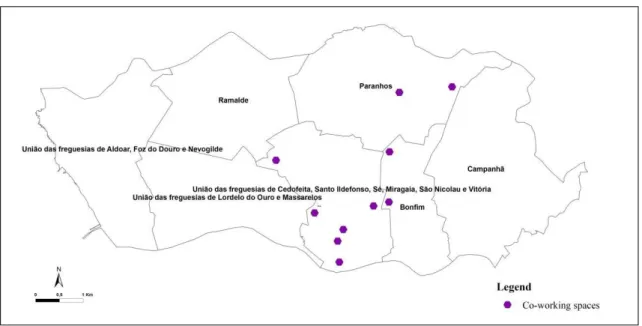
In January 2017, the city of Porto officially had 10 co-working spaces, presenting a relative concentration, since they were distributed only by 3 parishes of the city: Union of the Parishes of Cedofeita, Santo Ildefonso, Sé, Miragaia, São Nicolau and Vitória (6 spaces), Bonfim (2 spaces) and Paranhos (2 spaces). Of the 10 spaces, 6 were located in the central area (Figure 1).
7
Source: https://classic.mapme.com/scaleupporto/places/category/Start&Scale, page consulted on January 4th, 2017.
There are coworking spaces that exist with this and only this purpose and there are establishments that complement the main economic activity with the provision of coworking facilities (Cfr. Gandini, 2015). In line with scientific studies (confront with Bouncken & Reuschl, 2016, Gandini, 2015, and Spinuzzi, 2012), Porto co-working spaces are frequented by different types of entrepreneurs, from freelancers to micro-enterprises. In terms of conditions, and according to the evidence presented in other academic works, all these spaces provide individual work areas and collective work areas such as meeting rooms, laboratory spaces, in some cases, or exploitation of technologies in others, and areas of social interaction (glass, lounge area, bar, etc.). Internet and telephone service, electricity and water supply networks are the responsibility of the owners / managers of the spaces.
Porto I/O, Typographia-Cowork and Uptown Guest Office welcome co-workers from any professional area; the OPO'Lab is directed to creative activities (in the area of architecture, design and construction) with a strong application of innovative technologies; and the CRU - Cowork, hosting any type of activity, is directed mainly to creative activities, being located, for this reason, in the creative neighborhood of Miguel Bombarda, which allows them to be close to what they consider to be a strong creative ecosystem in the city, populated by art galleries and related industries.
The three spaces emerged from the personal and professional experience of their owners / managers. The OPO'Lab has emerged in 2009/2010 from another project and is associated with a company. It mainly receives micro-enterprises and some foreigners working remotely and traveling from place to place (digital nomads). The CRU - Cowork was created in 2012 and is associated with a collaborative store that sells clothing, accessories and jewelry from national designers. It welcomes freelancers and self-employed people. Like OPO'Lab they also receive many digital nomads, but their goal is to target Porto's creatives (namely at the level of prices charged and the conditions offered). The founder of Porto I/O was a co-worker and managed a co-working space in Barcelona. When he returned to Porto, he decided to open a similar space that would function as a community, facilitating business processes. Porto I/O has facilities in two
8
locations in city centre: the building at Rua Cândido dos Reis opened in October 2014 and in May 2016 opened the space near Ribeira. They welcome freelancers and people that work for national and international companies.
It is consensual among the three interviewees that the location is very important, being an intentional factor. They emphasize, first and foremost, the transformations that are occurring in the city, in general, and in its central area, in particular, which, being promising, contribute to the creation of an environment conducive to entrepreneurship, creativity and innovation. The location in central area is considered privileged for it favors access to a set of equipments and services that support their activity, as well as a greater proximity to a high concentration of people and, particularly, professionals who seek these spaces.
Considering their activities, the three spaces seek to organize workshops and events and establish collaborations that facilitate the exchange of experiences, to promote good practices and provide advice to the development of the business of their co-workers. Concerning the perception of the interviewees about the success of companies or professionals, there are some consensual ideas, namely the lack of institutional support for the creation, implementation and follow-up of the business plan and the low level of entrepreneurs' investment capacity, together with the lack of investment by other entities in their business. The founder of CRU - Cowork has no idea about success (or unsuccess) of the coworkers who share their space, as she does not always follow their development long enough to draw conclusions. Nonetheless, about those who sell products in the collaborative store she has the perception that the insuccess is high: about 50% to 60% of the entrepreneurs don’t survive. She believes that creatives have many gaps in skills to run businesses and that the small size of businesses is a factor that hampers growth. The Porto I/O community manager also ignores the success rate because, like the founder of CRU - Cowork, this initiative does not follow the businesses long enough. This ignorance is in no way connected with a strictly capitalist, profit-oriented logic. On the contrary, interviewees are concerned about the success and performance of their co-workers, developing relationships of true spirit of comradery towards them. Nevertheless, it should be noted that, among these spaces, OPO'Lab is part of a more capitalistic and profit-oriented trend. This co-working space was created to support the company of its owner, therefore co-workers are seen as potential collaborators of the company, for they
9
contribute to the development of company's products and services, while gaining experience and support from the company in the development of their own products and services. CRU-Cowork and Porto I / O are more in line with a tendency to transform capitalist practices in benefit of the professional autonomy and business growth of co-workers.
Networks are considered fundamental. In this sense, these initiatives seek to stimulate networking among co-workers and between co-workers and other partners. They encourage entrepreneurs to talk about their business with other professionals and to collaborate with each other. Informal networks and partnerships are particularly valued and considered to be much more effective than formal networks. Institutional partnerships generally present difficulties that the interviewees would like to overcome, declaring that they would appreciate more support from the local institutions. At this level, situations are diverse. The OPO'lab is the only one of the three that has an established partnership with the Porto City Council. The CRU - Cowork would like to have more effective support, namely in the promotion of these spaces. The responsible of Porto I/O states that the support would be welcome, however the initiative is self-sufficient, so in practice that support would not be a condition for success.
Conclusion
Since they emerged in 2005 in the USA, co-working spaces have spread throughout Europe, taking on a new business trend and collaborative work. This has also occur in Porto, although we do not have information to analyze its evolution over time. In January 2017, there were officially 10 co-working spaces in the city, which focused mainly on the central area. By analyzing the existing spaces in Porto, and taking into account their description of Internet pages, we can argue that co-working in Porto is directed to different areas of activity, from the most technological to the most creative, passing through situations of spaces that do not have a specific orientation and that welcome any professional. There are a set of conditions that are, in general terms, common to the different spaces: they have individual spaces of work, collective spaces and spaces of social interaction and interaction. By conducting three semi-structured interviews, we noticed that these spaces are associated with other activities, indicating that it is not yet possible to survive only from co-working in the city. The spaces analysed fit into a
10
scenario of economic development based on resilient communities (Kostakis and Bauwens, 2014). Of the three spaces, one is more profit-oriented while the other two show signs of strong concern about the performance, needs, and expectations of their coworkers, their professional autonomy and responsibility. Therefore, in these two cases we can perspective a DIY and DIT ethos (van Holm, 2017) of worker cooperation and self-organization, which might reaffirm worker rights beyond borders (Rolle, 2005b). With regard to associated activities, the three spaces seek to organize workshops and events and establish collaborations that contribute to the development of the skills and business of their co-workers. There is consensus among the three interviewees regarding the lack of institutional support for the creation, implementation and follow-up of the business plan. It is also stated that the reduced investment capacity of entrepreneurs is aggravated by the lack of investment by other entities in their businesses. Networks are considered to be key, particularly informal networks and collaborations being valued andconsidered to be much more effective and profitable than formal partnerships. All interviews consider that having more support from the city's institutions would be beneficial.
References
Boschma, R., & Frenken, K. (2006). Why is economic geography not an evolutionary science? Towards an evolutionary economic geography. Journal of Economic Geography, 6(3), 273-302. doi:10.1093/jeg/lbi022
Bouncken, R. B., & Reuschl, A. J. (2016). Coworking-spaces: how a phenomenon of the sharing economy builds a novel trend for the workplace and for entrepreneurship. Review of Managerial Science, 1-18. doi:10.1007/s11846-016-0215-y
Brown, J. (2017). Curating the “Third Place”? Coworking and the mediation of creativity. Geoforum, 82, 112-126. doi:10.1016/j.geoforum.2017.04.006
Cabral, V., & van Winden, W. (2016). Coworking: an analysis of coworking strategies for interaction and innovation. International Journal of Knowledge-Based Development, 7(4), 357-377.
Capdevila, I. (2015). How Can City Labs Enhance the Citizens’ Motivation in Different Types of Innovation Activities? In D. McFarland & L. M. Aiello (Eds.), 6th International Conference on Social Informatics, SocInfo 2014 (Vol. 8852, pp. 64-71): Springer Verlag.
11
Castel, R. (1998). La centralité du travail et cohesion sociale. In J. Kergoat, Jaques, Boutet, J., Jacot, H. E Linnhart, D. (Eds.),Le monde du travail. Paris: La Decouverte.
Ferreira, C., Sá Marques, T., & Guerra, P. (2015). Feiras e mercados no Porto: velhos e novos formatos de atividade económica e animação urbana. GOT – Revista de Geografia e Ordenamento do Território(8), 75-102.
Ferreira, C. M. F., Marques, T. S., & Guerra, P. (2016). Bottom-up Initiatives of Economic and Symbolic Innovation in Oporto City Centre. In T. d. Noronha & H. Pinto (Eds.), Innovation for resilience (pp. 149-168). Faro: University of Algarve.
Gandini, A. (2015). The rise of coworking spaces: A literature review. Ephemera: Theory & Politics in Organization, 15(1), 193-205.
Guerra, P. (2017). Just Can’t Go to Sleep. DIY cultures and alternative economies facing social theory. Portuguese Journal of Social Sciences, 16 (3), 283-303.
Hernández, J. L. S. (2017). Las prácticas económicas alternativas en perspectiva
geográfica (pp. 67). Retrieved from
http://saladeprensa.usal.es/filessp/Las_pr__cticas_econ__micas.pdf.
Kostakis, V., & Bauwens, M. (2014). Network Society and Future Scenarios for a Collaborative Economy (pp. 87). doi:10.1057/9781137406897.0001.
Lee, R., Leyshon, A., Aldridge, T., Tooke, J., Williams, C., & Thrift, N. (2004). Making geographies and histories? Constructing local circuits of value. Environment and Planning D: Society and Space, 22(4), 595-617. doi:10.1068/d50j.
Martins, L. S. (2004). Espaços de Lazer e de Turismo no Noroeste de Portugal. Porto: Edições Afrontamento.
Méndez, R. (2015a). Redes de colaboración y economia alternativa para la resiliencia urbana: una agenda de investigación. Biblio3W, XX(1.139), 24.
Méndez, R. (2015b). De la globalización capitalista al desarrollo territorial: por una geografía económica socialmente relevante. Scripta Nova. Revista Electrónica de Geografía y Ciencias Sociales. [En línea]. XIX(522(2)). Retrieved from http://www.ub.es/geocrit/sn/sn-522-2.pdf.
Rolle, P. (2005a). El trabajo y su medida. In B. Lahire, P. Saunier, M. Stroobants, M. Alaluf, & M. Postone (Ed.), Lo que el trabajo esconde. Materiales para un replanteamiento del análisis sobre el trabajo. Madrid:Traficantes de sueños.
Rolle, P. (2005b). Asir y utilizar la actividad humana. Cualidad del trabajo, cualificación y
competencia. In B. Lahire, P. Saunier, M. Stroobants, M. Alaluf, & M. Postone (Ed.), Lo que el trabajo esconde. Materiales para un replanteamiento del análisis sobre el trabajo. Madrid:Traficantes de sueños.
12
Spinuzzi, C. (2012). Working Alone Together: Coworking as Emergent Collaborative Activity. Journal of Business and Technical Communication, 26(4), 399-441. doi:10.1177/1050651912444070.
Van Holm, E. J. (2017). Makerspaces and Local Economic Development. Economic Development Quarterly, 31(2), 164-173. doi:10.1177/0891242417690604.
Weber, M. (1944). Economia y Sociedad. (1st edition 1922). México: Fondo de Cultura Económica.
Winden, W. v., & Carvalho, L. (2015). New Urban Economies: Challenges Ahead. In URBACT (Ed.), New Urban Economies: How can cities foster economic development and develop 'new urban economies' (pp. 51-53). Saint-Denis: URBACT.