1
From social representations to action:
Proximity and the relation between social representations of the development of intelligence and authoritative parenting
Isabel Miguel*, Joaquim P. Valentim** & Felice Carugati***
* Institute of Cognitive Psychology, Human and Social Development of the Faculty of Psychology and Educational Sciences, University of Coimbra (Portugal) & Portucalense University UPT – Oporto Global University (Portugal)
Financial support from Portuguese Foundation for Science and Technology provided through fellowship SFRH/BD/28432/2006 is gratefully acknowledged.
E-mail (corresponding author): [email protected]
** Faculty of Psychology and Educational Sciences, University of Coimbra (Portugal). E-mail: [email protected]
*** Department of Education, Alma Mater Studiorum, University of Bologna (Italy).
Financial support from the Italian Ministry of Education and Research (2007- prot. 2007NW4NR9-002) is gratefully acknowledged.
2
From social representations to action:
Proximity and the relation between social representations of the
development of intelligence and authoritative parenting
3
ABSTRACT
A well-established body of literature (Carugati, 2013; Carugati, Emiliani, & Molinari, 1989; Carugati & Selleri, 2004; 2011, 2014; Carugati, Selleri, & Scappini, 1994; Miguel, Valentim, & Carugati, 2012; Mugny & Carugati, 1985; Selleri & Carugati, 2013) holds that the construction of social representations of intelligence is guided by the subjective inexplicability about the target-topic and by the social identities of subjects. Within the general framework of the sociogenesis of social representations, this article aims to explore the role of social positions in organizing individual’s reported action towards the object of representation. A theoretical model which examines the relations between social representations of the development of intelligence, parental goals and the authoritative parenting style was tested in sub-samples of educators, which included 227 mothers, 117 fathers and 122 mother-teachers. Structural equation modeling procedures indicated, as hypothesized, that specific socio-cognitive dynamics are relevant in shaping the patterns of relations with the object of representation, suggesting that these dynamics are a result of the organization of multiple discourses where content, social positions and behavioral interaction are strongly intertwined. Theoretical contributions of findings are discussed.
4
INTRODUCTION
Research on social representations of intelligence and its development has consistently shown that the socio-cognitive dynamics in the origin of these social representations sustain different patterns of discourse, which are reconstructed from the specific points of view of concrete categories of people who have significant relations with the topic (Amaral, 1997; Amaral, Peixoto, & Carugati, 2010; Carugati et al., 1989; Carugati et al., 1994; Miguel, Valentim, & Carugati, 2010, 2012; Poeschl, 1998, 2001; Snellman & Raty, 1995). Two complementary sources of socio-cognitive dynamics – inexplicability of a salient issue and conflict of identities – are therefore at stake, enabling representations to fulfill their twofold function, i.e. to make sense of the individuals’ social world and to protect their positive social identity (Carugati & Selleri, 2014; Mugny & Carugati, 1985). Social representations of intelligence, in particular, are built and strung together into complex and logical networks according to the individuals’ social positions and identities, leading to the development of significant socio-cognitive organizations of different levels of symbolic productions. Indeed, as Carugati and Selleri (2011) hold, “social positions and social identities are candidates for playing a prominent role in the sociogenesis and socialization of social representations, at least when the topic is intelligence” (p. 11).
Personal involvement, conceived as a subjective and socially determined frame of reference that corresponds to an individual’s relationship to a social object (Gruev-Vintila & Rouquette, 2007), has been suggested to explain how the activation of social dynamics linked to the varying degrees of proximity that the social object implies is found to modify the formation and structure of a representation. In fact, distance to the object of representation is defined by specific practices, knowledge level and personal
5
implication towards the object of representation (Abric, 2001a; Lo Monaco & Guimelli, 2008; Salesses, 2005). Concerning intelligence and its development, it is, therefore, in the experienced daily situations that mothers experience a specific socio-cognitive condition, having to negotiate different roles (as mothers, as professionals, as teachers) and, consequently, possibly conflicting behaviors, decisions, demands and contradictory answers. In the same vein, specific dynamics, activated by symbolic social positions and by their double educational responsibility, also determine mother-teachers’ different selection and organization of knowledge, allowing conflicting and contradictory elements to be solved (Molinari & Emiliani, 1993). However, in a different manner, deriving from the dominant cultural models, the supposed smaller social implication of fathers in educational issues relating to children shapes a particularly distinct socio-cognitive condition from that experienced by mothers and mother-teachers, consequently not arising the same kind of demands or conflicts.
Within the theoretical framework of social representations theory, it has long been advocated that social representations are guides for action, which direct behaviors and social relations (Abric, 1997b, 2001b; Carugati, 1990; Jodelet, 1989a, 1989b; Moscovici, 1961; Mugny & Carugati, 1985). In the specific case of intelligence, it is surely not unreasonable to assume, as it has been suggested (Carugati & Selleri, 2011; Miguel, Valentim, & Carugati, 2009a; Mugny & Carugati, 1985), that educators’ ideas about intelligence and its development will have a major influence on their interventions with children. On the other hand, parents’ ideas and parenting goals are cited as pivotal in determining parenting behavior (Belsky & Jaffe, 2006; Goodnow & Collins, 1990; Grusec, 2008; Hastings & Grusec, 1998; Hirsjärvi & Perälä-Littunen,
6
2001; Kuczynski, 1984; McGillicuddy-De Lisi, 1982; Miguel et al., 2009a; Okagaki & Bingham, 2005).
Bearing on the assumptions that parental behavior may, therefore, be influenced both by parental goals and specific social representations concerning children’s development of intelligence, a theoretical model has been formulated (Miguel, Valentim, & Carugati, 2013) which establishes the following relations: 1) social representations of the development of intelligence influence parenting styles, 2) values that parents desire for their children influence the parenting styles they adopt, 3) social representations of the development of intelligence influence values that parents desire for their children and 4) desired values for children mediate the relationship between social representations of the development of intelligence and parenting styles. Overall, results suggested that social representations of the development of intelligence and desired values for children tend to build up a potentially significant organization for parental activities, as they are not without behavioral effects. For example, representational dimensions which emphasize the role of parents and the importance of constant accompaniment of children for the development of their intelligence were related to reported authoritative parenting style, while dimensions which outline the role of school and teachers related to reported authoritarian and permissive parenting styles. However, although parents’ ideas are shown to permeate parents’ action (see Miguel et al., 2009a), research has still much to go deep in the search for specific dynamics which permeate parental actions.
As for the content of representations concerning intelligence and its development, literature has strongly emphasized the hypothesis of proximity to the object as influencing individuals’ ideas and theories (Amaral, 1997; Carugati et al.,
7
1989; Miguel et al., 2012; Molinari & Emiliani, 1993; Mugny & Carugati, 1985). In fact, studies have shown how symbolic stands of position influence discourses about specific social objects. In the same vein, it might be reasonable to assume that, besides from specific representational contents, the patterns of relations between representations and daily practices are also themselves shaped by the specific situation of individuals that, on the one hand, have a functional necessity for a given object of representation and, on the other hand, to whom that topic activates some identity problems and implies decision making. In fact, some definitions of social practices put in evidence that they are action systems or behaviors that need to be considered in association with their impregnation in the social, as social practices are socially influenced and anchored (Flament, 2001). Furthermore, a view where action is part and parcel of a social representation has been emphasized, stressing that thinking and acting in social contexts cannot be distinguished on logical grounds (Wagner, 1993, in press): representations exist in action as well as in belief and discourse, they endow behavior with meaning, their holomorphic character allow concerted interaction, anticipation of other's actions and the constitution of meaning. Action is, therefore, an extension of representations and lies at the bottom of the world’s meaningful co-construction.
Hence, it is the main goal of the present study to establish a comparative analysis of a theoretical model between different subsamples differing on their degree of proximity to the object of representation, in order to achieve a better understanding of how specific socio-cognitive conditions also influence reported individual action. Therefore, the present study extends on previous work (Miguel et al., 2013), by testing the proposed model of relations through a re-analysis of data in different sub-samples, aiming to go more deeply in the search for the dynamics which regulate the relations
8
between representations and reported action. The choice of exploring sub-samples is, therefore, guided by the theoretical framework established in literature about the role of social positions and social identities in molding people’s symbolic products (e.g., Miguel et al., 2012; Mugny & Carugati, 1985; Poeschl, 2001; Selleri & Carugati, 2013). Differences found would suggest the need for further research on these variations as a basis for understanding the role of parental category and social context in parenting and child development. On the other hand, the choice of exploring the authoritative parenting style is twofold: among the three parenting styles assessed – authoritative, authoritarian and permissive (Robinson, Mandleco, Olsen, & Hart, 2001) – previous research has evidenced the authoritative pattern as presenting the highest level of explained variance in the analyses (Miguel et al., 2013); furthermore, in reviewing the literature on parenting styles, one is struck by the consistency with which authoritative upbringing is pointed as the most advantageous and the one that best promotes children’s balanced development, namely promoting both instrumental and social competences and lowering levels of problem behavior (Baumrind, 1971; Clémence, 2007; Clémence et al., 2005; Demo & Cox, 2000; Milevsky, Schlechter, Netter, & Keehn, 2007; Schucksmith, Hendry, & Glendinning, 1995; Steinberg, 2001; Williams et al., 2009). For these reasons, the authoritative parenting style was selected for the present study.
Hypotheses
The following hypothesis is suggested: the pattern of relations between social representation of the development of intelligence, parental values and the reported authoritative parenting style varies according to participants’ symbolic social position
9
(Hypothesis 1). More specifically, regarding the supposed high level of mothers’ implication and social responsibility in their children’s education, it is expectable that these participants show more complex patterns of relations between their representations, parental goals and reported parenting behavior (Hypothesis 1a). In turn, due to their lower personal and social implication, fathers will display straightforward patterns (Hypothesis 1b). Finally, due to the identity conflict activated by their double educational role, mother-teachers will display straightforward patterns (Hypothesis 1c).
METHOD
Sample
This study involved 466 Portuguese participants with different socio-educational positions: 117 fathers, 227 mothers, 122 mother-teachers. Considering the whole sample, 117 participants were men (25%) and 349 were women (75%), ranging from 24 to 69 years old. Fathers presented a mean age of 40.39 (SD = 5.76; ages between 25 and 69 years old), mothers a mean of 39.19 (SD = 5.60; ages between 24 and 60) and mother-teachers a mean of 41.89 (SD = 6.41; ages entre 29 e 60).
Measures
The main goal of the research is to extend on previous work and deepen the study on how different social positions display different patterns of links between representations of intelligence and reported parental behavior, by means of a re-analysis of data across different sub-samples. Since extensive detailing of measures has already been presented (Miguel et al., 2012), only short descriptions are presented next.
10 Development of intelligence
Participants rated each of the 31 items for their extent of agreement or disagreement on a 7-point scale (1 = totally disagree, 7 = totally agree). A variety of themes formerly identified in literature or found in previous research findings were evaluated (Amaral, 1997; Constans & Leonardis, 2003; Faria & Fontaine, 1993; Matteucci, 2007; Miguel, Valentim, & Carugati, 2008; Miguel et al., 2010; Mugny & Carugati, 1985; 1998, 2001; Sternberg, 2004). Three main factors were yielded (Miguel et al., 2012): parents’ role for the development of intelligence, emphasizing the provision of affective equilibrium and the setting of disciplinary practices (e.g., “the quality of affective relations between parents and children influences the development of intelligence”, “without rules and discipline, the development of intelligence is compromised”); stimuli and incentives, alluring to incentives and external motivational strategies aimed at promoting intellectual development (e.g., “for the child to make progress, she has to be presented with challenges that stimulate her intellectually”, “for the child to progress intellectually, it is essential to stimulate the development of reading habits”); and school, teachers and molding, which present severity and pressure on children as major factors for their intellectual development (e.g., “teachers’ competence is the best assurance of the child’s development of intelligence”, “it is by contradicting the child when she is wrong that the development of intelligence is promoted”).
Parenting styles
The modified version of the Parenting Styles and Dimensions Questionnaire – Short Form (PSDQ; Robinson et al., 2001) was used in its Portuguese version.
11
Participants independently rated themselves on each item by assessing ‘‘how often they perceived themselves exhibiting parenting behaviors reflected in each item’’, using a 5-point scale anchored by 1 (never) and 5 (always). As extensively described earlier (Miguel, Valentim, & Carugati, 2009b), the questionnaire included 32 items, which summed to form three patterns of parenting – authoritative (e.g., “I am responsive to my child’s feelings and needs”, “I give my child reasons why rules should be obeyed”, “I show respect for my child’s opinions by encouraging my child to express them”), authoritarian (e.g., “I use physical punishment as a way of disciplining my child”, “I yell or shout when my child misbehaves”, “I use threats as punishment with little or no justification”) and permissive (“e.g., “I find it difficult to discipline my child”, “I state punishments to my child and do not actually do them”).
Parental values
Parental Values Scale (Castro, 1997) was completed using a 5-point scale (1 = not important; 5 = very important). Participants were asked to rate how important it was for them that their child would display six different characteristics when older adults: independent, creative, with self-made ideas, obedient, respectful of the elderly and good parents/spouses. As previously detailed (Miguel et al., 2013), the good fit index provided by the confirmatory factor analysis (CFA) unfolds the underlying two-factor solution: self-direction values and conformity values.
RESULTS
A structural model was tested with EQS software for each subsample. Following Byrne’s (2006)suggestion, a multivariate test of statistical significance (Wald-Test) was
12
implemented to identify non-significant parameters to be dropped from the model without its degradation fit. Respecified and more restrictive models were then estimated for each subsample, which led to the definition of the final models and the estimation of its goodness-of-fit statistics.
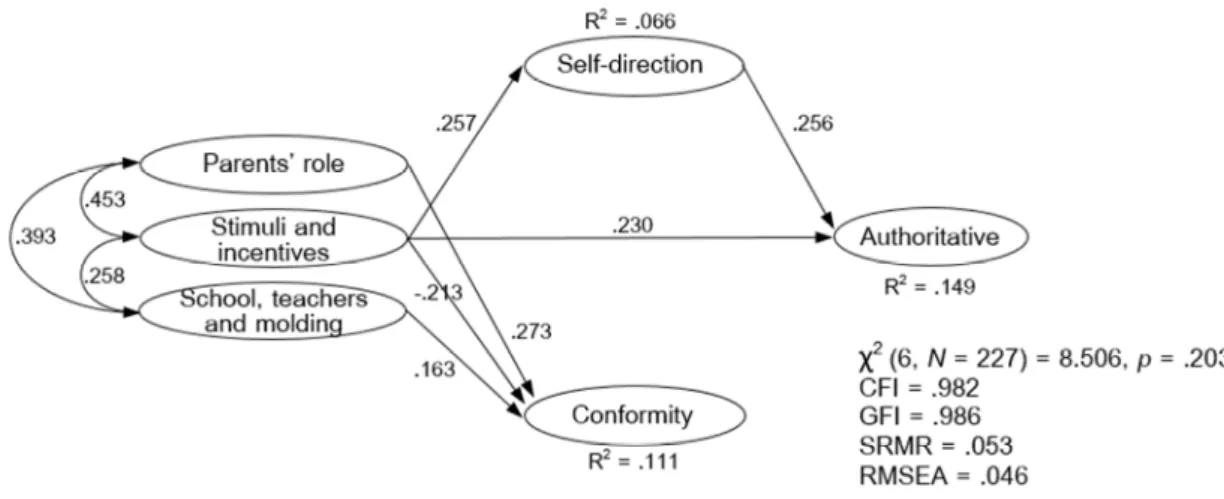
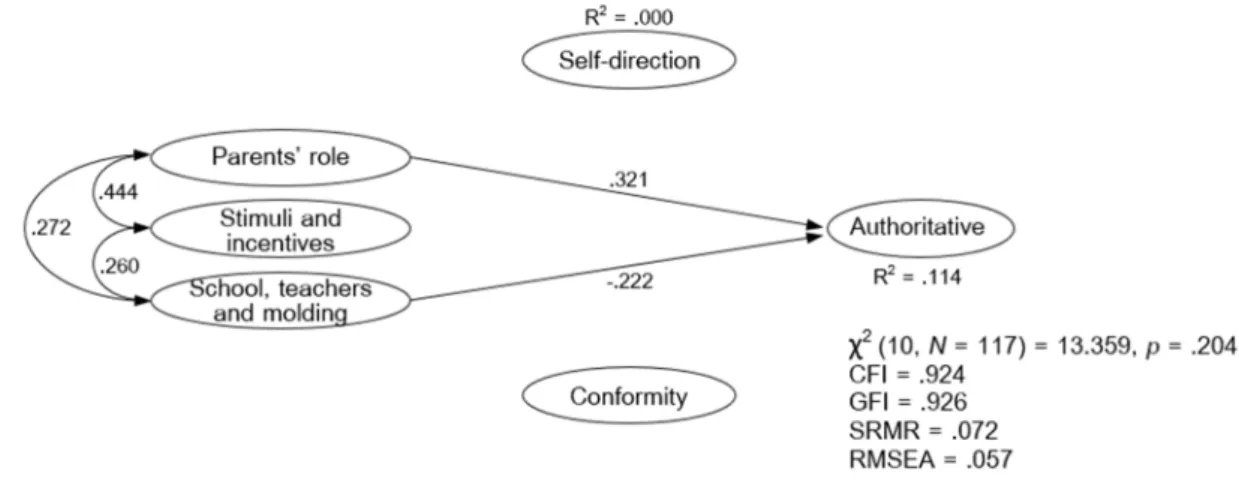
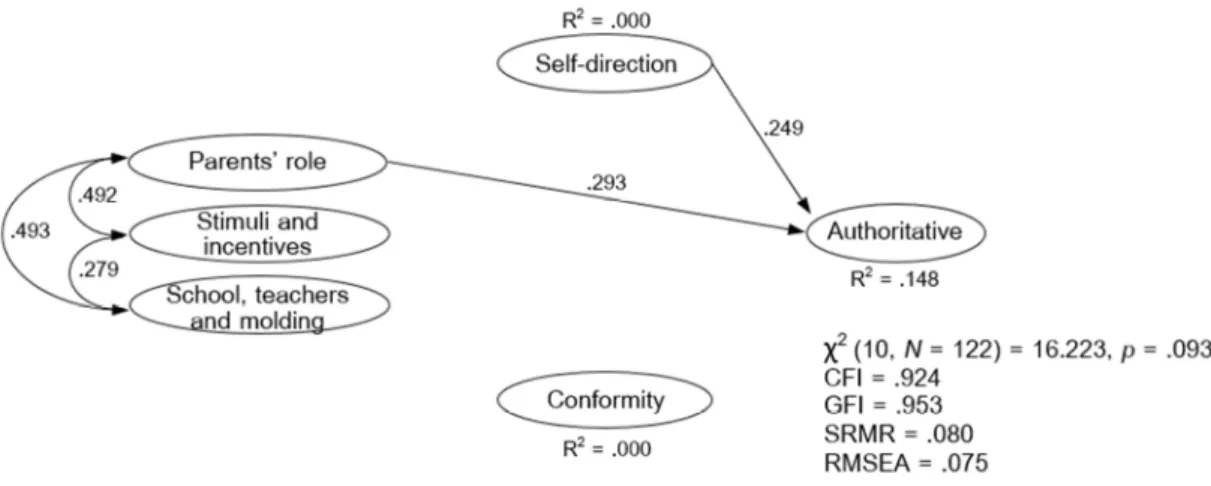
Concerning mothers, fit indices showed excellent fit: CFI = .981; GFI = .986; SRMR = .053 and RMSEA = .046 (Figure 1). The same for the model considering fathers: CFI = .924, GFI = .926, SRMR = .072 and RMSEA = .057 (Figure 2). Also the model considering mother-teachers displayed very good fit: CFI = .924, GFI =.953, SRMR = .080 and RMSEA = .075 (Figure 3). Standardized parameter estimates are shown in the figures.
[Figure 1 about here] [Figure 2 about here] [Figure 3 about here]
Concerning mothers, the authoritative parenting style is associated to the importance assigned to stimuli and incentives – defined by a set of items that refers the need to challenge children and to provide them constant stimuli and incentives – for the development of children’s intelligence (Figure 1). In fathers’ and mother-teachers’ case, it is the emphasis on parents’ role, defined in a more general sense and reporting to more structuring characteristics – e.g., establishing a good communication with the child, setting discipline rules and monitoring behavioral patterns – which seems to relate to the adoption of the authoritative parenting style (Figure 2 and Figure 3). Also in fathers’ case, the importance of school, teachers and molding for children’s
13
development of intelligence is a negative predictor of the authoritative parenting style (Figure 2).
Self-direction values desired for children also seem to be a good predictor of the authoritative parenting style reported by mothers and mother-teachers (Figure 1 and Figure 2). However, this is not the case for fathers, whose results do not show any relationship between desired values for children and the authoritative parenting style. The mediational role of self-direction values desired for children is, nevertheless, only observed for mothers (Figure 1). Results of the mediation analysis, performed throughout the bootstrapping method, provided a 95% confidence interval of the indirect effect which confirms the mediating role of self-direction values desired for children in the relation between stimuli and incentives and the authoritative parenting style (B = .04; CI = .02 to .08).
DISCUSSION
Due to its social value, the topic of intelligence development is a particularly pressing issue for those people who – like mothers, fathers and mother-teachers – have to make daily decisions of how to interact with their children and explain intriguing and puzzling issues such as the interindividual differences of intelligence between them. The choice for different sub-samples of participants was, therefore, guided by the theoretical framework that individuals have different roles in the social arena, which are activated by the specific social positions they hold in social systems, lending them different degrees of proximity to the object of representation. Results provide overall support to this hypothesis.
14
More specifically, Hypothesis 1a is empirically supported, as mothers seemed to show more complex patterns of relations between variables, as compared to other participants. The authoritative parenting style reported by mothers seems to be not only influenced by their social representations of the development of intelligence, but also by the self-direction values desired for their children. Given the dominant cultural models which lend mothers a higher level of involvement, proximity and supposed direct responsibility in their children’s education, mothers seem to maintain an intense interaction with them and develop a deeper knowledge about what parenting practices or styles work best in which type of situations. Mothers’ behavior may, thus, be guided by the specific knowledge about their children, not necessarily reflecting their representations about children in general. On the other hand, their strong educational implication carries the need to manage several daily situations and to adapt their behavior according to the specific contextual demands. The response to these different scenarios is, therefore, given through the articulation of a set of complex dynamics, in which “negotiations” between representations, educational goals and parenting style are continuously attuned.
Fathers seem to evidence somewhat straightforward models of relations between social representations of the development of intelligence, desired values for children and the authoritative parenting style, lending empirical support to Hypothesis 1b. Although also involved in educational matters, fathers supposedly develop a less intimate knowledge of their children’s behavioral specificities. In this sense, their representations and general knowledge about intelligence and its development might guide, in a more straightforward sense, the behavioral patterns and parenting style they report having with their children.
15
The different role and supposed levels of involvement of fathers and mothers seem to be expressed in the patterns of relations between representations, desired values for children and the authoritative parenting style. While for mothers the representation that the development of intelligence is prompted by constant and daily stimuli and incentives influences the authoritative parenting style, for fathers this parenting pattern is influenced by the importance assigned to parents’ role in a more general and structuring sense. Therefore, while mothers’ authoritative behavior seems to be triggered by their emotional involvement with the child and the need to provide constant care, fathers’ authoritative behavior seems to be more associated to the establishment of discipline rules and the negotiation of children’s behavioral conducts. In this sense, fathers seem to explicitly assume a less interventional role, possibly passing on to mothers tasks which relate to children’s constant accompaniment and stimulation.
In mother-teachers’ case, parents’ role was also a significant predictor of the authoritative parenting style. Both the family and the institutional world of school as a thinking environment which molds general ideas comprise a different context in which mother-teachers are embedded and which differentiates them from the remaining categories of participants, revealing the importance of the social dynamics involved in their double role as mothers and as teachers. These patterns may, therefore, be interpreted as the product of their conflict activated by two kinds of relationships (mother-child and teacher-pupil), a conflict which seems to gain expression in relatively less complex and more straightforward models of relations between social representations of the development of intelligence, desired values for children and the authoritative parenting style. Empirical support is found to Hypothesis 1c.
16
The main contributions of the present study should be outlined. First, results call upon a long due focus of concern on the study of social representations: the relation between social representations and the social practices towards the object of representation (Abric, 1997b; Jodelet, 1989a; Moscovici, 1961). According to Abric (1997a), social representations are taken as systems of expectations for individuals to predict the evolution of situations in relation to a specific social objet. It therefore allows individuals, as members of social groups, to a priori define the most appropriate option for their implementation practices. Indeed, social representations inform individuals what to expect from other group members and how to behave in social interactions, they make social life predictable and understandable, they offer bits and pieces of meaning on the basis of which individuals make up their own minds and take a stand on important social issues. However, the full understanding of the process by which a socially constructed representation is transcribed into individual action needs further development. Thus, the understanding of the processes which enable the implementation of social representations at the individual level and their role in the relationship between social representations and social practices would, in our view, guarantee greater precision in the analysis of the orientation function given to social representations (Abric, 1997b), especially considering an alternative perspective where the representations’ holomorphic character is considered and where behaviour and belief are taken as integral to representations and not something that can be conceptualized separately (Wagner, 1993, in press). The present paper may, therefore, provide a contribution towards this path of analysis.
Second, taken as a whole, results of the present study suggest that educational actions of the several social actors may be better explained if interpreted as the
17
expression a common sense reservoir, differently accessed and used according to specific social insertions. In fact, mothers, fathers and mother-teachers hold different social positions, in which the balance between the need to maintain a positive self-image and the sense of responsibility draw a mechanism for selecting and regulating educational dynamics. The more or less personal implication is induced by the implementation of an evaluative mechanism on the self-object relation, which in turn determines the intensity level of the adopted practices based on the personal investment it requires. Thus, results outline the crucial role of parental category, characterized by
differing levels of proximity and personal involvement, in the kind of relationship established with the object of representation, suggesting that these dynamics are a result of the organization of multiple discourses where content, people concerned and their social positions are strongly interrelated. The essential role of proximity and personal involvement in the internal organization of representational contents has been previously demonstrated (Guimelli & Abric, 2007; Miguel et al., 2012). However, the results of the present study provide an empirical illustration of group members coming to terms with challenges specific to their way of seeing the world, and offer the possibility of extending the argument of proximity and personal involvement into the study of how action is undertaken, from the standpoint of specific social groups and positions. Indeed, results suggest that the degree of individual proximity seems to be at the origin of different types of action, as individuals mobilize different actions towards objects to which they are more or less implied. The mobilizing role of personal involvement as a major explanatory variable of social thinking (Vintila, 2012) and action is, therefore, underlined, as the implementation of action requires that individuals be at least minimally mobilized by the object, providing more or less personal
18
engagement depending on the continuum ranging from very low to very strong involvement (Lheureux, Lo Monaco, & Guimelli 2011). Attention is also called upon the fact that people represent social objects in and through action (Wagner, in press).
As symbolic structures that embody and define the experience of reality, social representations support existing institutionalized relationships, in an ideological framework which serves to maintain relations of power in the social order and defend particular identities (Howarth, 2006). Therefore, a third contribution of the present study is to emphasize the importance of positional and ideological dynamics (Doise, 1982, 2011) in the construction of social reality. Besides from showing the importance of identities and of particular interests in modulating the relation between representations and practices, results seem to come across dominant cultural models and mirror normative family practices, which link women to the family context, assigning them a more important role in family management and in issues relating to children (Múrias & Ribeiro, 2012; Poeschl, 2000). Social representations have been proposed to be taken as a general theory about a meta-system of social regulations intervening in the system of cognitive functioning (Doise, 1993). During the past few decades, claims have been made for a more social social psychology, which could stand for a movement towards a more societal view of social psychology (Doise, 2011; Himmelweit & Gaskell, 1990; Valentim, 2011b). This movement should be aimed at challenging the individualized and universalist models of human thought and behavior, hereby focusing on the central role of social-historical frameworks and meaning systems of the societies and analyzing the social contexts and ideological functions of psychological processes (Doise, 2002; Himmelweit & Gaskell, 1990; Valentim, 2011a, 2013). Societal psychology concerns the study of the constructions of collective meaning systems
19
which regulate social relations, by investigating the links between individual cognitive functioning and the normative factors – the meta-system – that direct the way people think, act and interact in society. As social representations organize social relationships by providing normative reference knowledge which make up the symbolic environment of citizens, societal psychology inspired by social representations approach offers therefore a different perspective on shared knowledge. It does not imply that all members of a group would consensually endorse the same norms and values, but rather accounts for debate and conflict occurring around shared knowledge. Two broad criteria derived from a social representational approach seem essential for a societal psychology (Staerklé, 2011). The first one emphasizes the normative determinants of human thought and behavior, which should be analyzed and understood in relation to collective meaning systems. The second criterion takes into account the social, institutional and historical contextualization of psychological processes in social contexts and highlights the dynamic and changing nature of representations. A societal psychology would hereby necessarily articulate different levels of analysis (Doise, 2011), particularly concerning the complex relationships between shared ideological beliefs, group memberships and individual thought and action (Staerklé, 2011). For doing this – the integration of different levels of analysis – the theory of social representations presents itself as a unique, privileged and “grand” theoretical tool, useful for the construction of social psychology as an anthropology of modern culture and society (Moscovici, 1981; Valentim, 2013). However, for this to be accomplished, research on social representations needs to overcome two major obstacles it has been presented with (Valentim, 2013). The first one is to overcome the excessive lightness and the lack of theoretical and methodological robustness which sometimes has also been a trademark
20
of studies in this field. The second challenge is to invest in the theoretical potentialities and the specific characteristics of the theory of social representation. We hope that approaching the study of the relation between social representations and practices by means on the concepts of proximity and personal involvement – as has been the main purpose of the present study – may provide a modest but solid contribution, both theoretical and methodological, towards a deepening of studies on social representations.
21
References
Abric, J.-C. (1997a). Les représentations sociales: Aspects théoriques. In J.-C. Abric (Ed.), Pratiques sociales et représentations (2nd ed., pp. 11-36). Paris: Presses Universitaires de France.
Abric, J.-C. (1997b). Pratiques sociales, représentations sociales. In J.-C. Abric (Ed.), Pratiques sociales et représentations (2nd ed., pp. 217-238). Paris: Presses Universitaires de France.
Abric, J.-C. (2001a). L'approche structurale des représentations sociales: Développements récents. Psychologie et Société, 4(2), 81-104.
Abric, J.-C. (2001b). A structural approach to social representations. In K. Deaux & G. Philogène (Eds.), Representations of the social: Bridging theoretical traditions (pp. 42-47). Oxford: Blackwell.
Amaral, V. (1997). Níveis de análise da ancoragem das representações sociais da inteligência e do seu desenvolvimento: Das posições sociais objectivas às identidades sociais. Análise Psicológica, 15(2), 305-317.
Amaral, V., Peixoto, F., & Carugati, F. (2010). Representações sociais da inteligência: Estrutura e efeitos de algumas variáveis sociocognitivas. Psychologica, 52(1), 5-18.
Baumrind, D. (1971). Current patterns of parental authority. Developmental Psychology Monograph, 4(1), 1-103. doi: 10.1037/h0030372
Belsky, J., & Jaffe, S. (2006). The multiple determinants of parenting. In D. Cichetti & D. A. Cohen (Eds.), Developmental psychopathology (2nd ed., Vol. 3: Risk, disorder and adaptation, pp. 38-85). New York, NY: Wiley.
Byrne, B. M. (2006). Structural equation modeling with EQS: Basic concepts, applications and programming (2nd ed.). Mahwah, NJ: Lawrence Erlbaum Associates.
Carugati, F. (1990). From social cognition to social representations in the study of intelligence. In G. Duveen & B. Lloyd (Eds.), Social representations and the development of knowledge (pp. 126-143). Cambridge: Cambridge University Press.
Carugati, F. (2013). Commentary: Crossing boundaries between everyday and research contexts: Extending the conversation. In G. Marsico, K. Komatsu & A. Iannaccone (Eds.), Crossing boundaries: Intercontextual dynamics between family and school (pp. 171-185). Charlotte, NC: Information Age Publishing. Carugati, F., Emiliani, F., & Molinari, L. (1989). Being a mother is not enough:
Theories and images in social representations of childhood. Revue Internationale de Psychologie Sociale, 3(3), 289-306.
Carugati, F., & Selleri, P. (2004). Intelligence, educational practices and school reform: Organisations change, representations persist. European Journal of School Psychology, 2, 149-167.
Carugati, F., & Selleri, P. (2011). Once upon a time... The case of social representations of intelligence. Papers on Social Representations, 20, 33.31-33.15.
Carugati, F., & Selleri, P. (2014). Social development and the development of social representations: Two sides of the same coin? In A. Antonietti, E. Confalonieri &
22
A. Marchetti (Eds.), Reflective thinking in educational settings: A cultural framework (pp. 15-54). Cambridge: Cambridge University Press.
Carugati, F., Selleri, P., & Scappini, E. (1994). Are social representations an architecture of cognitions? A tentative model for extending the dialog. Papers on Social Representations, 3(2), 134-151.
Clémence, A. (2007). Les modèles d’éducation parentaux. Psychoscope, 28(4), 16-18. Clémence, A., Kaiser, C.-A., Modak, M., Nicolet, M., Zittoun, T., Biétry, V., &
Gex-Collet, D. (2005). Les modèles de l'exercice de l'autorité dans la famille et dans l'école. In Collectif (Ed.), Eloge de l'altérité. Défis de société: 12 regards sur la santé, la famille et le travail (pp. 165-175). Grolley: Les Éditions de l'Hèbe. Constans, S., & Leonardis, M. (2003). Co-construction of the representations of
intelligence between mother and daughter: Developmental and differential approaches. European Journal of Psychology of Education, 18(4), 369-387. doi: 10.1007/BF03173242
Demo, D. H., & Cox, M. J. (2000). Families with young children: A review of research in the 1990s. Journal of Marriage and the Family, 62, 867-895. doi: 10.1111/j.1741-3737.2000.00876.x
Doise, W. (1982). L’explication en psychologie sociale. Paris: Presse Universitaire de France.
Doise, W. (1993). Debating social representations. In G. M. Breakwell & D. V. Canter (Eds.), Empirical approaches to social representations (pp. 157-170). Oxford: Clarendon.
Doise, W. (2002). Da psicologia social à psicologia societal. Psicologia: Teoria e Pesquisa, 18(1), 27-35. doi: 10.1590/S0102-37722002000100004
Doise, W. (2011). The homecoming of society in social psychology. In J. P. Valentim (Ed.), Societal approaches in social psychology (pp. 9-34). Berne: Peter Lang. Faria, L., & Fontaine, A. M. (1993). Representações dos professores sobre a natureza e
desenvolvimento da inteligência. Revista Portuguesa de Pedagogia, 3, 471–487. Flament, C. (2001). Pratiques sociales et dynamiques des représentations. In P. Moliner (Ed.), La dynamique des représentations sociales (pp. 43-58). Grenoble, France: Presses Universitaires de Grenoble.
Goodnow, J. J., & Collins, W. A. (1990). Development according to parents: The nature, sources and consequences of parents' ideas. Hove: Lawrence Erlbaum Associates Ltd.
Gruev-Vintila, A., & Rouquette, M. L. (2007). Social thinking about collective risk: How do risk-related practice and personal involvement impact its social representations? Journal of Risk Research, 10(4), 555-581. doi: 10.1080/13669870701338064
Grusec, J. E. (2008). Parents’ attitudes and beliefs: Their impact on children’s development. In R. E. Tremblay, M. Boivin & R. D. Peters (Eds.), Encyclopedia on early childhood development [online] (pp. 1-5). Montreal, Quebec: Centre of Excellence for Early Childhood Development and Strategic Knowledge Cluster on Early Child Development.
Guimelli , C., & Abric, J.-C. (2007). La représentation sociale de la mondialisation : Rôle de l’implication dans l’organisation des contenus représentationnels et des jugements évaluatifs. Bulletin de Psychologie, 487, 49-58. doi: 10.3917/bupsy.487.0049
23
Hastings, P. D., & Grusec, J. E. (1998). Parenting goals as organizers of responses to parent- child disagreement. Developmental Psychology, 34(3), 465-479. doi: 10.1037/0012-1649.34.3.465
Himmelweit, H. T., & Gaskell, G. (1990). Societal psychology. New York: Sage. Hirsjärvi, S., & Perälä-Littunen, S. (2001). Parental beliefs and their role in
child-rearing. European Journal of Psychology of Education, 16(1), 87-116. doi: 10.1007/BF03172996
Howarth, C. (2006). A social representations is not a quiet thing: Exploring the critical potential of social representations theory. British Journal of Social Psychology, 45, 65-86. doi: 10.1348/014466605X43777
Jodelet, D. (1989a). Folies et représentations sociales. Paris: PUF.
Jodelet, D. (1989b). Représentations sociales: Un domaine en expansion. In D. Jodelet (Ed.), Les représentations sociales (pp. 30-62). Paris: Presses Universitaires de France.
Kuczynski, L. (1984). Socialization goals and mother-child interaction: Strategies for long-term and short-term compliance. Developmental Psychology, 20(6), 1061-1073. doi: 10.1037/0012-1649.20.6.1061
Lheureux, F., Lo Monaco, G., & Guimelli , C. (2011). Entre représentations sociales et intentions de pratiques: L’implication. Revista Interamericana de Psicología, 45(1), 59-74.
Lo Monaco, G., & Guimelli, C. (2008). Représentations sociales, pratique de consommation et niveau de connaissance: Le cas du vin. Les Cahiers Internationaux de Psychologie Sociale, 78, 35-50. doi: 10.3917/cips.078.0035 Matteucci, M. C. (2007). Teachers facing the school failure: The social valorization of
effort in the school context. Social Psychology of Education, 10, 29-53. doi: 10.1007/s11218-006-9011-x
McGillicuddy-De Lisi, A. V. (1982). The relationship between parents' beliefs about development and family constellation, socioeconomic status and parents' teaching strategies. In L. M. Laosa & I. E. Sigel (Eds.), Families as learning environments for children (pp. 261-299). New York: Plenum Press.
Miguel, I., Valentim, J. P., & Carugati, F. (2008). Representações sociais da inteligência e práticas educativas: Apresentação de uma investigação em curso. In A. Caetano, M. Garrido, S. Batel & A. M. Martins (Eds.), Percursos da investigação em psicologia social e organizacional (Vol. III, pp. 301-318). Lisboa: Edições Colibri.
Miguel, I., Valentim, J. P., & Carugati, F. (2009a). Parental ideas and their role in childrearing: The idea-behavior connection. Italian Journal of Sociology of Education, 3, 225-253.
Miguel, I., Valentim, J. P., & Carugati, F. (2009b). Questionário de Estilos e Dimensões Parentais – Versão Reduzida: Adaptação portuguesa do Parenting Styles and Dimensions Questionnaire – Short Form. Psychologica, 51, 169-188.
Miguel, I., Valentim, J. P., & Carugati, F. (2010). Intelligence and its development: Social representations and social identities. Papers on Social Representations, 19, 20.21-20.33.
Miguel, I., Valentim, J. P., & Carugati, F. (2012). The degree of proximity in the construction of social representations: The case of intelligence. Spanish Journal of Psychology, 15(3), 1244-1258. doi: 10.5209/rev_SJOP.2012.v15.n3.39411
24
Miguel, I., Valentim, J. P., & Carugati, F. (2013). Social representations of the development of intelligence, parental values and parenting styles: A theoretical model for analysis. European Journal of Psychology of Education, 28(4), 1163-1180. doi: 10.1007/s10212-012-0160-3
Milevsky, A., Schlechter, M., Netter, S., & Keehn, D. (2007). Maternal and paternal parenting styles in adolescents: Associations with self-esteem, depression and life-satisfaction. Journal of Child and Family Studies, 16(1), 39-47. doi: 10.1007/s10826-006-9066-5
Molinari, L., & Emiliani, F. (1993). Structure and functions of social representations: Theories of development, images of child and pupil. Papers on Social Representations, 2(2), 95-106.
Moscovici, S. (1961). La psychanalyse, son image et son publique. Paris: PUF.
Moscovici, S. (1981). Foreword. In P. Heelas & A. Lock (Eds.), Indigenous psychologies: The anthropology of the self (pp. vii-xi). London: Academic Press. Mugny, G., & Carugati, F. (1985). L'Intelligence au pluriel: Les représentations
sociales de l'intelligence et de son développement. Cousset: Editions DelVal. Múrias, C., & Ribeiro, R. (2012). Ideias a desconstruir ou a reinventar: Questionando
percursos tradicionais de liderança de mulheres e de homens. In C. Múrias & M. Koning (Eds.), Lideranças partilhadas: Percursos de literacia para a igualdade de género e qualidade de vida (pp. 201-222). Porto, Portugal: LivPsic.
Okagaki, L., & Bingham, G. E. (2005). Parents' social cognitions and their parenting behaviors. In T. Luster & L. Okagaki (Eds.), Parenting: An ecological perspective (2nd ed., pp. 3-33). Mahwah, NJ: Lawrence Erlbaum Associates. Poeschl, G. (1998). Processus d’ancrage et représentations sociales de l’intelligence.
Psicologia, 12, 85-100.
Poeschl, G. (2000). Trabalho doméstico e poder familiar: Práticas, normas e ideais. Análise Social, 15, 695-719.
Poeschl, G. (2001). Social comparison and differentiation strategies in social representations of intelligence. Swiss Journal of Psychology, 60(1), 15-26. doi: 10.1024//1421-0185.60.1.15
Robinson, C. C., Mandleco, B., Olsen, S. F., & Hart, C. H. (2001). The Parenting Styles and Dimensions Questionnaire (PSDQ). In B. F. Perlmutter, J. Touliatos & G. W. Holden (Eds.), Handbook of family measurement techniques (Vol. 3. Instruments and index, pp. 319-321). Thousand Oaks: Sage.
Salesses, L. (2005). Effet d’attitude dans le processus de structuration d’une représentation sociale. Psychologie Française, 50, 471-485. doi: 10.1016/j.psfr.2005.06.002
Schucksmith, J., Hendry, L. B., & Glendinning, A. (1995). Models of parenting: Implications for adolescent well-being within different types of family contexts. Journal of Adolescence, 18, 253-270. doi: 10.1006/jado.1995.1018
Selleri, P., & Carugati, F. (2013). Taking care of children and pupils: Agreements and disagreements in parents’ and teachers’ social representations. In G. Marsico, K. Komatsu & A. Iannaccone (Eds.), Crossing boundaries: Intercontextual dynamics between family and school (pp. 229-269). Charlotte, NC: Information Age Publishing.
Snellman, L., & Raty, H. (1995). Conceptions of intelligence as social representations. European Journal of Psychology of Education, 3, 173-287. doi: 10.1007/BF03172921
25
Staerklé, C. (2011). Back to new roots: Societal psychology and social representations. In J. P. Valentim (Ed.), Societal approaches in social psychology (pp. 81-106). Bern: Peter Lang.
Steinberg, L. (2001). We know some things: Parent-adolescent relationships in retrospect and prospect. Journal of Research on Adolescence, 11(1), 1-19. doi: 10.1111/1532-7795.00001
Sternberg, R. J. (2004). Culture and intelligence. American Psychologist, 59(5), 325-338. doi: 10.1037/0003-066X.59.5.325
Valentim, J. P. (2011a). Introduction. In J. P. Valentim (Ed.), Societal approaches in social psychology (pp. 1-5). Bern: Peter Lang.
Valentim, J. P. (2013). Que futuro para as representações sociais? Psicologia e Saber Social, 2(2), 158-166.
Valentim, J. P. (Ed.). (2011b). Societal approaches in social psychology. Bern: Peter Lang.
Vintila, A. (2012). L’implication personnelle, variable explicative majeure de la pensée sociale. Quelques rappels du modèle tridimensionnel proposé par M. L. Rouquette. Social Psychology, 30, 121-128.
Wagner, W. (1993). Can representations explain social behaviour? A discussion of social representations as rational systems. Papers on Social Representations, 2, 236-249.
Wagner, W. (in press). Do comportamento social à representação. In J. P. Valentim (Ed.), Representações sociais: Perspectivas teóricas no estudo do pensamento quotidiano.
Williams, L. R., Degnan, K. A., Perez-Edgar, K. E., Henderson, H. A., Rubin, K. H., Pine, D. S., . . . Fox, N. A. (2009). Impact of behavioral inhibition and parenting style on internalizing and externalizing problems from early childhood through adolescence. Journal of Abnormal Child Psychology, 37, 1063–1075. doi: 10.1007/s10802-009-9331-3
26
FIGURES
Figure 1. Path model of the relations between social representations of the development
of intelligence, desired values for children and authoritative parenting style for mothers (N = 227).
Figure 2. Path model of the relations between social representations of the development
of intelligence, desired values for children and authoritative parenting style for fathers (N = 117).
Figure 3. Path model of the relations between social representations of the development
of intelligence, desired values for children and authoritative parenting style for mother-teachers (N = 122).
27
Figure 1. Path model of the relations between social representations of the development of intelligence, desired values for children and authoritative parenting style for mothers (N = 227).
28
Figure 2. Path model of the relations between social representations of the development of intelligence, desired values for children and authoritative parenting style for fathers (N = 117).
29
Figure 3. Path model of the relations between social representations of the development of intelligence, desired values for children and authoritative parenting style for mother-teachers (N = 122).