Variation along drying of the textural properties of pears
M. J. Barroca, 1R. P. F. Guiné, 2M. J. Lima, 3D. M. S. Ferreira
CERNAS, Polytechnic Institute of Coimbra, ISEC, DEQB, Rua Pedro Nunes, Quinta da Nora, 3030-199 Coimbra, Portugal; e-mail: [email protected]; 1CI&DETS, Polytechnic Institute of Viseu, ESAV, Quinta da Alagoa, Ranhados, 3500-606 Viseu, Portugal; e-mail: [email protected];; 2CI&DETS, IPV, ESAV, Quinta da Alagoa, Ranhados, 3500-606 Viseu, Portugal; e-mail: [email protected]; 3CI&DETS, IPV, ESAV, Quinta da Alagoa, Ranhados, 3500-606 Viseu, Portugal; e-mail: [email protected].
INTRODUCTION
Texture results from complex interactions between the different food components, and the changes in texture that occur during the processing of foods have been related to tissue and cell microstructural changes (Marsilio et al, 2000). The textural properties, as well as appearance and flavour, are the most influencing organoleptic quality attributes which establish the acceptability of foods by the consumers. Therefore, there has been a large interest in developing methods to predict and control the texture of foods, particularly in relation to processing treatments, such as drying. Instrumental texture profile analysis (TPA) is one of the methods to determine the texture by simulating or imitating the repeated biting or chewing of a food.
One of the oldest food preservation techniques is drying through the action of the sun. This process is undoubtedly the cheapest of the drying methods, not requiring any kind of expensive equipment. However, its importance is limited to regions characterised by a hot and dry climate such as the tropical and semi-tropical areas (Guiné and Castro, 2003; Guiné et al, 2007). Furthermore, drying carried out using direct open air sun exposure has many disadvantages, such as the strong dependency on the weather conditions, the need for large exposure areas and the susceptibility to microbial contamination by insects, rodents or other small animals (Lahsasni et al, 2004a; Togrul and Pehlivan, 2002).
Fruits like figs, plums, grapes, apricots and peaches have been dried for many centuries, but recently some other species like apples, mango pawpaw, pineapple, banana and pears have been gaining importance (Guiné and Castro, 2002a).
The pear (Pyrus communis L.) is a fruit rich in volatile aromatic compounds, sugars and organic acids, which is commonly found in temperate zones. Its bitter taste is usually associated with the skin due to the presence of phenolic and polyphenolic compounds, which have a very important role in health, acting as antioxidants with proved benefits in the
prevention of cardiovascular diseases, cancer and chronic diseases (Hagen, 2006). The production of dried pears has particular relevance in some countries like Australia, South Africa, Argentina and, although on a smaller scale, also in Portugal where they are traditionally produced from fruits of the local cultivar S. Bartolomeu (Figure 1) following a rudimentary open-air sun exposure method (Guiné and Castro, 2002b).
Figure 1. Pears of the variety S. Bartolomeu.
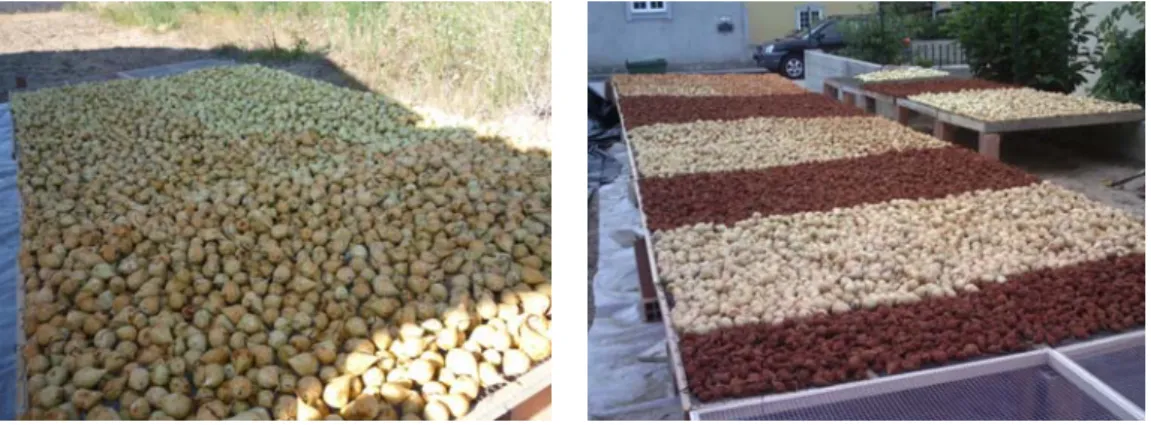
The traditional solar drying method consists of five different phases which are briefly described: (1) the pears are peeled manually; (2) the peeled and uncut pears are left in direct sun exposure in open fields for 5 to 6 days – 1st drying (Figure 2); (3) they are taken out of the sun at the hottest hour of the day and muffled in barrels or baskets for 2 days, which are left in the shade – barrelling (this procedure is supposed to increase elasticity, thus facilitating the following operation); (4) the pears are pressed so that their form changes from spherical to flat – pressing (Figure 3); (5) finally the pears are left again in direct sun exposure for 2 to 3 more days - 2nd drying (Figure 4) (Ferreira et al, 1997; Guiné and Castro 2003).
Figure 3. Pressing operation.
Figure 4. Second drying stage.
It is important to improve the traditional drying methods, making them more profitable and offering the consumer products of unquestionable quality. Presently the open-air drying is being substituted by the use of solar driers, taking advantage of the cheapness of the solar energy, and at the same time allowing for the production of dried fruits of better quality since the problems of contamination and infestation are minimized.
EXPERIMENTAL
The pears used in the present study are of the same variety which is traditionally dried in Portugal (S. Bartolomeu), and they were purchased to a traditional producer of dried pears.
In the present work, the pears were dried in two different systems having also the sun as the energy source: a solar stove (ESAV) and a solar drier (ESTV). The drying was stopped at a moisture content of about 20 %. Along the drying process 28 samples were used from each drying system to evaluate their texture. The texture profile analysis to all the samples was performed using a Texture Analyser (Figure 6), and the textural properties: hardness, adhesiveness, springiness, cohesiveness, and chewiness were then calculated after standard equations. The objective of this work is, on one hand, to evaluate how the textural attributes change along time during the drying operation and, on the other hand, to compare the two
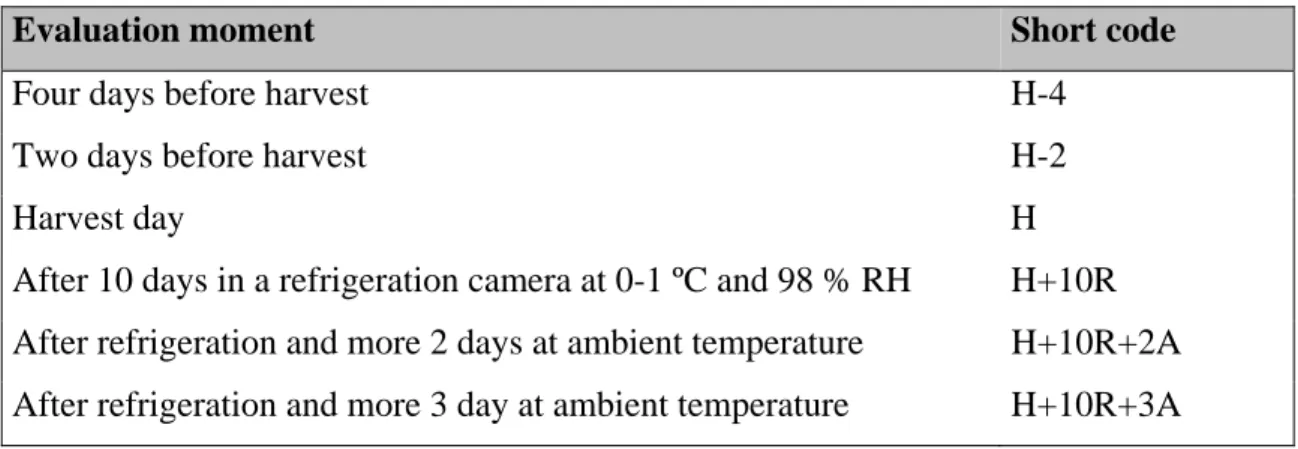
drying methods used. Furthermore, the evaluation of the textural properties was also evaluated before drying, during the latest maturation days and storage periods, as shown in Table 1.
Figure 6. Texture analyser used to perform the TPA’s.
Table 1. Plan for evaluation of the textural properties of pears prior to drying.
Evaluation moment Short code
Four days before harvest H-4
Two days before harvest H-2
Harvest day H
After 10 days in a refrigeration camera at 0-1 ºC and 98 % RH H+10R After refrigeration and more 2 days at ambient temperature H+10R+2A After refrigeration and more 3 day at ambient temperature H+10R+3A
RESULTS AND DISCUSSION
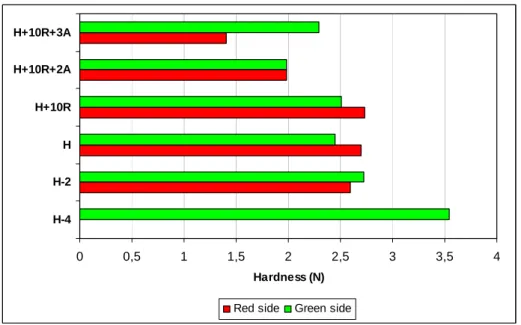
Figure 7 shows the hardness of the pears in the moments evaluated before drying, to perceive how this property varies along the latest stages of maturation. The results show that expect for the last day evaluated (H+10R+3A) there is practically no difference between the red and the green side of the pears, thus indicating that the different colour is not due to differences in the maturity of the plant tissues in both sides of the pear, as it could be assumed due to a big difference in the colour of the two sides of the pears (see Figure 1): one intense green and the other intense pink. From Figure 1 it is also possible to see that the hardness did not vary much in the last two days before harvest and in the next ten days while it was kept under refrigeration, which indicates that refrigeration did effectively preserve the characteristics that the pears had at harvest.
Figure 7. Variation of the hardness along maturation prior to drying.
Figure 8 represents the variations of adhesiveness in the period evaluated before drying, and it is possible to see that the pears have no measurable adhesiveness, since the values are very close to zero. Nonetheless, this property increases very slightly with time, when the pears were left at ambient temperature.
Figure 8. Variation of adhesiveness along maturation prior to drying.
The graph in Figure 9 presents the values of the textural attribute cohesiveness along the same period evaluated, and the results allow us to conclude that this property has a similar
-0,025 -0,02 -0,015 -0,01 -0,005 0 H-4 H-2 H H+10R H+10R+2A H+10R+3A Adhesiveness (N.s) Red side Green side
0 0,5 1 1,5 2 2,5 3 3,5 4 H-4 H-2 H H+10R H+10R+2A H+10R+3A Hardness (N) Red side Green side
behaviour to hardness, i.e., it practically does not change before harvest and while in refrigeration, and tends to diminish later when the pears were left at ambient temperature. Once again the results are very similar when the two sides of the pears are compared.
Figure 9. Variation of cohesiveness along maturation prior to drying.
Figure 10 shows how the property springiness behaves in the period evaluated, and the results show that this property presents values of approximately 70 % from day H-4 until day H+10+2A, thus indicating that no significant changes occurred during that time. However, a very important rise of 10 % is observed in the last day (H+10R+3A) increasing to 80 %. These results are consistent regardless of the side of the pear considered.
Figure 10. Variation of springiness along maturation prior to drying.
0 0,1 0,2 0,3 0,4 0,5 0,6 0,7 H-4 H-2 H H+10R H+10R+2A H+10R+3A Cohesiveness
Red side Green side
0 10 20 30 40 50 60 70 80 90 H-4 H-2 H H+10R H+10R+2A H+10R+3A Springiness (%) Red side Green side
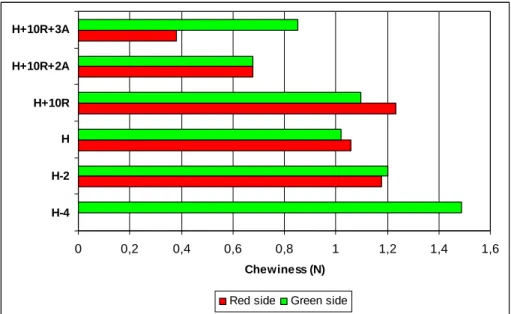
In Figure 11 the textural attribute chewiness is represented for both sides of the pears in the period at stake. The behaviour of this property is very much like that of hardness, being expected having in mind that these two textural attributes are so tightly related.
Figure 11. Variation of chewiness along maturation prior to drying.
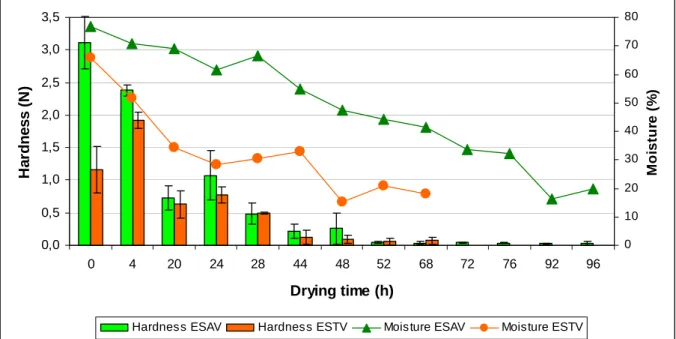
As it was mentioned before, one other objective of the present work was to study the textural behaviour during drying, for two different drying systems: a solar stove (ESAV) and a solar drier (ESTV). Figure 12 shows the variation of hardness of the pears along the drying time, and the graph also shows how the moisture content of the pears varies in the same time period, to evaluate the extent of the drying process. From the results obtained is possible to see that the drying operation greatly affects the hardness of the pears, diminishing very strongly along drying, for both the drying systems tested, as seen in Figure 12. The graph also shows that the drying is quite faster in the solar drier (ESTV) than in the solar stove (ESAV), taking about 50 hours to reach the desirable moisture content of about 20 % (wet basis), whereas the solar stove takes about 90 hours to reach the same moisture content.
Figure 13 shows the variations in cohesiveness along drying and it is possible to see that this property does not have a constant trend, with some diminishing around 20-28 hours and increasing after that.
0 0,2 0,4 0,6 0,8 1 1,2 1,4 1,6 H-4 H-2 H H+10R H+10R+2A H+10R+3A Chewiness (N) Red side Green side
Figure 12. Evolution of hardness and moisture content of the pears along drying for the solar stove (ESAV) and solar drier (ESTV).
Figure 13. Evolution of cohesiveness of the pears along drying for the solar stove (ESAV) and solar drier (ESTV).
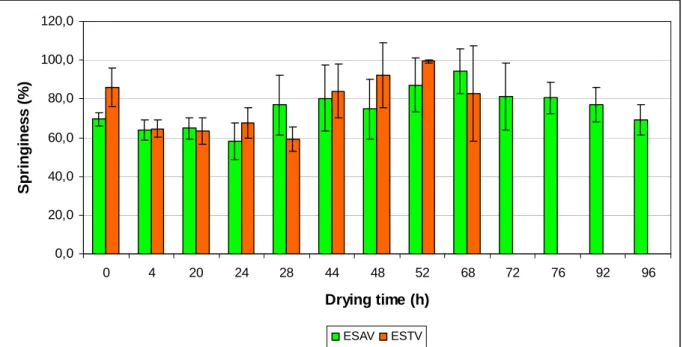
Figure 14 reveals that the variation of the textural attribute springiness is very similar to that of the cohesiveness increasing in the period between 44 and 68 hours. The graph also
0,0 0,5 1,0 1,5 2,0 2,5 3,0 3,5 0 4 20 24 28 44 48 52 68 72 76 92 96 Drying time (h) Ha rd n e s s ( N ) 0 10 20 30 40 50 60 70 80 Mo is tu re (% )
Hardness ESAV Hardness ESTV Moisture ESAV Moisture ESTV
0,0 0,1 0,2 0,3 0,4 0,5 0,6 0,7 0,8 0 4 20 24 28 44 48 52 68 72 76 92 96 Drying time (h) C o h e s iven ess ESAV ESTV
shows that the two drying systems tested are similar with respect to the product textural characteristics.
Figure 14. Evolution of springiness of the pears along drying for the solar stove (ESAV) and solar drier (ESTV).
In the graph of Figure 15 the evolution of chewiness along drying is presented for the two dryings, ESAV and ESTV. The variation of this property in equal to that of hardness, given that these properties are mathematically related, and once more the value greatly diminishes along drying, thus indicating that the drying operation has a great influence on the cell and tissue structure of the biological materials that constitute the pear.
Figure 16 shows the values of adhesiveness of the pears during drying and once more it is evident that the pears have very low values of adhesiveness. Nonetheless, it is seen that this property shows slightly higher values of adhesiveness in those periods where cohesiveness and springiness present lower values.
0,0 20,0 40,0 60,0 80,0 100,0 120,0 0 4 20 24 28 44 48 52 68 72 76 92 96 Drying time (h) S p ri n g in ess ( % ) ESAV ESTV
Figure 15. Evolution of chewiness of the pears along drying for the solar stove (ESAV) and solar drier (ESTV).
Figure 16. Evolution of adhesiveness of the pears along drying for the solar stove (ESAV) and solar drier (ESTV).
CONCLUSION
The results obtained with this work allowed to draw some important conclusions, namely that despite the pears showing a very attractive skin pink coloured on one side and a green
0,0 0,2 0,4 0,6 0,8 1,0 1,2 1,4 0 4 20 24 28 44 48 52 68 72 76 92 96 Drying time (h) C h ew in ess ( N ) ESAV ESTV -0,040 -0,035 -0,030 -0,025 -0,020 -0,015 -0,010 -0,005 0,000 0 4 20 24 28 44 48 52 68 72 76 92 96 Drying time (h) A d h esi v e n e ss ( N .s ) ESAV ESTV
coloured skin on the other side, the textural attributes of the pears are uniform throughout the whole pear, thus indicating that there are no differences in the maturity of the tissues on both sides of the pears.
One other important conclusion that could be reached with this work was that the storage under refrigeration allowed maintaining the textural characteristics of the pears equal to those at harvest. Furthermore, the storage at ambient temperature induced important changes in the pears tissues, thus altering the texture.
With respect to the evolution of texture along drying, it was concluded that this processing operation exerts a great influence in the pear characteristics, softening in a great extent the tissues of the pears.
Finally it was possible to conclude that both drying systems tested produced similar results, thus allowing obtaining dried products with the same textural properties.
Acknowledgment: The authors thank CI&DETS, CERNAS and FCT (project
PTDC/AGR-ALI/74587/2006) for financial support.
References
Marsilio V, Lanza B, Campestre C, De Angelis M (2000) Oven-dried table olives: textural properties as related to pectic composition. Journal of the Science of Food and Agriculture, 80, 271-1276.
Guiné RPF, Castro JAAM (2002a) Experimental determination and computer fitting of dessorption isotherms of D. Joaquina pears. Food and Bioproducts Processing, 80, 149-154.
Guiné RPF, Castro JAAM (2002b) Pear drying process analysis: drying rates and evolution of water and sugar concentrations in space and time. Drying Technology, 20(7), 1515-1526. Guiné RPF; Ferreira DMS, Barroca MJ, Gonçalves FM (2007) Study of the solar drying of
pears. International Journal of Fruit Science, 7(2), 101-118.
Guiné RPF, Castro JAAM (2003) Analysis of moisture content and density of pears during drying. Drying Technology, 21(3), 581-591.
Lahsasni S, Kouhila M, Mostafa M, Idlimam A, Jamali A. (2004a). Thin layer convective solar drying and mathematical modeling of prickly pear peel (Opuntia ficus indica). Energy, 29, 211-224.
Togrul IT, Pehlivan D (2002) Mathematical modelling of solar drying of apricots in thin layers. Journal of Food Engineering, 55, 209-216.
Hagen SF, Solhaug KA, Bergtsson GB Borge GIA, Bilger W (2006) Chlorophyll fluorescence as a tool for non-destructive estimation of anthocyanin and total flavonoids in apples. Posthavest Biology and Technology, 41, 156-163.
Ferreira D, Costa CA, Correia P, Guiné R (1997) Caracterização da Pêra Passa de Viseu. Terra Fértil, 3, 75-79.