Adaptation and validation of the Portuguese version of the Healthy Life
Styles Questionnaire
Marco Batista
(Instituto Politécnico de Castelo Branco/Escola Superior de Educação/Portugal/[email protected])
Ruth Jimenez Castuera, Marta Leyton Roman, Susana Lobato, Maria Isabel Aspano (Facultad de Deporte/Universidad de Extremadura/Spain/[email protected])
ABSTRACT
The aim of this study was the adaptation and validation of Healthy Lifestyle Questionnaire (EVS), of Jimenez Castuera (2004) adapted of Wold (1995), using an exploratory and confirmatory factor analysis of the measurement model, with a sample of sports veterans. In the exploratory and confirmatory factor analysis part 684 Portuguese veteran athletes of both genders, aged between 30 and 90 years (M=43.78 SD=8.61), of which 547 male subjects and 137 subjects were female, which are competitors of various sports. The main results showed that the psychometric qualities of both the exploratory factor analysis, and confirmatory factor analysis, proved the adequacy of adaptation performed, demonstrating that the factor structure (Adaptation to Sports Questionnaire EVS: 3 factors/20 items) It has quite acceptable levels of validity (χ2 = 172.117, df=41, p = .000, χ2/g.l. = 4.190, CFI = .966, IFI = .966, MFI = .909, GFI = .955, AGFI = .927, RMR = .049, SRMR = .043, RMSEA = .068), with reasonable levels of internal consistency of the three primary factors (eating habits =.80; tobacco consumption =.91; resting habits =.84). This led us to conclude that the adaptation to the Sports of the Portuguese version of the EVS can be used with high confidence in the assessment of healthy lifestyles in the sports context.
Keywords: Healthy Lifestyles, motivation, factor analysis, sport. LITERATURE REVIEW
Healthy lifestyles form an obstacle to disease (Odgen & Carroll, 2010; Telama et al, 2014) and include preventive health, good nutrition and weight control, leisure, regular physical activity, periods of rest and relaxation, the ability to face adverse conditions or situations and to establish affective solidarity and citizen relations, adopting an attitude of existing and being in the world with the goal of living well (WHO, 2002).
The study of the healthy lifestyles can be tagged to the present day by three major periods: a first period beginning in the nineteenth century until the mid-twentieth century; a second period that finishes the second half of the twentieth century and a third period that focuses on present days. During the first period, there are highlight studies (Veblen, 1994; Adler, 1929; Weber, 1946) which emphasized the healthy lifestyles, dependent on a sociological view and individual factors, from the people who were part of the social stratum that could keep it. In the second period, it stood out studies (Bandura, 1982; Rodríguez Marín & Garcia Hurtado, 1995) reporting an incorporation of the healthy lifestyles in the health area and also studies what are isolated behaviours, apparently favourable or leading to a healthy lifestyle. In the third period, there has been a development up to the present time, where to noteworthy works
(Prochaska, Spring & Nigg, 2008; García-Ubaque, 2011) that reflect healthy behaviours integrated in diverse contexts, or even the different dimensions relationship with healthy lifestyles, such as motivation and basic psychological needs, seeking to realize the self-determination for a particular practice and the adoption of healthy behaviours.
In a particular study (Pastor, Balaguer & García-Merita, 1998) it was showed the prevalence, throughout life, of healthy behaviours and unhealthy, started in childhood or adolescence. Of these, have stand out as healthy behaviours: eating habits, physical activity habits, resting habits, accidents and their prevention and the practice of free time activities. As unhealthy behaviours, the study showed the consumption of alcohol, tobacco or drugs.
Regarding to the instruments created and used in the research to measure healthy lifestyles, we found the Quality of Life Scale (Olson et al., 1982), consisting of 25 items, which evaluates six dimensions, namely: the economic well-being; friends, neighbours and community; family life and home; education and entertainment; media; religion and health. In another study (Grimaldo, 2010), focusing on health professionals, the use of Quality of Life Scale revealed a burden factorial distributed in nine dimensions.
Another instrument used has been the Satisfaction with Life Scale (SWLS) (Diener et al. 1985), consisting of 5 items that evaluates only one dimension of satisfaction in general life. Some studies in which it has been used, we highlight the application in samples with teenagers (Atienza, 2000), with adult samples (Cid, Silva & Alves, 2007), with samples of elderly (Pons et al., 2002) or with samples of pregnant woman and puerperal (Cabañero, 2004).
To evaluate the health behaviours in the school population we have The Health Behaviour in School Children (HBSC) (Wold, 1995), which determines sociodemographic variables, healthy lifestyle variables, everyday life variables and psychosocial health variables. This instrument draws up an health behaviours inventory in students (Pastor, Balaguer & García-Merita, 1998, Balaguer, 1999, 2000) with a factorial distribution of 29 items (Jimenez-Castuera, 2004; Castillo, 2000; Moreno et al. , 2012).
In turn, if we are to evaluate the perceptions and attitudes of teachers, as for the education for health, we have the questionnaire Perceptions and Attitudes to Health Education Questionnaire (TPAHEQ) (Apostolidou, 1999), consisting of 38 items, in a six factors distribution that qualify behaviours such as tobacco consumption, resting habits, alcohol consumption, physical exercise practice, health conditions and attitudes to personal health. In order to determine the Lifestyle Index (LSI) (Rodríguez, Lemos & Canga, 2001), it has been created an instrument which included dimensions of tobacco consumption, alcohol consumption, hours of sleep per day, physical activity level and attitudes towards health. The publication of the Practice Questionnaire about Lifestyles (Salazar & Arrivillaga, 2004), consisting of 90 items, has been subsequently being applied to health professionals (Sanabria, Gonzalez & Urrego, 2007). The instrument has three dimensions: on a first dimension it objectives the subjects identification; on a second dimension it considers healthy practices, physical activity, leisure time, self-care, taking biosecurity measures, eating habits, consumption of psychoactive drugs and sleeping time, and in a third dimension it includes beliefs about leisure time and psychoactive consumption as well as the biomedical approach in health and in disease.
With the elaboration of the Healthy Life Questionnaire (Grimaldo, 2003), consisting of 39 items and applied to college students, we have obtained a distribution on three factors, namely in recreational and sports activities, academic and family satisfaction, and the consuming of foods. The same author later developed studies where he employed this instrument to health professionals (Grimaldo, 2010, 2012).
Using a sample of Colombian adults, it was proposed the "Fantastic" Questionnaire (Lifestyle) (Ramírez-Vélez & Agredo, 2012), of 25 items, determining behaviours towards family and friends, physical activity, nutrition, tobacco consumption, alcohol consumption, sleep and stress, personality type, introspection, driving to work and other drugs.
Subsequently, appears the Life and Health Styles Questionnaire for University Students (ESVISAUN) (Bennasar, 2012), consisting of 48 items, which gather sociodemographic data, socioeconomic data, perceived health status and life quality, physical activity, tobacco , alcohol and other drugs, eating habits, sexuality, road safety, dental hygiene, disease and disability, and university environment. Recently it was carried out the content validation and adaptation by the Delphi technique (betancurth, Alvarez & Vargas, 2015).
With the Healthy Lifestyle Questionnaire (EVS) in a study (Jimenez-Castuera, 2004), developed in Spain it is proposed an instrument of 30 items, distributed in five factors that determine behaviours, more particularly eating habits and that even presents the sub-factors: balanced diet and respect for eating time, resting habits, tobacco consumption, alcohol consumption and the use of other drugs.
Currently, the healthy lifestyle construct has a close relationship with the modern food pyramid and it is investigated according to multivariate models, involving the life quality and the absence of diseases 3,4. There are several examples of physical activity promotion programs as a mean of promoting a healthy and active lifestyle, including The Sports Play and Active Recreation for Kids (SPARK); Health Behaviour in School-aged Children (HBSC); Healthy Lifestyle in Europe Nutrition in Adolescence (HELENA); Estrategia para la Nutrición, Actividad Física y Prevención de la Obesidad (NAOS) (Strategy for the nutrition and physical activity and obesity prevention); Lifestyle Education for Activity Program (LEAP); Alimentación y valoración del Estado Nutricional en Adolescentes (AVENA)( Eating and valorisation of the nutritional state in teenagers); Foro Gana Salud; Global Movement for Active Ageing; Health is in the Movement; The Ever Active Adults (EAA); El Ejercicio te Cuida na província da Extremadura (Exercise takes care of you in Extremadura); Physician-based Assessment and Counselling for Exercise - PACE; Programa Peso (weight programme). This last two, both, in Portugal.
For the studies development it is important to know which theories and models lead to the adoption of healthy lifestyles. Presenting, therefore the Socio-ecological Model (Bennasar, 2012; Sallis & Owen, 2002; McLeroy et al, 1988 Bronfenbrenner, 1994; Stokols, 1996), the Trans-contextual Model (Hagger et al. 2003; Biddle, 2001; Hagger & Chatzisarantis, 2012, 2014), and the Trans-theoretical Model (Prochaska & DiClemente).
In this way, the theoretical mark of the Self-determination Theory (Deci & Ryan, 1980,1985,1991, 2000) supports this work because we have observed that the results of studies employing the TAD in relation to health (Jimenez-Castuera et al., 2007; Moreno, Moreno & Cervelló, 2007; Moreno, Hernández & González-Cutre, 2009; Leyton et al. 2012; Moutão, Alves & Cid, 2012; DeFreese & Smith, 2013; Leyton, 2014; Pizarro, 2014; Nunes, Teixeira & Coelhoso, 2014; Ruiz-Juan et al., 2014; Hagger et al., 2014; Vega et al., 2015; Fernández-Ozcorta, Almagro & Sáenz-López, 2015), suggests that identifying the individuals underlying motivation level and explore the social context influence associated with these behaviours and their elections, can improve the interventions aimed to change lifestyles (Duda et al, 2014;. Silva, Vaello, alias, y Murcia, 2015). This motivational macro theory stresses out the importance of basic psychological competence needs satisfaction, autonomy and social relations in the appearance of self-determined behaviour, which are those that cause a number of consequences including what lifestyles maintain (Nutbeam, Aaro & Catford 1989).
More recently, Deci and Ryan (2012) and Vallerand (2015) define the self-determination theory as an empirical theory of human motivation and personality in social contexts, which distinguishes between determined motivations non determined. These types of self-determination concretized in demotivation (lack of intention to act), external, introjected and identified regulation (determined by rewards and / or external agents) and intrinsic regulation (pleasure when performing an activity).
In the same line of investigation (Jimenez-Castuera et al. 2007) examined the relationship between physical activity and sports over behaviours belonging to healthy lifestyles, using a 402 students sample of Physical Education, from 14 to 18 years old. The results showed that the stated practice predicts significantly and positively a balanced diet and the respect for the meals time and without show statistical significance, the resting habits.
Some studies (Moreno, Moreno & Cervello, 2007; DeFreese & Smith, 2013) showed the ratio of practicing sports and physical activities and the more self-determined motivation. In a study Leyton et al. (2012), where they used a sample of older women, they found that the more self-determined motivation levels had a positive relationship with the lifestyles of variables that enhance the health, such as food habits and resting, and a negative relationship with the lifestyles variable that harm health, including tobacco consumption.
In turn, in another research (Leyton, 2014) where was used a 135 women sample aged between 40 and 88 years old to carry out an exercise programme, with nutrition education and promotion of intrinsic motivation, in order to improve the variables lifestyles that enhance the health of adults and older people, it was shown that the promotion of this same motivation favoured, positively, the increased satisfaction of basic autonomy and competence psychological needs, the more self-determined motivation forms and eating habits.
Pizarro (2014) with a 94 women sample aged between 42 and 88 years old obtained results where the intrinsic regulation, integrated regulation and identified regulation related positively and significantly with the variables of lifestyles that enhance health (rest and healthy eating habits). The demotivation was related positively, however not significantly with the injurious to a healthy lifestyle variable (tobacco consumption).
Through an experimental research (Nunes, Teixeira & Coelhoso, 2014), it was analysed the effect of an intervention based on the basic psychological needs satisfaction about the reduction of alcohol consumption in 25 Portuguese youngsters aged between 13 to 17 years, not finding significant results between the satisfaction incidence of basic psychological needs on alcohol consumption. Besides that, they observed that the basic psychological needs satisfaction for autonomy favours the alcohol consumption. Another research (Moreno Hernandez & Gonzalez-Cutre, 2009) showed that the needs of autonomy satisfaction and relationship with others predicted, positively, intrinsic motivation. It is also important to mention that several authors (Juan Ruiz et al, 2014; Vega et al, 2015) indicated that tobacco consumption used to be a significant predisposing factor for alcohol consumption.
In a study of Hagger, et al. (2014), made with 140 university students, it was tried to determine behaviours depending on the autonomous motivation type, or controlled, of the students for the exercise. The results showed significant behaviours and direct effects on students who showed an autonomous motivation, regarding to healthier eating habits, resting habits and personal hygiene, as well as active behaviour and exercise.
In another research (Fernández-Ozcorta, Almagro & Saenz-Lopez, 2015) it states that according to the gained data, the students who have satisfied their basic psychological needs and a more self-determined motivation, regarding the exercise, tend to a greater intention to remain physically active in the future.
It should be noted that the practice of physical activity is subject to measurement through numerous instruments available to the investigation, such as TTM (Prochaska & DiClemente, 1982) or the International Physical Activity Questionnaire (IPAQ) (Craig et al., 2003), emerging physical activity as a fundamental element in a healthy lifestyle, in which we try to measure the motivation to practice and not the amount of practice that is done.
The Healthy Lifestyles Questionnaire (EVS) is presented as a new instrument, which has an appropriate number of items per factor. It does not appear too long or too short, nor with open questions, not excessively short (questions) or a single question or single item for each factor to be determined.
This study had as first objective the validation to Portuguese of the Healthy Lifestyles Questionnaire (EVS). The use of this questionnaire will allow a characterization of healthy habits and lifestyles of athletes, relying on the translated Spanish version (Jimenez-Castuera, 2004), of the questionnaire developed by Wold (1995), only being modified taking into account the information it was intended to obtain and translated into Portuguese. Another objective in this same study was to test the concurrent validity, where we opted for a correlation analysis of the variables of the Healthy Lifestyles with the self-determined motivation ones, hoping to find out that intrinsic motivation, integrated regulation and identified regulation appear correlated with the resting habits or healthy eating and inversely with tobacco consumption.
METHODOLOGY
Participants: The study sample consisted of 684 Portuguese veteran athletes of both genders, aged between 30 and 90 years (M = 43.78, SD = 8.61), of which 80% (547 individuals) were male gender and 20% (137 individuals) of the female gender, competing in several sports. In this study are data referring to practitioners of team sports like football (27.8%), roller hockey (3.2%), rugby (7.3%), basketball (2.1%), as well as individual modalities, such as tennis (9.7%), judo (15.2%), athletics (13.2%), cycling / mountain biking (9.1%), triathlon / duathlon (4.4%), horse riding (1.5%) or swimming (2.2%). The type of sample used for the sample selection of this study was non- intentional probabilistic for conglomerates (Azorín & Sanchez-Crespo, 1986), since it is not based on a probabilistic basis, being inherent to the data collection in an intentional approach to subjects with certain specific characteristics.
Instruments: We used the Healthy Lifestyle Questionnaire (EVS) in the translated and
adapted Spanish 1 version, of the questionnaire designed by Wold2 (HBSC). Adapted version of The Health Behaviour School Children of 30 items, changing the reported inventory to our needs for obtaining information and translated into Portuguese. It was only used 20 items in the Portuguese version, not all dimensions of the original version make sense, given the sample under study, including alcohol and drug use.
The EVS displays the version of 20 items, respectively, as it measures the eating habits in a total of 10 items, particularly eating habits regarding to the mealtimes (e.g., "I try to respect the main meals of the day") - 5 items; eating habits in respect for a balanced diet (e.g., "usually I eat fish two or more times per week") - 5 items; tobacco consumption (e.g., "I feel good when I smoke") - 5 items and resting habits (e.g., I sleep the sufficient number of hours for my body to be rested ") - 5 items.
In this study we used a Likert scale which ranges from strongly disagree (1) and strongly agree (5), with questions that refer to three factors: eating habits, tobacco consumption and resting habits (Aspano, 2015). Preliminarily, the goodness of fit index of confirmatory factor
analysis was acceptable: χ2 = 632.68, p = .000, χ2 / g.L. = 2.010, CFI = .940, IFI = .940, GFI = .920, SRMR = .060, RMSEA = .070.
It was also used the Behaviour Regulation Sport Questionnaire (BRSQ) (Lonsdale, Hodge & Rose, 2008). This questionnaire consists of 24 items to which it answers in a 7 levels Likert scale, ranging from 1 ("nothing true to me") and 7 ("completely true for me"). The items are grouped, afterwards, in 6 factors (4 items each), which reflect the types of motivation underlying the motivational continuum of self-determination theory (SDT) (Deci & Ryan, 1980, 1985, 1991, 2000, 2012). For this study we used the validated version in a preliminary way for the Portuguese population (Monteiro et al., 2014), with resource to a confirmatory factorial analysis, in a 623 athletes sample from football Sport, presenting its measurement model (6 factors with three items each) acceptable values adjustable to the data: χ2 = 365.6, p = 0:00, χ2 / gl = 3.05, CFI = 0.927, NNFI = 0.907, SRMR = 0.055, RMSEA = 0.057. Also in this study we have obtained the following internal reliability indices: amotivation (α = 0.81), external regulation (α = 0.83), introjected regulation (α = 0.68), identified regulation (α = 0.62), integrated regulation (α = 0.68) and intrinsic motivation (α = 0.72).
Proceedings: It was conducted a reverse translation (Hambleton, 1996) of the Healthy
Lifestyles (EVS) scale items, having in first place being translated to Portuguese and then translated again by a translator unrelated to the research group to Spanish, where he noted a great similarity with the original questionnaire in English, also after retroversion process. Afterwards, the items were evaluated by three experts in the field (Lynn, 1986) who considered that these were adequate to evaluate the construct for what it was created. Once translated, was administered the questionnaire to a small group of athletes with similar ages to the final sample to verify its correct understanding, not noticing any problems of reading comprehension.
In the next phase, we carried out a selection of sports centres, such as clubs and associations, attending to a convenience sample (Cubo Delgado, Martin Marin & Ramos Sanchez, 2011). For collecting information, we put ourselves in direct contact with the veteran sportsmen to request their collaboration in the study asking, after their approval, the signing of an informed consent.
The administration of the final questionnaire, which brought together the Healthy Lifestyle Questionnaire and the Behaviour Regulation Sport Questionnaire was held in the presence of the main investigator, to explain briefly the aims and structure, as well as how to fill it . During the filling process, the main investigator was available for any problem that might arise. The approximate time of completion was about, twenty minutes.
Data Analysis: We used the SPSS statistical software (version 23.0 for Windows, SPSS, Inc.,
Chicago, IL, USA) for collecting data analysis. We have obtained descriptive values, with mean (average) and standard deviations, as well as the reliability values of the questionnaires factors. Each variable has passed the normality tests using the Kolmogorov- Smirnov test and the variances homogeneity by the Levene test (Field, 2013), which led to the use of parametric statistics.
It was conducted an analysis correlation and, to verify the structure of the respective factors with their corresponding items, it was set correctly to Portuguese context and proceeded to confirmatory factor analysis (CFA) using EQS 6.1 software.
The internal consistency analysis of the Healthy Lifestyle Questionnaire and the Behavioural Regulation in Exercise Questionnaire
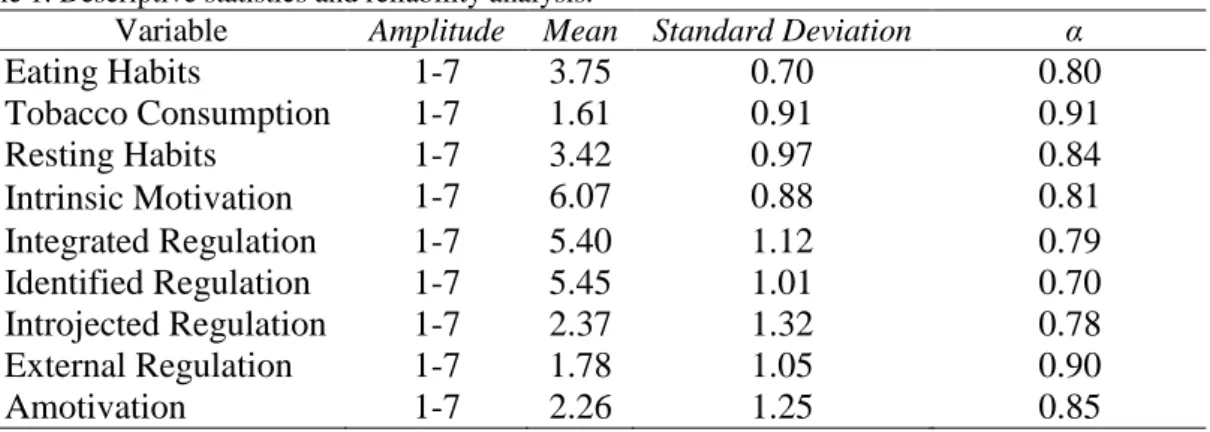
The internal consistency of each factors resulting from the factor analysis (Cronbach's alpha) showed the following results: (.80) eating habits (.91) tobacco consumption, (.84) resting habits. The reliability coefficient should be above the .70 (Nunnally, 1978). There were also values of 0.861 on the KMO and Bartlett's test, where 56.24% of the variance is explained by three factors.
Focusing on the Behavioural Regulation in Exercise Questionnaire, we obtained also acceptable reliability coefficients, namely: intrinsic motivation (.81), integrated regulation (.79), identified regulation (.70), introjected regulation (.78), external regulation ( .90) and amotivation (.85).
Table 1. Descriptive statistics and reliability analysis.
Variable Amplitude Mean Standard Deviation α
Eating Habits 1-7 3.75 0.70 0.80 Tobacco Consumption 1-7 1.61 0.91 0.91 Resting Habits 1-7 3.42 0.97 0.84 Intrinsic Motivation 1-7 6.07 0.88 0.81 Integrated Regulation 1-7 5.40 1.12 0.79 Identified Regulation 1-7 5.45 1.01 0.70 Introjected Regulation 1-7 2.37 1.32 0.78 External Regulation 1-7 1.78 1.05 0.90 Amotivation 1-7 2.26 1.25 0.85
Confirmatory Factor Analysis of Healthy Lifestyle Questionnaire
We conducted a confirmatory factor analysis to evaluate the three-factor model of the Healthy Lifestyles Questionnaire version. In the analysis we took into account an index combination (Bentler, 1995) and, therefore, to determine the scale adjustment, were followed by the indicators recommended by Byrne (2006): χ2, χ2/g.l, CFI (Comparative Fit Index), IFI (Incremental Fit Index), TLI (Tucker Lewis Index), RMSEA (Root Mean Square of approximation) and SRMR (Standardized Root Mean Square Residual). The χ2 indicates a similarity in the covariances observed with those that were predict in the hypothetical model, however, is very sensitive to the sample size, so it is recommended (Jöreskog & Sörbom, 1993) to be complete with the χ2 / gl, whose values below 2 indicate a very good model fit, although values below 5 are considered acceptable (Schumacker & Lomax, 2010). The incremental indexes (CFI, IFI, TLI) compare the hypothetical model and the null model, not being affected by the sample size. Are considered acceptable (Schumacker & Lomax, 2010) values greater than .90. The RMSEA and SRMR error indexes should be less than .08 (Browne & Cudeck, 1993; Hu, Bentler & Cutoff, 1999).
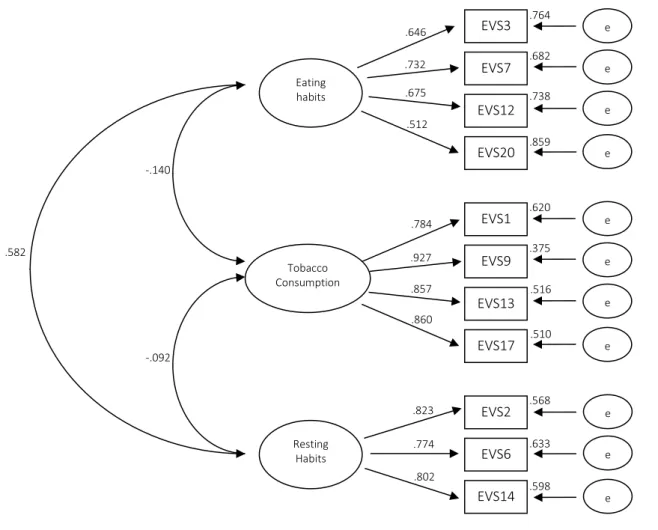
After analysis, it was shown that the 20 items were grouped into three factors, respectively: eating habits (10 items), tobacco consumption (5 items) and resting habits (5 items).
In a similar way, the standardized factor loads were all statistically significant (p <.01), whereby it can be concluded that the model shown in Figure 1, in an analytical level provides satisfactory results.
Fig. 1 - Healthy Lifestyle Questionnaire Structural Model (EVS)
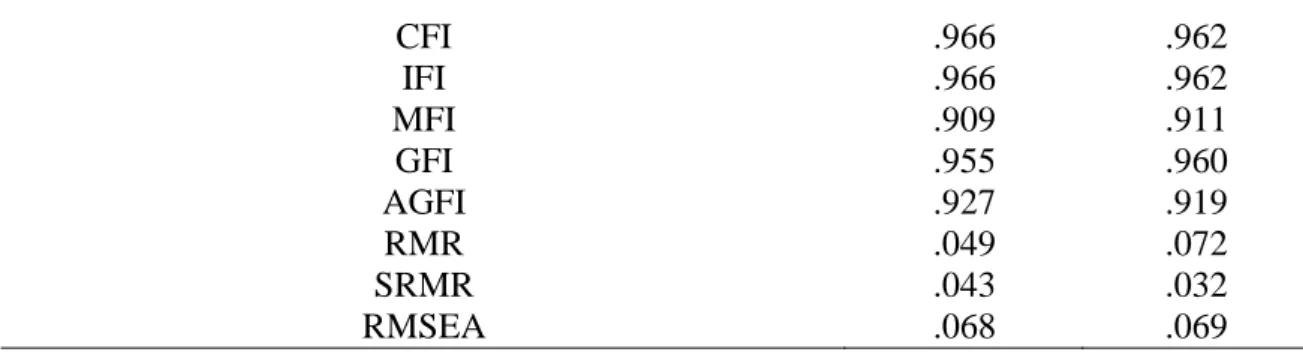
The preliminary analysis of the data also indicated that the sample did not meet the criterion of normality, since the Mardia coefficient was high (62.43). For that reason, following other authors, Finney and DiStefano (2006), we used the robust estimation method of verisimilitude maximum (Byrne, 2001). After a first analysis, the overall model results (Table 2) indicated a reasonable adjustment of the Healthy Lifestyles Questionnaire (EVS): (χ2 = 172,117, p = .000, χ2 / df = 4.190, CFI = .966, IFI = .966, MFI = .909, GFI = .955, AGFI = .927, RMA = .049, RMSEA = .068, SRMR = .043).
In its turn the Behavioral Regulation in Exercise Questionnaire (BRSQ): (χ2 = 167,024, p = .00, χ2 / df = 4.280, CFI = .962, IFI = .962, MFI = .911, GFI = .960, AGFI = .919, RMA = .072, RMSEA = .069, SRMR = .032).
With these results, the structural model shows a satisfactory global adjustment.
Table 2. Indexes of adjustment to the EVS and BRSQ model.
EVS BRSQ
Ҳ/df 4.190 4.280
BENTLER-BONETT NORMED FIT INDEX .956 .952
BENTLER-BONETT NON-NORMED FIT INDEX .955 .936
EVS3 EVS7 EVS12 EVS20 EVS1 EVS9 EVS13 EVS17 EVS2 EVS6 EVS14 Eating habits Tobacco Consumption Resting Habits e e e e e e e e e e e .764 .682 .738 .859 .620 .375 .516 .510 .568 .633 .598 .646 .732 .675 .512 .784 .927 .857 .860 .823 .774 .802 -.140 .582 -.092
CFI .966 .962 IFI .966 .962 MFI .909 .911 GFI .955 .960 AGFI .927 .919 RMR .049 .072 SRMR .043 .032 RMSEA .068 .069
Concurrent validity between EVS and BSQ questionnaires
From the analysis of the data in Table 3, we observed significant negative correlations between tobacco consumption variable and the eating and resting habits variables. These last two variables showed a significant positive correlation between the two.
When observed, the correlations between the EVS and BRSQ factors, we observed positive correlations between eating habits and resting habits with the intrinsic motivation, integrated regulation and identified regulation. In turn are presented negative correlations with introjected regulation, external regulation and amotivation.
Tobacco consumption appears in a non-significant negative correlation with intrinsic motivation and integrated regulation, presenting a non-significant positive correlation with identified regulation, and significant with introjected regulation, external regulation and amotivation.
Apparently, the eating habits and resting factors arise correlated positively and significantly with autonomous motivation factors and the tobacco consumption factor appears correlated positively and significantly with controlled motivation factors.
Table 3. Correlation between factors from EVS and BRSQ
1 2 3 4 5 6 7 8 1 – Eating Habits - 2 – Tobacco Consumption -.140** - 3 – Resting Habits .582** -.092* - 4 – Intrinsic Motivation .284** -.034 .176** - 5 – Integrated Regulation .184** -014 .073 .594** - 6 – Identified Regulation .182** .048 .172** .581** .636** - 7 – Introjected Regulation -.077* .126** -.071 -.360** -.028 -.096* - 8 – External Regulation -.182** .099** -.114** -.555** -.282** -.328** .674** - 9 – Amotivation -.164** .104** -.118** -.439** -.194** -.279** .498** .749** *p < .05; **p < .01 DISCUSSION
The main objective of this study was to extend previous research on the healthy lifestyles, particularly associated with the field of sports by veteran athletes, to validate the EVS questionnaire in Portuguese competitive sports context. Given the fact that each new application of a measuring instrument is a contribution to improve the theoretical value of the
research area (Baric & Horga, 2006), this study extends the body of knowledge, confirming the EVS instrument validity in a different research, as well as improving the knowledge of how to help sport and exercise psychologists to understand healthy practices and health indicators in veteran athletes.
The results of the confirmatory factor analysis revealed a three factors structure proposed to evaluate the athletes healthy lifestyles, including eating habits, tobacco consumption and resting habits, showing a good data adjustment. Besides that, all constructs showed good psychometric properties, in particular in advising several authors (Nunnally, 1978; Bentler, 1995; Byrne, 2006; Schumacher & Lomax, 2010; Browne & Cudeck, 1993; Hu, Bentler & Cutoff 1999). These results are consistent with previous research using the EVS (Jimenez-Castuera, 2004) and confirm the importance of each of the three dimensions in the understanding of the athletes’ healthy lifestyles.
By observing the results of the EVS preliminary validation (Aspano, 2015) with the ones obtained in our study, both present good psychometric properties, recommended by the literature (Nunnally, 1978; Bentler, 1995; Byrne, 2006; Schumacker & Lomax, 2010, Browne & Cudeck, 1993; Hu, Bentler & Cutoff, 1999), presenting, apparently, the EVS in these two studies as a reliable instrument for the evaluation of healthy lifestyles.
Furthermore, there is another important data to highlight on the EVS, which is a contribution to the literature related to sport. The concurrent validity analysis revealed that the eating and resting habits factors arise correlated positively with intrinsic motivation factors, integrated regulation, identified regulation and tobacco consumption factor appears correlated positively with regulatory factors introjected, external regulation and amotivation. Similar observations have been obtained in other studies (Leyton, 2014; Pizarro, 2014; Hagger et al, 2014), where were proved that the promotion of intrinsic motivation favoured, positively, the increase of the satisfaction on basic psychological needs in autonomy and competence, the more self-determined motivation forms and eating habits. The physical activity predicts positively and significantly, the balanced diet and the respect for the meals time and without show statistical significance, the resting habits 45.
In our study, the positive correlations between healthy resting and nutrition habits with the self-determined motivation, reflect the trends noted by other authors (Prochaska, Spring & Nigg, 2008; García-Ubaque, 2011; Pizarro, 2014; Hagger et al. , 2014), showing healthy behaviours integrated in the veteran sport context, alongside to a self-determination for the practice. The results obtained, by favouring the most self-determined motivation levels towards doing sports for the only pleasure that it gives, making the behaviours to merge with the own life of the subject or practitioner, and thus increment a healthy lifestyle . Similarly, Leyton et al. (2012) noted that the most self-determined motivation levels presented a positive relationship with the lifestyles variables that enhance health.
In a global way, by the results found, and given to the theoretical referential of self-determination theory (Deci & Ryan, 1980, 1985, 1991, 2000, 2012) in which this essay is based, these seem to respect the trend also found by other authors (Moreno, Moreno & Cervello, 2007; DeFreese & Smith, 2013), which demonstrated the relationship between the practice of sports and physical activities and the more self-determined motivation, which, apparently, is observed in our study, given the tendency of the sportsman inquired for a motivational base of more self-determined behaviours, having as a consequence, the maintenance of the healthy lifestyles (Nutbeam, Aaro & Catford, 1989).
As with any study, this research has limitations that should be considered for future researches. The study sample was not representative of the Portuguese population of the
veteran athletes, and as such, the results may not be generalized. It would also be interesting to see additional samples with athletes from other countries and could also be collected data to compare the validity of the scale in different cultural contexts.
The instrument has the potential to become cleaner, as new contributions arise about healthy lifestyles, namely, the clearance of alcohol and drug use, being these dimensions a part of the original Wold2 questionnaire.
It may be interesting the studies application that are based on the trans-theoretical motivation model, or the planned behaviour theory, or even in the self-determination theory and to evaluate as a consequence the adoption of the healthy lifestyles in several population strata which reflects the sport and physical activity practice. We aim further, the non-inclusion of the physical exercise practice factor in the questionnaire, which in future studies can be measured like other researches already carried out, with other specific instruments, as the TTM example (Prochaska & DiClemente, 1982).
CONCLUSIONS
Thus, we can conclude that the adaptation to Sports of the Portuguese version of the Healthy Lifestyles Questionnaire (EVS), can be used with confidence in the evaluation of healthy lifestyles, underlying to the self-determination theory in sport context.
Importantly, that the performed correlations revealed the expected direction, where the intrinsic motivation, integrated regulation and identified regulation appeared correlated, positively, with the resting or eating habits and inversely with the tobacco consumption. The tobacco consumption behaviour appears correlated with introjected regulatory factors, external regulation and also amotivation.
The results indicate that the factorial validity and reliability of the Portuguese version of the Healthy Lifestyles Questionnaire (EVS) are acceptable in sports.
ACKNOWLEDGEMENTS
This paper had no financial or organizational support.
REFERENCES
Adler A. The Practice and Theory of Individual Psychology. London: Routledge & Kegan Paul; 1929. Azorín F, Sánchez-Crespo JL. Métodos y aplicaciones del muestreo. Madrid: Alianza Editorial; 1986.
Apostolidou M. Teachers and health education in Cyprus schools: Historical context, current concerns and
perceptions na future development. PhD Thesis. University of Wales. Cardiff; 1999.
Aspano M. Predicción de estilos de vida saludables a través de la teoría de la autodeterminación en
adolescentes portugueses. Trabajo de fin de Master no publicado. Cáceres: Universidad de Extremadura;
2015.
Atienza F, Pons D, Balaguer I, García-Merita M. Propriedades psicométricas de la escala de satisfacción con la vida en adolescentes. Psicothema. 2000; 12: 331-336.
Balaguer I. Estilo de vida de los adolescentes de la comunidade valenciana: Un estúdio de la socialización para estilos de vida saludable. DGICYT (PB94-1555); 1999.
Balaguer I. Un estudio sobre los predictores de los estilos de vida saludables de los adolescentes valencianos. Direcció General de Salut Pública (I.V.E.S.P., 011/1999). Valencia: Conselleria de Sanitat de la Generalitat Valenciana; 2000.
Bandura A. Self-efficacy mechanism in human agency. American Psychologist. 1982; 37: 122-147.
Baric R, Horga S. Psychometric Properties Of The Croatian Version Of Task And Ego Orientation In Sport Questionnaire (CTEOSQ). Kinesiology. 2006; 38(2): 135-142.
Bennasar M. Estilos de vida y salud en estudiantes universitarios: la universidad como entorno promotor de la
salud. Tesis Doctoral. Universitat de les Illes Balears; 2012.
Bentler PM. EQS structural equations program manual. Encino, C.A: Multivariate Software; 1995
Betancurth, D. P., Álvarez, C. V., Vargas, L. J. Validación de contenido y adaptación del cuestionario Fantástico por técnica Delphi. Salud Uninorte. 2015; 31(2), 214-227.
Biddle S. Rebuilding the Foundations of Offense-Defense Theory. Journal of Politics. 2001; 63: 741–774. doi: 10.1111/0022-3816.00086
Bronfenbrenner U. Ecological models of human development. In T Husen & TN Postlethwaite (Eds.),
International Encyclopedia of Education (2nd Ed., Vol. 3, pp. 1643-1647). Oxford, England: Pergamon
Press; 1994.
Browne MW, Cudeck R. Alternative ways of assessing model fit. En K.A. Bollen y J.S. Long (Eds). Testing
Structural Equation Models. Newbury Park, C.A: Sage; 1993: 136-162.
Byrne B. Structural equation modeling with AMOS. Basic concepts, applications and programming. Mahwah, NJ: Lawrence Erlbaum Associates, Publishers; 2001.
Byrne B. Structural equation modeling with EQS. Basic concepts, applications, and programming (2nd Ed.) Mahawah, NJ: Lawrence Erlbaum Associates, Publishers; 2006.
Cabañero M, Richard M, Cabrero J, Orts M, Reig A, Tosal B. Fiabilidad y validez de una Escala de Satisfacción con la Vida de Diener en una muestra de mujeres embarazadas y puérperas. Psicothema. 2004; 16: 448-455.
Castillo I. Un estudio de las relaciones entre las perspectivas de meta y otras variables motivacionales con el
estilo de vida saludable en la adolescencia temprana. Tesis Doctoral sin publicar. Universitat de
Valencia; 2000.
Cid L, Silva C, Alves J. Actividade física e bem-estar psicológico - perfil dos participantes no programa de exercício e saúde de Rio Maior. Motricidade. 2007; 3(2): 47–55.
Craig C, Marshall A, Sjostrom M, Bauman A, Booth M, Ainsworth B. International Physical Activity Questionnaire: 12-Country Reliability and Validity. Med Sci Sports Exercise. 2003; 35:1381-95.
Cubo Delgado S, Martín Marin B, Ramos Sanchez JL. Métodos de Investigación y Análisis de Datos en Ciências
Sociales y de la Salud. Madrid: Pirâmide; 2011.
Deci E, Ryan R. The empirical exploration of intrinsic motivational processes. En L. Berkowitz (Ed.), Advances in experimental social psychology (39-80). New York: Academic Press; 1980.
Deci E, Ryan R. Intrinsic motivation and Self-determination in human behavior. New York: Plenum; 1985. Deci E, Ryan R. A motivational approach to self: Integration in personality. En R. Dienstbier (Ed.), Nebraska
symposium on motivation: Perspectives on motivation (237-288). Lincoln, NE: University of Nebraska Press; 1991.
Deci E, Ryan R. The „„what‟‟ and „„why‟‟ of goal pursuits: Human needs and the self-determination of behavior. Psychological Inquiry. 2000; 11: 227-268.
Deci E, Ryan R. Self-determination theory. En A. W. Kruglanski, P. A. M. Van Lange y E. T. Higgins (Eds.), Handbook of theories social psychology (416-437). London: SAGE; 2012.
DeFreese JD, Smith AL. Teammate social support, burnout, and self-determined motivation in collegiate athletes. Psychology of Sport and Exercise, 2013; 14: 258-265.
Diener E, Emmons R, Larsen R, Griffin S. The Satisfaction With Life Scale. Journal of Personality Assessment. 1985; 49(1): 71-75.
Duda J, Williams G., Ntoumanis N, Daley A, Eves F, Mutrie N, Rouse P, Lodhia R, Blamey R, Jolly K. Effects of a standard provision versus an autonomy supportive exercise referral programme on physical activity, quality of life and well-being indicators: a cluster randomised controlled trial. International Journal of Behavioral Nutrition and Physical Activity. 2014; 11(1), 1.
Fernández-Ozcorta E, Almagro B, Sáenz-López P. Predicción de la intención de seguir siendo físicamente activos en estudiantes universitarios. Cuadernos de Psicología del Deporte. 2015; 15(1): 275-284.
Field AP. Discovering statistics using IBM SPSS Statistics. London: Sage publications; 2013.
Finney SJ, DiStefano C. Non-normal and categorical data in structural equation modeling. In G. R. Hancock & R. O. Mueller (Eds.), Structural equation modeling: A second course. Greenwich, CT: Information Age Publishing; 2006: 269-314.
García-Ubaque J. Hábitos saludables de los trabajadores de una institucion hospitalaria pública de alta
complejidad en Bogotá. Tesis Doctoral. Bogotá. Universidad Nacional de Colombia; 2011.
Grimaldo M. Manual técnico de la escala de calidad de vida de Barnes y Olson. Lima: Universidad de San Martín de Porres; 2003.
Grimaldo M. Adaptación de la Escala de Calidad de Vida de Olson & Barnes para profesionales de la salud.
Cultura. 2010; 24: 1-20.
Grimaldo M. Estilo de vida saludable en estudiantes de posgrado de Ciencias de la Salud. Psicología y Salud. 2012; 22(1): 75-87.
Hagger M, Chatzisarantis N, Culverhouse T, Biddle S. The processes by which perceived autonomy support in physical education promotes leisure-time physical activity intentions and behavior: a trans-contextual model. Journal Education Psychology. 2003; 95: 784–795.
Hagger M, Chatzisarantis N. Transferring motivation from educational to extramural contexts: a review of the trans-contextual model. European Journal of Psychology and Education. 2012; 27: 195–212.
Hagger M. Chatzisarantis N. It is premature to regard the egodepletion effect as “Too Incredible”. Front.
Psychol. 2014; 5:298.
Hagger M, Hardcastle S, Chater A, Mallett C, Pal S, Chatzisarantis N. Autonomous and controlled motivational regulations for multiple health-related behaviours: between- and within-participants analyses. Health
Psychology & Behavioural Medicine. 2014; 2: 565 – 601.
Hambleton RK. Adaptación de tests para su uso en diferentes idiomas y culturas: fuentes de error, posibles soluciones y directrices prácticas. En J. Muñiz (Coor.), Psicometría. Madrid: Universitas; 1996.
Hu L, Bentler P. Cutoff criteria for fit indexes in covariance structure analysis: Conventional criteria versus new alternatives. Structural Equation Modeling. 1999; 6: 1–55. http://dx. doi.org/10.1080/10705519909540118.
Jimenez-Castuera R. Motivación, trato de igualdad, comportamientos de disciplina y estilos de vida saludables
en estudiantes de e ducación física en secundaria.Tesis Doctoral. Universidad de Extremadura: Cáceres;
2004.
Jiménez-Castuera R, Cervelló-Gimeno E, García-Calvo T, Santos-Rosa F, Iglesias-Gallego D. Estudio de las relaciones entre motivación, práctica deportiva extraescolar y hábitos alimenticios y de descanso en estudiantes de Educación Física. International Journal of Clinical and Health Psychology, 2007; 7: 385-401.
Jöreskog KG, Sörbom D. LISREL 8: Structural equation modeling with the SIMPLIS command language. Chicago: Scientific Software International; 1993.
Leyton M, Jiménez-Castuera R, Domínguez FJ, Corzo H. Análisis correlacional entre la teoría de la autodeterminación y variables de estilos de vida saludables: descanso, tabaco y alimentación. IV Congreso Internacional de Ciencias del Deporte y la Educación Física. (VIII Seminario Nacional de Nutrición, Medicina y Rendimiento Deportivo) Pontevedra, España. 2012; 10-12.
Leyton M. Aplicación de un programa de ejercicio físico para optimizar la motivación y los hábitos saludables en los adultos. Tesis doctoral. Cáceres: Universidad de Extremadura; 2014.
Lonsdale, C., Hodge, K., & Rose, E. (2008). The Behavioral Regulation in Sport Questionnaire (BRSQ): Instrument Development and Initial Validity Evidence. Journal of Sport & Exercise Psy-chology. 2008; 30: 323-355.
Lynn MR. Determination and quantification of content validity. Nursing Research. 1986; 35: 382–385.
McLeroy, K., Bibeau, D., Steckler, A, Glanz K. An ecological perspective on health promotion programs. Health
Education Quality. 1988; 15(4):351-77.
Monteiro D, Moutão J, Batista P, Cid L. Clima motivacional, regulação da motivação e perceção de esforço dos
atletas no futebol. Motricidade. 2014;10(4): 94-104.
Moreno J, Moreno R, Cervelló E. El autoconcepto físico como predictor de la intención de ser físicamente activo. Psicología y Salud. 2007; 17: 261-267.
Moreno, J.A., Hernández, A. & González-Cutre, D. Complementando la teoría de la autodeterminación con las metas sociales: un estudio sobre la diversión en educación física. Revista Mexicana de Psicología. 2009; 26(2): 213-222.
Moreno C, Ramos P, Rivera F, Jiménez-Iglesias A, García-Moya I, Sánchez-Queija I, López A; Granado M. Las
conductas relacionadas con la salud y el desarrollo de los adolescentes españoles. Resultados del Estudio HBSC-2010 con chicos y chicas españoles de 11 a 18 años. Madrid: Ministerio de Sanidad,
Servicios Sociales e Igualdad; 2012.
Moutão J, Alves J, Cid L. Adjustment of self determination theory in prediction of vitality and exercise adherence. Gymnasium. 2012; 1,4 (5): 13-34.
Nunes T, Teixeira D, Coelhoso F. A educação não formal na prevenção dos problemas ligados ao álcool. Saber
& Educar. 2014; 19: 38-47.
Nunnally JC. Psychometric theory. New York: McGraw-Hill; 1978.
Nutbeam D, Aaro L, Catford J. Understanding children‟s health behaviour: The implication for health promotion for young people. Social Science and Medicine. 1989; 29 (3): 317-325.
Odgen C, Carrol M. Prevalence of overweight, obesity, and extreme obesity among adults: United States, trends
1960–1962 through 2007–2008. National Center for Health Statistics - Division of Health and Nutrition
Examination Surveys. 2010; 1-5.
Olson D, McCubbin H, Barnes H, Larsen A, Muxen M, Wilson M. Families inventories: Inventories used in a
national survey of families across the family life-cycle (2ª ed.). St Paul: University of Minnesota; 1982.
Pastor Y, Balaguer I, García-Merita ML. Dimensiones del estilo de vida relacionado con la salud en la adolescencia: una revisión. Revista de Psicología General y Aplicada. 1998; 51: 469-483.
Pizarro P. Análisis de la motivación en la práctica de actividad física y ejercicio físico. Trabajo de Master. Cáceres: Universidad de Extremadura; 2014.
Pons D, Atienza F, Balaguer I, & García-Merita M. Propiedades psicométricas de la escala de satisfacción con la vida en personas de tercera edad. Revista Iberoamericana de Diagnóstico y Evaluación Psicológica. 2002; 13: 71-82.
Prochaska J, DiClemente C. Trans-theoretical therapy - toward a more integrative model of change.
Psychotherapy: Theory, Research and Practice. 1982; 19(3): 276-288.
Prochaska J, Spring B, Nigg C. Multiple health behavior change research: An introduction and overview. The
American Journal of Preventive Medicine. 2008; 46:181–188.
Ramírez-Vélez R, Agredo R. Fiabilidad y validez del instrumento" Fantástico" para medir el estilo de vida en adultos colombianos. Revista de Salud Pública. 2012; 14 (2): 226-37
Rodríguez Marín J. Garcia Hurtado J. Estilo de vida y salud. En: Latorre, JM, editor. Ciencias psicosociales
aplicadas II. Madrid: Síntesis; 1995.
Rodríguez AM, Lemos S, Canga A. Relación entre variables de personalidad. Actitudes hacia la salud y estilo de vida. Revista de Psicología General y Aplicada, 2001; 54 (4): 659-670.
Ruiz-Juan F, Isorna M, Ruiz-Risueño J, Vaquero-Cristóbal R. Consumo e ingesta de alcohol en españoles mayores de 16 años y su relación con la actividad físico-deportiva, la familia y el consumo de tabaco.
Revista Iberoamericana de Psicología del Ejercicio y el Deporte. 2014; 9(2): 339-372.
Salazar IC, Arrivillaga M. El consumo de alcohol, tabaco y otras drogas como parte del estilo de vida de los jóvenes universitarios. Revista Colombiana de Psicología. 2004;13: 74-89.
Sallis J. Owen N. Ecological models of health behavior. In K. Glanz, B.K. Rimer, and F.M. Lewis (Eds.),Health
Behavior and Health Education: Theory, Research, and Practice, third edition. San Francisco:
Jossey-Bass; 2002.
Sanabria P, Gonzalez L, Urrego D. Estilos de vida saludable en profesionales de la salud colombianos - Estudio exploratório. Revista Medicina. 2007; 15(2): 207-217.
Schumacker RE, Lomax RG. A beginner’s guide to structural equation modeling (3rd ed.). New York: Routledge; 2010.
Silva F, Vaello A, Alias A, Murcia J. Predicción del motivo salud en el ejercicio físico en centros de fitness. RICYDE. Revista Internacional de Ciencias del Deporte. 2015; 11(40), 163-172.
Stokols D. Translating Social Ecological Theory into Guidelines for Community Health Promotion. American
Journal of Health Promotion. 1996; 10(4): 282-298.
Telama R, Yang X, Leskinen E, Kankaanpa A, Hirvensalo M, Tammelin T, Viikari J, Raitakari O. Tracking of Physical Activity from EarlyChildhood through Youth into Adulthood. Medicine and Science In Sports
And Exercise. 2014; 46(5): 955-962
Vallerand R. The psychology of passion: A dualistic model. Oxford University Press, USA; 2015.
Veblen T. [1899]. The Theory of the Leisure Class: An Economic Study of Institutions. Penguin twentieth-century classics. Introduction by Robert Lekachman. New York: Penguin Books; 1994.
Vega A, Aramendi P, Buján M, Garín S. La educación para la salud en la ESO: Aportaciones de un estudio sobre el País Vasco. Educación XXI. 2015; 18(1): 167-188. Doi: 10.5944/educXX1.18.1.12316
Weber M. Essays in sociology. New York: Oxford University Press; 1946.
WHO. The European Healyh Report 2002. Copenhagen: WHO Regional Office for Europe; 2002.
Wold B. Health-Behaviour in schoolchildren: A WHO crossnational Survey. Resource Package Questions