HOW THE POPULATION’S PERCEPTIONS INFLUENCE THEIR BEHAVIOURS
REGARDING THE CONSUMPTION OF FIBRE RICH FOODS
Célia A. C. Martinho1, Ana Cristina Correia1, Fernando M. J. Gonçalves1,2, Renato de Carvalho2, José Luís Abrantes2, Raquel P. F. Guiné*1,2
1
Escola Superior Agrária de Viseu, Quinta da Alagoa, Estrada de Nelas, Ranhados, Viseu, Portugal 2
CI&DETS, Instituto Politécnico de Viseu, Av. Coronel Vale de Andrade, Viseu, Portugal *Corresponding author:
Phone: +351232446600 Fax: +351232426536
E-mail address: [email protected]
ABSTRACT: The association between dietary fibre, health benefits and healthy food has been studied
in recent years. The food industry, to accompany the strong interest shown by consumers, has placed at their disposal new products, rich in dietary fibre. In order to meet this huge interest and demand for these products, this work was elaborated, which had as main objective to evaluate the degree of knowledge of the Portuguese population about fibre and its effects on health, as well as evaluating the their consumption habits in respect of fibres. To achieve this goal an inquiry was carried out by questionnaire to 182 adults. The most relevant results indicate that only 13% of the inquired eat two meals a day with vegetables and/or salads and 9% eat at least 3 pieces of fruit. Whole grains are never consumed by 41% and 18% do so at least once a week. The vast majority (90%) of respondents have the notion that fibre intake contributes to the prevention and treatment of diseases. With this work it was concluded that respondents‘ knowledge about dietary fibre is insufficient, and that although they give great importance to their role in treatment and prevention of diseases, the level of intake is too low.
Key words: fibre, food habits, fibre intake, fibre rich food
INTRODUCTION
Food plays an important role in the maintenance of human life by providing the caloric and nutritional elements necessary for the body functions. Among these elements, dietary fiber has attracted great interest in the last decades, having been produced several studies in this area (Kendall et al., 2010). The theme "dietary fiber" was one of the most attractive in nutrition and public health in the second half of the 20th century, and it was the stimulus for a large number of researches at many levels: epidemiological, physiological, analytical and technical. In that context, it was the incentive for the development of knowledge about the causes of several diseases, especially those dealing with the large intestine and diabetes, and has contributed for the governments and the food industry to establish valuable goals to a healthy diet (Cummings et al. 2004). Since then there have been a growing number of studies about dietary fiber, not only related to their diet aspects, but also on its economic recovery, resulting in increased knowledge of its chemical, nutritional and functional properties (Rodríguez et al., 2006).
At present, this issue continues to awaken interest and it is clear the growing concern that people have about health. Epidemiological studies have shown a correlation between diets rich in fibre and a lower incidence of some chronic diseases such as cardiovascular disease (Honda et al., 1999), colon cancer (Bobek et al., 2000, Honda et al., 1999) and breast cancer (Park et al., 2009). Also fiber intake has an effect on the absorption of glucose, and in general, the consumption of fibres induces a lower risk of disease (Gallaher & Schneeman, 2003).
Although it is known that dietary fibers play an important role in preventing various diseases, and that diets high in fiber, such as those rich in cereals, fruits and vegetables, have a positive effect on health (Kendall et al. , 2010), often this is not taken into account in the current daily intake of food. The stress of modern life, has led to increased demand for processed foods with predominance of refined products rich in saturated fats and low in
dietary fiber. The increased consumption of these foods, combined with the stress and the reduction of physical exercise, led to an increase in several human health disorders such as obesity, hypertension and heart problems (Kendall et al., 2010).
Besides the growing importance that has been attributed to dietary fiber, there have also emerged new sources of fiber and a better understanding of the technological functionality of fibres, which allowed offering new opportunities for its use in the food industry. In addition to the nutritional effect, the fibers can be used for economic and technological purposes as well. As technology agents, their use may range from a bulking agent to a substitute for fat (Guillon & Champ, 2000), and have been used in bakery products, beverages, candy, milk, frozen dairy products, pastas, meats and soups . In recent times, the production of products rich in fiber is "fashionable". At the technological level there has been interest in order to improve the sensory characteristics of products, so as to make them not only healthier but also more "attractive" from the organoleptic point of view.
Dietary fibres have been studied, particularly in recent years, for the positive effects that they have on people's health. To understand what is the level of knowledge that a group of the Portuguese population demonstrate about the benefits of their intake and also what are their motivations and habits of consumption, a survey was conducted and a statistical analysis of the results was consequently performed.
EXPERIMENTAL METHODOLOGY
To achieve the objectives of this study, it was conducted a survey by mix questionnaire, with open and closed questions to obtain some more qualitative information to complement the quantitative information. The questionnaire was divided into various topics in order to obtain data related to consumption habits, knowledge about dietary fiber, and ways of disseminating information, food labeling, the relationship between fiber, variety of foods and disease.
The survey was conducted between April and June 2011, having been obtained in total 182 completed questionnaires. For the treatment of data two software programs were used: SPSS (Statistical Package for Social Sciences - version 18) and Microsoft Excel (version 2007).
RESULTS AND DISCUSSION
182 people were surveyed of which 54% were female and 46% were male. Approximately 70% had between 18 and 40 years, university frequency and lived in urban areas.
To link the consumption of fiber with some of the eating habits of those surveyed, were asked questions related to weekly frequency of consumption of vegetables, salads, fruit, fast food, whole grains and number of meals outside the home. About 39% of those surveyed make more than one meal a day with a salad and/or vegetables, and only 2% do more than two. These numbers are far below those recommended by the current food wheel published by the Directorate General of Health in 2005, which indicates that we should eat vegetables at least in the two main meals every day. The results indicate that only 13% of those surveyed do satisfy this requirement. Regarding the number of times they eat meals away from home per week, 31% report eating five meals, which may be related to the number of days a week that people are normally absent from home, mostly for reasons of work or school. This is reinforced by the fact that the vast majority of those surveyed are old enough to be in working life. Approximately 90% eat meals such as "fast food" once a week or simply do not consume them al all, and this information somehow goes against the present tendency to increased consumption of such foods (Kendall et al., 2010). The whole foods do not seem to be part of the daily diet of respondents because 41% said not to eat whole grains and food products. One meal a day with them is made by more than 12% and 82% do not eat whole foods every day.
The results presented in Table 1 allow to verify the level of information of the regarding their knowledge about fibres.
Table 1. Relative frequency of the answers regarding knowledge of those surveyed about fiber. Relative Frequency (%)
Totally disagree Disagree not agree or disagree
Agre e
Totally agree
1. Only plant foods have fiber
13.2 35.7 14.3 22.0 13.7
2. Foods of animal origin such as meat, eggs and dairy products have no fiber (except if added) 11.0 22.5 23.1 28.0 14.3 3. According to World Health Organization, an average adult should eat 25g of fiber per day
2.7 7.1 56.0 26.9 5.5
4. The whole foods (pasta, bread, rice, cereals, ...) have the least amount of fiber than non-integral
33.5 33.5 17.0 10.4 3.8
5. The unpeeled fruits have less fiber than peeled
34.1 39.6 15.4 7.7 1.6
6. Dietary fibers are classified into soluble and insoluble
3.3 4.4 45.1 24.7 21.4
When asked if the fibers are of animal or vegetable origin, the responses are confused, suggesting that this area is not known to the majority of those surveyed. In relation to the recommendations of the World Health Organization and the Directorate General of Health (Candeias, n.a.), the majority of respondents (56%) did not know how much fiber should be consumed each day (25 g/day). This data reveals that the importance of fiber to the diet is not known to the majority of respondents, since only 5% are completely sure of their answer. The largest quantity of fiber present in whole foods is known to 67% of respondents, revealing that there is an association between whole foods and a higher amount of fiber. The same relationship is observed with the skin of fruit because 74% of those surveyed said that the fruit with skin has more amount of fiber compared to that peeled. The answers to the last question show that 45% of people had no opinion about the solubility of fibers and equivalent percentage of respondents agree with the statement.
There are several ways to pass and give information that keep the general pubic informed about various topics, including about fibers. In this way, questions were asked about the means to get more information related to fibers and their consumption and, in the opinion of those surveyed, the means that would be most appropriate are shown in Figure 1.
Figure 1. Means of dissemination for information about dietary fibre
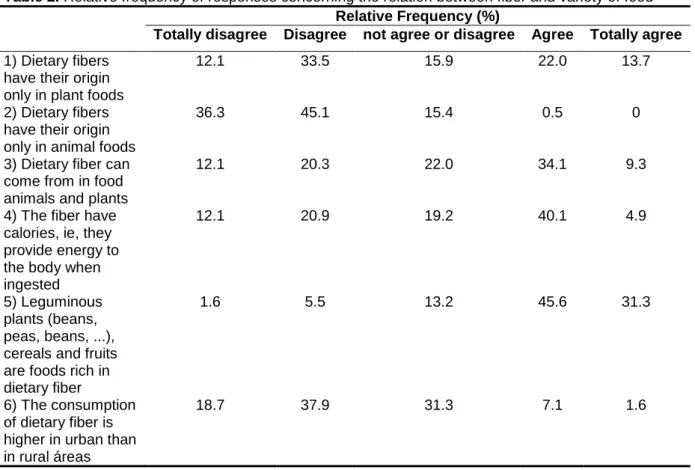
From the analysis of the responses, one can highlight two media considered more appropriate to encourage the consumption of fibre: television (44%) and school (41%), but none of these was identified as where there is usually more information on fibres. In fact, the respondents considered most important the health canters and hospitals as the places with available information on this subject. To the radio was given little importance, because this media was referred less often. It should be noted that health centers, hospitals, television and school are the means of transmission of information considered the most important. Foods have different fiber contents and some of it is not part of the natural food constitution. In this context, it was designed a group of questions in order to evaluate the respondents' knowledge about the food groups that have higher fibre contents (Table 2). The analysis of the responses indicates that respondents do not have consolidated knowledge concerning the origin of the fibers, taking into account that the fiber source is of plant origin and both the results in Table 1 and Table 2 do not evidence this in a clear way.
As it can be seen in Table 2, nearly half of the enquired responded that the fibers have nutritional value. However, this high percentage obtained may not due to effective knowledge about the recent legislation (just over one year) which indicates that the fibers have an average energy value of 8 kJ/g (2 kcal/g) (Dl nº. 54/2010 28/05), but due to the lack of information. Most respondents agreed that legumes, cereals and fruits are rich in fiber. Studies described by Slavin (2008) and Martins et al. (2006) among many other corroborate the opinion of those surveyed. Furthermore, the results did now allow establishing a relationship between fiber intake and the environment of living (rural or urban).
Legend:
1 2 3 4 5 6
- important → + important
Means with information Most appropriate means of dissemination
Table 2. Relative frequency of responses concerning the relation between fiber and variety of food Relative Frequency (%)
Totally disagree Disagree not agree or disagree Agree Totally agree
1) Dietary fibers have their origin only in plant foods
12.1 33.5 15.9 22.0 13.7
2) Dietary fibers have their origin only in animal foods
36.3 45.1 15.4 0.5 0
3) Dietary fiber can come from in food animals and plants
12.1 20.3 22.0 34.1 9.3
4) The fiber have calories, ie, they provide energy to the body when ingested
12.1 20.9 19.2 40.1 4.9
5) Leguminous plants (beans, peas, beans, ...), cereals and fruits are foods rich in dietary fiber
1.6 5.5 13.2 45.6 31.3
6) The consumption of dietary fiber is higher in urban than in rural áreas
18.7 37.9 31.3 7.1 1.6
Another group of questions was delineated to investigate whether the respondents relate the fibre intake with health benefits associated to some types and diseases. According to Figure 2, about 90 % of respondents agree with the fact that fibers can prevent and treat disease.
0 20 40 60
Totally disagree Disagree Not agree or disagree
Agree Totally agree
R e la ti ve F re q u e n cy ( % )
1) Eating adequate amounts of dietary fiber can prevent and treat diseases Figure 2. Relationship between fibre intake and disease
Other questions aimed that respondents could eventually establish a relationship between fiber and some diseases. The prevention and treatment of deficiency in vitamins and minerals or vision problems were the illnesses most commonly mentioned as not having to do with the intake of fibre. On the other hand, the most common diseases related to the benefits of fiber intake were: constipation; (86%), obesity (80%), cardiovascular disease and cholesterol (70%), bowel cancer (69%).
Food labels and nutrition information were also examined. These are consulted by most respondents when buying food products, however there are few that give relevance to the amount of fiber that a food product contains when making their purchase.
CONCLUSIONS
The most relevant results indicate that just over 10% of those surveyed eat two meals with vegetables and/or salad a day and at least three pieces of fruit (recommended intake to achieve the recommended intake is 25 g of fibre/day). Whole grains (bread, pasta...) also showed low levels of consumption, despite the respondents revealing knowledge about their higher fibre contents.
The consultation of food labels is of interest for the majority of respondents, about 80%, but little more than half show curiosity to know the fiber content that the food actually has.
The vast majority of respondents have the notion that fiber intake contributes to the prevention and treatment of diseases. Of the various diseases listed, the most cited were constipation (86%), obesity (80%), cardiovascular disease and cholesterol (70%) and bowel cancer (69%).
With regard to the means of dissemination for information on dietary fiber, school and television were considered the most appropriate media to encourage consumption, but in the opinion of respondents, health centers and hospitals are those where more information is at present available.
This study also revealed that knowledge about fibres and the amounts eaten should be higher than they are now. Furthermore, and despite being given high importance to the fibers in the treatment and prevention of diseases, the intake is actually still very under the recommended amounts.
АCKNOWLEDGEMENTS
The authors thank financial support to the research centre CI&DETS.
REFERENCES
1. Kendall CWC, Esfahani A, Jenkins DJA (2010). The link between dietary fibre and human health. Food Hydrocolloids, 24, 42-48.
2. Cummings JH, Edmond LM, Magee EA (2004) Dietary carbohydrates and health: do we still need the fibre concept?. Clinical Nutrition Supplements, 1, 5-17.
3. Rodríguez R, Jiménez A, Fernández- Bolaños J, Guillén R, Heredia A (2006) Dietary fibre from vegetable products as source of functional ingredients. Trends in Food Science & Technology, 17, 3-15. 4. Honda T, Kai I, O Ludwig DS, Pereira MA, Kroenke CH, Hilner JE, Van HL, Slattery ML (1999) Dietary
fiber, weight gain and cardiovascular disease risk factors in young adults. Journal of American Medical Association, 282(16), 1539-1546.
5. Bobek P, Galbavy S, Mariassyova M (2000) Effect of inuline on nutritional hypercholesterolemia and chemically induced precancerous lesions on rat colon. Bulletin Protravinarskeho Vyskumu, 39(3), 213-221.
6. Park Y, Brinton LA, Subar AF, Hollenbeck A, Schatzkin A (2009) Dietary fiber intake and risk of breast cancer in postmenopausal women: the National Institutes of Health-AARP Diet and Health Study. The American Journal of Clinical Nutrition, 90, 664-671.
7. Gallaher D, Schneeman BO (2003) Fibra alimentaria. In B. Bowman, & R. Russel, Conocimientos actuales sobre nutrición Organización Panamericana de la Salud Publicación Técnica, 592.
8. Guillon F, Champ M (2000) Structural and physical properties of dietary fibres, and consequences of processing on human physiology. Food Research International, 33, 233-245.
9. DGS-direcção Geral de Saúde (2005) A roda dos alimentos, um guia para a escolha alimentar diária!. http://www.dgs.pt (consultado em 06/09/2011).
10. Candeias V (n.a.) Aumente o seu consumo de hortaliças, legumes e frutas. Divisão de Promoção e Educação para a Saúde - Direcção Geral da Saúde (consultado em 06/09/2011).
11. DL - Decreto-Lei nº 54/2010. 28 de Maio 2010. I Série, 104, 1842-7.
12. Slavin JL (2008) Position of the american dietetic association: helth implications of dietery fiber. Journal of the American Dietetic Association. October, 108, 1716-1731.
13. Martins I, Porto A, Oliveira L (2006) Tabela da composição dos alimentos. Instituto Nacional de Segurança Alimentar. Departamento de Alimentação e Nutrição. 1ª edição.