ASILUM: a platform to evaluate advanced combinations of smart
antennas and multi-user detection for UMTS FDD and TDD
L. Hérault1, M. Reed2, N. Voyer3, L. Brunel3, A. Gameiro4, L.M. Correia5, Jörg PAMP6, M. Pesce71
CEA-LETI, France, E-mail: [email protected], corresponding author 2
ASCOM, Switzerland 3
Mitsubishi Electric ITE, France 4
Instituto de Telecomunicações, Portugal 5
Instituto Superior Tecnico / Technical University of Lisbon, Portugal 6
IMST GmbH, Germany 7
Eidgenoessische Technische Hochschule Zürich (ETHZ), Switzerland
ABSTRACT
The purpose of this paper is to present and explain some results of ASILUM1, a project included into IST (Information Society Technologies), a research programme of European Community. This project aims to contribute to the technical innovation and policies of the European Community by validating new transceivers concepts to increase the capacity of UMTS (FDD and TDD modes) through new and efficient interference mitigation schemes. These schemes are jointly using smart antennas and multi-user detection. They have been validated through link and system level simulations.
1 Introduction
Self interference is a known problem in DS/CDMA systems, this will be especially true for 3GPP mobile radio systems that promise high data rates for multi-media applications. The problem is due to the fact that all users send in the same time and frequency band and that the same frequencies are used between all cells. DS/CDMA signals are separated by their individual code, however "conventional" receivers suffer from interference from the other users, as the codes are not orthogonal to each other. In the uplink the codes are not orthogonal to each other due to the unco-ordinated transmission from the different users with different multi-path profiles etc. This problem is minimised by the use of long pseudo random spreading codes which minimise the interference from one user onto another. In the downlink the users signals are transmitted in such a way that they are orthogonal to each other but due to multi-path effects the signals arrive at the terminals in a non-orthogonal way.
Interference in 3GPP systems will be more severe and more problematic than that experienced in 2G CDMA systems like IS-95 because of the utilisation of different data rates by different users. High data rate users will generate a lot more interference than low data rate users, this means less users can be supported in such cells.
The interference not only limits the cell capacity but also the cell radius of the system. The cell radius is also very important to service providers as this determines the cost to cover a town or city. In early deployment of 3GPP coverage is a lot more important than capacity and the benefit that
1 www.ist-asilum.org
interference cancellation and antenna arrays provides can mean that service providers are profitable sooner due to the lower start-up costs.
Two known methods to mitigate interference are antenna arrays and interference canceling multi-user detection. In the work performed by ASILUM the two methods are combined to provide a very powerful receiver combination. The work in ASILUM was split into two logical parts. The first part was to produce single cell results to show the frame error rate and bit error rate performance of the receivers with different user loading.
The results from the link level evaluation are then used as input data to a system level evaluatio n platform. The system level evaluation determines the overall improvement in cell capacity and cell size in the system. Results to date indicate that large cell capacity increases are possible with the use of both interference canceling receivers and antenna arrays. The significance of the work done in ASILUM is of very important to the industry sector as the results show that Ø Interference cancellation techniques are possible
without changing the 3GPP specification for both UTRA-TDD and FDD,
Ø Large cell size increase and capacity increase is possible by using such techniques,
Ø Low complexity solutions for the receiver exist that could be realisable on real-time hardware, and
Ø Solutions to open problems, such as channel estimation, acquisition and tracking have been found, even when the receiver is operating in an extremely high interference environment.
2 Multi-User Receiver Techniques
Multi-user detection (MUD) has been a known method of reducing interference in a multiple users DS/CDMA system since the work of Verdu [Ver86IT]. In this work it was determined that the optimal receiver, which cancels all interference, has a complexity exponential with the number of users. Due to this high complexity and the conflicting requirement to design a high performance receiver a lot of research over the last 15 years has been performed [Ver98]. The aim of the investigations has to be to derive a low-complexity high-performance MUD solution. Each algorithm technique has it's own characteristics and advantages. In the ASILUM project, the most likely techniques have been selected and investigated. Below a quick summary of the
techniques is covered before showing the results for each of the approaches.
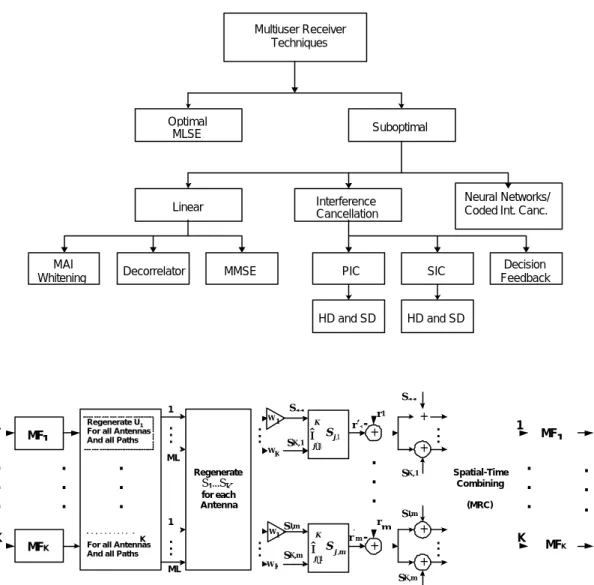
The following diagram shows an overview of possible MUD schemes. Due to complexity constraints only sub-optimal techniques are investigated here.
Multiuser Receiver Techniques Optimal MLSE Suboptimal Linear Interference Cancellation Neural Networks/ Coded Int. Canc.
MAI
Whitening Decorrelator MMSE SIC
Decision Feedback
HD and SD HD and SD
PIC
Regenerate U1
For all Antennas And all Paths
Regenerate U K For all Antennas And all Paths
. . . 1 ML . . . 1 ML . . . Regenerate for each Antenna + + r’1 r’m r1 r m MF1 MFK 1 K . . . . . . W1 W K W 1 W K S 1,1 SK,1 S1,m SK,m Spatial-Time Combining (MRC) + + + + S 1,1 SK,1 S1,m SK,m MF 1 MFK 1 K . . . . . . . . . . . . . . . . . . . . .
-∑
= K j j S 1 1 ,∑
= K j jm S 1 , S1...SKFigure 1: Multisensor PIC Scheme – One stage representation only
A major goal of the ASILUM project is to propose efficient interference mitigation techniques that can operate with the 3GPP standard [3GPP212,3GPP], are practical and provide good performance. The techniques were investigated for both the Time Division Duplex (TDD) and the Frequency Division Duplex (FDD) operating mode. From the above techniques the Parallel Interference Canceller (PIC) [Div98], and a Space-Time Joint Detector [Jun93PIMRC] were investigated for the TDD, Coded Interference Cancellation (Iterative MUD) was investigated for the uplink of the FDD [ReeAle99JSAC]. Due to limited space the details of the techniques are not described in detail here but the reader is referred to the references. Below the multi-sensor PIC and the Iterative MUD results are shown as examples of the performance with the 3GPP standard.
2.1 Multisensor PIC for UMTS-TDD
The PIC structures studied in the present project approach have been considered in several papers [Ney99,Div98], but most of the studies focused their performance in single antenna environments. Therefore, the objective is to extend
this study to a multi-element environment for typical UMTS-TDD scenarios. The specific PIC structures considered are:
Ø One Stage PIC: this structure estimates and subtracts in a single step all the MAI for each of the K users. This is simplest PIC version.
Ø Multistage PIC (two or more stages): with this structure in each stage a decision attempt is made for each user to completely cancel the interference caused by all the other (K-1) users. With this sort of PIC decisions performed in subsequent stages can be considered more reliable. However, for SD_PIC (Soft Decision PIC) that may be not true. Ø Partial PIC: it has been shown that when complete
cancellation (“brute force”) is attempted, a bias arises in the decision statistics. Partial interference cancellation mitigates the negative effects of biased estimation and significant improvement is achieved (especially in SD_PIC).
A multisensor PIC was implemented to evaluate the performance achieved with these three approaches in an
UMTS-TDD uplink. The main objective is select the best PIC approaches under imperfect channel estimation and near far effect situations for UMTS-TDD uplink.
Figure 2: Performance comparison between different PIC structures and a conventional receiver.
The spreading factor was 16, Eb/No=10dB, antenna spacing 0.45 wavelength, with perfect channel estimation and a vehicle speed of 50km/h. As can be seen large performance improvements are possible with a combination of antenna arrays and the PIC structure.
2.2 Multisensor joint detection for UMTS-TDD
A joint detector using multiple antennas has been developed for the uplink of the TDD mode. It has been studied in several papers [BlaPap00VT, JunBla95VT], but a fractionally spaced implementation of the detector described in [BlaPap00VT] has been considered in ASILUM in order to get robustness versus synchronization errors . The principle of the joint detection is to perform a joint demodulation of the received bursts, by using zero -forcing or MMSE equalizers. Compared with a conventional Rake receiver, the joint detector cancels both interference and the multiple access noise. The use of multiple antennas allow to perform a directional channel estimation, which improves the performance in the following ways:
Ø The benefit is all the more important since the directions of arrival of the signals of the different users are different.
Ø If the directions of arrival of the signals of the different emitters are enough distant from each other, the performances do not degrade with the number of emitters.
Ø A fractionally spaced implementation brings a robustness versus synchronization errors.
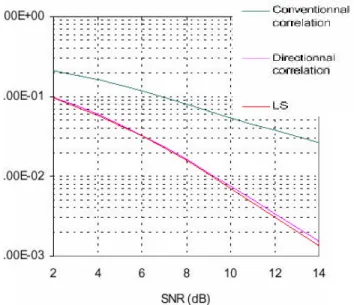
Figure 3 illustrates a comparison of the performances with a conventional Rake receiver, when either a directional correlation or a least square approach is used to estimate the channel. In this example, a linear antenna array with 8 elements is considered. A “Vehicular A” channel model is used, with 8 users and a velocity of 120km/h, when the spreading factor of all emitters is 16. Moreover, the directions of arrival of the signals are supposed perfectly
estimated, the emitters are synchronous, and a fractionally spaced equalization is performed with 2 samples per chip.
Figure 3: Performance comparison between a fractionally spaced joint detection and a conventional receiver.
As can be seen large performance improvements are possible with a combination of antenna arrays and joint detection.
2.3 Iterative Multi-user Detection for UMTS-FDD.
This section is based on the concepts of Iterative Multiuser Detection (IMUD) [ReeSch98TC]. An IMUD uses concepts from turbo codes [BerGla93ICC] or more specifically serial concatenated turbo codes [BenMon96EL], where the CDMA system is viewed as the inner code and the outer code is the code associated with each user. When this system model is used a receiver structure similar to a serial concatenated turbo decoder can be determined which performs detection and decoding in an iterative or multi-stage way.
IMUD techniques have many variations and the complexity of the system depends largely on the implementation selected. In this work we utilize methods [AleGra98ETT, ReeAle99JSAC] as these methods have low computational complexity, where the total complexity increases at a linear rate with the number of users in the system. This type of receiver also allows for easy integration of antenna arrays. This is achieved while still being able to achieve the performance of the optimal receiver.
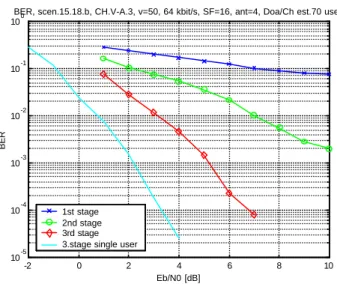
In Figure 4 we show performance results of the receiver. In this example we use the Vehicular A channel model (first 3 taps) with a speed of 50 km/h ("Jakes" fading on each tap), a spreading factor N=16, and 4 antennas. In this system we support K=70 active users. In this case the "conventional" receiver performance (1st Stage) again has severe flooring problems, however the Iterative MUD achieves results (3rd Stage) are within 3dB of the optimum performance (3. Stage single user). This is a remarkable result considering the complexity of the receiver, per user, is independent of the number of users. With this result we have a user to spreading factor ratio of approximately 4.3, which is about
nine times larger than current single antenna DS/CDMA systems available on the market.
-2 0 2 4 6 8 10 10-5 10-4 10-3 10-2 10-1 100
BER, scen.15.18.b, CH.V-A.3, v=50, 64 kbit/s, SF=16, ant=4, Doa/Ch est.70 user
Eb/N0 [dB]
BER
1st stage 2nd stage 3rd stage 3.stage single user
Figure 4: IMUD Performance with N=16, E=4, K=70
3 Integrating Link and System level
simulations
ASILUM simulation methodology consisted in splitting the simulation effort into two simulators.
Ø At microscopic level and with a time resolution in the order of the chip duration, the actual transmitter/receiver digital communication chain is simulated in a Link Level Evaluation Platform (LLEP). LLEP focuses in simulating the actual physical layer of the UMTS system in a specific cell under fixed traffic conditions and fast fading channel.
Ø At macroscopic level, and with a time resolution of few tens of frames, the actual evolution of a mobile radio network is simulated in a System level Evaluation Platform (SLEP). SLEP focuses in simulating all the layers of the UMTS system over a combination of multiple cells, and with varying near-far and traffic conditions.
LLEP and SLEP simulations are complementary. It was felt too complex to simulate an effective radio system with many cells at chip level, as well as inappropriate to simulate upper layers in signal processing tools. On the other hand, it was also felt important to check the impact of algorithms studied in LLEP also at the system level, with soft handover, actual near-far conditions, and realistic inter-cell interference distribution.
Among many other results previously mentionned in this paper, LLEP simulations also aimed at providing figures of merit of the receiver, to be later on used in System Level Evaluation platform (SLEP). SLEP uses a model of the physical layer which contains some parameters measured at LLEP level, so as to fit SLEP model with LLEP simulated reality. The figures of merit are basically
Ø the SINR (Signal-to-Interference-plus-noise) required at the input of the turbo decoder to fulfill a target BER of BLER level,
Ø the multi-user detection factor α, being defined as the ratio between intra-cell MAI power level observed after
the studied receiver and a reference receiver. The reference receiver is chosen arbitrarily as being the optimum Wiener beamforming followed by a conventional RAKE receiver with infinite number of fingers.
It is to be noted that LLEP simulations showed few variation
of the SINR and the α values in multiple MAI
configurations for a given receiver structure.
At SLEP level, the distribution of calls passing over the network is changed dynamically according to traffic generation models. The related mobile stations also change their position according to mobility models. Then, according to consequent near-far propagation variations, the SLEP Radio Resource Management (RRM) module decides the contents of the active set of each mobile station.
Finally, for each near-far call distribution, and the related MS-Cell connectivity, SLEP aims at solving for the power control equation that reflects the physical layer behavior. The unknowns are the transmit power levels Pi of all radio
links. For each radio link, the slow power control loop is assumed to converge, and unless in power saturation cases, the SINR at the output of the single antenna receiver verifies : SelfNoise MAI MAI N PiG SF SINR ext o i f i i = + + + int ) ( , α
SF being the used spreading factor, Gi,k the coupling loss
between the ith mobile station and the kth cell antenna connector. Similarly in beamforming solution, the above equation expresses as + + + =
∑
∑
= ≠ ∀ ≠ ∀ i i i f i i i f j f i j i j i f j j i f j f j i j i f j j o i i i f i i i BF G P BF G P BF G P N BF G P SF SINR , ) ( , ) ( ) ( / , ) ( , ) ( ) ( / , ) ( , , ) ( , β αwhere β is the channel orthogonality factor, BFj,i the gain
observed for the jth signal when applying the Wiener
beamformer solution gi(θ) optimised for the i
th signal : θ θ θ π d g w BFji=
∫
j i 2 0 , ( ) ( )wj(θ) being the spatial channel transfer function observed
for the jth signal. This transfer functions is also used in the link level simulations. To determine these functions, a wideband directional channel has been developed and assessed with channel measurement campaigns [MarCorr01, MarZol01, 3GPP R1#22].
The gain BFi,j strongly depends on the relative spatial
distribution of users, so that it was not possible to model this gain at SLEP level. Instead, SLEP computes the actual optimum Wiener solution gι(θ), obtained as a well known
function of the spatial distribution of the interfering powers
Because gi(θ) and Pi levels are linked together and cannot
be determined separately, SLEP solves for the determination of those levels at once, while respecting the dynamic range of each radio link. To find the effective radio capacity of the system, SLEP increases the offered traffic in the system until the power saturation rate increases to a value for which the global user satisfaction rate gets below a 95% threshold.
4 Conclusions
Single cell results show large performance improvements are possible when combining both interference cancellation techniques and antenna arrays. Antenna arrays inherently provide a noise reduction gain as well as providing interference reduction gains. Multi-user detection provides further improvement by reducing interference from other users further. The main conclusions from the single cell results are that interference cancellation techniques are possible without changing the 3GPP specification for both TDD and FDD, low complexity solutions for the receiver exist that could be realisable on real-time hardware, solutions to open problems, such as channel estimation, acquisition and tracking have been found, even when the receiver is operating in an extremely high interference environment.
A methodology to interface link level simulations with system level simulations has been described. It enables the provision of accurate system-level results of usage of combined beamforming and multi-user detection schemes.
5 References
[Ver86IT] S. Verdú, "Minimum Probability of Error for Asynchronous Gaussian Multiple -Access Channels", IEEE Trans. in Inf. Theory, vol. 32, pp.85-96, Jan. 1986.
[Ver98] S. Verdú, "Multiuser Detection", Cambridge University Press, 1998
[3GPP212] 3G TS 25.212 V3.5.0 "3rd Generation Partnership Project: Technical Specification Group Radio Access Network; Multiplexing and channel coding (FDD)"
[3GPP] www.3gpp.org
[ReeAle99JSAC] M. C. Reed and P. D. Alexander, "Iterative Detection using Antenna Arrays and FEC on Multipath Channels", IEEE Journal on Sel. Areas in Comm., vol. 17, pp.2082-2089, Dec. 1999.
[JunBla93PIMRC, MarZol0] P. Jung, J. Blanz, P. Baier, "Coherent receiver antenna diversity for CDMA mobile radio systems using joint detection", Proc. IEEE Int. Symp. on Personal, Indoor and Mobile Radio Comm. (PIMRC 1993),Yokohama, pp488-492.
[Ney99] S. Neiyer, R. Correal, M. Buehrer and B. D. Woener, “A DSP-Based DS-CDMA Multiuser Receiver Employing Partial Parallel Interference Cancellation” IEEE Journal on Selected Areas in Communications, Vol. 17, No. 4, April 1999.
[Div98] Dariush Divsalar, Marvin K. Simon and Dan Raphaeli, “ Improved Parallel Interference Cancellation for CDMA”, IEEE Transactions on Communications, Vol. 46, No.2, February 1998.
[ReeSch98TC] M. C. Reed, C. B. Schlegel, P. D. Alexander, and J. A. Asenstorfer, "Iterative Multiuser Detection for {CDMA} with {FEC}: Near Single User Performance", IEEE Trans. on Comm. vol. 46, pp 1693-1699, Dec. 1998
[AleGra98ETT] P. Alexander, A. Grant and M. Reed, "Performance Analysis of an Iterative Decoder for Code-Division Multiple-Access", European Trans. on Telecommunications, vol 9, pp 419-426, Sep./Oct. 1998. [BahCoc74IT] L. R. Bahl, J. Cocke, F. Jelinek, and J. Raviv, "Optimal Decoding of Linear Codes for Minimising Symbol Error Rate", IEEE Journal on Inf. Theory, vol.20, pp 284-287, 1974.
[BerGla93ICC] C. Berrou, A. Glavieux, and P. Thitmajshima, "Near Shannon Limit Error-Correcting Coding and Decoding: Turbo-Codes", May, IEEE Int. Conf. on Communications, Geneva, Switzerland, pp 1064-1070,1993 [BenMon96EL] S. Benedetto and G. Montorsi, "Iterative Decoding of Serially Concatenated Convolutional Codes", Electronic Letters, vol. 32, June, pp 1186-1188, 1996
[BlaPap00VT] J.J. Blanz, A. Papathanassiou, M. Haardt, I. Furio, P.W. Baier, "Smart antennas for combined DOA and joint channel estimation in time-slotted CDMA", IEEE Trans. On Vehicular Technology, vol. 49, no.2, pp 293-306, 2000
[JunBla95VT] P. Jung, J.J. Blanz, "Joint detection with coherent receiver antenna diversity in CDMA mobile radio systems", IEEE Trans. On Vehicular Technology, vol. 44, no.1, pp 76-88, 1995
[MarCorr01] G.Marques and L.M.Correia, "A Wideband Directional Channel Model for UMTS Micro-cells", Proceedings of PIMRC2001 – 12th IEEE International Symposium on Personal, Indoor and Mobile Radio Communications, San Diego, California, USA, Sep. 2001. [MarZol01] G.Marques, E.Zollinger, J.Kunisch, S.Weitz, J.Siemons, J.Pamp, and L.M.Correia, "Modelling and Measuring Wideband Directional Channels for UMTS Micro-cells", IST Mobile Communications Summit, Barcelona, Spain, Sep. 9-12, 2001
[3GPP R1#22] "Micro-cell Wideband Directional Channel Model", 3GPP TSG RAN WG 1, document TSG R1#22 R1-01-0992, New York City, NY, USA, October 23 – 26, 2001,
www.3gpp.org