Understanding the role of influencers’
credibility in social media and its impact on
consumers’ purchase intentions
Joana Nascimento
Dissertation written under the supervision of Professor Daniela
Langaro
Dissertation submitted in partial fulfilment of requirements for the MSc in
Management with specialization in Strategic Marketing at the Universidade
i
CATÓLICA Lisbon School of Business and Economics
Understanding the role of influencers’ credibility in social
media and its impact on consumers’ purchase intentions
by Joana Nascimento June 2019
Abstract
Digital media and the internet, in particular, have developed into a massive vehicle for consumer-generated communications. In these contexts, consumers are no longer only passive subjects in the marketing exchange process. Else than consuming content, they increasingly create, share and distribute information to other consumers through digital platforms.
The fast growth of social media over the last decades has boosted the adoption of influencer marketing. This type of marketing brought companies new opportunities to expose themselves and strengthen relationships with customers. However, there is some lack of knowledge regarding the drivers that influence the effects of the influencer. In this sense, the current dissertation intents to understand how the characteristics of digital influencers, concerning various dimensions of credibility, affect the consumers' purchase intentions, comparing low and high product involvement. The present study was developed in an exploratory and quantitative way, in which a survey was conducted with 1924 valid responses obtained.
The final results indicate that, for low-involvement products, all the credibility related characteristics, namely expertise, trustworthiness, attractiveness and popularity, influence consumers' purchasing intentions. Moreover, it was confirmed that an increase in the influencer’s credibility might increase the user’s purchase intentions. Contrarily, for high-involvement products, only trustworthiness and attractiveness affect purchase intentions, and increases in the credibility of the influencer might not have such a significant impact on purchase intentions.
Keywords: social media networks, digital influencers, product involvement, purchase intention.
ii CATÓLICA Lisbon School of Business and Economics
Entender o papel da credibilidade dos influenciadores
nas redes sociais e o seu impacto na intenção de
compra dos consumidores
por Joana NascimentoJunho 2019
Resumo
Mídia digital e a internet, em particular, transformaram-se num veículo massivo para as comunicações geradas pelos consumidores. Nestes contextos, os consumidores deixaram de ser apenas agentes passivos no processo de troca no marketing. Mais do que consumir conteúdo, eles cada vez mais criam, partilham e distribuem informações através das plataformas digitais.
O rápido crescimento das redes sociais nas últimas décadas impulsionou a adoção do marketing de influência. Este tipo de marketing trouxe novas oportunidades para as empresas se exporem e fortalecerem relações com os seus clientes. No entanto, existe alguma falta de conhecimento sobre os drivers que influenciam os efeitos dos influenciadores.
Neste sentido, a presente dissertação foi desenvolvida com o intuito de compreender de que forma as características dos influenciadores digitais, no que diz respeito a várias dimensões de credibilidade, afetam as intenções de compra dos consumidores, comparando baixo e alto envolvimento com o produto. O estudo atual foi desenvolvido de forma exploratória e quantitativa, no qual foi realizado um inquérito com 1924 respostas válidas obtidas.
Os resultados finais indicam que, para produtos de baixo envolvimento, todas as características relacionadas com a credibilidade, nomeadamente perícia, fidedignidade, atratividade e popularidade, influenciam as intenções de compra dos consumidores. Além disso, foi confirmado que um aumento na credibilidade do influenciador poderá aumentar as intenções de compra dos consumidores. Pelo contrário, para produtos de alto envolvimento, apenas a fidedignidade e atratividade afetam as intenções de compra, e um aumento da credibilidade do influenciador poderá não ter um impacto significativo nas intenções de compra.
Palavras-chave: redes sociais, influenciadores digitais, intenção de compra, envolvimento de produto.
iii Acknowledgements
First and foremost, I would like to thank my thesis supervisor, Daniela Langaro, for all the support, advice and knowledge that was shared with me throughout this process. Thank you for guiding me and helping me find solutions when I was lost!
Secondly, I have to express my profound gratitude to my family, especially my parents, who are the most important pillar in my life. They always helped me either personally and emotionally, and academically and financially. They always told me to follow my dreams and that I can do everything, unless I don’t want to.
Moreover, I also want to thank my sisters, Constança, Leonor and Inês for distracting me from the stressful moments of the thesis, forcing me to play with them. I will always be an example to them, and they will always be my little babies. Thank you also to the other members of the family who have always encouraged me to continue.
Additionally, I would like to thank to all my friends for all the help, motivation, fun times that I will never forget. I am grateful to my friends who have been with me since the high school, Sofia Batista and Mariana Serras, for continuing with me throughout these years, taking care of my (sometimes complicated) character, for all the patience, advice and memorable moments. To my friends and colleagues, Sara Pereira, Sofia Gomes, Inês Rodrigues, Inês Coelho, Maria Miguel Félix, Carolina Sá Pereira, whom I met in the first year of Católica and who continue with me. Thank you for all the possible escapades from Católica, for the sharing notes, theories, knowledge and most importantly, thank you for never giving up on me. To my friends from the North, Tiago Pontes Silva and Gonçalo Rodrigues, for being the funniest boys I’ve met in Católica and for giving me some fun times. Thank you also to my friends who made Erasmus with me, especially Bárbara de Sousa, Cláudia Carvalho, Francisco Piteira and Nuno Barreiros for helping me and supporting me in difficult times.
Further, I would like to thank my little and crazy dog for being with me at home while I was doing my thesis. For all the sloppy kisses she gave me when I was upset.
Last but not least, I want to thank a very special blogger, whose name is confidential, for helping me to spread my survey with her followers. I have no words to thank for her genuine gesture.
v List of Contents
1. Introduction ... 1
1.1. Background ... 1
1.2. Problem statement ... 2
1.3. Academic and managerial relevance ... 3
1.4. Dissertation Outline ... 4
2. Literature review ... 5
2.1. Social Media Marketing ... 5
2.1.1. Social media users and Main Social Media Platforms ... 6
2.1.2. Main SM platforms in Portugal ... 8
2.1.3. The importance of Social Media - Benefits for Businesses ... 8
2.2. Influencer marketing ... 9
2.2.1. Social media influencers ... 10
2.3. Theories that help explain the interaction between influencers and consumers . 11 2.3.1. Social Influence Theory ... 11
2.3.2. Social Learning Theory ... 14
2.3.3. Source Credibility Model ... 15
2.3.4. Source Attractiveness Model ... 18
2.3.5. Popularity ... 19
2.4. Product Match-Up Proposition ... 20
2.5. Product involvement ... 21 2.6. Purchase intention ... 22 2.7. Conceptual framework ... 23 3. Research methodology ... 24 3.1. Research objective ... 24 3.2. Research approach ... 24
3.3. Pre-test – influencer and product selection ... 25
3.4. Data Collection and Sample ... 26
3.5. Measurements ... 26
3.6. Procedure ... 28
vi
4.1. Data Collection and Data Cleaning ... 30
4.2. Sample description ... 30
4.3. Measures validation ... 31
4.4. Principal Component Analysis ... 32
4.5. Variables added ... 34
4.6. Normality tests ... 34
4.7. Correlation Analysis ... 36
4.8. Hypotheses Analysis ... 37
5. Discussion and Conclusions ... 42
5.1. Theoretical and Managerial implications ... 44
5.2. Limitations and Future research ... 46
6. References ... 48
7. Appendices ... 60
Appendix 1. Pre-test analysis ... 60
Appendix 2. Survey ... 62
Appendix 3. Survey statistics ... 75
Appendix 4. Descriptives and Measurement items statistics ... 77
Appendix 7. Correlation Analysis ... 85
viii
List of Figures
Figure 1. Number of social media users worldwide from 2010 to 2021 (in billions) Figure 2. Most popular social networks worldwide as of January 2019, ranked by number of active users (in millions)
Figure 3. Conceptual Framework Figure 4. Survey Flow
ix List of tables
Table 1. Summary of the distinction between the three processes Table 2. Source Credibility Scale
Table 3. Popularity Scale
Table 4. Willingness to buy Scale Table 5. Product Involvement Scale Table 6. Summary construct statistics
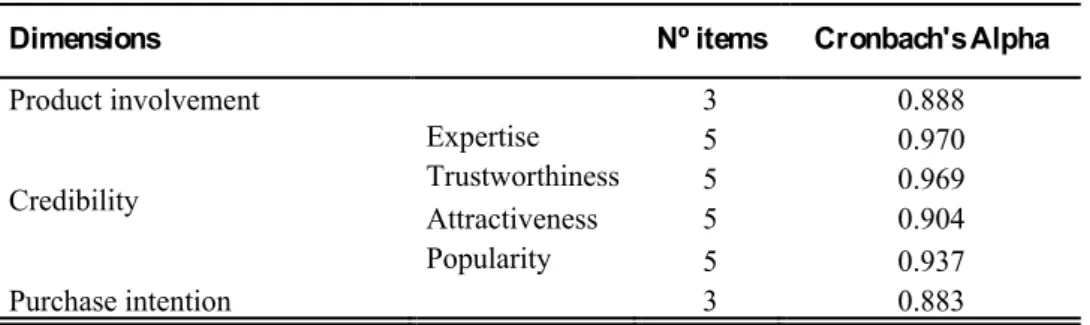
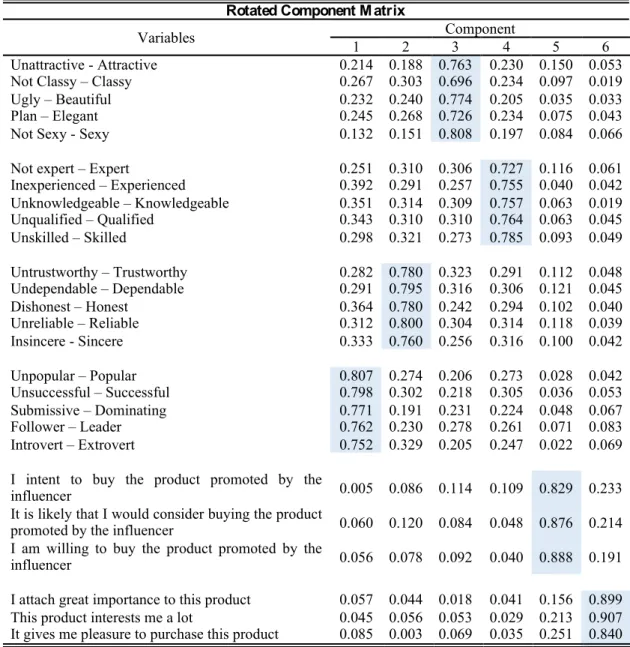
Table 7. Reliability analysis – Cronbach’s Alpha test Table 8. Rotated Component Matrix
Table 9. KOM and Bartlett’s Test
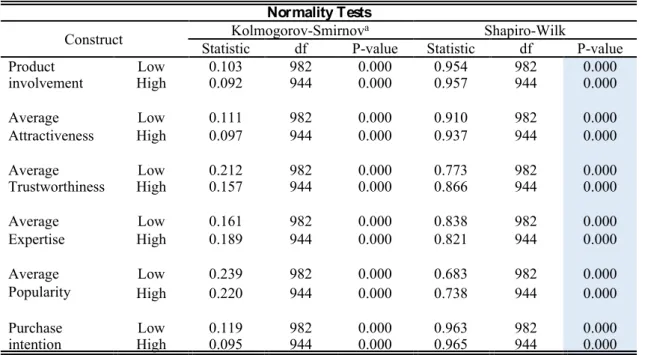
Table 10. Normality tests - Kolmogorov-Smirnov and Shapiro-Wilk
Table 11. Independent-Samples Mann-Whitney U Test – Product involvement Table 12. Summary of Pearson Correlation’s Analysis
Table 13 a). Multiple linear regression – Low involvement product Table 13 b). Multiple linear regression – High involvement product
Table 14. Independent-Samples Mann-Whitney U Test – Purchase intention Table 15. Summary of the findings
Table 16. Pre-test – Influencer Statistic Descriptive
Table 17. Pre-test – Product involvement Statistic Descriptive Table 18. Pre-test – Demographic statistics: age and gender
Table 19. Demographic statistics: age, gender, school degree and nationality Table 20. Frequencies: age, gender, school degree and nationality
Table 21. Descriptive statistics: social media Table 22. Frequencies: social media
Table 23. Construct measures and estimates Table 24. Total variance explained
Table 25 a). First Factor – Product involvement Table 25 b). Second Factor – Average Attractiveness Table 25 c). Third Factor – Average Trustworthiness Table 25 d). Fourth Factor – Average Expertise Table 25 e). Fifth Factor – Average Popularity
x
Table 25 f). Sixth Factor – Purchase intention Table 26. Pearson Correlation’s Analysis
Table 27 a) Multiple linear regression [low involvement] – Model Summary Table 27 b) Multiple linear regression [low involvement] – ANOVA Table Table 27 c) Multiple linear regression [low involvement] – Table of Coefficients Table 28 a) Multiple linear regression [high involvement] – Model Summary Table 28 b). Multiple linear regression [high involvement] – ANOVA Table Table 28 c) Multiple linear regression [high involvement] – Table of Coefficients
xi List of graphics
Graph 1. Histogram Graph 2. Dispersion
xii
List of abbreviatures
UCG. User Generated Content SM. Social Media
IM. Influencer Marketing SMM. Social Media Marketing SMI. Social Media Influencers CGM. Consumer-Generated Media SIT. Social Influence Theory SLT. Social Learning Theory
ELM. Elaboration Likelihood Model PI. Purchase intention
LIP. Low Involvement Product HIP. High Involvement Product
1 1. Introduction
1.1. Background
In more recent years, the world saw a growth in the popularity of powerful new tools related with the improved capacity of the internet to handle 2-way interaction, blogs, wikis and social networks (Newman 2009). These new tools can be grouped as Social Media, often associated with Web 2.0 and User Generated Content (UGC).
The 21st century is witnessing a boost of internet-based messages conveyed through social media. Social media became the main factor in leveraging diverse consumer behaviors’ elements, information acquisition, comprising awareness, attitudes, opinions, purchase behavior, and post-purchase communication and evaluation (Mangold and Faulds 2009). Furthermore, SM constitutes an important component of the marketing communication mix of companies once in a traditional sense, it enables communication between businesses and consumers, and in a nontraditional sense it enables consumers to communicate to each other (Maghsoodi, Naami and Vakilinia 2012).
The emergence of social media, that has triggered new ways of connection between brands and consumers, created the boom of influencer marketing. Influencer marketing accentuates the use of influencers to drive a brand’s message to reach the target audience (Smart Insights 2017). Nowadays, many brands are investing in influencer endorsement rather than celebrity endorsement. Now, it is possible to find people representing brands on their social media accounts, such as Facebook, Instagram, Twitter, or YouTube.
Alongside with social media, a new type of celebrity was generated. Past research refers to this new type as ‘micro-celebrities’, who work under the online environment (Khamis, Ang, & Welling, 2016).
The most popular social media platform where these micro-celebrities are present is Instagram, however, they are also present on Facebook, Twitter, and YouTube. (Djafarova & Rushworth, 2017; Gageler & Van der Schee, 2016).
Following a Nielsen marketing study, influencer marketing yields “returns on investments” (ROI) 11 times higher as compared to digital marketing, which means that, in these days, investing on social media influencers is truly an important strategy.
Building strong and significative relationships with customers take time and involve interactive conversations (Hoffman and Fodor 2010). Consumers perceive social media as a more trustworthy source of information respecting products and services (Foux, 2006). Also, since consumers tend to perceive friends and influencers they follow more credible than distant
2
sellers (Neilsen 2013; Jonas 2010), brands are looking for partner alliances with influencers who should fit with the brand’s values and the target audience.
Indeed, if social media did not exist, social media influencers would not accomplish the fame they achieved today.
1.2. Problem statement
The problem this thesis strives to understand is the impact of using social media influencers on the consumers’ purchase intention.
Additionally, the objective of the study relies on understanding the role of credibility, i.e., the characteristics (trustworthiness, expertise, attractiveness, and popularity) of the influencer that leads to successfully endorse her/him products.
To add some complexity to the research, it came to the idea of comparing the purchase intentions between products of two different involvement levels. The idea came from the fact that not all the products are the same and consumers do not attach the same level of importance to them.
Then, the research aims to understand if the effects of using influencers differ according to the degree of involvement, high vs low involvement product category.
To commence, it is important to explain the differences between the two product involvement categories. On one hand, low involvement products are products in which the consumer does not need to think hard before buying them. There is no risk associated and consequently, the decision-making process is much faster. On the other hand, high involvement products are products in which the decision-making process and the buying decision are extensive and are influenced by several variables.
In order to acknowledge how the role of the credibility of the influencer influences the consumer’s purchase intention, the following research questions (RQ) are put forward:
RQ1: Does the trustworthiness of the influencer have an impact on user’s purchase intention regarding the brands that are endorsed?
RQ2: Does the expertise of the influencer have an impact on user’s purchase intention regarding the brands that are endorsed?
RQ3: Does the attractiveness of the influencer have an impact on user’s purchase intention regarding the brands that are endorsed?
3 RQ4: Does the popularity of the influencer have an impact on user’s purchase intention regarding the brands that are endorsed?
RQ5: What are the effects on the research questions mentioned above when the level of involvement is considered?
1.3. Academic and managerial relevance
The media landscape has been dramatically changed over the last ten years (Mangold and Faulds, 2009), and companies have adopted social media as a way to better connect with their customers (Kumar et al 2016).
The rapid growth of technology and the appearance of the internet brought many advantages for the society and economy as well. It allowed people to be connected with friends and acquaintances, share content (Giannakos et al. 2013) and exposed a new global market where space barriers and time don’t exist (Racolta-Paina & Luca, 2010). It is important for firms to update themselves, follow technological trends and be aware that social media networks are dynamic platforms. (Akar & Nasir 2015).
Unlike celebrity endorsements, influencer endorsements have received little attention regarding its potential impact on advertising effectiveness.
To understand the emergence of a new consumer profile, called the “online consumer”
(Racolta-Paina & Luca, 2010), companies should explore the role that influencers have on social media and how the interaction between them and customers influence the consumer’s purchase intention.
Moreover, this study hopes to provide a complete understanding of measuring social media influencers’ efficiency through the use of three concepts: source credibility model (Hovland and Weiss, 1951), source attractiveness model (McGuire 1985), product match-up hypothesis (Forkan 1980; Till and Busler 1998; 2000); Kamins 1989, 1990).
Contrary to the models stated above, the popularity of the influencer was little studied in the past due to the novelty of the topic. As a result, this thesis intends to overfill this gap and contribute with meaningful insights.
In the end, marketers should know which social media influencer to choose to better fit the target audience and which degree of involvement (low vs high) are consumers more willing to follow the influencer and buy the product.
4
In conclusion and since social media influencers is a hot and recent topic, there is a lack of studies in the past about them. This dissertation aims to provide relevant managerial implications for determining the consumers’ behavior towards the use of influencers by brands. Analyzing the impact that influencer marketing has on consumer’s brand attitude and purchase intention, it helps marketers and advertisers to understand with whom the brand may associate with.
Thereby, it is fundamental for brands to connect with an influencer who is well-liked by their audience to endorse their products (De Veirnman et al 2017). When a company makes a partnership with social media influencers, the image the brand benefits from them helps to build direct relationships with key consumers and enhances brand loyalty.
1.4. Dissertation Outline
The flow of this dissertation is as follow: first, it starts by presenting the introduction, concerning the background, problem statement and academic and managerial relevance. Second, it provides the results of an extensive literature on social media marketing and influencer marketing. Perceived credibility, purchase intention, and product involvement are also mentioned in this chapter. Research questions arise based on this literature review, which respects the purpose to understand the relationship among these constructs.
The third chapter is dedicated to the methodology used to collect data required to answer the research questions and test the hypotheses. Afterward, primary data is presented, and the results are discussed and analyzed.
Finally, the last chapter concludes with the main findings and conclusions of the study, followed by theoretical and managerial implications, ending up with some limitations that provide recommendations for future research.
5 2. Literature review
2.1. Social Media Marketing
The emergence of Internet-based social media has been changing the way companies communicate and create bonds with consumers (Hennig-Thurau et al. 2010). It is also facilitating consumer-to-consumer communications (Mangold and Faulds 2009) and especially stimulating communication between unknown people (Duan et al., 2008).
The change from the old-way communication to the interactive two-way communication had allowed brands to work closely with their customers to generate new products, business models, services and values (Kim & Ko 2012).
Social media (SM) can be described as “the space, consisting of a plurality of platforms and implications that enable online interactions between people or people and companies/brands characterized by specific actions and the expression of any type of user-generated content (photos, videos, text, etc)” (Pachitanu 2016).
According to Mangold and Faulds (2009: 358), social media covers “a wide range of online, word-of-mouth forums including blogs, company-sponsored discussion boards and chat rooms, consumer-to-consumer e-mail, consumer product or service ratings websites and forums, Internet discussion boards and forums, moblogs (sites containing digital audio, images, movies, or photographs), and social networking websites.”
SM is a group of online applications with the goal of encouraging interactions, collaborations and sharing of information (Richter & Koch, 2007). This form of media is increasing exponentially and replacing the traditional media (Bruhn, Schoenmueller and Schäfer 2012). It has been adopted not only by social networkers but also by business firms and governmental organizations (Kim & Ko 2012).
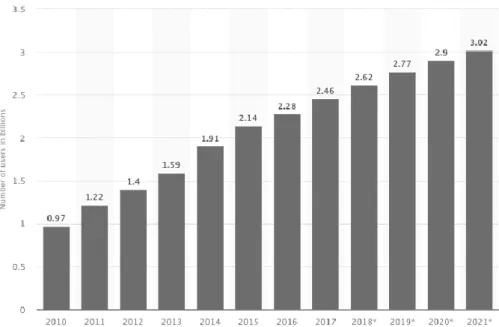
Recent business reports have shown that there are 4.02 billion of internet users, 2.62 billion of social media users and the total spending on social media advertising represented 34,5% of digital advertising in 2017 (Hootstuit 2018, Statista 2019).
Social media is a crossbreed component of the promotion mix since it blends attributes of the traditional Integrated Marketing Communication (IMC) tools, i.e., companies interacting with consumers, with an extreme form of word-of-mouth, i.e., consumers interacting with each other (Mangold and Faulds, 2009).
6
Web 2.0 and User-Generated Content
Kaplan & Haelein (2010) stated that SM is a set of online applications that build on the technological and ideological basis of Web 2.0 and that allow the creation and exchange of User Generated Content (UGC).
Usually, there is a confusion between these two terms, and therefore it is important to clarify them.
Web 2.0 is a term that was first used in 2004 to define a new way in which software developers and end-users started to utilize the ‘World Wide Web’. (Kaplan and Haenlein 2010). This term allows users to share information and communicate with other people. In theoretical words, Web 2.0 refers to the evolution from fixed HTML Web pages to a more organized Web that provides Web applications to users.
User-generated content (UGC), which achieved broad popularity in 2005 (Kaplan and Haenlein 2010) is also recognized as consumer-generated media (CGM) and relates to any material created and uploaded to the internet by non-media professionals (Maghsoodi, Naami and Vakilinia 2012). UGC is changing the way people interact with the internet and the ways advertisers touch those people.
2.1.1. Social media users and Main Social Media Platforms
The statistics represented in Figure 1 show the number of social media users worldwide between 2010 and 2016 with a projection until 2021. In the current year (2019), the number of users is estimated to be around 2.77 billion.
According to Nielsen (2009a), 70% of online users trust the evaluations of other consumers on social media platforms.
The graphic represented in Figure 2 provides information on the most popular networks around the globe, ordered by the number of active users. The market leader is Facebook with 2.27 billion monthly active users. This social media platform enables users to share deeper information (Kotler 2012) and according to Mochon et al (2017), Facebook likes are more effective when adopted by a firm at the beginning of promotional communication.
Followed by Facebook is the video-sharing platform YouTube with 1.90 billion monthly active users.
In the sixth position is the photo-sharing app Instagram, with 1 billion monthly active accounts. Regarding eWOM purposes, this platform fits very well since products and brands can be visually imaged and named in the photo itself.
7
Figure 1. Number of social media users worldwide from 2010 to 2021 (in billions)
Source: Statista 2019
Figure 2. Most popular social networks worldwide as of January 2019, ranked by number of active users (in millions)
8
2.1.2. Main SM platforms in Portugal
As reported by PORDATA, in 2017, there were around 10.29 million of citizens in Portugal, within which 7.20 million (70% of the population) are internet users and 6.10 million (59% of the population) are active social media users (Adcombo 2017).
The most active social media platforms in Portugal are the market leader, Facebook with 72.93% of active users, followed by Pinterest 9.88%, Instagram 8.81%, Twitter 3.96%, YouTube 2.28%% and Tumblr with 1.35% (StatCounter April 2019).
Focusing on two main SM platforms, Facebook and Instagram. In August 2017, a study reported that there were 5.9 million Facebook users (aged 13+), 51% female and 49% male. It was also possible to notice a concentration of users between 35 and 44 years old, representing 24% of active users. (NapoleonCat.com 2017)
Regarding Instagram, in 2017 it had 2.7 Million active users, 52% female and 48% male. Contrarily to Facebook, the age group with more users were between 18 and 24 years old, representing 31% of active users. (NapoleonCat.com 2017)
2.1.3. The importance of Social Media - Benefits for Businesses
Social media marketing (SMM) is often associated with relationship marketing, as companies no longer “try to sell their product” but instead “try to connect with their customers”. (Gordhamer, 2009).
Initially, firms were a little averse to the use of technology, nevertheless, the rise of social media, which has brought many advantages for both brands and consumers, turned technology into an opportunity rather than a threat (Kim & Ko 2012).
Due to the richness and features of social media, companies have recognized the potential of using social media as an essential marketing tool to attract new customers (Arum & Sung 2018) and reduce injury and misconceptions towards brands (Kim & Ko 2012).
In this context, through social media, firms can gain competitive advantage (Li et al. 2007), by encouraging customers to understand better and involve deeply with the brand (Arum & Sung 2018).
Consequently, the use of this type of marketing requires fewer investment costs (Bruhn et al 2012), is simpler at gathering and accessing consumer-to-consumer communication (Godes and Mayzlin 2004) and demands less effort compared to traditional marketing.
Finally, according to McKee (2010), SMM allows companies to build brand loyalty through conversation, networking, and community building.
9 2.2. Influencer marketing
The rise of social media has introduced new channels for companies to interact more directly and organically with consumers. Now it is time for companies to use influencer marketing in their communication strategies to better target their audience.
Influencer marketing (IM) has been existing in companies for many years, however incorporating social media is a new phenomenon.
Brown and Hayes (2008) refer to influencer marketing as strategies and activities through individuals who have influence and/or power over the actual or potential target customers. This type of marketing focuses on using influencers to carry a brand’s message to reach customers. (Smart Insights 2017).
According to Gretzel and Yoo (2013), when compared to traditional marketing, IM demands consumers being more active and energetic in producing and distributing marketing messages to generate influence.
Influencer marketing using social media has changed the way companies decide their communications strategies (Palmer et al 2014). The fast growth of SM platforms over the last decades led to a reduction of managers and marketer’s control of brand management (Berthon et al., 2007). Since consumers have the opportunity to talk and share content with hundreds or even thousands of other consumers, companies are no longer in the control of brand communication (Bruhn et al 2012).
Indeed, it is known that influencer marketing is a powerful method to reach and engage with the target segment and influence their purchase intentions (eMarketer, 2017).
Nowadays, with the increase of social media users, companies each time more are adopting the influencer marketing to promote their products. A recent study made by SocialPubli (2019), with a sample of 150 brands from Spain, Portugal, USA, Colombia, Mexico and Peru, showed that 80% of the brands assume that influencer marketing is important, in some respects as the products’ launch (34,2%) and content generation (35,4%).
Additionally, more studies found that, on average, 80% of online marketers confirmed that social media influencers are potential endorsers, boosting their online businesses to large levels (Forbes 2017).
10
2.2.1. Social media influencers
In recent years, the world has shifted to social media and consumers are looking to other consumers and favorite personalities instead of looking to companies, as they did in the past (Talaverna 2015)
During the last decade, companies have instituted social media influencers as potential endorsers since they generate eWOM (electronic Word-of-Mouth) compared to fellow marketing strategies (e.g., celebrity endorsement) (Forbes 2017; Patel 2016; Talaverna 2015). According to Freberg et al. (2011), social media influencers (SMI) are individuals representing an independent third-party endorser who can shape the audience through the use of social media platforms. These individuals are on the consumers’ social graph and can directly or indirectly impact the consumers’ behavior (Brown & Hayes, 2008). Due to their ability of persuasion, SMIs are particularly invited to be brand ambassadors, disclosing information about the products and updating online followers about the latest promotions (Liu et al. 2012; Markethub 2016).
Since social media influencers promote brand’s products through their personal lives, they tend to be perceived by consumers as more sincere (Tapinfluence 2017), credible (Buyer 2016) and reliable (Talaverna 2015).
Overall, brands use these powerful people to occupy a grey zone between firms and consumers and to deliver in a more efficient and trustworthy way the marketers’ messages.
Several benefits of using social media influencers have been highlighted. Brands are giving up traditional marketing and increasingly focusing on influencers to endorse their products (Veirman et al 2017). These endorsements are understood as more credible eWOM (electronic Word-of-Mouth) rather than paid advertising (Abidin 2016). Also, due to their higher credibility and authenticity, these endorsements lead to higher message acceptance from consumers. (de Vries, Gensler, and Leeflang 2012).
Since these personalities have built a considerable social network of followers, they maximize the information diffusion (Weimann 1994; Keller and Berry 2003), influencing an extremely large number of others (Gladwell 2000).
Types of influencers
In the social media context, influencers are recognized based on their type and level of engagement with the brand and their capability to influence others (Gretzel & Yoo, 2013). According to McQuarrie, Miller, and Phillips (2013), influencers can be distinguished between grassroots influencers (regular people who lack the professional knowledge and experience and
11 do not hold an institutional position) and designated celebrities (professionals with institutional positions).
Considering the number of followers, SMIs are categorized as micro influencers (up to 10,000 followers) and macro influencers (up to 250,000 followers) (eMarketer, 2017).
2.3. Theories that help explain the interaction between influencers and consumers
Manifold factors influence the purchase decision or intention of customers. The existing literature proposes that influencer endorsement, as well as celebrity endorsement, mainly strengthens the consumer’s intention to purchase.
The credibility of an endorsement person has been examined from many perspectives: source expertise (Maddux and Rogers, 1980; Wood and Kallgren, 1988), source attractiveness (Chaiken, 1979; Joseph, 1982; Patzer, 1983; Kahle and Homer, 1985), and celebrity status (Petty, Cacioppo, and Schumann, 1983).
In 1953 Carl I. Hovland and his associates first introduced the Source Credibility Model, followed by three additional models: Source Attractiveness Model (McGuire 1985), the Product Match-Up Hypothesis (Forkan 1980; Kamins 1989,1990) and the Meaning Transfer Model (McCracken 1989).
Source Credibility Model and Source Attractiveness model both reflect and inform the research of the Social Influence Theory / Source Effect Theory (Kelman 1961, Meenaghan 1995).
2.3.1. Social Influence Theory
Social influence theory (SIT) explains how the presence and behavior of others influence an individual (Latané 1981).
Since its beginning, experimental social psychology has been focusing on the study of social influence. In this extent, it is possible to categorize three general research traditions:
(1) “The study of social influences on judgments, stemming from the earlier work on prestige suggestion;
(2) The study of social influences arising from small-group interaction (3) The study of social influences arising from persuasive communications” (Kelman 1961: 60,61)
In his study, Kelman (1958) argued that an individual engages in different basic processes when adopting an induced behavior. The author distinguished three unique processes of social influence called compliance, identification, and internalization.
12
Compliance
Kelman (1958;1961) claims that compliance occurs when an individual adopts influence from another person or group because (s)he expects to attain a positive reaction from the other person or group. The individual does not accept the induced behavior because (s)he believes in its content, but because (s)he is interested in achieving particular rewards or approval and in avoiding specific punishments or disapproval from the influencing agent.
Hence, the satisfaction resulting from compliance is a result of the social effect of accepting influence.
Identification
Another process is identification, which, accordingly to Kelman (1958;1961), occurs when an individual accepts influence from another person or group because (s)he wants to adopt the behavior associated with a satisfying self-defining relationship to this person or group.
The author defines a self-defining relationship as a role relationship that creates a part of the self-image of a person. The self-defining relationship that an individual attempts to establish or maintain through identification may take diverse forms. It may take the form of classical identification, in which the individual assumes the control of all or part of the role of the influencing agent. It also may take the form of reciprocal role relationship, in which the individual is involved in a mutual relationship with another agent (e.g. a friendship between two people), or the individual ratifies a social role which is described concerning another (reciprocal) role (e.g. the relationship between patient and doctor).
This process is identical to compliance since the individual does not assume the persuaded behavior because its content is quite irrelevant and inherently satisfying. However, identification diverges from compliance, in that the individual truly believes in the opinions and responses (s)he adopts.
The behavior is approved both privately and publicly, and its exhibition does not depend on the observability by the other, but it depends on the function an individual take at any moment.
Internalization
Lastly, the internalization process. According to Kelman (1958;1961), internalization occurs when an individual approves influence because the induced behavior is consistent with his/her value system, and its content is intrinsically rewarding.
(S)He adopts the behavior since it might be convenient for the solution of a given problem, it might be favorable to his/her orientation or demanded by his/her needs/values.
13 The behavior adopted through internalization is integrated with the existing values of an individual. It turns to be part of an individual system, and its demonstration relies on neither the activation of the relevant function nor on the observability of the influencing agent, but on the degree to which the values have been made significant by the issues under concern.
Antecedents and consequents of the three processes
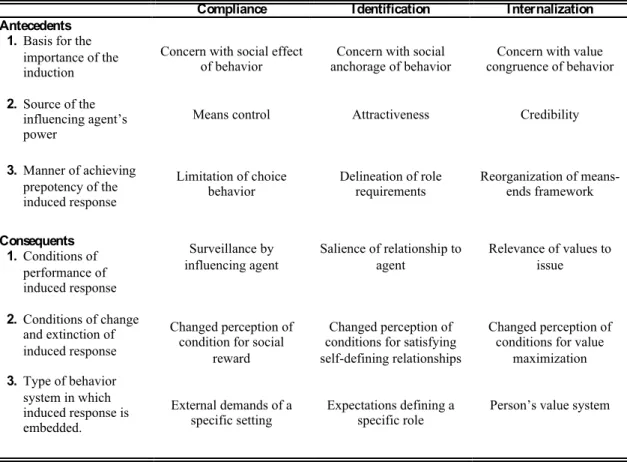
It should be highlighted that these three processes are not mutually exclusive, and each process is represented by a distinctive set of antecedents and a distinctive set of consequent conditions, comprising a specific qualitative variation of a broad set of determinants (summarized in table 1).
First, starting with the antecedents of the three processes, it should be addressed that between them no systematic quantitative differences are hypothesized. The probability of accepting influence is determined as a function of three determinants: “the importance of the induction for the individual’s goal achievement, the power of the influencing agent, and the prepotency of the induce response”.
The processes differ according to the qualitative form that the determinants take. As it is possible to see in the table below, they differ in terms of: “the basis for the importance of the induction, the source of the influencing agent’s power, and the manner of achieving prepotency of the induced response”.
Afterward, depending on the nature of the three antecedents, the influence process will take the form of compliance, identification or internalization.
Each process correlates to a distinctive pattern of internal reactions (thoughts and feelings) in which the individual involves as (s)he accepts influence.
Finally, the consequential changes will be different for each of the three processes. They will differ depending on: “the conditions of performance of induced response, conditions of change and extinction of induced response, and type of behavior system in which induced response is embedded”.
14
Table 1: Summary of the distinction between the three processes
Compliance I dentification I nternalization Antecedents
1. Basis for the
importance of the induction 2. Source of the influencing agent’s power 3. Manner of achieving prepotency of the induced response
Concern with social effect of behavior
Means control
Limitation of choice behavior
Concern with social anchorage of behavior
Attractiveness
Delineation of role requirements
Concern with value congruence of behavior Credibility Reorganization of means-ends framework Consequents 1. Conditions of performance of induced response 2. Conditions of change and extinction of induced response 3. Type of behavior system in which induced response is embedded. Surveillance by influencing agent Changed perception of condition for social
reward External demands of a specific setting Salience of relationship to agent Changed perception of conditions for satisfying self-defining relationships Expectations defining a specific role Relevance of values to issue Changed perception of conditions for value
maximization
Person’s value system
2.3.2. Social Learning Theory
Social learning theory (SLT), created by Bandura (1963), is studied in this academic research in order to forecast which socialization agents can predict consumer behaviors and perceptions (Bush et al 1999).
According to Moschis and Churchill (1978) and Subramanian and Subramanian (1995), social learning theory explains that an individual exposed to socialization agents (via direct or indirect social interaction) acquires motivation and as a result displays favorable attitude.
This theory has been applied to fields, such as advertising and communication, as a framework to understand consumer consumption behavior influenced by many agents: celebrities, peers or family (Martin & Bush 2000; North & Kotzé 2001; Clark et al 2001).
Additionally, SLT suggests that individuals develop behaviours and attitudes through diverse learning experiences, which usually happen in many different contexts depending on the contact an individual has with a variety of encounters and influencers (King and Multon 1996).
As illustrated by Makgosa (2010), social learning theory demonstrates in a clear way the impact celebrities have on consumers’ behaviors. Furthermore, it is proposed that this theory serves as
15 a foundation for the understanding of social media influencers as they are the new independent third-party endorsers.
In this perspective, SLT illustrates that the consumer’s attitude and the social media influencer’s effectiveness (source credibility, source attractiveness, product match-up and meaning transfer) are highly influential factors in an individual’s purchase intention.
Social learning theory on influencer marketing
In a previous study, Lim et al. (2017) applied the social learning theory to influencer endorsement, aiming to determine if the factors that led to the successful outcome of a celebrity endorsement (credibility, expertise, attractiveness, meaning transfer and product match-up) would be the same for a social media influencer endorsement. Withal, the authors wanted to reveal if the factors stated above were significant to influence consumer’s attitudes and purchase intention.
According to the authors, only two factors showed relevant effects on consumer’s attitudes and purchase intentions. Firstly, it was found an insignificant relationship between source credibility of social media influencers and consumers’ attitudes and purchase intention. Secondly, consistent with preceding studies (Ohanian 1991; Till and Busler 1998), the source attractiveness model did not have an impact on purchase intentions. However, the attractiveness of SMIs prevailed substantially to generate user’s positive attitude.
Thirdly, it was confirmed an important correlation between product match-up and the purchase intention and consumer attitude. Under Kamins and Gupta (1994), product match-up hypothesis demonstrated that product-related messages carried by an endorser should be congruent to accomplish an effective advertising outcome.
Lastly, the research confirmed a positive connection between the meaning transfer of social media influencers and consumer attitudes and purchase intention.
2.3.3. Source Credibility Model
Source credibility is described by Baker and Churchill (1977) and later by Ohanian (1990) as “the believability of a spokesperson or endorser in an ad, their expertise, and trustworthiness”. This model explains that the effectiveness of a message depends on the perceived level of expertise, trustworthiness (Hovland and Weiss, 1951; Hovland et al., 1953; Ohanian, 1990), attractiveness and familiarity of an influencer (La-Ferle & Choi, 2005; Arai, Ko, & Ross, 2014; Solomon, 2014).
16
According to Erdogan (1999: 297), the information provided by a credible source can influence believes, opinions, attitudes and/or behaviors through a process called internalization. This process happens when a receiver accepts the source influence in terms of their attitude and value structures.
Previous research has revealed that in many situations highly credible endorsers are more effective to produce attitude changes toward the position held (Craig and McCann, 1978), gaining attention and enhancing recall (Sternthal, Phillips, and Dholakia, 1978) than less credible sources.
In addition, Goldberg and Hartwick (1990) pointed that there is another type of credibility – the perceived reputation of the company that yields the product. For decades that companies perceive the using of credible sources as an important factor in marketing communication strategies. Nevertheless, a study conducted by Lafferty and Goldsmith (1999) revealed that the credibility of the corporation is significantly more important for the consumer’s attitudes toward the brand than the endorser itself.
Thereby, besides investing in choosing the right credible personality, companies should also be concerned with their image and credibility.
Trustworthiness
Trustworthiness refers to the honesty, integrity, and believability of an endorser depending on the perceptions of the target audience (Erdogan 1999; Arai et al., 2014; Jin & Phua, 2014). The major determinant of source credibility with likability as its attribute of trust, is trustworthiness (Friedman et al 1978; Arai et al., 2014; Jin & Phua, 2014), which influences beliefs, opinions, attitudes and behaviors (Ohanian, 1990; Liu & Brock, 2011; Tzoumaka, Tsiotsou, & Siomkos, 2016).
In its turn, Ohanian (1991) verified that the customer’s intentions to buy an endorsed product are not influenced by trustworthiness.
Additionally, it was tested by Deshpande and Stayman (1994) that the endorser’s ethnic status affects the endorser trustworthiness as well as brand attitudes.
To conclude, McGuire (1969) states that trustworthy sources are more persuasive than sources less trustworthy.
17
Expertise
Another dimension included in source credibility is expertise, which is defined as “the degree to which the endorser is perceived to have the adequate experience, knowledge, or skills to promote the product " (Van der Waldt et al., 2009: 104).
More literature suggests that this dimension is “the extent to which a communicator is perceived to be a source of valid assertions” (Erdogan 1999: 298). Furthermore, Aaker and Myers (1987) found that a celebrity who is perceived as an expert is more persuasive. Controversially, Speck, Schumann, and Thompson (1988) affirmed that the statement above is true, i.e, expert personalities produce high recall of product information than non-expert personalities, however, it is not statistically significant.
According to Ohanian (1991) endorsers’ perceived expertise has a significant impact on subjects’ intention to purchase products, whether they are for personal use or gift giving.
A study conducted by Andrews and Shimp (1990) observed the effects of involvement, source characteristics and argument quality on central and peripherical processing of advertising. They concluded that, for low-involvement participants, a favorable source induced more attitude change than an unfavorable one.
Another study by McGarry and Hendrick (1974) supported that when subjects are highly involved, source credibility does not affect on persuasion, because in these contexts the decision-making passes through the central route, with consumers being attentive to the quality of the argument and not to its peripherical elements.
The understanding mentioned above is not consensual with some authors challenging these findings. Homer and Kahle (1990) examined the effect of source credibility and involvement on persuasion. Under the low involvement scenario, a highly credible source was less influential than a low credible one. Nonetheless, under the high involvement scenario, the high credible source was superior to the low credible one.
Moreover, previous studies did not evaluate the different nuances of credibility and were focused on firm created content (as in traditional advertising), with brands elaborating the arguments, so the source was not as legitimate as in the case of influencers. Thereby, in the current study it is proposed that in the context of influencers, the trustworthiness of the source and its expertise are relevant not only in low involvement contexts but also in high involvement.
18
Following this rationale, the following hypotheses are formulated:
H1: The perceived trustworthiness of the influencer has a significant effect on PI on both low involvement products and high involvement products.
H2: The perceived expertise of the influencer has a significant effect on PI on both low involvement products and high involvement products.
2.3.4. Source Attractiveness Model
Other authors have underlined the importance of source attractiveness in determining liking for the endorser and as a result, increasing endorsement effectiveness (Friedman & Friedman 1979).
Attractiveness of the celebrity endorser was found out by Liu et al. (2007) to be more likely to influence the consumer’s purchase intentions and can be sub-divided into two elements: likeability and resemblance (Gupta 2017). It comprehends any number of virtuous attributes in a celebrity endorser perceived by consumers, besides meaning only physical appealing (Erdogan 1999).
According to Erdogan (1999), this model affirms how the consumer’s opinion on the endorser’s physical characteristics can result in a change in the consumer’s behavior. For that reason, the basis for choosing the right celebrity endorsers is attractiveness, benefiting then from dual effects: the celebrity status and the physical appeal (Singer 1983).
Moreover, past research has shown that physically communicators are more successful at generating purchase intentions (Friedman et al. 1976; Petty and Cacioppo 1980; Petroshius and Crocker 1989) and changing beliefs (Baker and Churchill 1977; Chaiken 1979; Debevec and Keman 1984) than less unattractive counterparts.
A study presented by Kahle and Homer (1985), which manipulated the likeability and physical attractiveness of a celebrity, and afterwards measured attitude and purchase intentions on the same product, demonstrated that the product was most liked by participants exposed to attractive celebrities than participants exposed to unattractive celebrities. Therewithal, participants exposed to attractive and likeable celebrities were more likely to recall for the brand, while unattractive celebrities had a relevant impact on recognitions measures of the product itself. Also, the results indicated that unlikeable celebrities produce more intentions to buy than likeable celebrities, and attractive celebrities perform better in influencing the consumer to buy than unattractive celebrities.
19 In sum, it is possible to find a strong correlation between attractive celebrity endorsers and attitudes towards advertising and brands, nevertheless it is ambiguous that those factors can generate purchase intention since many literature is controversy (Petty et al 1983; Debevec and Keman 1984; Kahle and Homer 1985; Patzer 1985; Caballero et al 1989).
There are many confusions in whether physical attractiveness impacts the consumer’s purchase intentions, and it was only evaluated the physical attractiveness of celebrity endorsers and not applied to the digital influencers.
Since the decision-making process goes through the central route and the influencer’s beauty and attractiveness are not expected to influence the decision-making, in the present study it is proposed that attractiveness is only relevant in low involvement contexts but not in high involvement.
In this sense, the following hypothesis is formulated.
H3: The perceived attractiveness of the influencer has a significant effect on PI on low involvement products but not on high involvement products.
2.3.5. Popularity
Unlike trustworthiness, attractiveness and credibility, the popularity of the influencer had received little attention in the past.
In a social media context, popularity refers to the network size, reflected in the number of followers, an influencer or celebrity has in his/her social media platforms (Veirman et al 2017). According to Jin and Phua (2014), celebrities with a high number of followers are greater perceived to have social influence. In fact, consumers perceive influencers with a large number of followers as more credible sources of information, more physically attractive and trustworthy.
Appropriately, a high number of people following influencers might result in a broad reach of the message, and consequently, leveraging the power of eWOM. It also may lead to higher perceptions of popularity, and therefore greater likeability (Veirman et al 2017).
Moreover, the number of followers influences the consumer’s intention to build an online connection with the influencer as well as the consumer’s attitudes towards the influencer and the brand. Even though the number of followers is important to influence consumers, some findings show that not always consumers tend to trust in those numbers, since they can be done in dishonest ways, such as paying for it. (Djafarova & Trofimenko 2018).
20
Finally, according to the ELM perspective (Petty, Cacioppo & Schumann, 1983), celebrity status may play different roles according to the degree of product involvement. When an advertisement concerned a low involvement product, endorser status was a very poor factor determining attitudes, when the ad involved a high involvement product, endorser status did not affect attitudes.
Applying this to social media context and digital influencers, the study proposes that popularity only affects the consumer’s purchase intention in low involvement contexts and not in high involvement.
Following this, the following hypothesis is formulated.
H4: The perceived popularity of the influencer has a significant effect on PI on low involvement products but not on high involvement products.
2.4. Product Match-Up Proposition
For advertising to be effective in reaching the target audience, there should be congruency between an endorser and the product itself.
For instance, the product match-up hypothesis studies the relationship between a celebrity image and the brand image (Forkan 1980; (Kamins, 1990). A successful match-up depends on the degree of perceived fit between the endorser and the product (Misra and Beatty 1990). Thereby, endorsing a spokesperson who has a high product congruent image creates in consumers’ mind a greater advertiser and celebrity believability. (Levy 1959; Kamins and Gupta 1994; Kotler 1997).
According to Evans (1988), if influencers do not have a specific and distinct relationship to the product they endorse, the audience tends to remember the influencer but not the product. Further, the match-up hypothesis emphasizes that attractive celebrities tend to be more effective when endorsing products (Kahle and Homer 1985; Kamins 1990) and proposes that the celebrity’s characteristics interact positively with the nature of the product promoted (Friedman and Friedman 1979; Lynch and Schuler 1994).
Two other studies, conducted by Friedman and Friedman (1978) and Atkin and Block (1983), proposed interaction between the type of product endorsed and the type of endorser, and found that celebrity endorsers are more adequate for high psychological and social risk products. Kapitan and Silvera (2016) indicated that the fit between the product and the endorser plays a dual role in the endorsement process. In one hand, a poor product-endorser fit acts as the main
21 element that raises the likelihood of deeper processing (by increasing the scepticism). On the other hand, product-endorser fit acts as a communication factor under deeper processing so that some degree of fit increments perceptions of source credibility and therefore the likelihood of internalization.
To conclude, practitioners of advertising suggest that advertising effectiveness can be significantly improved by having a match-up between the characteristics of the social media influencers and the campaign or brand attributes (Cooper, 1984; Forkan, 1980; Marshall, 1987).
2.5. Product involvement
Beyond the choice of a suitable celebrity endorser, marketers should also take into consideration whether the product promoted belongs to a high or low involvement category.
The concept of product involvement has been described as “one of the most important variables in consumer research” (Antil, 1984: 203). Consistent with Miller and Marks (1996) and Gordon et al. (1998), product involvement comprises a continuing engagement by consumers respecting feelings, thoughts, and behavioral responses to a product category.
Product involvement is autonomous of situational stimuli (Rodgers and Schneider, 1993; Miller and Marks, 1996) and it is, in particular, a consumer reply to the product: consumer-defined concept (Martin 1998). Consequently, the simple choice of a brand over another can be explained through the intensity and complexity of consumers’ feelings and attitudes towards brands which they are highly involved. (Martin 1998).
Moreover, Sujan (1985) confirmed that higher involvement consumers are more willing to have more experience with the product, hence, more existing product-related cognitive structure, when compared to lower involvement consumers.
When consumers are highly involved, they tend to apply superior cognitive effort in comprehending advertising, dedicate more attention to ads, focus their attention on product-related information in advertisements and participate in a greater elaboration of product information. (Petty, Cacioppo & Schumann, 1983; Celsi & Olson, 1988).
According to Petty et al (1983), for many consumers, the impact of celebrity endorsers is null when it comes to highly involving products.
Empirical research had confirmed that for high involvement products celebrities who manifest seriousness and experience towards their careers are better perceived by consumers. While for low involvement products consumers also consider product availability (Gupta 2017).
22
Using the ELM, Elaboration Likelihood Model, which discusses that persuasion varies under low and high involvement conditions, Petty and Cacioppo (1980) manipulated the attractiveness of endorsers using a shampoo advertisement, to better comprise the effectiveness of advertising message types. The results were different under low and high involvement. For high involvement conditions, the quality of the arguments included in a message had a greater impact than for low involvement conditions.
Years later, in 1983 an improvement of the earlier study (1980) made by Petty, Cacioppo, and Schumann proved that under low involvement conditions, unlike behavioral intentions, attitudes towards the product are significantly influenced by the type of endorser. Further, findings suggested that, under low involvement conditions, celebrity exposure increased product category recall whereas for high involvement conditions it didn’t affect recall measures. From the ELM perspective, contrasting from less involvement consumers, higher involvement consumers tend to dynamically process advertising communications about the product. In response to the message, these consumers have the motivation and capacity to produce high levels of cognitive elaboration.
2.6. Purchase Intention
Purchase intention (PI) is defined by Kim and Ko (2012) as the “combination of consumers’ interest in and the possibility of buying a product”.
Many studies had shown that purchase intention is positively influenced by diverse factors: perceived value, as a result of perceived price (Chang and Wildt 1994) and perceived quality (Boulding and Kirmani 1993; Dodds et al. 1991; Rao et al. 1999), customer satisfaction (LaBarbera and Mazursky 1983; Yi, 1990), and attitude and preference toward the brand/product (Kim, Kim & Johnson, 2010; Kim & Ko, 2010b; Kim & Lee, 2009; Lloyd & Luk, 2010).
Some research explains that the consumer’s intention to buy a specific product may be driven by utilitarian and hedonic factors. (Arum & Sung 2018).
According to Batra and Ahtola (1991), utilitarian motivation is rational-based and goal-oriented. It is based on needs and on a mission to be accomplished (Babin et al. 1994). Additionally, utilitarian motivation is influenced by distinct factors such as convenience, cost saving, product selection and information availability (To et al. 2007).
23 Contrarily, hedonic motivation is associated with seeking goods for enjoyment and happiness (Babin et al. 1994) and is stimulated by factors like adventure, authority, and status (To et al. 2007).
Moreover, Tauber (1972) stated that besides the utility of a product or service, other factors are influencing the consumer’s intention to purchase, such as the socialization, own satisfaction and/or simply wasting time. Years later, Hirschman and Holbrook (1982) added a few features that motivate the consumer’s intention such as feelings, aesthetic, enjoyment and emotions. Past research also studied other features that may impact the consumer’s purchase intention. Caballero and Solomon (1984), evaluated the consumers’ reactions on two types of the product category (low and high involvement products) to an attractive/ unattractive model. Results confirmed that for high involvement products, attractiveness does not increase sales, whereas, under low involvement products, unattractive model had a surprisingly positive effect on sales.
2.7. Conceptual framework
The conceptual framework for the determinants of purchase intention is presented in Figure 1. We argue that trustworthiness, expertise, attractiveness and popularity of the influencer are related to the consumer’s purchase intention
24
3. Research methodology
3.1. Research objective
From the literature review it can be noticed that, because social media influencers are a recent topic, few authors have studied them. Moreover, when studying the role of the credibility of influencers on consumer’s purchase intention, product involvement had received little attention. Hence, this study aims to understand how important the credibility of the influencer is when endorsing the brand’s products. For brands to choose the right influencer, it is essential to study if the way consumers perceive influencer is significantly relevant to generate purchase intentions. In addition, this dissertation’s goal is to comprehend why the consumer’s purchase intention might vary under low or high involvement product categories.
Therefore, to have a deeper knowledge about these topics, constructs such as source credibility, source attractiveness, and popularity are assumed to analyze the impact on purchase intentions.
3.2. Research approach
To accomplish these objectives, theories and concepts were withdrawn from relevant studies, through an electronic search of several index databases of academic journals.
Following Saunders et al (2009) three research approaches can be used: descriptive, exploratory and explanatory. In this academic paper, descriptive and exploratory research approaches will be undertaken.
Descriptive research aims to produce a meticulous representation of people, situations or events, based on secondary data gathered through quantitative methods. Before proceeding to the next phase, concepts such as digital influencers, social influence theory, source credibility model and source attractiveness model were examined in-depth to develop a wide knowledge of endorsement practices.
The exploratory research is used when a problem has not yet been studied in-depth and researchers want to investigate it further. In order to identify and broadly express the new problem statement, this method requires the collection and analysis of primary data, commonly assembled through questionnaires, focus groups and interviews.
In this thesis, an online survey was conducted. Due to time and budget constraints (Wright, 2005), i.e., the need to rapidly collect data required and the flexibility provided, embolden the use of this method.
25 Second, empirical studies show that 72% of college students are internet users and 87% of college students have access to the Internet (Anderson, 2001), therefore, since the majority of the respondents are students, under the ages of 18 to 28 years old, who are familiarized with internet and social media networks, online questionnaires are the best way to reach this audience. Finally, it eliminates geographical barriers (Evans and Mathur, 2005) and reduces the bias of the interviewer (Bronner and Kuijlen, 2007).
3.3. Pre-test – influencer and product selection
Before the main study, a pre-test was made to select the influencer endorsement and the products to be used in the study.
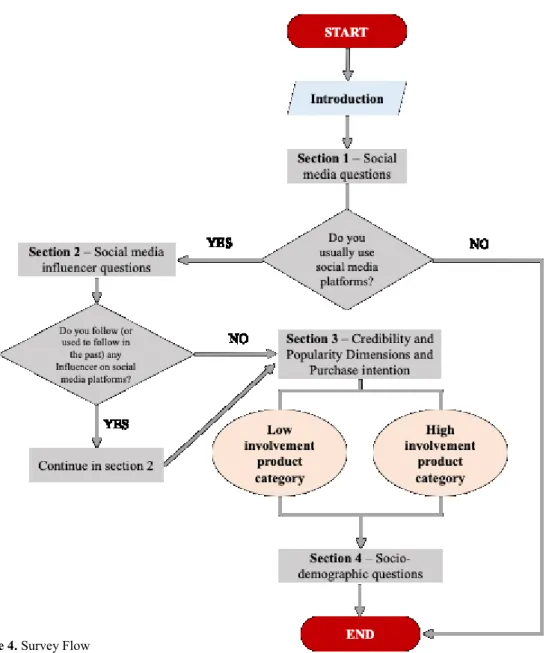
As the main objective was to study the influence of social media influencers, two preliminary questions were first introduced to respondents. The first one related to the use of social media platforms and the second one related to the following of social media influencers.
To reduce the scope, this dissertation focused only on Portuguese influencers and celebrities, and therefore, respondents were asked to name Portuguese influencers and identify which category of products they promote. The influencer that was referred the most was chosen to appear in the main survey.
As the aim of this research was to understand if the impact of the influencer’s credibility on consumer’s purchase intention differs according with the degree of product involvement, in the pre-survey respondents were presented with a list of diverse products, belonging to low and high involvement categories, and they were asked, for each product, to identify if it belonged to low or high involvement category. The two products that had a significant percentage on each category of involvement were chosen, within the same product category (e.g., technology, beauty and cosmetics, clothes).
Pre-test analysis
The pre-survey was conducted through Qualtrics (an online statistics software) and was distributed online via social media platforms. Thirty participants answered the questionnaire. From the analysis of the results (appendix 1), Ana Garcia Martins, better known as “A Pipoca Mais Doce”, was the most mentioned influencer, followed by the influencer Mafalda Sampaio. Ana Garcia Martins is a 38 years old blogger and writer. She created her blog called “A Pipoca Mais Doce” in 2003, and since then she is recognized as being an influencer, promoting a broad range of products, such as food, clothes, and cosmetics.