EUROPEAN ORGANISATION FOR NUCLEAR RESEARCH (CERN)
Submitted to: EPJC CERN-PH-EP-2016-001
July 13, 2016
Measurement of the charged-particle multiplicity inside jets from
√
s
= 8 TeV pp collisions with the ATLAS detector
The ATLAS Collaboration
Abstract
The number of charged particles inside jets is a widely used discriminant for identifying the quark or gluon nature of the initiating parton and is sensitive to both the perturbative and non-perturbative components of fragmentation. This paper presents a measurement of the average number of charged particles with pT > 500 MeV inside high-momentum jets in dijet events using 20.3 fb−1of data recorded with the ATLAS detector in pp collisions at √s = 8 TeV collisions at the LHC. The jets considered have transverse momenta from 50 GeV up to and beyond 1.5 TeV. The reconstructed charged-particle track multiplicity distribution is unfolded to remove distortions from detector effects and the resulting charged-particle multiplicity is compared to several models. Furthermore, quark and gluon jet fractions are used to extract the average charged-particle multiplicity for quark and gluon jets separately.
1 Introduction
Quarks and gluons produced in high-energy particle collisions hadronize before they can be observed directly. However, the properties of the resulting collimated sprays of hadrons, known as jets, depend on the type of parton which initiated them. One jet observable sensitive to the quark or gluon nature is the number of charged particles inside the jet. Due to their larger colour-charge under the strong force, gluon-initiated jets contain on average more particles than quark-initiated jets. The average (charged) particle multiplicity inside jets increases with jet energy, but increases faster for gluon-initiated jets than for quark-initiated jets [1]. These properties were used recently at the Large Hadron Collider (LHC) to differentiate between jets originating from a quark or a gluon [2–6]. These studies have found significant differences in the charged-particle multiplicity between the available simulations and data. Improved modelling based on measurements of the number of charged particles inside jets is thus crucial for future studies.
This paper presents a measurement of the average charged-particle multiplicity inside jets as a function of the jet transverse momentum in dijet events in pp collisions at √s= 8 TeV with the ATLAS detector. The measurement of the charged-particle multiplicity inside jets has a long history from the SPS [7–9], PETRA [10,11], PEP [12–15], TRISTAN [16], CESR [17], LEP [18–29], and the Tevatron [30]. At the LHC, both ATLAS [31,32] and CMS [33] have measured the charged-particle multiplicity inside jets at √
s = 7 TeV. One ATLAS result [31] used jets that are reconstructed using tracks and have transverse momentum less than 40 GeV. A second ATLAS analysis [32] has measured charged particles inside jets with transverse momenta spanning the range from 50 to 500 GeVwith approximately constant 3–4% uncertainties. The CMS measurement [33] spans jet transverse momenta between 50 and 800 GeVwith 5–10% uncertainties in the bins of highest transverse momentum. The analysis presented here uses the full √s = 8 TeVATLAS dataset, which allows for a significant improvement in the precision at high transverse momentum up to and beyond 1.5 TeV.
This paper is organized as follows. After a description of the ATLAS detector and object and event selection in Sect. 2, simulated samples are described in Sect. 3. In order for the measured charged-particle multiplicity to be compared with charged-particle-level models, the data are unfolded to remove distortions from detector effects, as described in Sect.4. Systematic uncertainties in the measured charged-particle multiplicity are discussed in Sect.5and the results are presented in Sect.6.
2 Object and event selection
ATLAS is a general-purpose detector designed to measure the properties of particles produced in high-energy pp collisions with nearly a full 4π coverage in solid angle. Charged-particle momenta are mea-sured by a series of tracking detectors covering a range1 of |η| < 2.5 and immersed in a 2 T axial magnetic field, providing measurements of the transverse momentum, pT, with a resolution σpT/pT ∼ 0.05% × pT/ GeV ⊕ 1%. Electromagnetic and hadronic calorimeters surround the tracking detector, with
1ATLAS uses a right-handed coordinate system with its origin at the nominal interaction point (IP) in the centre of the detector
and the z-axis along the beam pipe. The x-axis points from the IP to the centre of the LHC ring, and the y-axis points upward. Cylindrical coordinates (r, φ) are used in the transverse plane, φ being the azimuthal angle around the beam pipe. The pseudorapidity is defined in terms of the polar angle θ as η = − ln tan(θ/2). The variable ∆R = p(∆φ)2+ (∆η)2 is a
forward calorimeters allowing electromagnetic and hadronic energy measurements up to |η| = 4.5. A detailed description of the ATLAS detector can be found in Ref. [34].
This measurement uses the dataset of pp collisions recorded by the ATLAS detector in 2012, corre-sponding to an integrated luminosity of 20.3 fb−1at a center-of-mass energy of √s = 8 TeV. The data acquisition and object/event selection are described in detail in Ref. [35] and highlighted here for com-pleteness. Jets are clustered using the anti-kt jet algorithm [36] with radius parameter R = 0.4 imple-mented in FastJet [37] using as inputs topological calorimeter-cell clusters [38], calibrated using the local cluster weighting (LCW) algorithm [39,40]. An overall jet energy calibration accounts for residual de-tector effects as well as contributions from multiple proton–proton collisions in the same bunch crossing (pileup) [41] in order to make the reconstructed jet energy correspond to an unbiased measurement of the particle-level jet energy. Jets are required to be central (|η| < 2.1) so that their charged particles are within the |η| < 2.5 coverage of the tracking detector. Events are further required to have at least two jets with pT > 50 GeV and only the leading two jets are considered for the charged-particle multiplicity measurement. To select dijet topologies where the jets are balanced in pT, the two leading jets must have pleadT /psubleadT < 1.5, where pleadT and psubleadT are the transverse momenta of the jets with the highest and second-highest pT, respectively. The jet with the smaller (larger) absolute pseudorapidity |η| is classified as the more central (more forward) jet. A measurement of the more forward and more central average charged-particle multiplicities can exploit the rapidity dependence of the jet type to extract information about the multiplicity for quark- and gluon-initiated jets as is described in Sect.6. The more forward jet tends to be correlated with the parton with higher longitudinal momentum fraction x, and is less likely to be a gluon-initiated jet.
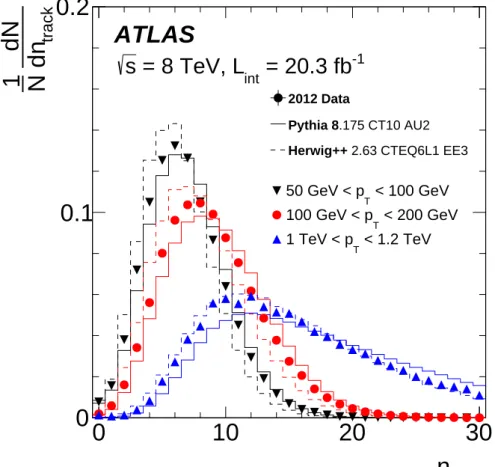
Tracks are required to have pT ≥ 500 MeV, |η| < 2.5, and a χ2 per degree of freedom (resulting from the track fit) less than 3.0. Additional quality criteria are applied to select tracks originating from the collision vertex and reject fake tracks reconstructed from random hits in the detector. In particular, tracks are matched to the hard-scatter vertex by requiring |z0sin(θ)| < 1.5 mm and |d0| < 1 mm, where z0 and d0 are the track longitudinal and transverse impact parameters, respectively, calculated with respect to the primary vertex. Tracks must furthermore have at least one hit in the silicon pixel detector and at least six hits in the semiconductor microstrip detector. The matching of tracks with the calorimeter-based jets is performed via the ghost-association technique [42]: the jet clustering process is repeated with the addition of ‘ghost’ versions of measured tracks that have the same direction but infinitesimally small pT, so that they do not change the properties of the calorimeter-based jets. A track is associated with a jet if its ghost version is contained in the jet after reclustering. The distribution of the number of tracks in three representative jet pT ranges is shown in Fig.1. The number of tracks increases with jet pTand the data fall mostly between the distributions predicted by Pythia and Herwig++ Monte Carlo simulations.
track
n
0
10
20
30
trackdn
dN
N
1
0
0.1
0.2
ATLAS
-1= 20.3 fb
int= 8 TeV, L
s
< 100 GeV T 50 GeV < p < 200 GeV T 100 GeV < p < 1.2 TeV T 1 TeV < p 2012 Data .175 CT10 AU2 Pythia 8 2.63 CTEQ6L1 EE3 Herwig++Figure 1: The distribution of the number of reconstructed tracks associated with a jet (not unfolded) in three example
jet pTranges: 50 GeV< pT< 100 GeV, 100 GeV< pT< 200 GeV, and 1 TeV< pT< 1.2 TeV for data and for Pythia
8 and Herwig++ predictions. The simulated samples are described in Sect.3. The data points have statistical
3 Event simulation
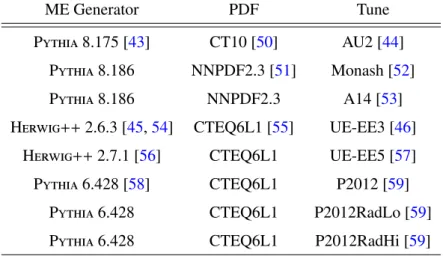
Monte Carlo (MC) samples are used in order to determine how the detector response affects the charged-particle multiplicity and to make comparisons with the corrected data. The details of the samples used are shown in Table1. The sample generated with Pythia 8.175 [43] using the AU2 [44] set of tuned parameters (tune) and the Herwig++ 2.6.3 [45] sample with the UE-EE3 [46] tune are further processed with the ATLAS detector simulation [47] based on GEANT4 [48]. The effects of pileup are modelled by adding to the generated hard-scatter events (before the detector simulation) multiple minimum-bias events generated with Pythia 8.160, the A2 tune [44], and the MSTW2008LO [49] Parton distribution function (PDF) set. The distribution of the number of interactions is then weighted to reflect the pileup distribution in the data.
ME Generator PDF Tune
Pythia 8.175 [43] CT10 [50] AU2 [44] Pythia 8.186 NNPDF2.3 [51] Monash [52]
Pythia 8.186 NNPDF2.3 A14 [53]
Herwig++ 2.6.3 [45,54] CTEQ6L1 [55] UE-EE3 [46]
Herwig++ 2.7.1 [56] CTEQ6L1 UE-EE5 [57]
Pythia 6.428 [58] CTEQ6L1 P2012 [59]
Pythia 6.428 CTEQ6L1 P2012RadLo [59]
Pythia 6.428 CTEQ6L1 P2012RadHi [59]
Table 1: Monte Carlo samples used in this analysis. The abbreviations ME, PDF, and UE respectively stand for ma-trix element, parton distribution function, and underlying event. ‘Tune’ refers to the set of tunable MC parameters used.
4 Unfolding
The measurement is carried out within a fiducial volume matching the experimental selection to avoid extrapolation into unmeasured kinematic regions that have additional model dependence and related un-certainties. Particle-level definitions of the reconstructed objects are chosen to be as close as possible to those described in Sect.2. Particle-level jets are clustered from generated stable particles with a mean lifetime τ > 30 ps, excluding muons and neutrinos. As with the detector-level jets, particle-level jets are clustered with the anti-kt R = 0.4 algorithm. Any charged particle clustered in a particle-level jet is considered for the charged-particle multiplicity calculation if it has pT> 500 MeV. Events are required to have at least two jets with |η| < 2.1 and pT > 50 GeV and the two highest-pTjets must satisfy the same pT -balance requirement between the leading and subleading jet as at detector level (pleadT /psubleadT < 1.5). The pT symmetry requirement enriches the sample in a back-to-back topology and suppresses non-isolated jets. In more than 70% of events, the nearest jet in∆R with pT> 25 GeV is the other selected jet and in > 25 GeV within ∆R = 0.8 from one of the two selected
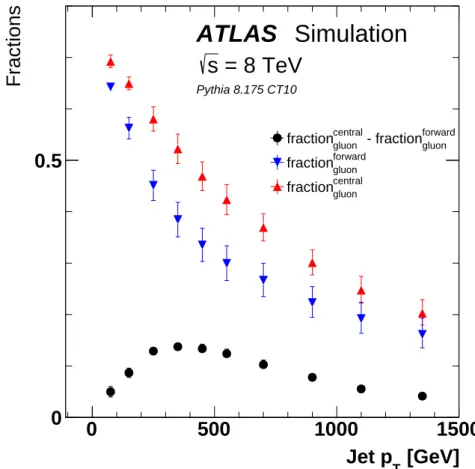
gluons can be cleanly matched to the outgoing jets. In this analysis, the type of a jet is defined as that of the highest-energy parton in simulation within a∆R = 0.4 cone around the particle-jet’s axis.2 Figure2
shows the fraction of gluon-initiated jets as a function of jet pT for the more forward and more central jet within the event. The fraction of gluon-initiated jets decreases with pT, but the difference between the more forward and more central jets peaks around pT ∼ 350 GeV. This difference is exploited in Sect.6to extract separately the average quark- and gluon-initiated jet charged-particle multiplicity.
[GeV]
TJet p
0
500
1000
1500
Fractions
0
0.5
ATLAS Simulation
= 8 TeV
s
Pythia 8.175 CT10 forward gluon - fraction central gluon fraction forward gluon fraction central gluon fractionFigure 2: The simulated fraction of jets originating from gluons as a function of jet pT for the more forward jet
(down triangle), the more central jet (up triangle), and the difference between these two fractions (circle). The fractions are derived from Pythia 8 with the CT10 PDF set and the error bars represent the PDF and matrix
el-ement uncertainties, further discussed in Sect.6. The uncertainties on the fraction difference are computed from
propagating the uncertainties on the more forward and more central fractions, treating as fully correlated.
The average charged-particle multiplicity in particle-level jets is determined as a function of jet pT. An it-erative Bayesian (IB) technique [61] as implemented in the RooUnfold framework [62] is used to unfold the two-dimensional charged-particle multiplicity and jet pTdistribution. In the IB unfolding technique, the number of iterations and the prior distribution are the input parameters. The raw data are corrected
2While it is possible to classify jets as quark- or gluon-initiated beyond leading order in m
jet/Ejet[60], the classification is
jet algorithm-dependent and unnecessary for the present considerations. For the results presented in Sect.6that rely on jet-type labelling, alternative definitions were considered and found to have a negligible impact compared to other sources of theoretical and experimental uncertainty.
using the simulation to account for events that pass the fiducial selection at detector level, but not the corresponding selection at particle level; this correction is the fake factor. Then, the IB method iteratively applies Bayes’ theorem using the response matrix to connect the prior distribution to the posterior distri-bution at each step, with the nominal Pythia 8.175 sample used for the initial prior distridistri-bution. The re-sponse matrix describes the bin migrations between the particle-level and detector-level two-dimensional distribution of charged-particle multiplicity and jet pT. Although the response matrix is nearly diagonal, the resolution degrades at high pT where more bin-to-bin migrations from particle level to detector level occur.
The number of iterations in the IB method trades off unfolding bias against statistical fluctuations. An optimal value of four iterations is obtained by minimizing the bias when unfolding pseudo-data derived from Herwig++ using a prior distribution and a response matrix derived from Pythia as a test of the methodology. Lastly, unfolding applies another correction from simulation to the unfolded data to account for events passing the particle-level selection but not the detector-level selection; this correction is the inefficiency factor.
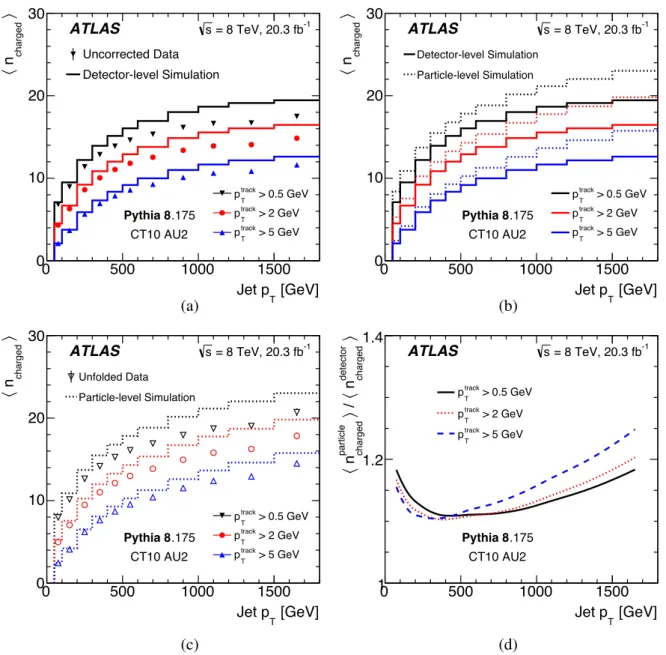
Figure3displays the pTdependence of the average charged-particle multiplicity for uncorrected data and detector-level simulation and for particle-level simulation as well as the unfolded data. The prediction from Pythia 8 with the AU2 tune has too many tracks compared with the uncorrected data, and the size of the data/MC difference increases with decreasing track pTthreshold (Fig.3(a)). The difference between the detector-level and particle-level simulation in Fig.3(b) (for which the ratio is given in Fig.3(d)) gives an indication of the corrections required to account for detector acceptance and resolution effects in the unfolding procedure. Particle-level distributions in Fig.3(c) show similar trends to the detector-level ones in Fig.3(a).
5 Systematic uncertainties
All stages of the charged-particle multiplicity measurement are sensitive to sources of potential bias. The three stages of the measurement are listed below, with an overview of the systematic uncertainties that impact the results at each stage:
Response Matrix: For events that pass both the detector-level and particle-level fiducial selections, the response matrix describes migrations between bins when moving between the detector level and the particle level. The response matrix is taken from simulation and various experimental uncertainties in the charged-particle multiplicity and jet pT spectra result in uncertainties in the matrix. These uncertainties can be divided into two classes: those impacting the calorimeter-based jet pT and those impacting track reconstruction inside jets. The dominant uncertainty at high jet pT is due to the loss of charged-particle tracks in the jet core due to track merging. This charged energy loss uncertainty is estimated using the data/MC differences in the ratio of the track-based jet pT to the calorimeter-based jet pT [35]. More charged energy is lost in the data than in the MC and thus this uncertainty is one-sided. There are other tracking uncertainties in the track momentum scale and resolution, the track reconstruction efficiency, and the rate of tracks formed from random combinations of hits (fake tracks). The prescription for these sub-dominant tracking uncertainties is identical to Ref. [35]. The uncertainties related to the calorimeter-based jet are sub-dominant (except in the lowest p bins) and are due to the uncertainty in the jet energy scale and the jet
[GeV] T Jet p 0 500 1000 1500 〉 charged n〈 0 10 20 30 ATLAS -1 = 8 TeV, 20.3 fb s CT10 AU2 .175 Pythia 8 Uncorrected Data Detector-level Simulation > 0.5 GeV track T p > 2 GeV track T p > 5 GeV track T p [GeV] T Jet p 0 500 1000 1500 〉 charged n〈 0 10 20 30 ATLAS -1 = 8 TeV, 20.3 fb s Detector-level Simulation Particle-level Simulation > 0.5 GeV track T p > 2 GeV track T p > 5 GeV track T p CT10 AU2 .175 Pythia 8 [GeV] T Jet p 0 500 1000 1500 〉 charged n〈 0 10 20 30 > 0.5 GeV track T p > 2 GeV track T p > 5 GeV track T p ATLAS -1 = 8 TeV, 20.3 fb s Unfolded Data Particle-level Simulation CT10 AU2 .175 Pythia 8 [GeV] T Jet p 0 500 1000 1500 〉 detector charged n〈 / 〉 particle charged n〈 1 1.2 1.4 CT10 AU2 .175 Pythia 8 ATLAS -1 = 8 TeV, 20.3 fb s > 0.5 GeV track T p > 2 GeV track T p > 5 GeV track T p (a) (b) (c) (d)
Figure 3: The jet pTdependence of (a) the average reconstructed track multiplicity for uncorrected data and
detector-level simulation, (b) the average reconstructed track multiplicity for the detector-detector-level simulation and the average charged-particle multiplicity for the particle-level simulation, (c) the average charged-particle multiplicity for the unfolded data and the particle-level simulation, and (d) the average charged-particle multiplicity divided by the
average reconstructed track multiplicity in simulation. Three charged-particle and track pT thresholds are used in
each case: 0.5 GeV, 2 GeV, and 5 GeV. Pythia 8 with the CT10 PDF and the AU2 tune are used for the simulation. For the data, only statistical uncertainties are included in the error bars (which are smaller than the markers for most bins).
Correction Factors: Fake and inefficiency factors are derived from simulation to account for the frac-tion of events that pass either the detector-level or particle-level fiducial selecfrac-tion (pT > 50 GeV |η| < 2.1, and plead
T /psubleadT < 1.5), but not both. These factors are derived in bins of jet pT and charged particle multiplicity, separately for the more forward and more central jets. They are gen-erally between 0.9 and 1.0 except in the first jet-pTinterval (50 < pT< 100 GeV), where threshold
effects cause the correction factors to take values down to 0.8. Experimental uncertainties corre-lated with the detector-level selection acceptance, such as the jet energy scale uncertainty, result in uncertainties in these correction factors. Another source of uncertainty in the correction factors is the explicit dependence on the particle-level multiplicity and jet pT spectrum. A comparison of particle-level models (Pythia and Herwig++) is used to estimate the impact on the correction factors.
Unfolding Procedure: A data-driven technique is used to estimate the potential bias from a given choice of a prior distribution and number of iterations in the IB method [63]. The particle-level spec-trum is reweighted so that the simulated detector-level specspec-trum, from propagating the reweighted particle-level spectrum through the response matrix, has significantly improved agreement with the uncorrected data. The modified detector-level distribution is unfolded with the nominal response matrix and the difference between this and the reweighted particle-level spectrum is an indication of the bias due to the unfolding method (in particular, the choice of a prior distribution).
A summary of the systematic uncertainties can be found in Table2and more detail about the evaluation of each uncertainty can be found in Ref. [35]. The response matrix uncertainty shown in Table 2 is decomposed into four categories, as described above.
Average ncharged Jet pTRange [100 GeV]
Systematic
Uncertainty [%] [0.5,1] [1,2] [2,3] [3,4] [4,5] [5,6] [6,8] [8,10] [10,12] [12,15] [15,18] Response Matrix
Total Jet Energy Scale +1.9−1.9 +0.7−0.9 +0.6−0.8 +0.8−0.7 +0.7−0.7 +0.6−0.7 +0.6−0.7 +0.6−0.5 +0.4−0.4 +0.3−0.3 +0.8−0.7 Jet Energy Resolution +0.6−0.6 +0.1−0.1 +0.1−0.1 +0.1−0.1 +0.1−0.1 +0.1−0.1 +0.1−0.1 +0.2−0.2 +0.1−0.1 +0.1−0.1 +0.2−0.2 Charged Energy Loss +0.0−0.0 +0.0−0.0 +0.0−0.0 +0.0−0.0 +1.2−0.0 +1.1−0.0 +1.1−0.0 +1.1−0.0 +1.0−0.0 +3.6−0.0 +3.3−0.0 Other Tracking +1.2−0.0 +1.0−0.0 +0.9−0.0 +0.8−0.0 +0.8−0.0 +0.7−0.0 +0.7−0.0 +0.7−0.0 +0.7−0.0 +0.7−0.0 +0.8−0.0 Correction Factors +0.1−0.1 +0.1−0.1 +0.1−0.1 +0.1−0.1 +0.1−0.1 +0.1−0.1 +0.0−0.0 +0.0−0.0 +0.0−0.0 +0.0−0.0 +0.0−0.0 Unfolding Procedure +6.4−6.4 +3.4−3.4 +0.6−0.6 +0.8−0.8 +0.6−0.6 +0.4−0.4 +0.4−0.4 +0.2−0.2 +0.2−0.2 +0.2−0.2 +0.1−0.1 Total Systematic +6.8−6.7 +3.6−3.5 +1.2−1.0 +1.4−1.1 +1.7−0.9 +1.5−0.8 +1.5−0.8 +1.4−0.6 +1.3−0.5 +3.7−0.4 +3.5−0.7 Data Statistics 0.5 0.2 0.1 0.1 0.0 0.1 0.1 0.3 0.6 1.2 3.9 Total Uncertainty +6.8−6.7 +3.6−3.6 +1.2−1.0 +1.4−1.1 +1.7−0.9 +1.5−0.8 +1.5−0.8 +1.4−0.6 +1.5−0.8 +3.9−1.3 +5.2−4.0 Measured Value 7.87 9.87 12.19 13.54 14.59 15.41 16.28 17.41 18.25 18.71 20.78
Table 2: A summary of all the systematic uncertainties and their impact on the ntrack mean for ptrackT > 0.5 GeV
and the more forward jet. Uncertainties are given in percent. The last row is the measured average charged particle multiplicity. A value of 0.0 is quoted if the uncertainty is below 0.05%.
6 Results
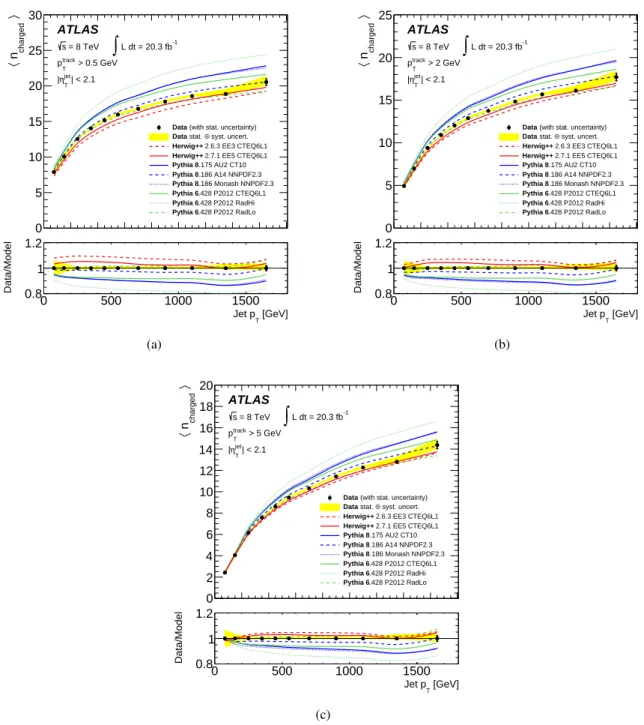
The unfolded average charged-particle multiplicity combining both the more forward and the more central jets is shown in Fig. 4, compared with various model predictions. As was already observed for the reconstructed data in Fig.1, the average charged-particle multiplicity in data falls between the predictions of Pythia 8 and Herwig++, independently of the underlying-event tunes. The Pythia 8 predictions are generally higher than the data and this is more pronounced at higher jet pT. The default ATLAS tune in Run 1 (AU2) performs similarly to the Monash tune, but the prediction with A14 (the ATLAS default for the analysis of Run 2 data) is significantly closer to the data. A previous ATLAS measurement [31] of charged-particle multiplicity inside jets was included in the tuning of A14, but the jets in that measurement have pT. 50 GeV. One important difference between A14 and Monash is that the value of αsgoverning the amount of final-state radiation is about 10% lower in A14 than in Monash. This parameter has a large impact on the average charged-particle multiplicity, which is shown by the Pythia 6 lines in Fig.4where the Perugia radHi and radLo tunes are significantly separated from the central P2012 tune. The αsvalue that regulates final-state radiation is changed by factors of one half and two for these tunes with respect to the nominal Perugia 2012 tune. The recent (and Run 2 default) EE5 underlying-event tune for Herwig++ improves the modelling of the average charged-particle multiplicity with respect to the EE3 tune (Run 1 default).
〉 charged n 〈 0 5 10 15 20 25 30 ATLAS > 0.5 GeV track T p | < 2.1 jet T η | -1 L dt = 20.3 fb
∫
= 8 TeV s(with stat. uncertainty)
Data syst. uncert. ⊕ stat. Data 2.6.3 EE3 CTEQ6L1 Herwig++ 2.7.1 EE5 CTEQ6L1 Herwig++ .175 AU2 CT10 Pythia 8 .186 A14 NNPDF2.3 Pythia 8 .186 Monash NNPDF2.3 Pythia 8 .428 P2012 CTEQ6L1 Pythia 6 .428 P2012 RadHi Pythia 6 .428 P2012 RadLo Pythia 6 [GeV] T Jet p 0 500 1000 1500 Data/Model 0.8 1 1.2 (a) 〉 charged n 〈 0 5 10 15 20 25 ATLAS > 2 GeV track T p | < 2.1 jet T η | -1 L dt = 20.3 fb
∫
= 8 TeV s(with stat. uncertainty)
Data syst. uncert. ⊕ stat. Data 2.6.3 EE3 CTEQ6L1 Herwig++ 2.7.1 EE5 CTEQ6L1 Herwig++ .175 AU2 CT10 Pythia 8 .186 A14 NNPDF2.3 Pythia 8 .186 Monash NNPDF2.3 Pythia 8 .428 P2012 CTEQ6L1 Pythia 6 .428 P2012 RadHi Pythia 6 .428 P2012 RadLo Pythia 6 [GeV] T Jet p 0 500 1000 1500 Data/Model 0.8 1 1.2 (b) 〉 charged n 〈 0 2 4 6 8 10 12 14 16 18 20 ATLAS > 5 GeV track T p | < 2.1 jet T η | -1 L dt = 20.3 fb
∫
= 8 TeV s(with stat. uncertainty)
Data syst. uncert. ⊕ stat. Data 2.6.3 EE3 CTEQ6L1 Herwig++ 2.7.1 EE5 CTEQ6L1 Herwig++ .175 AU2 CT10 Pythia 8 .186 A14 NNPDF2.3 Pythia 8 .186 Monash NNPDF2.3 Pythia 8 .428 P2012 CTEQ6L1 Pythia 6 .428 P2012 RadHi Pythia 6 .428 P2012 RadLo Pythia 6 [GeV] T Jet p 0 500 1000 1500 Data/Model 0.8 1 1.2 (c)
Figure 4: The measured average charged-particle multiplicity as a function of the jet pT, combining the more
forward and the more central jets for (a) ptrack
T > 0.5 GeV, (b) p
track
T > 2 GeV, and (c) p
track
T > 5 GeV. The band
around the data is the sum in quadrature of the statistical and systematic uncertainties. Error bars on the data points represent the statistical uncertainty (which are smaller than the markers for most bins).
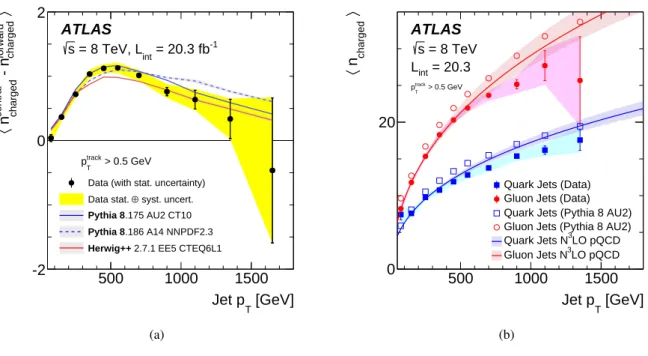
The difference in the average charged-particle multiplicity between the more forward and the more central jet is sensitive to the difference between quark and gluon constituent multiplicities. Figure5(a) shows that the difference is significant for pT . 1.1 TeV. The shape is governed by the difference in the gluon fraction between the more forward and the more central jet, which was shown in Fig.2to peak around pT ∼ 350 GeV. The average difference, combined with the gluon fraction, can be used to extract the average charged-particle multiplicity for quark- and gluon-initiated jets separately. Given the quark and gluon fractions fq,gf,c with f = more forward, c = more central, q = quark, g = gluon and fq+ fg = 1, the average charged-particle multiplicity for quark- and gluon-initiated jets is extracted by solving the system of equations in Eq. (1);
hnchargedf i= fqfhnchargedq i+ fgfhngchargedi (1) hncchargedi= fqchnchargedq i+ fgchngchargedi.
Given the jet pT, the charged particle multiplicity inside jets does not vary significantly with η. This is confirmed by checking that the solution to Eq.1reproduces the quark and gluon jet charged particle mul-tiplicities for both Pythia 8 and Herwig++ to better than 1% across most of the pT range. The extracted pTdependence of the average charged-particle multiplicities for quark- and gluon-initiated jets is shown in Fig.5(b). Pythia 8 with the CT10 PDF set is used to determine the gluon fractions. The experimental uncertainties are propagated through Eq. (1) by recomputing the quark and gluon average charged-particle multiplicities for each variation accounting for a systematic uncertainty; the more forward and more cen-tral jet uncertainties are treated as being fully correlated. In addition to the experimental uncertainties, the error bands in Fig. 5(b) include uncertainties in the gluon fractions from both the PDF and matrix element (ME) uncertainties. The PDF uncertainty is determined using the CT10 eigenvector PDF sets and validated by comparing CT10 and NNPDF. The ME uncertainty is estimated by comparing the frac-tions fq,gf,cfrom Pythia 8 and Herwig++ after reweighting the Pythia 8 sample with CT10 to CTEQ6L1 to match the PDF used for Herwig++. All PDF re-weighting is performed using LHAPDF6 [64]. The PDF and ME uncertainties are comparable in size to the total experimental uncertainty. As expected, the average multiplicity increases with jet pT for both the quark-initiated jets and gluon-initiated jets, but increases faster for initiated jets. Furthermore, the multiplicity is significantly higher for gluon-initiated jets than for quark-gluon-initiated jets. The average charged-particle multiplicity in Pythia 8 with the AU2 tune is higher than in the data for both the quark- and gluon-initiated jets. In addition to predictions from leading-logarithm parton shower simulations, calculations of the scale dependence for the parton multiplicity inside jets have been performed in perturbative quantum chromodynamics (pQCD). Up to a non-perturbative factor that is constant for the jet pTrange considered in this analysis,3these calculations can be interpreted as a prediction for the scale dependence of hnchargedi for quark- and gluon-initiated jets. There are further caveats to the predictability of such a calculation since nchargedis not infrared safe or even Sudakov safe [65]. Therefore, the formal accuracy of the series expansion in √αsis unknown. Given these caveats, the next-to-next-to-next-to-leading-order (N3LO) pQCD calculation [66,67] is overlaid in Fig.5with renormalization scale µ= RpT in the five-flavour scheme and R= 0.4. The theoretical error band is calculated by varying µ by a factor of two. The prediction cannot give the absolute scale, and therefore the curve is normalized in the second pTbin (100 GeV< pT < 200 GeV) where the statistical uncertainty is small. The predicted scale dependence for gluon-initiated jets is consistent with the data within the uncertainty bands while the curve for quark-initiated jets is higher than the data by about one standard deviation.
[GeV] T Jet p 500 1000 1500 〉 forward charged - n central charged n 〈 -2 0 2 ATLAS -1 = 20.3 fb int = 8 TeV, L s > 0.5 GeV track T p
Data (with stat. uncertainty) syst. uncert. ⊕ Data stat. .175 AU2 CT10 Pythia 8 .186 A14 NNPDF2.3 Pythia 8 2.7.1 EE5 CTEQ6L1 Herwig++ (a) [GeV] T Jet p 500 1000 1500 〉 charged n 〈 0 20 ATLAS = 8 TeV s = 20.3 int L > 0.5 GeV track T p
Quark Jets (Data) Gluon Jets (Data) Quark Jets (Pythia 8 AU2) Gluon Jets (Pythia 8 AU2) LO pQCD 3 Quark Jets N LO pQCD 3 Gluon Jets N (b)
Figure 5: The jet pTdependence of (a) the difference in the average charged-particle multiplicity (ptrackT > 0.5 GeV)
between the more forward and the more central jet. The band for the data is the sum in quadrature of the systematic and statistical uncertainties and the error bars on the data points represent the statistical uncertainty. Bands on the
simulation include MC statistical uncertainty. The jet pTdependence of (b) the average charged-particle multiplicity
(ptrack
T > 0.5 GeV) for quark- and gluon-initiated jets, extracted with the gluon fractions from Pythia 8.175 with the
CT10 PDF. In addition to the experimental uncertainties, the error bands include uncertainties in the gluon fractions from both the PDF and ME uncertainties. The MC statistical uncertainties on the open markers are smaller than
the markers. The uncertainty band for the N3LO pQCD prediction is determined by varying the scale µ by a factor
of two up and down. The markers are truncated at the penultimate pT bin in the right because within statistical
uncertainty, the more forward and more central jet constituent charged-particle multiplicities are consistent with each other in the last bin.
7 Summary
This paper presents a measurement of the pT dependence of the average jet charged-particle multiplic-ity in dijet events from 20.3 fb−1of √s = 8 TeV pp collision data recorded by the ATLAS detector at the LHC. The measured charged-particle multiplicity distribution is unfolded to correct for the detec-tor acceptance and resolution to facilitate direct comparison to particle-level models. Comparisons are made at particle level between the measured average charged-particle multiplicity and various models of jet formation. Significant differences are observed between the simulations using Run 1 tunes and the data, but the Run 2 tunes for both Pythia 8 and Herwig++ significantly improve the modelling of the average ncharge. Furthermore, quark- and gluon-initiated jet constituent charged-particle multiplicities are extracted and compared with simulations and calculations. As expected, the extracted gluon-initiated jet constituent charged-particle multiplicity is higher than the corresponding quantity for quark-initiated jets and a calculation of the pT-dependence accurately models the trend observed in the data. The particle-level spectra are available [68] for further interpretation and can serve as a benchmark for future mea-surements of the evolution of non-perturbative jet observables to validate MC predictions and tune their model parameters.
Acknowledgements
We thank CERN for the very successful operation of the LHC, as well as the support staff from our institutions without whom ATLAS could not be operated efficiently.
We acknowledge the support of ANPCyT, Argentina; YerPhI, Armenia; ARC, Australia; BMWFW and FWF, Austria; ANAS, Azerbaijan; SSTC, Belarus; CNPq and FAPESP, Brazil; NSERC, NRC and CFI, Canada; CERN; CONICYT, Chile; CAS, MOST and NSFC, China; COLCIENCIAS, Colombia; MSMT CR, MPO CR and VSC CR, Czech Republic; DNRF, DNSRC and Lundbeck Foundation, Den-mark; IN2P3-CNRS, CEA-DSM/IRFU, France; GNSF, Georgia; BMBF, HGF, and MPG, Germany; GSRT, Greece; RGC, Hong Kong SAR, China; ISF, I-CORE and Benoziyo Center, Israel; INFN, Italy; MEXT and JSPS, Japan; CNRST, Morocco; FOM and NWO, Netherlands; RCN, Norway; MNiSW and NCN, Poland; FCT, Portugal; MNE/IFA, Romania; MES of Russia and NRC KI, Russian Feder-ation; JINR; MESTD, Serbia; MSSR, Slovakia; ARRS and MIZŠ, Slovenia; DST/NRF, South Africa; MINECO, Spain; SRC and Wallenberg Foundation, Sweden; SERI, SNSF and Cantons of Bern and Geneva, Switzerland; MOST, Taiwan; TAEK, Turkey; STFC, United Kingdom; DOE and NSF, United States of America. In addition, individual groups and members have received support from BCKDF, the Canada Council, CANARIE, CRC, Compute Canada, FQRNT, and the Ontario Innovation Trust, Canada; EPLANET, ERC, FP7, Horizon 2020 and Marie Sk?odowska-Curie Actions, European Union; Investisse-ments d’Avenir Labex and Idex, ANR, Region Auvergne and Fondation Partager le Savoir, France; DFG and AvH Foundation, Germany; Herakleitos, Thales and Aristeia programmes co-financed by EU-ESF and the Greek NSRF; BSF, GIF and Minerva, Israel; BRF, Norway; the Royal Society and Leverhulme Trust, United Kingdom.
The crucial computing support from all WLCG partners is acknowledged gratefully, in particular from CERN and the ATLAS Tier-1 facilities at TRIUMF (Canada), NDGF (Denmark, Norway, Sweden), CC-IN2P3 (France), KIT/GridKA (Germany), INFN-CNAF (Italy), NL-T1 (Netherlands), PIC (Spain), ASGC (Taiwan), RAL (UK) and BNL (USA) and in the Tier-2 facilities worldwide.
References
[1] R. Ellis, W. Stirling, and B. Webber, QCD and Collider Physics, Cambridge University Press, 2003, isbn: 0521545897.
[2] ATLAS Collaboration,
Light-quark and gluon jet discrimination in pp collisions at √s= 7 TeV with the ATLAS detector,
Eur. Phys. J. C74 (2014) 3023, arXiv:1405.6583 [hep-ex].
[3] ATLAS Collaboration, Search for high-mass diboson resonances with boson-tagged jets in proton-proton collisions at √s= 8 TeV with the ATLAS detector,JHEP 12 (2015) 055, arXiv:1506.00962 [hep-ex].
[4] ATLAS Collaboration, Jet energy measurement and its systematic uncertainty in proton-proton collisions at √s= 7 TeV with the ATLAS detector,Eur. Phys. J. C75 (2015) 17,
arXiv:1406.0076 [hep-ex].
[5] CMS Collaboration, Search for the standard model Higgs boson produced through vector boson fusion and decaying to bb,Phys. Rev. D92 (2015) 032008, arXiv:1506.01010 [hep-ex]. [6] CMS Collaboration, Measurement of electroweak production of two jets in association with a Z
boson in proton-proton collisions at √s= 8 TeV,Eur. Phys. J. C75 (2015) 66, arXiv:1410.3153 [hep-ex].
[7] UA1 Collaboration, G. Arnison et al.,
Analysis of the fragmentation properties of quark and gluon jets at the CERN SPS p¯p collider,
Nucl. Phys. B276 (1986) 253.
[8] UA2 Collaboration, P. Bagnaia et al.,
Measurement of jet fragmentation properties at the CERN p¯p Collider,
Phys. Lett. B144 (1984) 291.
[9] UA2 Collaboration, P. Bagnaia et al.,
Measurement of production and properties of jets at the CERN p¯p collider,
Z. Phys. B20 (1983) 117.
[10] JADE Collabortion, W. Bartel et al.,
Experimental Evidence for Differences in pTBetween Quark Jets and Gluon Jets,
Phys. Lett. B123 (1983) 460.
[11] TASSO Collaboration, W. Braunschweig et al.,
Charged multiplicity distributions and correlations in e+e−annihilation at PETRA energies,
Z. Phys. C45 (1989) 193–208.
[12] HRS Collaboration, M. Derrick et al., Comparison of charged particle multiplicities in quark and gluon jets produced in e+e- annihilation at 29 GeV,Phys. Lett. B165 (1985) 449.
[13] MARK II Collaboration, A. Petersen et al., Inclusive Charged-Particle Distribution in Nearly Threefold-Symmetric Three-Jet Events at Ec.m.= 29 GeV,Phys. Rev. Lett. 55 (1985) 1954. [14] SLD Collaboration, K. Abe et al., Measurement of the charged multiplicity of Z0 → b¯b events,
Phys. Rev. Lett. 72 (1994) 3145, arXiv:hep-ex/9405004 [hep-ex].
[16] AMY Collaboration, Y.K. Kim et al.,
Comparison of quark and gluon jets produced in high-energy e+e−annihilations,
Phys. Rev. Lett. 63 (1989) 1772.
[17] CLEO Collaboration, S. Alam et al.,
Study of gluon versus quark fragmentation inΥ → ggγ and e+e−→ qqγ events at √s=10 GeV,
Phys. Rev. D56 (1997) 17, arXiv:hep-ex/9701006 [hep-ex].
[18] OPAL Collaboration, G. Alexander et al.,
A Direct observation of quark - gluon jet differences at LEP,Phys. Lett. B265 (1991) 462–474. [19] OPAL Collaboration, G. Alexander et al.,
A Study of differences between quark and gluon jets using vertex tagging of quark jets,
Z. Phys. C58 (1993) 387.
[20] OPAL Collaboration, R. Akers et al.,
A model independent measurement of quark and gluon jet properties and differences,
Z. Phys. V68 (1995) 179.
[21] ALEPH Collaboration, D. Buskulic et al., Study of the subjet structure of quark and gluon jets,
Phys. Lett. B346 (1995) 389.
[22] OPAL Collaboration, G. Alexander et al.,
Test of QCD analytic predictions for the multiplicity ratio between gluon and quark jets,
Phys. Lett. B388 (1996) 659.
[23] ALEPH Collaboration, D. Buskulic et al.,
Quark and gluon jet properties in symmetric three-jet events,Phys. Lett. B384 (1996) 353. [24] DELPHI Collaboration, P. Abreu et al.,
Energy dependence of the differences between the quark and gluon jet fragmentation,
Z. Phys. B70 (1996) 179.
[25] OPAL Collaboration, K. Ackerstaff et al.,
Multiplicity distributions of gluon and quark jets and tests of QCD analytic predictions,
Eur. Phys. J. C1 (1998) 479, arXiv:hep-ex/9708029 [hep-ex].
[26] DELPHI Collaboration, P. Abreu et al., The scale dependence of the hadron multiplicity in quark and gluon jets and a precise determination of CA/CF,Phys. Lett. B449 (1999) 383,
arXiv:hep-ex/9903073 [hep-ex]. [27] OPAL Collaboration, G. Abbiendi et al.,
Experimental properties of gluon and quark jets from a point source,
Eur. Phys. J. C11 (1999) 217, arXiv:hep-ex/9903027 [hep-ex].
[28] OPAL Collaboration, M. Z. Akrawy et al., A study of coherence of soft gluons in hadron jets,
Phys. Lett. B247 (1990) 617.
[29] OPAL Collaboration, G. Abbiendi et al., Scaling violations of quark and gluon jet fragmentation functions in e+e−annihilations at √s= 91.2 and 183 − 209 GeV,Eur. Phys. J. C37 (2004) 25, arXiv:hep-ex/0404026 [hep-ex].
[30] CDF Collaboration, T. Affolder et al.,
Charged particle multiplicity in jets in p¯p collisions at √s= 1.8 TeV,
[31] ATLAS Collaboration, Properties of jets measured from tracks in proton-proton collisions at center-of-mass energy √s= 7 TeV with the ATLAS detector,Phys. Rev. D84 (2011) 054001, arXiv:1107.3311 [hep-ex].
[32] ATLAS Collaboration, Measurement of the jet fragmentation function and transverse profile in proton-proton collisions at a center-of-mass energy of 7 TeV with the ATLAS detector,
Eur. Phys. J. C71 (2011) 1795, arXiv:1109.5816 [hep-ex].
[33] CMS Collaboration,
Shape, Transverse Size, and Charged Hadron Multiplicity of Jets in pp Collisions at 7 TeV,
JHEP 06 (2012) 160, arXiv:1204.3170 [hep-ex].
[34] ATLAS Collaboration, The ATLAS Experiment at the CERN Large Hadron Collider,
JINST 3 (2008) S08003.
[35] ATLAS Collaboration,
Measurement of jet charge in dijet events from √s= 8 TeV pp collisions with the ATLAS detector, (2015), arXiv:1509.05190 [hep-ex].
[36] M. Cacciari, G. P. Salam, and G. Soyez, The Anti-k(t) jet clustering algorithm,
JHEP 04 (2008) 063, arXiv:0802.1189 [hep-ph].
[37] M. Cacciari, G. P. Salam, and G. Soyez, FastJet User Manual,Eur. Phys. J. C72 (2012) 1896, arXiv:1111.6097 [hep-ph].
[38] W Lampl et al., Calorimeter Clustering Algorithms: Description and Performance, (2008),
url:https://cds.cern.ch/record/1099735.
[39] C. Cojocaru et al., Hadronic calibration of the ATLAS liquid argon end-cap calorimeter in the pseudorapidity region1.6 < |η| < 1.8 in beam tests,Nucl. Instrum. Meth. A531 (2004) 481, arXiv:0407009.
[40] ATLAS Collaboration, Local hadronic calibration, (2009),
url:https://cds.cern.ch/record/1112035.
[41] ATLAS Collaboration, Performance of pile-up mitigation techniques for jets in pp collisions at√ s= 8 TeV using the ATLAS detector, (2015), arXiv:1510.03823 [hep-ex].
[42] M. Cacciari, G. P. Salam, and G. Soyez, The Catchment Area of Jets,JHEP 04 (2008) 005. [43] T. Sjöstrand, S. Mrenna, and P. Z. Skands, A Brief Introduction to PYTHIA 8.1,
Comput. Phys. Commun. 178 (2008) 852, arXiv:0710.3820 [hep-ph].
[44] ATLAS Collaboration, Summary of ATLAS Pythia 8 tunes, (2012),
url:https://cds.cern.ch/record/1474107.
[45] M. Bähr et al., Herwig++ Physics and Manual,Eur. Phys. J. C58 (2008) 639–707, arXiv:0803.0883 [hep-ph].
[46] S. Gieseke, C. Röhr, and A. Siodmok, Colour reconnections in Herwig++,
Eur. Phys. J. C72 (2012) 2225, arXiv:1206.0041 [hep-ph].
[47] ATLAS Collaboration, The ATLAS Simulation Infrastructure,Eur. Phys. J. C70 (2010) 823, arXiv:1005.4568 [physics.ins-det].
[49] A. D. Martin et al., Parton distributions for the LHC,Eur. Phys. J. C63 (2009) 189–285, arXiv:0901.0002 [hep-ph].
[50] J. Gao et al., CT10 next-to-next-to-leading order global analysis of QCD,
Phys. Rev. D89 (2014) 033009, arXiv:1302.6246 [hep-ph].
[51] R. D. Ball et al., Parton distributions with LHC data,Nucl. Phys. B867 (2013) 244, arXiv:1207.1303 [hep-ph].
[52] P. Skands, S. Carrazza, and J. Rojo, Tuning PYTHIA 8.1: the Monash 2013 Tune,
Eur. Phys. J. C74 (2014) 3024, arXiv:1404.5630 [hep-ph].
[53] ATLAS Collaboration, ATLAS Run 1 Pythia 8 tunes, (2014),
url:https://cds.cern.ch/record/1966419.
[54] K. Arnold et al., Herwig++ 2.6 Release Note, (2012), arXiv:1205.4902 [hep-ph].
[55] D. Stump et al., Inclusive jet production, parton distributions, and the search for new physics,
JHEP 10 (2003) 046, arXiv:hep-ph/0303013 [hep-ph].
[56] J. Bellm et al., Herwig++ 2.7 Release Note, (2013), arXiv:1310.6877 [hep-ph]. [57] M. H. Seymour and A. Siodmok,
Constraining MPI models usingσe f f and recent Tevatron and LHC Underlying Event data,
JHEP 10 (2013) 113, arXiv:1307.5015 [hep-ph].
[58] T. Sjöstrand, S. Mrenna, and P. Z. Skands, PYTHIA 6.4 Physics and Manual,
JHEP 05 (2006) 026, arXiv:hep-ph/0603175 [hep-ph].
[59] P. Z. Skands, Tuning Monte Carlo Generators: The Perugia Tunes,
Phys. Rev. D82 (2010) 074018, arXiv:1005.3457 [hep-ph].
[60] A. Banfi, G. P. Salam, and G. Zanderighi, Infrared safe definition of jet flavor,
Eur. Phys. J. C47 (2006) 113, arXiv:hep-ph/0601139 [hep-ph].
[61] G. D’Agostini, A Multidimensional unfolding method based on Bayes’ theorem,
Nucl. Instrum. Meth. A362 (1995) 487.
[62] T. Adye, Unfolding algorithms and tests using RooUnfold, (2011), arXiv:1105.1160 [physics.data-an].
[63] B. Malaescu, An Iterative, dynamically stabilized method of data unfolding, (2009), arXiv:0907.3791 [physics.data-an].
[64] A. Buckley et al., LHAPDF6: parton density access in the LHC precision era,
Eur. Phys. J. C75 (2015) 132, arXiv:1412.7420 [hep-ph].
[65] A. J. Larkoski, S. Marzani, and J. Thaler, Sudakov Safety in Perturbative QCD,
Phys. Rev. D91 (2015) 111501, arXiv:1502.01719 [hep-ph].
[66] A. Capella et al., Evolution of average multiplicities of quark and gluon jets,
Phys. Rev. D61 (2000) 074009, arXiv:hep-ph/9910226 [hep-ph].
[67] I. M. Dremin and J. W. Gary, Energy dependence of mean multiplicities in gluon and quark jets at the next-to-next-to-next-to leading order,Phys. Lett. B459 (1999) 341,
arXiv:hep-ph/9905477 [hep-ph].
The ATLAS Collaboration
G. Aad87, B. Abbott114, J. Abdallah152, O. Abdinov11, B. Abeloos118, R. Aben108, M. Abolins92, O.S. AbouZeid138, N.L. Abraham150, H. Abramowicz154, H. Abreu153, R. Abreu117, Y. Abulaiti147a,147b, B.S. Acharya163a,163b,a, L. Adamczyk39a, D.L. Adams26, J. Adelman109, S. Adomeit101, T. Adye132, A.A. Affolder76, T. Agatonovic-Jovin13, J. Agricola55, J.A. Aguilar-Saavedra127a,127f, S.P. Ahlen23, F. Ahmadov67,b, G. Aielli134a,134b, H. Akerstedt147a,147b, T.P.A. Åkesson83, A.V. Akimov97,
G.L. Alberghi21a,21b, J. Albert168, S. Albrand56, M.J. Alconada Verzini73, M. Aleksa31,
I.N. Aleksandrov67, C. Alexa27b, G. Alexander154, T. Alexopoulos10, M. Alhroob114, G. Alimonti93a, J. Alison32, S.P. Alkire36, B.M.M. Allbrooke150, B.W. Allen117, P.P. Allport18, A. Aloisio105a,105b, A. Alonso37, F. Alonso73, C. Alpigiani139, B. Alvarez Gonzalez31, D. Álvarez Piqueras166,
M.G. Alviggi105a,105b, B.T. Amadio15, K. Amako68, Y. Amaral Coutinho25a, C. Amelung24, D. Amidei91, S.P. Amor Dos Santos127a,127c, A. Amorim127a,127b, S. Amoroso31, N. Amram154, G. Amundsen24, C. Anastopoulos140, L.S. Ancu50, N. Andari109, T. Andeen32, C.F. Anders59b, G. Anders31,
J.K. Anders76, K.J. Anderson32, A. Andreazza93a,93b, V. Andrei59a, S. Angelidakis9, I. Angelozzi108, P. Anger45, A. Angerami36, F. Anghinolfi31, A.V. Anisenkov110,c, N. Anjos12, A. Annovi125a,125b, M. Antonelli48, A. Antonov99, J. Antos145b, F. Anulli133a, M. Aoki68, L. Aperio Bella18, G. Arabidze92, Y. Arai68, J.P. Araque127a, A.T.H. Arce46, F.A. Arduh73, J-F. Arguin96, S. Argyropoulos64, M. Arik19a, A.J. Armbruster31, L.J. Armitage78, O. Arnaez31, H. Arnold49, M. Arratia29, O. Arslan22,
A. Artamonov98, G. Artoni121, S. Artz85, S. Asai156, N. Asbah43, A. Ashkenazi154, B. Åsman147a,147b, L. Asquith150, K. Assamagan26, R. Astalos145a, M. Atkinson165, N.B. Atlay142, K. Augsten129, G. Avolio31, B. Axen15, M.K. Ayoub118, G. Azuelos96,d, M.A. Baak31, A.E. Baas59a, M.J. Baca18, H. Bachacou137, K. Bachas75a,75b, M. Backes31, M. Backhaus31, P. Bagiacchi133a,133b,
P. Bagnaia133a,133b, Y. Bai34a, J.T. Baines132, O.K. Baker175, E.M. Baldin110,c, P. Balek130, T. Balestri149, F. Balli137, W.K. Balunas123, E. Banas40, Sw. Banerjee172,e, A.A.E. Bannoura174, L. Barak31,
E.L. Barberio90, D. Barberis51a,51b, M. Barbero87, T. Barillari102, M. Barisonzi163a,163b, T. Barklow144, N. Barlow29, S.L. Barnes86, B.M. Barnett132, R.M. Barnett15, Z. Barnovska5, A. Baroncelli135a, G. Barone24, A.J. Barr121, L. Barranco Navarro166, F. Barreiro84, J. Barreiro Guimarães da Costa34a, R. Bartoldus144, A.E. Barton74, P. Bartos145a, A. Basalaev124, A. Bassalat118, A. Basye165, R.L. Bates54, S.J. Batista159, J.R. Batley29, M. Battaglia138, M. Bauce133a,133b, F. Bauer137, H.S. Bawa144, f,
J.B. Beacham112, M.D. Beattie74, T. Beau82, P.H. Beauchemin162, P. Bechtle22, H.P. Beck17,g, K. Becker121, M. Becker85, M. Beckingham169, C. Becot111, A.J. Beddall19e, A. Beddall19b, V.A. Bednyakov67, M. Bedognetti108, C.P. Bee149, L.J. Beemster108, T.A. Beermann31, M. Begel26, J.K. Behr43, C. Belanger-Champagne89, A.S. Bell80, W.H. Bell50, G. Bella154, L. Bellagamba21a, A. Bellerive30, M. Bellomo88, K. Belotskiy99, O. Beltramello31, N.L. Belyaev99, O. Benary154, D. Benchekroun136a, M. Bender101, K. Bendtz147a,147b, N. Benekos10, Y. Benhammou154, E. Benhar Noccioli175, J. Benitez64, J.A. Benitez Garcia160b, D.P. Benjamin46, J.R. Bensinger24, S. Bentvelsen108, L. Beresford121, M. Beretta48, D. Berge108, E. Bergeaas Kuutmann164, N. Berger5, F. Berghaus168, J. Beringer15, S. Berlendis56, N.R. Bernard88, C. Bernius111, F.U. Bernlochner22, T. Berry79, P. Berta130, C. Bertella85, G. Bertoli147a,147b, F. Bertolucci125a,125b, I.A. Bertram74, C. Bertsche114, D. Bertsche114, G.J. Besjes37, O. Bessidskaia Bylund147a,147b, M. Bessner43, N. Besson137, C. Betancourt49, S. Bethke102, A.J. Bevan78, W. Bhimji15, R.M. Bianchi126, L. Bianchini24, M. Bianco31, O. Biebel101, D. Biedermann16, R. Bielski86, N.V. Biesuz125a,125b, M. Biglietti135a, J. Bilbao De Mendizabal50, H. Bilokon48, M. Bindi55, S. Binet118, A. Bingul19b,
W. Blum85,∗, U. Blumenschein55, S. Blunier33a, G.J. Bobbink108, V.S. Bobrovnikov110,c,
S.S. Bocchetta83, A. Bocci46, C. Bock101, M. Boehler49, D. Boerner174, J.A. Bogaerts31, D. Bogavac13, A.G. Bogdanchikov110, C. Bohm147a, V. Boisvert79, T. Bold39a, V. Boldea27b, A.S. Boldyrev163a,163c, M. Bomben82, M. Bona78, M. Boonekamp137, A. Borisov131, G. Borissov74, J. Bortfeldt101,
D. Bortoletto121, V. Bortolotto61a,61b,61c, K. Bos108, D. Boscherini21a, M. Bosman12, J.D. Bossio Sola28, J. Boudreau126, J. Bouffard2, E.V. Bouhova-Thacker74, D. Boumediene35, C. Bourdarios118,
S.K. Boutle54, A. Boveia31, J. Boyd31, I.R. Boyko67, J. Bracinik18, A. Brandt8, G. Brandt55, O. Brandt59a, U. Bratzler157, B. Brau88, J.E. Brau117, H.M. Braun174,∗, W.D. Breaden Madden54, K. Brendlinger123, A.J. Brennan90, L. Brenner108, R. Brenner164, S. Bressler171, T.M. Bristow47, D. Britton54, D. Britzger43, F.M. Brochu29, I. Brock22, R. Brock92, G. Brooijmans36, T. Brooks79, W.K. Brooks33b, J. Brosamer15, E. Brost117, J.H Broughton18, P.A. Bruckman de Renstrom40,
D. Bruncko145b, R. Bruneliere49, A. Bruni21a, G. Bruni21a, BH Brunt29, M. Bruschi21a, N. Bruscino22, P. Bryant32, L. Bryngemark83, T. Buanes14, Q. Buat143, P. Buchholz142, A.G. Buckley54, I.A. Budagov67, F. Buehrer49, M.K. Bugge120, O. Bulekov99, D. Bullock8, H. Burckhart31, S. Burdin76, C.D. Burgard49, B. Burghgrave109, K. Burka40, S. Burke132, I. Burmeister44, E. Busato35, D. Büscher49, V. Büscher85, P. Bussey54, J.M. Butler23, A.I. Butt3, C.M. Buttar54, J.M. Butterworth80, P. Butti108, W. Buttinger26, A. Buzatu54, A.R. Buzykaev110,c, S. Cabrera Urbán166, D. Caforio129, V.M. Cairo38a,38b, O. Cakir4a, N. Calace50, P. Calafiura15, A. Calandri87, G. Calderini82, P. Calfayan101, L.P. Caloba25a, D. Calvet35, S. Calvet35, T.P. Calvet87, R. Camacho Toro32, S. Camarda31, P. Camarri134a,134b, D. Cameron120, R. Caminal Armadans165, C. Camincher56, S. Campana31, M. Campanelli80, A. Campoverde149, V. Canale105a,105b, A. Canepa160a, M. Cano Bret34e, J. Cantero84, R. Cantrill127a, T. Cao41,
M.D.M. Capeans Garrido31, I. Caprini27b, M. Caprini27b, M. Capua38a,38b, R. Caputo85, R.M. Carbone36, R. Cardarelli134a, F. Cardillo49, T. Carli31, G. Carlino105a, L. Carminati93a,93b, S. Caron107,
E. Carquin33b, G.D. Carrillo-Montoya31, J.R. Carter29, J. Carvalho127a,127c, D. Casadei80, M.P. Casado12,h, M. Casolino12, D.W. Casper66, E. Castaneda-Miranda146a, A. Castelli108,
V. Castillo Gimenez166, N.F. Castro127a,i, A. Catinaccio31, J.R. Catmore120, A. Cattai31, J. Caudron85, V. Cavaliere165, E. Cavallaro12, D. Cavalli93a, M. Cavalli-Sforza12, V. Cavasinni125a,125b,
F. Ceradini135a,135b, L. Cerda Alberich166, B.C. Cerio46, A.S. Cerqueira25b, A. Cerri150, L. Cerrito78, F. Cerutti15, M. Cerv31, A. Cervelli17, S.A. Cetin19d, A. Chafaq136a, D. Chakraborty109,
I. Chalupkova130, S.K. Chan58, Y.L. Chan61a, P. Chang165, J.D. Chapman29, D.G. Charlton18,
A. Chatterjee50, C.C. Chau159, C.A. Chavez Barajas150, S. Che112, S. Cheatham74, A. Chegwidden92, S. Chekanov6, S.V. Chekulaev160a, G.A. Chelkov67, j, M.A. Chelstowska91, C. Chen65, H. Chen26, K. Chen149, S. Chen34c, S. Chen156, X. Chen34f, Y. Chen69, H.C. Cheng91, H.J Cheng34a, Y. Cheng32, A. Cheplakov67, E. Cheremushkina131, R. Cherkaoui El Moursli136e, V. Chernyatin26,∗, E. Cheu7, L. Chevalier137, V. Chiarella48, G. Chiarelli125a,125b, G. Chiodini75a, A.S. Chisholm18, A. Chitan27b, M.V. Chizhov67, K. Choi62, A.R. Chomont35, S. Chouridou9, B.K.B. Chow101, V. Christodoulou80, D. Chromek-Burckhart31, J. Chudoba128, A.J. Chuinard89, J.J. Chwastowski40, L. Chytka116,
G. Ciapetti133a,133b, A.K. Ciftci4a, D. Cinca54, V. Cindro77, I.A. Cioara22, A. Ciocio15, F. Cirotto105a,105b, Z.H. Citron171, M. Ciubancan27b, A. Clark50, B.L. Clark58, M.R. Clark36, P.J. Clark47, R.N. Clarke15, C. Clement147a,147b, Y. Coadou87, M. Cobal163a,163c, A. Coccaro50, J. Cochran65, L. Coffey24,
L. Colasurdo107, B. Cole36, S. Cole109, A.P. Colijn108, J. Collot56, T. Colombo31, G. Compostella102, P. Conde Muiño127a,127b, E. Coniavitis49, S.H. Connell146b, I.A. Connelly79, V. Consorti49,
S. Constantinescu27b, C. Conta122a,122b, G. Conti31, F. Conventi105a,k, M. Cooke15, B.D. Cooper80, A.M. Cooper-Sarkar121, T. Cornelissen174, M. Corradi133a,133b, F. Corriveau89,l, A. Corso-Radu66, A. Cortes-Gonzalez12, G. Cortiana102, G. Costa93a, M.J. Costa166, D. Costanzo140, G. Cottin29,
G. Cowan79, B.E. Cox86, K. Cranmer111, S.J. Crawley54, G. Cree30, S. Crépé-Renaudin56, F. Crescioli82, W.A. Cribbs147a,147b, M. Crispin Ortuzar121, M. Cristinziani22, V. Croft107, G. Crosetti38a,38b,
T. Cuhadar Donszelmann140, J. Cummings175, M. Curatolo48, J. Cúth85, C. Cuthbert151, H. Czirr142, P. Czodrowski3, S. D’Auria54, M. D’Onofrio76, M.J. Da Cunha Sargedas De Sousa127a,127b, C. Da Via86, W. Dabrowski39a, T. Dai91, O. Dale14, F. Dallaire96, C. Dallapiccola88, M. Dam37, J.R. Dandoy32, N.P. Dang49, A.C. Daniells18, N.S. Dann86, M. Danninger167, M. Dano Hoffmann137, V. Dao49, G. Darbo51a, S. Darmora8, J. Dassoulas3, A. Dattagupta62, W. Davey22, C. David168, T. Davidek130, M. Davies154, P. Davison80, Y. Davygora59a, E. Dawe90, I. Dawson140, R.K. Daya-Ishmukhametova88, K. De8, R. de Asmundis105a, A. De Benedetti114, S. De Castro21a,21b, S. De Cecco82, N. De Groot107, P. de Jong108, H. De la Torre84, F. De Lorenzi65, D. De Pedis133a, A. De Salvo133a, U. De Sanctis150, A. De Santo150, J.B. De Vivie De Regie118, W.J. Dearnaley74, R. Debbe26, C. Debenedetti138, D.V. Dedovich67, I. Deigaard108, J. Del Peso84, T. Del Prete125a,125b, D. Delgove118, F. Deliot137, C.M. Delitzsch50, M. Deliyergiyev77, A. Dell’Acqua31, L. Dell’Asta23, M. Dell’Orso125a,125b,
M. Della Pietra105a,k, D. della Volpe50, M. Delmastro5, P.A. Delsart56, C. Deluca108, D.A. DeMarco159, S. Demers175, M. Demichev67, A. Demilly82, S.P. Denisov131, D. Denysiuk137, D. Derendarz40, J.E. Derkaoui136d, F. Derue82, P. Dervan76, K. Desch22, C. Deterre43, K. Dette44, P.O. Deviveiros31, A. Dewhurst132, S. Dhaliwal24, A. Di Ciaccio134a,134b, L. Di Ciaccio5, W.K. Di Clemente123,
A. Di Domenico133a,133b, C. Di Donato133a,133b, A. Di Girolamo31, B. Di Girolamo31, A. Di Mattia153, B. Di Micco135a,135b, R. Di Nardo48, A. Di Simone49, R. Di Sipio159, D. Di Valentino30, C. Diaconu87, M. Diamond159, F.A. Dias47, M.A. Diaz33a, E.B. Diehl91, J. Dietrich16, S. Diglio87, A. Dimitrievska13, J. Dingfelder22, P. Dita27b, S. Dita27b, F. Dittus31, F. Djama87, T. Djobava52b, J.I. Djuvsland59a,
M.A.B. do Vale25c, D. Dobos31, M. Dobre27b, C. Doglioni83, T. Dohmae156, J. Dolejsi130, Z. Dolezal130, B.A. Dolgoshein99,∗, M. Donadelli25d, S. Donati125a,125b, P. Dondero122a,122b, J. Donini35, J. Dopke132, A. Doria105a, M.T. Dova73, A.T. Doyle54, E. Drechsler55, M. Dris10, Y. Du34d, J. Duarte-Campderros154, E. Duchovni171, G. Duckeck101, O.A. Ducu27b, D. Duda108, A. Dudarev31, L. Duflot118, L. Duguid79, M. Dührssen31, M. Dunford59a, H. Duran Yildiz4a, M. Düren53, A. Durglishvili52b, D. Duschinger45, B. Dutta43, M. Dyndal39a, C. Eckardt43, K.M. Ecker102, R.C. Edgar91, W. Edson2, N.C. Edwards47, T. Eifert31, G. Eigen14, K. Einsweiler15, T. Ekelof164, M. El Kacimi136c, V. Ellajosyula87, M. Ellert164, S. Elles5, F. Ellinghaus174, A.A. Elliot168, N. Ellis31, J. Elmsheuser26, M. Elsing31, D. Emeliyanov132, Y. Enari156, O.C. Endner85, M. Endo119, J.S. Ennis169, J. Erdmann44, A. Ereditato17, G. Ernis174, J. Ernst2, M. Ernst26, S. Errede165, E. Ertel85, M. Escalier118, H. Esch44, C. Escobar126, B. Esposito48, A.I. Etienvre137, E. Etzion154, H. Evans62, A. Ezhilov124, F. Fabbri21a,21b, L. Fabbri21a,21b, G. Facini32, R.M. Fakhrutdinov131, S. Falciano133a, R.J. Falla80, J. Faltova130, Y. Fang34a, M. Fanti93a,93b, A. Farbin8, A. Farilla135a, C. Farina126, T. Farooque12, S. Farrell15, S.M. Farrington169, P. Farthouat31, F. Fassi136e, P. Fassnacht31, D. Fassouliotis9, M. Faucci Giannelli79, A. Favareto51a,51b, W.J. Fawcett121, L. Fayard118, O.L. Fedin124,m, W. Fedorko167, S. Feigl120, L. Feligioni87, C. Feng34d, E.J. Feng31, H. Feng91,
A.B. Fenyuk131, L. Feremenga8, P. Fernandez Martinez166, S. Fernandez Perez12, J. Ferrando54, A. Ferrari164, P. Ferrari108, R. Ferrari122a, D.E. Ferreira de Lima54, A. Ferrer166, D. Ferrere50, C. Ferretti91, A. Ferretto Parodi51a,51b, F. Fiedler85, A. Filipˇciˇc77, M. Filipuzzi43, F. Filthaut107, M. Fincke-Keeler168, K.D. Finelli151, M.C.N. Fiolhais127a,127c, L. Fiorini166, A. Firan41, A. Fischer2, C. Fischer12, J. Fischer174, W.C. Fisher92, N. Flaschel43, I. Fleck142, P. Fleischmann91, G.T. Fletcher140, G. Fletcher78, R.R.M. Fletcher123, T. Flick174, A. Floderus83, L.R. Flores Castillo61a,
M.J. Flowerdew102, G.T. Forcolin86, A. Formica137, A. Forti86, A.G. Foster18, D. Fournier118, H. Fox74, S. Fracchia12, P. Francavilla82, M. Franchini21a,21b, D. Francis31, L. Franconi120, M. Franklin58,
M. Frate66, M. Fraternali122a,122b, D. Freeborn80, S.M. Fressard-Batraneanu31, F. Friedrich45,
D. Froidevaux31, J.A. Frost121, C. Fukunaga157, E. Fullana Torregrosa85, T. Fusayasu103, J. Fuster166, C. Gabaldon56, O. Gabizon174, A. Gabrielli21a,21b, A. Gabrielli15, G.P. Gach39a, S. Gadatsch31,
Y.S. Gao144, f, F.M. Garay Walls47, C. García166, J.E. García Navarro166, M. Garcia-Sciveres15, R.W. Gardner32, N. Garelli144, V. Garonne120, A. Gascon Bravo43, C. Gatti48, A. Gaudiello51a,51b, G. Gaudio122a, B. Gaur142, L. Gauthier96, I.L. Gavrilenko97, C. Gay167, G. Gaycken22, E.N. Gazis10, Z. Gecse167, C.N.P. Gee132, Ch. Geich-Gimbel22, M.P. Geisler59a, C. Gemme51a, M.H. Genest56, C. Geng34b,n, S. Gentile133a,133b, S. George79, D. Gerbaudo66, A. Gershon154, S. Ghasemi142,
H. Ghazlane136b, M. Ghneimat22, B. Giacobbe21a, S. Giagu133a,133b, P. Giannetti125a,125b, B. Gibbard26, S.M. Gibson79, M. Gignac167, M. Gilchriese15, T.P.S. Gillam29, D. Gillberg30, G. Gilles174,
D.M. Gingrich3,d, N. Giokaris9, M.P. Giordani163a,163c, F.M. Giorgi21a, F.M. Giorgi16, P.F. Giraud137, P. Giromini58, D. Giugni93a, F. Giuli121, C. Giuliani102, M. Giulini59b, B.K. Gjelsten120, S. Gkaitatzis155, I. Gkialas155, E.L. Gkougkousis118, L.K. Gladilin100, C. Glasman84, J. Glatzer31, P.C.F. Glaysher47, A. Glazov43, M. Goblirsch-Kolb102, J. Godlewski40, S. Goldfarb91, T. Golling50, D. Golubkov131, A. Gomes127a,127b,127d, R. Gonçalo127a, J. Goncalves Pinto Firmino Da Costa137, L. Gonella18,
A. Gongadze67, S. González de la Hoz166, G. Gonzalez Parra12, S. Gonzalez-Sevilla50, L. Goossens31, P.A. Gorbounov98, H.A. Gordon26, I. Gorelov106, B. Gorini31, E. Gorini75a,75b, A. Gorišek77,
E. Gornicki40, A.T. Goshaw46, C. Gössling44, M.I. Gostkin67, C.R. Goudet118, D. Goujdami136c, A.G. Goussiou139, N. Govender146b, E. Gozani153, L. Graber55, I. Grabowska-Bold39a, P.O.J. Gradin164, P. Grafström21a,21b, J. Gramling50, E. Gramstad120, S. Grancagnolo16, V. Gratchev124, H.M. Gray31, E. Graziani135a, Z.D. Greenwood81,o, C. Grefe22, K. Gregersen80, I.M. Gregor43, P. Grenier144, K. Grevtsov5, J. Griffiths8, A.A. Grillo138, K. Grimm74, S. Grinstein12,p, Ph. Gris35, J.-F. Grivaz118, S. Groh85, J.P. Grohs45, E. Gross171, J. Grosse-Knetter55, G.C. Grossi81, Z.J. Grout150, L. Guan91, W. Guan172, J. Guenther129, F. Guescini50, D. Guest66, O. Gueta154, E. Guido51a,51b, T. Guillemin5, S. Guindon2, U. Gul54, C. Gumpert31, J. Guo34e, Y. Guo34b,n, S. Gupta121, G. Gustavino133a,133b, P. Gutierrez114, N.G. Gutierrez Ortiz80, C. Gutschow45, C. Guyot137, C. Gwenlan121, C.B. Gwilliam76, A. Haas111, C. Haber15, H.K. Hadavand8, N. Haddad136e, A. Hadef87, P. Haefner22, S. Hageböck22, Z. Hajduk40, H. Hakobyan176,∗, M. Haleem43, J. Haley115, D. Hall121, G. Halladjian92, G.D. Hallewell87, K. Hamacher174, P. Hamal116, K. Hamano168, A. Hamilton146a, G.N. Hamity140, P.G. Hamnett43,
L. Han34b, K. Hanagaki68,q, K. Hanawa156, M. Hance138, B. Haney123, P. Hanke59a, R. Hanna137, J.B. Hansen37, J.D. Hansen37, M.C. Hansen22, P.H. Hansen37, K. Hara161, A.S. Hard172,
T. Harenberg174, F. Hariri118, S. Harkusha94, R.D. Harrington47, P.F. Harrison169, F. Hartjes108, M. Hasegawa69, Y. Hasegawa141, A. Hasib114, S. Hassani137, S. Haug17, R. Hauser92, L. Hauswald45, M. Havranek128, C.M. Hawkes18, R.J. Hawkings31, A.D. Hawkins83, D. Hayden92, C.P. Hays121, J.M. Hays78, H.S. Hayward76, S.J. Haywood132, S.J. Head18, T. Heck85, V. Hedberg83, L. Heelan8, S. Heim123, T. Heim15, B. Heinemann15, J.J. Heinrich101, L. Heinrich111, C. Heinz53, J. Hejbal128, L. Helary23, S. Hellman147a,147b, C. Helsens31, J. Henderson121, R.C.W. Henderson74, Y. Heng172, S. Henkelmann167, A.M. Henriques Correia31, S. Henrot-Versille118, G.H. Herbert16,
Y. Hernández Jiménez166, G. Herten49, R. Hertenberger101, L. Hervas31, G.G. Hesketh80, N.P. Hessey108, J.W. Hetherly41, R. Hickling78, E. Higón-Rodriguez166, E. Hill168, J.C. Hill29, K.H. Hiller43, S.J. Hillier18, I. Hinchliffe15, E. Hines123, R.R. Hinman15, M. Hirose158,
D. Hirschbuehl174, J. Hobbs149, N. Hod108, M.C. Hodgkinson140, P. Hodgson140, A. Hoecker31, M.R. Hoeferkamp106, F. Hoenig101, M. Hohlfeld85, D. Hohn22, T.R. Holmes15, M. Homann44, T.M. Hong126, B.H. Hooberman165, W.H. Hopkins117, Y. Horii104, A.J. Horton143, J-Y. Hostachy56, S. Hou152, A. Hoummada136a, J. Howard121, J. Howarth43, M. Hrabovsky116, I. Hristova16,
J. Hrivnac118, T. Hryn’ova5, A. Hrynevich95, C. Hsu146c, P.J. Hsu152,r, S.-C. Hsu139, D. Hu36, Q. Hu34b, Y. Huang43, Z. Hubacek129, F. Hubaut87, F. Huegging22, T.B. Huffman121, E.W. Hughes36, G. Hughes74, M. Huhtinen31, T.A. Hülsing85, N. Huseynov67,b, J. Huston92, J. Huth58, G. Iacobucci50, G. Iakovidis26, I. Ibragimov142, L. Iconomidou-Fayard118, E. Ideal175, Z. Idrissi136e, P. Iengo31, O. Igonkina108,
G. Introzzi122a,122b, P. Ioannou9,∗, M. Iodice135a, K. Iordanidou36, V. Ippolito58, A. Irles Quiles166, C. Isaksson164, M. Ishino70, M. Ishitsuka158, R. Ishmukhametov112, C. Issever121, S. Istin19a, F. Ito161, J.M. Iturbe Ponce86, R. Iuppa134a,134b, J. Ivarsson83, W. Iwanski40, H. Iwasaki68, J.M. Izen42, V. Izzo105a, S. Jabbar3, B. Jackson123, M. Jackson76, P. Jackson1, V. Jain2, K.B. Jakobi85, K. Jakobs49, S. Jakobsen31, T. Jakoubek128, D.O. Jamin115, D.K. Jana81, E. Jansen80, R. Jansky63, J. Janssen22, M. Janus55,
G. Jarlskog83, N. Javadov67,b, T. Jav˚urek49, F. Jeanneau137, L. Jeanty15, J. Jejelava52a,t, G.-Y. Jeng151, D. Jennens90, P. Jenni49,u, J. Jentzsch44, C. Jeske169, S. Jézéquel5, H. Ji172, J. Jia149, H. Jiang65, Y. Jiang34b, S. Jiggins80, J. Jimenez Pena166, S. Jin34a, A. Jinaru27b, O. Jinnouchi158, P. Johansson140, K.A. Johns7, W.J. Johnson139, K. Jon-And147a,147b, G. Jones169, R.W.L. Jones74, S. Jones7, T.J. Jones76, J. Jongmanns59a, P.M. Jorge127a,127b, J. Jovicevic160a, X. Ju172, A. Juste Rozas12,p, M.K. Köhler171, A. Kaczmarska40, M. Kado118, H. Kagan112, M. Kagan144, S.J. Kahn87, E. Kajomovitz46,
C.W. Kalderon121, A. Kaluza85, S. Kama41, A. Kamenshchikov131, N. Kanaya156, S. Kaneti29,
V.A. Kantserov99, J. Kanzaki68, B. Kaplan111, L.S. Kaplan172, A. Kapliy32, D. Kar146c, K. Karakostas10, A. Karamaoun3, N. Karastathis10,108, M.J. Kareem55, E. Karentzos10, M. Karnevskiy85, S.N. Karpov67, Z.M. Karpova67, K. Karthik111, V. Kartvelishvili74, A.N. Karyukhin131, K. Kasahara161, L. Kashif172, R.D. Kass112, A. Kastanas14, Y. Kataoka156, C. Kato156, A. Katre50, J. Katzy43, K. Kawade104, K. Kawagoe72, T. Kawamoto156, G. Kawamura55, S. Kazama156, V.F. Kazanin110,c, R. Keeler168, R. Kehoe41, J.S. Keller43, J.J. Kempster79, H. Keoshkerian86, O. Kepka128, B.P. Kerševan77, S. Kersten174, R.A. Keyes89, F. Khalil-zada11, H. Khandanyan147a,147b, A. Khanov115,
A.G. Kharlamov110,c, T.J. Khoo29, V. Khovanskiy98, E. Khramov67, J. Khubua52b,v, S. Kido69, H.Y. Kim8, S.H. Kim161, Y.K. Kim32, N. Kimura155, O.M. Kind16, B.T. King76, M. King166,
S.B. King167, J. Kirk132, A.E. Kiryunin102, T. Kishimoto69, D. Kisielewska39a, F. Kiss49, K. Kiuchi161, O. Kivernyk137, E. Kladiva145b, M.H. Klein36, M. Klein76, U. Klein76, K. Kleinknecht85,
P. Klimek147a,147b, A. Klimentov26, R. Klingenberg44, J.A. Klinger140, T. Klioutchnikova31,
E.-E. Kluge59a, P. Kluit108, S. Kluth102, J. Knapik40, E. Kneringer63, E.B.F.G. Knoops87, A. Knue54, A. Kobayashi156, D. Kobayashi158, T. Kobayashi156, M. Kobel45, M. Kocian144, P. Kodys130, T. Koffas30, E. Koffeman108, L.A. Kogan121, T. Kohriki68, T. Koi144, H. Kolanoski16, M. Kolb59b, I. Koletsou5, A.A. Komar97,∗, Y. Komori156, T. Kondo68, N. Kondrashova43, K. Köneke49, A.C. König107, T. Kono68,w, R. Konoplich111,x, N. Konstantinidis80, R. Kopeliansky62, S. Koperny39a, L. Köpke85, A.K. Kopp49, K. Korcyl40, K. Kordas155, A. Korn80, A.A. Korol110,c, I. Korolkov12, E.V. Korolkova140, O. Kortner102, S. Kortner102, T. Kosek130, V.V. Kostyukhin22, V.M. Kotov67, A. Kotwal46,
A. Kourkoumeli-Charalampidi155, C. Kourkoumelis9, V. Kouskoura26, A. Koutsman160a, A.B. Kowalewska40, R. Kowalewski168, T.Z. Kowalski39a, W. Kozanecki137, A.S. Kozhin131, V.A. Kramarenko100, G. Kramberger77, D. Krasnopevtsev99, M.W. Krasny82, A. Krasznahorkay31, J.K. Kraus22, A. Kravchenko26, M. Kretz59c, J. Kretzschmar76, K. Kreutzfeldt53, P. Krieger159, K. Krizka32, K. Kroeninger44, H. Kroha102, J. Kroll123, J. Kroseberg22, J. Krstic13, U. Kruchonak67, H. Krüger22, N. Krumnack65, A. Kruse172, M.C. Kruse46, M. Kruskal23, T. Kubota90, H. Kucuk80, S. Kuday4b, J.T. Kuechler174, S. Kuehn49, A. Kugel59c, F. Kuger173, A. Kuhl138, T. Kuhl43, V. Kukhtin67, R. Kukla137, Y. Kulchitsky94, S. Kuleshov33b, M. Kuna133a,133b, T. Kunigo70, A. Kupco128,
H. Kurashige69, Y.A. Kurochkin94, V. Kus128, E.S. Kuwertz168, M. Kuze158, J. Kvita116, T. Kwan168, D. Kyriazopoulos140, A. La Rosa102, J.L. La Rosa Navarro25d, L. La Rotonda38a,38b, C. Lacasta166, F. Lacava133a,133b, J. Lacey30, H. Lacker16, D. Lacour82, V.R. Lacuesta166, E. Ladygin67, R. Lafaye5, B. Laforge82, T. Lagouri175, S. Lai55, S. Lammers62, W. Lampl7, E. Lançon137, U. Landgraf49,
M.P.J. Landon78, V.S. Lang59a, J.C. Lange12, A.J. Lankford66, F. Lanni26, K. Lantzsch22, A. Lanza122a, S. Laplace82, C. Lapoire31, J.F. Laporte137, T. Lari93a, F. Lasagni Manghi21a,21b, M. Lassnig31,
F. Ledroit-Guillon56, C.A. Lee26, S.C. Lee152, L. Lee1, G. Lefebvre82, M. Lefebvre168, F. Legger101, C. Leggett15, A. Lehan76, G. Lehmann Miotto31, X. Lei7, W.A. Leight30, A. Leisos155,y, A.G. Leister175, M.A.L. Leite25d, R. Leitner130, D. Lellouch171, B. Lemmer55, K.J.C. Leney80, T. Lenz22, B. Lenzi31, R. Leone7, S. Leone125a,125b, C. Leonidopoulos47, S. Leontsinis10, G. Lerner150, C. Leroy96,
A.A.J. Lesage137, C.G. Lester29, M. Levchenko124, J. Levêque5, D. Levin91, L.J. Levinson171, M. Levy18, A.M. Leyko22, M. Leyton42, B. Li34b,z, H. Li149, H.L. Li32, L. Li46, L. Li34e, Q. Li34a, S. Li46, X. Li86, Y. Li142, Z. Liang138, H. Liao35, B. Liberti134a, A. Liblong159, P. Lichard31, K. Lie165, J. Liebal22, W. Liebig14, C. Limbach22, A. Limosani151, S.C. Lin152,aa, T.H. Lin85, B.E. Lindquist149, E. Lipeles123, A. Lipniacka14, M. Lisovyi59b, T.M. Liss165, D. Lissauer26, A. Lister167, A.M. Litke138, B. Liu152,ab, D. Liu152, H. Liu91, H. Liu26, J. Liu87, J.B. Liu34b, K. Liu87, L. Liu165, M. Liu46, M. Liu34b, Y.L. Liu34b, Y. Liu34b, M. Livan122a,122b, A. Lleres56, J. Llorente Merino84, S.L. Lloyd78, F. Lo Sterzo152, E. Lobodzinska43, P. Loch7, W.S. Lockman138, F.K. Loebinger86, A.E. Loevschall-Jensen37,
K.M. Loew24, A. Loginov175, T. Lohse16, K. Lohwasser43, M. Lokajicek128, B.A. Long23, J.D. Long165, R.E. Long74, L. Longo75a,75b, K.A. Looper112, L. Lopes127a, D. Lopez Mateos58, B. Lopez Paredes140, I. Lopez Paz12, A. Lopez Solis82, J. Lorenz101, N. Lorenzo Martinez62, M. Losada20, P.J. Lösel101, X. Lou34a, A. Lounis118, J. Love6, P.A. Love74, H. Lu61a, N. Lu91, H.J. Lubatti139, C. Luci133a,133b, A. Lucotte56, C. Luedtke49, F. Luehring62, W. Lukas63, L. Luminari133a, O. Lundberg147a,147b, B. Lund-Jensen148, D. Lynn26, R. Lysak128, E. Lytken83, V. Lyubushkin67, H. Ma26, L.L. Ma34d, Y. Ma34d, G. Maccarrone48, A. Macchiolo102, C.M. Macdonald140, B. Maˇcek77,
J. Machado Miguens123,127b, D. Madaffari87, R. Madar35, H.J. Maddocks164, W.F. Mader45,
A. Madsen43, J. Maeda69, S. Maeland14, T. Maeno26, A. Maevskiy100, E. Magradze55, J. Mahlstedt108, C. Maiani118, C. Maidantchik25a, A.A. Maier102, T. Maier101, A. Maio127a,127b,127d, S. Majewski117, Y. Makida68, N. Makovec118, B. Malaescu82, Pa. Malecki40, V.P. Maleev124, F. Malek56, U. Mallik64, D. Malon6, C. Malone144, S. Maltezos10, V.M. Malyshev110, S. Malyukov31, J. Mamuzic43,
G. Mancini48, B. Mandelli31, L. Mandelli93a, I. Mandi´c77, J. Maneira127a,127b,
L. Manhaes de Andrade Filho25b, J. Manjarres Ramos160b, A. Mann101, B. Mansoulie137, R. Mantifel89, M. Mantoani55, S. Manzoni93a,93b, L. Mapelli31, G. Marceca28, L. March50, G. Marchiori82,
M. Marcisovsky128, M. Marjanovic13, D.E. Marley91, F. Marroquim25a, S.P. Marsden86, Z. Marshall15, L.F. Marti17, S. Marti-Garcia166, B. Martin92, T.A. Martin169, V.J. Martin47, B. Martin dit Latour14, M. Martinez12,p, S. Martin-Haugh132, V.S. Martoiu27b, A.C. Martyniuk80, M. Marx139, F. Marzano133a, A. Marzin31, L. Masetti85, T. Mashimo156, R. Mashinistov97, J. Masik86, A.L. Maslennikov110,c, I. Massa21a,21b, L. Massa21a,21b, P. Mastrandrea5, A. Mastroberardino38a,38b, T. Masubuchi156, P. Mättig174, J. Mattmann85, J. Maurer27b, S.J. Maxfield76, D.A. Maximov110,c, R. Mazini152, S.M. Mazza93a,93b, N.C. Mc Fadden106, G. Mc Goldrick159, S.P. Mc Kee91, A. McCarn91, R.L. McCarthy149, T.G. McCarthy30, L.I. McClymont80, K.W. McFarlane57,∗, J.A. Mcfayden80, G. Mchedlidze55, S.J. McMahon132, R.A. McPherson168,l, M. Medinnis43, S. Meehan139,
S. Mehlhase101, A. Mehta76, K. Meier59a, C. Meineck101, B. Meirose42, B.R. Mellado Garcia146c, F. Meloni17, A. Mengarelli21a,21b, S. Menke102, E. Meoni162, K.M. Mercurio58, S. Mergelmeyer16, P. Mermod50, L. Merola105a,105b, C. Meroni93a, F.S. Merritt32, A. Messina133a,133b, J. Metcalfe6, A.S. Mete66, C. Meyer85, C. Meyer123, J-P. Meyer137, J. Meyer108, H. Meyer Zu Theenhausen59a, R.P. Middleton132, S. Miglioranzi163a,163c, L. Mijovi´c22, G. Mikenberg171, M. Mikestikova128, M. Mikuž77, M. Milesi90, A. Milic31, D.W. Miller32, C. Mills47, A. Milov171, D.A. Milstead147a,147b, A.A. Minaenko131, Y. Minami156, I.A. Minashvili67, A.I. Mincer111, B. Mindur39a, M. Mineev67, Y. Ming172, L.M. Mir12, K.P. Mistry123, T. Mitani170, J. Mitrevski101, V.A. Mitsou166, A. Miucci50, P.S. Miyagawa140, J.U. Mjörnmark83, T. Moa147a,147b, K. Mochizuki87, S. Mohapatra36, W. Mohr49, S. Molander147a,147b, R. Moles-Valls22, R. Monden70, M.C. Mondragon92, K. Mönig43, J. Monk37, E. Monnier87, A. Montalbano149, J. Montejo Berlingen31, F. Monticelli73, S. Monzani93a,93b,