Volume 5, Número 3 (jul./set. 2020) pp: 2118-2137. https://periodicos.ifal.edu.br/diversitas_journal/ © Diversitas Journal
Página | 2118 Página | 2118
Development of’ Trainer Sensor as Media Learning Control Systems
for Engine Cadets at Politeknik Pelayaran Surabaya
Desenvolvimento do sensor de treinamento como sistemas de controle
de aprendizado de mídia para cadetes de motores na Politeknik
Pelayaran Surabaya
Saiful Irfan1
(1)ORCID: https://orcid.org/0000-0001-5245-7676; Surabaya Merchant Marine Polytechnic, Surabaya, INDONESIA. E-mail: [email protected]
Recebido em: 26 de agosto de 2019; Aceito em: 21 de maio de 2020; publicado em 10 de 07 de 2020. Copyright© Autor, 2020.
ABSTRACT: The purpose of this research was designed to: (1) develop sensor trainers that fit the needs
of the control system subjects (2) develop sensor trainer with good performance, and (3) test the feasibility of sensor miner as media learning for control system learning at Surabaya Merchant Marine Polytechnic. This study was a Research and Development (R&D) in the field of education. The development research model used was ADDlE: Analysis, Design, Development, Implementation, and Evaluation. The instrument used in this study was a questionnaire with a four answer Likertscale. The validity test of the instrument was carried out by consulting with material experts and media experts. Instrument reliability was calculated using the alpha formula and produced a reliability value of 0.87 (very reliable). There are three aspects measured at this implementation stage, namely aspects of material quality, media operations, and learning aspects. The results obtained were for the quality of the material got a percentage of 78.76°/c, for media operations got 68,77°/c, and for learning got a percentage of 76.35°/c. Of the three percentages, a total percentage of 76,62°/c was obtained, so that the media trainer censor was declared feasible to be used as a learning media for the control system course after the feasibility test was conducted by theuser.
KEYWORDS: development, learning media, trainer, control system preliminary.
RESUMO: O objetivo desta pesquisa foi elaborado para: (1) desenvolver treinadores de sensores que
atendam às necessidades dos sujeitos do sistema de controle (2) desenvolver treinadores de sensores com bom desempenho e (3) testar a viabilidade do minerador de sensores como aprendizado de mídia para aprendizado do sistema de controle na Surabaya Merchant Marine Polytechnic. Este estudo foi uma pesquisa e desenvolvimento (P&D) no campo da educação. O modelo de pesquisa de desenvolvimento utilizado foi o ADDlE: Análise, Design, Desenvolvimento, Implementação e Avaliação. O instrumento utilizado neste estudo foi um questionário com escala Likerts de quatro respostas. O teste de validade do instrumento foi realizado consultando especialistas em materiais e especialistas em mídia. A confiabilidade do instrumento foi calculada usando a fórmula alfa e produziu um valor de confiabilidade de 0,87 (muito confiável). Existem três aspectos medidos nesse estágio de implementação, a saber, aspectos da qualidade do material, operações de mídia e aspectos de aprendizado. Os resultados obtidos foram para a qualidade do material com 78,76 ° / c, para operações com mídia 68,77 ° / c e para aprendizado com 76,35 ° / c. Das três porcentagens, foi obtida uma porcentagem total de 76,62 ° / c, de modo que o censor do media trainer foi declarado viável para ser usado como meio de aprendizado para o curso do sistema de controle após a realização do teste de viabilidade pelo usuário.
PALAVRAS-CHAVE: desenvolvimento, mídia de aprendizagem, treinador, sistema preliminar de
Página | 2119 INTRODUCTION
The development of automation technology in the current era of globalization growing rapidly. The development of this automation technology is very useful and helpful for the community. One technology product Today's automation is the existence of a smart home, where one can monitor room conditions and control electronic equipment in the house using a computer or smart phone. Improving the quality of human resources can be started from the field education. Education is an appropriate and effective means for introduce technology and its development to students. In every formal education, learning has several basic competencies that must be achieved. Basic competenciesit is written in the syllabus contained in each subject. These basic competencies are goals that must be achieved in every learning activity. From the results of observations that have been made, researchers get a syllabus subject of control system in Surabaya Merchant Marine Polytechnic. The researchers got information that Surabaya Merchant Marine Polytechnic does not yet have the tools for the trainer learning practice control systemcourses. From the background above it can be formulated the problem, that are how to design a sensor trainer for the control system course at Suarabaya Merchant Marine Polytechnic and what is the performance of the sensor trainer for the control system course at Surabaya Merchant Marine Polytechnic, and what is the eligibility level of the sensor trainer for the control system course at Surabaya Merchant Marine Polytechnic.
LITERATURE REVIEW Research and Development
There are many development research models, one type development research models that are often used in the field education is ADDIE. According to EndangMulyatiningsih(Mulyatiningsih, 2011)ADDIE development research model is an abbreviation of Analysis, Design, Development or Production, Implementation or Delivery, and Evaluation developed by Dick and Carry (2015). The ADDIE
Página | 2120 development research model is often used for development of teaching materials such as
modules and learning media a. Analysis
At this stage, the main activity was analyzing the need for the development of new learning models /methods and analyze the feasibility and development requirements new learning models/methods. The following was a process conducted at the analysis stage: 1) Thinking about new products to be developed. 2) Identifying products that were suitable with the target audience students, learning objectives, identifying content / learning material identify learning environments and delivery strategies in learning.
b. Design
1) Designing new product concepts. 2) Designing new product development devices. 3) The design is written for each learning unit. 4) Instructions for applying the design or manufacturing of products were written in detail. c. Development
1) Developing the product tools needed in development. Based on product design results according to the structure of the model.
2) Making instruments to measure product performance. d. Implementation
1) Start using new products in learning that is real
2) Look back at the goals of product development, interaction between students and ask for feedback early in the process evaluation.
e. Evaluation
1) Look back at the impact of learning in a critical way 2) Measuring the achievement of product development goals.
3) Looking for any information that can make students achieves resultswell. Learning Media
According to Kemp and Dayton in Daryanto (Daryanto, 2010) contributions learning media include the following:
a. Delivery of learning messages can be morestandardized.
Página | 2121 c. Learning becomes more interactive by applyingtheory study.
d. Learning time can beshortened.
e. The quality of learning can beimproved.
f. The learning process can take place anytime and anywhere isrequired.
g. Positive attitude of students towards learning materials and processes learning can be improved.
h. The teacher's role changes in a positivedirection
Sensor Trainer
Sensor trainer is one of the learning media interactive, because students are required to interact with in the use of these sensor trainers. Students will interact with the trainer uses the help of the job sheet that has been provided. The sensor trainer consists of three parts, namely the sensor section, controller, and output. The sensors used in this sensor trainer, namely the LM35 temperature sensor, For parts the controller used microcontroller arduinouno. Whereas for the output section is an LCD, LED, buzzer, and DC motor.
a) Sensor
The sensor is a component used for detect changes in the nature of an object or environment. LM 35 temperature sensor is a sensor used for measure the temperature of an object or environment. LM 35 works by changing the heat energy into energy electricity. This sensor has been packaged in the form of IC (Integrated Circuit) which has 3 legs, namely VCC, output, and GND. The output of LM35 is linear with temperature changes around, where if the temperature rises then the voltage at the foot of the LM 35 output will also increase. This LM35 sensor has a scale factor of l0mV /˚C, so that will happen an increase in output voltage by 10 mV each there temperature increases of 1˚C.
b) Atmega328
Atmega 328 is Atmel's micro controller output a member of the 8-bit AVR family. This micro controller has a flash capacity (program memory) of 32 Kb (32,768 bytes), memory (static RAM) 2 Kb(2,048 bytes), and EEPROM (non-volatile memory) of 1024 bytes. The maximum speed that can be achieved is 20
Página | 2122 MHz. The special design of this processor familyallows achievement execution
speed of up to cycle per instruction for most instructions, so that speeds can be reached close to 20 million instructions per second. ATmega 328 is a feature-rich processor. In a packaged chip in the form of DIP-28 there are 20 Input / Output pins (21 pins if the reset pin is it use, 23 pins when not using an external oscillator), with 6 in among them can function as an ADC (analog-to-digital converter) pin, and 6 others have PWM (pulse width modulation)functions.
Figure. 1 Configuration pin atmega 325
Arduino Uno R3 is a development board microcontroller based on ATmega 328P chip. Arduino Uno has 14 digital input / output pins (or commonly written I / O, where 14 of them can be used as intermediate PWM outputs others pins 0 to 13), 6 pins of analog input, using crystal 16MHz include pins A0 to A5, USB connections, power jacks, headers ICSP and reset button. That is all that is need to support a microcontroller circuit. Specifications ArduinoUno R3 can be seen in Table 1 and ArduinoUno R3 can be seen in Figure.2
Página | 2123
Figure.2. ArduinoUno R3 Microcontroler Atmega 328
operating voltage 5 volt lnoutvoltage 7 - 12 volt Pin l/O Digital 14
Pin Analog 6
Current DC each pin l/O 50 mA Current DC when 3.3V 50 mA Memori Flash 32 KB
SRAM 2 KB
c) The Output
1) LED
LED (Light Emitting Diode) is a diode that can emit light. LEDs are formed from materials semiconductors, namely doping gallium, arsenic, and phosphorus. The nature of LED resembles a diode that only works on one course direction that is when the LED is given a forward bias. Although the nature of LED resembles a diode but current the maximum that can be passed by the LED is only by20mA, if the current passing through the LED exceeds the maximum value. The LED will be damaged. With the ability to skip the small current, the LED needs to be given resistance in the form resistors mounted in series that function as current divider.
Página | 2124
Figure.3. Symbol and figure LED
2) LCD
According to HeriAndrianto(Andrianto, 2008) LCD is a display of crystalline liquid material which is operating using the dot matrix system. LCD is widely used as a display of electronic devices such as calculators, digital multitester, and digital clock and so on.
RESEARCH METHODS A. DevelopmentModel
The research and development of this sensor media trainer is included in research and development methods (Research and Development) in the field of education. This research aims to develop a feasible product to help cadets practice control systems. Research steps and the development used is the ADDIE model according to EndangMulyatiningsih. (Mulyatiningsih, 2011).The development that will be carried out is the development of the media sensor trainer learning for the control system course at Surabaya Merchant Marine Polytechnic.
B. DevelopmentProcedure
The development research procedure broadly adopted ADDIE steps explained by EndangMulyatiningsih(Mulyatiningsih, 2011) The steps implementedinclude:
1. Analysis
a. Think about the product to bedeveloped
Página | 2125 observations on the syllabus of the controlsystem
c. Identifying learningconditions
d. Identifying delivery strategies inlearning. 2. Design
a. Designing product concepts at this stage the authors designed the work diagram of the trainer the sensor. Sensor trainers must be able to help students in achieve basic competencies of analog and digitalinput-output. b. Designing product manuals and jobsheets in accordance with the
learning objectives. The manual contains the procedures for using the trainer thesensor.
3. Development
a. Make products in accordance with the product concept design. This step is the development of a media sensor trainer to support the learning process that has been prepared. Following an electronic trainer sensordesign: 1) Minimum system circuit
The minimum system circuit consists of a supply chain minimum power and circuit arduinouno. The power suppl y for this circuit is on will later be distributed to the entire series used. All ports on the arduinouno are connected to the pin housing female to provide full access to trainer users the sensor.
2) LM35 Circuit
The LM35 series consists of female pins for LM35 and pins female for LM35 and arduinouno connections. LM35 is sensors that are read in analog, so toaccess it uses arduinouno, which has features ADC (Analog to Digital Convener). To access it VCC, GN D, and data pins are required. Figure 1 is image circuit of the LM35 sensor.
Página | 2126 3) 16 x 2 LCD circuit
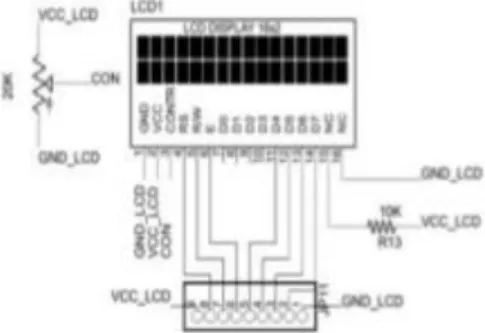
It takes nine pins to access the circuit l6x2 LCD, these pins are VCC, GND, RS, RW, E, D4, D5,D6 and D7. In this series there is one variable resistor to adjust the contrast on the 16x2 LCD.16x2 LCD including digital output, so all ports on ATmega328 can be used to access this series. Figure 3 is a 16x2 LCD image series on the sensortrainer.
Figure.5. LC D 1 6x2 circuit 4) DC MotorCircuit
The DC motor output circuit can be accessed digitally or analog. If accessed digitally, then all PORT ATmega16 can be used to access the circuit this. But if it is accessed analogically then the port can used to access a DC motor circuit is a port which has PWM facilities. By accessing the circuit DC motor analog we can adjust the motor speed the. In this DC motor circuit there is a transistor BD 139 functions as a switch. Figure 6 is Pictures of DC motor circuits on the sensor trainer:
Página | 2127 5) LED circuit
There are eight LEDs on the sensor trainer. LED it can be accessed using all existing I / O portion ATmega 16. In this LED circuit the method is used active high where if the data pin is given logic high, the LED will lights up (on). Figure 19 is a series of eight images LED pieces on the sensor trainer:
Figure . 7. LED circuit 6) Buzzer Curcuit
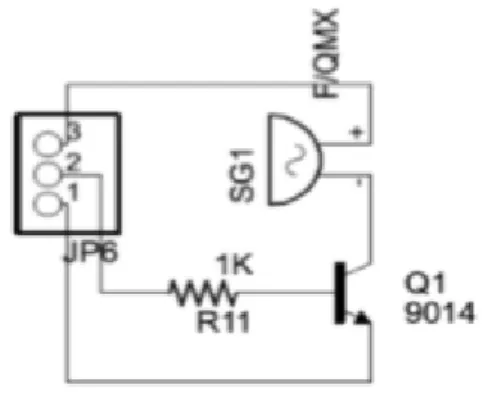
There is one transistor 9014 in t he circuit buzzer. The transistor was used as a switch to be activating buzzer. To access the buzzer circuit three pins were needed, namely VCC, GND, and data. All ports I/ O on ATmega16 could be used to accessthis series. Buzzer will be active (on) if the data pin is given logic 1(high) and will die (off) if the data pin was given a low logic 0 (low). Figure 8 was a picture of the buzzer sequence
onsensor trainer:
Página | 2128 4. Implementation
After learning resources were made and declared feasible by material experts and media experts, then the application phase was carried out learning process. The implementation phase was carried out for engine cadets at Surabaya Merchant Marine Polytechnic. Implementation phase conducted to determine the feasibility of the sensor trainer in the process learning. At this stage cadets were given the user questionnaire used to measure the eligibility of trainersthesensor.
5. Evaluation
There were two stages of evaluation conducted in this study. The first evaluation was done after the researchers got the results of the test validation was done by material experts and media experts. The result of the test validation was then used as a reference for conducting improvements to the sensor trainer. The second evaluation phase was carried out after researchers obtain data at the implementation stage. Data from the questionnaire was processed and used to measure the trainer's eligibility the sensor.
C. Research Subjects
The subject of this research is the cadets of engine department of Surabaya Merchant Marine Polytechnic.
D. Data Collection Methods and Tools 1. Data CollectionMethod
There are two methods used to get data research, the observation method and the questionnaire method. Observation conducted to collect data needed for manufacturing instructional Media. The questionnaire method was carried out to collect data on the feasibility of instructionalmedia.
a. Observation Method
This data collection method is done in a way observing learning activities and the media used. Data observations before research are used in manufacturing background and problem identification. The design of the sensor trainer also refers to data obtained at the time of observation.
Página | 2129 The questionnaire method was conducted by giving a questionnaire
contains items of statement to respondents to assess the media learning that has been made. In this study the respondents are material experts, media experts, and users. Questionnaire to assess the feasibility of a sensor trainer arranged using a scale likert four choices. The use of a four choice Likert scale will be more maximum compared to five choices, this is due because the four choice Likertscale triggers respondents to answer more assertive because there is no hesitant / neutral choice.
2. Data Collection Tools
According to Sugiyono(Sugiyono, 2016b) research instruments are tools which can be used in measuring social phenomena and nature. The preparation of research instruments according to EkoPutroWidoyoko(Widoyoko, 2012)can be passed through several stages, namely: (l)determine the variablesto be examined, (2) formulating a definitionconceptual, (3) construct conceptual definitions, (4) arrange the lattice instrument, (5) arranging instrument points. Of steps and from the relevant research readings, a grid was obtained instrument as follows:
a. Instrument for materialexperts
Instruments for material experts are used to assess the feasibility of the sensor trainer in material terms.
b. Instrument for mediaexperts
Instruments for media experts are used to judge the feasibility of the sensortrainer in terms of learning media. The experts the media are lecturers or teachers who are experts in the field of medialearning.
c. Instrument forusers
Instruments for users are used to judge the feasibility of the sensor trainer is seen from the user, Surabaya Merchant Marine Polytechnic cadets. E. Data analysis technique
1. Test Validity
The instrument is declared valid if the instrument can used to measure what should be measured (Sugiyono, 2016b). Points of statement in the material expert questionnaire must be leads to the material content of the sensor trainer
Página | 2130 that is also with statement items on the media expert questionnaire and the user.
Validity test is done by holding consultations to the expert judgments. 2. Instrument Reliability Test
Reliability Tests are carried out to determine the level of reliability instruments used for data collection. Instrument declared reliable if the instrument used to measure an object the same time many times it will still produce data the same (Sugiyono, 2016a). Instrument reliability testing can be done using Cronbach’s alpha formula.
3. Feasibility Test
Learning media products that have been implemented in form of the finished product is then tested for the product's suitability. Questionnaire used has four choices, namely: StronglyAgree, Agree, Disagree, and Strongly Disagree. These choices arequalitative data, to transform into quantitative data used grading 4 gradations that is 4,3,2,1.
RESULTS AND DISCUSSION
A. Description of Test Data 1. Sensor Trainer Performance
Testing product trials are conducted to find out whether the media learning can work according to product design ornot. Testing is done by making a program for each series of inputs and outputs on the sensor trainer. Followingis a description of the tests that have been carried out:
a. Testing the Buzzer OutputTesting the buzzer output is done bycreating a program which sounds the buzzer for 3 seconds then silence for3seconds.
b. LED Output TestingLED output testing is done by creating a
program Sequential LEDs. In
thisprogramtheLEDwilllightoneafteranotheronewithanintervalofonesecond. c. Testing the DC MotorOutput
Testing the DC motor output is done by making DC motor speed control program. In this program created motor speed will increase by 50 PWM each
Página | 2131 interval three seconds, after the speed reaches 250 PWM, then the motor DC
will stop for threeseconds. d. 16x2 LCD OutputTesting
Testing the LCD output is done by making a program which displays letters, numbers and symbols on the 16x2 LCD. In the program the writing cursor on the LC D is placed on the 5th column and the 0th row of the l6x2 LCD with the command"Ledgotoxy(5.0);"
e. Testing the LM35Sensor
Input LM35 Sensor input testing is done by making a program that displays ADC data generated from temperature reading by the LM35 sensor. To display ADC data 16x2 LCD is used. To increase the temperature on the LM35 sensor, then the LM35 sensor is brought near a heater. OnThis test LM35 temperature sensor has a temperature change linear when brought near the heater.
2. Description of Material Validation Data
Result of data calculation for the material quality aspect was 82.03% and aspects of expediency of 90.63%. From the aspects, it also obtained a total percentage of 86.33%. From the calculations above, the average total score is obtained amounted to 3.45 and the percentage of total score was 86.33%. From the resultsit was concluded that the sensor trainer was declared "VERY WORTH" viewed from the material validation test.
3. Media Validation Data Description
Media validation test was done to assess the sensor trainer seen front point of view of learning media. Media validation is done with giving questionnaires to lecturers who are experts in the field of media learning and teaching subjects. Assessment results by Media experts are 82.64%, aspects of operation amounted to 82.81%, and aspects the benefit of the media is 86.98%. From these aspects to obtained a total percentage of 84.14%. From the calculations that have been made, the average total score is obtained amounted to 3.37 and the percentage of the total score was 84.14%. From the result sit was concluded that the sensor trainer was declared" VERY WORTH "viewed from the media validation test.
Página | 2132 The limited test was conducted by 20 cadets engine department. This
test was done to get advice from users. In this section only the calculation results are presented feasibility analysis of the limited test, more detailed calculations regarding the feasibility of the sensor trainer. From the limited test obtained the average total score was 3.1 2 with a percentage of 78.02°/c. With these results, the sensor trainer is declared "WORTH".
5. Instrument Reliability Test
The instrument tested was a questionnaire for users who used to measure the level of eligibility of sensor trainers by cadets. Previously the questionnaire had been consulted with experts to get valid results. Testing was done using alpha formula.The data tested for reliability are data taken from the test limited. Based on calculations that have been done, obtained a result of 0.89 included in the "VERY RELIABLE" category.
B. Analysis of Implementation Data
The implementation took place at Surabaya Merchant Marine Polytechnic and the following were the result was found that a percentage of 77.87% in aspects material quality, 69.12% for media operations, and 78.73% for learning. It also obtained an average total score of 3.01 with a percentage of 75.24%. With these results, the trainer the censor was declared "DECENT" as a learning media for the control system course at Surabaya Merchant Machine Polytechnic.
C. Product Review
1. Electronic sensor trainer
The following was an explanation of the electronic circuits contained on the sensor trainer:
a) Minimum system
The minimum system was the main controller of the trainer thesensor. The minimum system used Arduino Uno. At this minimum system the power supply produced from an adapter of 5V was channeled through the DC jack connector. There was also a minimum system port for delivering power to input and output circuit.
b) Buzzer Output Circuit
To turn on the buzzer use one transistor NPN 9014 type that functions as a switch. There were three pins in the buzzer output circuit, namely pin
Página | 2133 +, data, and pin -.The data pin was taken from the arduinouno I / O port
which was used as the output. c) LED Output Circuit
The LED output circuit has 8 LEDs that can function as output. In this series there were 8 data pinsand I pin-. Eight data pins were connected by I / O ports ATmega328 was used as an output.
d) DC Motor Output Circuit
The DC motor output circuit used a BD 139 transistor which functions as a switch. There were three pins on DC motor output circuit, namely pin+, data, and -. To regulate DC motor speed, then the data pin must be connected with ATmega 16 I / O port which functions as output and the port was programmed to produce a PWM signal (pulse withmodulation). e) l6x2 LCD Output Circuit l6x2
LCD output circuit was used to display data in the form of writing and numbers. In this series there was one variable resistor used to adjust the intensitylight on the LCD background.
f) LM35 Sensor InputCircuit
LM35 sensor circuit was very simple because onlyconsists of one sensor that could be read with the facility ADC on ATmega328. Arduinouno port that could be used for ADC facility was PORT A
Figure 9. Cadets used the sensor trainer 2. Manual Book
The manual was used to simplify the operationsensor trainer by the user. In the censor trainer's manualthere is also an initial explanation about the Arduinounornicrocontroller.
Página | 2134 3. Jobsheet
Jobsheets were used by the cadets to help in the process sensor trainer operation. Jobsheet creation was sorted based on basic competencies to be achieved. The order starting from digital output programming, analog output, digital input, and the last is analog input.
DISCUSSION OF RESEARCH RESULTS
This discussion describes the answers to problems that have been formulated in the formulation of the problem. The formulation of the problem will beansweredin withthe processes and data carried out during thestudy.
1. How was the sensor trainer design in accordance with basic competency needs in control system subject at engine department of Surabaya Merchant Marine Polytechnic? The sensor trainer design was based on competence at control system subject at engine department of Surabaya Merchant Marine Polytechnic. The sensor trainer able to assist students in making programs analog input, digital input, analog output, and digital output.
2. What is the performance of the sensor trainer for the control system course at Surabaya Merchant Marine Polytechnic?
Performance testing was done by doing programming on each input and output of the sensor trainer. Following was a description of the tests that have been carried out:
a. Testing the Buzzer Output
Testing the buzzer output is done by creating a programwhich sounds the buzzer for 3 seconds then silence for 3seconds. Programs that are made run repeatedly. OnThis testing buzzer can function according to programwas made.
b. LED Output Testing
LED output testing is done by creating a program sequential LEDs. In this program the LED will light oneafter another with an interval of one second. In this test all LEDs can function properly.
c. Testing the DC Motor OutputTesting the DC motor output is done by makingDC motor speed control program.
Página | 2135 In this program created the speed of the motor will increase every
three seconds,after the speed reaches maximum, the DC motor will stop for three seconds. The DC motor testing program is running repeatedly. In this test a DC motor can workwell.
d. 1 6x2 LCD Output
Testing the LCD output is done by making a program which displays letters, numbers and symbols on the 16x2 LCD.ln this test 1 6x2 LCD can function in accordance with program created.eg.
e. Testing theLM35
Sensor InputLM35 Sensor input testing is done by making a program that displays ADC data generated fromtemperature reading by the LM35 sensor. To display ADC data 16x2 LCD is used. In this test the LM35 temperature sensor can function in accordance with its working principle. 3. What is the level of eligibility of the sensor trainer as media learning at control
system subject at engine department of Surabaya Merchant Marine Polytechnic? The level of eligibility was measured using instruments has been consulted by experts. There were three types of questionnaires there were instruments to test the feasibility of the media trainer the sensor. The questionnaire was in the form of a questionnaire for material validation,media validation, and questionnaires for users.
a. MaterialValidation
Material validation was carried out by two material experts competent in the field of control system subject. There were two aspects measured in this validation, namely the quality of the material, and expediency. Media trainer sensors on the aspect of material quality get a percentage of 82.03% and 90.63% in the aspect of expediency. From these two aspects, a total percentage was obtained 86.33%, thus the media censor trainer was stated "VERY WORTH" was used in control system subject at engine department of Surabaya Merchant Marine Polytechnic.
b. Media Validation
Media validation was done by lecturers and teachers who competent in the field of learning media. There were three aspects measured in this validation, i.e. media design, operation andexpediency of the media. Media
Página | 2136 trainer sensor on aspects of media design got a percentage of 82.64%, in
aspects operation gained 82.81%, and in the aspect of expediency the media got 90.63%. From the three aspects obtained a total percentage of 84.14%, thus the media trainer sensor declared "VERY WORTH" was used on control system subject at engine department of Surabaya Merchant Marine Polytechnic. In testing the revision was not found and the media censor trainer was declared "WORTH IT". There were three aspects measured at this stage of implementation namely aspects of material quality, media operations, and aspects learning. The results obtained were for material quality get a percentage of 77.87%, for media operations got69.12%, and for learning got a percentage of 75.24%. Of the three percentages obtained a total percentage of 75.24%, so that the media trainer censors declared "DECENT" were used as learning media.
CONCLUSION
After doing research and development of learning media sensor trainer, the following conclusions can bedrawn:
1. Research and development of sensor trainers was carried out using ADDIE model (Analysis, Design, Development, Implementation, and Evaluation) which requires researchersto analyze aspects that exist in the object of research. The results of the analysis served as the basis of making instructor learning media the sensor. The selection of inputs in the form of sensors and various outputs the sensor trainer must be based on basic competencies that were contained in the syllabus ofsubjects. 2. Performance testing was carried out to determine whether the trainer the sensor
could work well or not. The performance of the trainer the sensor was done by programming each input and outputthere is a sensortrainer.
3. The feasibility of the sensor trainer learning media was tested from 3 aspects, i.e. material validation test, media validation test, and user test. Sensor truer learning media got a percentage of 86.33% with the category "VERY WORTH" in the validation of the material. In the validation of the media trainer the sensor got a percentage eligibility of 81.14% with the category "VERY WORTH". For eligibility at the implementation stage, the sensor trainer got a percentage of
Página | 2137 75.24% thus, the trainer censors declared "DECENT" were used as learning media.
REFERENCES
(1) Andrianto, H. (2008). Pemrograman Mikrokontroler AVR ATmega8535. Bandung: Informatika.
(2) Daryanto. (2010). Media Pembelajaran. Yogyakarta: Gavarmedia.
(3) Dick, W., & Carey, L. (2015). The systematic design of instruction. 6th.
Boston, MA.
(4) Mulyatiningsih, E. (2011). Riset Terapan Bidang Pendidikan dan Teknik. Yogyakarta: UNY Press.
(5) Sugiyono. (2016a). Memahami Penelitian Kualitatif. Bandung: Alfabeta.
(6) Sugiyono. (2016b). Metode Penelitian dan Pengembangan (Research and
Development/R&D). In Bandung: Alfabeta.
https://doi.org/10.1016/j.drudis.2010.11.005
(7) Widoyoko, E. P. (2012). Teknik penyusunan instrumen penelitian.