EUROPEAN ORGANIZATION FOR NUCLEAR RESEARCH (CERN)
CERN-PH-EP/2013-037 2015/05/19
CMS-BPH-14-001
Measurement of prompt J/ψ and ψ
(
2S
)
double-differential
cross sections in pp collisions at
√
s
=
7 TeV
The CMS Collaboration
∗Abstract
The double-differential cross sections of promptly produced J/ψ and ψ(2S) mesons
are measured in pp collisions at√s = 7 TeV, as a function of transverse momentum
pT and absolute rapidity|y|. The analysis uses J/ψ and ψ(2S)dimuon samples
col-lected by the CMS experiment, corresponding to integrated luminosities of 4.55 and
4.90 fb−1, respectively. The results are based on a two-dimensional analysis of the
dimuon invariant mass and decay length, and extend to pT = 120 and 100 GeV for
the J/ψ and ψ(2S), respectively, when integrated over the interval|y| < 1.2. The
ra-tio of the ψ(2S) to J/ψ cross sections is also reported for |y| < 1.2, over the range
10 < pT < 100 GeV. These are the highest pTvalues for which the cross sections and
ratio have been measured.
Published in Physical Review Letters as doi:10.1103/PhysRevLett.114.191802.
c
2015 CERN for the benefit of the CMS Collaboration. CC-BY-3.0 license
∗See Appendix B for the list of collaboration members
1
Studies of heavy-quarkonium production are of central importance for an improved under-standing of nonperturbative quantum chromodynamics (QCD) [1]. The nonrelativistic QCD (NRQCD) effective-field-theory framework [2], arguably the best formalism at this time,
factor-izes high-pT quarkonium production in short-distance and long-distance scales. First a heavy
quark-antiquark pair, QQ, is produced in a Fock state2S+1L[Ja], with spin S, orbital angular
mo-mentum L, and total angular momo-mentum J that are either identical to (color singlet, a = 1) or
different from (color octet, a= 8) those of the corresponding quarkonium state. The QQ cross
sections are determined by short-distance coefficients (SDC), kinematic-dependent functions
calculable perturbatively as expansions in the strong-coupling constant αs. Then this
“preres-onant” QQ pair binds into the physically observable quarkonium through a nonperturbative evolution that may change L and S, with bound-state formation probabilities proportional to long-distance matrix elements (LDME). The LDMEs are conjectured to be constant (i.e., in-dependent of the QQ momentum) and universal (i.e., process inin-dependent). The color-octet terms are expected to scale with powers of the heavy-quark velocity in the QQ rest frame. In the nonrelativistic limit, an S-wave vector quarkonium state should be formed from a QQ pair produced as a color singlet (3S[11]) or as one of three color octets (1S[08],3S1[8], and3PJ[8]).
Three “global fits” to measured quarkonium data [3–5] obtained incompatible octet LDMEs, despite the use of essentially identical theory inputs: next-to-leading-order (NLO) QCD calcu-lations of the singlet and octet SDCs. The disagreement stems from the fact that different sets of measurements were considered. In particular, the results crucially depend on the minimum
pT of the fitted measurements [6], because the octet SDCs have different pTdependences. Fits
including low-pTcross sections lead to the conclusion that, at high pT, quarkonium production
should be dominated by transversely polarized octet terms. This prediction is in stark contra-diction with the unpolarized production seen by the CDF [7, 8] and CMS [9, 10] experiments, an observation known as the “quarkonium polarization puzzle”. As shown in Ref. [6], the
puz-zle is seemingly solved by restricting the NRQCD global fits to high-pT quarkonia, indicating
that the presently available fixed-order calculations provide SDCs unable to reproduce reality
at lower pTvalues or that NRQCD factorization only holds for pT values much larger than the
quarkonium mass. The polarization measurements add a crucial dimension to the global fits because the various channels have remarkably distinct polarization properties: in the helicity
frame,3S[11]is longitudinally polarized,1S0[8]is unpolarized,3S1[8]is transversely polarized, and
3P[8]
J has a polarization that changes significantly with pT. Bottomonium and prompt
charmo-nium polarizations reaching or exceeding pT = 50 GeV were measured by CMS [9, 10], using
a very robust analysis framework [11, 12], on the basis of event samples collected in 2011. In-stead, the differential charmonium cross sections published by CMS [13] are based on data
collected in 2010 and have a much lower pT reach. Measurements of prompt charmonium
cross sections extending well beyond pT = 50 GeV will trigger improved NRQCD global fits,
restricted to a kinematic domain where the factorization formalism is unquestioned, and will provide more accurate and reliable LDMEs.
This Letter presents measurements of the double-differential cross sections of J/ψ and ψ(2S)
mesons promptly produced in pp collisions at a center-of-mass energy of 7 TeV, based on dimuon event samples collected by CMS in 2011. They complement other prompt charmo-nium cross sections measured at the LHC, by ATLAS [14, 15], LHCb [16, 17], and ALICE [18].
The analysis is made in four bins of absolute rapidity (|y| <0.3, 0.3< |y| <0.6, 0.6< |y| <0.9,
and 0.9 < |y| < 1.2) and in the pT ranges 10–95 GeV for the J/ψ and 10–75 GeV for the ψ(2S).
A rapidity-integrated result in the range|y| < 1.2 is also provided, extending the pT reach to
2
ratios are also reported. The dimuon invariant mass distribution is used to separate the J/ψ
and ψ(2S)signals from other processes, mostly pairs of uncorrelated muons, while the dimuon
decay length is used to separate the nonprompt charmonia, coming from decays of b hadrons, from the prompt component. Feed-down from decays of heavier charmonium states, approxi-mately 33% of the prompt J/ψ cross section [19], is not distinguished from the directly produced charmonia.
The CMS apparatus is based on a superconducting solenoid of 6 m internal diameter, providing a 3.8 T field. Within the solenoid volume are a silicon pixel and strip tracker, a lead tungstate crystal electromagnetic calorimeter, and a brass and scintillator hadron calorimeter. Muons are measured with three kinds of gas-ionization detectors: drift tubes, cathode strip chambers, and resistive-plate chambers. The main subdetectors used in this analysis are the silicon tracker and the muon system, which enable the measurement of muon momenta over the pseudorapidity
range|η| <2.4. A more detailed description of the CMS detector, together with a definition of
the coordinate system used and the relevant kinematic variables, can be found in Ref. [20]. The events were collected using a two-level trigger system. The first level, made of custom hardware processors, uses data from the muon system to select events with two muon candi-dates. The high-level trigger, adding information from the silicon tracker, reduces the rate of
stored events by requiring an opposite-sign muon pair of invariant mass 2.8< M <3.35 GeV,
pT > 9.9 GeV, and|y| < 1.25 for the J/ψ trigger, and 3.35 < M < 4.05 GeV and pT > 6.9 GeV
for the ψ(2S)trigger. No pTrequirement is imposed on the single muons at trigger level. Both
triggers require a dimuon vertex fit χ2probability greater than 0.5% and a distance of closest
approach between the two muons less than 5 mm. Events where the muons bend towards each other in the magnetic field are rejected to lower the trigger rate while retaining the
highest-quality dimuons. The J/ψ and ψ(2S)analyses are conducted independently, using event
sam-ples separated at the trigger level. The ψ(2S)sample corresponds to an integrated luminosity
of 4.90 fb−1, while the J/ψ sample has a reduced value, 4.55 fb−1, because the pT threshold of
the J/ψ trigger was raised to 12.9 GeV in a fraction of the data-taking period; the integrated luminosities have an uncertainty of 2.2% [21].
The muon tracks are required to have hits in at least eleven tracker layers, with at least two in the silicon pixel detector, and to be matched with at least one segment in the muon
sys-tem. They must have a good track fit quality (χ2 per degree of freedom smaller than 1.8) and
point to the interaction region. The selected muons must also match in pseudorapidity and azimuthal angle with the muon objects responsible for triggering the event. The analysis is restricted to muons produced within a fiducial phase-space window where the muon
detec-tion efficiencies are accurately measured: pT > 4.5, 3.5, and 3.0 GeV for the regions|η| < 1.2,
1.2 < |η| < 1.4, and 1.4 < |η| < 1.6, respectively. The combinatorial dimuon background
is reduced by requiring a dimuon vertex fit χ2 probability larger than 1%. After applying the
event selection criteria, the combined yields of prompt and nonprompt charmonia in the range
|y| < 1.2 are 5.45 M for the J/ψ and 266 k for the ψ(2S). The prompt charmonia are separated from those resulting from decays of b hadrons through the use of the dimuon pseudo-proper
decay length [22], ` = LxyM/pT, where Lxy is the transverse decay length in the laboratory
frame, measured after removing the two muon tracks from the calculation of the primary
ver-tex position. For events with multiple collision vertices, Lxy is calculated with respect to the
vertex closest to the direction of the dimuon momentum, extrapolated towards the beam line.
For each(|y|, pT)bin, the prompt charmonium yields are evaluated through an extended
un-binned maximum-likelihood fit to the two-dimensional(M,`)event distribution. In the mass
3
with free mean (µCB) and width (σCB) parameters. Given the strong correlation between the
two CB tail parameters, αCBand nCB, they are fixed to values evaluated from fits to event
sam-ples integrated in broader pT ranges. A single CB function provides a good description of the
signal mass peaks, given that the dimuon mass distributions are studied in narrow (|y|, pT)
bins, within which the dimuon invariant mass resolution has a negligible variation. The mass distribution of the underlying continuum background is described by an exponential function. Concerning the pseudo-proper decay length variable, the prompt signal component is mod-eled by a resolution function, which exploits the per-event uncertainty information provided by the vertex reconstruction algorithm, while the nonprompt charmonium term is modeled by an exponential function convolved with the resolution function. The continuum background component is represented by a sum of prompt and nonprompt empirical forms. The distribu-tions are well described with a relatively small number of free parameters.
2.85 2.9 2.95 3 3.05 3.1 3.15 3.2 3.25 3.3 Events / 4 MeV 0 50 100 150 200 250 300 350 400 450 Data Total Prompt Nonprompt Background CMS ψ J/ < 32 GeV T 30 < p 0.6 < |y| < 0.9 (7 TeV) -1 4.55 fb
Dimuon invariant mass [GeV] -0.5 0 0.5 Pseudo-proper decay length [mm]1 1.5 2 2.5
m μ Events / 20 -1 10 1 10 2 10 3 10 DataTotal Prompt Nonprompt Background CMS ψ J/ < 32 GeV T 30 < p 0.6 < |y| < 0.9 (7 TeV) -1 4.55 fb
Dimuon invariant mass [GeV]
3.4 3.5 3.6 3.7 3.8 3.9 4 Events / 14 MeV 0 50 100 150 200 250 300 350 Data Total Prompt Nonprompt Background CMS (2S) ψ < 27.5 GeV T 25 < p |y| < 0.3 (7 TeV) -1 4.9 fb
Pseudo-proper decay length [mm]
-0.5 0 0.5 1 1.5 2 2.5 m μ Events / 20 -1 10 1 10 2 10 Data Total Prompt Nonprompt Background CMS (2S) ψ < 27.5 GeV T 25 < p |y| < 0.3 (7 TeV) -1 4.9 fb
Figure 1: Projections on the dimuon invariant mass (left) and pseudo-proper decay length
(right) axes, for the J/ψ (top) and ψ(2S) (bottom) events in the kinematic bins given in the
plots. The right panels show dimuons of invariant mass within ±3 σCB of the pole masses.
The curves, identified in the legends, represent the result of the fits described in the text. The vertical bars on the data points show the statistical uncertainties.
Figure 1 shows the J/ψ and ψ(2S)dimuon invariant mass and pseudo-proper decay length
pro-jections for two representative(|y|, pT)bins. The decay length projections are shown for events
with dimuon invariant mass within±3 σCBof the pole mass. In the highest pT bins, where the
number of dimuons is relatively small, stable results are obtained by fixing µCBand the slope
of the exponential-like function describing the nonprompt combinatorial background to values
extrapolated from the trend found from the lower-pTbins. The systematic uncertainties in the
signal yields are evaluated by repeating the fit with different functional forms, varying the val-ues of the fixed parameters, and allowing for more free parameters in the fit. The fit results are robust with respect to changes in the procedure; the corresponding systematic uncertainties are
4
negligible at low pT and increase to≈2% for the J/ψ and≈6% for the ψ(2S)in the highest pT
bins.
The single-muon detection efficiencies eµ are measured with a “tag-and-probe” (T&P)
tech-nique [24], using event samples collected with triggers specifically designed for this purpose, including a sample enriched in dimuons from J/ψ decays where a muon is combined with an-other track and the pair is required to have an invariant mass within the range 2.8–3.4 GeV. The procedure was validated in the phase-space window of the analysis with detailed Monte Carlo (MC) simulation studies. The measured efficiencies are parametrized as a function of muon
pT, in eight bins of muon|η|. Their uncertainties, reflecting the statistical precision of the T&P
samples and possible imperfections of the parametrization, are≈2–3%. The efficiency of the
dimuon vertex fit χ2probability requirement is also measured with the T&P approach, using a
sample of events collected with a dedicated (prescaled) trigger. It is around 95–97%, improving
with increasing pT, with a 2% systematic uncertainty At high pT, when the two muons might
be emitted relatively close to each other, the efficiency of the dimuon trigger eµµis smaller than
the product of the two single-muon efficiencies [13], eµµ = eµ1eµ2ρ. The correction factor ρ
is evaluated with MC simulations, validated from data collected with single-muon triggers.
For pT < 35 GeV, ρ is consistent with being unity, within a systematic uncertainty estimated
as 2%, except in the 0.9 < |y| < 1.2 bin, where the uncertainty increases to 4.3% for the J/ψ
if pT < 12 GeV, and to 2.7% for the ψ(2S)if pT < 11 GeV. For pT > 35 GeV, ρ decreases
ap-proximately linearly with pT, reaching 60–70% for pT ∼ 85 GeV, with systematic uncertainties
evaluated by comparing the MC simulation results with estimations made using data collected
with single-muon triggers: 5% up to pT = 50 (55) GeV for the J/ψ (ψ(2S)) and 10% for higher
pT. The total dimuon detection efficiency increases from eµµ ≈78% at pT =15 GeV to≈85% at
30 GeV, and then decreases to≈65% at 80 GeV.
To obtain the charmonium cross sections in each (|y|, pT)bin without any restrictions on the
kinematic variables of the two muons, we correct for the corresponding dimuon acceptance, defined as the fraction of dimuon decays having both muons emitted within the single-muon fiducial phase space. These acceptances are calculated using a detailed MC simulation of the
CMS experiment. Charmonia are generated using a flat rapidity distribution and pT
distri-butions based on previous measurements [13]; using flat pT distributions leads to negligible
changes. The particles are decayed by EVTGEN[25] interfaced toPYTHIA 6.4 [26], whilePHO
-TOS[27] is used to simulate final-state radiation. The fractions of J/ψ and ψ(2S)dimuon events
in a given(|y|, pT)bin with both muons surviving the fiducial selections depend on the decay
kinematics and, in particular, on the polarization of the mother particle. Acceptances are cal-culated using polarization scenarios corresponding to different values of the polar anisotropy
parameter in the helicity frame, λHXϑ : 0 (unpolarized),+1 (transverse), and−1 (longitudinal).
A fourth scenario, corresponding to λHXϑ = +0.10 for the J/ψ and+0.03 for the ψ(2S), reflects
the results published by CMS [10]. The two other parameters characterizing the dimuon
an-gular distributions [28], λϕ and λϑ ϕ, have been measured to be essentially zero [10] and have
a negligible influence on the acceptance. The acceptances are essentially identical for the two
charmonia and are almost rapidity independent for|y| <1.2. The two-dimensional acceptance
maps are calculated with large MC simulation samples, so that statistical fluctuations are small,
and in narrow|y|bins, so that variations within the bins can be neglected. Since the efficiencies
and acceptances are evaluated for events where the two muons bend away from each other, a factor of two is applied to obtain the final cross sections.
The double-differential cross sections of promptly produced J/ψ and ψ(2S)in the dimuon
chan-nel,Bd2σ/dpTdy, whereB is the J/ψ or ψ(2S)dimuon branching fraction, is obtained by
efficien-5
cies and acceptance, by the integrated luminosity and the widths of the pT and|y|bins. The
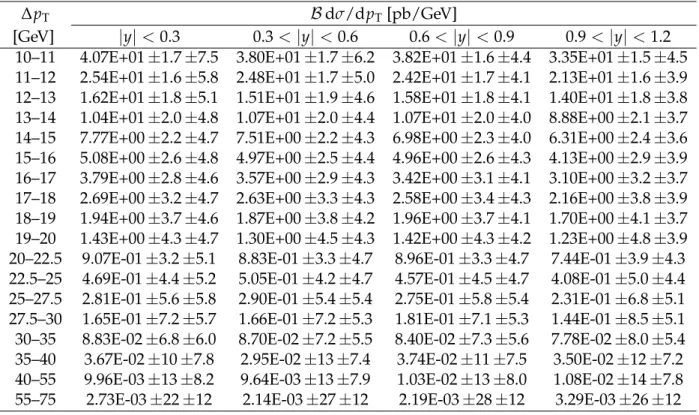
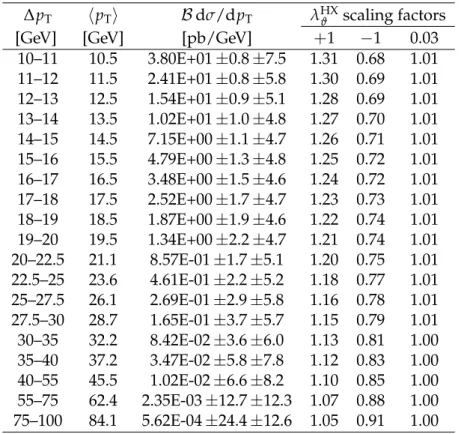
numerical values, including the relative statistical and systematic uncertainties, are reported for both charmonia, five rapidity intervals, and four polarization scenarios in Tables A.1–A.4 of Appendix A. Figure 2 shows the results obtained in the unpolarized scenario. With
re-spect to the|y| < 0.3 bin, the cross sections drop by ≈5% for 0.6 < |y| < 0.9 and ≈15% for
0.9 < |y| <1.2. Measuring the charmonium production cross sections in the broader rapidity
range |y| < 1.2 has the advantage that the increased statistical accuracy allows the
measure-ment to be extended to higher-pT values, where comparisons with theoretical calculations are
particularly informative. Figure 3 compares the rapidity-integrated (unpolarized) cross
sec-tions, after rescaling with the branching fraction B of the dimuon decay channels [29], with
results reported by ATLAS [14, 15]. The curve represents a fit of the J/ψ cross section measured in this analysis to a power-law function [30]. The band labelled FKLSW represents the result of
a global fit [6] comparing SDCs calculated at NLO [3] with ψ(2S)cross sections and
polariza-tions previously reported by CMS [10, 13] and LHCb [17]. According to that fit, ψ(2S)mesons
are produced predominantly unpolarized. At high pT, the values reported in this Letter tend
to be higher than the band, which is essentially determined from results for pT <30 GeV.
[GeV] T p 0 20 40 60 80 100 120 [nb / GeV] y dT p / d σ d B -6 10 -5 10 -4 10 -3 10 -2 10 -1 10 1 CMS -1 2) × | < 1.2 ( y | | < 0.3 y | | < 0.6 y 0.3 < | | < 0.9 y 0.6 < | | < 1.2 y 0.9 < | of 2.2% not included Luminosity uncertainty ψ J/ (2S) ψ ψ : L = 4.55 fb J/ (2S) : L = 4.90 fb ψ -1 = 7 TeV s pp 2
Figure 2: The J/ψ and ψ(2S)differential pTcross sections times the dimuon branching fractions
for four rapidity bins and integrated over the range|y| <1.2 (scaled up by a factor of 2 for
pre-sentation purposes), assuming the unpolarized scenario. The vertical bars show the statistical and systematic uncertainties added in quadrature.
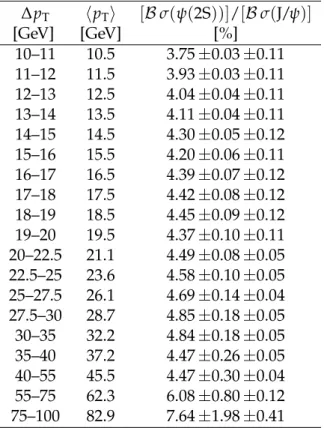
The ratio of the ψ(2S)to J/ψ differential cross sections is also measured in the|y| <1.2 range,
recomputing the J/ψ values in the pT bins of the ψ(2S) analysis. The measured values are
reported in Table A.5 of Appendix A. The corrections owing to the integrated luminosity, ac-ceptances, and efficiencies cancel to a large extent in the measurement of the ratio. The total
systematic uncertainty, dominated by the ρ correction for pT > 30 GeV and by the acceptance
and efficiency corrections for pT <20 GeV, does not exceed 3%, except for pT >75 GeV, where
it reaches 5%. Larger event samples are needed to clarify the trend of the ratio for pT above
≈35 GeV.
In summary, the double-differential cross sections of the J/ψ and ψ(2S)mesons promptly
pro-duced in pp collisions at√s = 7 TeV have been measured as a function of pT in four|y|bins,
as well as integrated over the |y| < 1.2 range, extending up to or beyond pT = 100 GeV.
New global fits of cross sections and polarizations, including these high-pT measurements,
6 [GeV] T p 0 20 40 60 80 100 120 [nb / GeV] T pd y / d 2 σd -5 10 -4 10 -3 10 -2 10 -1 10 1 10 2 10 ψ J/ (2S) ψ = 7 TeV s pp -1 | < 1.2, 4.55 fb (2.4%) y CMS, | -1 | < 0.75, 2.3 pb (3.5%) y ATLAS, | -1 | < 1.2, 4.90 fb (10.6%) y CMS, | -1 | < 0.75, 2.1 fb (2.4%) y ATLAS, | | < 1.2 y FKLSW, | Power-law fit
Figure 3: The J/ψ (open symbols) and ψ(2S)(closed symbols) differential (unpolarized) cross
sections from this analysis (circles) and from ATLAS (squares) [14, 15]. The vertical bars show the statistical and systematic uncertainties added in quadrature, not including the uncertainties from integrated luminosities and branching fractions, which are indicated by the percentages given in the legend. The curve shows a fit of the J/ψ cross section measured in this analysis to a
power-law function, while the band labelled FKLSW represents a calculation of the ψ(2S)cross
section using LDMEs determined with lower-pTLHC data [6].
believed to be most reliable. The new data should also provide input to stringent tests of recent theory developments, such as those described in Refs. [31–33].
Acknowledgments
We congratulate our colleagues in the CERN accelerator departments for the excellent perfor-mance of the LHC and thank the technical and administrative staffs at CERN and at other CMS institutes for their contributions to the success of the CMS effort. In addition, we gratefully acknowledge the computing centres and personnel of the Worldwide LHC Computing Grid for delivering so effectively the computing infrastructure essential to our analyses. Finally, we acknowledge the enduring support for the construction and operation of the LHC and the CMS detector provided by the following funding agencies: BMWFW and FWF (Austria); FNRS and FWO (Belgium); CNPq, CAPES, FAPERJ, and FAPESP (Brazil); MES (Bulgaria); CERN; CAS, MoST, and NSFC (China); COLCIENCIAS (Colombia); MSES and CSF (Croatia); RPF (Cyprus); MoER, ERC IUT and ERDF (Estonia); Academy of Finland, MEC, and HIP (Finland); CEA and CNRS/IN2P3 (France); BMBF, DFG, and HGF (Germany); GSRT (Greece); OTKA and NIH (Hungary); DAE and DST (India); IPM (Iran); SFI (Ireland); INFN (Italy); MSIP and NRF (Re-public of Korea); LAS (Lithuania); MOE and UM (Malaysia); CINVESTAV, CONACYT, SEP, and UASLP-FAI (Mexico); MBIE (New Zealand); PAEC (Pakistan); MSHE and NSC (Poland); FCT (Portugal); JINR (Dubna); MON, RosAtom, RAS and RFBR (Russia); MESTD (Serbia); SEIDI and CPAN (Spain); Swiss Funding Agencies (Switzerland); MST (Taipei); ThEPCenter, IPST, STAR and NSTDA (Thailand); TUBITAK and TAEK (Turkey); NASU and SFFR (Ukraine); STFC (United Kingdom); DOE and NSF (USA).
References 7
References
[1] N. Brambilla et al., “Heavy quarkonium: progress, puzzles, and opportunities”, Eur. Phys. J. C 71 (2011) 1534, doi:10.1140/epjc/s10052-010-1534-9,
arXiv:1010.5827.
[2] G. T. Bodwin, E. Braaten, and G. P. Lepage, “Rigorous QCD analysis of inclusive annihilation and production of heavy quarkonium”, Phys. Rev. D 51 (1995) 1125,
doi:10.1103/PhysRevD.51.1125, arXiv:hep-ph/9407339.
[3] M. Butenschoen and B. A. Kniehl, “J/ψ Polarization at Tevatron and the LHC:
Nonrelativistic-QCD Factorization at the Crossroads”, Phys. Rev. Lett. 108 (2012) 172002, doi:10.1103/PhysRevLett.108.172002, arXiv:1201.1872.
[4] B. Gong, L.-P. Wan, J.-X. Wang, and H.-F. Zhang, “Polarization for Prompt J/ψ, ψ(2S) Production at the Tevatron and LHC”, Phys. Rev. Lett. 110 (2013) 042002,
doi:10.1103/PhysRevLett.110.042002, arXiv:1205.6682.
[5] K.-T. Chao et al., “J/ψ Polarization at Hadron Colliders in Nonrelativistic QCD”, Phys. Rev. Lett. 108 (2012) 242004, doi:10.1103/PhysRevLett.108.242004,
arXiv:1201.2675.
[6] P. Faccioli et al., “Quarkonium production in the LHC era: a polarized perspective”, Phys. Lett. B 736 (2014) 98, doi:10.1016/j.physletb.2014.07.006,
arXiv:1403.3970.
[7] CDF Collaboration, “Polarization of J/ψ and ψ(2S) Mesons Produced in p ¯p Collisions at√
s =1.96 TeV”, Phys. Rev. Lett. 99 (2007) 132001,
doi:10.1103/PhysRevLett.99.132001, arXiv:0704.0638.
[8] CDF Collaboration, “Measurements of Angular Distributions of Muons fromΥ Decays in
p¯p Collisions at√s=1.96 TeV”, Phys. Rev. Lett. 108 (2012) 151802,
doi:10.1103/PhysRevLett.108.151802, arXiv:1112.1591.
[9] CMS Collaboration, “Measurement of theΥ(1S), Υ(2S), and Υ(3S) Polarizations in pp
Collisions at√s=7 TeV”, Phys. Rev. Lett. 110 (2013) 081802,
doi:10.1103/PhysRevLett.110.081802, arXiv:1209.2922.
[10] CMS Collaboration, “Measurement of the prompt J/ψ and ψ(2S) polarizations in pp
collisions at√s=7 TeV”, Phys. Lett. B 727 (2013) 381,
doi:10.1016/j.physletb.2013.10.055, arXiv:1307.6070.
[11] P. Faccioli, C. Lourenc¸o, and J. Seixas, “Rotation-Invariant Relations in Vector Meson Decays into Fermion Pairs”, Phys. Rev. Lett. 105 (2010) 061601,
doi:10.1103/PhysRevLett.105.061601, arXiv:1005.2601.
[12] P. Faccioli, C. Lourenc¸o, and J. Seixas, “New approach to quarkonium polarization studies”, Phys. Rev. D 81 (2010) 111502(R), doi:10.1103/PhysRevD.81.111502,
arXiv:1005.2855.
[13] CMS Collaboration, “J/ψ and ψ(2S)production in pp collisions at√s=7 TeV”, JHEP 02
8 References
[14] ATLAS Collaboration, “Measurement of the differential cross-sections of inclusive,
prompt and non-prompt J/ψ production in proton-proton collisions at√s =7 TeV”,
Nucl. Phys. B 850 (2011) 387, doi:10.1016/j.nuclphysb.2011.05.015, arXiv:1104.3038.
[15] ATLAS Collaboration, “Measurement of the production cross-section of
ψ(2S) →J/ψ(→µ+µ−)π+π−in pp collisions at
√
s=7 TeV at ATLAS”, JHEP 09 (2014)
079, doi:10.1007/JHEP09(2014)079, arXiv:1407.5532.
[16] LHCb Collaboration, “Measurement of J/ψ production in pp collisions at√s=7 TeV”,
Eur. Phys. J. C 71 (2011) 1645, doi:10.1140/epjc/s10052-011-1645-y,
arXiv:1103.0423.
[17] LHCb Collaboration, “Measurement of ψ(2S) meson production in pp collisions at√
s =7 TeV”, Eur. Phys. J. C 72 (2012) 2100,
doi:10.1140/epjc/s10052-012-2100-4, arXiv:1204.1258.
[18] ALICE Collaboration, “Measurement of prompt J/ψ and beauty hadron production cross
sections at mid-rapidity in pp collisions at√s=7 TeV”, JHEP 11 (2012) 065,
doi:10.1007/JHEP11(2012)065, arXiv:1205.5880.
[19] P. Faccioli, C. Lourenc¸o, J. Seixas, and H. W ¨ohri, “Study of ψ0and χcdecays as feed-down
sources of J/ψ hadro-production”, JHEP 10 (2008) 004,
doi:10.1088/1126-6708/2008/10/004, arXiv:0809.2153.
[20] CMS Collaboration, “The CMS experiment at the CERN LHC”, JINST 3 (2008) S08004,
doi:10.1088/1748-0221/3/08/S08004.
[21] CMS Collaboration, “Absolute Calibration of the Luminosity Measurement at CMS: Winter 2012 Update”, CMS Physics Analysis Summary CMS-PAS-SMP-12-008, 2012.
[22] CMS Collaboration, “Prompt and non-prompt J/ψ production in pp collisions at√
s =7 TeV”, Eur. Phys. J. C 71 (2011) 1575,
doi:10.1140/epjc/s10052-011-1575-8, arXiv:1011.4193.
[23] M. J. Oreglia, “A Study of the Reactions ψ0 →γγψ”. PhD thesis, Stanford University,
1980. SLAC-R-236.
[24] CMS Collaboration, “Measurements of inclusive W and Z cross sections in pp collisions
at√s=7 TeV”, JHEP 01 (2011) 080, doi:10.1007/JHEP01(2011)080,
arXiv:1012.2466.
[25] D. J. Lange, “The EvtGen particle decay simulation package”, Nucl. Instrum. Meth. A 462 (2001) 152, doi:10.1016/S0168-9002(01)00089-4.
[26] T. Sj ¨ostrand, S. Mrenna, and P. Z. Skands, “PYTHIA 6.4 physics and manual”, JHEP 05 (2006) 026, doi:10.1088/1126-6708/2006/05/026, arXiv:hep-ph/0603175. [27] E. Barberio and Z. Wa¸s, “PHOTOS - a universal Monte Carlo for QED radiative
corrections: version 2.0”, Comput. Phys. Commun. 79 (1994) 291,
doi:10.1016/0010-4655(94)90074-4.
[28] P. Faccioli, C. Lourenc¸o, J. Seixas, and H. W ¨ohri, “Towards the experimental clarification of quarkonium polarization”, Eur. Phys. J. C 69 (2010) 657,
References 9
[29] Particle Data Group, K. A. Olive et al., “Review of Particle Physics”, Chin. Phys. C 38 (2014) 090001, doi:10.1088/1674-1137/38/9/090001.
[30] HERA-B Collaboration, “A measurement of the ψ0to J/ψ production ratio in 920 GeV
proton-nucleus interactions”, Eur. Phys. J. C 49 (2007) 545,
doi:10.1140/epjc/s10052-006-0139-9, arXiv:hep-ex/0607046.
[31] Z.-B. Kang, J.-W. Qiu, and G. Sterman, “Heavy Quarkonium Production and Polarization”, Phys. Rev. Lett. 108 (2012) 102002,
doi:10.1103/PhysRevLett.108.102002, arXiv:1109.1520.
[32] Z.-B. Kang, Y.-Q. Ma, J.-W. Qiu, and G. Sterman, “Heavy quarkonium production at collider energies: Factorization and evolution”, Phys. Rev. D 90 (2014) 034006,
doi:10.1103/PhysRevD.90.034006, arXiv:1401.0923.
[33] G. T. Bodwin, H. S. Chung, U.-R. Kim, and J. Lee, “Fragmentation Contributions to J/ψ Production at the Tevatron and the LHC”, Phys. Rev. Lett. 113 (2014) 022001,
10 A Tables of cross sections
A
Tables of cross sections
Table A.1: The J/ψ differential cross section times dimuon branching fractionBdσ/dpTin four
rapidity ranges for the unpolarized scenario. The relative uncertainties (first statistical and then systematic) are given in percent. The systematic uncertainties are to be treated as bin-to-bin correlated.
∆pT Bdσ/dpT[pb/GeV]
[GeV] |y| <0.3 0.3< |y| <0.6 0.6 < |y| <0.9 0.9< |y| <1.2
10–11 1.12E+03±0.3±7.9 1.06E+03±0.3±6.2 1.02E+03±0.3±4.6 8.84E+02±0.2±5.5
11–12 6.55E+02±0.3±5.9 6.34E+02±0.3±4.8 6.20E+02±0.3±4.1 5.38E+02±0.3±4.7
12–13 4.06E+02±0.3±5.0 3.97E+02±0.3±4.3 3.97E+02±0.3±3.9 3.39E+02±0.3±3.8
13–14 2.65E+02±0.4±4.7 2.56E+02±0.4±4.1 2.54E+02±0.4±3.9 2.18E+02±0.4±3.8
14–15 1.78E+02±0.4±4.5 1.71E+02±0.4±4.0 1.67E+02±0.4±3.9 1.46E+02±0.4±3.9
15–16 1.21E+02±0.5±4.4 1.18E+02±0.5±3.9 1.14E+02±0.5±3.9 1.03E+02±0.5±3.3
16–17 8.25E+01±0.6±4.4 8.19E+01±0.6±3.8 7.97E+01±0.6±3.9 7.00E+01±0.6±3.3
17–18 6.05E+01±0.6±4.3 5.89E+01±0.6±3.8 5.76E+01±0.6±3.8 5.00E+01±0.7±3.3
18–19 4.42E+01±0.7±4.3 4.30E+01±0.7±3.8 4.18E+01±0.7±3.8 3.64E+01±0.7±3.3
19–20 3.25E+01±0.8±4.3 3.22E+01±0.8±3.8 3.11E+01±0.8±3.8 2.67E+01±0.9±3.3
20–21 2.42E+01±0.9±4.3 2.46E+01±0.9±3.8 2.31E+01±0.9±3.8 2.03E+01±1.0±3.3
21–22 1.92E+01±1.0±4.3 1.81E+01±1.0±3.8 1.80E+01±1.0±3.8 1.54E+01±1.1±3.3
22–23 1.46E+01±1.2±4.3 1.40E+01±1.1±3.7 1.35E+01±1.2±3.8 1.20E+01±1.2±3.4
23–24 1.12E+01±1.3±4.3 1.10E+01±1.3±3.7 1.07E+01±1.3±3.8 9.36E+00±1.4±3.4
24–25 8.92E+00±1.4±4.4 8.75E+00±1.4±3.7 8.39E+00±1.4±3.8 7.46E+00±1.5±3.4
25–26 7.43E+00±1.6±4.4 6.81E+00±1.6±3.7 6.86E+00±1.6±3.8 5.96E+00±1.7±3.4
26–27 5.66E+00±1.8±4.4 5.45E+00±1.7±3.7 5.35E+00±1.8±3.8 4.96E+00±1.8±3.4
27–28 4.72E+00±1.9±4.4 4.54E+00±1.9±3.7 4.26E+00±2.0±3.8 3.74E+00±2.1±3.4
28–29 3.83E+00±2.1±4.4 3.70E+00±2.1±3.7 3.65E+00±2.1±3.8 3.08E+00±2.3±3.5
29–30 3.04E+00±2.3±4.4 2.99E+00±2.3±3.7 2.91E+00±2.4±3.8 2.50E+00±2.5±3.5
30–32 2.35E+00±1.9±4.4 2.35E+00±1.8±3.7 2.22E+00±1.9±3.9 1.90E+00±2.1±3.5
32–34 1.69E+00±2.2±4.5 1.61E+00±2.2±3.7 1.53E+00±2.3±3.9 1.34E+00±2.4±3.5
34–36 1.17E+00±2.6±4.5 1.19E+00±2.5±3.7 1.13E+00±2.6±3.9 9.62E-01±2.9±3.6
36–38 8.70E-01±3.0±6.5 8.80E-01±2.9±5.9 8.32E-01±3.0±6.1 7.03E-01±3.4±5.8
38–42 5.67E-01±2.6±6.5 5.51E-01±2.6±5.9 5.39E-01±2.6±6.1 4.70E-01±2.9±5.9
42–46 3.34E-01±3.4±6.5 2.99E-01±3.5±5.9 3.13E-01±3.4±6.1 2.63E-01±3.7±5.9
46–50 2.13E-01±4.4±6.5 1.87E-01±4.5±5.9 1.80E-01±6.5±6.1 1.64E-01±4.9±5.9
50–60 1.00E-01±4.1±11 9.48E-02±4.1±11 8.37E-02±4.3±11 7.03E-02±4.9±11
60–75 3.06E-02±6.4±11 2.97E-02±6.1±11 2.72E-02±6.5±11 2.39E-02±7.3±11
11
Table A.2: The ψ(2S)differential cross section times dimuon branching fraction Bdσ/dpT in
four rapidity ranges for the unpolarized scenario. The relative uncertainties (first statistical and then systematic) are given in percent. The systematic uncertainties are to be treated as bin-to-bin correlated.
∆pT Bdσ/dpT[pb/GeV]
[GeV] |y| <0.3 0.3< |y| <0.6 0.6< |y| <0.9 0.9 < |y| <1.2
10–11 4.07E+01±1.7±7.5 3.80E+01±1.7±6.2 3.82E+01±1.6±4.4 3.35E+01±1.5±4.5
11–12 2.54E+01±1.6±5.8 2.48E+01±1.7±5.0 2.42E+01±1.7±4.1 2.13E+01±1.6±3.9
12–13 1.62E+01±1.8±5.1 1.51E+01±1.9±4.6 1.58E+01±1.8±4.1 1.40E+01±1.8±3.8
13–14 1.04E+01±2.0±4.8 1.07E+01±2.0±4.4 1.07E+01±2.0±4.0 8.88E+00±2.1±3.7
14–15 7.77E+00±2.2±4.7 7.51E+00±2.2±4.3 6.98E+00±2.3±4.0 6.31E+00±2.4±3.6
15–16 5.08E+00±2.6±4.8 4.97E+00±2.5±4.4 4.96E+00±2.6±4.3 4.13E+00±2.9±3.9
16–17 3.79E+00±2.8±4.6 3.57E+00±2.9±4.3 3.42E+00±3.1±4.1 3.10E+00±3.2±3.7
17–18 2.69E+00±3.2±4.7 2.63E+00±3.3±4.3 2.58E+00±3.4±4.3 2.16E+00±3.8±3.9
18–19 1.94E+00±3.7±4.6 1.87E+00±3.8±4.2 1.96E+00±3.7±4.1 1.70E+00±4.1±3.7
19–20 1.43E+00±4.3±4.7 1.30E+00±4.5±4.3 1.42E+00±4.3±4.2 1.23E+00±4.8±3.9
20–22.5 9.07E-01±3.2±5.1 8.83E-01±3.3±4.7 8.96E-01±3.3±4.7 7.44E-01±3.9±4.3
22.5–25 4.69E-01±4.4±5.2 5.05E-01±4.2±4.7 4.57E-01±4.5±4.7 4.08E-01±5.0±4.4
25–27.5 2.81E-01±5.6±5.8 2.90E-01±5.4±5.4 2.75E-01±5.8±5.4 2.31E-01±6.8±5.1
27.5–30 1.65E-01±7.2±5.7 1.66E-01±7.2±5.3 1.81E-01±7.1±5.3 1.44E-01±8.5±5.1
30–35 8.83E-02±6.8±6.0 8.70E-02±7.2±5.5 8.40E-02±7.3±5.6 7.78E-02±8.0±5.4
35–40 3.67E-02±10±7.8 2.95E-02±13±7.4 3.74E-02±11±7.5 3.50E-02±12±7.2
40–55 9.96E-03±13±8.2 9.64E-03±13±7.9 1.03E-02±13±8.0 1.08E-02±14±7.8
12 A Tables of cross sections
Table A.3: The J/ψ differential cross section times dimuon branching fraction Bdσ/dpT for
the integrated rapidity range|y| <1.2, in the unpolarized scenario. The relative uncertainties
(first statistical and then systematic) are given in percent. The systematic uncertainties are to
be treated as bin-to-bin correlated. The average pTvalues,hpTi, are calculated after acceptance
and efficiency corrections. Detector smearing has a negligible effect on this value. The last three columns list the scaling factors needed to obtain the cross sections corresponding to the
polarization scenarios represented by the indicated λHX
ϑ values.
∆pT hpTi Bdσ/dpT λHXϑ scaling factors
[GeV] [GeV] [pb/GeV] +1 −1 0.10
10–11 10.5 1.01E+03±0.1±7.9 1.31 0.68 1.03 11–12 11.5 6.09E+02±0.1±5.9 1.30 0.68 1.03 12–13 12.5 3.82E+02±0.2±5.0 1.29 0.69 1.03 13–14 13.5 2.47E+02±0.2±4.7 1.28 0.70 1.03 14–15 14.5 1.65E+02±0.2±4.5 1.26 0.71 1.03 15–16 15.5 1.14E+02±0.2±4.4 1.25 0.71 1.03 16–17 16.5 7.84E+01±0.3±4.4 1.24 0.72 1.03 17–18 17.5 5.66E+01±0.3±4.3 1.23 0.73 1.02 18–19 18.5 4.13E+01±0.4±4.3 1.22 0.73 1.02 19–20 19.5 3.05E+01±0.4±4.3 1.21 0.74 1.02 20–21 20.5 2.30E+01±0.5±4.3 1.20 0.75 1.02 21–22 21.5 1.76E+01±0.5±4.3 1.19 0.75 1.02 22–23 22.5 1.35E+01±0.6±4.3 1.19 0.76 1.02 23–24 23.5 1.05E+01±0.6±4.3 1.18 0.77 1.02 24–25 24.5 8.35E+00±0.7±4.4 1.17 0.77 1.02 25–26 25.5 6.75E+00±0.8±4.4 1.17 0.78 1.02 26–27 26.5 5.35E+00±0.9±4.4 1.16 0.78 1.02 27–28 27.5 4.31E+00±1.0±4.4 1.16 0.79 1.02 28–29 28.5 3.57E+00±1.1±4.4 1.15 0.79 1.02 29–30 29.5 2.86E+00±1.2±4.4 1.15 0.80 1.02 30–32 30.9 2.21E+00±0.9±4.4 1.14 0.80 1.02 32–34 32.9 1.55E+00±1.1±4.5 1.13 0.81 1.02 34–36 35.0 1.11E+00±1.3±4.5 1.12 0.82 1.01 36–38 37.0 8.22E-01±1.5±6.5 1.12 0.83 1.01 38–42 39.8 5.33E-01±1.3±6.5 1.11 0.83 1.01 42–46 43.8 3.02E-01±1.8±6.5 1.10 0.85 1.01 46–50 47.9 1.86E-01±2.3±6.5 1.09 0.86 1.01 50–60 54.2 8.75E-02±2.1±10.9 1.08 0.87 1.01 60–75 66.0 2.78E-02±3.2±11.1 1.07 0.89 1.01 75–95 82.9 7.97E-03±5.4±11.2 1.05 0.91 1.01 95–120 104.1 1.96E-03±10.7±11.4 1.04 0.92 1.01
13
Table A.4: The ψ(2S)differential cross section times dimuon branching fractionBdσ/dpTfor
the integrated rapidity range|y| <1.2, in the unpolarized scenario. The relative uncertainties
(first statistical and then systematic) are given in percent. The systematic uncertainties are to
be treated as bin-to-bin correlated. The average pTvalues,hpTi, are calculated after acceptance
and efficiency corrections. Detector smearing has a negligible effect on this value. The last three columns list the scaling factors needed to obtain the cross sections corresponding to the
polarization scenarios represented by the indicated λHXϑ values.
∆pT hpTi Bdσ/dpT λHXϑ scaling factors
[GeV] [GeV] [pb/GeV] +1 −1 0.03
10–11 10.5 3.80E+01±0.8±7.5 1.31 0.68 1.01 11–12 11.5 2.41E+01±0.8±5.8 1.30 0.69 1.01 12–13 12.5 1.54E+01±0.9±5.1 1.28 0.69 1.01 13–14 13.5 1.02E+01±1.0±4.8 1.27 0.70 1.01 14–15 14.5 7.15E+00±1.1±4.7 1.26 0.71 1.01 15–16 15.5 4.79E+00±1.3±4.8 1.25 0.72 1.01 16–17 16.5 3.48E+00±1.5±4.6 1.24 0.72 1.01 17–18 17.5 2.52E+00±1.7±4.7 1.23 0.73 1.01 18–19 18.5 1.87E+00±1.9±4.6 1.22 0.74 1.01 19–20 19.5 1.34E+00±2.2±4.7 1.21 0.74 1.01 20–22.5 21.1 8.57E-01±1.7±5.1 1.20 0.75 1.01 22.5–25 23.6 4.61E-01±2.2±5.2 1.18 0.77 1.01 25–27.5 26.1 2.69E-01±2.9±5.8 1.16 0.78 1.01 27.5–30 28.7 1.65E-01±3.7±5.7 1.15 0.79 1.01 30–35 32.2 8.42E-02±3.6±6.0 1.13 0.81 1.00 35–40 37.2 3.47E-02±5.8±7.8 1.12 0.83 1.00 40–55 45.5 1.02E-02±6.6±8.2 1.10 0.85 1.00 55–75 62.4 2.35E-03±12.7±12.3 1.07 0.88 1.00 75–100 84.1 5.62E-04±24.4±12.6 1.05 0.91 1.00
14 A Tables of cross sections
Table A.5: The ratio of the ψ(2S) to J/ψ differential cross sections times dimuon branching
fractions in percent, as a function of pT, in the unpolarized scenario for |y| < 1.2. The first
uncertainty is statistical and the second is systematic. The systematic uncertainties are to be treated as bin-to-bin correlated.
∆pT hpTi [Bσ(ψ(2S))]/[Bσ(J/ψ)] [GeV] [GeV] [%] 10–11 10.5 3.75±0.03±0.11 11–12 11.5 3.93±0.03±0.11 12–13 12.5 4.04±0.04±0.11 13–14 13.5 4.11±0.04±0.11 14–15 14.5 4.30±0.05±0.12 15–16 15.5 4.20±0.06±0.11 16–17 16.5 4.39±0.07±0.12 17–18 17.5 4.42±0.08±0.12 18–19 18.5 4.45±0.09±0.12 19–20 19.5 4.37±0.10±0.11 20–22.5 21.1 4.49±0.08±0.05 22.5–25 23.6 4.58±0.10±0.05 25–27.5 26.1 4.69±0.14±0.04 27.5–30 28.7 4.85±0.18±0.05 30–35 32.2 4.84±0.18±0.05 35–40 37.2 4.47±0.26±0.05 40–55 45.5 4.47±0.30±0.04 55–75 62.3 6.08±0.80±0.12 75–100 82.9 7.64±1.98±0.41
15
B
The CMS Collaboration
Yerevan Physics Institute, Yerevan, Armenia
V. Khachatryan, A.M. Sirunyan, A. Tumasyan
Institut f ¨ur Hochenergiephysik der OeAW, Wien, Austria
W. Adam, T. Bergauer, M. Dragicevic, J. Er ¨o, M. Friedl, R. Fr ¨uhwirth1, V.M. Ghete, C. Hartl,
N. H ¨ormann, J. Hrubec, M. Jeitler1, W. Kiesenhofer, V. Kn ¨unz, M. Krammer1, I. Kr¨atschmer,
D. Liko, I. Mikulec, D. Rabady2, B. Rahbaran, H. Rohringer, R. Sch ¨ofbeck, J. Strauss,
W. Treberer-Treberspurg, W. Waltenberger, C.-E. Wulz1
National Centre for Particle and High Energy Physics, Minsk, Belarus
V. Mossolov, N. Shumeiko, J. Suarez Gonzalez
Universiteit Antwerpen, Antwerpen, Belgium
S. Alderweireldt, S. Bansal, T. Cornelis, E.A. De Wolf, X. Janssen, A. Knutsson, J. Lauwers, S. Luyckx, S. Ochesanu, R. Rougny, M. Van De Klundert, H. Van Haevermaet, P. Van Mechelen, N. Van Remortel, A. Van Spilbeeck
Vrije Universiteit Brussel, Brussel, Belgium
F. Blekman, S. Blyweert, J. D’Hondt, N. Daci, N. Heracleous, J. Keaveney, S. Lowette, M. Maes, A. Olbrechts, Q. Python, D. Strom, S. Tavernier, W. Van Doninck, P. Van Mulders, G.P. Van Onsem, I. Villella
Universit´e Libre de Bruxelles, Bruxelles, Belgium
C. Caillol, B. Clerbaux, G. De Lentdecker, D. Dobur, L. Favart, A.P.R. Gay, A. Grebenyuk,
A. L´eonard, A. Mohammadi, L. Perni`e2, A. Randle-conde, T. Reis, T. Seva, L. Thomas, C. Vander
Velde, P. Vanlaer, J. Wang, F. Zenoni
Ghent University, Ghent, Belgium
V. Adler, K. Beernaert, L. Benucci, A. Cimmino, S. Costantini, S. Crucy, A. Fagot, G. Garcia, J. Mccartin, A.A. Ocampo Rios, D. Poyraz, D. Ryckbosch, S. Salva Diblen, M. Sigamani, N. Strobbe, F. Thyssen, M. Tytgat, E. Yazgan, N. Zaganidis
Universit´e Catholique de Louvain, Louvain-la-Neuve, Belgium
S. Basegmez, C. Beluffi3, G. Bruno, R. Castello, A. Caudron, L. Ceard, G.G. Da Silveira,
C. Delaere, T. du Pree, D. Favart, L. Forthomme, A. Giammanco4, J. Hollar, A. Jafari, P. Jez,
M. Komm, V. Lemaitre, C. Nuttens, D. Pagano, L. Perrini, A. Pin, K. Piotrzkowski, A. Popov5,
L. Quertenmont, M. Selvaggi, M. Vidal Marono, J.M. Vizan Garcia
Universit´e de Mons, Mons, Belgium
N. Beliy, T. Caebergs, E. Daubie, G.H. Hammad
Centro Brasileiro de Pesquisas Fisicas, Rio de Janeiro, Brazil
W.L. Ald´a J ´unior, G.A. Alves, L. Brito, M. Correa Martins Junior, T. Dos Reis Martins, J. Molina, C. Mora Herrera, M.E. Pol, P. Rebello Teles
Universidade do Estado do Rio de Janeiro, Rio de Janeiro, Brazil
W. Carvalho, J. Chinellato6, A. Cust ´odio, E.M. Da Costa, D. De Jesus Damiao, C. De Oliveira
Martins, S. Fonseca De Souza, H. Malbouisson, D. Matos Figueiredo, L. Mundim, H. Nogima,
W.L. Prado Da Silva, J. Santaolalla, A. Santoro, A. Sznajder, E.J. Tonelli Manganote6, A. Vilela
16 B The CMS Collaboration
Universidade Estadual Paulistaa, Universidade Federal do ABCb, S˜ao Paulo, Brazil
C.A. Bernardesb, S. Dograa, T.R. Fernandez Perez Tomeia, E.M. Gregoresb, P.G. Mercadanteb,
S.F. Novaesa, Sandra S. Padulaa
Institute for Nuclear Research and Nuclear Energy, Sofia, Bulgaria
A. Aleksandrov, V. Genchev2, R. Hadjiiska, P. Iaydjiev, A. Marinov, S. Piperov, M. Rodozov,
S. Stoykova, G. Sultanov, M. Vutova
University of Sofia, Sofia, Bulgaria
A. Dimitrov, I. Glushkov, L. Litov, B. Pavlov, P. Petkov
Institute of High Energy Physics, Beijing, China
J.G. Bian, G.M. Chen, H.S. Chen, M. Chen, T. Cheng, R. Du, C.H. Jiang, R. Plestina7, F. Romeo,
J. Tao, Z. Wang
State Key Laboratory of Nuclear Physics and Technology, Peking University, Beijing, China
C. Asawatangtrakuldee, Y. Ban, W. Guo, S. Liu, Y. Mao, S.J. Qian, D. Wang, Z. Xu, F. Zhang8,
L. Zhang, W. Zou
Universidad de Los Andes, Bogota, Colombia
C. Avila, A. Cabrera, L.F. Chaparro Sierra, C. Florez, J.P. Gomez, B. Gomez Moreno, J.C. Sanabria
University of Split, Faculty of Electrical Engineering, Mechanical Engineering and Naval Architecture, Split, Croatia
N. Godinovic, D. Lelas, D. Polic, I. Puljak
University of Split, Faculty of Science, Split, Croatia
Z. Antunovic, M. Kovac
Institute Rudjer Boskovic, Zagreb, Croatia
V. Brigljevic, K. Kadija, J. Luetic, D. Mekterovic, L. Sudic
University of Cyprus, Nicosia, Cyprus
A. Attikis, G. Mavromanolakis, J. Mousa, C. Nicolaou, F. Ptochos, P.A. Razis, H. Rykaczewski
Charles University, Prague, Czech Republic
M. Bodlak, M. Finger, M. Finger Jr.9
Academy of Scientific Research and Technology of the Arab Republic of Egypt, Egyptian Network of High Energy Physics, Cairo, Egypt
Y. Assran10, A. Ellithi Kamel11, M.A. Mahmoud12, A. Radi13,14
National Institute of Chemical Physics and Biophysics, Tallinn, Estonia
M. Kadastik, M. Murumaa, M. Raidal, A. Tiko
Department of Physics, University of Helsinki, Helsinki, Finland
P. Eerola, M. Voutilainen
Helsinki Institute of Physics, Helsinki, Finland
J. H¨ark ¨onen, V. Karim¨aki, R. Kinnunen, M.J. Kortelainen, T. Lamp´en, K. Lassila-Perini, S. Lehti, T. Lind´en, P. Luukka, T. M¨aenp¨a¨a, T. Peltola, E. Tuominen, J. Tuominiemi, E. Tuovinen, L. Wendland
Lappeenranta University of Technology, Lappeenranta, Finland
17
DSM/IRFU, CEA/Saclay, Gif-sur-Yvette, France
M. Besancon, F. Couderc, M. Dejardin, D. Denegri, B. Fabbro, J.L. Faure, C. Favaro, F. Ferri, S. Ganjour, A. Givernaud, P. Gras, G. Hamel de Monchenault, P. Jarry, E. Locci, J. Malcles, J. Rander, A. Rosowsky, M. Titov
Laboratoire Leprince-Ringuet, Ecole Polytechnique, IN2P3-CNRS, Palaiseau, France
S. Baffioni, F. Beaudette, P. Busson, E. Chapon, C. Charlot, T. Dahms, L. Dobrzynski, N. Filipovic, A. Florent, R. Granier de Cassagnac, L. Mastrolorenzo, P. Min´e, I.N. Naranjo, M. Nguyen, C. Ochando, G. Ortona, P. Paganini, S. Regnard, R. Salerno, J.B. Sauvan, Y. Sirois, C. Veelken, Y. Yilmaz, A. Zabi
Institut Pluridisciplinaire Hubert Curien, Universit´e de Strasbourg, Universit´e de Haute Alsace Mulhouse, CNRS/IN2P3, Strasbourg, France
J.-L. Agram15, J. Andrea, A. Aubin, D. Bloch, J.-M. Brom, E.C. Chabert, C. Collard, E. Conte15,
J.-C. Fontaine15, D. Gel´e, U. Goerlach, C. Goetzmann, A.-C. Le Bihan, K. Skovpen, P. Van Hove
Centre de Calcul de l’Institut National de Physique Nucleaire et de Physique des Particules, CNRS/IN2P3, Villeurbanne, France
S. Gadrat
Universit´e de Lyon, Universit´e Claude Bernard Lyon 1, CNRS-IN2P3, Institut de Physique Nucl´eaire de Lyon, Villeurbanne, France
S. Beauceron, N. Beaupere, C. Bernet7, G. Boudoul2, E. Bouvier, S. Brochet, C.A. Carrillo
Montoya, J. Chasserat, R. Chierici, D. Contardo2, B. Courbon, P. Depasse, H. El Mamouni,
J. Fan, J. Fay, S. Gascon, M. Gouzevitch, B. Ille, T. Kurca, M. Lethuillier, L. Mirabito, A.L. Pequegnot, S. Perries, J.D. Ruiz Alvarez, D. Sabes, L. Sgandurra, V. Sordini, M. Vander Donckt, P. Verdier, S. Viret, H. Xiao
Institute of High Energy Physics and Informatization, Tbilisi State University, Tbilisi, Georgia
Z. Tsamalaidze9
RWTH Aachen University, I. Physikalisches Institut, Aachen, Germany
C. Autermann, S. Beranek, M. Bontenackels, M. Edelhoff, L. Feld, A. Heister, K. Klein, M. Lipinski, A. Ostapchuk, M. Preuten, F. Raupach, J. Sammet, S. Schael, J.F. Schulte, H. Weber,
B. Wittmer, V. Zhukov5
RWTH Aachen University, III. Physikalisches Institut A, Aachen, Germany
M. Ata, M. Brodski, E. Dietz-Laursonn, D. Duchardt, M. Erdmann, R. Fischer, A. G ¨uth, T. Hebbeker, C. Heidemann, K. Hoepfner, D. Klingebiel, S. Knutzen, P. Kreuzer, M. Merschmeyer, A. Meyer, P. Millet, M. Olschewski, K. Padeken, P. Papacz, H. Reithler, S.A. Schmitz, L. Sonnenschein, D. Teyssier, S. Th ¨uer
RWTH Aachen University, III. Physikalisches Institut B, Aachen, Germany
V. Cherepanov, Y. Erdogan, G. Fl ¨ugge, H. Geenen, M. Geisler, W. Haj Ahmad, F. Hoehle,
B. Kargoll, T. Kress, Y. Kuessel, A. K ¨unsken, J. Lingemann2, A. Nowack, I.M. Nugent,
C. Pistone, O. Pooth, A. Stahl
Deutsches Elektronen-Synchrotron, Hamburg, Germany
M. Aldaya Martin, I. Asin, N. Bartosik, J. Behr, U. Behrens, A.J. Bell, A. Bethani, K. Borras, A. Burgmeier, A. Cakir, L. Calligaris, A. Campbell, S. Choudhury, F. Costanza, C. Diez Pardos, G. Dolinska, S. Dooling, T. Dorland, G. Eckerlin, D. Eckstein, T. Eichhorn, G. Flucke,
J. Garay Garcia, A. Geiser, A. Gizhko, P. Gunnellini, J. Hauk, M. Hempel16, H. Jung,
18 B The CMS Collaboration
D. Kr ¨ucker, W. Lange, J. Leonard, K. Lipka, A. Lobanov, W. Lohmann16, B. Lutz, R. Mankel,
I. Marfin16, I.-A. Melzer-Pellmann, A.B. Meyer, G. Mittag, J. Mnich, A. Mussgiller, S.
Naumann-Emme, A. Nayak, E. Ntomari, H. Perrey, D. Pitzl, R. Placakyte, A. Raspereza, P.M. Ribeiro
Cipriano, B. Roland, E. Ron, M. ¨O. Sahin, J. Salfeld-Nebgen, P. Saxena, T. Schoerner-Sadenius,
M. Schr ¨oder, C. Seitz, S. Spannagel, A.D.R. Vargas Trevino, R. Walsh, C. Wissing
University of Hamburg, Hamburg, Germany
V. Blobel, M. Centis Vignali, A.R. Draeger, J. Erfle, E. Garutti, K. Goebel, M. G ¨orner, J. Haller, M. Hoffmann, R.S. H ¨oing, A. Junkes, H. Kirschenmann, R. Klanner, R. Kogler, T. Lapsien, T. Lenz, I. Marchesini, D. Marconi, J. Ott, T. Peiffer, A. Perieanu, N. Pietsch, J. Poehlsen, T. Poehlsen, D. Rathjens, C. Sander, H. Schettler, P. Schleper, E. Schlieckau, A. Schmidt, M. Seidel, V. Sola, H. Stadie, G. Steinbr ¨uck, D. Troendle, E. Usai, L. Vanelderen, A. Vanhoefer
Institut f ¨ur Experimentelle Kernphysik, Karlsruhe, Germany
C. Barth, C. Baus, J. Berger, C. B ¨oser, E. Butz, T. Chwalek, W. De Boer, A. Descroix, A. Dierlamm,
M. Feindt, F. Frensch, M. Giffels, A. Gilbert, F. Hartmann2, T. Hauth, U. Husemann, I. Katkov5,
A. Kornmayer2, P. Lobelle Pardo, M.U. Mozer, T. M ¨uller, Th. M ¨uller, A. N ¨urnberg, G. Quast,
K. Rabbertz, S. R ¨ocker, H.J. Simonis, F.M. Stober, R. Ulrich, J. Wagner-Kuhr, S. Wayand, T. Weiler, R. Wolf
Institute of Nuclear and Particle Physics (INPP), NCSR Demokritos, Aghia Paraskevi, Greece
G. Anagnostou, G. Daskalakis, T. Geralis, V.A. Giakoumopoulou, A. Kyriakis, D. Loukas, A. Markou, C. Markou, A. Psallidas, I. Topsis-Giotis
University of Athens, Athens, Greece
A. Agapitos, S. Kesisoglou, A. Panagiotou, N. Saoulidou, E. Stiliaris, E. Tziaferi
University of Io´annina, Io´annina, Greece
X. Aslanoglou, I. Evangelou, G. Flouris, C. Foudas, P. Kokkas, N. Manthos, I. Papadopoulos, E. Paradas, J. Strologas
Wigner Research Centre for Physics, Budapest, Hungary
G. Bencze, C. Hajdu, P. Hidas, D. Horvath17, F. Sikler, V. Veszpremi, G. Vesztergombi18,
A.J. Zsigmond
Institute of Nuclear Research ATOMKI, Debrecen, Hungary
N. Beni, S. Czellar, J. Karancsi19, J. Molnar, J. Palinkas, Z. Szillasi
University of Debrecen, Debrecen, Hungary
A. Makovec, P. Raics, Z.L. Trocsanyi, B. Ujvari
National Institute of Science Education and Research, Bhubaneswar, India
S.K. Swain
Panjab University, Chandigarh, India
S.B. Beri, V. Bhatnagar, R. Gupta, U.Bhawandeep, A.K. Kalsi, M. Kaur, R. Kumar, M. Mittal, N. Nishu, J.B. Singh
University of Delhi, Delhi, India
Ashok Kumar, Arun Kumar, S. Ahuja, A. Bhardwaj, B.C. Choudhary, A. Kumar, S. Malhotra, M. Naimuddin, K. Ranjan, V. Sharma
19
Saha Institute of Nuclear Physics, Kolkata, India
S. Banerjee, S. Bhattacharya, K. Chatterjee, S. Dutta, B. Gomber, Sa. Jain, Sh. Jain, R. Khurana, A. Modak, S. Mukherjee, D. Roy, S. Sarkar, M. Sharan
Bhabha Atomic Research Centre, Mumbai, India
A. Abdulsalam, D. Dutta, V. Kumar, A.K. Mohanty2, L.M. Pant, P. Shukla, A. Topkar
Tata Institute of Fundamental Research, Mumbai, India
T. Aziz, S. Banerjee, S. Bhowmik20, R.M. Chatterjee, R.K. Dewanjee, S. Dugad, S. Ganguly,
S. Ghosh, M. Guchait, A. Gurtu21, G. Kole, S. Kumar, M. Maity20, G. Majumder, K. Mazumdar,
G.B. Mohanty, B. Parida, K. Sudhakar, N. Wickramage22
Indian Institute of Science Education and Research (IISER), Pune, India
S. Sharma
Institute for Research in Fundamental Sciences (IPM), Tehran, Iran
H. Bakhshiansohi, H. Behnamian, S.M. Etesami23, A. Fahim24, R. Goldouzian, M. Khakzad,
M. Mohammadi Najafabadi, M. Naseri, S. Paktinat Mehdiabadi, F. Rezaei Hosseinabadi,
B. Safarzadeh25, M. Zeinali
University College Dublin, Dublin, Ireland
M. Felcini, M. Grunewald
INFN Sezione di Baria, Universit`a di Barib, Politecnico di Baric, Bari, Italy
M. Abbresciaa,b, C. Calabriaa,b, S.S. Chhibraa,b, A. Colaleoa, D. Creanzaa,c, L. Cristellaa,b, N. De
Filippisa,c, M. De Palmaa,b, L. Fiorea, G. Iasellia,c, G. Maggia,c, M. Maggia, S. Mya,c, S. Nuzzoa,b,
A. Pompilia,b, G. Pugliesea,c, R. Radognaa,b,2, G. Selvaggia,b, A. Sharmaa, L. Silvestrisa,2,
R. Vendittia,b, P. Verwilligena
INFN Sezione di Bolognaa, Universit`a di Bolognab, Bologna, Italy
G. Abbiendia, A.C. Benvenutia, D. Bonacorsia,b, S. Braibant-Giacomellia,b, L. Brigliadoria,b,
R. Campaninia,b, P. Capiluppia,b, A. Castroa,b, F.R. Cavalloa, G. Codispotia,b, M. Cuffiania,b,
G.M. Dallavallea, F. Fabbria, A. Fanfania,b, D. Fasanellaa,b, P. Giacomellia, C. Grandia,
L. Guiduccia,b, S. Marcellinia, G. Masettia, A. Montanaria, F.L. Navarriaa,b, A. Perrottaa,
A.M. Rossia,b, T. Rovellia,b, G.P. Sirolia,b, N. Tosia,b, R. Travaglinia,b
INFN Sezione di Cataniaa, Universit`a di Cataniab, CSFNSMc, Catania, Italy
S. Albergoa,b, G. Cappelloa, M. Chiorbolia,b, S. Costaa,b, F. Giordanoa,2, R. Potenzaa,b,
A. Tricomia,b, C. Tuvea,b
INFN Sezione di Firenzea, Universit`a di Firenzeb, Firenze, Italy
G. Barbaglia, V. Ciullia,b, C. Civininia, R. D’Alessandroa,b, E. Focardia,b, E. Galloa, S. Gonzia,b,
V. Goria,b, P. Lenzia,b, M. Meschinia, S. Paolettia, G. Sguazzonia, A. Tropianoa,b
INFN Laboratori Nazionali di Frascati, Frascati, Italy
L. Benussi, S. Bianco, F. Fabbri, D. Piccolo
INFN Sezione di Genovaa, Universit`a di Genovab, Genova, Italy
R. Ferrettia,b, F. Ferroa, M. Lo Veterea,b, E. Robuttia, S. Tosia,b
INFN Sezione di Milano-Bicoccaa, Universit`a di Milano-Bicoccab, Milano, Italy
M.E. Dinardoa,b, S. Fiorendia,b, S. Gennaia,2, R. Gerosaa,b,2, A. Ghezzia,b, P. Govonia,b,
M.T. Lucchinia,b,2, S. Malvezzia, R.A. Manzonia,b, A. Martellia,b, B. Marzocchia,b,2, D. Menascea,
20 B The CMS Collaboration
INFN Sezione di Napoli a, Universit`a di Napoli ’Federico II’ b, Universit`a della Basilicata (Potenza)c, Universit`a G. Marconi (Roma)d, Napoli, Italy
S. Buontempoa, N. Cavalloa,c, S. Di Guidaa,d,2, F. Fabozzia,c, A.O.M. Iorioa,b, L. Listaa,
S. Meolaa,d,2, M. Merolaa, P. Paoluccia,2
INFN Sezione di Padovaa, Universit`a di Padovab, Universit`a di Trento (Trento)c, Padova, Italy
P. Azzia, N. Bacchettaa, D. Biselloa,b, R. Carlina,b, P. Checchiaa, M. Dall’Ossoa,b, T. Dorigoa,
U. Dossellia, F. Gasparinia,b, U. Gasparinia,b, A. Gozzelinoa, S. Lacapraraa, M. Margonia,b,
A.T. Meneguzzoa,b, F. Montecassianoa, M. Passaseoa, J. Pazzinia,b, N. Pozzobona,b,
P. Ronchesea,b, F. Simonettoa,b, E. Torassaa, M. Tosia,b, P. Zottoa,b, A. Zucchettaa,b, G. Zumerlea,b
INFN Sezione di Paviaa, Universit`a di Paviab, Pavia, Italy
M. Gabusia,b, S.P. Rattia,b, V. Rea, C. Riccardia,b, P. Salvinia, P. Vituloa,b
INFN Sezione di Perugiaa, Universit`a di Perugiab, Perugia, Italy
M. Biasinia,b, G.M. Bileia, D. Ciangottinia,b,2, L. Fan `oa,b, P. Laricciaa,b, G. Mantovania,b,
M. Menichellia, A. Sahaa, A. Santocchiaa,b, A. Spieziaa,b,2
INFN Sezione di Pisaa, Universit`a di Pisab, Scuola Normale Superiore di Pisac, Pisa, Italy
K. Androsova,26, P. Azzurria, G. Bagliesia, J. Bernardinia, T. Boccalia, G. Broccoloa,c, R. Castaldia,
M.A. Cioccia,26, R. Dell’Orsoa, S. Donatoa,c,2, G. Fedi, F. Fioria,c, L. Fo`aa,c, A. Giassia,
M.T. Grippoa,26, F. Ligabuea,c, T. Lomtadzea, L. Martinia,b, A. Messineoa,b, C.S. Moona,27,
F. Pallaa,2, A. Rizzia,b, A. Savoy-Navarroa,28, A.T. Serbana, P. Spagnoloa, P. Squillaciotia,26,
R. Tenchinia, G. Tonellia,b, A. Venturia, P.G. Verdinia, C. Vernieria,c
INFN Sezione di Romaa, Universit`a di Romab, Roma, Italy
L. Baronea,b, F. Cavallaria, G. D’imperioa,b, D. Del Rea,b, M. Diemoza, C. Jordaa, E. Longoa,b,
F. Margarolia,b, P. Meridiania, F. Michelia,b,2, G. Organtinia,b, R. Paramattia, S. Rahatloua,b,
C. Rovellia, F. Santanastasioa,b, L. Soffia,b, P. Traczyka,b,2
INFN Sezione di Torino a, Universit`a di Torino b, Universit`a del Piemonte Orientale (No-vara)c, Torino, Italy
N. Amapanea,b, R. Arcidiaconoa,c, S. Argiroa,b, M. Arneodoa,c, R. Bellana,b, C. Biinoa,
N. Cartigliaa, S. Casassoa,b,2, M. Costaa,b, R. Covarelli, A. Deganoa,b, N. Demariaa, L. Fincoa,b,2,
C. Mariottia, S. Masellia, E. Migliorea,b, V. Monacoa,b, M. Musicha, M.M. Obertinoa,c,
L. Pachera,b, N. Pastronea, M. Pelliccionia, G.L. Pinna Angionia,b, A. Potenzaa,b, A. Romeroa,b,
M. Ruspaa,c, R. Sacchia,b, A. Solanoa,b, A. Staianoa, U. Tamponia
INFN Sezione di Triestea, Universit`a di Triesteb, Trieste, Italy
S. Belfortea, V. Candelisea,b,2, M. Casarsaa, F. Cossuttia, G. Della Riccaa,b, B. Gobboa, C. La
Licataa,b, M. Maronea,b, A. Schizzia,b, T. Umera,b, A. Zanettia
Kangwon National University, Chunchon, Korea
S. Chang, A. Kropivnitskaya, S.K. Nam
Kyungpook National University, Daegu, Korea
D.H. Kim, G.N. Kim, M.S. Kim, D.J. Kong, S. Lee, Y.D. Oh, H. Park, A. Sakharov, D.C. Son
Chonbuk National University, Jeonju, Korea
T.J. Kim, M.S. Ryu
Chonnam National University, Institute for Universe and Elementary Particles, Kwangju, Korea
21
Korea University, Seoul, Korea
S. Choi, D. Gyun, B. Hong, M. Jo, H. Kim, Y. Kim, B. Lee, K.S. Lee, S.K. Park, Y. Roh
Seoul National University, Seoul, Korea
H.D. Yoo
University of Seoul, Seoul, Korea
M. Choi, J.H. Kim, I.C. Park, G. Ryu
Sungkyunkwan University, Suwon, Korea
Y. Choi, Y.K. Choi, J. Goh, D. Kim, E. Kwon, J. Lee, I. Yu
Vilnius University, Vilnius, Lithuania
A. Juodagalvis
National Centre for Particle Physics, Universiti Malaya, Kuala Lumpur, Malaysia
J.R. Komaragiri, M.A.B. Md Ali29, W.A.T. Wan Abdullah
Centro de Investigacion y de Estudios Avanzados del IPN, Mexico City, Mexico
E. Casimiro Linares, H. Castilla-Valdez, E. De La Cruz-Burelo, I. Heredia-de La Cruz, A. Hernandez-Almada, R. Lopez-Fernandez, A. Sanchez-Hernandez
Universidad Iberoamericana, Mexico City, Mexico
S. Carrillo Moreno, F. Vazquez Valencia
Benemerita Universidad Autonoma de Puebla, Puebla, Mexico
I. Pedraza, H.A. Salazar Ibarguen
Universidad Aut ´onoma de San Luis Potos´ı, San Luis Potos´ı, Mexico
A. Morelos Pineda
University of Auckland, Auckland, New Zealand
D. Krofcheck
University of Canterbury, Christchurch, New Zealand
P.H. Butler, S. Reucroft
National Centre for Physics, Quaid-I-Azam University, Islamabad, Pakistan
A. Ahmad, M. Ahmad, Q. Hassan, H.R. Hoorani, W.A. Khan, T. Khurshid, M. Shoaib
National Centre for Nuclear Research, Swierk, Poland
H. Bialkowska, M. Bluj, B. Boimska, T. Frueboes, M. G ´orski, M. Kazana, K. Nawrocki, K. Romanowska-Rybinska, M. Szleper, P. Zalewski
Institute of Experimental Physics, Faculty of Physics, University of Warsaw, Warsaw, Poland
G. Brona, K. Bunkowski, M. Cwiok, W. Dominik, K. Doroba, A. Kalinowski, M. Konecki, J. Krolikowski, M. Misiura, M. Olszewski
Laborat ´orio de Instrumenta¸c˜ao e F´ısica Experimental de Part´ıculas, Lisboa, Portugal
P. Bargassa, C. Beir˜ao Da Cruz E Silva, P. Faccioli, P.G. Ferreira Parracho, M. Gallinaro, L. Lloret Iglesias, F. Nguyen, J. Rodrigues Antunes, J. Seixas, D. Vadruccio, J. Varela, P. Vischia
Joint Institute for Nuclear Research, Dubna, Russia
S. Afanasiev, I. Golutvin, V. Karjavin, V. Konoplyanikov, V. Korenkov, G. Kozlov, A. Lanev,
A. Malakhov, V. Matveev30, V.V. Mitsyn, P. Moisenz, V. Palichik, V. Perelygin, S. Shmatov,
22 B The CMS Collaboration
Petersburg Nuclear Physics Institute, Gatchina (St. Petersburg), Russia
V. Golovtsov, Y. Ivanov, V. Kim31, E. Kuznetsova, P. Levchenko, V. Murzin, V. Oreshkin,
I. Smirnov, V. Sulimov, L. Uvarov, S. Vavilov, A. Vorobyev, An. Vorobyev
Institute for Nuclear Research, Moscow, Russia
Yu. Andreev, A. Dermenev, S. Gninenko, N. Golubev, M. Kirsanov, N. Krasnikov, A. Pashenkov, D. Tlisov, A. Toropin
Institute for Theoretical and Experimental Physics, Moscow, Russia
V. Epshteyn, V. Gavrilov, N. Lychkovskaya, V. Popov, I. Pozdnyakov, G. Safronov, S. Semenov, A. Spiridonov, V. Stolin, E. Vlasov, A. Zhokin
P.N. Lebedev Physical Institute, Moscow, Russia
V. Andreev, M. Azarkin32, I. Dremin32, M. Kirakosyan, A. Leonidov32, G. Mesyats, S.V. Rusakov,
A. Vinogradov
Skobeltsyn Institute of Nuclear Physics, Lomonosov Moscow State University, Moscow, Russia
A. Belyaev, E. Boos, M. Dubinin33, L. Dudko, A. Ershov, A. Gribushin, V. Klyukhin,
O. Kodolova, I. Lokhtin, S. Obraztsov, S. Petrushanko, V. Savrin, A. Snigirev
State Research Center of Russian Federation, Institute for High Energy Physics, Protvino, Russia
I. Azhgirey, I. Bayshev, S. Bitioukov, V. Kachanov, A. Kalinin, D. Konstantinov, V. Krychkine, V. Petrov, R. Ryutin, A. Sobol, L. Tourtchanovitch, S. Troshin, N. Tyurin, A. Uzunian, A. Volkov
University of Belgrade, Faculty of Physics and Vinca Institute of Nuclear Sciences, Belgrade, Serbia
P. Adzic34, M. Ekmedzic, J. Milosevic, V. Rekovic
Centro de Investigaciones Energ´eticas Medioambientales y Tecnol ´ogicas (CIEMAT), Madrid, Spain
J. Alcaraz Maestre, C. Battilana, E. Calvo, M. Cerrada, M. Chamizo Llatas, N. Colino, B. De La Cruz, A. Delgado Peris, D. Dom´ınguez V´azquez, A. Escalante Del Valle, C. Fernandez Bedoya, J.P. Fern´andez Ramos, J. Flix, M.C. Fouz, P. Garcia-Abia, O. Gonzalez Lopez, S. Goy Lopez, J.M. Hernandez, M.I. Josa, E. Navarro De Martino, A. P´erez-Calero Yzquierdo, J. Puerta Pelayo, A. Quintario Olmeda, I. Redondo, L. Romero, M.S. Soares
Universidad Aut ´onoma de Madrid, Madrid, Spain
C. Albajar, J.F. de Troc ´oniz, M. Missiroli, D. Moran
Universidad de Oviedo, Oviedo, Spain
H. Brun, J. Cuevas, J. Fernandez Menendez, S. Folgueras, I. Gonzalez Caballero
Instituto de F´ısica de Cantabria (IFCA), CSIC-Universidad de Cantabria, Santander, Spain
J.A. Brochero Cifuentes, I.J. Cabrillo, A. Calderon, J. Duarte Campderros, M. Fernandez, G. Gomez, A. Graziano, A. Lopez Virto, J. Marco, R. Marco, C. Martinez Rivero, F. Matorras, F.J. Munoz Sanchez, J. Piedra Gomez, T. Rodrigo, A.Y. Rodr´ıguez-Marrero, A. Ruiz-Jimeno, L. Scodellaro, I. Vila, R. Vilar Cortabitarte
CERN, European Organization for Nuclear Research, Geneva, Switzerland
D. Abbaneo, E. Auffray, G. Auzinger, M. Bachtis, P. Baillon, A.H. Ball, D. Barney, A. Benaglia, J. Bendavid, L. Benhabib, J.F. Benitez, P. Bloch, A. Bocci, A. Bonato, O. Bondu, C. Botta,
H. Breuker, T. Camporesi, G. Cerminara, S. Colafranceschi35, M. D’Alfonso, D. d’Enterria,
23
M. Dordevic, B. Dorney, N. Dupont-Sagorin, A. Elliott-Peisert, G. Franzoni, W. Funk, D. Gigi, K. Gill, D. Giordano, M. Girone, F. Glege, R. Guida, S. Gundacker, M. Guthoff, J. Hammer, M. Hansen, P. Harris, J. Hegeman, V. Innocente, P. Janot, K. Kousouris, K. Krajczar, P. Lecoq, C. Lourenc¸o, N. Magini, L. Malgeri, M. Mannelli, J. Marrouche, L. Masetti, F. Meijers, S. Mersi, E. Meschi, F. Moortgat, S. Morovic, M. Mulders, S. Orfanelli, L. Orsini, L. Pape, E. Perez,
A. Petrilli, G. Petrucciani, A. Pfeiffer, M. Pimi¨a, D. Piparo, M. Plagge, A. Racz, G. Rolandi36,
M. Rovere, H. Sakulin, C. Sch¨afer, C. Schwick, A. Sharma, P. Siegrist, P. Silva, M. Simon,
P. Sphicas37, D. Spiga, J. Steggemann, B. Stieger, M. Stoye, Y. Takahashi, D. Treille, A. Tsirou,
G.I. Veres18, N. Wardle, H.K. W ¨ohri, H. Wollny, W.D. Zeuner
Paul Scherrer Institut, Villigen, Switzerland
W. Bertl, K. Deiters, W. Erdmann, R. Horisberger, Q. Ingram, H.C. Kaestli, D. Kotlinski, U. Langenegger, D. Renker, T. Rohe
Institute for Particle Physics, ETH Zurich, Zurich, Switzerland
F. Bachmair, L. B¨ani, L. Bianchini, M.A. Buchmann, B. Casal, N. Chanon, G. Dissertori, M. Dittmar, M. Doneg`a, M. D ¨unser, P. Eller, C. Grab, D. Hits, J. Hoss, G. Kasieczka, W. Lustermann, B. Mangano, A.C. Marini, M. Marionneau, P. Martinez Ruiz del Arbol,
M. Masciovecchio, D. Meister, N. Mohr, P. Musella, C. N¨ageli38, F. Nessi-Tedaldi, F. Pandolfi,
F. Pauss, L. Perrozzi, M. Peruzzi, M. Quittnat, L. Rebane, M. Rossini, A. Starodumov39,
M. Takahashi, K. Theofilatos, R. Wallny, H.A. Weber
Universit¨at Z ¨urich, Zurich, Switzerland
C. Amsler40, M.F. Canelli, V. Chiochia, A. De Cosa, A. Hinzmann, T. Hreus, B. Kilminster,
C. Lange, J. Ngadiuba, D. Pinna, P. Robmann, F.J. Ronga, S. Taroni, Y. Yang
National Central University, Chung-Li, Taiwan
M. Cardaci, K.H. Chen, C. Ferro, C.M. Kuo, W. Lin, Y.J. Lu, R. Volpe, S.S. Yu
National Taiwan University (NTU), Taipei, Taiwan
P. Chang, Y.H. Chang, Y. Chao, K.F. Chen, P.H. Chen, C. Dietz, U. Grundler, W.-S. Hou, Y.F. Liu, R.-S. Lu, M. Mi ˜nano Moya, E. Petrakou, J.F. Tsai, Y.M. Tzeng, R. Wilken
Chulalongkorn University, Faculty of Science, Department of Physics, Bangkok, Thailand
B. Asavapibhop, G. Singh, N. Srimanobhas, N. Suwonjandee
Cukurova University, Adana, Turkey
A. Adiguzel, M.N. Bakirci41, S. Cerci42, C. Dozen, I. Dumanoglu, E. Eskut, S. Girgis,
G. Gokbulut, Y. Guler, E. Gurpinar, I. Hos, E.E. Kangal43, A. Kayis Topaksu, G. Onengut44,
K. Ozdemir45, S. Ozturk41, A. Polatoz, D. Sunar Cerci42, B. Tali42, H. Topakli41, M. Vergili,
C. Zorbilmez
Middle East Technical University, Physics Department, Ankara, Turkey
I.V. Akin, B. Bilin, S. Bilmis, H. Gamsizkan46, B. Isildak47, G. Karapinar48, K. Ocalan49,
S. Sekmen, U.E. Surat, M. Yalvac, M. Zeyrek
Bogazici University, Istanbul, Turkey
E.A. Albayrak50, E. G ¨ulmez, M. Kaya51, O. Kaya52, T. Yetkin53
Istanbul Technical University, Istanbul, Turkey
K. Cankocak, F.I. Vardarlı
National Scientific Center, Kharkov Institute of Physics and Technology, Kharkov, Ukraine
24 B The CMS Collaboration
University of Bristol, Bristol, United Kingdom
J.J. Brooke, E. Clement, D. Cussans, H. Flacher, J. Goldstein, M. Grimes, G.P. Heath, H.F. Heath,
J. Jacob, L. Kreczko, C. Lucas, Z. Meng, D.M. Newbold54, S. Paramesvaran, A. Poll, T. Sakuma,
S. Seif El Nasr-storey, S. Senkin, V.J. Smith
Rutherford Appleton Laboratory, Didcot, United Kingdom
K.W. Bell, A. Belyaev55, C. Brew, R.M. Brown, D.J.A. Cockerill, J.A. Coughlan, K. Harder,
S. Harper, E. Olaiya, D. Petyt, C.H. Shepherd-Themistocleous, A. Thea, I.R. Tomalin, T. Williams, W.J. Womersley, S.D. Worm
Imperial College, London, United Kingdom
M. Baber, R. Bainbridge, O. Buchmuller, D. Burton, D. Colling, N. Cripps, P. Dauncey, G. Davies, M. Della Negra, P. Dunne, A. Elwood, W. Ferguson, J. Fulcher, D. Futyan, G. Hall,
G. Iles, M. Jarvis, G. Karapostoli, M. Kenzie, R. Lane, R. Lucas54, L. Lyons, A.-M. Magnan,
S. Malik, B. Mathias, J. Nash, A. Nikitenko39, J. Pela, M. Pesaresi, K. Petridis, D.M. Raymond,
S. Rogerson, A. Rose, C. Seez, P. Sharp†, A. Tapper, M. Vazquez Acosta, T. Virdee, S.C. Zenz
Brunel University, Uxbridge, United Kingdom
J.E. Cole, P.R. Hobson, A. Khan, P. Kyberd, D. Leggat, D. Leslie, I.D. Reid, P. Symonds, L. Teodorescu, M. Turner
Baylor University, Waco, USA
J. Dittmann, K. Hatakeyama, A. Kasmi, H. Liu, N. Pastika, T. Scarborough, Z. Wu
The University of Alabama, Tuscaloosa, USA
O. Charaf, S.I. Cooper, C. Henderson, P. Rumerio
Boston University, Boston, USA
A. Avetisyan, T. Bose, C. Fantasia, P. Lawson, C. Richardson, J. Rohlf, J. St. John, L. Sulak
Brown University, Providence, USA
J. Alimena, E. Berry, S. Bhattacharya, G. Christopher, D. Cutts, Z. Demiragli, N. Dhingra, A. Ferapontov, A. Garabedian, U. Heintz, E. Laird, G. Landsberg, Z. Mao, M. Narain, S. Sagir, T. Sinthuprasith, T. Speer, J. Swanson
University of California, Davis, Davis, USA
R. Breedon, G. Breto, M. Calderon De La Barca Sanchez, S. Chauhan, M. Chertok, J. Conway, R. Conway, P.T. Cox, R. Erbacher, M. Gardner, W. Ko, R. Lander, M. Mulhearn, D. Pellett, J. Pilot, F. Ricci-Tam, S. Shalhout, J. Smith, M. Squires, D. Stolp, M. Tripathi, S. Wilbur, R. Yohay
University of California, Los Angeles, USA
R. Cousins, P. Everaerts, C. Farrell, J. Hauser, M. Ignatenko, G. Rakness, E. Takasugi, V. Valuev, M. Weber
University of California, Riverside, Riverside, USA
K. Burt, R. Clare, J. Ellison, J.W. Gary, G. Hanson, J. Heilman, M. Ivova Rikova, P. Jandir, E. Kennedy, F. Lacroix, O.R. Long, A. Luthra, M. Malberti, M. Olmedo Negrete, A. Shrinivas, S. Sumowidagdo, S. Wimpenny
University of California, San Diego, La Jolla, USA
J.G. Branson, G.B. Cerati, S. Cittolin, R.T. D’Agnolo, A. Holzner, R. Kelley, D. Klein, J. Letts, I. Macneill, D. Olivito, S. Padhi, C. Palmer, M. Pieri, M. Sani, V. Sharma, S. Simon, M. Tadel, Y. Tu, A. Vartak, C. Welke, F. W ¨urthwein, A. Yagil, G. Zevi Della Porta


![Figure 3: The J/ ψ (open symbols) and ψ ( 2S ) (closed symbols) differential (unpolarized) cross sections from this analysis (circles) and from ATLAS (squares) [14, 15]](https://thumb-eu.123doks.com/thumbv2/123dok_br/15727199.1071104/8.892.289.606.164.451/figure-symbols-symbols-differential-unpolarized-sections-analysis-circles.webp)