Proceedings of 3 International
Conference on Software
Development for Enhancing
Accessibility and Fighting
Info-exclusion
rd
DSAI 2010
Proceedings of the 3rd International Conference
on Software Development for Enhancing
DSAI 2010
Proceedings of the 3rd International Conference
on Software Development for Enhancing
Accessibility and Fighting Info-Exclusion
Oxford, United Kingdom, November 25-26, 2010
Edited by:
Paul Gnanayutham | Hugo Paredes | Ioannis T. Rekanos
Published by:
UTAD - Universidade de Trás-os-Montes e Alto Douro
ISBN: 978-972-669-994-1
Preface
With t he adv ent o f Information a nd C ommunication T echnologies ( ICT) many n ew
opportunities for citizens and consumers have opened up. It is imperative that people with
disabilities ar e e ntitled e qual ac cess t o e ducation and employment, e qual rights t o
parenthood, pr operty o wnership, po litical r ights, and legal r epresentation. People with
disabilities i nclude t hose w ho hav e l ong-term physical, m ental, i ntellectual o r se nsory
impairments, w hich, i n i nteraction w ith v arious bar riers, m ay hi nder t heir f ull and
effective par ticipation i n so ciety o n an e qual basi s w ith o thers. Computers, adapt ive
technology and t he i nternet c an he lp disabled people take advantage of education and
employment o pportunities l eading t o sustainable l ong t erm e mpowerment o pportunities.
In f act, ICT o ffer c apacity bui lding and c ombating po verty am ong t he di sabled i n t heir
communities, o ffering individuals the ab ility t o ac cess k nowledge by adapt ing di gital
media, and to enhance their social and economic integration in communities. ICTs means
new 'digital o pportunities', ' new j ob opportunities', and o f c ourse 'new ho pe'. T he
information society h as t he p otential to contribute mor e in the form of knowledge
resources. T he r esources m ust be de veloped t o m eet t he r equirements o f al l di sabled
people by overcoming the traditional barriers to mobility and geographic distance.
The International C onference o n So ftware D evelopment f or Enhanc ing Ac cessibility a nd
Fighting I nfo-exclusion ( DSAI 2010) (dsai2010.utad.pt) lies exactly within the
aforementioned context. In its third edition, DSAI 2010 will take place in 25-26 November
2010 at SAE, Littlemore Park, Armstrong Road, Oxford, OX4 4FY Oxford, United Kingdom
(www.oxford.sae.edu).
The main topics of DSAI 2010 include: software and Web accessibility (e.g., Web
accessibility tools an d e valuation, e-learning an d accessibility, design for all); interfaces
and interaction (e.g., ergonomics, accessibility and usability, adaptive interfaces, novel
and m ulti-modal use r i nterfaces); improvement of digital TV and electronic
communications access (e.g., human-computer interfaces, non-invasive brain computer
interaction, g esture i nterfaces); technologies (e.g., mobile T echnology, v irtual
environments, augmented reality, assistive technology).
Keynote spe eches w ill be given by Professor Gilbert Cockton, Sc hool o f D esign,
Northumbria U niversity, on " Inclusion R equires I nclusiveness", and Professor Morten
Tollefsen, Media Lunde Tollefsen AS, Norway, on "Developing an accessible user interface:
creativity and the art of stealing".
This book contains the proceedings of the DSAI 2010, organized by the SAE Institute,
United Kingdom, in cooperation with the University of Trás-os-Montes e Alto Douro,
Portugal and the University of Portsmouth, United Kingdom.
I would like to express my warm thanks to the co-organizers, reviewers, authors, speakers,
participants, and to all that, in different ways, helped in the organization of DSAI 2010.
I hope to meet you again next year for the 4th DSAI International Conference edition.
Steering Committee,
Committees
Conference Chair
Paul Gnanayutham - University of Portsmouth, United Kingdom
Conference Co-Chairs
Hugo Paredes - University of Trás-os-Montes and Alto Douro, Portugal
Ioannis T. Rekanos – Aristotle University of Thessaloniki, Greece
Organization Committee Chair
Jennifer George - SAE Institute, United Kingdom
Organization committee
Itai Bercovier – SAE Institute, United Kingdom
Hugo Fernandes - University of Trás-os-Montes e Alto Douro, Portugal
Steve Hartley - SAE Institute, United Kingdom
Paulo Martins - University of Trás-os-Montes e Alto Douro, Portugal
Steering Committee
João Barroso - University of Trás-os-Montes e Alto Douro, Portugal
Leontios Hadjileontiadis – Aristotle University of Thessaloniki, Greece
Francisco Godinho – University of Trás-os-Montes e Alto Douro, Portugal
Vitor Santos – Instituto Piaget, Portugal
Scientific committee
Adérito Marques - Universidade Aberta, Portugal
António Teixeira - DETI/IEETA, Univeridade de Aveiro, Portugal
Benjamim Fonseca - University of Trás-os-Montes e Alto Douro, Portugal
Carla Vieira Faria - Ajudas.com, Portugal
Cecilia Sik Lanyi - University of Pannonia, Hungary
Claude Moulin - Université de Technologie de Compiègne, France
Daniel Gonçalves - INESC-ID / IST, Portugal
Daniela Braga - Microsoft Language Development Center, Portugal
David Duce - Oxford Brookes University, United Kingdom
Diamantino Freitas -Faculdade de Engenharia da Universidade do Porto, Portugal
Enrico Pontelli - New Mexico State University, United States of America
Frode Eika Sandnes - Oslo University College, Norway
Franz Puehretmair - KI-I,Linz, Austria
Gabriel Pires - Institute for Systems and Robotics - Coimbra, Portugal
Gaël Harry Dias - Universidade da Beira Interior, Portugal
Gerhard Nussbaum - KI-I,Linz, Austria
Grigori Evreinov - University of Tampere, Finland
Gustavo Rossi - Universidad Nacional de La Plata, Argentina
João Rodrigues -Universidade do Algarve, Portugal
João Varajão - University of Trás-os-Montes e Alto Douro, Portugal
Joaquim A. Jorge - Instituto Superior Técnico, Portugal
John Gill -John Gill Technology Ltd
José Antonio Borges - NCE/UFRJ, Brazil
Jose Luis Sevillano - University of Seville, Spain
Katsuhito Yamaguchi - Nihon University, Japan
Lenka Lhotska - Czech Technical University, Czech Republic
Leonel Morgado - University of Trás-os-Montes e Alto Douro, Portugal
Ling-fu Meng - Department of Occupational Therapy, Taiwan
Manuel Cota - Universidad de Vigo, Spain
Manuel J. Fonseca - INESC-ID/IST/TU Lisbon, Portugal
Miguel Sales Dias – Microsoft, Portugal
Maria Teresa Segarra -IT / Telecom Bretagne, France
Morten Tollefsen - Media Lunde Tollefsen AS, Norway
Paula Morais - Universidade Portucalense, Portugal
Pier Luigi Emiliani - Italian National Research Council, Italy
Ramiro Gonçalves - University of Trás-os-Montes e Alto Douro, Portugal
Ronald Vargas - Aalborg University, Denmark
Roland Wagner - University of Linz, Austria
Santiago Aguilera - Universidad Politécnica de Madrid, Spain
Simon Ball - JISC TechDis, United Kingdom
Teresa Chambel - Faculdade de Ciências da Universidade de Lisboa, Portugal
Vitor Filipe - University of Trás-os-Montes e Alto Douro, Portugal
Willibald Kremser - Austrian Computer Society, Austria
Wolfram Wöß - Johannes Kepler University, Austria
Zeljko Obrenovic - TU/e, Netherlands
Keynote Speakers
Inclusion Requires Inclusiveness
By Professor Gilbert Cockton, School of Design, Northumbria University
Interactive Technologies are useless unless they are used. This applies even more to assistive
technologies, since poor uptake and diffusion here is a moral as well as design failure. Good
intentions are not enough. Designs for inclusive technologies must be demonstrably successful with
respect to personal and social criteria, and not just technical criteria. To achieve this, it is not enough
to decide on who a technology is being designed to assist. As well as making choices about
technologies and beneficiaries, design teams must make choices about evaluations and design
purpose, and co-ordinate these with all other choices. Inclusiveness thus extends beyond choices of
beneficiaries to the design process itself. Design processes must be comprehensive enough to
maximise the changes of design success.
In my keynote presentation, I will present a high level framework for designing that can be
specialised for Inclusive Design. The framework combines six meta-principle for designing with four
types of design choice and their interconnections. Examples from past and current accessibility
research will provide concrete examples of the impact of inclusive design processes on the
achievement of inclusive design.
Bio
Gilbert Cockton is a Professor in Nothumbria University's School of Design in Newcastle upon Tyne,
UK, where he leads research on human-integrative approaches to design and evaluation, with a
focus on balancing creative, technical, scientific and ethical inputs to design decisions. From
1997-2009, he was Research Chair in HCI at the University of Sunderland.
A Fellow of the Royal Society for the Arts, he has published extensively since 1985, with over 190
papers, chapters, books, articles and edited proceedings, and almost 200 invited presentations, on
usability, user-experience and accessibility, the uses of empirical grounding, the theoretical bases for
worthwhile design purposes, and notations and architectures for interactive software.
His career has blended education, academic research, childcare, design, consultancy, work for and
within business and public sectors, directing large regional economic development projects, and
professional service. He has secured funding for research and knowledge transfer projects and
infrastructure with a value of almost £7M. He is currently scientific co-ordinator for the COST IC0940
TwinTide, a 25 country European network on inter-sector transferability of software design and
evaluation approaches.
He has served in many roles within the international HCI community, including Vice-Chair of IFIP
TC13 (200406), Chair of British HCI Group (2001-2004), Chair of ACM CHI 2003 and BCS HCI 2000
Conferences, and Secretary of IFIP WG2.7 on user interface engineering (1993-99). He is Editor
Emeritus of the journal Interacting with Computers, a member of the editorial board of the Journal
of Usability Studies, and an advisor to national projects in Japan, Finland and Poland.
Developing an accessible user interface: creativity
and the art of stealing
By Professor Morten Tollefsen - Media Lunde Tollefsen AS, Norway
Physiotherapy h as be en, and st ill i s, a c ommon o ccupation f or v isually i mpaired.
Administrative s oftware i s use d t o se t up t ime she ets, f or bi lling pur poses, f or w riting
journals e tc. In Norway commercial software use d by physiotherapists has not be en
accessible f or bl ind a nd v isually i mpaired. Funds w ere t herefore g ranted f or t he
development of an appropriate product / user interface for these users.
In t his l ecture I w ant t o sho w ho w badl y a st andard pr oduct c ould w ork w ith assistive
devices. Furthermore, I will show how much potential there is for accessibility with today's
technology and development tools.
The program for administration of physiotherapy includes innovative solutions for many of
the main challenges for visually impaired, for example efficient use of forms, tables, and
use of date fields / calendars. Are these solutions only smart for the visually impaired, or
are they smart solutions for everyone?
Bio
Morten Tollefsen took a masters degree in computing in 1991. He worked at the University
of O slo and O slo m unicipality unt il 1 999, w hen he st arted t he c ompany Me diaLT w ith
Magne Lunde. Both Lunde and Tollefsen are blind.
They w anted t o s tart a c ompany w ith f ocus on t hree ke y a reas of I CT f or t he d isabled:
research and i nnovation, t raining, and ad aptation. Me diaLT c urrently has 1 5 e mployees
and has become a leading R & D community in ICT for disabled people in Norway.
Tollefsen has l ed several national research projects, and par ticipated in a num ber of EU
projects. Tollefsen is particularly concerned with human-machine interaction, and since
the introduction of www, has worked with accessibility of web-based user interfaces.
Inclusion Requires Inclusiveness
Gilbert Cockton
School of Design, Northumbria University, Newcastle upon Tyne, NE1 8ST, UK
Abstract—Interactive Technologies are useless unless
they are used. This applies even more to assistive technologies, since poor uptake and diffusion here is a moral as well as a design failure. Good intentions are not enough. Designs for inclusive technologies must be demonstrably successful with respect to personal and social criteria, and not just technical criteria. Success is more likely if emerging positions and approaches from Interaction Design are adopted. In this keynote presentation, I will present a high level framework for designing that aims at balance, integration and generosity. The framework is inclusive with respect to both intellectual traditions and also the needs of design work. I argue that inclusiveness within the design process is required to achieve fully human accessibility.
I. INTRODUCTION
In 2001, the Assembly of the World Health Organisation (WHO) endorsed The International Classification of Functioning, Disability and Health (ICF [17]). The new classification adopted a balanced and integrative approach to disability. It abandoned an exclusively biomedical approach to disability. Instead, it took what it called, somewhat clumsily, a
biopsychosocial approach to ‘disability’, which became
an umbrella term for impairment, activity limitation and participation restriction. Impairments, due to
limitations in body functions and structures, limit activities and restrict participation, but only in the
context of environmental factors and personal factors. The ICF moved away from a biomedical position that disability solely results from bodily impairments, towards a systems view of disability as resulting from interacting biological, psychological and social factors.
We should expect research on accessibility and assistive technologies to be compatible with this biopsychosocial account of disability. In my keynote, I explore what is required to achieve such compatibility through design research. I make extensive use of very familiar examples of assistive technology, spectacles and contact lenses, to motivate key points.
II. THREE APPROACHES TO ACCESSIBILITY
Accessibility research could logically consider only one, or some combination of, biological, psychological and sociological factors when designing and evaluating assistive technologies (ATs).
A. Biomedical Approaches to Accessibility
A biomedical approach to accessibility would treat bodily impairments as the design problem, and would
explore design solutions to overcome them. Design problems here are essentially engineering ones. Bodies that are deficient with respect to some function can be augmented by a well designed innovative AT. Such innovations would succeed when someone could function as if their impairment were not there.
Such engineering approaches have been effective for centuries. For example, the invention of eye glasses in Italy in the thirteenth century was followed by centuries of improvements to lenses as first, scientific understandings of optical physics developed, and then scientific understandings of ophthalmology. At some point, people with vision corrected by prescription glasses could see as well as people with normal vision, e.g., when performing a Snellen test from a fixed distance.
In the UK after 1945, the National Health Service (NHS) provided free spectacles for children, but with a limited range of frames. The most common were round plastic coated wire (pink or blue) that were instantly recognizable as free glasses worn by children whose parents could not afford to buy more individual styles. In terms of performance on a Snellen test, free NHS glasses and purchased ones would be equivalent. However, many children felt stigmatized by NHS glasses, and memories persist decades later. Catherine Hayward, fashion director at Esquire magazine, was recently quoted in the BBC news magazine [8]:
In the 70s when my sister had to wear glasses at 10 or 11, we were all devastated. She was crying. 'Oh no, being subject to wearing glasses for the rest of your life.' Those ugly National Health ones. The only one in the class wearing them. The objective fact (that children with NHS spectacles could see as well as children with normal sight, or with privately purchased spectacles) is a very narrow a basis for judging the success or failure of spectacles. Acceptable accessibility requires more than engineered augmentations of human bodies. Bodies contain people, who have feelings, motives, experiences, social relationships and everything else that makes us human.
B. Biopsycho Approaches to Accessibility
We could move one step closer to the ICF position on disability by considering both physical and
psychological factors in accessibility.
To continue with our eyesight correction example, standard issue free spectacles, privately purchased spectacles and contact lenses can be technically equivalent, with the exception of some conditions
reasons for preferring contact lenses to spectacles are largely psychological, and relate to people’s preferences about their appearance. Given this, it is hard to consider eye correction as being solely an engineering design problem, where a solution can be synthesized, based on a technical specification [15]. People’s feelings about their appearance are not amenable to precise specification, and thus the design problem here cannot be specified in a way that allows solutions to be synthesized on the basis of a formal analysis of the problem. Nevertheless, a short glance at any retail display of spectacle frames, from ‘designer’ models to stylish budget versions, demonstrates that a lack of technical specifications has been no obstacle to the design of eyewear that responds to the needs and wants of diverse populations. As a result, we rarely think of spectacles or contact lenses as prostheses or assistive technologies. They have become lifestyle choices, which we should take as a critical indicator of success for accessibility.
Psychological considerations are additional to biomedical ones. Defects in vision can be objectively measured, as can the quality of optical solutions, so for part of the problem of eye correction, an engineering design approach is absolutely necessary. However, it is not sufficient.
Turning attention to accessible digital technologies, here too it is not enough to design assistive technologies that are compatible with some objective measure of individual capability. One of my former PhD students, Brendan Cassidy, developed the idea of
acceptable accessibility [2] to extend our focus on
accessibility beyond objective biomedical limitations to body function and structure. In one of his studies, a participant with Fibromyalgia was able to use function keys on ATMs (Auto Teller Machines), but preferred a novel interaction device, because she did not have to remove her crutches to use it. However, as her condition varied, she did not use crutches every day. Her range of objective capability and related preferred challenge thus varied, invalidating any biomedical approach to design based on fixed specifications of individual capability.
Acceptable accessibility covers a span of capabilities. Effective capability can be reduced by comfort factors, where an individual would rather not operate at the ‘official’ limit of their capability. However, impaired individuals are also often highly motivated to avoid limitations to their activities and restrictions on their social participation. Here, an individual’s aspirations may take them beyond some medically assessed limit of their capability. For example, individuals may make strenuous efforts to be independent, and be motivated to work well beyond their comfort zone, and well beyond any capabilities as established in a formal medical assessment.
Variations in individual motivation thus limit the effectiveness of biomedical approaches to accessibility, and the engineering design approaches that are
associated with them. Motives, feelings and experiences are more the domain of applied arts design disciplines, such as product, fashion or graphics design. Here, problems and solutions co-evolve [7], so difficulties associated with specifying problems relating to motives, feelings or experiences are far less of an issue.
Engineering design requires a clear tractable problem specification that allows focused systematic analysis and synthesis of solutions that can be validated or verified using quantitative measures. Applied arts design uses solution generation to drive problem definition. A key distinguishing feature of the wicked
problems [16] that characterize such applied arts design
disciplines is that typically problems are not fully understood until after an acceptable solution has been created.
Accessibility thus requires design approaches that embrace the challenges of wicked problems. As with eyewear, we are beginning to see some assistive technologies moving from crude unattractive engineering solutions to attractive well-considered designs, for example, mobility scooters, wheelchairs, and a range of walking aids such as crutches that come in a range of form factors and styles.
C. Biopsychosocial Approaches to Accessibility
Returning to our example of correcting defective eyesight, contact lenses are a good solution for people who don’t want to expose their defects in vision in public, and/or those who are not happy with their appearance when wearing spectacles. However, contact lenses can be unsuitable when flying, or for prolonged computer use. They cannot be worn without tight fitting goggles when swimming. For some activities, problems arise with both spectacles and contact lenses, especially in environments where lenses will mist up, or glasses or lenses can be physically dislodged. Here, social participation may be restricted, even though it is technically possible to correct eyesight. However, participation does become possible with specialist eyewear such as goggles or masks with prescription lenses. The key point here is that different physical or social environments may require different assistive technologies. A single AT may reduce activity limitations and enable participation in one context, but be disabling in another.
Social considerations further complicate treating accessibility solely as an engineering design problem. For example, with training, an impaired individual and their regular carers may be able to use an assistive device, but other individuals who are unfamiliar with a device may not be able to interact with someone using it, e.g., a communication device for young children with severe motor impairments. Dawe’s studies of families with children with cognitive impairments [5] demonstrated the need to consider the multiple individuals and stages involved in the technology adoption process. It is not enough to demonstrate that
impaired individuals can use a device. All members of an individual’s care circle must be able to use it, directly or indirectly. Just as a psychological perspective on accessibility extends our focus to acceptable accessibility, so too does a social perspective further extend our focus to socially
appropriate accessibility.
Turning to digital accessibility, accessibility standards sometimes have less to do with someone’s condition than with the ATs that they use. Most web accessibility standards for the visually impaired have no relation at all to an individual’s physical condition, but instead relate to current limitations of screen reading technologies, such as a longstanding inability to deal with dynamic web capabilities such as JavaScript. Here, disability is clearly a result of an individual’s technological environment, where it is the interaction of websites and screen readers that limits activities and restricts participation, and not simply a person’s body. Activity limitations and participation restrictions need not be solely the concern of website developers. Indeed, it would be far more effective to improve everyone’s screen readers, perhaps as a public good, rather than stick with inadequate commercial offerings. Whereas standard cheap spectacle frames caused embarrassment to socially disadvantaged British children in past decades, a highly capable standard screen reader could greatly improve web accessibility for the visually impaired. ATs are now components in digital product-service ecosystems, and thus cannot be considered in isolation. From this perspective, the next version of the WHO’s ICF needs to take a
biopsychosociotechnical approach! D. Fully Human Accessibility
The above raises the important question as to whether current design research settings are adequate for meeting the challenges posed by ICF for Accessibility. We need design settings that combine appropriate elements of both engineering and applied arts design, which could focus on all of the following:
• Technical options for augmenting human movement, perception and cognition
• Technical options for integrating and co-ordinating across assistive and non-assistive devices, without loss of capability in any integrated technology
• Creative options for designing for human aspirations and comfort
• Creative options for designing for human social relationships
Such design settings must include approaches from both engineering and applied arts design traditions. Neither design tradition is adequate on its own. Engineering design approaches are needed to implement systems that satisfy specified technical requirements. Applied arts approaches are needed to
design for the wide range of human values, concerns and issues that are not amenable to precise appropriate technical specifications. Here, solutions depend on the creative simultaneous refinement of problem and solution spaces. While engineering design approaches tend to dominate research on accessibility and inclusion (e.g., rehabilitation engineering, computer systems design), applied arts approaches have been successfully applied. For example, Hutchinson and collaborators developed an award winning creative multimedia piece that focused on terminal illness [13]. There has also been a over a decade of creative work on technology support for art therapy for people with cognitive and emotional difficulties (e.g, [4,11]). For fully human accessibility we need both engineering and creative approaches to design: one or the other in isolation is not enough.
III. NEW DESIGN SITUATIONS FOR THE ICF CHALLENGE
We require new design settings that span approaches from both engineering and applied arts design traditions. As with any design setting, these new ones can be characterized by the range of design choices that have to be made in them. We can thus expect types of design choices from both engineering and applied arts design to be combined or merged within design settings that can fully meet the challenges of the ICF.
The pivotal type of design choice is the choice of
design purpose. In engineering design, such choices
can be made too early, before a design problem is truly understood. In applied arts design, such a choice may never be explicitly made. We need approaches to design purpose that let the problem specifications of engineering design be extended to embrace loosely characterized human concerns. Unlike engineering design, where an early precise verifiable problem specification is preferred, a looser sense of design purpose may steadily evolve alongside explorations of the solution space. The ICF demands a broad view of design purpose for accessibility, extending purpose beyond simple compensation for impaired body functions through reduction of activity limitations to increasing participation in society. Any true reduction of information and other forms of exclusion requires more than a narrow engineering solution that simply compensates for an impaired bodily function.
The first type of design choice has been introduced as a choice of design purpose. In its engineering form as a problem or requirements specification, it is well understood as the foundation for success. However, too often these are not presented as a matter of choice, but of inevitability. Customer and user research is often presented as a set of activities that will inevitably converge on a set of requirements that are correct and complete. The result is the problem specification rather than a problem specification that is the result of a series of choices on how to conduct requirements elicitation
and how to interpret the collected evidence. It is vital to see all design decisions as choices, where there are always alternatives, and where the choice of one option over another always requires judgements that favour one set of evaluative criteria (i.e., values) over others. Where there is time pressure to get problem specification over and done with as soon as possible, the poor choices of purpose are bound to result.
Difficulties in establishing valid stable clearly specified problem statements early in the development process can be managed via an iterative approach to design. To drive each iteration, it is important to carry out design evaluations that can indicate what needs to be done next. This exposes a second type of design choice, i.e., the choice of evaluation. As with design purpose, this is chosen and should never wholly be the result of some fixed requirements. For example, a design team may decide to test a prototype with able bodied or impaired users depending on the maturity of the prototype. They may additionally choose to conduct a laboratory based evaluation, with each participant session lasting no more than a few hours. Alternatively, they may choose to leave a device with a few participants for several weeks. For the first option, all interaction may be closely observed and recorded, for the second, participants and/or their carers may be relied upon to collect and/or recall data.
Different types of design choice need to be co-ordinated. For our first two types of design choice, evaluation criteria should be derived from design purpose, rather than be related to measures that are easy to make, but may have no bearing on design success, such as time on task, error counts, frequency of help requests and similar easily collected measures.
If we had based our analysis of design choices on popular media on design, we would have seen design choices as wholly focused on artefacts. The role of the designer would be solely to make choices of materials, features and qualities. Design purpose and evaluation are rarely regarded as types of design choice in popular accounts of design. However, they are clearly positions and activities that can only result from human choices.
Choices about artefacts are the most obvious type of
design choice. They are typically made deliberately and explicitly in much engineering design, but may be tacit in applied arts practices. Similarly, choices of evaluation will also typically be made deliberately and explicitly in much engineering design, but in applied arts design, evaluation may be hidden away within the reflective practice of designers. The same applies to design purpose, which will be explicit in engineering design (albeit in a form of a problem specification that can be too narrow in scope), but may never be articulated at all in the applied arts, especially as a design is evolving through reflective practice.
There is a fourth type of design choice which can be also be narrowly constructed in both engineering and applied arts design. We design for people, and thus we should know who we are designing for, as well as what
we are designing (artefact choices), why we are designing (design purpose) and whether we have succeeded (choices of evaluations). In making choices about who we are designing for, we are choosing who will benefit. Choices of beneficiary are thus a fourth type of design choice. To meet the challenges of the ICF, we need to widen the scope of beneficiaries from individuals with specific impairments to a wide circle of social roles associated with impaired individuals.
To have an adequate span of concerns to be able to address the challenges of the ICF, a design setting has to have an abstract core that can make four types of design choice:
• Purpose – why is an AT being designed? • Artefact – what specific AT is being designed? • Beneficiaries – who is a specific assistive
technology being designed for?
• Evaluations – whether a specific AT delivers the intended benefits to each included beneficiary? Engineering design approaches have little, if any, support for broad choices of beneficiaries. Nor do they provide broad support for evaluation of a wide range of benefits. Human-centred design approaches, by contrast, are strong on developing understandings of beneficiaries and evaluating benefits. However, human-centred approaches can assume that people’s needs and wants can be easily accessed in ways that make design purpose obvious. In contrast, good engineering designers expect to expend considerable initial effort on defining and specifying design problems, resulting in a focused design purpose that is less common in human-centred approaches from applied arts design.
Concrete design settings can thus be stripped bare to an abstract core, comprised initially from different types of design choice. This abstract core can be called an abstract design situation (ADS). The level of abstraction here however is not at the expense of practical utility. ADSs can reshape the ways in which we think about design. As the number of choice types increase, it becomes harder to see design as having any single centre. For example, design purpose cannot be wholly user-centred, since choices here inevitably involve judgments by the design team, which may rightly be strongly influenced by the type of design solution that they have in mind. Design purpose is not solely a consequence of choices of beneficiaries.
Instead, it results from how design teams’
understandings of technical and creative opportunities interact with their understandings of beneficiaries.
More complex ADSs (and thus their corresponding concrete design settings) cannot be organized around some single central type of design choice. Instead, the required design practices are balanced and integrative [1]. Furthermore, given that solutions can often overshoot design purpose, such design practices have the potential to be generous, delivering unintended benefits, perhaps to unintended beneficiaries.
Big challenges (such as ICF) require big solutions. By requiring explicit choices of purpose at some point in the design process, we create design settings that are broader than simpler user-centred approaches. By requiring deep understandings of potential beneficiaries and an imaginative range of evaluation options, we create design settings that are broader than tightly defined engineering design. Rather than being biased towards either technology or people, design must integrate across different choice types in a balanced manner. In the process, opportunities often emerge for delivering unforeseen benefits. The result is a design setting that is Balanced, Integrative and Generous, i.e., one that is BIG
IV. DESIGN WORK FOR NEW DESIGN SITUATIONS
enough to meet the ICF’s challenges.
ADSs are useful for exposing contrasts between different design traditions, such as engineering and applied arts, and within these traditions (e.g., artefact-centred, designer-led, user-artefact-centred, technology-push, user-pull). ADSs are a simple auditing tool that can expose the current commitments within design settings. Some design settings may commit to all four identified types of design choice (or perhaps more, the above may not be exhaustive). Other design settings may only commit to two (e.g., artefact and evaluation in designer-maker craft settings) or three (e.g., technically-led design with only purpose, artefact and evaluation). Furthermore, such an audit can be extended to consider types of connections between different types of design choice.
As ADSs become more complex (i.e., have more design choice types), the potential connections between choices become more complex too. No concrete design setting would ever attempt to explicitly consider every type of connection, since three-way, four-way and more complex connections are possible, and there are even connections to connections. For example, a scenario description is a narrative of usage that can connect the features and capabilities of a proposed design to its intended benefits (scenario outcome/s). The scenario connects an (envisaged) artefact to its benefits (i.e., design purpose). However, if we evaluate this scenario, we would be evaluating a connection, and thus connecting from the evaluation criteria to a connection between an artefact and design purpose. This example of a connection to a connection indicates the potential complexity of connections within even an ADS, never mind concrete design settings.
In theory, as connection types become ever more complex, an infinite number of connections are possible. This requires design teams to have a clear view of not only the types of design choice that will be explicitly made, but also the types of connections that will be forged between them. Once extended to include the possible types of connections between types of design choices, the ADS concept extends the scope of
audits of concrete design settings. A design team can establish their commitment to a range of design practices through identifying their explicit design choice types and their explicit connection types between them. At this point, the ADS concept becomes something that can support design work, albeit at a very abstract strategic level.
Committedness is our first example of a meta-principle for designing. Meta-meta-principles are a further
form of abstraction that indicate the work that design approaches can support. The ADS concept is a simple design management tool that supports committedness by scoping out complete design processes. Other meta-principles focus on specific design work.
Six meta-principles for designing have been derived and motivated [3]. These extend ADSs by scoping out a range of design work that supports balanced, integrative, generous design, with its fusion of engineering and applied arts practices.
Three simple meta-principles relate to forming menus of design options from which choices can be made. They are simple because they can apply to only a single design choice or connection type. They focus attention on support for making choices within design, with each meta-principle focusing attention on distinct aspects of design work, i.e., collecting, communicating and checking design options.
The second meta-principle, receptiveness, emphasizes the need to be open to a wide range of ways to collect options. Design teams need to be receptive to possibilities for collecting options all types of design choice and inter-connections. Brainstorming, sketching, personal experience, state of the art surveys, co-design, literature surveys, design patterns and guidelines, historical surveys, theoretical sensitivities, creativity methods, trends analysis, and human science research methods are examples of design approaches that can improve receptiveness.
The third meta-principle, expressivity, emphasizes the need to effectively communicate within design settings. Design teams need to communicate options for all choice and connection types to all stakeholders. Sketches, prototypes, research reports, evaluation plans, requirements specifications, mood boards, value propositions, product visions, scenarios and personas are examples of design approaches that can improve expressivity.
The fourth meta-principle, credibility, emphasizes the need to be realistic about genuine options. Design teams need to be test the credibility of possible options for all choice and connection types. Formal modelling, feasibility studies, pilot testing, data analysis methods, predictive models, literature surveys and expert reviews are examples of design approaches that can improve credibility of design options in isolation.
Two further complex meta-principles relate to the work that can be achieved as a result of balancing and integrating a range of design choices. They are complex because they must apply to more than one
design choice and connections between them. The fifth meta-principle of improvability focuses attention on the extent to which design choices can be systematically evaluated, understood in relation to the overall combination of choices, and iterated to address
problems. Evaluation methods cannot provide
sufficient support for improvability. It is not enough to identify the strengths and weaknesses of a design (evaluability). Design approaches are also needed that can expose the cause of strengths and weaknesses (understandability) and that can generate appropriate responses on the basis of understandings (responsiveness). While evaluation method are well developed, more broad iteration methods that can translate evaluation results into effective responses are still not well developed for universal design.
The sixth meta-principle of inclusiveness focuses attention on the extent to which all design choices and their co-ordinating connections can deliver benefits (at acceptable costs) to a wide range of beneficiaries. Within information systems design, stakeholder analysis has been the main approach to improving inclusiveness. However, most existing stakeholder analysis depends on formal organisational structures. For ATs, the care circle of an impaired individual always spans organisational, community and family boundaries. Innovative approaches such as worth webs [9] are currently under development. Advances here can draw on existing research on supporting parents of neonates in intensive care [14].
Extending abstract design situations with meta-principles for designing creates a more extensive basis for meeting the ICF’s challenges. Committedness to a broad enough set of design choice types is necessary, but not sufficient, for fully human accessibility. Once a broad enough set of design choice types has been committed to, as well as a sufficient set of interconnections to allow effective co-ordination of these choices, a design team needs to ensure that sufficient high quality options can be collected,
checked and communicated for choices and
connections. In addition, choices need to be co-ordinated to maintain the improvability and inclusiveness of the overall design process.
Hirsh and Johnson’s Comprehensive Assistive
Technology (CAT) Model [12] provides an alternative
approach to responding to the ICF’s challenges. The CAT model visualises a hierarchy of prompts that can guide AT design and evaluation. For example, the CAT model’s ‘Person’ and ‘Context’ attributes can be used to identify a target audience of beneficiaries. Also, its ‘Activities’ attribute can be used to identify accessibility challenges that could form the basis for a problem specification approach to design purpose. The CAT model can also be used to design a potential communication solution (artefact) by analysing a disabled individual, to evaluate specific assistive devices, and to evaluate choices of AT for a specific individual. The CAT model is clearly versatile and
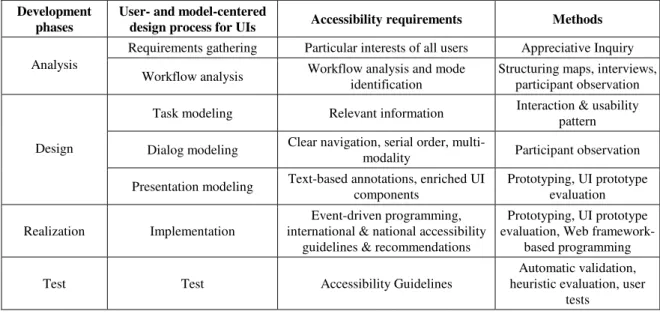
comprehensive. However, there are no clear ways to extend it or strengthen it, and it makes limited use of the wide range of design and evaluation approaches that have been developed in relevant areas such as product design, interaction design, occupational therapy, rehabilitation engineering, or universal design. By starting with high level concepts such as an ADS extended with meta-principles for designing, we can create a more open framework that can incorporate a design team’s existing approaches, while drawing their attention to gaps in their repertoire and ways to fill these. Table 1 illustrates how existing approaches from interaction design can be associated with design choice types and meta-principles.
Table 1: Scoping methods by Choice Type and Meta-principle Recept-iveness Express -ivity Credib-ility Inclus-iveness Arte-facts Litera-ture review Sketches Feasib-ility Sustaina -bility Benefi-ciaries
Probes Personas
Ethno-graphy Worth webs Evalu-ations Human Science, Arts Reports, Present-ations Human Science Value-sensitive design
Purpose Theory Product Vision
Human Science
Theory
Design and evaluation approaches can be shown to support one or more meta-principles, typically for a single type of design choice or connection. A key benefit of meta-principles for designing is that, when combined with ADSs, they support the scoping of design and evaluation approaches. Gaps in existing design practices can be identified, and new approaches can be developed to fill these gaps.
Few existing concrete design settings have sufficient methodological power to be able to fully meet the challenge of the WHO’s ICF. This is particularly the case when designing, not to simply reduce limitations for simple isolated activities, but instead to demonstrably remove restrictions on participation in society for impaired individuals.
To meet the challenge of the ICF, we need to develop frameworks of design and evaluation approaches that support balanced, integrative and generous design. To achieve this, for any ADS, with its committed to design choice types and connections, we need approaches that: 1. Promote receptiveness to a wide range of design
options for each committed to choice and connection type
2. Establish the credibility of design options through analyses of validity, feasibility, etc.
stakeholders
4. Support improvability for a current concrete design situation
5. Balance inclusiveness for a current concrete design situation
Most current combinations of design and evaluation approaches do not fully support all relevant meta-principles for all committed to design choice and connection types. It is easy to highlight gaps that will typically prevent design teams from developing highly inclusive designs. Once identified, we can begin to explore ways to fill such gaps, such as receptiveness to care circle structure as an approach to identifying a wide range of potential stakeholder beneficiaries [9].
In my keynote talk, I will present examples of work by former and current PhD students that illustrates the principles of balanced, integrative and generous design by co-ordinating different types of design choice.
Table 2a: Major Choices by Type for four accessibility PhDs
Eamon Doherty
Purpose Broad range of initial purposes (e.g., recreation, feeding, appliance control), eventually focused on communication.
Artifact Cyberlink brain-body interface device with a range of interface styles and configurations with direct cursor control
Beneficiaries Medical staff, occupational therapists and family members
Evaluations Formal experiments and longitudinal field studies
Paul Gnanayutham
Purpose Broad range of initial purposes maintained.
Artefact Cyberlink brain-body interface device with an adaptive tiled interface style with indirect cursor control
Beneficiaries Primarily family members supporting use with no researcher present
Evaluations Formal experiments (including able bodied participants) and longitudinal field studies
I have supervised four PhDs with a focus on accessibility. Eamon Doherty (currently at Fairleigh Dickinson University) developed an interaction design approach to the limitations of current brain-body interfaces [6]. Paul Gnanayutham (currently at
Portsmouth University) developed algorithmic
improvements to Eamon’s work that enabled independent usage of a brain-body interface by individuals and their carers [10]. Brendan Cassidy [2] (currently at UCLAN) developed patented applications of vibrational haptics for visually and aurally impaired users of public terminals. A current PhD student, Jenni George, is currently developing a social networking approach to supporting the care circles of children with extensive motor impairments [9].
The underlying structure of the concrete design settings for these four PhDs is summarised in Tables 2a and 2b. In my keynote talk, I will relate design and evaluation approaches used in these PhDs to meta-principles for designing, and will indicate where improvements could be made to balance, integration and generosity within their design processes.
Table 2b: Major Choices by Type for four accessibility PhDs
Brendan Cassidy
Purpose Increased/total independence for deaf-blind/visually impaired users of public terminals (e.g., ATMs).
Artifact Flexible prototype rig with novel input device (move-select), and vibrational direction and status indicators
Beneficiaries Deaf-blind/visually impaired users of public terminals, manufacturers and providers of public terminals
Evaluations Formal experiments (including ones with able bodied participants)
Jenni George
Purpose Improving choice and usage of AT devices for children with extensive motor impairments.
Artefact Social network
Beneficiaries Care circles of children with extensive motor impairments
Evaluations Under development V. CONCLUSIONS
The ICF challenges accessibility research to reach beyond simple compensations for impaired body functions and structures to the demonstrable removal of restrictions on an impaired individual’s ability to participate in society. Neither engineering design, applied arts design, nor user-centered approaches are
adequate in isolation. The ICF challenges us to combine existing design paradigms in order to develop fully human approaches to accessibility.
This paper has presented an abstract framework for reasoning about the range of choices and connections that have to be made within design settings, and the work that design and evaluation approaches must support to enable balanced, integrative and generous approaches to inclusive interaction design. The framework is ambitious, and it will take several years to develop and test new concrete approaches to filling the gaps in existing concrete design settings for accessibility.
This paper’s title is Inclusion Requires Inclusiveness. This requirement extends beyond the meta-principle of inclusiveness to the breadth of the design process itself. To achieve genuine inclusiveness, the design process itself must be inclusive, i.e., it must support a wide range of design choice types and their co-ordinating connections, and both choice and connection types in turn must be given support to deliver on a broad range of meta-principles for designing.
Whenever well-intentioned attempts at universal design fail, it is often because the underlying design process has been narrowly restricted to engineering, applied arts or user-centred paradigms. The familiar example of vision correction devices makes it clear that the existence of the current range of prosthetic eyewear depends on a broad design perspectives. We cannot design for a more inclusive world until we have created a design process that is genuinely inclusive with respect to the types of choice that must be made and co-ordinated, and the types of work that design and evaluation approaches must perform. Even in the abstract, the requirements here are more extensive than we have generally realised. There are significant challenges ahead, but I am confident that they can be overcome.
REFERENCES
[1] Brown, T. 2009. Change by Design: How Design Thinking Transforms Organizations and Inspires Innovation, Collins Business.
[2] Cassidy, B., Cockton, G., Bloor, C. and Coventry, L. 2005. Capability, Acceptability and Aspiration for: collecting accessibility data with prototypes. Proc. HCI 2005, Vol. 2, eds. L. Mackinnon, O. Bertelsen and N. Bryan-Kinns, 138-143. [3] Cockton, G. 2009. Getting There: Six
Meta-Principles and Interaction Design. Proc. CHI 2009, ACM, 2223-2232.
[4] Cubranic, D., Collie, K. and Booth, K.S. 1998. Computer support for distance art therapy.
Proc. CHI'98, vol. 2, ACM, 277–278.
[5] Dawe, M. 2006. Desperately seeking simplicity: how young adults with cognitive disabilities and their families adopt assistive technologies. Proc CHI 2006. ACM, 1143-1152.
[6] Doherty E.P, Cockton G., Bloor C., Rizzo J. and Blondina, B. 2002. Yes/No or Maybe - Further Evaluation of an Interface for Brain-Injured Individuals. Interacting with Computers, 14(4), 341-358.
[7] Dorst, K and Cross, N. 2001. Creativity in the Design Process: co-evolution of problem-solution. Design Studies, 22(5), 425-437.
[8] Geoghegan, T. 2010. Could glasses soon be history? BBC News Magazine. last accessed 14.10.10 at www.bbc.co.uk/news/magazine-11285011
[9] George, J., Cockton, G., Greenough, T. 2010. A Social Approach to Accessible Social Networking Using the CAT Model, K. Miesenberger et al. (Eds.): ICCHP 2010, Part I, LNCS 6179, 216–223. [10] Gnanayutham, P. and Cockton, G. 2005. Adaptive
Personalisation for Researcher-Independent Brain-Body Interface Usage. CHI 2009 Extended Abstracts, ACM, 3003-3068.
[11] Hancock, M., ten Cate, T., Carpendale, S., and Isenberg, T. 2010. Supporting sandtray therapy on an interactive tabletop. Proc. CHI '10. ACM, 2133-2142.
[12] Hersh, M.A. and Johnson, M.A. 2008. On Modelling Assistive Technology Systems Part I: Modelling Framework. Technology and Disability, 20(3), 193–215.
[13] Hutchison A. 1999. Joovin8 - Narrative Interactions. Proc. Interact'99, Vol. 2, eds. S. Brewster, A. Cawsey and G. Cockton, British Computer Society, 87-88.
[14] Moncur, W. Reiter, E. Masthoff, J. and Carmichael, A. 2010. Modelling the socially intelligent communication of health information to a patient's personal social network. IEEE Trans. Information Technology in Biomedicine, 14(2) 319-325.
[15] Pahl, G., Beitz, W., Feldhusen, J., Grote, K.-H., Wallace, K. and Blessing, LT.M. (Eds.). 2007.
Engineering Design: A Systematic Approach, 3rd
Edn.
[16] Rittel, H. and Webber, M. 1973. Dilemmas in a General Theory of Planning. Policy Sciences, 4, 155–169.
[17] World Health Assembly. 2001. The International Classification of Functioning, Disability and
Health, last accessed 14th October 2010 at
Phantom Limb Pain Management Using Facial Expression Analysis,
Biofeedback and Augmented Reality Interfacing
D. Tzionas, K. Vrenas, S. Eleftheriadis, S. Georgoulis, P. C. Petrantonakis, and L. J. Hadjileontiadis
Dept. of Electrical & Computer Engineering Aristotle University of Thessaloniki
GR 54124 Thessaloniki, Greece [email protected]
Abstract—Post-amputation sensation often translates to
the feeling of severe pain in the missing limb, referred to as phantom limb pain (PLP). A clear and rational treatment regimen is difficult to establish, as long as the underlying pathophysiology is not fully known. In this work, an innovative PLP management system is presented, as a module of an holistic computer-mediated pain management environment, namely Epione. The proposed Epione-PLP scheme is structured upon advanced facial expression analysis, used to form a dynamic pain meter, which, in turn, is used to trigger biofeedback and augmented reality-based PLP distraction scenarios. The latter incorporate a model of the missing limb for its visualization, in an effort to provide to the amputee the feeling of its existence and control, and, thus, maximize his/her PLP relief. The novel Epione-PLP management approach integrates edge-technology within the context of personalized health and it could be used to facilitate easing of PLP patients' suffering, provide efficient progress monitoring and contribute to the increase in their quality of life.
I. INTRODUCTION
Pain, although it is the oldest medical problem and the universal physical affliction of mankind, it has been little understood in physiology until very recently. Nowadays, pain is generally agreed-upon as an experience which involves more than just physical sensations. The International Association for the Study of Pain (IASP)'s defines pain as 'an unpleasant sensory and emotional experience associated with actual or potential tissue damage, or described in terms of such damage' [1].
The most common types of pain are [1] acute pain (results from disease, inflammation, or injury to tissues) and chronic pain (is widely believed to represent disease itself), which both remain a huge problem. One of the peculiar type of pain is the one that relates with the post-amputation sensation. In fact, many amputees are frequently aware of severe
phantom limb pain (PLP) in the absent limb, since the
brain cells affected by amputation do not simply die off, but neurons in the brain remain dynamic and excitable. PLP is real and is often accompanied by other health problems, such as depression.
As pain is directly connected to the patient's everyday life, its management is of great importance to elevated his/her quality of life. The goal of pain management is to easing the suffering and improving the quality of life of those living with pain, enabling them to work, attend school, or participate in other day-to-day activities. Treatment approaches to long term
pain include pharmacologic measures, interventional procedures, physical therapy, physical exercise, application of ice and/or heat, and psychological measures, such as biofeedback and cognitive behavioral therapy, like relaxation and the use of imagery as a distraction that provides relief [2]. Actually, pain management sets a challenging field, where edge technology could be incorporated within pain management approaches to create an effective environment that could contribute to better pain handling; hence, improving the quality of life at a global level.
In this work, a PLP management system is presented. This is, actually, a module of an holistic computer-mediated pain management environment,
namely Epione1[3]. The proposed Epione-PLP scheme
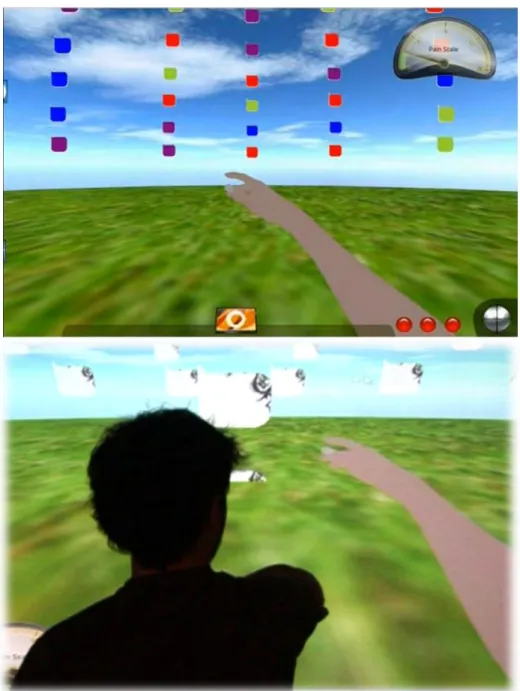
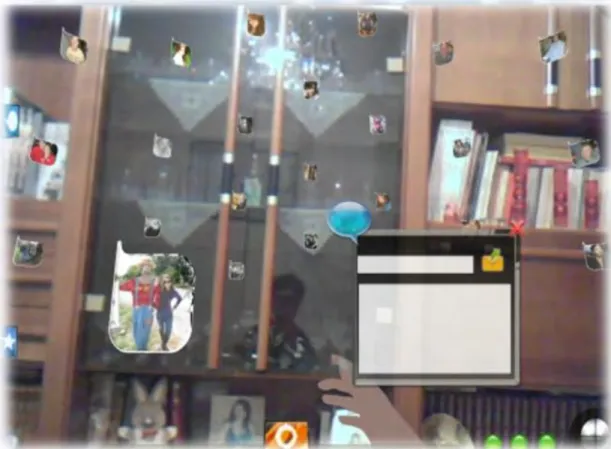
uses advanced facial expression analysis, as a means to form a dynamic pain meter, which is then used to trigger biofeedback and augmented reality-based PLP distraction scenarios. The latter are structured upon a model of the missing limb for its visualization, in an effort to create to the amputee the feeling of its existence and control, and, thus, maximize his/her PLP relief. The proposed system introduces a novel environment of PLP management that could assist patients and physicians during the process of easing of suffering, contributing to the new culture of
Personalized Healthcare2.
II. BACKGROUND
A. Phantom Limb Pain (PLP)
Ambroise Paré (1510-1590), a French military surgeon, has given the first medical description of post-amputation sensation, who noticed that patients may complain of severe pain in the missing limb following amputation. Paré characterized the post-amputation syndrome in his 'Haquebusses and other guns' and
1
Epione (Ηπιόνη) was the goddess of the soothing of pain. She was
the wife of the medicine god Asklepios, and the mother of a number of minor healing gods, including Hygeia (Good Health), Panakeia (All-Cures) and Iaso (Healing).
2Personalized Healthcare is an important new approach to medicine,
providing great benefits to patients, by improving treatment, enabling people to monitor their own health, increasing compliance and providing inputs to computer systems and associated communications networks and embedded devices that will make it possible to organize, interpret and interrogate this information and apply it to tailoring medical treatment. Personalized Healthcare is at the core of the European Community Initiative „European Research Area 2030: Preparing Europe for a New Renaissance-A Strategic View of the European Research Area‟ [4].
proposed different models to explain the pain [5] Subsequent studies by Charles Bell (1830), Magendie (1833), Rhone (1842), Guéniot (1861) and others gave detailed descriptions of the phenomenon and, in 1871, Mitchell introduced the term 'phantom limb' [6], [7].
Nowadays, it is common knowledge that virtually all amputees experience phantom sensations after limb amputation; the phantom becomes the site of severe pain, which may be exceedingly difficult to treat. A clear and rational treatment regimen is quite difficult to establish, since the underlying pathophysiology is not fully known. Nevertheless, nerve injury is followed by a series of changes in the peripheral and the central nervous system; hence, these changes play a role in the induction and maintenance of chronic phantom pain [8]. Following a nerve cut, formation of neuromas are seen universally, which show spontaneous and abnormal evoked activity following mechanical or chemical stimulation [9]. The ectopic and increased spontaneous and evoked activity from the periphery is assumed to be the result of a novel expression or up-regulation of sodium channels [10]. The sympathetic nervous system may also play an important role in generating and, in particular, in maintaining PLP [11]. Studies based on electrophysiology have documented the existence of nociceptive specific neurons and wide dynamic range neurons in the cerebral cortex. Following limb amputation and deafferentation of adult monkeys, there is a reorganization of the primary somatosensory cortex, sub-cortex and thalamus [12]. A similar reorganization has been observed in humans
based on the information from the
magnetoencephalogram. Interestingly, this cerebral reorganization was seen mostly in patients with PLP and there was a linear relationship between pain and degree of reorganization [13].
From the aforementioned, it is likely that the first PLP events occur in the periphery, which subsequently generates a cascade of events that sweep more centrally and also recruit cortical brain structures [8].
The occurrence of PLP seems to be independent of age in adults, gender and level, or side of amputation [14]. Moreover, the incidence of PLP is similar following civilian or military accidents [15]. Several studies have shown that 75% of patients develop pain within the first few days after amputation [16]. However, phantom pain may be delayed for months or years. PLP is described as shooting, stabbing, boring, squeezing, throbbing, and burning [16]. Moreover, PLP is primarily localized in distal parts of the missing limb (fingers and palms in upper limb amputees and toes, instep, top of the foot and ankle in lower limb amputees) [17].
B. PLP Management Strategies
Treatment of PLP can be classified as medical, non-medical and surgical [8]. In general, treatment should be based on non-invasive techniques as surgical procedures carry a risk of further deafferentation resulting in even more pain. In this vein, some PLP management strategies have been proposed, based on medication [18]. However, some others try to provide
the amputee with alternative ways to handle the PLP suffering, with the 'mirror box'-based being the most well-known therapy, introduced by Dr. Ramachandran [19] at the University of California San Diego.
'Mirror-box'-based therapy is a drug free treatment and has been described in medical literature to be of benefit to 80% of users (some even report numbers as high as 95%) and that rehabilitation can be dramatically improved by integrating physical and mental practice. This is achieved by utilizing mirrors to trick patients' brains into thinking that they were moving their missing limb. The use of visual feedback with the 'mirror box' as a technique accelerates the recover from PLP. In fact, the patient places the affected limb inside the 'mirror box' and his/her unaffected limb in front of the mirror. Seeing the reflection of the unaffected limb, the patient thus receives visual feedback from a virtual image of his/her affected limb appearing as if it is normal (Fig. 1) [20].
There is, however, great variability in the experienced authenticity of the 'mirror box' illusion and its ability to alleviate PLP. The effect of this positive visual feedback to the amputee can be very therapeutic. The latter translates into reposition of phantom limbs, which were perceived to be held in painful or awkward positions, into non-painful postures, giving temporary relief from PLP. Amputees' perceptions of their phantom limbs, however, often differ greatly from their original limbs [21]. In such cases, the phantom limb can be shorter, or longer, vary in thickness, have gaps or be continuous, in comparison to the original limb. This is one cause for the inability of the 'mirror box' illusion to provide any therapeutic value in some cases, as the reflected image bears no resemblance to the phantom limb as it is perceived by the amputee. These irregularly shaped phantoms cannot be viewed in the mirror, as it necessarily reflects the image of the intact arm.
To circumvent the aforementioned disadvantages, Augmented Reality (AR)-based 'mirror box' illusion simulation has been proposed [22]. There, a 3-dimension (3D) graphical representation of an arm on a flat screen that is controlled by a wireless data glove is implemented. The latter is worn on the intact arm, whilst the phantom appears on the flat screen in place
Fig. 1. An example of the use of the 'miror box'-based therapy by a left-hand amputee. The patient places his normal hand on one side and looks into the mirror getting the illusion that the
![Fig. 2. Organizational block-diagram of the Epione pain management environment [3].](https://thumb-eu.123doks.com/thumbv2/123dok_br/15998252.1103278/31.893.472.780.121.525/fig-organizational-block-diagram-epione-pain-management-environment.webp)