1 A Work Project presented as part of the requirements for the Award of a Master Degree in
International Management from NOVA – School of Business and Economics.
THE PLANT-BASED MEAT REVOLUTION FROM THE UNITED STATES: Does it have potential in Portugal?
A case study of ‘Beyond Meat’
Ana Clara Vianna Martins de Almeida 34242
A Work Project carried out on the Master in International Management Program, under the supervision of:
Lena Kemna Catherine da Silveira
2 THE PLANT-BASED MEAT REVOLUTION FROM THE UNITED STATES: Does it have
potential in Portugal?
Abstract
The global food system is in constant transformation due to technology and changes in consumer behavior. The search for plant-based alternatives to meat is rising and a new product category emerged as a response to this trend: plant-based meat - an innovation that uses technology to recreate the meat experience. An extensive approach composed of diverse research techniques allowed to analyze consumer behavior in regards to the meat and meat alternative’s market in Portugal. Based on the analysis, it was possible to understand the most effective strategy for Beyond Meat, the leading US American brand in the category, in Portugal.
Keywords: Beyond Meat Portugal, Plant-based Meat, Foodtech, Brand Management.
This work used infrastructure and resources funded by Fundação para a Ciência e a Tecnologia (UID/ECO/00124/2013, UID/ECO/00124/2019 and Social Sciences DataLab, Project 22209), POR Lisboa (LISBOA-01-0145-FEDER-007722 and Social Sciences DataLab, Project 22209) and POR Norte (Social Sciences DataLab, Project 22209).
3 Table of Contents
1. Introduction & Work Project Objectives ... 1
2. Contextual Background ... 3
2.1 Global Food Trends shaping the plant-based meat market ... 3
2.2 The new meat substitutes market ... 4
2.3 The market of Meat Substitutes in Portugal ... 5
2.4 Beyond Meat’s brand situation ... 6
3. Addressing the Work Project Objectives ... 8
3.1 Methodology ... 8
3.2 Research Insights ... 10
3.3. Market Segments in the Portuguese Market ... 12
3.3.1 Plant-Based Meat Category and Beyond Meat’s Brand Image ... 16
3.4 Consumer Decision Journey... 17
4. Recommendations for Beyond Meat’s positioning in Portugal ... 18
5. Research Limitations ... 20
References ... 22
4 List of Tables
Table 1 - Relevant Food Trends Worldwide... 4
Table 2 - Work Project Methodology ... 10
Table 3 - Main Research Insights ... 11
Table 4 - Conventional Meat Lovers Market Segment ... 13
Table 5 - On the fence Meat Eater Market Segment ... 14
Table 6 - Nostalgic Vegs Market Segment ... 15
Table 7 - Bio Fanatic Vegs Market Segment ... 15
Table 8 - Insights on Category and Beyond Meat ... 17
Table 9 - Consumer Decision Journey ... 18
5 List of Figures
Figure 1 - Beyond Meat's Environmental Impact ... 7 Figure 2- Segmentation ... 12
1 1. Introduction & Work Project Objectives
In January 2019, 250,000 people all over the world committed to a month of veganism as part of the ‘Veganuary’ movement (Smithers, 2019). The motivations behind the adoption of a vegetarian diet or reduction of meat consumption vary, among the most common are environmental impact, ethical concerns, religion and perceived health benefits are. Vegetarians already make up 15% of the world's population and vegan enthusiasts are growing day by day. In consonance with this, the search for vegan or vegetarian alternatives to meat is rising (Euromonitor International, 2019).
In the United States, entrepreneurs created a new product category as a response to this trend: an imitation of meat that closely resembles the taste, texture and smell of animal meat, but consists of plants. This invention, which debuted with burgers and soon developed to sausages and meatballs, actually bleeds beet juice and tastes like meat (Euromonitor International, 2019). Differently from most meat substitutes, these products are not placed in vegetarian aisles or natural food section. Instead, consumers can find them among animal protein (see Appendix 1 - Beyond Meat's shelf positioning) and by the name of plant-based meat.
The main ingredients from Beyond Meat’s burgers – the pioneering brand in this market - are water, pea protein isolate, expeller-pressed canola oil and refined coconut oil. “To accomplish a juicy, meat-tasting product that carnivores will crave, Beyond Meat biophysicists figure out, at a molecular level, what it is that makes meat taste and behave like meat. They then identify plant materials that behave the same way, to replicate it” (Kramar, et al., 2019). As to the target consumers, instead of focusing on vegetarians and vegans, these companies are generally targeting consumers who genuinely eat and enjoy the taste of meat (Euromonitor International, 2019). Large
2 chains – such as McDonald’s, Burger King and Subway – embraced this trend and currently offer products by Beyond Meat and Impossible Foods – the second largest plant-based meat company- in their menus, in some of their restaurants in the United States.
Considering the success of the newly launched plant-based meat companies around the world, this Work Project aims at investigating the potential for the plant-based meat category, in particular for Beyond Meat, in Portugal. Given this goal, the meat and meat alternatives markets in Portugal were analyzed. To do so, it involved conducting a competitor analysis and identifying consumer behavior through interviews and store observations. The main goal was to identify how to make the most out of plant-based meat’s points of parity and points of difference, in order to determine their ideal target and positioning for plant-based meat brands in Portugal and provide recommendations particularly for Beyond Meat’s Portuguese market entry.
Although plant-based meat is currently a trending topic, there are still limited academic resources available on this new market category. This lack of research, in the face of the success of the trend worldwide, emphasizes the relevance of this Work Project and raises awareness for business opportunities for plant-based meat companies in Portugal. Therefore, a diverse research approach incorporating non-academic sources as well as primary research were adopted.
This project starts with a contextual description of the current global food trends, Beyond Meat’s current situation and an overview of the meat alternatives market in Portugal. Followed by the methodology used to collect insights and then focusing on extracting and organizing those insights. Finally, recommendations regarding the ideal target and positioning for plant-based meat brands in Portugal were presented.
3 2. Contextual Background
In order to better comprehend the context in which Beyond Meat operates, the main global trends that are shaping the food market and the meat industry in particular were presented in subsequent. Then, an introduction to the meat imitations market worldwide was made. Next, an analysis of the Portuguese meat and meat alternatives’ market was conducted with the goal of mapping the main players in the plant-based meat category and their respective strategy and positioning. Subsequently, an analysis of Beyond Meat’s brand and products was conducted.
2.1 Global Food Trends shaping the plant-based meat market
One of the driving factors influencing global trends is technology, which is responsible not only for a change in human interactions, but also in their diet. According to the J. Walter Thompson report on Future Trends, consumers’ acceptance towards biohacked and engineered foods is growing (J. Walter Thompson, 2019). On the other hand, consumers are more selective towards which brands they buy from due to ethical reasons. Therefore, conscious consumption has become a form of indulgence and veganism has been seen as a solution for consumers who wish to lower their footprint (J. Walter Thompson, 2019). As a response to this, many brands are arising with the purpose of changing the face of veganism from boring and challenging to cool and practical. So called ‘Plant-based comfort foods’, which are non-vegan versions of classic dishes such as ‘mac n cheese’ or burgers, have developed into a food trend in itself (Euromonitor, 2019).
In Table 1 - Relevant Food Trends Worldwide below, the four main trends responsible for influencing the food industry worldwide were compiled. The four trends apply to the food industry
4 in general and are particularly relevant to this work in order to comprehend how aligned the plant-based meat category is to the market and how consumers will respond to the category.
Table 1 - Relevant Food Trends Worldwide 2.2 The new meat substitutes market
Meat alternatives are not new. Soy, jackfruit, mushrooms, tofu burgers and sausages are the most common substitutes for animal meat. However, until recently, there was not in the market a plant-based product that had the aim to taste and feel like meat and used science and technology to reach this goal. For the first time, these products are target animal meat-eating customers. Competition has emerged across the whole world through not only foodtech startups, but also traditional players, with brands such as Nestlé and Unilever having entered the market in Europe and in the United States in 2019. UBS predicts the plant-protein market will rise to $85 billion by 2030 from $4.6 billion in 2019 (Bloomberg, 2019).
5 To understand the growth of Beyond Meat and Impossible foods - the largest firms in the global market now - it is interesting to analyze their initial strategy when entering the US american market. While Beyond Meat began by selling their products directly in grocery stores, Impossible Foods chose to focus only on restaurants first. Today, the two companies can be found both in restaurants and grocery stores in the United States, although Impossible Food’s presence in the last is significantly smaller than Beyond Meat’s. In fact, Beyond Meat seems to be winning the race so far: it had a gain of 734% in shares after going public in July 2019 (Business Insider, 2019). Both Beyond Meat and Impossible Foods have strong social media presence with 214 and 791 thousand followers respectively. Impossible Foods has not yet entered the European market.
In the face of the opportunities in the plant-based market, traditional food brands are expanding their portfolio into this new category. MorningStar Farms, a brand owned by Kellogg recently launched plant-based chicken tenders and nuggets (Business Insider, 2019). Nestlé is also making efforts in the same direction: the company will launch the Awesome Burger through Sweet Earth - a California-based brand that Nestlé acquired in 2017 - in the United States and the Incredible Burger was launched in Europe though Garden Gourmet- also acquired by Nestlé and sold primarily in the UK (Nestlé, 2019). Although both Nestlé and Kellogg have a strong market presence, their plant-based meat burgers have not been having such an impressive success so far.
2.3 The market of Meat Substitutes in Portugal
In 2018 Portugal became the first country where serving a vegan meal option in public buildings was made mandatory by law (Johnston, 2018), however, in respect to other European countries the Portuguese vegetarian market is still behind. A study conducted by Nielsen in September 2017 had the goal to analyze the shift in eating habits from the Portuguese society from 2007 to 2017. It reveals that, although the majority of the Portuguese population maintains the consumption of
6 meat, fish, dairy products and eggs, the meat and fish consumptions have reduced from 79% to 77% and from 76% to 70%, respectively. It also found out that the number of vegetarians in Portugal has quadrupled in ten years: from 0.3% in 2007 to 1.2% in 2017 (Magalhães, 2018). Although Portugal is among the top five markets where fresh meat consumption is declining (see Appendix 2 - Graph Fresh Meat yearly Consumption per Declining Market), the meat substitutes market is not yet as developed. While vegetarians are still a small fraction of the Portuguese population, Flexitarianism – one of the above explained trends – is also shaping the Portuguese market and influencing consumers (Euromonitor, 2019).
The main vegetarian brands in Portugal are GutBio (Aldi’s private label), Cem Porcento, Fit Food, Sojasun, Nature Foods, Vegin, Garden Gourmet (Nestlé-owned brand), Beat Root and Linda McCartney’s. These brands differ not only in terms of product, but also strategy. Appendix 3 - Meat and Substitutes Brands in Portugal | Price features a graph with the price per kg from Meat and Meat Substitutes brands in Portugal and points of sale. Most vegetarian brands have higher prices than meat brands and might be found in Natural Stores and/or supermarkets. As seen in the graph, Beyond Meat is, together with Fit Food and Garden Gourmet one of the priciest meat alternatives’ brands in Portugal.
2.4 Beyond Meat’s brand situation
Beyond Meat is a US American company founded in 2009 by Ethan Brown which produces vegan meat substitutes that closely resemble innovative meat. Their first product came to the market in 2013 and, since then, the company has been gaining significant media coverage, especially after going public and closing partnerships with large food chains. In terms of product catalogue, the company currently sells Beyond Burgers (see Appendix 6 – Beyond Burger), Beyond Sausages (see Appendix 8 - Beyond Sausage Packaging) and Beyond Beef Crumbles (see Appendix 9 -
7 Beyond Beef's Crumbles). These are sold through grocery stores, but Beyond Meat’s products can also be found in the menu of large chains.
The company believes that there is a better way to feed the planet and their mission is to create The Future of Protein. Beyond Meat states that their products are a solution “that solves four growing issues attributed to livestock production: human health, climate change, constraints on natural resources and animal welfare” (see Appendix 5 - Mission statement). Following this logic, their logo is a bull-in-a-cape (see Appendix 4 ). Their brand promise is “to enable people to feel good about enjoying the meat they love by removing the adverse effects on their health, planet, and animal welfare” (Finkle, 2019). The company conducted a study in partnership with the the University of Michigan (Heller, et al., 2018), which
compared the Beyond Burger – their main product and the only one available in Portugal to date - to a Beef Burger. According to the results, Beyond Burger is considered functionally and nutritionally similar to beef and generates 90% less greenhouse gas emissions, requires 46% less energy, has >99% less impact on water scarcity and 93% less impact on land use than a ¼ pound of U.S. beef (see Figure 1 - Beyond Meat's Environmental Impact).
When it comes to international expansion, Beyond Meat is distributed internationally (Rosenbaum, 2019) through local partners in Australia, Chile, the European Union, Hong Kong, Ireland, Israel, the Middle East, New Zealand, South Korea, Taiwan and the United Kingdom (Rosenbaum, 2019).
Figure 1 - Beyond Meat's Environmental Impact (Lawrence S, 2019)
8 3. Addressing the Work Project Objectives
In this section, the methodology used to investigate the ideal target and positioning for plant-based meat companies and the potential for Beyond Meat in Portugal was described. Given this goal, qualitative research was used to identify current consumer behavior towards plant-based meat and meat through interviews and store observations. The main goal was to determine how to make the most out of the points of parity and points of difference of the plant-based meat category and Beyond Meat in particular in order to achieve a positioning that best targets their ideal Portuguese consumer.
3.1 Methodology
After analyzing secondary research about Beyond Meat and the Meat substitutes’ market presented in the contextual section above, primary research was carried out with the goal of comprehending who is the Portuguese consumer and their behavior, with an emphasis on plant-based meat and Beyond Meat. Thus, a qualitative research was chosen, having as components: in-store observations, interviews with store staff, in-depth interviews with shoppers and social listening were carried out. The research method used and their respective objectives are presented in Table 2 - Work Project Methodology below.
1. In-store observations: In-store decisions are largely physiological and shoppers usually do not know how and why they took their decisions, rather, it is driven by what they see when shopping. Store observation is relevant to shopper research, as ‘what shoppers say’ is not always ‘what shoppers do’. (Nielsen, 2019)
Details: 26 hours in supermarkets in Lisbon, which resulted in the observation of 136 customers. Observations were spread along four weeks in different supermarkets and timeslots in order to assess a larger number of customers and attain a more accurate assessment of the reality. Given the fact that visitors were unaware they were being observed, their behavior was minimally influenced by the procedure. Store observations were conducted in Lidl, Aldi, Continente and Pingo Doce. The observations were conducted in both the frozen meat and meat
9 substitute’s areas in supermarkets. Regardless of the customer’s purchase decision, a detailed observation grid organized in a set of pre-defined topics to fill in was used, to assure all aspects are addressed and results can easily be analyzed (see observation grid in Appendix 10 - Observation Grid).
Data collection period: October 2019
Objectives: Provide demographic information and outline the behavior in-store and decision-making process related to meat and meat substitutes; identify key attributes considered in choice/navigation of categories; conclude where products should be placed and note how shoppers interact with the category and product(Duarte, 2019).
2. depth Interviews with Shoppers: In-depth interviews allow the assessment of consumer perceptions that may otherwise be difficult to uncover. (Keller, 2013)
Details: 30 in person interviews with Portuguese aged 18 to 49 years old who have been living in Portugal for at least 5 years (see interview guide in Appendix 11 - Interview Guide)
Data collection period: October and November 2019
Objectives: To better understand profiles, purchase habits and motivations of Portuguese consumers. The main focus of the interview was to understand their eating habits when it comes to meat or meat substitutes followed by assessing their perception of the concept of “plant-based meat” by Beyond Meat. Consumers were shown the package of Beyond Meat’ Beyond Burger in person, as well as a promotional video from the brand. All interviews lasted approximately 1 hour and were recorded and transcribed to further be analyzed(Duarte, 2019).
3. Interviews with Store Staff: these interviews provide relevant information about consumers' frequently asked questions and uncertainties.
Details: 3 interviews with store employees in Vegan Junkies, a restaurant where Beyond Meat is served.
10 Objectives: To assess frequently asked questions, concerns, fears and doubts; to identify the brands/products buyers ask for the most and its reactions to staff answers; to find out if buyers are well informed on where to find the products they are looking for and to detect consumers’ main preferences(Duarte, 2019) regarding Beyond Meat.
4. Social Listening: Social listening consists of analyzing the main conversations, topics and trends taking place around a brand and industry in order to make strategic marketing decisions. (Sprout Social, 2019)
Details: Analysis of social media conversations in Portugal regarding Meat substitutes and Beyond Meat in 6 corporate Instagram accounts, 7 Facebook pages, 4 closed Facebook Groups and 2 discussion forums. See detailed list of groups in Appendix 13 - Social Listening Sources. Data collection period: October and November 2019
Objectives: To extract genuine feedback and perceptions on Beyond Meat, competitors and the plant-based meat category; identify concerns, motivations and purchasing drivers of consumers; understand what communities are saying about Beyond Meat and competitors(Duarte, 2019).
Table 2 - Work Project Methodology 3.2 Research Insights
As a result of the techniques presented above, relevant insights were extracted and presented in the current section. Firstly, the main research insights shared by most respondents were introduced in order to give an overview of Portuguese behavior in relation to the meat and meat alternatives category (Table 3 - Main Research Insights). Secondly, a segmentation was carried out to analyze the different consumer behaviors in the meat and meat substitutes’ market and the characterization of the segments identified was presented leading to a brand positioning. Finally, the first impressions from consumers towards the plant-based meat category and Beyond Meat were displayed in Table 8 - Insights on Category and Beyond Meat.
11 1. Meat Industry
Impact’s Superficial Awareness
Consumers have a superficial awareness of the meat industry’s impacts to the environment and to human health. Although being aware that the meat industry may cause harm to the environment, consumers choose not to deep into the topic and lack understanding of the specificities to the issue.
• “I am aware of the environmental impact and the animal treatment, so I´m trying to reduce my meat intake.” (Woman, 38 years old)
• “I prefer not to start thinking about the environmental and health factors, so I eat my steak well done” - (Woman, 41 years old)
2. Meat as
convenience
Meat is seen as an easy, accessible and practical source of protein. Portuguese consumers are used to having meat in every meal and many traditional Portuguese recipes contain meat.
• “There is always meat wherever I go.” - (Woman, 26 years old) • “I enjoy the taste of meat and I have been eating it since ever. Also, everyone in my house eats meat, so it is convenient” - (Man, 32 years old)
3. Importance of protein
Consumers believe having a source of protein in every meal is indispensable. Protein is seen as essential for having a balanced meat and, even when Portuguese do not eat an animal protein, they look for a substitute, such as tofu, seitan or veggie burgers.
• “We need protein and I believe meat is the best source for it. Especially for children.” - (Woman, 36 years old)
• “I always have some kind of protein in my plate. I usually eat seitan, tofu, tempeh or soy.” - (Man, 21 years old)
•
4. Low awareness of meat brands
Consumers are not loyal to meat brands and have difficulty in naming meat brands they buy from. Whether they buy their meat in the supermarket fridge or in a butcher, Portuguese consumers do not usually recall the name of the brand, which is not a defining factor in the purchasing decision.
4. Low in-store
presence and
awareness of plant-based meat brands
Consumers do not know Beyond Meat or the plant-based meat category. The ones who know it, however, claim that the product is not available in most grocery stores and, therefore, is hard to be found.
5. Processed Food
Most consumers seem to be aware that processed food may cause negative effects to the health, but still consume it regularly. When asked about their diet, consumers say they try to have a balanced diet and to avoid processed food, but end up recurring to it due to convenience.
Table 3 - Main Research Insights (Author, based on primary research)
12 3.3. Market Segments in the Portuguese Market
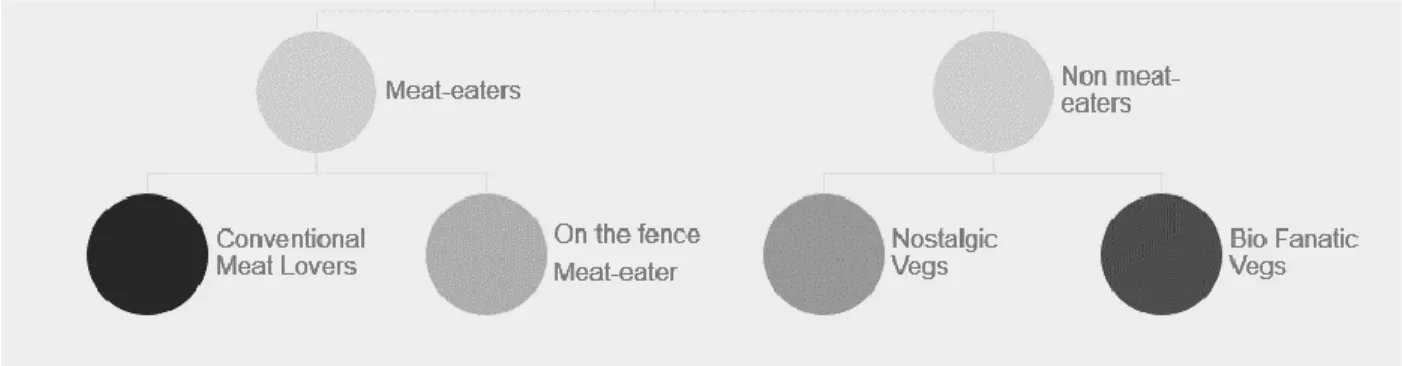
In order to investigate the ideal target and positioning for plant-based meat companies and the potential for Beyond Meat in Portugal, a consumer segmentation based on the previous insights was conducted. This segmentation is relevant in order to understand different patterns in consumers’ habits, aspirations and needs and therefore determine who would be the best target for plant-based meat companies in Portugal. The segmentation process was conducted in three steps, as shown in Figure 2 - Segmentation, and was based on insights from social listening, interview with staff, store observations and qualitative in-depth interviews.
Figure 2 - Segmentation
Firstly, respondents were filtered by a pre-recruiting questionnaire that had the criteria of selecting only respondents who lived in Portugal for more than 5 years. This criterion guaranteed that all respondents had been in contact with the Portuguese market for at least 5 years and could, therefore, be interpreted as a typical Portuguese consumer. In addition, consumers were also asked regarding their diet, in particular in relation to the consumption of meat. Through this question, the goal was to have access to a diverse sample regarding meat consumption. From this sample, consumers who lived in Portugal for at least five years were divided into two groups: those who consumed meat and those who did not. Both groups moved on to the next segmentation stage, (Author, based on primary research)
13 which filtered both groups according to their behavior towards meat and meat substitutes, respectively. The result of this second segmentation stage was the creation of four consumer segments: Conventional Meat Lovers, On the Fence Meat Eaters, Nostalgic Vegs and Bio Fanatic Vegs, which will be presented in depth below.
The first segment, Conventional Meat Lovers, is described in details in Table 4 - Conventional Meat Lovers Market Segment below. These consumers appreciate meat and eat it on a daily basis.
Conventional Meat Lovers Frequently purchased
products and brands
Red and white meat.
Conventional restaurants, Fast Food and homemade food. Pingo Doce, Continente, Aberdeen Angus, Carnalentejana and Iglo. Purchase channels/store
areas Shop mostly in hyper-, supermarkets and butchers. Main purchase drivers • Price • Convenience
Main insights
• Believe animal protein is important for the health and a meal is incomplete without it;
◦ “We need protein and I believe meat is the best source for it. Specially for children.” (Woman, 33 years old)
• Enjoy the taste of meat and is not concerned about the idea of it having blood or resembling an animal;
◦ “I love meat and I have been eating it since ever. Also, everyone in my house eats meat, so it is convenient.” (Man, 25 years old)
• Do not tend to be loyal to any brand, as they often choose based on promotions or buy directly from the butcher.
Table 4 - Conventional Meat Lovers Market Segment
The second segment is “On the Fence Meat Eaters” (see in Table 5 - On the fence Meat Eater Market Segment ). This segment differs from the Conventional Meat Lovers because they are meat eaters who hold restrictions regarding its consumption and present other purchase drivers and channels.
14 On the Fence Meat Eaters
Frequently purchased products and brands
Red and white meat, Tofu, Soy, Veggie Burgers and Veggie sausages. Conventional restaurant, vegetarian restaurants and fast food chains. Pingo Doce, Continente, Aberdeen Angus, Carnalentejana, Iglo, Cem Porcento, VegIn, Beyond Meat, Pura Vida, Garden Gourmet, Gutbio, McDonald´s and Vegan Junkies.
Purchase
channels/store areas Shop in hyper-, supermarkets, butchers and natural stores.
Main purchase drivers
• Price
• Environmental Impact • Convenience
• Resemblance to meat
Main insights
• Enjoy the taste of meat and give preference to white meat; “I eat fish and chicken more, red meat not as much. I eventually eat in vegetarian restaurants.” (Woman, 41 years old)
• Feel guilty about their meat intake and live in a constant dilemma between values, convenience and cravings;
◦ “I am aware of the environmental impact and the animal treatment, so I´m trying to reduce.” (Woman, 38 years old) • Do not tend to be loyal to any meat brand, as they often choose
based on promotions or buy directly from the butcher. • Do not check the labels
Table 5 - On the fence Meat Eater Market Segment
The third segment are the Nostalgic Vegs (see in Table 6 - Nostalgic Vegs Market Segment), which consists of consumers who do not eat animal meat, but enjoy its taste.
Nostalgic Vegs Frequently
purchased products and brands
Tofu, Soy, Veggie Burgers, Tempeh, Beans, and Veggie sausages.
Purchase channels/store areas
Shop in hyper-, supermarkets and natural stores.
Main purchase drivers • Price • Environmental Impact • Convenience • Resemblance to meat
15 Main insights
• Enjoy the taste of meat, but chooses not to eat because of ethical reasons;
◦ “I enjoy the taste of meat, but I chose to stop eating it due to sustainability and ethical reasons.” (Woman, 35 years old)
• Believes being a vegetarian does not mean to only eat healthy;
◦ “I usually eat healthy, but there are days in which you just want to hang out with friends and eat tasty junk food. In those places there are usually no veg tasty options.” (Woman, 31 years old)
• Has many meat-eater friends;
• Is bothered by the lack of vegetarian options. • Do not check the labels
Table 6 - Nostalgic Vegs Market Segment
The fourth segment is the Bio Fanatic Vegs (Table 7 - Bio Fanatic Vegs Market Segment). This segment consists of consumers who are mainly vegetarians and vegans and have a health-oriented approach to food, avoiding processed food.
Bio Fanatic Vegs Frequently
purchased products and brands
Tofu, Soy, Veggie Burgers, Tempeh, Beans, homemade natural burgers and Veggie sausages.
Vegetarian restaurants or home-made food.
Fit Food, VegIn, BeatRoot, Naturefoods, Gutbio, Linda Mccartney Purchase
channels/store areas
Natural stores, local food markets and local producers. Main purchase
drivers
• Brand’s reliability
• Environmental and social impact
Main insights
• Prioritize organic and non-processed food;
◦ “I usually cook my own food and prefer to buy organic or from brands I trust.” (Woman, 23 years old)
• Do not like the taste of meat or the idea of meat immitations • See vegetarianism as a political act
◦ “My choice of not eating meat is closely linked to my principles, so I take it seriously.” (Man, 29 years old)
• Have active participation in discussion forums
Table 7 - Bio Fanatic Vegs Market Segment (Author, based on primary research)
16 As observed, Conventional Meat Lovers, On the Fence Meat Eaters, Nostalgic Vegs and Bio Fanatic Vegs not only present differences regarding meat consumption, but also in terms of purchasing channels and drivers. Conventional Meat Lovers and Bio Fanatic Vegs are extremer regarding their diets. While Conventional Meat Lovers enjoy the taste of meat and do not question the meat industry, Bio Fanatic Vegs take their approach to food seriously and not eating meat is part of their essence. On the Fence Meat Eaters and Nostalgic Vegs, on the other hand, are looser regarding their diet, can transit between natural and processed food more easily. In addition, these two segements shop not only in supermarkets, but also in natural stores.
3.3.1 Plant-Based Meat Category and Beyond Meat’s Brand Image
In order to understand who the ideal target for plant-based meat brands in Portugal is, it is relevant to determine the category and brand image from each segment towards plant-based meat and Beyond Meat. Due to the fact that it is a new category and there is not yet a top of mind plant-based meat brand in Europe, the image consumers have of Beyond Meat and the category itself are very connected. The insights from Table 8 - Insights on Category and Beyond Meat were collected mainly through in-depth interviews, in which consumers were confronted with a video and packaging from Beyond Meat, and through social listening.
Segment Category and Brand Image
Conventional Meat Lovers
Negative. See Plant-based meat as non-sense and prefer real meat. According to a Meat Lover, Beyond Meat “is not meat, it is plant” (man, 37 years old). This segment prefers original meat and are suspicious regarding the actual nutritional protein value in in the patties.
On the Fence Meat Eaters
Positive. Believe it looks like real meat and very appetizing. See it as a convenient (and tasty) alternative to meat. On the Fence Meat Eaters hope plant-based meat will help them eat less animal meat.
Nostalgic Vegs
Positive. Nostalgic Vegs say “Beyond Meat simulates the normal meat experience and is better than eating a bean hamburger” (woman, 35 years old). They believe it is convenient and make it easier for going out with
meat-17 eater friends. These consumers already know the plant-based meat category, but have difficulty finding it in Portugal.
Bio Fanatic Vegs
Negative. Do not like processed food in general and have a sense of distrust towards large corporations. Do not enjoy and do not eat meat. These consumers do not want to eat at restaurants where meat is served and do not wish to relive the meat experience. However, they see no harm in those who are in the transition phase towards a vegetarian diet and want to consume such products. Bio Fanatic have already heard of plant-based meat, read articles, discussed and have a formed opinion about it.
Table 8 - Insights on Category and Beyond Meat
3.4 Consumer Decision Journey
According to the presented analysis regarding the brand and category from the four consumer segments, On the Fence Meat Eaters and Nostalgic Vegs have a positive attitude towards Beyond Meat and the plant-based meat category and therefore present the biggest potential. In order to better assess these two segments, a description of their Consumer Decision Journey was presented in Table 9 - Consumer Decision Journey. The Consumer Decision Journey framework (see in Appendix 12 - Consumer Decision Journey) was developed by Mckinsey & Company (McKinsey & Company, 2015). It is relevant to observe where each segment is in the consumer decision journey in order to understand how to better target the consumer.
Consumer Decision Journey
On the fence Meat Eater Nostalgic Veg
Consider
Consumers consider an initial set of brands, based on brand perceptions and exposure to recent touchpoints (McKinsey & Company, 2015)
Evaluate
Consumers add or subtract brands as they evaluate
Convenience
On the Fence Meat Eaters are not dependent on meat alternatives – they also consume meat – and, therefore, do not go extra miles to buy their meat alternatives. Instead, they consider brands
Evaluation often happens before entering the store since Nostalgic Vegs have a deeper knowledge and understanding of vegetarian products.
18 that are sold close to their home or office and
brands that are known from supermarket, social media and tv advertisings. Therefore, they often choose meat alternatives which are sold in large supermarket chains, such as Pingo Doce, Continente and Lidl – which can be easily found in most Portuguese cities. In these grocery stores, On the Fence Meat Eaters find not only meat alternatives, but also meat and other products they consume.
Wide Consideration
Nostalgic Vegs use meat alternatives for daily purposes and value taste. They consider brands from supermarkets and natural stores and are always open to trying out products from innovative brands.
Word of Mouth
Nostalgic Vegs are part of the vegetarian community and, therefore, often get brand referrals through online forums and/or friends.
Table 9 - Consumer Decision Journey
After analyzing the previous consumer insights, segments and respective Consumer Decision Journeys, it is possible to conclude that On the Fence Meat Eaters are in the Consideration phase, while On the Fence Meat Eaters are in the evaluation phase in regards to plant-based meat brands. Due to the low in-store availability and low awareness of the category in Portugal, Nostalgic Vegs are not yet familiar with plant-based meats. Nostalgic Vegs, on the other hand, are familiar with the product, but have not had many opportunities to buy or try it in Portugal.
4. Recommendations for Beyond Meat’s positioning in Portugal
Bearing in mind that the goal of this work project was to determine the ideal target and positioning for plant-based meat companies in Portugal, recommendations were done in the following considering the previous research and insights. As presented in previous sections, main current global food trends – such as conscious consumerism, foodtech, plant-based comfort food and flexitarianism – are in line with the advent of the plant-based meat category. As observed, On the Fence Meat Eaters and Nostalgic Vegs are the most adequate targets for plant-based meat companies due to their diets, shopping habits and values in regards to meat and meat alternatives. Having both segments in mind and their respective status in the Consumer Decision Journey – (Author, based on primary research)
19 Consideration and Evaluation – the recommendations below focus on the ideal Strategy and Marketing & Communications plan for Beyond Meat in Portugal with the main goal of raising awareness to the brand.
The consideration phase for On the Fence Meat Eaters requires Beyond Meat to have a strong presence in grocery stores and natural stores. In addition, a higher social media presence and partnerships with content creators will guarantee a higher brand awareness for Beyond Meat. Moreover, partnerships with restaurants and pop-up food trucks will allow consumers to try the product and to know the brand before seeing it in grocery stores. This strategy will guarantee that consumers are already familiar Beyond Meat and have tried the product, so that they can then move on to the Buy phase. This strategy also applies to Nostalgic Vegs since they are in the Evaluation phase, which, for them, happens before entering the store. Thus, it is important for Nostalgic Vegs to be in contact with the brand and product in social media, events and restaurants.
Recommendations
Target On the Fence Meat Eaters and Nostalgic Vegs
Retail Strategy
Increase grocery store penetration
Since the plant-based meat category and Beyond Meat have a poor shelf availability and low awareness. Plant-based meat brands should continure in the meat aisle, but it is indispensable to guarantee that it has proper visibility and availability. By Continente, Beyond Meats’s products should be not only in their Food Lab section, but also in the normal meat fridge section.
Recommended points of sale: Continente, Pingo Doce, Lidl, Aldi, Intermarché, Go Natural and Celeiro.
Marketing & Communications
Increase Restaurant partnerships
Closing partnerships with restaurants and food chains will allow Beyond Meat to grow their brand awareness through brands already known by consumers. Considering that the category has a low brand awareness, being in a restaurant will make consumers know the product faster and more conveniently. Through restaurant availability, consumers can try the
20 burger without having to buy it. In addition, this guarantees that the product will have been well prepared and, therefore, lowers the risks of a poor first time experience – which might happen when consumers prepare ther burgers by themselves at home after buying in a grocery store. Main chains to focus on: McDonald’s, Burger King, Subway and Hard Rock Cafe
National Chains: Ground Burger, Honorato, B' Perfect Burgers, A Cultura do Hambúrguer, Carnalentejana, Galeto, U-Try, Honorato, To.B
Pop-up Food Trucks
Having pop-up food trucks from Beyond Meat during festivals and events will allow Beyond Meat to reach their audience and give opportunities for consumers to try their products. Festivals and large events are usually occasions in which it is difficult to find vegetarian products.
Recommended festivals and events: Rock in Rio, Nos Primavera Sound, Somersby Out Jazz, EDP Cool Jazz, Meo Marés Vivas, Super Bock Super Rock and Vodafone Paredes de Coura.
Social Media Presence
Beyond Meat should create an account exclusively for Portugal and in Portuguese in order to attract Portuguese consumers and inform them about where to find their products. Moreover, the company should give away products to content creators who are aligned with On the Fence Meat Eaters and Nostalgic Vegs.
Product
Variety
Beyond Meat should expand their product catalogue by bringing products already offered by the company in other countries, such as Beyond Sausages (see Appendix 8 - Beyond Sausage Packaging) and Beyond Beef Crumbles (see Appendix 9 - Beyond Beef's Crumbles). Moreover, the company should create specific products for the Portuguese market, like “alheira” and “chouriço”.
Table 10 – Recommendations 5. Research Limitations
While conducting this research, two main limitations were encountered. Firstly, the fact that plant-based meat is a relatively new category to the Portuguese market (Beyond Meat was launched in Portugal in 2019) made it difficult to find consumers who were familiar to it already. Although interviewees were shown a video of Beyond Meat and saw the packaging live, the experience is (Author, based on primary research)
21 not equal to consuming the product or facing it in a supermarket aisle. Thus, if repeated again in one year, this research will be able to provide more specific insights to the plant-based meat category. In addition, due to the previously already mentioned reasons, this research was unable to quantify the amount of consumers per segment, which would be valuable in order to assess the size of the market.
22 References
Accenture Strategy The Future of Food: New Realities for the Industry [Relatório]. - 2017. Duarte Madalena Research Project on the Bio Baby Food Category in Portugal : A case study on NaturNes Bio [Relatório]. - Lisbon : [s.n.], 2019.
Euromonitor International Driving FOrces Behind PLant-Based Diets: Climate Concern and Meat Reduction [Online] // Passport. - Euromonitor International, 06 de 2019.
Euromonitor The Future of Meat [Relatório]. - 2019.
Finkle Colin Beyond Meat brand profile [Online] // Brand Marketing Blog. - 21 de 07 de 2019. - 10 de 10 de 2019. - https://brandmarketingblog.com/articles/good-branding/beyond-meat-brand-profile/.
Heller Martin C. e Keoleian Gregory A. A Comprehensive Comparison of Plant-Based and Animal-Based Protien Sources: Beyond Meat's Beyond Burger Life Cycle Assessment
[Relatório] : CSS Report / School for Environment & Sustainability ; University of Michigan. - Ann Arbor : School for Environment & Sustainability, 2018.
HIGHET E. A. Não comer e não beber como opção da espiritualidade religiosa: jejum e abstinência nas religiões [Periódico] // Revista Semestral de Estudos e Pesquisas em Religião. - 2005. - pp. 106-127.
J. Walter Thompson The Future 100 [Relatório] / Innovation Group. - 2019.
Johnston Alice This Is the Only Country Where It's Illegal Not to Offer a Vegan Option [Online] // Culture Trip. - 20 de 02 de 2018. - 19 de 09 de 2019. -
https://theculturetrip.com/europe/portugal/articles/this-is-the-only-country-where-its-illegal-not-to-offer-a-vegan-option/.
23 Keller Kevin Strategic Brand Management: Building, Measuring and Managing Brand Equity [Livro]. - [s.l.] : Pearson, 2013. - Vol. 4th Edition.
Kramar Andrea e Clifford Catherine How Beyond Meat became a $550 million brand,
winning over meat-eaters with a vegan burger that ‘bleeds’ [Online] // CNBC. - 21 de January de 2019. - 03 de January de 2019. - https://www.cnbc.com/2019/01/21/how-bill-gates-backed-vegan-beyond-meat-is-winning-over-meat-eaters.html.
Lawrence S King T Meat the Alternative: [Relatório]. - Melbourne : Food Frontier, 2019. Locker Melissa How to help the Amazon rainforest: 9 things you can do during the fires and beyond [Online] // Fast Company. - 21 de 08 de 2019. - 10 de 09 de 2019. -
https://www.fastcompany.com/90392750/9-ways-to-help-the-amazon-rainforest-right-now-as-fires-burn.
Mackintosh Eliza The Amazon is burning because the world eats so much meat [Online] // CNN. - 23 de 08 de 2019. - 10 de 10 de 2019. -
https://edition.cnn.com/2019/08/23/americas/brazil-beef-amazon-rainforest-fire-intl/index.html. Magalhães Maria Benedita Lemos de Impacto do Marketing e das Marcas no Processo de Decisão de Compra de Alimentos para uma Dieta de Base Vegetal Impacto do Marketing e das Marcas no Processo de Decisão de Compra de Alimentos para uma Dieta de Base Vegetal [Relatório]. - 2018.
McKinsey & Company The new consumer decision journey [Online] // McKinsey & Company. - McKinsey & Company, October de 2015. - 23 de November de 2019. - https://www.mckinsey.com/business-functions/marketing-and-sales/our-insights/the-new-consumer-decision-journey.
24 Nestlé to launch new 100% plant-based burgers in Europe and US [Online] // Nestlé Corporate Website. - 02 de 04 de 2019. - https://www.nestle.com/media/news/nestle-launch-plant-based-burgers.
Nielsen STORE OBSERVATIONS [Online] // Nielsen Corporate Website. - 2019. - 19 de 11 de 2019. - https://www.nielsen.com/pk/en/solutions/measurement/store-observations/.
Robb-Nicholson Celeste What’s the beef with red meat? [Online] // Harvard Health Publishing. - 20 de 09 de 2019. - https://www.health.harvard.edu/healthbeat/whats-the-beef-with-red-meat.
Rosenbaum Eric Beyond Meat says one overseas market has ‘desperate’ need for plant-based protein [Online] // CNBC. - CNBC, 7 de 06 de 2019. - 11 de 20 de 2019. -
https://www.cnbc.com/2019/06/07/beyond-meat-one-overseas-market-has-desperate-need-for-plant-burger.html.
Smithers Rebecca Veganuary ends on record high with 250,000 participants [Online] // The Guardian. - 31 de 01 de 2019. - 10 de 09 de 2019. -
https://www.theguardian.com/lifeandstyle/2019/jan/31/veganuary-record-high-participants-plant-based.
Sprout Social Social Media Listening: Your Launchpad To Success on Social [Online] // Sprout Social. - 19 de November de 2019. - 2019 de November de 2019. -
https://sproutsocial.com/insights/topics/social-media-listening/.
Thompson Kat What’s the Difference Between Impossible Foods and Beyond Meat? [Online] // Thrillist. - 06 20, 2019. - 09 17, 2019. - https://www.thrillist.com/eat/nation/impossible-burger-vs-beyond-meat.
25 Zia Mustafa [et al.] Brazil Once Again Becomes the World’s Largest Beef Exporter [Online] // United States Department of Agriculture. - 01 de 07 de 2019. - 18 de 09 de 2019. -
https://www.ers.usda.gov/amber-waves/2019/july/brazil-once-again-becomes-the-world-s-largest-beef-exporter/.
26 A Work Project presented as part of the requirements for the Award of a Master Degree in
International Management from NOVA – School of Business and Economics.
THE PLANT-BASED MEAT REVOLUTION FROM THE UNITED STATES: Does it have potential in Portugal?
A case study of ‘Beyond Meat’
Ana Clara Vianna Martins de Almeida 34242
APPENDICES
A Work Project carried out on the Master in International Management Program, under the supervision of:
Lena Kemna Catherine da Silveira
27 Table of Contents
Appendix 1 - Beyond Meat's shelf positioning ... 28
Appendix 2 - Graph Fresh Meat yearly Consumption per Declining Market ... 28
Appendix 3 - Meat and Substitutes Brands in Portugal | Price ... 29
Appendix 4 – Logo ... 29
Appendix 5 - Mission statement ... 29
Appendix 6 – Beyond Burger ... 30
Appendix 7 – Beyond Burger Packaging... 30
Appendix 8 - Beyond Sausage ... 30
Appendix 9 - Beyond Beef's Crumbles ... 31
Appendix 10 - Observation Grid... 31
Appendix 11 - Interview Guide ... 31
Appendix 12 - Consumer Decision Journey ... 33
28 Appendices
Appendix 1 - Beyond Meat's shelf positioning
Source: Beyond Mead’s Instagram, 2019
Appendix 2 - Graph Fresh Meat yearly Consumption per Declining Market
29 Appendix 3 - Meat and Substitutes Brands in Portugal | Price
Source: Author, based on primary research Appendix 4 – Logo
Source: Beyond Meat Website (2019) Appendix 5 - Mission statement
At Beyond Meat, we believe there is a better way to feed the planet. Our mission is to create The Future of Protein® – delicious plant-based burgers, sausage, crumbles, and more-- made directly from simple plant-based ingredients. By shifting from animal, to plant-based meat, we are creating one savory solution that solves four growing issues attributed to livestock production: human health, climate change, constraints on natural resources and animal welfare
30 Appendix 6 – Beyond Burger
Source: Beyond Meat Website (2019) Appendix 7 – Beyond Burger Packaging
Source: Beyond Meat Website (2019)
Appendix 8 - Beyond Sausage
31 Appendix 9 - Beyond Beef's Crumbles
Source: Beyond Meat Website (2019)
Appendix 10 - Observation Grid
Appendix 11 - Interview Guide Interview guide
Warm-up
“Thank you for agreeing to talk with me today. Regarding my working project at Nova SBE, I’m conducting a research about meat substitutes in Portugal. I’m using a particular
technique - the non-directive method - meaning that I will not be asking you direct questions about a subject. There are no right or wrong answers and, of course, everything we talk about
32 today is completely confidential. Do you mind if I record this interview? I’m covering some different topics within this hour and if you have any questions feel free to ask at any time” Initial Question
The last time you bought a meat substitute, which type and brand was it and why? Topics to be developed:
1. Purchase Behavior 1.2. Product type 1.3. Brand purchased 1.4. Buying drivers
1.5. Decision making drivers 1.6. Purchase volume & frequency 1.7. Channel of purchase
1.8. Journey inside the store 2. Consumer Behavior 2.1. Occasion & situation 2.2. Consumption Motivation 3. Image and Perception
3.1. Associations regarding the use 3.2. Image of vegetarian products 3.3. Image of vegan products 3.4. Image of vegetarian brands 3.5. Image of animal meat brands 4. Users expectations
5. Obstacles and incentives 6. Sources of information
33 Appendix 12 - Consumer Decision Journey
Appendix 13 - Social Listening Sources
Facebook Groups
◦ Vegetarianos e Vegans de Portugal ◦ Portugal Veggie
◦ Vegans e Vegetarianos amigos ◦ Freeganismo Portugal ◦ Vegetarianos de Portugal Instagram Accounts ◦ Vegan Junkies ◦ Kong ◦ Beyond Meat ◦ Continente ◦ Makro Facebook Pages ◦ Beyond Meat ◦ Makro ◦ Continente ◦ Celeiro ◦ Go Natural ◦ Achados Veganos Others ◦ Reddit ◦ Quora