Comparative Evolutionary Genomics Unveils the
Molecular Mechanism of Reassignment of the CTG
Codon in Candida spp.
Steven E. Massey,
1Gabriela Moura,
2Pedro Beltra
˜o,
2Ricardo Almeida,
2James R. Garey,
1Mick F. Tuite,
3and Manuel A.S. Santos
2,41
Department of Biology, University of South Florida, Tampa, Florida 33620, USA;
2Centre for Cell Biology, Department of
Biology, University of Aveiro, 3810-193 Aveiro, Portugal;
3Research School of Biosciences, University of Kent at Canterbury,
Canterbury CT2 7NJ, UK
Using the (near) complete genome sequences of the yeasts Candida albicans, Saccharomyces cerevisiae, and
Schizosaccharomyces pombe, we address the evolution of a unique genetic code change, which involves decoding of
the standard leucine-CTG codon as serine in Candida spp. By using two complementary comparative genomics
approaches, we have been able to shed new light on both the origin of the novel Candida spp. Ser-tRNA
CAG,
which has mediated CTG reassignment, and on the evolution of the CTG codon in the genomes of C. albicans, S.
cerevisiae, and S. pombe. Sequence analyses of newly identified tRNAs from the C. albicans genome demonstrate
that the Ser-tRNA
CAGis derived from a serine and not a leucine tRNA in the ancestor yeast species and that
this codon reassignment occurred
∼170 million years ago, but the origin of the Ser-tRNA
CAGis more ancient,
implying that the ancestral Leu-tRNA that decoded the CTG codon was lost after the appearance of the
Ser-tRNA
CAG. Ambiguous CTG decoding by the Ser-tRNA
CAGcombined with biased AT pressure forced the
evolution of CTG into TTR codons and have been major forces driving evolution of the CTN codon family in
C. albicans. Remarkably, most of the CTG codons present in extant C. albicans genes are encoded by serine and
not leucine codons in homologous S. cerevisiae and S. pombe genes, indicating that a significant number of serine
TCN and AGY codons evolved into CTG codons either directly by simultaneous double mutations or indirectly
through an intermediary codon. In either case, CTG reassignment had a major impact on the evolution of the
coding component of the Candida spp. genome.
[Supplemental material is available online at http://www.genome.org and at http://www.bio.ua.pt/genomica/
Lab/Genomedata.html. The following individuals kindly provided reagents, samples, or unpublished information
as indicated in the paper: N. Federspiel.]
Alterations to the standard genetic code have been found in several organisms and organelle genomes during the past 20 years (for review, see Osawa et al. 1992), resulting in intense debate about their origin and evolution. In an attempt to explain their occurrence, two mutually exclusive models, (1) the “Codon Capture” theory (Osawa and Jukes 1989; Jukes and Osawa 1993) and (2) the “Ambiguous Intermediate” theory (Schultz and Yarus 1994, 1996), have been put forward in recent years. The Codon Capture theory is a neutral theory, which postulates that the reassigned codon completely disap-pears from the genome under AT or GC pressure. On its re-appearance, a tRNA with a different amino acid identity and an anticodon complementary to the codon being reassigned takes over the decoding of the codon. Any decoding ambigu-ity is excluded. The driving force is the neutral effect of GC/ AT pressure. Conversely, the Ambiguous Intermediate theory has no requirement for the disappearance of the codon from the genome. The codon undergoes a transitional stage in which it is ambiguously decoded. Such ambiguity may be one
of aminoacylation identity (Schultz and Yarus 1994, 1996), anticodon misreading (Yarus and Schultz 1997), or a tition between two nonambiguous tRNAs (i.e., codon compe-tition). The driving force in this case is likely to be a positive benefit resulting from the reassignment.
An interesting example of a genetic code deviation oc-curs in Candida yeasts, in which the nuclear CTG codon codes for serine rather than the “universal” leucine (Kawaguchi et al. 1989; Ohama et al. 1993; Santos and Tuite 1995; Sugiyama et al. 1995; Sugita and Nakase 1999). The reassignment of the CTG codon from leucine to serine is mechanistically unusual in that it cannot be accomplished via a single mutation in the anticodon of a serine tRNA (Ser-tRNA). All other known codon reassignments, with the exception of the reassignment of the CUN leucine codon box to threonine in yeast mito-chondria (Osawa et al. 1990), may be accomplished via a single mutation of the anticodon of the tRNA concerned. In the Candida spp., a single tRNA with a CAG anticodon, the Ser-tRNACAG, decodes the CTG codon as serine (Yokogawa et al. 1992; Ohama et al. 1993; Santos et al. 1993; Suzuki et al. 1994; Ueda et al. 1994; Sugiyama et al. 1995). Interestingly, this tRNA is charged with serine, but is also mischarged with leucine at a 3% rate in vivo in Candida zeylanoides (Suzuki et 4Corresponding author.
E-MAIL [email protected]; FAX 351234426408.
Article and publication are at http://www.genome.org/cgi/doi/10.1101/ gr.811003.
al. 1997). Therefore, the CTG codon has the unique property of being “polysemous” (Suzuki et al. 1997), that is, it codes for two amino acids, indicating that the CTG codon in some of the extant Candida species is still ambiguous. This has been taken as providing supporting evidence for an Ambiguous Intermediate mechanism for CTG reassignment (Santos et al. 1996; Knight et al. 2001a,b). However, it questions the origin of the hybrid Ser-tRNACAG. Here we demonstrate that the an-cestor of the Ser-tRNACAG was a serine tRNA, based on an analysis of newly identified tRNAs from the Candida albicans genome, tRNAs from other yeast species, and a consideration of tRNA intron sequences. In addition, we date the codon reassignment to∼170 million years ago using the Ser-tRNACAG sequences of the Candida spp., and show that the ancestor of the Ser-tRNACAGoriginated some time before the codon reas-signment, indicating that CTG evolution should have been driven by a combination of genome GC pressure and ambigu-ous CTG decoding. In addition, a comparative genomics study was carried out to trace the origin of the 17,000 CTG codons present in the C. albicans genome and to evaluate both the impact of biased AT pressure and serine-CTG mis-reading on the usage of the CTN codons in C. albicans. Most of the original C. albicans CTG codons mutated to TTA (27.8%) and TTG (25.3%) leucine codons. Remarkably, CTG codons present in the C. albicans genome evolved relatively recently from codons encoding serine or conserved/ semiconserved serines but not leucine codons. Only a minor fraction (0.2%; total = 102) of the CTG codons present in C. albicans exist in Saccharomyces cerevisiae, implying that almost all the original CTG codons disappeared from the C. albicans genome. In contradiction to the polysemous nature of the CTG codon, this unexpected observation provides apparent support for a Codon Capture mechanism for CTG reassign-ment. However, CTG elimination cannot be explained by bi-ased AT pressure, raising the possibility that appearance of the Ser-tRNACAGand consequent serine-CTG misreading was the determining factor driving CTG almost to extinction.
RESULTS
Identity of the Ancestor of the
C. albicans Ser-tRNA
CAGThe tRNAs identified from the C. albicans genome are d i s p l a y e d a t h t t p : / / w w w . b i o . u a . p t / g e n o m i c a / L a b / Genomedata.html. Pairwise
align-ments were conducted between the Ser-tRNACAGof C. albicans, Candida
cylindracea, Candida tropicalis, and Candida rugosa and the class II tRNAs of S. cerevisiae, Schizosaccha-romyces pombe, C. cylindracea, and C. albicans. Without exception, the Ser-tRNACAGs of C. albicans, C.
cyl-indracea, C. tropicalis, and C. rugosa possess a higher mean identity with the serine tRNAs of S. cerevisiae, S. pombe, C. cylindracea, and C. albi-cans than with the leucine tRNAs, indicating that the ancestral tRNA was a serine tRNA (data not shown). Holmquist et al. (1973) determined that the average divergence for pairs of eukaryotic tRNAs coding for different amino acids is 48%. A
somewhat higher mean identity is observed when the Ser-tRNACAGis compared with the leucine tRNAs of S. pombe, S.
cerevisiae, C. cylindracea, and C. albicans (59%, 60%, 61%, and 59%, respectively). This is likely indicative of a common ori-gin for serine and leucine tRNAs, consistent with the obser-vation that the isoacceptors are unique in eukaryotes for pos-sessing an extra arm.
Using neighbor-joining (NJ) analysis, the C. albicans Ser-tRNACAGwas compared with the class II tRNAs of C. albicans (Fig. 1A), S. cerevisiae (Fig. 1B), C. cylindracea (Fig. 1C), and S. pombe (Fig. 1D). In all cases the C. albicans Ser-tRNACAG grouped with serine tRNAs rather than leucine tRNAs, with varying degrees of bootstrap support. Thus, the above data indicate that the ancestor of the C. albicans Ser-tRNACAGwas a serine tRNA. The close relationship between C. albicans Ser-tRNAAGAand Ser-tRNATGA1and Ser-tRNATGA2(Fig. 1A) indi-cates that these tRNAs have undergone a change in antico-don. Such events make it difficult to predict the specific an-ticodon of the ancestor of the Ser-tRNACAG.
Sequence Analysis of tRNA Introns
Sequence alignments reveal that the introns of C. albicans Ser-tRNACGAand Candida guilliermondii Ser-tRNACGAare simi-lar to each other and to that of C. cylindracea Ser-tRNACAG (Table 1). This is evidence for a common ancestry of the Ser-tRNACAGand Ser-tRNACGAof the Candida spp. Interestingly, an insertion of A into position 34 of the anticodon of the C. guilliermondii Ser-tRNACGA produces a CAG anticodon and adds an A to the 5⬘ end of the intron, found in the C. cylin-dracea Ser-tRNACAG intron. The presence of an intron may have been a predisposing factor for the codon reassignment, because no serine tRNA can change its anticodon to CAG via a single point mutation. An insertion in the anticodon loop would produce a loop larger than the canonical 7 nt, which would likely be detrimental given that the size of the antico-don loop is highly conserved in tRNAs (Sprinzl et al. 1998). However, the presence of an intron would absorb such an anticodon expansion, allowing the loop to maintain its size as the sequence and structure of tRNA introns do not influence splice-site selection by the S. cerevisiae tRNA splicing endo-nuclease (Reyes and Abelson 1988). Hence, a nucleotide in-sertion (or deletion) into the intron should not cause any perturbation to the splicing of introns from the anticodon loop, as already noted by Yokogawa et al. (1992).
Table 1. Introns of ser-tRNACAGand ser-tRNACGAFrom the Candida spp. Anticodon
of tRNA Candida species Source Intron
Ser(CAG) C. tropicalis GenBank accession no. D17535 tttattctgggat Ser(CAG) C. lusitaniae GenBank accession no. D17534 tttatcagcacc-Ser(CAG) C. melibiosica Ohama et al. 1993
ttacacagcacc-
**::::::::::-Ser(CAG) C. maltosa GenBank accession no. D26074 tttttcgtggtaaacgaaggtcaac Ser(CAG) C. cylindracea Yokogawa et al. 1992 atcttcattctcgac Ser(CGA) C. albicans Ueda et al. 1994 -tctt-attcgcgtt Ser(CGA) C. guilliermondii Ueda et al. 1994
-tctt-tt-gagtt -****-:**:::*:: Ser(CGA) C. zeylanoides Ueda et al. 1994 taaatttgagta
Introns that display similarity were aligned. Bold type indicates identical nucleotides. Symbols displayed below the aligned sequences summarize the alignment: (*) a conserved nucleotide, (:) a nucleotide that is identical with one exception, (.) a position that has two identical nucleotides, and (-) a position with no identical nucleotides.
Date of the CTG Codon Reassignment
Using the Ser-tRNACAGsequences to construct an NJ tree (Fig. 2), a date of at least 171Ⳳ 27 million years ago was obtained for the emergence of the codon reassignment. Using SSU rRNA sequences to construct an NJ tree, a date of 178Ⳳ 19 million years ago was obtained for the codon reassignment (Fig. 3), which agrees with the date obtained from the Ser-tRNACAGtree. The date is also in agreement with a figure of 150 million years ago, derived using the maximum likelihood method and SSU rRNA sequences (Pesole et al. 1995). The discrepancy is probably due to the use of a limited data set in the previous analysis as C. cylindracea was omitted, which may cause an underestimation of the divergence date. Over-all, the evidence points to the codon reassignment having occurred during the Jurassic era. It should be noted that satu-ration is reached at the base of the tree, and this would lead to an underestimation of the time of divergence of the outgroup, that is, Homo sapiens Ser-tRNAGCT.
A tree of the C. albicans serine tRNAs indicates that the Ser-tRNACAGoriginated at least 272Ⳳ 25 million years ago (Fig. 4B), which is considerably more ancient than the date for the codon reassignment. The probability that the codon reas-signment and appearance of the Ser-tRNACAGoccurred at ap-proximately the same time, that is, within 10 million years of each other, is low, with p < 0.0006. Therefore, a major new feature of this work is that the appearance of the Ser-tRNACAG predates the reassignment event by a significant amount of
time. Some caution should be expressed when assigning ab-solute dates in the absence of a fossil record; however, the dates are valuable in indicating the ancient origin of the tRNA compared with the CTG reassignment event.
Apparently, all copies of the ancestral tRNA(s) were con-verted into Ser-tRNACAG, or remaining copies were lost from the genome. Therefore, a close relative of the tRNA is not present in the genomes of C. albicans or C. cylindracea (Fig. 1A,C). Interestingly, considerations of the class II tRNAs of S. cerevisiae do not indicate a close relative either (Fig. 1B), im-plying that the homolog of the ancestral tRNA was lost from this genome also after the divergence of S. cerevisiae from C. albicans.
The agreement of the SSU rRNA and Ser-tRNACAG phy-logenetic trees for the date of the codon reassignment indi-cates that the Ser-tRNACAGis evolving at a rate comparable to that of the tRNAs used to calibrate the molecular clock. Thus, the reassignment is complete and the other CTN codons, es-pecially the CTA codon, are “safe” from further reassign-ments, that is, the evolutionary imperative behind the CTG reassignment is not driving further change.
The Effect of Genome GC Pressure on Codon Usage
in C. albicans
Ambiguous CTG decoding provides compelling evidence for its reassignment through a misreading mechanism as pro-Figure 1 Trees of the serine and leucine tRNAs of Candida albicans, Saccharomyces cerevisiae, Candida cylindracea, and Schizosaccharomyces pombe with the C. albicans Ser-tRNACAG. (A) Tree of the serine and leucine tRNAs of C. albicans. (B) Tree of the serine and leucine tRNAs of S. cerevisiae. (C) Tree of the serine and leucine tRNAs of C. cylindracea. (D) Tree of the serine and leucine tRNAs of S. pombe. Trees were constructed using the NJ method and the Kimura 2-parameter distance model (Kimura 1980). The␥ shape parameter used was 0.623 for C. albicans, 0.400 for C. cylindracea, 0.833 for S. cerevisiae, and 0.698 for S. pombe. (CACAG) The C. albicans Ser-tRNACAG. The numerals represent the confidence levels from 100 bootstrap replicates. The tRNA sequences used for A are displayed at http://www.bio.ua.pt/genomica/Lab/Genomedata.html. The tRNA sequences used for B, C, and D were obtained from GenBank. The scale represents the average number of substitutions per site.
posed by the Ambiguous Intermediate theory (Schultz and Yarus 1994). However, this should have a negative impact on the organism’s fitness and therefore prompts the question of whether biased GC pressure reduced CTG usage to a bearable minimum prior to reassignment (Jukes and Osawa 1993). To shed new light on this important question, a comparative study of the effect of GC pressure on the coding component of C. albicans, S. cerevisiae, and S. pombe genomes was carried out. The total GC content is similar in the three species (Table 2); however, C. albicans shows the lowest GC content at the codon third position. A comparative analysis of codon usage carried out for the three species shows that, with very few exceptions, codon usage follows a similar trend, which is rep-resented by the usage of the serine codon family shown in Figure 5B. However, leucine codons do not follow this overall trend, in particular, significant differences in frequency are found for the CTA, CTC, and CTG codons, whose usage is clearly repressed in C. albicans in relation to S. cerevisiae and S.
pombe (Fig. 5A). That CTG and CTA usage is repressed whereas TTG us-age is favored in C. albicans indi-cates that AT pressure alone is not the main force driving the evolu-tion of the leucine codons. One al-ternative explanation is that tRNA selection is responsible for this ef-fect, as is the case in many organ-isms (Osawa 1995). This is also in line with the observation that S. cer-evisiae, S. pombe, and C. albicans de-code the CTN codon family with a rather different set of anticodons, that is, GAG and TAG for S. cerevi-siae; AAG, TAG, and CAG for S. pombe; and AAG for C. albicans. Be-cause the AAG anticodon in C. al-bicans decodes the CTC, CTT, and CTA codons using extended wob-bling, it is likely that the weak in-teraction between the AAG antico-don and the CTA/C/T coantico-dons, in particular with CTA, is an impor-tant factor in reducing CTN usage in C. albicans, as is observed for two-codon sets in highly expressed genes in most organisms (Ikemura 1981a,b; Ohama et al. 1990; Osawa 1995).
Considering that the three yeast species being studied have similar total GC content and rather conserved tRNA populations (data not shown), the exceptions being higher AT content at N3 and the Leu-tRNA isoacceptors that decode the CTN codon family in C. albi-cans, specific effects of biased AT pressure at N3 and tRNA selection on CTN usage should be unveiled by determining the relative codon usage frequency for genome pairs, that is, C. albicans versus S. cerevi-siae and C. albicans versus S. pombe (Fig. 6A,B). The increase in AT pres-sure at N3 in C. albicans is clearly visible for frequently used codons in the C. albicans/S. cerevisiae pair, where C. albicans clearly prefers A- and T-ending codons. Interestingly, the Leu-TTG codon, the Val-GTG, and the Gly-GGG codons are ex-ceptions to this rule and imply that translational selection is an important factor modulating usage of these codons in C. albicans. When a similar analysis is carried out for the C. al-bicans/S. pombe pair, the same trend is observed, but the num-ber of exceptions increases for C-ending and rarely used codons (Fig. 6B), thus further supporting the hypothesis that both AT pressure and tRNA selection modulate codon usage in C. albicans (Fig. 6A,B).
A deeper insight into the effect of GC pressure on codon usage can be gained by aligning C. albicans and S. cerevisiae homologous genes and determining the content of A and T at N3 for each homologous codon. That is, for each S. cerevisiae codon in a double alignment, the nucleotide present at the corresponding N3 position in C. albicans can be determined Figure 2 Date of divergence of the CTG codon reassignment using Ser-tRNACAGsequences. (A)
Nonlinearized tree; (B) linearized tree. The tree was constructed using the NJ method and the Kimura 2-parameter distance model (Kimura 1980). A␥ shape parameter of 1.83 was used. A nucleotide substitution rate of 1.156⳯ 10ⳮ9substitutions per site per year was used to estimate divergence dates. This value was calculated to be representative of yeast tRNAs, as described in Methods. The standard error of the key divergence time is indicated. Lower numerals represent the confidence level from 100 replicate bootstrap samples. Homo sapiens Ser-tRNAGCT(HomoGCT) was used as an out-group. The scale represents the average number of substitutions per site.
and compared with all other codons for the complete set of homologous genes (Fig. 7). C. albicans prefers A- and T-ending codons without exception, and G- and C-ending codons are repressed. However, leucine codons show a significant devia-tion to this trend in that there is a clear relative increase in G3. This is mainly achieved by decreasing C3 and T3. A similar trend is observed for the arginine codon family, but in this case there is a relative increase in A3 and the G3 effect is not so visible (Fig. 7). Thus, leucine codons have a slight bias favoring purine- and repressing pyrimidine-ending codons in-stead of favoring A- and T-ending leucine codons, which con-tradicts the general trend of an increased frequency of A3 and T3. Considering that this is a rather localized effect, the most likely explanation for it is that the weak interaction between the AAG anticodon and CTA, CTC, and CTT codons and the disappearance of the CAG or TAG anticodons from the C. albicans genome drove a massive conversion of CTN into TTA and TTG codons, which are decoded by a strong interaction with cognate TAA and CAA anticodons, respectively.
Leucine-Encoding CTG Codons Have Disappeared
From the C. albicans Genome
The observation that the Ser-tRNACAGappeared prior to CTG reassignment combined with the unusual evolutionary pat-tern of the leucine codons raises the interesting possibility
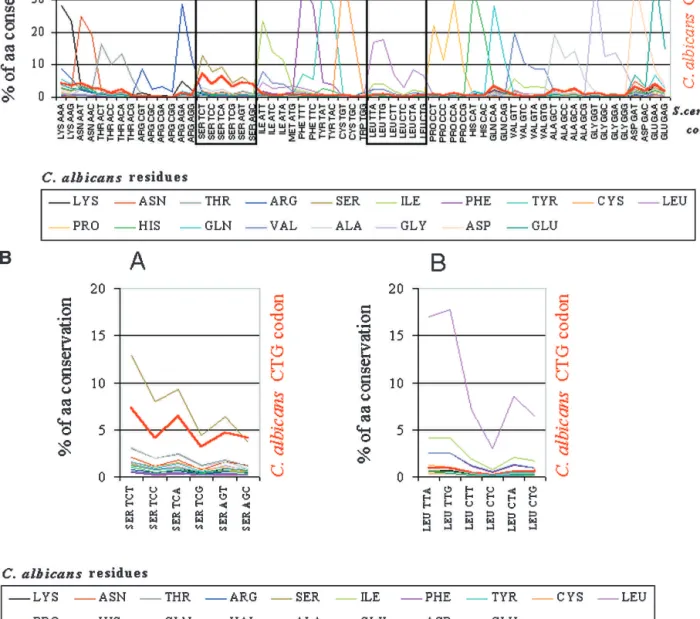
that the Ser-tRNACAGitself shaped the evolution of leucine codons, and in particular the CTG codons. That is, the negative pressure im-posed on CTG codons by incorpo-ration of serines instead of leucines might have played a major role in the evolution of all six leucine codons. To clarify this question, the complete set of C. albicans and S. cerevisiae homologous genes were aligned as described in Meth-ods, and for each S. cerevisiae amino acid the codons present in the homologous positions in C. al-bicans genes were computed. By plotting the percentage of the amino acid found in the S. cerevi-siae genome for each codon pres-ent at homologous positions in the C. albicans genome, an overall pic-ture of amino acid conservation between the two species is ob-tained. As expected, the level of amino acid conservation between the two species is very high (Fig. 8A,B). If a similar analysis is carried out, but instead of comparing amino acids in S. cerevisiae with codons at homologous positions in C. albicans homologous genes, the CTG codons present in the former are compared with codons present in the latter, an evolution-ary pattern for the CTG codon be-tween the two species emerges (red line in Fig. 8A,B). Remarkably, al-most all CTG codons present in the S. cerevisiae genome are repre-sented by leucine-TTG and -TTA codons in C. albicans. Only 0.2% of the total number of CTG codons remain conserved at homologous positions (Fig. 8B).
The above results only provide a partial picture for the evolution of the CTG codon in that the alignments are not reciprocal and consequently do not show how the 17,000 CTG codons present in C. albicans are represented in the S. cerevisiae genome. For this, the converse comparative analysis was carried out. C. albicans residues in the aligned gene set were fixed, and the corresponding codons present at homolo-gous positions in the S. cerevisiae genome were computed (Fig. 9A,B). The C. albicans CTG codons were then fixed in the alignment, and the codons present in the S. cerevisiae genome were identified. Most strikingly, almost none of the C. albi-cans CTG codons are represented by leucines in the S. cerevisiae genome; instead, serines appear at homologous positions, indicating that almost all C. albicans CTG codons evolved recently from serine or conserved serine codons (Fig. 9B).
Considering that evolution of the CTG codon from ser-ine codons is rather surprising, because of the need for two mutations to convert a serine or conserved serine codon into a CTG codon, a triple alignment between C. albicans, S. cer-evisiae, and S. pombe genomes was carried out to remove the background noise inherent in a double genome alignment Figure 3 Date of divergence of the CTG codon reassignment using SSU rRNA sequences. (A)
Non-linearized tree; (B) Non-linearized tree. The tree was constructed using the NJ method and the Kimura 2-parameter distance model (Kimura 1980). A␥ shape parameter of 0.146 was used. The standard error of the key divergence time is indicated. Lower numerals represent the confidence level from 100 replicate bootstrap samples. Aspergillus nidulans was used as an out-group. The scale represents the average number of substitutions per site.
and consequently improve data quality. The results of the triple alignment are a clear-cut confirmation of the double alignment (Fig. 10). That is, C. albicans CTG codons are rep-resented in the S. cerevisiae and S. pombe genomes by serine and not leucine codons. There is a very low level of conserved leucine codons and an even lower number of conserved CTG codons in the three genomes. That none of the other leucine codons shows this trend highlights the unique evolutionary pathway for CTG codons in the C. albicans genome (Fig. 10). The residual number of conserved CTGs present in the three genomes indicates that they are likely to be located at posi-tions that tolerate leucine or serine residues by C. albicans proteins.
DISCUSSION
The occurrence of genetic code changes raises two important evolutionary questions, namely: How do genetic code alter-ations evolve? and, Why do they evolve? The reassignment of the leucine-CTG codon to serine in Candida spp. is a paradigm genetic code change whose study has already unveiled several intricate and subtle evolutionary forces involved in the evo-lution of genetic code changes (Santos et al. 1993, 1996, 1999; Perreau et al. 1999). The present evolutionary study sheds important new light on the evolution of CTG reassignment by showing that a combination of the evolutionary
mecha-nisms postulated by both the Codon Disappearance and Ambigu-ous Intermediate theories has driven CTG reassignment. That is, increased AT pressure at the third codon position increases usage of A- and T-ending codons; however, the appearance of the Ser-tRNACAG, which decodes the CTG codon as serine, has been the major force re-pressing CTG, and perhaps CTA/ CTC/CTT, and increasing TTR codon usage.
The Evolution of the
Ser-tRNA
CAGA serine ancestry for the Ser-tRNACAG is consistent with struc-tural probing analyses that demon-strate that the structure of C. albi-cans Ser-tRNACAGis that of a typical serine tRNA (Perreau et al. 1999). A serine ancestry for the Ser-tRNACAG indicates that the suggested mecha-nism of tRNA mis-aminoacylation (Schultz and Yarus 1994, 1996) has not occurred in this case, despite the polysemous nature of the CTG codon (discussed further below). Therefore, if codon ambiguity were a part of the mechanism of reas-signment, then it was the result of either the decoding ambiguity of the Ser-tRNACAG, mediated via an ambiguous codon–anticodon inter-action, or “codon competition” be-tween a cognate leucine and a cog-nate serine tRNA. Therefore, the an-cestor of the Ser-tRNACAGmay have initially decoded a serine codon, but also the CTG codon, to a minor extent, via an ambiguously decoding anticodon. The leucine tRNA that originally decoded the CTG codon would have been lost from the genome of C. albicans, consistent with the observation that the S. pombe Leu-tRNACAGbears no similarity to the C. albicans Ser-tRNACAG(Fig. 1D).
The CTG Codon is Polysemous by Default
A problem with proposing a serine ancestry for the Ser-tRNACAG is to explain the presence of m1G37 in the Ser-tRNACAG, which in Candida zeylanoides is responsible for mis-charging of the tRNA with leucine (Suzuki et al. 1997), result-ing in the polysemous nature of the CTG codon. The proposal has been made that the m1G37 evolved to ameliorate the detrimental effects of reassigning the CTG codon from leu-cine to serine (Suzuki et al. 1997). In addition, m1G37 could be viewed as a remnant of a putative leucine ancestry of the tRNA. The presence of m1G37 in the Ser-tRNA
CAGof the
Can-dida spp. is likely an adaptive mutation that occurred after the anticodon of the tRNA had mutated to CAG, because m1G37 is found in tRNAs reading C Y/G N codons from Eubacteria, Archaea, and Eukaryotes (Bjork 1986; Bjork et al. 1987), whereas serine tRNAs possess a modified A37. The Ser-tRNACAGreads a codon (CTG) that belongs to the C Y/G N Figure 4 Date of divergence of the Ser-tRNACAGfrom the serine tRNAs in Candida albicans. (A)
Nonlinearized tree; (B) linearized tree. The tree was constructed using the NJ method and the Kimura 2-parameter distance model (Kimura 1980). A␥ shape parameter of 0.623 was used. A nucleotide substitution rate of 1.156⳯ 10ⳮ9substitutions per site per year was used to estimate divergence dates. This value was calculated to be representative of yeast tRNAs, as described in Methods. The standard error of the key divergence time is indicated. Lower numerals represent the confidence level from 100 replicate bootstrap samples. Homo sapiens Ser-tRNAGCT(HomoGCT) was used as an out-group. The scale represents the average number of substitutions per site.
group. m1G37 appears to have a role in maintaining the fi-delity of codon–anticodon interaction (Bjork et al. 1989, 2001; Hagervall et al. 1990, 1993; Li and Bjork 1995; Li et al. 1997; Urbonavicius et al. 2001). We suggest, therefore, that m1G37 is required for the efficient decoding of the CTG codon and that the low level of leucylation is a by-product, not an imperative, for the mutation. m1G37 therefore arose as an adaptive mutation after the reassignment occurred, rather than as a facilitative mutation that allowed the reassignment to occur. The presence of m1G37 is probably mildly detrimen-tal to the yeast, but less detrimendetrimen-tal than retaining A37. Fur-ther evidence for the above hypothesis is provided by the reassignment of the entire leucine CTN codon box to threo-nine in yeast mitochondria. This is the only other codon re-assignment, apart from the Candida codon rere-assignment, that involves a change in identity of the 37 nucleotide (N37) in the anticodon loop of the associated tRNA. During the course of the reassignment, A37, typical of threonine tRNAs (Sprinzl et al. 1998), has mutated to m1G37 in the threonine tRNA re-sponsible for decoding the CTN codons.
An explanation for the misacylation of the C. zeylanoides Ser-tRNACAGwith leucine, rather than with any of the other 18 amino acids, lies in the observation that, as class II tRNAs, Ser-tRNA and Leu-tRNA are structurally similar. Therefore, the Ser-tRNACAG is most likely to be misrecognized by leucyl-tRNA synthetase, rather than the other 18 aminoacyl-leucyl-tRNA synthetases that charge class ItRNAs. Experimental evidence supports this assertion; mutations in S. cerevisiae (Soma et al. 1996) and human (Breitschopf et al. 1995) Ser-tRNAs result in misacylation with leucine. Likewise, mutations in S. cerevisiae (Himeno et al. 1997) and human (Breitschopf and Gross 1994) Leu-tRNAs result in misacylation with serine. Hence, we propose that the nature of the polysemous codon results from the process of reassignment, rather than being an integral part of the mechanism.
The Evolution of the CTG Codon
The discovery that the Ser-tRNACAGappeared before CTG re-assignment is in agreement with the finding that GC pressure alone cannot explain the evolutionary pattern of the CTN codon family in C. albicans and most likely in the other Can-dida species that reassigned the CTG codon. This is particu-larly clear if one considers the relative preference for G- and A-ending codons (N3 position) in C. albicans in relation to S. cerevisiae leucine codons (Fig. 7). That is, C. albicans has a relative preference for purine-ending rather than pyrimidine-ending codons in the leucine codon family. The A3/G3 pref-erence can be explained by the strong directional mutational bias of CTN codons into TTA and TTG codons, and the G3 preference is mainly due to conversion of CTN codons into TTG codons. However, if one considers the higher AT content at N3 in C. albicans codons, one would expect a biased pref-erence for TTA and not TTG as is the case for the six arginine codons (Fig. 7).
Another important discovery emerging from the study presented herein relates to the nature of the 17,000 CTG codons present in extant C. albicans. It is remarkable that almost all CTG codons present in the ancestral yeast species disappeared from the C. albicans genome and that the new codons evolved from serine or conserved serine codons whose conversion into CTG codons require at least two mutations. Alternatively, the conversion of serine codons into CTG codons may have occurred via doublet mutations, such as described for the conversion of serine-AGY codons into ser-ine-TCN codons (Averof et al. 2000). If taken separately, this could be considered as providing strong support for the “Codon Disappearance” theory proposed by Jukes and Osawa (1993); however, the unique evolutionary pattern of the CTN codons in C. albicans and the early appearance of the Ser-tRNACAG in the Candida spp. imply a novel evolutionary mechanism in which the ambiguous decoding of the CTG codon by the newly created Ser-tRNACAGwas the main force driving CTG codons to extinction. It is likely that increased AT pressure at the N3 codon position also played an impor-tant role. If so, CTG (CTN) evolution has been driven by a combination of the negative pressure imposed by CTG mis-reading and biased AT pressure at the N3 codon position.
Should the Ambiguous Intermediate Theory
Be Reformulated?
The Ambiguous Intermediate theory originally proposed by Schultz and Yarus (1994) postulates that codon reassignment is driven by a mechanism, which requires ambiguous decod-ing of the codon bedecod-ing reassigned by tRNAs with expanded decoding properties. Briefly, the theory postulates that a mu-tant tRNA with expanded decoding properties starts decoding a codon belonging to a noncognate amino acid codon family, making it ambiguous. The theory proposes that this ambigu-ity increases because of additional mutations in the newly created tRNA up to a point at which the mutant tRNA effi-ciently decodes the ambiguous codon, which can then ac-quire a new meaning. The implication of this theory is that, contrary to expectation, codon ambiguity provides some sort of selective advantage to drive codon reassignment to completion. That the CTG and TGA codons are ambiguous in C. albicans and Bacillus subtilis, respectively (Lovett et al. 1991; Suzuki et al. 1997) and that reconstruction of the C. albicans CTG reassignment in S. cerevisiae showed that the latter has a selective advantage under some stress conditions Table 2. Decreased GC Content at the Third Codon
Position in Candida Species That Reassigned the CTG Codon From Leucine to Serine
Candida species
GC content of coding sequences (%)
Total 1st codon position 2nd codon position 3rd codon position C. albicans 36.93 44.14 37.65 29.00 C. dubliniensis 36.13 41.86 39.91 26.65 C. maltosa 37.16 44.73 37.60 29.15 C. glabrata 41.91 45.56 37.81 42.37 S. cerevisiae 39.71 44.59 36.58 37.96 S. pombe 39.80 48.04 38.24 33.12 All species shown have similar GC content in coding DNA and also at the first and second codon positions. However, GC pressure decreases significantly at the third codon position (N3, bold) in the three species that decode the standard leucine-CTG codon as serine, that is, Candida albicans, Candida dubliniensis, and Candida maltosa. Candida glabrata decodes the CTG codon as a leucine and follows the Saccharomyces crevisiae and Schizosaccharomyces pombe pattern. An exception to the lowering of GC content at the N3 position in Candida species that reassigned the CTG codon is represented by Candida cylindracea. However, the latter uses the CTG codon at a high frequency, which is in sharp contrast to a generalized low CTG usage in the Candida species that reassigned the CTG codon, indicating that other evolutionary forces shape CTG usage in C. cylindracea.
provide support for a reassignment mechanism through am-biguous decoding in which the environment may play a sig-nificant role (Santos et al. 1999).
A recent study carried out in mitochondria showed a good correlation between codon reassignment and codon dis-appearance; that is, of the 11 codons that have been reas-signed in some lineages, 8 have disappeared in some other lineage (Knight et al. 2001a). However, no significant associa-tion between codons predicted to disappear by mutaassocia-tion pres-sure and reassigned codons was found. Rather, some codons apparently disappear for reasons unrelated to mutational bias, and these are the ones that are more like to be reassigned (Knight et al. 2001a). Our data provide the missing link be-tween codon reassignment and disappearance by showing that codon misreading by mutant tRNAs is an important evo-lutionary force driving codons to extinction. That most codon reassignments are associated with tRNA mutations, ed-iting, altered tRNA modification, and release factor mutations (Knight et al. 2001a,b) provides strong support for this hy-pothesis, which unveils a novel mechanism for codon reassign-ment through codon ambiguity and supports a reformulation of the original Ambiguous Intermediate theory, as follows: Mutant tRNAs with expanded decoding properties, or mutations in the translational machinery, which create decoding ambiguity, in
conjunction with biased GC pressure, impose a negative selective pressure on particular codons, decreasing their usage to very low levels or forcing them to disappear from the genome. Some overall positive advantage must be present in order for this process to occur. These codons can be gradually reassigned through structural change of the translational machinery and loss of the ancestral cognate tRNAs.
The novelty of the reformulated theory relies on the disap-pearance or reduction of codon usage to a tolerable minimum caused by ambiguous decoding and not GC pressure only. Despite introducing a new mechanism for codon disappear-ance, the reformulated theory still relies on ambiguous decod-ing as a mechanism for codon reassignment and, therefore, we consider that the Ambiguous Intermediate theory should maintain its original name.
Conclusions
This study shows that the Ser-tRNACAGevolved from a serine and not a leucine tRNA and that the CTG codons present in extant Candida species are new codons, which have evolved recently. This study also unveils a hidden aspect of Candida biology, that of having a very unstable proteome during the last 272 million years or so. This instability clearly has impor-Figure 5 Usage of leucine and serine codons in Candida albicans, Saccharomyces cerevisiae, and Schizosaccharomyces pombe. (A) Of the six leucine codons, TTA and TTG are the most frequently used by the nuclear genomes of the three yeast species, the exception being CTT in S. pombe. In C. albicans, the usage of CTN codons, in particular CTC and CTA but also CTG codons, is repressed in relation to the same codons in the other two yeasts, whereas usage of the CTT codon is similar between C. albicans and S. cerevisiae. The usage of the CTA codon is also repressed in C. albicans, indicating that other forces apart from genome AT pressure shape CTN usage in this species. (B) The bias in C. albicans CTN usage is not observed for serine codons, whose distribution follows the expected pattern for a genome with low GC content in coding sequences (Table 2). The values indicated are relative to the total synonymous codon count for each genome and independent of amino acid frequency.
tant consequences at the phenotypic level, and one is urged to unravel its physiological and evolutionary meaning. This instability arises from three distinct mechanisms: (1) initial ambiguous decoding of the CTG codon by the newly created Ser-tRNACAG, forcing its disappearance; (2) evolution of serine or conserved serine codons into CTG codons through an in-termediary codon; and (3) ambiguous charging of the Ser-tRNACAGby both the seryl- and leucyl-tRNA synthetases.
METHODS
Genome Data Retrieval and Selection
Sequence data for C. albicans was obtained from the Stanford DNA Sequencing and Technology Centre Web site at http:// www-sequence.stanford.edu/group/candida. Sequencing of the C. albicans genome was accomplished with support from
the National Institute of Dental and Craniofacial Research and the Burroughs Wellcome Fund.
The sequences are of 10⳯ mean coverage. Complete ge-nome sequence data builds for S. cerevisiae (May 01, 2002) and S. pombe (May 16, 2002) were downloaded from GenBank (ftp://ftp.ncbi.nih.gov).
Sequence data were filtered before any analysis was con-ducted. All open reading frames (ORFs) were scanned for ir-regularities in sequence size, start and stop codon positions, and invalid character usage. The total of validated ORFs for each genome is 8467, 6313, and 4659 for C. albicans, S. cer-evisiae, and S. pombe, respectively. The C. albicans serine and leucine tRNA genes were identified by homology searching of the database, using the BLASTN program and the S. cerevisiae serine and leucine tRNA gene sequences. Introns were as-signed using the tRNAscan-SE 1.1 program (Lowe and Eddy 1997). S. cerevisiae, S. pombe, and C. cylindracea tRNA gene sequences were obtained from GenBank.
Figure 6 Candida albicans prefers A- and T-ending codons. Codon usage in C. albicans, Saccharomyces cerevisiae, and Schizosaccharomyces pombe was analyzed by counting the total number of codons for each species. To determine the codon preference between two species, the relative frequency of usage of each codon was divided by the corresponding value for the same codon in the other species. The codon usage ratios obtained for C. albicans/S. cerevisiae (A), C. albicans/S. pombe (B), and S. cerevisiae/S. pombe (C) were plotted as indicated in the graph, with ratio values above 1 (upper part in the graph) indicating the preferred codons in C. albicans in relation to the other two species (A and B) and in S. cerevisiae in relation to S. pombe (C). The C. albicans/S. cerevisiae codon ratios indicate that C. albicans prefers highly used codons (green bars) ending with A and T, with the exception of Leu-TTG and Gly-GGG. For the C. albicans/S. pombe pair, the preference for frequently used A- and T-ending codons is maintained, but four frequently used C-ending codons, Asn-AAC, Thr-ACC, Ile-ATC, Phe-TTC, and also the G-ending codons Leu-TTG, Val-GTG, and Gly-GGG, are preferred. Therefore, the data indicate that in C. albicans the effect of AT pressure is more visible at the third codon position for highly used codons. That the CTG codon is used at low frequency in C. albicans implies that AT pressure was not the main force driving its reassignment to serine. Green and brown bars indicate highly and rarely used codons, respectively.
RNA Sequence Alignments
The tRNA sequences were manually aligned, excluding in-trons and ensuring that the stems, anticodons, and invariant nucleotides (U8, A14, G18, G19, A21, G53, U54, U55, and C61) were aligned. The percentage identity of two tRNAs was calculated as the number of identical nucleotides divided by the nucleotide length of the longest of the two tRNA mol-ecules. The 5⬘-CCA terminus of mature tRNAs was not in-cluded in any of the sequence analyses. Small subunit (SSU) rRNA sequences were aligned using the DCSE program (De Rijk and De Wachter 1993), taking into account secondary structure information. The alignments used in this publica-tion are available at http://chuma.cas.usf.edu/∼garey/ alignments/alignment.html.
Tree Construction
NJ trees using Kimura 2-parameter distances and␥ corrections for site-to-site variation were constructed using the MEGA 2.1 program (Kimura 1980; Kumar et al. 2001). The PAUP 4.0 program (Swofford 1993) was used to calculate the␥ shape parameter using maximum likelihood.
Tree Calibration and Estimates of Divergence Times
The trees were linearized under the molecular clock assump-tion using the MEGA 2.1 program and the method of Nei and Kumar (2000) to obtain estimates of divergence times. The tRNA nucleotide substitution rate was estimated by con-sidering tRNAs from C. albicans, S. cerevisiae, and S. pombe, using the respective tRNAs from H. sapiens as out-groups. The tRNAs considered were aspartate, asparagine, cysteine, phenylalanine, histidine, tryptophan, and tyrosine. These tRNAs were chosen because each of the tRNAs specific for these amino acids possesses a single isoacceptor in each ge-nome; thus, the common ancestry of each set of tRNAs was unambiguous. The C. albicans tRNA sequences used are listed at the Web site http://www.ukc.ac.uk/bio/tuite/research/ tRNA.htm. The S. cerevisiae, S. pombe, and H. sapiens tRNAs used are listed at the Web site http://rna.wustl.edu/GtRDB/. The tRNA sequences were concatenated into a single sequence
for each species. A␥ shape parameter of 0.578 was estimated using the maximum likelihood method in PAUP, and a linearized NJ tree was constructed. A nucleotide substitution rate of 1.156⳯ 10ⳮ9 substitutions per site per year was estimated from the NJ tree using 420 million years ago for the divergence of S. cerevisiae from S. pombe (Lum et al. 1996). This tRNA nucleotide substitution rate was used to estimate the divergence times of key genes within the lin-earized tRNA trees displayed in Figures 2 and 4. The diver-gence times of key genes within the linearized ribosomal RNA tree (Fig. 3) were estimated by calibrating the rRNA tree using 420 million years ago for the divergence of S. cerevisiae and S. pombe.
To test the statistical significance of the key divergence times, we calculated the standard error of branch lengths of the genes that were used to estimate the respective divergence times. These standard errors were used to estimate the prob-ability that the codon reassignment and origin of the Ser-tRNACAGdid not occur at the same time (i.e., within 10 mil-lion years of each other), using approximations to the normal distribution.
Codon Usage Analysis
A platform for protein sequence data manipulation and analysis was built on Perl (ActivePerl 5.6.1; http:// w w w . a c t i v e p e r l . c o m ) u s i n g B i o P e r l 1 . 0 ( h t t p : / / www.bioperl.org) and consists of a series of programs and CGI scripts. The three groups of validated sequences were intro-duced separately, and each ORF was analyzed according to its codon usage. A range of several statistical values was gener-ated at three different levels of genome comparison: (1) dis-tribution of individual codons, (2) dependencies between groups of synonymous codons, and (3) differences in amino acid usage.
Homolog Alignments
A stand-alone BLAST (Altschul et al. 1997; version 2.2.2, http://www.ncbi.nlm.nih.gov/BLAST/) was used to find S. cer-evisiae–C. albicans homologous proteins. All protein pairs that Figure 7 GC pressure alone at the third codon position does not explain the evolution of leucine codons in Candida albicans. To elucidate the role of GC pressure in the evolution of C. albicans ORFs, an analysis of GC3 pressure (GC pressure at the third codon position) was carried out by comparing the complete ORFs set of both genomes using BLASTP at an E-value of 10ⳮ5. For each Saccharomyces cerevisiae codon, the corre-sponding N3 codon position was identified in C. albicans ortholog genes. The data show that S. cerevisiae codons are represented in C. albicans mainly by A- or T-terminating codons (yellow and light blue bars), in agreement with high AT pressure at the third codon position in the C. albicans genome (N3 = 71% AT; Table 2). However, the leucine codons show a small deviation from the pattern observed for all other codons. That is, they change more frequently than expected into G-terminating codons (blue bar), thus contradicting the high AT pressure at the N3 position observed in C. albicans genes. This increase in G3 is matched by a slight increase in A3, indicating an increase in purines at N3. This is achieved by decreasing the usage frequency of C- and T-ending codons. That is, when compared with all other codons, there is a relative increase in purines at the N3 position in C. albicans genes instead of an increase in AT-ending codons, as would be expected from the relative increase of AT pressure at N3 in the C. albicans genome, thus indicating that other forces apart from GC pressure shaped the evolution of leucine codons in the latter.
were reciprocal best hits (Rivera et al. 1998) with a BLAST expected value lower than 10ⳮ5were included in this study. In all, 2899 pairs of homologous proteins that matched these criteria were found. The C. albicans genes in this homolog set have a total of 6084 CTGs (40% of the genome total), an average size of 533.68 codons, and an average of 3.52 CTGs per thousand (the genome average is 6.97 CTGs per thou-sand). The protein homologs were aligned with T-Coffee
(Notredame et al. 2000; http://igs-server.cnrs-mrs.fr/∼cnotred/ Projects-home-page/t-coffee-home-page.html). N- or C-terminal extensions or insertions in the protein sequence of either species that lacked a mirror residue in the homologous sequence (gaps) were not included in the analysis. The align-ments around gaps were analyzed to reduce possible ambigu-ity. Based on a manual analysis of 30 alignments, a set of sequential rules was determined to formalize our definition of Figure 8 The majority of the CTG codons present in the Saccharomyces cerevisiae genome are encoded by TTG and TTA codons in the Candida albicans genome. (A) To quantify the relative conservation of amino acids and codons between C. albicans and S. cerevisiae, the two genomes were aligned using BLASTP at an E-value of 10ⳮ5. For each S. cerevisiae amino acid, the corresponding codons present at homologous positions in C. albicans orthologs were identified, thus providing overall information about amino acid and codon conservation between the two species. To elucidate the mutational pattern of the CTG codon between the two species, its frequency of conversion at each position of the alignment was computed independently of the other leucine codons (thick red line in the graph). As would be expected, the major trend is residue conservation between the two species at each position for each respective codon family. For the CTG and the other leucine codons, two important trends are observed: first, their conversion into leucine TTG and TTA codons and also into conserved amino acids of leucine (Ile, Met, and Phe); second, the avoidance of nonconserved leucine, namely, serine codons. As observed in Figures 6 and 7, the preferential conversion of CTN codons into TTG does not follow the rules imposed by increased AT pressure in C. albicans as TTG is a G-ending codon, thus indicating that translational selection is a strong driving force in the evolution of the CTN codons in C. albicans. (B) Magnification of the previous graph in the regions of serine and leucine codons (boxes A and B, respectively).
ambiguous regions. We consider ambiguous: (1) all the aligned portions between a gap and a perfect match; (2) all aligned segments of at least five amino acids that surrounded ambiguous regions with at least 20% negative score or; (3) any window of 15 amino acids with one third negative alignment. All amino acids and their respective codons within S. cerevisiae proteins and genes were compared with their aligned residues in the homologous C. albicans protein and DNA sequences. Codon conservation for each species was de-termined from the alignments and scored according to the codon or amino acid residue present at the same position in
the other species and its respective third-position nucleotide (N3). A triple alignment was also performed between C. albi-cans, S. cerevisiae, and S. pombe proteins, using the same method already described, to determine the origin of the leu-cine codons present in modern day C. albicans strains.
ACKNOWLEDGMENTS
The research reported here was supported by project grants to M.A.S.S. from the Portuguese Foundation for Science and Technology (FCT; Projects POCTIREFs: BME/32938, 32942/ Figure 9 Candida albicans CTG codons display a biased pattern of conversion to serine codons in Saccharomyces cerevisiae. To identify the S. cerevisiae codons that correspond to each amino acid present at the respective position in homologous C. albicans genes, the two genomes were compared as described in Figure 8 with the exception that S. cerevisiae codons were taken as the reference in the alignment. As before, the CTG codon was computed independently. As in Figure 8, the major trend between the two genomes is amino acid conservation. However, the CTG codon shows a major deviation from the other leucine codons. That is, instead of being represented in the S. cerevisiae genome by leucine codons, it is represented by serine codons and codons corresponding to amino acids conserved of serine. (B) Magnification of the previous graph in the regions of serine and leucine codons (boxes A and B, respectively).
99 and BME/39030/01) and the EMBO YIP Programme, and to M.F.T. and M.A.S.S. from the Biotechnological Biological Re-search Council (BBSRC). G.M. is supported by a postdoctoral research fellowship (SFRH/BPD/7195/2001) from FCT. We thank Nancy Federspiel for her kind permission to use the C. albicans genome data. Finally, we are most thankful to Justin O’Sullivan for his helpful discussions and input into this study.
The publication costs of this article were defrayed in part by payment of page charges. This article must therefore be hereby marked “advertisement” in accordance with 18 USC section 1734 solely to indicate this fact.
REFERENCES
Altschul, S.F., Madden, T.L., Schaffer, A.A., Zhang, J., Zhang, Z., Miller, W., and Lipman, D.J. 1997. Gapped BLAST and PSI-BLAST: A new generation of protein database search programs. Nucleic Acids Res. 25: 3389–3402.
Averof, M., Rokas, A., Wolfe, K.H., and Sharp, P.M. 2000. Evidence for a high frequency of simultaneous double-nucleotide substitutions. Science 287: 1283–1286.
Bjork, G.R. 1986. Transfer RNA modification in different organisms.
Chem. Scripta 26: 91–95.
Bjork, G.R., Ericson, J.U., Gustafsson, C.E., Hagervall, T.G., Jonsson, Y.H., and Wikstrom, P.M. 1987. Transfer RNA modification.
Annu. Rev. Biochem. 56: 263–287.
Bjork, G.R., Wikstrom, P.M., and Bystrom, A.S. 1989. Prevention of translational frameshifting by the modified nucleoside 1-methylguanosine. Science 244: 986–989.
Bjork, G.R., Jacobsson, K., Nilsson, K., Johansson, M.J., Bystrom, A.S., and Persson, O.P. 2001. A primordial tRNA modification required for the evolution of life? EMBO J. 20: 231–239. Breitschopf, K. and Gross, H.J. 1994. The exchange of the
discriminator base A73 for G is alone sufficient to convert human tRNALeu
into a serine-acceptor in vitro. EMBO J.
13: 3166–3167.
Breitschopf, K., Achsel, T., Busch, K., and Gross, H.J. 1995. Identity elements of human tRNALeu
: Structural requirements for converting human tRNASer
into a leucine acceptor in vitro.
Nucleic Acids Res. 23: 3633–3637.
De Rijk, P. and De Wachter, R. 1993. DCSE, an interactive tool for sequence alignment and secondary structure research. Comput.
Appl. Biosci. 9: 735–740.
Hagervall, T.G., Ericson, J.U., Esberg, K.B., Li, J.M., and Bjork, G.R. 1990. Role of tRNA modification in translational fidelity.
Biochim. Biophys. Acta 1050: 263–266.
Hagervall, T.G., Tuohy, T.M., Atkins, J.F., and Bjork, G.R. 1993. Deficiency of 1-methylguanosine in tRNA from Salmonella
typhimurium induces frameshifting by quadruplet translocation. J. Mol. Biol. 232: 756–765.
Himeno, H., Yoshida, S., Soma, A., and Nishikawa, K. 1997. Only one nucleotide insertion to the long variable arm confers an efficient serine acceptor activity upon Saccharomyces cerevisiae
Figure 10 A high percentage of Candida albicans CTG codons are represented by serine residues in the Saccharomyces cerevisiae and Schizo-saccharomyces pombe genomes. To determine the origin of leucine codons present in the C. albicans genome, the percentage of serine and leucine residues present simultaneously in the S. cerevisiae and S. pombe genomes was determined for each of the six leucine codons present in the C. albicans genome. For this, the three genomes were compared using the BLASTP program as in Figures 8 and 9. The conservation of CTN codons between C. albicans and S. cerevisiae/S. pombe is very low and reaches the lowest value for CTG codons (0%). Interestingly, 14% of the C. albicans CTG codons encode serine residues and only 0.7% encode leucine residues in S. cerevisiae and S. pombe. This trend is not observed for any other leucine codon; leucine is always highly conserved in homologous S. cerevisiae/S. pombe genes.
tRNALeuin vitro. J. Mol. Biol. 268: 704–711.
Holmquist, R., Jukes, T.H., and Pangburn, S. 1973. Evolution of transfer RNA. J. Mol. Biol. 78: 91–116.
Ikemura, T. 1981a. Correlation between the abundance of Escherichia
coli transfer RNAs and the occurrence of the respective codons in
its protein genes. J. Mol. Biol. 146: 1–21.
———. 1981b. Correlation between the abundance of Escherichia coli transfer RNAs and the occurrence of the respective codons in its protein genes: A proposal for a synonymous codon choice that is optimal for the E. coli translational system. J. Mol. Biol.
151: 389–409.
Jukes, T.H. and Osawa, S. 1993. Evolutionary changes in the genetic code. Comp. Biochem. Physiol. 106: 489–494.
Kawaguchi, Y., Honda, H., Taniguchi-Morimura, J., and Iwasaki, S. 1989. The codon CUG is read as serine in an asporogenic yeast
Candida cylindracea. Nature 341: 164–166.
Kimura, M. 1980. A simple method for estimating evolutionary rate of base substitutions through comparative studies of nucleotide sequences. J. Mol. Evol. 16: 111–120.
Knight, R.D., Landweber, L.F., and Yarus, M. 2001a. How mitochondria redefine the code. J. Mol. Evol. 53: 299–313. Knight, R.D., Freeland, S.J., and Landweber, L.F. 2001b. Rewriting
the keyboard: Evolvability of the genetic code. Nat. Rev. Genet.
2: 49–58.
Kumar, S., Tamura, K., Jakobsen, I.B., and Nei, M. 2001. MEGA2: Molecular Evolutionary Genetics Analysis software. Bioinformatics
17: 1244–1245.
Li, J.N. and Bjork, G.R. 1995. 1-Methylguanosine deficiency of tRNA influences cognate codon interaction and metabolism in
Salmonella typhimurium. J. Bacteriol. 177: 6593–6600.
Li, J., Esberg, B., Curran, J.F., and Bjork, G.R. 1997. Three modified nucleosides present in the anticodon stem and loop influence the in vivo aa-tRNA selection in a tRNA-dependent manner. J.
Mol. Biol. 271: 209–221.
Lovett, P.S., Ambulos, N.P., Mulbry, W., Noguchi, N., and Rogers, E.J. 1991. UGA can be decoded as tryptophan at low efficiency in Bacillus subtilis. J. Bacteriol. 173: 1810–1812.
Lowe, T.M. and Eddy, S.R. 1997. tRNAscan-SE: A program for improved detection of transfer RNA genes in genomic sequence.
Nucleic Acids Res. 25: 955–964.
Lum, P.Y., Edwards, S., and Wright, R. 1996. Molecular, functional and evolutionary characterization of the gene encoding HMG-CoA reductase in the fission yeast, Schizosaccharomyces
pombe. Yeast 12: 1107–1124.
Nei, M. and Kumar, S. 2000. Molecular evolution and phylogenetics. Oxford University Press, New York, NY.
Notredame, C., Higgins, D., and Heringa, J. 2000. T-Coffee: A novel method for multiple sequence alignments. J. Mol. Biol.
302: 205–217.
Ohama, T., Muto, A., and Osawa, S. 1990. Role of GC-biased mutation pressure on synonymous codon choice in Micrococcus
luteus, a bacterium with a high genomic GC-content. Nucleic Acids Res. 18: 1565–1569.
Ohama, T., Suzuki, T., Mori, M., Osawa, S., Ueda, T., Watanabe, K., and Nakase, T. 1993. Non-universal decoding of the leucine codon CTG in several Candida species. Nucleic Acids Res.
21: 4039–4045.
Osawa, S. 1995. Codon usage. In Evolution of the genetic code (ed. S. Osawa), pp. 45–57. Oxford University Press, New York, NY. Osawa, S. and Jukes, T.H. 1989. Codon reassignment (codon
capture) in evolution. J. Mol. Evol. 28: 271–278.
Osawa, S., Collins, D., Ohama, T., Jukes, T.H., and Watanabe, K. 1990. Evolution of the mitochondrial genetic code. III. Reassignment of CTN codons from leucine to threonine during evolution of yeast mitochondria. J. Mol. Evol. 30: 322–328. Osawa, S., Jukes, T.H., Watanabe, K., and Muto, A. 1992. Recent
evidence for evolution of the genetic code. Microbiol. Rev.
5: 229–264.
Perreau, V.M., Keith, G., Holmes, W.M., Przykorska, A., Santos, M.A., and Tuite, M.F. 1999. The Candida albicans CTG-decoding Ser-tRNA has an atypical anticodon stem–loop structure. Mol.
Biol. 293: 1039–1053.
Pesole, G., Lotti, M., Alberguina, L., and Saccone, C. 1995. Evolutionary origin of nonuniversal CTG Ser codon in some
Candida species as inferred from a molecular phylogeny. Genetics 141: 903–907.
Reyes, V.M. and Abelson, J. 1988. Substrate recognition and splice site determination in yeast tRNA splicing. Cell 55: 719–730. Rivera, M.C., Jain, R., Moore, J.E., and Lake, J.A. 1998. Genomic
evidence for two functionally distinct gene classes. Proc. Natl.
Acad. Sci. 95: 6239–6244.
Santos, M.A.S. and Tuite, M.F. 1995. The CTG codon is decoded in vivo as serine and not leucine in Candida albicans. Nucleic Acids
Res. 23: 1481–1486.
Santos, M.A.S., Keith, G., and Tuite, M.F. 1993. Non-standard translational events in Candida albicans mediated by an unusual seryl-tRNA with a 5⬘-CAG-3⬘ (leucine) anticodon. EMBO J.
12: 607–616.
Santos, M.A.S., Perreau, V., and Tuite, M.F. 1996. Transfer RNA structural change is a key element in the reassignment of the CUG codon in Candida albicans. EMBO J. 15: 5060–5068. Santos, M.A.S., Cheesman, C., Costa, V., Moradas-Ferreira, P., and
Tuite, M.F. 1999. Selective advantages created by codon ambiguity allowed for evolution of an alternative genetic code in
Candida spp. Mol. Microbiol. 31: 937–947.
Schultz, D.W. and Yarus, M. 1994. Transfer RNA mutation and the malleability of the genetic code. J. Mol. Biol. 235: 1377–1380. ———. 1996. On malleability in the genetic code. J. Mol. Evol.
42: 597–601.
Soma, A., Kumagai, R., Nishikawa, K., and Himeno, H. 1996. The anticodon loop is a major identity determinant of Saccharomyces
cerevisiae tRNALeu
. J. Mol. Biol. 263: 707–714.
Sprinzl, M., Horn, C., Brown, M., Ioudovitch, A., and Steinberg, S. 1998. Compilation of tRNA sequences and sequences of tRNA genes. Nucleic Acids Res. 26: 148–153.
Sugita, T. and Nakase, T. 1999. Non-universal usage of the leucine CTG codon and the molecular phylogeny of the genus Candida.
Syst. Appl. Microbiol. 22: 79–86.
Sugiyama, H., Ohkuma, M., Masuda, Y., Park, S.M., Ohta, A., and Takagi, M. 1995. In vivo evidence for non-universal usage of the codon CTG in Candida maltosa. Yeast 11: 43–52.
Suzuki, T., Ueda, T., Yokogawa, T., Nishigawa, K., and Watanabe, K. 1994. Characterization of serine and leucine tRNAs in an asporogenic yeast Candida cylindracea and evolutionary implications of genes for tRNACAG
Ser
responsible for translation of a non-universal genetic code. Nucleic Acids Res. 22: 115–123. Suzuki, T., Ueda, T., and Watanabe, K. 1997. The ‘polysemous’
codon—A codon with multiple amino acid assignment caused by dual specificity of tRNA identity. EMBO J. 16: 1122–1134. Swofford, D.I. 1993. PAUP: Phylogenetic analysis using parsimony,
version 3.11. Illinois Natural History Survey, Champaign, IL. Ueda, T., Suzuki, T., Yokogawa, T., Nishigawa, K., and Watanabe, K.
1994. Unique structure of new serine tRNAs responsible for decoding leucine codon CTG in various Candida species and their putative ancestral tRNA genes. Biochimie 76: 1217–1222. Urbonavicius, J., Qian, Q., Durand, J.M., Hagervall, T.G., and Bjork,
G.R. 2001. Improvement of reading frame maintenance is a common function for several tRNA modifications. EMBO J.
20: 4863–4873.
Yarus, M. and Schultz, D.W. 1997. Further comments on codon reassignment. Response. J. Mol. Evol. 45: 3–6.
Yokogawa, T., Suzuki, T., Ueda, T., Mori, M., Ohama, T., Kuchino, Y., Yoshinari, S., Motoki, I., Nishigawa, K., Osawa, S., et al. 1992. Serine tRNA complementary to the nonuniversal serine codon CTG in Candida cylindracea: Evolutionary implications. Proc. Natl.
Acad. Sci. 89: 7408–7411.
WEB SITE REFERENCES
ftp://ftp.ncbi.nih.gov; GenBank.
http://chuma.cas.usf.edu/∼garey/alignments/alignment.html; small subunit rRNA sequences aligned in this paper using the DCSE program.
http://igs-server.cnrs-mrs.fr/∼cnotred/Projects-home-page/ t-coffee-home-page.html; T-Coffee.
http://rna.wustl.edu/GtRDB/; the S. cerevisiae, S. pombe, and H.
sapiens tRNAs used in this paper.
http://www.activeperl.com; ActivePerl 5.6.1. http://www.bioperl.org; BioPerl 1.0.
http://www.bio.ua.pt/genomica/Lab/Genomedata.html; tRNAs identified from the C. albicans genome.
http://www.ncbi.nlm.nih.gov/BLAST/; BLAST.
http://www-sequence.stanford.edu/group/candida; Stanford DNA Sequencing and Technology Centre.
http://www.ukc.ac.uk/bio/tuite/research/tRNA.htm; C. albicans tRNA sequences used in this paper.