Universidade de Aveiro Ano 2019
Departamento de Economia, Gestão, Engenharia Industrial e Turismo
MARCELLO
FERNANDES CHEDID
RELAÇÃO DE COLABORAÇÃO ENTRE
UNIVERSIDADE E INDÚSTRIA DE SOFTWARE COM
BASE NA GESTÃO DO CONHECIMENTO: UMA
ABORDAGEM EXPLORATÓRIA
COLLABORATION RELATIONSHIP BETWEEN
UNIVERSITY AND SOFTWARE INDUSTRY BASED
ON KNOWLEDGE MANAGEMENT: AN
Universidade de Aveiro Ano 2019
Departamento de Economia, Gestão, Engenharia Industrial e Turismo
MARCELLO
FERNANDES CHEDID
RELAÇÃO DE COLABORAÇÃO ENTRE
UNIVERSIDADE E INDÚSTRIA DE SOFTWARE COM
BASE NA GESTÃO DO CONHECIMENTO: UMA
ABORDAGEM EXPLORATÓRIA
COLLABORATION RELATIONSHIP BETWEEN
UNIVERSITY AND SOFTWARE INDUSTRY BASED
ON KNOWLEDGE MANAGEMENT: AN
EXPLORATORY APPROACH
Tese apresentada à Universidade de Aveiro para cumprimento dos requisitos necessários à obtenção do grau de Doutor em Engenharia e Gestão Industrial, realizada sob a orientação científica da Doutora Leonor da Conceição Teixeira, Professora Auxiliar do Departamento de Economia, Gestão, Engenharia Industrial e Turismo da Universidade de Aveiro.
Thesis submitted to the University of Aveiro for fulfillment of the necessary requirements leading to the Doctoral degree in Industrial Engineering and Management, carried out under the scientific supervision of Doctor Leonor da Conceição Teixeira, Assistant Professor of the Department of Economics, Management, Industrial Engineering and Tourism of the University of Aveiro.
o júri
PresidenteMembros
Doutor Jorge Ribeiro Frade
Professor Catedrático, Departamento de Engenharia de Materiais e Cerâmica, Universidade de Aveiro
Doutor José António Rodrigues Pereira de Faria
Professor Auxiliar, Faculdade de Engenharia, Universidade do Porto Doutora Isabel Maria Pinto Ramos
Professora Associada com Agregação, Departamento de Sistemas de Informação, Universidade do Minho
Doutora Maria Manuela Cruz da Cunha
Professora Coordenadora Principal com Agregação, Departamento de Tecnologias, Instituto Politécnico do Cávado e do Ave
Doutor Carlos Manuel dos Santos Ferreira
Professor Associado com Agregação, Departamento de Economia, Gestão, Engenharia Industrial e Turismo, Universidade de Aveiro Doutora Leonor da Conceição Teixeira
Professora Auxiliar, Departamento de Economia, Gestão, Engenharia Industrial e Turismo, Universidade de Aveiro (Orientadora)
agradecimentos
Se é difícil condensar todo o trabalho desenvolvido em algumas páginas, resumir quatro anos de relacionamentos em poucas linhas é ainda mais. Em primeiro lugar, o meu agradecimento é para a minha orientadora, Professora Doutora Leonor Teixeira, por ter acreditado em alguém que não era oriundo da academia e ter o interesse e a disponibilidade para orientar um trabalho diferente e interdisciplinar. Agradeço também a sua atenção cuidadosa aos detalhes e a sua habilidade em manter o controle durante as minhas explosões de perseverança e paixão (e às vezes de irritação) durante o desenvolvimento deste trabalho.Muito especialmente, desejo agradecer (por ordem alfabética e não de importância) às Professoras Doutoras Ana Caldeira, Helena Alvelos e Teresa Carvalho, por ter sido possível estabelecer uma rede de colaboração importantíssima no desenvolvimento de um conjunto de trabalhos que sem as vossas participações seria impossível. Muito obrigado!
Ao Professor Doutor José Vasconcelos pela confiança demonstrada no seu incentivo à minha participação neste programa doutoral.
À Professora Doutora Carina Pimentel pela conversa amiga e reconfortante. Um agradecimento muito especial aos docentes e investigadores, unidades de investigação e empresas da indústria de software que estiveram disponíveis e colaboraram com sua participação nos trabalhos empíricos necessários para o bom desenvolvimento desta tese.
Agradeço aos meus colegas de curso, em especial ao Pedro Almeida pela importante ajuda no contato com a indústria de software para a realização das entrevistas. À Liliana Ávila, minha companheira nas vicissitudes de um doutoramento, com um “ouvido amigo” sempre disponível.
Agradeço igualmente a todos os docentes e funcionários do DEGEIT, particularmente a Sra. Célia Jorge pelo “bom dia” de todos os dias.
Por último, mas não menos importante, sou grato a minha esposa e companheira, Ção. Sempre ao meu lado, com compreensão e estímulo. Com certeza, nunca conseguirei retribuir toda a sua dedicação. E ao nosso filho, Niki, que com a sua dor me deu forças para continuar e não desistir. Eu nunca conseguiria chegar até aqui sem vocês.
palavras-chave
Relação de colaboração, Universidade, Indústria de software, Gestão do conhecimento, Partilha de conhecimento.resumo
O atual ambiente que carateriza a indústria de software é extremamente dinâmico e, de certa forma complexo, exigindo soluções de alto desempenho, de desenvolvimento rápido e eficientes em termos de custos. A relação de colaboração com as universidades pode representar um recurso fundamental, na medida em que juntas mais facilmente podem promover o desenvolvimento tecnológico que está na base de soluções de inovação. Adicionalmente, são os vários estudos que apontam a partilha de conhecimento como um fator importante e fortemente influenciador de uma relação de colaboração.Neste contexto, a presente tese tem como objetivo identificar um conjunto de fatores que possam potencializar e/ou facilitar a relação de colaboração entre a universidade e a indústria de software de forma sustentável, com base na gestão do conhecimento. Em consonância com o objetivo geral, foram definidas três questões de investigação: (i) Quais são as principais motivações que levam à decisão de estabelecer uma relação de colaboração?; (ii) Quais são os mecanismos de gerenciamento usados na governança das relações de colaboração?; (iii) Quais são os princípios e a cultura da gestão do conhecimento e da partilha de conhecimento nessas organizações?
Por forma a responder àquelas questões e, consequentemente, ao objetivo geral, numa fase inicial foi conduzido um estudo quantitativo através da aplicação de um questionário cujo objetivo foi o de explorar e compreender a prática da partilha de conhecimento e de colaboração no contexto de uma universidade. De uma maneira geral, concluiu-se que a partilha de conhecimento afeta positivamente o comportamento de colaboração. Os resultados obtidos mostram ainda que, por forma a promover e incentivar a partilha de conhecimento e, consequentemente, fomentar as relações de colaboração, é importante trabalhar os mecanismos baseados na motivação intrínseca e
no networking.
Seguidamente, foi conduzido um estudo qualitativo com base em entrevistas, com o objetivo de identificar um conjunto de fatores que pudessem melhorar e/ou facilitar a relação de colaboração entre a universidade e a indústria de software de forma sustentável, com base na gestão do conhecimento. Foram entrevistados participantes com visões complementares e experiências diferentes nos dois tipos de indústria envolvidas e, simultaneamente, que ocupassem posições com poder de decisão. Os resultados revelaram que as relações de colaboração estabelecidas entre essas organizações são configuradas apenas como uma ‘conexão’. Esta ‘conexão’ é caracterizada por ser uma troca simples, sem construir uma relação de colaboração sustentável; embora os envolvidos apontem vantagens na existência de uma relação de colaboração sustentável. Os resultados revelaram ainda que as relações de colaboração são, normalmente, conduzidas através de canais informais de comunicação, o que dificulta a captura e disseminação do conhecimento pelos restantes membros de cada uma das organizações envolvidas.
Em jeito de conclusão e em termos práticos este trabalho contribui com a identificação e análise de um conjunto de fatores potenciadores de uma relação de colaboração entre a universidade e a indústria de software, podendo auxiliar as organizações envolvidas na definição de estratégias para o desenvolvimento de ações futuras, a fim de promover uma relação de colaboração sustentável. Em termos teóricos, este trabalho contribui para o aumento do corpo de conhecimento na área, com resultados provenientes de estudos empíricos, uma vez que a literatura aponta como principal lacuna a ausência daqueles (estudos empíricos), por forma a complementar e validar a teoria existente.
keywords
Collaboration relationship; University; Software industry; Knowledge management; Knowledge sharing.abstract
The current environment that characterizes the software industry is extremely dynamic and somewhat complex demanding high-performance solutions, rapid development and cost efficiency. The collaboration relationship with universities has been represented a key resource, to the extent that together more easily can promote technological development that underpins innovation solutions. In addition, several studies point out knowledge sharing as an important and strongly influential factor in a collaboration relationship.
In this context, the present thesis aims to identify a set of factors that can enhance and/or facilitate the collaboration relationship between the university and the software industry in a sustainable way, based on knowledge management. In line with the general objective three research questions were defined: (i) What are the main motivations that lead to the decision of establishing a collaboration relationship?; (ii) What are the management mechanisms used in the governance of collaboration relationships?; (iii) What are the principles and culture of knowledge management and of knowledge sharing in these organizations?
In order to answer those questions and, consequently, achieve the general objective, an initial quantitative study based on a questionnaire was conducted. This study aims to explore and understand the practice of knowledge sharing and collaboration in the context of a university. Overall it was concluded that, knowledge sharing positively affects the collaboration behavior. The obtained results also showed that in order to promote and encourage knowledge sharing and, consequently, to foster collaboration relationships, it is important to work mechanisms based on intrinsic motivation and networking.
Subsequently, it was conducted a qualitative study based on interviews in order to identify a set of factors that could enhance/facilitate the collaboration relationship between the university and the software industry in a sustainable way, based on knowledge management. Participants with complementary visions and different experiences in the two types of involved industries and simultaneously, with decision-making positions were interviewed. The results revealed that collaboration relationships established among these organizations are set-up only as a ‘connection’. This ‘connection’ is characterized by being a simple exchange, without building a sustainable collaboration relationship; although, those involved point to advantages in the existence of a sustainable collaboration relationship. The results also revealed that the collaboration relationships are usually conducted through informal communication channels, which makes it difficult to capture and disseminate knowledge to other remaining members of each involved organizations.
In nutshell and in practical terms, this work contributes to the identification and analysis of a set of factors that enhance a collaboration relationship between university and software industry. This result can support organizations in the strategies definition for the development of actions, in order to promote a sustainable collaboration relationship. In theoretical terms, this work contributes to the increase of the body of knowledge in the area, with empirical results, since the literature point the lack of empirical studies as the main gap in this area of knowledge.
i
Contents
Contents ... i
List of tables ... viii
List of abbreviations ... x
Chapter I - General Introduction ... 1
I.1 Introduction and motivation ... 2
I.2 State of the art and related work ... 4
I.2.1 University-industry collaboration relationship ...4
I.2.1.1 The main drivers of university-industry collaboration relationship ... 5
I.2.2 The university-software industry collaboration relationship ...8
I.2.2.1 About the university ... 8
I.2.2.1.1 Characterization of higher education in Portugal with facts and figures ... 9
I.2.2.2 About the software industry ... 13
I.2.2.2.1 Characterization of the software industry in Portugal with facts and figures ... 17
I.2.2.3 About the university-software industry collaboration relationship ... 22
I.2.3 Knowledge management ... 25
I.2.3.1 About knowledge ... 26
I.2.3.2 About knowledge management ... 29
I.2.3.2.1 Knowledge management system processes ... 31
I.2.3.3 About knowledge management in knowledge intensive organizations ... 35
I.2.4 Knowledge management in university-software industry collaboration relationship ... 38
I.2.4.1 Knowledge sharing in university-software industry collaboration relationship ... 38
I.3 Objectives and research methodology ... 40
I.3.1 Objectives ... 40
I.3.2 Research methodology ... 42
I.3.2.1 About Design Science Research ... 42
I.3.2.1.1 Design Science Research in the investigation process ... 44
I.3.2.2 Research strategy ... 46
I.3.2.2.1 Research strategy for the quantitative approach... 46
I.3.2.2.2 Research strategy for the qualitative approach ... 49
I.4 Thesis structure ... 51
Chapter II - The university-industry collaboration ... 57
II.1 Introduction ... 59
II.2 Background ... 59
II.2.1 The university-industry collaboration ... 59
ii
II.2.2.1 Motivations of interaction ... 62
II.2.2.2 Channels of interaction ... 63
II.2.2.3 Outcomes of interaction ... 64
II.3 Future research directions ... 68
II.4 Conclusion ... 69
II.5 References ... 69
II.6 Additional reading ... 72
II.7 Key terms and definitions ... 72
Chapter III - The knowledge management culture: An exploratory study in
academic context ... 73
III.1 Introduction ... 75
III.2 Background ... 76
III.2.1 About knowledge management ... 76
III.2.1.1 Types of knowledge ... 77
III.2.1.2 Knowledge management ... 78
III.2.1.3 Knowledge management culture ... 79
III.2.2 The culture of knowledge management in the academic context ... 79
III.2.2.1 Knowledge and knowledge management in the academic context ... 81
III.2.2.2 Organizational culture in the academic context ... 83
III.2.2.3 Knowledge management culture in the academic context ... 85
III.3 Future research and directions ... 87
III.4 Conclusion ... 88
III.5 References ... 88
III.6 Key terms and definitions ... 93
Chapter IV - Knowledge management and software development organization:
What is the challenge? ... 95
IV.1 Introduction ... 97
IV.2 Background ... 98
IV.2.1 Theoretical foundations on software development organization and knowledge management ... 98
IV.2.1.1 Software development organization ... 98
IV.2.1.2 Knowledge management ... 99
IV.2.2 Knowledge management in software development environment ... 104
IV.2.2.1 Knowledge sharing in software development environment ... 106
IV.2.2.2 Tacit knowledge in software development environment ... 108
IV.3 What is the challenge? ... 110
iii
IV.5 Conclusion ... 111
IV.6 References ... 112
IV.7 Key terms and definitions ... 117
Chapter V - The role of social media tools in the knowledge management in
organizational context ... 119
V.1 Introduction ... 121
V.2 Background ... 122
V.2.1 Social media tools ... 122
V.2.2 Traditional knowledge management ... 124
V.3 The role of social media tools in the knowledge management in organizational
context ... 128
V.3.1 Knowledge management 2.0 ... 128
V.3.2 Social media as a knowledge management component ... 130
V.3.3 Benefits of using social media as knowledge management component ... 133
V.3.4 Threats of using social media as knowledge management component ... 134
V.4 Future research directions ... 136
V.5 Conclusion ... 137
V.6 References ... 137
V.7 Key terms and definitions ... 141
Chapter VI - Factors affecting attitude toward knowledge sharing: An empirical
study on a higher education institution ... 143
VI.I Introduction ... 145
VI.2 Literature review and research context ... 145
VI.2.1 Knowledge sharing ... 145
VI.2.1.1 Knowledge sharing in higher education institutions ... 146
VI.2.2 Factors that affect knowledge sharing ... 147
VI.3 Research model ... 150
VI.4 Material and methods ... 151
VI.4.1 Data collection ... 151
VI.4.2 Sample... 152
VI.4.3 Measurement ... 153
VI.5 Results and discussion ... 153
VI.6 Conclusion ... 156
VI.7 References ... 157
Chapter VII - Knowledge sharing and collaborative behavior: An empirical study on
a Portuguese higher education institution... 161
VII.1 Introduction ... 163
iv
VII.2.1 Knowledge sharing in higher education institutions ... 164
VII.2.2 Collaboration in higher education institutions ... 165
VII.3 Research model and hypotheses ... 166
VII.4 Materials and methods ... 171
VII.4.1 Method used ... 171
VII.4.2 Data collection ... 172
VII.4.3 Sample ... 173
VII.5 Results and discussion ... 175
VII.5.1 Reflective constructs ... 175
VII.5.2 Formative constructs ... 177
VII.5.3 Structural model assessment ... 178
VII.6 Conclusion and future work ... 181
VII.6.1 Conclusion ... 181
VII.6.2 Scientific and managerial implications ... 181
VII.6.3. Limitations and future research ... 182
VII.7 References ... 182
Chapter VIII - Characterization of knowledge sharing and collaboration practices in
a Portuguese university: An empirical study ... 189
VIII.1 Introduction ... 191
VIII.1.1 About knowledge sharing in higher education institutions ... 191
VIII.1.2 About collaboration in higher education institutions ... 193
VIII.2 Methodology ... 194
VIII.2.1 Data collection ... 194
VIII.2.2 Sample ... 194
VIII.3 Results ... 195
VIII.3.1 Means of communication used in knowledge sharing within UA ... 195
VIII.3.2 Types of knowledge shared within UA ... 196
VIII.3.3 Types of external organizations with which respondents establish collaboration... 197
VIII.3.4 Ways of how external collaboration relationships are established ... 198
VIII.4 Conclusions ... 200
VIII.5 References ... 201
Chapter IX - Collaboration relationship between software industry and university
based on knowledge management: An empirical study in Portugal ... 205
IX.1 Introduction ... 207
IX.2 Theoretical background and related work ... 208
IX.2.1 About the software industry ... 208
IX.2.2 About the university ... 209
v IX.2.4 Knowledge management in the university-software industry collaboration relationship
... 211
IX.3 Research objectives and methodology ... 212
IX.3.1 Research objectives ... 212
IX.3.2 The data collection instrument ... 212
IX.3.3 The sample ... 212
IX.3.3.1 The software industry sample ... 213
IX.3.3.2 The University sample ... 214
IX.4 Analysis and discussion of results ... 215
IX.4.1 University-software industry collaboration relationship ... 216
IX.4.1.1 The main motivations that lead to the decision of establishing a collaboration relationship ... 216
IX.4.1.2 Management mechanisms used in the governance of collaboration relationships 220 IX.4.1.3 Suggestions for promoting and encouraging collaboration relationships ... 223
IX.4.2 Culture and principles of knowledge sharing and of knowledge management ... 225
IX.5 Conclusion, limitations and future work ... 228
IX.6 References ... 229
Chapter X – Discussion, conclusions, and further studies... 235
X.1 Discussion ... 236
X.2 Final Considerations ... 243
X.3 Limitations of the study and further studies ... 248
References ... 251
Appendix I - Questionnaire ... 267
Appendix I.1 – Questionnaire ‘Knowledge sharing in the context of the
academic-scientific community’ ... 268
Appendix I.2 – Survey evaluation sheet ... 272
Appendix II - Semi-structured interview ... 273
Appendix II.1 – Interview guides ... 274
II.1.1 Software industry ... 274
II.1.2 University ... 275
Appendix II.2 – Interview protocol ... 276
vi
List of figures
Figure I.1 - University-industry interactions. ... 8
Figure I.2 - Organization chart of the education and training system. ... 9
Figure I.3 - Evolution of the number of students enrolled in higher education in Portugal. ... 11
Figure I.4 - Distribution of teachers by region, type of teaching and category of teaching career, 2016/17. ... 12
Figure I.5 - Distribution of professors by region, type of education and academic qualification, 2016/17. ... 12
Figure I.6 - Data by professional category of professor... 13
Figure I.7 - People employed as ICT specialist and total employment, EU-28, 2006-2016 (2006 = 100). ... 16
Figure I.8 - Employment growth in the ICT sector and its subsectors in the OECD area – Number of people employed (2008 = 100). ... 16
Figure I.9 - Software industry in Portugal – companies and staff at the service, to the economic activity code (Subclass - CAE Rev. 3), 2016. ... 18
Figure I.10 - Ratio of ICT specialists in total employment, 2016. ... 19
Figure I.11 - Employment in the ICT sector and sub-sectors, 2015 – percentage of total employment. ... 20
Figure I.12 - Students enrolled and graduated in ICT areas in higher education, 2015/16. ... 20
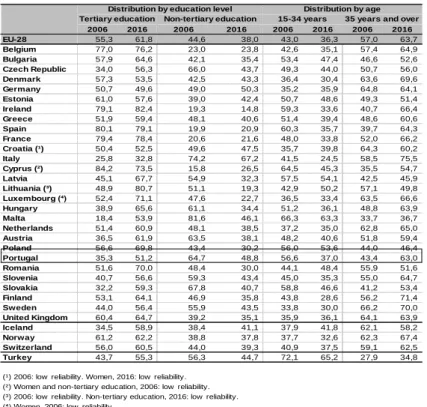
Figure I.13 - Evolution and distribution of ICT specialists by education and age levels, 2006 e 2016. ... 21
Figure I.14 - Companies expenditure on R&D in the ICT sector, 2015 - % of gross domestic product and total expenditure. ... 22
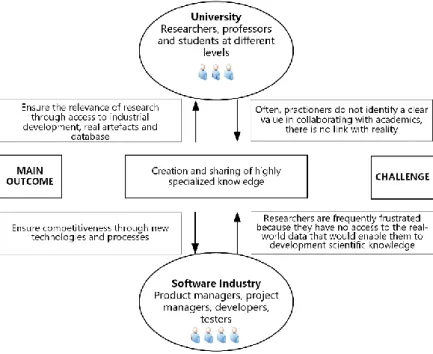
Figure I.15 - Main outcomes and challenges of the university-software industry relationship. ... 24
Figure I.16 - Different objectives, needs and competencies of the university and the software industry. ... 24
Figure I.17 - Data-information-knowledge hierarchy. ... 27
Figure I.18 - Knowledge management 'umbrella'. ... 29
Figure I.19 - The concept 'LEGO' of knowledge creation. ... 32
Figure I.20 - Approach strategy for codification and personalization of knowledge. ... 37
Figure I.21 - Research questions. ... 42
Figure I.22 - DSR cycles. ... 43
Figure I.23 - The research framework based on DSR. ... 45
Figure I.24 - Research development supported on Design Science Research. ... 45
Figure I.25 - Thesis structure. ... 52
Figure II.26 – Types of university-industry collaboration. ... 61
Figure II.27 - Motivations, channels of interaction, outcomes of UIC. ... 68
vii
Figure III.29 - Elements of culture. ... 79
Figure III.30 - Academic knowledge creation. ... 82
Figure IV.31 - Explicit and tacit knowledge. ... 100
Figure IV.32 – Knowledge management main pillars. ... 101
Figure IV.33 – Social system. ... 103
Figure IV.34 – Knowledge-crystallization. ... 105
Figure IV.35 – Knowledge spectrum and degree of tacitness. ... 109
Figure V.36 – Knowledge management pillars. ... 125
Figure V.37 – Social system. ... 127
Figure V.38 – Knowledge management technologies. ... 127
Figure V.39 – Technology-centric and People-centric approaches. ... 129
Figure V.40 – SLATES infrastructure – Based on McAfee (2006). ... 129
Figure V.41 – Tacit knowledge sharing in social media from Panahi et al. (2012). ... 130
Figure V.42 – Knowledge conversion circles enabled by social media – based on Nonaka et al. (2000) and adapted from Sigala and Chalkiti (2015)... 131
Figure VI.43 – Research model for interpreting the hypotheses. ... 150
Figure VI.44 – Results of multiple regression analysis. ... 156
Figure VII.45 – The research model. ... 167
Figure VII.46 – The results of structural model. ... 178
Figure VIII.47 – Boxplots of the variables related to the use of the means of communication within the UA. ... 196
Figure VIII.48 – Boxplots of the results concerning types of knowledge shared. ... 197
Figure VIII.49 – Boxplots of the results concerning types of organizations. ... 198
Figure VIII.50 – Boxplots of the results concerning ways of external collaborations. ... 200
Figure IX.51 – Representation of the snowball sampling technique used in the present study. ... 213
Figure IX.52 – Representation of the ‘tree code’ structure used in the webQDA software in the present study. ... 216
Figure IX.53 – Categories and subcategories that emerged from motivations that lead to the decision of establishing a collaboration relationship. ... 216
Figure IX.54 – Categories and subcategories that emerged from management mechanisms used in the governance of collaboration relationships. ... 220
Figure IX.55 – Categories and subcategories that emerged from the culture and principles of knowledge management and of knowledge sharing. ... 225
Figure X.56 - Framework of the university-software industry collaboration: state of the art and considerations about how to leverage this type of relationship. ... 247
viii
List of tables
Table I.1 - Motivations for universities and industry: a comparison. ... 6
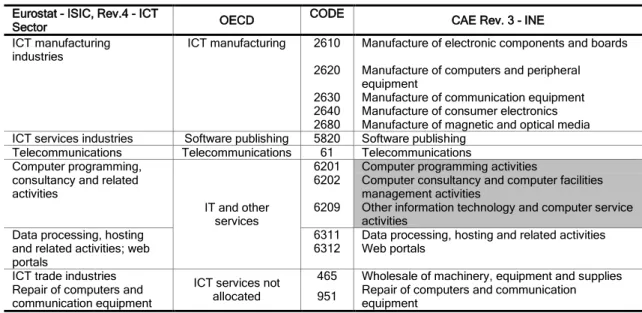
Table I.2 - Eurostat, OECD and INE classifications of ICT activities. ... 17
Table I.3 - Different types of knowledge identified in the literature. ... 28
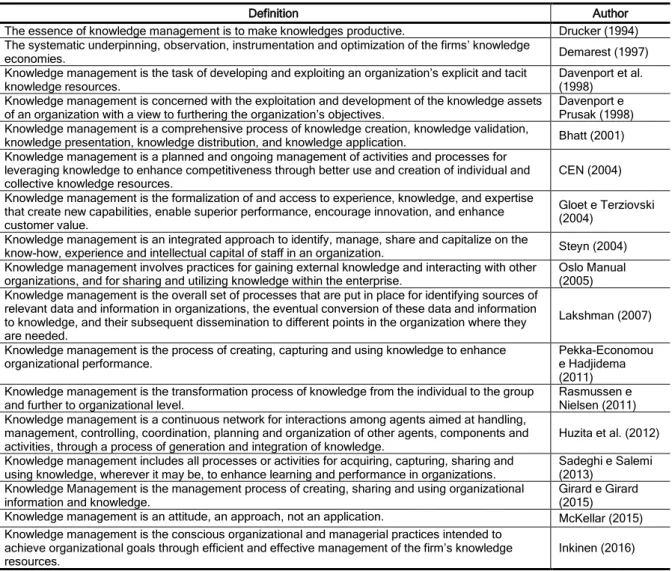
Table I.4 - Different definitions of knowledge management identified in the literature review. ... 30
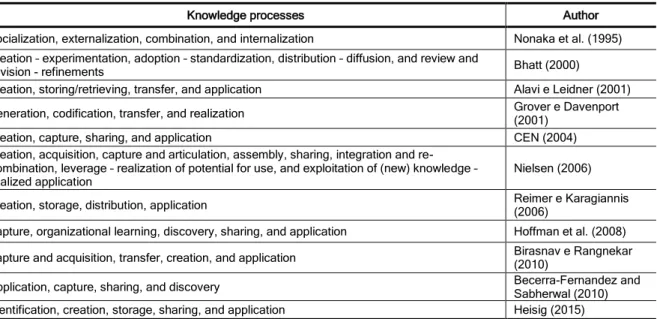
Table I.5 - Definitions of knowledge management processes according to several studies in the literature. ... 31
Table I.6 - Final structure of the applied questionnaire. ... 47
Table I.7. Scientific works integrated in the thesis. ... 52
Table II.8 - List of articles identified in the literature mentioning one or more drives. ... 62
Table II.9 - Channels of interaction and their actors across different studies. ... 65
Table II.10 - Threats and opportunities to university across different studies. ... 67
Table III.11 - The Academia’s missions. ... 80
Table III.12 - Benefits of implementation of knowledge management. ... 83
Table III.13 - Factors that act as barriers or obstacles and affect knowledge management culture. 85 Table III.14 - Academic characteristics and behaviors that affect knowledge management culture. 86 Table IV.15 - Barrier/facilitator. ... 106
Table IV.16 - The importance of knowledge sharing in SDO Situation. ... 107
Table IV.17 - Barriers on sharing tacit knowledge. ... 109
Table V.18 - Social media in knowledge management context. ... 132
Table V.19 - Main goals for the adoption of social media - adapted from Richter et al. (2011). ... 134
Table VI.20 - Factors affecting attitude toward knowledge sharing. ... 148
Table VI.21 - Items and descriptive statistics. ... 154
Table VI.22 - Correlation coefficients matrix. ... 155
Table VI.23 - Summary of regression analysis. ... 155
Table VII.24 - Hypotheses... 171
Table VII.25 - Demographic profile of respondents. ... 174
Table VII.26 - Measurement statistics of construct scales. ... 175
Table VII.27 - Discriminant validity of the constructs – HTMT results. ... 177
Table VII.28 - Weights of the first-order constructs on the second-order constructs. ... 178
Table VII.29 - Hypotheses testing. ... 179
Table VIII.30 - Descriptive statistics of the results concerning the use of the means of communication within the UA. ... 195
Table VIII.31 - Descriptive statistics of the results concerning types of knowledge shared within the UA. ... 197
ix
Table VIII.32 - Descriptive statistics of the results concerning types of organizations. ... 198
Table VIII.33 - Descriptive statistics of the results concerning ways of external collaborations. .... 199
Table IX.34 - Characterization of the respondents belonging to companies related to the software industry. ... 214
Table IX.35 - Characterization of the respondents belonging to the university sample. ... 215
Table IX.36 - Summary of results concerning the motivation category. ... 220
Table IX.37 - Summary of the management mechanisms category results. ... 223
Table IX.38 - Main results related with culture and the principles of knowledge sharing and knowledge management. ... 227
x
List of abbreviations
A3ES Agency for Assessment and Accreditation of Higher Education, acronym in Portuguese
ATKS Attitude Toward Knowledge Sharing AVE Average Variance Extracted
CAE Classification of Economic Activities, acronym in Portuguese CEO Chief Executive Officer
CR Composite Reliability
DGEEC Directorate-General for Statistics of Education and Science, acronym in Portuguese DGES Directorate-General for Higher Education, acronym in Portuguese
DSR Design Science Research EK Explicit Knowledge EM Extrinsic Motivation
EU European Union
EUROSTAT European Statistical Office FMEA Failure Mode and Effect Analysis HEI Higher Education Institution HTMT Heterotrait-Monotrait Ratio
ICT Information and Communication Technology IM Intrinsic Motivation
INE Statistics Portugal, acronym in Portuguese IS Information Systems
KI Knowledge Intensive
KM Knowledge Management
OECD Organisation for Economic Co-operation and Development PLS-SEM Partial Least Square-Structural Equation Modelling
R&D Research and Development
RU Research Unit
SDO Software Development Organization
SI Software Industry
SME Small and Medium Enterprise
SN Social Networks
TK Tacit Knowledge
TRA Theory of Reasoned Action UA University of Aveiro
UIC University-industry Collaboration
USIC University-software industry collaboration VIF Variance Inflation Factor
1
Chapter I - General Introduction
I.1 Introduction and motivation
I.2 State of the art and related work
I.3 Objectives and research methodology
I.4 Thesis structure
2
I.1 Introduction and motivation
The software industry plays a fundamental role in today’s modern society, because its products can be found in every field and in diverse sectors (Aurum, Daneshgar, & Ward, 2008). This fact contributes to the current extremely dynamic and somewhat complex environment that characterizes this type of industry (Huzita et al., 2012). This leads companies in the field to suffer the pressure for high performance solutions, rapid development and cost-efficient processes (Du Chatenier, Verstegen, Biemans, Mulder, & Omta, 2009; Dubé & Robey, 1999; Mead, Seshagiri, & Howar, 2016; Vasconcelos, Kimble, Carreteiro, & Rocha, 2017). On the other hand, considering the evolution and influence of the new organizational formats of software development, this type of industry seems to need a greater degree of maturity when it comes to software development processes and at a management level (Aurum et al., 2008; Colomo-Palacios, Casado-Lumbreras, Soto-Acosta, García-Peñalvo, & Tovar, 2014).
The software industry is characterized as being a “high technology, knowledge intensive, highly mutable industry – with weak entry-barriers and short innovation cycles – which demands continuous adaption, learning and access to knowledge” (Salavisa, Videira, & Santos, 2009, p. 1). However, most of the existing companies in this sector are small and medium-sized, operating in a resource scarce scenario, with limited access to finance, specialized personnel and knowledge networks; who are facing competition from large national and international companies (Lippoldt & Stryszowski, 2009; Richardson & Von Wangenheim, 2007; Savolainen & Ahonen, 2015). Many of these companies have been created in the last decades as start-ups or spin-offs from universities, and a significant portion of these still maintains this link (Bjerregaard, 2010; Salavisa et al., 2009; Segelod & Jordan, 2004). This industry is growing rapidly and the needed technologies and tools change frequently which makes the knowledge of these organizations more dynamic, requiring a high number of specialists having to update their skills and knowledge (Aurum et al., 2008; Bjørnson & Dingsøyr, 2008; Johanyak, 2016). In this sense, the collaboration relationship between university and software industry has increasingly assumed an important role in the development and technological innovation (Frølund, Murray, & Riedel, 2018). This happens through knowledge sharing, which represents a fundamental resource in the achievement of innovative solutions for both parties (Ankrah & AL-Tabbaa, 2015; Melese, Lin, Chang, & Cohen, 2009). According to Levy et al. (2009, p. 4), university-industry collaboration relationships “are especially relevant in the case of microelectronic, software and biotechnology, by contrast to the more mature industry of production technology”. In fact, the literature points out several strong advantages for this type of collaboration, including a positive impact on the competitiveness and productivity of the related organizations and, consequently, the surrounding society (Boyarchuk, Kharchenko, & Sklyar, 2018; Cohen, Nelson, & Walsh, 2002; Freitas, Geuna, & Rossi, 2013). From the industry’s point of view, its relationship with the university provides access to knowledge that provides solutions to particular problems. From the university’s point of view, the relationship in addition to contributing to a better
3 training of its students and offering employment opportunities provides access to the practical knowledge needed to validate basic research and to pursue applied research (Boyarchuk et al., 2018; Freitas et al., 2013).
Organizations belonging to the software industry, as well as higher education institutions designated in this work as universities are recognized as organizations based on intensive knowledge. Given the knowledge intensive nature of the two types of organizations, the collaboration strategy requires the integration of specialized knowledge dispersed between each of the members of the work teams, usually multidisciplinary. The highly specialized knowledge, both tacit and explicit, is created and shared in the different phases of the relationship (Boyarchuk et al., 2018; Salavisa et al., 2009). However, tacit knowledge becomes more important to the relations between these types of organizations (S. Ryan & O’Connor, 2013). Edmondson et al. (2012) add that the true value of a collaboration relationship is often associated with the tacit knowledge that is shared. This implies that possible solutions that aim at the sustainability and success of the relationship should be examined through knowledge management (Gill, 2002; Philbin, 2008).
In general, studies about this topic seek to identify and analyze motivational factors, barriers and results achieved in the relationship. However, despite their importance, the collaboration relationship between these two types of organizations is not always successful (Muscio, 2010; Wohlin et al., 2012). Therefore, understanding how a collaboration relationship can be conducted becomes important, since it is essential not only for the success of the relationship, but also to ensure its sustainability (Salimi & Rezaei, 2018).
Despite the relevance of the topic, the literature has highlighted the lack of empirical studies that adequately investigate the factors that can contribute to the sustainable promotion of the relationship. This is especially studies true for providing improvement recommendations for the management and the collaboration processes in order to promote a sustainable relationship between university and software industry (Feng, Zhang, Du, & Wang, 2015; Santoro & Bierly, 2006). In addition, most research about collaborations between university and software industry occur on an ad hoc or opportunistic basis, as “these collaboration activities are often based on personal relationships between in each individuals organizations” (Melese et al., 2009, p. 503). It is precisely this gap that is at the root of the motivation, leading to the development of this research project. It has the purpose identifying and analyzing a set of factors that can enhance and/or facilitate a collaboration relationship between the university and the software industry, in a sustainable way, based on knowledge management.
4
I.2 State of the art and related work
I.2.1 University-industry collaboration relationship
Since the end of the last century, factors such as globalization, increasing competition, and rapid technological advances have made the environments of organizations complex, impacting the life cycles of processes, products and services (Kauppila, Mursula, Harkonen, & Kujala, 2015; Mendes, Nunes, & Sequeira, 2012). Considering this scenario, the organizations are forced to search for new partners in order to respond to the new challenges.
The university-industry collaboration relationship represents a fundamental resource in promoting innovation (Lee, 2000) and technological development. This will have a positive impact on productivity and the competitiveness of organizations (Cohen et al., 2002; Freitas et al., 2013; Lee, 2000). This relationship is currently crucial for both industry and university and is an important indicator of the level of innovation of an economy. It has been the subject of analysis and studies in the EU, the USA and other developed countries (Boyarchuk et al., 2018; Melese et al., 2009). It has also been an incentive measure, integrating the policies of governments of industrialized countries (Schuetze, 2000). However, Gibson et al. (2016) and other authors note that, in general, the various studies on the collaboration relationship identify universities as the only providers of knowledge and technology. There is a gap in the university's role as the recipient of the knowledge created, in collaborative processes in the context of its interaction with external institutions (Bozeman & Boardman, 2013; Jongbloed, 2015; Kutvonen et al., 2013; Subramonian & Rasiah, 2016). According to Schuetze (2000), "there are other forms of knowledge and knowledge creation that involve the complex interactions between producers and users, theory and practice and academia and industry". Bozeman and Boardman (2013, p. 88) further emphasize that most empirical studies focus on collaborative research-based relationships and "seldom address outcomes related to education".
In this study, the term ‘university-industry collaboration relationship’ is defined as an activity that involves the interaction between teams composed of people from academia (teachers, researchers and students) and company professionals. The objective of this collaboration is to create and share knowledge and technology, with neither party being relegated to a simple case study (Daria & Kostiantyn, 2018; Schubert & Bjør-Andersen, 2012). This collaboration is expected to benefit the related members and teams (teachers, researchers, students and professionals), the organizations that establish the relationship and, consequently, the surrounding society (Boyarchuk et al., 2018). As suggested by Wholin (2013, p. 43), when universities enter into a collaboration relationship with the industry, they should not see it as just a place to study, but rather as a partner to do the study with.
5 In a general perspective, Lambert (2003) reports in his work called 'The Lambert review of business-university collaboration' that companies and universities are not natural partners due to differences in their cultures and missions.
Although both the university and industry recognize the potential of this collaboration relationship, it often poses a threat to both due to conflicting objectives and values. The university-industry collaboration relationship is complex; it can vary according to the scope, duration, geographical location and expected results and impacts (Schofield, 2013). Thus, the main challenge is to develop a better understanding of the organizational shape and needs of the other partner — which will result in a large number of opportunities for both (Sherwood, Robinson, & Butts, 2011; Wallin, Isaksson, Larsson, & Elfström, 2014; Wright, 2008). A successful collaboration relationship requires an appropriate balance between university and industry objectives and that each party can realize that their objectives have been met in terms of this collaboration (Barnes, Pashby, & Gibbons, 2002; Wohlin, 2013). In other words, according to Melese et al. (2009), collaboration relationships are important in situations where there are mutual benefits and the knowledge, resources and experience of those involved are complementary.
The collaboration relationships between the university and the industry, depends on the approach and, as such, may assume different typologies. In general, the relationship is associated with the level of involvement from organizations and the types of resources used. It may be associated with problem solving, technology development, idea testing or knowledge creation (Perkmann & Walsh, 2009). Each phase of the collaboration relationship may vary over time and require different types of intervention, sometimes occurring simultaneously or in some cases depending on the other (Bradley, Hayter, & Link, 2013; Nilsson, Rickne, & Bengtsson, 2010).
In this respect, it is possible to classify a university-industry collaboration relationship as:
(i) formal or informal (Hagedoorn, Link, & Vonortas, 2000; Nilsson et al., 2010; Polt, Rammer, Gassler, Schibany, & Schartinger, 2001);
(ii) short-term or long-term (Bruneel, D’Este, & Salter, 2010; Wallin et al., 2014);
(iii) low intensity or high intensity, being differentiated according to the intensity of contacts and activities demanded by the relationship;
(iv) institutional or personal (Freitas et al., 2013; Verheugen & Potocnik, 2005).
The scientific work presented in Chapter II discusses the different types of collaboration relationships in further detail.
I.2.1.1 The main drivers of university-industry collaboration relationship
In order to achieve a successful university-industry relationship, it is important to understand its three main drivers, i.e. the motivations for collaboration, the channels of interaction and the outcomes and benefits of the collaboration. The understanding of these drivers and their proper
6
articulation allows for the mitigation of barriers, overcoming of differences and creation of an environment of trust and commitment, consequently achieving the desired success in the collaboration (Kauppila et al., 2015). The scientific work presented in Chapter II describes in more detail the main drivers of the university-industry collaboration relationship.
Motivations
In a recent work of systematic review of the literature conducted by Ankrah e AL-Tabbaa (2015), the motivations for establishing a collaboration relationship (Table I.1), according to Oliver's six critical determinants (1990), are categorized as: (i) necessity; (ii) reciprocity; (iii) efficiency; (iv) stability; (v) legitimacy and; (vi) asymmetry. In Oliver’s opinion (1990, p. 242), the determinants explain the reasons why an organization decides to establish a collaborative relationship with another organization, and adds that “although each determinant is a separate and sufficient cause of relationship formation, these contingencies may interact or occur concurrently”.
Table I.1 - Motivations for universities and industry: a comparison. Source: Ankrah e AL-Tabbaa (2015, p. 392)
Determinants University Industry
Necessity • Responsiveness to government policy
• Strategic institutional policy • Responsiveness to government initiatives/policy • Strategic Institutional policy Reciprocity • Access complementary expertise,
state-of-the-art equipment and facilities
• Employment opportunities for university graduates.
• Access to students for summer internship or hiring
• Hiring of faculty members Efficiency • Access funding for research (Government
grant for research & Industrial funding for research assistance, lab equipment, etc.) • Business opportunity, e.g. exploitation of
research capabilities and results or deployment of IPR to obtain patents
• Personal financial gain for academics
• Commercialize university-based technologies for financial gain
• Benefit financially from serendipitous research results
• Cost savings (easier and cheaper than to obtain a license to exploit foreign technology) • National incentives for developing such
relations such as tax exemptions and grants • Enhance the technological capacity and
economic competitiveness of firms • Shortening product life cycle • Human capital development Stability • Shift in knowledge-based economy (growth in
new knowledge)
• Discover new knowledge/test application of theory
• Obtain better insights into curricula development
• Expose students and faculty to practical problems/applied technologies • Publication of papers
• Shift in knowledge-based economy (growth in new knowledge)
• Business growth
• Access new knowledge, cutting-edge technology, state-of-the art expertise/research facilities and complementary know-how • Multidisciplinary character of leading-edge
technologies
• Access to research networks or pre-cursor to other collaborations
• Solutions to specific problems
• Subcontract R&D (for example due to lack of in-house R&D)
• Risk reduction or sharing Legitimacy • Societal pressure
• Service to the industrial community/society • Promote innovation (through technology
exchange)
• Contribute to regional or national economy • Academics’ quest for recognition or achieve
eminence
• Enhancement of corporate image
7 Universities and industries seek, through the collaboration relationship, to have access to resources, skills and experiences, often limited in their organization, yet present in the organization with which it is intending to establish the relationship (Wallin et al., 2014; Wright, 2008). The characteristics of the university and industry, the experience in this type of relationship and the specific areas of interest, are factors that differentiate the motivation for the establishment of the relation. Considering that the motivation to establish a collaboration relationship is different between the university and the industry, understanding the real meaning of motivation in the different parts, becomes extremely important (Freitas & Verspagen, 2017). Guimón (2013) states that a successful university-industry collaboration relationship must support the missions and motivations of each partner.
Interaction channels
The collaboration relationship between the university and industry is usually established through certain channels of interaction; such as interface units or tangible media (Feng et al., 2015). The channels of interaction are the forms of communication existing between the university and the industry that allow for the establishment of a relationship of collaboration.
The various authors in the literature consider a variety of channels of interaction that can be established in the collaboration relationships; it may even involve more than one channel (Franco & Haase, 2015; Sherwood et al., 2011).
It is important to emphasize that universities have several ‘access doors’ through which their partners may try to develop a collaborative relationship. Cosh et al. (2006, p. 7) present in their work a taxonomy where they identify a wide variety of interactions and highlight the importance of what they call 'public space'. The 'public space' represents a set of activities where a range of formal and informal interactions can occur. These can contribute to define and conduct activities in terms of problem solving and, consequently, increase the explicit and tacit knowledge base (Figure I.1).
Outcomes and benefits of the university-industry collaboration relationship
The literature identifies an extensive list of possible outcomes and benefits achieved by both universities and industry. These include financial benefits, business expansion, knowledge sharing and experience, fulfillment of the mission of educating/training, improved organizational reputation, source of human resources, etc. (Ankrah & AL-Tabbaa, 2015; Mead et al., 1999). The main results provided by the collaboration relationship differ between their partners and are strongly associated with the initial motivation and the interaction channel used for this purpose (Arza, 2010). However, several studies report that the main benefit is generally based on the search for external competences and is associated with access to new knowledge and experiences. This is a critical factor in improving the innovative capacity of the organizations involved in this type of relationship (Wallin et al., 2014).
8
Figure I.1 - University-industry interactions. Source: Cosh et al. (2006, p. 8)
I.2.2 The university-software industry collaboration relationship
I.2.2.1 About the university
Firstly, it is important to note that the term ‘university’ used in this study refers to an academic community, made up of schools/departments/colleges, research units, research laboratories and interface units (e.g. technology transfer units, university-company relationship units).
Universities are complex and heterogeneous organizations (Bozeman & Boardman, 2013), fragmented into different knowledge domains, structured through communities (e.g. pedagogical, scientific, and institutional) with inviolable values of freedom and academic autonomy based on traditions and histories (Sporn, 1996; Tippins, 2003). The various communities assume their own culture within a symbolic context, making it difficult to establish a culture with a rational management process and strategic vision (Dill, 1982). Currently, the high level of specialization also contributes to the existence of subcultures within their own universities. Their integration into a single institutional culture is a great challenge that universities have been facing for years (Sporn, 1996). This specialization, according to Dill (1982, p. 312), may result “in declining involvement in institutional requirements and a lessening of social ties with disciplinary and institutional colleagues”. Encouraging a higher level of social interactions can be a facilitator in leading to the unification of the various subcultures of the different communities around a main culture (Bartell, 2003; Dill, 1982).
The structuring of the university based on different areas of knowledge also leads to the formation of several subcultures that overlap with the institutional culture (Howell & Annansingh, 2013). Subculture usually exert a strong influence on the behavior and how each member of the institution acts. On the other hand, Howell and Annansingh (2013) define subculture as a set of meanings
9 shared by members of a group, determining how they taught, develop researches and interact with others members of the institution; regardless of whether they are peers, employees or students.
Kerr suggests that, although the university is one of the sectors of society that can most be affected by political, economic, social and technological changes, unlike other sectors of society, the university has not yet been subjected to any great challenge and “the faculty members continue to operate largely as individual craftsmen” (Kerr, 1987, p. 184). However, Duderstadt (2001, p. 7) stresses that in the current context, we are faced with a “technology that has evolved so rapidly and relentlessly, increasing in power by a hundred-fold or more every decade, obliterating the constraints of space and time, and reshaping the way we communicate, think, and learn”.
It should also be noted that universities nowadays suffer from the impact of: (i) life cycles associated with technological innovations (Gill, 2002); (ii) economic and cultural globalization; (iii) the educational needs of an increasingly knowledge-driven society; and (iv) the training needs for high-performing professional activities (Bruckmann & Carvalho, 2014; Duderstadt, 2001). Solutions to these factors — which constitute major reasons for change in higher education institutions around the world — may be found in a collaboration relationship with the software industry.
I.2.2.1.1 Characterization of higher education in Portugal with facts and figures
The Law No. 62/2007, known as Regime Jurídico das Instituições de Ensino Superior (RJIES – legal framework of Portuguese higher education institutions), was responsible for the greater reform of the Portuguese higher education system. According this law, the Portuguese higher education system is organized into a binary system that integrates university education and polytechnic education. Public and private institutions offer three academic degrees (graduation, Masters and Doctorate) and a cycle of higher professional technical courses (DGEEC, 2018; DGES, 2018), Figure I.2.
Figure I.2 - Organization chart of the education and training system. Adapted from DGEEC (2018)
10
The system of institutions evolved from 1974 onwards with the massification and dispersion of the higher education institutions through the district capitals and in the autonomous regions of Portugal. However, this occurred without almost any effective regulation by the State (Fonseca & Encarnação, 2012). Regarding its distribution, public institutions have a dispersed pattern, covering the entire national territory, while private institutions are concentrated mainly in Lisbon and Porto, and in regions with larger population (Fonseca & Encarnação, 2012). In terms of institutional models, public institutions of higher education can choose between being a public institute or a foundation. Foundations are public institutions under private law, with “a greater autonomy in what concerns financial matters, multi-annual public funding on a contract basis, and greater flexibility for staff recruitment and management” (Bruckmann & Carvalho, 2014, p. 196).
An agency called Agência de Avaliação e Acreditação do Ensino Superior (A3ES acronym in Portuguese) was created in 2007, with the mission of assessing and accrediting higher education institutions and their study cycles. This agency also assesses and accredits the performance of the functions inherent in the insertion of Portugal into the European quality assurance system of higher education (Fonseca & Encarnação, 2012).
Currently, the Portuguese higher education system consists of 14 public universities, 2 military and police institutes, 27 public polytechnic institutes, 23 private universities and 58 private polytechnic institutes (DGES, 2018). Fonseca e Encarnação (2012) note that there are institutions, both public and private, that simultaneously offer university and polytechnic education in distinct organic units. The offer of study cycles is dynamic and with frequent changes (cancellations, name changes, etc.). In public institutions, the creation and definition of the number of vacancies of a cycle of studies is determined by the government and will depend on the level of employability of the cycle (Feijó & Tamen, 2017; Fonseca & Encarnação, 2012). In the 2017/2018 school year, the Portuguese higher education system totaled more than 5000 study cycle options, distributed between 2835 universities and 2240 in polytechnics (DGES, 2018). However, despite the geographic dispersion of the institutions and the number of existing study cycles, the OECD (2017b) identifies in its latest study that obtaining the third cycle of higher education in Portugal by the younger population (25-34 year old) “remains an important challenge”. Only about 35% of young people attained this level of education. It should be emphasized that the level of employment of Portuguese graduates is statistically high and the projectable financial benefit of a university education in Portugal is one of the most significant in Europe (Feijó & Tamen, 2017). Recently, the Ministry of Science Technology and Higher Education (2018) defined as one of its main objectives for Portugal to fully achieve European convergence by 2030, i.e. reach a ratio of 40% of graduates in higher education in the age group 30-34 year-olds by 2020 and 50% by 2030, with a 60% share of 20 year-olds in higher education by 2030.
After a period of great expansion, access to the higher education system has been declining since 2010, not only due to the effects of the negative evolution of demographic rates, but also to the
11 economic crisis that has been felt in Portugal in recent years. In Figure I.3, it is possible to observe that in the 2016/17 school year, 361943 students enrolled in higher education, 65% of which in universities and 35% in polytechnic institutes. Public education corresponded to 83.6% of the students enrolled and 16.4% corresponded to students enrolled in private education (Ministério da Ciência Tecnologia e Ensino Superior, 2018). Of the total number of students enrolled, 78.1% were enrolled in initial training courses (higher professional technical courses, graduation and integrated master), 15.4% in master's degrees, 5.5% in doctorates and 1.0% in specializations (DGEEC, 2018).
Figure I.3 - Evolution of the number of students enrolled in higher education in Portugal. Source: Ministério da Ciência Tecnologia e Ensino Superior (2018)
In Portugal, in the 2016/17 school year, the total number of professors in higher education was 33160, 77.5% of which in public institutions and 22.5% in private institutions. In total, 62.1% in university institutions, while in polytechnic institutions there were 37.9%. It should also be noted that, of the total number of professors in 2016/17, the female representation was 14682 teachers (44.3%) (DGEEC, 2018).
The distribution by career categories of 20578 university teaching staff was represented as follows: 7.4% as full professor, 13.4% as associate professor, 49.4% as assistant professor and 29.5% in other categories. In polytechnic institutions, 12582 professors were distributed as follows: 9.5% as coordinating professor, 49.9% as assistant professor, 36.2% as lecturer and 4.4% in other categories (Figure I.4).
12
Total Norte Centro A.M.
Lisboa Alentejo Algarve
33160 32539 10788 6878 12515 1401 957 281 340 Universitário 20578 20108 6403 3516 9056 572 561 244 226 Professor Catedrático 1519 1493 453 266 727 19 28 17 9 Professor Associado 2757 2733 976 420 1200 62 75 9 15 Professor Auxiliar 10235 9922 3287 1699 4252 427 257 161 152 Outras Categorias 6067 5960 1687 1131 2877 64 201 57 50 Politécnico 12582 12431 4385 3362 3459 829 396 37 114
Professor Coordenador Principal 44 42 18 5 16 3 - - 2
Professor Coordenador 1151 1138 355 328 339 85 31 9 4 Professor Adjunto 6273 6226 1883 1856 1755 488 244 16 31 Outras Categorias 5114 5025 2129 1173 1349 253 121 12 77 NUTS I e II Portugal Continente R.A. Açores R.A. Madeira Tipo de ensino e categoria Total
Figure I.4 - Distribution of teachers by region, type of teaching and category of teaching career, 2016/17. Source: DGEEC (2018)
Regarding academic qualifications, 19837 (59.8%) of teachers in higher education teaching in Portugal held the academic qualification of doctoral degree, 6884 (20.8%) for master’s degree, 6199 (18.7%) degree of graduation and 240 with other qualifications (Figure I.5). In university, most professors had doctorate qualification (70.9%), while in polytechnic only 41.6% (5240) had this qualification, and this number was slightly higher than that of professors qualified with a master’s degree, 4078 (DGEEC, 2018).
NUTS I e II Tipo de ensino e habilitação
Total Norte Centro A.M.
Lisboa Alentejo Algarve
Total 33160 32539 10788 6878 12515 1401 957 281 340 Doutoramento 19837 19428 6671 4115 7274 832 536 208 201 Mestrado 6884 6788 2287 1465 2506 345 185 39 57 Licenciatura 6199 6083 1732 1273 2635 217 226 34 82 Outras Habilitações 240 240 98 25 100 7 10 - -Universitário 20578 20108 6403 3516 9056 572 561 244 226 Doutoramento 14597 14223 4741 2540 6085 499 358 196 178 Mestrado 2806 2764 877 419 1366 30 72 22 20 Licenciatura 3052 2998 715 545 1568 40 130 26 28 Outras Habilitações 123 123 70 12 37 3 1 - -Politécnico 12582 12431 4385 3362 3459 829 396 37 114 Doutoramento 5240 5205 1930 1575 1189 333 178 12 23 Mestrado 4078 4024 1410 1046 1140 315 113 17 37 Licenciatura 3147 3085 1017 728 1067 177 96 8 54 Outras Habilitações 117 117 28 13 63 4 9 - -Portugal Continente R.A. Açores R.A. Madeira
Figure I.5 - Distribution of professors by region, type of education and academic qualification, 2016/17. Source: DGEEC (2018)
An important issue addressed by the Directorate-General for Statistics of Education and Science (DGEEC acronym in Portuguese) in a recent study, has to do with academic inbreeding in public university institutions in Portugal. The study reinforces the point that:
"The existence, in a higher education institution, of an excessive proportion of its professors in these conditions is traditionally seen as undesirable, because it may signal a less diverse academic community, more closed about itself, with less openness to external ideas and
with greater difficulty in integrating national and international research networks.” (DGEEC,
2017, p. 1)
Sarrico and Alves (2016, p. 159) highlight that, “there is a danger that academics will obtain their doctorates where they work for convenience, rather than because their research is significantly contributing to the body of knowledge in the area”. Feijó and Tamen (2017, p. 115) add, as another
13 effect of inbreeding, that many of the professor who have spent all their lives in the same institution, first as students and then as professors, remain students forever.
The main analysis of the DGEEC’s study (2017) relied on the doctoral professors who carried out their doctorate studies in the institution in which they currently teach and only professors belonging to the categories provided in the statutes of the teaching career; namely, the professors in the categories of full professor, associate and assistant professor (DGEEC, 2017, p. 1). The results for the 2015/16 school year suggest a very low teacher mobility. From a global point of view, about 70% of the professors completed their doctoral studies in the same institution in which they currently teach. Only 10% of the professors reported having received their doctoral degree in another Portuguese institution and 19% in foreign institutions (Figure I.6). Despite the effect of internationalization, by obtaining doctoral degrees in institutions outside of Portugal, most of them return to their previous institution suggesting an even more impactful inbreeding process (Sarrico & Alves, 2016). The study stresses that differences may still be more critical, since the global levels of academic inbreeding of institutions typically conceal large differences between their different faculties or organic units (DGEEC, 2017, p. 2).
Categoria profissional Nº de docentes de carreira doutorados
Na mesma IES
em que leciona Noutra IES portuguesa Numa IES estrangeira
Professor auxiliar 4909 73% 12% 15%
Professor associado 1574 68% 8% 24%
Professor catedrático 921 60% 8% 32%
Total 7404 70% 10% 19%
Instituição em que o docente se doutorou
Fo nte: Dado s repo rtado s pelas instituiçõ es de ensino superio r (IES) no inquérito REB IDES - Registro B io gráfico de Do centes do Ensino Superio r, 2015/16, DGEEC
Figure I.6 - Data by professional category of professor. Source: DGEEC (2017)
I.2.2.2 About the software industry
The history of software has evolved significantly in the last 30 years and its increasing relevance and criticality is well documented in several studies in the literature (Druffel, 2017). Looking back at the history of software, it can be divided into two important phases: a first phase where software was exclusively associated with technology. In the more recent second phase, emphasis has been put on applications and social changes brought about by software-based innovation processes, with increasingly significant changes in all societal contexts (Campbell-Kelly, 2007).
“Modern society is increasingly more dependent on software that offers quality and reliability” (Mead et al., 2016, p. 28), since these represent cross-cutting solutions for diverse products, services and processes that are part of everyday life in society. Currently, software represents a critical building element for the main types of systems (Druffel, 2017) and remains a fundamental resource for their connectivity and interoperability. This leads companies in this industry to rely heavily on the ability to discover opportunities and create innovative products, devices and solutions, so they can succeed in their marketplaces.