Corresponding author: G. Nolasco Fax: +35 1289818419
E-mail: [email protected]
RESEARCH PAPERS
Epidemiological situation of Citrus tristeza virus in mainland Portugal
Gonçalo SIlVa1,2 and GuStaVo nolaSCo11 Center for Mediterranean Bioresources and Food, Universidade do Algarve, Campus de Gambelas, 8005-139 Faro, Portugal 2 Current address: Natural Resources Institute, University of Greenwich, Medway Campus, ME4 4TB, UK
Summary. This study was conducted to update the occurrence and molecular variability of Citrus tristeza virus
(CTV) isolates recently obtained from surveys in different orchards in mainland Portugal. The asymmetric PCR-ELISA typing method based on the coat protein (CP) gene was used to characterize CTV isolates. Most isolates of the virus found in the Algarve region, where major citrus producing zones exist, belonged to the mild phylogenetic group (GpM). The prevalence of haplotypes from this group suggests that the aphid vector Toxoptera citricidus, which is present in the northern region of the country associated to diverse severe strains, has not yet reached the Algarve. Although most of the isolates harbour haplotypes from group M, haplotypes from the remaining phylo-genetic groups were also identified and characterized.
Key words: citrus, typing, CTV diversity.
Introduction
Portugal has a long tradition in the cultivation of citrus trees that are grown all over the country, cov-ering an area of 26,200 ha. The Southern region of Portugal, the Algarve, has the most dynamic and in-tensive citriculture and accounts for about 70% of the national production. In the remaining areas, citrus crops are in small scattered orchards or as backyard trees (Nolasco, 2009).
Citrus may be affected by several plant patho-genic bacteria, fungi and viruses that limit produc-tion, and in some cases these pathogens can ravage citrus orchards. Citrus tristeza virus (CTV), a member of the genus Closterovirus (family Closteroviridae), is the causal agent of serious diseases of citrus, and is widespread in almost all citrus areas of the world (Moreno et al., 2008).
Several CTV isolates have been described differ-ing in their biological characteristics, particularly in symptoms caused in various citrus hosts (Roistacher
and Moreno, 1991). Strains responsible for rapid de-cline of trees grafted in sour orange, or stem pitting of the branches of sweet orange or grapefruit, are usual-ly designated as severe, while those that do not cause symptoms are referred to as mild strains. CTV is phlo-em-limited and is transmitted through infected buds and in a semi-persistent manner by several aphid spe-cies, mainly Aphis gossypii and Toxoptera citricidus.
The first detection of CTV infection in Portugal oc-curred in 1988, owing to the importation of certified citrus plants from Spain. Furthermore, the continu-ous illegal introduction of budwood led to the dis-semination of CTV throughout the country (Nolasco, 2009). In 2004, T. citricidus was identified for the first time in the northwestern regions of Portugal and Spain (Ilharco et al., 2005). In a subsequent study, No-lasco et al. (2008) identified T. citricidus aphids feeding on field trees harbouring severe CTV strains, posing an epidemiological threat to Portugal and to all citrus producing countries of the Mediterranean basin.
Knowledge of the strains present in a certain re-gion is fundamental to the design of an adequate strategy and for the selective eradication of severe strains in regions in which CTV has become endem-ic. Several serological and molecular methods have
been developed for characterization of CTV isolates (Niblett et al., 2000; Hilf et al., 2005). Nolasco et al., (2009) developed an asymmetric PCR-ELISA typing method based on the recognition of seven phyloge-netic groups of the virus (Gp1, Gp2, Gp3a, Gp3b, Gp4, Gp5 and GpM), obtained from phylogenetic analysis of CTV haplotypes from different parts of the world. The biological characteristics of mono-phyletic isolates belonging to these groups have been recently studied (Hancevic et al., 2012).
The present study was conducted to molecularly characterize CTV isolates recently obtained from surveys in different orchards in mainland Portugal in order to evaluate the current epidemiological situ-ation in this country.
Materials and methods
Sample collection
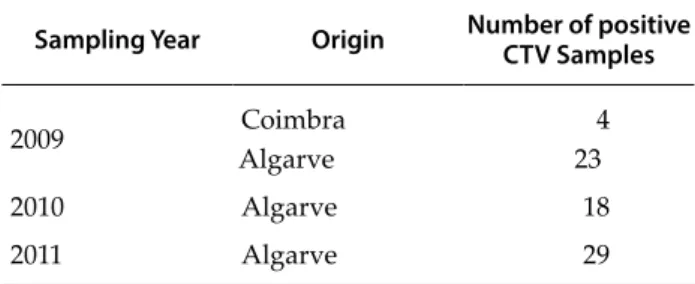
Between 2009 and 2011, several scattered or-chards in the Algarve and Coimbra regions of Por-tugal were surveyed by the services of agriculture for the presence of CTV. Samples were analyzed by ELISA according to standard methods. A total of 74 positive samples (Table 1) were selected for further molecular characterization.
IC/RT-PCR, cloning and sequencing of the CP gene
The coat protein (CP) gene of CTV was amplified by immunocapture-reverse transcription-polymer-ase chain reaction (IC/RT-PCR) according to Nolasco et al. (1993) using tubes coated with anti-CTV poly-clonal antibody SP7 and primers CTV1 and CTV10 as described by Sequeira and Nolasco (2002). This process amplified the sequence of the whole CP gene.
When necessary, the amplified CP gene was TA-cloned into a pTZ57R/T vector (InsTAcloneTM PCR Cloning Kit, Fermentas, Vilnius, Lithuania) accord-ing to the manufacturer’s instructions, and this was used to transform competent Inv αF’ E. coli cells. PCR screening of colonies was carried out on the CP gene with primers CTV1 and CTV10. The PCR prod-ucts that produced a single band of the expected size (672 bp) were characterized further by single-strand-ed conformation polymorphism (SSCP). Haplotypes that produced different SSCP patterns were selected, and the CP gene inserts were sequenced by CCMAR (UAlg, Portugal).
Sequence analysis
Chromatograms were analyzed and the sequenc-es were assembled using the Geneious software (Drummond et al., 2011). CP gene sequences from reference isolates retrieved from GenBank (T36 - NC001661, Qaha - AY340974, NUagA - AB046398, SY568- AF001623, T318A - DQ151548, VT - U56902, T30 - AF260651 and T385 - Y18420) and from hap-lotypes characterized in previous studies were in-cluded and used for comparison. For all sequences, the first and final 21 nt (primer regions) were re-moved and the sequences were aligned. Recombina-tion events amongst sequences were analyzed using RDP3 software (Martin et al., 2010). Phylogenetic analysis was carried out with Mega 5 (Tamura et al., 2011) using the Kimura-2 parameter model for esti-mating the evolutionary distances. Reconstruction of the phylogenetic tree was achieved using the neigh-bour-joining method.
Asymmetric PCR-ELISA typing (APET) assay
PCR products obtained by IC/RT-PCR were typed by APET assay (Nolasco et al., 2009). First, 1 µL of DNA preparation was labeled with digoxigen-in by asymmetric PCR reaction with primers CTV43 (forward) and CTV42 (reverse) which anneal, respec-tively, to positions 59 and 454 of the CP gene. Ampli-fication reactions were carried out in final volumes of 50 µL containing the template, 10 mM Tris-HCl (pH 8.8), 50 mM KCl, 0.08% Nonidet P40, 2.5 mM MgCl2, 80 µM of each of dATP, dGTP, dCTP, 76 µM dTTP, 2 µM of digoxigenin-11-dUTP (Roche Applied Science), 200 nM of primer CTV43, 20 nM of primer CTV42 and 1U of Taq DNA polymerase (Fermentas).
Table 1. Origin and sampling year of positive CTV samples
studied.
Sampling Year Origin Number of positive CTV Samples
2009 AlgarveCoimbra 234
2010 Algarve 18
After an initial step of 2 min at 94ºC, thermocycling consisted of 50 cycles of 92ºC for 30 s, 52ºC for 30 s, and 72ºC for 45 s followed by a final extension period of 5 min at 72ºC.
The following steps of the APET procedure were carried out as described by Nolasco et al. (2009). Brief-ly, the single stranded molecules obtained from the asymmetric PCR reaction were hybridised to a set of strain discriminating probes immobilized in the wells of an ELISA plate. The hybridised products were quantified through an ELISA assay using commercial alkaline-phospahatase conjugated anti-Dig antibod-ies. Analysis of the results was carried out in two steps using a software specially developed (Nolasco et al., 2009) which allowed estimation of the composition of the samples in terms of the seven phylogenetic groups.
Results
Characterization of CTV isolates
The 74 CTV positive samples collected between 2009 and 2011 from different orchards were select-ed for molecular characterization. Analysis of these CTV-positive citrus samples using IC/RT-PCR with primers CTV1 and CTV10 produced a fragment of 672 bp in length, representing the CP gene (results not shown). The 74 CTV isolates were then analyzed by APET. The majority of CTV isolates tested were monophyletic isolates belonging to group M (Table 2). There were, however, exceptions. Two isolates collected in Algarve in 2010 were haplotypes from group 2 and group 3b, respectively, and one isolate
collected in the Coimbra region in 2009 was a haplo-type from group 3a.
Furthermore, two isolates collected in Algarve in 2009 and 2011, namely isolates ALG09 and ALG11, be-sides having strong reactions with probe from group M also reacted to a lesser degree with probe from group 4 (Table 2). From an epidemiological point of view, existence of haplotypes from group 4 in an or-chard in which only haplotypes from group M were present was unusual. In consequence, further research was carried on these apparently atypical isolates.
Study of atypical cases
To verify the results obtained by APET with iso-lates ALG09 and ALG11, the amplified products of the IC/RT-PCR reaction were cloned and haplotypes from each isolate were analyzed by SSCP (Figure 1).
In both cases the SSCP patterns of the diverse clones were very similar. The haplotype 9 from each isolate generated a slightly different pattern (Figure 1). These haplotypes were therefore chosen for se-quencing as well as haplotype 5 from isolate ALG09. The sequences were aligned with additional CP gene sequences available from GenBank and from previous studies, and analyzed for the existence of recombination events using RDP3 software (Martin et al., 2010). Recombinations were not found. A phy-logenetic tree based on the matrix of pairwise dis-tances was constructed (Figure 2). All the CP gene sequences from isolates ALG11 and ALG09 clustered in group M along with the reference mild isolate T30. This is in agreement with the strong reaction with probe from group M in the APET assay.
To understand why these isolates also produced positive signals for Gp4, the nucleotide sequence was checked at the probe’s annealing position. Hap-lotype’ sequences belonging to group M usually have two mismatches with the Gp4 probe (probe originating the highest signal with haplotypes from Gp4), which is evidence for good discrimination be-tween haplotypes from groups GpM and Gp4, as de-scribed by Nolasco et al. (2009). Figure 3 shows that the sequence of isolate T30 (reference isolate from group M) has two mismatches with the Gp4 probe while the sequence of haplotype ALG09-5 only has one. The same result was observed for haplotypes ALG09-9 and ALG11-9. The disappearance of this mismatch originates from a higher melting tempera-ture of the hybrids formed between probe Gp4 and
Table 2. APET results for CTV isolates obtained in the
pe-riod 2009-2011. Number of CTV isolates Region Phylogenetic groups 1 2 3a 3b 4 5 M
69 Coimbra and Algarve - - - +
1 Coimbra +
-1 Algarve +
-1 Algarve +
-2a Algarve - - - - + - +
these haplotypes, leading to an atypically stronger signal for Gp4. From a biological point of view the existence of these point mutations are unlikely to have any direct effect, as the corresponding amino-acids are not changed.
Distribution of CTV haplotypes in mainland Portugal
To obtain a better picture of the distribution of CTV in Portugal, the data obtained in the present
study work was compared with previous data ob-tained by APET or sequencing. Data from 2004 came from a previous collaboration with the services of ag-riculture and from CTV isolates obtained in orchards in Algarve. Data from 2005 refers to the northwest-ern Portugal, and was obtained from regions where Toxoptera citricidus is present (Nolasco et al., 2008).
As can be seen from Figure 4, most of the infected plots in the Algarve region harboured haplotypes of GpM. This prevalence was stable over the period
Figure 1. SSCP patterns obtained from the cloned CP gene of isolates ALG11 and ALG09.
ALG09-5 ALG11-9 ALG09-9 T30 T385 201(25) Gp M Gp 2 440 Q3 T36 Qaha Gp 1 Gp 4 206 Gp 3b VT Nuaga T318A SY568 Gp 3a Gp 5 199 98 100 92 99 100 90 0.01
Figure 2. Phylogenetic tree of the CP gene sequences from CTV isolates ALG09 and ALG11. The tree was constructed from
the matrix of pairwise distances (Kimura 2 parameters) by the neighbour-joining method. Numbers close to the nodes represent the bootstrap values obtained from 1,000 replications.
considered. A small number of isolates harbouring haplotypes from Gp3b, Gp3a and Gp2 were also found in 2004 and 2011. In the northern and central regions of Portugal greater variability was found, with the detection of haplotypes from Gp1, Gp3a, Gp4, Gp5 and GpM.
Discussion
This study completes a previous characterization of the CTV situation in Portugal which gathered in-formation up to 2005 (Nolasco, 2009). Except for iso-lated cases found in backyard trees or small orchards in the north and central part of the country, CTV is present in the major citrus producing zones (Al-garve), as strains belonging to GpM. In most cases these isolates were monophyletic, a condition which
suggests that the development of rapid decline or stem pitting of sweet orange will not take place (Hancevic et al., 2012), while there is no shift in the strains present. Prevalence of group M in the Algarve region appears to be stable as this group was also the most common found in previous years. Some of the CTV positive citrus trees that were analyzed had previously been reported as negative, indicating that natural transmission of the virus through aphids is taking place.
Toxoptera citricidus, which is present in northern Portugal associated with diverse severe strains of CTV, has not yet been reported in Algarve. The prev-alence of GpM strains reinforces the conviction that this vector has not yet reached the region, and that the virus is vectored through other vectors that occur (Aphis citricola, Aphis spiraecola and Aphis gossypii).
Several authors have demonstrated the absence of relationships between geography and the strains of CTV present in a region (Papayiannis et al., 2007; Rubio et al., 2001; Tennant et al., 2010). The same is the case in Portugal, where all the seven phylogenetic groups of CTV have been found. However, in terms of prevalence this might not be the case. Djelouah et al. (2009) indicated greater prevalence of haplotypes from groups 3b and M in the Mediterranean region. In Middle Eastern countries Gp3b haplotypes pre-dominate, indicating that these countries may be the source for dissemination of these strains throughout the region. On the other hand, reports from Portu-gal (Nolasco, 2009) and Morocco (Lbida et al., 2004) suggest that GpM haplotypes introduced in those countries had Spanish origins. The prevalence of GpM strains in Algarve also reinforces this notion, as propagation budwood has been illegally introduced into the region from Spain at specific times.
Initial efforts to completely eradicate CTV ap-pear to have failed. Once aphid transmission is al-ready taking place and the number of infected trees is increasing, elimination of infected trees becomes unfeasible. Although the epidemiological situation
Figure 3. Annealing region of probe from group 4 in the sequences of isolates T30 (reference isolate from group M) and
haplotype ALG09-5. Squares over the sequences indicate probe/haplotype mismatches.
Figure 4. Outline map of Portugal showing the distribution
appears stable, frequent surveys for CTV and T. cit-ricidus should be conducted, accompanied by strain typing assays, so that shifts in this situation are rap-idly identified. The APET assay is a a simple and suitable tool for these assays.
Acknowledgements
This work was funded by the grant PTDC/AGR-GPL/99512/2008 from Foundation for Science and Technology (FCT), Portugal. Gonçalo Silva was sup-ported by the FCT grant SFRH/BD/37310/2007.
Literature cited
Djelouah K., S. Cerni, F. Fonseca, C. Santos, G. Silva, D. Yahi-aoui, A.M. D’Onghia and G. Nolasco, 2009. Diversity of the coat protein gene of Citrus tristeza virus (CTV) in the Mediterranean region. In: Citrus Tristeza Virus and
Toxop-tera citricidus: a serious threat to the Mediterranean citrus industry. (D’Onghia A.M., Djelouah K., Roistacher C.N.,
ed.). CIHEAM, 2009, Bari, Italy, p. 159-163. Options
Mé-diterranéennes: Série B. Etudes et Recherches n. 65). http://
om.ciheam.org/om/pdf/b65/00801409.pdf
Drummond A.J., B. Ashton, S. Buxton, M. Cheung, A. Coo-per, C. Duran, F. M., J. Heled, M. Kearse, S. Markowitz, R. Moir, S. Stones-Havas, S. Sturrock, T. Thierer and A. Wilson, 2011. Geneious v5.4. Available from http://www. geneious.com/.
Hancevic K., S. Cerni, G. Nolasco, T. Radic, K. Djelouah and D. Skoric, 2012. Biological characterization of Citrus triste-za virus monophyletic isolates with respect to p25 gene.
Physiological and Molecular Plant Pathology http://dx.doi.
org/10.1016/j.pmpp.2012.10.005.
Hilf M.E., V.A. Mavrodieva and S.M. Garnsey, 2005. Genetic marker analysis of a global collection of isolates of Citrus tristeza virus: Characterization and distribution of CTV genotypes and association with symptoms. Phytopathology 95, 909–917.
Ilharco F.A., C.R. Sousa-Silva and A.A. Alvarez, 2005. First re-port on Toxoptera citricidus (Kirkaldy) in Spain and Con-tinental Portugal. Agronomia Lusitana 51, 19–21.
Lbida B., F. Fonseca, C. Santos, M. Zemzami, A. Bennani and G. Nolasco, 2004. Genomic variability of Citrus tristeza vi-rus (CTV) isolates introduced into Morocco.
Phytopatholo-gia Mediterranea 43, 205–210.
Martin D.P., P. Lemey, M. Lott, V. Moulton, D. Posada and P. Le-feuvre, 2010. RDP3: a flexible and fast computer program for analyzing recombination. Bioinformatics 26, 2462–2463.
Moreno P., S. Ambros, M.R. Albiach-Marti, J. Guerri and L. Pena, 2008. Plant diseases that changed the world - Citrus tristeza virus : a pathogen that changed the course of the citrus industry. Molecular Plant Pathology 9, 251–268. Niblett C.L., H. Genc, B. Cevik, S. Halbert, L. Brown, G.
Nolas-co, B. Bonacalza, K.L. Manjunath, V.J. Febres, H.R. Pappu and R.F. Lee, 2000. Progress on strain differentiation of Cit-rus tristeza viCit-rus and its application to the epidemiology of citrus tristeza disease. Virus Research 71, 97–106. Nolasco G., 2009. Historical review of Citrus tristeza virus in
Portugal. Options Méditerranéennes B/65 CIHEAM
Publica-tions. Citrus Tristeza Virus and Toxoptera citricidus: a serious threat to the Mediterranean citrus industry.
Nolasco G., C. Deblas, V. Torres and F. Ponz, 1993. A Method Combining Immunocapture and Pcr Amplification in a Microtiter Plate for the Detection of Plant-Viruses and Subviral Pathogens. Journal of Virological Methods 45, 201–218.
Nolasco G., F. Fonseca and G. Silva, 2008. Occurrence of ge-netic bottlenecks during citrus tristeza virus acquisition by Toxoptera citricida under field conditions. Archives of
Virology 153, 259–271.
Nolasco G., C. Santos, G. Silva and F. Fonseca, 2009. Devel-opment of an asymmetric PCR-ELISA typing method for citrus tristeza virus based on the coat protein gene. Journal
of Virological Methods 155, 97–108.
Papayiannis L.C., C. Santos, A. Kyriakou, T. Kapari and G. Nolasco, 2007. Molecular characterization of Citrus triste-za virus isolates from Cyprus on the basis of the coat pro-tein gene. Journal of Plant Pathology 89, 291–295.
Roistacher C.N. and P. Moreno, 1991. The worldwide threat from destructive isolates of citrus tristeza virus. A review.
Proceedings of the 11th Conference of the International Organi-zation of Citrus Virologists. Riverside, CA, USA, 7–19.
Rubio L., M.A. Ayllon, P. Kong, A. Fernandez, M. Polek, J. Guerri, P. Moreno and B.W. Falk, 2001. Genetic variation of Citrus tristeza virus isolates from California and Spain: Evidence for mixed infections and recombination. Journal
of Virology 75, 8054–8062.
Sequeira Z. and G. Nolasco, 2002. Bacterial expressed coat protein: development of a single antiserum for routine detection of Citrus tristeza virus. Phytopathologia
Mediter-ranea 41, 55–62.
Tamura K., D. Peterson, N. Peterson, G. Stecher, M. Nei and S. Kumar, 2011. MEGA5: Molecular Evolutionary Genetics Analysis using Maximum Likelihood, Evolutionary Dis-tance, and Maximum Parsimony Methods. Molecular
Biol-ogy and Evolution 28, 2731–2739.
Tennant P.F., L.C. Fisher and W.A. Mclaughlin, 2010. Detection and characterization of Citrus tristeza virus stem pitting isolates in Jamaica. European Journal of Plant Pathology 127, 1–6.