Physical-Chemical, Microbiological And Sensory Properties Of Fructooligosaccharides Enriched Yogurt
Dalila Rayane de Lima Pádua*¹, Valéria Ribeiro Maitan² & Márcio Ramatiz Lima Santos³ ¹ Universidade Federal de Goiás – [email protected]*
² Pontifical Catholic University of Goiás ³ Instituto Federal Goiano - Campus Ceres
Resumo
The functional foods present many health benefits besides their nutritional values pertinent to their chemical composition. They can play an important role on reducing the risk of chronic-degenerative diseases, like cancer, diabetes and others. The prebiotics are non-digestive fibers by the human body, but they increase the intestinal bacterial flora. Among these prebiotics are the fructooligosaccharides. This research aims to evaluate the physical-chemical, microbiological and sensory properties of fructooligosaccharides enriched yogurt. Sensory analysis was performed with 50 non-trained panelists using a structured nine point hedonic scale for acceptance and buying intention. Microbiological (thermo-tolerant coliforms and salmonella sp/25g) and physical-chemical analyses (pH, titratable acidity expressed as, lactic acid concentration, and soluble solids as °Brix) were carried out in triplicate. All results were submitted to ANOVA and Tukey Test at 5 % of significance to verify the interaction between the averages. The acceptance was 7.9 indicating that product is according to "Liked very much" parameter. The purchase intention response showed 34% of panelists declaring that they would buy the yogurt if they could. The microbiological analysis were negative for thermo-tolerant coliforms and salmonella sp./25g. Physical-chemical results were according to other similar products with average of pH 4.45, titratable acidity 0.82 g lactic acid/100 mL, and 22º Brix. Physical-chemical, microbiological and sensory analysis are in accordance to the Brazilian legislation.
Abstract
Alimentos funcionais apresentam muitos benefícios à saúde além dos seus valores nutricionais inerentes à sua composição química. Eles podem desempenhar um papel importante na redução do risco de doenças crônico-degenerativas como o câncer, diabetes e outras. Os prebióticos são fibras não digestíveis pelo corpo humano, que aumentam a flora bacteriana intestinal. Entre estes prebióticos estão os frutooligassacarídeos (FOS). Este trabalho teve como objetivo avaliar as propriedades físico-químicas, microbiológicas e sensoriais de iogurte enriquecido com FOS. Análises sensoriais foram realizadas com 50 provadores não treinados usando uma escala hedônica estruturada de nove pontos para verificar a aceitação e a intenção de compra. Análises microbiológicas (coliformes termo-tolerantes e Samonela sp/25g) e físico-químicas (pH, acidez total titulável expressa como % de ácido láctico e sólidos solúveis totais expressos em ºBrix) foram realizadas em triplicata. Os resultados foram submetidos a ANOVA e ao teste de Tukey ao nível de 5% de significância para verificar a interação entre as médias. A aceitação global foi de 7,9, indicando que o produto estava de acordo com o parâmetro “Gostei muitíssimo”. A resposta para a intenção de compra mostrou que 34% dos provadores declararam que eles comprariam o iogurte se eles pudessem. As análises microbiológicas para coliformes termo-tolerantes e salmonela sp/25 g foram negativas. Os resultados das análises físico-químicas estavam de acordo com outros produtos similares, com média de pH de 4,4, acidez total titulável de 0,82 g de ácido lático/100 mL e 22° Brix e em acordo com o preconizado pela legislação brasileira.
Info Recebido: 15/05/2018 Publicado: 14/11/2018 DOI: 10.29247/2358-260X.2018v5i3.p97-103 ISSN: 2358-260X Palavras-Chave
alimento funcional; escala hedônica; controle de qualidade (QC); iogurte. Keywords:
functional food; hedonic scale; quality control (QC); yogurt.
INTRODUCTION
Recently there has been a rapid increase in the interest from consumers about the health benefits of specific food or on physiologically active components of some food, the so called functional food (PANG et al., 2012). According to the definition, the functional food are able to provide health benefits, reducing the risk for chronic diseases plus the benefits provided by adequate nutrition (AL-SHERAJI et al., 2013).
These foods should also be beyond basic nutrition. For a human being as assessed, his health properties should be scientific evidence. For example, foods that are low in fats and sugars or fiber incorporated, among
others, are foods.The prebiotics are among the
functional foods that are defined as the non-digestible carbohydrates that stimulated the growth of the prebiotic bacteria in the intestine (KÜSTER-BOLUDA; VIDAL-CAPILLA, 2013; NOLE et al., 2014).
They include mainly the oligosaccharides, polysaccharides, hydrolyzed protein, short-chain fatty acids, plants and herb extract. Until now, it was found that most of the prebiotics
are carbohydrates (WANG et al., 2015). Among
the class of polysaccharides,
fructooligosaccharides (FOS) are natural fructose polymers that are generally found linked to an initial, unconventional glucose molecule not metabolized by the human organism (UNOKI et al., 2013).
The insoluble fibers act as solid ingestible, with effect in the colonic transit. The fecal
volume increases by the fiber consumed and by the retention and absorption of water (DE ANGELIS, 2005).
The acceptable daily dose for
fructooligosaccharides (FOS) is established as 40 grams. There is no evidence of toxicity or gastrointestinal disorder associated to the consumption of inulin (ROMANO, 2012). Its ingestion can be associated to flatulence; that becomes more evident in individuals that are lactose intolerant. The gravity of these symptoms is associated to the dosage of FOS consumed, that is, the less FOS consumed, the less symptoms. The ingestion of 20-30 grams a day usually triggers the begin of a severe discomfort upon the individual, it´s ideal to follow the recommended dosage of about 10 grams a day per person (PASSOS e PARK, 2003).
Since the dairy industry has a fundamental role in the functional food market, the consumption of such food has had a considerable growth, the reason been the demand for healthier diets. For example, there are many types of yogurt in order to supply the extensive market demand. These products may vary depending on ingredients, composition, flavor, consistency, texture, caloric value, elaboration process and the nature of the post incubation process (MATHIAS et al., 2013).
In view of the importance of functional food consumption, the objective of this work was to develop a formulation of yoghurt
evaluate the physico-chemical, microbiological and sensorial properties.
MATERIAL AND METHODS
For the formulation of the beverage UHT
milk was used (Piracanjuba), sugar (Cristal ),
thermophilic lyophilized lactic culture from mixed strains having Streptococcus salivarius subsp. thermophilus e Lactococcus delbrueckii subesp.
Bulgaricus (Fermentech), prebiotic
fructooligosaccharides ORAFTI Beneo P 95 (supplied by Beneo Orafti company).
Physical-chemical analysis of milk
Total titratable acidity (TTA) was determined by titration with 0.1 N NaOH, expressed as lactic acid g / 1000 ml. Density at 15 ° C was determined with the aid of a thermololume and the results expressed in g / ml. The pH was measured using potentiometer (pH Meter Model HI-9224, Steinhem, Germany). Evaluated in three replicates (CASTANHEIRA, 2010).
Elaboration of yogurt
The production of yogurt with fructooligosaccharides was according to Rensis and Souza (2008) with modifications. The sugar and FOS were increased by a ratio of 6% each, before the heat treatment at 90 ° C / 5.min. After that, it was a cooled (Consul CHB53CB) to 45ºC and then a lactic culture was added (inoculation of 2%), followed by a fermentation resting period in an incubator (CE-300/120,CIENLAB)• at 45ºC for 6 hours; after
this period of time, it was cooled to 4ºC and after that the gel was homogenized with the aid of a spoon and stored at 4ºC.
After the yoghurt was manufactured, the product was kept cold at 4 ° C in properly sterilized glass vials of 500ml capacity and kept in cooling incubator type B.O.D. (MODEL SL-200/120, BRAND SOLAB, Brazil).
Physical-chemical and microbiological analyzes of yogurt
In order to evaluate the microbiological quality of the yogurt, analysis required by
resolution
RDC n°12 (Brazil,2001) for milk-based products were carried out. Regarding the count of thermotolerant coliforms, the result being expressed in NMP. And research of Salmonella sp. Evaluated in triplicate (CASTANHEIRA, 2010).
Total titratable acidity (TTA) was determined by titration with 0.1 N NaOH, expressed as lactic acid g / 0.1 L. The pH was measured using potentiometer (pH Meter Model HI-9224, Steinhem, Germany). And soluble solids measured with the aid of a refractometer analog (RHB32). The analytical procedures were carried in three replicates out according to the norms of the Adolfo Lutz Institute (2008) and to Castanheira, (2010).
Sensory analysis was performed
according to the methodology proposed by Minim (2006). It was held at the Pontificia Universidade Católica de Goiás, 50 tasters
among students, teachers and staff evaluated
global acceptance and purchase intent. Using a
nine points hedonic scale with two questions (What did you like the most? What did you dislike?). The results were submitted to variance analysis and to a Tukey test at 5% significance to verify the correlation between averages
The SPSS 8.0 statistical package for windows was used to calculate the average, the standard deviations and the statistical differences by the Tukey test at 5% significance.
DISCUSSION AND RESULTS
Analytical results for the UHT milk (with 3% fat) were as follows: a titer of 1.8 mL of 0.1 M NaOH solution, which can be expressed as 0.16 g lactic acid/100 mL; a density of 1.029 g/mL and a pH value of 6.8.
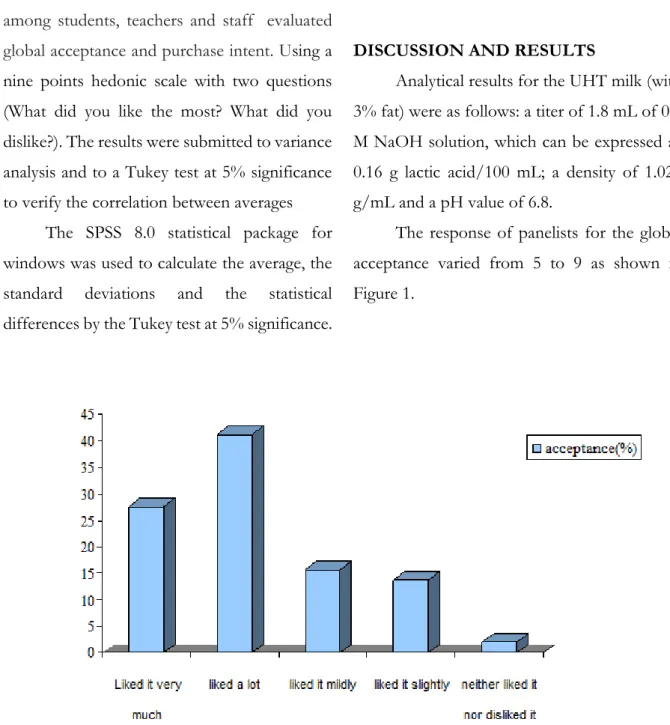
The response of panelists for the global acceptance varied from 5 to 9 as shown in Figure 1.
Figure 1 – Response frequency related to the overall acceptance (%) of yogurt with added
fructoseoligosaccharides hedonic scale.
The yogurt with added
fructooligosaccharides obtained an average acceptance score of 7.9, fitting in the product approval scale 8 (liked it a lot) among the panelists.
Texture could be improved according to 4% of the people who tasted it and said that that yogurt could be more consistent.
Bortozolo and Quadros (2007) have done a sensory evaluation of yogurt with added inulin and sucralose, obtaining an average of 8.2 which is between 8 (liked it a lot) and 9 (liked very much) on the hedonic scale.
The product had an acceptance rate of 98.1%, which shows that the product was well accepted. A product is considered sensorial
accepted when its rating is equal or superior to 70% (MAESTRI et al., 2014).
Beninca et al. (2014) performed acceptance tests and found rates of 97.1% and 93.3% for panelists favoring prebiotic yogurt produced with added pasteurized Physalis pulp and from concentrated pulp, respectively. According to Figure 2, in the response for intention 34% of the panelists said they would buy whenever possible.
Alves et al. (2009) manufactured a frozen yogurt from goat’s milk with probiotic and prebiotic culture added and carried out a “purchase intention survey”, finding that 61% of evaluators said they would buy the product against 39% who said they would not and attributed the latter to the strong taste of goat milk to which they are not used to.
Figure 2 - Score distribution of panelists for the response criteria “Purchase Intention” for yogurt
with added fructooligosaccharides.
The salmonella result was negative in the plaques of BS (Bismuth Sulphite) and BPLS
(Brilliant-green Phenol-red Lactose Sucrose
Agar).
ANVISA in its resolution nº 12 (BRAZIL, 2001), determines that the count for thermo-tolerant coliforms in commercial yogurt must not be superior to 10 NMP/mL (Number Most Probable per mL). As for the
microbiological analysis, the presence of thermo-tolerant coliform (at 45 ºC) was negative at day zero and day six (Table 1). Therefore, the results are in conformity to the Brazilian current legislation (BRAZIL, 2001). Such results are satisfactory, since they meet the minimum quality requirements for human consumption.
Table 1: Microbiological for Coliform thermotolerant and Samonella results of yogurt with added fructooligosaccharides. Coliforms thermotolerant (UFC/mL) Salmonella spp 1 day < 3.0 Absent 6 day < 3.0 Absent
After six days of yoghurt production the lactic acid content increased from 0.80 to 0.83 g of lactic acid /0.1L, thus justifying the pH value found on the sixth day 4.2 and soluble solids of 21 ° Brix ( Table 2). According to the literature it is possible to reduce pH and increase acidity,
due to the conversion of lactose to lactic acid by the fermentation of the lactic acid bacteria present in the yogurt. (BISCAIA, STADLER and PILATTI, 2004).
Table 2: Physical-chemical analyses results of yogurt with added fructooligosaccharides.
The cooling step during yogurt manufacture does not eliminate but only slows down their development and of their spores (MAZETO and MANEIRA, 2011). The increase in acidity indicates that there was lactose fermentation, as observed in table 2. That can also be observed regarding the pH, showing a decrease from 4.7 in the first production day to 4.2 in the sixth day after production. Nonetheless they are in conformity to the yogurt identity and quality standards (BRAZIL, 2000), which establishes the limit of 0.6 g to 1.5g of lactic acid/100g of product.
Cruz et al. (2012) measured the pH of a probiotic yogurt between 1 and 15 days under
cooling storage, recording a variation from 4.29 to 4.27.
The results obtained in the
determination of the soluble solids (o BRIX) are
within the average of values reported for existing yogurt in the market which varied between 13.26 and 23.6 °Brix (Cavalcanti et al. 2008).
CONCLUSION
The sensorial, microbiological and physical-chemical properties of FOS enriched yogurt were according to the standards established by the current Brazilian legislation and presented market potential and high Period
Titratable acidity (g de
lactic acid /0.1L) pH º Brix
1 day 0.80 4.7 23
purchase intention. This product can be a new functional food alternative due its fiber content.
REFERENCES
ALSHERAJI, S.H; ISMAIL, A; MANAP, M.Y; MUSTAFA, S; YUSOF, R.M; HASSAN, F.A. Prebiotics as
functional foods: A review. Journal of
Functional Foods, v. 5 (2013) 1542 – 1553.
ANVISA 2008, Food allegedly to have
functional or health 01properties, new
food/ingredients, substances
bioactive and probiotic available at
URL:
<http://www.anvisa.gov.br/alimentos/ comissoes/tecno_lista_alega.htm
BENINCA, C; MARTINS, C; SOUZA,
A.A.D.F; BECHEL, B.V;
ANTOCHESKI, E. Physical-chemical
characterization and sensorial
analyses of prebiotic yogurt with Physalis pulp sp(1) . 4th Innovation
extension and research seminar of
IFSC.2014..Available at:
http://eventoscientificos.ifsc.edu.br/ index.php/sepei/sepei2014/paper/dow nload/1036/691
BORTOLOZO, E.Q.; QUADROS, M.H.R.
Xucralose ilulina application in yogurt. Brazilian magazine of agro
industrial technology. l.V.01,N.01.2007 .
Available at:
https://periodicos.utfpr.edu.br/ rbta/article/viewFile/247/217
BRAZIL. Department of Health. Health surveillance bureau. Resolution - RDC nº 12, January 2 2001. Microbiotics on
food standard technical regulation,
available at: <
http://www.anvisa.gov.br/legis/resol/1 2_01rdc.htm>
CASTANHEIRA, A.C.G. Basic manual for
quality control of Milk and dairy – Comented..Cap-Lab. São Paulo. 2010.
BISCAIA, I. M. F.; STADLER, C. C.; PILATTI, L. A. Avaliação das alterações físico-químicas em iogurte adicionado de culturas probióticas. In: SIMPÓSIO DE ENGENHARIA DE PRODUÇÃO, v. 11, 2004.