A user collaboration model for urban passenger transport
by
António Júlio Albuquerque Diogo Nunes
Thesis submitted to the Faculty of Engineering, University of Porto for the Doctoral Program in Transport Systems
Supervisors
Maria Teresa Galvão Dias
João Bernardo de Sena Esteves Falcão e Cunha
This thesis was supported by Fundação para a Ciência e Tecnologia (FCT) through the MIT Portugal Program under grant SFRH/BD/52356/2013. The research was initially supported by TICE – OneStopTransport project 13843 and TICE – MOBIPAG project 13847, with funding provided by the COMPETE QREN Programme, managed by AdI in the context of European Union FEDER.
Abstract
This thesis is concerned with the development and evaluation of a model of collaboration between users of an urban passenger transport system. This model explores an opportunity created by the widespread adoption of advanced personal mobile devices with ubiquitous access to wireless communication networks, to harness information that is distributed throughout urban passenger transport systems. Its ultimate goal is to facilitate collaboration between users of those systems, using personal mobile devices and sensor-based data to ease their journeys.
This thesis firstly evaluates the potential of user collaboration on the improvement of resource utilisation, and enhancement of experience associated with more sustainable travel alternatives. This thesis subsequently defines the conceptual foundations of the user collaboration model, which hinges upon the creation of dynamic social networks, and requires the active participation of users as providers, consumers, and validators of spatiotemporally structured information. This thesis then describes the development and evaluation of two tools for the user collaboration model. The first relates to a methodology for estimating the destination of passenger journeys from Automated Fare Collection (AFC) data to produce an Origin-Destination (O-D) dataset; it applies to entry-only AFC systems with distance-based fare structures. The second tool relates to a novel concept of Temporary User-Centred Networks (TUNs) for passenger transport, which link users based on circumstantial collaboration potential. Lastly, this thesis describes the design and evaluation of a prototype service
Journata based on the user collaboration model.
Three main contributions are made by this thesis. The first is the intersection of theory topics to introduce a service science perspective to transport. The second is arguably the most significant, and consists of the user collaboration model more generally, and specifically of the tools to implement it. The third consists of the design and evaluation of the prototype service Journata as an instance of the user collaboration model.
Resumo
A presente tese descreve o desenvolvimento e a avaliação de um modelo de colaboração para utilizadores de sistemas de transportes urbanos de passageiros. O modelo tira partido da crescente utilização de dispositivos móveis pessoais sofisticados, com acesso às redes de comunicação sem fios, para recolher informação distribuída em sistemas de transportes urbanos de passageiros. O objectivo é facilitar a colaboração entre os utilizadores e auxiliar as suas viagens, através do uso dos dispositivos móveis pessoais e de dados provenientes de sensores.
A presente tese avalia inicialmente o potencial da colaboração entre utilizadores na maximização de recursos, e na melhoria da experiência associada a alternativas de mobilidade mais sustentável. Esta tese posteriormente define os fundamentos teóricos do modelo de colaboração, centrados na criação de redes sociais dinâmicas, e na participação ativa dos utilizadores na criação, consumo, e validação de informação espácio-temporal. Esta tese descreve ainda o desenvolvimento e avaliação de duas ferramentas para o modelo de colaboração. A primeira destas trata-se de uma metodologia que estima o destino de viagens registadas num sistema de bilhética de transporte público, gerando um conjunto de dados origem-destino; esta aplica-se a sistemas de bilhética que combinam tarifários com base em distância e leitura de bilhetes apenas na origem. A segunda ferramenta trata-se de um novo conceito de redes temporárias centradas no utilizador, que estabelecem ligações entre utilizadores com base numa medida de potencial de colaboração circunstancial. Por último, esta tese descreve o desenho e avaliação de um protótipo de um serviço designado
Journata que materializa o modelo de colaboração.
A presente tese faz três contribuições para o estado-da-arte. A primeira é a aplicação da ciência dos serviços ao domínio dos transportes. A segunda, que será talvez a mais significativa, trata-se da criação do modelo de colaboração e das ferramentas que o permitem implementar. A terceira centra-se no desenho e avaliação do protótipo
Acknowledgements
It has been a long, winding journey. I wish to thank the kind and talented people who have challenged and supported me, without whom the journey would have got nowhere. Fate had it that a common interest in urban passenger transport would lead me towards my supervisors Prof. Teresa Galvão and Prof. João Falcão e Cunha. I thank Prof. Teresa Galvão for the guidance and encouragement throughout the way, and time and patience for reading my ideas over and over again. I thank Prof. João Falcão e Cunha for the trust and support, and for having a solution for nearly every problem I found as a PhD candidate. I thank Prof. Chris Zegras for welcoming me to his research group during my visit to the MIT – Massachusetts Institute of Technology, and for challenging my models and assumptions. I thank Prof. Jorge Pinho de Sousa for the trust and enthusiasm in my research, and for encouraging me to join the Doctoral Program in Transport Systems. I thank Prof. José Luís Borges for sharing an interest in knowledge extraction, which turned out to steer my research focus.
The present research was enriched by working in collaboration with three Masters students in Informatics and Computing Engineering. I thank Tiago Gonçalves, Luís Dias, and Marco Amador for their interest in my research proposals. I learned a lot advising their studies, and really enjoyed their company in the research group. The shared office space has been a fun and intellectually stimulating environment. I thank my research project colleagues Marta Ferreira, André Cunha, Pedro Costa, Tânia Fontes, and Vera Costa, for the companionship, support, and fruitful contributions to my research. I also thank other talented researchers whom I shared the office with, for their willingness to share knowledge, with a special mention to Carlos Gomes, Fabrício Sperandio, Miguel Oliveira, and Eduardo Pinto. I thank Inês Frade, my fellow doctoral student and expat buddy at the MIT, for the friendship and advice. And I thank all participants in various experiments for supporting the development of Journata.
I thank STCP and TIP for kindy providing the valuable data used in this research. I thank the people at INEGI for making me feel welcome at their offices, for the day-to-day admin support, and for the financial contribution towards my tuition fees. I also thank other organisations for the involvement of their staff advising on this research, namely OPT, AMTP, and Metro do Porto.
I am deeply grateful to my parents, sisters, niece, and nephews, for their emotional support throughout the way, and for patiently listening to my concerns. I wish I keep making you proud, so that it is all worth it in the end. I thank my parents-in-law for helping Marta and I, often sacrificing their own plans to let us enjoy our scarce spare times. Last but not least, I owe my deepest gratitude to my small but warm household. To Pixel for constantly reminding me there is a life to be lived outdoors, in any weather. And to my dearest wife Marta, who, eleven years, two thesis, and three international relocations later, still is by my side everyday. I love you!
Publications and presentations
The following articles, abstracts, and posters were created in the course of the research described in this thesis.
Articles in scientific journals, first author
Nunes, António A., Teresa Galvão Dias, Chris Zegras, and João Falcão e Cunha. 2016. “Temporary User-Centred Networks for Transport Systems.”
Transportation Research Part C: Emerging Technologies 62: 55-69. doi:10.1016/j.trc.2015.11.006.
Nunes, António A., Teresa Galvão Dias, and João Falcão e Cunha. 2016. “Passenger Journey Destination Estimation from Automated Fare Collection System Data Using Spatial Validation.” IEEE Transactions on Intelligent Transportation Systems 17 (1): 133-42. doi:10.1109/TITS.2015.2464335.
Articles in international conference proceedings, first author
Nunes, António A., Teresa Galvão, and João Falcão e Cunha. 2014. “Urban Public Transport Service Co-Creation: Leveraging Passenger’s Knowledge to Enhance Travel Experience.” Procedia - Social and Behavioral Sciences 111: 577–85. doi:10.1016/j.sbspro.2014.01.091.
Nunes, António A., Teresa Galvão, João Falcão e Cunha, and Jeremy V. Pitt. 2011. “Using Social Networks for Exchanging Valuable Real Time Public Transport Information among Travellers.” In IEEE Conference on Commerce and Enterprise
Articles presented at international conferences, first author
Nunes, António A., Tiago Gonçalves, and Teresa Galvão. 2013. “A Prototype for Public Transport Service Co-Creation Using Social Media: Results from Usability Testing.” In International Conference on Exploring Service Science 1.3.
Nunes, António A., Teresa Galvão, and João Falcão e Cunha. 2012. “Public Transport Service Co-Creation: A Social Media Based Framework.” In The Art
& Science of Service Meeting.
Abstracts and posters presented at national conferences, first author
Nunes, António A. 2015. “Linking public transport passengers in real-time.” In
IEMS ’15 | 6th Industrial Engineering and Management Symposium.
Nunes, António A. 2014. “Reimagining the social network for urban public transport.” In IEMS ’14 | 5th Industrial Engineering and Management Symposium. Winner of best poster award.
Nunes, António A. 2013. “The use of pervasive mobile computing based services to improve urban public transport experience.” In IEMS ’13 | 4th Industrial
Engineering and Management Symposium.
Articles in international conference proceedings, co-author
Costa, Pedro Maurício, Tânia Fontes, António A. Nunes, Marta C. Ferreira, Vera Costa, Teresa Galvão Dias, José Luís Borges, João Falcão e Cunha. 2016 (accepted for presentation). “Application of collaborative information exchange in urban public transport: the Seamless Mobility solution”. In Proceedings of 6th
Transport Research Arena.
Costa, Pedro Maurício, Tânia Fontes, António A. Nunes, Marta C. Ferreira, Vera Costa, Teresa Galvão Dias, José Borges, João Falcão e Cunha. 2015. “Seamless Mobility: a disruptive solution for public urban transport”. In 22nd ITS World
Table of contents
1. Introduction ... 1
1.1. Motivation ... 1
1.2. Problem and objectives ... 5
1.3. Methodological overview ... 8 1.4. Contributions ... 10 1.5. Thesis structure ... 11 2. Literature review ... 13 2.1. Customer experience ... 13 Experience quality ... 15 Travel experience ... 16 User experience ... 24 2.2. Value co-creation ... 24
The notion of value ... 26
Who are the co-creators? ... 27
Co-creation in the public sector ... 29
Co-creation in passenger transport ... 31
2.3. ICT-based user collaboration ... 33
Crowdsourcing spatiotemporal data ... 35
Crowdsourcing in passenger transport ... 36
Passenger information requirements ... 39
Evaluation of user collaboration potential ... 42
2.4. Travel pattern extraction and estimation ... 43
Mobile phone network data ... 45
Traffic sensor data ... 46
Public transport AFC system data ... 47
2.5. Journey path analysis ... 51
Similarity metrics ... 51
Clustering methods ... 53
Relevance in information retrieval ... 55
2.6. Review summary ... 55
3. Foundations of the collaboration model ... 59
3.1. Leveraging collective intelligence ... 59
3.2. Information value ... 62
Information value for travellers ... 63
Information value for transport providers ... 65
3.3. User participation ... 67
3.4. Reimagining the social network ... 69
3.5. Validation and incentive mechanisms ... 70
3.6. Model summary ... 72
4. Passenger journey destination estimation ... 75
4.1. Methodology scope ... 76
4.2. Dataset description ... 77
4.3. Data preparation ... 81
4.4. Destination estimation methodology ... 83
4.5. Algorithm structure and implementation ... 89
4.6. Discussion of results ... 93
4.7. Multi-modal upgrade ... 97
4.8. Chapter conclusions ... 98
5. Temporary User-Centred Networks (TUNs) ... 101
5.1. Concept ... 102
5.2. Mathematical formulation ... 104
Journey similarity (SIM) ... 105
Journey substitutability (SUB) ... 107
Relevance ... 111
5.3. TUNs algorithm structure ... 113
Sourcing data ... 114
Calculating SIM ... 116
Calculating SUB ... 118
Compiling relevance ... 120
5.5. Implementation ... 125
5.6. Discussion of results ... 126
5.7. Indexing method ... 133
5.8. Chapter conclusions ... 135
6. Case study: Journata ... 137
6.1. Non-functional prototype: the concept ... 138
6.2. Functional prototype, first iteration ... 141
Implementation ... 144
Evaluation ... 145
Results ... 149
6.3. Functional prototype, second iteration ... 152
Evaluation ... 156
Results ... 157
6.4. Journata in Seamless Mobility ... 158
6.5. Chapter conclusions ... 160
7. Conclusions ... 163
7.1. Findings and contributions ... 163
7.2. Future research directions ... 167
List of figures
Figure 1.1 Research map ... 7
Figure 1.2 Methodology ... 8
Figure 2.1 Literature review map ... 56
Figure 3.1 Public transport user entries, bus and light-rail, 15 minute interval, Porto ... 61
Figure 3.2 Fundamentals of the user collaboration model ... 73
Figure 4.1 Geographic spread of boarding transactions in the subset of data and structure of travel zones ... 80
Figure 4.2 Application of key assumptions exemplified ... 85
Figure 4.3 Methodology flowchart ... 90
Figure 4.4 Daily average journey transactions throughout the day ... 91
Figure 4.5 Single daily journeys with multiple stages (three stage example) ... 92
Figure 5.1 Journey similarity (SIM) and journey substitutability (SUB) ... 106
Figure 5.2 Journey with SIM and SUB scores ... 108
Figure 5.3 Journey paths with maximum SUB at shorter substitute portion ... 109
Figure 5.4 SUB according to distance between location points within SPODs for various levels of substitution potential ... 111
Figure 5.5 Flowchart of main activities ... 113
Figure 5.6 Time chart ... 114
Figure 5.7 Flowchart of activity ‘sourcing data’ ... 115
Figure 5.8 Flowchart of activity ‘calculating SIM’ ... 117
Figure 5.9 Flowchart of activity ‘calculating SUB’ ... 119
Figure 5.10 Flowchart of activity ‘compiling relevance’ ... 120
Figure 5.11 Similar portion within substitute portion ... 121
Figure 5.12 Journey stage transaction records throughout the day ... 122
Figure 5.13 Time chart of ongoing journeys ... 123
Figure 5.14 Ongoing journeys at 11:00 ... 124
Figure 5.15 Aggregate results at 11:00 ... 127
Figure 5.17 Journey paths of selected passengers and highly relevant peers at 11:00
... 130
Figure 5.18 Journeys hourly across simulation period ... 134
Figure 5.19 New distinct journeys hourly across simulation period ... 134
Figure 6.1 Journata prototype iteration evolution ... 137
Figure 6.2 Journata logo in alternative shade combinations ... 137
Figure 6.3 Non-functional prototype interface screen mock-ups ... 139
Figure 6.4 Interface screen mock-ups created in Photoshop ... 140
Figure 6.5 First iteration functional prototype interface screens ... 143
Figure 6.6 Architecture of the Journata prototype ... 145
Figure 6.7 Experiment environment ... 147
Figure 6.8 Post-task questionnaire results ... 149
Figure 6.9 Post-test questionnaire results ... 151
Figure 6.10 Mock-up samples of preliminary interface designs ... 153
Figure 6.11 Second iteration functional prototype interface screens ... 155
Figure 6.12 Post-task questionnaire results ... 157
Figure 6.13 Social component interface screens of One Ride ... 160
List of tables
Table 2.1 Summary of travel experience factors in the literature ... 22
Table 2.2 Overview of passenger information requirements identified in the literature ... 41
Table 4.1 Data summary ... 79
Table 4.2 Network summary (dataset used) ... 81
Table 4.3 Irregular transaction records after pre-processing ... 82
Table 4.4 Results of the methodology applied to the Andante dataset ... 95
Table 4.5 Sensitivity analysis of the cut-off Euclidean distance parameter ... 96
Table 5.1 Data subset summary ... 125
Table 5.2 Relevant peers to selected passenger ... 128
Table 5.3 Analysis of TUNs across time intervals at various relevance threshold levels ... 132
Table 6.1 Participant characteristics ... 146
Table 6.2 Post-task questionnaire ... 148
Table 6.3 Post-test questionnaire-based interview ... 148
List of acronyms
AFC Automated Fare Collection APC Automatic Passenger Count AVI Automatic Vehicle Identification AVL Automatic Vehicle Location C2C Customer-to-Customer
DRT Demand Responsive Transport
EC Experience Component
EF Experience Factor
ETC Electronic Toll Collection
FEUP Faculty of Engineering, University of Porto HCI Human-Computer Interaction
ICE In-Car Entertainment
ICT Information and Communication Technology ITS Intelligent Transport System
JPRI Journey Pair Relevance Index O-D Origin-Destination
POI Point of Interest
PTAL Public Transport Accessibility Level
RAM Random Access Memory
RFID Radio-Frequency Identification SIM Journey similarity
SPOD Shared Potential Origins or Destination
STCP Sociedade de Transportes Colectivos do Porto, SA SUB Journey substitutability
TfL Transport for London
TUNs Temporary User-Centred Networks
UX User Experience
1. Introduction
This thesis is concerned with the development and evaluation of a model of collaboration between users of an urban passenger transport system. The thesis sets out the theoretical framing, conceptual foundations, and tools for the model, and describes the evolution of a case study that emerged from it. The model explores an unprecedented opportunity created by the widespread adoption of advanced personal mobile devices with ubiquitous access to wireless communication networks, to harness information that is distributed throughout urban passenger transport systems. Its ultimate goal is to improve utilisation of available resources to enhance travel experience and to promote sustainable urban transport. This chapter describes the motivation for the research, its objectives and methodological approach, and how it contributes to the state-of-the-art.
1.1. Motivation
The motivation for this research consists of two aspects, a need and an opportunity. The need is high in the political agenda, and relates to the reduction of adverse environmental and social impacts of urban passenger transport. The opportunity came in recent years with advances in Information and Communication Technologies (ICT), particularly with the evolution of personal mobile devices and their rampant popularity, combined with the proliferation of wireless networks. Starting from the need, and in order to fully grasp its complexity, one may reflect on the historical role of transport in the shaping of contemporary cities and as an enabler of modern urban lifestyle. The city has been described metaphorically throughout history as a human body. This dates at least as far back as Classical Greece in the writing of Plato who argued that cities exhibit the same virtues of human souls (Plato and Bloom 1991). The analogy has been perpetuated in the vocabulary that is commonly used to describe urban form. The understanding of the city as a human body has allowed the mapping of centre as its heart and of transport routes as arteries expanding outwards from it (Shibatani and Thompson 1999).
Figuratively speaking, transport is the blood of the city; literally speaking, it keeps the city alive.
Yet this romanticised vision has been challenged in most cities around the world. Technological advances in transport have granted the general public in developed countries the freedom to travel faster and across greater distances. However, the utopian gift of personal mobility was largely awarded at the expense of the environment and society as a whole (Low 2003, 1). Increasing reliance on private cars and fossil fuels for personal travel resulted in ‘auto sprawl syndrome’, which consists of two main spiralling symptoms, suburbanisation and private car dependency (SceneSusTech 1998, 100).
The first of these symptoms is widespread car ownership since World War II, initially and foremost in North America but also to a great extent in Western Europe. It acted as a catalyst for the suburbanisation of cities and consequently to the weakening of their hearts (Lucy and Phillips 1997, 260; Batty, Besussi, and Chin 2003, 9; Antrop 2004, 13; Glaeser and Kahn 2004, 2483; Richardson and Bae 2004, 1). As for the second symptom, suburbanisation led to greater travel distances and to a sustained increase in car use, since disperse forms of sprawling urbanisation reduce the viability of public forms of transport (Jansen 1993, 9). Rising car use in turn overwhelms road network capacity producing traffic congestion and heightening the environmental impact of personal travel. Meanwhile, this problem also became a reality in developing countries such as China and Brazil where car ownership levels began rising dramatically and are forecast to grow steadily (Han and Hayashi 2008; Motta, Silva, and Brasil 2012).
The adverse social impacts of car dominance have been exposed from a social geography perspective of inclusion (Boschmann and Kwan 2008), and from the urban planning and design perspectives of city liveability (Gehl 2010). The social inclusion aspect relates to the provision of transport that support equitable access to employment, leisure, and services, preventing isolation of lower income groups. The city liveability aspect applies to the preservation of cities as places for walking and cycling that encourage street activity and democratic use of public space, whilst safely
catering for travel demand. Today, many city dwellers travel on a daily basis for a variety of purposes, and rely on the transport systems that are available to them. Urban populations keep growing globally, and so will their travel needs and the strain on urban sprawl. In the year 2007 the global urban population equalled the global rural population, and is expected to become two-thirds of the world population by the year 2050 (United Nations 2014).
Provided that transport keeps cities alive, restraining mobility cannot be seen as an option if urban vitality is to be reinforced or even to remain unchanged. Hence it is widely acknowledged that urban mobility patterns must be readapted to meet increasing needs and desires to travel albeit in a more sustainable way (European Commission 2011). This raises the quintessential question on the meaning of sustainable transport. Several definitions exist, but one that attempted to harmonise them captures most successfully how sustainable transport is understood here:
A sustainable transport system is one that provides transport and mobility with renewable fuels while minimizing emissions detrimental to the local and global environment, and preventing needless fatalities, injuries, and congestion. (Black
2010, 10, emphasis in the original)
The definition is entirely aligned with the identified need for mitigating the socially and environmentally adverse impacts of transport, as long as it is understood that the social inclusion aspect is implicit in the notion of providing transport and mobility. One way to decrease those impacts is to encourage a shift from private to public modes of transport for personal travel. Public transport has potential to reduce emissions and congestion, to lessen the probability of traffic related injuries, to provide equitable accessibility for being affordable, and to release public space taken up by traffic and parking towards social activities and ‘softer’ modes of transport (Litman 2015, 2). Car use may also become more sustainable with the adoption of lower emission vehicles using renewable fuels (Granovskii, Dincer, and Rosen 2006; Faria et al. 2012), and with the introduction of new technologies designed to improve safety (e.g. Kusano and Gabler 2012). However, cars will hardly mitigate social inclusion issues, and their scope for reducing congestion and releasing public space is
constrained. Achievable improvements among these topics may largely relate to the increase of average vehicular occupancy, to the growth of car sharing and ride sharing schemes, and to the reduction of travel time via routing intelligence.
The promotion of sustainable urban transport is already happening in many different ways, and the most successful approaches will likely combine several complementary measures (Sloman et al. 2010). Hence this thesis is not intended to overcome singlehandedly that challenge, but to contribute towards the reduction of the adverse impacts of urban passenger transport from a novel perspective of collaboration between its users. This guides the present argument to the second aspect providing the motivation for this research, mentioned earlier as the opportunity.
In recent years, the rapid evolution and widespread adoption of personal mobile devices with advanced computing and sensing abilities (e.g. the ‘smartphone’), combined with the ubiquity of wireless communication networks, has brought us closer to a ‘pervasive computing’ paradigm (Saha and Mukherjee 2003). That has profoundly changed how people access and share information with each other without the need for fixed computing terminals or wired communication networks. It also acted as a catalyst for the development and growth of location-based services, which tailor information according to the context of the user (Rao and Minakakis 2003). The ability to communicate permanently and on the move increased significantly the timeliness in which information can be produced and consumed, and how useful it may be to others (Manovich 2009). Combined with the scattering of advanced mobile devices (Smith et al. 2015), a holistic view of an urban transport system can be obtained at any time by harnessing information that is distributed throughout it.
Besides mobile devices, advances in ICT have also materialised into the proliferation of embedded sensors across transport system infrastructures. Whilst designed and implemented with very specific purposes, a variety of sensors for collecting fares, locating vehicles, and counting passengers, generate huge volumes of data able to provide insight into the dynamics of a transport system and users within it (Rosado 2014). All things considered, transport systems of today are mobile-saturated,
data-intensive environments that facilitate collaboration between its users. Examples of potential collaboration include the sharing of transport-related information in real-time, and the identification of ride sharing options. The aforesaid environment affords an opportunity to aim for a reduction on the adverse impacts of urban passenger transport, by improving utilisation of available resources and enhance the experience associated with more sustainable travel alternatives. Perhaps the greatest motivation for this research stems from a belief that this opportunity has largely been neglected to the present day. This thesis wishes to trigger a change to that.
1.2. Problem and objectives
The objectives for this research were driven by an overarching goal of contributing towards the sustainability of urban passenger transport. That is effectively the need identified in the previous section. Despite it being widely acknowledged, urban local governments have been struggling for years to stimulate behavioural shifts towards more sustainable transport. This thesis takes on that endeavour from a user collaboration perspective that leverages recent advances in ICT. Hence the overarching goal translates into the following research problem:
How to facilitate collaboration between users of an urban passenger transport system using personal mobile devices and sensor-based data to ease their journeys?
This thesis has three main research objectives (RO), which were specified to divide the abovementioned research problem into a well-defined set of steps:
RO.1. Assess the potential of user collaboration on the improvement of resource utilisation and enhancement of experience associated with more sustainable travel alternatives;
RO.2. Define the conceptual foundations and develop the tools for a user collaboration model in urban passenger transport; and
RO.3. Design and evaluate a prototype service for mobile devices, based on the user collaboration model, in the urban public transport domain.
The first objective (RO.1) provides the theoretical framing and sets the scene for the remainder of the thesis. Its purpose is to understand how collaboration helps to make better use of existing transport resources, and to what extent that can improve travel experience. Achieving this objective requires an in-depth theoretical understanding of the concept of customer experience and the identification of factors that may influence that experience in the context of passenger transport. Furthermore, it involves the identification of passenger information requirements that can be obtained through user collaboration, in order to mitigate travel experience issues or generate new travel alternatives. Lastly, it involves a review of collaboration mechanisms from various service domains and an understanding of their applicability to urban passenger transport.
The second objective (RO.2) is considered to be the main theoretical contribution of this thesis. It provides the conceptual foundations for the user collaboration model, inasmuch as the mathematical formulation and algorithmic tools to implement it across urban passenger transport domains. The third objective (RO.3) is related to the empirical evaluation of the feasibility of the model through its application to the urban public transport domain. The design of a prototype service for mobile devices called Journata, which was iteratively developed in collaboration with other researchers initially, and more recently as part of a project with a wider institutional consortium called Seamless Mobility, provided a case study for evaluating the model. The majority of time dedicated to this research consisted of interchanging between RO.2 and RO.3, which allowed a dialectical refining of theoretical aspects from practice, and practicing the theory on the prototype service. Figure 1.1 summarises this section as a research map.
Figure 1.1 Research map
This thesis was originally intended to address exclusively the urban public transport domain, and focus on how collaborative exchanges of information between passengers could improve travel experience. However, as the model evolved, its future potential for application across other urban passenger transport domains became evident, and additional forms of collaboration for improving the utilisation of resources were identified. Hence the problem was broadened in its scope. Private car use, urban cycling, and Demand Responsive Transport (DRT) are among those other domains, in which user collaboration may potentially yield diverse benefits including the identification of ride sharing opportunities, and the reduction of travel time. The fundamentals of the model, including its conceptual foundations and mathematical formulation, are generalised across domains. The algorithmic tools are structurally similar in most cases, but their implementation details must accommodate the specifics of the domain and actual system of interest. For the research described in this thesis, the specifics reflect the initial and primary interest in the urban public transport domain and the characteristics of the system where data came from.
As a result, for the purpose of disambiguation, the expression ‘urban passenger transport system’ in the research problem is used throughout the thesis as a generalisation. It can either relate to a specific mono-modal system or network (e.g. bus services or road network), integrated multi-modal system (e.g. various services
Promote sustainability of urban passenger transport
Facilitate collaboration between users to ease their journeys
Define conceptual foundations and develop tools for a user
collaboration model
Design and evaluate prototype service in urban public transport Assess potential of
collaboration on resource utilisation and
represented by a transport agency), or to the entire set of passenger transport alternatives available to the public within a specific urban area, including cycling.
1.3. Methodological overview
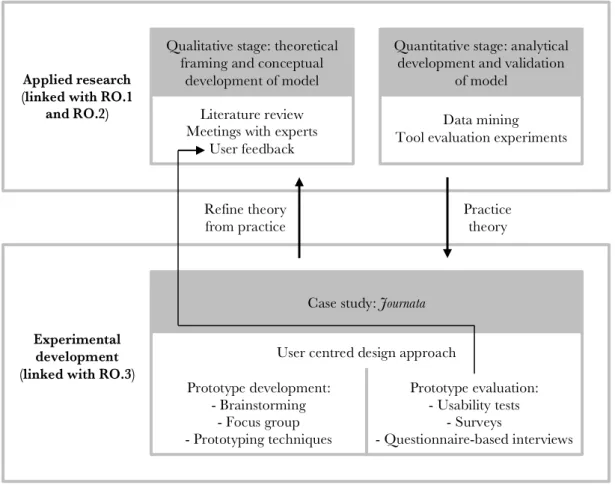
The research typology adopted combined applied research and experimental development. The first two objectives (RO.1 and RO.2) are characteristic of applied research, being concerned with the theoretical framing and development of a new concept that has materialised into the user collaboration model for urban passenger transport. The last objective (RO.3), relating to the design and evaluation of Journata, falls within experimental development because it drew from the model to deliver a new service that is expected to be publicly available in the near future following its ongoing field trial. Figure 1.2 outlines the adopted methodology, which is described throughout this section.
Figure 1.2 Methodology
Literature review Meetings with experts
User feedback
Data mining Tool evaluation experiments Qualitative stage: theoretical
framing and conceptual development of model
Quantitative stage: analytical development and validation
of model Prototype development: - Brainstorming - Focus group - Prototyping techniques Refine theory from practice Practice theory Prototype evaluation: - Usability tests - Surveys - Questionnaire-based interviews User centred design approach
The applied research part followed a mixed methods approach, qualitative in the outset but having gained a quantitative bias upon mathematical formulation of the model. The literature review was the starting point and reflects the multidisciplinary nature of the problem by covering several topics within transport research, service science, information science, and network science. The literature review provided the theoretical framing for the research. In addition, it contributed towards the conceptual foundation of the user collaboration model, alongside opinions gathered from meetings with experts, and feedback obtained from users of the first iteration of
Journata as detailed later in this section. The shift from concept to object came with
the development of a theoretical notion of spatiotemporal relevance between users of a passenger transport system. This key outcome allowed the mathematical formulation of the model as a measure of circumstantial collaboration potential between users. This marked the turning point to the predominantly quantitative stage.
Two algorithms were developed as data mining tools for the model, and were applied to a large dataset in the urban public transport domain for evaluation. The first is concerned with estimating the destination of passenger journeys to produce an Origin-Destination (O-D) dataset. The second builds on that dataset to implement the mathematical formulation of the model and produce dynamic estimates of collaboration potential between users. The effectiveness and efficiency of these algorithms were evaluated using spatial validation rules and mathematical concepts relating to random graph theory.
The experimental development part wrapped several research methods into a case study. A distinctive feature of this case study is that it emerged from the iterative development of Journata. Therefore, the case study itself is an outcome of the thesis, having evolved alongside the user collaboration model to enable its empirical evaluation. The development of Journata followed a user centred design approach. Research methods included a brainstorming session and a focus group to elicit requirements, prototyping techniques to define the design, and evaluation with users. The latter consisted of usability tests accompanied by surveys and
questionnaire-based interviews. Each design iteration of Journata incorporated new advances from the model, and its evaluation provided feedback to close the loop.
1.4. Contributions
This thesis provides three main contributions. The first is to the state-of-the-art, by bringing a service science perspective that is scarce in the transport literature. This is a reaction to the critique that the public sector, which many urban passenger transport providers are part of or controlled by, is lagging behind in the adoption of new value creation practices and tools (Cassia and Magno 2009). This contribution draws from the literature in other service domains and highlights the potential role of user collaboration in the mobile-saturated, data-intensive setting of urban passenger transport to improve resource utilisation, enhance travel experience, and reduce adverse environmental and social impacts.
The second main contribution is also to existing theory and consists of the user collaboration model. The concept is believed to be entirely new, and replicable across urban passenger transport domains and systems around the world. It provides tools to explore collaboration opportunities for the benefit of travellers and transport providers with improved experience and travel decision support, and for the benefit of society and the environment with the promotion of more sustainable transport. At a detailed level, each of the algorithms developed as tools for the model also contribute to the state-of-the-art.
The first algorithm for estimating the destination of passenger journeys refines assumptions from previous works, and is the first in the literature dedicated to entry-only Automated Fare Collection (AFC) systems with distance-based fare structures. The meaning of these terms will be explained in Chapter 4, but essentially entry-only refers to systems where only passenger departures are recorded, and distance-based means that journey fares depend on distance travelled. The output of the algorithm can produce reliable O-D matrices at any level of aggregation and geographic coverage, which are also useful for service performance monitoring and transport planning support. The second algorithm for producing dynamic estimates of
collaboration potential between users is also believed to be innovative. It streamlines computation of path similarity for the case of passenger transport where those paths have to follow a predefined network grid, it introduces a measure of path substitutability as the degree to which two paths constitute alternatives to each other, and it presents an aggregate measure of spatiotemporal relevance between users. This algorithm is key to materialise the model.
The third main contribution is the prototype service Journata. Not only it served as a case study for the empirical testing and validation of the user collaboration model, it is also expected to be generally available to the public in the near future if it succeeds in its ongoing field trial. Journata is the corollary of this thesis as a predominantly applied research effort, being a tangible outcome that is value brought back to the society.
1.5. Thesis structure
This thesis is organised in the following way. Chapter 2 provides a review of the literature and other background material to this research. Due to the multidisciplinary nature of the problem, the review covers several topics. It reviews the notion of customer experience, its relation to passenger transport, and impact on travel behaviour. It reviews recent value creation trends in the context of services, namely the rise of the Web 2.0 as a form of value creation through collaboration. It reviews the state-of-the-art of ICT-based user collaboration in urban passenger transport, including its potential in light of graph theory, and relevant mobile platforms and how they overcome information needs of travellers. In regards to the development of algorithmic tools, it surveys existing types of data sources in urban passenger transport domains and methodologies for extracting and estimating travel patterns. It also reviews trajectory similarity metrics and clustering methods and their suitability to the measurement of collaboration potential between users.
Chapter 3 describes the conceptual foundations of the user collaboration model. It begins by describing what the opportunity and main objective of this model consist of. Then it discusses why travellers and transport providers may benefit from the model.
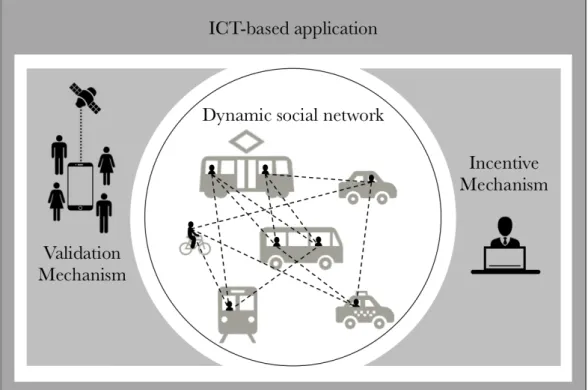
Lastly, it defines how the model works. This includes the notion of users as information providers, reimagining the social network concept to account for the dynamics of urban passenger transport, and the role of validation and incentive mechanisms that are applicable to some forms of collaboration, for sustaining the reliability and breadth of information obtained from users.
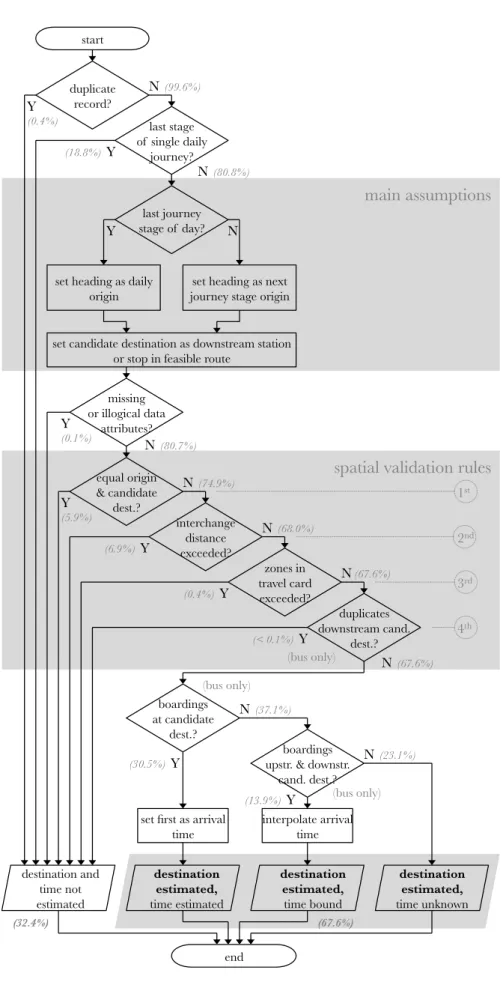
Chapter 4 presents the first tool for the model and its application to a dataset in the urban public transport domain. Firstly it details the characteristics of the transport system and the attributes of the data available. This is followed by the formal definition of the methodology to estimate the destination of passenger journeys, and by a description of the structure of the algorithm to implement it. Lastly, it presents and discusses the results, and provides a sensitivity analysis of the trade-off between extensiveness and accuracy of estimates.
Chapter 5 presents the second tool for the model and its application to an enriched dataset obtained from the algorithm described in Chapter 4. It defines the proposed notion of spatiotemporal relevance between users of a passenger transport system. Then it provides essential definitions, the mathematical formulation of the user collaboration model, and the structure of the algorithm to perform the required calculations. This is followed by the implementation of the algorithm, and the presentation and discussion of initial results. Lastly, some efficiency improvements to the algorithm are described.
Chapter 6 describes the evolution of the case study Journata from its inception as non-functional prototype through to its implementation as a commercial prototype service. This includes the details of two intermediate versions of functional prototypes, and the research methods adopted for eliciting requirements, designing, and evaluating them. The results obtained from the evaluation at different stages of development are presented and discussed.
Chapter 7 concludes this thesis. It summarises the main findings and contributions of the research, and presents future research directions.
2. Literature review
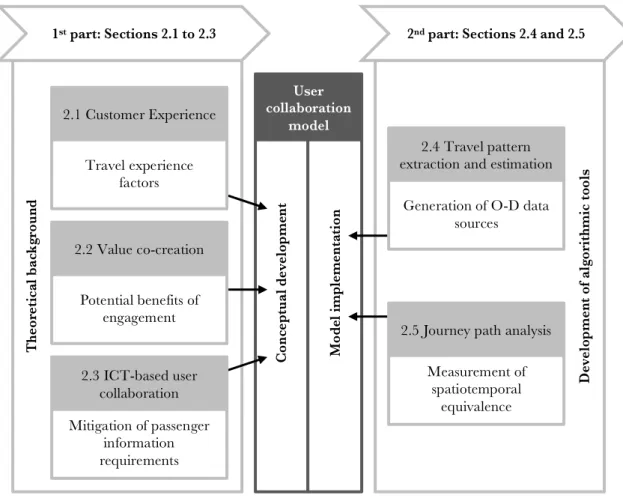
This literature review covers several topics within transport research, service science, information science, and network science, reflecting the multidisciplinary nature of the research problem. It attempts to establish the necessary relationships between different theoretical fields to support the conceptual foundation of the user collaboration model. Section 2.1 reviews the notion of customer experience, how it relates to passenger transport, and its potential role influencing travel behaviour. Section 2.2 reviews value creation trends in services to frame the potential benefits of active engagement of transport users. Section 2.3 reviews the state-of-the-art of ICT-based
user collaboration as a form of value creation in services in general, but particularly in
the urban passenger transport domains. This section also links collaboration to graph theory, as a way to evaluate its potential to overcome some information needs of travellers. Section 2.4 reviews existing types of data sources and methodologies for
estimating travel patterns, as prerequisites for implementing the user collaboration model.
Section 2.5 reviews trajectory similarity metrics and clustering methods, and the notion of
relevance in information retrieval. This provides the background for the measurement of
collaboration potential between users, and so to the materialisation of the model. Section 2.6 summarises the literature review.
2.1. Customer experience
Over the past two decades, the marketing literature has given attention to the creation of value for customers in the shape of experiences. Pine and Gilmore (1998) coined the term ‘Experience Economy’ as the latest phase in the historical progress of economic value, after the chronological sequence of the agrarian, industrial, and service economies. The authors argued that services were becoming increasingly commoditised, as did products in a previous phase, and that the new competitive battleground lied on staging experiences. The argument drew from practices that were common in the entertainment business, yet it became influential by expressing that the experience economy was spreading and becoming a differentiating factor
across many business sectors. Neither their seminal article nor subsequent book (Pine and Gilmore 1999) explicitly defined experience. Instead the authors provided economic distinctions and characterised experience as occurring “when a company intentionally uses services as the stage, and goods as props, to engage individual customers in a way that creates a memorable event” (Pine and Gilmore 1998, 98), adding that it is “inherently personal, existing only in the mind of an individual who has been engaged on an emotional, physical, intellectual, and even spiritual level” (99). The authors gave various examples, one of which from passenger air transport. This example mapped the ‘commodity mind-set’ to the functional view of moving people from A to B cheaply and on time, and mapped experience to providing a respite for travellers away from their hectic lives, using the travel service merely as a stage (Pine and Gilmore 1998).
The business world has since been charmed with the notion of customer experience as a competitive differentiator (Bitner, Ostrom, and Morgan 2008, 69). And indeed the recipes of the experience economy accelerated the development of practices of ‘customer experience management’, which recognise the significance of emotional bonds between companies and customers, and how these are nurtured in every interaction across multiple channels (Berry, Carbone, and Haeckel 2002; Smith and Wheeler 2002; Schmitt 2003; Verhoef et al. 2009). This continued focus on customer experience triggered attempts to produce definitions for it (e.g. Shaw and Ivens 2002, 6; Gentile, Spiller, and Noci 2007, 397; Meyer and Schwager 2007, 2) but a struggle to find consensus remains today. This thesis is not intended to dwell into the debate and embraces the last revision of an evolving definition that corroborates the characterisation above. It highlights the sensorial and emotional elements of experience, inasmuch as the role of the level of consciousness of the customer:
A Customer Experience is an interaction between an organization and a customer as perceived through a customer’s conscious and subconscious mind. It is a blend of an organization’s rational performance, the senses stimulated and emotions evoked, and intuitively measured against customer expectations across all moments of contact. (Shaw, Dibeehi, and Valden 2010, 3)
The focus on customer perceptions in the above definition implies a subjective nature to the construct. In their early work on customer experience engineering, Carbone and Haeckel (1994, 9) noted that customers could not help but have an experience with a product or a service. Yet a good experience is not guaranteed (Berry and Carbone 2007, 27). Their standpoint may seem cautious if compared with the dichotomy of service delivery and staging of experiences inherent to the experience economy, but Berry and Carbone (2007) were equally adamant of benefits deriving from the new focus. The authors have argued that an organisation cannot control the subjective emotional responses from customers but can systematically manage the clues that trigger them. Those clues are embedded in every way customers experience the organisation, and if managed effectively they can collectively meet or exceed their expectations (Haeckel, Carbone, and Berry 2003, 20). What is vital about their argument is that those emotions will drive behaviour, hence are the crux of building loyalty. “Emotional connection extends far beyond customer satisfaction” (Berry and Carbone 2007, 32). People who love a brand or identify themselves with the values of an organisation are bound to be loyal customers.
Experience quality
Notions of customer experience management kept attracting scholarly interest, alongside the continued effort from organisations to adopt them into their value propositions to raise loyalty (e.g. Frow and Payne 2007; Verhoef et al. 2009). Therefore, the design of methodologies to measure experience quality and assess its impacts on customer behaviour has been a concern, in spite of conceptual difficulties arising from the degree of subjectivity involved, and practical obstacles in developing and implementing scales that are able to capture its affective components (Palmer 2010). Those methodologies are generally rooted in previous notions of service quality and customer satisfaction, and in quality management frameworks such as SERVQUAL (Parasuraman, Zeithaml, and Berry 1988), yet fundamental distinctions exist.
Service quality can be objectively measured from a specific set of functional attributes, whereas experience quality is subjectively and holistically evaluated by the
customer (Otto and Ritchie 1996). Adding to the cognitive nature of service quality assessment, the holistic evaluation of experience quality comprises an affective component that is subjective and emotional (Otto and Ritchie 1996). Shaw, Dibeehi, and Valden (2010, 3) argued that more than half of an experience is about the emotions and feelings it evokes for the customer, hence its assessment extends beyond the evaluation of service quality. The aforementioned SERVQUAL framework has indeed been argued not to consider the affective component contributing to the overall customer experience (Fick and Brent Ritchie 1991).
Customer satisfaction in turn relates to “the perceived discrepancy between prior expectation and perceived performance after consumption” (Chen and Chen 2010, 30). This implies less depth as a mainly cognitive construct, but greater breadth as a judgement that exceeds the actual experience alone. In other words, it suggests a post-consumption, more pondered assessment of the gap between expected and delivered performance. Another perspective considers customer satisfaction to be the net outcome of a series of customer experiences benchmarked against expectations (Meyer and Schwager 2007, 2). According to this, understanding how to improve satisfaction requires its deconstruction into the constituent experiences.
Existing methodologies to measure experience focus on the identification of relevant factors in a specific service domain of interest, for subsequent qualitative analysis (e.g. Rowley 1999) or quantitative evaluation combining factor analysis and structural equation modelling (e.g. Chen and Chen 2010; Maklan and Klaus 2011). The latter type enabled for an empirical demonstration that experience quality has greater explanatory power than customer satisfaction on loyalty (Maklan and Klaus 2011), supporting theoretical assumptions on the importance of customer experience for organisations.
Travel experience
Turning back to the aims of this thesis, the review of customer experience management practices for building loyalty will be directed towards the passenger transport context. This initially requires a finer understanding of the loyalty concept.
Customer loyalty is said to consist of ‘three Rs’, which stand for retention, repeat business, and referrals (Heskett, Sasser Jr., and Schlesinger 1997). These relate respectively to keeping relationships with customers, to repeating business from the same or other services, and to raising new customers via endorsements. With respect to the promotion of urban passenger transport, this conception can arguably be interpreted to map customer loyalty into retaining passengers, increasing patronage of specific modes of transport and modal alternatives, and encouraging modal shift through positive testimonials. Nonetheless, despite the long-standing interest on customer experience across several service domains, and potential benefits for transport providers and society in general, the existing literature on travel experience is scarce.
This reflects particularly on public transport operation, where traditional customer satisfaction surveys remain a key instrument to identify service quality factors and prioritise improvements (Eboli and Mazzulla 2011; Eboli and Mazzulla 2012a). In fact, several previous studies focused on service quality and travel satisfaction rather than on the actual travel experience. Some have examined factors that influence satisfaction in the daily commute (Cantwell, Caulfield, and O’Mahony 2009; Ettema et al. 2012; Eriksson, Friman, and Gärling 2013) and public transport travel (Stuart, Mednick, and Bockman 2000). Others have identified factors to benchmark satisfaction across travel modes (Stradling, Anable, and Carreno 2007), to analyse the effect of satisfaction on modal choice (Habib, Kattan, and Islam 2011; Abou-Zeid and Ben-Akiva 2012; Abou-Zeid et al. 2012), and to assess the relationship between travel satisfaction and subjective well-being (Ettema et al. 2011). Others have emphasised the identification of key service quality factors influencing satisfaction, both in public transport (Friman 2004; Geetika and Nandan 2010; Eboli and Mazzulla 2011; Eboli and Mazzulla 2012b; de Oña et al. 2013) and air travel (Babbar and Koufteros 2008).
Some studies have mostly focussed on service quality factors themselves. These include understanding passenger perceptions of service quality (dell’Olio, Ibeas, and Cecín 2010; Cirillo, Eboli, and Mazzulla 2011) and desired levels of service (dell’Olio, Ibeas, and Cecin 2011). These also include evaluating the effect of service
quality on ridership (Paulley et al. 2006; Litman 2011) and on attitudes driving modal choice (Beirão and Sarsfield Cabral 2007), and analysing customer satisfaction surveys results to derive service quality assessment methods (Nathanail 2008; Tyrinopoulos and Aifadopoulou 2008; de Oña, de Oña, and Calvo 2012). Amongst the fewer studies that addressed travel experience, some focus on ‘experience-centric’ services such long-haul air travel, cruise trips, and leisure motorcycling experiences that are outside the scope of this thesis (Le Bel 2005; Zomerdijk and Voss 2010; Zomerdijk and Voss 2011).
Li (2003) is the earliest study found in the literature that deals with the quality of urban travel experience. His study presented an alternative to the vast body of existing research approaches for explaining travel behaviour based on conventional decision theory, and particularly using random utility models. Li (2003) has criticised those approaches on the grounds of the Nobel wining ‘prospect theory’ (Kahneman and Tversky 1979; Kahneman and Tversky 1984), for ignoring the important role of experience value and the hedonic motivations of decision-makers. The author drew from research in psychology to propose a model that considered the subjective perception of travel time, as opposed to clock time, to be fundamental for the passenger evaluation of travel experience. Based on a literature review, Li (2003) hypothesised that a range of factors within four categories influence perceived travel time and subsequently, from his logic, the urban travel experience.
The first is ‘commute characteristics’ and includes objective duration and number of journey stages; the second is ‘journey episodes’ that subdivide into the ride, wait, and access and transfer travel states; the third is ‘travel environment’ and includes comfort, and availability and quality of entertainment provided; and the fourth is ‘expectancy’ that subdivides into the expected travel time and service reliability (Li 2003, 56). Furthermore, the author recognised that other factors could have a moderating influence. Among these were ‘goal attainment’ representing the fulfilment of the journey objective, ‘economic values’ representing the monetary payoff, and ‘time urgency’ that may either be a personality trait, or a personality state stemming from time demands of the external environment (Li 2003, 57-58). The transport provider does not control some factors, notably the mediating factors,
questioning the appropriateness of studies that focus on service quality alone. However, it is debatable whether the fourth category on expectancy relates to experience or satisfaction because it already suggests a pondered assessment of prior expectation against measurable service delivery performance. Lastly, it is noted that the relationships of the model were tentative, being unclear if it has since been empirically evaluated.
Two years later, Anable and Gatersleben (2005) examined and compared the relative impact of various functional (often worded as ‘instrumental’) and affective journey factors on travel experience, by carrying out two studies relating to work travel and leisure day trips. Overall the authors found that affective factors are considered more important for leisure travel, but also play a role in the work travel experience. The studies were based on responses to travel survey questionnaires in respect to journeys by car and by public transport in both cases, plus walking and cycling in the work travel one. The choice of factors appears to be informed by their literature review, but the rationale behind it is vaguely described. Anable and Gatersleben (2005) considered flexibility, convenience, cost, predictability, environmental friendliness, and health as functional factors, and lack of stress, sense of control, sense of freedom, relaxation, and excitement as affective factors. One of the main conclusions drawn from this study is that the affective journey attributes were measurable and relevant constructs that should be considered alongside functional factors in order to understand travel experience and influence modal choice. It may however be argued that stress, excitement, and relaxation are not factors but affective responses, as differentiated in other studies.
Around the same time, Ory and Mokhtarian (2005) have published research on travel liking that studied what sorts of people liked to travel, and under what circumstances was travel enjoyed. Whilst the study did not identify a set of factors that are relevant for this thesis, its results suggest that travel liking is an intrinsic human characteristic, which inevitably bears a subjective influence on travel experience. Two years later, Stradling et al. (2007) surveyed Edinburgh residents living close to a designated ‘Quality Bus Corridor’ to understand what they disliked about the urban bus travel experience. The study was based on a self-completion
questionnaire containing items obtained from the literature and from discussions with bus users. The authors conducted factor analysis that revealed eight overarching factors of dislike, revealing not only functional but also social and affective concerns. Those were feeling unsafe, preference for walking or cycling, service provision issues, unwanted arousal, preference for car use, cost, disability and discomfort, and self-image. Whilst most of these are largely self-explanatory, unwanted arousal deserves further clarification. This factor contained questionnaire items relating to issues such as overcrowding, uncleanliness, harsh driving, and impoliteness of other passengers. Meanwhile, two studies applied the seminal Circumplex Model of Affect (Russell 1980) to travel experience. The model represents affective concepts in an orthogonal spatial model of two dimensions, pleasure-displeasure in the horizontal axis, and degree of arousal in the vertical axis (Russell 1980). The first study examined affective appraisals of the daily commute experience across various modes of travel (Gatersleben and Uzzell 2007). It suggested that different travel modes elicited different affective responses. Notably, the use of private cars and public transport were generally found to be associated respectively with excess and a lack of arousal, hence the former to be stressful and the latter to be boring. Furthermore, attitudes towards public transport were found to be more negative than for other modes. This led to the insightful conclusion that strategies for promoting public transport use should consider the main sources of pleasure with its travel experience, reportedly reading, listening to music, interacting with people, and enjoying the scenery. The second study used confirmatory factor analysis to validate that public transport travel experience is multidimensional (Olsson et al. 2012). The authors found one cognitive dimension relating to judgement of service quality factors plus two affective dimensions named positive activation and positive deactivation. These range from enthusiasm to boredom and from relaxation to stress, and derive from combinations of the dimensions originally proposed by Russell (1980).
Carreira et al. (2013; 2014) authored the latest research on travel experience reviewed in this thesis. The authors initially carried out a qualitative study with bus passengers regarding mid-distance experience-centric and utilitarian journey types, and confirmed travel experience to depend both on service quality and aspects not
controlled by the transport provider (Carreira et al. 2013). Their starting point was to identify experience factors in the literature, which was scarce and required the addition of service quality and satisfaction studies. The authors built on those studies that focussed on the cognitive assessment of service aspects controlled by the transport provider, to study more comprehensively the multi-channel customer experience. After reviewing the literature, the analysis of interviews with passengers and other stakeholders yielded relevant experience factors. The authors made a clear distinction between ‘Experience Factors (EFs)’ and ‘Experience Components (ECs)’, shedding some light on the erratic use of vocabulary in previous studies. EFs were defined as service provision aspects that drive travel experience, and ECs as internal customer responses to the service provided. Their comprehensive work significantly improved the breadth and depth of existing research on travel experience.
From the first qualitative study (Carreira et al. 2013), eleven identified EFs were grouped into two main categories; the first, trip conditions, consists of cleanliness, comfort, easy accessibility, safety, scenery visibility, and waiting time; the second, supplementary services, consists of information provision, on-board entertainment, and off-board services; two additional factors, social environment and staff skills were identified outside those categories. ECs were divided into cognitive, sensorial, and emotional. The latter included positive emotions such as excitement and joy, and negative emotions such as annoyance, discontentment, nervousness, and fear.
A second quantitative study based on a questionnaire survey regarding mid-distance bus journeys (Carreira et al. 2014) refined the definition of EFs into a shorter list of seven using exploratory factor analysis, and evaluated their impacts on ECs and loyalty behaviours. It consisted of individual space, information provision, staff skills, social environment, vehicle maintenance, off-board facilities, and ticket line service. The results confirm the hypothesis that travel experience influences passenger loyalty, directly and indirectly, and emphasise its holistic nature involving both cognitive and emotional components, and factors not controlled by the transport provider. On-board aspects were found to be the core of experience, followed by information provision and staff skills. However, the cognitive experience component was said to involve not only quality assessment but also customer satisfaction (Carreira et al. 2014,
37). This appears to go against aforementioned distinctions between customer experience and customer satisfaction. These studies by Carreira et al. (2013; 2014) have also explicitly split the travel experience into its constituent before, during, and after moments. Although other studies (e.g. Stradling et al. 2007) had already considered factors outside the duration of the journey, such as the walking distance to access transport services and the quality of waiting facilities, their distinction between those moments provides further depth to the understanding of travel experience.
Table 2.1 Summary of travel experience factors in the literature
Li (2 00 3) An ab le a nd Ga te rs le be n (2 00 5) St ra dl in g et al . ( 20 07 ) Ga te rs le be n an d U zze ll (2 00 7) Ca rr ei ra e t al . ( 20 13 ) Ca rr ei ra e t al . ( 20 14 ) Ma in ly c on tr ol le d Travel environment
Comfort (includes crowding) ✓ ✓ (d) ✓ ✓ (k)
Entertainment ✓ ✓ ✓
Cleanliness / maintenance ✓ (a) ✓ (d) ✓ ✓
Accessibility ✓ (e) ✓
Driver skills (public transport only) ✓ (d) ✓ (i) ✓ (i) Journey characteristics
Journey time ✓ ✓ (b) ✓ (f) ✓ (g) ✓ (j)
Journey stages & episodes ✓
Cost ✓ ✓ Other Information provision ✓ (f) ✓ ✓ Safety ✓ ✓ ✓ Off-board services ✓ ✓ Ma in ly un co nt ro lle d Travel setting Social environment ✓ (d) ✓ ✓ ✓ Scenery ✓ ✓ Subjective appraisal Convenience / flexibility ✓ ✓ (f) ✓
Sense of freedom & control ✓
Modal preference ✓ (c) ✓ ✓ (h)
Self-image ✓
Notes:
(a) Included in the comfort category; (b) alluded to in the predictability factor; (c) alluded to in the
environment and health and fitness factors; (d) included in the unwanted arousal factor; (e) included in
the disability and discomfort factor; (f) included in the service provision factor; (g) alluded to in terms of
delays; (h) alluded to in terms of enjoyment; (i) included in the staff skills factor; (j) partially considered as