A comparative study of territoriality in intertidal and subtidal blennioids
(Teleostei, Blennioidei)
Emanuel J. Gonc¸alves & Vitor C. Almada
Unidade de Investigac¸a˜o em Eco-Etologia, Instituto Superior de Psicologia Aplicada, R. Jardim do Tabaco 44, P-1100 Lisboa, Portugal (e-mail: [email protected])
Received 15.11.1996 Accepted 5.6.1997
Key words: littoral fishes, territory structure, behaviour, turbulence
Synopsis
This paper presents a comparative analysis of territoriality in three intertidal (Lipophrys pholis, Corypho-blennius galerita, Salaria pavo) and two subtidal (Tripterygion delaisi, ParaCorypho-blennius pilicornis) blennioid fishes. Focal-animal observations of males guarding eggs showed that: (i) intertidal species had smaller terri-tories that were less frequently patrolled; (ii) in subtidal species feeding was limited to the territory, while in intertidal fishes a substantial proportion of the feeding acts occurred outside the defended area; (iii) intertidal species spent less time out of the nest and showed a lower level of locomotory activity; (iv) subtidal species were subjected to a higher number of territorial intrusions with more species intruding their territory, some of them potential egg predators; (v) subtidal species performed several water column displays that played a significant role in courtship, while in intertidal fishes these displays are almost absent. Signalling without the presence of a female was almost absent in intertidal species. It is argued that intertidal fishes minimize the time spent out of the nest and the loss of contact with the substrate, features that may be of high survival value in conditions of strong turbulence. Although intertidal species have a reduced time available for feeding, this may be compensated by lower levels of locomotory activity, territorial defense and risk of egg predation.
Introduction
Blennioid fishes are among the most abundant fish groups in tropical and warm temperate rocky coasts, occurring both in intertidal and subtidal habitats. Therefore, they provide an excellent op-portunity to investigate the ways in which intertidal conditions affect the behaviour of fishes that occu-py such habitats (Almada & Santos 1995). Their suitability for this type of study is further empha-sized by their small size and ease of observation and by the fact that, the males at least, are territorial during the breeding season, which allows detailed observations of individual fishes for long periods.
There is a considerable body of literature concern-ing the territorial behaviour of blennioid fishes (Fishelson 1963, 1975, Stephens et al. 1970, Nursall 1977, 1981, Wirtz 1978, Almada et al. 1983, 1987, 1992, 1994, Lindquist 1985, Santos 1985, 1992, Hasti-ngs 1986, Patzner et al. 1986, Koppel 1988, Santos et al. 1989).
There are, however, few detailed comparative studies on the differences in territorial structure be-tween intertidal and subtidal species. Almada & Santos (1995) showed that the basic features of re-productive behaviour, namely male breeding terri-toriality and parental care, are common to both in-tertidal and subtidal blennioid fishes. They suggest
conditions of marked turbulence. Almada et al. (1992) suggested that intertidal blennies may expe-rience reduced egg predation and less territorial in-trusions by potential egg eaters, compared to sub-tidal equivalents. This situation may offset the costs due to the limited time available to feed, imposed by the tidal cycle. This view is in accordance with the more general hypothesis of Gibson (1988) and Horn & Gibson (1988) that rocky intertidal resident fishes are subjected to less severe predation pres-sure, at least by aquatic predators.
Almada et al. (1992) showed that unguarded egg masses of Lipophrys pholis may survive for up to 5 days without predation. Moreover, it is known that subtidal species may visit the intertidal to spawn, leaving the egg masses unguarded during low tide (e.g. DeMartini 1978, Middaugh et al. 1981, Potts 1985). These findings also suggest a reduction of egg predation in intertidal habitats.
In this paper, we present comparative data on the territoriality of the breeding males of five blennioid species, three intertidal (Lipophrys pholis, Salaria pavo and Coryphoblennius galerita) and two sub-tidal (Parablennius pilicornis and Tripterygion de-laisi).
Material and methods
Data were collected at Arra´bida coast (38°28′N, 8° 59′W) and Ria Formosa (36°59′N, 7°51′W), in Portugal, during the years 1986, 1987, 1993 and 1994. At Arra´bida, the study site consists of vertical cliffs with boulders and large rocks that become exposed at low tide. At Ria Formosa, the study site is situat-ed inside a lagoon, and the only hard substrates available are bricks in which the males of S. pavo establish nests. In both sites wave action is very re-duced. Both study areas were previously character-ized by Almada et al. (1992, 1994).
Behavioural observations were conducted by skin- and scuba-diving. We performed focal-animal observations (Altmann 1974) of territorial males
et al. 1996); S. pavo – April/May to September/Oc-tober (Almada et al. 1994); T. delaisi – January/ March to August/September; and P. pilicornis – February/March to August/September. The amount of focal observation time was: C. galerita = 8 h 13 min (n = 23); L. pholis = 17 h 51 min (n = 22); S. pavo = 31 h 7 min (n = 65); T. delaisi = 7 h 20 min (n = 22); and P. pilicornis = 7 h 36 min (n = 23).
The area around each nest was arbitrarily divided in four quadrants (upper, lower, left and right), and taking the nest as centre, a series of concentric cir-cles with 10 cm distance between each radius was drawn. The successive locations that a fish visited during each observation period were recorded on a plastic sheet. We also recorded the different beha-vioural categories performed by the fish in each lo-cation, based on the descriptions provided by Fish-elson (1963), Wirtz (1978), Almada et al. (1983, 1987, 1992) and Patzner et al. (1986). The area defended against intruders was considered as the territory.
In these observations the time unit used was one minute and the following data were recorded: (i) frequency of excursions out of the nest, their dura-tion, locations visited and the activities performed by the fish during each excursion; (ii) appearance of intruders, their species, the location of their closest approach to the nest and whether they withdrew without apparent reaction by the resident male or left after agonistic action of the territorial fish. For more details on the behavioural observations see Almada et al. (1990b, 1992, 1994, 1995).
The nests mean height to the hydrographic zero were similar in the intertidal species studied (C. ga-lerita, L. pholis and S. pavo). Almada et al. (1992) determined that the average diurnal submersion time obtained for L. pholis was 5h 34min. This value was used to calculate the daily rates of patrolling, intrusions and total movement in the intertidal spe-cies (for details on this method see Almada et al. 1992). For subtidal species (T. delaisi and P. pilicor-nis), these rates were calculated based on the day-light hour period in the peak of the breeding season (14 h in May).
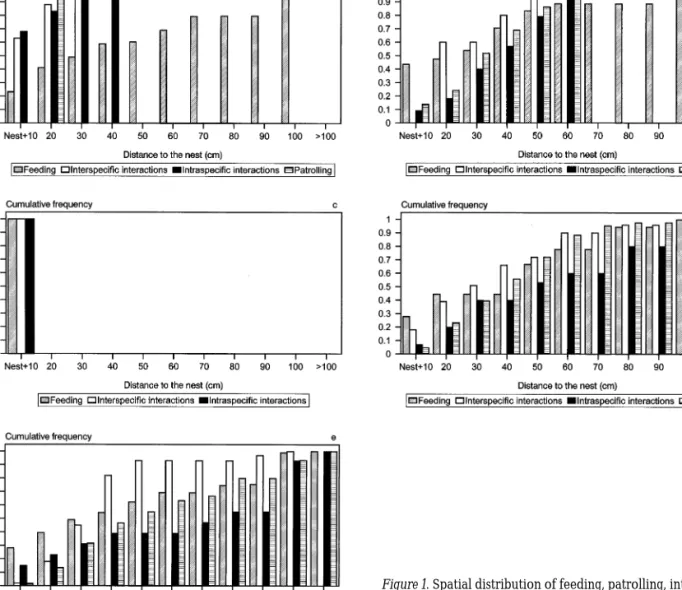
Figure 1. Spatial distribution of feeding, patrolling, interspecific
and intraspecific interactions, in the male’s territory of each spe-cies. a – C. galerita (n = 23); b – L. pholis (n = 22); c- S. pavo (n = 65); d – T. delaisi (n =22); e – P. pilicornis (n = 23).
Statistical analysis was performed using the PC computer program STATISTICA for Windows 4.0 (Copyright Statsoft 1993) and the simulation statis-tical program ACTUS (Estabrook & Estabrook 1989) designed for the analysis of contingency ta-bles. This program uses random numbers to simu-late 1000 tables, each with the same row and column totals of the original table. Each simulated table is compared with the original data table. Values small-er than 50 are one-tailed significant (p<0.05). The significance of χ2is assessed by the number of times
out of 1000 that the value of χ2for the simulated
ta-ble is equal to or greater than that for the original table (Estabrook & Estabrook 1989).
Results
The spatial distribution of feeding, patrolling, intra and interspecific intrusions as a function of the distance to the nest for each species, is shown in Figure 1.
In S. pavo, all activities (including feeding) are concentrated in an area of less than 10 cm from the nest. In this species, nests are densely aggregated in bricks and each nest may be surrounded by several others in the same brick. Territoriality is restricted to the nest itself (Almada et al. 1994, 1995, Gon-c¸alves et al. 1996). The breeding males of the two other intertidal species (L. pholis and C. galerita)
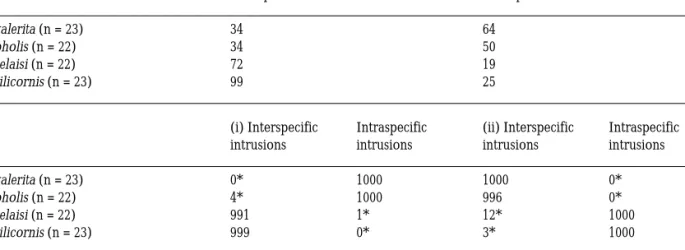
C. galerita (n = 23) 34 64 L. pholis (n = 22) 34 50 T. delaisi (n = 22) 72 19 P. pilicornis (n = 23) 99 25 b (i) Interspecific intrusions Intraspecific intrusions (ii) Interspecific intrusions Intraspecific intrusions C. galerita (n = 23) 0* 1000 1000 0* L. pholis (n = 22) 4* 1000 996 0* T. delaisi (n = 22) 991 1* 12* 1000 P. pilicornis (n = 23) 999 0* 3* 1000
(i) cases in which simulated values did not exceed observed values; (ii) cases in which observed values did not exceed simulated values. χ2= 73.81, d.f. = 3, p<0.001. For details of ACTUS see Estabrook & Estabrook (1989).
* p<0.05 (one-tailed).
Table 2. Total number of intrusions in the male’s territory of each species.
Intruders C. galerita (n = 21) L. pholis (n = 17) T. delaisi (n = 17) P. pilicornis (n = 20)
C. galerita 64 33 – – L. pholis 19 50 – – T. delaisi – – 19 3 P. pilicornis – – 8 25 Other blennioids 3 – 9 2 Wrasses – – 32 29 Gobies – – 15 3 Sea breams 9 – – 60 Clingfishes – – 8 – Atherina sp. – – – 2 Crabs 3 1 – –
have territories smaller than those of P. pilicornis and T. delaisi. Indeed, the shortest distance to the nest at which intruders could penetrate is smaller in intertidal fishes (C.galerita: mean = 15.2 cm, s.d. = 8.3, range = 10–40 cm, n = 42 interactions; L. pholis: mean = 38.2 cm, s.d. = 15.9, range = 10–60 cm, n = 28 interactions; T. delaisi: mean = 42.6 cm, s.d. = 27.3, range = 10–100 cm, n = 47 interactions; P. pilicornis: mean = 43.4 cm, s.d. = 25.3, range = 10–100 cm, n = 64 interactions; Kruskal-Wallis: H (3, n = 181) = 57.27, p<0.001). The radius of the defended area was: C. galerita = 40 cm; L. pholis = 60 cm; S. pavo = 10 cm; T. delaisi = 100–150 cm; P. pilicornis = 100– 150 cm. In addition, patrolling is significantly more
frequent in subtidal species, being absent in S. pavo and extremely rare in C. galerita. The mean individ-ual patrolling rates per day were: L. pholis = 20.6 (s.d. = 13.3, range = 2.9–44.5, n = 7), T. delaisi = 164.2 (s.d. = 159.9, range = 42–630, n = 11), and P. pilicornis = 144.7 (s.d. = 83.4, range = 33.6–336, n = 17) (Kruskal-Wallis: H (2, n = 35) = 15.29, p<0.001). The spatial distribution of the feeding acts is an-other feature that distinguishes intertidal and sub-tidal species. In intersub-tidal species, a substantial pro-portion of the feeding acts occurred out of the de-fended area (C. galerita = 51%, L. pholis = 13%), while in subtidal species territories and home range coincide (Figure 1).
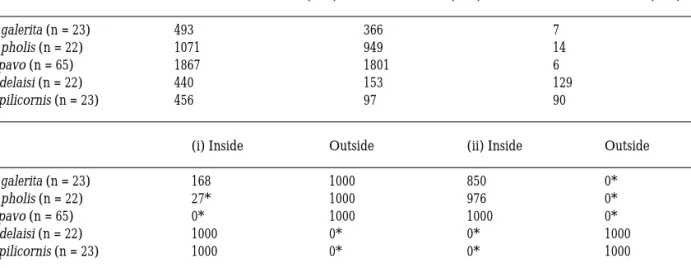
Table 3. a – Number of minutes spent inside and outside the nest by the parental male of each species. b – Statistical analysis using ACTUS.
a Total observation time (min) Inside the nest (min) Outside the nest (min)
C. galerita (n = 23) 493 366 7
L. pholis (n = 22) 1071 949 14
S. pavo (n = 65) 1867 1801 6
T. delaisi (n = 22) 440 153 129
P. pilicornis (n = 23) 456 97 90
b (i) Inside Outside (ii) Inside Outside
C. galerita (n = 23) 168 1000 850 0*
L. pholis (n = 22) 27* 1000 976 0*
S. pavo (n = 65) 0* 1000 1000 0*
T. delaisi (n = 22) 1000 0* 0* 1000
P. pilicornis (n = 23) 1000 0* 0* 1000
(i) cases in which simulated values did not exceed observed values; (ii) cases in which observed values did not exceed simulated values. χ2= 1353.86, d.f. = 4, p<0.001. For details of ACTUS see Estabrook & Estabrook (1989).
* p<0.05 (one-tailed).
Table 4. Water column movements performed by each species in
courtship or other contexts.
Courtship Total
Male Female Male Female
C. galerita 0 0 0 2
L. pholis 0 0 1 0
S. pavo 0 0 0 0
T. delaisi 79 0 141 2
P. pilicornis 69 0 98 21
Table 5. Percentage of coutship acts performed with or without
the presence of a female. Number of courtship acts Female present (%) Female not present (%) C. galerita 19 84.2 15.8 S. pavo 524 100 0 T. delaisi 44 31.8 68.2 P. pilicornis 30 33.3 66.7
The proportion of interspecific in relation to intraspecific intrusions was significantly higher in subtidal species (Table 1). In addition, the estimated numbers of interspecific and total intrusions occur-ring per day were also higher in subtidal species. The mean interspecific intrusion rates per day were: C.galerita = 34.4 (s.d. = 15.5, range = 16.7–50.1, n = 16), L. pholis = 22.6 (s.d. = 24.0, range = 2.8–83.5, n = 13), T. delaisi = 136.5 (s.d. = 81.9, range = 42–336, n = 16), and P. pilicornis = 210.2 (s.d. = 128.1, range = 42–462, n = 20) (Kruskal-Wallis: H (3, n = 65) = 42.77, p<0.001); and the mean total intrusion rates per day were: C.galerita = 72.8 (s.d. = 31.1, range = 16.7–133.6, n = 21), L. pholis = 46.7 (s.d. = 51.1, range = 5.6–200.4, n = 17), T. delaisi = 224.8, s.d. = 221.2, range = 42–1008, n = 17), and P. pilicornis = 263.2 (s.d. = 135.1, range = 67.2–504, n = 20)
(Krus-kal-Wallis: H (3, n = 75) = 45.30, p<0.001). Subtidal species also suffered intrusions by many non-blen-nioid fishes. Among them were potential egg preda-tors like the clingfish Lepadogaster candollei (see Almada et al. 1987) and several wrasses (Table 2).
The nesting males of subtidal species spent a greater proportion of time out of the nest, when compared with intertidal ones (Table 3). In addi-tion, the daily total amount of movement was also significantly higher in subtidal species. The mean individual total amount of movement per day was: C.galerita = 43.42 m (s.d. = 43.90, range = 3.34– 133.60 m, n = 16), L. pholis = 33.66 m (s.d. = 35.18, range = 0.56–101.87 m, n = 12), S. pavo = 21.10 m (s.d. = 25.04, range = 1.67–70.14 m, n = 11), T. delai-si = 113.77 m (s.d. = 152.18, range = 8.35–705.60 m, n = 20), and P. pilicornis = 152.10 m (s.d. = 85.68,
cies. The mean maximum distance from the nest was: C.galerita = 38.7 cm (s.d. = 34.8, range = 10–100 cm, n = 23), L. pholis = 32.3 cm (s.d. = 35.2, range = 0–100 cm, n = 22), S. pavo = 12.9 cm (s.d. = 37.2, range = 0–200 cm, n = 65), T. delaisi = 66.0 cm (s.d. = 27.4, range = 30–100 cm, n = 20), and P. pilicornis = 97.0 cm (s.d. = 36.9, range = 40–200 cm, n = 23) (Kruskal-Wallis: H (4, n = 153) = 82.53, p<0.001).
The two groups also differ in some details of their behaviour patterns. Subtidal species performed nu-merous behaviour patterns that involved move-ments in the water column, namely in courtship and agonistic displays, while these elements were ex-tremely rare in intertidal fishes (Table 4). In addi-tion, courtship signalling in the absence of a nearby female was common in subtidal species and almost absent in intertidal ones (Table 5). In L. pholis, courtship was too rarely observed to be quantified. One interesting feature shared by the two groups, is that all species performed more radial than tan-gential displacements, that is, they performed more displacements involving the nest and the peripheral locations, than movements between peripheral lo-cations (Mann-Whitney U-test: C. galerita Z = 4.69, p<0.001; L. pholis Z = 3.47, p<0.001; T. delaisi Z = 3.67, p< 0.001; P. pilicornis Z = 4.69, p< 0.001). When compared with tangential movements, radial displacements minimize the amount of time spent away from the nest.
Discussion
The intertidal habitats of rocky coasts tend to expe-rience much greater turbulence than habitats locat-ed well below the tidal influence. Many of the find-ings presented in this paper can be interpreted as representing adaptations of intertidal fishes to tur-bulent conditions. When compared to subtidal spe-cies, they defend smaller territories, present a re-duced total amount of activities, signalling and other behaviour patterns that involve movements in the water column are almost absent, and they stay
For a fish living in turbulent conditions, the risk of being dislodged by water movements and even wounded is likely to be high. Nursall (1977) stated that ‘Ophioblennius atlanticus, in its turbulent hab-itat, faces physical difficulties. Individuals bearing minor abrasions on the body are not uncommon. It is common for redlip blennies to bear puncture wounds from the spines of Diadema antillarum′. Some behavioural features of the intertidal species studied in this paper, suggest that they are minimiz-ing the time spent out of the nest and the loss of contact with the substrate. Nevertheless, it is inter-esting to note that Phillips (1977) noted that Isti-blennius zebra, a fish that lives in high intertidal pools that remain quiet for long periods, performs several behaviour patterns that involve loss of con-tact with the substrate. A similar situation occurs in Parablennius sanguinolentus at Azores (Santos 1985, 1992). These water column displays play a sig-nificant role in courtship and other social interac-tions in other blennioids living in low turbulence ar-eas (e.g. Fishelson 1975).
Almada et al. (1992) showed that, for L. pholis, the mean time available for feeding was very short (5 h 34 min per day). This corresponds to the period when territories are underwater during daylight hours. The same applies to C. galerita and S. pavo, since their nests are located in similar heights on the shore. Subtidal species are likely to be able to feed during all daylight time (about 14 h in the peak of the breeding season). However, this does not neces-sarily mean that the males of intertidal species have to cope with higher energetic costs associated with territorial defense and parental care. Indeed, they may reduce their metabolism when out of water (e.g. Laming et al. 1982), and the small territory size, lower level of intrusions and reduced locomotor ac-tivities, may also contribute to save energy.
If the predation pressures are smaller in the in-tertidal, the benefits of breeding in this zone may further offset the costs imposed by the reduced time available for feeding. Our data show that, unlike tertidal species, subtidal fishes suffer territorial
in-trusions by several potential egg predators. More-over, the fact that several fish species visit the in-tertidal to spawn, leaving their egg masses unguard-ed (e.g. Enophrys bison, DeMartini 1978, Menidia menidia, Middaugh et al. 1981, Crenilabrus melops, Potts 1985), is also in agreement with this hypothe-sis. It was also observed that when a parental male is removed from his nest, subtidal species suffered al-most immediate egg predation (unpublished data), while in intertidal species, egg masses can survive several days unharmed (Almada et al. 1992). We suggest that this hypothesis can be further investi-gated using other fish lineages, besides blennioids, that contain species subjected to different degrees of turbulence. Gobiids, cottids and gobiesocids could provide good opportunities for this type of studies.
Acknowledgements
Part of this study was supported by Junta Nacional de Investigac¸a˜o Cientı´fica e Tecnolo´gica (JNICT) as part of the project PBIC/1313/MAR/92. E.G. was supported by a grant from JNICT (BD/872/90-IG). We thank the staff of Parque Natural da Ria Formo-sa and Parque Natural da Arra´bida for valuable help during the field work, and especially Arq. Nuno Le Coq and Arq. Eduardo Carqueijeiro whose institutional support made this work possi-ble. We also would like to thank Rui Oliveira, Anto´-nio Jose´ dos Santos, Miguel Henriques, Elsa Ro-drigues and David Gonc¸alves for help in the field work.
References cited
Almada, V.C., E.N. Barata, E.J. Gonc¸alves & R.F. Oliveira. 1990a. On the breeding season of Lipophrys pholis (Pisces: Blenniidae) at Arra´bida, Portugal. J. mar. biol. Ass. U.K. 70: 913–916.
Almada, V.C., H. Carreiro, C. Faria & E.J. Gonc¸alves. 1996. The breeding season of Coryphoblennius galerita in Portuguese waters. J. Fish Biol. 48: 295–297.
Almada, V.C., J. Dores, A. Pinheiro, M. Pinheiro & R.S. Santos. 1983. Contribuic¸a˜o para o estudo do comportamento de
Co-ryphoblennius galerita (L.) (Pisces: Blenniidae). Memo´rias do
Museu do Mar – se´rie Zoolo´gica 2: 1–166.
Almada, V.C., G. Garcia & R.S. Santos. 1987. Padro˜es de activ-idade e estrutura dos territo´rios dos machos parentais de
Para-blennius pilicornis Cuvier (Pisces: Blenniidae) da costa
portu-guesa. Ana´lise Psicolo´gica 2: 261–280.
Almada, V.C., E.J. Gonc¸alves, R.F. Oliveira & E.N. Barata. 1992. Some features of the territories in the breeding males of the intertidal blenny Lipophrys pholis (Pisces: Blenniidae). J. mar. biol. Ass. U.K. 72: 187–197.
Almada, V.C., E.J. Gonc¸alves, R.F. Oliveira & A.J. Santos. 1995. Courting females: ecological constraints affect sex-roles in a natural population of the blenniid fish Salaria pavo. Anim. Be-hav. 49: 1125–1127.
Almada, V.C., E.J. Gonc¸alves, A.J. Santos & M.C. Baptista. 1994. Breeding ecology and nest aggregations in a population of Salaria pavo (Pisces: Blenniidae) in an area where nest sites are very scarce. J. Fish Biol. 45: 819–830.
Almada, V.C., R.F. Oliveira, E.N. Barata, E.J. Gonc¸alves & A.P. Rito. 1990b. Field observations on the behaviour of the breed-ing males of Lipophrys pholis (Pisces: Blenniidae). Portuga-liae Zoologica 1: 27–36.
Almada, V.C. & R.S. Santos. 1995. Parental care in the rocky lit-toral: adaptation and exaptation in Atlantic and Mediterrane-an blennies. Rev. Fish Biol. Fish. 5: 23–37.
Altmann, J. 1974. Observational study of behavior: sampling methods. Behaviour 49: 227–267.
DeMartini, E.E. 1978. Spatial aspects of reproduction in buffalo sculpin, Enophrys bison. Env. Biol. Fish. 3: 331–336. Estabrook, C.B. & G.F. Estabrook. 1989. ACTUS: a solution to
the problem of small samples in the analysis of two-way con-tingency tables. Historical Methods 22: 5–8.
Faria, C., V.C. Almada & E.J. Gonc¸alves. 1996. Juvenile recruit-ment, growth and maturation of Lipophrys pholis (Pisces: Blenniidae), from the west coast of Portugal. J. Fish Biol. 49: 727–730.
Fishelson, L. 1963. Observations on littoral fishes of Israel. I. Be-haviour of Blennius pavo Risso (Teleostei, Blenniidae). Israel Journal of Zoology 12: 67–80.
Fishelson, L. 1975. Observations on the behaviour of the fish
Meiacanthus nigrolineatus Smith-Vaniz (Blenniidae) in nature
(Red Sea) and in captivity. Aust. J. Mar. Freshwat. Res. 26: 329–341.
Gibson, R.N. 1988. Patterns of movement in intertidal fishes. pp. 55–63. In: G. Chelazzi & M. Vannini (ed.) Behavioural Adap-tations to Intertidal Life, Kluwer Academic Publishers, Dor-drecht.
Gonc¸alves, E.J., V.C. Almada, R.F. Oliveira & A.J. Santos. 1996. Female mimicry as a mating tactic in males of the blenniid fish
Salaria pavo. J. mar. biol. Ass. U.K. 76: 529–538.
Hastings, P.A. 1986. Habitat selection, sex ratio and sexual selec-tion in Coralliozetus angelica (Blennioidei: Chaenopsidae). pp. 785–793. In: T. Uyeno, R. Arai, T. Taniuchi. & K. Matsuura (ed.) Indo-Pacific Fish Biology: Proceedings of the Second In-ternational Conference on Indo-Pacific Fishes, Ichthyological Society of Japan, Tokyo.
Horn, M.H. & R.N. Gibson. 1988. Intertidal fishes. Scient. Amer. 258: 54–60.
the shanny (Blennius pholis) to the intertidal habitat. J. mar. biol. Ass. U.K. 62: 329–338.
Lindquist, D.G. 1985. Depth zonation, microhabitat, and mor-phology of three species of Acanthemblemaria (Pisces: Blen-nioidea) in the Gulf of California, Mexico. P.S.Z.N.I.: Marine Ecology 6: 329–344.
Middaugh, D.P., G.I. Scott & J.M. Dean. 1981. Reproductive be-havior of the Atlantic silverside, Menidia menidia (Pisces, Atherinidae). Env. Biol. Fish. 6: 269–276.
Nursall, J.R. 1977. Territoriality in redlip blennies
(Ophioblen-nius atlanticus – Pisces: Blenniidae). J. Zool. 182: 205–223.
Nursall, J.R. 1981. The activity budget and use of territory by a tropical blenniid fish. Zool. J. Linn. Soc. 72: 69–92.
Patzner, R.A., M. Seiwald, M. Adlgasser & G. Kaurin. 1986. The reproduction of Blennius pavo. V. Reproductive behaviour in natural environment. Zool. Anz. 216: 338–350.
Philips, R.R. 1977. Behavioural field study of the Hawaiian rock-skipper, Istiblennius zebra (Teleostei, Blenniidae). I. Etho-gram. Z. Tierpsychol. 43: 1–22.
mo´rias do Museu do Mar – Se´rie Zoolo´gica 3: 1–45. Santos, R.S. 1992. Behavioural ecology, phenology and ethology
of an intertidal blenny, Parablennius sanguinolentus
parvicor-nis (Valenciennes in Cuvier & Valenciennes 1836) (Pisces:
Blenniidae), from the Azores. Ph.D. Thesis, University of Liverpool, Liverpool. 293 pp.
Santos, R.S., V.C. Almada & A.J. Santos. 1989. Field experi-ments and observations on homing and territoriality in inter-tidal fishes. pp. 622–632. In: R.J. Blanchard, P.J. Brain, D.C. Blanchard & S. Parmigiani (ed.) Ethoexperimental Analysis of Behavior, Kluwer Academic Publishers, Dordrecht. Stephens, J.S., R.K. Johnson, G.S. Key & J.E. McCosker. 1970.
The comparative ecology of three sympatric species of Cali-fornia blennies of the genus Hypsoblennius Gill (Teleostomi, Blenniidae). Ecol. Monogr. 40: 213–233.
Wirtz, P. 1978. The behaviour of the Mediterranean Tripterygion species (Pisces, Blennioidei). Z. Tierpsychol. 48: 142–174.