MERGERS AND ACQUISITIONS: CAUSES AND CONSEQUENCES
Search for market dominance
Bruno Alexandre Lopes dos Santos
Project submitted as partial requirement for the conferral of Master of Science in Business Administration
Supervisor:
Professor Doutor Pedro Manuel de Sousa Leite Inácio, ISCTE Business School, Finance Departmant
M&A Causes and consequences
Search for market dominance Bruno Alexandre Lopes dos Santos
I
Resumo (Português)
A temática das fusões e aquisições surge como um ponto marcante no desenvolvimento empresarial dos EUA, que rapidamente se transformou numa referência na criação de valor empresarial por todo o mundo.
O caso da indústria do aço dá ênfase a esta temática, visto ser um processo de combinação de empresas num sector bastante disperso quer a jusante como a montante que deu origem a uma empresa dominante.
A emergência da economia chinesa juntamente com a conjuntura mundial levaram os dois maiores players desta indústria a um processo de combinação, contudo este não foi um processo simples. A abordagem hostil por parte da Mittal Steel não agradou aos dirigentes da Arcelor SA que deste logo puseram em prática um conjunto de medidas defensivas as quais, após elevarem a alavancagem financeira da empresa adquirida, forçaram a revisão (em alta) da oferta.
Assim, após uma forte pressão exercida pelos accionistas o processo consumou-se e as
sinergias expectáveis, através da projecção dos cash flows futuros, anunciam um futuro favorável
ao crescimento da ArcelorMittal.
Contudo, embora algumas sinergias já tenham sido alcançadas, o futuro económico e político está mais incerto que nunca , pelo que os cash flows futuros não podem ser assumidos como garantidos. Não sendo possível à ArcelorMittal descurar os aspectos de mudança na sua envolvente, de governação empresarial e de risco cambial.
Palavras-chave:
Fusões e aquisições, Medidas defensivas, Sinergias, Cash flows futuros
Classificação JEL:
L610 - Metals and Metal Products; Cement; Glass; Ceramics
M&A Causes and consequences
Search for market dominance Bruno Alexandre Lopes dos Santos
II
Abstract (English)
Mergers and acquisitions marked a turning point in the economic development of U.S
economy, which quickly became a worldwide reference on value creation.
In 2006, on a dispersed industry, either at upstream or downstream levels (steel industry) a strong example of a consolidation process took place creating a dominant player.
Emergency of the Chinese economy added to the perspectives of a financial crisis made the two largest steel players to enter on a combination process, process which was far from simple. The hostile take-over bid launched by Mittal Steel did not please Arcelor SA Board of Directors which implemented some defensive measures in order to avoid the possibility of being acquired by its main rival and, on more practical terms, leading to the increase of the offered price. Due to the forced price revision the deal was consummated.
According to the expected synergies expectable, by projecting future cash flows, there are positive predictions for the future of ArcelorMittal.
However, nowadays the economic and political future is more uncertain than ever and, although some synergies have already been achieved, the future cash flows can not be taken as granted. Some aspects such as the market changes, corporate governance and currency exchange risk can not be forgotten by ArcelorMittal group.
Key words:
Mergers and acquisitions, Defensive measures, Synergies, Future cash flows,
JEL Classification:
L610 - Metals and Metal Products; Cement; Glass; Ceramics
M&A Causes and consequences
Search for market dominance Bruno Alexandre Lopes dos Santos
III
Executive Summary (Sumário Executivo)
Desde os primórdios, a criação de valor e construção de uma riqueza sustentável constituem o principal objectivo da gestão de empresas, devendo esta metodologia ser transmitida através de toda a hierarquia.
Com vista a aprofundar a temática anteriormente referida, o autor procurou encontrar um caso de estudo recente que tivesse revolucionado uma determinada indústria. Neste âmbito destacou-se o caso da indústria do aço protagonizado pelas duas maiores empresas do sector (Arcelor SA e Mittal Steel) que remonta a 2006 e que promoveu a consolidação de uma indústria bastante dispersa tanto nas operações a jusante como a montante.
A Mittal Steel foi constituída em 2004 através da aquisição da LNM Holdings N.V por parte da Ispat International N.V fusionada com a International Steel group Inc. Era, em 2005, o maior produtor de aço a nível de quantidade, tendo as suas vendas dispersas pelo mundo e a transformação da matéria-prima centrada em zonas “low cost”tais como o Brasil e a Europa de Leste.
A Arcelor SA foi constituída através da fusão de três empresas: a Espanhola Arcelania, a Francesa Usinor e a Luxemburguesa Arbed. O volume de vendas da Arcelor SA focava-se principalmente na Europa (71% das vendas).
Embora fosse o principal produtor de aço a nível de quantidade, a Mittal Steel, apresentava em 2005 um volume de vendas de 28,132 milhões de dólares enquanto a Arcelor SA, segunda maior, apresenta um volume de vendas de 38,438 milhões de dólares. Embora as linhas de produtos de ambas as empresas fossem idênticas, o valor acrescentado pela Arcelor SA nos seus produtos era bastante superior.
Contudo, em 2005, a indústria do aço entrava numa fase crítica, causada principalmente pela emergência de algumas empresas Asiáticas, principalmente chinesas que fizeram a China passar de um exportador para um importador de matérias-primas, controlando os preços das diversas commodities. Situação à qual os grandes “players” não poderão estar expostos, surgindo nesta sequência a proposta de takeover da Mittal Steel.
Esta tentativa de tomada hostil não foi bem recebida pelo “Board of Directors” da Arcelor que desde logo tomaram diversas medidas defensivas. As quais começaram por ser uma
M&A Causes and consequences
Search for market dominance Bruno Alexandre Lopes dos Santos
IV
crítica ao CEO e Chairman da Mittal Steel (Mr Mittal), mas rapidamente se transformaram em acções que alavancaram o nível de passivo financeiro da empresa (aquisição da Dofasco e a distribuição de dividendos elevados) passando pela tentativa de uma fusão “amigável” com os Russos da Severstal SA. Medidas que culminaram numa proposta de aquisição das próprias acções, que caso a proposta da Mittal Steel não tivesse sucesso iria promover uma elevada
alavancagem financeira. Contudo a combinação ArcelorMittal tornar-se-ia uma realidade a 25 de
Junho de 2006 impedindo tal medida.
Desta forma já dispondo dos relatórios referentes à empresa fusionada de 2007 e 2008, o autor procedeu à projecção dos restantes cash flows futuros, utilizando a metodologia do FCFF (Free Cash Flow for the Firm) baseando-se num crescimento das vendas e outros custos (excepto os custo das vendas) de 20% em 2009, 15% em 2010, 7.5% em 2011, 5% em 2012 e 3% nos seguintes anos. Quanto ao custo das vendas o crescimento considerado foi de 15% em 2009, 10% em 2010, 5% em 2011 e de 3% nos anos seguintes. Sendo assumido para o efeito uma taxa de crescimento do activo económico (invested capital) anual de 3%.
Face à necessidade de actualização dos cash flows encontrados procurou-se determinar um custo médio do capital (WACC) que reflectisse o equilíbrio entre passivo e activo existente na ArcelorMittal. Cruzando alguns pressupostos extraídos de algumas bases financeiras como a Bloomberg ou o Damodaran com os relatórios de contas da empresa. Foi assumida uma taxa de juro sem risco (OT’s a 10 anos dos Estados Unidos da América) assim como um prémio de risco de mercado (Rm-Rf) de 5.5% “Damodaran assumption”. Quanto ao risco do sector (βu) foi considerado o do aço geral (Steel general) ajustado devido ao valor demasiado elevado provocado pela conjuntura actual. Quanto aos “relatório e contas” de 2006 a 2008 da ArcelorMittal foram retirados: taxa média de imposto, net debt, custos financeiros, capitalização bolsista (valor do equity) e o custo da ívida financeira (que não poderia ser inferior à taxa de juro sem risco utilizada na análise).
Assumindo uma perpetuidade de 3% após o ano 2018, estipulou-se um entreprise value de 672,739 milhões de dólares.
Contudo com vista a avaliar as sinergias geradas pela combinação destas duas empresas, assumiu-se a criação de uma empresa fictícia Summed company (empresa soma) reflectindo a soma dos resultados de ambas as empresas se estas continuassem a operar independentemente. Os pressupostos assumidos foram em tudo idênticos aos anteriormente descritos, com excepção das
M&A Causes and consequences
Search for market dominance Bruno Alexandre Lopes dos Santos
V
taxas de crescimento que se situariam nos 3% ao invés do crescimento das vendas e seu custo apresentado na hipótese anterior. Quanto à formulação do WACC este também apresentaria algumas diferenças pois ponderaria o entreprise value de cada uma das empresas. Extraindo-se desta análise conjunta um valor de 166,718 milhões de dólares.
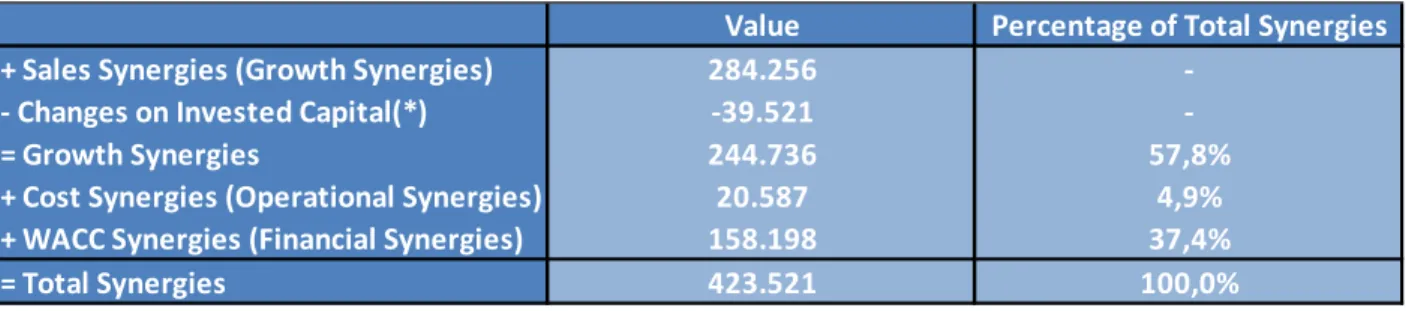
Assim foram calculadas sinergias futuras de 423,521 milhões de dólares. Contudo emergia a questão: qual a fonte destas sinergias?
Com vista à resolução desta questão o autor resolveu separar as sinergias em três grupos: sinergias de crescimento (incremento das vendas), sinergias operacionais (redução nos custos de produção) e sinergias financeiras (diminuição do factor de actualização).
Obteve-se desta forma a seguinte distribuição percentual das sinergias: crescimento 57.8%, operacionais 4.9% e financeiras de 37.4%.
Embora os valores apresentados sejam aliciantes, o futuro é incerto e as sinergias não são garantidas. A actual instabilidade económica e política coloca inúmeros pontos de interrogação relativamente ao futuro da economia global. Situação que adicionada à possibilidade de um
downgrade no rating, ao risco cambial e ao domínio da família Mittal nas decisões da empresa,
poderá promover um impacto devastador na ArcelorMittal.
Embora algumas sinergias já tenham sido alcançadas, após uma integração “amigável”, a ArcelorMittal ainda se encontra num processo de recuperação do investimento efectuado, não se devendo descurar os aspectos relativos à governação empresarial, mudança na envolvente ou alterações nas taxas de câmbio sob pena de cair numa situação de default financeiro.
M&A Causes and consequences
Search for market dominance Bruno Alexandre Lopes dos Santos
VI
Acknowledgments
I would like to thank to every person who had been involved, directly or indirectly, on my thesis development. Since the persons who supported my development as a person, such as Professor Clementina Barroso and Professor António Gomes Mota, professors from the financial department of ISCTE business school, to all of my friends and family. I would like also to acknowledge all and every person which gave me strengths to go forward and to develop this thesis mainly my family and some person who can be considered as so.
But my special gratefulness is to my supervisor/coordinator Professor Pedro Manuel de Sousa Leite Inácio which, since the first moment, supported my thesis, closely followed its evolution, always available understanding and questioning my theories. Thank you!
M&A Causes and consequences
Search for market dominance Bruno Alexandre Lopes dos Santos
VII
Index of tables
Table 1 – Gains on main M&A theories Table 2 – Premiums payment methodology
Table 3 – Expected synergies on main kinds of M&A Table 4 – Main steel extractors & steel transformers (2008) Table 5 – Medium price per tonne sold in Euros (2005) Table 6 – ArcelorMittal kinds of synergies expected Table 7 – ArcelorMittal D/E ratio
M&A Causes and consequences
Search for market dominance Bruno Alexandre Lopes dos Santos
VIII
Index of graphs
Graph 1 – Williamson trade-off Graph 2 – Onion diagram Graph 3 –M&A Waves in U.S Graph 4 – Steel prices evolutions Graph 5 – Nickel prices evolution Graph 6 – Zinc prices evolution Graph 7 – Thermal Coal price $/ton Graph 8 – Coking Coal price $/ton Graph 9 – Iron ore price C/dmu Graph 10 – Natural Gas $/1000m3 Graph 11 – Steel scrap price $/ton Graph 12 – Electricity price C/Kwh Graph 13 – Chinese market power
Graph 14 – Steel production by zone (in tons) Graph 15 – U.S and China steel consumption Graph 16 – Steel demand (Index 2006 Q1=100) Graph 17 – Arcelor’s foundation
Graph 18 – Mittal Steel foundation
Graph 19 – Severstal denomination change
Graph 20 – Negotiations between Arcelor & Mittal
Graph 21 – Main advantage and disadvantage on increasing mining activities Graph 22 – Demand for steel (China against Rest of world)
M&A Causes and consequences
Search for market dominance Bruno Alexandre Lopes dos Santos
IX
Índex
Resumo (Português) ... I Abstract (English) ... II Executive Summary (Sumário Executivo) ... III Acknowledgments ... VI Index of tables ... VII Index of graphs ... VIII
CHAPTER I – Literature Review
1. Introduction ... 1
2. Mergers and acquisitions main differences ... 2
2.1. Acquisitions ... 2
2.2. Mergers ... 2
2.3. Legal and image issues ... 2
3. Global perspective over mergers and acquisitions ... 3
3.1. Reasons for a Regulated Politic on M&A ... 3
3.2. Regulation in North-America ... 4
3.3. Regulation in European Union ... 5
3.4. International Cooperation ... 6
4. Cost/benefit analysis on Mergers and acquisitions: ... 7
4.1. Jacquemin’s approach ... 7
4.2. Williamson trade-off ... 9
5. Organizational/Corporate culture ... 11
5.1. Relevance for M&A valuation and success measurement ... 11
5.2. Cultures and subcultures ... 12
5.3. M&A in different cultures ... 14
5.3.1 The requested cultural leadership ... 14
5.3.2 Avoiding failure in cultural integration ... 14
6. Waves of Mergers and Acquisitions ... 15
1st cycle – Era horizontal mergers ... 16
2nd cycle – Era of vertical mergers ... 16
3rd cycle – M&A activity in the area of conglomerates ... 16
M&A Causes and consequences
Search for market dominance Bruno Alexandre Lopes dos Santos
X
5th cycle: Cycle of cross-boarder mergers - Transnational and Transcontinental M&A ... 17
“6th cycle – Era of M&A in order to fight against globalization” ... 18
7. Main theories of M&A ... 18
7.1. Theory of economic performance and efficiency ... 18
7.1.1 Cost reductions ... 19
7.1.2 Resources rationalization ... 19
7.1.3 Acquisition of resources ... 20
7.1.4 Increasing market power ... 20
7.1.5 Acquisition and diffusion of new technology ... 20
7.1.6 Speculation ... 21 7.2. Agency theory ... 21 7.3. Hurbis theory ... 22 8. Premiums ... 23 8.1. Premiums calculation ... 23 8.2. Premium payment ... 24 9. Synergies ... 24 9.1. Growth synergies ... 25 9.2. Coalition synergies ... 25 9.3. Operational synergies ... 26 9.4. Financial synergies ... 26 9.5. SGA synergies ... 26
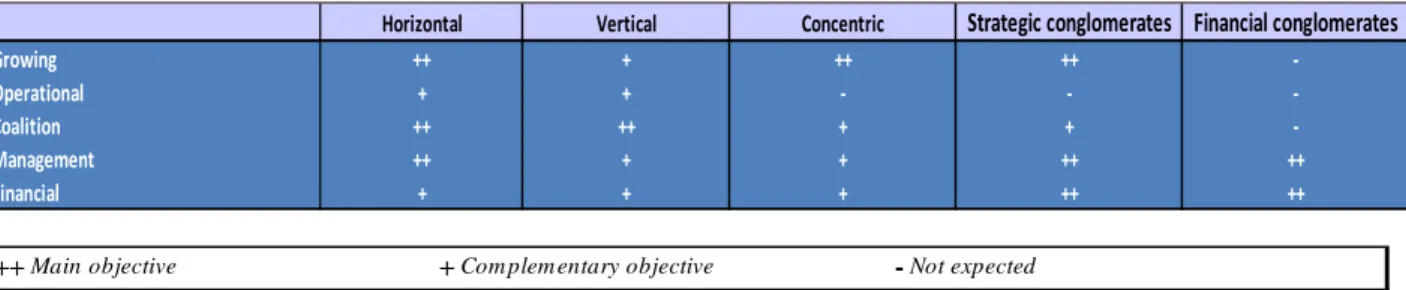
10. Kinds of mergers and acquisitions ... 27
10.1.Horizontal Mergers and acquisitions ... 27
10.2.Vertical mergers and acquisitions ... 28
10.3.Conglomerate mergers and acquisitions ... 28
10.4.Concentric mergers and acquisitions ... 29
CHAPTER II – ArcelorMittal SA Case Study
1. Introduction to the case study ... 302. Steel industry ... 31
2.1. The Chinese emergency ... 34
2.2. The Arcelor and Mittal reaction to the environmental changes ... 36
2.3. Differences between steel industry in United States and Europe ... 37
M&A Causes and consequences
Search for market dominance Bruno Alexandre Lopes dos Santos
XI
2.3.2. European Union (E.U) ... 38
3. Main players ... 39
3.1. Arcelor S.A ... 39
3.2. Mittal Steel ... 40
3.3. Severstal S.A ... 42
4. The Arcelor question ... 43
5. The process ... 45
5.1. Corporate Governance Critics (November/December 2006) ... 45
5.2. Dofasco acquisition (January 26th 2006) ... 46
5.3. First offer (January 27th 2006) ... 47
5.4. Payout measure – Getting back shareholders trust (February 16th 2006) ... 48
5.5. Self tender offer (May 12th 2006) ... 49
5.6. Improved offer (May 19th 2006) ... 50
5.7. Severstal Meaure (May 26th 2006) ... 50
5.8. Shareholders questions about defensive measures – the perspective change ... 52
5.9. Third offer (June 25th 2006) ... 53
6. Future cash flows estimation ... 55
6.1. Enterprise value ... 55
6.2. Synergies ... 58
7. The Risks Associated with ArcelorMittal Merger – “Future Fears” ... 59
7.1. The integration problem in ArcelorMittal’s growth ... 59
7.2. Independency on upstream operations – strength or a weakness ... 59
7.3. Geographical risk ... 60
7.4. People risk ... 61
7.5. Downgrade risk ... 62
7.6. Foreign Exchange risks ... 63
7.7. Capital Expenditures risk ... 63
7.8. Dominant shareholder risk ... 64
7.9. ArcelorMittal distribution process risk ... 64
7.10.Political risk ... 65
7.10.1. Associated with sales ... 65
7.10.2. Associated with resources requirements ... 65
7.11.Efficient integration risk ... 66
M&A Causes and consequences
Search for market dominance Bruno Alexandre Lopes dos Santos
XII
7.13.Steel industry ... 66
8. Conclusions ... 68
Bibliography ... 71
-Books & Monographs ... 71
-Press & scientific publications ... 72
-Thesis ... 74 -Websites ... 75
Exhibits
1. Exhbith regulations ... 76 1.1.Clayton’s Act ... 76 1.2.Rule No 4064/89 of 21 December 1989 ... 862. Exhibit top steel transformers by output ... 114
3. Exhibit main steel transformers financial data (2005) ... 115
4. Exhibit Arcelor financial data (2003-2005) ... 116
5. Exhbit Mittal financial data (2003-2005) ... 117
6. Exhibit Arcelor + Mittal financial data (2003-2005) ... 118
7. Exhibit Mittal offer evolution ... 119
8. Exhibit premiums ... 122
9. Exhibit mining risks associated with ArcelorMittal ... 123
10. Exhibit number of employees by segment ... 125
11. Exhibit ArcelorMittal financial data (2006* - 2008) ... 126
12. Exhibit Wacc assumptions ... 127
13. Exhibit Wacc calculation ... 129
14. Exhibit Arcelor + Mittal future cash flows (projection) ... 131
15. Exhibit ArcelorMittal future cash flows (projection) ... 132
16. Exhibit ArcelorMittal incremental cash flows (projection) ... 133
M&A Causes and consequences
Search for market dominance Bruno Alexandre Lopes dos Santos
XIII
Para os que caminharam comigo: Mãe, Pai, coordenador e avós
CHAPTER I – Literature
Review
M&A Causes and consequences
Search for market dominance Bruno Alexandre Lopes dos Santos
1
1.
Introduction
Creating value and building a sustainable wealth have been the main objectives of business management, which should be spread through all organizational stakeholders and not just centred in management.
Mergers and acquisitions where firstly identified as a turning point in the development of U.S This growth process, quickly became standard in business value creation standards through the world, allowing not only a simple increase on shareholder’s value but, in some occasions, by offering value over the sum of the merged companies, generating synergies1.
This method of organizational development has great significance not only in financial but also in strategic terms. M&A require a profound organizational reorganization by targeting all the organizational stakeholders from members or shareholders, taking care of customers, suppliers, financial and economic regulators not forgetting all the political powers involved.
Organizational change promoted by these growing methods may have different motivations, from achieving a better market position to efficiency improvements. Due to all potential benefits, acquired companies often agree to be purchased knowing that they would not survive alone. This “win-win" should be the basis for successful M&A activity.
In the following essay, the researcher will discuss M&A emphasizing his analysis on one of the main objectives of mergers and acquisitions: the pursuing of market hegemony.
After this introduction the author will present a chapter with a literature review on M&A, followed by a second chapter where the ArcelorMittal case is discussed. On a final stage some conclusion will be extracted.
1Gains related with the companies together generating higher results than the sum of both parts, being the equation
“2+2=5” (Ansoff Igor) the special alchemy of a merger or an acquisition; in another words, the key principle behind buying a company is to create shareholder value over and above that of the sum of the two companies.
M&A Causes and consequences
Search for market dominance Bruno Alexandre Lopes dos Santos
2
2.
Mergers and acquisitions main differences
2.1. AcquisitionsAlthough both constitute a combination of two or more companies, mergers and acquisitions are different issues which sometimes were incorrectly identified as synonymous.
An acquisition is a process where a company acquires2 a part or the totality of another’s capital, such process can be suggested on a:
• “hostile basis” – not desired by the target and usually facing strong barriers imposed by
the acquired company
• “friendly way” – although it can not be totally desired, faces insufficient barriers to its
development
However, this is not a linear division. On business activity, an acquisition which starts on a friendly basis can end on a real “arm wrestling”.
2.2. Mergers
On the other hand a merger happens when two firms voluntary agree to go forward as a single new company rather than remain separately owned and operated.
After the merger process the overall company can remain with the name and judicial constitution of one of the merged companies or promote a merger of equals3.
2.3. Legal and image issues
When one company acquires another, it allows the acquired firm to proclaim the action as a merger. Such action happens mainly because being bought tends to show negative connotations. Presenting the deal as a merger has the propensity to make the takeover process more pleasant. Sometimes, when both CEO’s agree that joining together is in the interest of both
2 Takes over
3 Merger which creates a company with a different designation and different juridical constitution, where companies
stocks are surrendered and new company stock is issued in its place; for example the merger between Daimler-Benz and Chrysler ceased to exists, creating DaimlerChrysler, and the merger between Arcelor SA and Mittal Steel which created ArcelorMittal SA
M&A Causes and consequences
Search for market dominance Bruno Alexandre Lopes dos Santos
3
companies, it is possible to “hide” an acquisition. But when the deal is made on a hostile basis the process is always regarded and transmitted to the market as an acquisition.
3.
Global perspective over mergers and acquisitions
Mergers and acquisitions in different countries and juridical systemsM&A can be experienced in just one country/juridical system or can involve, simultaneously, different juridical systems. This last approach was named as transnational mergers.
Due to its global impact, transnational mergers have recently become a crucial worry for governments. Although governments tried to find some answers to the problems emerged from this kind of mergers, the objective has not been fully achieved.
3.1. Reasons for a Regulated Politic on M&A
Mergers and acquisitions may contribute to the increase in competitiveness for firms operating in a global market. However, powerful companies in the market can promote a decrease on social welfare4. At this stage international regulation guidelines became essential in order to solve the problems arising from those companies dominant behaviour.
First effective idealization over transnational activity was defined based on two main issues:
• Transiting all benefits for social welfare
• Preventing and counteracting any anti-competitive behaviour
Complementing such theory, Neumann (1990) stated that these competition guidelines can be applied on two approaches:
• Constructive – “assuming social welfare as the main objective” being regulation just a
way of replacing the market, when it is not managing resources efficiently or is not maximizing social welfare
M&A Causes and consequences
Search for market dominance Bruno Alexandre Lopes dos Santos
4
• Evolutionist – “based on Schumpeter’s market vision” being competition a dynamic
process which generates technical progress5 and the main objective of regulation is to build an institutional and economic environment which allows innovation, by eliminating barriers to new entrants
Adopting a constructive or an evolutionist analysis, the main purpose should always be promoting efficiency increases on resources usage.
3.2. Regulation in North-America
U.S first step on market regulation of market competition was given in 1890 with
Sherman’s Act promulgation.
Sherman Act constitutes the first “protection” of companies and consumers against dominant
player’s emergency6.
Defending the free competition principle, this act stated that “every person who shall
monopolize, or attempt to monopolize, or conspire with any other person or persons, to monopolize any part of the trade or commerce among several states, or with foreign nations, shall be deemed guilty of a felony” although never referencing M&A, this was the first
regulation against the possibility of social welfare reduction caused by firms concentration. The act which first emphasised mergers and acquisitions was Clayton’s Act (1914). Approved by Federal Trade Commission (FTC) stated that “no corporation engaged in
commerce shall directly acquire the whole or any part of the stock or other share capital of another’s also engaged in commerce (…) where (…) the effect of such acquisition may be substantially to lessen competition” which can be seen also in annex 1.1 – Clayton’s Act. After
its promulgation the Act, together with Anti-trust division of U.S. tribunal of justice, started to be responsible for the detection of any illegal mergers or acquisitions.
In 1976 another step was given with the Hard-Scott-Rodino Antitrust Improvements Act, where legislation about M&A in U.S starts to concern the principle of notification7 in order to control large industrial concentrations.
5 Neumann (1990) “Efficient process are discovered and new markets are creating by competing enterprises”
6 Denominated as trusts
M&A Causes and consequences
Search for market dominance Bruno Alexandre Lopes dos Santos
5
Evolution along the years had been constant and in 1968 the U.S justice department had promulgated the Merger Guidelines8. Although Guidelines were not a law, they brought transparency to control process.
3.3. Regulation in European Union
Rome agreement does not concern any article related to M&A. Before the 80’s M&A activity in the European Union was ruled by the 81º and 82º articles, which do not emphasise M&A issues.
Regulation over M&A was just implemented in the end of 50’s when the U.S had already half century of experience. This new regulation had got together different countries rules in order to shrink, the possibility of negative impacts on global market integration.
As the effective market realization in 1992, was expected to promote M&A exponential growth, additional legislation was needed. Leading to regulation number 4064/89 which concerns, between others:
• Real communitarian application [nº1, 2 and 3 of 1st article]
• Promotion on efficiency issues – an organization can have a technological process without penalizing the consumer surplus [number 1, b) 2nd article]
• Defining a concept where the consumer surplus was near one – being unacceptable to sacrifice the consumer surplus
• Application of strong restriction on M&A which tend to establish or reinforce a dominant market position [number 3 of 2nd article]
As can be seen in the annex 1.2 – rule number 4064/89of 21 December 1989, major part of guidelines was common to U.S Guidelines with specificities of a common market and not a common country.
M&A Causes and consequences
Search for market dominance Bruno Alexandre Lopes dos Santos
6
3.4. International Cooperation
Internal application of regulations early described ignored the external/global effect of M&A. The existence of international cooperation and coordination proved to be essential as a way to obtain cross-border mergers which promote an increase on social welfare. Three main options in order to apply an efficient management over cross-boarder were suggested:
• Bilateral cooperation – reconciling the positions of different regulation authorities
• Creation of competition rules framework for M&A – based on a global regulator such as WTO9
• Multilateral cooperation – with the existence of a worldwide supranational authority
Although to achieve an efficient regulation multilateral cooperation should be the applied methodology on cross-boarder M&A regulation, bilateral cooperation was the more utilized coordination method.
In order to promote a better transnational cooperation some contracts were signed between EU, Canada, Japan and U.S10 in order to promote a multilateral framework.
WTO, as expected, was presented as the promoter of this framework, its principal objective was to harmonize the market and avoid anti-competitive behaviour. Five years after the signing of the first pact (1991), a huge step was given with the creation of the “Working group on the
Interactions between Trade and Competition Policy”. This group identified two anti-competitive
practices:
• Practices which impact on more than one market - with the essential multilateral cooperation in these circumstances where the existence of several authorities with different perspectives can generate several conflicts
• Practices which impact on distinct markets than its home market - there are problems in obtaining and processing information from the other markets, where legislation and regulation can be very closed
9 World Trade Organization
M&A Causes and consequences
Search for market dominance Bruno Alexandre Lopes dos Santos
7
The conclusion extracted was that, given the lack of communication between different countries,
bilateral cooperation can not be sufficient by itself according to WTO a multilateral cooperation
agreement is needed including, between others:
• Principles and rules on a national level – competition policy and regulation on different countries
• Set of rules for anti-competitive practices – transnational rules
• Framework for cooperation provisions, aiming to identify and report anti-competitive practices with substantial effects on international trade
• Mechanism for conflict resolution
Not only domestic but, more than ever, transnational M&A can have negative impact on social welfare strategy and market performance (as will be seen on the topic 4.2.).
Such issues become more complex when the frame of analysis changed from a closed economy to an open economy. As the economy is becoming more global than ever, generate of inefficient situations caused by the lack of information tends to increase.
Although bilateral cooperation has been successful, some innovation is required, imposing the need of a multinational cooperation.
4.
Cost/benefit analysis on Mergers and acquisitions:
4.1. Jacquemin’s approach
As in all business terms, the main question on mergers and acquisitions consist of a success or failure analysis: do these decisions create or destroy value instead?
Following Jacquemin’s (1990) perspective, benefits associated with mergers can be from two kinds:
• Cost reduction in terms of production and/or transaction
M&A Causes and consequences
Search for market dominance Bruno Alexandre Lopes dos Santos
8
The same author refers that benefits provided by cost reductions in terms of production and/or transaction can be achieved by economies of scale11 or economies of scope12.
Both can be achieved with an increase on the rationalization of production and management, motivated by the merger process. Mergers process can be faced as a way to solve inefficiencies, as a company with a lower cost structure tends to increase its market share.
Although marginal costs tend to decrease, on M&A activity arises the problem of
transaction costs. But such costs can also be eliminated or internalized through a merging
process, mainly on a vertical merger. Coase’s approach (1937) stated that “a firm will tend to
grow until the costs of organizing an extra transaction within the firm become equal to the costs of carrying out the same transaction by means of an exchange on the open market”. It is being
positive to internalize activities when the market costs are higher than processing such activities inside the organizational structure.
Jacquemin’s theory also added that benefits associated with management efficiency gains on mergers can be the solution for agency problems13 as will be seen in the topic 7.2.
However, M&A can also have negative impact on customer prices, rival companies and even on merged companies. One example of a negative impact on merged companies can be given by diseconomies of scale14.
Although issues such as diseconomies of scale can be relevant for economic analysis, the main cost referred by economic theories is the one caused on costumer prices and rival companies by the market power increase of merged companies.
11
Follow Jacquemin’s approach (1990) economies of scale can be:
• Static – when result from increase on the production inputs, not changing any production condition
• Dynamic – when result from a learning process
12 “Related with efficiencies primarily associated with demand-side changes, such as increasing or decreasing the
scope of marketing and distribution of different types” (www.wikipedia.com) 13
Eisenhardt (1989), “Agency theory is directed at the ubiquitous agency relationship, in which (the principal)
delegates work to another (the agent), who performs that work. Such problems can arise when: the desires or goals of the principal and agent conflict and or if it is difficult or expensive for the principal to verify what the agent is actually doing” adapted by the author
14 Diseconomies of scale took place when a companies achieve a dimension which become departmental
M&A Causes and consequences
Search for market dominance Bruno Alexandre Lopes dos Santos
9
Such increases tend to boost industrial concentration levels as smaller players, avoiding bankruptcy situations, are acquired by dominant players. Highly concentrated industrial sectors tend to have players selling at higher prices, much higher than their marginal cost, promoting several inefficiencies such as:
• Limitation on the quantity of products placed
• Production costs, become less relevant, as they have a limited impact on results – if companies have higher production costs they simply increase their prices without any market penalization15
Thus, market concentration through M&A can, also lead to price cartelization16. On the other
hand, a decreasing number of companies in the market imply a reduction on customer choice, being itself a cost, leading to a welfare loss.
4.2. Williamson trade-off
The author that developed the deepest study over welfare issues was Williamson, basing his theory on welfare determination promoted by an increase on market power (caused by M&A processes).
Williamson had developed a linear function where, assuming stable costs at a certain production level, tries to determine under what conditions the net effect of a merger on welfare is positive.
15 Also called market monopolization
M&A Causes and consequences
Search for market dominance Bruno Alexandre Lopes dos Santos
10
Williamson theory is described in the following graph:
Graph 1 – Williamson trade-off Source: http://www.med.govt.nz/
The graph shows that:
• An increase on market power is reflected in the increase of the equilibrium price from P1
to P2 and retrenchment of supplied quantities from Q1 to Q2; As a result of this change,
consumer surplus decreases, however such decrease is not entirely appropriated by the supplier:
o While "monopoly profits" area represents a transfer of surplus from consumer to producer;
o “Deadweight” area symbolizes an effective loss in social welfare
• Decrease in average production costs from AC1 to AC2, associated with economies of
scale promote efficiency gains, which result on a social welfare improvement represented by “cost-savings"
Williamson’s theory stated that the net effect of a merger on social welfare will just be positive if:
“Cost-savings” >”Dead-weight”
It is important to refer that Williamson’s model did not consider any difference between producer and consumer surpluses. Defending that “total welfare” is calculated through the sum of both surpluses. However, in his perspective, the balance between efficiency gains and consumer surplus reduction can not be forgotten. Defending that higher Q1/Q2 ratio require a
M&A Causes and consequences
Search for market dominance Bruno Alexandre Lopes dos Santos
11
5.
Organizational/Corporate culture
5.1. Relevance for M&A valuation and success measurement
The relation between corporate culture17 and organizational effectiveness attracted an increasing interest through the years, reaching a climax in the 80’s. At that time corporate culture became a crucial subject due to the influence of organizational values18 in organizational results. On the 80’s Hofstede (1980) and Ouchi’s Theory Z (1981) were the first theories directly related w corporate culture.
Hofstede defended the existence of five cultural dimensions which restricted cultural behaviour:
• Power distance – expected differences between power levels (proximity/distance to the
leader)
• Uncertainty avoidance – capacity to accept environmental uncertainty
• Individualism/Collectivism – acting as a group or as an individual
• Masculinity level – male societies are traditionally ruled by competitiveness, ambition
and material possession, being female societies the reverse
• Short/long term orientation – time horizon orientation
17 Montana and Charnov (2008), “Sum of values, customs, traditions and meanings that make a company become
unique (...) corporate culture is often stated as the character of an organization since it embodies the vision of the company’s founders (...) corporate culture influences ethical standards within a corporation, as well as managerial behavior”
18 Beliefs and ideas about what kinds of goals members of an organization should pursue, concerning also all
M&A Causes and consequences
Search for market dominance Bruno Alexandre Lopes dos Santos
12
Graph 2 – Onion diagram
Source: Hofstede (1994) page 9 [Adapted by author]
If values are more connected with the moral and ethical codes, being a determinant factor of what people think that “should be done”, rituals and symbols reflect what people think “is or is
not true”.
“Onion diagram” defended that acts/attitudes link values with symbols and rituals. In Hofstede’s
perspective what defines the employee’s acts and attitudes is a conjugation between values, rituals and symbols transmitted not only through corporate culture, but also by their own culture.
Theory Z developed by Ouchi, also called "Japanese Management style”, was focused on
employees loyalty to the company. Ouchi defended that companies should provide a welfare increase for any employee, in his perspective:
“High Employees Satisfaction = Productivity Increase”
5.2. Cultures and subcultures
It is common to identify organizations with one corporate culture, which is generally the culture of top management. On real business life cultural homogeneity is not verified, as several sub-cultures can be found that compete with the top management culture.
Working teams can also create their own habits and peculiar interactions which may lead to tensions within organizational structure disturbing the whole system. In this perspective, Roger Harrison (1972) and, on the 80’s, Charles Handy (1985) stated that corporate culture can be adapted within different departments.
M&A Causes and consequences
Search for market dominance Bruno Alexandre Lopes dos Santos
13
Roger Harrison and Charles Handy described four ways to link organizational structure to
corporate culture:
• Power culture – concentration of power on a few
• Role Culture – power derives from hierarchical position
• Task Culture – power derives from expertise
• Personal Culture – all individuals believe themselves as superiors to the organization
Charles Handy defended that Personal Culture frequently makes organizational structure hard to manage.
Another contribution was brought by Edgar H. Schein (1985) that described corporate
culture as "a pattern of shared basic assumptions that the group learned as it solved its problems of external adaptation and internal integration, that has worked well enough to be considered valid and, therefore, to be taught to new members as the correct way to perceive, think, and feel in relation to those problems" developing a standpoint observation which characterized three
cognitive levels:
• First level includes artifacts19, facilities and offices, the way company employees interact with organization outsiders, slogans or “jokes” which characterize organizational environment
• Second level concerns organizational values, which tend to be studied trough interviewing processes
• Third level is where organization's tacit assumptions20 are placed; its existence is usually consciously unknown by the membership; being an element, usually, not investigated due to its complexity level
According to Schein's model miss understanding cultural norms can strongly compromise organizational future, meaning that the first and second levels can not be totally applied without the third21.
19
Organizational attributes that can be seen, felt and heard by an “amateur” observer
20 Culture elements that are unseen and not cognitively identified on daily interactions between organizational
M&A Causes and consequences
Search for market dominance Bruno Alexandre Lopes dos Santos
14
5.3. M&A in different cultures
5.3.1 The requested cultural leadership
As it was previously justified “different cultures within organizations are frequently
appointed as one of the main reasons for the failure of integration processes”.
On M&A processes each organization has its own culture which tends to clash when brought together due to cultural differences22.
The main way to solve such differences is through the imposition of a strong cultural leadership. Organizational leaders should also be cultural leaders making possible the change from the two old cultures into a “unified” new culture. A common culture should concern:
• Culture innovation, through recognition of cultural differences, creating a new culture
which replaces the previous cultures, and a
• Culture maintenance by reconciling old cultures in the new “unified” culture
5.3.2 Avoiding failure in cultural integration
If it is possible to find a dominant culture within an organization, it is understandable that M&A increase these features and cause culture shock on different levels of the merged organization.
Sometimes such shocks are expected and anticipated by cultural due diligence. The main problem arises when those cultural aspects are overlooked and undervalued, and cultural shock appears after the signing of the contract with all its potential hazards.
Failure to link strategic vision to process objectives may jeopardize organizational operations. Due diligence23 is essential to avoid such errors on mergers or acquisitions evaluation
process.
21 Such situation leads, for example, to increasing difficulty for newcomers to assimilate organizational culture also
explaining the change failure
22
Which generate lack of identity, communication problems, and inter-group conflicts
23 Process which allows an individual evaluation process, due to the specificity of M&A operations “each merger is
M&A Causes and consequences
Search for market dominance Bruno Alexandre Lopes dos Santos
15
The basic function of due diligence on M&A context is to evaluate responsibilities, results and risks associated with each decision.
Being essential:
• Knowledge of the business
• Strong skills/competencies to match that knowledge, supported by clear objectives added to common sense
• Flexibility and open mind to constantly raising new questions This analysis should always be focused on the cultural integration process.
6.
Waves of Mergers and Acquisitions
Association with the environmental change
M&A cycles have not a specific starting or ending date, authors diverge when trying to point a date for the start of a new M&A cycle. By the other way ending dates are generally pointed as coincident with wars or financial disasters.
Cycles produce different effects depending on the political and economic space in which they took place. Analysing American’s (U.S.) economy, historians and economists refer 5 waves of mergers:
Graph 3 – M&A waves in U.S. Source: Paulo Bento (2004)
M&A Causes and consequences
Search for market dominance Bruno Alexandre Lopes dos Santos
16
1st cycle – Era horizontal mergers
(1897 – 1904)
First M&A cycle was marked by a strong increase on horizontal mergers activity which created mainly steel, telephone, oil, mining, railroad and other giants of the manufacturing industry.
In this era some monopolies raised, followed by a deep transformation on economic and business structure, strongly associated with the installation of railways.
First cycle of M&A had slowed down with panics of 1904 and 1907, in association with the First World War and the creation of first anti-trust regulations.
2nd cycle – Era of vertical mergers
(1924 – 1929)
Second cycle promoted fundamental changes on economic structure, with consolidation of industries that were the subject of the first wave and also a significant increase on vertical integration processes.
This was the cycle where crucial developments in technology and manufacture took place, with the major automobile manufacturers reinforcing positions through new production processes 24
. The era of vertical mergers ended with 1929 “Crash” and “Great Depression”.
3rd cycle – M&A activity in the area of conglomerates
(1950 – 1969)
Period in which the “conglomerate concept” raised in U.S. Assuming a visionary position, some of the major conglomerates, such as IT&T or Litton, were created.
In order to follow the market trend, some established companies accepted the concept and start a diversification process into new industries/areas.
Conglomerate stocks crashed in 1969 and the diversified companies never achieved the expected diversification benefits.
M&A Causes and consequences
Search for market dominance Bruno Alexandre Lopes dos Santos
17
4th cycle – M&A activity on concentric mergers, hostile takeovers, LBO's and junk bonds
(1984 – 1989)
Cycle also named as the “era of hostile takeovers25, characterized by a fierce bidding war for strategic positions.
In addition there was an increasing number of junk bond financing and a steadily increasing volume/size of LBO’s26.
After the 1987 stock market crash, U.S. corporate raiders had paused for a few months. The cycle ended with the collapse of the junk bond market in 1989/1990 added to the decreasing on savings and banks loans.
5th cycle: Cycle of cross-boarder mergers - Transnational and Transcontinental M&A
(1995 to …)
Cycle marked by deals with high transactional values named as “mega-deals”27 open space for uncommon processes “mergers of equals” (explained in the topic 2.2). Companies of unprecedented size and global sweep were created in this period28 on the assumption that size matters, boosting organizational market value.
The main problem is that high stock prices pressure companies to do “huge deals” to maintain heady trading multiples which, for some, were not supportable in the long run.
Fifth cycle was also the period of Millennium Bubble bursting and of great scandals, such as Enron, which promoted a revolution in all corporate governance issues.
For some authors this cycle is not ended yet, but for others, the collapse had started with the fall down of Internet stocks in 2000 followed by financing problems of telecoms, defending that a 6th cycle had already started.
25
The first major-company hostile bid was made by Morgan Stanley on behalf of Inco, which “opened the door” for the major investment banks to make hostile takeover bids on behalf of raiders
26 “highly-leveraged transaction (HLT), or bootstrap transaction occurs when a financial sponsor acquires a
controlling interest in a company's equity and where a significant percentage of the purchase price is financed through leverage borrowing” (www.wikipedia.com)
27 Nine of the ten largest deals in history, until 1995, took place in this period
M&A Causes and consequences
Search for market dominance Bruno Alexandre Lopes dos Santos
18
“6th cycle – Era of M&A in order to fight against globalization”
“(2003 to …)”
The stronger contradiction starts in the fifth cycle ended/sixth cycle start. In some authors opinion, after the first cycle ended, somewhere in 2001, the growth of merger activity between 2002 and 2006 (from USD1.2 trillion to USD 3.4 trillion) created a new M&A cycle.
Main factors which justify this growth were:
• Globalization
• Encouragement promoted by governments of some countries29 to create some strong, internal and external, players
• Low financing costs availability and
• Tremendous growth of private equity funds with an increase in management-led buyouts.
“The winds of globalization have forced businesses to target beyond their national borders for competitive advantage that is world wide in scale” (http://www.lexuniverse.com – history of U.S
M&A).
7.
Main theories of M&A
In the last decades have been witnessing an increase amount on M&A activity. Between the main theories that justify such situations can be found:
• Economic performance and efficiency
• Conflict between decision makers and investors (agency theory)
• Hubris existence
7.1. Theory of economic performance and efficiency
Historically appointed as the main cause for business change, economic performance and efficiency theory defend that motivation for M&A procedure emergency is profit and company
M&A Causes and consequences
Search for market dominance Bruno Alexandre Lopes dos Santos
19
value maximization, which is achieved through an efficient combination of two, or more, businesses.
Such efficient is reached when the expected value is greater than the sum of both parts “2 +2 =
5” (Ansoff, Igor).
V (A+B) > VA + VB
Meaning that Companies together have an higher value than companies summed
Between the latest theories six causes can which promote this additional value can be found: cost reductions, resources rationalization, increased market power, acquisition of resources, acquisition of new technology and speculation.
7.1.1 Cost reductions
Cost reductions can occur on:
• Financial costs – arising from the existence of surplus funds on one company/business, which can be transferred to other businesses, internally financing its investment needs
• Operational costs – M&A can create economies of scale or scope (as it was explained on the topic 4.1) which can also promote a more efficient usage of human and technological resources, plant, equipments, materials and other inputs leading to a cost reductions.
7.1.2 Resources rationalization
Usually associated with optimized usage of available resources after a business combination, joint production will tend to reduce costs. If in the joint company there is one production facility able to fit all production requirements at a lower marginal cost, the merger process will tend to “close down” all remaining plants rationalizing the production resources.
However, economies of scale are more frequent in the distribution area, where a large supply chain with a broader coverage allows for lower distribution costs.
M&A Causes and consequences
Search for market dominance Bruno Alexandre Lopes dos Santos
20
7.1.3 Acquisition of resources
An acquisition or a merger allows to the acquirer control over the acquired company resources. Expressing, following Porter’s idea (1980) “a fast way of organic growth” inside or outside country boundaries.
Acquisition of resources through cross-border30 M&A tends to be, nowadays, critical for business development when trying to access new markets or even reinforce its presence. M&A allows the elimination/reduction of lack of experience and knowledge in new markets.
7.1.4 Increasing market power
Increases on market power after M&A processes, due to the increase on market share, promote the improvement of organizational power over customers, suppliers, staff and other stakeholders putting higher barriers to new entrants. As it was explained in the topic 6 on the first U.S M&A cycles was common a fast achievement of monopolistic positions. With the emergency of some antitrust rules such processes become more controlled.
More recently, with the impact of the financial crisis, M&A process was referred as one way to avoid small organizations insolvency, being acquired by major industry players contributes to an increasing market power of the merged company.
7.1.5 Acquisition and diffusion of new technology
In order to stay competitive, players need to be on top of technological developments and business applications, M&A process assumes in such circumstances a crucial position. With the acquisition of other players, organizations can maintain or even develop their competitive edge31. Acquisitions allow spreading knowledge through combined companies, which could speed up the objectives achievement, seen as impossible without the combination.
30 Outside country boundaries
M&A Causes and consequences
Search for market dominance Bruno Alexandre Lopes dos Santos
21
7.1.6 Speculation
Speculative actions are associated not only with different performance expectations and with relative position on industry sectors, but also take into account behavioural perspectives of organizational managers32 - Different managers build different organization structures.
In the recent past, due to high economic fluctuation, an elevated level of speculation processes took place with a strong increase on opportunistic acquisitions33.
7.2. Agency theory
Conflict between shareholders and managers
Agency theory described by Jensen-Meckling (1976), argued that “managers should act
as agents of shareholders (…) trying to avoid situations where there is a conflict of interests between decision makers and company owners” Jensen-Mecklin named such problems as agency problems.
Stating that managers promote organizational growth and constantly efficiency improvements was the way to achieve their desired power and other rewards.
In this issue of efficiency level some measures can become a “conflict point”. Taking as an example the investment of surplus funds from operations34 although it allows the financing of new projects, shareholders, worried about short-term dividends would strongly oppose to such decision creating agency problems.
In such cases the solution appointed by Jensen’s theory was that managers should distribute the surplus (FCFF) to shareholders through extraordinary surplus or acquire own shares (boosting market shares value).
In Agency theory, M&A was appointed as one radical solution, applied in order to restore the required efficiency and harmony of interests between shareholders, managers and all stakeholders.
32
Different managers create different companies
33 Short term acquisitions aimed to selling at higher prices, not following any economic reasoning
M&A Causes and consequences
Search for market dominance Bruno Alexandre Lopes dos Santos
22
7.3. Hurbis theory
According to Roll (1986) ideology managers make mistakes on “target companies” evaluation.
When acquiring a company listed on the stock market, the offer, due to market efficiency, should concern a conjugation between:
• Acquired company value – given by the market through market capitalization
• A Premium35 – justified by the incremental cash flows the merged company is
expected to generate
Roll’s theory emphasis the mistake made by managers evaluation on premiums definition, which are driven to pay a higher price36 being “infected by Hubris”.
Hubris existence lead acquirer managers to reduce requested due diligence tasks. Hubris in the
case of takeovers can be associated with “auctions”, the higher the competition, higher the premium.
The main problem become visible after the takeover, when synergies gains are not sufficient to cover the excessive premium paid. Such insufficiency is named as "winners curse"37.
Acquirer benefits Acquired benefits Total gains
Economic Performance and Efficiency + + +
Agency Theory - 0 or +
-Hubris - + 0
+ Positive gains - Negative gains 0 Null gains
Table 1 – Gains on main M&A theories Source: Berkovich-Narayanan (1993)
Following Berkovich-Narayanan (1993) M&A processes motivated by economic performance and efficiency improvements should create a positive impact even on the acquirer or acquired organizations.
35
Difference between the offer value and the market value
36 Roll (1986) "bidding firms infected by hubris simply pay to much for their targets"
M&A Causes and consequences
Search for market dominance Bruno Alexandre Lopes dos Santos
23
But such results do not held for M&A motivated either by Agency theory, an acquisition motivated by lack of trust between managers and shareholders, or infected with Hubris, which became “problematic when there is more than one potential bidder” Robinson (2003).
8.
Premiums
8.1. Premiums calculation
On mergers and acquisitions evaluation process some discrepancies can arise. Sometimes evaluation just focus on “positive results”, but such results may not be enough to cover the cost
of capital. Analysis based on accounting results or on value creation38 may lead to different conclusions.
This evaluation process tends to be facilitated not only by the knowledge in advance of some strength’s generated by the combination, but also by the previous knowledge of future obstacles. Rodriguez in 2003 stated that “in order to reduce disparities, some information should be
worked in advance, before the final signing of the contract” it is also relevant to study the value
creation which “should be taken into account not only the characteristics of tangible and
intangible assets but also its influence on ultimate success”.
Questions about valuation processes often lead to paid premiums to being questioned as one obstacle to combinations success. High premiums may represent an excessive force demonstration, but constitute an incentive for the acquired company being, at the same time, a potential synergies indicator.
In order to predict the future synergies it is essential to know if the acquisition was made on a hostile or friendly basis.
38 EVA (economic value added) or CFROI (cash flow return on investment) are examples of financial instruments
M&A Causes and consequences
Search for market dominance Bruno Alexandre Lopes dos Santos
24
8.2. Premium payment
Being acquisitions an investment, payment method will also produce future effects. Usually represented by only one, or a combination, between the two following payment methods:
• In cash – where the acquirer issues funds, which may exist within the company or must
be obtained externally
• By shares – situation where the acquirer issue shares that are distributed to the acquired
company shareholders; since there is no need for the use of funds, there is no increase in the financial risk of the new entity
However, considering future financial risks, it is important to take into account the fact that in a cash payment the shareholders leave risks exclusively on the purchasing company, when the shares payment is applied, the future risks are shared among all shareholders involved (acquirer and acquired).
Acquirer responsibility Acquired responsibility "Corporate involvement"
Cash Payment + - Only Acquirer
Shares Payment + + Acquirer & Acquired
Table 2 – Premiums payment methodology Source: Author
9.
Synergies
Decision takers on mergers, acquisitions and other alliances have to know which resources, skills and other assets can be the source of "value creation". Through an individual evaluation of each situation, as each asset have its own characteristics. Such evaluations can be generalized or not.
One of the main difficulties on synergies evaluation comes from the fact that after making an acquisition assuming future synergies, it become difficult to measure what would be the performance, after the change, without the combination.