Nauplius
THE JOURNAL OF THE
BRAZILIAN CRUSTACEAN SOCIETY
e-ISSN 2358-2936 www.scielo.br/nau www.crustacea.org.br
Additional distribution and ecology
records of the deep-water isopod
Rocinela murilloi
Brusca & Iverson, 1985
(Isopoda, Aegidae) in western Mexico
Michel E. Hendrickx
Laboratorio de Invertebrados Bentónicos, Unidad Académica Mazatlán, Instituto de Ciencias del Mar y Limnología, Universidad Nacional Autónoma de México. P.O. Box 811. Mazatlán, 82000, Sinaloa, Mexico.
ZOOBANK: http://zoobank.org/urn:lsid:zoobank.org:pub:08480E56-BE1B-463E-8D2F-F9F402F9BDC4
ABSTRACT
A series of specimens of the fish external parasite Rocinella murilloi Brusca and Iverson, 1985, is reported from 12 localities off western Mexico. These records are the first for southwestern Mexico (four) and add six new localities off the west coast of the Baja California Peninsula where the species was known from a single record. The specimens were recovered from bottom-operated nets, between 700 and 1235 m, slightly shallower than previous records. Environmental conditions confirm the presence of R. murilloi below the core of the Oxygen Minimum Zone, and this species appears to be highly tolerant to moderate to severe hypoxic conditions. General distribution of the species in the eastern Pacific is presented.
KEY WORDS
Isopods, deep sea, eastern Pacific, environmental parameters
INTRODUCTION
Species of the genus Rocinela Leach, 1818, in the eastern tropical Pacific were reviewed by Brusca and France (1992). The deep-water isopod Rocinela murilloi Brusca and Iverson, 1985, was originally described from material collected by the “Velero IV” off Punta Guiones on the coast of Costa Rica at 1,866 m depth. Later records by Brusca and France (1992) indicated that this is a widely distributed species, occurring in Californian waters, particularly from the San Diego area, off the Baja California west coast (one locality at Punta Descanso), Mexico, off Peru (near Lobos de Tierra and Lobos de Afuera Islands), and off Arica, Chile. Until 2008 the only locality reported for the Gulf of California was at 21°19’N 106°24’W, at 1201 m depth, but a series of specimens was reported in six new localities in the southern Gulf (Hendrickx, 2008). Despite its wide distribution, R. murilloi has been scarcely reported from the eastern Pacific except from off California (Brusca and
CORRESPONDING AUTHOR Michel E. Hendrickx [email protected] SUBMITTED 04 July 2018 ACCEPTED 30 October 2018 PUBLISHED 06 December 2018
DOI 10.1590/2358-2936e2018036
All content of the journal, except where identified, is licensed under a Creative Commons attribution-type BY.
France, 1992), and there are large latitudinal intervals with single or no records, e.g., the SW coast of Mexico, south of the Gulf of California, off Central America except Costa Rica, and off Pacific Colombia and Ecuador.
During exploratory cruises off the west coast of the Baja California Peninsula and off SW Mexico, more material of R. murilloi was collected in 12 localities, thus extending our knowledge on the distribution and occurrence of this large species of Aegidae off western Mexico. Additional information on its ecology was also obtained. Two additional records from the Gulf of California are also included in this report.
MATERIAL AND METHODS
The specimens on which this study is based were collected during the TALUD VIII (April 2005), X (February 2007; Gulf of California), XII (April 2008; SW Mexico), XV (July–August 2012), and XVI-B (May 2014) (both off Baja California west coast) cruises aboard the R/V “El Puma” of the Universidad Nacional Autónoma de México (UNAM). Material was collected in depths of 700–1235 m with a benthic sledge operating in a global depth interval of 300–2300 m. Environmental data near the bottom (epibenthic) were obtained with a Seabird CTD (water temperature) and by direct titration of oxygen concentration in water samples collected with General Oceanic Niskin bottles. Sediments were collected with a multicore meiofauna sampler. Organic matter was determined by the ignition method. Depth was measured with ship echosounders (see Papiol et al., 2016 for further details). The material has been deposited in the Regional Invertebrate Collection (ICML-EMU), UNAM, in Mazatlán, Mexico. Abbreviations: St., station; spec., specimen(s); TL, total length (± 0.1 mm). SEM (Scanner Electron Microscope) photographs of appendages were obtained during this study.
SYSTEMATICS
Aegidae White, 1850
Rocinela Leach, 1818
Rocinella murilloi Brusca and Iverson, 1985
(Figs. 1–4)
Rocinella murilloi Brusca and Iverson, 1985: 44, fig. 14 a–j.— Brusca and France, 1992: 258, figs. 1A–B, 2, 4A, 5H, 15–17. — Espinosa-Pérez and Hendrickx, 2001, 47 (list). — Hendrickx, 2008: 1260.
Material examined. TALUD VIII, St. 20 (25º56’56”N 110º43’W), Apr 19, 2005, 1 spec. (TL 14.1 mm), BS, 700–750 m (ICML-EMU-9971).
TALUD X, St. 9 (27º52’51”N 112º15’53”W), Feb 10, 2007, 1 spec. (TL 18.5 mm), BS, 1205–1215 m (ICML-EMU-9969).
TALUD XII. St. 13 (17°45’16”N 102°0’29”W), Mar 30, 2008, 1 spec. (TL 34.5 mm), BS, 1198 m (ICML-EMU-10630-A); St. 23 (18º33’43”N 103º57’45”W), Abr 1, 2008, 50 spec. (TL 25.4–34.4 mm), BS, 1058– 1088 m (ICML-EMU-9973); St. 27 (18º40’28”N
Figure 2.Rocinela murilloi Brusca and Iverson, 1985, female, 33.4 mm (ICML-EMU-9973), SEM photographs of pereopods. A, pereopod I; B, same, detail of propodus; C, same, detail of carpus and distal part of merus; D, pereopod II; E, same, detail of propodus; F, same, detail of carpus and merus; G, pereopod III; H, same, detail of propodus; I, same, detail of carpus and merus.
104º35’51”W), Abr 2, 2008, 4 spec. (TL 16.2–34.8 mm), BS, 1040–1095 m (ICML-EMU-9972); St. 28 (18º50’19”N 104º34’14”W), Apr 2, 2008, 1 spec. (TL 33.7 mm), BS, 1101–1106 m (ICML-EMU-9970).
TALUD XV. St. 1 (23°18’ 40”N 111°19’ 37”W), Aug 4, 2012, 4 spec. (TL 11.9–14.1 mm), BS, 750– 850 m (ICML-EMU-10630-B); St. 5C (23º16’42”N 110º54’55”W), Aug 5, 2012, 4 spec. (TL 25.8–34.7 mm), BS, 980–1036 m (ICML-EMU-10632-A); St. 5E (23º05’22”N 110º27’54”W), Aug 5, 2012, 1 spec. (TL 34.8 mm), BS, 948–954 m (ICML-EMU-10630-C); St. 8 (24º54’48”N 112º38’06”W), Jul 30,
2012, 1 spec. (TL 33.3 mm), BS, 1212–1235 m (ICML-EMU-10631-B); St. 24 (27°5’42”N 114°35’30”W), Aug 1, 2012, 1 spec. (TL 32.1 mm), BS, 772–786 m (ICML-EMU-10631-A).
TALUD XVI-B, St. 5 (28º48’6”N 115º24’6”W), May 24, 2014, 1 spec. (TL 31.6 mm), BS, 772–776 m (ICML-EMU-10632-B).
long; eyes large, dark, widely separated; antenna 1 short, antenna 2 extending to pereonite III; pereonite I the longest; coxae of pereonites V–VII extending posteriorly; pleotelson with a pair of submedian pits (Fig. 1). The original description (Brusca and Iverson, 1985) also included illustrations of the pereopods I, IV and VII, the maxilliped, the pleopods 1–5, and a dorsal view of the female holotype. Brusca and France (1992) completed the illustration series by adding drawings of the frontal margin of the carapace (ventral
view), the mandible, the maxillule, the maxilla, the pereopod III, and the uropod (all from the holotype). SEM photographs of selected appendages and of
the frontal portion of the carapace of R. murilloi
(Figs. 2–4) are provided here for the first time. The shape and ornamentation of pereopods I–III of the material examined (Fig. 2A, D, G) perfectly match the illustrations and descriptions provided by Brusca and Iverson (1985) and Brusca and France (1992), with the inferior margin of the propodus featuring a
Figure 4. Rocinela murilloi Brusca and Iverson, 1985. A, female, 33.4 mm; B, C, female, 33.6 mm (ICML-EMU-9973). A, ventral view of the frontal part; B, scales on second article of pereopod III; C, same, magnified.
distally expanded, broadly-rounded lobe, with 5-5-5 (pereopods I-II-III) stout, recurved spines (Fig. 2B, E, H). In the pereopod I, the carpus has one stout spine (Fig. 2C), and the merus features 2 distal spines (Fig. 2C) and 1 subbasal, shorter spine. Pereopod II (not described previously) (Fig. 2D–F) is similar to pereopod I but with two stout spines on the carpus (Fig. 2F). The merus of pereopod III (Fig. 2G, I) has 3 long, distal stout spines, decreasing in length towards the proximal margin, and one shorter, proximal spine.
The mandible of the examined material (Fig.
3A–F) also closely matches the description and
illustrations provided by Brusca and France (1992), with a 3-articulated palp (Fig. 3A, B), the second article about twice as long as first, and with a distal row of about 10 serrate spines and 2 distal, single setae (Fig. 3B); the strongly projecting linguiform molar process (Fig. 3C) also matches the description, and is covered by regularly spaced rows of minute spines (Fig. 3D); the claw-like incisor is spoon-like, ending in a rather sharp tip (Fig. 3E), and the lobe between the molar process and the incisor (the lamina mobilis of Brusca and France, 1992) seems to be an isolated process surrounded by a field of numerous, sharp spinules (Fig. 3F).
Brusca and France (1992) also provided an illustration and a SEM photograph of the ventral view of the frontal part of R. murilloi carapace, with a narrow, arrowhead shape frontal lamina that perfectly matches the material examined (Fig. 4A).
The surface of the pereopods I–III articles is covered by minute scales (Fig. 4B, C), not illustrated previously.
DISCUSSION
Rocinela murilloi is a widely distributed deep-water aegid, ranging from California to Chile (Brusca and France, 1992; Hendrickx, 2008). It was reported for this geographical range by Espinosa-Pérez and Hendrickx (2001) but inadvertently omitted by the same authors for polar and temperate waters of the East Pacific (Espinosa-Pérez and Hendrickx, 2006).
Hendrickx (2008) reported a total of 11 specimens from seven localities in the southern Gulf of California. The material examined in the present study amounts to two additional specimens from the southern Gulf of California (2 localities), 56 specimens from SW Mexico
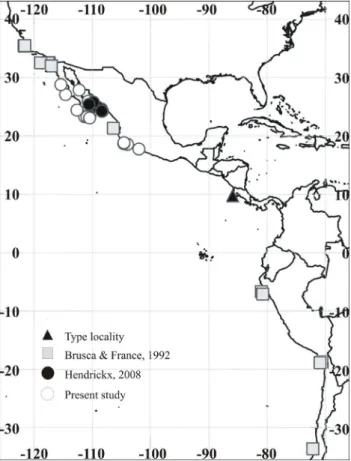
(4 localities), and 12 specimens from off the west coast of the Baja California Peninsula (6 localities) (Fig. 5). With a total of 81 specimens found in 19 localities,
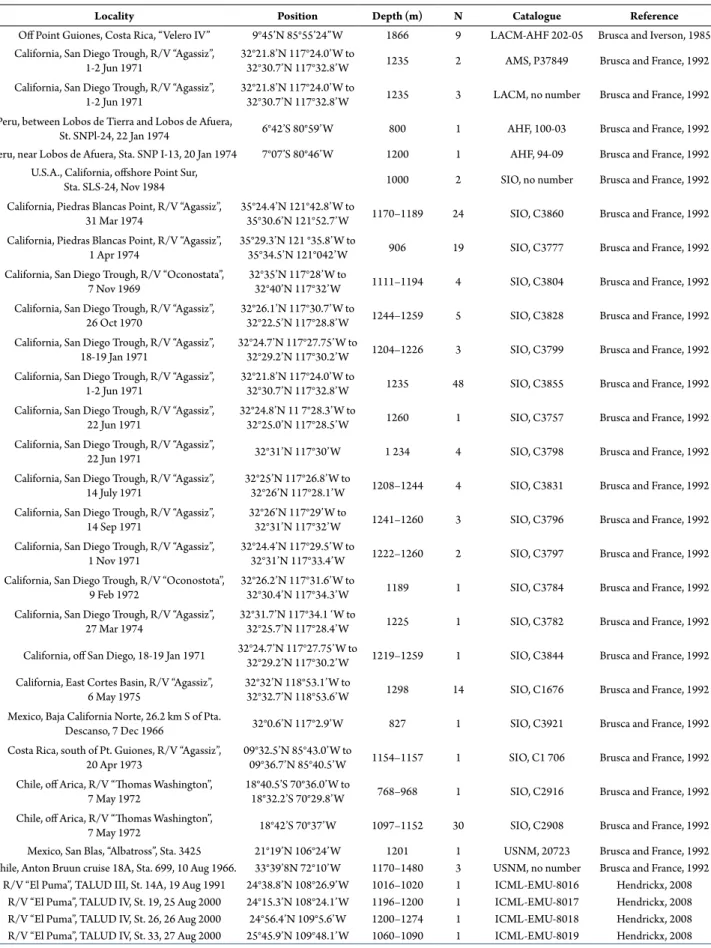
R. murilloi appears to be a widespread and relatively common species of fish parasite in deep-water off western Mexico. When considering new and previous records for this species (Tab. 1), there is a clear lack of data for very wide areas in the eastern Pacific (Fig. 5), particularly between SW Mexico (17°45’16”N) and Costa Rica (ca. 09°36.7’N), between Costa Rica and northern Peru (7°07’S), and between northern Peru and Chile (only two records in ca. 18°40’S and 33°39’S).
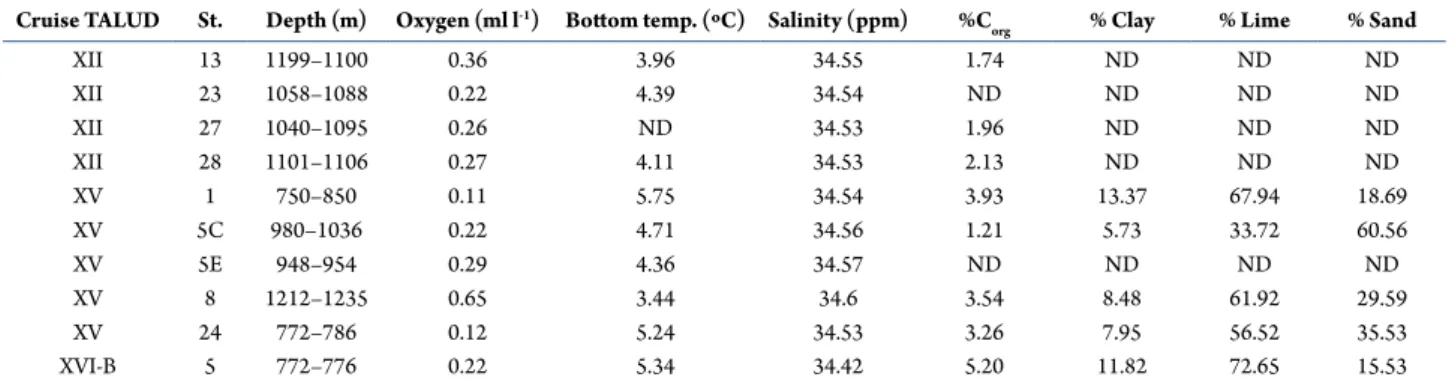
The material reported by Hendrickx (2008) for the southern Gulf of California was collected at depths of 890 to 1274 m, with an epibenthic dissolved oxygen range of 0.20 to 0.76 ml/l, and a bottom temperature range of 3.6 to 5.3 ºC. Overall depth range of the additional material examined herein is 700 to 1235 m, thus slightly shallower than previously known (768 to 1866 m; Brusca and France 1992). The new material reported herein was collected in a lower dissolved oxygen concentrations range (i.e., 0.11–0.65 ml/l) and a slightly different temperature range (i.e.,
Table 1. Previous and present records of Rocinela murilloi Brusca and Iverson, 1985 in the eastern Pacific. N, number of specimens; LACM-AHF, Los Angeles County Museum of Natural History, ex-Allan Hancock Foundation, California; AMS, The Australian Museum, Sydney; SIO, Scripps Institution of Oceanography, California; USNM, United States National Museum, Washington D.C. Some closely set records overlap.
Locality Position Depth (m) N Catalogue Reference
Off Point Guiones, Costa Rica, “Velero IV” 9°45’N 85°55’24”W 1866 9 LACM-AHF 202-05 Brusca and Iverson, 1985 California, San Diego Trough, R/V “Agassiz”,
1-2 Jun 1971
32°21.8’N 117°24.0’W to
32°30.7’N 117°32.8’W 1235 2 AMS, P37849 Brusca and France, 1992 California, San Diego Trough, R/V “Agassiz”,
1-2 Jun 1971
32°21.8’N 117°24.0’W to
32°30.7’N 117°32.8’W 1235 3 LACM, no number Brusca and France, 1992 Peru, between Lobos de Tierra and Lobos de Afuera,
St. SNPl-24, 22 Jan 1974 6°42’S 80°59’W 800 1 AHF, 100-03 Brusca and France, 1992 Peru, near Lobos de Afuera, Sta. SNP I-13, 20 Jan 1974 7°07’S 80°46’W 1200 1 AHF, 94-09 Brusca and France, 1992
U.S.A., California, offshore Point Sur,
Sta. SLS-24, Nov 1984 1000 2 SIO, no number Brusca and France, 1992 California, Piedras Blancas Point, R/V “Agassiz”,
31 Mar 1974
35°24.4’N 121°42.8’W to
35°30.6’N 121°52.7’W 1170–1189 24 SIO, C3860 Brusca and France, 1992 California, Piedras Blancas Point, R/V “Agassiz”,
1 Apr 1974
35°29.3’N 121 °35.8’W to
35°34.5’N 121°042’W 906 19 SIO, C3777 Brusca and France, 1992 California, San Diego Trough, R/V “Oconostata”,
7 Nov 1969
32°35’N 117°28’W to
32°40’N 117°32’W 1111–1194 4 SIO, C3804 Brusca and France, 1992 California, San Diego Trough, R/V “Agassiz”,
26 Oct 1970
32°26.1’N 117°30.7’W to
32°22.5’N 117°28.8’W 1244–1259 5 SIO, C3828 Brusca and France, 1992 California, San Diego Trough, R/V “Agassiz”,
18-19 Jan 1971
32°24.7’N 117°27.75’W to
32°29.2’N 117°30.2’W 1204–1226 3 SIO, C3799 Brusca and France, 1992 California, San Diego Trough, R/V “Agassiz”,
1-2 Jun 1971
32°21.8’N 117°24.0’W to
32°30.7’N 117°32.8’W 1235 48 SIO, C3855 Brusca and France, 1992 California, San Diego Trough, R/V “Agassiz”,
22 Jun 1971
32°24.8’N 11 7°28.3’W to
32°25.0’N 117°28.5’W 1260 1 SIO, C3757 Brusca and France, 1992 California, San Diego Trough, R/V “Agassiz”,
22 Jun 1971 32°31’N 117°30’W 1 234 4 SIO, C3798 Brusca and France, 1992 California, San Diego Trough, R/V “Agassiz”,
14 July 1971
32°25’N 117°26.8’W to
32°26’N 117°28.1’W 1208–1244 4 SIO, C3831 Brusca and France, 1992 California, San Diego Trough, R/V “Agassiz”,
14 Sep 1971
32°26’N 117°29’W to
32°31’N 117°32’W 1241–1260 3 SIO, C3796 Brusca and France, 1992 California, San Diego Trough, R/V “Agassiz”,
1 Nov 1971
32°24.4’N 117°29.5’W to
32°31’N 117°33.4’W 1222–1260 2 SIO, C3797 Brusca and France, 1992 California, San Diego Trough, R/V “Oconostota”,
9 Feb 1972
32°26.2’N 117°31.6’W to
32°30.4’N 117°34.3’W 1189 1 SIO, C3784 Brusca and France, 1992 California, San Diego Trough, R/V “Agassiz”,
27 Mar 1974
32°31.7’N 117°34.1 ‘W to
32°25.7’N 117°28.4’W 1225 1 SIO, C3782 Brusca and France, 1992 California, off San Diego, 18-19 Jan 1971 32°24.7’N 117°27.75’W to
32°29.2’N 117°30.2’W 1219–1259 1 SIO, C3844 Brusca and France, 1992 California, East Cortes Basin, R/V “Agassiz”,
6 May 1975
32°32’N 118°53.1’W to
32°32.7’N 118°53.6’W 1298 14 SIO, C1676 Brusca and France, 1992 Mexico, Baja California Norte, 26.2 km S of Pta.
Descanso, 7 Dec 1966 32°0.6’N 117°2.9’W 827 1 SIO, C3921 Brusca and France, 1992 Costa Rica, south of Pt. Guiones, R/V “Agassiz”,
20 Apr 1973
09°32.5’N 85°43.0’W to
09°36.7’N 85°40.5’W 1154–1157 1 SIO, C1 706 Brusca and France, 1992 Chile, off Arica, R/V “Thomas Washington”,
7 May 1972
18°40.5’S 70°36.0’W to
18°32.2’S 70°29.8’W 768–968 1 SIO, C2916 Brusca and France, 1992 Chile, off Arica, R/V “Thomas Washington”,
7 May 1972 18°42’S 70°37’W 1097–1152 30 SIO, C2908 Brusca and France, 1992 Mexico, San Blas, “Albatross”, Sta. 3425 21°19’N 106°24’W 1201 1 USNM, 20723 Brusca and France, 1992 Chile, Anton Bruun cruise 18A, Sta. 699, 10 Aug 1966. 33°39’8N 72°10’W 1170–1480 3 USNM, no number Brusca and France, 1992
Table 1. Cont.
Locality Position Depth (m) N Catalogue Reference
R/V “El Puma”, TALUD VI, St. 18, 15 Mar 2001 24°14.9’N 108°16.3’W 890–950 1 ICML-EMU-8020 Hendrickx, 2008 R/V “El Puma”, TALUD VII St. 19, 7 Jun 2001 24°16.2’N 108°23.7’W 1160–1180 2 ICML-EMU-8021 Hendrickx, 2008 R/V “El Puma”, TALUD VIII St. 16, 18 Apr 2005 25°24’N 110°37’W 1030 4 ICML-EMU-8022 Hendrickx, 2008 R/V “El Puma”, TALUD VIII, St. 20, Apr 19, 2005 25º56’56”N 110°43’W 700–750 1 ICML-EMU-9971 Present study
R/V “El Puma”, TALUD X, St. 9, Feb 10, 2007 27º52’51”N 112º15’53”W 1205–1215 1 ICML-EMU-9969 Present study R/V “El Puma”, TALUD XII. St. 13, Mar 30, 2008 17°45’16”N 102°0’29”W 1198 1 ICML-EMU-10630-A Present study R/V “El Puma”, TALUD XII, St. 23, Abr 1, 2008 18º33’43”N 103º57’45”W 1058–1088 51 ICML-EMU-9973 Present study R/V “El Puma”, TALUD XII, St. 27, Abr 2, 2008 18º40’28”N 104º35’51”W 1040–1095 4 ICML-EMU-9972 Present study R/V “El Puma”, TALUD XII, St. 28, Apr 2, 2008 18º50’19” N 104º34’14”W 1101–1106 1 ICML-EMU-9970 Present study R/V “El Puma”, TALUD XV, St. 1, Aug 4, 2012 23°18’40”N 111°19’37”W 750–850 4 ICML-EMU-10630-B Present study R/V “El Puma”, TALUD XV, St. 5C, Aug 5, 2012 23º16’42”N 110º54’55”W 980–1036 4 ICML-EMU-10632-A Present study R/V “El Puma”, TALUD XV, St. 5E, Aug 5, 2012 23º05’22”N 110º27’54”W 948–954 1 ICML-EMU-10630-C Present study R/V “El Puma”, TALUD XV, St. 8, Jul 30, 2012 24º54’48”N 112º38’06”W 1212–1235 1 ICML-EMU-10631-B Present study R/V “El Puma”, TALUD XV, St. 24, Aug 1, 2012 27°5’42”N 114°35’30”W 772–786 1 ICML-EMU-10631-A Present study R/V “El Puma”, TALUD XVI-B, St. 5, May 24, 2014 28º48’6”N 115º24’6”W 772–776 1 ICML-EMU-10632-B Present study
3.44–5.75 ºC). Salinity data at sampling localities, not available in Hendrickx (2008) report, were 34.42–34.60 ups. Additional information shows a strong variation in sediments composition and in % of organic carbon content (Tab. 2). This differs from the muddy environment previously reported by Hendrickx (2008). Sediment type at sampling localities, however, might not be directly related to the presence of the isopods, which are temporary external parasites of fishes.
Present information and previous records (Hendrickx, 2008) indicate that R. murilloi is highly tolerant to oxygen depletion and is a member of the deep-water fauna inhabiting below the lower boundary of the Oxygen Minimum Zone (OMZ) occurring off western Mexico (see Hendrickx and Serrano, 2010). This OMZ is particularly wide, deep, and with anoxic core-values off the west coast of Baja California (Papiol et al., 2016) and off SW Mexico (Serrano, 2012). Although R. murilloi is presumably attached in a
permanent way to their hosts and might therefore move over long distance over the sea floor, environmental conditions prevailing close to the bottom below the OMZ core, in a similar depth range, are considered stable, particularly in what concerns dissolved oxygen concentration and water temperature (Hendrickx and Serrano, 2010; Serrano, 2012).
Species of Rocinela are blood-sucking temporary parasites of marine fishes. They can easily detach from their host, swim and reattach to a new host. However, very little is known about the fish-parasite relationship (Brusca and France, 1992). Rocinela murilloi and other species of the genus may abandoned their host once they are captured in bottom trawls or slegdes (see Brusca and France, 1992; Wing and Moles, 1995), thus making the identification of hosts very difficult. Cruz-Acevedo et al. (2018) reported 50 species of bathypelagic and bathydemersal deep-water fishes between 300 and 2100 m off western Baja California, the area where most specimens of R. murilloi were
Table 2. Environmental data associated with the capture of Rocinela murilloi Brusca and Iverson, 1985 (present study). Cruise TALUD St. Depth (m) Oxygen (ml l-1) Bottom temp. (ºC) Salinity (ppm) %C
org % Clay % Lime % Sand
collected in the present survey. Of these, 27 species were captured in depths that match the depths at which the isopods were caught, thus leaving unclear possible associations. However, based on the list of species of fishes captured in the same samples (Cruz-Acevedo et al., 2018), R. murilloi could be a parasite of Bathypterois
Günther, 1878 (two species), Dicrolene filamentosa
Garman, 1899, Dibranchus spinosus (Garman, 1899),
Paraliparis Collett, 1879, Sebastolobus Gill, 1881, or
Lycenchelys Gill, 1884 (three species).
ACKOWLEDGEMENTS
Ship time aboard the R/V “El Puma” was provided by the Coordinación de la Investigación Científica, UNAM, and partly supported by CONACyT (project 179467 for the TALUD XV and XVI-B cruises). The TALUD project has also received laboratory and field work support from CONACyT (project 179467 for the TALUD XV and XVI–B cruises), Mexico. Thanks to Philippe Willenz, Institut Royal des Sciences Naturelles de Belgique (IRSNB) for his invitation and to Julien Cillis (IRSNB) for his contribution with SEM photographs of figures 2–4. The final edition of the manuscript and of the figures was done by Mercedes Cordero. Photograph of figure 1 was taken and edited by José Salgado-Barragán. Special thanks to J. Goy for reviewing the redaction of the last draft of the manuscript. The author thanks all participants in the TALUD cruises for their help during the sampling operations aboard the R/V “El Puma”.
REFERENCES
Brusca, R.C. and France, F.C. 1992. The genus Rocinela (Crustacea:
Isopoda: Aegidae) in the tropical eastern Pacific. Zoological Journal of the Linnean Society, London, 106: 231–275.
Brusca, R.C. and Iverson, E.W. 1985. A guide to the marine isopod
Crustacea of Pacific Costa Rica. Revista de Biología Tropical, 33: 1–77.
Collett, R. 1879. Fiske fra Nordhavs-Expeditionens sidste Togt,
Sommeren 1878. Forhandlinger i Videnskabs-selskabet i Christiania, 14: 1–106.
Cruz-Acevedo, E.; Tolimieri, N. and Aguirre-Villaseñor, H. 2018.
Deep-sea fish assemblages (300-2100 m) in the eastern Pacific
off northern Mexico. Marine Ecology Progress Series, 592: 225–242.
Espinosa Pérez, Ma. C. and Hendrickx, M.E. 2001. Checklist of
isopods (Crustacea: Peracarida: Isopoda) from the eastern tropical Pacific. Belgian Journal of Zoology, 131: 41–54.
Espinosa-Pérez, M.C. and Hendrickx, M.E. 2006. A comparative
analysis of biodiversity and distribution of shallow water marine isopods (Crustacea: Isopoda) from polar and temperate waters in the East Pacific. Belgian Journal of Zoology, 136: 219–247.
Garman, S. 1899. Reports on an exploration off the west
coasts of Mexico, Central and South America, and off the Galapagos Islands, in charge of Alexander Agassiz, by the U.S. Fish Commission Steamer Albatross, during 1891, Lieut. Commander Z.L. Tanner, U.S.N., commanding. The fishes.
Memoirs of the Museum of Comparative Zoology at Harvard College, 26: 1–431.
Gill, T. N. 1881. A deep-sea rock-fish. Annual Report of the Board
of Regents of the Smithsonian Institution, 14: 375.
Gill, T. N. 1884. On the anacanthine fishes. Proceedings of the
Academy of Natural Sciences of Philadelphia, 36: 167–183.
Günther, A. 1878. Preliminary notices of deep-sea fishes collected
during the voyage of H.M.S. “Challenger” by Albert Günterm F.R.S, keeper of the Zoological Department, British Museum.
Annals and Magazine of Natural History (Series 5), 2 (7/8/9) (art. 2/22/28): 17–23, 179–187, 248–251.
Hendrickx, M.E. 2008.Rediscovery of Rocinela murilloi Brusca
and Iverson, 1985 (Crustacea: Isopoda: Aegidae) in the Gulf of California, Mexico, and ecological data associated with its capture. Crustaceana, 81: 1259–1262.
Hendrickx, M.E. and Serrano, D. 2010. Impacto de la zona de
mínimo de oxígeno sobre los corredores pesqueros en el Pacífico mexicano. Interciencia, 35: 12–18.
Leach, W.E. 1818. Cymothoadées. p. 338–358. In: (editor
unknown), Dictionnaire des Sciences Naturelles, vol. 12. Paris, Strasbourgs et Levrault.
Papiol, V.; Hendrickx, M.E. and Serrano, D. 2016. Effects of
latitudinal changes in the oxygen minimum zone of the northeast Pacific on the distribution of bathyal benthic decapod crustaceans. Deep Sea Research Part II: Topical Studies in Oceanography, 137: 113–130.
Serrano, D. 2012. La zona de mínimo oxígeno en el Pacífico
mexicano. p. 105–119. In: P. Zamorano, M.E. Hendrickx and M. Caso (eds), Biodiversidad y comunidades del talud continental del Pacífico mexicano. México D.F., Mexico, Secretaría del Medio Ambiente y Recursos Naturales (SEMARNAT), Instituto Nacional de Ecología (INE).
Wing, B. L. and Moles, D. A. 1995. Behavior of Rocinela angustata
(Isopoda, Aegidae), an ectoparasite of Alaskan marine fishes.
Journal of Aquatic Animal Health, 7: 34‒37.
White, A. 1950. List of specimens of British animals in the