Abstract
Submitted: July 20, 2017 Modification: September 6, 2017 Accepted: October 22, 2017
Effects of three silane primers and
five adhesive agents on the bond
strength of composite material
for a computer-aided design and
manufacturing system
Objective: The objective of this study was to evaluate the effects of combinations of silane primers and adhesive agents on the bond strength of a composite block for a computer-aided design and manufacturing system. Material and Methods: Three silane primers [Clearfil Ceramic Primer (CP), Super-Bond PZ Primer (PZ), and GC Ceramic Primer II (GP)] were used in conjunction with five adhesive agents [G-Premio Bond (P-Bond), Repair Adhe Adhesive (R-Adhesive), Super-Bond D-Liner Dual (SB-Dual), Super-Bond C&B (SB-Self), and SB-Dual without tributylborane derivative (SB-Light)]. The surface of a composite block (Gradia Block) was ground with silicon carbide paper. After treatment with a silane primer, a adhesive agent was applied to each testing specimen. The specimens were then bonded with a light-curing resin composite. After 24 h, the shear bond strength values were determined and compared using a post hoc test (α=0.05, n=8/group).
We also prepared control specimens without primer (No primer) and/or without adhesive agent (No adhesive). Results: PZ/SB-Dual and GP/SB-Dual presented the highest bond strength, followed by GP/P-Bond, CP/SB-Dual, CP/R-Adhesive, No primer/SB-Dual, GP/R-Adhesive, CP/P-Bond, No primer/R-Adhesive, PZ/R-primer/R-Adhesive, CP/SB-Self, PZ/P-Bond, PZ/SB-Self, and GP/SB-Self in descending order of bond strength. No primer/P-Bond, No primer/SB-Self, and all specimens in the SB-Light and No adhesive groups presented the lowest bond strengths. Conclusion: A dual-curing adhesive agent (SB-Dual) containing a tributylborane derivative in combination with a silane primer (GP or PZ) presents a greater bond strength between the composite block and the repairing resin composite than the comparators used in the study.
Keywords: Bond strength. CAD-CAM. Composite resin. Adhesive.
Ayano SHINOHARA1
Yohsuke TAIRA1
Michino SAKIHARA1
Takashi SAWASE1
1Nagasaki University, Graduate School of Biomedical Sciences, Department of Applied
Prosthodontics, Japan.
Corresponding address: Yohsuke Taira Department of Applied Prosthodontics - Graduate School of Biomedical Sciences - Nagasaki University
1-7-1 Sakamoto, Nagasaki 852-8588 - Japan. Phone: +81-95-819-7688 - Fax: +81-95-819-7689
Introduction
The advent of computer-aided design and computer-aided manufacturing (CAD/CAM) systems, the use of highly filled resin composite materials became increasingly common for crown restorations16. Despite the improvement of the mechanical properties of composite blocks for CAD/CAM systems over time8,13, partial fractures still occur occasionally on
restorations in the oral environment. Strong bonding between the machine-milled composite blocks and the resin composite veneering materials is required to repair defects in resin composite restorations or to modify the esthetics of the monochromatic composite blocks using the layering technique15.
Ceramic repair systems and pre-treatment agents have improved the bond strength of resin-based materials to composite blocks4,6. Certain studies recommend to treat the surface with silanes1,5,19,20,
while others claim that silanization techniques do not increase bond strength22,23. When a silane primer and
an adhesive agent were applied to the surface of a composite block, the bond strength was greater than that obtained through the use of a lithium disilicate glass ceramic or a feldspar ceramic3. Studies show
that the combined use of a silane primer and a light-curing adhesive agent is effective to increase the bond strength between the layers of a resin composite11,12.
However, there is little information available on the effect of the type of polymerization initiator contained in the adhesive agent on the bond strength.
Masuhara14 (1969) developed a self-curing
adhesive agent initiated with tributylborane (TBB) for dental treatment. The features of polymerization initiated by TBB are fundamentally different from those of the photoinitiators upon postpolymerization and interfacial initiation of polymerization10,21. Super-Bond
D-Liner Dual (Sun Medical Co., Moriyama, Japan) is a commercially available adhesive agent that uses a dual-curing system containing a photoinitiator and TBB. Despite the reports of TBB being a useful initiator component9,17, it is not clear if dual-curing systems provide an added advantage vis-à-vis the bond strength of a composite block.
The objective of this study was to evaluate the bond strength between a composite block and the light-curing resin composite comprising five different adhesive agents (three light-curing systems, one self-curing system, and one dual-curing system) in conjunction
with three silane primers. The null hypothesis was that there is no significant difference among the bond strengths for the different combinations of the adhesive agents and silane primers.
Materials and methods
Shear bond strength tests
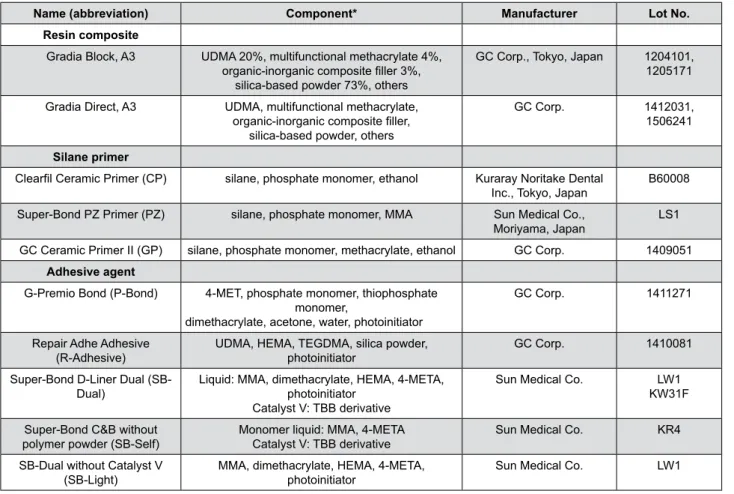
The three silane primers (CP, PZ, and GP) and five adhesive agents (P-Bond, R-Adhesive, SB-Dual, SB-Self, and SB-Light) used are listed in Figure 1. The testing specimens consisted of 192 rectangular specimens (8×10×3 mm) that were cut from a composite block (Gradia Block, A3, GC Corp., Tokyo, Japan) using a diamond saw (IsoMet Low Speed Saw, Buehler, Lake Bluff, IL, USA), they were divided into 24 groups (15 combinations of 3 primers and 5 adhesive agents and 9 controls) of 8 specimens each. All specimens were ground with 600-grit silicon-carbide abrasive paper (BuehlerMet2, Buehler, Lake Bluff, IL, USA), rinsed by spraying with water for 10 s, and air-dried. We attached a piece of masking tape with a circular hole of 2 mm in diameter to the surface of each specimen to delineate the bonding area (Figure 2). One microliter of each of the silane primer and adhesive agent was then applied to the specimens with a micropipette (Eppendorf AG, Hamburg, Germany) and gently air-blown. Except for SB-Self, the adhesive agents used were cured for 10 s using a light-emitting diode handpiece (power density 1,000 mW/ cm2; Pencure, J. Morita MFG. Corp., Tokyo, Japan). We
also prepared control specimens without primer (No primer) and/or without adhesive agent (No adhesive).
We placed an acrylic ring (internal diameter: 4 mm, height: 2 mm) on the specimen and filled it with a light-curing resin composite (Gradia Direct, A3, GC Corp., Tokyo, Japan). The resin composite was then light-cured for 40 s. The specimens were stored in the atmosphere for 30 min and then immersed in water at 37°C for 24 h. Each specimen was embedded in an acrylic resin mold and placed in a shear-testing device (No. ISO/TR11405, Wago Industrial Ltd., Nagasaki, Japan). The shear bond strength of each specimen was determined using a universal testing machine (AGS-10kNG, Shimadzu Corp., Kyoto, Japan) at a cross-head speed of 0.5 mm/min.
Corp., Tokyo, Japan) at a magnification of ×20 to assess bond failure. Failure modes were categorized as adhesive failure at the interface between the composite block and veneered resin composite (Ad) and a combination of Ad and crack propagation (Cr) inside the composite block (Ad/Cr).
Scanning electron microscopy (SEM)
In addition, a composite block was ground with 600-grit silicon-carbide abrasive paper, its surface was sputter-coated with gold (Ion Coater IB-3, Eiko Engineering Co. Ltd., Hitachinaka, Japan), then we observed it using a scanning electron microscope (JCM-6000Plus, JEOL Ltd., Tokyo, Japan) at magnifications
of ×1,000 and ×10,000.
Statistical analysis
The mean bond strength and standard deviation (SD) of all eight specimens were calculated for each test group. The reliability of the sample size and the assumption of homoscedasticity were confirmed using power analysis and Levene’s test, respectively. The data were analyzed using analysis of variance (ANOVA) and a post hoc (Tukey-Kramer HSD) test, statistical
significance was set at 0.05.
Name (abbreviation) Component* Manufacturer Lot No.
Resin composite
Gradia Block, A3 UDMA 20%, multifunctional methacrylate 4%, organic-inorganic composite filler 3%,
silica-based powder 73%, others
GC Corp., Tokyo, Japan 1204101, 1205171
Gradia Direct, A3 UDMA, multifunctional methacrylate, organic-inorganic composite filler,
silica-based powder, others
GC Corp. 1412031, 1506241
Silane primer
Clearfil Ceramic Primer (CP) silane, phosphate monomer, ethanol Kuraray Noritake Dental
Inc., Tokyo, Japan B60008 Super-Bond PZ Primer (PZ) silane, phosphate monomer, MMA Sun Medical Co.,
Moriyama, Japan LS1 GC Ceramic Primer II (GP) silane, phosphate monomer, methacrylate, ethanol GC Corp. 1409051
Adhesive agent
G-Premio Bond (P-Bond) 4-MET, phosphate monomer, thiophosphate monomer,
dimethacrylate, acetone, water, photoinitiator
GC Corp. 1411271
Repair Adhe Adhesive
(R-Adhesive) UDMA, HEMA, TEGDMA, silica powder, photoinitiator GC Corp. 1410081 Super-Bond D-Liner Dual
(SB-Dual) Liquid: MMA, dimethacrylate, HEMA, 4-META, photoinitiator Catalyst V: TBB derivative
Sun Medical Co. LW1 KW31F
Super-Bond C&B without
polymer powder (SB-Self) Monomer liquid: MMA, 4-METACatalyst V: TBB derivative Sun Medical Co. KR4 SB-Dual without Catalyst V
(SB-Light) MMA, dimethacrylate, HEMA, 4-META, photoinitiator Sun Medical Co. LW1
*UDMA: urethane dimethacrylate, MMA: methyl methacrylate, 4-MET: 4-methacryloyloxyethyl trimellitic acid, HEMA: 2-hydroxyethyl methacrylate, TEGDMA: triethyleneglycol dimethacrylate, 4-META: 4-methacryloyloxyethyl trimellitate anhydride, TBB: tributylborane
Figure 1- Resin composites, silane primers, and adhesives agents used for shear bond strength tests
Results
Shear bond strength
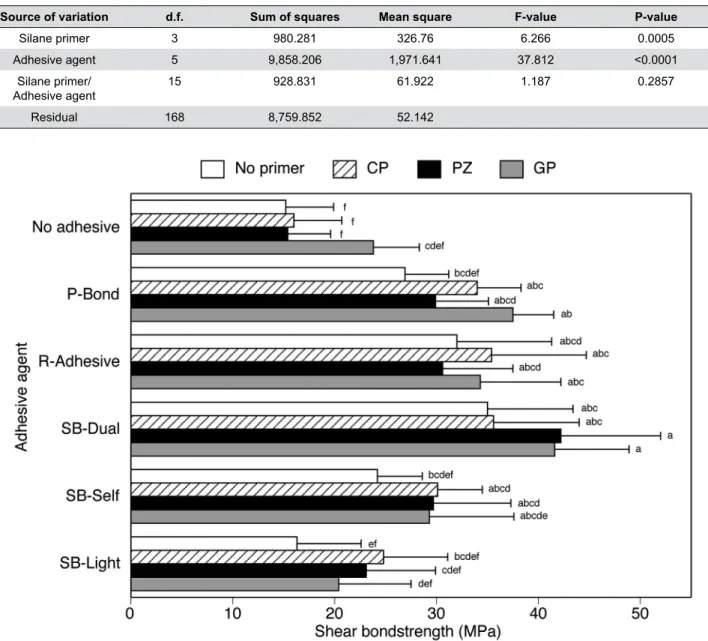
The results of a two-way ANOVA indicate that the bond strength was significantly influenced by both the primer (P=0.0005) and the adhesive agent (P<0.0001) independently and that their interaction did not reach a level of statistical significance (Table 1).
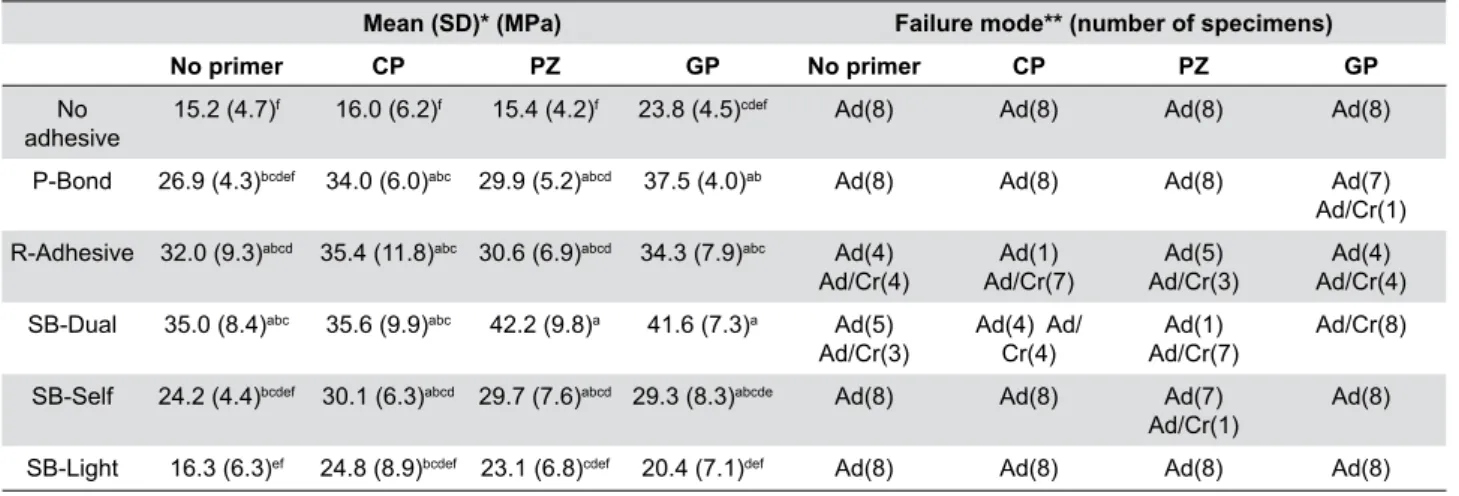
The mean bond strength ranged from 15.2 to 42.2 MPa (Figure 3, Table 2). PZ/SB-Dual and GP/SB-Dual presented the greatest bond strength, however no significant differences were observed among 14 groups (PZ/SB-Dual, GP/SB-Dual, GP/P-Bond, CP/SB-Dual, CP/R-Adhesive, No primer/SB-Dual, GP/R-Adhesive, CP/P-Bond, No primer/R-Adhesive, PZ/R-Adhesive, CP/SB-Self, PZ/P-Bond, PZ/SB-Self, and GP/SB-Self).
No primer/P-Bond, No primer/Self, and all the SB-Light and No adhesive groups presented the lowest bond strength. Within each adhesive agent group, no statistically significant difference was observed among the No primer, CP, PZ, and GP specimens.
Regarding the mode of failure when using R-Adhesive or SB-Dual, a greater number of specimen failures were in the category of Ad/Cr. Except for two specimens, all the specimens in the No adhesive, P-Bond, SB-Self, and SB-Light specimen groups presented only Ad.
Scanning electron microscopy
Figure 4 shows SEM images of the ground CAD/ CAM composite surface. Numerous supramicron and submicron particles of the hybrid filler can be observed.
Source of variation d.f. Sum of squares Mean square F-value P-value
Silane primer 3 980.281 326.76 6.266 0.0005
Adhesive agent 5 9,858.206 1,971.641 37.812 <0.0001
Silane primer/
Adhesive agent 15 928.831 61.922 1.187 0.2857
Residual 168 8,759.852 52.142
Table 1- Two-way ANOVA results
Mean (SD)* (MPa) Failure mode** (number of specimens)
No primer CP PZ GP No primer CP PZ GP
No
adhesive 15.2 (4.7)
f 16.0 (6.2)f 15.4 (4.2)f 23.8 (4.5)cdef Ad(8) Ad(8) Ad(8) Ad(8)
P-Bond 26.9 (4.3)bcdef 34.0 (6.0)abc 29.9 (5.2)abcd 37.5 (4.0)ab Ad(8) Ad(8) Ad(8) Ad(7) Ad/Cr(1) R-Adhesive 32.0 (9.3)abcd 35.4 (11.8)abc 30.6 (6.9)abcd 34.3 (7.9)abc Ad(4)
Ad/Cr(4) Ad/Cr(7)Ad(1) Ad/Cr(3)Ad(5) Ad/Cr(4)Ad(4) SB-Dual 35.0 (8.4)abc 35.6 (9.9)abc 42.2 (9.8)a 41.6 (7.3)a Ad(5)
Ad/Cr(3) Ad(4) Ad/Cr(4) Ad/Cr(7)Ad(1) Ad/Cr(8) SB-Self 24.2 (4.4)bcdef 30.1 (6.3)abcd 29.7 (7.6)abcd 29.3 (8.3)abcde Ad(8) Ad(8) Ad(7)
Ad/Cr(1) Ad(8) SB-Light 16.3 (6.3)ef 24.8 (8.9)bcdef 23.1 (6.8)cdef 20.4 (7.1)def Ad(8) Ad(8) Ad(8) Ad(8)
*Identical small letters indicate values that are not statistically different (p≥0.05)
**Ad: Adhesive failure at the interface between the composite block and the veneered resin composite, Ad/Cr: Combinations of adhesive failure and crack propagation inside the composite block.
Table 2- Shear bond strengths and failure modes observed after shear bond testing
The surfaces of the filler particles were relatively smooth against the roughened matrix resin.
Discussion
This study assessed the effects of three silane primers and five types of coupling agents on bonding between a composite block and a light-curing resin composite. The results of two-way ANOVA indicated that the addition of coupling agents and silane primers made a statistically significant difference on the bond strength. Therefore, the null hypothesis was rejected. ANOVA also indicated that the contribution from coupling agents to the bond strength was greater than the silane primers.
Both GP/P-Bond and GP/R-Adhesive were applied according to the manufacturer’s protocol for repairing resin composite restorations. The reported shear bond strength19,22 between a resin composite and six
different CAD/CAM polymer materials were lower than those of GP/P-Bond and GP/R-Adhesive. Therefore, the relatively high bond strength presented by GP/ SB-Dual in this study, is notable when compared to both GP/P-Bond and GP/R-Adhesive. Comparing the molecular weight of methyl methacrylate (MMA) to the molecular weights of the dimethacrylates contained in P-Bond and R-Adhesive, MMA presents low weight. This difference in monomer composition could be one of the factors affecting the diffusion of the coupling agents into the slightly roughened matrix resin (Figure 4).
The different bond strengths generated by the three MMA-based adhesive agents (SB-Dual, SB-Self, and SB-Light) suggest the presence of other factors not related to MMA. SB-Dual contains both a TBB derivative and a photoinitiator. SB-Light (containing no TBB derivative) and SB-Self (containing no photoinitiator) were used as controls to evaluate the role of the TBB derivative. The greater bond strengths obtained from SB-Dual suggest cooperative effects between TBB and the photoinitiator, SB-Self and SB-Light presented lower values. This supports the findings of a previous study, which reports that the combined used camphorquinone and TBB was effective to decrease residual monomer and to promote the postpolymerization of the resin9. The degree of
conversion of the polymerized Gradia composite, measured by Fourier transform near infrared spectroscopy, is reported to be around 40–50%7.
Considering this, we speculate that the unpolymerized methacryloyl groups remaining in the Gradia Block get chemically bonded to the methacrylates in the primers and coupling agents by radical polymerization.
The composite block used contained 73% inorganic filler and 3% organic-inorganic composite filler. Silane coupling agents react with inorganic components such as silica to form siloxane bonds; they also copolymerize with methacrylates2,18. However, in this study we did
not obtain a high bond strength using a silane primer alone (CP/No adhesive, PZ/No adhesive, or GP/No adhesive). We hypothesize that the inorganic filler particles had already been treated with silane coupling agents during the manufacture process, therefore, the substrate surface contained few exposed inorganic components. This could be the reason for the limited effect of the silane primers on bond strength.
The mode of failure tended to shift from Ad to Ad/Cr as the bond strength increased (Table 2). R-Adhesive and SB-Dual presented more Ad/Cr, indicating a higher bond strength, than the No adhesive, P-Bond, SB-Self, and SB-Light specimens. Neither the composite block nor the veneering resin composite presented complete cohesive failure, suggesting that the adhesive force was inferior to the cohesive strength of the resin composite materials. Thus, the improvement on the adhesive force seems to be a worthy subject for further research.
Conclusions
Within the limitations of this study, we conclude that the combination of a silane primer (GP or PZ) and a dual-curing adhesive agent (SB-Dual) improves the bond strength between a composite block and a light-curing resin composite. Furthermore, the contribution of the coupling agent to the bond strength is greater than that of the silane primers.
References
1- Arao N, Yoshida K, Sawase T. Effects of air abrasion with alumina or glass beads on surface characteristics of CAD/CAM composite materials and the bond strength of resin cements. J Appl Oral Sci. 2015;23(6):629-36.
2- Bowen RL. Properties of a silica-reinforced polymer for dental restorations. J Am Dent Assoc. 1963;66:57-64.
3- Duzyol M, Sagsoz O, Polat Sagsoz N, Akgul N, Yildiz M. The effect of surface treatments on the bond strength between CAD/CAM blocks and composite resin. J Prosthodont. 2016;25(6):466-71.
4- Elsaka SE. Repair bond strength of resin composite to a novel CAD/CAM hybrid ceramic using different repair systems. Dent Mater J. 2015;34(2):161-7.
5- Elsaka SE. Influence of surface treatments on bond strength of metal and ceramic brackets to a novel CAD/CAM hybrid ceramic material. Odontology. 2016;104(1):68-76.
6- Gilbert S, Keul C, Roos M, Edelhoff D, Stawarczyk B. Bonding between CAD/CAM resin and resin composite cements dependent on bonding agents: three different in vitro test methods. Clin Oral Investig. 2016;20(2):227-36.
7- Hadis M, Leprince JG, Shortall AC, Devaux J, Leloup G, Palin WM. High irradiance curing and anomalies of exposure reciprocity law in resin-based materials. J Dent. 2011;39(8):549-57.
8- Harada A, Nakamura K, Kanno T, Inagaki R, Örtengren U, Niwano Y, et al. Fracture resistance of computer-aided design/computer-aided manufacturing-generated composite resin-based molar crowns. Eur J Oral Sci. 2015;123(2):122-9.
9- Hirabayashi C. Studies on MMA-TBB resin II. The effect of dual use of TBB and other initiators on polymerization of PMMA/MMA resin. Dent Mater J. 2003;22(1):48-55.
10- Hirabayashi C, Imai Y. Studies on MMA-TBB resin I. Comparison of TBB and other initiators in the polymerization of PMMA/MMA resin. Dent Mater J. 2002;21(4):314-21.
11- Hisamatsu N, Atsuta M, Matsumura H. Effect of silane primers and unfilled resin bonding agents on repair bond strength of a prosthodontic microfilled composite. J Oral Rehabil. 2002;29(7):644-8.
12- Hisamatsu N, Tanoue N, Yanagida H, Atsuta M, Matsumura H. Twenty-four hour bond strength between layers of a highly loaded indirect composite. Dent Mater J. 2005;24(3):440-6.
13- Lauvahutanon S, Takahashi H, Shiozawa M, Iwasaki N, Asakawa Y, Oki M, et al. Mechanical properties of composite resin blocks for CAD/ CAM. Dent Mater J. 2014;33(5):705-10.
14- Masuhara E. On the chemistry of a new adhesive plastic filling material. Dtsch Zahnärztl Z. 1969;24(7):620-8.
15- Rocca GT, Bonnafous F, Rizcalla N, Krejci I. A technique to improve the esthetic aspects of CAD/CAM composite resin restorations. J Prosthet Dent. 2010;104(4):273-5.
16- Ruse ND, Sadoun MJ. Resin-composite blocks for dental CAD/CAM applications. J Dent Res. 2014;93(12):1232-4.
17- Shinohara A, Taira Y, Sawase T. Effects of tributylborane-activated adhesive and two silane agents on bonding computer-aided design and manufacturing (CAD/CAM) resin composite. Odontology. 2017;105(4):437-42.
18- Söderholm KJ, Shang SW. Molecular orientation of silane at the surface of colloidal silica. J Dent Res. 1993;72(6):1050-4.
19- Stawarczyk B, Krawczuk A, Ilie N. Tensile bond strength of
resin composite repair in vitro using different surface preparation conditionings to an aged CAD/CAM resin nanoceramic. Clin Oral Investig. 2015;19(2):299-308.
20- Stawarczyk B, Trottmann A, Hämmerle CHF, Özcan M. Adhesion of veneering resins to polymethylmethacrylate-based CAD/CAM polymers after various surface conditioning methods. Acta Odontol Scand. 2013;71(5):1142-8.
21- Taira Y, Imai Y. Review of methyl methacrylate (MMA)/tributylborane (TBB)-initiated resin adhesive to dentin. Dent Mater J. 2014;33(3):291-304.
22- Wiegand A, Stucki L, Hoffmann R, Attin T, Stawarczyk B. Repairability of CAD/CAM high-density PMMA- and composite-based polymers. Clin Oral Investig. 2015;19(8):2007-13.