J. res.: fundam. care. online 2015. abr./jun. 7(2):2569-2581
2569
RESEARCH
Padrões de mudanças na saúde do homem a partir de indicadores demográficos e epidemiológicos
Patterns of changes in men's health from demographic indicators and epidemiologic Patrones de cambios en la salud de los hombres de indicadores demográfica y epidemiológica Vanessa Cruz Santos 1 , Mayra Gomes Santos 2 , Alba Benemérita Alves Vilela 3 ,Adriana Alves Nery 4 ,
Cezar Augusto Casotti 5 , Eduardo Nagib Boery 6
Objective: to analyze patterns of change on human health in the period 2006 to 2010 through demographic and epidemiological indicators. Method: an epidemiological study, descriptive subsidized on data from the Department of Computer Science of SUS (DATASUS) of the Ministry of Health, Brazilian Institute of Geography and Statistics and Integrated System of Penitentiary Information, in the period 2006 to 2010. For the tables and data analysis tools developed by DATASUS were used - TabWin and TabNet, besides the program Microsoft Office Excel 2007. Results: among the indicators of morbidity and mortality, the result from external causes in all kinds were growing in the studied years and higher in males population compared to female. Conclusion: the health problems most prevalent in the male population are preventable, then, health education can contribute in changing the behavioral and cultural profile of this population, which has negative consequences to their health. Descriptors: Epidemiology, Health policy, Gender and health, Men's health.
Objetivo: analisar padrões de mudanças na saúde do homem no período de 2006 a 2010 por meio dos indicadores demográficos e epidemiológicos. Método: estudo epidemiológico, descritivo, subsidiado em dados do Departamento de Informática do SUS (DATASUS) do Ministério da Saúde, Instituto Brasileiro de Geografia e Estatística e Sistema Integrado de Informações Penitenciárias, referentes ao período de 2006 a 2010. Para a tabulação e análise dos dados, foram utilizadas ferramentas desenvolvidas pelo DATASUS – TabWin e TabNet, além do programa Microsoft Office Excel 2007. Resultados: entre os indicadores de morbimortalidade, os decorrentes de causas externas, em todos os tipos, foram crescentes nos anos estudados e mais elevados na população masculina em relação à feminina. Conclusão: os agravos de saúde mais recorrentes na população masculina são preveníveis, logo, a educação em saúde poderá contribuir na alteração do perfil comportamental e cultural dessa população quem, por sua vez, acarreta consequências negativas à sua saúde. Descritores: Epidemiologia, Política de saúde, Gênero e saúde, Saúde do homem.
Objetivo: analizar los modelos de cambio en la salud humana en el período 2006-2010 a través de indicadores demográficos y epidemiológicos. Métodos: estudio epidemiológico, descriptivo, subsidiado en datos del Departamento de Informática del SUS (DATASUS) del Ministerio de la Salud, Instituto Brasileño de Geografía y Estadística y Sistema Integrado de Informaciones Penitenciarias, referentes al período de 2006 a 2010. Para las tablas y análisis de los datos fueron utilizadas herramientas desarrolladas por el DATASUS – TabWin y TabNet, del programa Microsoft Office Excel 2007. Resultados: entre los indicadores de morbilidad y mortalidad, los decurrentes de causas externas, en todos los tipos, fueron crecientes en los años estudiados y más elevados en la población masculina en relación a la femenina. Conclusión: los problemas de salud más prevalentes en la población masculina, son prevenibles, por lo que la educación en salud, puede contribuir para cambiar el perfil conductual y cultural de esta población, que a su vez tiene consecuencias negativas para su salud. Descriptores: Epidemiología, Política de la salud, Género y salud, Salud de los hombres.
.
1 Nurse, Master degree student, Graduate Program in Nursing and Health, State University of Southwest Bahia/PPGES/UESB. Jequié(Bahia), Brazil. E-mail: [email protected] 2 Nurse, Master degree student, Graduate Program in Nursing and Health, State University of Southwest Bahia/PPGES/UESB. Jequié(Bahia), Brazil. E-mail: [email protected]
3 Nurse, PHD Professor, Graduate Program in Nursing and Health, State University of Southwest Bahia/PPGES/UESB. Jequié(Bahia), Brazil. E-mail: [email protected] 4 Nurse, PHD Professor, Graduate Program in Nursing and Health, State University of Southwest Bahia/PPGES/UESB. Jequié(Bahia), Brazil. E-mail: [email protected] 5 Dental surgeon, PHD Professor, Graduate Program in Nursing and Health, State University of Southwest Bahia/PPGES/UESB. Jequié(Bahia), Brazil. E-mail: [email protected] 6 Nurse, PHD Professor, Graduate Program in Nursing and Health, State University of Southwest Bahia/PPGES/UESB. Jequié(Bahia), Brazil. E-mail: [email protected]
ABSTRACT
RESUMEN RESUMO
J. res.: fundam. care. online 2015. abr./jun. 7(2):2569-2581
2570
T
he topic about the health situation of men has achieved prominence in Brazil, mainly due to high rates of morbidity and mortality due to external causes that affect this group as well as its low demand for the services of primary health care, which could at least minimize this aggravating, considered as a complex public health problem.
Morbidity and mortality indicators can provide a larger view of the process of illness and vulnerability to health problems of the male population, seeking to reflect about the behavior and social life of the population, as well as identifying epidemiological data illustrating the most pressing problems in their health. The recurrent topics in the study on men´s health were guided into three areas: violence, tendency to exposure to risks and sexual and reproductive health.¹
In this context, in 2009 from the results of studies about men´s health, the Ministry of Health (MH) released the National Policy of Integral Care to men´s health (NPICMH), recognizing the specificities in the health-disease process associated with this gender, highlighting the male uniqueness in their various socio-cultural and economic-political contexts, as well as highlighting the men´s health indicators and pointing principles aimed at increasing life expectancy and decreasing the incidence of morbidity and mortality by avoidable and preventable causes.2,3
The NPICMH aims to reverse the picture, which compromises men´s health, being created with the purpose of promoting actions that may sensitize men to the recognition of their social and health conditions, developing daily practices of prevention and care.4 However, it is observed that the non-recognition of men´s uniqueness by their health services can provide difficulties in incorporating these subjects as a protagonist of their care.5
From this context, it becomes relevant this study, which is justified by the need to address the situation of men´s health in Brazil, since, there are larger coefficients, for example, of morbidity and mortality in relation to women and it is known that they are associated with several causes such as risk behavior that mostly occurs due to a social enforcement of culture entrenched for a hegemonic masculinity.
It is believed that the results of this study may provide subsidies, contributing to health strategies and actions that are guided from the guidelines and standards of NPICMH, since through health indicators it will be possible to identify the demands of the male population.
To this end, the study aims to analyze patterns of changes in human health in the period of 2006 to 2010 through demographic and epidemiological indicators.
J. res.: fundam. care. online 2015. abr./jun. 7(2):2569-2581
2571
RESULTS AND DISCUSSION
METHOD
This is a descriptive epidemiological study, which used secondary data of indicators employed as diagnostic parameter of men´s health for creation of NPICMH, named: demographic indicators and of morbidity and mortality.
Recorded mortality data were included in Mortality Information System (MIS), classified as the 10th International Classification of Diseases (ICD-10), comprising the categories of External Causes (ICD 10 - Cap. XX); Tumors (ICD 10 - Cap. II); other causes of mortality - Circulatory System Diseases (ICD 10 - Cap. IX); Digestive Tract Diseases (ICD 10 - Cap. XI) and Respiratory Diseases (ICD 10 - Cap. X).
The population group studied was adults, composed of those individuals with 25 to 59 years old in national region. The time of the study used was 2006 and 2010, chosen because it was the period of the implementation of NPICMH, and 2010 was the covered years of DATASUS, until then.
The data were obtained electronically through the Department of Cumputer Science of the SUS (DATASUS) of the Ministry of Health; The Brazilian Institute of Geography and Statistics (IBGE) and Integrated System of Penitentiaries Information (InfoPen); being the collection held in April and May, 2013.
For data tabulation and descriptive analysis tabulation tools developed by DATASUS – TabWin and TabNet– were used, aiming to provide the need for managers, scholars and interested public from health care to obtain and analyze, with speed and objectivity, the data of information systems of SUS. These tabulation enable visualization and spatial evaluation of information, being a valuable resource in support of health policies and actions.6 For the construction of the tables the program Microsoft Office Excel 2007 was also used.
The health of the male population has been highlighted in recent years, and the data of epidemiological information systems make possible the delimitation of a scenario that contributes to the construction of actions, strategies and policies aimed at human health.3 The diagnosis about the situation of men´s health, through epidemiological data, signals the need for urgent action in high rates of morbidity and mortality of male population.1
J. res.: fundam. care. online 2015. abr./jun. 7(2):2569-2581
2572
According to the Brazilian Institute of Geography and Statistics,7 the total residentpopulation of Brazil, in 2006, according to gender was 186,770,560, 50.85% female population (94,954,834) and 49.15% male population (91,815,726). These numbers have been growing steadily over the years. In 2010, they increased to 190,755,799, 51.3% female population (97,348,809) and 48.7% male population (93,406,990). Despite the increase in total population of 3,985,239 inhabitants, male population decreased 0.45% while female grew 0.5%.
The increase and/or decrease in the percentage of the male population in relation to women may be associated, among several factors, birth and mortality indicators, however it has not been possible to identify this association, as these are not stratified by gender in the Information Systems about Live Births and Mortality. However, men live less than women, identified from the rate of elderly population according to gender.
Also the identification, in a study conducted by health professionals that the man has as singularity to search for health care only in specialized services excluding the activities of prevention and promotion to health.8 It is noted that women care more than men.
Adolescence and old age are lifecycles to maximize male vulnerability, requiring their express recognition. In adolescence, the belief in the invulnerability by men is exacerbated, make them vulnerable to preventable diseases, through non-adoption of preventive practices, about an unwanted conception and the risk of infection by HIV/AIDS, for example, and through the abusive use of alcohol and other drugs and involvement with scenarios of violence, that reaffirm his virile social position.1
In the case of adolescence,9 they report that the National Policy of Integral Care to Adolescents and Youth´s health (NPICAY) expands the upper limit of the age group of the population being contemplated by its programmatic actions, previously defined as 10 to 19 years old, proposed as the age group of 10 to 24 years old. With this, a portion of the population outside the age range considered as pertinent to adolescence – which ends on 19 years old – is understood in a transience of adolescence to adulthood in a continuum experienced as youth.
In this way, it is considered that the NPICAY could be a fundamental support to at least reduce the male vulnerability, in the age group which assisted before of NPICMH. However this policy has not yet been implemented, being associated with the continuation of male vulnerability in adult life, which has resulted in high morbidity and mortality rates.
Most traditional health indicators highlights the existence of this differential, being greater male mortality in practically all ages and for almost all of the causes; with respect to life expectancy at birth and at other ages also indexes are always smaller among men.
In 2006, the number of elderly was 16,943,274, 55.23% female population (9,358,466) and 46.77% male population (7,584,808). Until 2010 the number of elderly of both genders was 20,590,599 in 2010, 55.53% are female (11,434,487) and 44.47% are men (9,156,112). The population of elderly people grew 3,647,325, but while the number of elderly females increased 0.3%, the males decreased by 2.3%.
J. res.: fundam. care. online 2015. abr./jun. 7(2):2569-2581
2573
In relation to the process of men´s population aging, it is observed that thereduction of his mortality was slower and constantly lower than observed in the female; as a result, currently, the average male life is comparatively lower in all regions of Brazil.10
There are several factors related to these indicators, like the violence that is a multi-causal, complex and difficult phenomenon to be minimized, by having roots in socio-cultural, political, economic and psychobiological factors, among others.
In the study of Schraiber et al.11 about men, masculinity and violence, held in primary health care services, was evaluated the non-fatal violence suffered and perpetrated by men, considering simultaneously the relationships of conjugality or partnership and other private and public space. From this evaluation, there were high rates of violence in the population researched and the a big amount of users within the health services, especially in primary care, which constitute cases of violence suffered or cases of male aggressors.
Due to men were more involved in causes of violence, it is shown a higher number and growing individuals of that group who are deprived of freedom.
In 2006, according to the Integrated System of Penitentiaries Information (InfoPen),12 the number of individuals deprived of freedom in Closed Regime, Semi-Open Regime, Open Regime, Temporary, by Safety Measures for treatment or hospitalization and prisioners of the Secretary of Public Safety was of 401,236, being 94.25% male (378.171). In all segments over 2006 to 2012, these numbers were increasing and the majority was still being male. In June 2012, it was found that during this period the numbers amounted 112, 242, and the number of individuals deprived of freedom became 549.557 being 93.43% of men (513.478) that is despite the percentage have decreased, the number has risen.
Although there are no systematized information about morbidity and mortality in prison environment, diseases and damages care in this context must be to studies that will highlight the health conditions of the population deprived of freedom.1
About the violence in a broader perspective, this should be understood as a determinant of morbidity and mortality indicators by external causes in all its dimensions, namely, transport accidents, assaults and self-harm voluntarily and/or suicides.1
The male mortality rate is greater than women´s to all kinds of violence. The male deaths by external causes, between the age group of 25 to 59 years old, in the period of 2006-2010 progressively increased reaching 66,808 in 2010. As to the type of violence, murders we have been highlighted from the others (of 25,191 for 27,223) during this period and, although the Mortality Rate for 100.000.00 inhabitants (MR) have reduced (from 62.6 to 62.3), the numbers are still high, according to table 2.
J. res.: fundam. care. online 2015. abr./jun. 7(2):2569-2581
2574
Table 1. Number of deaths and mortality rate by some external causes in Brazil, accordingto type, year and gender, between 25 to 59 years old, during the period from 2006-2010. Type
2006 2007 2008 2009 2010
Male Female Male Female Male Female Male Female Male Female
Transport acidentes deaths 18.100 3.189 18.867 3.248 18.967 3.378 19.003 3.369 21.688 3.895 MR for transport accidentes 45,0 7,4 45,4 7,4 45,0 7,6 44,1 7,4 49,6 8,4 Death for homicides 25.191 2.268 24.670 2.165 25.933 2.300 26.779 2.455 27.223 2.570 MR for homicides 62,6 5,3 59,3 4,9 61,6 5,2 62,2 5,4 62,3 5,6 Death for suicides 4.475 1.134 4.544 1.236 4.784 1.253 5.019 1.217 4.863 1.375 MR for suicides 11,1 2,6 10,9 2,8 11,4 2,8 11,7 2,7 11,1 3,0
Deaths for event. undetermined intent 3.659 637 4.663 764 5.105 810 5.545 902 3.879 674 MR for event. undetermined intent 9,1 1,5 11,2 1,7 12,1 1,8 12,9 2,0 8,9 1,5
Death for other
external causes 8.494 1.234 8.529 1.270 8.58 9 1.293 8.835 1.302 9.155 1.478 MR for other external causes 21,1 2,9 20,5 2,9 20,4 2,9 20,5 2,9 21,0 3,2 Total de óbitos 59.919 8.462 61.273 8.683 63.378 9.034 65.181 9.245 66.808 9.992 Total de óbitos por TME 149,0 19,7 147,4 19,7 150,4 20,3 151,4 20,3 152,9 21,6
Source: Ministry of Health/SVS-SIM
*MR- Mortality Rate for 100,000,00 inhabitants
The amount of men who die of external causes, mainly by homicide remains one of the main reasons that should be prioritized on men's health care and, in particular those groups which are most affected as blacks,13 who live in slums or on the outskirts of major cities, with low education and low professional qualification. It is worried even more, the growing trend of selective mortality: an unacceptable and growing association between homicide and victims´ skin color.
As the specific mortality rate for diseases of the circulatory system between 25-59 years old, it is observed that men are more targeted towards women. From 2006 to 2010, the increase in deaths was 40,411 to 41,819, with reduction of MR of 127.0 to 118.7. The ischemic heart disease deaths increased from 15,961 to 17,216, decreasing MR from 50.1 to 48.9. The cerebrovascular disease deaths decreased from 10,508 to 10,095, with reduction of MR from 33.0 to 28.7.
Information about cardiovascular disease demonstrate that it affects more men than women, with prevalence and projections of an increase in the near future, including epidemic aspects, added to the incapacitating features in productive age.14
The highest incidence male mortality, for circulatory diseases occurred in recent years, as it was expected, after 60 years old (72.2%). In the same year, the cardiovascular cause’s deaths occurred in the population of 25-59 years old, around 26.8%, a significant percentage. When pointing out this fact, it is sad losing many lives each year and most of these deaths could be avoided if there was an effective primary prevention policy.1
J. res.: fundam. care. online 2015. abr./jun. 7(2):2569-2581
2575
With regard to the number of deaths by diseases of the circulatory system, theseindicators has been high and, despite the MR have reduced, this is the second health problem that more affect Brazilian men´s lives, being inferior only to external causes.
The rate of mortality from acute respiratory infections also deserves special care in male population, as this also has risen in numbers (4,934 to 6,223), as well as by the MR (from 10.1 to 11.9).
Some tumors have occurred more in male population, as malignant neoplasms. In relation to the age group of 30 to 59 years old, during the period from 2006-2010, there is an increase of deaths arising from these neoplasms, in all the types available in DATASUS. However, the tumors causing more deaths of men and that more increased were lung, trachea and bronchi (from 3,178 to 3,373) followed by the stomach (from 2,116 to 2,457) as seen in table 3.
Table 2. Number of deaths and mortality rate for some malignant neoplasms in Brazil, according to type, year and gender, between the age group of 30 to 59 years old, during the period from 2006-2010.
Type
2006 2007 2008 2009 2010
Male Female Male Female Male Female Male Female Male Female Deaths for tracts
bronchial lung
neoplasm 3.178 2.128
3.26
1 2.160 3.295 2.252 3.387 2.394 3.373 2.435 MR for lung tracts
bronchial
neoplasia 10,0 6,2 9,9 6,1 9,8 6,3 9,9 6,5 9,6 6,5
Deaths for prostate
neoplasm 584 N/A 596 N/A 620 N/A 576 N/A 632 N/A
MR for prostate
neoplasm 1,8 N/A 1,8 N/A 1,9 N/A 1,7 N/A 1,8 N/A
Deaths for stomach neoplasm 2.418 1.259 2.454 1.283 2.317 1.333 2.460 1.275 2.499 1.383 MR for stomach neoplasm 7,6 3,7 7,4 3,6 6,9 3,7 7,2 3,5 7,1 3,7 Deaths for Esophageal neoplasm 2.116 393 2.257 422 2.337 416 2.370 466 2.457 428 MR for Esophageal neoplasm 6,6 1,1 6,8 1,2 7,0 1,2 6,9 1,3 7,0 1,1
Deaths for colon
neoplasm 1.532 1.586
1.57
3 1.782 1.701 1.822 1.738 1.968 1.872 1.941 MR for colon
neoplasm 4,8 4,6 4,8 5,0 5,1 5,1 5,1 5,4 5,3 5,2
Deaths for other neoplasm 14.13 3 11.199 14.528 11.406 896 14. 11.792 15.366 12.248 825 15. 12.513 MR for other neoplasm 44,4 32,6 44,0 32,2 44, 5 32,9 44,9 33,4 44,9 33,2 Total of deaths 23.961 16,565 24.669 17,053 166 25. 17,615 25.897 18.351 658 26. 10.833 Total of deaths for MR 75,3 48,2 74,7 48,1 75,2 52,2 75,6 50,1 75,7 49,7
*N/A- Not applied
* In the total of deaths, the prostate neoplasm was excluded
In summary, it was found that the highest percentage of deaths occurring in the male population, with 25 to 29 years old, population assisted by the NPICMH, was due to
J. res.: fundam. care. online 2015. abr./jun. 7(2):2569-2581
2576
external causes (ICD 10 - Cap. (XX); followed by Circulatory Diseases (ICD10 - Cap. IX); Tumors (ICD 10 - Cap. II); Digestive Tract Diseases (ICD 10 - Cap. XI) and Respiratory Diseases (ICD 10 - Cap. X).Although there is no big difference in coefficients of mortality from malignant neoplasms, it is necessary to highlight that among men, lung neoplasm predominate, followed by the stomach and prostate. The historical series analysis of mortality in Brazil clearly shows the growing importance of prostate cancer that is higher than the malignant neoplasm of stomach, since some years ago.10
With regard to indicators of morbidity, it is verified that the external causes has been one of the first causes of hospitalization by the Unified Health System (SUS) for the age group between 25 to 59 years old and the number of men is higher to women´s. In the temporal cut (2006-2010), there was an increase mainly for hospitalization of men, by transport accidents (form 50,882 to 70,946) bigger than the amount of women. The rate of hospitalization for every 100,000 inhabitants, also significantly increased for this type of hospitalization (from 16.24 to 12.65) as seen in table 4.
Table 3. Number and rate of hospitalization (SUS) by some external causes in Brazil, according to type, year and gender, between 25 to 59 years old, during the period from 2006-2010.
2006 2007 2008 2009 2010
Type Male Female Male Female Male Female Male Female Male Female
Hospitalization for self-harm 3.753 2.033 3.902 2.189 3.048 1.808 3.740 2.062 3.388 1.972 HR for self-harm 0,93 0,47 0,94 0,50 0,72 0,41 0,87 0,45 0,78 0,43 Hospitalization for assault 20.495 3.672 20.118 3.989 14.182 2.526 18.541 3.349 22.292 4.196 HR for assault 5,10 0,86 4,84 0,91 3,37 0,57 4,31 0,73 5,10 0,91 Hospitalization for transport accident 50.882 12.478 51.251 12.254 43.662 10.187 57.103 14.111 70.946 17.006 HR Hospitalization for transport accident 12,65 2,91 12,33 2,78 10,36 2,28 13,26 3,10 16,24 3,67 Hospitalization for other external causes 92.995 33.458 103.17 5 37.487 112.981 40.704 133.623 47.339 123.931 43.187 HR for other external causes 23,12 7,81 24,82 8,51 26,82 9,12 31,04 10,39 28,36 9,33 Total of hospitalizations 168,125 51,641 178,446 55,919 173,873 55,225 213,007 668,861 223,945 66,361 Total of hospitalization for HR 41,8 12,05 42,93 12,7 41,27 12,38 49,48 14,67 50,48 14,34 source: Ministtry of Health/SE/Datasus – Hospital Information System of SUS - HIS/SUS. * HR – hospitalization rate per 100.000 inhabitants
In 2008, reduction in almost all types of hospitalization was noticed, as for example, those relating to external causes. However, this reduction was due to a lower register of hospitalizations due to the implementation of the Unified Table Procedures, Medicines and Orthosis/Orosthesis and Special Materials of SUS. This fact interfered in the data analysis, because the numbers may be lower than the real ones.
J. res.: fundam. care. online 2015. abr./jun. 7(2):2569-2581
2577
The number of hospitalizations for ischemic heart disease in men aged 30-59 yearsold (from 2006 to 2010) increased from 57,707 to 60,642. This also happened with pneumonia, from 61,981 to 69,747.
It can be stressed as another limiting factor in the analysis of the morbidity indicators the fact of the hospitalizations being only from SUS, not including private services, which may underestimate the data to a smaller value.3
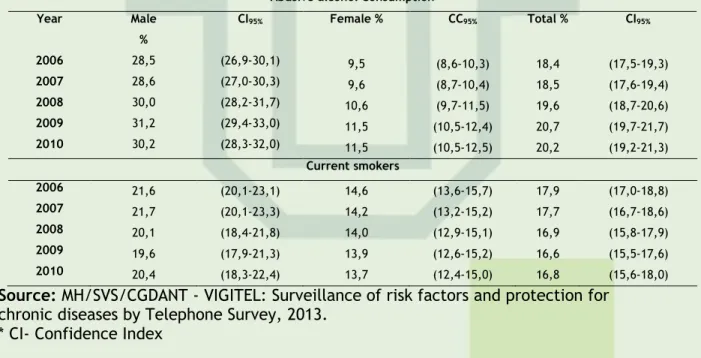
Other relevant indicators to assess health conditions in Brazil are those related to risk factors and protection for the prevalence of abusive consumption of alcoholic beverages - one of the factors that is associated to high rates of morbidity and mortality by violence and by the frequency of smoking in current days.
From the temporal analysis, it was observed the growth coefficients of abusive consumption of alcohol prevalence in the male population, registering 28.5 coefficients/100,000 (in 2006) and 30.2/100,000 inhabitants (in 2010). For the prevalence of current smokers there was a reduction registering coefficients of 21.6/100,000 (in 2006) and 20.4/100,000 inhabitants (in 2010). All these indicators have confidence index CI (95%) as seen table 1.
Table 4. Prevalence of abusive alcohol consumption and current smokers in Brazil, according to year and gender, between the age group of 25 to 54 years old for the period 2006-2010.
Abusive alcohol Consumption
Year Male % CI95% Female % CC95% Total % CI95% 2006 28,5 (26,9-30,1) 9,5 (8,6-10,3) 18,4 (17,5-19,3) 2007 28,6 (27,0-30,3) 9,6 (8,7-10,4) 18,5 (17,6-19,4) 2008 30,0 (28,2-31,7) 10,6 (9,7-11,5) 19,6 (18,7-20,6) 2009 31,2 (29,4-33,0) 11,5 (10,5-12,4) 20,7 (19,7-21,7) 2010 30,2 (28,3-32,0) 11,5 (10,5-12,5) 20,2 (19,2-21,3) Current smokers 2006 21,6 (20,1-23,1) 14,6 (13,6-15,7) 17,9 (17,0-18,8) 2007 21,7 (20,1-23,3) 14,2 (13,2-15,2) 17,7 (16,7-18,6) 2008 20,1 (18,4-21,8) 14,0 (12,9-15,1) 16,9 (15,8-17,9) 2009 19,6 (17,9-21,3) 13,9 (12,6-15,2) 16,6 (15,5-17,6) 2010 20,4 (18,3-22,4) 13,7 (12,4-15,0) 16,8 (15,6-18,0)
Source: MH/SVS/CGDANT - VIGITEL: Surveillance of risk factors and protection for chronic diseases by Telephone Survey, 2013.
* CI- Confidence Index
It is noticed from the coefficients that despite the prevalence of abusive consumption of alcohol have elevated in both genders, it was higher for male. In the case of the prevalence of current smokers, it decreased between the period and age group analyzed, continuing higher also for the male population.
An important indicator to evaluate the problem of alcohol abuse is the measure of the effect of alcoholism on health, seen through the frequency of alcoholic psychosis and alcohol dependence syndrome, including mental disorders, and liver cirrhosis. It has been usual to evaluate this impact through mortality and hospital morbidity. Compared with other diagnoses, it shows that only violence present differentials between the genders, higher in mortality or morbidity.10
J. res.: fundam. care. online 2015. abr./jun. 7(2):2569-2581
2578
CONCLUSION
Thus, Schwarz et al.3 point out that men studied about risk behaviors, they reflect features of particular population of a given region and this should be taken into consideration at the time of analysis.
Other indicators used for the preparation of NPICMH and that should be evaluated, are the indices of person with disabilities. The results of the Demographic Census of 2000 showed that 24.6 million Brazilians reported some type of disability (14.5% of the total population). They are people with some difficulty, with great difficulty or inability to see, to hear, to move or with mental disabilities. Of the total of people with disabilities (46.42%), a minority represents the male population (11,420,544).
The results of the Demographic Census in 2010, showed 45,606,048 million people who reported at least one of the disabilities investigated, with 23.9% of the Brazilian population. Of these, most 26.5% are female (25,800,681), and 21.2% were male (19,805,367). Mental or intellectual deficiency had a greater prevalence in the male population representing 1.5% and for women, the equivalent of 1.2%, as well as the hearing that was 5.3% for male population and 4.9% of the female.
The prevalence of mental or intellectual disability and hearing in the male population is compatible with the type of activity developed by men and the risk of accidents of several causes.1 It is then noticed, that working conditions continue to negatively influence on men´s health as 2010 results show this increasing.
Another recurrent theme in the study on men´s health is the risk and sexual and reproductive health, which was also used as a parameter for the construction of NPICMH. Then, in Brazil1 it is necessary to overcome the restriction of responsibility on women contraceptive practices, ensuring men the right to participate in reproductive planning. Parenthood should not be seen only from the point of view of legal obligation, but above all as a human right to participate in the whole process, from the decision of whether or not to have children. Therefore, it should be available information, birth control and condoms for contraception and family planning and access should be facilitated to adolescents and youth.
In a study on the men´s assistance needs in nursing perspective and family health, it was found that when analyzing the articles found regarding men´s health, all texts addressed the needs of the male population by a collective perspective - as health care need.15
From the results, it should be noted that even if the specific mortality deaths per 100,000 inhabitants has decreased from 2006 to 2010 for some indicators, it is seen that as the population increases, certain epidemiological indicators rise in digital levels, deserving
J. res.: fundam. care. online 2015. abr./jun. 7(2):2569-2581
2579
REFERENCES
of attention for this progressive increase, since it should not be justified from merely increasing the population.
Despite the NPICMH have been created with the purpose of reducing the rates of morbidity and mortality for men, it is noted that this is still in the process of execution, because various obstacles, mainly due to the prevention of risk factors of male population, these indexes have been raised gradually.
Besides, even this policy addressing the young and elderly male population being more vulnerable, covering the adult age group 25 to 59 years old, not accompanying the elderly, as well as adolescents and young adults 12 to 24 years old within their specificities, which are underprivileged of specific public policies faced with the evidence of non-implementation of the National Policy of Integral Health Care of Adolescents and Youth - NPICAY
The incompleteness of some data stratified by gender and age group in DATASUS limited analysis of the indicators that were used as a diagnosis of the situation of men´s health for development of NPICMH. These could be relevant to the creation and/or implementation of the programmatic actions, which would contribute to the promotion of the health of the male population, as well as the prevention of diseases and rehabilitation of those who have suffered health damage, that is, NPICMH proposal.
By indicators evaluated, the most recurrent health aggravations in the male population, are preventable, then, from the implementation of actions proposed by NPICMH as health education, it may be possible to modify the behavioral and cultural profile of this population, with negative consequences to their health.
1. Brasil. Ministério da saúde (MS). Secretaria de atenção à saúde. SVS/DAPE. Política
nacional de atenção integral à saúde do homem (Princípios e Diretrizes). Brasília: MS; 2008. [site
da internet]. [acesso em 13 de jun 2013]. Disponível em:
http://portal.saude.gov.br/portal/arquivos/pdf/politica_nacional_atencao_integral.pdf
2. Moura ECD, Lima AMP, Urdaneta M. Uso de indicadores para o monitoramento das ações de promoção e atenção da Política Nacional de Atenção Integral à Saúde do Homem (PNAISH). Ciênc. saúde coletiva. Rio de Janeiro, 2012, 17 (10). [site da internet]. [acesso em 13 de jun
2013]. Disponível em:
http://www.scielo.br/scielo.php?script=sci_arttext&pid=S141381232012001000009&lng=en&nrm =iso
3. Schwarz E, Gomes R, Couto MT, Moura EC, Carvalho SA, Silva SFC. Política de saúde do homem. Rev. Saúde Pública. São Paulo 2012; 46 (supl.1). [site da internet]. [acesso em 13 jun 2013]. Disponível em: http://www.scielo.br/pdf/rsp/v46s1/co4221.pdf
4. Brasil. Ministério da Saúde (MS). Dispõe sobre a Política Nacional de Atenção Integral à Saúde do Homem. Diário Oficial [da] República Federativa do Brasil, Brasília. 2009. [site da internet].
J. res.: fundam. care. online 2015. abr./jun. 7(2):2569-2581
2580
[acesso em 13 jun 2013]. Disponível em:
http://dtr2001.saude.gov.br/sas/PORTARIAS/Port2008/PT-09-CONS.pdf
5. Gomes R, Moreira MCN, Nascimento EF, RebelloI L EFS, CoutoII MT, Schraiber LB. Os homens não vem! Ausência e/ou invisibilidade masculina na atenção primaria. Ciênc. Saúde Coletiva, Rio de Janeiro 2011; 16 (supl. 1): 983-992. [site da internet]. [acesso 25 maio 2013]. Disponível em: http://www.scielo.br/scielo.php?pid=S1413-81232011000700030&script=sci_arttext
6. Brasil. Ministério da Saúde (MS). Departamento de Informática do SUS (DATASUS). Informações de Saúde. Indicadores e Dados Básicos - Brasil – 2011. IDB-2011. [site da internet]. [acesso 13 jun 2013]. Disponível em: http://tabnet.datasus.gov.br/cgi/idb2011/matriz.htm
7. IBGE. Indicadores Sociodemográficos e de Saúde no Brasil – 2010. Ed. Rio de Janeiro, IBGE - Instituto Brasileiro de Geografia e Estatística, 2009, pp 1-152.
8. Araújo MG, Cassiano AN, Lima GAF, Holanda CSM, Carvalho JBL. Access of the male population to the health services: perception of the family health strategy professionals. J. res.: fundam. care. online 2013.out./dez. 5(4):475-84. [site da internet]. [acesso 22 jun 2013]. Disponível em:
http://www.seer.unirio.br/index.php/cuidadofundamental/article/view/2744/pdf_911
9. Lopez SB, Moreira MCN. Políticas Nacionais de Atenção Integral à Saúde de Adolescentes e Jovens e à Saúde do Homem: interlocuções políticas e masculinidade. Ciênc. saúde coletiva. Rio de Janeiro 2013; 18 (3). [site da internet]. [acesso 22 jun 2013]. Disponível em:
http://www.scielosp.org/scielo.php?script=sci_arttext&pid=S1413-81232013000800020&lng=en&nrm=iso
10. Laurenti R, Jorge MHPDM, Gotlieb SLD. Perfil epidemiológico da morbi-mortalidade masculina. Ciênc. saúde coletiva, Rio de Janeiro, 2005; 10 (1). [site da internet]. [acesso 16 jun
2013]. Disponível em:
http://www.scielo.br/scielo.php?script=sci_arttext&pid=S141381232005000100010&lng=pt&nrm =iso
11. Schraiber LB, Barros CRS,Couto MT; Figueiredo WS; Albuquer FP. Homens, masculinidade e violência: estudo em serviços de atenção primária à saúde. Rev. bras. epidemiol. São Paulo. Dec. 2012: 15 (4). [site da internet]. [acesso 13 jun 2013]. Disponível em:
http://www.scielosp.org/scielo.php?script=sci_arttext&pid=S1415-790X2012000400011
12. Brasil. Ministério da Justiça (MJ). Sistema prisional. Informações Info-pen estatística. 2013.
[site da internet]. [acesso 22 jun 2013]. Disponível em:
http://portal.mj.gov.br/main.asp?View={D574E9CE-3C7D-437A-A5B6-22166AD2E896}&BrowserType=NN&LangI
13. Waiselfisz JJ. Mapa da Violência 2012: A Cor dos Homicídios no Brasil. Rio de Janeiro: CEBELA, FLACSO; Brasília: SEPPIR/PR, 2012. [site da internet]. [acesso em jun 2013]. Disponível em: http://mapadaviolencia.org.br/pdf2012/mapa2012_cor.pdf
14. Chagas ACP, Zilli EC, Ferreira JFM, Moretti MA,Ramos RF. Saúde cardiovascular do homem brasileiro: visão da Sociedade Brasileira de Cardiologia. Arq. Bras. Cardiol. São Paulo 2009; 93
(6). [site da internet]. [acesso 20 jun 2013]. Disponível em:
http://www.scielo.br/scielo.php?script=sci_arttext&pid=S0066782X2009001200004&lng=en&nrm =iso
15. Castro CO, Tocantins FR. Necessidades assistenciais do homem na perspectiva da enfermagem e a saúde da família. R. pesq.: cuid. fundam. Online. v 2,(Ed. Supl.), p. 813-816,
J. res.: fundam. care. online 2015. abr./jun. 7(2):2569-2581
2581
2010.[site da internet]. [acesso em jun 2013].
http://www.seer.unirio.br/index.php/cuidadofundamental/article/viewArticle/1141
Received on: 15/02/2014 Required for review: No Approved on: 29/10/2014 Published on: 01/04/2015
Contact of the corresponding author: Vanessa Cruz Santos Universidade Estadual do Sudoeste da Bahia (UESB). Rua José Moreira
Sobrinho, s/n, Jequiezinho – 45206-190 – Jequié, BA. E-mail: [email protected]